Feeds:
Posts
Comments

Posts Tagged ‘scotland’

Photo: SWNS
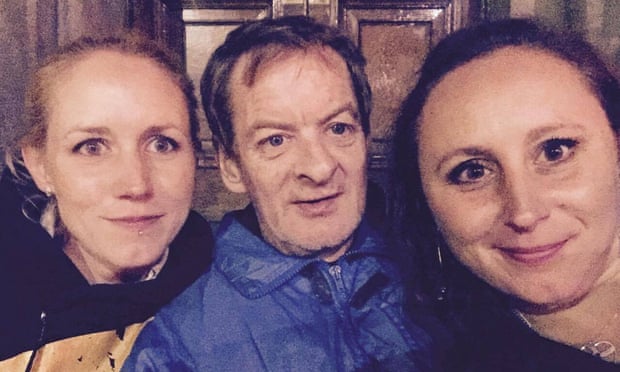
Annis Lindkvist, right, and her younger sister, Emma Åhlström, with Jimmy Fraser, a homeless Scot they invited for Christmas in Sweden. 

I have never been sure how to react to someone who is homeless, but I have learned smiling is better than walking past, head down.

Mother Teresa said to smile. A woman who runs an excellent Rhode Island homeless agency told me she doesn’t give anyone money but talks to people and tries to see if she can help with a referral or something to eat. A formerly homeless veteran told me he always talks to veterans and tells them where to find veterans services. Once he took in a stranger overnight. Some people will buy a sandwich or a cup of coffee.

Last week as I was talking to an employee of a refugee agency, I became curious about how he was led to his current work. He said, “One day I stopped walking past people.”

He didn’t initially look for refugee work, but he landed there after launching his personal outreach to homeless people and a subsequent stint in Americorps. He used to talk to people on the New York City streets, asked what they needed and delivered food, socks, and as many of their needs as he could.

So many good people out there showing kindness one person at a time!

This Guardian story about a Swedish tourist in Scotland who not only befriended a homeless man but invited him for Christmas with her family (and sent him airfare) is really over the top.

Libby Brooks writes, “A homeless man from Edinburgh has described the ‘incredible act of kindness’ of a tourist who invited him to spend Christmas at her family home in Sweden.

“Jimmy Fraser was begging on George Street in the city centre when Annis Lindkvist and her sister Emma, from Sagmyra in central Sweden, asked him for directions.

“They struck up a friendship and swapped numbers at the end of the trip, staying in touch by text before Lindkvist offered to pay for his flights so he could spend a week with her family over the festive period.

“Fraser, who became homeless following his divorce 13 years ago, said: ‘It’s weird, I know. I was begging on George Street and these two women came up to me and the next thing I knew I was in Sweden. People promise you things all the time on the street but they never materialise.

” ‘But I thought I’m going to go for it as it’s once in a lifetime. I couldn’t believe it anyway at first. People tell you “see you tomorrow, I’ll get you a drink” and then nothing happens. But this did happen, actually, so it was really weird.’

“The 54-year-old former security guard, who went to an ice hockey match, Christmas markets and midnight mass with his host’s family and friends, told the BBC News website: ‘It was a beautiful experience.’ …

“Lindkvist described her own doubts about issuing such an open invitation to a stranger. ‘We give money to charity every month but we have never done anything like this before,’ she said. ‘There were friends and family who thought I was really crazy, but I just opened my home to him and said everything that is ours was his too.’

“The 37-year-old, who works with dementia sufferers, said she had invited Fraser back to stay with the family again over the Easter break, and that he was ‘part of the family now.’ ”

More here.

Read Full Post »

Today, our anniversary, I’m remembering some of the novelties we encountered as we toured Scotland on our honeymoon.

For example, I found I really loved scotch eggs, having never had them before. I remember making them a few times in the deep-fat fryer when we got home. (FYI: they are hard-boiled eggs wrapped in sausage.)

Here’s a funny article by way of an environmentalist on twitter (@tveitdal) about a “scotch egg company” that “claims to have cracked the problem of eggshell waste.”

Sarah Shearman writes at inkl.com, “Leicester-based egg processing plant Just Egg hard boils and peels 1.5m eggs a week for snacks such as egg mayonnaise and Scotch eggs, creating mountains of shells to dispose of. It’s a dilemma the company’s owner, Pankaj Pancholi, has been keen to crack since he launched the business 14 years ago.

“At home, eggshells can easily be composted or sprinkled on flower beds as a slug deterrent or soil enhancer. But for industrial egg producers, shells have to be disposed of in landfill because the waste egg attached to them rots quickly, causing a smelly by-product.**

“It costs Pancholi around £50,000 a year to dispose of them, a significant sum for a company with [revenue] of £4.2m last year.

“In 2012, Pancholi teamed up with Prof Andy Abbott and scientists at Leicester University to find a cost-effective, sustainable way to recycle the shells.

“Eggshell is made of calcium carbonate, like chalk, with a hard-wearing, crystalline structure. Since chalk is often used as a filler to reinforce plastic, Abbott hatched a plan to do the same with eggshell powder.

“Abbott’s department set to work designing a plant to make this eggshell powder. Because Just Egg has to dispose of eggshells swiftly to avoid the rot, the eggshell processing plant was built as an extension to the existing factory, with the eggshells passing through on a conveyor belt to be processed.

“The eggshells are chopped up with blades and washed and treated with a water-based solution to remove any remaining egg protein. The egg membrane (the clear film lining the eggshell) is also retained, as the Leicester scientists are exploring potential uses for it, such as wound dressings. …

“Each egg produces about 15g of shell and the team has been stockpiling the powder, awaiting the first order. Abbott has been spreading the word about the product and says there has been interest from ‘hundreds’ of plastics companies.”

** Oh, my goodness. Here is where I remind you that in 7th grade I created an amazing egg-breaking machine with Joanna Pousette-Dart and left it in the science classroom, forgetting I needed to take it home. Rot was definitely an issue.

More here.

Photo: Dan Matthews
Just Egg boils and peels 1.5m eggs a week. It used to cost £50,000 a year to dispose of the shells. Now the company pulverizes the shells and expects to sell the powder to plastics companies.
 

Read Full Post »

You’ve heard of working vacations to learn about farm life and milking cows or to help Earthwatch study sea lions. A new and unusual vacation offering involves running a bookshop.

‘Literature lovers often dream about owning a bookshop ,” writes Jess Denham at The Independent, “and now, the opportunity is there if you’re willing to fork out £150 for the privilege.

“The Open Book shop in Scotland’s ‘national book town’ of Wigtown has been listed on room-letting website AirBnB offering wordy holidaymakers the chance to work a 40-hour week selling books and customising the store with their ‘own stamp.’ ”

“Local book experts will be on hand to train guests in the seaside town …

“Some ten guests have already hired the bookshop and apartment above, including an elderly couple fulfilling a lifelong ambition, two members of a band that writes and performs songs about books, a librarian from Oregon and a Dutch civil servant. … Guests are encouraged to blog about their experience while carrying out ‘all the normal duties of a bookseller’ …

“Independent authors are invited to sell their own books in the store and set up their own promotional displays.”

More here.

Photo: The Open Book
The Open Book store in Wigtown, Scotland, is opening its doors to holidaymakers.

Read Full Post »

Mary Ann is a creative person and a great source of blog ideas. She also remembers topics I’ve enjoyed in the past. For example, the stealth book artist in Scotland. She sent me word of the artist’s new accessibility.

The BBC reports, “An anonymous artist has been leaving delicate paper sculptures made from old books at locations in Edinburgh and around Scotland for more than three years.  The identity of the woman has remained secret despite the international attention that the book sculptures have received.

“BBC Scotland’s arts correspondent Pauline McLean conducted an interview with her — via email to maintain her anonymity.

“Question: Why did you start making the sculptures?

“Answer: The first book sculpture, a little tree for The Scottish Poetry Library, was made primarily as a response to library closures and cutbacks. But it was also as a bit of fun for the library staff who, throughout Scotland, the UK and much further afield, provide a service in straitened times — above and beyond. It was a poor attempt to illustrate the notion that a book is more than just a book — and a library is a special kind of building.

“It’s no secret that I would like everyone to have access to books, art, artifacts and the buildings that house them. Not just those with the money for a ticket. I think it’s true that the immediate way we can and do now access information has altered things. But it remains important to have expert help, to see things for real, to have buildings set aside that inspire and make expectations of us and that anyone can enter. …

“I like to think the sculptures have served their purpose in some small way, but I do worry that they overly draw attention to themselves as objects. My intention was never that they be viewed as artworks or even that they would last. They are, after all, made from clapped-out old books. The end for me though was in leaving them. Once a gift is given it is in the hands of another.” More here.

There are several good pictures of book sculptures at the BBC site. Suzanne’s Mom couldn’t resist the one below. It makes me nostalgic for the inspired ceramic tea cups of Anne Kraus.

Photo: Anonymous book sculptor
“Nothing beats a nice cup of tea (or coffee) and a really good book.”

Read Full Post »

Photo: PA/Owen Humphries
Murmuration of starlings over Gretna, Scotland

Starlings swarm in flash mobs over Scotland every November and February, and they don’t even need social media to remind them it’s time.

According to an article at the BBC, “Tens of thousands of the birds are regularly seen around this time of year near the Dumfries and Galloway town. It is one of the most famous locations for the natural spectacle, the reason for which is not definitively known.

“A survey of the birds across the UK is currently under way with members of the public urged to record sightings. The poll, conducted by the University of Gloucestershire and the Society of Biology, is the first of its kind and has already received more than 600 reports from Cornwall to John O’Groats.

“Dr Anne Goodenough, reader in applied ecology at Gloucestershire University, said: ‘One of the theories behind the murmurations is that it means they are safer from predators such as hawks and falcons.

” ‘Another theory could be they are signalling a large roost and it could be a way of attracting other birds to that area to build up a big flock as it would be warmer. It’s much warmer to roost as a big group rather than a smaller one and the murmurations can be as big as 100,000 birds.’ ”

More here. Don’t miss the other amazing photos at the BBC site.

YouTube video: DylanWinter@virgin.net

Read Full Post »

As usual, John has a pretty good idea of the kind of story that really floats my boat. Mysterious green balls washing up on the beaches of Australia, Anyone?

The Science Alert website reports that on the weekend of September 20, “thousands of peculiar green balls appeared on Dee Why Beach near Sydney in Australia. About 6 centimetres in diameter, these squishy little spheres are living organisms – seaweed balls known as ‘marimo’.

” ‘They’re actually a really unusual growth form of seaweed, because seaweeds mostly grow on the rocks but occasionally they get knocked off and rolled around in the ocean forming these beautiful little balls,’ Alistair Poore from the University of New South Wales explained to 7News.’It’s quite an unusual phenomenon, it’s only been seen a handful of times around the world.’

“First discovered in the 1820s by Austrian botanist Anton Eleutherius Sauter, and named by Japanese botanist Tatsuhiko Kawakami in 1898 (‘marimo’ roughly means ‘bouncy play ball’ in Japanese), colonies of these little balls have only been seen off the coast of Iceland, Scotland, Japan, Estonia and now Australia.”

See videos at Science Alert, here.

More on the green balls at Wikipedia and at Smithsonian.

Read Full Post »

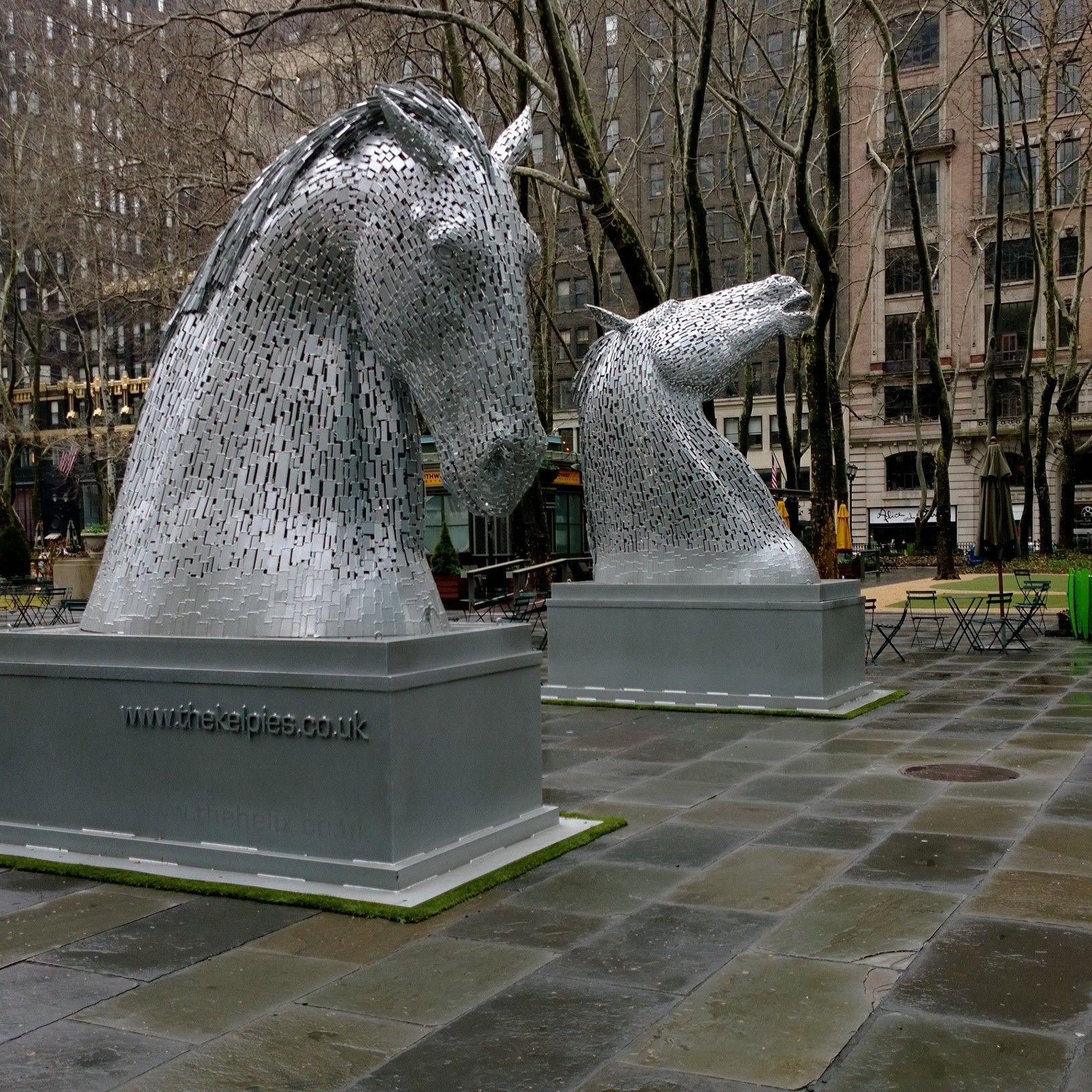
The last tidbit from my recent New York City trip is about the Kelpies on loan in Bryant Park, near the New York Public Library.

Kelpies are water spirits of Scottish folklore, typically taking the form of a horse. Artist Andy Scott was inspired by the legends to create giant ones for Helix Park in Falkirk, Scotland.

The ones in New York are smaller maquettes but still pretty huge.

The artist writes that he came up with an idea eight years ago about “mystical water-borne equine creatures. …

“Since then it has evolved dramatically and in the process the ethos and function has shifted from the original concept. Falkirk was my father’s home town and that inherited link to the town has been one of my driving inspirations. A sense of deep personal legacy has informed my thinking from the outset …

“The mythological associations behind the original brief have been absorbed by other sources of inspiration in the creative processes, and the ancient ethereal water spirits have been forged into engineered monuments. The Kelpies are modeled on heavy horses (two Clydesdales of Glasgow City Council actually served as models in the process), and it is this theme of working horses which captured my imagination and drove the project.”

The website adds that the Kelpies in New York City “were installed by Andy and his colleague Simon Chambers, with the assistance of the American Scottish Foundation, the Bryant Park Corporation, Mariano Brothers freight & cranes, Synlawn matting and the New York City Department of Parks & Recreation. Thanks to Creative Scotland for their funding assistance towards the costs of the transport and install.”

You really have to check out Scott’s website. The full-size sculptures are unbelievable. Click here.

Kelpies-Bryant-Park

Read Full Post »

In the UK, retirees are taking up ballet.

Emma Ailes writes for BBC Scotland, “In a locker room at Scottish Ballet, a group of dancers are lacing up their ballet shoes. Only one thing marks them out from the other dancers here. These dancers are all in their 60s and 70s.

“Today, they are rehearsing ‘Swan Lake.’

“Among them is Alicia Steele. She danced when she was young. Now, nearly 80, she’s back.

” ‘I went to keep-fit classes, but I found them a bit boring,’ she says. ‘And I love the music with the piano. I just love it and it makes you feel a bit young again. It doesn’t make you look young, but it makes you feel young inside.’

“There’s been a 70% jump in the number of adult dancers signing up for classes in recent years, according to the Royal Academy of Dance. Some, like Alicia, danced when they were young. Others are complete beginners.

“Their oldest ballerina is 102.” More.

I took ballet both as a child and as an adult. But for now, I am sticking with tai chi chuan. Today the teacher had me learning complicated new moves with the advanced students. “You deserve it,” he said to me.

I’m not sure how to take that.

Photo: BBC Scotland

Read Full Post »

Photo: Getty Images

I have been as keen as anyone to talk about the arts in terms of their economic contributions to communities. (You have to defend the arts in the language people understand.) But in the end, a focus on economic return is limiting. There are other values on the spectrum from “art for art’s sake” to “art for the economy’s sake.”

How about art for wonder’s sake, joy’s sake, self-expression’s sake, mystery’s sake — for the sake of just seeing what comes out and where it leads?

Over in Scotland, Tiffany Jenkins of The Scotsman is having a fit about Maria Miller, the Scottish Secretary of State for Culture, Media and Sport (Sport?!), who expressed her own take on the arts in a recent speech.

Says Jenkins, “The speech began with the right noises – ‘culture educates, entertains and it enriches’ – but quickly took a wrong turn, concentrating on what culture can ‘deliver,’ specifically for the economy, using sentences such as: ‘It allows us to build international relationships, forging a foundation for the trade deals of tomorrow.’ ”

Uh-oh.

“It matters,” writes Jenkins, “because of what happened with the funding body Creative Scotland, where there was a major negative reaction … in part due to an agenda that instructed the arts to be about the economy …

“To her credit Fiona Hyslop, Cabinet secretary for culture and external affairs for Scotland, was reported on Twitter responding to Miller’s speech stating: ‘The Scottish Government does not see arts and culture as a commodity.’ …

“That the arts are central to the economy is not an isolated idea, or a new one. … [But] it is a philistine approach that misses the value and point of culture. It is true that the Edinburgh festivals, for example, bring a strong financial return. … But even in this case, the financial return is not the best thing about the festivals – or why people come back every year to perform or to watch. They do it because they love it, enjoy it and are driven to participate in something meaningful. …

“Let us not forget the economic climate in which the Arts Council was established. This was a period in the 1940s, after a devastating war, when Britain was in a dire financial situation. The funding body was set up not to use the arts to get the country out of the economic crisis, in the blunt instrumental terms they are discussed today, but to stimulate ‘the best’ work.

“Economist John Maynard Keynes, the council’s first chairman, wanted to bring forth a ‘creative renaissance’ that was artist led, and acted at ‘arm’s length’ from the government, a vision that I would have no trouble with if it were realized today.” But it isn’t, complains Jenkins. Many of her concerns are pretty universal.  More.

It’s an argument we will never hear the end of, having been debated in every generation. I am coming down firmly on the side of “yes, and…”

In other words, the arts can be great for the economy, but that is just the tiniest part of why they are great.

Read Full Post »

Sitting high up in the nosebleed gallery at the Shubert Theater (aided by great, great Aunt Julia’s opera glasses), we watched the Scottish version of Wagner‘s Flying Dutchman today.

“A sea captain doomed by a curse to an existence of eternal wandering, a yearning heroine desperate to escape her restricting world – set against the uncontrolled violence of the sea.” Thus the Boston Lyric Opera. More.

GiltCity.com had this take: “With her free spirit constrained by the rigid confines of society, one woman yearns for escape. … Taking off on an adventure of a lifetime, with the mercurial sea as violent backdrop, she encounters a captain doomed to wander the endless waters for eternity.”

Enjoyed the production, said to be the first in America using the original version of the opera, which Wagner kept tinkering with over his life.  The sets were striking — spare suggestions of ships like bleachers, bathed in blood-red light, and a movie of raging seas across the whole back wall. I liked the psychological take, with Senta [Allison Oakes] responding to yarns about a Flying Dutchman [Alfred Walker] at three different ages (and portrayed by three different performers).

The opera was sung in German, with English on two video monitors.

Read Full Post »

When people click “like” at one of my entries, I go look at their site. Often I find that we share interests. Art is one interest.

Katie J. Anderson clicked “like” for the post “Art in the Exurbs.” I think she is an artist in Scotland.

Her WordPress blog, here, led me further, to an artists’ cooperative blog where she volunteers time. The site is the Commonty, which in Scottish law is a “common; a piece of land in which two or more persons have a common right.”

Following Ariadne’s thread from one blog to another can confuse a person. Thus, the Commonty took me to “The Stove,” which the site says emphatically is not the Commonty although TheStove’s home page also seems to be the Commonty’s.

Perhaps confusion is a hazard of a blog run by many people. I dug some more and found this: “an artists collective from SouthWest Scotland, The Stove is occupying a 3 storey building in the heart of Dumfries as the HQ for an adventure that asks useful questions about the role of a southern regional capital in contemporary Scotland.”

Which doesn’t sound that different from this: “The Commonty was formed, and is run entirely, by working creative people on a voluntary basis – we have nobody’s remit or priorities except our own.

“We are committed to the vision of Dumfries and Galloway as a region whose character is significantly shaped by the creative people and projects that are based here — we see a vital spark in the interconnections between our environment and culture, making this the place that we want to live, and a place that we are proud of.”

In a recent post, the Commonty notes with pride: “The Theatre Royal, Lochside Theatre, and The Stove have received funding from Creative Scotland as part of a national programme which helps organisations carry out refurbishments and purchase equipment.”

Does someone from Dumfries or Galloway want to tell me more?

Photograph of Lochside Theatre at http://thecommonty.blogspot.com/

Read Full Post »

Who came up with the game of golf first? Wikipedia has so many answers that it amounts to no answer, but let’s give it a shot.

This entry is for my dentist, who loves golf and who was kind enough to say that Suzanne’s Mom’s Blog makes him think of floating down a peaceful stream after all the anxious hammering from the media.

“A golf-like game is recorded as taking place on 26 February 1297, in the Netherlands, in a city called Loenen aan de Vecht, where the Dutch played a game with a stick and leather ball. The winner was whoever hit the ball with the least number of strokes into a target several hundred yards away. Some scholars argue that this game of putting a small ball in a hole in the ground using golf clubs was also played in 17th-century Netherlands and that this predates the game in Scotland. There are also other reports of earlier accounts of a golf-like game from continental Europe.

“In April 2005, new evidence re-invigorated the debate concerning the origins of golf. Recent evidence unearthed by Prof. Ling Hongling of Lanzhou University suggests that a game similar to modern-day golf was played in China since Southern Tang Dynasty, 500 years before golf was first mentioned in Scotland.

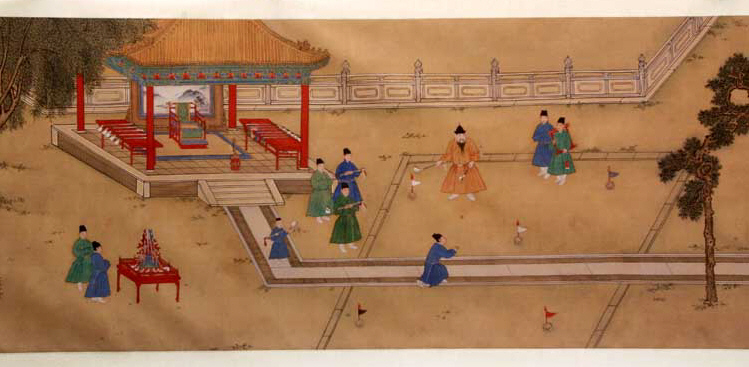
Dōngxuān Records (Chinese: 東軒錄) from the Song Dynasty (960–1279) describes a game called chuíwán (捶丸) and also includes drawings of the game.It was played with 10 clubs including a cuanbang, pubang, and shaobang, which are comparable to a driver, two-wood, and three-wood. Clubs were inlaid with jade and gold, suggesting chuíwán was for the wealthy. Chinese archive includes references to a Southern Tang official who asked his daughter to dig holes as a target. Ling suggested chuíwán was exported to Europe and then Scotland by Mongolian travelers in the late Middle Ages.

“The modern game of golf is generally considered to be a Scottish invention. A spokesman for the Royal and Ancient Golf Club of St. Andrews, one of the oldest Scottish golf organizations, said ‘Stick and ball games have been around for many centuries, but golf as we know it today, played over 18 holes, clearly originated in Scotland.’ ” More.

The Ming emperor in the picture below seems more like he’s playing croquet. I’m not sure how today’s golfers would react to the idea that their game started as croquet.

Image:  Ming_Emperor_Xuande_playing_Golf.jpg

Read Full Post »

I’ve written several posts on the threat to languages that have few speakers — and on the linguistic preservationists racing against time. (Here, for example.)

Why does language extinction matter, you ask? Because language embodies so much about culture. We are poorer in being ignorant of how different people live and in having a chance to learn taken away from us.

Now the last speaker of a rare Scots dialect is gone. Writes the Associated Press, “In a remote fishing town on the tip of Scotland’s Black Isle, the last native speaker of the Cromarty dialect has passed away, taking with him a little fragment of the English linguistic mosaic.

“Academics said [October 3] that Bobby Hogg, who was 92 when he died … was the last person fluent in the dialect once common to the seaside town of Cromarty, 175 miles (280 kilometers) north of Edinburgh.

“ ‘I think that’s a terrible thing,’ said Robert Millar, a linguist at the University of Aberdeen in northern Scotland. ‘The more diversity in terms of nature we have, the healthier we are. It’s the same with language.’ …

“It’s part of a relentless trend toward standardization which has driven many regional dialects and local languages into oblivion. Linguists often debate how to define and differentiate the world’s many dialects, but most agree that urbanization, compulsory education and mass media have conspired to iron out many of the kinks that make rural speech unique.” More.

Photograph: Am Baile-High Life Highland/Associated Press.
Bobby Hogg, who recently passed away aged 92.

Read Full Post »

Asakiyume has alerted me to a great story about an anonymous library patron in Scotland who creates sculpture from old books and deposits them in libraries by stealth. The artist makes reference in his (her?) sculptures to Scottish mystery writer Ian Rankin and dragons and all sorts of literary things. You will flip over the pictures here.

Asakiyume says she likes the quotations that the mystery artist leaves with the sculptures: “I liked ‘Libraries are expensive,’ corrected to ‘Libraries are expansive,’ and also the quote from Robert Owen … (founder of some utopian communities) … ‘No infant has the power of deciding … by what circumstances (they) shall be surrounded.’ ”

The messages remind me of the mysterious tea cups of Anne Kraus, which I described here.

Now although Asakiyume knew I would love the book art, she may not have known that I have a family reputation for stealth projects, like secretly leaving a small Zimbabwean soapstone sculpture of parents and baby in John’s house after Meran gave birth.

Recently, I was telling Erik about a few of my escapades, and he got a look on his face suggesting that he was a little worried about the family he had married into.

When I was on the publicity committee for a local theater producing a musical about George Seurat, I purchased Seurat greeting cards and left them in stores’ card racks around town. They got sold, but the sales staff would have had to wing the price as there was no price on them.

Then there was the year that I sent a series of postcards from different cities under different names to an ice cream shop and in each card suggested a type of frozen dessert the shop should carry. Every card had a different reason why customers might want that dessert.

It worked, and the shop must have made money off the dessert as they stocked it for years afterward.

Photo: ThisCentralStation.com

Read Full Post »

In case you just tuned in, this blog was started at the invitation of my daughter, who is the founder of the birthstone-jewelry company Luna & Stella. Sometimes I blog about the jewelry, but Suzanne told me to write about whatever interests me. Already a customer who was previously wary of online purchasing found the blog and wrote Suzanne that it helped her decide that Luna & Stella was good people.

The blog is currently housed at WordPress, which makes life easy for a neophyte like me. One thing that is fun at WordPress is clicking on posts from the other bloggers, posts that are on the Freshly Pressed page or found by clicking on a key word at the Tags page.

Today I got quite interested in an entry from a WordPress blogger in northern England who calls herself Heather Uphillanddowndale. She shows her photographs of a lovely Scottish island and talks about its fight against a major commercial fish farm.

I used to think fish farms made a lot of sense, but lately I have read about possible environmental damage and overcrowding that can spread disease to wild fish.

Heather quotes from a statement by island residents: “Highland Council has recently received an initial application to site a fish farm off the east coast of Eigg, north of Kildonan. The site identified covers an area extending to 20ha (this equates to 28 football pitches) & would consist of 14 x 30m diameter cages which would be serviced by a 10m x 10m permanently sited barge (powered by diesel generator).

“The community has considered this proposal at length. The outcome of the resulting ballot which had an 86% turnout was 97% against the development.

“Eigg lies within the Small Isles National Scenic Area. A large fish farm would have a considerable negative impact on the approach to the island and could also impact negatively on the peace and quiet that visitors seek when they come to the island, as well as on the quality of life of nearby residents.” Read more at Uphilldowndale.

Read Full Post »

« Newer Posts - Older Posts »