Feeds:
Posts
Comments

Posts Tagged ‘signing’

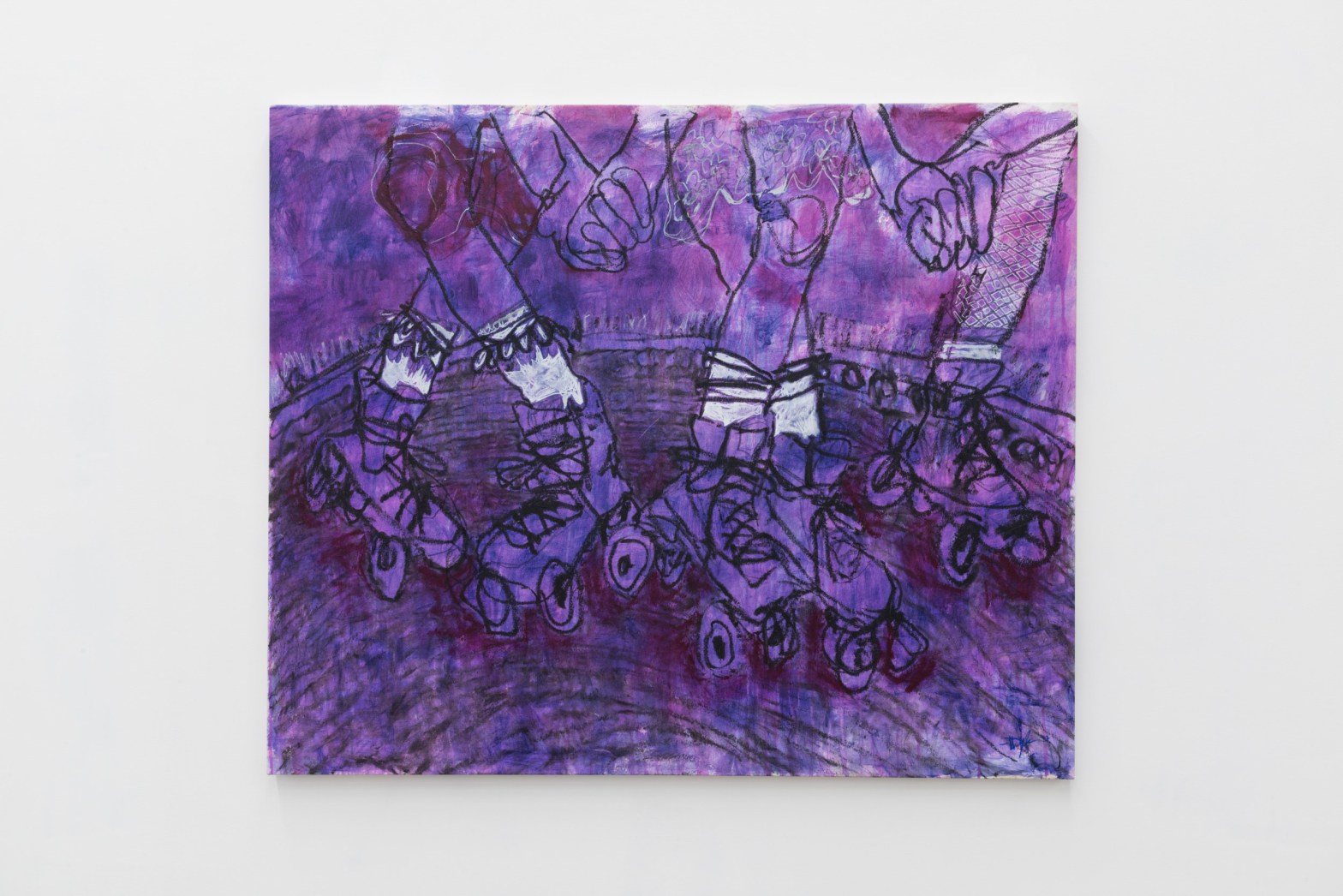
Photo: Luana Rigolli/T293 Gallery).
Art by Dylan Rose Rheingold, “Hot Skates” (2022), oil, acrylic, paint pen on canvas. Although growing numbers of artists question the value of signing their works, Rheingold is one who has chosen to sign.

When my mother died, there were decisions to be made about several works by our neighbor, the Abstract Expressionist Richard Pousette-Dart. For most of his career he rebelled against the custom of signing work. But toward the end of his life, he came around to the idea that in the art market, his family and friends needed to have his signature. He offered to sign our paintings. We sold some and kept some. The photographs and brass jewelry were never signed.

Anoushka Bhalla wrote recently at Hyperallergic that the issue of signing keeps coming back in the art world.

“It all began during the early Renaissance when a young Raphael Santi forwent the long-held tradition of co-operative art making under guild systems to autograph his first painting, ‘The Mystical Marriage of St. Catherine.’

“While Raphael was modest in breaking long-established customs, obscuring his signature within decorations behind a Virgin Mary figure, his male successors centuries down the line would not remain as bashful. The signatures of Picasso and Keith Haring are far more familiar than that of, say, Helen Frankenthaler. …

“Signed artworks by male artists fetch astounding prices in the secondary market as compared to their female counterparts. A recent study states that ‘For every £1 a male artist earns for his work, a woman earns a mere 10p.’ The same study also states that ‘while the value of a work by a man rises if he has signed it, the value of a work by a woman falls if she has signed it, as if it has somehow been tainted by her gender.’ Female artists have long been conscious of this gender disparity, with some feeling paralyzed against the market and choosing to forgo their signatures to make their works more ‘collectible.’ Are these artists signing away their autonomy too?

“I spoke to Baseera Khan about these troubling statistics. A femme artist of color, they were the subject of a solo exhibition at the Brooklyn Museum in 2021. ‘No, I don’t sign my works. I think it’s an old tradition,’ they declare. ‘I don’t think I’m valued because of my gender, because I’m a femme artist, quite not as much as the male artists — and that’s a fight.’ …

“Artists Julie Torres and Ellen Letcher, who operate LABspace, an artist-run gallery in Hillsdale, New York, often find themselves in awkward positions, having to ward off collectors who demand signatures from their artists and sometimes even return works for them to be signed. But for others, like Lucia Hierro, whose work was recently acquired by the Guggenheim Museum, and who often does not sign her pieces, says she will stand her ground. There is a finality to signatures, she says, which she dislikes.

“[Although Xayvier Haughton] makes art that is difficult to collect, he feels defenseless in the face of powerful collectors who make sure to somehow obtain his signature before acquisition. He acknowledges this as a conscious decision on his part. Installations are notoriously difficult to collect, and that in itself is an anti-market statement. … While Haughton wants to adhere to his principles, he doesn’t want to be blacklisted in the art world — which he feels is the fate of artists who defy the desires of collectors. In this fickle art-world bubble, he’s attempting to hold onto his autonomy by forgoing his signature.

“But some disagree with this sentiment. Bhasha Chakrabarti, also an emerging artist, who works in painting, sculptures and installations, is a skeptic. ‘I find the idea of making installation with the motivation of evading the market to be disingenuous…. If you make art and are functioning within the gallery system, you’re not evading the art world,’ even though, she adds, she feels suspicious of the art world’s deep stake in capitalism. When I mention the Eurocentric history of asserting ownership via signatures on artwork, she counters, citing Sufi mystic poets who claimed authorship after each recital. …

“Artist Chiffon Thomas approaches the dilemma more philosophically. Thomas, whose solo show Staircase to the Rose Window was on view at PPOW Gallery in Tribeca last year. … Over time, he explains, he stopped signing his works and acquired an existential approach to art-making. He realized he wanted to capture a sense of universality in his art, to the extent that he grew uncomfortable using his childhood, his family, or any personal signifiers. …

“But perhaps the most compelling response comes from a young artist, Dylan Rose Rheingold. As more painters shy away from signing their works on the front of their canvases, Rheingold realizes this is an empowering act as a woman. Nevertheless, she will occasionally sign as ‘Dylan,’ a traditional male name, although she also uses the more feminine ‘Dylan Rose,’ and lately she is using her full name, Dylan Rose Rheingold, boldly asserting ownership over her art.

“Her resolve strengthens when she explains passionately a recent encounter she had with a ‘big collector who owns a big gallery in New York. … When I met him, he told me that I should drop my middle name because my work would be a lot more valuable. People would not assume I’m a woman.’ She countered with ‘I’m happy to take my chances.’ ”

More at Hyperallergic, here. No firewall but memberships are encouraged.

Read Full Post »

I wanted to share something from the Christian Science Monitor editor about about a reporter who died recently.

“David Clark Scott traveled the world: He roamed throughout Latin America as the Mexico City bureau chief and reached into Southeast Asia as Australia bureau chief. He supported and counseled dozens of Monitor reporters as international editor.

“When he wrote columns, his favorite stories were of people taking the time to help one another. He even produced an entire podcast.

In these times, when everyone is fixated on what went wrong, it’s important to look for what is going right, and sometimes, frankly, it needs to be at the top of the page.

“Dave passed on this week. On his last day of work, he pitched three stories, any one of which would have made a lovely column. But, he told me, he’d already ‘put a call in to the principal at the Nansemond Parkway Elementary School cuz, well, that’s the intro that tugs at my heart.’

“It did mine, too, so I wanted to share it with you.

“The Nansemond students in Suffolk, Virginia, have been learning a new language: sign language, so they can communicate with food nutrition service associate Leisa Duckwall, who is deaf. It started with a fourth grade teacher, Kari Maskelony, who has deaf family members and started teaching her class. This month it spread when Principal Janet Wright-Davis decided the whole school would learn a new sign every week in honor of Disabilities Awareness Month.

” ‘I don’t think [the students] saw it as a disability,’ Dr. Wright-Davis told me over the phone. It was just a new way to communicate. Her biggest surprise? ‘How much they want to learn it.’ Their favorite sign: pizza.

“The difference in the cafeteria is palpable, she says. Instead of pointing, as they used to, the students sign their requests. ‘She’s smiling and they’re smiling, and it’s just a different environment,’ says Dr. Wright-Davis.

“Ms. Duckwall has come to morning announcements to teach everyone new signs and has signed that day’s menu. Dr. Wright-Davis gets stopped in the hall by students signing good morning and wanting to show her what they’ve learned. Instead of stopping at the end of this month, the students are going to keep learning all year.

“The school had its Trunk or Treat event Thursday evening, and the children were signing as they celebrated Halloween. ‘One gentleman came out, and he was signing,’ Dr. Wright-Davis says. It made her realize the lessons wouldn’t be confined to the lunchroom or even the school. ‘They’re going to encounter someone, even if it’s just to say good morning, or please, or thank you. … Now they know a little bit more to show some gratitude.’

“There’s plenty to learn from Nansemond: Show some gratitude, look for ways to make people feel welcome, and seek out kindness and celebrate it when you find it. Dave always did.”

See the Monitor, here, and more at WAVY television, here. No firewalls.

Read Full Post »

Here’s a new idea. A couple of young entrepreneurs have found a way to convert sign language into audible speech with their prize-winning electronic gloves.

National Public Radio has the story.

“For years, inventors have been trying to convert some sign language words and letters into text and speech. Now a pair of University of Washington undergraduates have created gloves called SignAloud. Sensors attached to the gloves measure hand position and movement, and data is sent to a computer via Bluetooth and is then converted into spoken word and text.

“Theirs is one of seven inventions recently awarded a Lemelson-MIT Student Prize, with awards ranging from $10,000 to $15,000.

“Inventors Navid Azodi and Thomas Pryor, both college sophomores, say the gloves will help create a communication bridge between deaf and hearing communities. The gloves, they say, will help deaf people better communicate with the rest of the world without changing the way they already interact with each other.

“However, the invention has been met with criticism that the bridge they want to create goes only one way — and it’s not necessarily one the deaf community has been clamoring for. …

“Azodi says he and Pryor are moving beyond their prototype and are working closer with those who use American Sign Language to develop new versions. They’re also working on better understanding ASL, which is more than just hand movements; it also uses facial expressions and body language to convey meaning.” Read more.

I don’t know much about the culture of the deaf community, but I do remember reading about resistance to cochlear implants a few years ago. It’s hard for people who can hear to understand that some people really don’t mind deafness and prefer their own ways of dealing with the world. But kudos to all inventors anyway, especially young ones open to continuous revision!

Photo: Conrado Tapado/Univ of Washington, CoMotion
SignAloud gloves translate sign language into text and speech.

Read Full Post »

A while back, I wrote about the BBC National Orchestra of Wales launching a series of concerts to bring the joy of music to deaf children and adults, here.

I’ve been thinking about that lately. If you don’t love Christmas music, you might say that people who have hearing loss are better off at this time of year. But I like that there are so many initiatives to help the deaf enjoy Christmas music and other sorts of music.

Did you see this Clarke Canfield story in the Boston Globe? He writes about a sign language interpreter of lyrics who is adding a whole new level of fun to rock music — delighting the hearing and nonhearing alike.

“Teaming American Sign Language with dance moves and body language, [Holly Maniatty] brings musical performances alive for those who can’t hear,”  he writes, “Her clients are a who’s who of rock, pop, and hip-hop: Bruce Springsteen, Eminem, Mumford and Sons, Jay-Z, Billy Joel, Marilyn Manson, U2, Beastie Boys, and Wu-Tang Clan, to name a few.

“Along the way, videos of her fast-motion, helter-skelter signing have become popular online.

“There’s the video of Springsteen jumping down from the stage at the New Orleans Jazz Fest and joining Maniatty and another interpreter. There, he dances and signs to ‘’Dancing in the Dark.’’

‘‘ ‘Deaf people were commenting, “Oh, the Boss knows he has deaf fans. That’s awesome,’’ ‘’ she said. ‘When artists connect with their interpreters, they also connect with their deaf fans.’

“In another video, rap artist Killer Mike approaches Maniatty in front of the stage after noticing her animated signing.

‘‘I’ve never seen that before .”… At a Wu-Tang performance, Method Man took notice of her signing, came down from the stage, and joined her.”

Read all about it here. See her dancing with Bruce Springsteen here.

 Photo: Robert F. Bukaty/Associated Press

Read Full Post »

The holiday concert last Saturday deserves its own post.

I learned about the Melrose Symphony Orchestra, the oldest continuous volunteer orchestra in the country, because my friend Alden began playing the oboe there a year or so ago and loves it. Saturday was the first time we got to a performance, and we were amazed by the whole scene.

Memorial Hall, remarkable for its size and its caryatid-supported honorary box, must have had a thousand people in it. It seemed like everyone of every age in Melrose had come, and a look at the program suggested that every business in town was a supporter.

The website says that “the mission of the Melrose Symphony is to give the citizens of Melrose and surrounding area an opportunity to participate in the joy of music.”

The conductor, Yoichi Udagawa, is determined to make classical music fun and accessible to all. He is not only an excellent musician but a real showman, drawing applause from audience members who have attended before as soon as he said he was going to tell a joke.

Alden told us the orchestra provides scholarships for high school students who often join up again after college. And he explained that the kids who were walking around before the performance and in the intermissions selling tickets were raising money by giving audience members a chance to conduct the last number, a jingle bell sing-along.

We also had music from Grieg and Vaughn Williams, so it wasn’t 100% holiday. But the guest star, Renese King, sang Gospel music with two talented nieces, a backup group, and a lovely young woman who danced sign language — and that really got everyone in the spirit of the season.

I have to say, I have lived in New England 30 years and have never seen a whole community rally around a cultural institution to this extent. Melrose must have a secret formula. I’d like to know what’s in the water.

Photograph: Melrose Symphony Orchestra

Read Full Post »