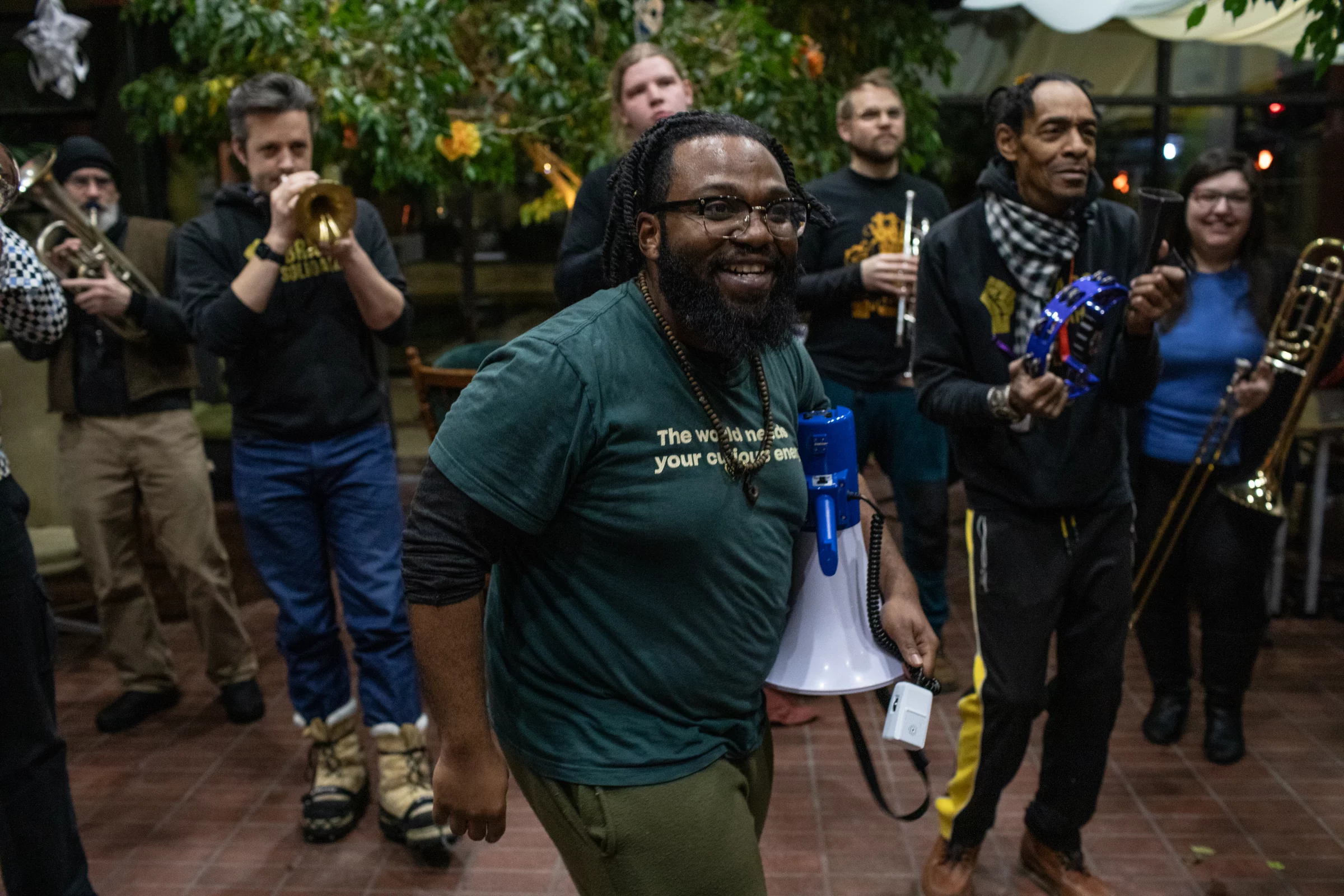
Photo: Erin Trieb for NPR.
Alsa Bruno (center) sings with Brass Solidarity, a band founded in 2021 in response to the killing of George Floyd. Above, you see them practicing at a community center in Minneapolis, Minnesota, Jan. 19, 2026.
You have probably noticed how much music is in the air around Minneapolis these days: songs of love, agape, hope, unity, and resistance. Suzanne sent me the one that Bruce Springsteen wrote, which is brand new, but some of the songs go back to the civil rights movement of the 1960s, to slave songs, folk music, and gospel.
Recently on Instagram I heard Brass Solidarity play “Don’t Let Nobody Turn You ‘Round,” and I thought, “Oh, I know that one! We used to sing it in the ’60s!”
Brass Solidarity has been introducing both hope and a joyful sense of connection into government-instigated chaos in Minneapolis. So I went online to learn more about them. In a 2023 report from Minnesota Public Radio, here, Minneapolis teacher and band member Natalie Peterson observed, “there’s a lot of work that can be done through energizing people and just bringing a joyful energy to something that can be incredibly hard.”
Last week, Kat Lonsdorf and Megan Lim added more at NPR: “Raycurt Johnson strolls into a local theater in south Minneapolis, shaking off the cold. He’s carrying a tambourine in one hand and a bullhorn in the other.
” ‘I was born in the civil rights era, and I’m still doing that,’ the 65-year-old says with a laugh.
“Around him, other musicians unpack their instruments, mostly brass: tubas, trombones, trumpets. Together they make up a community band called Brass Solidarity, formed in the aftermath of the 2020 murder of Minneapolis resident George Floyd by police officer Derek Chauvin. … The band plays once a week in George Floyd Square, where the killing occurred. When Renee Macklin Good was killed by a federal immigration agent earlier this month just blocks from there, the band started playing music in her memory as well. …
“The following week, Brass Solidarity was at Good’s memorial site, playing for people gathered there. ‘It was really interesting because there was a lot of mournfulness coming in, but people were rocking with us, and jamming with us,’ says Daniel Goldschmidt, another member of the band, who plays the melodica. …
“Since then, Brass Solidarity has turned out for several anti-ICE protests, and updated their repertoire a bit to include critical lyrics about ICE and other federal agencies. Goldschmidt, a practicing music therapist, says the music isn’t just about bringing the mood up in an otherwise depressing environment – it also helps calm people down, at a time when many are angry. Which is especially helpful [amid threats] to deploy the military to Minneapolis.
” ‘Street band music has the ability to bring down the temperature in spicy situations on the street during protests,’ Goldschmidt says.
“The band has been playing even as the temperatures have hovered well-below freezing. … ‘[But] the horns lock up. Someone’s here with a wooden clarinet right now. That’s not gonna work when it’s cold,’ says Alsa Bruno, a singer with the band. ‘And yet, we show up.’
“In recent days, the band has been meeting and playing indoors, as the weather has dropped into the negative single digits. But members are still showing up at outdoor events, banging drums or singing into bullhorns.
” ‘This is not a moment for us to give in to insecurity. It’s actually the moment that we get to stand together in the cold, knowing we’re all cold, being arm in arm, knowing that this weather is just weather,’ says Bruno. ‘It’s temporary. We’re forever.’ “
Finally, in case you missed it: the spirit of folk singer Woody Guthrie has returned, with Resistance Revival Chorus belting out his song “All You Fascists Bound To Lose.” In fact, you may be hearing other Guthrie anthems again, not just “This Land Is My Land.” There’s another one mourning Mexican migrants who died being deported. We are relearning from the singer who was ahead of his time that eternal vigilance is the price of liberty.
See the 2025 PBS report on the Guthrie revival, here.
Please add music that speaks to you just now.






 Suzanne's Mom's Blog