Feeds:
Posts
Comments

Posts Tagged ‘sustainability’

Photo: Pete Norton/Getty Images
Reuben Reid (front) of the Forest Green Rovers in England went fully vegan after the team’s owner introduced healthful food. He says it’s made a huge difference in his life.

Even after the retirement of founding host Bill Littlefield, the WBUR show Only a Game continues to have stories that appeal to sports lovers and lay people alike. I got a kick out of this one about England’s vegan soccer team.

Gary Waleik was the reporter.

“The menu at sports events has traditionally been a bit limited … and unhealthy. Especially at soccer games in England.

” ‘On a match day, you’re looking at a lot of sausages, burgers, bacon sandwiches. Quick and easy fried food,’ says Forest Green Rovers striker Reuben Reid. His team is broadening its menu with healthier fare. But that’s just one part of a much larger mission.

“In 2010, Forest Green Rovers, then a fifth-tier football club in Nailsworth, England, was in financial trouble. Dale Vince, who loved the sport as a kid, was approached by the team.

” ‘They said they needed a little bit of help to get through the summer,’ Vince says. ‘And I thought it would be a nice thing to do — because we could, so we should. But within a couple of months, it was clear that they needed much more than just a little bit of money.

” ‘And they said to me, “You really need to be the Chairman.” And I said, “I really don’t. I’ve got so much else to do.” But I then faced the choice — if I walked away, they would fold.’

“It was heady stuff for a guy who, two decades before, was living a hermit’s life on a hill in England’s bucolic Cotswolds region.

” ‘I had an old U.S. Air Force radar trailer that I rescued from a scrap yard and converted into a home,’ Vince says.

“In 1991, he was traveling in Cornwall. And something caught his eye.

” ‘It was England’s first modern, proper wind farm,’ Vince says. … That inspired him to build his own windmill farm, beginning in 1996. He called his new company Ecotricity. It was a big risk.

” ‘When I got started, renewable energy powered about 2 percent of Britain,’ Vince says. ‘Last year, it was 30 percent. And we’ve grown to be a company of about 700 people supplying about 200,000 customers.’ …

” ‘I saw the opportunity to use football as a new channel to speak to a new audience of people about sustainability,’ Vince says. ‘It’s still a football club, but it’s become something else, as well.’ …

” ‘We cut red meat out of the menu straight away for the players. We did it across the whole ground at the same time, so staff and fans and visitors as well. And then we took a series of other steps over the next couple of years toward full-on veganism.’

“The team dropped all meat, fish and dairy. By 2015, Dale Vince was the Chairman of the world’s first vegan sports team.

‘There were people at the time that said, “You’re gonna kill the club. Nobody’s gonna eat it. This kinda stuff,’ Vince remembers.”

Read more here.

Read Full Post »

Photo: Paige Pfleger/The World
Puerto Rican farmer Daniella Rodríguez Besosa says Hurricane Maria “was also a call to action. Nobody else is going to help us. We need to help ourselves.”

Americans expect and deserve government help when there is a natural disaster, and often they get it. But Puerto Rico was pretty much out of sight, out of mind after Hurricane Maria. I do know someone who went there to help with logistics as part of a Federal Emergency Management team, but I also know several someones who lost everything and came to the mainland with their children.

Puerto Ricans who stayed behind have been managing as best they can. I was impressed with Paige Pfleger’s story at Public Radio International (PRI) about women farmers working together to build resilience.

“High in the mountains of Puerto Rico,” Pfleger writes, “a group of women struggles to keep their balance as they drive pickaxes deep into the earth of a hillside guava orchard. They’re digging a narrow trench called a swale on the steep terrain of this 7-acre farm. It’s a low-cost, low-impact way to retain rain water and reduce erosion in a place where both can be a challenge.

“With a swale ‘you end up storing most of your water in the soil itself, so the plants can access it whenever they need it,’ said Daniella Rodríguez Besosa, who has her own farm nearby. Besosa is part of a group called the Circuito Agroecológico Aiboniteño — all farmers, mostly women — who’ve been working together since Hurricane Maria hit Puerto Rico in 2017 to help each other’s farms recover and become more sustainable

Maria ‘was an eye-opener for a lot of people,’ Besosa said. ‘It was also a call to action. Nobody else is going to help us; we need to help ourselves.’

“Farms in Puerto Rico were devastated during Hurricane Maria. It’s been estimated that 80 percent of the crops on the island were destroyed, and $1.8 billion of damage was done to agricultural infrastructure.

“ ‘The best part from this hurricane crisis was this, that we get to organize to help each other recover,’ said Janette Gavillan, the owner of the guava orchard the Circuito is working on.

“Gavillan is a retired chemistry professor and is relatively new to farming. But she says working with the Circuito has taught her ways to be more sustainable. …

“Since Maria, the Circuito’s members have come to see sustainability as synonymous with resilience and independence. They hope that if they’re able to rely only on themselves, they’ll be better prepared for the next big storm, or at least be better able to recover. …

“A few miles from Gavillan’s farm, Jessica Collazo works a small plot dotted with baby chicks and thin beds of fruits and vegetables. … Collazo and her husband support their family by selling their produce at local markets, but she says after Maria, they had to start from zero.

“ ‘We were left with nothing,’ Collazo said. The storm washed her crops, seeds and soil over the side of the mountain.

“The brigade of local farmers helped her clear fallen trees and get new seeds. Circuito members also built banks on the edges of the mountain and dug swales that Collazo hopes will reduce the damage from the next hurricane.

“ ‘On my own, that would take me months,’ Collazo said. ‘But with help, it took only a few hours.’

“Collazo hopes the expertise and extra hands of the Circuito members will help her family reach its goal of building a completely self-sustaining farm. She says she wants to dig her own well so she doesn’t have to depend on the government for water, and install solar panels so she doesn’t have to rely on the local electric utility.” More at PRI, here.

I can’t help thinking of the Little Red Hen (“All right, then, I’ll do it myself!”) and wondering if it’s unfair to say that this is more likely to be a woman’s experience than a man’s. In any case, it’s the women farmers arming themselves against a sea of troubles here. I hope that like the Little Red Hen, they reward themselves.

Read Full Post »

Image: Wallenius Wilhelmsen Logistics
Wallenius Wilhelmsen Logistics scooped two Singapore Environmental Achievement Awards for sustainability.

In The Sea Around Us, Rachel Carson suggested that Earth’s oceans might be too vast for humans to completely ruin. At least that’s what I remember, but I was only 14 when I tried to tackle the grown-up books on my new school’s summer reading list.

I wonder what Carson would say now, given that increased carbon dioxide is damaging reefs and many sea creatures.

She might also be concerned about shipping, but as Hannah Koh reports at Eco-Business, sustainable practices are starting to appear.

“Despite being in an industry that is predisposed towards environmental degradation, Swedish-Norwegian shipping company Wallenius Wilhelmsen Logistics (WWL) has not let the circumstances define it.

“The company has been proactively putting in place measures to reduce sea and airborne pollutant emissions and set up an international coalition to champion the enforcement of sulphur emission regulations – critical to minimising the impact of the shipping industry.

“Its initiatives impressed the judges of the Singapore Environmental Achievement Awards – which aims to increase the level of awareness and adoption of good environmental approaches within organisations, held by the non-profit Singapore Environment Council – that WWL won the SEC-CDL Outstanding Singapore Environmental Achievement Award and the SEC-MPA Singapore Environmental Achievement Award (Maritime).

“Speaking to Future Ready Singapore in a phone interview, WWL’s head of sustainability Anna Larsson shares that the company’s award-winning approach to sustainability is guided by a combination of its long-term vision as well as immediate-term targets.

“Having and acting on a sustainable vision for the future has reaped rewards for WWL, from saving costs to staff retention, and prepares WWL for the future of the shipping industry today, which challenges companies to balance their bottom lines against their environmental impacts. …

“Ship operators today are under pressure to clean up their act, especially after the United Nations shipping agency ruled in October 2016 to implement a global sulphur cap of 0.5 per cent by 2020. …

“Experts have estimated that this will cost the industry some US$35 to $40 billion alone for the container shipping industry, at a time when the shipping industry is suffering its worst downturn ever.” More here.

Gotta love those Swedes for biting the bullet!

Read Full Post »

Is it possible for a group of people to collaborate effectively enough to make their quaint English village carbon neutral?

Tatiana Schlossberg has an answer at the New York Times: “Ashton Hayes is different in an important way when it comes to one of the world’s most pressing issues: climate change. Hundreds of residents have banded together to cut greenhouse emissions — they use clotheslines instead of dryers, take fewer flights, install solar panels and glaze windows to better insulate their homes.

“The effort, reaching its 10th anniversary this year, has led to a 24 percent cut in emissions, according to surveys by a professor of environmental sustainability who lives here.

“But what makes Ashton Hayes unusual is its approach — the residents have done it themselves, without prodding from government. About 200 towns, cities and counties around the world — including Notteroy, Norway; Upper Saddle River, N.J.; and Changhua County, Taiwan — have reached out to learn how the villagers here did it.

“As climate science has become more accepted, and the effects of a warming planet are becoming increasingly clear, Ashton Hayes is a case study for the next phase of battling climate change: getting people to change their habits.

‘We just think everyone should try to clean up their patch,’ ” said Rosemary Dossett, a resident of the village. ‘And rather than going out and shouting about it, we just do it.’

Oh, ye-es! One and one and 50 make a million.

More here.

Read Full Post »

I think it’s safe to say that most adults would rather take care of themselves than rely on charity, but sometimes it’s hard for people living in extreme poverty to figure out how to cut the cord. Beth Alaimo at the Christian Science Monitor‘s People Making a Difference has a story about some Ugandans who are finding a way.

“Iganga, a town conveniently located along the central highway from Kampala to Nairobi, is much more than a popular truck stop. It’s where Musana, a community organization breaking Uganda’s reliance on foreign aid, has made its home. …

“With 67 percent of the population living in poverty, Uganda is no stranger to dependency. Despite being a popular region for development ventures, organizations often lack an approach that prioritizes what locals want and need while leaving the savior mentality behind.

“Originally a children’s home for 80 orphans, Musana Community Development Organization decided to change its model from a system that perpetuated child-rearing dependency to one that encouraged parents to provide what they could. Today, says co-founder Leah Pauline, ‘we are more than a charity. We’re a sustainable solution for the community.’ …

“Its first and largest project, the nursery and primary boarding school, is the closest to being self-sustainable. Roughly 600 students are attending this upcoming semester, an estimated 500 of whom are paying fees, with the rest receiving scholarships.

“Businesses created and run by locals are also moving the Musana community closer to achieving sustainability. A trendy restaurant (the ‘only place in Iganga you can find a burger’ says Pauline), a dairy farm, and handmade women’s crafts are all businesses funding community outreach.

“A bakery is the newest sustainability project at Musana and has quickly become profitable. Proposed and started by the head of child care, the kids often come in and help bake.” More here.

A famed Wharton School professor from South Africa, Ian C. MacMillan, has been known to complain about the dependency cycle he sees in Africa, and has taken steps on his own to boost independent small businesses there. An article here is partly about that work.

Photo: Musana Community Development Organization
The Musana Community Development Organization runs several enterprises, including a nursery and primary boarding school. A bakery, proposed and started by the head of child care, is the newest project and has quickly become profitable. The children often come in and help bake.

Read Full Post »

Here’s a good one from the radio show Living on Earth (LOE).

“At Huston-Tillotson University in Austin, Texas, an environmental science professor teaches sustainability by example, transforming an empty dumpster into a tiny apartment where he’s lived for a year. Professor Jeff Wilson tells [LOE] host Steve Curwood about life in his micro home and his long-term goals for Project Dumpster.

CURWOOD: “Dr. Jeff Wilson, aka Professor Dumpster, is teaching sustainability by downsizing his living quarters to the dimensions of a dumpster – a clean dumpster, mind you. Jeff Wilson joins me now from his steel abode on the campus of Huston-Tillotson University in Austin, Texas, where he’s Dean of the University College and teaches environmental science. Welcome to Living on Earth, Jeff, or, do you prefer, ‘Professor Dumpster?’

WILSON: “I’ll take Professor Dumpster and you’re at my disposal.

CURWOOD: [LAUGHS] “Right now you’re in your dumpster. What kind of headroom do you have?

WILSON: “Well, it’s a standard 10 cubic yard dumpster, which means it’s six foot by six foot at the base. And this one’s actually quite tall; it’s about seven feet…. I’ve got a wooden false floor, so the actual height of standing room is about 6’2” right now. I’ve got a window unit air conditioner. I have a few tapestries hanging on the wall. I have a twin bed and then a very small bookshelf on the corner with various things like an Oscar the Grouch mug …

“The main point of this entire experiment is to test if one can have a pretty good life on a whole lot less. … A lot of people asked why we used a dumpster instead of a tiny house or instead of even a container, and the reason we did that were some of the awareness and educational aspects of this project around addressing waste. And dumpsters, you know, are these magical boxes that we put our waste into and come back a few days later … and everything’s disappeared. So we want to highlight some of those subjects as well. …

“One of the things we’re interested in is the increased interactions with the community and the environment when you’re in a smaller home like this, sort of what that might do for one’s sort of quality-of-life and sense of experience and just the overall magic that is brought into the everyday. If you want to call it dumpster magic.”

Find the rest of the interview transcript, plus the audio version and pictures, here.

Photo: Jeff Wilson
Egress from the the professor’s dumpster home can be challenging. 

Read Full Post »

Erik’s running buddy passed along a BBC story suggesting that cutting back on meat could have value for the planet.

Interestingly, that was the premise of Frances Moore Lappé‘s 1971 bestseller, Diet for a Small Planet, which my sister got me interested in when she was a vegetarian.

At the BBC, environment analyst Roger Harrabin notes research that confirms some of Lappé’s predictions.

“Research from Cambridge and Aberdeen universities estimates greenhouse gases from food production will go up 80% if meat and dairy consumption continues to rise at its current rate. That will make it harder to meet global targets on limiting emissions.

“The study urges eating two portions of red meat and seven of poultry per week. However that call comes as the world’s cities are seeing a boom in burger restaurants. …

“If [the trend] continues, more and more forest land or fields currently used for arable crops will be converted for use by livestock as the world’s farmers battle to keep up with demand.

“Deforestation will increase carbon emissions, and increased livestock production will raise methane levels and wider fertiliser use will further accelerate climate change. The lead researcher, Bojana Bajzelj from the University of Cambridge, said: ‘There are basic laws of biophysics that we cannot evade.’

“The average efficiency of livestock converting plant feed to meat is less than 3%, and as we eat more meat, more arable cultivation is turned over to producing feedstock for animals that provide meat for humans.” Read more here. And consider going in for mushroom burgers.

I only ever made the eggplant casserole Diet for a Small Planet, but it sure was yummy.

Photo: CiteLighter-Cards
In 1971, Frances Moore Lappé wrote that raising animals for food takes resources better used elsewhere. It can also put too much methane into the atmosphere.

Read Full Post »

@OFH_John tweeted this cool article about making batteries from something like rhubarb.

CBS News has the story: “A cheap rechargeable battery that harnesses energy by using the electrochemistry of organic molecules rather than metals is being touted by Harvard researchers as a breakthrough for renewable energy.

“The Harvard team reports that the battery, which they say can be applied on a power-grid scale, uses naturally abundant and small organic compounds called quinones rather than electrocatalysts from costly precious metals such as platinum.

“Quinones would be inexpensive to obtain and can be found in green plants or synthesized from crude oil. The battery designed by Harvard scientists and engineers used a quinone molecule that’s almost identical to one that’s found in rhubarb.

“The technology is outlined in the Jan. 9 edition of the journal Nature.”

More here.

Photo: Eliza Grinnell, Harvard School of Engineering & Applied Sciences
Michael J. Aziz with metal-free flow battery made from naturally abundant, small organic molecules.

Read Full Post »

Artist Sarah Hall is killing two birds with one stone. Or solving two challenges with one creation. According to Canadian Public Broadcasting, Hall has made stained glass windows that can convert the sun’s rays into energy for the building the stained glass embellishes.

Emily Chung writes, “Lux Gloria by Sarah Hall, at the Cathedral of the Holy Family in Saskatoon, is currently being connected to Saskatoon Light & Power’s electrical distribution network, confirmed Jim Nakoneshny, facilities manager at the cathedral.

“The artwork, which consists of solar panels embedded in brightly coloured, hand-painted art glass, had just been reinstalled and upgraded after breaking and falling into the church last year.

“Once it is connected, the cathedral will be able to use the solar power produced by the art installation to offset its own power consumption from the regular grid, Nakoneshny added.

“According to Kevin Hudson, manager of metering and sustainable electricity for Saskatoon Light & Power, the solar panels are expected to produce about 2,500 kilowatt hours annually or about a third to a quarter of the 8,000 to 10,000 kilowatt hours consumed by a typical home in Saskatoon each year.”

Read all about it at the CBC, here.

Photo: Sarah Hall on Popsci.com website
Lux Gloria: The solar-stained glass installment features dichroic glass and will be connected to the electrical grid in Saskatoon, Saskatechewan.

Read Full Post »

Cate McQuaid, my favorite Boston Globe art critic, who usually covers more esoteric subjects, explains some large artsy globes seen around Boston in recent days.

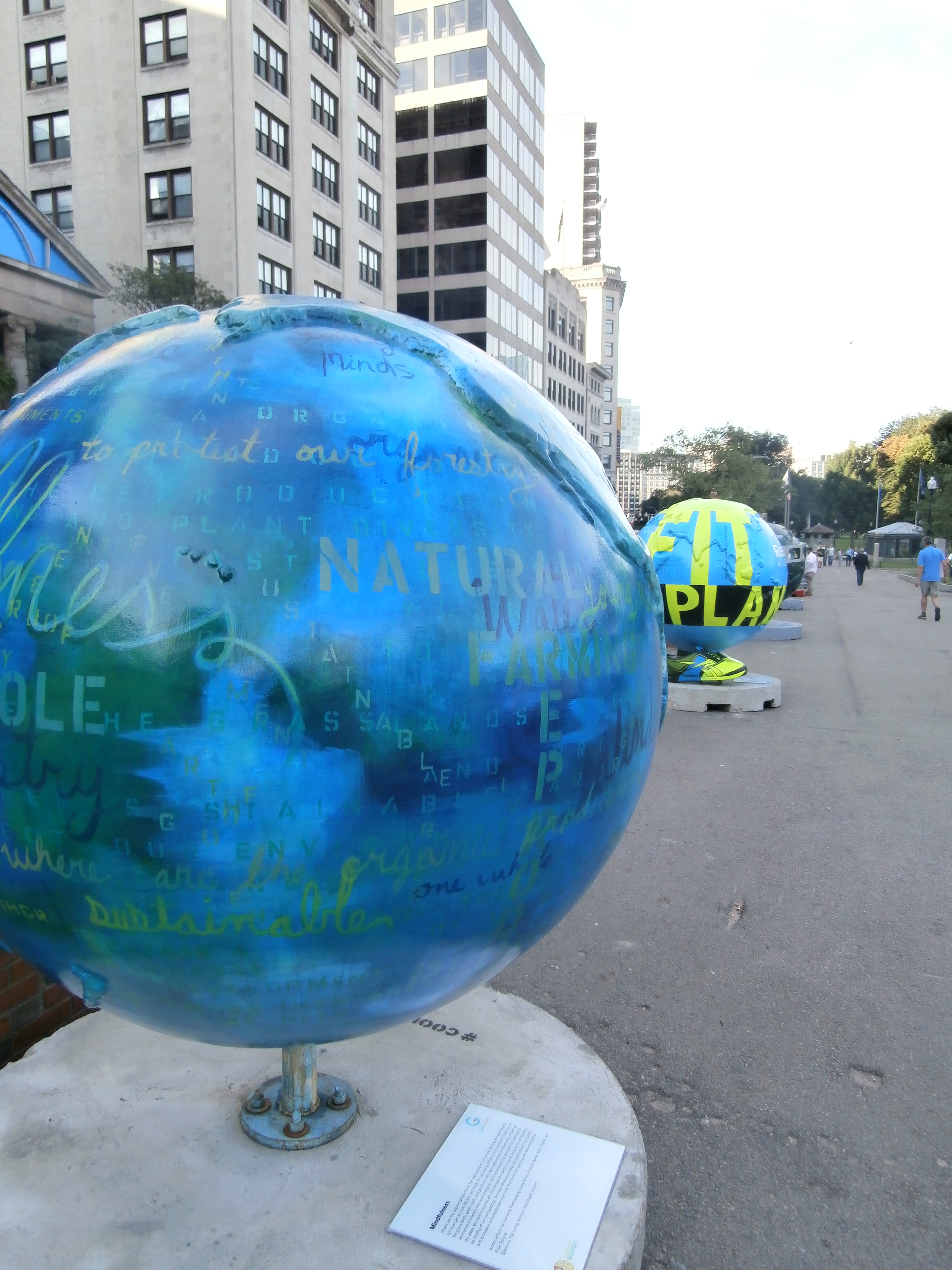
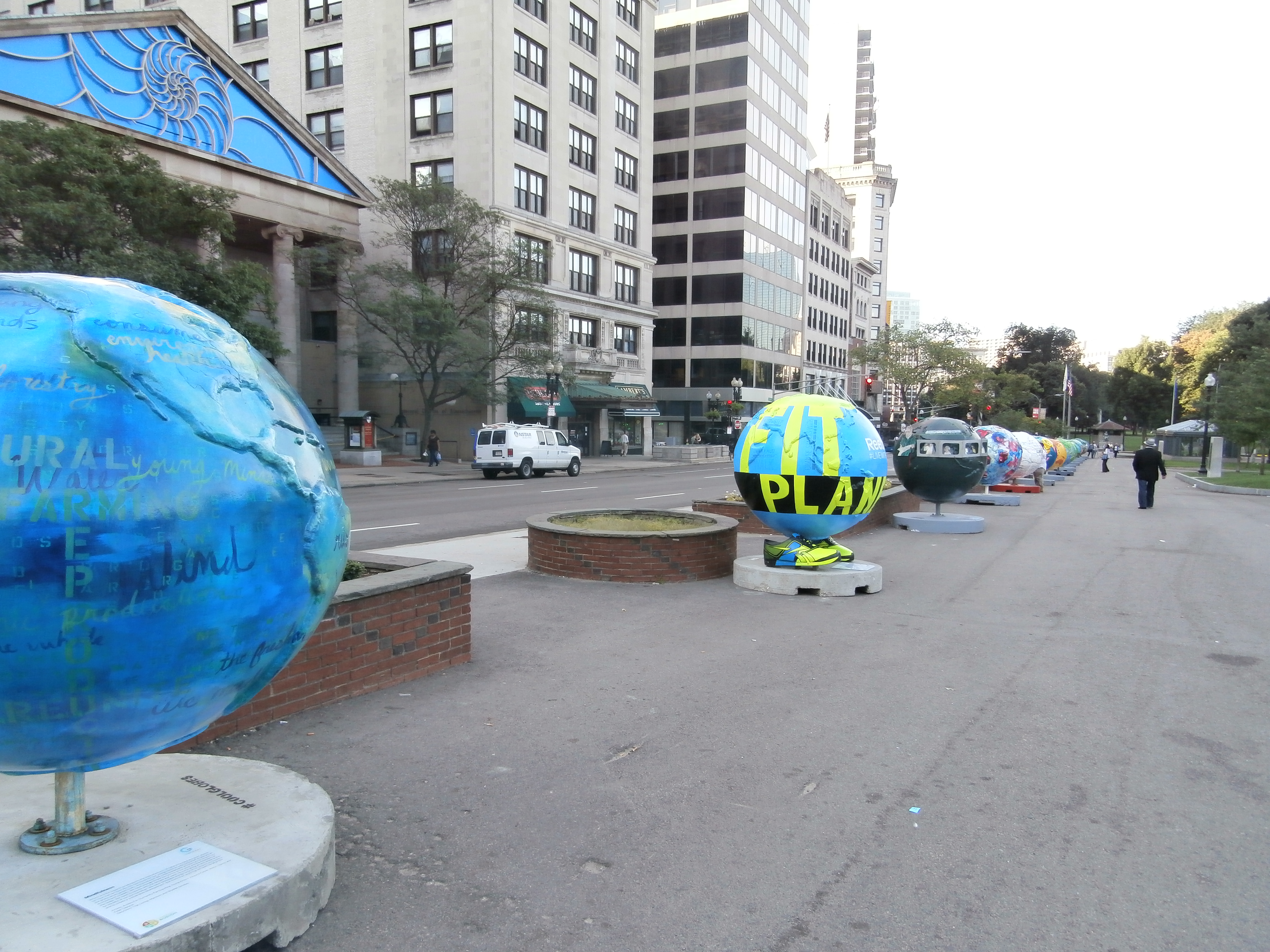
“Huge, colorful orbs line up in a row down the Tremont Street side of Boston Common. It looks like a giant might be marshaling his marbles. Get up close, and you’ll see that the spheres, each 5 feet in diameter, are globes, fancifully decorated and proffering solutions to climate change.

“ ‘Cool Globes: Hot Ideas for a Cooler Planet’ has landed in Boston. The public art project, for which artists designed globes with green strategies to contend with environmental issues, originated in Chicago in 2007 and has traveled the world.”

Environmental activist Wendy Abrams, says McQuaid, is the initiative’s founder.

“Abrams cites two inspirations for the project, the wrecked cars that Mothers Against Drunk Driving pointedly deploy in their Crash Car Program, and the painted cow sculptures that showed up in the streets of Chicago in 1999 — a public art project that prompted Boston to follow suit with painted cod.”

Read about individual artists’ Cool Globe themes, the outreach to students, and more, here.

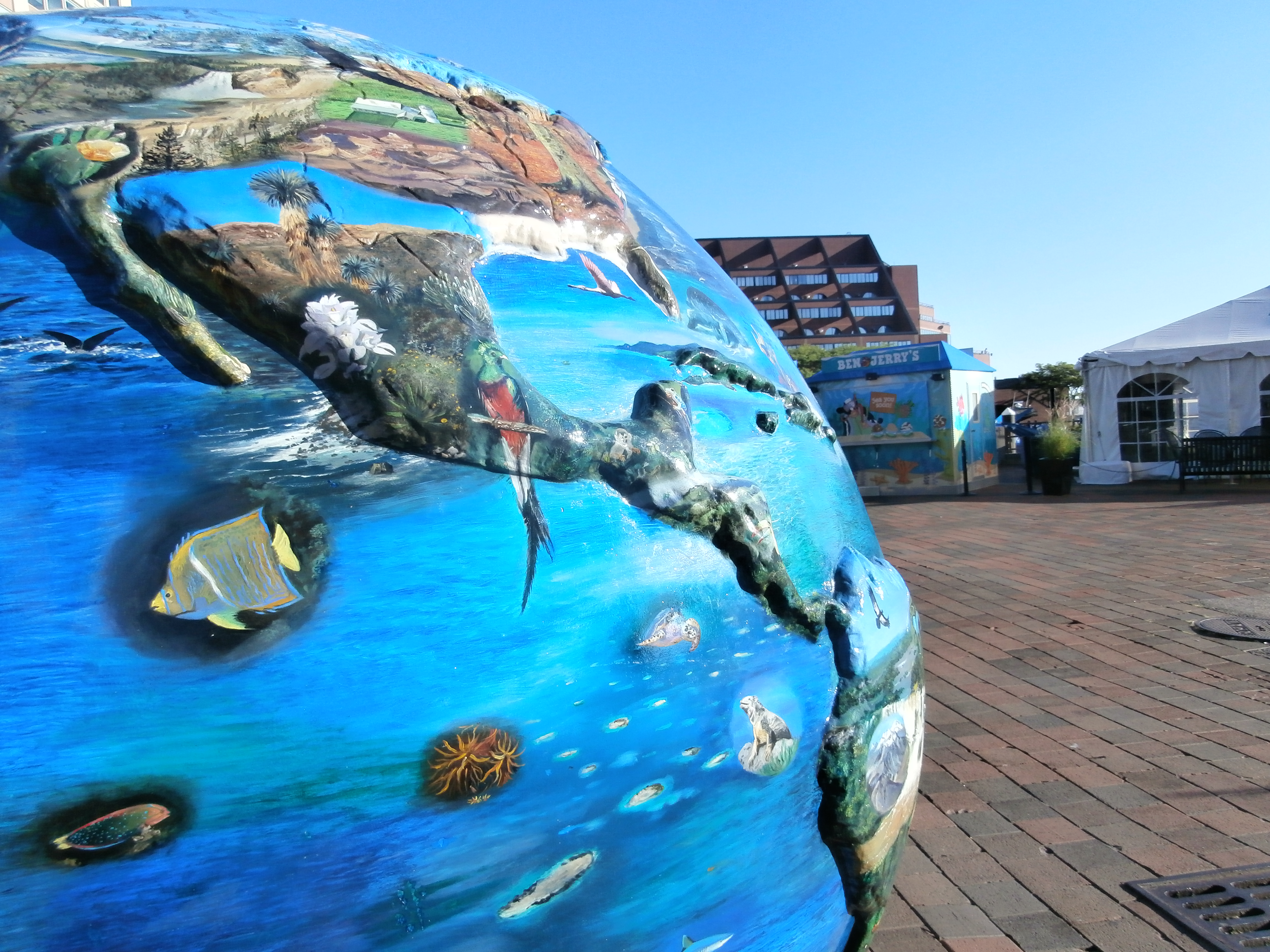
The first two photos below are near the Park Street subway station. The third is in front of the aquarium, and I am not sure if it is part of the traveling series.

cool-globes-boston

globes-for-a-coller-planet

globe-at-aquarium

Read Full Post »

Building energy savings into school design means more money for education.

At Yes! Magazine, Erin L. McCoy describes what planners did for the rural Richardsville Elementary School near Bowling Green, Kentucky.

“When Richardsville opened its doors in fall 2010, it was the first net zero school in the nation, meaning that the school produces more energy on-site than it uses in a year.

“Solar tubes piping sunlight directly into classrooms eliminate much of the school’s demand for electric light, while a combination of geothermal and solar power cut down on the rest of the energy bill. Concrete floors treated with a soy-based stain don’t need buffing. The kitchen, which in most schools contributes to 20 percent of the energy bill, houses a combi-oven that cooks healthier meals and eliminates frying. This means an exhaust fan doesn’t pipe the school’s temperature-controlled air to the outdoors all day long.

“Meanwhile, ‘green screens’ in the front hall track the school’s energy usage so kids can see the impact of turning off a light in real time.

“These and other innovations make Richardsville better than net zero. It actually earns about $2,000 a month selling excess energy to the Tennessee Valley Authority. …

“Three factors are essential to making a green school work: First, you need the participation of the community and the local power company; second, you can’t forget that a school is a dynamic learning environment; and third, you need to speak the language of money.

“Since the economic recession began in 2008, school districts have suffered. Local tax bases were shaken as property values plummeted, and states have cut back on funding to districts, which were pushed to cut funds wherever they were able. Addressing energy use made a lot of financial sense.”

More.

Photograph: Michael Heinz/The Journal & Courier/AP/File
Students gather on the first day of school at Wyandotte Elementary School near Lafayette, Ind., in 2011. Wyandotte is one of many US schools that have made cutting energy use a priority.


Read Full Post »

Pius Sawa at AlertNet (and the Christian Science Monitor) writes, “Residents of Rusinga Island in Kenya [are experimenting] with renewable energy innovations, environmentally friendly farming, tree planting, and other efforts aimed at improving the island’s environment, creating jobs, and overcoming shortages of food and water.

“For the past 16 years, Ester Evelyn Odhiambo has dedicated herself to improving life on one small island. It’s no small task.

“Rusinga Island, in the northeast corner of Lake Victoria in Kenya, is about 16 km (10 miles) long and 5 km (3 miles) wide. About 30,000 people call it home. But the island over the years has become an increasingly inhospitable environment for them.

“ ‘If you plant something, it just dries out,’ says Ms. Odhiabmo, who runs an organization to help people widowed or orphaned by AIDS [Kisibom, or “come and learn”]. ‘You try to irrigate, and the water is too little because the sun comes and dries everything.’

“The changes have come because of poor management of resources – including forests and fishing grounds – and because of increasing climate impacts.

“But now residents are experimenting with renewable energy innovations, environmentally friendly farming, tree planting, and other efforts aimed at improving the island’s environment, building resilience, creating livelihoods, and overcoming shortages of food and water.”

More.

Photograph: Pius Sawa/AlertNet
Ester Evelyn Odhiambo opens a charcoal refrigerator on Rusinga Island, Kenya. It is lined with charcoal, into which water seeps through a hosepipe fed by a bucket. The wet charcoal absorbs heat and keeps the items inside the fridge cool without needing electricity.


Read Full Post »

If you had to guess one church in San Francisco that would be all over the idea of rooftop gardening to feed whoever needs feeding, which one would it be?

Right. Glide. I like its garden’s name: Graze the Rooftop.

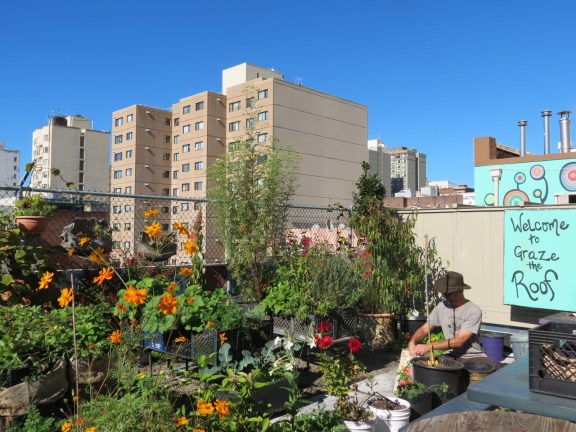
“Graze the Roof is an edible, community-produced vegetable garden on the rooftop of Glide Memorial Church, a progressive church and nonprofit located in the Tenderloin district of San Francisco.

“Graze the Roof features lightweight (upcycled) raised garden beds made from milk crates; a worm composting system and an educational mural which ties the whole project together. Glide youth and volunteers from throughout the Bay Area maintain the garden and host monthly tours and workshops.”

Do you live in the San Francisco area? Looks like there are a lot of fun workshops available, such as Designing Sustainable Habitats, Introduction to Permaculture, and Urban Fruit Tree Stewardship. Read more here.

Photo: Graze the Roof

Read Full Post »

Planetizen’s Brent Toderian wrote a while back that he attended a book party in Vancouver where Simon Fraser University City Program Director Gordon Price asked “each member of the crowd to state an urban design decision that ‘they loved.’ …

“When it came to my turn, my answer took a big picture and perhaps surprising approach, depending on your definition of urban design. In Vancouver, a city often referred to as ‘a city by design,’ the most important urban design decision we ever made, the decision I loved most, is actually usually referred to as a transportation decision.

“In 1997, the city approved its first influential Transportation Plan.

“It was a game-changer for our city-making model in many ways, most notably in its decision to prioritize the ways we get around, rather than balance them. The active, healthy and green ways of getting around were ranked highest – first walking, our top priority, then biking, and then transit, in that order. The prioritization then went on to goods movement for the purposes of business support and economic development, and lastly, the private vehicle. …

“If you’re a driver who is worried about a ‘war on the car,’ remember this — our model of city building understands the ‘Law of Congestion’ and proves that when you build a multimodal city, it makes getting around better and easier for every mode of transportation, including the car. It makes our city work better in every way.”

Read Toderian’s whole Planetizen post, here.

Photo: Vancouver.ca

Read Full Post »

I was thinking about houses this past weekend.

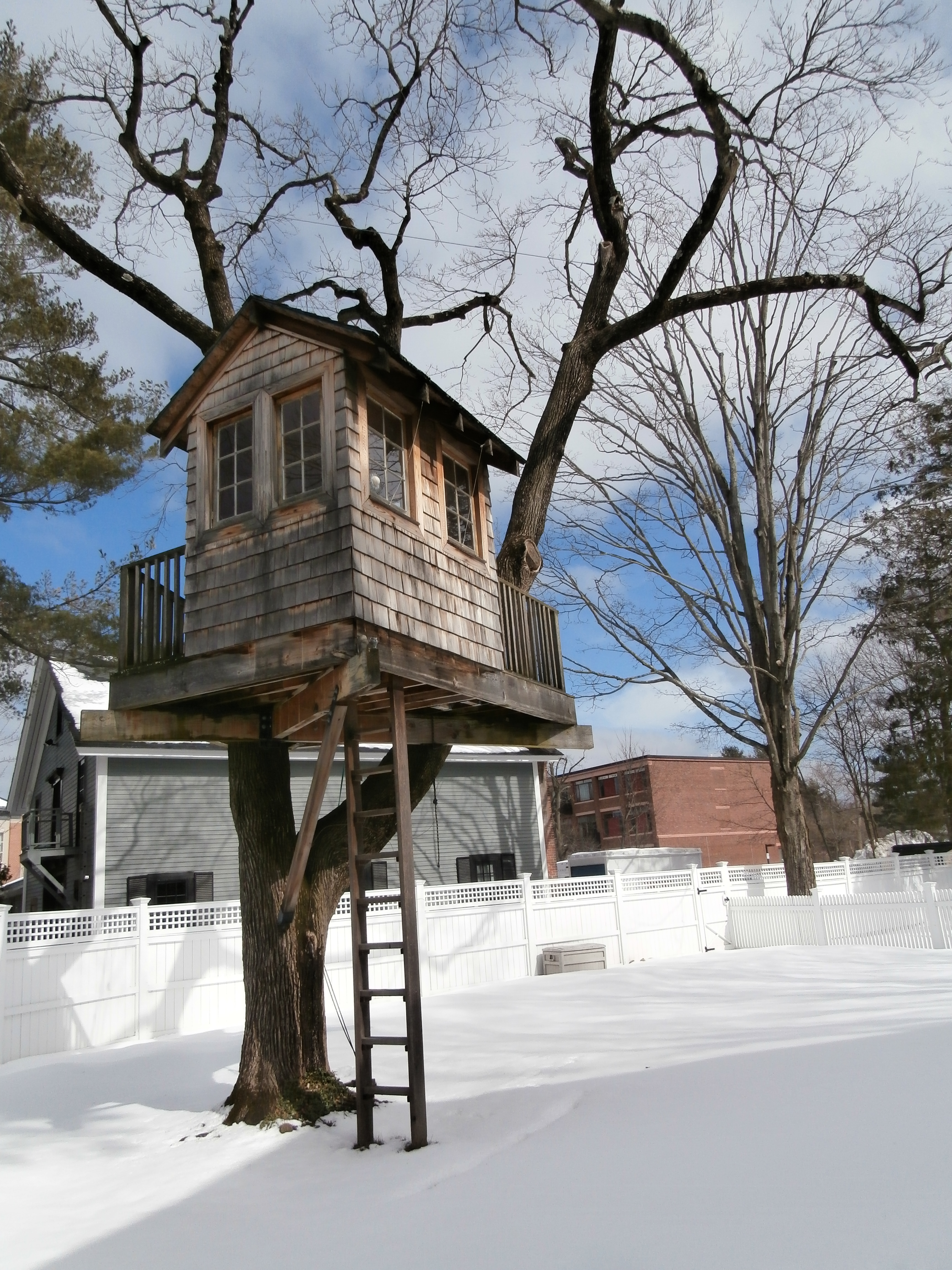
First, there is this house on the grounds of a private school near where I live. I snapped it on my walk.

Concord Academy Treehouse

Second, there is this house on a Hudson River Estate falling down around the ears of the latest, impecunious generation.

Photo of Rokeby, a 43-room house on the Hudson River, by Piotr Redlinski for The New York Times. New York Times story here.

Third, there is a tiny house that a Hampshire College student is living in as a senior project.

James Sullivan writes, “As a child, Hampshire College senior Nara Williams hated being told to pick up after herself. This semester, she’s learning to keep things tidy — very tidy.

“For her senior project, she is living in a 130-square-foot house to explore the realities and benefits of living small.

“A few weeks ago, Williams took delivery on a model home used as a showcase for the Tumbleweed Tiny House Co., a leader in the burgeoning ‘small house’ movement. …

“The housing project, Williams said, is her inquiry into ‘viable alternatives’ to the American dream. Blogging about the experience, she is raising questions about property ownership, material goods, consumption, sustainable living, and other issues in an era marked by housing and environmental concerns.”

Read about Rokeby, the Hudson River estate passed down through too many generations, and read about the tiny house, and pray that no one bequeaths you anything like the former. A tree house or a tiny house are what you want if you prefer to own property and not have property own you.

Update: Omigosh, a scathing memoir is just out on what it was like to grow up at Rokeby — reviewed in the Globe, here

Photo: Darren Durlach/Globe Staff
Boston Globe story here.

Read Full Post »

« Newer Posts - Older Posts »