Feeds:
Posts
Comments

Posts Tagged ‘sustainable’

Photo: John and Suzanne’s Mom.
Chunghie Lee‘s bojagi style “No-Name Women Paper DuRuMaGill”: photo images silk-screen-printed on Korean mulberry paper dyed with ground oriental ink stick. At Lexington Arts in Massachusetts.

My friend Ann, the textile artist, put me on to a new/ancient type of quilting and fabric art. It’s from Korea and it’s called bojagi.

According to the websit for Beyond Above Publications, “Bojagi (Bo-Jah-ki), or wrapping cloth, is the ancient Korean folk tradition of making pieced textiles for both everyday and ceremonial use. Originally made by anonymous housewives to fulfill a practical need along with an artistic impulse, Bojagi and its techniques have recently gained attention outside of Korea due to the increasing interest in the value of handmade items, as well the use of recycled materials and the politics of sustainability in textiles and contemporary art.”

I would never know about this type of thing, but Ann is on every email list imaginable for textile art in Greater Boston and beyond. So one day I headed over to Lexington Arts and Crafts to see contemporary bojagi by artist Chunghie Lee.

Apart from appreciating Lee’s skillful needlework, I was struck by her use of sustainable materials: previously used fabrics, mulberry paper, and ground-up ink sticks for red and black dyes. Especially moving was her focus on “no-name women,” the anonymous people behind this technique to make scraps of cloth go far. Women unknown and unappreciated.

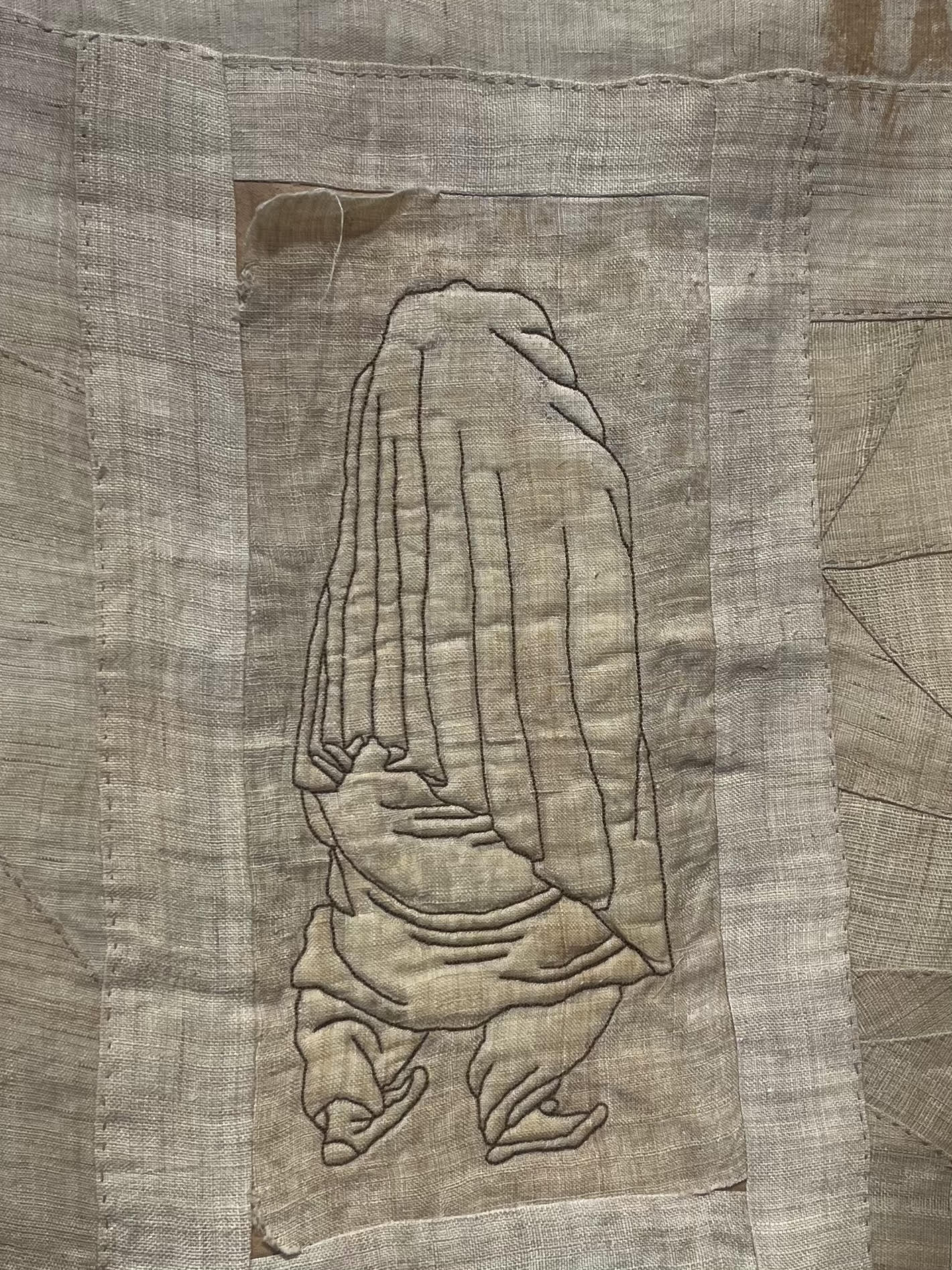
You have to look closely to see them. Lee brings them into her work with silk screens of old-time photos, barely visible. Which is why for this piece I am showing you only a close-up.

Close-up of silk bojagi “no-name women” piecework by Chunghie Lee.

Here is more detail from the publishing company Lee founded with Jiyoung Chung, a visual artist inspired by the Joomchi papermaking tradition.

“From traditional women’s work to contemporary sustainable textiles, bojagi works include delicately pieced and hand-stitched traditional bojagi, reinterpreted bojagi, wearable pieces, installations, and wall hangings.

This uniquely Korean art form made by anonymous ancestors has evolved from functional works into a contemporary art form that is embraced worldwide.

“Since the late 14th century, every household, from the royal palace to the thatched-roof hut in a mountain village, has found these wrapping cloths indispensable. The tradition of making and using bojagi was established during the Josun Dynasty (1392 – 1910), when women were restricted from leaving their households. To spend the long, tedious hours of the day, girls were taught to sew at age ten, and needlework became a big part of their lives as they moved into  adulthood. This folk art tradition was the only escape from the sequestered lifestyle of Korean women, and provided them with an artistic outlet for creative expression.”

Chunghie Lee adds, “I see this patchwork as a metaphor for human life. We may feel ourselves to be as random pieces of fabric, alone and without meaning, but God’s hand places us together in a beautiful composition, which has great harmony and meaning. As artists of all nationalities, generations and heritages, we discover we are all alike, and have been saving and making beautiful things with discarded fabric and other materials. In the eyes of artists, fabric scraps can be transformed and repurposed to fulfill the design and vision of the creator.”

More on bojagi at the website for publishing company Beyond Above, here. Follow Lee on Facebook, here.

Below, Chunghie Lee’s contemporary version of Korean piecework, followed by her careful stitching for “No-name Woman with Head Covering.”

Read Full Post »

Photo: Durrie Bouscaren/The World.
Inspired by Istanbul’s “deadstock” shops, OhSevenDays uses small batches of fabric to create womenswear. Designer Megan Mummery is pictured above inside OhSevenDays in Turkey.

According to public radio show The World, the textile industry generates an estimated 92 million tons of waste every year — equivalent to a garbage truck full of clothing every second. But today’s article suggests a way to give textiles a second life. 

The whole time I read this, I was picturing Cinderella’s little friends among the birds and mice turning the ugly sisters’ cast-off fabrics and ribbons into a gown for the ball. You remember the Disney Cinderella? I’m talking about the pretty gown the sisters destroyed, causing the Fairy Godmother to step in.

Durrie Bouscaren reports at The World, “In the backstreets of Istanbul’s garment districts, there are stores selling bolts and bolts of leftover fabric. …

“These 100-meter rolls of fabric, known as ‘deadstock,’ are the discards of Turkey’s largest clothing manufacturers. And to a growing cohort of designers, they hold the key to reducing waste in the fashion industry.  

“ ‘There are big manufacturers in Turkey that do production runs of 30,000 to 50,000 unit pieces. So, the precision in that production is something else,’ said Australian Canadian designer Megan Mummery.

“At that scale, fabric rolls with small tears, stains or other imperfections are immediately removed from the machines. And if a brand miscalculates and orders too many rolls of a specific fabric, it will end up with a surplus.

“In most cases, deadstock fabric rolls are incinerated or dropped off at a landfill. …

“ ‘It’s minuscule for them — one roll is 100 meters,’ Mummery told The World. ‘But for us, it’s gold.’

“Inspired by Istanbul’s deadstock shops, which she explored after moving to the city with her husband in 2015, Mummery began using smaller batches of fabric to create womenswear designs. She named her brand OhSevenDays — a reference to her earliest collections of only seven pieces at a time, and a play on the Turkish word ‘seven,’ for ‘one who loves.’  

“ ‘It was really slow at the beginning,’ Mummery said. … ‘And I remember, an influencer once wore a top and posted it, and we got like 20 orders in a day, and it was the most exciting thing ever!’ 

“Today, Mummery’s designs are a tasteful blend of classic neutrals and airy patterns. Signature bralette tops are paired with matching high-waisted skirts and summery cotton shorts, perfectly at home in the historic Istanbul apartments and garden balconies often featured in her photo shoots. A line of maternity clothes offers options for both the office and casual wear. 

“As with many small-scale sustainable brands, OhSevenDays’ price point is higher than that of major retailers. A popular blue patchwork Darcy dress is priced at $240, and a dark denim jumpsuit sells for $150. A breathable, white cotton maternity blouse is $124. …

“Turkey is among the world’s largest exporters of clothing, and a significant amount of deadstock fabric is available in the country, according to [Sibel Ege, an Istanbul-based fashion industry expert who runs a textile consultancy called REN Sourcing]. But few brands are incorporating it into their practices, and even fewer customers are aware of what it is. 

“ ‘After COVID, the customers became more aware of the importance of (sustainability), and started to pressure the brands,’ Ege said. ‘But if the customer doesn’t know what it means, it doesn’t make a value at the sales.’ 

“Mummery and her team work together out of a shared studio that is no larger than 700 square feet. A line of dresses hangs above the machines, while tailors measure, steam and cut fabric — making the pieces from start to finish.  That makes the work harder, but more interesting, said tailor Türker Pehlivan. 

” ‘It’s challenging,’ Pehlivan said. ‘But in the end, something beautiful comes out — and we’re happy because we made something beautiful.’

“[Mummery] has found ways to use the small size of OhSevenDays to her advantage.  Custom sizing can be done according to a shopper’s measurements at no extra charge, if fabric is available — the website notes. …

“Deadstock-sourced pieces are also popular among clothing subscription services, where subscribers receive a selection of clothes every month that can be kept or returned. This reduces the risk of disappointing customers if a popular item runs out quickly. …

“ ‘We say, you know, there might be a little color discrepancy between the products — and most of the boutiques love that actually,’ Mummery said. ‘Because when there’s a dress on the railing and two slightly different colors, they have a story to tell, even in the store.’ “

More at The World, here.

Read Full Post »

Photo: Mark Stockwell/Boston Globe.
Mohammed Hannan of Hannan Healthy Foods farm in Lincoln, Massachusetts, holds garlic, one of many organic greens grown on his farm.

After the US takes a step forward, it always seems to take two steps back. In today’s story, We learn about federal funds that have been supporting sustainable agriculture. Until now.

Jocelyn Ruggiero reports for the Boston Globe, “It’s dreary, gray, and unseasonably chilly on the first day of Community Supported Agriculture pickups at the Hannan Healthy Foods farm. As CSA members trickle in to collect their bags of produce, they chat with Mohammed Hannan and passersby who’ve stopped to buy green garlic, beets, collards, and various herbs and greens at the farm stand. Hannan’s 11-year-old daughter, Afsheen, sits bundled up at the checkout table, reading a book alongside volunteer and longtime CSA member Tricia Moore. Aside from the weather, the scene looks similar to opening day last summer. But circumstances are vastly different from what they were 12 months ago.

“One person is notably absent. Hannan’s wife, Kaniz Fouzia, died of pancreatic cancer in March. And even as the family grieves, Hannan confronts the practical challenges of running the farm without his primary support.

“He also faces another crisis. Last year, as with every year since it launched, the farm’s biggest buyer was the New Entry Sustainable Farming Project’s Food Hub, which purchased $7,000 in produce, primarily funded by two federal grants: the Local Food Purchase Assistance and Local Food for Schools Cooperative Agreement programs.

“Since 2021, the Food Hub has bought more than $32,000 of produce from Hannan, supported by these food grants, both part of the 2021 American Rescue Plan. These initiatives enable local schools, food banks, and senior centers to purchase produce from the Hub and, by extension, local farmers and producers. They’ve brought close to $20 million to the Massachusetts economy. Both the LFPA and LFS were originally scheduled to run through December 2025, [but the federal] administration abruptly and prematurely terminated funding for both programs. …

“Established in 2005, the Food Hub aggregates and distributes vegetables grown by more than 35 beginning, immigrant, and refugee farmers in the Boston region. It is an initiative of the Friedman School of Nutrition Science and Policy at Tufts University, which was founded in 1998 to integrate recent immigrants and refugees with farming backgrounds into Massachusetts agriculture. …

“[The] sudden termination of multiple streams of support disrupted many long-planned efforts and, in some cases, left farmers holding the bill for purchases they had already made based on awards that were withdrawn.

“It’s no coincidence that Hannan is the steward of a successful farm. He’s always had close ties to agriculture. He grew up on his family’s organic farm in Bangladesh, which was both a source of food and income. Hannan went on to earn a master’s degree in wildlife biology, studying the country’s ecologically critical coastal areas. In 2014, he gave up an opportunity to accept a Duke fellowship when his wife received a US Diversity Visa; the family left Bangladesh to settle in Cambridge.

“He eked out a living at multiple minimum-wage jobs — Walgreens, Indian restaurants, and MIT facilities — before landing work in biotech, then as a lab manager at MIT. During the lean years, he yearned for the affordable organic food that was so accessible in Bangladesh. He wondered, ‘How can I change my situation? How can I grow food here?’ …

“Unsure about whether working a full-time job while running a farm would be feasible, Hannan spent the summer of 2017 volunteering mornings, nights, and weekends at White Rabbit Farm in Dracut. … He began the New Entry Sustainable Farming Project farmer training program that winter, leasing a small piece of land through New Entry and growing produce to feed his family. By 2019, he had launched his first 30-member CSA and was selling to the Food Hub. In 2020, he graduated and set his sights on a plot in Lincoln.

“The weeds were chest-high on the 2.5-acre barren plot, and there was no potable water for washing produce. … ‘I came up with a plan: I’ll grow veggies that do not need washing: bottle and bitter gourds, tomatoes, eggplants, peppers.’ As he expanded, Hannan connected with the Lincoln community through an online forum. There, he met Tom Flint, an 11th-generation Lincoln farmer. Flint introduced him to Lincoln Land Conservation Trust trustee Jim Henderson, who let Hannan use his backyard sink and cure garlic in his barn. These were the first of many new friends who welcomed him to Lincoln. …

“During COVID, unsolicited, strangers started contacting Hannan: ‘I had accountants, engineers, doctors. They were helping on the weekends. … We were laughing, harvesting … and eating from the farm. It was really good.’ Town residents later responded to his query on the town’s forum and helped Hannan build a deer fence when he couldn’t afford a contractor. His robust volunteer network has strengthened and extended beyond Lincoln, and today includes such groups as the Boston-based climate justice nonprofit Mothers Out Front. …

“[Today] Hannan’s MIT job subsidizes his farm, and his volunteer community provides supplemental support. However, for many other small farmers affected by funding cuts, the consequences will be existential. As Hannan puts it: ‘Small farmers like me … will definitely choose other options.’ ”

More at the Globe, here.

Read Full Post »

Photo: Seabound.
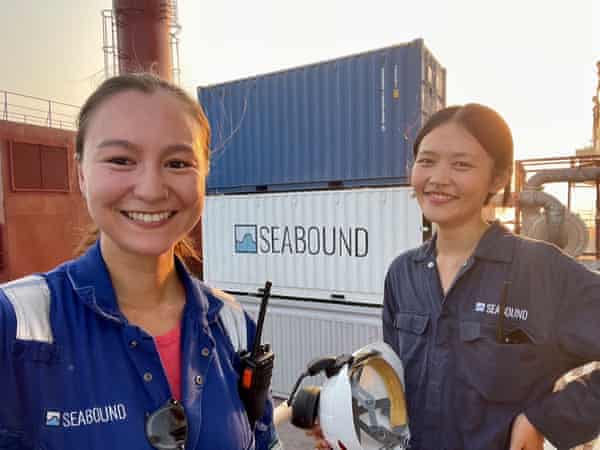
Seabound co-founders are chief executive Alisha Fredriksson (left) and chief technology officer Rojia Wen. Seabound’s carbon-capture prototype sailed for two months on a midsize container ship. 

Today’s story is about two women in the male-dominated shipping industry and their work on what might be a stepping stone to sustainability. The challenge is that the process to create their carbon-absorbing pellets also involves carbon release.

Emma Bryce writes at the Guardian, “An industrial park alongside the River Lea in the London suburb of Chingford might not be the most obvious place for a quiet revolution to be taking place. But there, a team of entrepreneurs is tinkering with a modest looking steel container that could hold a solution to one of the world’s dirtiest industries.

“Inside it are thousands of cherry-sized pellets made from quicklime. At one end, a diesel generator pipes fumes through the lime, which soaks up the carbon, triggering a chemical reaction that transforms it into limestone.

“With this invention, Seabound, the company behind it, hopes to capture large amounts of carbon directly from the decks of cargo ships, and help clean up this strikingly polluting industry. …

“Behind all this is Alisha Fredriksson, a young entrepreneur who once dreamed of being a doctor but reached a turning point in her career after reading a report from the Intergovernmental Panel on Climate Change that detailed the global implications of 2.7 F degrees versus 3.6 F degrees of warming.

“ ‘That’s when I realized that everyone around the world will be affected by the climate crisis, and so if I cared about large-scale social impact, the best thing I could do would be to help tackle it,’ says 30-year-old Fredriksson, chief executive of Seabound. …

“Trials have shown that her invention can scrub most of the carbon from the ship exhaust, filtered through its lime-pebbled interior. Ultimately, the goal is to have this device strapped to ships across the world’s oceans, she says. …

“She and her co-founder, Roujia Wen, hit on the idea of scaling down the existing quicklime-based carbon-capture technology typically employed at industrial plants. They then made a prototype, and attracted about $4m in funding from investors. Some of this came from shipping companies. ‘It all happened really quickly. Suddenly we had money, and we had to go build it,’ says Fredriksson. …

“Since then, successive prototypes of the Seabound container have taken her from the company’s test-bed in east London, to … a three-week voyage to test its efficiency. This showed that a Seabound unit can capture 78% of all the carbon from the exhaust that is pumped through it, and 90% of the sulphur, a toxic air pollutant.

“The latest prototype is being built to the dimensions of a standard 20ft shipping container, so that it can seamlessly slot in with cargoes on deck, Fredriksson says. … Once in port, the limestone-filled units can be substituted for containers of fresh quicklime. This product is made by heating limestone to high temperatures in kilns, an energy-intensive process that also releases CO2 from the limestone, making production extremely carbon-intensive.

“Companies are trying to make quicklime using kilns heated with renewable energy, or developing methods to capture the released CO2 so that it doesn’t enter the atmosphere. Seabound is working to source this ‘green’ quicklime, Fredriksson says. …

“Some critics are concerned that decarbonizing technologies could distract from solutions, such as zero-emission ammonia fuel or wind-powered innovations, that are essential to push the shipping industry to net zero.

“ ‘The potential for short-term use of carbon-capture retrofits on existing vessels should not become a justification to extend the lifespan of fossil fuels or delay the shift to truly sustainable alternatives,’ says Blánaid Sheeran, climate diplomacy policy officer at Opportunity Green, a nonprofit organization focused on gaps in global climate policy.

“But Fredriksson believes Seabound’s technology could support this transition. In April, at a meeting of the International Maritime Organization, UN member states agreed to a landmark deal that will start charging ships for every ton of emissions above a threshold. That threshold will gradually decrease to push the industry towards green fuels.

“Seabound slots into this new regulatory landscape, according to Fredriksson, by enabling ships to decarbonize their fuels, thereby lowering their emissions, and gradually adjust to the rules by adding more containers over time. …

“Fredriksson says [Seabound’s] offering is cost-effective and she has already had a commitment from one company to fit the first full-scale containers on to its ships this year.”

More at the Guardian, here. No firewall. Donations sought.

Read Full Post »

Photo: MWA Hart Nibbrig.
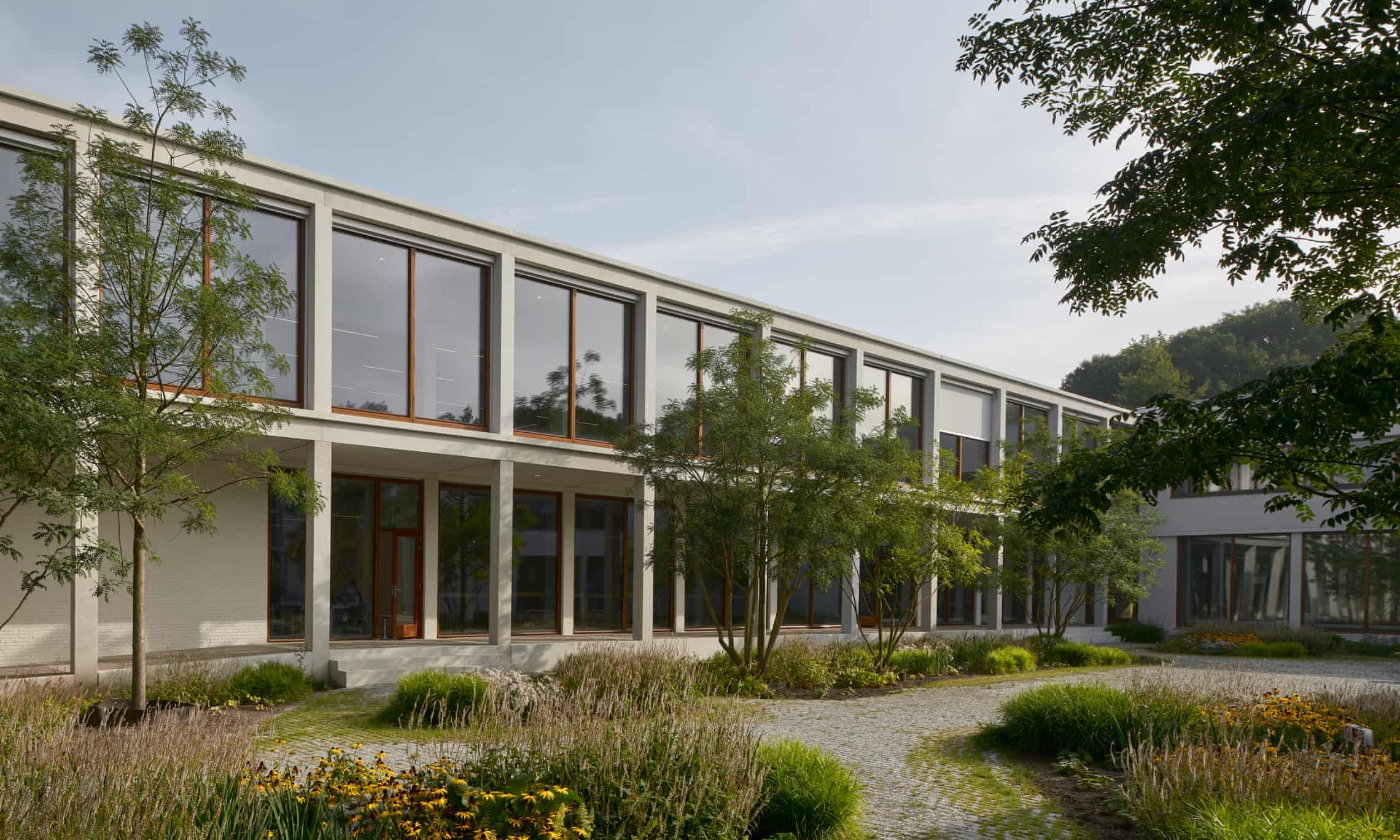
The makeover by Maarten van Kesteren Architects of  a 1960s Utrecht college at less than half the cost of a new building and a third the carbon footprint is a lesson in sustainability.

In today’s story, a design company worked with what was available to make an old building sustainable. Apparently there’s some controversy about the approach, refitting the old instead of building everything new. See what’s happening in the Netherlands.

Rowan Moore writes at the Guardian, ” ‘The greenest building,’ to quote a slogan now popular among architects, ‘is one that is already built.’ It sums up the belated realization that the carbon impact and energy consumption of demolition and new building can be more significant than those of heating, cooling and running a building when it’s in use. It’s still a principle that is only patchily put into practice, in the UK and elsewhere. But the Dutch not-for-profit organization Mevrouw Meijer (meaning Mrs Meijer), which works to give new life to old school buildings, is quietly showing how it can be done.

“Her organization’s approach, says its founder, Wilma Kempinga, makes environmental, financial and practical sense, but it’s also about the experiences and memories of childhood. ‘It’s very important that students experience beauty,’ she says. ‘This is a place you will remember for the rest of your life.’ For Kempinga, beauty is best achieved by making the most of existing buildings – even those thought unremarkable – and getting the best young architects to design the transformation.

“We’re sitting in Nimeto, a trade school in Utrecht where students aged 16 to 21 learn shop window dressing, theatre set design, painting and decoration, specialist restoration and other skills. It’s a decent work of 1960s Dutch welfare state modernism – one of thousands from the country’s postwar educational construction boom: well lit and well proportioned, built in white-painted brick, within whose plain walls are the sights, sounds and smells of young people making things. Some of them are painting at encrusted easels beneath north-facing skylights, or planing and cutting timber; others trying out their decorating techniques on a house-like structure built to offer them as many awkward junctions and other challenges as possible. The school is populated with trompe l’oeil fragments of architecture – parts of stage sets – and experimental displays of objects you might find in a shop window.

“Now it’s better than ever. Where once the school was divided into two main blocks, they are now linked by first floor bridge and gallery with a colonnade underneath. A central courtyard that was a car park is now a garden that marks the cycle of the school year with yellow-and-white flowers in September, and blue-and-white flowers in spring. Double-height spaces bring light into a large basement, which can now be used for learning rather just storage. They also break open a regimented former arrangement of internal corridors double-loaded with classrooms. You can now look up, down, sideways and across, as well as straight ahead.

“The canteen is in one of the two blocks, the library in another, meaning that the two facilities shared by all students are distributed across the school. Previously, says Nimeto’s principal, Henk Vermeulen, students working in one part would refer to those in another as being ‘on the other side,’ but now all parts of the building are equally theirs. …

“The new design, by Maarten van Kesteren, a young architect based in The Hague, is about opening up and connections and making a shared container for the multifarious creativity of the students. The ‘whole school has a feeling that you are part of a lively workshop,’ as Van Kesteren puts it. The detail is simple, with what Kempinga calls ‘very beautiful pure materials that are unusual in school buildings,’ such as an oak floor whose woody smell mixes with that of the workshops. The project is achieved by the minimum of means, the only new structure being the long gallery/bridge, and gains additional education space. … It is also less than half the cost of an equivalent new building, with 30% of the carbon footprint.

“Mevrouw Meijer’s role, here and elsewhere, is to make the case for renovating rather than replacing, generating the evidence that it will be cheap, practical and climate-friendly. They also help select the architect. … Young practices without previous school experience, such as Van Kesteren’s, are preferred. ‘We don’t want an old guy or an old girl,’ says Vermeulen, but someone who will bring fresh thinking. As his school is always making the case that its inexperienced students should be trusted with opportunities, he says, it should do the same when appointing architects. …

“The original Nimeto building is typical of many in the Netherlands, whose design is quietly humane without being spectacular or special enough for it to be designated as significant heritage. Yet, says Kempinga, they are part of the country’s shared memory. …

“Schools also tend to be located in the centre of the communities they serve, whereas new replacements are often more remote. Yet, as Vermeulen puts it, ‘our neighborhood should profit from a new school, and our students are supposed to be working for this society,’ so it’s better if they stay put. The external landscape at Nimeto has been designed so as to connect the school’s garden with its surroundings and form part of the ‘ecological structure,’ as Van Kesteren says, of Utrecht.

“Mevrouw Meijer now have a number of school projects under way and recently completed. … Mevrouw Meijer is named after a well-loved children’s book character who worries a lot about nothing until she adopts and raises a baby blackbird, which teaches her to concentrate on essentials. If this sounds whimsical, the organization’s projects seem to be based on impeccable logic and well-founded aspirations; the only mystery is why their ideas are not applied more widely. There’s a mistaken belief that the best way to be sustainable to is to build something with all the latest environmental materials and devices. …

“Kempinga says it’s a question of attitude. ‘A lot of people like new buildings,’ she says, ‘and don’t have the imagination to see what’s possible with old ones.’ “

More at the Guardian, here.

Read Full Post »

Photo via the Guardian.
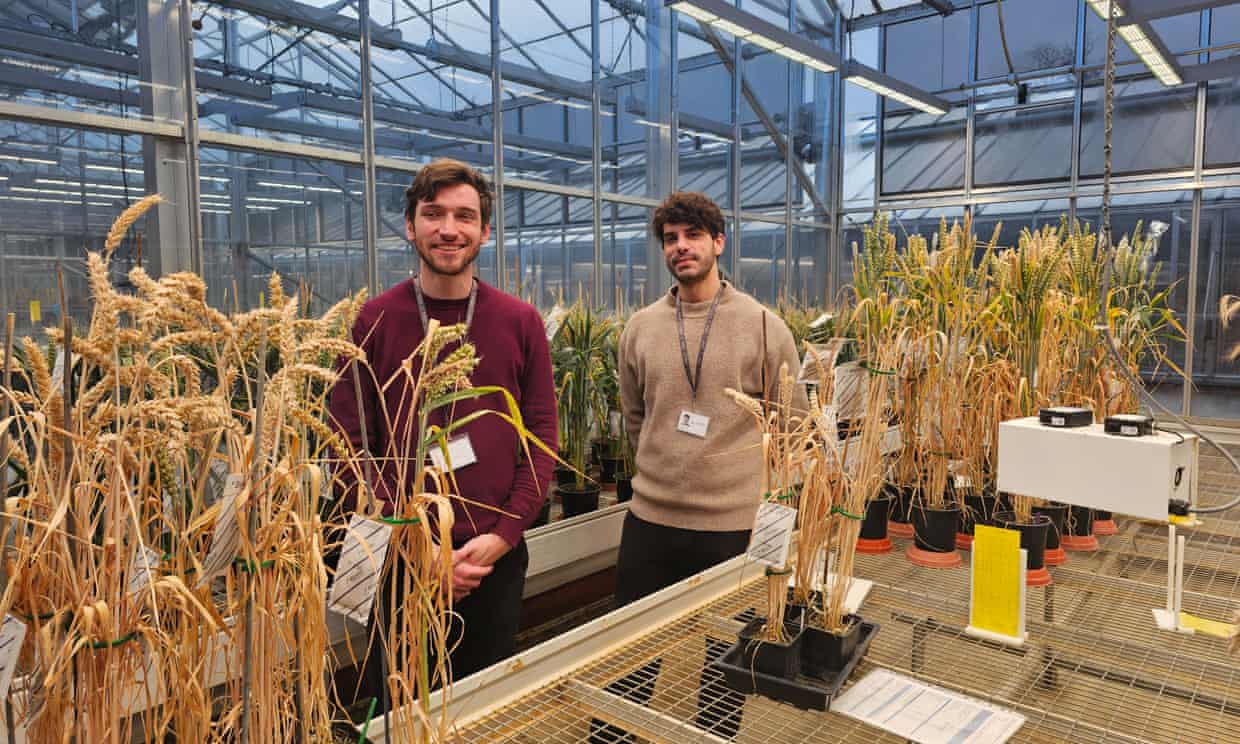
Imperial College researchers Franklin Keck, left, and Ion Ioannou are seeking a biological approach to mining copper with less danger to the environment. 

Can mining be made greener? I know it sounds implausible, but you have to love people who will tackle questions like that. Especially as the modern world is demanding more and more metals.

Robin McKie writes at the Guardian that copper “faces an uncertain future as manufacturers prepare to expand its use to make the electric cars, renewable power plants and other devices that will help the planet move towards net zero. Unrestricted extraction could cause widespread ecological devastation, scientists have warned.

“The issue is to be the prime focus for the new Rio Tinto Centre for Future Materials, based at Imperial College London in partnership with several international university groups. …

“ ‘The world needs to electrify its energy systems, and success will absolutely depend on copper,’ materials scientist and Imperial vice-provost Prof Mary Ryan, one of the centre’s founders, told the Observer last week. ‘The metal is going to be the biggest bottleneck in this process. So, in setting up the centre, we decided copper would be the first challenge that we dealt with.’ …

“Copper has become essential for powering devices ranging from smartphones to electric vehicles because it transmits electricity with minimal loss of power and is resistant to corrosion. Around 22m tons of copper were mined in 2023, a 30% increase from 2010, and annual demand will reach around 50m tons by 2050, say analysts.

“Such an output will have enormous environmental consequences because copper mining uses acids that poison rivers, contaminate soil and pollute the air. Producers such as Peru, Chile and the Democratic Republic of the Congo have seen natural habitats destroyed, wildlife populations wiped out and human health damaged near mines. Deep-sea mining has been proposed, but the idea horrifies marine biologists, who say such enterprises would devastate sea life.

“The aim of the new centre is to find ways round these problems and help provide the materials the world will need to reach net zero. It is funded by the mining group Rio Tinto and hosted by Imperial College London in partnership with the University of British Columbia in Vancouver, the University of California, Berkeley, the Australian National University and the University of the Witwatersrand, Johannesburg.

“One key project is seeking new ways to mine copper. ‘We typically extract it from minerals that have crystallized out of very saline, copper-rich brines,’ said Professor Matthew Jackson, chair in geological fluid dynamics at Imperial College. ‘However, this process requires huge amounts of energy to break open the rocks and bring them to the surface and also generates a lot of waste as we extract copper from its source ores.’

“To get round this issue, Jackson, working with international partners, has been searching for underground sites where copper-rich brines are still in liquid form. These brines are created by volcanic systems which can, crucially, provide geothermal energy for extraction.

“ ‘That means we can extract the copper by pumping the brines to the surface via boreholes – which is relatively easy – and also use local energy to power the mine itself and possibly provide excess energy for nearby communities,’ Jackson said. ‘Essentially, we are seeking to build self-powered mines and have already pinpointed promising sites in New Zealand, and there is potential to explore conventionally barren areas such as Japan.’

“A different approach is being followed by another Imperial project where a company, RemePhy, has been started by Imperial PhD students Franklin Keck and Ion Ioannou.

“They have used GM technology to develop plant-bacterial systems that have an enhanced ability to extract metal from the soil. ‘Essentially, you will be able to grow these crops on land contaminated by waste left over from the mining of metals such as copper, and they will extract that metal,’ said Keck.

“The importance of these techniques was stressed by Ryan. ‘The world will need more copper in the next 10 years than has been mined in the whole of the last century. [We] need to both reduce our demand for copper and work out how to extract it in the most sustainable way possible.’ “

More at the Guardian, here. No firewall. Donations support reliable journalism.

Read Full Post »

Photo: Giacomo Augugliaro/Getty Images.
A loggerhead turtle (Caretta caretta) off Elafonissos island in Greece, where the rebound in population has been called “phenomenal.”  

Today’s article is about the resurgence of turtles in Greece. But before I get into it, I need you to indulge my current train of thought about turtles.

There are the chocolate, caramel, and pecan-footed “turtles” that my sister-in-law makes every Christmas, turtles that this week have gotten certain farflung relatives wildly excited.

There are songs about turtles like one I just found out my exercise teacher made for a fundraiser years ago, here.

And there are turtle fans all over the world who are bringing real turtles back from the brink of extinction. Slowly but surely.

Helena Smith writes for the Guardian about that.

“After nearly a quarter of a century observing one of the world’s most famous sea turtle nesting grounds,” she reports, “Charikleia Minotou is convinced of one thing: nature, she says, has a way of ‘sending messages.’

“Along the sandy shores of Sekania, on the Ionian island of Zakynthos, what she has seen both this year and last, has been beyond her wildest dreams. The beach, long described as the Mediterranean’s greatest ‘maternity ward’ for the Caretta caretta loggerhead sea turtle, has become host to not only record numbers of nests, but record numbers of surviving hatchlings as the species makes an extraordinary resurgence.

“ ‘The message sea turtles are sending is very clear,’ said Minotou, who coordinates the WWF program in the protected area. ‘And that is the measures we have taken over the past 25 years to ensure conditions are right for the marine turtles to nest here are working … It’s fantastic.’

“One of the oldest living species, sea turtles are believed to have existed for more than 100m years. Although highly migratory – over a lifetime, the reptiles cross thousands of miles of seas and oceans – female turtles always return as mature adults, about 20 to 25 years later, to the habitat where they were born to lay eggs. It is a reproductive cycle that happens with perfect synchronicity. In Sekania and other nesting grounds in Zakynthos and around Greece, turtles tagged at birth by conservationists a quarter of a century ago are now reappearing to nest.

“ ‘It’s hugely moving,’ says Minotou, a sustainable development expert who highlights the importance of technological advances, including the installation of CCTV cameras, in helping to ward off seagulls, ghost crabs and other predators. ‘This year more than 1,200 nests have been recorded in Sekania, which is one every 50cm [~20 inches] of beach. An amazing number.’

“From Spain in the west to Cyprus in the east, the Mediterranean has witnessed a record rise in sea turtle nesting – testimony to the painstaking efforts of environmentalists determined to save an ancient mariner that not that long ago was on the verge of extinction. Only one in 1,000 turtle hatchlings makes it to adulthood, making the turnaround even more remarkable.

“In Greece, which hosts 60% of Caretta caretta nests, the rebound has been phenomenal: from an average of 5,000 to 7,000 nests per year, since 2023 over 10,000 nests have been recorded annually, according to Archelon, the Sea Turtle Protection Society of Greece. …

“Thirty years ago, before the creation of a state-funded marine park on Zakynthos – the country’s biggest sea turtle nesting ground after the bay of Kyparissia in the Peloponnese – Greek authorities appeared oblivious to the plight of a species whose survival is now widely recognized as vital for marine ecosystems and the region’s ecological biodiversity.

“Few have more vivid memories of the dangers the creatures once faced than Lily Venizelos, who founded the UK-based Mediterranean Association to Save the Sea Turtles (Medasset) in the 1980s.

“The doughty campaigner, now in her 90s, spent years lobbying successive Greek governments to legislate policies to protect Caretta caretta from the then nascent threat of tourism and other perils posed by speedboat propellers, beach furniture and human activity in marine turtle habitats, conservationists say. …

“ ‘It’s been the most wonderful news, at my age, to find out that the Caretta caretta are no longer so threatened, but it’s crucial protective measures continue to be enforced. One false move and everything could be lost.’ ”

Do you have any thoughts on why turtles are so beloved? I think for me it’s their patience, the way they get everything done that they need to do while moving slowly.

More at the Guardian, here. No firewall.

Read Full Post »

Photo: EcoForge.
Startup EcoForge’s lead scientist, Jiale Han, working on making sustainable building products.

Sometimes the Boston Globe features interviews with founders of startup companies. This company is in Rhode Island, and it makes alternative building products for a greener future.

Alexa Gagosz has the story.

“Brown University graduates Rongyu Na and Myung Bender are the founders of EcoForge, a startup that is developing local and sustainable building materials from agricultural residues and plants.

Alexa Gagosz: How does EcoForge work?
“Rongyu Na: We start by providing our solutions, such as material binding agents and fire-resistant agents, to materials like hemp — a bio-based material that’s carbon-negative — to interested companies and manufacturers.

“Unlike traditional materials that harm both people and the planet, our materials significantly improve sustainability and ensure material health. EcoForge’s bio-based building products help construction projects secure permits, reduce carbon emissions by up to 40 percent, and save on future energy costs, estimated at more than 15 percent on heating and cooling.

“AG: How does EcoForge fit into both of your experiences?
“RN: With my extensive experience in industrial design at NASA and at Subaru, Nissan, and Amazon, I’ve worked on future clean mobility concepts and innovative products like the Kindle, and led global initiatives focused on sustainable materials. My passion for sustainability is complemented by a strong background in innovation and design excellence.

“My cofounder, Myung Bender, is a seasoned entrepreneur. Her startup was acquired by Apple, and as the former head of product at Bumble, she brings strong business acumen and operational expertise. We’ve both developed numerous products, and we are now focusing on products that significantly impact our health and the planet.

“AG: What kinds of ‘agricultural residues’ are you using? And what kinds of building materials can they be transformed into?
“RN: Our technology is highly compatible with various plants, allowing us to form building products by leveraging their natural material structures.

Agricultural residues like hemp/cannabis waste, sunflower husks, sugarcane waste, corncobs, and invasive plants like Arundo donax [giant reed] are of particular interest to us.

“We’re currently focusing on creating solutions such as zero-VOC [no volatile organic compounds], 95 percent bio-based binders, and highly compatible sustainable fire-resistant technology that work with hemp and cannabis waste. We’re looking to collaborate with interested companies and manufacturers to transform these faster-growing plants and agricultural residues into various building products.

“AG: Who are your customers?
“RN: Our primary customers are large manufacturers seeking innovation and reduced carbon footprints through selling or licensing our ecologically safe material solutions. Secondary customers include corporate owners and real estate firms who renovate frequently to meet ESG [Environmental, Social, and Governance] goals.

“AG: Who or what is your greatest competition? How do you plan on breaking into the market?
“RN: Our greatest competition comes from traditional material solution suppliers using petroleum-based materials that employ green-washing strategies and lack transparency. These companies are also energy-intensive and cause harm to both the planet and human health. They still have a strong influence in the market, with established market presence, customer bases, and industry equipment tuned for their specifications, making it challenging for new entrants.

“To break into the market, we plan to leverage our unique value propositions. … Our hemp recipes tackle cost, supply, fire safety, performance, recyclability, or degradability issues. Our adaptable products are compatible with existing manufacturing lines and can be used for various building products like ceiling tiles, drywall, insulation panels, and flooring. …

“AG: What challenges are you facing currently, and how do you plan to overcome them?
“RN: One of the biggest challenges has been overcoming the industry’s struggle with greenwashing and false claims. Many companies claim to be sustainable but fall short in practice. This makes it difficult for genuinely sustainable products to stand out and gain trust. … We’re committed to maintaining maximum transparency and conducting rigorous testing to ensure our materials are genuinely sustainable and healthy.”

Read about the cost of their products and their funding sources at the Globe, here.

Read Full Post »

Photo: Rasmus Hjortshoj.
Dortheavej residence in Copenhagen. Social housing accounts for about 20% of all housing stock in Denmark and is available to anyone, regardless of income.

I’m always interested in housing stories, partly because among the issues that the department I worked in at the Fed addressed was housing. After the mortgage meltdown in 2008, I remember, we had a gigantic event at the Patriots’ football stadium to gather borrowers in danger of foreclosure under one roof with organizations that could help them.

Today’s story looks at new ideas in public housing from around the world. Maddie Thomas reports at the Guardan, “The social housing of last century often calls to mind towering blocks of flats, poorly maintained with dark, pokey and cold units. But alongside a rise in community living, the 21st century has brought quality construction, sustainability, and quality of life to the forefront of social housing design.

“Australia’s commitment to and funding for social housing stock is limited. But by 2037, Australia is estimated to have 1.1 million people seeking social housing. Professor of architecture and head of the University of NSW’s school of the built environment, Philip Oldfield, says that for an investment in social housing to match cosmopolitan cities like Paris or Barcelona, more housing of quality needs to be built.

“ ‘Architects are trained in this … so when they’re given the opportunity to do it well, Australian architects will create as good a housing as anywhere else in the world,’ he says. ‘At the moment, the system, with few exceptions, doesn’t give them that creative opportunity to deliver … the kind of world class social housing we would love to see.’

“While Australian not-for-profits are building design-led affordable housing for low to middle income earners, government-funded social housing for those on waitlists is lacking. Oldfield says organizations like Nightingale Housing are pioneers in built-to-rent housing, with 20% of apartments assigned to community housing providers for those most in need. But examples like Sydney’s Sirius building, previously owned by the state government, show that Australia needs more purpose-built social housing to cater to demand and match international standards.

“ ‘In conventional market-led housing, you build for the people who purchase the house … so you don’t consider as much the energy bills that are going to accumulate over time,’ he says. ‘With social housing, you’re not trying to create a profit so you can consider things like the life cycle costs for housing in a much more significant way.’ …

“Social housing in Denmark is available to anyone, regardless of income. Highly regulated to ensure quality construction, social housing accounts for about 20% of all housing stock in Denmark. In 2013, global architecture firm Bjarke Ingels Group was commissioned by Lejerbo, a Danish organization building housing for those in need, to design ‘Dortheavej’ – a social housing block in Copenhagen.

“Bjarke Ingels’ ‘winding wall’ of social housing has 66 units for low-income citizens, with a small balcony and floor-to-ceiling windows in each.

“ ‘The stacking of prefabricated elements consisting of two kinds of stacked modules, which are repeated to create the characteristic checkered pattern,’ says Kai-Uwe Bergmann, partner at Bjarke Ingels. ‘By gently adjusting the modules, the living areas open more towards the courtyard while curving the linear block away from the street to expand the sidewalk into a public square.’

“The stairwells allow for the units to be filled with daylight, and views of the neighboring green space. Pathways through the site give access to the street. The apartments themselves range from 60 to 115 sq m [~646 to ~1200 square feet], but with open plan designs, space within the units themselves is flexible.”

Read housing stories from Mexico City, Paris, Barcelona, Los Angeles, and Vienna at the Guardian, here; no paywall. You’ll appreciate the variety of approaches around the world and enjoy some great photos.

Making Home Home blog, looking at you!

Read Full Post »

Photo: OatShoes.
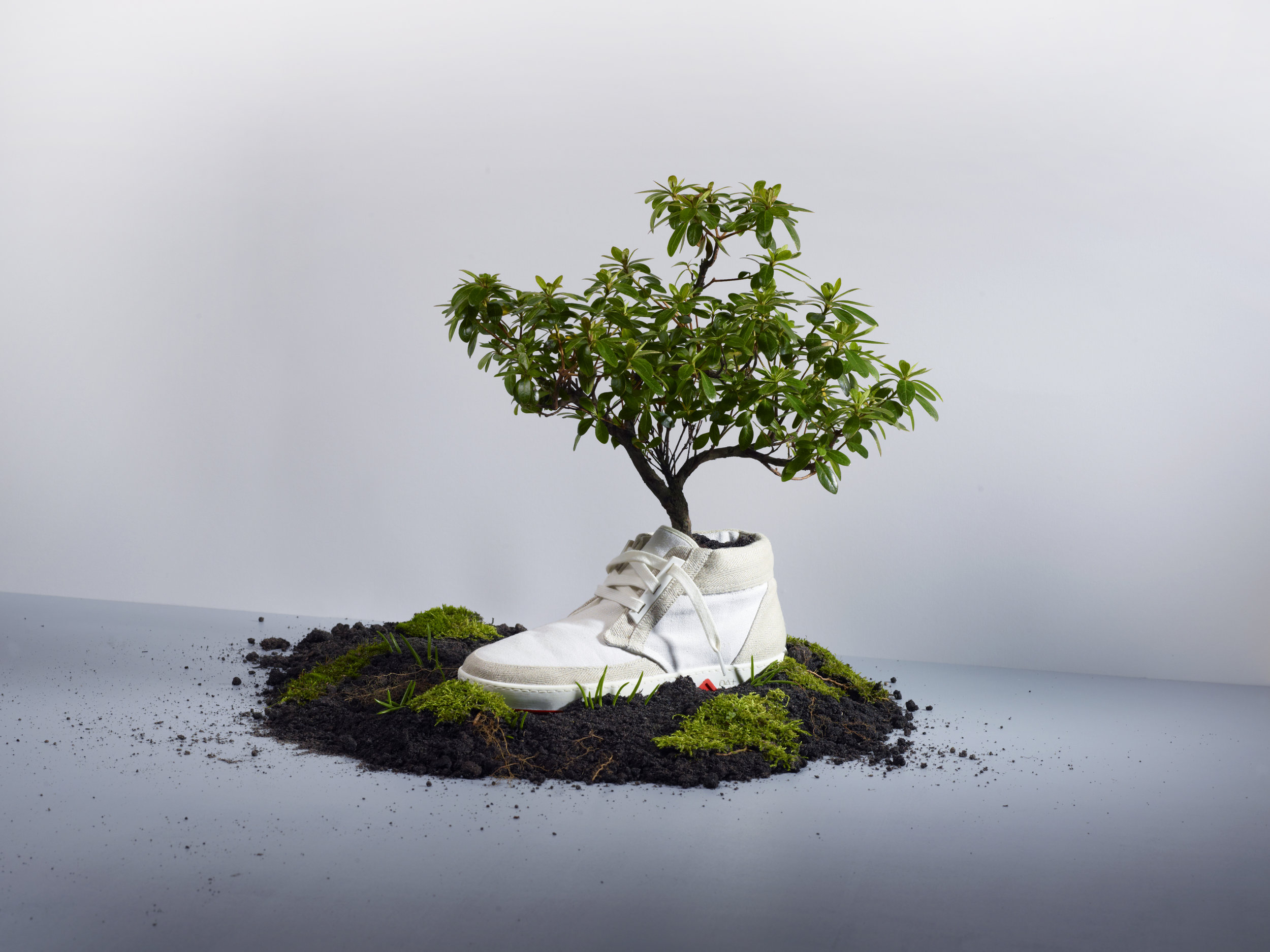
One of the companies vying to be first in sustainable footwear is Oat. Plant your shoes when done, the company says!

I try to follow sustainable practices, but shoes for an old person’s feet need to be pretty strong, which means that when they’re worn out, the pieces end up in a landfill. So now I’m wondering if the recent initiatives to improve the sustainability of shoes can work for me.

Here are some thoughts from the Washington Post.

Daliah Singer writes, “Thomas Bogle was logging dozens of miles on the spruce- and pine-lined backcountry trails that weaved around his home in Steamboat Springs, Colo., as he trained for an ultramarathon. His mind wasn’t focused on his target pace, though. Instead, he couldn’t stop thinking about the micro bits of plastic and rubber the soles of his shoes were shedding on the forest floor.

“With every step we take, our shoes leave behind an invisible trail of toxic contaminants that can potentially harm the soil, water and animal health.

“Nearly 24 billion pairs of shoes were produced in 2022. Each contains myriad plastics and synthetic, petroleum-based rubber. Of the 500,000 tons of microplastics that seep into the world’s oceans each year, up to 35 percent come from synthetic textiles, including footwear, according to one estimate, from the International Union for Conservation of Nature.

Footwear alone accounts for 1.4 percent of global greenhouse gas emissions, not that far below the airline industry, which is responsible for around 2 percent.

“Though shoe brands have taken strides toward sustainability, from offsetting carbon emissions to swapping out materials in the upper sections of shoes, they have largely overlooked soles. Now a slew of companies are starting to focus underfoot by developing new plant-based soles that won’t leave plastics behind when they degrade.

“Bogle, who spent eight years working in product development at a footwear company, is now working on an outsole from plant byproducts, while Keel Labs, a sustainable materials company started by two fashion design students, is making soles out of seaweed-based fiber. Native Shoes has a line of slip-ons made from an algae-based material, and Unless, a plant-based streetwear company in Portland, Ore., rolled out a shoe made entirely of biodegradable materials in conjunction with NFW.

“Shoes are designed ‘to last 1,000 years, and we use [them] for 100 days,’ said Yuly Fuentes-Medel, program director of climate and textiles at Massachusetts Institute of Technology. Americans alone toss out 300 million pairs of shoes every year. According to the Environmental Protection Agency, only about 13 percent of clothing and footwear is recycled in the United States.

“That’s partly because of the complexity of the shoemaking process. The average sneaker is composed of more than 130 individual pieces, according to Fuentes-Medel, who recently helped create the Footwear Manifesto, a report on how to make the industry more sustainable. Manufacturinga pairrequires at least 100 steps on average, including stitching and gluing, she said. That makes it nearly impossible to recycle them or take them apart to reuse their materials.

“The plastics in shoes also pose problems while consumers are wearing them. A 2022 study in the Journal of Hazardous Materials suggests abraded plastic from shoe soles reduces soil’s capacity to hold water and impedes photosynthesis. Another study, published in Science of the Total Environment, attributed mass coho salmon die-offs to 6PPD, a chemical added during tire manufacturing that is also found in footwear. …

“Bogle had an idea to create an entirely plastic-free shoe outsole — the component that was the first to wear out on his shoes during his long runs in the Colorado wilderness. He enlisted Gene Kelly, a professor of pedology (or soil science) at Colorado State University and a fellow runner, who helped develop a shoe sole made of beeswax, vegetable oils and plant byproducts such as leaves and husks from corn, hemp and other crops.

“Bogle’s company, Solum, partners with farmers and producers across the country to grow and harvest the materials, before converting them into bio-pellets and blending them with natural rubber to craft the sole.

“Instead of shedding toxic chemicals, Bogle explained, Solum’s soles deposit biologically derived nutrients back into the soil as they naturally wear down over time. A consumer survey by the company found that the average lifetime of a shoe outsole is around three years. Solum’s break down about 11 percent faster by design.”

Check out BlueView shoes and Ponto, too.

Read Full Post »

Photo: Claudia Wolff/Unsplash.
Do books use too much paper?

Those of us who still prefer a solid book to a pale, digital imitation may sometimes wonder whether we are encouraging the use of too much paper, especially since overstocks can end up in landfills.

Curiously, at least one publisher is thinking along the same lines.

Elizabeth Segran writes at Fast Company, “Over the past three years, HarperCollins’s designers have put their skills toward a new mission: saving paper. In an effort to reduce the carbon footprint of each book, they’re tweaking fonts, layout, and even the ink used. The goal is to pack more into each page, while ensuring that the pages are as readable as ever. And so far, these subtle, imperceptible tweaks have saved 245.6 million pages, equivalent to 5,618 trees.

“HarperCollins’s Christian publishing division, Zondervan Bibles, first came up with the idea of using design to save paper. Bibles have historically used upwards of 2,500 pages. In 2015, Zondervan’s designers determined that if they used different fonts and adjusted the page layout, they could reduce the number of sheets used. It would also cut HarperCollins’s printing costs. They developed a new compact typeface called the NIV Comfort Print. Ultimately, it saved more than 350 pages per bible, resulting in a total savings of 100 million pages in 2017. Stacked up, that would be the equivalent to four times the height of the Empire State Building.

“Tracey Menzies, the VP of creative operations and production at HarperCollins, wanted to see if the company could apply these learnings to other kinds of books. … The team got to work. They tested their theories with a large book in their catalog — more than 600 pages — by creating 50 versions of it using different fonts. HarperCollins uses a wide range of off-the-shelf fonts in its books, rather than custom ones. As the team ran the experiments, they observed that some fonts were more compact, resulting in fewer total pages, while remaining easy to read. So they curated a list of 15 fonts they determined are the most eco-friendly, which will be the preferred fonts from now on.

“In the end, the designers found that clever font selection, coupled with a thoughtful layout design that reduced white space, resulted in more words per page. For instance, in one example, the same text set to Garamond Pro resulted in many more words on the page compared to Bembo. Both fonts are fairly similar, with a classic serif look. And when you place them side by side, the differences are imperceptible. ‘The goal is to make these changes without the reader even seeing the difference,’ says Menzies.

“But there were also many complexities in the process. For instance, they had to consider the heaviness of the font. One font they used frequently is Bodoni, which was first created in 1798, and appears frequently in HarperCollins books. As a very heavy font, they realized they could fit more words on a page, while keeping it readable. But they also found that with very large letters, like subheadings, the ink would bleed through the paper, making it hard to read the words on the next page.

“ ‘The designer is always balancing out not just a single page, but also what’s on the page before and the page after,’ says [Leah Carlson-Stanisic, associate director of design at HarperCollins]. ‘Ultimately, this ended up with finding fonts that used less ink, in addition to less paper, which is also better for the planet.’

“Still, there is complex math involved with cutting pages from books. Printers produce very large sheets, which are then cut and folded into what ultimately becomes segments of 16 pages. When trying to cut pages from the book, designers need to be able to remove multiples of 16 pages. For the book So Fetch, for instance, using a more eco-friendly font saved nearly a million pages in total over the entirety of its print run. ‘We want to make sure our big titles, by prominent authors, are using these eco-fonts,’ says Carlson-Stanisic. ‘It adds up a little bit at a time, saving more and more trees.’ …

” ‘When we experimented with these fonts, we realized they weren’t a limitation at all,’ Menzies says. ‘It was simply a different approach that didn’t sacrifice aesthetics. Now, our designers are constantly questioning how we do things and thinking about ways to make things more sustainable.’

More at Fast Company, here.

Read Full Post »

Photo composite: Alessio Mamo.
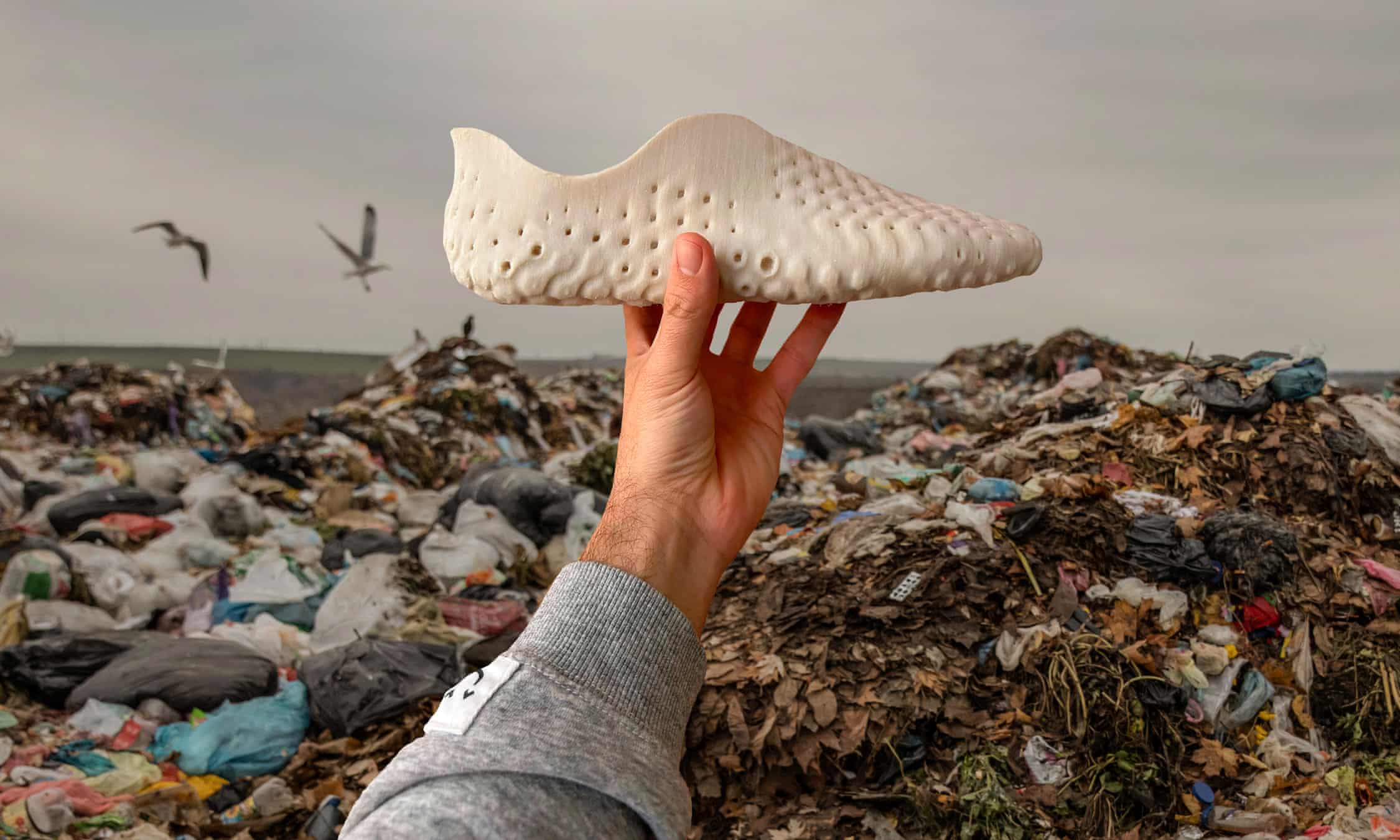
Compostable shoes are being created using 3D printing. 

Overthinking things can lead to a kind of paralysis. You want to do the right thing for the environment, you look for clothes not made with synthetics, wear the clothes many years, finally give them to Goodwill for others to use, and recycle raggedy textiles safely. But you know that a lot of this is still going to end up on the beaches of some African country. How can you do more? Do enough?

And what about shoes?

Well, one step at a time. You have to trust that every little bit helps.

At the Guardian, Patrick Greenfield writes that there is now such a thing as a compostable shoe. “The shoes may not immediately strike you as the future of mainstream fashion. Pale and porous, they resemble a cross between a beige Croc and the long-net stinkhorn fungus found on forest floors. Their creators, however, hope this will be the next huge breakthrough in sustainable footwear: the world’s first 3D printed, made-to-measure, compostable shoe, which can be broken down at the end of its life, in an attempt to stem the flow of millions of shoes into landfill each year.

“Fashion is among the world’s top polluting industries. It is responsible for about 10% of global carbon emissions and consumes huge amounts of water and land for production. Modern shoes are among the hardest items to produce sustainably because of their complexity, say industry experts, and there are few reliable statistics about the number manufactured every year for the world’s 8 billion humans. There is an almost total dearth of statistics about their environmental impact.

“Most shoes are composed of a mixture of synthetic fabric, rubber, plastic and metal, which is often held together with strong adhesives, and they are incredibly difficult to dispose of. The vast majority are bound for landfill once used, where they could take hundreds of years to break down. There are efforts to pioneer recyclable trainers [sneakers] for the world’s $70bn (£55bn) industry, with some brands offering services if customers post back.

“To produce its new compostable model, the London-based shoe company Vivobarefoot has joined forces with a material science company, Balena, to create prototypes of the shoes, which are not yet available for sale. They will be manufactured based on in-store foot scans and then printed over 30 hours. Once they have worn down, the footwear can be returned for composting at an industrial facility. …

“Says Asher Clark, a co-founder of Vivobarefoot. ‘This is about reimagining the way things are done from linear, offshore production to the world’s first scan-to-print-to-soil footwear. It is a vision for cutting out a lot of waste in supply chains and providing an end of life solution for the footwear industry.’

“There are caveats to the sustainability claims of the shoes, says Clark, which will be sold for between £200 [$255] and £260 [$331]. BioCir flex, the patented thermoplastic used to make them is 51% biological materials, 49% petrochemical. It cannot be thrown on a compost heap at the end of the garden to break down – it needs to go to a composting plant. …

“ ‘There is a trade-off between the biodegradability and durability: that is the key tension. The external factors that break down physical products are things like light, heat and moisture,’ he says. ‘The challenge is to make a shoe that will handle all those elements but also respond to the elements that start to break it down at the end of its life.’ …

“Glue and other binding materials can make shoes difficult to recycle, even when new substances are used for their main components, such as cactus ‘leather’ – a material made from the leaves of the nopal cactus – and grape-skin derivatives, says Luca Mosca, fashion lead at the sustainability consultancy Quantis. He says it is still hard to say what constitutes an environmentally friendly shoe, and that consumers should use them for as long as possible. … ‘Shoes are very complicated products.’ ”

More at the Guardian, here.

Read Full Post »

Photo: matusgajdos17/500px.
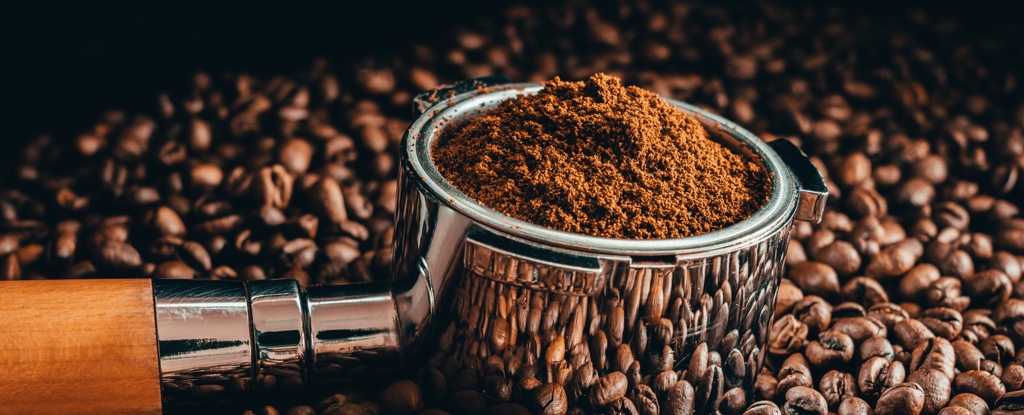
Australian researchers say concrete could be 30 percent stronger with charred coffee grounds.

Longtime coffee drinkers know that coffee is good for all sorts of things besides waking you up. Coffee grounds are great in compost, for example, and provide useful nutrients for your garden — nitrogen, potassium, and phosphorous.

But coffee grounds for construction projects? At ScienceAlert, Tessa Koumoundouros describes new research showing the possibilities.

“We could be producing concrete that’s 30 percent stronger by processing and adding charred coffee grounds to the mix, researchers in Australia discovered. Their clever recipe could solve multiple problems at the same time.

“Every year the world produces a staggering 10 billion kilograms (22 billion pounds) of coffee waste globally. Most ends up in landfills. ‘The disposal of organic waste poses an environmental challenge as it emits large amounts of greenhouse gases including methane and carbon dioxide, which contribute to climate change,’ explained RMIT University engineer Rajeev Roychand.

“With a booming construction market globally, there’s also an ever increasing demand for resource intensive concrete causing another set of environmental challenges too.

” ‘The ongoing extraction of natural sand around the world – typically taken from river beds and banks – to meet the rapidly growing demands of the construction industry has a big impact on the environment,’ said RMIT engineer Jie Li. … ‘With a circular-economy approach, we could keep organic waste out of landfill and also better preserve our natural resources like sand.’

“Organic products like coffee grounds can’t be added directly to concrete because they leak chemicals that weaken the building material’s strength. So using low energy levels, the team heated coffee waste to over 350 °C (around 660 °F) while depriving it of oxygen.

“This process is called pyrolyzing. It breaks down the organic molecules, resulting in a porous, carbon-rich charcoal called biochar, that can form bonds with and thereby incorporate itself into the cement matrix. …

“The researchers [are now] testing how the hybrid coffee-cement performs under freeze/thaw cycles, water absorption, abrasions and many more stressors. The team is also working on creating biochars from other organic waste sources, including wood, food waste and agricultural waste. …

“Said RMIT engineer Shannon Kilmartin-Lynch, ‘Inspiration for my research, from an Indigenous perspective, involves Caring for Country, ensuring there’s a sustainable life cycle for all materials.’ “

The research was published in the Journal of Cleaner Production.

More at Science Alert, here.

Read Full Post »

Photo: Alfredo Sosa/CSM Staff.
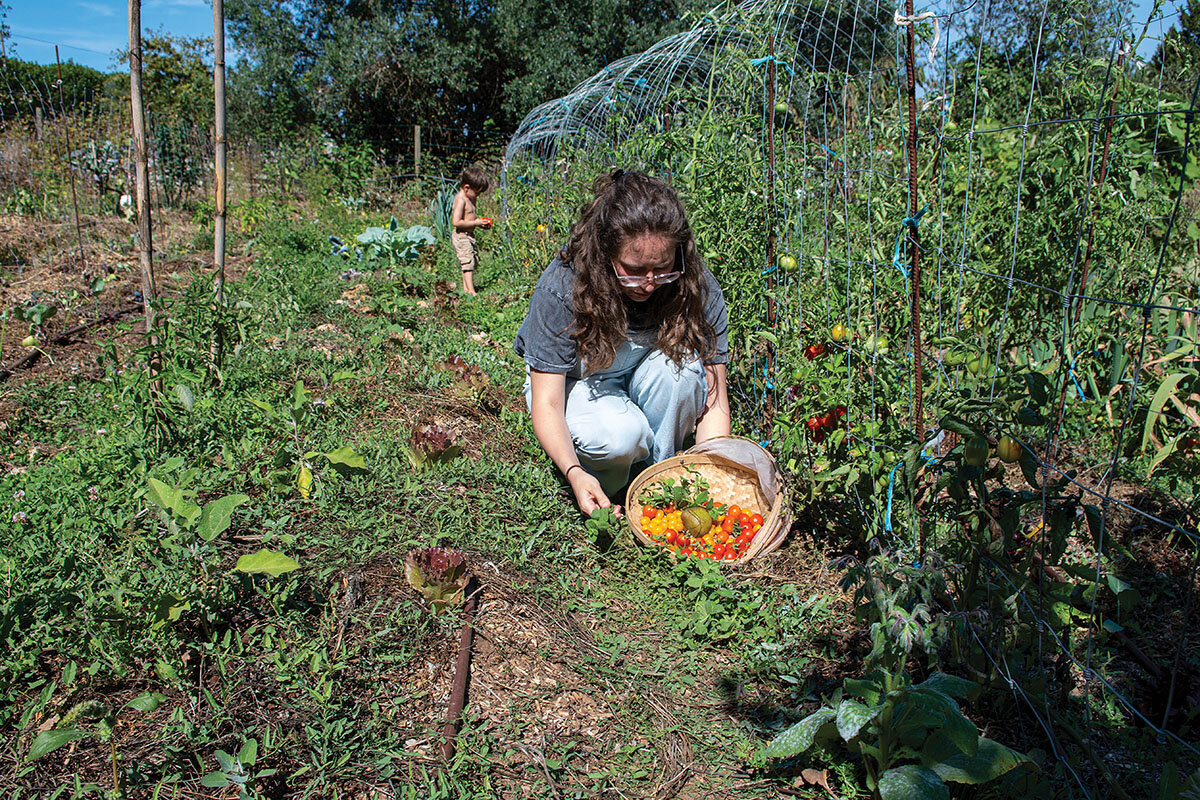
Rute Gabriel and her 3-year-old son, Isaac, pick tomatoes on their regenerative farming homestead, Projeto Liberta-te, in Porto de Mós, Portugal.

I’m impressed with the many young couples in today’s story who have chosen a life that is more friendly to the earth. My only question: how do people who are not 30 incorporate some of these principles into their daily lives?

Stephanie Hanes writes at the Christian Science Monitor, “For Rute Gabriel and Pipo Vieira, it was the tomato plant on their 25th-floor balcony in Toronto that convinced them to return home. 

“The couple, sweethearts ever since high school in this Portuguese region of stone-fenced fields and olive groves, were sharing an apartment with Ms. Gabriel’s grandmother. Their friends back home thought they had hit the jackpot. They had managed to move from the country to the city. They had immigrated to a higher-income country. And in the middle of the 2010s, they had jobs at a time when the global financial crisis – known here simply as ‘the austerity’ – was still hitting Portugal hard. 

“But the couple had a sense that something was wrong. They were in their 20s and working constantly in jobs they did not love. They missed the bright sunlight and rosemary-fresh scent of home, and had a growing unease about what felt like an unsustainable lifestyle – not only in their balance of life and work, but also in their lives and the environment. …

“Then one day, browsing the internet, Ms. Gabriel came across a YouTube video about ‘permaculture’ … a philosophy that focuses on re-integrating humans into their habitats in a way that’s mutually beneficial for people, the land, and animals.

“Ms. Gabriel was fascinated, she recalls. This was the sort of lifestyle she and Mr. Vieira were craving.  They tried to implement bits and pieces of permaculture at their high-rise apartment, putting a little tomato plant on their balcony, and then trying out ‘companion planting,’ in which they added peppers and carrots to the same container. …

“In 2016, they did what generations of young Europeans have avoided: They moved back not only to their homeland, but also to the countryside and an agrarian life. Their plan was to build a homestead and run Portuguese-language permaculture classes – to support themselves, to regenerate the land, and to help others create sustainable lifestyles. …

“Many of their friends thought they were crazy. … Over the past decades, some rural villages have dwindled to five, eight, or 20 people; schools have closed, and health clinics have shuttered. Portuguese farmers are the oldest in the European Union, with 51.9% above age 65, according to government data. Only about 6.4% are under the age of 40.

“But some in the Climate Generation – as we’re calling the cohort that was born since 1989 and into a world of accelerating impacts from a heating atmosphere – are bucking this trend. Government data shows a small but clear uptick in young people entering the agricultural sector over the past few years. And some are coming back to rural areas in Portugal to intentionally step onto the front lines of their country’s climate struggle, trying out new methods of climate-friendly food production. 

“The full size of this movement is hard to quantify because many of these young people hold other jobs and may not identify themselves as farmers for government statistical purposes. But it is recognizable. … The Climate Generation knows that what we eat, and how we grow it, has huge climate implications. Everything from shipping feed to making fertilizer to throwing wasted food in a landfill contributes to greenhouse gas emissions. But by focusing on rebuilding soil’s natural fertility, ‘regenerative’ farming practices can sequester carbon – a potential climate solution. …

“But food systems reflect something even more for the Climate Generation. Food is a tangible, everyday doorway into larger questions about how we relate to the earth and how we consume and share resources. Look at food closely, and it illuminates questions about how and why we work. It brings a tangible practicality to philosophical theories – about whether we keep demanding more by expanding and growing, about modern consumption and lifestyles, about what it means to continue extracting from a planet showing its limits in the form of wildfires, droughts, storms, and heat waves. …

“ ‘This is the future of humanity,’ says João Rodrigues, a 34-year-old artist-turned-farmer, standing by his tomato plants in the interior of Portugal. ‘To go small.’ ”

More at the Monitor, here. No firewall. The article has a lot of interesting detail.

Read Full Post »

Photo: Philippe Ruault.
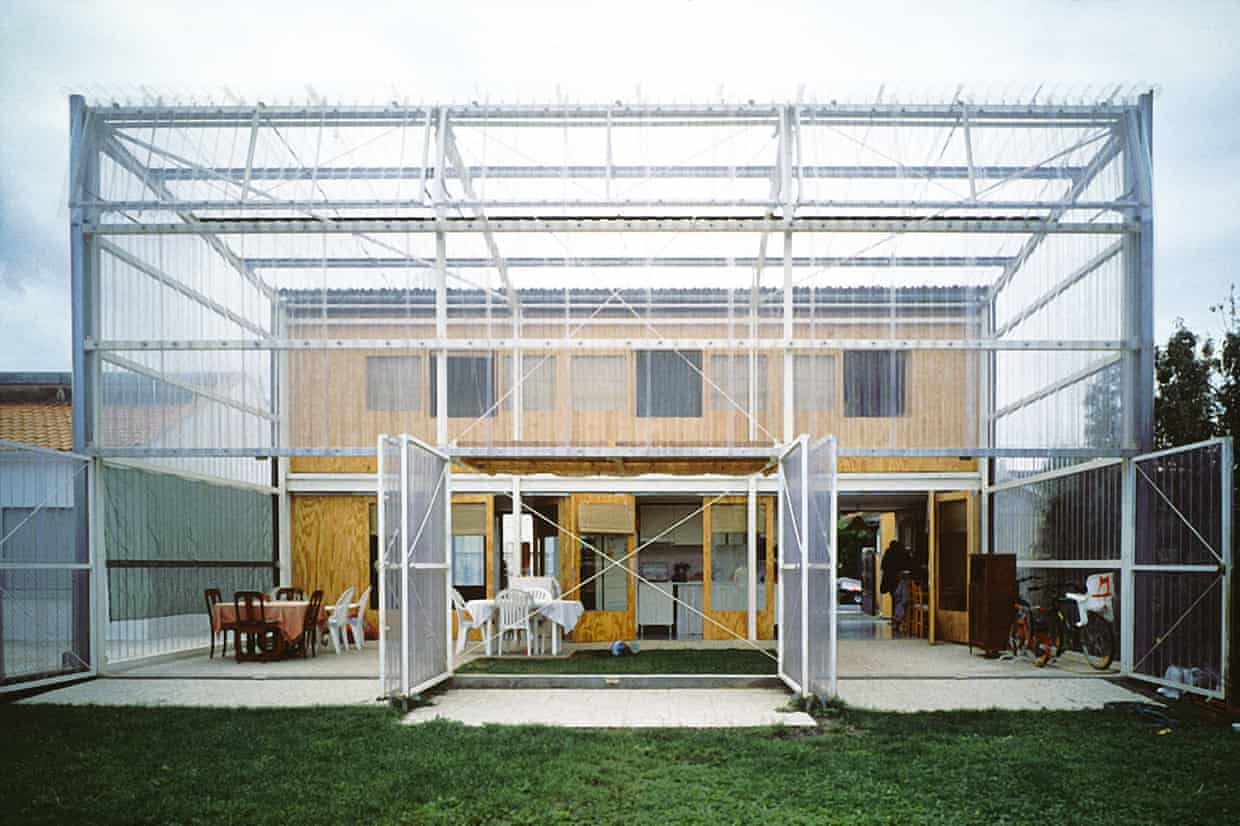
By adding a double-height conservatory at a family home in Floirac, Bordeaux, the architects “doubled the floor area their clients expected, while staying within a very limited budget,” the Guardian reports.

It’s generally considered cheaper and more efficient to tear down a building and build new than to renovate or reuse. Two acclaimed French architects have found the opposite, and their insights are timely. More people are realizing that standard construction practices are unnecessarily wasteful — and damaging to the planet.

Rowan Moore describes the architects’ approach at the Guardian. “The French architects Anne Lacaton and Jean-Philippe Vassal are famous for their belief in keeping existing buildings whenever possible, no matter how unpromising or unloved they may be. They follow, in effect, an architectural version of the Hippocratic oath – ‘first, don’t demolish.’ It’s a message that has never been more pertinent, as it dawns on the construction industry that constant demolition and rebuilding is an environmentally devastating activity.

“The husband-and-wife team have been putting this idea into practice for decades. … Keeping the already-there is not, though, their only concern, nor is it to do with sustainability alone. They like to use words such as ‘generosity,’ ‘kindness’ and, above all, ‘freedom,’ which means that they are always looking to find and create spaces additional to those asked for in a brief, ‘with no utility, no function,’ as Vassal puts it, ‘in which the user will feel the possibility to be inventive for themselves.’ …

“ ‘We really feel enclosed in a brief,’ says Lacaton, ‘that has so many rules, so many recommendations and impositions.’ … They strive against an attitude that ‘in architecture everything must be quantified… everything should be uniform.’ …

“In the early 1990s, they designed a new family house in their home city of Bordeaux, where they doubled the floor area their clients expected, while staying within a very limited budget. Their secret was to erect a double-height conservatory built like a simple greenhouse, which gave a sense of generosity and freedom to the rest of the house, a two-story structure with also basic construction. …

“[They have] a fondness for adapting humble and disregarded ways of building. ‘We found we were conditioned by our education as architects,’ says Lacaton, ‘to say that one way of constructing is the right one and the other one is not good. We discovered that we could use any tool, any material, anything if it’s used in an intelligent way.’ They also developed the idea of reusing the already-there, as with a seaside house in Gironde, south-west France. which was built among 46 pine trees, along with arbutuses and mimosas, without cutting any down. With the Palais de Tokyo in Paris, a 1930s building remodeled as a centre of contemporary art in two phases, in 2001 and 2012, they took pleasure in making only minimal alterations to its damaged interior. …

“Where they differ from other architects is in their attitude to control. In the John Soane museum, every detail and experience is minutely managed and directed. Contemporary practitioners often photograph their works unpopulated, at the precise moment between completion and inhabitation, where the perfection of their idea is most immaculate. For Lacaton and Vassal, it’s important to know when to stop, when to leave it to residents to occupy and embellish their homes. They enjoy and photograph the different things that people do to their spaces.

“Their way is humane and intelligent. It’s also invaluable. In Britain and elsewhere, there’s a desperate need to create more homes without incurring unacceptable bills for carbon emissions and energy consumption. Reuse is an obvious answer.”

More at the Guardian, here.

Read Full Post »

Older Posts »