Feeds:
Posts
Comments

Posts Tagged ‘theater’

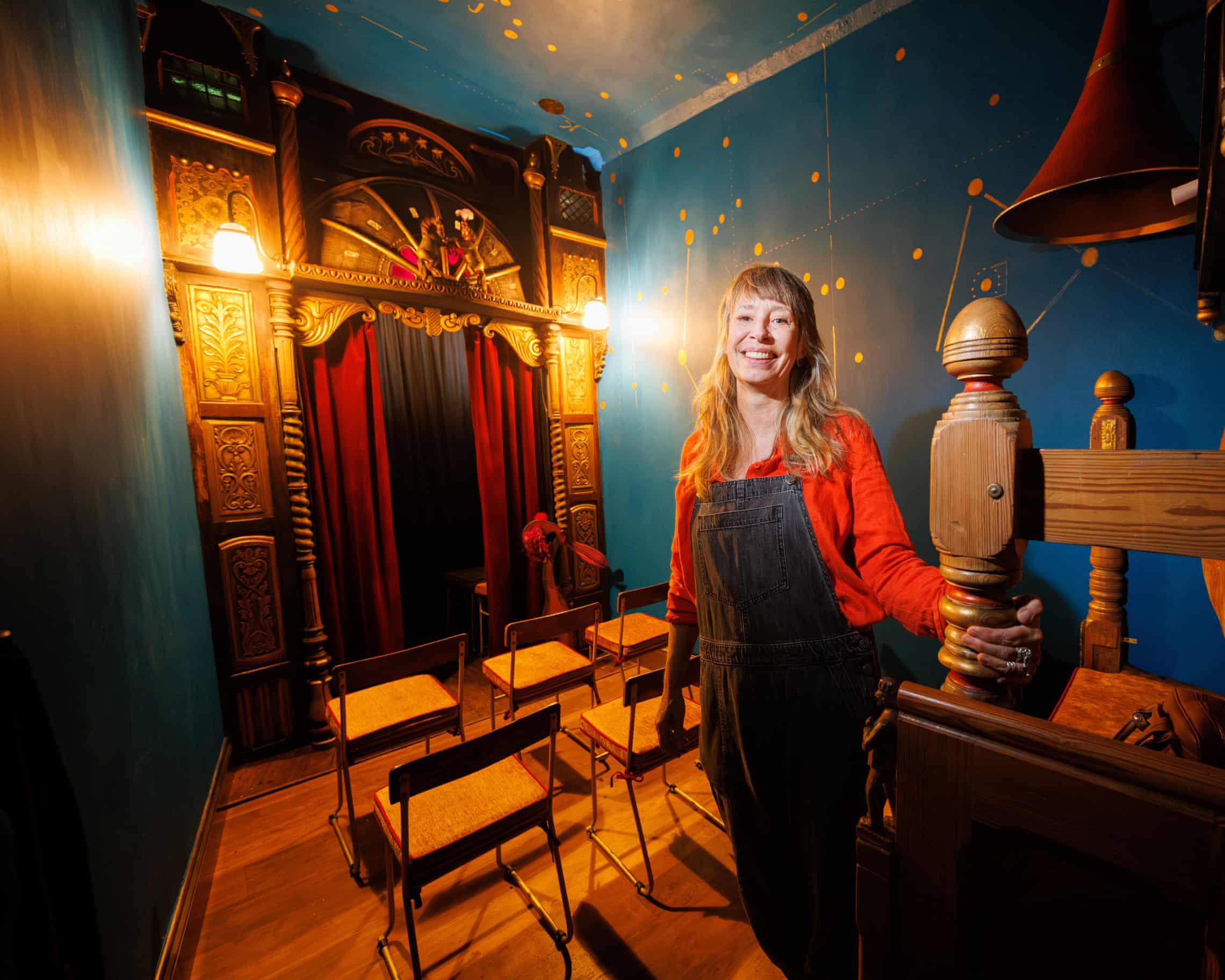
Photo: Sam Frost/The Guardian.
Loz Samuels, creative director of the tiny Theatre of Small Convenience, believes that in the digital age it is ‘really important’ to keep places like this alive. 

People care about having the arts in their lives. It’s not all about big donors wanting to show themselves in designer clothes at a charity ball. Although they are needed, too.

It’s mostly about the audience.

Jessica Murray writes at the Guardian about how a threatened UK theater, housed in what was once a Victorian public toilet, was brought back to life.

“Perched on a sign above a tiny stage draped with red velvet curtains are the Latin words Multum in parvo. Meaning ‘much in little,’ it has become the motto of this minuscule establishment in the Worcestershire town of Malvern.

“This is the world’s smallest commercial theater, with room for 12 people – or 16 with some standing – that has been brought back to life by local residents after falling into disrepair and at risk of demolition.

“Called the Theatre of Small Convenience, it was once a Victorian toilet and measures just [108 square feet] – the stage itself is a snug [16 square feet].

“ ‘Places like this are so rare now,’ said Loz Samuels, the theatre’s creative director and co-founder of the community interest company which runs it. …

“The theatre was created in 1997 by Dennis Neale, described as a local legend and eccentric performer who spent 19 years putting on puppetry shows in the space that captivated local children. In its heyday it was a much-loved and unique claim to fame for Malvern, with the theatre entering the Guinness World Records in 2002.

“But after Neale’s retirement in 2017, the building fell into disrepair and was badly damaged by a fire caused by a dehumidifier. With a destroyed roof, damp floor and damaged walls, local residents began to fear it would be lost for ever, especially with talk of a development next door. …

“Along with local volunteers Jan Birtle and Dibah Farooqui, [the community interest company] acquired the building from the council and raised [$22,000] from the local community to help get the renovation off the ground.

“ ‘It needs replastering, it needed rewiring, it needed a new floor, it needed underfloor heating. There’s obviously no room for heaters,’ Samuels said. …

“The theatre’s deep blue walls are adorned with a vivid gold constellation – with stars ‘sponsored’ by local residents – while intricate wooden carvings frame the stage.

“The challenge hasn’t been plain sailing, and Samuels has fears for the long-term future of the theatre. The team were recently rejected for Arts Council funding, and … with just 12 seats, making the space financially viable will take some creative thinking.

“Set to open its doors in October [2025], the theatre’s first show is Sceptre, a seance-themed immersive show designed specifically for the space. There are plans for a Narnia-style Christmas grotto and even weddings in the future.

“ ‘It is a challenge to find work that fits in here,’ she said. ‘But I feel like the building creates opportunities, you’ve just got to be imaginative. You can make real sensory experiences because you can control the light. As soon as you step foot in here, you forget the world outside, you could be anywhere.’

“Neale, who still lives locally, has also given the project his blessing and recorded a message that will be played at the start of future performances.

“ ‘I think what he did is so quintessentially English and so special,’ Samuels said. ‘He’s really happy, although I think at first he was a bit like, Who is this crazy woman?  …

“Samuels is urging performers and artists with original ideas for the space to come forward, and despite some nervousness, is optimistic for the future of the venue.

“ ‘I feel like it’s a strangely magical place and I just believe that the universe will look after it somehow,’ she said.”

More at the Guardian, here. No paywall.

Read Full Post »

Photo: Rory Murphy.
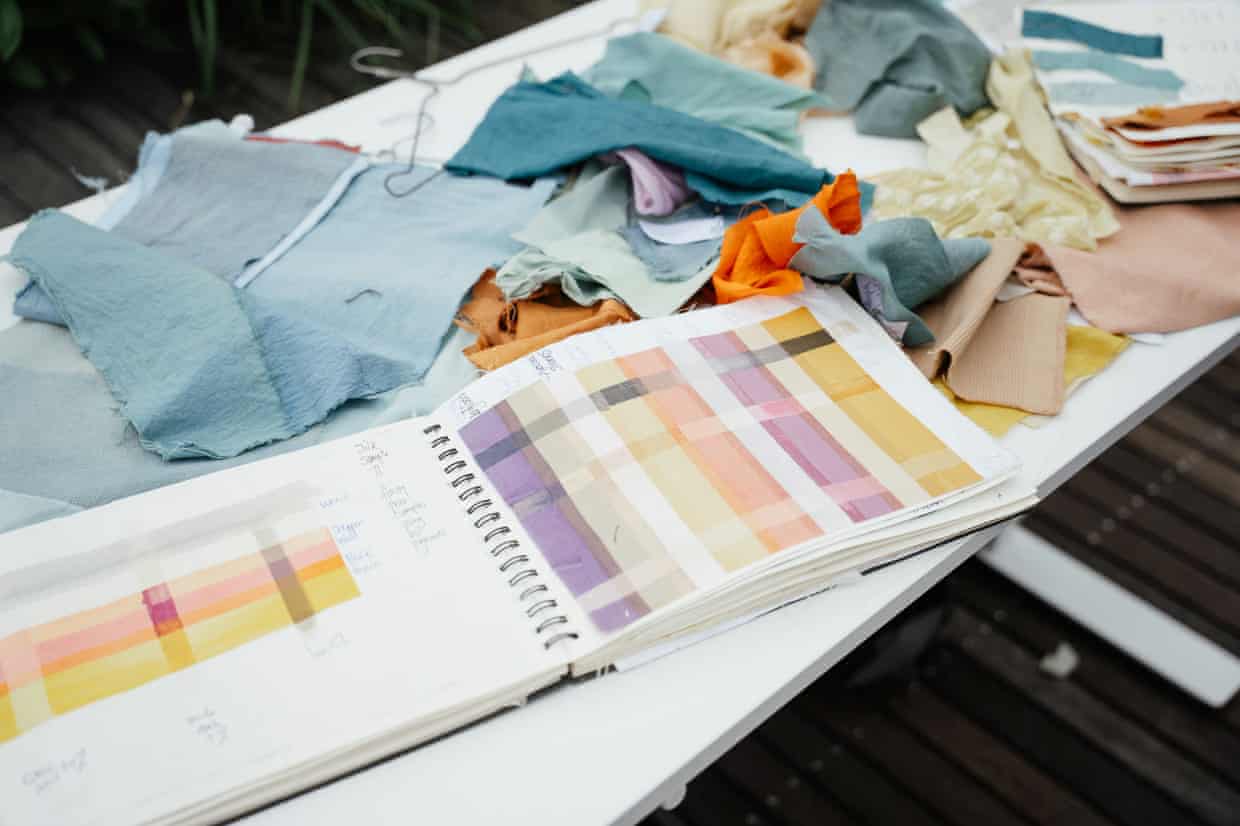
Chemical dyes are often toxic for the environment and bad for human health, and that is why the National Theatre in London is planning to use natural dyes from a rooftop garden in its costumes.

My friend Ann is deep into using natural dyes for her textile art, and she even grows the plants that are used for those dyes. It is not just that she is concerned about all the synthetics in our environment, she loves the colors that nature produces.

In London, the National Theatre is on the same track.

Helena Horton  writes at the Guardian, “Squint at the roof of the grey, brutalist National Theatre on London’s South Bank and you might be able to spy a riot of color spilling from the concrete. This is the theater’s new natural dye garden, from which flowers are being picked to create the colors for the costumes worn in the theater’s plays.

“Chemical dyes are often toxic for the environment and bad for human health, so the costume designers at the theater are experimenting with using flowers including indigo, dahlias, hollyhocks, camomile and wild fennel to create the vivid colors used in their productions.

“The textile artist, Liz Honeybone, is buzzing with excitement about the opportunities the new garden is bringing. … She has been very concerned about the health impacts of using harsh, synthetic chemical dyes, which require users to be swaddled in protective clothing. …

“ ‘There used to be a thing called dyer’s nose, which is basically when the aniline dyes came in,’ Honeybone said, ‘They used to destroy your nasal membrane.’ …

“The theater is planning to use natural dyes from the garden in every production at the South Bank going forward, starting with Playboy of the Western World, which is on this autumn and winter.

“Claire Wardroper, costume production supervisor at the theater, said it was ‘a beautiful early 19th century piece, with lots of nice woolly jumpers, because it’s set in rural Ireland, and we can certainly get some nice colors into them.’ …

“They are trying to bring a gentler, more environmentally friendly way of dyeing into the mainstream. ‘We are saying that if you want to use this horrible synthetic dye, you can do that, but you can achieve this beautiful look by using a natural dye, and we can do it a little bit slower and a bit more sort of organically,’ said Honeybone.

“Wardroper added: ‘It’s unfortunate to say, but the theatre and film and anything creative in one-shot opportunity entertainment has a history of being incredibly wasteful.’ …

“Honeybone said: ‘It’s been such a good harvest. My indigo is more than I can cope with. I’ve got three shows going on at the moment, so I’ve had to recruit people to help me.’

“People may imagine the colors extracted from flowers will be muted compared with synthetic dyes, but Honeybone said this could not be further from the truth and she has been able to create neon greens and yellows. ‘Our forefathers were drowning in color. They loved it, it wasn’t hard to get and all the tapestries that were up on the wall were a riot of color. What we’re seeing now is the sad, faded leftovers,’ she said.

“Honeybone says she has become ‘obsessed’ with natural dyeing. ‘My daughter gave me a bunch of flowers on Mother’s Day, and I noticed there was some golden rod in it, so whisked that out and dyed with it just to see what it yielded. And it was the most glorious, strong yellow.’

“The garden is not only used for dyes but also as a refuge from the hustle and bustle of the theatre. The pair said actors were frequently seen pacing among the flowers, or sitting down on benches to learn their lines.

“The space is also a haven for wildlife. The grey concrete of the South Bank does not have a huge amount to offer pollinators, and they have been swarming to the garden to sample the nectar from the varied dye plants.

“Wardroper said: ‘We’re seeing so much more wildlife, like hummingbird moths, and we’ve got bees on the National Theatre roof which produce honey for the National Theatre. And they’re loving the variety of plants that we’ve planted as well. These are a new stock of plants that they just haven’t had access to. So the bee person that comes in and caters to the bees is very happy.’

“The pair hope that most if not all of the costumes at the theatre can eventually be produced using natural methods. But for now, Honeybone is enjoying the opportunity to start using these dyes.

“She said: ‘This is such an all round sensory experience, totally engulfed in the smells and the feeling. … It is just wonderful.’ ”

More at the Guardian, here. (Gotta love that someone in this earthy-crunchy field has a name like Honeybone and that Wardroper oversees the wardrobe!)

Read Full Post »

Photo: CBS.
Topper was a television series based on the 1937 film Topper, which was based on two novels by Thorne Smith. Topper’s house was haunted by the ghosts of the former occupants.

At least as early as Ancient Greek playwrights, thespians have had to find ways to create ghosts onstage — and later, in film. Today’s story for Halloween explains how it can be accomplished.

Margaret Hall writes at Playbill, “Theater has always been good at making the unreal feel like it is in reach. Whether it be transporting an audience across time, space, or even dimension, the suspension of disbelief that theatre inspires is a rife playground for the imagination. Audiences eat up the opportunity to believe in the impossible. …

“That impossible belief has, for centuries, included a glimpse into the afterlife. Be it Hamlet’s ghostly father or the hallucinatory son in Next to Normal, theatermakers love to explore what may be just outside the realm of our awareness. Over the centuries, a whole host of techniques have been developed to demonstrate the concept of ‘spirit’ onstage. …

“Perhaps the most important technical advancement in the art of stage spirits is Pepper’s Ghost, an illusion that has been so successful that it has changed our very conception of what a ghost is supposed to look like.

“Before Pepper’s Ghost, spirits were most commonly portrayed as quasi-corporeal, walking the same floorboards as the living and obeying many of the same rules of physics that govern flesh and blood. After all, how is a ghost supposed to make the haunting sounds of footsteps if their feet never touch the ground?

“Pepper’s Ghost changed all of that. Named for the English scientist John Henry Pepper, who popularized the illusion in the 1800s, the technique is an early example of projection work onstage. … While the Ancient Greeks had to rely on body doubling and shadows to project different forms, Pepper’s Ghost harnessed light. Using a specially arranged room out of view of the audience, a plate of glass would be placed at an angle to reflect the interior of the hidden room out toward the audience.

“While the glass would remain hidden for much of a performance, at key moments the stage lighting would be angled to catch the reflection of a brightly lit actor in the hidden room. The audience would then perceive the hazy projection as a ghostly figure located among the actors on the main stage. Due to the necessary angles needed to make the glass undetectable, it was functionally impossible to make the projected actor appear as though they were standing on the same floor as the actors on the main stage. Instead, a floating ghost was popularized, as was the idea of a ghost fading in and out of visibility (such levels of solid-ness could be adjusted by dimming or brightening the light shone on the hidden actor).

“Pepper’s Ghost immediately became a sensation. Imagine how it must have felt to watch Macbeth swing to strike the ghost of Banquo for the first time, only for his sword to pass through him! … While the technique is now nearly 200 years old, it is still employed across the globe. …

“The principles of Pepper’s Ghost serve as the foundation from which many more digitally based techniques have since developed. The use of reflection, light, and spatial projection are practically the cornerstones for modern stage illusions.

“It’s no secret that projections and LED screens are all the rage on stage these days. Their ability to transform a space with very little transition time is prized, bringing elements of the filmmaker’s toolkit into the theatermaker’s arsenal. While some shows now rely on digital projections (remember Dear Evan Hansen?), many have found a middle ground, blending the digital and the practical to great effect.

“Consider McNeal. … While the dead remain six feet under in the new play, the show does deal with a modern kind of poltergeist: Artificial Intelligence and its impact on the art-making process. McNeal incorporates a number of cutting-edge digital techniques, including deep-fake technology (which digitally alters images and videos of real people), and generative artificial intelligence (which creates images out of written requests).

“At various points in the play, star Robert Downey Jr. is transformed on screens built into the set using deepfakes, appearing at various points to be Ronald Reagan, Winston Churchill, Barry Goldwater, and more. … In McNeal’s climax, director Bartlett Sher strips away the technology, going even further back in theatre illusion history than Pepper’s Ghost to call upon one of the simplest analog tricks: body doubling. After an hour of high concept digital effects, the switch back to practicality is shockingly effective.

“Though digital effects have become more common in recent years, for many ghostly shows, practicality is becoming the hot new trend. After all, when you can’t trust anything you see on a screen, it is easy to yearn for the simplicity of something happening right in front of your eyes. In Les Misérables, the ghostly personages of Fantine and Eponine in the finale are simply played by the original actors draped in white, as are the ghosts of Our Town. …

“While it is important to explore the options new technology can open, it is also key to remember that sometimes, the simplest answer is the smartest.”

More at Playbill, here. Is anyone old enough to remember the ghostly couple (and their ghostly St Bernard) from the 1950s TV show Topper?

Read Full Post »

Photo: Alexandra Corcode.
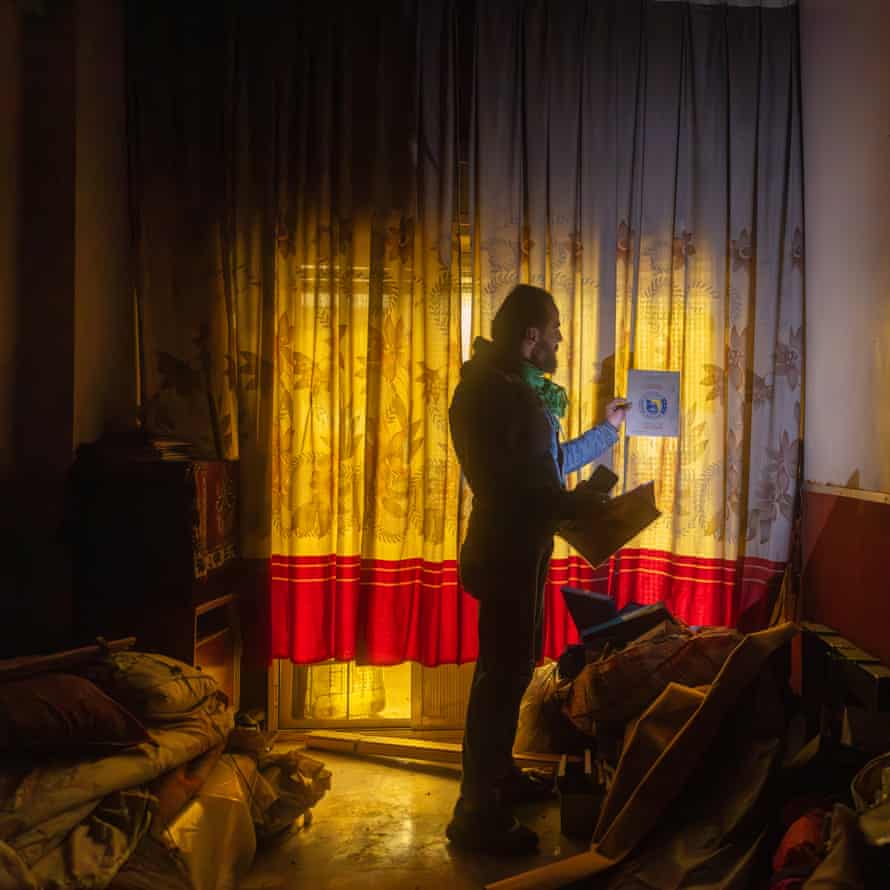
Mohamad searching for memories in a suitcase in Damascus. Their apartment was a stage — until the Assad government arrested them.

In today’s post, we learn more about how people living under repressive regimes keep culture and freedom going.

Andrei Popoviciu writes at the Guardian, “Thick layers of dust shimmer in sunlight as Mohamad and Ahmad Malas sift through old belongings in their Damascus apartment, abandoned for 14 years. …

“On one of the walls portraits of their father and one of their brothers, who have died, hang frozen in time. There’s no electricity so they use their phone torches to light their way as they collect personal artifacts they long forgot about.

“ ‘Looking around brings back so many memories,’ Mohamad says. ‘It’s painful.’

“For the 41-year-old brothers, returning to their flat is bittersweet. Their apartment was more than just a home. It was once a stage, a space where they performed original theatre plays away from the watchful eye of the Bashar al-Assad regime, which tightly controlled and censored artistic expression. In the two years before they left Syria, they performed more than 200 plays in their home.

“But their lives changed in 2011 when they were arrested for participating in the popular movement that started on the heels of the Arab spring and sought to remove Assad from power. Ahmad was wanted by the political police for sharing a revolutionary magazine with a friend, so the day security forces came knocking he fled immediately. Mohamad stayed behind to gather a few belongings before they escaped to Lebanon.

“Life there was uncertain, with Syrians facing the constant threat of deportation. Egypt offered brief stability, despite them feeling they could not continue their work as actors. Europe was where they felt they could freely perform with no censorship or threat. In 2013, they arrived in France as asylum seekers and speaking no French.

“Their first year in France was a struggle, spent moving from city to city, unable to work and battling to learn the language. Eventually, they were granted asylum and settled in Reims, in the country’s north-east. There, they rebuilt their acting careers, landing roles in theatre plays, films, and television.

“As they found their footing, they wrote and performed a play, The Two Refugees, chronicling the experience of refugees in France and inspired by their story. The production was a success and gained international recognition, taking them from Iraq to Japan and Jordan, often with the support of French cultural institutions.

“ ‘France gave us security and a chance to continue our art in a free world,’ said Ahmad. …

“They never imagined they would return to Syria. But as rebel forces were taking city by city, advancing toward Damascus in late 2024, they closely followed events from afar. Mohamad was at a film festival in Jordan; Ahmad was in France.

“On the morning of 8 December, Mohamad sent Ahmad a video. It showed people celebrating in a Damascus square, waving the revolution’s green flag and singing slogans against Assad. Ahmad could hardly believe his eyes. A deep longing stirred within them both. Soon after, Mohamad traveled from Jordan, and Ahmad followed from France.

“ ‘It felt like a dream come true,’ said Mohamad of the moment they entered Syria. ‘We felt like we could fly, it was surreal to walk through the streets and not see Assad’s photos everywhere.’ …

“The brothers knew they had to bring their play home, so they started performing it across the country, from Aleppo in the north to the coastal city of Tartus. They were unsure how an audience that had never left would react to a story of exile.

“ ‘Everyone understood it,’ Mohamad said. ‘I get it now – because even though they never left, they felt trapped in their own country.’ “

More at the Guardian, here. No paywall. Nice pictures.

Read Full Post »

Photo: Odelyn Joseph/AP.
A woman runs to take cover from gunfire during clashes between police and gangs in Port-au-Prince, a city where a theater company perseveres.

There’s something about theater people and defiance. Something that keeps them from giving in to the ways things are when things are bad. I’ve blogged here about the anti-government theater of Belarus and here about Ukrainians offering theater in the subway, away from Russian bombs.

In today’s post, Tom Phillips and Etienne Côté-Paluck report at the Guardian about Haiti.

“In a dimly lit rehearsal room in a city under attack, Jenny Cadet raised an imaginary pistol and fired a single make-believe bullet at her director.

“ ‘Life is a theatre. I am a theatre. We are a theatre. The world is a theatre,’ proclaimed the 31-year-old Haitian actor, turning to the audience as she uttered the tragicomedy’s final lines.

“Moments later, real-life shots rang out outside the stage school in Port-au-Prince – the latest act of violence in an increasingly terrifying drama that has forced tens of thousands of people to flee their homes here in the past fortnight alone.

“ ‘Every day [there’s shooting],’ sighed the play’s director, Eliezer Guérismé, as his company took a break from their read-through to the all-too familiar sound of gunfire. ‘But even with the shooting, we keep on working because that’s our mission. We don’t want to stop.’

As gangs tighten their grip over a city now almost entirely outside of government control, Guérismé, 39, said he saw drama as a key way of interrogating and denouncing the social and political crisis. …

“Theatre was also ‘an act of rebellion and resistance’ and a way of fostering renewal, given the politically charged violence into which Port-au-Prince has been plunged since the 2021 assassination of Haiti’s president Jovenel Moïse.

“ ‘People need to see the reality that they are living up on stage … theatre is the mirror of society … Everything we hear in this city – the sound of the bullets that are very, very present – we try to put on stage,’ the director said. …

“Nearly 4,000 people have been killed since the start of the year, according to the UN, as rifle-carrying gang fighters have advanced across the capital, opening fire on government buildings and burning homes.

“A US-backed policing mission has so far failed to restore order and in recent days the violence has intensified further with gangsters even attacking Pétion-Ville, one of the last supposedly safe enclaves in the hills over Port-au-Prince. … Foreign diplomats and aid workers are fleeing by helicopter amid calls for a UN peacekeeping mission to be deployed.

“ ‘It feels like the end of Port-au-Prince,’ Guérismé admitted this week. “Every day people are leaving their neighborhoods.’

“The Haitian director recognized that continuing to rehearse his latest production was a perilous business in a city where residents’ movements grow more restricted by the day.

“One of his troupe’s actors commutes to the drama school each day from Carrefour, a gang-run area to the city’s south which is effectively off-limits to outsiders. ‘I know he’s taking a risk to come. He’s taking a huge risk… Living in Port-au-Prince today requires a superhuman effort,’ Guérismé said. …

“But Guérismé was determined to fight on. … ‘It’s my country. It’s my homeland. It’s my city’ … and I have responsibilities,’ the director said as his group prepared for Port-au-Prince’s annual ‘En Lisant’ theatre and performing arts event. ….

“Philippe Violanti, the French dramatist who wrote Guérismé’s latest tragicomic play, had planned to fly to Port-au-Prince to see his work staged for the first time. But Violanti was forced to cancel after flights into the capital were suspended because three US aircraft were hit by gunfire while taking off or landing.

“Six of the seven foreign artists invited to the festival – from Guadalupe, French Guiana, France, Belgium and the US – have pulled out. Performances for primary and secondary school children have been dropped from the program. Some rehearsals are being held online.

“Guérismé said the mood was grim, but he believed it was essential Haiti’s acting community did not throw in the towel.

“ ‘The festival will not be postponed. We will go ahead,’ he vowed. ‘This is the time to make a gesture of hope – to affirm that life is here.’ ”

More at the Guardian, here.

Read Full Post »

Photo: Landmark Media/Alamy.
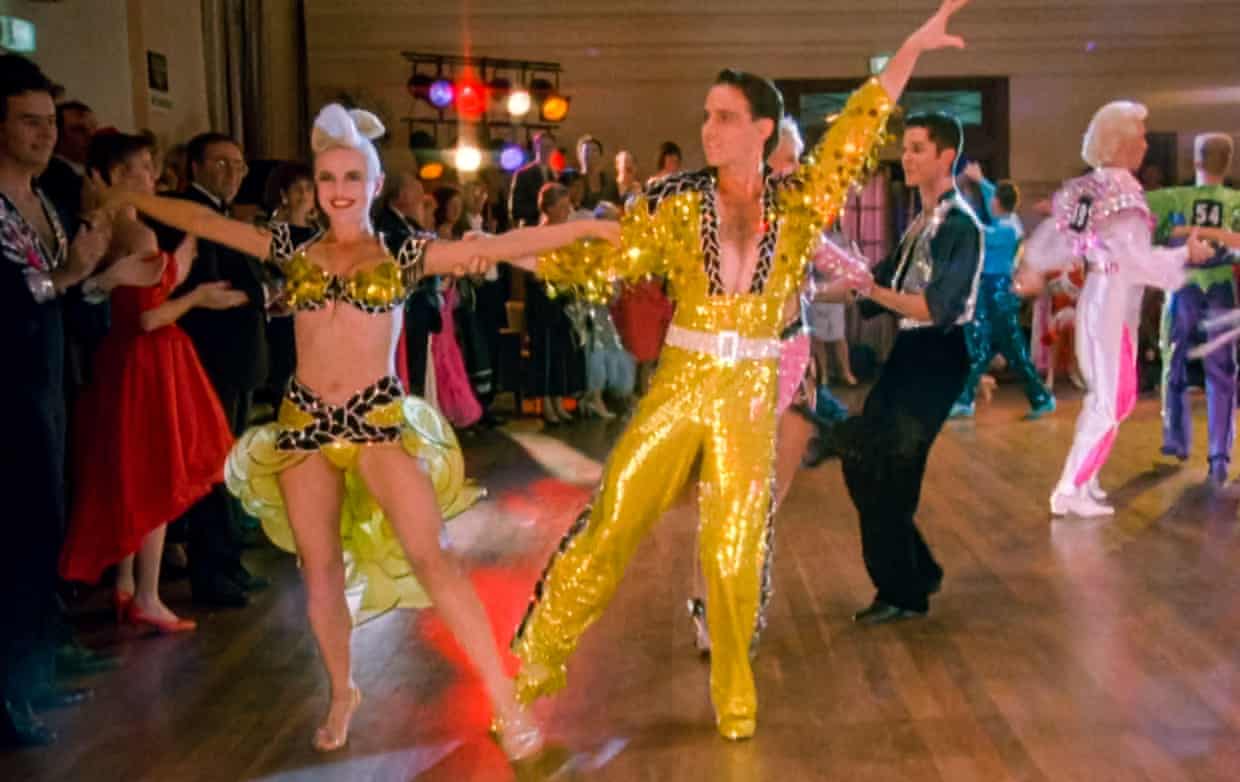
Gia Carides and Paul Mercurio in
Strictly Ballroom in a scene filmed in Australia’s Petersham town hall back in the day. 

This is not a new thought, but we all know of underutilized spaces and worthwhile organizations looking for space. How can we make sure we use extra space productively?

Here’s what Maddie Thomas at the Guardian says some Australian town halls are doing.

“It’s been more than three decades since Baz Luhrmann’s Strictly Ballroom was filmed in Petersham town hall. But earlier this year, the 82-year-old building in Sydney opened its doors to the Inner West Theatre Company’s production of the classic, free of charge.

“Beautiful brick early 20th-century town halls were once venues for council meetings, award nights and country dances. But in recent decades many have been under-used or left entirely empty as modern buildings serve changing community needs.

“Sydney’s Inner West council is the product of repeated amalgamations and, as a result, has an unusually large number of former town halls serving no obvious municipal purpose. Since July it has opened no fewer than seven as arts and culture venues with no hiring fees, hoping both to revive its old buildings and address a crisis in the performing arts sector.

“Since the Covid pandemic about 1,300 live performance venues around Australia have closed, leaving many in the music and arts industries struggling to stay afloat. In Sydney, revered institutions including jazz club 505 have been lost, and the number of people attending popular venues has almost halved.

“The cost of hiring a commercial venue for rehearsals and a final show can be as high as $80,000. In the first three months of the council offering its spaces free of charge, it has had more than 1,100 bookings across Marrickville, Petersham, Leichhardt, Annandale, St Peters, Balmain and Ashfield town halls, 72% of them for independent theatre, music or dance productions.

“Kane Wheatley is the musical director of the Inner West Theatre Company.

“ ‘Being able to have the town hall at no cost means that our money can be spent in putting on great productions and … providing affordable theatre in a cost-of-living crisis for members of the community,’ Wheatley says.

“His company has booked two musicals to run at the Petersham town hall in 2025. Tickets will cost $49, which just covers the costs of bringing in sound and lighting equipment. …

“The council’s mayor, Darcy Byrne, says offering affordable spaces for rehearsal, exhibition and live performance mirrors one of the original functions of town halls.

“ ‘Most town halls in Australia traditionally were used for dances, concerts, major events and so, in a way, by repurposing them as arts and cultural venues, we’re going back to their traditions,’ Byrne says. …

“After the second world war, [Lisa Murray, formerly the historian for City of Sydney council] says, councils began building civic centers to expand their services and in the 1950s there was an ‘explosion’ of municipal libraries. …

“Like many of their counterparts around the country, the Inner West buildings have retained Victorian or early 20th-century heritage features. … They offer large performance spaces with elaborate stages and commercial kitchens, and have been fitted out with live performance and recording equipment. …

“ ‘In a lot of them, the acoustics are challenging because they were designed in the era when people were giving speeches without microphones,’ Byrne says. ‘There’s acoustic treatments that may be necessary but absolutely, in every town across Australia, there is one of these beautiful buildings that’s currently being greatly under-utilized.’ …

“North of Melbourne (which is home to 30-odd town halls), Clunes is the third largest locality in Hepburn shire council. It has recently restored its town hall, built in 1873, after cracks began to appear in the masonry and the symmetrical facade started to rotate.

“The project manager at the council, Sam Hattam, says revitalization of the building gets the community engaged to start using the space.

“Thirty minutes away, the council’s headquarters at Daylesford town hall are also due to undergo restoration and electrical works later this year. Creswick town hall, renovated in 2021, is used for the newly established folk n’ roots music festival CresFest.

“ ‘The councils across Australia are spending millions and millions of dollars every year on the maintenance and repair of town halls because they have enormous heritage and civic value,’ Byrne says. ‘But the truth is most of them are sitting empty, dormant and unused for 80% or 90% of the time, which is just a waste of a great public resource.’

“Byrne hopes the momentum from such efforts will make other council areas think about throwing open their doors as Inner West has done.”

Is your town hall living its best life? What about other buildings — schools, parish halls, etc.?

More at the Guardian, here. No paywall.

Read Full Post »

Photo: C. Stephen Hurst.
A production of the play Coconut Cake at the International Black Theatre Festival in July 2024.

One of the interesting things about theater targeted at a particular group is that people from many demographics may be curious to see it. The production may become a kind of meeting place, a place of shared laughter and emotion. Just for example, the plays of Black playwright August Wilson were often tried out in Boston, where a very diverse audience jumped at the chance to see them.

To encourage and support more Black playwrights, several theaters have decided to collaborate.

Dorothy Marcic and Kimberly LaMarque Orman report at American Theatre, “Chicagoan and English professor Melda Beaty started writing plays in 2011 and sent them out to readings, festivals, and theatres, with limited response. Then she submitted to a contest — and won.

“Her life changed when the International Black Theatre Festival (IBTF) awarded her play Coconut Cake the Sylvia Sprinkle-Hamlin Rolling Premiere (SSHRP) Award, presented at the IBTF July 29-Aug. 3 in Winston-Salem, N.C. Named after the co-founder of the IBTF, the SSHRP award includes ‘rolling premieres’ at several Black theatres. …

“The idea for the award came from IBTF artistic director Jackie Alexander, also North Carolina Black Rep’s producing artistic director. Recalling his experiences in New York seeing great plays that disappeared after a single run, Alexander wanted to try another model. As he put it to us, ‘We have these great Black theatre companies in major cities, and if we work together on a worthy play, we don’t need critics, we don’t need funding — we can create a hit of our own.’

“He’d been talking for a number of years with various artistic directors on how to collaborate, including at a dinner with the founder/executive director of Memphis’s Hattiloo Theatre, Ekundayo Bandele, and with the artistic director of Houston’s Ensemble Theatre, Eileen J. Morris, who recalled discussions about what their theatres could do to create art in the most efficient and economical way.

“When Alexander called and asked Morris if her theatre could be one stop for the rolling premiere of a new play about Maya Angelou called Phenomenal Woman, while its writer, Angelica Chéri, was still writing it, Morris noted, ‘For me, that was cool because I believed in the play. I believed in the experience. I believed in the opportunity. Despite not seeing the final script yet, I trusted in the process. The fact the first play was about Dr. Maya Angelou — that was a great selling point.’

Their goal for the first project was to share resources: designers, director, costumes.

“Though they wanted a female director, Morris was already booked to helm several plays in her own season, so Alexander stepped in and directed productions in both North Carolina and Houston; each theatre came up with its own funding. …

Phenomenal Woman played first in North Carolina, and by the time it opened in Houston it was selling out already because of the buzz from press in Winston-Salem. That success led to Phenomenal Woman to be picked up by producers with an eye on New York. …

“Hattiloo was recently able to produce Beaty’s Coconut Cake, [a] play about five senior men (four Black, one white), who meet every morning at the same McDonald’s to talk about marriages, health, and ambitions, while playing chess and learning important life lessons. This time around, each rolling premiere production of Coconut Cake is being produced on its own, without sharing designers or directors — a structure that allows both bigger-budget theatres like Houston’s Ensemble and theatres with fewer resources to each have their own vision. …

Coconut Cake has been in the oven for a while; it first appeared at IBTF in a reading in 2017. This was followed by a 2020 virtual reading through Houston’s Ensemble Theatre, in collaboration with St. Louis Black Rep. Ron Himes, St. Louis Black Rep’s producing artistic director, was initially skeptical.

” ‘I was one of those adamantly opposed to streaming theatre,’ he said, ‘and I had told everyone, no, we’re not doing it. Then Eileen called, and I was in. And you know, it worked. It was great!’ …

“Another Coconut Cake cast member was the indomitable Count Stovall, who had been in the original 2017 festival reading. An avid chess player, he had inspired Beaty with some moves she uses, particularly at the end of the play, when the audience sees that the king only can move a couple spaces at a time, while ‘the queen is everything.’ Stovall also told us even though memory loss was not explicitly written into the play, the fact that all actors were in their 60s and 70s meant, ‘It was there — you just didn’t see it.’

“Also joining for the Coconut Cake rolling premiere program was the Westcoast Black Theatre Troupe (WCBTT) of Sarasota, Fla. Founder/artistic director Nate Jacobs had been mentored for years by Sprinkle-Hamlin and her husband, Larry Leon Hamlin, the Festival’s co-founder and also the director of Jacobs’s first production at the IBTF.

“As Jacobs continued attending the festival, bringing other artists, he remembered what Sprinkle-Hamlin had told him about the festival: ‘We Black artists are competing with each other. But we ain’t got anything — no money. We need to unify and become stronger, because no other people are obligated to tell our stories.’

“So when Alexander asked if Westcoast would join the rolling world premiere program, Jacobs immediately agreed. ‘The show was a hit,’ he said of Westcoast’s production of Coconut Cake in June. ‘It popped. I was happy, again, to propel another artist.’ Beaty came and took notes, making changes as the show progressed through the various productions. ‘She’s a phenomenal writer,’ Jacobs told us. ‘And we need quality. [Audiences] such as ours, love Black culture, but they don’t want mediocrity, which means we have to be better than the best.’ “

More at American Theatre here.

Read Full Post »

Photo: Ivan Honchar Museum.
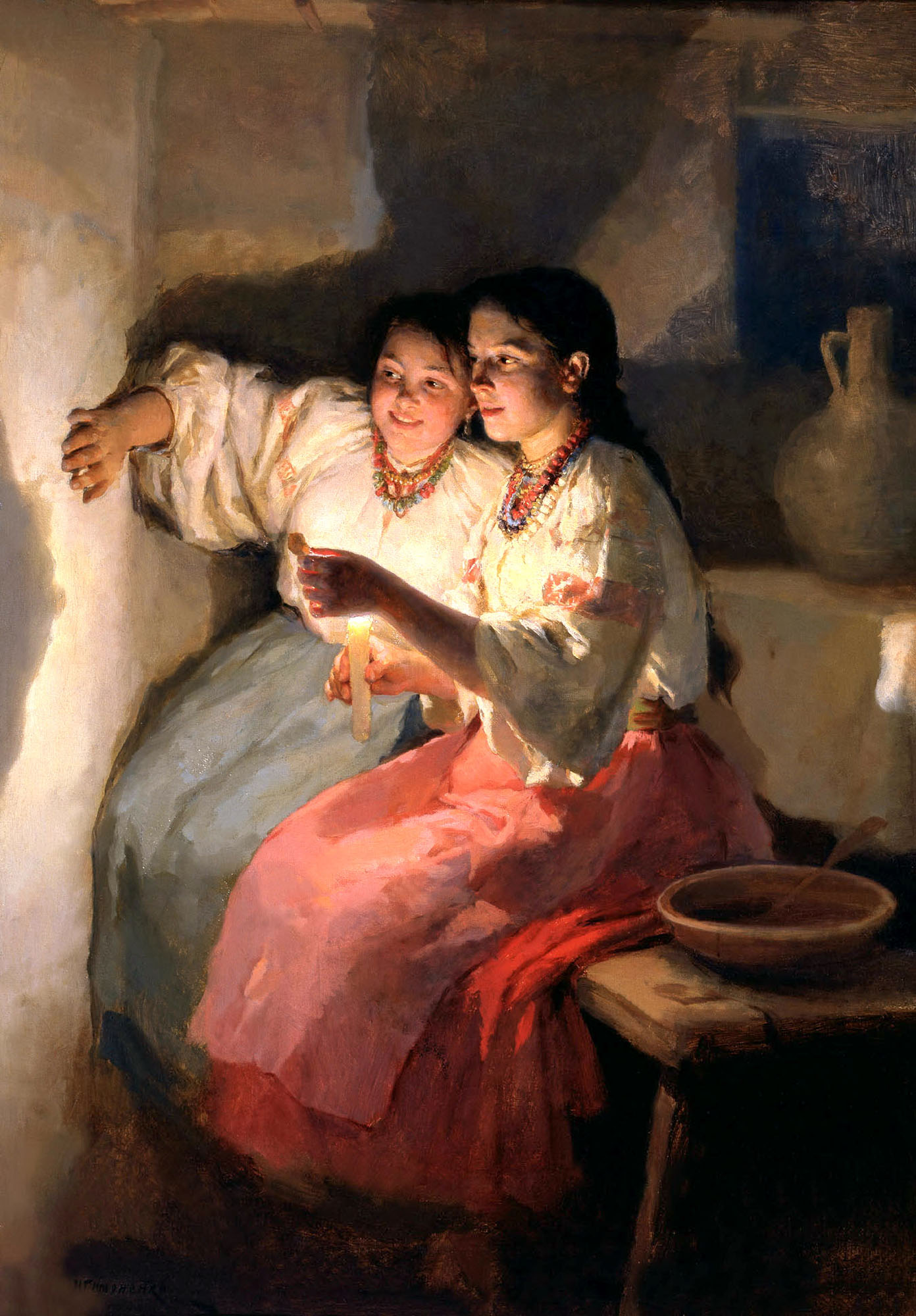
Witchy arts are part of Ukrainian folklore. The girls in the painting above (Divination by Mykola Pymonenko, 1888) are trying to predict the future.

Somehow, even in wartime, artists’ imaginations keep creating. Today’s story is about a new Ukrainian play that has captured the country’s attention.

Ashley Westerman at National Public Radio [NPR] tells us that “even though the plot takes place centuries ago, the play’s takeaways and parallels to today resonate with Ukrainians.”

Here are excerpts from the NPR transcript.

Westerman: In the early days of Russia’s full-scale invasion of Ukraine, a video surfaced online – a woman shouting at a Russian soldier sitting atop a tank. …

‘Do you even know where you are? You’re in Konotop,’ shouted the woman off-screen. ‘Every second woman here is a witch.’ …

“The video went viral in Ukraine, not just because of the woman’s defiance, but also because Konotop, a city in the country’s far northeast, is a place associated with witches. ‘Witches are a part of Ukrainian culture and Ukrainian tradition,’ says Khrystyna Fedorak, so you can rely on something having to do with witches going viral. This is one of the reasons the play Fedorak is currently starring in at the Ivan Franko Theater in the capital, Kyiv, has become a summer blockbuster. Fedorak plays the witch in the dark musical comedy The Witch Of Konotop.

“Based on the 1833 satirical fiction by Ukrainian writer Hryhorii Kvitka-Osnovianenko, this story leans hard on the stereotype that Ukrainian literature is full of sadness and tragedy. Taking place in the 1600s, the audience follows the main character, Zabryokha, a Cossack military leader in Konotop, pursuing the lovely Olena, but she rejects his proposal. She loves someone else. In this scene, Pistryak, Zabryokha’s cunning assistant, tries to confuse Olena’s love interest by accusing him of crimes he didn’t commit. …

“Then, in a twist of events that sounds a lot like today, Zabryokha receives an order to join a military campaign to help the Cossacks fend off an overreaching Tsarist Russia.

” ‘They order us,’ Pistryak says, ‘to take our Cossacks in Konotop to join the main army. There may be drills, or there may be war.’

“But Zabryokha refuses to go, saying he needs to stay in Konotop to root out the witch problem — the root, he says, of everyone’s problems. What ensues is a string of ridiculous, funny and very human moments. Spells are cast, couples are wed and, of course, there’s a witch hunt, meaning a swim test. If you’re not a witch, you drown. If you are a witch, you don’t.

“All with a larger threat looming over everything — Russia. But while that might be the most obvious takeaway from The Witch Of Konotop, the cast has some of their own ideas.

Kateryna Artemenko: Don’t kill women (laughter). Don’t mess with women. …

Westerman: Artemenko plays one of the townswomen mistaken for a witch. …

Artemenko: The main message is about people who — they’re trying to fool their destiny, but destiny will find them.

Westerman: Nazar Zadniprovskiy, who plays the ill-fated Cossack commander, views this play as a lesson in avoiding responsibility. … Zadniprovskyi says many people see a parallel with Ukrainian men dodging conscription today. …

“As the play ends and the theater’s mustard-yellow felt curtain drops to a thunderous applause, producer Polina Lytvynova and I ask a few audience members what parallels they drew. Olha Vasylevska is from Kharkiv, the northeastern Ukrainian city currently fending off an intense Russian offensive. She thinks the play is about love.

Olha Vasylevska: (Through interpreter.) If the love is true, it doesn’t need any outside assistance … but if the love is not true, nobody and nothing can help it, even the witch.

“Westerman: Markian Halabala, from Kyiv, says the message he took away is that you shouldn’t interfere in God’s will.

“Markian Halabala: (Through interpreter.) This is like Putin. He interfered in natural Ukraine’s way of independence. And Russians, they try to stop and prevent, like, [the] natural way of Ukrainian history with this war.

“Westerman: Critics say the many takeaways The Witch Of Konotop offers its audiences is one reason it’s been so popular. … But another reason is the overall push to celebrate Ukrainian culture and literature. Putin has repeatedly said victory, to him, means nothing short of Ukraine losing not just their sovereignty, but also their identity.”

Finally, Westerman spoke to Mykhailo Kukuyuk, who plays Pistryak. He speaks of the value of his country’s arts: “What are we fighting for? it’s the details, the sparks, that make us alive.” He adds that, while it’s sometimes difficult to block out the events happening outside of this theater, it’s an honor to perform for his country.

More at NPR, here.

Read Full Post »

Photo: A24.
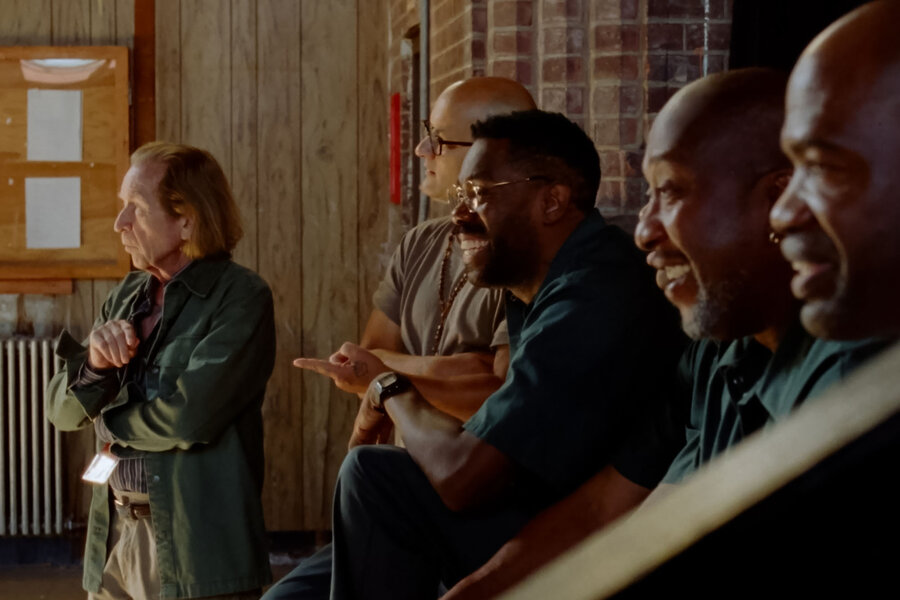
From left, Paul Raci, Sean San José, Colman Domingo, Sean “Dino” Johnson, and Mosi Eagle star in Sing Sing.

There are certain kinds of stories that always get my attention, and I’m grateful when other people find the same things interesting. Things like climate change, entrepreneurs, immigration, the kindness of strangers, housing, and life after prison. Just to name a few.

So you may be sure I liked today’s story about a theatrical production at a prison and the movie made about it.

Stephen Humphries writes at the Christian Science Monitor, “The world’s most unpredictable play only had one performance. It was staged inside a prison. The comedy, Breakin’ the Mummy’s Code, is about a man from ancient Egypt who embarks on a time travel adventure. Along the way, he encounters Robin Hood, Roman gladiators, cowboys, Hamlet, pirates, and – because why not? – Freddy Krueger from The Nightmare on Elm Street. It included a Shakespeare soliloquy – plus dance numbers. 

Breakin’ the Mummy’s Code was created by incarcerated men inside Sing Sing Correctional Facility in New York. It received a standing ovation in Cellblock B.

Now, a new movie explores the play’s legacy: the healing effect it had on its participants.

Sing Sing, directed by Greg Kwedar, reenacts the making of Breakin’ the Mummy’s Code. It even stars one of the play’s original actors. Already generating Oscar buzz, the movie … chronicles a budding friendship between two incarcerated men. Thematically, it’s about identity. The characters live in a hypermasculine environment that venerates bravado, toughness, and aggression. But the amateur actors come to discover that empathy, vulnerability, and tenderness are strengths, not weaknesses. The movie makes a case for the rehabilitative impact of arts programs inside prisons.

“ ‘I was a witness to it,’ says Mr. Kwedar, who taught an acting class in a prison with his creative partner, Clint Bentley, as part of their research. ‘I think the greatest teacher is what it’s like to step into another character and move in their shoes and step outside of yourself. That is a process of empathy’. … It gives you a prism to look at all the relationships in your life and to see perspective.’ …

“[Mr. Kwedar] spent seven years developing Sing Sing with Rehabilitation Through the Arts (RTA), the nonprofit that runs the theater program.

“There are dozens of similar theater projects across the United States. Perhaps the most well-known is Shakespeare Behind Bars. That program, which operates in three prisons in Kentucky and in one in Michigan, boasts a 6% recidivism rate for those who have participated in its productions. The Monitor was the first publication to write about that program. Then it became the subject of an award-winning 2005 documentary, Shakespeare Behind Bars

“ ‘Prisons function on shame and guilt,’ says Shakespeare Behind Bars founder Curt Tofteland, who has longtime collegial connections with the RTA. ‘But shame and guilt doesn’t change behavior. Why? Because shame and guilt doesn’t change thinking.’ …

“When change does happen, it’s a result of the actors exploring questions that the scripts raise, including ‘Who am I?’ 

“The two men at the heart of the story – John ‘Divine G’ Whitfield (played by Colman Domingo) and Clarence ‘Divine Eye’ Maclin (who portrays himself) – had to grapple with those existential questions. As the film unfolds, the audience learns that Mr. Maclin was one of the most feared men in the prison. Acting freed him to shed the gangster identity he’d clung to. The program helped him learn to express emotions. He even cried onstage. Now, he’s a natural performer on screen. …

“ ‘This is a movie about the landscape of the human face,’ says Mr. Kwedar. ‘It’s about drawing close to someone and looking them in the eyes and hearing their stories, and to know their names. And when you do that, it’s impossible to see that person as anything less than human.’

Sing Sing was filmed inside a recently decommissioned prison in New York. Its cast of established and first-time actors includes 13 RTA alumni. The production employed community-based filmmaking. For starters, it had a nonhierarchical pay structure. Everyone on set … was paid the same rate. …

“Last month, the director screened the movie inside the Sing Sing facility itself. He calls it the most profound theatrical experience of his life.”

More at the Monitor, here. No paywall. Subscriptions encouraged.

Read Full Post »

Photo: Thomas M Jauk.
This theatre’s climate impact report found wood made up half of the 41 tons of raw materials it used last year, but produced only 1% of its emissions.

What does it take to be climate neutral? This theater in Germany believes we all have role to play.

In June, Kate Connolly reported at the Guardian, “A handful of Spanish conquistadors fight through thick undergrowth to emerge in the ivy-clad ruins of a fallen civilisation during a rehearsal of Austrian playwright Thomas Köck’s Your Palaces Are Empty.

“Premiered last month at the Hans Otto Theater in Potsdam, south-west of Berlin, the bleak and unforgiving drama probes the wounds of a shattered capitalist world that has exploited its people and the planet’s resources.

“But it is not just the dystopian play that is embracing the subject of the climate crisis.

“The production itself has been declared climate neutral under a €3m [~$3.3 million] pilot project launched by Germany’s federal ministry of culture. The project, called Zero, is sponsoring the Potsdam theatrer and 25 other cultural institutions across Germany, from dance companies to libraries and museums, to completely restructure their creative modus operandi.

“ ‘It leads to restrictions,’ says the director, Moritz Peters, crouching on a wooden stool on stage as he takes a break from rehearsals. ‘But it also forces greater creativity.’

“No aspect of the process of making a play has been left unturned. From the lighting (switching to LED bulbs) to reducing travel (rehearsals are longer but less frequent to cut down on journeys) ‘everything has come in for scrutiny,’ says Marcel Klett, the managing director.

“Swapping to a green source of electricity in 2022 had already improved the theatre’s carbon footprint, reducing its annual 661 tons of emissions, or the ‘equivalent of 66 households,’ by more than 10%, but did not go far enough, Klett says. No less challenging is tackling a change in attitude. ‘Nurturing a sense that we all – from the set designer to the theatergoer – have a role to play and have to ask ourselves: “what can I concretely do?” ‘ Klett says.

“The costume designer, Henriette Hübschmann, says she initially struggled with having to abandon her usual task of creating new costumes from scratch. ‘At least half of the costumes have to come from the existing collection of props and costumes now,’ she says, on a tour of the wardrobe in the theater’s underbelly. ‘The rest should be from recycled, easily recyclable or renewable materials.’ …

“An inventory of its resources forms the basis of the theater’s first climate impact report. … It states that wood makes up half of the 41 tons of raw materials that the theater used last year, but is responsible for only about 1% of the emissions produced, while just four tons of steel and aluminum used in productions made up almost 30%. …

“Other forms of stage-set building are also being experimented with, such as growing constructions out of the organic building material mycelium. The potential use of this in other areas, such as exhibition architecture, is already being explored.

“Most [theaters], from a certain size upwards, will be required to do so from next year, under EU legislation that will treat theaters the same as all big commercial enterprises.

“Klett is hopeful of a knock-on effect among audiences and theatre staff as well as from other cultural institutes joining in. …

“He is appealing to local politicians to embrace the project by sponsoring the erection of solar panels on the theater’s roof and allowing the space – a former Prussian military stables – to be insulated, which is currently not allowed because the building is listed.

“The success of the project, though, will largely depend on the audience and the way they choose to travel to the theater. … Travel remains the theater’s single biggest polluting factor, contributing to about 50% of Hans Otto’s emissions. In response, theater tickets will double up as public transport passes in the three hours before and after the play.”

More at the Guardian, here. No paywall. Donations solicited.

Read Full Post »

Photo: Kasia Stręk/The Guardian.
Actors from Mariupol theatre and new recruits of the renewed theater, now in Uzhorod, rehearse for a piece called Poets Lived Here, depicting how lives have been changed by the war.

As with all stories about war zones like Ukraine, one hopes that positive news published yesterday — or a few months ago — is still true today. Consider an article by the Guardian’s Shaun Walker written in March that was a testament to the resilient spirit of the Ukrainian people.

“When the bombs hit the Mariupol Drama theatre, Vira Lebedynska did not hear a boom or a blast. From the recording studio in the theatre’s basement, where she was sheltering along with a few other theatre employees, the sensation was more like a vacuum.

“ ‘There was a whoosh, and a feeling that the air was being sucked out of the room,’ she recalled. A few seconds earlier, her cat Gabriel had suddenly tensed, perhaps sensing the sound of a plane overhead. … The 65-year-old actor and vocal trainer was one of about 20 theatre employees among the more than 1,000 people sheltering in the theatre as the Russian army laid siege to Mariupol in March 2022.

“The strike, believed to have been carried out with two 500kg bombs dropped from a Russian aircraft, came despite widespread knowledge that it was the biggest civilian shelter in the city. …

“[Now] in Kyiv, Lebedynska will perform in Mariupol Drama, a play based on the memories of four actors who were sheltering inside the theatre, all of whom speak about their own experiences from the stage.

“The four are among a small group of actors and staff from the theatre who have resurrected the troupe in Uzhhorod, in the far west of Ukraine. Performances take place in the vast, boxy auditorium of the city’s main theatre, which has offered up its stage for the Mariupol troupe. There are also occasional tours; [The March 16] performance will be the Kyiv premiere of Mariupol Drama. Props are minimal while costumes have been sewn from scratch or bought in local secondhand shops, but the spirit and sense of duty is high.

‘The body of our theatre has been destroyed, but the heart still beats here in Uzhhorod,’ said Hennadiy Dybovskiy, the theatre’s recently appointed 63-year-old director, who is originally from Donetsk.

“In Mariupol Drama, each of the actors brings a real artifact on to the stage that reminds them of their time sheltering in the theatre. For Lebedynska, it is cloakroom tag number 392; staff of the theatre wore the tags around their necks to identify themselves to others who might need help finding their way around. For 24-year-old Dmytro Murantsev, it’s the one-piece Spider-Man pyjama suit that he wore throughout the siege, as it was his warmest item of clothing.

“Also on stage in the play are Ihor Kytrysh, 43, and his wife, Olena Bila, 42 who have both acted at the Mariupol theatre for more than two decades. They left the theatre the day before the explosion, risking a drive across the frontline to get out of the city.

“They feel grateful they made it out, with their son, but like most people from Mariupol, they feel a sharp sense of loss for everything they left behind. …

“Lebedynska said she ignored her son’s pleas to leave Mariupol in the buildup to the war because she did not think full-scale war was possible. When the hostilities started, she took a rucksack of important possessions and Gabriel the cat, and made her way to the theatre. She and a few other theatre colleagues set up camp in the recording studio in the basement. …

“ ‘There weren’t that many people at first, but then someone opened the theatre doors and people started streaming in. They had heard there would be an organized evacuation from the theatre, but there was no evacuation so in the end everyone stayed there,’ she recalled.

“People cooked food on open fires outside, and carried various sets and props from the storerooms to sleep on. On occasion, some people tried to leave and drive out of Mariupol, but they often came back some hours later, saying they had been shot at.

“Lebedynska does not remember the aftermath of the strike clearly. … She walked for two hours through the ruined city, in a dressing gown, before stopping to stay the night in an apartment on the edge of Mariupol with the windows blown out. …

“It can feel strange playing with a skeleton troupe to a mostly empty auditorium, in a theatre a thousand miles from Mariupol in the opposite corner of Ukraine. But Dybovskiy said it was an important act of defiance to keep going. ‘This is the only professional collective that is flying the flag of Donetsk region. We won’t let the Russian Orcs appropriate our Donetsk theatre traditions,’ he said. …

“[Meanwhile, a] newly Russianized troupe has already been on several tours to Russian regions, and Moscow has sent in actors and directors to work in occupied Ukrainian territory. The theatre frequently takes part in ‘patriotic’ concerts devoted to Russian national holidays and its orchestra is called on to play military marches. …

“Lebedynska said that in the months after she had fled to Ukraine-controlled territory, she still had some contact by telephone with fellow actors who had stayed. ‘I think a lot of them had simply been waiting for the “Russian world” to come.’ …

“Murantsev said he thought these views were more of a coping mechanism, for people who could not bear to leave their home town. ‘I don’t think there were many super pro-Russian people there, I think they just feel “outside politics” and want to stay quiet,’ he said.”

There will come a time after the war, a time of rebuilding. And it will have to start with healing these sorts of divisions. Meanwhile, a reduced but feisty Mariupol theater will grow in the west.

More at the Guardian, here. No firewall. Donations encouraged.

Read Full Post »

Photo: John Labarbera.
Company 360 Dance Theatre in the show Nine.

To follow up on my recent post about deaf actors performing for general audiences, I have a related story about the use of signing in dance. I always felt that watching signing was like watching dance.

Lauren Wingenroth writes at Dance Magazine, “For Deaf audiences, watching performances with traditional sign language interpretation can feel like watching a tennis match: Their focus has to toggle between whatever is happening onstage and the interpreter, often off to the side, who might be communicating what the music sounds like or what’s being said. That’s if the performance even has an interpreter, which all too often is not the case.

“But attend a Company 360 Dance Theatre performance and the tables are turned. The Fredericksburg, Virginia–based company, led by choreographer Bailey Anne Vincent, who is Deaf, incorporates American Sign Language into all its productions. ‘If you’re a Deaf person, you’re in on the story more than a hearing person,’ says Vincent.

“For Vincent, using ASL in her choreography — which might mean incorporating a sign to emphasize an emotion a character is feeling, or to communicate what a lyric is saying — is both an artistic choice and an accessibility-related one. Though her audience is mostly hearing, ‘I still try to approach all our shows assuming there might be someone who is Deaf in the audience,’ she says. But it’s also just a natural extension of the fact that ASL is Vincent’s preferred language. ‘When I choreograph, the way that my mind thinks is in my own language,’ she says. …

“Deaf actress and dancer Alexandria Wailes feels similarly. ‘Dance and using ASL are both so embedded in who I am, as part of my identity,’ says Wailes through an interpreter. ‘I can’t really separate one from the other.’ …

“To get a sense of the deepening relationship between dance and ASL, look at choreographer and performer Brandon Kazen-Maddox’s career thus far. A GODA (grandchild of Deaf adults) and native ASL signer, Kazen-Maddox was long one of the New York City performing arts scene’s go-to interpreters, a reliable presence at performances, talkbacks, and more.

“But in 2019, choreographer Kayla Hamilton asked Kazen-Maddox to join her New York Live Arts Fresh Tracks piece not as an interpreter but as an artist. ‘She asked me to represent all sounds in sign language, and also use my body as a dancer,’ says Kazen-Maddox. ‘It was the most mind-shifting thing for me.’ …

“The experience was the beginning of a shift in Kazen-Maddox’s career, away from simply facilitating communication between­ Deaf and hearing individuals as an interpreter­ and towards an emerging genre Kazen-Maddox calls ‘American Sign Language dance theater.’ …

“Always key to this work, says Wailes: Deaf or Hard of Hearing performers who are ‘bilingual’ in dance and ASL. ‘If you’re trying to be more inclusive, great,’ she says. ‘Who are the people who are onstage? What are their lived experiences and how does this reveal itself­ in the work?’ …

“Until recently, Betsy Quillen experienced performances for Deaf audiences and hearing audiences separately. ‘It’s one or the other — it’s very isolated,’ says Quillen, who is a Hard of Hearing actor and theater director. …

“So when choreographer William Smith asked Quillen to collaborate with him on a piece for Roanoke Ballet Theatre that incorporated sign language, they had a clear goal: to make something that both Deaf and hearing audiences could understand and enjoy.

“ ‘My specific role was making sure that Deaf eyes would understand it, and that we were making our Deaf audiences feel welcomed and included and respected,’ says Quillen. ‘But we also made sure to show our hearing audience that this piece is made even more beautiful because we’ve included the Deaf audiences — that all of this ASL in every part of the production is enhancing the experience for everybody in the audience.’ “

More at Dance Magazine, here.

Read Full Post »

Photo: Lesley Black.
Theater company A Play, A Pie and a Pint produces up to 40 plays a year as well as two pantomimes in the Oran Mor venue in Glasgow, Scotland. Actor Elaine C Smith is pictured above.

I’m in the middle of reading a novel by one of my favorite mystery writers, Ian Rankin, who writes about Scotland. Besides his plots and characters, I love the Scottish slang. Sometimes I even have to look up expressions or words — Teuchter, Slainte, Howff. And it’s not just Gaelic words that are fun, but the Scottish way of putting English words together. For example, “getting mortal” means getting extremely drunk, smashed.

The murder mystery takes place during the offbeat theater festival known as the Fringe, which is why a recent BBC article about a Scottish theater group caught my eye.

Pauline McLean writes, “Established in 2004, A Play, A Pie and a Pint produces up to 40 plays a year as well as two pantomimes in the Oran Mor venue in Glasgow. It has given a platform to established names [and] has also helped new writers get a foothold in the industry, like Liam Moffat, whose play Jack opens the new season. …

“For Juliet Cadzow it is a bitter sweet moment. Her husband David MacLennan was the theatre director who came up with the idea. He died in 2014 after being diagnosed with motor neurone disease. …

“This is what he wrote at the time: ‘The actor Ralph Richardson once described acting as the art of keeping the audience from coughing. And Alfred Hitchcock said the length of a film should be directly related to the endurance of the human bladder. That’s why Colin Beattie and I started “A Play, A Pie, and a Pint.” ‘

“The first show was a play called Hieroglyphics, by Anne Donovan, author of Buddha Da. It was her first stage play. …

“Lunchtime theatre was already popular across Europe but the Scottish offer of a pie made it different, and brought its own challenges.

” ‘It was waiter service when it first started and everyone came and sat at long trestle tables and they were served their pie and It took time when it was busy,’ [actor Linda Duncan McLaughlin] says. ‘They wouldn’t have stopped serving before the play went up. So the waiters were trying to be quiet and and the audience were trying to be quiet but they were still eating.’

“But the concept quickly took off. ‘I think the fact that it was weekly helped,’ says Juliet. ‘If you didn’t like the play that was on that week, there would be a new one next week. And the audience were quite vociferous.

‘They would say to David “I didn’t like that one,” but they’d still come back the next week.’

“Those involved in the shows also liked the challenge of creating a 50-minute show with limited resources and rehearsals. Linda Duncan McLaughlin has written plays, as well as performing in them.

“She says: ‘You’ve got to get what basically is a full play into a fifty minute timeframe. You only have three actors, so if you wanted to write six parts, you’re going to have to be really good at writing doubling up parts and you have to make sure the actors can cope with that. It is limited but it’s a great discipline for a writer. And it really focuses your mind.’

“For some performers, it’s a chance to return to their roots, although Robbie Coltrane admitted his week long run in Peter MacDougall’s play My Father’s Old Suit in 2005 was a daunting one.

” ‘The idea of 500 Glaswegians drinking and having their dinner?’ he recalled in a 2010 documentary. ‘It’s like one of those Frank Sinatra concerts where all you can hear is the knives and forks clattering.’

“[Icelandic] writer Jon Atli Jonassan found the 2009 run of his play The Deep helped him into filmmaking. … ‘No one wanted to make it, but after the production here, we got interest from filmmakers. It was the most expensive film ever made in Iceland and was shortlisted for Best Foreign Film at the Oscars.’ …

” ‘If you’d asked us that first week, I’m not sure we would have been confident that we’d still be going twenty years hence,’ says Linda, who is co-chair of the Scottish Society of Playwrights. ‘It does offer an opportunity for new work to be on every week of the year for forty eight weeks of the year, which no other organization can offer. So it really does have a strong, vital part to play in Scottish theatre culture and long may it continue.’ “

More at the BBC, here.

Read Full Post »

Wigmaking for Theater

Photo: Antonio Olmos/The Observer.
Skilled wigmaker Violet Barrie at England’s RSC [Royal Shakespeare Company].

Although I was in many theatrical productions as a kid, the first time I learned anything about wigs was when I had chemo. I lost my hair and wasn’t brave enough to go to work without any. (John told Suzanne, who was living in Switzerland then, “Mom looks like a little, bald mouse.”) But Dana Farber was known for nice wigs, and I got one there that I liked a lot.

Today’s story from the Guardian is all about wigs for the theater. Which can get complicated.

David Jays writes, “It’s a sunny afternoon in Stratford upon Avon and I’m watching actors become witches. In Georgia McGuinness’s design for Macbeth, the witches seem to be mostly hair. Amber Sylvia Edwards and Dylan Read peer out from mountains of furry locks, each looking as if a yeti has fallen asleep on their shoulders. The tumble of tresses is so heavy, it needs a harness for support. Welcome to the wild world of wigs.

“Some hairpieces are bobby-dazzlers: towers of Restoration foppery, ravishingly long Rapunzels. Others slink by unnoticed, disguised in realism. Who makes them? Who pins them on night after night? To find out, I meet two wig mavens. Sandra Smith is head of wigs at the RSC [Royal Shakespeare Company], and has warmly invited me to spend the day with her team in Stratford. Chris Smyth, meanwhile, only recently began his wig journey: he designed a memorable crimson creation for Jane Asher in The Circle at the Orange Tree in London. …

“The RSC storeroom’s wooden doors conceal mop after mop of blondes, browns and russets. A separate cupboard holds periwigs and judges’ rugs, like a bevy of poodles. This hoard reflects a practice built on sustainability and thrift. Mounds of witchy hair were foraged from the stores, saving thousands of pounds. ‘Nothing goes to waste, even the ratty bits,’ Smith says.

“Wigs, like actors, never retire. ‘We keep them till they die,’ her colleague Lavinia Blackwell says matter-of-factly. … ‘Wigs is an area of theatre that has been drastically cut back,’ designer Tom Piper says. ‘People have disappeared and budgets have gone down. I’m so grateful for somewhere like the RSC, who’ve got the team and a lot of stock.’ …

“Only when I see the foundations for all the team’s creations do I appreciate the challenge of our lumpy, bumpy human variety. Some heads are footballs, some shaped for rugby. The wigs team wrap actors’ heads in clingfilm and wind round sellotape to map the cranium, marking the hairline. …

“Theatrical wigs take quite a bruising, and the hair may be reused, which helps explain why the V&A [Victoria & Albert] collection holds few early wigs – the oldest come from Diaghilev’s Ballets Russes in the early 20th century. Even so, key artifacts indicate their role in nailing character. When Vivien Leigh played Blanche DuBois in the film of A Streetcar Named Desire in 1951, ‘the wig fundamentally made her appear less glamorous,’ [says Simon Sladen, V&A senior curator of theatre and performance] says. Leading theatrical wig-maker Stanley Hall created ‘impoverished, rather thin hair … to point out her highly nervous, worn-out character.’ …

“It’s painstaking work. ‘You tie each hair with a tiny little hook,’ Smyth tells me. How did he acquire the skills? ‘I do drag and I make my own costumes,’ he says. ‘I did a couple of days’ training in wigs and just fell in love, because it’s so difficult. It’s like the dark arts. I will never know everything. Everybody does it differently; it’s a rabbit hole that keeps deepening and deepening.’ …

“Everyone’s route into wig world is different. Smith was studying hairdressing and beauty therapy in Pontypridd when a friend took a job at the RSC, and she visited for work experience. ‘I had a lovely two weeks and I haven’t left since. I’ve been with the RSC for 38 years.’

“I crouch beside Violet Barrie, who ran a salon in Leamington Spa until Covid struck. Hairdressing was a family trade in her Jamaican childhood, so the fascination began early – just as it did when Smith grew up in Wales, watching friends and neighbors who came to get their hair done by her aunt on a Thursday evening. No wonder the wig room feels like a hug. …

“ ‘We invade somebody’s space from the first moment,’ Smith asserts. ‘We’ve got to be really skilled, but equally sophisticated in personal care: 90% of our job is reacting to somebody’s needs.’ The team intuit who is comfortable, who hates to be touched. …

“In the wings, Thérèse Bradley, playing Duncan, rushes up with a huge beam and a hug for Smith. ‘These women!’ she says. However careworn you may be when you sit in the wig room chair, she says, you leave ready for anything. ‘They perform miracles!’ ”

More at the Guardian, here. No firewall. Donations solicited. Check out the wild wigs for the Macbeth witches.

Read Full Post »

Photo: Atdhe Mulla.
The play Negotiating Peace had its premiere at Pristina’s Oda theatre in October, before going on tour. 

Wars eventually end, but the peace that follows is often uneasy. Art can bring some laughs into people’s lives and add to the accumulation of small things that make a more lasting difference.

Philip Oltermann writes at the Guardian, “When political leaders present war as the only solution, it is up to artists to remind people that finding peace is still possible. That is the starting point for a Kosovo-based theatre company, Qendra Multimedia. …

“The lesson it draws, and the genre it chooses to present its findings, is unexpected: the Kosovan playwright Jeton Neziraj’s Negotiating Peace shows the diplomacy of peace as a farce, albeit a necessary one.

“Dramatizing roundtable talks between the fictional warring countries of Banovia and Unmikistan, the play is a frenzied comedy in which vain generals can only be lured to the negotiating table by promises of Hollywood films celebrating their actions. Opposing parties get drunk while negotiating demilitarized zones, mix up drafts of ceasefire agreements and sign on the wrong dotted line. Maps of disputed territories are partitioned with paper scissors until holy lands turn into showers of confetti. …

“ ‘When you talk about serious things, you must not talk about it in a serious way,’ said Orest Pastukh, a Ukrainian actor who is one of five members of Qendra’s multinational cast with first-hand experience of their country going to war. ‘If we would speak seriously about war and peace, everybody would go mad.’

“The play … is loosely based on the Dayton accords that in 1995 brought a halt to the three-and-a-half-year Bosnian war, the deadliest chapter in the breakup of Yugoslavia. At its premiere at Pristina’s Oda theatre last week, it also mixed in elements of the peace settlement that four years later ended the war in Kosovo. …

“To end that conflict between Serbs and Kosovo-Albanians in the breakaway province, Nato acted more swiftly and aggressively than it had done in the Bosnian war. In downtown Pristina, gratitude for the US’s assertive leadership in the peace talks is still palpable. There is a statue of a waving Bill Clinton, a bust of Madeleine Albright and a street named after Richard Holbrooke. …

“It may seem surprising, therefore, that in Negotiating Peace, moral certitudes come wrapped in sarcasm and not in pathos. The Holbrooke-type character, Joe Robertson, played by Harald Thompson Rosenstrøm, a Norwegian, is not just a ‘beast of peace’ but also ‘a schizophrenic, a brutal Mazarin.’ …

“ ‘When I read Holbrooke’s memoir To End a War, I realized that the negotiating table was also a kind of stage,’ Neziraj said on the eve of his play’s premiere. ‘And a dramatic stage on which actors were acting quite bizarrely,’ involving negotiators staging walkouts and new political borders ‘being drawn on napkins.’

“He said studying the Dayton agreement, as well as the Oslo accords signed between Israel and Palestine in 1993, had robbed him of the illusion that peace talks were structured conversations led by experts in their fields. ‘They are the fruit of the wills of individuals at a certain moment,’ Neziraj said. …

” ‘War doesn’t end when you lay down your arms,’ Neziraj said. ‘We in Kosovo live in an interim state, which is not war but neither a fully fledged peace.’ …

“Neziraj is aware of his own cynicism, and Negotiating Peace eventually manages to snap out of it. Towards the end of the play, the summit looks like a failure: faith in the UN is shot to shreds, there are calls for a second conference organized by the EU.

The chief negotiator appeals to the audience for advice to break the deadlock.

“As the play tours around the Balkans, the company intends to invite different real-life witnesses on to the stage. In Pristina the job fell to Aida Cerkez, a veteran Associated Press correspondent who covered the siege of Sarajevo from the Bosnian capital. Her 10-minute monologue changes the mood of the play.

“ ‘The only precondition for peace is to get everybody around the same table,’ she said after the curtain call. ‘And to get everybody around the same table, you have to militarily weaken the dominant side. As long as one side can think it can win, there’s no reason to sit down at the negotiating table. In Bosnia, that condition was met by Nato bombing. …

” ‘Peace is not the absence of armed conflict,’ she said. ‘In Bosnia we are living the absence of armed conflict, not peace. But that’s not nothing. It’s a lot.’ “

More at the Guardian, here. No paywall.

Read Full Post »

Older Posts »