Feeds:
Posts
Comments

Posts Tagged ‘theater’

Have you ever run into one of those pay-it-forward situations — when a stranger does you a small favor and then you choose if you want to do the same for another person? I was in line to buy coffee at a Jamaica Plain shop a couple years ago when the person in front paid for me. Then I paid for the person behind me. Fun. I blogged about the phenomenon here and here. It can be about helping someone who has few resources, but not necessarily.

Here’s a recent example of the practice. It involves theater tickets.

“A theatre in Rome has taken the tradition of ‘suspended coffees’ — where a person buys an extra drink for someone less well-off — and applied it to tickets.

“The initiative [ran] for just over two weeks at the Teatro delle Muse, where people buying tickets for a variety show [purchased] an extra seat at a reduced price to leave at the box office for someone else … The aim is to use a small charitable gesture to make the theatre accessible to everyone. The comedy show, called ‘You Are Not Neapolitans,’ [started] on 16 February. …

“The ‘caffe sospeso’ tradition originates in Naples, the idea being that when ordering your coffee you also anonymously gift another to a stranger in need. The idea has now spread internationally, and in some places has been adapted to include pizza or other food items. In a nod to the original Neapolitan custom, the theatre’s donated tickets [came] with a steaming cup of coffee … courtesy of a local bar.”

More here. Il Messaggero reported the story, and the BBC passed it on.

I’d love to know if you have encountered this kind of thing. Panera Cares, for example, was a noble experiment begun during the economic downturn in 2010 to help the hungry, but I read that the some of the locations ran into trouble.

Photo: Google Maps
The initiative at Teatro delle Muse is called “Theatre and Coffee… on hold for you”

Read Full Post »

Here’s a great story from the Japan Times about a theater group for people over 60. Where do I sign up?

Nobuko Tanaka writes, “At the age of 91, Saitama resident Izumi Noguchi is speaking at his first press conference — at least as an actor anyway.

“ ‘When I saw an advert in April inviting anyone aged 60 or older to audition for a new project called 10,000 Gold Theater, I just felt like challenging myself to do something I’d never had a chance to try before,’ he says.

“Noguchi is the oldest person to join the 10,000 Gold Theater ensemble. …  ‘Gold Symphony, my dream, your dream’ [is] a staging on an unparalleled scale that features some 1,600 performers (not 10,000 as the name suggests) who are all volunteers and almost all amateurs …

“Arts promoter Taneo Kato came up with the idea [when] he was watching a performance of ‘Hamlet’ in which stage icon Yukio Ninagawa directed members of the Saitama Gold Theater and Saitama Next Theater — troupes made up of older and younger actors that he formed in 2006 and 2009, respectively, after becoming artistic director at Saitama Arts Theater in 2006.

“ ‘Out of the blue, midway through “Hamlet,” veteran enka singers the Komadori Sisters — who are actually twins — appeared and sang “I Want to be Happy One Day,” ’ Kato says, recalling how striking a moment it was to see the women, born in 1938, sing those words.” More here.

I wonder how big an issue memorization is for the performers. My friend Dorothy started a group of older amateur actors in Concord, but they do readings and don’t have to memorize. I have many memorized stories, Bible verses, and poems in my head and can trot them out at a moment’s notice. Not sure if I could acquire new ones to the same extent.

Photo: Maiko Miyagawa
Massive undertaking: Seiji Nozoe directs elderly actors during rehearsals for the play ‘Gold Symphony, my dream, your dream,’ performed in Chuo-ku, Saitama City, December 2016.

Read Full Post »

The world’s oldest working actor has died at age 101. And good for him to have worked at something he loved for so long!

Shaun Walker wrote recently at the Guardian, “Vladimir Zeldin, believed to have been the world’s oldest working actor, has died aged 101, after appearing for 71 years at the same Moscow theatre.

“The Russian actor appeared on stage as recently as [September], using a walking stick due to a broken hip, to appear in the play The Dance Teacher by the Spanish playwright Lope de Vega.

“He had appeared in the play more than 1,000 times, Tass reported. The theatre had planned for him to appear again next February, to mark his 102nd birthday. …

“Zeldin was born in 1915, when Tsar Nicholas II was on the Russian throne. He shot to fame when he appeared in the film They Met in Moscow, on which shooting began shortly before the Nazi invasion of the Soviet Union in 1941. …

“When the war finished, Zeldin joined Moscow’s Red Army Theatre, where he was part of the troupe from 1945 until his death. The theatre is now known as the Russian Army Theatre. Fellow actors at the theatre described him as full of energy until the very last.” More.

I think the actress who played 104-year-old Great-Great-Grandmaw in All the Way Home (the stage version of James Agee’s A Death in the Family) must have been nearly as old as Zeldin. I remember her voice came out as kind of a croak. But that may have been because she was acting.

Photo: Alexander Zemlianichenko Jr/AP  
Vladimir Zeldin on stage in Moscow.

Read Full Post »

Actor Finn Wittrock wrote recently at the New York Times about helping to start a mini Shakespeare company in the 1990s to entertain his parents and other theater professionals. He recalls with wonder his young self’s confidence of success.

“I was born in the Berkshires in Western Massachusetts. I lived there until I was 6, then moved to Evanston, Ill., and later to Los Angeles. But every summer for most of my youth, I would go back East with my brother, my mom and my dad, who most summers was acting or teaching for Shakespeare & Company. I would often be cast as a page or an altar boy in one of the professional productions.

“I went in lieu of a summer camp; I went to romp in the Berkshires, see old friends, get out of the city. But mostly I went for the Very Young Company.

“Starting at the age of 8 and until I was 16, my oldest friends and I would get together every summer: Rory, Reilly, Wolfe, and later my brother, Dylan, and Wolfe’s brother, Tiger (yes, their real names) would arrange five or six scenes from Shakespeare, rehearse them on our own time in the sun-drenched Berkshire afternoons and perform them for the adult company after one of their Mainstage shows. We began the company ourselves and it ended when we were no longer ‘very young.’

“For a kid, it was an epic undertaking; an outlet for pre- and post-adolescent energies. We were totally self-motivated; nobody told us to do it, which was in itself an incentive. We’d choose a scene based on our own criteria: Had the company done it before? Could we make fun of them for it? Could we put Reilly in a wig and have him play a girl? And, most important: Did it end in a sword fight? …

Sometimes I yearn to have the boldness of one who knows nothing, who jumps onstage for no other reason than because he is young and has a loud voice.”

Later in his essay, Wittrock recalls something the celebrated director Mike Nichols once said about his own early years: ” ‘Why was I so confident back then? I had no business being that confident.’ And yet he attributed most of his early success to that unreasonable confidence. …

“No one gave us permission to do the Very Young Company; no one ordered us to do it, and no one had to boost our confidence to do it. We just did it. We were just kids howling Shakespeare to the Berkshire trees, and our readiness was all.” More at the New York Times, here.

At one point in my  childhood, I, too, was confident. I thought, if my parents would only call the movie theater and set it up, four of us kids — the Gordons, one of my brothers, and I — would be a smashing success performing our version of “Snow White and Rose Red” before the feature. The grownups didn’t quite believe in it.

Some neighbors and I did perform an original play about a snowman for family members. One of the actors returned a copy of the pencil-scrawled script to me at my aunt’s funeral in 2002, decades later.

Photo: Lauren Lancaster for the NY Times
Finn Wittrock, right, and Rory Hammond, enacting the killing of Lady Macduff and her son in a mini-“Macbeth.” The young actors formed their own company more than 20 years ago to entertain their parents and other professionals at Shakespeare & Company in Lenox, Mass.

Read Full Post »

A musical based on a winning 1950s Mademoiselle college-contest story, Doris Betts’s “The Ugliest Pilgrim,” is playing at the Speakeasy Stage in Boston, and it’s pretty special. My husband and I saw it yesterday.

The Violet of the title is a young woman from North Carolina who has saved up enough money to take a bus to Tulsa, Oklahoma, to beseech a television faith healer to resurrect her face, disfigured by a hatchet accident in childhood.

In spite of being an ornery character, suspicious of ridicule, she is befriended on the bus by two soldiers and an old woman, none of whom believe in the faith healer.

The group splits up, and Violet makes it to the television studio. Having first accosted the faith healer, she enlists her own belief, her carefully chosen Bible verses, and her childhood memories and fears in a dreamlike growth process that resonates on many levels.

The production’s fugue of psychology, American beauty culture, race relations — and musical numbers suggestive of the regions Violet passes through — rises to a crescendo and resolves into a satisfying ending. The show has humorous moments, moving moments, moments of insight, and memorable songs.

One of the most stirring musical numbers, “Raise Me Up,” is performed at the television station by both charlatans and true believers. The professional actors are backed by a series of Boston-area Gospel choirs, filling in at different performances.

What a great idea! I knew when I bought tickets that, if nothing else, I’d like the local choirs. As it happens I liked it all.

Jeanine Tesori wrote the music. The book and lyrics were by Brian Crawley, direction by Paul Daigneault, musical direction by Matthew Stern, and choreography by David Connolly. An earlier version of the show played Off-Broadway in the late 1990s. Speakeasy is presenting the brand-new version as the Boston premier.

Check out the review by Boston Globe critic Don Aucoin, here.

Read Full Post »

Our 5-year-old grandson’s friend had been planning to attend an American Repertory Theater musical with her grandmother today at 10 a.m. We decided to go, too.

The show was The Pirate Princess and was loosely (very loosely) based on Shakespeare’s Twelfth Night. It was a hoot for me, and the young man in the photo seemed riveted. But whether he could make head or tail of the  convoluted plot, I have my doubts. It will be interesting to see down the road what he remembers — and whether he wants to see more plays.

The plot involves a brother and sister who get separated in a shipwreck (in this case, it’s thanks to a monster called the Kraken) and have separate adventures with characters who later mistake the sister dressed as a boy for the boy and vice versa. (I kept whispering in my grandson’s ear, “The pirate thinks he’s the girl that he thinks is a boy”; “The Queen thinks he’s his sister but doesn’t know his sister is a girl.” My grandson didn’t respond.)

There were songs, musical instruments, fancy costumes, pirates storming up lighted platforms in the middle of the audience, sword fights, and imaginative special effects. I especially like the jellyfish created by glowing umbrellas with streamers, carried along the aisles in the dark. The Kraken with his many legs was pretty great, too.

After the show, we had hot chocolate and cookies at the Darwin on Mt. Auburn Street. I’m not sure what our grandson will be able to tell his parents about the madcap entertainment he witnessed, but bits and pieces will likely emerge over time. I myself saw Peter Pan and Alice in Wonderland when I was four, but I didn’t become a theater nut until I was 10.

010216-hot-chocolater-after-theater

Read Full Post »

An experimental theater piece to test the Theory of Purposefully Divided Attention to Fend Off Meltdowns.
Cast: Grandma (G), Adult One (1), Adult Two (2), Adult Three (3), Small Child (Small)
Setting: Dinner table

G: Why is your hairdresser your hero?

1: She’s a real bootstrap entrepreneur. She’ll try anything.

G: Is that a blackberry in your popsicle?

Small: No, a blueberry.

2: Well, when you have kids, you can’t participate in every charity event or random partnership.

3: You have to prioritize, be strategic. Know when to say no.

1: But she has a great community reputation. She’s so upbeat.

G: I really think that’s a blackberry. Like Mrs. Rabbit’s in Peter Rabbit. Supporting everything in the community can add up.

1: It rolls up.

3: But you can waste a lot of time.

2: And energy.

G: People are grateful, though. If you’re strategic, you miss the kind of opportunities that you have no idea where they will lead. I like the way that popsicle drips right into the holder. It’s less messy.

Small: Do you want one?

G: I don’t want to take your last popsicle.

Small: We can make more.

G: Maybe after dinner.

Small: Let’s do it!

G: Careful — the juice is spilling. One and one and 50 make a million. It’s good to be open to serendipity if you possibly can.

2: There are only so many hours in the day.

3: Numerous small investments can’t get what one big investment would.

G: Do you want a napkin?

Small: I got a green popsicle at Whole Foods, but it dripped all over my dragon shirt. It was green.

G: There is nothing like a reputation for being upbeat and cooperative. I know where we can pick blackberries for the next batch of popsicles.

Small: But you have to add juice so it sticks together.

1: We now trade services. She does that with almost everyone. I feel like she could teach a class in entrepreneurship.

G: Teach one together, how about?

Small: Do you want a popsicle? Do you want one now?

G: Maybe after dinner. Look, that’s a raspberry. Or do you think it’s a strawberry?

Small: Do you want a popsicle now? I can go get it. We can make more later. Yes or no?

G: OK. Yes.

Small: Say, Please.

G: Yes, please.

Photo: Matthew Klein

Read Full Post »

Maura Judkis of the Washington Post blogged recently about an actor who wants the opportunity to perform in your home and will throw in a surprising service.

Judkis writes, “Fringe Festival audiences have opened their homes to Brian Feldman. He has met their families and friends, admired their art, eaten their food, handled their precious china. …

“The premise for Feldman’s show, ‘Dishwasher,’ is this: He will come to a person’s house, wash all of the dirty dishes, perform a monologue of the audience’s choosing and then conclude with a single question: ‘Am I a better actor or dishwasher?’ The answer can depend on the monologue that he cold-reads — and on how crusty that casserole dish in the sink has become. The show — the first Fringe show to take place in private homes — has sold out its entire run. …

“His [work] follows in the tradition of great performance artists such as Tehching Hsieh and Marina Abramovic, but it’s more playful — and in his opinion, more theatrical.

“ ‘It’s hard to define — I’m straddling the middle, and I’m always pitching it as theater,’ he said. ‘I was always more interested in theater that had a concept that was hard to define, or things that didn’t have an ending, and didn’t necessarily have a beginning.’ …

“In the week of performing the show so far, he’s dealt with messes big and small. There was the Cleveland Park home with the too-small sink.

“ ‘It was hard to wash anything,’ he said. ‘They had a door that you could enclose yourself in the kitchen. I used it to comic effect, it was almost like “Noises Off.” ‘ …

“So far, five of his hosts have told him he’s better at acting, one has said he’s better at dishwashing, and two couldn’t decide.

“ ‘I’m trying to do as good a job dishwashing as I am acting,’ he said. ‘It’s subjective, just like art.’ ”

Read how Judkis and her friends got him to read “the character of Mrs. Pringle, who is fretting about a disappointing party, from the play ‘Fourteen’ by Alice Gerstenberg. ‘This is my last dinner party — my very last — a fiasco — an utter fiasco!’ ” here.

Photo: Maura Judkis/The Washington Post
Brian Feldman performs a monologue in the writer’s home.

Read Full Post »

Wow, what an awesome job the Concord Players did with this goofy musical by the folks who brought you Monty Python!

Spamalot had so many insane costume changes, extravagant production numbers, and giddy jokes that it never allowed you a minute to think how silly it all is.

We laughed a lot. They say laughing is good for your health, and I can see why it is good for mental health at least — when you are really laughing, you can’t think about anything but the thing that is making you laugh. So you’re really “living in the moment,” as the gurus advise.

Tom was one of the trumpet players (not the one who gets shot by the conductor for playing the wrong trumpet themes in the overture), and Claire gave a party after the matinee. Wisely, she decided not to emphasize Spam for the meal (“No one would have come to the party,” she said) and instead presented a delicious spread with a Cinco de Mayo theme.

Several guests cracked out their smart phones to inform us about what Cinco de Mayo celebrates (the 1862 defeat of the French by Mexicans at Pueblo — not sure I feel much wiser, though).

Spamalot is sold out. But it was sold out today, too, and I saw a few empty seats, so take a chance — maybe a ticket holder won’t show up. The woman next to me was offended by some of the naughtiness and irreverence and left at intermission. So you could always come for the second half.

Read Full Post »

A Syrian actor who visited a refugee camp, felt compassion for the children, and returned to help them put on a play decided to start at the top. Only the best playwright would do.

From the Zaatari refugee camp in Jordan, NY Times reporter Ben Hubbard describes the scene: “On a rocky patch of earth in this sprawling city of tents and prefab trailers, the king, dressed in dirty jeans and a homemade cape, raised his wooden scepter and announced his intention to divide his kingdom. His elder daughters, wearing paper crowns and plastic jewelry, showered him with false praise, while the youngest spoke truthfully and lost her inheritance.

“So began a recent adaptation here of King Lear. For the 100 children in the cast, it was their first brush with Shakespeare, although they were already deeply acquainted with tragedy. All were refugees who had fled the civil war in Syria. …

“ ‘The show is to bring back laughter, joy and humanity,’ said its director, Nawar Bulbul, a 40-year-old Syrian actor known at home for his role in ‘Bab al-Hara,’ an enormously popular historical drama that was broadcast throughout the Arab world.

“Last year, he and his French wife moved to Jordan, where friends invited him to help distribute aid in Zaatari. …

“Children he met in the camp made him promise to return, and he did — with a plan to show the world that the least fortunate Syrian refugees could produce the loftiest theater. …

“The mere fact that the play was performed was enough for the few hundred spectators. Families living in nearby tents brought their children, hoisting them on their shoulders so they could see. …

“The crowd burst into applause, and a number of the leading girls broke into tears. Mr. Bulbul said they were overwhelmed because it was the first time anyone had clapped for them.”

More here, at the NY Times, where you can also see a slide show and watch a video about the refugee-camp theater initiative.

Photo: Warrick Page for The New York Times

Read Full Post »

A lovely, warm day for walking, grandkids, and friends.

Here are a few photos, including one of director-playwright Jermaine Hamilton with cast members at Brandeis University.

I was so happy I managed to get to Jermaine’s senior-thesis play about inequality of U.S. high schools, Bridging the Gap. What a challenge to make it work for both his social sciences major and his theater minor! A great bunch of natural actors and Jermaine’s lighting and sound collaborators pushed it over the finish line, and judging from the audience comments in the talk-back, the issues that the play presented struck chords.

Jermaine has a teaching job lined up for next year, after graduation. The school is lucky to have him.

Jermaine, standing, joins his cast for a talk-back with the audience. The other pictures are walking-around shots.
Jermaine-Hamilton_with-cast

daffodils


gravestone-shadows

flower-box-april-12-14


032214-library-wndow

tree-face


Read Full Post »

Washington-Sq-is-where-I-came-inWashington Square, New York City

Random photos from my travels.

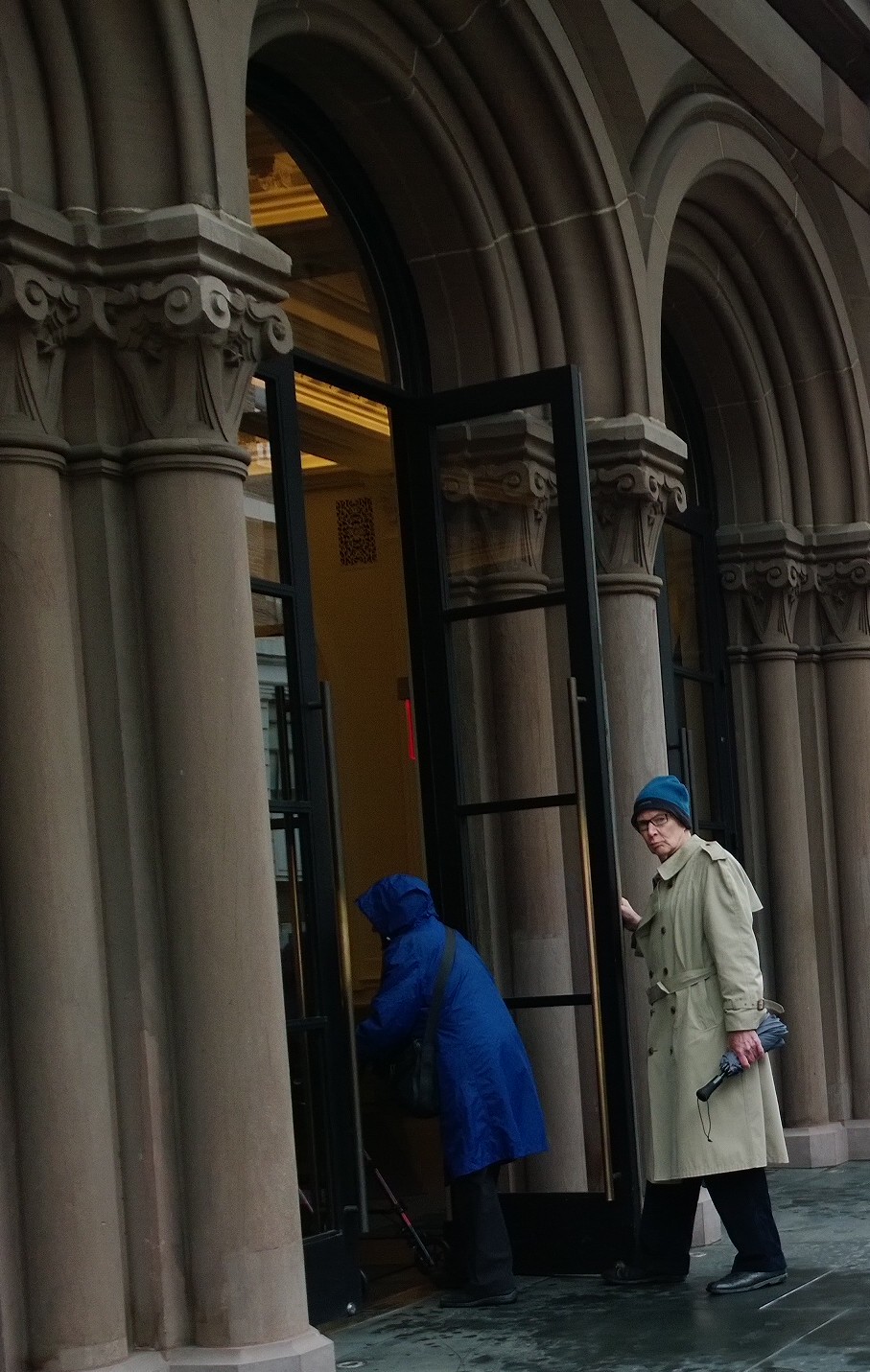
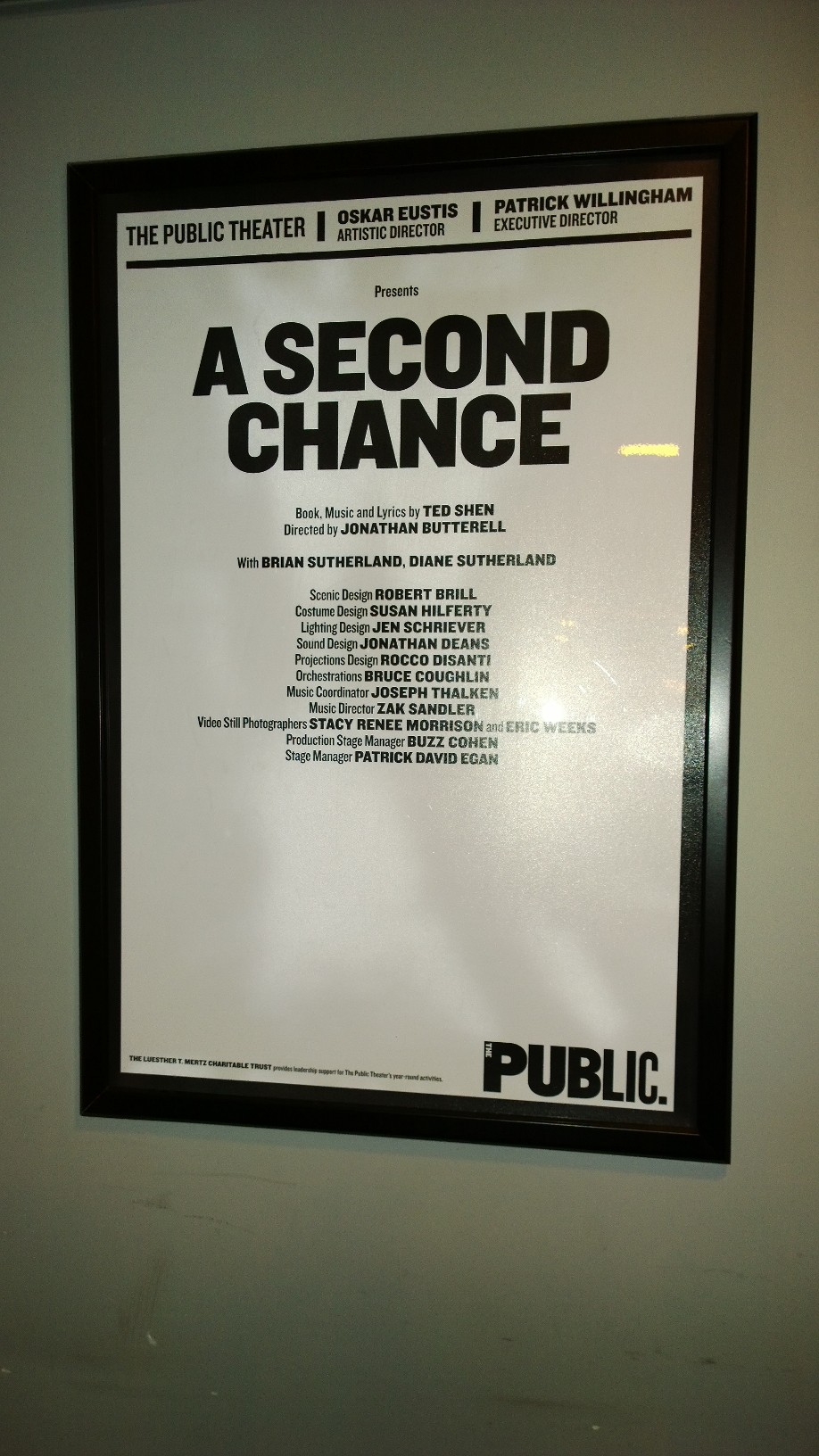
My husband going into the Public Theater to see classmate Ted Shen’s musical, A Second Chance. The Playbill for the show. A delightful chandelier at the Public, with paddles that illuminate changing phrases.

Subway buskers playing a grandson’s favorite song, “When the Saints Go Marchin’ In.” Grand Central Station. The charming Iroquois Hotel. A flower-themed mosaic in the Lexington Ave. subway.

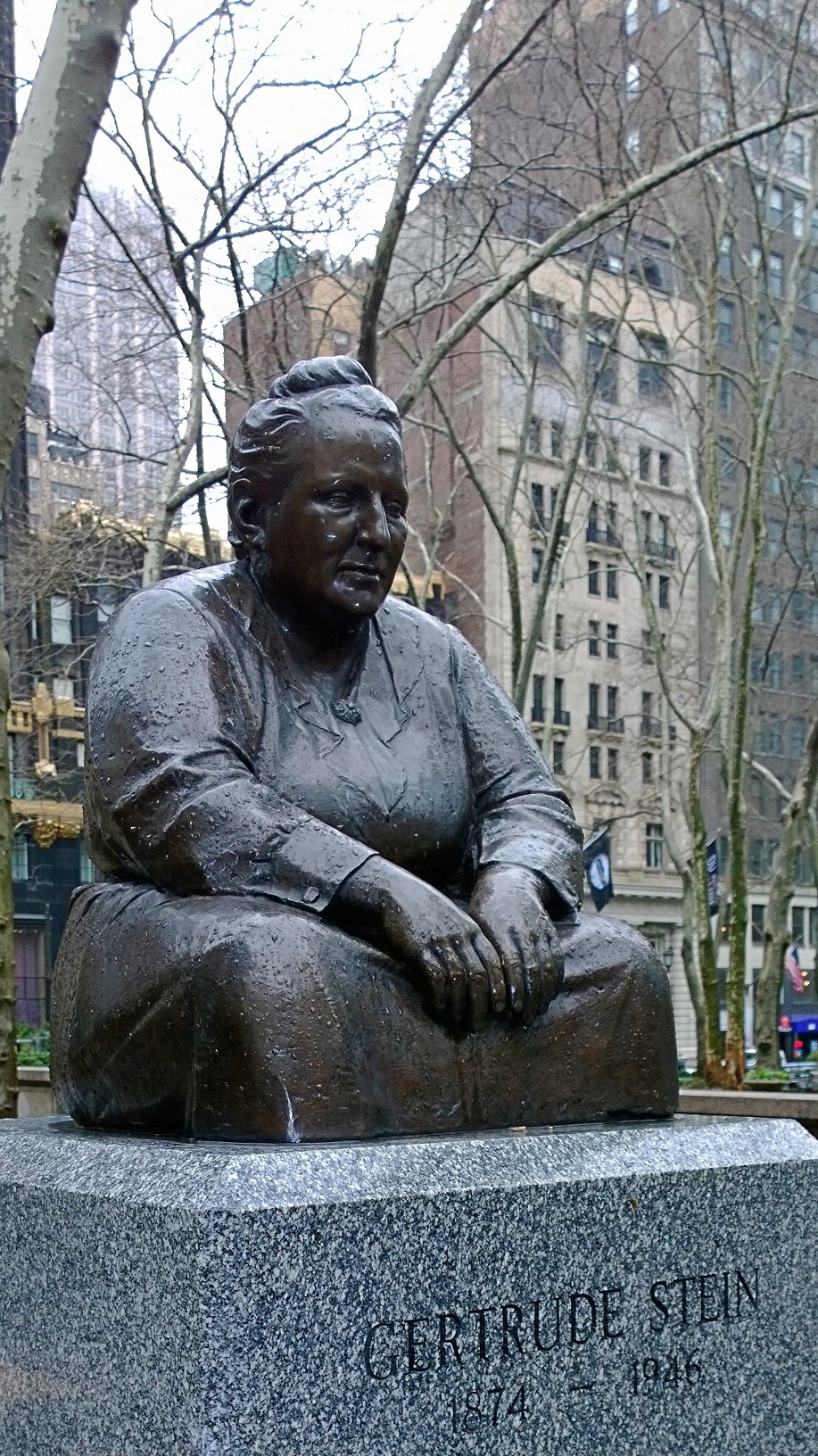
Gertrude Stein looking like herself in Bryant Park. And the Metropolitan Museum, where we saw a great photography show with my sister and brother-in-law. More on that later.

(Be watching for the relaunch of the Luna & Stella website, where one of the family pictures is of my sister at age 3, pictured with Suzanne’s maternal grandfather. … Did I mention this is a blog for Suzanne’s birthstone-jewelry company Luna & Stella?)

Public-Theater_NYC

Ted-Shen-Second-Chance-Playbill


The-Public_has-cool-chandelier

When-the-saints-go-marching-in


Grand-Central-NYC

Iroquois-hotel-treats-guests-right


Lex-Av-Subway-NYC

Met-Museum-NYC


Gertrude-Stein-Bryant-Park


Read Full Post »

Ted-Shen-Second-Chance-at-PublicWe went down to New York this weekend to see my husband’s classmate’s new musical.

Ted Shen wrote the book, lyrics, and music to A Second Chance, a lovely little cameo about a widower and a divorcee. The title refers to new beginnings for two people, but it’s hard for my husband and me not to think of new careers, too, since Shen was an investment banker for 30 years before turning to music so seriously.

At TheaterMania, where a couple of old reviews I wrote are still archived, Shen describes how he began to develop his musical after Stephen Sondheim gave him encouragement.

And he explains his style. “In my role as composer, my preference has been to emphasize the use of ‘action songs’ that show the characters interacting with each other and conversing primarily through lyrics rather than pure spoken dialog, and to limit the use of ‘introspection songs’ that stop the action to express feelings and inner thoughts. I have attempted to create a contemporary musical ‘language’ that is jazz-inflected rather than written in today’s predominant pop-based genre.’ ” More at TheaterMania.

Oskar Eustis, the artistic director of the Public Theater, where the show is being performed, says that Shen “has written some of the most elegant and sophisticated music I have heard in theater in many a moon.”

While in New York, we also saw the musical A Gentleman’s Guide to Love and Murder (based on the movie Kind Hearts and Coronets). It was pure Broadway fun, and we laughed a lot. But A Second Chance gave us more to talk about after.

Consider checking out the site for the Shen Family Foundation, here, which “concentrates its grant-making in the area of musical theater through its funding support of works of exceptionally gifted and highly original musical theater composers.”

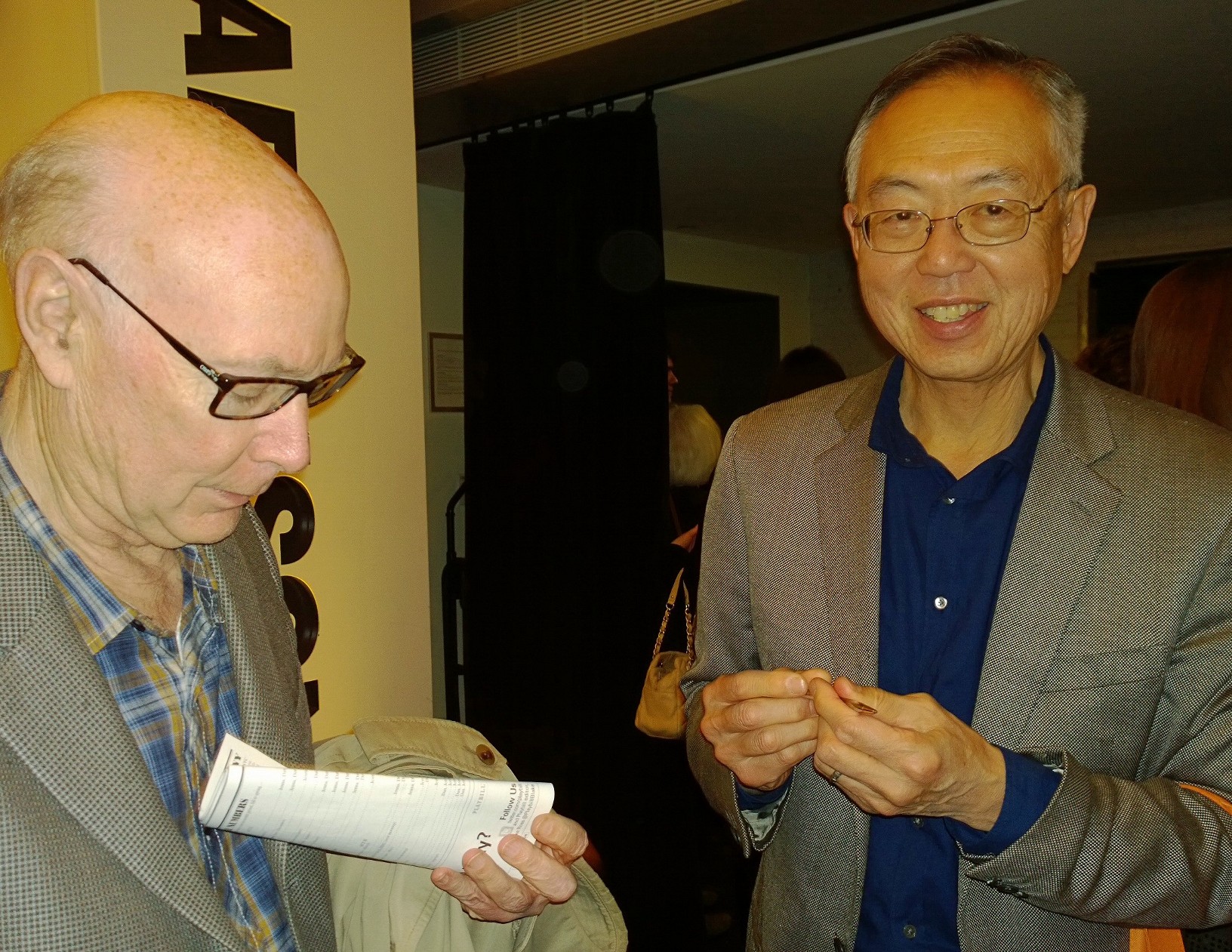
Photo: Suzanne‘s Dad reconnects with his classmate decades after business school and asks him to sign a Playbill.

032914-John-and-Ted-Shen-at-Public-Theater

Read Full Post »

One thinks of Iran as repressive, and having watched the doomed 2009 revolution unfold on twitter, I believe it is. But Iranian theater people seem to be managing to squeeze in some fun.

I blogged before about the Tehran production in a taxi, here. Now Studio 360 has a story on what might be called extreme improvisation. I take that back. There’s a script. But the actor doesn’t get to see it in advance.

“Actors face stage fright all the time,” says Studio 360, a radio show. “But consider this scenario: you show up to perform a one-person show, and you’ve never seen the script. You don’t know what it’s about because you promised not to do any research. It’s your first performance, and the only one you’ll ever have. The theater’s artistic director hands you a fat manila envelope with a script. And go.

“Also, the audience will decide whether you drink a glass of water that appears to have been poisoned.

“This is the premise of White Rabbit, Red Rabbit, by Iranian playwright Nassim Soleimanpour. ‘I did not know what was in front of me inside that envelope,’ says actor Gwydion Suilebhan. ‘What if this script is going to require that I disrobe? Or insult my mother? Or be rude or self-debasing?’ …

“Soleimanpour pulls his strings from afar, because — although the play has been performed in Toronto, Berlin, San Francisco, Brisbane, Edinburgh, London, and now Washington, DC — he really is in a cage. He doesn’t have a passport and can’t leave Iran, so he has never seen his play performed. ‘Nassim has given up the kind of control that is customary for playwrights,’ says Suilebhan, of working with actors and directors to realize the play. ‘At the same time, because he has put all of these restrictions on how it is to be performed, he has seized certain kinds of control that playwrights normally do not have. So he is literally embodying the ideas of control and submission and manipulation that he’s baked into his script.’ ” More.

Photo of Iranian playwright Nassim Soleimanpour found at the HuffingtonPost

Read Full Post »

Well, if you aren’t into musicals, it might not be hilarious to you, but I just love that a famous songwriter wrote this number for Great American Soup back in 1970, and a famous Broadway star performed it. Terry Teachout posted it, here, on his theater blog. His blog is called “About Last Night,” and I connect to it through ArtsJournal.

Back when I was reading the Wall Street Journal, I used to enjoy Teachout’s theater reviews. But according to his blog, reviews are just the tip of the iceberg for this Renaissance Man.

“Terry’s first play, Satchmo at the Waldorf, opens off Broadway at the Westside Theatre on Mar. 4. Previews start Feb. 15. The production is directed by Gordon Edelstein, with John Douglas Thompson appearing in the triple role of Louis Armstrong, Joe Glaser, and Miles Davis. It was seen in 2012 at Shakespeare & Company of Lenox, Mass., Long Wharf Theatre of New Haven, Conn., and Philadelphia’s Wilma Theater. For more information, go here.

“To see John Douglas Thompson on stage in Satchmo at the Waldorf, go here. To watch a Wall Street Journal-produced video interview with Terry, go here.”

Teachout also writes opera libretti. I always thought it would be fun to do that.

Below: “Great American Soup” commercial, written by Stan Freberg and starring Ann Miller.

Read Full Post »

« Newer Posts - Older Posts »