Feeds:
Posts
Comments

Posts Tagged ‘war’

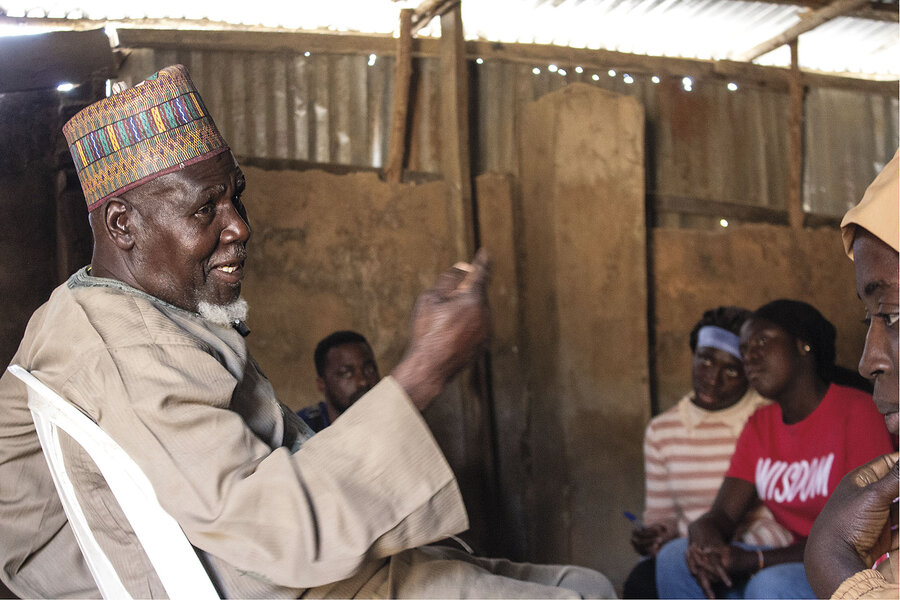
Photo: Nathaniel Bivan.
Ahmed Haruna speaks during a storytelling session in Nigeria.

I know I pick sides when I read about wars. It’s pretty clear that Russia invaded an independent neighbor when it launched attacks on Ukraine, for example. I have to remind myself that civilians on all sides suffer. And then for years after — sometimes generations after — bitterness festers. Not a good thing.

So I was interested to read how some Nigerians are working to ease longlasting enmity. Whatever works, I’d say.

Nathaniel Bivan writes at the Christian Science Monitor, “Seven years ago, when Dalyop Timothy Toma was 15, an angry mob came in the night to torch his family’s home in Kyeng village. Everyone but his grandfather fled outside into the bushes to safety. 

“ ‘He couldn’t run because he was disabled,’ recalls Mr. Toma, his face contorting in grief at the memory of his grandfather’s killing. Then he adds matter-of-factly, ‘We were planning revenge.’

“Mr. Toma and his family, who are Christians from the Berom ethnic group, blamed Muslims, mainly from the Fulani group, for the attack. Sectarian tensions run high in Kyeng and other communities in Nigeria’s Plateau state. Disputes often involve politics or land and sometimes erupt into violence.

“But in 2022, a youth leader from Kyeng invited Mr. Toma to do something extraordinary: Recount his painful story aloud to a large room full of people from different ethnic groups that he distrusted. That gathering, organized by a nongovernmental organization called Youth Initiative Against Violence and Human Rights Abuse (Yiavha), changed Mr. Toma’s attitude toward those he thought were his enemies.

‘Telling my story helped me heal gradually,’ says Mr. Toma, explaining that he no longer thirsts for vengeance.

“Yiavha has made him a peace ambassador, tasked with spreading his story of grace and forgiveness at intergenerational storytelling sessions in his community and in others.

“Plateau state, in central Nigeria, is home to some 4 million people. Jacob Choji Pwakim, a longtime peace-building activist in Jos, the state’s capital, founded Yiavha to change the narrative in communities that have been riven by ethno-religious attacks.

“The origins of the violence in Plateau state can be traced to a tumultuous week in Jos in early September 2001. More than 1,000 people were killed and tens of thousands displaced amid a long-running struggle for political and economic power among the area’s different ethnic groups. Disputes also flared between settlers and people indigenous to Jos. 

“Yiavha has held at least 66 storytelling sessions across the state. Elders have given accounts of bygone times when residents from various ethnic groups lived in harmony, even sharing gifts during religious celebrations for Eid and Christmas. Meanwhile, young people have recounted why they destroyed farms or livestock belonging to members of a different faith or tribe.

” ‘This was what inspired me to set up Yiavha in 2014, with the objective of creating a platform where young people across the divide can talk about their experiences without judgment,’ Mr. Pwakim says. 

“So far, Yiavha has worked with up to 3,300 young people, including more than 300 who have been trained as peace ambassadors who might eventually organize storytelling sessions in their communities. Other young people become agents of change after attending the sessions, organizing interfaith meals, youth soccer competitions, and trash cleanups. …

“One sunny afternoon in February, a group of young people is assembled at a soccer viewing center in Kambel, a community in the Anglo-Jos settlement within Jos. Ahmed Haruna is at the front of the room telling stories to the rapt audience, which includes residents of both Kambel and Channel Seven, another community in Anglo-Jos.

“ ‘Growing up, we didn’t even know the difference, who was Muslim or Christian among us,’ Mr. Haruna says. Over the years, residents have lived in segregated areas, with Christians mainly in Kambel and Muslims mainly in Channel Seven. But the storytelling sessions are gradually bringing them together to interact once again. 

“After Mr. Haruna finishes sharing stories about the settlements’ tranquil past, peace ambassador Joshua Tsok opens the floor for questions. …

“Training for peace ambassadors is extensive. In 2023, for example, peace ambassadors gathered in Barkin Ladi, another community in Plateau state known for violent sectarian conflict. A training facilitator, Hussaini Umaru, who is an associate professor in the department of theater and film arts at the University of Jos, says he divided the young people into groups and asked them to narrate and dramatize personal experiences of conflict, and then discuss the episodes. 

“It is not easy for ambassadors to trust their trainers. Umar Farouk Musa, a development consultant who facilitated a training session last August, explains that this is typically the first hurdle. ‘Some thought we were there to introduce an agenda or to spy. But we built their confidence,’ he says. 

“The government’s Plateau Peace Building Agency is a key partner with Yiavha. Kenneth Dakop, a team lead for the agency, says that Yiavha’s initiatives have helped transform young people who previously were drivers of violence in their communities. ‘Most of them are either unemployed or into substance and drug abuse,’ he says. 

“Yiavha’s ambassadors have seen transformations in themselves. ‘I want to become a professional teacher,’ Mr. Toma says. 

“This year, Yiavha paired Mr. Toma with a Fulani boy and assigned each of them to plant a pear tree in the other’s village to signify a commitment to peace.”

More at the Monitor, here.

Read Full Post »

Photo: Dina Litovsky.
Román Baca leads rehearsal on the deck of the Intrepid, the aircraft carrier turned museum on the Hudson River.

The wars that have been fought in my lifetime sometimes seem to have been necessary and inevitable. Most often, not. As the young people head off, I always think about how their lives will have been warped if they get back. It seems so wrong. And right now the services we’ve promised them are being slashed.

Fortunately, there are efforts at healing that forge ahead. One such program involves ballet.

Brian Seibert writes at the New York Times, “When Román Baca was serving as a Marine in Iraq in 2005, he didn’t tell many people what kind of work he had done before the war. He had tried that in boot camp, and it hadn’t gone well. So when his best friend in the platoon asked him why he seemed so interested in local dance practices, he hesitated before admitting the truth: He was a ballet dancer.

“Baca’s friend wasn’t bothered by the revelation. So Baca told him his crazy idea: to translate their wartime experiences into dance.

“Eventually, that crazy idea became Baca’s life. With his wife, Lisa Fitzgerald, he founded Exit12 Dance Company, which makes and performs works about military experience. What started as a way for Baca to deal with his trauma has expanded into a mission to help other veterans deal with theirs — through dance.

“In recent weeks, a group of veterans and family members of veterans, ranging in age and physical ability, has been gathering in the belly of the U.S.S. Intrepid, an aircraft carrier turned museum on the Hudson River. Using various improvisational exercises, they have been creating a dance work [to] perform on May 30 on the ship (on the flight deck, weather permitting). More important than that performance, though, is the process.

“Baca sees the workshops as a corrective for military training. ‘To make a person respond immediately to orders and commit acts of violence, military training changes your identity,’ he said. ‘It removes everything that defines a person’ — your clothing, your haircut — ‘and then it changes you through physical exercises, repetitive motion and powerful brain-body connections.’

“Baca, who has been leading these workshops since 2011, recalled a moment from one: Everett Cox, a Vietnam War veteran who had kept away from everything military for decades, responded to a prompt of action verbs by expertly stabbing and slashing with an invisible bayonet. His long-unused training was intact in muscle memory.

“Another time, Baca was choreographing a military exercise sequence and directed his dancers to yell ‘kill’ with every motion. When Fitzgerald questioned if that creative decision might have been a bit much, Baca explained that he was only being accurate: Coupling all actions with the word ‘kill’ was part of boot camp.

” ‘That’s absolutely needed when you are in uniform,’ he said. ‘But what do you do with that after you get home?’

“The workshops use physical exercises to help restore what Baca, borrowing a term from the philosopher Paul Ricoeur, called narrative identity. ‘You start to tell people who you are and parts of your story and then you listen to others do the same,’ he said.

“ ‘A lot of trauma survivors will say that you never fully heal,’ he added. But as evidence of how the process can work, he pointed to the experience of Cox, who returned from service in Vietnam feeling so guilty and ashamed that he did not consider himself a veteran. ‘I lost my mind in Vietnam’ is how Cox put it to me.

“For nearly 40 years, Cox, who took drugs and attempted suicide, tried to lock away what had happened. He was diagnosed as paranoid schizophrenic; one psychiatrist told him he was incurably insane. Then, in 2010, he attended a retreat for veterans at the Omega Institute, a holistic wellness center in the Hudson Valley. ‘It changed my life,’ he said. For the first time, he began to talk about his wartime experiences, and to write about them, and to cry. …

“ ‘If you’re holding a war in, it takes a lot of energy,’ he said. ‘And if you want to loosen that up, it also takes a lot of energy.’ ”

I so admire Baca, who against what seems to me like very long odds, keeps working hard to bring these damaged veterans back to life.

More at the Times, here.

Read Full Post »

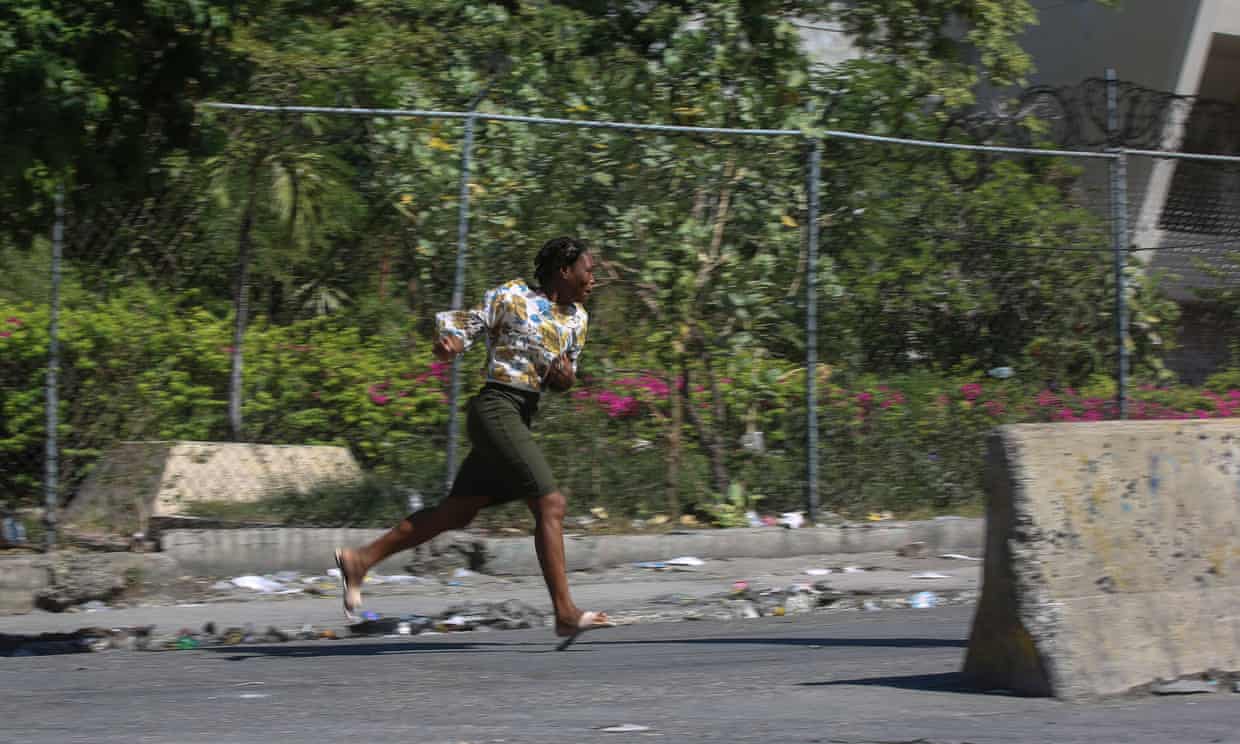
Photo: Odelyn Joseph/AP.
A woman runs to take cover from gunfire during clashes between police and gangs in Port-au-Prince, a city where a theater company perseveres.

There’s something about theater people and defiance. Something that keeps them from giving in to the ways things are when things are bad. I’ve blogged here about the anti-government theater of Belarus and here about Ukrainians offering theater in the subway, away from Russian bombs.

In today’s post, Tom Phillips and Etienne Côté-Paluck report at the Guardian about Haiti.

“In a dimly lit rehearsal room in a city under attack, Jenny Cadet raised an imaginary pistol and fired a single make-believe bullet at her director.

“ ‘Life is a theatre. I am a theatre. We are a theatre. The world is a theatre,’ proclaimed the 31-year-old Haitian actor, turning to the audience as she uttered the tragicomedy’s final lines.

“Moments later, real-life shots rang out outside the stage school in Port-au-Prince – the latest act of violence in an increasingly terrifying drama that has forced tens of thousands of people to flee their homes here in the past fortnight alone.

“ ‘Every day [there’s shooting],’ sighed the play’s director, Eliezer Guérismé, as his company took a break from their read-through to the all-too familiar sound of gunfire. ‘But even with the shooting, we keep on working because that’s our mission. We don’t want to stop.’

As gangs tighten their grip over a city now almost entirely outside of government control, Guérismé, 39, said he saw drama as a key way of interrogating and denouncing the social and political crisis. …

“Theatre was also ‘an act of rebellion and resistance’ and a way of fostering renewal, given the politically charged violence into which Port-au-Prince has been plunged since the 2021 assassination of Haiti’s president Jovenel Moïse.

“ ‘People need to see the reality that they are living up on stage … theatre is the mirror of society … Everything we hear in this city – the sound of the bullets that are very, very present – we try to put on stage,’ the director said. …

“Nearly 4,000 people have been killed since the start of the year, according to the UN, as rifle-carrying gang fighters have advanced across the capital, opening fire on government buildings and burning homes.

“A US-backed policing mission has so far failed to restore order and in recent days the violence has intensified further with gangsters even attacking Pétion-Ville, one of the last supposedly safe enclaves in the hills over Port-au-Prince. … Foreign diplomats and aid workers are fleeing by helicopter amid calls for a UN peacekeeping mission to be deployed.

“ ‘It feels like the end of Port-au-Prince,’ Guérismé admitted this week. “Every day people are leaving their neighborhoods.’

“The Haitian director recognized that continuing to rehearse his latest production was a perilous business in a city where residents’ movements grow more restricted by the day.

“One of his troupe’s actors commutes to the drama school each day from Carrefour, a gang-run area to the city’s south which is effectively off-limits to outsiders. ‘I know he’s taking a risk to come. He’s taking a huge risk… Living in Port-au-Prince today requires a superhuman effort,’ Guérismé said. …

“But Guérismé was determined to fight on. … ‘It’s my country. It’s my homeland. It’s my city’ … and I have responsibilities,’ the director said as his group prepared for Port-au-Prince’s annual ‘En Lisant’ theatre and performing arts event. ….

“Philippe Violanti, the French dramatist who wrote Guérismé’s latest tragicomic play, had planned to fly to Port-au-Prince to see his work staged for the first time. But Violanti was forced to cancel after flights into the capital were suspended because three US aircraft were hit by gunfire while taking off or landing.

“Six of the seven foreign artists invited to the festival – from Guadalupe, French Guiana, France, Belgium and the US – have pulled out. Performances for primary and secondary school children have been dropped from the program. Some rehearsals are being held online.

“Guérismé said the mood was grim, but he believed it was essential Haiti’s acting community did not throw in the towel.

“ ‘The festival will not be postponed. We will go ahead,’ he vowed. ‘This is the time to make a gesture of hope – to affirm that life is here.’ ”

More at the Guardian, here.

Read Full Post »

Photo: AP/Amr Nabil.
Sudanese Camirata troupe founder Dafallah el-Hag at the Russian cultural center in Cairo, Egypt, this past September.

There is too much war going on.

I struggle to think what alternative Ukraine had after an invasion, but I wish there had been some less lethal way to kick the invader out. In the Middle East, the fighting has gone on beyond anything the world at large can condone. And there are endless ethnic wars in places like Myanmar and Sudan that pain me to think about.

Today’s little story about cheering up Sudanese refugees through art will seem like a feeble attempt to find something positive, but to those who have been touched by the music of kindness, even a tearful, grateful moment can be valuable.

Fatma Khaled wrote recently for the Associated Press (AP), “As the performers took the stage and the traditional drum beat gained momentum, Sudanese refugees sitting in the audience were moved to tears. Hadia Moussa said the melody reminded her of the country’s Nuba Mountains, her family’s ancestral home.

“ ‘Performances like this help people mentally affected by the war. It reminds us of the Sudanese folklore and our culture,’ she said.

Sudan has been engulfed by violence since April 2023, when war between the Sudanese military and the paramilitary Rapid Support Forces broke out across the country. The conflict has turned the capital, Khartoum, into an urban battlefield and displaced 4.6 million people, according to the U.N. migration agency, including more than 419,000 people who fled to Egypt.”

[Think about that, a flight to Egypt.]

“A band with 12 Sudanese members now lives with thousands of refugees in Egypt. The troupe, called ‘Camirata,’ includes researchers, singers and poets who are determined to preserve the knowledge of traditional Sudanese folk music and dance to keep it from being lost in the ruinous war.

“Founded in 1997, the band rose to popularity in Khartoum before it began traveling to different states, enlisting diverse musicians, dancers and styles. They sing in 25 different Sudanese languages. Founder Dafallah el-Hag said the band’s members started relocating to Egypt … as Sudan struggled through a difficult economic and political transition after a 2019 popular uprising unseated longtime ruler Omar al-Bashir. …

“The band uses a variety of local musical instruments on stage. El-Hag says audiences are often surprised to see instruments such as the tanbour, a stringed instrument, being played with the nuggara drums, combined with tunes of the banimbo, a wooden xylophone. …

“Kawthar Osman, a native of Madani city who has been singing with the band since 1997, feels nostalgic when she sings about the Nile River, which forms in Sudan from two upper branches, the Blue and White Nile.

“ ‘It reminds me of what makes Sudan the way it is,’ she said, adding that the war only ‘pushed the band to sing more for peace.’

“Over 2 million Sudanese fled the country, mostly to neighboring Egypt and Chad, where the Global Hunger Index has reported a ‘serious’ level of hunger. …

“Living conditions for those who stayed in Sudan have worsened as the war spread beyond Khartoum. Many made hard decisions early in the war either to flee across frontlines or risk being caught in the middle of fighting. In Darfur, the war turned particularly brutal and created famine conditions. …

“Armed robberies, lootings and the seizure of homes for bases were some of the challenges faced by Sudanese who stayed in the country’s urban areas. Others struggled to secure food and water, find sources for electricity and obtain medical treatment since hospitals have been raided by fighters or hit by airstrikes. Communications networks are often barely functional.

“The performers say they struggle to speak with family and friends still in the country, much less think about returning. ‘We don’t know if we’ll return to Sudan again or will see Sudan again or walk in the same streets,’ Farid said.” More at AP, here.

During this tragic war, very little aid has gotten through, although nonprofits like Alight, one of my favorites, are always poised to help. Rachel Savage at the Guardian wrote that on Christmas, the first successful shipment since the war started a year and a half ago finally got through.

She wrote, “An aid convoy has reached a besieged area of Khartoum for the first time since Sudan’s civil war broke out in April 2023, bringing food and medicines in a country where half of the people are at risk of starvation.

“The 28 trucks arrived in southern Khartoum on 25 December, according to the World Food Program (WFP), which provided 22 trucks loaded with 750 tons of food.

“Unicef sent five trucks with medicines and malnutrition kits for children, while Médecins Sans Frontières (MSF) [Doctors Without Borders] contributed one truck of medical supplies, according to the Khartoum State Emergency Response Room (ERR), a grassroots aid group that is helping to coordinate the distribution.

“Sheldon Yett, Unicef’s Sudan representative, said: ‘Access to the area has been essentially cut off due the conflict dynamics. It took three months of often daily negotiations with government authorities at all levels and with other parties who controlled the access.’ ” More at the Guardian, here.

Read Full Post »

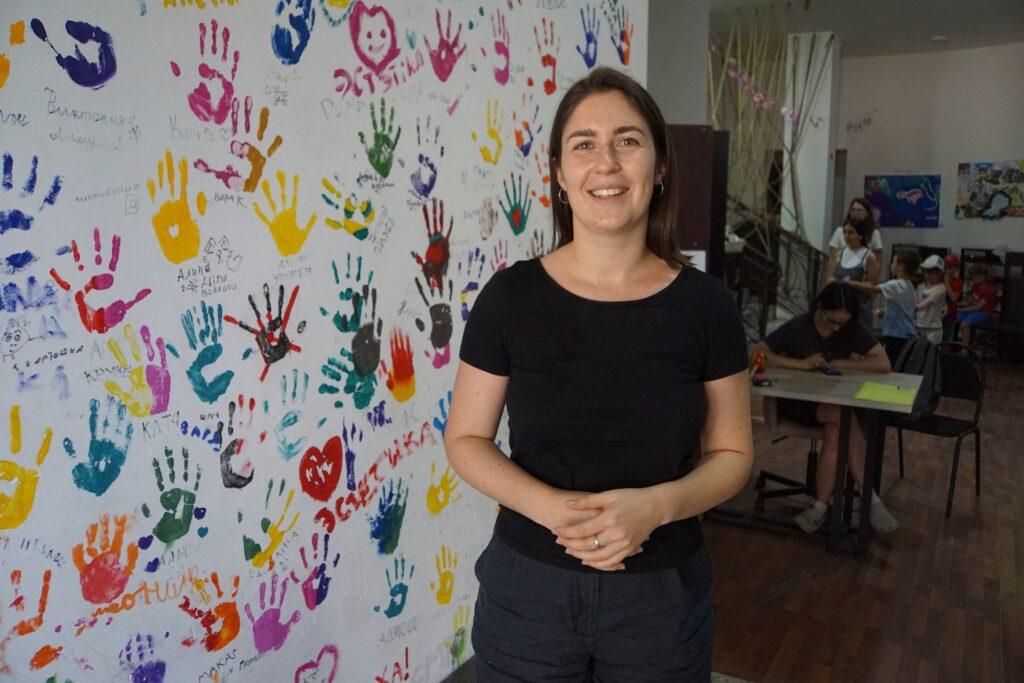
Photo: Daniel Ofman/The World.
Elena Chegodaeva is the founder of the Liberated School in Yerevan, Armenia. Most of the students are the kids of Russian immigrants who left Russia because of the war in Ukraine.

When tyrants like Putin have total control over the media, it’s easy to forget that there may be some people in the country who are not supportive of tyranny. In today’s story we learn about Russian dissenters who fled to Armenia after Russia’s full-scale invasion of Ukraine — and how they are trying to make a new life there. (Do you know why media outlets always say “full-scale” invasion? Because Russia has been doing other, more limited invasions for a long time.)

With contributions from Stepan Adamyan, Daniel Ofman reported the story for Public Radio International’s The World.

“Russian Elena Chegodaeva left Moscow in early March of 2022 — about a week after Russia began its full-scale invasion of Ukraine.

“Chegodaeva was against the war and fled to Yerevan, Armenia. … Chegodaeva is among the hundreds of thousands of Russians who have left their homeland since the invasion of Ukraine. Most of them oppose Russia’s war in Ukraine, or they fear getting drafted. 

“Many have wound up all over Europe — and Turkey, Georgia and Armenia have become some of the most-frequent destinations for exiled Russians. According to some estimates, more than 100,000 Russian citizens fled to Armenia alone. This reality has led to some changes within Yerevan, the Armenian capital, as the new residents try to put down roots.

“Chegodaeva, an educator, soon realized the need for a school for the Russian children coming to the city. So, after coordinating with families and securing teachers and a space within a couple of weeks, she started the Svobodnaya Shkola, which is Russian for Liberated School. …

“At first, the school only had 40 students — all kids of Russian immigrants. Back then, many of the families thought the war would end and they would soon return to Russia. The school operated out of an apartment. Now, 2 1/2 years later, many of the families are still here, and the student body has grown to 250, with classes held in two different buildings. Lessons are taught in Russian and English, while Armenian is also taught twice a week. …

“Yura Boguslavsky, a parent of two sons, ages 10 and 15, at Chegodaeva’s school, said that their education is one of the reasons he left Russia. … [And] when he and his family first arrived in Armenia, they also struggled. ‘I think the first two or three weeks was just a shock; we managed to find someplace to live, and all the streets in Yerevan were full of lost people with backpacks who were very sad.’ …

“Back in Russia, Boguslavsky attended anti-war protests, and was opposed to the Kremlin’s politics. Professionally though, Boguslavsky said, he was thriving. In Moscow, he ran a studio and an animation school. But once he got to Yerevan, he had to start from scratch. …

“A year after arriving in Yerevan, Boguslavsky started a new animation studio called Invisible Friends. He also teaches animation to students of all ages. He produced a Claymation, stop-motion documentary called, We flew, we came here, based on interviews that Armenian students conducted with Russian kids who had recently arrived in Yerevan.

“In the film, one child says that he didn’t know how long they were leaving Russia for — but when he found out, he says he ‘began missing his friends’ and sometimes cried at night. The kids described the toys they took with them and the ones they left behind.

“Boguslavsky said that the kids were a lot more expressive than the adults were. That’s why he chose to feature children in the film.

“ ‘All the adults … were saying almost the same things, just retelling the news. And the kids were sometimes even funny; they talked about how they understood what their parents told them. They were speaking a lot about their feelings.’

“Boguslavsky said that this film inspired him to find a way to keep teaching animation in Armenia. He said that nowadays, he feels comfortable in Armenia, but he knows that many other people are having a hard time.

“Finding affordable housing, and consistent work, is a challenge for many Russian immigrants who don’t work in the tech sector. A lot of people are also having trouble adjusting because they’re still hoping to return to Russia.

“ ‘I know many people who were suffering a lot, and not living their lives, and they were stuck in the past, and I don’t want to be like that, you know.’

“Boguslavsky said that it’s unlikely that he’ll return to Russia anytime soon. He said that he’s focused on making a life for himself and his family here in Armenia.

“Chegodaeva said that’s her mindset as well, and one of the reasons she founded the school. However, she said she still holds out hope that she’ll one day go back to Russia.”

More at The World, here.

Read Full Post »

Photo: va.gov.
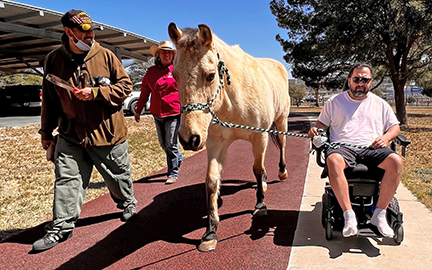
Army Veteran Carlos Longoria takes a trip on the track with Biscuit.

Whenever it gets close to Veterans Day, I start seeing stories about therapy for traumatized veterans. We know that, inevitably, some of the young people we send off to war will come back in bad shape. And unfortunately, our government spends a lot more on sending them off than on what they may need when they get back.

Often it’s civilian nonprofits that step up, like an arts group in Asheville, North Carolina, that offered supportive pottery classes to vets — that is, before Hurricane Helene. (Click here.)

Today’s article by Jason Kucera describes an ongoing Veterans Administration (VA) initiative.

“Mankind and horses have carried on beneficial, strong relationships with one relying on the speed, endurance, and raw power while the other affection and care. For a US Marine Corps Veteran such as Kody Wall, this special bond saved his life.

“ ‘I moved home to Montgomery (Texas) after my time as a Marine and very little went well. I had a really hard time adapting, so it wasn’t long until I was divorced and sleeping on an air mattress at my sister’s house,’ Wall said.

“During this time, he said he was battling suicidal thoughts, wanting to just ‘give up.’ Though he had been getting his routine care at a Houston VA outpatient clinic, he did not feel comfortable going into an office or trying to work through appointments over the phone. While hopelessness set in, the darkness would soon clear thanks to a unique therapeutic approach focused on his relationship with a horse.

“ ‘My sister pushed me to visit Sunny Creek Ranch as she knew how much I enjoyed being around horses. It was the best thing that could’ve happened for me,’ said Wall. ‘I’ve been attending sessions since 2016 and spend any extra time I have to help.’ He also shares his own experiences with other Veterans attending sessions, which can really help to open them up. 

“Sunny Creek Ranch hosts an intensive equine-assisted therapy Eagala-certified program in this heavily forested, southeast Texas town, just about an hour north of Houston. Launched by Shannon Novak, an Air Force Veteran spouse, the ranch is a partner of Houston VA. …

“She added that for a lot of Veterans and their family members that participate, they find the relationship with these horses to be similar to that of their own personal relationships. ‘Horses are so intuitive, they know everything about you, and they never forget you.’ …

“Houston VA recently began referring Veterans to equine therapy and plans to ramp up referrals to other holistic therapy approaches in the future. ‘Evidence-based talk psychotherapies for trauma are effective, but we know not every Veteran wants to address their trauma by sitting down in an office or virtual appointment with VA,’ said Dr. Shannon Sisco, whole health coordinator at the Houston VA. …

“Wall said working with the horses in equine therapy has helped him learn to communicate more openly with his young son, resulting in a better and more trusting relationship.

“ ‘The challenge in equine therapy is to develop a trusting relationship with your horse, which in many ways brings out lessons about our own relationships and helps us learn new ways of being in them,’ Sisco said.  

“Veterans do not need experience working with horses to participate in the therapy. They will not actually be riding horses, just interacting with them alongside a professionally licensed therapist. ‘The difference between connecting with horses versus people is that it all depends on your actions rather than your words,’ Sisco said. ‘They are watching what you do and listening to your tone. If you’re not earning their trust, they’re going to let you know.’ … 

“Veterans can choose to participate in individual equine therapy sessions, along with immediate family members, or in small groups with other Veterans.  For more information or to request a referral for equine therapy or any of the VA’s Whole Health programs.”

Although this story focused on Texas, there are similar VA programs around the country. Search here on “horses.” More on today’s feature, here.

Read Full Post »

Photo: Dominique Soguel.
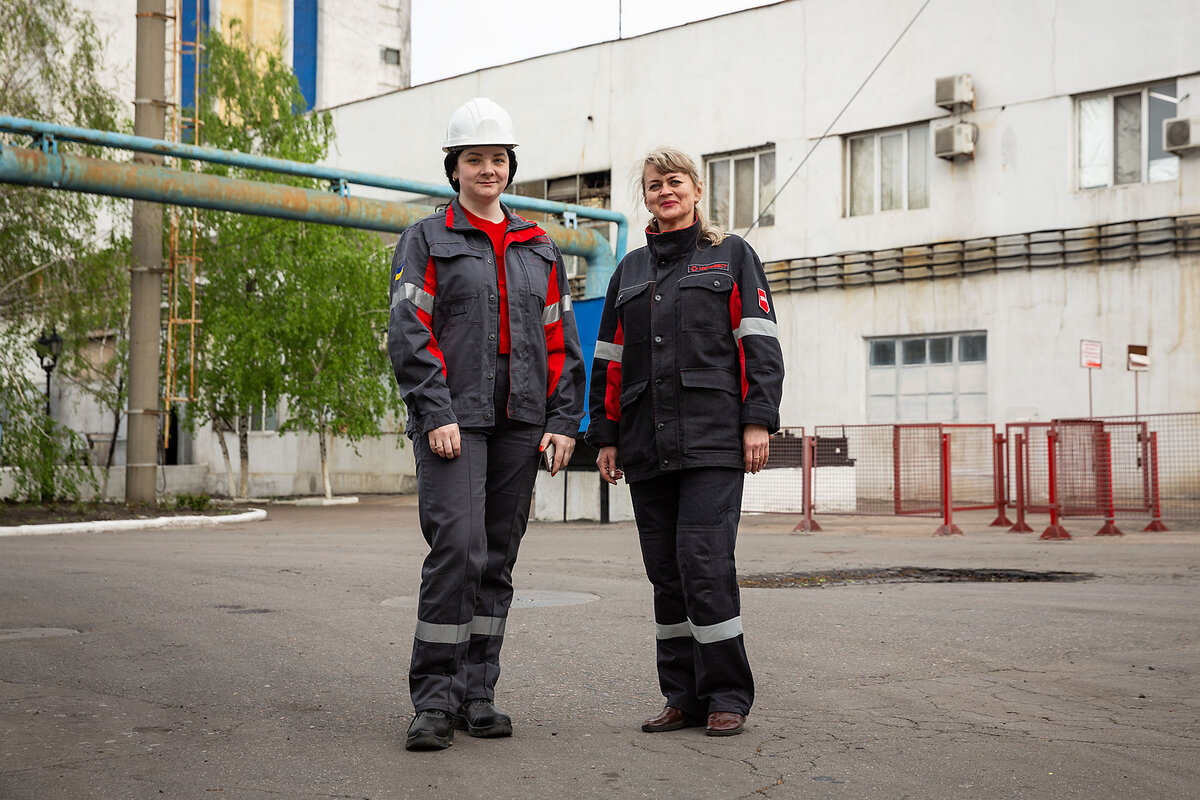
Kateryna Tolmachova (at left) and Olena Boiko stand in front of Metinvest Pokrovsk Coal, April 17, 2024. Both women have had to step up their work since Russia’s invasion has called away many of their male colleagues to military duty.

Yesterday I sent another donation to a Ukrainian I know from my four-month gig with Ukrainian journalists at the beginning of the Russian invasion. (Read about that here.) The war has kept going since then, affecting every aspect of life in Ukraine.

Consider how some women have had to step up to jobs men used to do. The women in today’s story work in coal mining. Whether coal mining is a bad thing in general is a topic for another day.

Dominique Soguel writes for the Christian Science Monitor, “Kateryna Tolmachova started working in the Donbas coal industry in 2017. But when Russia invaded Ukraine in February 2022 and men were called to military service, her career accelerated. For women like her, stepping into the critical roles the men left empty wasn’t just an opportunity, but a duty.

“ ‘Who, if not us?’ says Ms. Tolmachova, who recently became deputy head of the pumping division at Metinvest Pokrovsk Coal. ‘If our men are taken to the army and protect us from there, we need to protect the economy.’

“Nowhere is this shift more evident than in the coal mining industry of Donbas, where women have increasingly taken on critical roles to sustain both the war machine and their families. Ms. Tolmachova’s journey from machine operator to a leadership role highlights the expanding opportunities for women in the industry as more men get called to the front. …

“Metinvest Pokrovsk Coal, one of Ukraine’s newest coal mines, has been quick to harness the potential of female employees. … The war has brought significant challenges to the company. Approximately 1,000 employees have been mobilized to the Ukrainian military, and about 1,500 have moved to safer regions with their families. In all, 87 employees have been killed and 232 injured due to the ongoing conflict. Before the war, Metinvest employed around 8,000 people; now, this number has decreased to about 6,000.

“In response, the company’s female employees are taking on a greater share of the workload, and in more critical capacities. As Andry Akulih, general director of Metinvest notes, they make up almost a third of the current workforce (31%) compared with just under a quarter (24%) before the war. Those who stay often do so to care for older relatives who are either unable or unwilling to leave. Women are turning to the mine for employment opportunities as there is a dearth of other jobs, with most supermarkets and schools closed in the region.

“Traditionally, he explains, women at the coal mine were confined to roles such as operating the elevator or managing the facilities where miners receive their lamps and oxygen equipment. These jobs were considered suitable for women, as they did not involve the strenuous physical labor required underground.

“ ‘Women have come to substitute men in some underground jobs like pumping and electrical machines,’ he says. Before, ‘there were enough men to do these jobs. Women were not interested.’ …

“Metinvest’s training center, led by Larysa Batrukh, has adapted to this new reality. Previously, the center trained approximately 100 students per month, but now it trains around 50, including a small but growing number of women. …

“Inside a large classroom with boarded-up windows, most chairs are stacked on empty desks. One woman was killed after a Russian missile hit the grounds of the training center.

“But that did not deter Oksana Mariash, who returned to the mine after evacuating her daughter to Poland. She is training to become a pumping system operator, and focuses attentively on her lessons, aware that exams are approaching. ‘Of course, it is scary and hard when you hear explosions, but it is interesting to learn, and I really like my teachers.’

“One of those instructors, Yevhen Mezhenny, oversees the education for technical positions, including welders and machine operators. He is impressed by the seamless transition of women into traditionally male-dominated roles.

“ ‘I’m surprised, but it is going very smoothly, with no big hiccups,’ he says. ‘Ukrainian women are very smart and hardworking, and they put a lot of effort into studying. Many of them were previously teachers or accountants.’

“Most of the women working or training at the mine also have significant responsibilities on the home front, too.

“Tetiana Hrekova manages the demands of her job while caring for her 11-year-old son and her elderly parents. She begins her day at 4 a.m. to catch the bus, a crucial link in keeping operations running smoothly despite the war. She returns home at 5 p.m. and starts a fresh shift feeding the family and supporting her son’s online schooling.

“ ‘I can only hope that the war will be over soon and children will go to school,’ she says during her eight-hour shift deep in the coal mine. ‘We will not be afraid of leaving them above ground and be able to … enjoy our work.’ ”

Rosie the Riveter rises again!

More at the Monitor, here. No paywall.

Read Full Post »

Photo: Dominique Soguel.
Nataliia Kalinichenko and her husband, Yurii, outside the office of the print weekly Bilopilshchyna, which they have continued to publish despite the war.

And while we’re on the subject of Ukraine, I want to share a story while it’s fresh, because in a war zone, you never know how long a piece of good news will last.

Dominique Soguel (with support from Oleksandr Naselenko) reports at the Christian Science Monitor, “The streets of [Bilopillia, Ukraine], just seven miles from the Russian border, are nearly deserted. Air-raid sirens have been a round-the-clock reality for weeks, and people take them seriously: When the warnings blare, everyone lies flat to take cover or scrambles to underground shelters.

“But for Nataliia Kalinichenko and her husband, Yurii, there’s no break from getting the news out to the community. They have safety routines; Ms. Kalinichenko asks friends or relatives to monitor social media platform Telegram for news of incoming Russian attacks, while Mr. Kalinichenko uses a drone detector while driving. But their mission is to keep locals informed through publication of their print weekly, Bilopilshchyna.

“Before the war, the newspaper featured 12 to 16 colorful spreads with articles on local entertainment, politics, and practical information like bus schedules. Now, it is a stark black-and-white publication filled with military and civilian obituaries and snapshots of local buildings destroyed by Russian attacks.

“ ‘With the onset of Russia’s invasion, our community’s information needs changed dramatically, as did our ability to meet them,’ says Ms. Kalinichenko, who joined the newspaper in 1996 and became its editor-in-chief a decade later. ‘Safety became the primary concern.’ …

“The information landscape has transformed over the past 2 1/2 years. Televisions, once tuned to Russian and Ukrainian channels, lost their appeal. The first Russian strike on the town’s television tower in March 2022 marked the beginning of a series of barrages. Telegram, which now tracks incoming missiles, has become a lifeline – though it requires electricity and an internet connection. Both have been hard to reliably access amid Russia’s offensive. …

“Inevitably, the community has shrunk. The agricultural district of Bilopillia was once home to about 16,000 residents. Now the figure is between 3,000 and 8,000, according to Ms. Kalinichenko. Residents come and go depending on attacks and electricity supplies. New arrivals from other regions temporarily swell the numbers.

“The Kalinichenkos are determined to stay put and keep the paper running as a team. On the walls of their office hang photographs documenting the paper’s history, including a period when it was known as the Flag of Stalin. Piles of newspapers are testament to disruptions in postal delivery services, and a collapsed ceiling from a recent blast prevents Ms. Kalinichenko from sitting at her usual desk.

“At a nearby shop, salesperson Nina Davydova and her teenage daughter, Victoria, discuss the toll of constant strikes. Though Victoria gets her news only through Telegram, Nina says Bilopilshchyna is still popular.

“ ‘People really like to buy the newspaper,’ she says, pointing out that she has already sold six copies this morning, even though Russian attacks were particularly intense. ‘Grandmothers will buy five to six copies so that they can bring it to their neighbors who cannot walk.’

“The newspaper sells at 20 locations in the Sumy region, which shares a 28-mile border with Russia. While many readers have fled, they continue to pay for a subscription in order to remain connected to their homeland, says Ms. Kalinichenko. Even in its reduced format, it serves as a vital source of information for local agricultural communities.

“Serhii, a sardonic shopkeeper, displays the latest copies alongside shrapnel that damaged his shop, which sits a few blocks from Nina’s. ‘If people would not buy it, I would not sell it,’ he says. ‘About five people buy it every day. But people also come from surrounding villages on market days to buy 10 copies at a time.’

“Articles pay tribute to slain soldiers and quote analysts to dispel rumors and dismantle Russian disinformation. One recent instance involved pollution of the river Seim – caused by industrial activities upstream in Russia. Russian trolls on Telegram spread the notion that drinking water had also been compromised, but that was not actually the case. Experts quoted in the paper helped debunk that notion.

“ ‘For villagers with no internet, it is an important source of information and local news,’ says Serhii.

“That assessment is echoed by customer Dymtro Potiomkyn, who grew up with the paper on the family table. He recalls it being a way for people to buy and sell goods locally. Today, it publishes information about what kind of social help is available locally. He buys the paper in person, while his mother gets it delivered by mail.

“ ‘This newspaper is crucial for villages that are right on the border with Russia,’ says Mr. Potiomkyn, who runs a funeral business in the region. ‘Some have been without electricity or internet for years. It’s literally their only source of Ukrainian news.’ “

I know from my own four-month remote gig with a Ukrainian news outlet that Telegram is important to the information landscape there. I also know about Ukrainians’ concern that the outside world gets false information from social media posted by Russians. That’s why Americans like me were helping Ukrainian journalists put their own Twitter and Facebook updates in colloquial English. My experience here.

More at the Monitor, here. No paywall. Subscriptions are reasonable.

Read Full Post »

Photo: Ivan Honchar Museum.
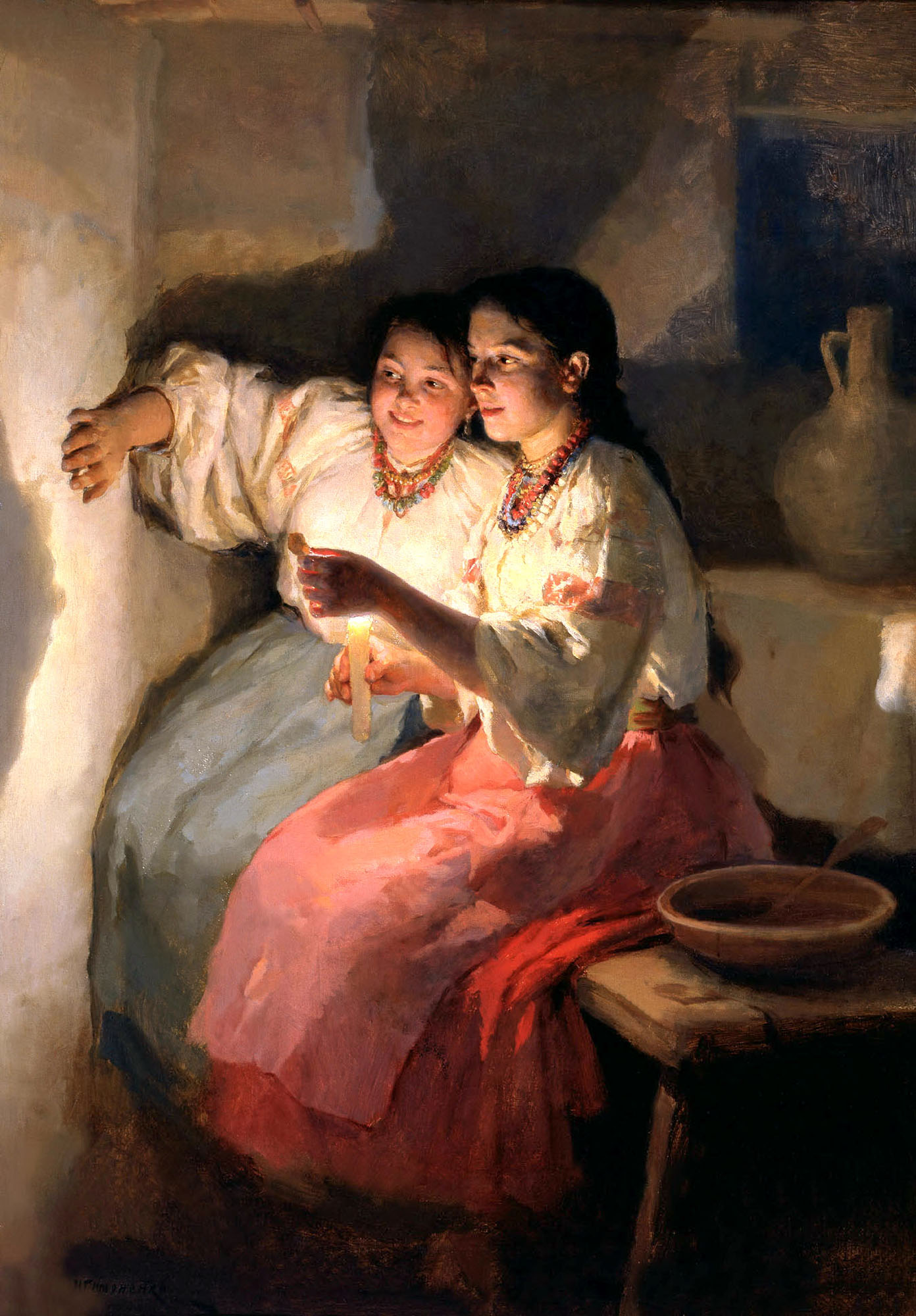
Witchy arts are part of Ukrainian folklore. The girls in the painting above (Divination by Mykola Pymonenko, 1888) are trying to predict the future.

Somehow, even in wartime, artists’ imaginations keep creating. Today’s story is about a new Ukrainian play that has captured the country’s attention.

Ashley Westerman at National Public Radio [NPR] tells us that “even though the plot takes place centuries ago, the play’s takeaways and parallels to today resonate with Ukrainians.”

Here are excerpts from the NPR transcript.

Westerman: In the early days of Russia’s full-scale invasion of Ukraine, a video surfaced online – a woman shouting at a Russian soldier sitting atop a tank. …

‘Do you even know where you are? You’re in Konotop,’ shouted the woman off-screen. ‘Every second woman here is a witch.’ …

“The video went viral in Ukraine, not just because of the woman’s defiance, but also because Konotop, a city in the country’s far northeast, is a place associated with witches. ‘Witches are a part of Ukrainian culture and Ukrainian tradition,’ says Khrystyna Fedorak, so you can rely on something having to do with witches going viral. This is one of the reasons the play Fedorak is currently starring in at the Ivan Franko Theater in the capital, Kyiv, has become a summer blockbuster. Fedorak plays the witch in the dark musical comedy The Witch Of Konotop.

“Based on the 1833 satirical fiction by Ukrainian writer Hryhorii Kvitka-Osnovianenko, this story leans hard on the stereotype that Ukrainian literature is full of sadness and tragedy. Taking place in the 1600s, the audience follows the main character, Zabryokha, a Cossack military leader in Konotop, pursuing the lovely Olena, but she rejects his proposal. She loves someone else. In this scene, Pistryak, Zabryokha’s cunning assistant, tries to confuse Olena’s love interest by accusing him of crimes he didn’t commit. …

“Then, in a twist of events that sounds a lot like today, Zabryokha receives an order to join a military campaign to help the Cossacks fend off an overreaching Tsarist Russia.

” ‘They order us,’ Pistryak says, ‘to take our Cossacks in Konotop to join the main army. There may be drills, or there may be war.’

“But Zabryokha refuses to go, saying he needs to stay in Konotop to root out the witch problem — the root, he says, of everyone’s problems. What ensues is a string of ridiculous, funny and very human moments. Spells are cast, couples are wed and, of course, there’s a witch hunt, meaning a swim test. If you’re not a witch, you drown. If you are a witch, you don’t.

“All with a larger threat looming over everything — Russia. But while that might be the most obvious takeaway from The Witch Of Konotop, the cast has some of their own ideas.

Kateryna Artemenko: Don’t kill women (laughter). Don’t mess with women. …

Westerman: Artemenko plays one of the townswomen mistaken for a witch. …

Artemenko: The main message is about people who — they’re trying to fool their destiny, but destiny will find them.

Westerman: Nazar Zadniprovskiy, who plays the ill-fated Cossack commander, views this play as a lesson in avoiding responsibility. … Zadniprovskyi says many people see a parallel with Ukrainian men dodging conscription today. …

“As the play ends and the theater’s mustard-yellow felt curtain drops to a thunderous applause, producer Polina Lytvynova and I ask a few audience members what parallels they drew. Olha Vasylevska is from Kharkiv, the northeastern Ukrainian city currently fending off an intense Russian offensive. She thinks the play is about love.

Olha Vasylevska: (Through interpreter.) If the love is true, it doesn’t need any outside assistance … but if the love is not true, nobody and nothing can help it, even the witch.

“Westerman: Markian Halabala, from Kyiv, says the message he took away is that you shouldn’t interfere in God’s will.

“Markian Halabala: (Through interpreter.) This is like Putin. He interfered in natural Ukraine’s way of independence. And Russians, they try to stop and prevent, like, [the] natural way of Ukrainian history with this war.

“Westerman: Critics say the many takeaways The Witch Of Konotop offers its audiences is one reason it’s been so popular. … But another reason is the overall push to celebrate Ukrainian culture and literature. Putin has repeatedly said victory, to him, means nothing short of Ukraine losing not just their sovereignty, but also their identity.”

Finally, Westerman spoke to Mykhailo Kukuyuk, who plays Pistryak. He speaks of the value of his country’s arts: “What are we fighting for? it’s the details, the sparks, that make us alive.” He adds that, while it’s sometimes difficult to block out the events happening outside of this theater, it’s an honor to perform for his country.

More at NPR, here.

Read Full Post »

Art: Hubert and Jan van Eyck. 
Ghent Altarpiece (completed 1432).

In New England, when we hear about an art thief’s confession, it makes our heart beat a little faster. That’s because we are hoping so much that the Isabella Stewart Gardner Museum heist (see where I wrote about it, here) will be solved in our lifetimes.

Today’s story, however, is about a much older art theft, equally puzzling.

Noah Charney reports at the Guardian, “Just about everything bad that could happen to a painting has happened to Hubert and Jan van Eyck’s Adoration of the Mystic Lamb (also known as the Ghent Altarpiece). It’s almost been destroyed in a fire, was nearly burned by rioting Calvinists, it’s been forged, pillaged, dismembered, censored, stolen by Napoleon, hunted in the first world war, sold by a renegade cleric, then stolen repeatedly during the second world war, before being rescued by The Monuments Men, miners and a team of commando double-agents. …

“In 1934, one of its 12 panels was stolen in a heist that has never been solved, though the case is still open and new leads are followed all the time.

“On 11 April of that year, Ghent police commissioner Antoine Luysterborghs pushed through a crowd at the St Bavo Cathedral that had gathered to gawk at something that was no longer there. One of the panels, depicting The Just (or Righteous) Judges, was gone. …

“The theft was followed quickly by a ransom demand for one million Belgian francs. As a show of good faith, the ransomer returned one of the panel’s two parts (a grisaille painting of St John the Baptist). But police remained baffled.

“Then a stockbroker called Arsène Goedertier had a heart attack at a Catholic political rally. He summoned his lawyer, Georges de Vos, to his deathbed. Just before he died, De Vos claimed, Goedertier whispered: ‘I alone know where the Mystic Lamb is. The information is in the drawer on the right of my writing table, in an envelope marked “mutualité.” ‘

“The lawyer followed the instructions and found carbon copies of the ransom notes, plus a final, unsent note with a tantalizing clue about the stolen panel’s whereabouts: ‘[it] rests in a place where neither I, nor anybody else, can take it away without arousing the attention of the public.’

“But if Goedertier did steal the panel, why? The church has been defensive, and there is an air of cover-up – as well as evidence that other members of the bishopric were involved. One theory goes that a group of church members, Goedertier among them, were involved in a failed investment scheme that lost church money. Rather than admit their failure, they stole the panel and ransomed it to cover the losses. But Goedertier was wealthy and devout; it seems odd he would resort to extorting his beloved diocese. …

“De Vos failed to alert police about Goedertier’s confession for a month. Eventually, after many false leads, police concluded Goedertier had been the thief. The case went cold. …

“The greatest strides in solving the crime have not been made by an active officer, though. Karel Mortier was chief of the Ghent police from 1974 to 1991, and fascinated with the Just Judges theft. It was a huge unsolved mystery, not just for Ghent, for Flanders, for Belgium, but for the art world. Mortier has dedicated his quiet hours to the hobby that drives him to this day: the hunt for the lost panel.

“Now in his 80s, he has done more than anyone to shed light on the case. He was the first to note that Goedertier had an eye problem that meant he could barely see in the dark, much less rob a cathedral at night. He turned up information that Goedertier already had more than the million francs demanded in the ransom in his bank account. What, then, was the motivation for stealing the panel?

“Mortier also suggested Goedertier could not have acted alone: the panel was taken from the altarpiece’s framework, which was so high off the ground that it needed a ladder, and at least two people, to remove it. Surely, Mortier concluded, one of the four church custodians was involved, if only to provide the ladder.

“Mortier’s investigation met many obstacles. The church granted him access to 600 pages of archives relating to the painting – but not the period between 1934-1945. It seemed there was either a conspiracy to hide the truth, or that those involved in the investigation, the police in particular, were wildly inept.”

More at the Guardian, here. No firewall.

Read Full Post »

Photo: BBC/Sarah Rainsford.
Culture has had to move underground in Kharkiv, to hide from Russian drone and missile strikes.

I want to tell you about a beautiful initiative to move culture underground in Kharkiv, Ukraine. But you know that in a county at war, plans are made with the knowledge that they may go off track at any time. What matters most about the story is the indomitable spirit of the Ukrainian people and how they always strive to get things back on track no matter what.

The BBC’s Eastern Europe correspondent Sarah Rainsford wrote about the initiative in March.

“If you want to go to a concert in Kharkiv these days, you have to know who to ask. In Ukraine’s second city, just 40 kilometres [~25 miles] from the Russian border, mass gatherings have been banned since the start of Russia’s full-scale invasion. Most cultural events that do take place are not advertised to make sure they do not get shelled.

“But after two years of near-silence, the Kharkiv National Opera and Ballet is about to burst back into sound — underground.

” ‘We want to bring life back to Kharkiv, including cultural life,’ the theatre’s general director, Ihor Touluzov, explains. ‘Demand for any kind of cultural event here is really high.’

“The bunker theatre is being prepared beneath the main auditorium, down several flights of stairs.

“It has no dress circle, chandeliers or champagne — and a lot of grey concrete. But follow the sound of music and it leads to a raised stage with spotlights and rows of seats. Most importantly, there’s a company of singers, dancers and musicians desperate to perform before a proper audience again.

” ‘We really miss our big hall, the feeling of being on a big stage with lots of people watching,’ violinist Natalia Babarok explains. …

“In the first weeks after the full-scale invasion, when Russian troops were closest and the shelling most intense, a missile landed near to the theatre. Chunks of stone were torn from the side of the building and windows blown out. The roof caught fire several times, but staff managed to extinguish the flames before they took hold. The risk to life remains. …

“When the main theatre closed in February 2022, Volodymyr Kozlov did not stop singing. Thousands of Kharkiv residents were living on the metro then, staying underground away from the explosions. So Volodymyr and a group of fellow artists would tour the stations, performing three concerts a day, a mixture of classical music and popular tunes.

“When he was not singing, Volodymyr was helping to evacuate residents from the areas under heaviest fire or delivering food and other supplies.

” ‘It was impossible to stop, because if you did then the thoughts [of danger] would enter your head, and you couldn’t let them,’ the baritone explains. …

“Volodymyr is performing alongside his wife, Yulia Forsyuk, a soprano soloist who plays the lead role in the Ukrainian opera, Natalka Poltavka. …

“Now the pair are rehearsing to perform for Kharkiv residents again, safely beneath the city streets. But it’s not just the surroundings and acoustics that are different. … One man was killed fighting on the frontline and several more have been mobilized; others are scattered as refugees.

“For those who have stayed in Kharkiv, everything is being adjusted to their reduced new reality.

” ‘Our director adapts the score to feel like everyone’s still there,’ Natalia Babarok describes the changes for the orchestra.

” ‘My husband plays the trombone, but he’s told to play the bassoon and the horn parts too. As a violinist, I might also play the part of the flute. You have to play for yourself, and for someone else.’ “

The long, beautiful article is at the BBC, here. No paywall.

Alas, last Friday: “KYIV, May 10 (Reuters) – Russian forces launched an armored ground attack on Friday near Ukraine’s second city of Kharkiv in the northeast of the country and made small inroads, opening a new front.”

Read Full Post »

Photo: Atdhe Mulla.
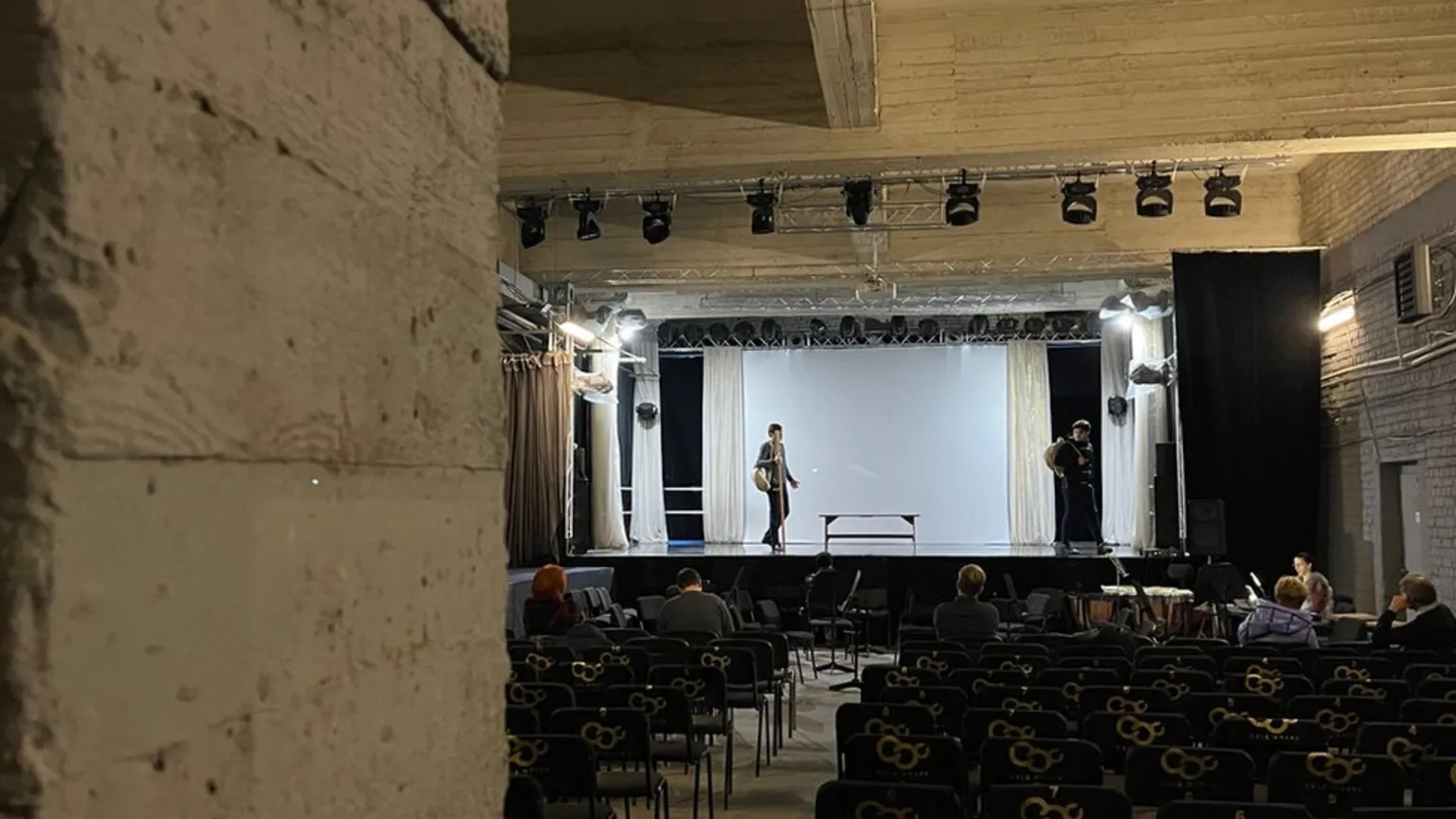
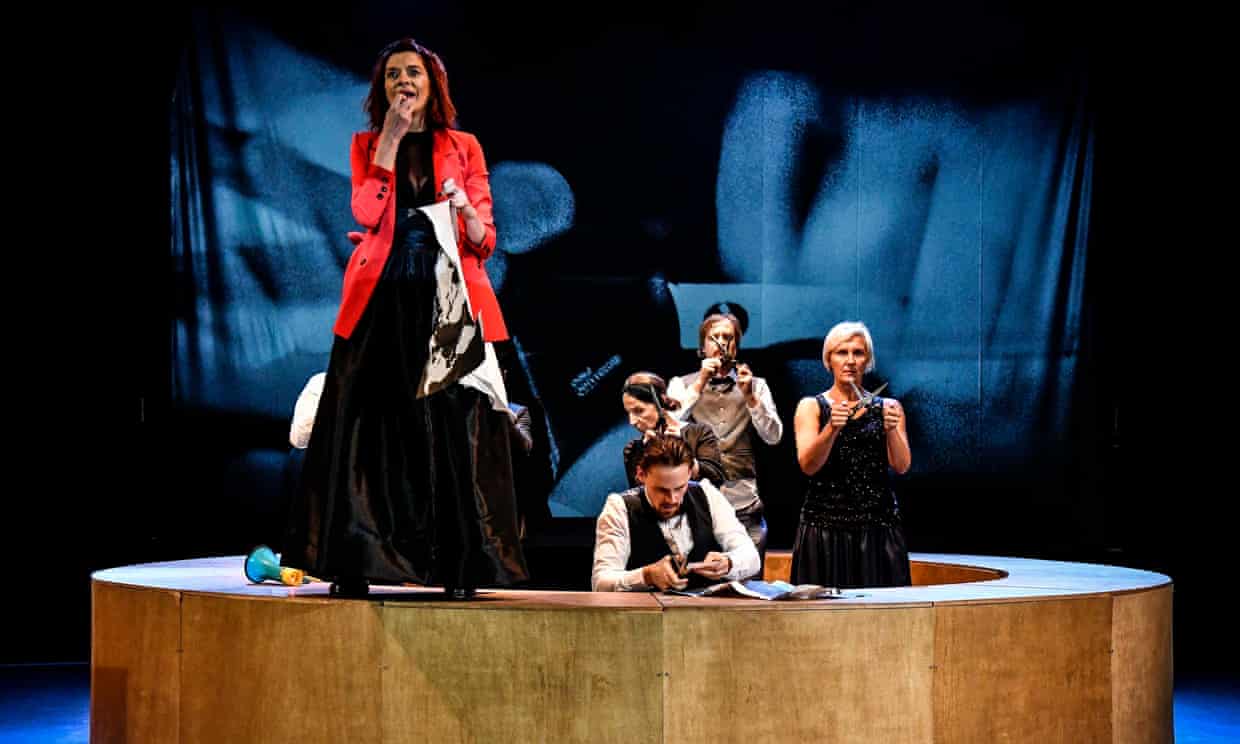
The play Negotiating Peace had its premiere at Pristina’s Oda theatre in October, before going on tour. 

Wars eventually end, but the peace that follows is often uneasy. Art can bring some laughs into people’s lives and add to the accumulation of small things that make a more lasting difference.

Philip Oltermann writes at the Guardian, “When political leaders present war as the only solution, it is up to artists to remind people that finding peace is still possible. That is the starting point for a Kosovo-based theatre company, Qendra Multimedia. …

“The lesson it draws, and the genre it chooses to present its findings, is unexpected: the Kosovan playwright Jeton Neziraj’s Negotiating Peace shows the diplomacy of peace as a farce, albeit a necessary one.

“Dramatizing roundtable talks between the fictional warring countries of Banovia and Unmikistan, the play is a frenzied comedy in which vain generals can only be lured to the negotiating table by promises of Hollywood films celebrating their actions. Opposing parties get drunk while negotiating demilitarized zones, mix up drafts of ceasefire agreements and sign on the wrong dotted line. Maps of disputed territories are partitioned with paper scissors until holy lands turn into showers of confetti. …

“ ‘When you talk about serious things, you must not talk about it in a serious way,’ said Orest Pastukh, a Ukrainian actor who is one of five members of Qendra’s multinational cast with first-hand experience of their country going to war. ‘If we would speak seriously about war and peace, everybody would go mad.’

“The play … is loosely based on the Dayton accords that in 1995 brought a halt to the three-and-a-half-year Bosnian war, the deadliest chapter in the breakup of Yugoslavia. At its premiere at Pristina’s Oda theatre last week, it also mixed in elements of the peace settlement that four years later ended the war in Kosovo. …

“To end that conflict between Serbs and Kosovo-Albanians in the breakaway province, Nato acted more swiftly and aggressively than it had done in the Bosnian war. In downtown Pristina, gratitude for the US’s assertive leadership in the peace talks is still palpable. There is a statue of a waving Bill Clinton, a bust of Madeleine Albright and a street named after Richard Holbrooke. …

“It may seem surprising, therefore, that in Negotiating Peace, moral certitudes come wrapped in sarcasm and not in pathos. The Holbrooke-type character, Joe Robertson, played by Harald Thompson Rosenstrøm, a Norwegian, is not just a ‘beast of peace’ but also ‘a schizophrenic, a brutal Mazarin.’ …

“ ‘When I read Holbrooke’s memoir To End a War, I realized that the negotiating table was also a kind of stage,’ Neziraj said on the eve of his play’s premiere. ‘And a dramatic stage on which actors were acting quite bizarrely,’ involving negotiators staging walkouts and new political borders ‘being drawn on napkins.’

“He said studying the Dayton agreement, as well as the Oslo accords signed between Israel and Palestine in 1993, had robbed him of the illusion that peace talks were structured conversations led by experts in their fields. ‘They are the fruit of the wills of individuals at a certain moment,’ Neziraj said. …

” ‘War doesn’t end when you lay down your arms,’ Neziraj said. ‘We in Kosovo live in an interim state, which is not war but neither a fully fledged peace.’ …

“Neziraj is aware of his own cynicism, and Negotiating Peace eventually manages to snap out of it. Towards the end of the play, the summit looks like a failure: faith in the UN is shot to shreds, there are calls for a second conference organized by the EU.

The chief negotiator appeals to the audience for advice to break the deadlock.

“As the play tours around the Balkans, the company intends to invite different real-life witnesses on to the stage. In Pristina the job fell to Aida Cerkez, a veteran Associated Press correspondent who covered the siege of Sarajevo from the Bosnian capital. Her 10-minute monologue changes the mood of the play.

“ ‘The only precondition for peace is to get everybody around the same table,’ she said after the curtain call. ‘And to get everybody around the same table, you have to militarily weaken the dominant side. As long as one side can think it can win, there’s no reason to sit down at the negotiating table. In Bosnia, that condition was met by Nato bombing. …

” ‘Peace is not the absence of armed conflict,’ she said. ‘In Bosnia we are living the absence of armed conflict, not peace. But that’s not nothing. It’s a lot.’ “

More at the Guardian, here. No paywall.

Read Full Post »

Photo: The Unwritten Record.
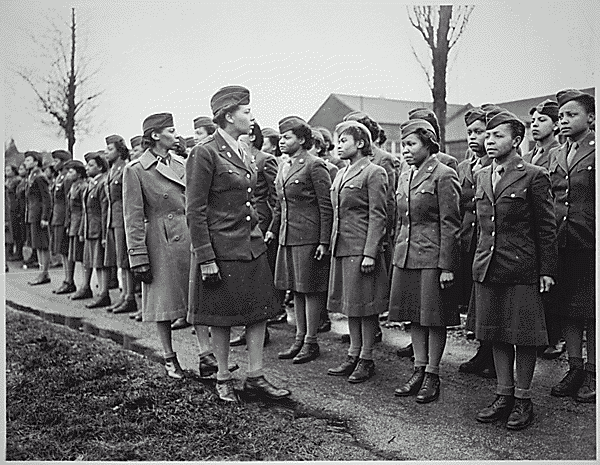
African American Women in the military during WW II.

November 11 is Veterans Day in the US. Veterans come in all shapes and sizes and they all deserve recognition. The African American veterans above served in the military in World War II.

A veteran from more recent times was honored in this reminiscence at the Washington Post. Lauren Koshere, a volunteer with Veterans Affairs’ My Life, My Story program and a food service worker at William S. Middleton Memorial Veterans Hospital in Madison, Wisconsin, shared some poignant memories.

“Final Salutes don’t come with much notice, maybe five minutes. But even those of us in chronically understaffed departments can attend. I join a river of co-workers flowing toward Ward 1B: nurses in turquoise scrubs, doctors in white coats, executives in business suits, police in uniform and me in a hairnet and black polyester polo — ‘VA Food Service’ embroidered over the heart — but without my usual stainless-steel tray cart.

“Most of us working in Veterans Affairs hospitals are not veterans. But the nurse standing across from me, in a hall lined with people, must be a veteran: She knows exactly how to stand with respect for a memorial service. I try to copy her posture, feet shoulders-width apart, hands joined behind my back.

“No one speaks. Then the quiet is broken by a single resonant tone. Five seconds of silence. Then another tone. A nurse carrying a brass singing bowl and wooden mallet appears from the hospice unit. She strikes the bowl again. Behind her, another nurse escorts a morgue cart draped in an American flag.

“I think of a hospice patient I’ve been bringing meals to for weeks. He was born in the late 1940s. Every day, his thin form lies at the same angle under a faded Green Bay Packers blanket.

“Until a hot day in July, we had never spoken — I suspected he couldn’t — but he always nodded and made eye contact when I set down his dinner tray. On this day, I pointed to a cup of chocolate ice cream he had ordered. ‘It’s a good day for ice cream.’

“He surprised me by replying, ‘Every day is a good day for ice cream.’

“The gurney comes into full view, and I now see a black baseball cap with a yellow, red and green Vietnam veterans badge resting on the flag.

“When the procession stops, people remove their hats. Veterans salute, and hold it, while the rest of us raise our hands to our hearts. The first notes of a ‘Taps’ recording fill the hallway, and we are locked in stillness. …

“My vision blurs as the song continues, and I wonder how many other funerals are being remembered in this hallway. I hear soft, deep sighs and a few sniffles. …

“As the flag-draped gurney passes on its way to the morgue, I realize it isn’t every day that I’m this close to the sharply defined red, white and blue. Working with veterans reminds me of what millions have invested for the idea of that flag. But it also reminds me of what that flag has asked, has taken. …

“Joseph Campbell said, ‘Affirmation is difficult. We always affirm with conditions.’ But ‘affirming it the way it is — that’s the hard thing, and that is what rituals are about.’

“To affirm unconditionally. To affirm the way it is. Ritual asks us to suspend our noise and our opinions and our egos. For a few moments of sacred silence, we affirm, creating the space where ritual works its power: weaving the personal to the anonymous, the individual to the universal, the known to the unknown.

“During a Final Salute, the deceased veteran’s identity is not disclosed. … The Final Salute on this day has gathered strangers in honor of a stranger. I don’t know whose loved one walks behind the gurney. I don’t know who lies under the Vietnam veterans hat, the American flag. But I did know a veteran who liked the Packers and chocolate ice cream.

“I never saw him again.”

More at the Post, here.

Read Full Post »

Photo: National Research and Restoration Center.
The location of Russia’s attacks, says Richard Kurin at Smithsonian magazine, suggest they target “sites that are significant to Ukrainian history, culture and identity.” (Above, although many items in storage were already in fragile condition, the conservation task is now more difficult.)

Today I have a couple articles about efforts to protect Ukrainian culture since the full-scale Russian invasion.

Richard Kurin writes at the Smithsonian, “Russian leader Vladimir Putin has wrongly made culture both a justification and an object of war with Ukraine. As in other regions of Europe, the population of the geographic region of modern Ukraine reflects a diversity of ethnic migrations and cultural influences, as well as a succession of political rulers and changing boundaries over millennia.

“Putin, though, claims that Ukrainians lack the history, culture and identity worthy of a national state separate from Russia. While drawing on periods of the czarist Russian Empire and the Soviet era to make his case, Putin denies crucial cultural realities.

“The Ukrainian language, the country’s art and its history — including the Slavic-Christian state centered in Kyiv a thousand years ago, the 19th-century flowering of Ukrainian culture and nationalism, the post-World War I Ukrainian republic, the Ukrainian independence movement of the early 1990s and its reaffirming Orange Revolution in 2004 and the Euromaidan Revolution in 2013-2014 — all represent an undeniable Ukrainian identity that is centuries in the making. …

“We take a close look at the ongoing work of hundreds of professionals across a landscape of Ukrainian and international organizations to defend endangered cultural heritage.

“Crucial investigations are underway that will one day provide an accounting of Russia’s devastating war crimes. These attacks are not just random, nor do they represent collateral damage. Rather, they suggest a targeted attack on Ukrainian history, culture and identity, a means toward Putin’s ends — the destruction is a deliberate attempt to obliterate Ukrainian history and culture.

“To support Putin’s wrongful argument that Ukraine doesn’t have a culture and history independent of Russia, his forces figure they can simply bomb away the country’s cultural heritage.

“To date, almost 1,600 cases of potential damage to Ukrainian cultural heritage sites have been documented, including some 700 monuments and memorials, and more than 200 museums, archives and libraries. Notably, more than 500 are religious sites — places of worship and cemeteries — with those of the Ukrainian Orthodox Church specifically targeted. The greatest number of cases are associated with regions of the most aggressive Russian attacks: Kyiv, Kharkiv, Mariupol and Luhansk. And the work of organizations, including the Smithsonian, mobilized thanks to years of cultural heritage training efforts, is aiding the country in its effort to protect artifacts, books, documents and artworks from these insidious attacks. …

“[In 2010], the Smithsonian formally established [Smithsonian Cultural Rescue Initiative or] SCRI under the direction of curator and former U.S. Army  ‘monuments woman‘ Cori Wegener. … As part of SCRI’s expanding research and training activities, [Ihor Poshyvailo, now director of the Maidan Museum in Kyiv] became first a trainee and then an instructor for the program and stayed in close contact with Wegener. …

“Last year, with the Russian invasion of Ukraine on February 24, the lab ramped up its efforts employing [satellites], including some with specialized sensors that can detect heat signatures to record ‘kinetic’ activity. That enables the monitoring of bombings, missile strikes, artillery shelling and fires. Using that data, the lab’s analysts are able to see how closely the heat signatures align with cultural sites. If proximate, they call up satellite photographic imagery to examine possible damage. Given satellite coverage, they can reference images over a period of time to pinpoint when the damage occurred and how extensive it is.” More at the Smithsonian, here. No firewall.

Meanwhile at CNN, there’s a great story about one woman’s quiet campaign to get US museums to relabel Ukrainian art misidentified as Russian.

For example: “Repin, a renowned 19th century painter who was born in what is now Ukraine, has been relabeled on the Met’s catalog as ‘Ukrainian, born Russian Empire’ with the start of each description of his works now reading, ‘Repin was born in the rural Ukrainian town of Chuhuiv (Chuguev) when it was part of the Russian Empire.’ …

“One of Repin’s lesser-known contemporaries, Kuindzhi was born in Mariupol in 1842 when the Ukrainian city was also part of the Russian Empire, his nationality has also been updated. The text for Kuindzhi’s ‘Red Sunset’ at the Met has been updated to include that ‘in March 2022, the Kuindzhi Art Museum in Mariupol, Ukraine, was destroyed in a Russian airstrike.’

“In reference to the recent relabeling process, the Met told CNN in a statement that the institution, ‘continually researches and examines objects in its collection in order to determine the most appropriate and accurate way to catalogue and present them. The cataloguing of these works has been updated following research conducted in collaboration with scholars in the field.’ …

“Semenik told CNN that she channeled her anger about the Russian invasion into her efforts to identify and promote Ukraine’s art heritage, using her Twitter account [Ukrainian Art History, or @ukr_arthistory] to showcase Ukrainian art to the world.

“Semenik is herself lucky to be alive. She was trapped in the Kyiv suburb of Bucha for weeks as Russian forces laid waste to the area last March, hiding out in the basement of a kindergarten before eventually walking some 12 miles to safety with her husband and their cat in tow.

“She began her campaign after a visit to Rutgers University in New Jersey last year. While helping curators there, she was surprised to see artists she always considered as Ukrainian labeled as Russian.”

So interesting! Read more here. No firewall.

Read Full Post »

Photo: Erin Clark/Globe staff.
Olga Yulikova sorts through donations that people drop off “onto the front porch of her Arlington home to help a Ukrainian family fleeing war,” the Boston Globe reports.

Because I’m downsizing and complaining about how difficult it can be to get some items into the hands of people who need them, Suzanne told me about our community’s Buy Nothing Project on Facebook. So far, no one there has wanted an old ironing board, but lots of people were interested in beat-up posters. I picked the first to raise her hand.

Meanwhile, in Arlington, they call their Facebook group Everything Is Free and are using it to help refugees get settled. To me that’s a worthier cause than giving free things to people who could often afford to buy them ten times over.

Sonel Cutler writes at the Boston Globe, “In Ukraine, Olena had a fulfilling job in real estate and an apartment she loved. The only time she had ever left her home city of Zaporizhzhia was to go on vacation.

“[In] February 2022, Olena, who asked to be identified by her first name only for privacy, became scared for the safety of her young daughter and made the most difficult decision of her life: to flee her home.

“She and her daughter left Zaporizhzhia abruptly in March after Russian forces took over a nearby nuclear power station. They took only passports, her daughter’s birth certificate, and few other items before driving to western Ukraine and then to Germany.

“In April, the Biden administration launched the Uniting for Ukraine program, which helped Olena and her daughter seek refuge in the United States. They arrived in late June, staying with childhood friends in Arlington until January, when their hosts had to bring their own parents to the country from Ukraine. …

“Connecting on Facebook, Olena became friends with Arlington resident Olga Yulikova, who helped her secure an apartment and turned to the town’s ‘Everything is Free’ Facebook group for donations to furnish the place.

“Arlington residents overwhelmingly answered her request. In a matter of days, the previously bare apartment had a fridge, coffee maker, queen-sized mattress, dish soap, and more essentials for Olena and her daughter.

“ ‘I’m completely overwhelmed, and I’m so grateful for all the help,’ Olena told the Globe, with Yulikova translating. …

“Yulikova, who immigrated from Moscow as a refugee in 1989, had been organizing humanitarian aid for Ukrainian refugees since the war began last year.

“She and Olena became close friends after meeting online, sharing stories over cups of coffee, and connecting over the discovery that Yulikova’s great-grandmother hailed from Olena’s hometown in Ukraine.

‘I cannot stop the war. I’m very much against it,’ Yulikova said. ‘I cannot save the Ukrainian people that are suffering. I can only help one or two individuals.’

“Yulikova posted her request for donations or small amounts of money in the community Facebook group on Jan. 22, and set up a wish list, listing a drop-off location for donated items.

“ ‘She [had] an empty apartment with no money,’ Yulikova said. ‘She’s very happy, but she [didn’t] really have a mattress to sleep on. So I figured I’ll put it on our Arlington lists, just like I did for everything else when I was collecting donations to be sent to Ukraine.’

“Daniel Icekson, a 54-year-old Arlington resident and friend of Yulikova, had been following Olena’s story after they had met briefly months before.The tragedy of the war in Ukraine moved Icekson, whose relatives perished in the Holocaust. When he heard Olena was looking for donations, Icekson began disassembling a large wardrobe, planning to reassemble it in Olena’s apartment.

“ ‘I thought, Why not? We have this extra wardrobe. We’ll just give it away,’ Icekson said. ‘If I can just contribute in a small way to one family, then I guess that’s a good thing.’

“Yulikova said she initially worried about how she and Olena would transport hefty items like a kitchen table and a jumbo bean bag into the apartment by themselves. But, according to Yulikova, ‘people came out of the woodwork’ to help.

“ ‘[They] said “Oh, no problem. I will drive. I will bring. I will assemble, disassemble,” ‘ she said. ‘People just volunteer.’

“While she knew Icekson, the majority of donors were complete strangers to Yulikova, something she said helped restore her lost faith in humanity. …

“Though her young daughter has immersed herself in school, performing with the local theater, and learning English, Olena remains troubled by her separation from her son and father, who remain in Ukraine to support the army.

“ ‘Every day, I don’t know if my son and my father will live another day,’ she said. ‘Every day I keep the phone at my fingertips and check in on them 100 times a day.’ “

More at the Globe, here.

Read Full Post »

Older Posts »