Feeds:
Posts
Comments

Posts Tagged ‘women’

1000

Photo: Glenn Castellano
A design by Meredith Bergmann of suffragists Elizabeth C. Stanton and Susan B. Anthony, the first Central Park statue depicting real women.

Other than fictional characters like Alice in Wonderland, females have not been represented among Central Park’s statues. A new sculpture, of suffragists Elizabeth C. Stanton and Susan B. Anthony, is the first step in changing the all-male array of historical figures in the park.

Nadja Sayej reports at the Guardian, “In 1995, the artist Meredith Bergmann was working on a film set in Central Park when she noticed something was off.

“ ‘I noticed then there were no statues of women,’ said Bergmann. ‘There was a wonderful Alice in Wonderland sculpture, but there were no sculptures of actual women of note and accomplishment.’

“Now, 23 years later, Bergmann has created the winning design for a bronze statue of New York suffragists Elizabeth C Stanton and Susan B Anthony, who fought for women’s right to vote. Bergmann’s creation will be erected in Central Park on 26 August 2020, coinciding with the centennial of the ratification of the 19th amendment ‘Votes for Women.’ …

“There are only five public statues of real women in New York City (excluding fictional characters like Alice in Wonderland and Mother Goose), while there are 145 sculptures of men, including statues of William Shakespeare and Ludwig van Beethoven, who are both in Central Park.

“ ‘We are happy to have broken the bronze ceiling to create the first statue of real women in the 164-year history of Central Park,’ said Pam Elam, the president of the Monumental Women campaign, which is backing the statue. …

“The statue has a long scroll that snakes from a desk down to a ballot box, which is meant to represent the change they made to the 19th amendment – but it doesn’t stop there. The scroll will detail the voices of over 20 other women, including Ida B Wells-Barnett and Sojourner Truth, with quotes written chronologically from 1848 to 2020. …

“While the quotes are currently kept under wraps, a few potential teasers have been posted on the group’s Instagram account. For example, Shirley Chisholm, the first black congresswoman, once said: ‘You don’t make progress by standing on the sidelines, whimpering and complaining, you make progress by implementing ideas,’ while Maya Angelou once said: ‘We may encounter many defeats but we must not be defeated.’ …

“[Says] Elam, ‘Women’s history is such a treasure chest of inspirational stories, it gives us courage to keep fighting for women’s rights and achieve equality in our lives. We want to get their stories out there for people to be energized by their contributions.’ ” More at the Guardian, here.

I’m in New York this week to be with my sister as she winds up six weeks of radiation and chemo. If I see any statues of women, I’ll be sure to share a picture.


Read Full Post »

inspace-greenstairs-large

Photo: Boston Society of Architects
This open staircase is pretty cool. Unless you are wearing a skirt.

A recent twitter series gave me a laugh. It sure shows how your perspective may change with a change of clothes.

At the Los Angeles Times, Carolina A. Miranda wrote how she hit a nerve with one frustrated tweet.

“A couple of weeks ago, after viewing an architectural schematic that featured a pair of elevated glass catwalks, I posted a tweet that invited male architects to navigate their own designs in a skirt.

Carolina A. Miranda
@cmonstah
Idea: All male architects should be required to navigate their own buildings in a skirt.

“The post ignited a flurry of responses from women, including Mary McNamara, Los Angeles Times assistant managing editor and former television critic, who suggested adding heels to the mix. To that challenge, design writer Alissa Walker of Curbed added babies. …

“I took [a picture] at the Nicanor Parra Library at Diego Portales University in Santiago, Chile, in 2015. The building was designed by Chilean architect Mathias Klotz and was completed in 2012 — in other words, at a point in time when male architects should know better. Yet the library features glass floors in locations throughout the building. …

“John Hill, who writes the blog ‘A Daily Dose of Architecture,’ pointed out the use of see-through walkways in Rafael Viñoly’s building for the architecture school he designed for the City College of New York — which he completed in 2009. City College isn’t the only school of architecture to employ transparent walkways. …

“This not only affects the women who work and study in those buildings — according to the Assn. of Collegiate Schools of Architecture, 42% of accredited architecture degrees were awarded to women in 2013 — but it normalizes the idea among architecture students that transparent walkways are just a benign architectural feature. They are not. …

“In 2010, technology writer Joanne McNeil wrote about this very topic in a post that ran on her blog ‘Tomorrow Museum,’ later reprinted by Mediaite.

” ‘If I were commissioning the interior of any kind of store and someone brought me blueprints including glass staircases, I’d tell him to take a hike,’ she wrote then. ‘I wouldn’t give him a second shot. If he’s not intuitive enough to grasp that women in skirts will be uncomfortable walking upstairs, clouded glass or not, then what other errors has he made in his design?’

“So, if there are a few good men out there (within driving distance of Los Angeles) willing to walk around one their own or someone else’s buildings in a skirt — while wearing high heels and holding a purse and a baby — my lines are open.”

More here. Let me know if you have encountered similar architectural challenges. Although I wear pants more often these days, I have memories of negotiating the green staircase above in a skirt — uncomfortably.

Read Full Post »

Art: Mary Delany (1700-1788)
Flowering Raspberry (Rubus odoratus) paper collage.

I’m not sure how I learned about the extraordinary botanical collages of Mary Delany, but as soon as I saw photos of her work, I headed straight to Wikipedia.

There I got enraged for the umpteenth time about the helplessness of women in past centuries (Delany was forced to marry a 60-year-old when she was 17). Finally, I came to this description of her late-blooming avocation.

“In 1771, a widow in her early 70s, Mary began on decoupage, a fashion with ladies of the court. Her works were detailed and botanically accurate depictions of plants.

“She used tissue paper and hand colouration to produce these pieces. She created 985 of these works, calling them her ‘Paper Mosaiks,’ [from] the age of 71 to 88, when her eyesight failed her.

‘With the plant specimen set before her she cut minute particles of coloured paper to represent the petals, stamens, calyx, leaves, veins, stalk and other parts of the plant, and, using lighter and darker paper to form the shading, she stuck them on a black background. By placing one piece of paper upon another she sometimes built up several layers and in a complete picture there might be hundreds of pieces to form one plant. It is thought she first dissected each plant so that she might examine it carefully for accurate portrayal.’ [Hayden, Ruth. Mrs Delany: her life and her flowers] …

Frances Burney (Madame D’Arblay) was introduced to her in 1783, and frequently visited her at her London home. … She had known many of the luminaries of her day, had corresponded with Jonathan Swift [among others], and left a detailed picture of polite English society of the 18th century in her six volumes of Autobiography and Letters (ed. Lady Llanover, 1861–1862).”

More pictures at Wikipedia, here. You may also be interested in this post, about the botanical art of Peter Rabbit creator Beatrix Potter. Potter, as a woman, failed to receive the attention men in science achieved — a century after Delany.

Read Full Post »

072117-Cynthia-Bloom-Block-Island-art

I went to the deCordova Sculpture Park and Museum in Lincoln Friday to see what New England women had been doing with abstract art since 1950.

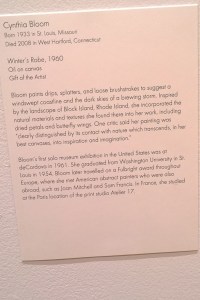
I was drawn to the painting above, and no wonder. It turned out to be Cynthia Bloom’s way of seeing New Shoreham, Rhode Island, my favorite place in the smallest state. The explanatory text says the artist “incorporated the natural materials and textures she found there into her work, including dried petals and butterfly wings.”

The gigantic heart sculpture looks sweet enough from a safe distance, but when you get close to Jim Dine’s “Two Big Black Hearts” (1985) and see all the broken tools, horseshoes, ladies shoes, etc., smashed roughly into the surface, you may feel a chill.

What’s nice is that on a summer’s day, you can walk in the shady woods on the deCordova grounds and see art along the paths. The serene head is “Humming,” by Jaume Plensa (2011), and the more abstract piece is “Maiden’s Dream,” by Isaac Witkin (1996). That one makes me ask, “Is it a good dream?”

After spending time on the grounds and in the galleries, I took the elevator to the roof deck and photographed the romantic turrets of what was once the home of art collector Julian de Cordova (1851-1945). I don’t think I had ever been on the roof before. The view over Flint’s Pond is amazing.

072117-Cynthis-Bloom-Block-Island-art-at-decordova

072117-Jim-Dine sculpture-decordova

072117-Plensa- sculpture-in-decordova-woods

072117-Witkin-sculpture-in-decordova-woods

072117-decordova-art-museum-turrets

2117-Flints-Pond-deCordova-Lincoln-MA

Read Full Post »

boghosian_27homeless6_met

Photo: Aram Boghosian for The Boston Globe
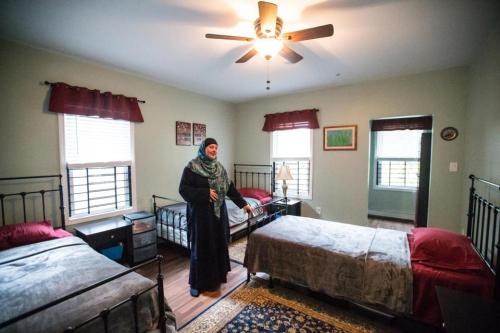
Malika MacDonald is director of the Amal Women’s Center, which provides shelter for Muslim women and children in need of temporary housing.

When I was working at the central bank, we had a Hubert Humphrey Fellow visit us from Bahrain. One aspect of America she was studying was homelessness. She said there was no homelessness in her country. She said families would never let it happen; they would take people in.

Having no way to know whether that was true in every case, I was nevertheless intrigued. Was it something about the culture in a Muslim country?

One thing I do know is that in this country, alas, Muslim women and children like other women and children, sometimes find themselves in need of temporary housing. That was the impetus for a new center in Boston, the brainchild of an Egyptian-American college student.

Lisa Wangsness wrote about the initiative at the Boston Globe. Here is the part of the article that touched me the most.

“The project began six years ago, when Mona Salem, then a 20-year-old Egyptian-American college student, was trying to help a young Muslim friend who wanted to escape a foster home where she felt unsafe.

“Salem thought her friend would feel most comfortable in a Muslim-run shelter for women, but soon discovered none existed in Boston. So she began raising money to start one, and teamed up with [Malika MacDonald, the national director of the Islamic Circle of North America Relief USA’s Transitional Housing Network.] …

“Donations poured in from every direction. Dishes and pots and pans for the kitchen arrived from families affiliated with the Framingham and Wayland mosques. A man offered his Home Depot credit card to pay for lighting. Various groups and individuals sponsored each of the bedrooms, furnishing them with bright-colored bedding and art for the walls.

“Salem said she was near tears when she saw the finished house the other day.

“ ‘That place was a dump when we first got there, and now it’s beautiful — absolutely beautiful,’ she said. ‘That says a lot about . . . how strong we are as a community to help one another.’

“Help arrived from beyond the local Muslim community as well. An artist in Texas sent an Arabesque Moroccan ceiling medallion for the living room. A board member of the interfaith group Kids4Peace Boston donated a lacquered dining table and banquette. The founder of a planned shelter for transgender people in Indiana sent along bathroom towels, MacDonald said.”

I suspect many of those donors know what it’s like to feel different and look for comfort.

More at the Boston Globe, here.

Read Full Post »

After 46 years of marriage, I can say I have a husband who is the same guy he always was, just with more life experience. But among my small circle of friends, including my blog friends, many women are dealing with extraordinary changes.

It may be true that, overall, women are as likely to develop dementia as men (see study) and present their husbands with unexpected caregiving challenges, but so far those stories are not the ones I’m hearing.

A college friend married to a brilliant scientist who has known for some time he was developing Alzheimer’s recently told me, “I finally realized he is completely dependent on me.” She is biting the bullet, reaching out for more helpers and planning an altered future.

Another friend whose husband has dementia made the decision to leave behind all her East Coast activities and relocate to Minnesota, where there is a network of family members. She intends to keep her husband in their new home, which has become a safe place in his mind. When her husband no longer recognizes anyone at all, she says, she will get full-time care, move herself out, and come visit him.

I reconnected last month with a high school friend who suffered a bitter divorce decades ago. She told me her ex’s wealthy girlfriend has been able to provide high-quality care for him for the 15-plus years since he was diagnosed with dementia. Although the divorce is still raw enough that there are topics my friend can’t discuss with her children, she goes to the Alzheimer’s facility regularly to read to her ex. She wants to become a better person.

Dementia has not been the only challenge for women I know. In one case, after a relative discovered her husband’s multiyear dalliance with a blackmailing call girl (and he then suffered a physical and emotional collapse), the wife made heroic efforts to rebuild the shattered relationship. A year later, they are both enjoying life together a little more every day.

Then there is the friend whose husband’s rare disease progressed to the point that he can no longer be left alone. She has had friends come in for an hour or two so she can shop for groceries and walk the dog, but the cost of a few hours coverage from a trained home-health-care aide has to be parceled out frugally as this friend has lost one income, is trying to build a home-based career, and needs to pay for two children’s colleges.

I can’t say enough about how much I admire these women who are rising to meet unanticipated disruption despite their sorrow and fear.

Art: William Utermohlen
In 1995, U.K.-based artist William Utermohlen was diagnosed with Alzheimer’s disease. He created a series of self-portraits over five years, before his death in 2007. (Caution: This is the first in the series. The others may be painful.)

alzheimers-disease-self-portrait-paintings-william-utermohlen-1

Read Full Post »

Photo: Jessica Hinchliffe/ABC Brisbane
The women of Queensland’s Spice Exchange create different spice blends to sell. 

This happy refugee story is from Australia, another country where refugees make valuable contributions, in this case sharing their beautiful foods and recipes with the broader population.

Jessica Hinchliffe writes at ABC Brisbane, “A social enterprise in Queensland is helping refugee and migrant women gain employment and foster community spirit through cooking.

“The Spice Exchange sees these enterprising women come together to create spice blends, condiments and gingerbread. They use recipes and spices well known in their home countries.

“Backed by Access Community Services, the social enterprise in Logan, south of Brisbane, also helps the women practise their English-speaking skills.

“Many of those involved are single women with dependent children, with limited education and literacy skills.

“Organiser Tianna Dencher said the Spice Exchange was helping these women, who sometimes felt isolated, find their voice. …

” ‘We saw that these women were comfortable with food and we decided to create something that would engage women around food.

” ‘Many of the women had such great cultural diversity, had beautiful cuisines that had spices … that’s how we started.’

“The program also teaches the women about workplace culture, marketing and how to price products. …

“Adhel Mawien Ukong began with the Spice Exchange in September and said the program provided her with opportunities for her and her children.

” ‘I’ve learnt so much,’ she said. ‘I start at 9:00 am and finish at 2.30 pm, and it’s given me a job four days a week and it’s helped us.

I love it so much so I come here every day of the week sometimes, and I’ve invited other women to join me.’ “

More here.

Hat Tip to @VictoriaLynden on twitter.

Read Full Post »

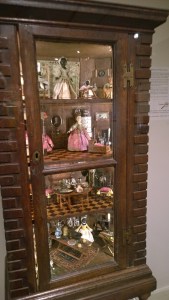
The Concord Museum has an exhibit on dollhouses right now, and I walked over to check it out. I’ve always liked dollhouses and even sought out one for Suzanne  when she was in utero.

At the museum, children were playing happily with the sturdy contemporary dollhouse they were allowed to touch, but I suspect the people most intrigued by the glassed-in displays from the Strong Museum and various private collectors were the adults.

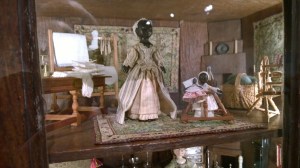
The Concord Museum is a history museum, and so I was less troubled by the accurate recreation of inequality in the miniature scenes than by the lack of relevant commentary in the placards. I couldn’t help thinking, for example, that some of the black schoolchildren who pass through the museum might be troubled by one dollhouse and might appreciate some discussion of the life of the servants in the attic and kitchen. But the placard was silent about wealth, poverty, and the legacy of slavery.

Another aspect of social history that seems fundamental to a discussion of dollhouses involves the many women who created them as a hobby.

Women who had servants in the attic and the kitchen were not folding the laundry. They were not cooking or tidying up. They were not raising their children. They did not have jobs. In short, they had almost nothing useful to do — a recipe for depression.

I often wonder about the psychological constraints that kept such women from giving themselves permission to go out into the world, as Jane Addams or Beatrix Potter did, each in her own way.

If making exquisite little worlds at home gave the dollhouse creators and their friends and families pleasure, that is a great thing in itself. If it represents a determination to create something fine when hardly any meaningful activity was allowed, then that is an even greater thing.

The dollhouse exhibit is up through January 15. Related events may be found here.

122916-dollhouse-reflects-unequal-history

122916-racial-inequality-in-dollhouse

Read Full Post »

In Tanzania, women farmers appearing on a TV show called in English “Female Food Heroes” are bringing attention to the importance of their work and the barriers to expansion.

Oxfam America reporter Coco McCabe writes about contestant Edna Kiogwe, “She grew up in a farming family and knows well the hurdles they face, especially women farmers who, in her country, own only a small fraction of the land. …

“It’s that inequality — and the lost opportunities buried beneath it — to which Kiogwe and 14 other women farmers helped to bring attention this year as contestants in the fifth season of a highly popular reality TV show shot in Tanzania and aired across East Africa. Called Mama ‘Shujaa wa Chakula ,’ or ‘Female Food Heroes,’ the Oxfam-sponsored show celebrates the vital contributions women farmers make in feeding the planet, and highlights the challenges many encounter on a daily basis, including limited access to land, credit, and training opportunities. …

“In the village of Kisanga, where ‘Mama Shujaa wa Chakula’ was filmed [in 2015], the 15 contestants learned a great deal about the struggles local farmers face in feeding their families. Each of the women stayed with a village family for the duration of the three-week shoot, and daily contests included designing tools that could be useful to Kisanga farmers, interviewing them about their agricultural challenges, and putting together skits to help bring attention to those hurdles. …

“Kiogwe [now] spends most of her time in Dar es Salaam, a coastal city about a two-and-a-half hour drive away, where she lives and works as a civil servant. But her city life belies her village roots — and her keen interest in farming. Unlike most women in Tanzania, Kiogwe owns her own land, given to her by her forward-thinking father on her wedding day. She harvests corn, cassava, rice, and sugar cane, carefully aligning her 28 days of annual leave from her city job with peak work times on her small farm in the Morogoro region. …

“ ‘I want to make agriculture like a business,’ says Kiogwe. … With a little effort, greater value can be added to the fruits farmers grow, for instance.

“ ‘Change it from fruit to juice, we can sell it … We can add value to maize — maize flour for porridge — and you can have a good label and good packaging and compete with international businesses. That is my dream.’ ” More here.

According to OXFAMCloseup, the nonprofit’s quarterly magazine, the episodes shot in Kisanga, Tanzania, aired in five countries and had 14 million people tune in. The magazine adds, “Versions of the program are now being produced in Ethiopia and Nigeria, and some finalists have become involved in local, national, and even global farmer advocacy.”

Photo: Coco McCabe / Oxfam America
Edna Kiogwe helps her host family with the morning chores in Kisanga, where the TV show “Female Food Heroes” was filmed in 2015.

Read Full Post »

Gregg tweeted recently about Robinson Meyer’s Atlantic article on 92-year-old metallurgist Ursula Franklin.

Meyer writes, “It’s hard to describe what Ursula Franklin’s done in her life. There’s just too much.

“The 92-year-old metallurgist pioneered the field of archeometry, the science of dating archaeologically discovered bronzes, metals, and ceramics. Her research into spiking levels of radioactive strontium in baby teeth factored heavily into the U.S. government’s decision to institute a nuclear test ban.

“She delivered the Massey Lectures—an important, annual series of talks delivered by Canadian public intellectuals—in 1989, and she was the first woman to be named University Professor at the University of Toronto, the university’s highest position.

“She was also born in Munich in 1921, and was imprisoned in a Nazi work camp for the last 18 months of the war.”

Meyers’s questions cover much of Franklin’s life, her pacifism, and her trail-blazing for women scientists. It’s a long interview. Here’s a taste.

“Once you were at the University of Toronto … did you see the university change over your time there, and just generally what was it like to be a female professor of engineering during the ’70s and ’80s?”

Franklin answers, “Well, pretty lonely. You know the real difficulty is to protect and advance your women students, and to see that they are in a hassle-free learning environment. When I came to the university, I’d been around long enough to know that I wasn’t one of the gang, and I never would be. I didn’t have a desire to be one of the boys.

“But the great wish—to give my women students a hassle-free, happy learning environment—that’s what’s difficult. The culture of engineering is not a culture of acceptance and understanding of anything that is female and—at the same time—equal. So that’s… that’s a real job. It was a long and hard [work] in this, and it’s by no means yet all done.”

I remember the fuss over strontium 90 in milk. How great to read about this woman ‘s role in uncovering the problem and to see that she is going strong at 92. More at the Atlantic.

Ursula Franklin  photo

Read Full Post »

Because I believe in Pete Seeger’s notion that “one and one and 50 make a million,” I’m drawn to stories of individuals making small contributions that could add up to something big.

So here is a story from Forbes, of all places, about several women in Detroit quietly working toward rescuing the city.

Denise Restauri writes, “As we drive through Detroit, on the surface I see a city that’s been abandoned by its residents, filled with poverty and crime. But when we stop and meet store owners, artists and women who went from being homeless to employed, I see a city that’s energized with entrepreneurship, hipster creativity and potential.

“Suddenly I understand what Veronika Scott, the 24-year-old who is sitting in the driver’s seat, often called ‘the crazy coat lady,’ means when she says, ‘I love Detroit.’

“Veronika is empowering Detroit with a disruptive business model. She’s the CEO and Founder of The Empowerment Plan, a non-profit organization that employs homeless women and trains them to become full-time seamstresses who produce coats that turn into sleeping bags which are given to homeless individuals across the nation.

“She doesn’t just employ these women — she educates and equips them with the professional skills and knowledge needed to compete in Detroit’s new economy and evolving job market.”

Restauri goes on to describe five other female-powered enterprises in her Forbes post.

JJ Curis, 32, is gallery director at the Library Street Collective, which helps struggling artists. The five James Sisters, 25-32, cofounded DROUGHT to make organically grown produce accessible to all.

Amy Kaherl, 32, is the executive director of Detroit SOUP, a novel idea that involves inviting people to pay for a dinner where they can hear pitches from local charities and vote on which one should get the evening’s donations, or micro grants.

Cheryl P. Johnson, 53, is the CEO of COTS: Coalition On Temporary Shelter. And LaKeisha Blackwell, 41, is jail diversion coordinator at Northeast Guidance Center. Read about the women here.

Photo: Forbes
Veronika Scott wears the Empowerment Plan’s sleeping bag coat.

Read Full Post »

Last fall, I blogged about the worthy Granola Project, which gives employment to refugees in Rhode Island. It is housed at the social service agency Amos House in Providence. I bought some of the granola at the farmers market a just last week.

Now Sarah Shemkus has written for the Boston Globe about a similar initiative for refugees in Massachusetts, but with the goal of helping refugee women to spin off companies on their own.

“Moo Kho Paw fled the violence and oppression of Myanmar for a refugee camp in Thailand nearly a decade ago,” writes Shemkus. “Five years later, she, her husband, and their baby daughter resettled again, this time landing in Springfield.

“As she adapted to her new home, Paw started looking for a job … That’s when she learned about Prosperity Candle, the Easthampton company where she has now worked for three years.

“ ‘I love the job,’ Paw said. ‘It helps me to pay the rent, to buy the baby diapers.’

“That’s precisely what Ted Barber, 46, hoped for when he and partner Amber Chand founded Prosperity Candle in 2010. … Sales are only part of its mission — the company says its real goal is to help women in and from developing countries by teaching them new skills and creating jobs. …

“In Easthampton, the company employs refugees such as Paw to make and package candles and fulfill orders. Currently, up to four refugees are working there at any given time, though Barber expects to hire more as the business expands. …”

The idea for an enterprise like Prosperity Candle first occurred to Barber when he was working in Africa, helping entrepreneurs build small businesses. …

” ‘I realized I wanted to do something different.’ …

“Rather than giving away money or supplies, [his] company would provide women with the resources, skills, and support they need to start a sustainable businesses. …

“Prosperity Candle formed as a low-profit limited liability company, a structure that requires the business to put its social mission ahead of profits.”

More.

Photo: Matthew Cavanaugh for The Boston Globe
Moo Kho Paw (left) and Naw Test made candles at Prosperity Candle in Easthampton.

Prosperity Candle formed as a low-profit limited liability company, a structure that requires the business to put its social mission ahead of profits.

Read Full Post »

John sent me a good New Yorker story about “the Arslanköy Women’s Theatre Group, an all-female theatre group, based in rural Turkey, which is writing and performing plays.

“Ümmiye Koçak, who is now in her mid-fifties, was a forty-four-year-old farmworker with a primary-school education when she caught the theatre bug from a school play that a local school principal, Hüseyin Arslanköylü, had staged the previous year,” writes Elif Batuman.

“Ümmiye had never seen a play before, and it seeped into her thoughts. For a long time, she had been puzzling over the situation of village women and the many roles they had to play. In the fields, they worked like men; in villas, they became housekeepers; at home, they were wives and mothers.

“In 2000, with other women from her village, Arslanköy, she formed the Arslanköy Women’s Theatre Group. The group met every night at the school, after the women had worked ten- or twelve-hour days on farms. Their first production, a contemporary Turkish play called ‘Stone Almonds,’ sold out a theatre in the provincial capital of Mersin, and was written up in the national press.” Continued here.

Still more at the New Yorker blog, here.

I’m wondering about the mysterious figure at the left here. Hamlet’s father? But he doesn’t show up after people die, or does he? It was always a somewhat confusing play. As my father used to say, quoting I know not who: “The king dies, the queen dies, Ham dies — I calls it a helluva play!”

Photograph: New Yorker magazine
“Hamlet” performed in a mountain location near Arslanköy at dawn.

Read Full Post »

Do men and women have different approaches to charitable giving?

In the July 12 Christian Science Monitor, Temma Ehrenfeld writes that the Women’s Philanthropy Institute at Indiana University has found that “female-headed households are more likely to give to charity than male-headed households, and that in nearly all income groups women give more than men.”

In addition, continues Ehrenfeld, “Insiders say women have their own culture in grant-making. …

“For example, the Global Fund for Women (GFW), unlike most grant-givers, accepts handwritten proposals of any length and in any language, and is unusually open to grants for general purposes rather than specific projects. It also funds meetings to create networks of women activists.

“The approach demonstrated its power during Egypt’s Arab Spring, said Christine Switzer, GFW’s director of development. ‘Our women were able to mobilize together,’ she said, pointing to 77 grants totaling more than $1 million GFW has given to Egyptian women, young and old.”

I often wonder, though, Are women more generous to the underprivileged when they become heads of state? I doubt it. Indira Gandhi? Maggie Thatcher? Golda Meir? Kirchner of Argentina? Let me know if you see studies on this topic.

Meanwhile, there’s more to read at the Monitor.

Photograph: http://www.dw.de

Read Full Post »

New research on the importance of calling your mom is doing the rounds.

John, @OFH_John on twitter, saw it at a Washington Post blog, which saw it at Wired, which saw it at the journal Evolution & Human Behavior: “Wired flags a new study that proves many mothers across the country right: For your own sake, you should call home more often. … A phone call to mom provides significant stress relief while instant message conversations won’t.”

Once my post goes up and triggers @LunaStellaBlog1 (you’re aware that I write this blog for Suzanne’s birthstone-jewelry company?), who knows where the message in a bottle will end up? Telephones will ring.

The Evolution & Human Behavior authors say that upbeat hormones can be generated by Mom’s voice (unless she is hassling you, of course), and those good hormones can combat your stress chemicals (read the abstract).

Bet moms get stress relief, too. As Dr. Malissa Wood said at a book reading today, women with more interpersonal connections are less likely to have heart attacks.

The call-your-mom paper is “Instant messages vs. speech: hormones and why we still need to hear each other.” The authors are Leslie J. Seltzer, Ashley R. Prososki, Toni E. Ziegler, and Seth D. Pollak.

Bless their healthy little hearts for getting ET to phone home.

Read Full Post »

« Newer Posts