Feeds:
Posts
Comments

Posts Tagged ‘youth’

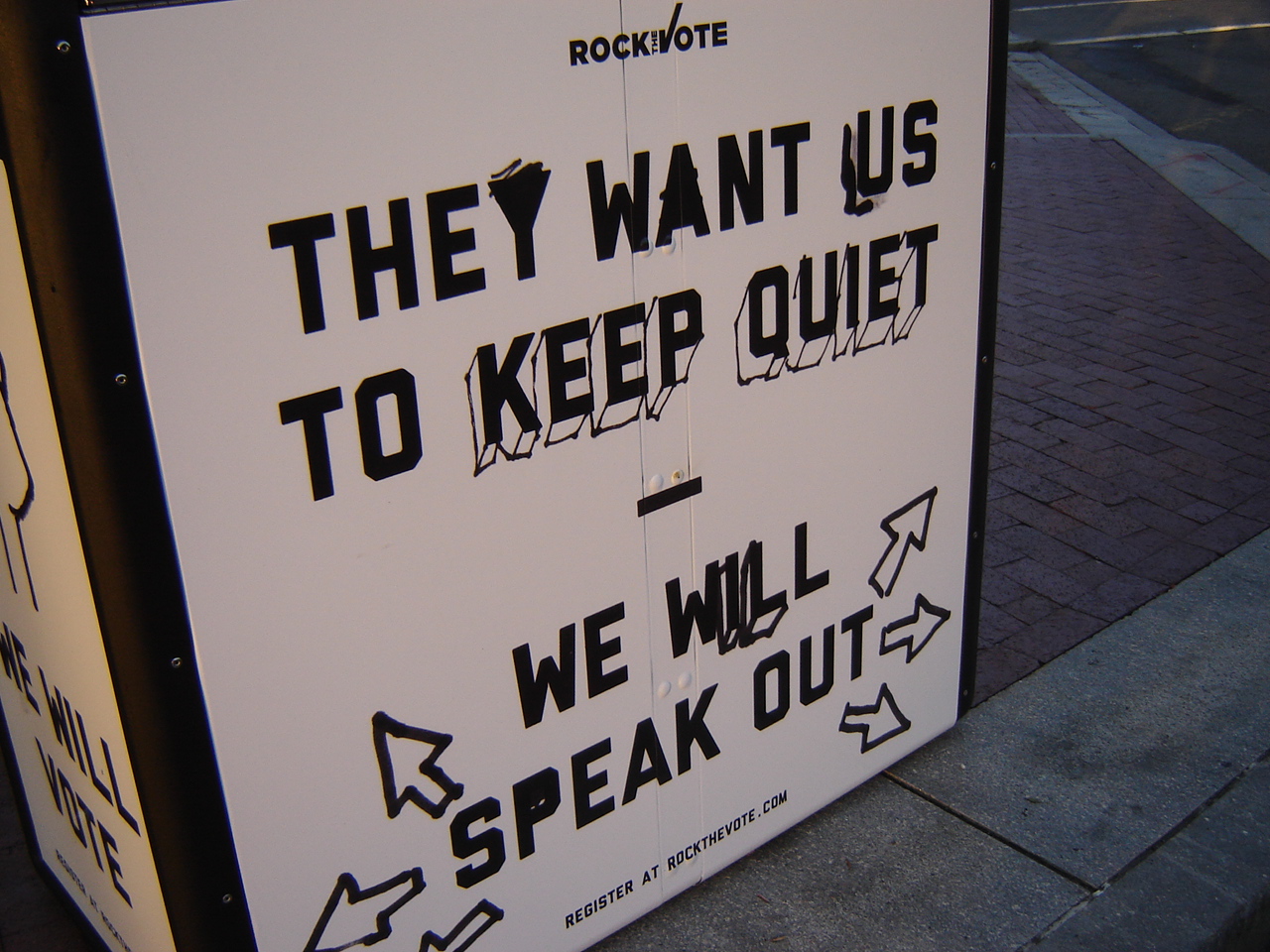
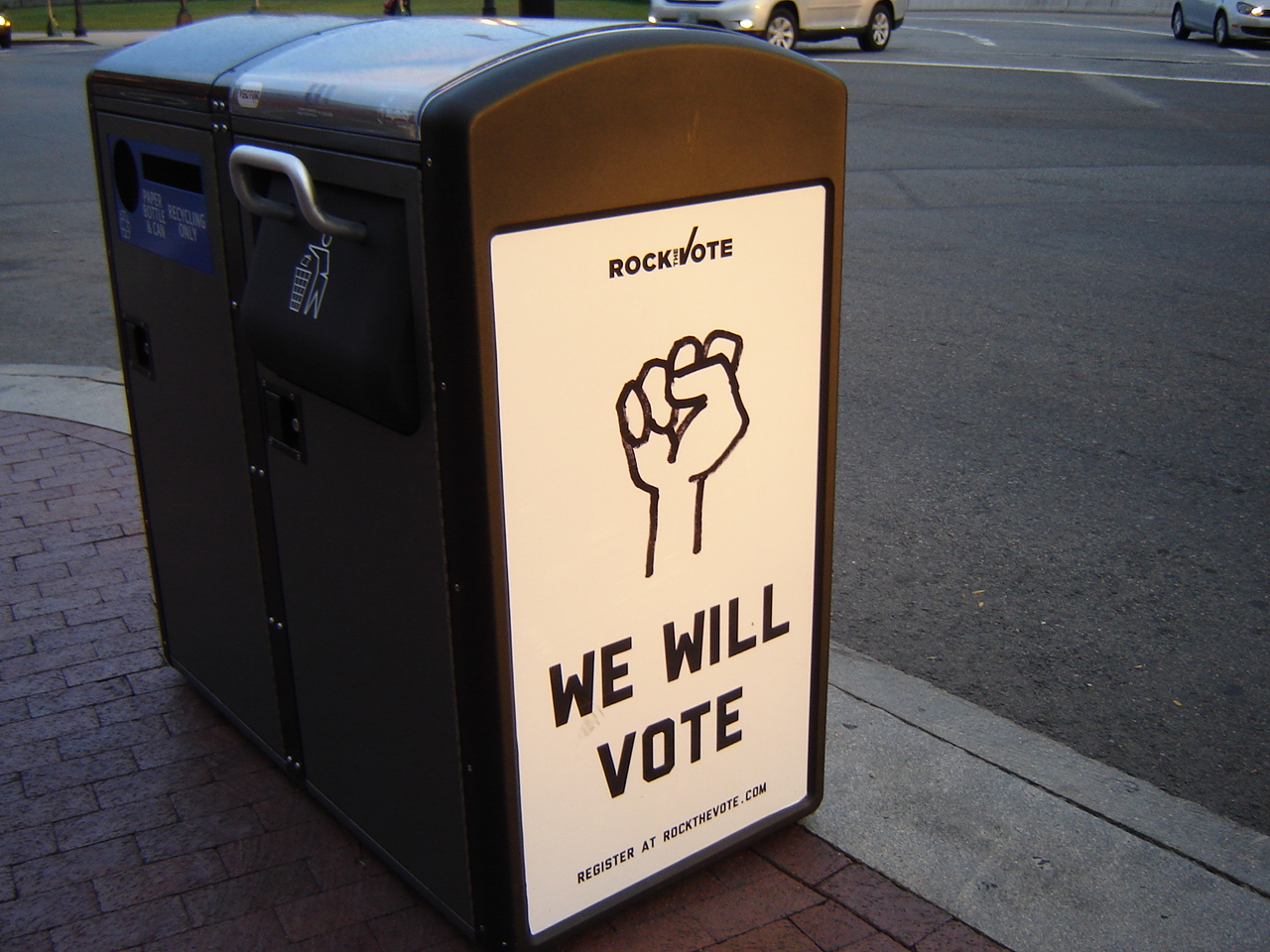
Saw these signs on my morning walk and did a little googling around to learn more.


Naturally, there’s a website with an explanation:

“Rock the Vote’s mission is to engage and build political power for young people in our country.

“Founded twenty-one years ago at the intersection of popular culture and politics, Rock the Vote has registered more than five million young people to vote and has become a trusted source of information for young people about registering to vote and casting a ballot. We use music, popular culture, new technologies and grassroots organizing to motivate and mobilize young people in our country to participate in every election, with the goal of seizing the power of the youth vote to create political and social change.

“The Millennial Generation is diverse and huge in number, making up nearly 1/4 of the entire electorate in 2012. This is both the challenge and the opportunity. Rock the Vote is dedicated to building the political power of young people by engaging them in the electoral process, urging politicians to pay attention to issues that matter to young voters, and protecting their fundamental right to vote. Our goal is to reinvigorate our country’s democracy and redefine citizenship for a generation in 2012 and beyond.”

Check out Rock the Vote here. There are some videos from celebrities using humor to encourage young people to register.

Read Full Post »

Here is another great music outreach to kids: the Philadelphia Youth Orchestra’s Tune up Philly initiative.

“The mission of Philadelphia Youth Orchestra’s Tune Up Philly program is to nurture urban children in challenging social and economic conditions by keeping them engaged in success through weekday out-of-school hours music instruction.  Through its Tune Up Philly program, Philadelphia Youth Orchestra organization believes that music education is a powerful vehicle for children to master skills that will enable them to acquire valuable tools for cooperative learning, teamwork, academic success and self-esteem.” More.

The Inquirer classical music critic Peter Dobrin wrote at Philly.com that an important goal of the initial program was to show the rest of the city what is possible.

“The brain-child of 24-year-old Curtis Institute of Music graduate Stanford Thompson … and adopted by the Philadelphia Youth Orchestra, Tune Up Philly started at St. Francis de Sales … with the aim of replicating itself at other sites …

“Modeled on the widely praised and emulated El Sistema program that has educated millions of children in Venezuela, Philadelphia’s upstart is already gathering considerable support. Since initial coverage in the Inquirer and subsequent media attention, the program has received donations of cellos, clarinets, double basses, flutes, saxophones, trumpets, trombones, violas, violins and other instruments, plus about $13,000 in cash and $10,000 in in-kind services.” More.

Photograph: First graders exploring xylophones in the 2012 summer program.

Read Full Post »

I blogged before about the idea that one and one and 50 make a million, the idea that little actions by many people can make big change.

It speaks to me. So I loved this food-for-the-hungry story in yesterday’s Boston Globe. Volunteers at Community Cooks in Somerville, Massachusetts, provide part of a meal for a charity once a month. It’s relatively small commitment that adds up. Vicki I founded it 20 years ago.

She tells the Globe‘s Jane Dornbusch: “My friend heard the Somerville Homeless Coalition wanted some food support. … It was an era when many young professionals who were interested in helping the community were moving to Somerville, so we were able to recruit very easily.”

Derek Neilson makes potato salad for Community Cooks.

Derek Neilson makes potato salad for Community Cooks. Photograph: Barry Chin, Globe staff

Dornbusch adds, “Community Cooks is just that: a community of cooks that prepares food for the community. Each volunteer is assigned to a team that provides a meal once a month to a partner organization; these organizations include homeless shelters, women’s and family shelters, youth development programs, providers of support for the developmentally disabled, and more.

“The team leader hands out dish assignments — main course, salad, side, dessert — and each volunteer purchases the necessary ingredients and prepares a homemade recipe to feed about 15. Then the volunteer drops it at a central location. Each team serves a particular organization, so volunteers develop a sense of community and partnership with one group. It’s not an overwhelming commitment.” But together the cooks make a big difference  Read more.

Read Full Post »

There’s a theory that if you want information to stick, it helps to tie it to emotions. The Center for Community Capital at the University of North Carolina tested the idea with The Bold and the Bankable: How the Nuestro Barrio Soap Opera Effectively Delivers Financial Education to Latino Immigrants.

It’s all true: If a character you like goes bankrupt because of reckless behavior with money, you are likely to remember and apply the learning to your own situation.

Last week I had the pleasure of attending a theatrical production by teenagers from the Underground Railway Youth Theater who had written a script from interviews they conducted with 80 people of all ages. The teens asked interviewees about their experiences with money and how they felt about it. Some of the stories were quite moving, and the high school audience’s emotions were likely engaged as they were quiet as mice.

There was a talkback afterward. A few students wanted to know how to join Youth Underground.

From the group’s website: “Youth Underground serves youth ages 13-18 with stipend eligible opportunities to create theater together and in tandem with community-based organizations; and to showcase their work throughout the city, Greater Boston, and at Central Square Theater. Youth Underground holds both an academic year program and intensive summer residency with an annual Ensemble of 30 members. Youth Underground showcases work through performances, a youth driven Community Dialogue Series, and peer exchanges with local and global organizations.”

The Boston Globe has a good article on it.

Read Full Post »

I was interested in an article in today’s NY Times about a school that gives chronically failing students another chance. It succeeds against all odds, but success is a slow process. New York’s mayor is not a fan, because many kids take six years to graduate.

Aniah McAllister, once a lost and wandering soul, has one of the happier stories. Reporter Michael Powell writes that she seems amazed to have earned 46 credits and to be headed to college.

“ ‘This school made realize,’ she says, ‘that I am much better than I thought I was.’

“That’s a pretty fair bottom line for any school,” writes Powell, “although in the up-is-down world of public education in New York, it might just be an epitaph for this small marvel of a high school. Known as a transfer high school, Bushwick Community admits only those teenagers who have failed elsewhere. Most students enter at age 17 or 18, and most have fewer than 10 credits.

“You can muck around quite a bit trying to find someone who has walked the school’s corridors, talked to its students and faculty, and come away unmoved. Most sound like Kathleen M. Cashin, a member of the State Board of Regents and a former superintendent. ‘They care for the neediest with love and rigor,’ she said. ‘They are a tribute to public education.’ ”

Read the article. I’m hoping it will have an influence on the policymakers and let an initiative that sounds so positive keep going.

Aniah McAllister, left, Justin Soto and Kassandra Barrientos attend Bushwick Community High School. Photograph: Kirsten Luce, NY Times

Read Full Post »

Last night I went to a jazz benefit for the nonprofit Kids4Peace Boston, which sponsors a summer camp and other events for children of three faiths — Christian, Muslim, and Jewish. The children are from both the United States and Jerusalem and are 11 to 12. Read more about the program here.

The fundraising event was held in the Grand Circle Gallery in Boston, which features magnificent travel posters and travel photography from the 1930s and 1940s. The entertainment was provided by Indian vocalist Annette Philip and her jazz quartet. Very impressive.

Read Full Post »

Today I walked over to the Moakley Courthouse on Boston Harbor to see an art exhibit that the Actors’ Shakespeare Project put together with youth in detention. It consisted of large photographs in which a young person, sometimes in costume, acted out a word from Shakespeare. I did not feel that the presentation in the low-ceiling hallway did the works justice — and having to go through metal detectors to look at them is a bit of a downer — but the concept is positive.

Deborah Becker of WBUR reported that the photographs were part of a larger effort to turn young offenders around with the help of art: “Using the arts as a way to heal and transform is the theme of an exhibit at Boston’s federal courthouse. The artists are children who have been involved with the Massachusetts Department of Youth Services (DYS), the agency that handles youngsters charged with crimes.

“At a recent reception of the artists and DYS officials, 17-year-old Ricky Brown was among the young people proudly describing his work. He helped paint a mural that covers the entire wall of a DYS district office in Springfield. He says it sends a message about kids in the juvenile justice system.

“It brightens up the whole building,” Brown said. “It makes sure to say that we’re not only there to get locked up. It’s there to let people know that we do work together, we do do something positive.”

Read more.

Read Full Post »

I was hoping to see this documentary before writing about it, but can’t get it from Netflix.

Have you heard of The Interrupters? It’s about street workers in Chicago, former gang members, who try to stop violence by, if necessary, literally “interrupting” a fight. They are trying to atone to some extent for their own past and are working to keep other young people from making the same mistakes.

As Saul Austerlitz writes in the Boston Globe, one can “see the possibility of redemption, even in those seemingly beyond it, and to bear witness to the hesitant first steps taken by young men and women toward a better future. …

“If anything truly surprised [the filmmakers], it was how much they enjoyed making this film, somber subject matter to the contrary. ‘We got to hang out with people who are amazing, inspiring, funny, fun to be around,’ says James, ‘and who have made this incredible journey in their lives, and we got to bear witness to people beginning their own journey in that way.’

“Cajoling, hectoring, relentlessly interrogative, interrupters like Ameena are moral arbiters by virtue of their own experiences. ‘They have moral authority without moralizing,’ says James. Understanding their struggles to come to grips with their own pasts, we also understand their motivation.” Read more here.

Read Full Post »

« Newer Posts