Feeds:
Posts
Comments

Archive for July, 2015

I have enjoyed Maria Popova’s reviews of children’s books at Brain Pickings and have been moved to buy quite a few.

This is the first picture book for grown-ups I’ve seen at her site, a kind of meditation on living life, with watercolors of an Everyman thinking about things.

Popova writes, “French-born, Baltimore-based artist Jean-Pierre Weill explores in The Well of Being (public library) — an extraordinary ‘children’s book for adults,’ three years in the making, that peers into the depths of the human experience and the meaning of our existence, tracing how the stories we tell ourselves to construct our personae obscure the truth of our personhood, and how we can untell them in order to just be. …

“Weill dances across the Big Bang, the teachings of the 18th-century Italian philosopher and mystic Ramchal, evolution, 9/11, and life’s most poetic and philosophical dimensions. He tells the lyrical story of a man — an androgynous being who ‘represents Everyman and also Everywoman,’ as Weill explains in the endnotes — moving from the origin of the universe to the perplexities of growing up to the mystery of being alive.”

Here’s a passage:

Is the world not whole? Is it not beautiful?

For now, let’s consider well-being a choice, something you can try on and wear. When we put on the hat and coat of well-being we incline towards joy without special occasion.

More at Brain Pickings, here.

Art: Jean-Pierre Weill 

Read Full Post »

On Sunday, I got to the Peabody Essex Museum early and decided to walk around Salem before going in to see the Thomas Hart Bentons. I thought I might take a look at the hotel where I stayed when DeAnna and Mairtin got married.

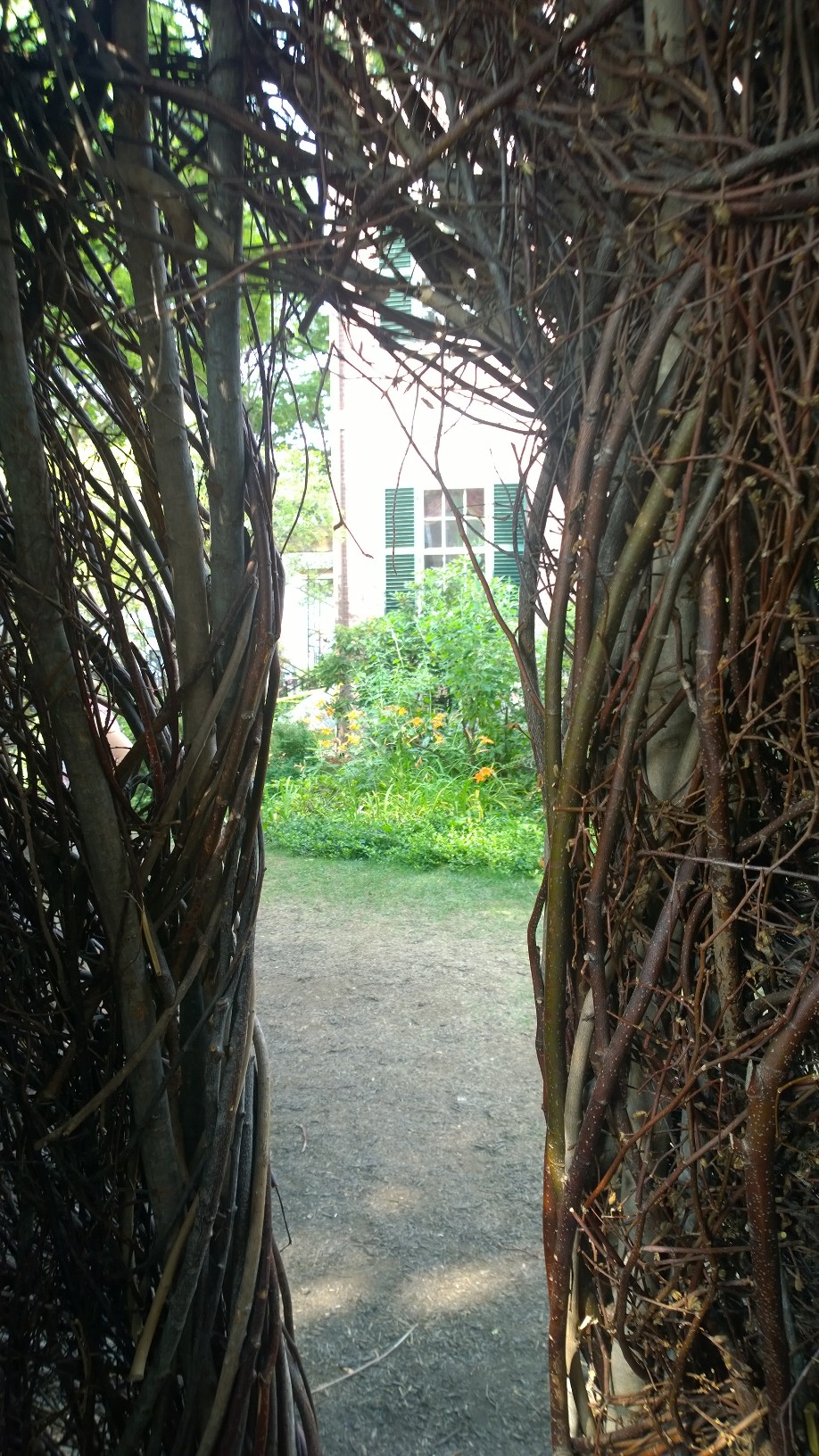
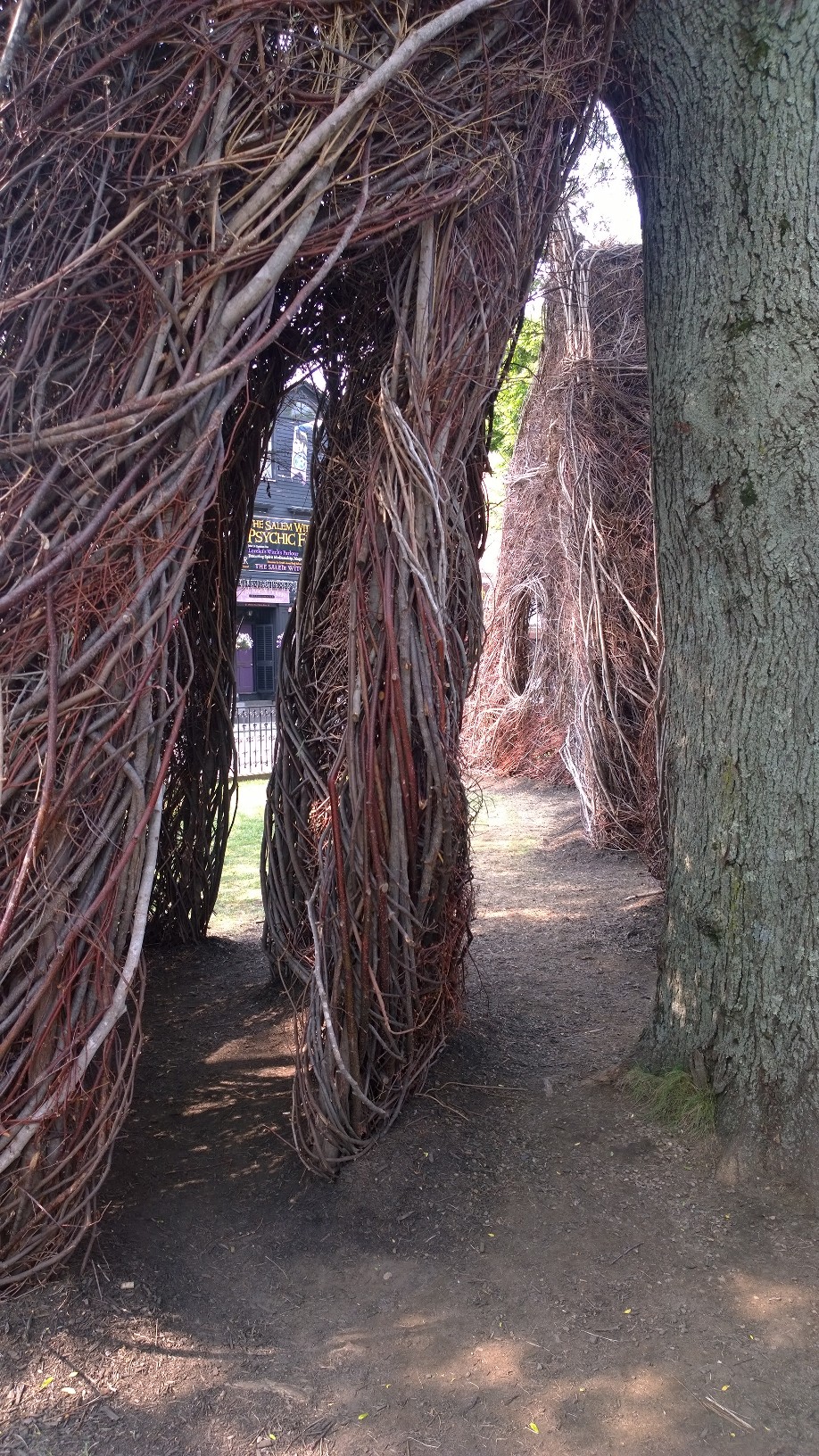
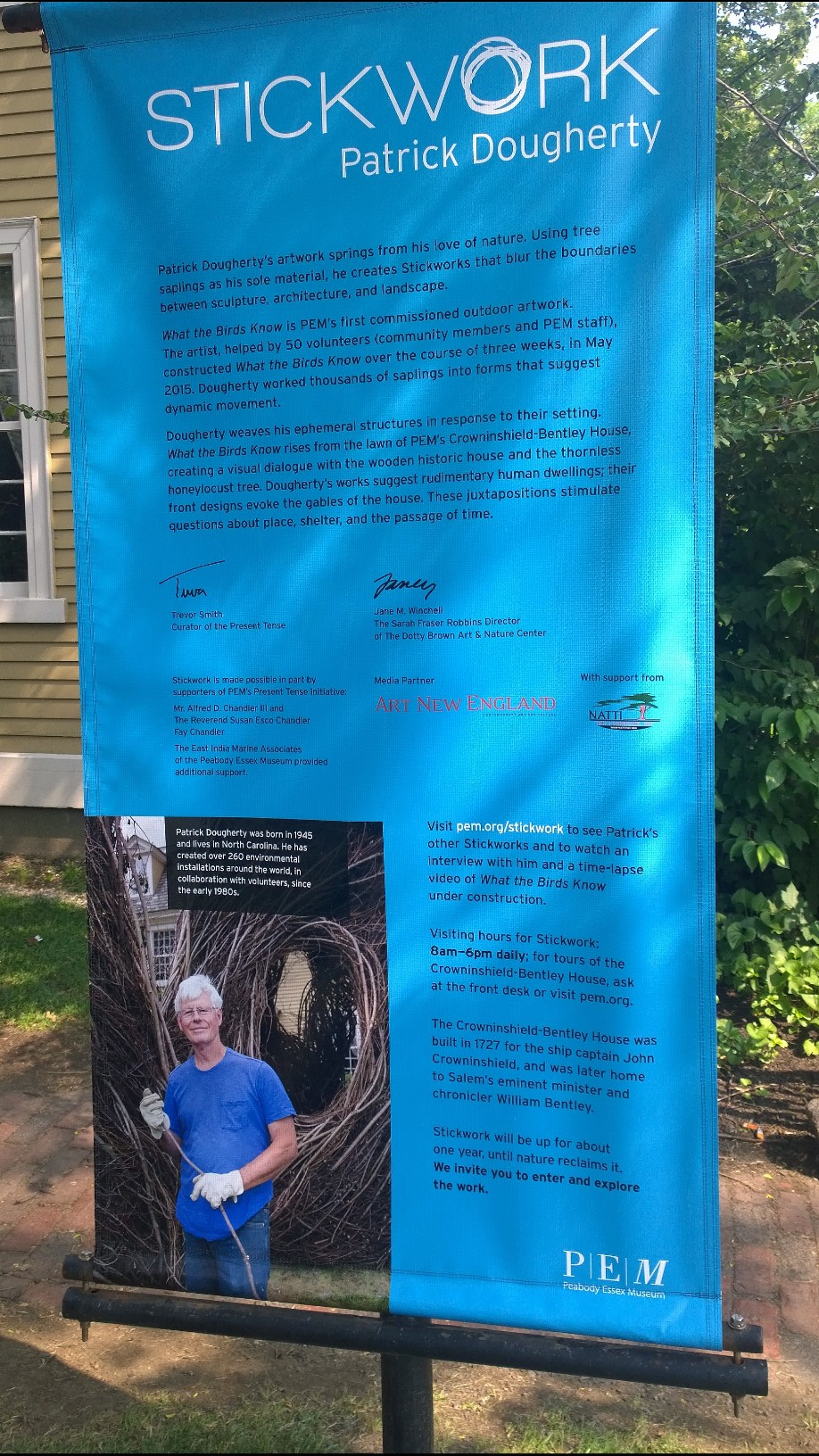
I hadn’t gone very far when what should I spy but some very strange constructions made of sticks. Turns out the sculptures, by Patrick Dougherty, were also a PEM exhibition: “Stickwork.”

From Dougherty’s website: “Born in Oklahoma in 1945, Dougherty was raised in North Carolina. He earned a B.A. in English from the University of North Carolina in 1967 and an M.A. in Hospital and Health Administration from the University of Iowa in 1969. Later, he returned to the University of North Carolina to study art history and sculpture.

“Combining his carpentry skills with his love of nature, Patrick began to learn more about primitive techniques of building and to experiment with tree saplings as construction material. In 1982 his first work, Maple Body Wrap, was included in the North Carolina Biennial Artists’ Exhibition, sponsored by the North Carolina Museum of Art. In the following year, he had his first one-person show entitled, ‘Waitin’ It Out,’ in Maple at the Southeastern Center for Contemporary Art in Winston-Salem, North Carolina.

“His work quickly evolved from single pieces on conventional pedestals to monumental scale environmental works, which required saplings by the truckloads. Over the last thirty years, he has built over 250 of these works, and become internationally acclaimed. His sculpture has been seen worldwide—from Scotland to Japan to Brussels, and all over the United States.” More at http://www.stickwork.net.

Aren’t artists something? They just follow where it leads. Nobody gets them into windowless rooms to discuss strategy, goals, subgoals, benchmarks, measures, or evaluation.

Although, I suppose, if Dougherty started out in hospital management, he was subjected to lots of that sort of thing.

071215-Dougherty-Sticks-Salem

071215-lilies-and-sticks

071215-more-Stickwork

071215-thru-the-sticks-darkly


071215-Pat-Dougherty-Stickwork-Salem

Read Full Post »

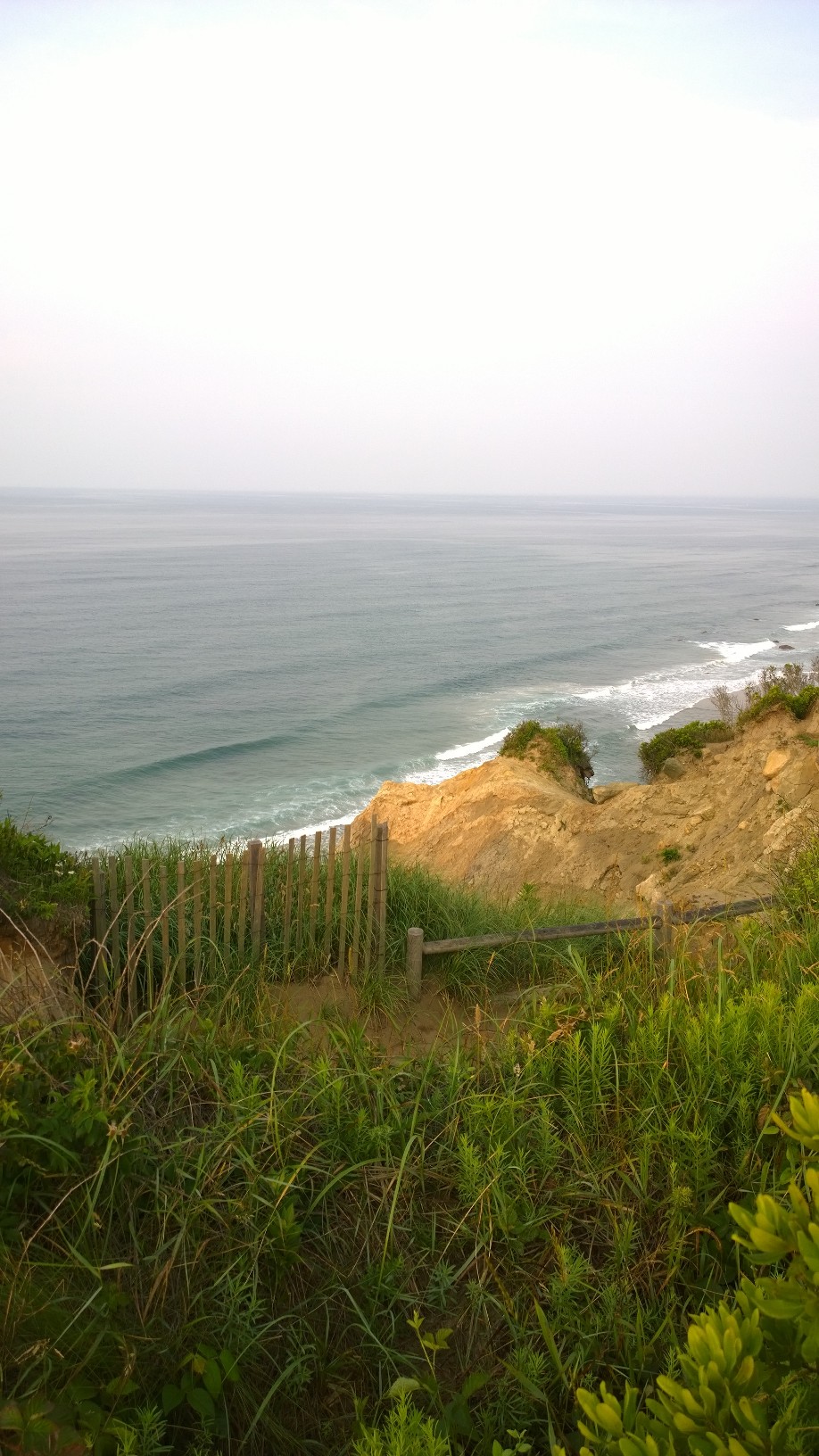
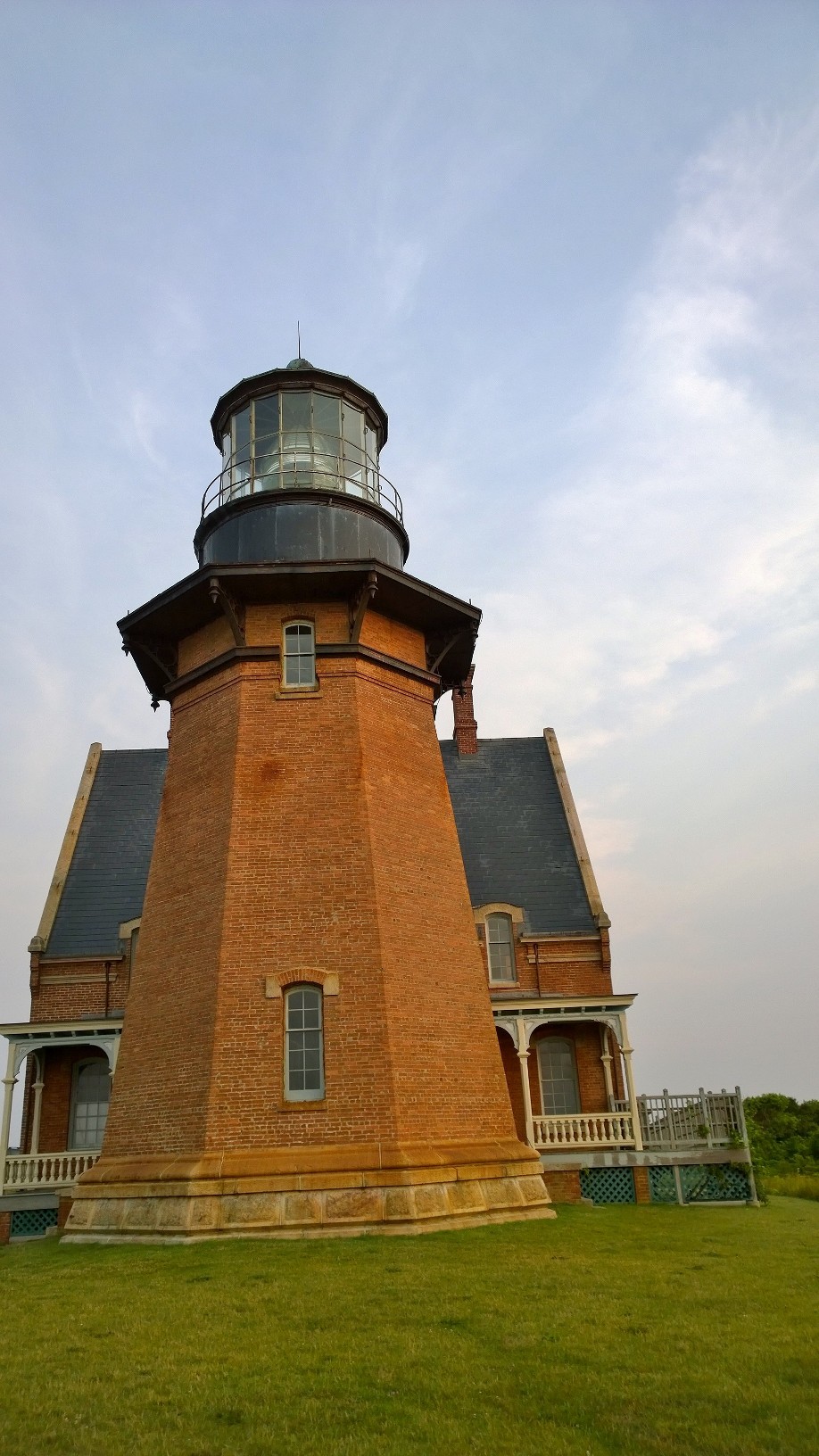
This group of photos starts with four from New Shoreham, including the Southeast Light and the posters on the food truck.

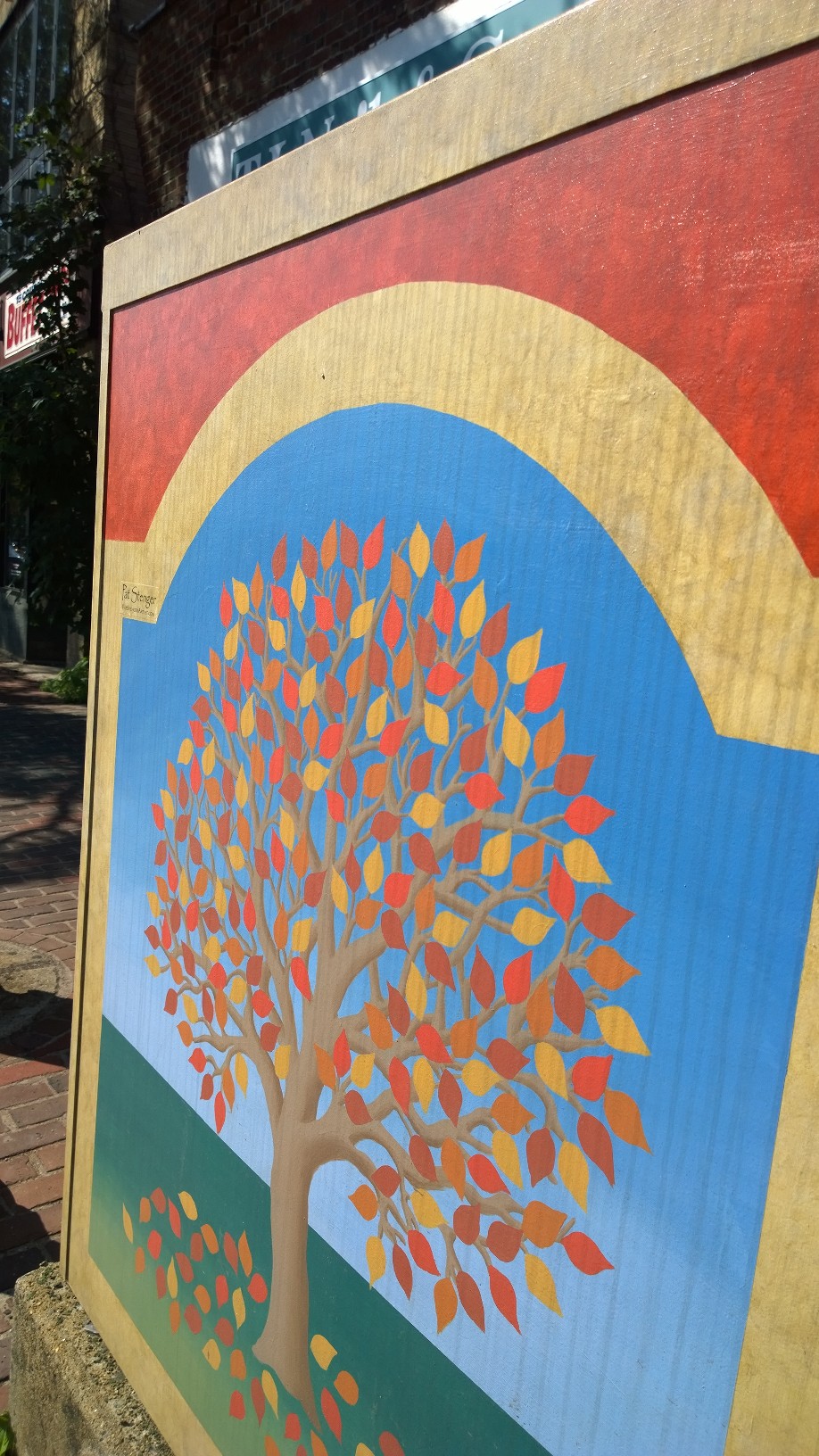
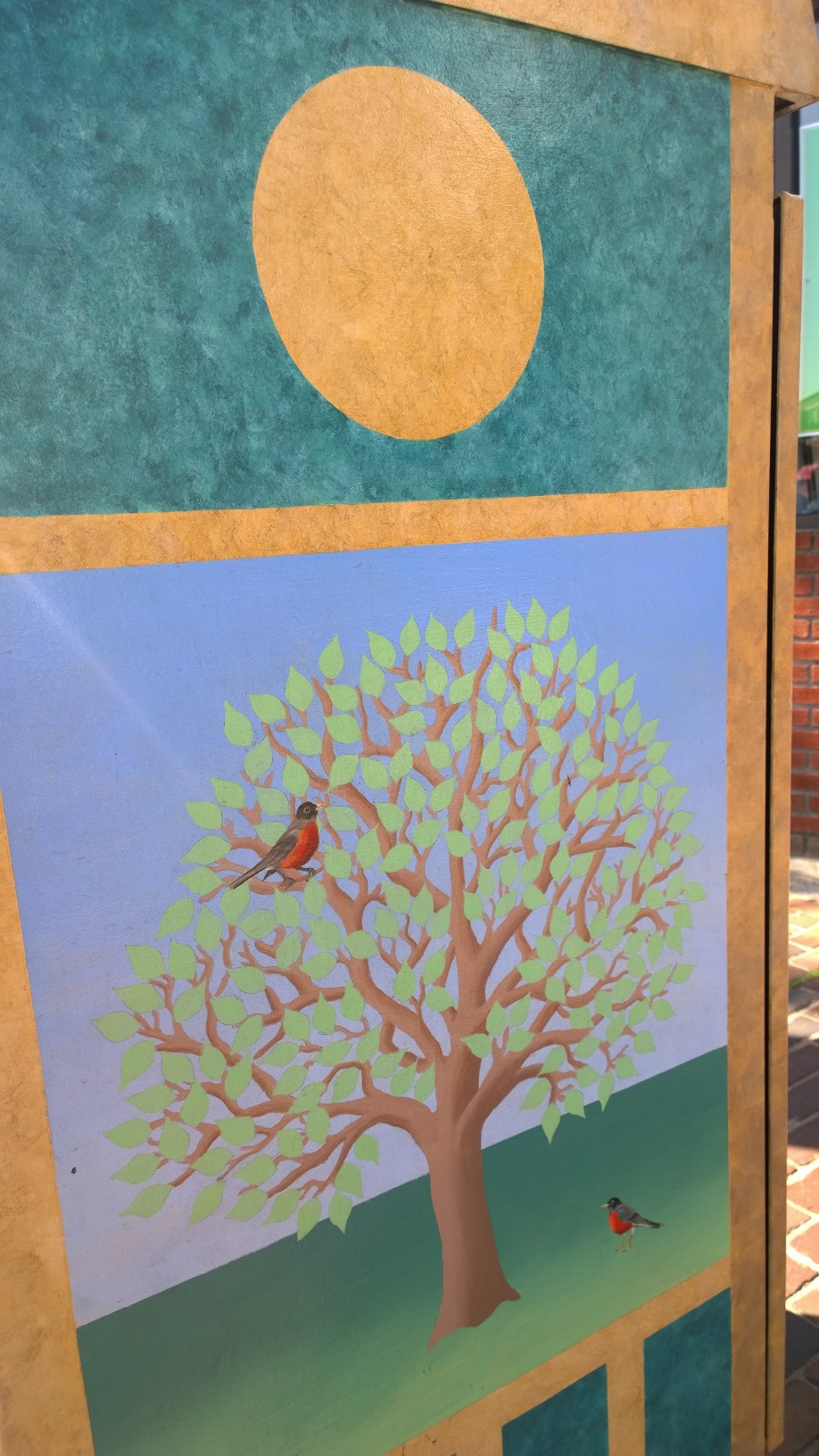
Next we have two sides of a utility box in Arlington, Mass. — the work of local artists. Many other utility boxes around town are painted, all charming.

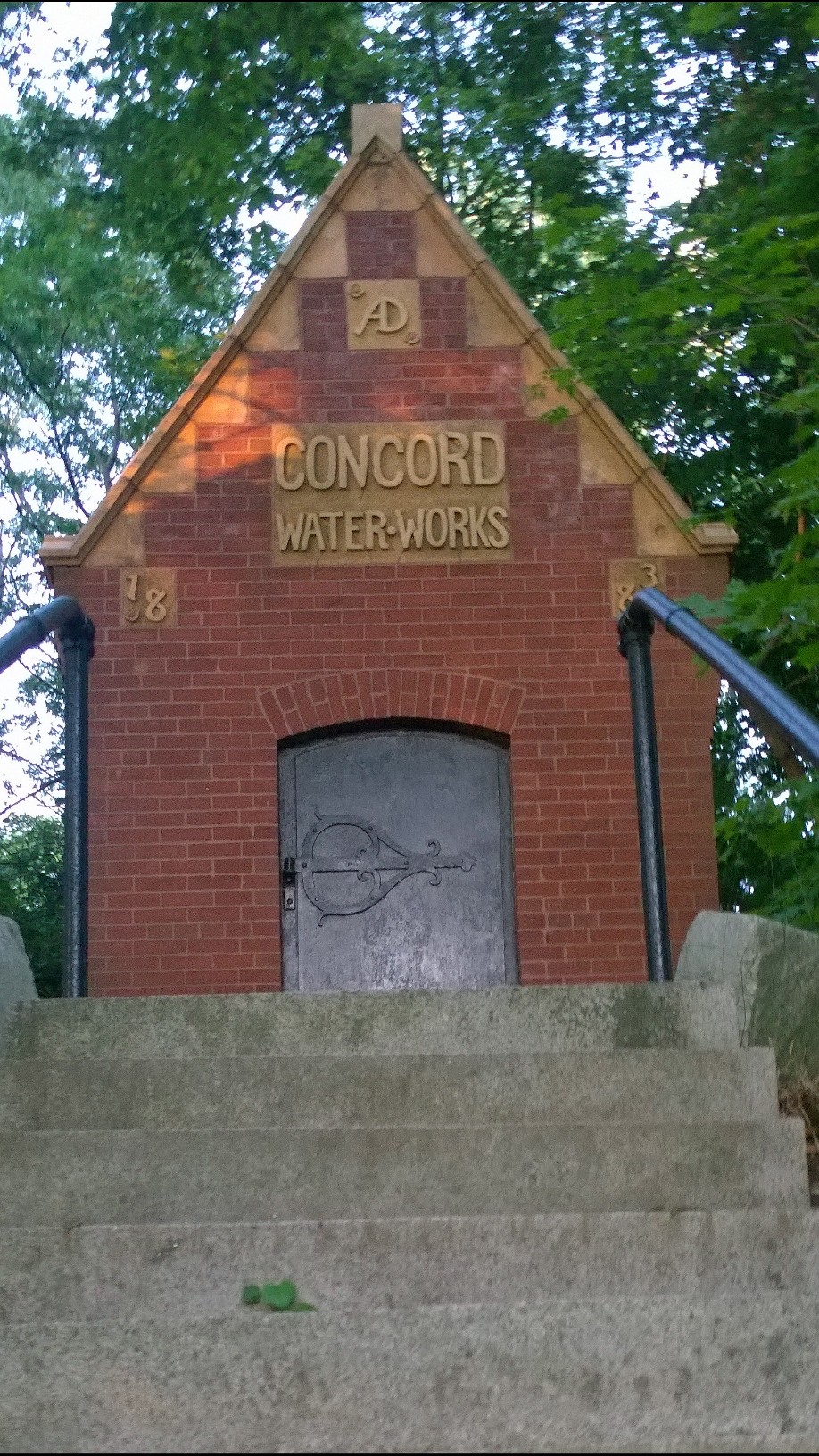
The old, unused water works building always strikes me as a perfect setting for a mystery novel. The dog in the next photo is checking out the portable Uni library in the Greenway, an initiative of Sam and Leslie Davol.

The lushness of the hydrangeas this year makes me think of sheep. I start singing, “Sheep may safely graze and pasture/ In a watchful shepherd’s eye.”

And you know clouds.

070615-Mohegan-Bluffs

070615-southeast-lighthouse


070615-food-truck-ad

070615-SE-Light-food-truck


071115-artists-paint-Arlington-utility-boxes

71115-Arlington-utility-box-with-bird


71015-old-concord-water-works

071415-sam-and-leslie-uni


071215-white-sheep-in-the-early-morning

071415-clouds


Read Full Post »

Art: Thomas Hart Benton
One of my favorites: Spring on the Missouri, 1945, oil and tempera on Masonite panel. On loan to the PEM from the North Carolina Museum of Art.


When I was moonlighting as a theater reviewer, I always liked to “sleep on it” before writing anything, just in case my unconscious had anything useful to add.

Well, I slept on the big Thomas Hart Benton exhibition I saw yesterday, and sleep confirmed that certain lesser-known aspects of his work are troubling. I still adore the wavy energy of his landscapes, people, horses, trains, clouds, smoke, even fence posts. I still love the way Benton honors ordinary people and ordinary jobs and the way his paintings comment on social injustice.
But I really did not like the gruesome murals of invading armies that Benton created to jolt overly complacent Americans after Pearl Harbor. There was something cheap about them.

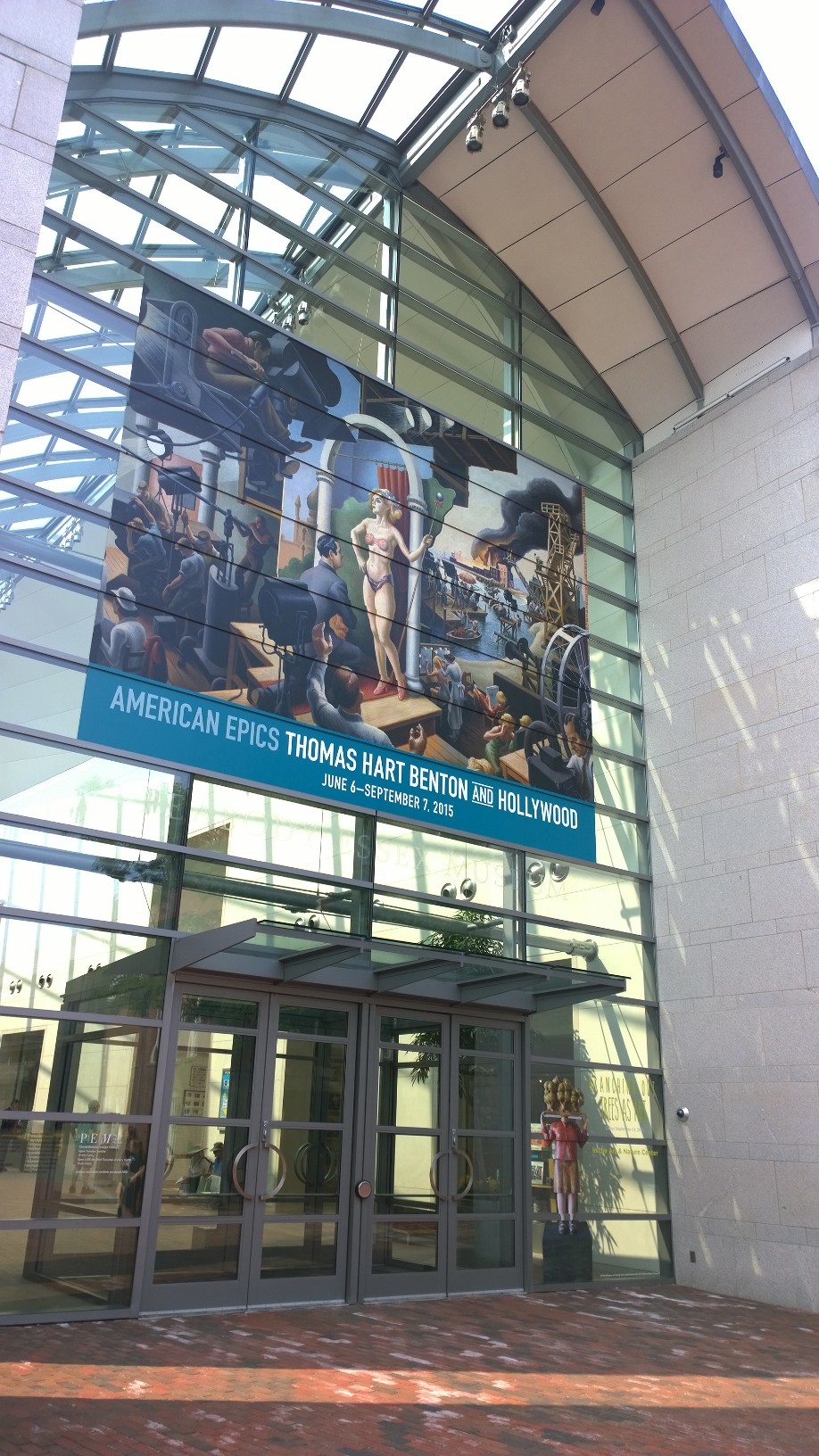
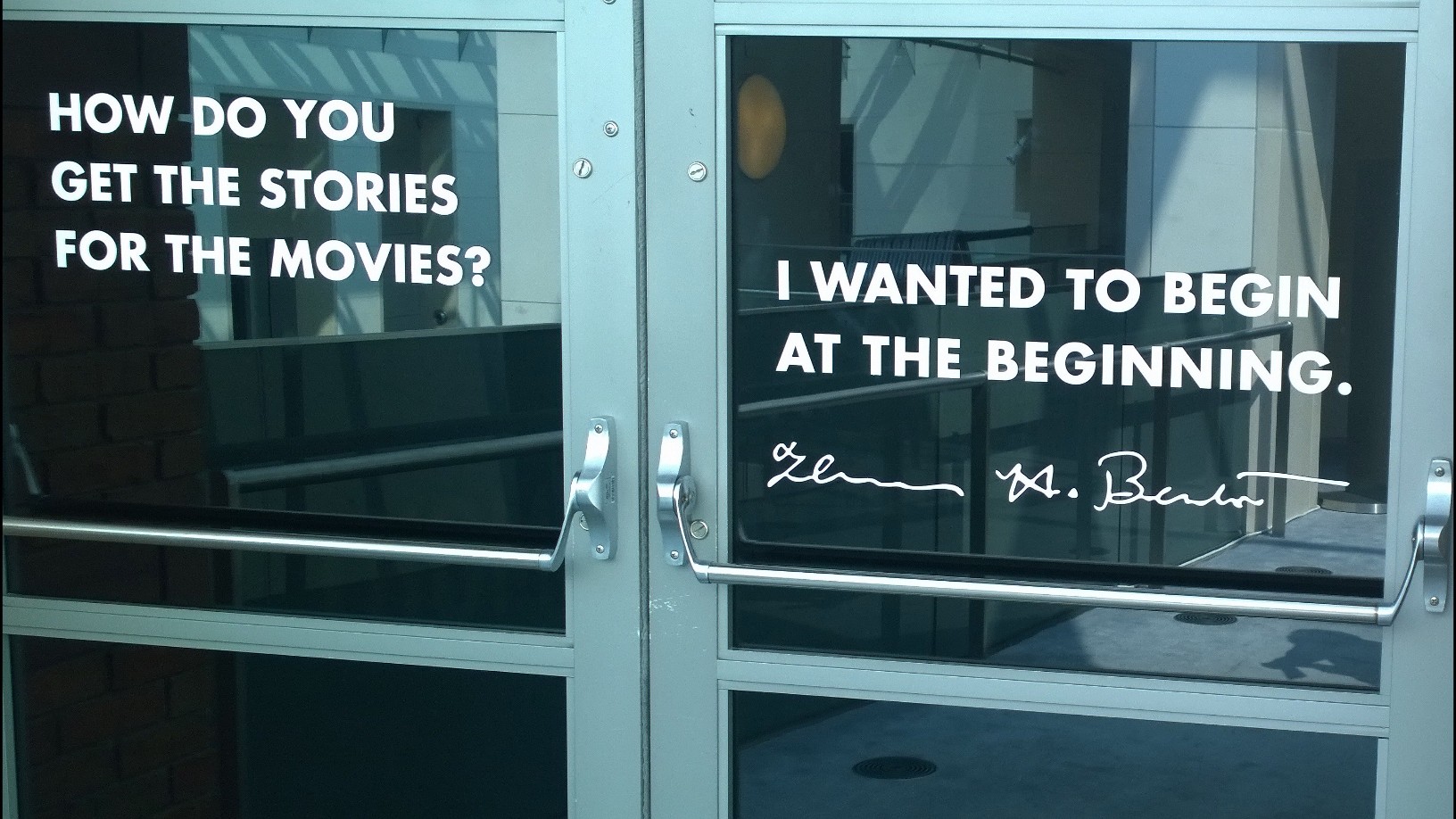
Of course, there was a lot more than that to the exhibition “American Epics: Thomas Hart Benton and Hollywood,” a sweeping retrospective of most of the artist’s work: murals showing Indians or slaves being mistreated, paintings of the the vibrant life of the West and Midwest, detailed depictions of the inner workings of Hollywood sets, designs for the Henry Fonda version of The Grapes of Wrath, illustrations for an edition of Huckleberry Finn, posters touting the contributions of African Americans to the war effort.

The day before, I had been hearing about Irving Berlin’s dedication to the war effort, and I think these two different artists conveyed, more viscerally than I had previously experienced, the underlying fear prevalent at that time. Since I grew up after it was all over, I probably unconsciously assumed that everyone always knew the Allies would win.

Do go to the show at the Peabody Essex Museum in Salem. You have until September 7. An enormous array of Benton’s work has been gathered from near and far — and there are some intriguing movie clips. (I was moved by a character’s tears to put The Grapes of Wrath on my Netflix list.)

Details of the exhibition here, at the PEM website.

071215-Thos-Hart-Benton-show

071215-Thos-Hart-Benton-at-PEM

Read Full Post »

Flashback city.

Hershey Felder has been presenting his one-man show on Irving Berlin at the Cutler Majestic. Embodying the great composer-lyricist, Felder takes the audience through an extraordinary life from Berlin’s birth in Belarus to his death in New York at 101.

We get to hear much of the great music, including the backstory of songs we thought we knew. “White Christmas,” for example. We may have known it was written after Pearl Harbor and became beloved of US troops everywhere, but its heartfelt power comes from a loss Berlin and his wife Ellen experienced at Christmas years before.

I liked the way Felder/Berlin first describes the famous characters with whom he interacted and, after a pause, springs their names on us. He describes writing music for one performer whose first audition pegged him as balding and mediocre at acting, singing, dancing. It was Fred Astaire.

Felder does brief and funny imitations of many celebrities: Ethel Merman, George Kaufman, Flo Ziegfeld. There are movie clips featuring people like Al Jolson — and a touching story about the great African American singer Ethel Waters.

But what can catch a person by surprise is an incident or name that hasn’t been thought of in decades. The story about Berlin putting aside “God Bless America” because an adviser thought no one would like it — then pulling it out when a well-known singer wanted something for Armistice Day years later — gave me a jolt. That’s because the well-known singer was Kate Smith, and I had a flashback to a childhood nanny who listened every day to Kate Smith on the old black & white Dumont TV singing “When the moon comes over the mountain” (not a Berlin song).

After a standing ovation, Felder made an announcement that the eldest daughter of Irving Berlin was in the audience, and she came up to the front. And so did a daughter of hers and a son and two grandsons (grandchildren and great-children of the composer.)

Berlin’s daughter spoke a few words of gratitude to Felder for his faithful portrayal, noting in particular her father’s fierce patriotism. It was fun to think that this woman was the baby for whom Berlin wrote “Blue Skies Shining for Me.”

There’s a lot to be said for the out-of-body state induced by watching a good entertainment (or reading an absorbing mystery, or doing tai chi, or playing with a child) that puts your mental tape loop on pause and leaves you refreshed.

More about the production can be found at Arts Emerson.

Read Full Post »

John (founder of www.mistersmartyplants.com) is a member of Arlington Tree Committee. He figured out a way to use Google Maps to identify heritage trees in town and got a sign made to encourage residents to adopt a thirsty tree.

Now that so many urban and suburban areas have taken down their trees to make construction projects easier, people are realizing what they’re missing.

Many have noted that trees play a role in residents’ mental and physical health.

University of Washington research social scientist Kathy Wolf has studied the health aspects and also has economic arguments. She has shown that an “urban canopy”  makes local shopping more agreeable for customers and lends vitality to downtown business districts. Read what she has learned, here.

Chris Mooney at the Washington Post notes other research. “In a new paper published Thursday, a team of researchers present a compelling case for why urban neighborhoods filled with trees are better for your physical health. The research appeared in the open access journal Scientific Reports.

“The large study builds on a body of prior research showing the cognitive and psychological benefits of nature scenery — but also goes farther in actually beginning to quantify just how much an addition of trees in a neighborhood enhances health outcomes. The researchers, led by psychologist Omid Kardan of the University of Chicago, were able to do so because they were working with a vast dataset of public, urban trees kept by the city of Toronto — some 530,000 of them, categorized by species, location, and tree diameter — supplemented by satellite measurements of non-public green space (for instance, trees in a person’s back yard). …

“Controlling for income, age and education, we found a significant independent effect of trees on the street on health,” said Marc Berman, a co-author of the study and also a psychologist at the University of Chicago. “It seemed like the effect was strongest for the public [trees]. Not to say the other trees don’t have an impact, but we found stronger effects for the trees on the street.”

Thank you to my high school classmate, Susie from Cleveland, for putting the Washington Post article on Facebook.

071115-Arlington-Tree-Watering

Read Full Post »

Photo: Laurence King Publishing
Adult coloring book ‘Secret Garden.’

Since March, I’ve been collecting articles on coloring books for grownups.

One article, by Alexandra Alter at the NY Times, was about Johanna Basford, a Scottish illustrator, who sold more than 1.4 million copies of her coloring book for grown-ups, “Secret Garden.”

Alter reported, “Ms. Basford and her publisher were surprised to learn that there was a robust — and lucrative — market for coloring books aimed at grown-ups. When they first tested the waters with ‘Secret Garden’ a year ago, they released a cautiously optimistic first printing of 16,000 books.

“’I thought my mom was going to have to buy a lot of copies,’ Ms. Basford said. …

“Surging demand caught Ms. Basford and her publisher off guard. Fan mail poured in from busy professionals and parents who confided to Ms. Basford that they found coloring in her books relaxing. More accolades flowed on social media, as people posted images from their coloring books.

“Hard-core fans often buy several copies of her books at a time, to experiment with different color combinations. Others have turned it into a social activity. Rebekah Jean Duthie, who lives in Queensland, Australia, and works for the Australian Red Cross, says she regularly gathers with friends for ‘coloring circles’ at cafes and in one another’s homes.” More at the Times.

My friend Mary Ann’s company, Rockport Books, offers a series called Just Add Color. Botanicals has 30 original designs from artist and illustrator Lisa Congdon. The series also includes Geometric Patterns, Folk Art, and Mid-Century Modern Animals, among others.

Finally, here’s Dugan Arnett at the Boston Globe addressing “the recent explosion — and it really is an explosion — in popularity of coloring books for adults? ‘I did not see this coming,’ said [Barnes & Noble’s Tracy] Moniak.

“In a sudden, unexpected, and generally curious development, grown-up versions of the doodle-books used by countless kindergartners have not only become a thing — but the thing, as far as millions of rapt Americans are concerned.

“At the moment, five of the top 30 titles on Amazon’s best-seller list are coloring books aimed at adults. Barnes & Noble currently carries well over 100 different adult coloring book titles, many of which feature much more intricate and detailed designs than children’s versions. And as the trend seeps into the mainstream, publishers and booksellers have been left scrambling to keep the most popular titles on store shelves.

“Marketed as a kind of personal therapy session — a simple and solitary alternative to the digital world in which we live — the books seem to have tapped into a deep desire to unwind, unplug, and fend off the stresses of daily life.” More.

Anyone want to have a coloring-book party?

Read Full Post »

In the early 1990s, I was a stringer for Harte-Hanks newspapers and was sent to interview a young romance novelist who was living in a small house on the water in Cochituate.

Suzanne Brockmann cheerfully explained about how success in romance writing requires following a formula — what the hero’s character should be, what the heroine should look like, by what page the first love scene should occur. She showed me the manual. It didn’t bother her at all that the books were meant to be read and thrown away.

As someone with occasional literary aspirations on the order of Dickens or Tom Stoppard, I was appalled. Goes to show that snootiness is ignorance.

I kept an eye out for the books. First I spotted Brockmann romances at magazine kiosks. Then I started seeing Brockmann mysteries on racks in every supermarket. Today I read that she is producing a movie — her second. Good girl!

Although the paint-by-numbers approach isn’t for everyone, I’m sure much of her success reflects the aspects of herself that she put into the writing, and in a way I admire her practicality. From a distance, she seems to have made a pretty fun career for herself.

Today’s Boston Globe talks about her latest project, an indie movie called Russian Doll.

“This is the second indie film for best-selling romance author Brockmann, who splits her time between Framingham and Sarasota, Fla. A few years ago, Brockmann, her husband, writer Ed Gaffney, and their son, Jason Gaffney, decided to make the romantic comedy The Perfect Wedding. Brockmann said it became important to her storytelling family to make a movie with gay characters who weren’t struggling to come out of the closet. Jason specifically wanted to see more characters like himself. …

“The family’s new project — a crime story thought up by Ed Gaffney — is about a detective who tries to solve a case while mourning the death of her wife. The starring role went to Brockmann’s daughter, Melanie Brockmann Gaffney, who has an acting background (she once appeared in an educational film series with Sudbury-raised Captain America star Chris Evans).” More at the Globe, here.

Read Full Post »

Melita posted this link on Facebook. She was so excited about the idea of a graffiti class for older folks that she contacted the organization to see if they were planning anything for Boston. I told her I would join her if they held a class. But, alas, Boston is not on their calendar. We have to get the experience vicariously from AxaNews.net.

The Axa article is a series of photos with captions like this: “Women spray their designs on a wall during a graffiti class offered by … LATA 65 [an] initiative for the elderly in the area of urban art. Since it began in 2012, they have introduced the world of graffiti to over 100 senior citizens, giving workshops in different neighborhoods of Lisbon.”

Dovas adds more at Bored Panda, “Graffiti and street art have both often served to deepen the rift of misunderstanding between young and old, but there’s one art organization in Lisbon, Portugal that’s working to change that. LATA 65 works to destroy age stereotypes and turn senior citizens into street artists by providing them with spray paint cans, masks and gloves and finding them free spots in the city to tag up and paint!

“It all begins with workshops, where the students learn about the history of street art and get to create their own stencils. They then find run-down parts of the city to jazz up with colorful tags and stencil art.

“According to the organization’s Facebook, their goal is to connect older and younger generations through art, to help the elderly engage in new forms of contemporary art and, most importantly, to let them have fun.”

This is a whole different level from the knitting groups Di organized with old folks and young girls at church back in the day. Suzanne and Joanna were regulars when they were about 7.

See the seniors’ graffiti artwork here.

Photo: Rafael Marchante/Reuters
Women spray their designs on a wall during a graffiti class offered by the LATA 65 organization in Lisbon, Portugal, May 14, 2015.

Read Full Post »

070715-crabby-lager

I liked the Crabby Lager poster outside the Barking Crab today. The popular restaurant is as rough-hewn as ever, but its Seaport neighborhood has gone upscale. The Barking Crab now shares a spanking new sidewalk with a boutique hotel called the Envoy. (The lettering for the hotel’s name is too esoteric for words. Took me 10 minutes to figure it out.)

In other photos, I couldn’t resist beautiful weeds in grungy corners. I don’t know the name of the purple bells, but the other flower is bindweed. Or maybe Morning Glory.

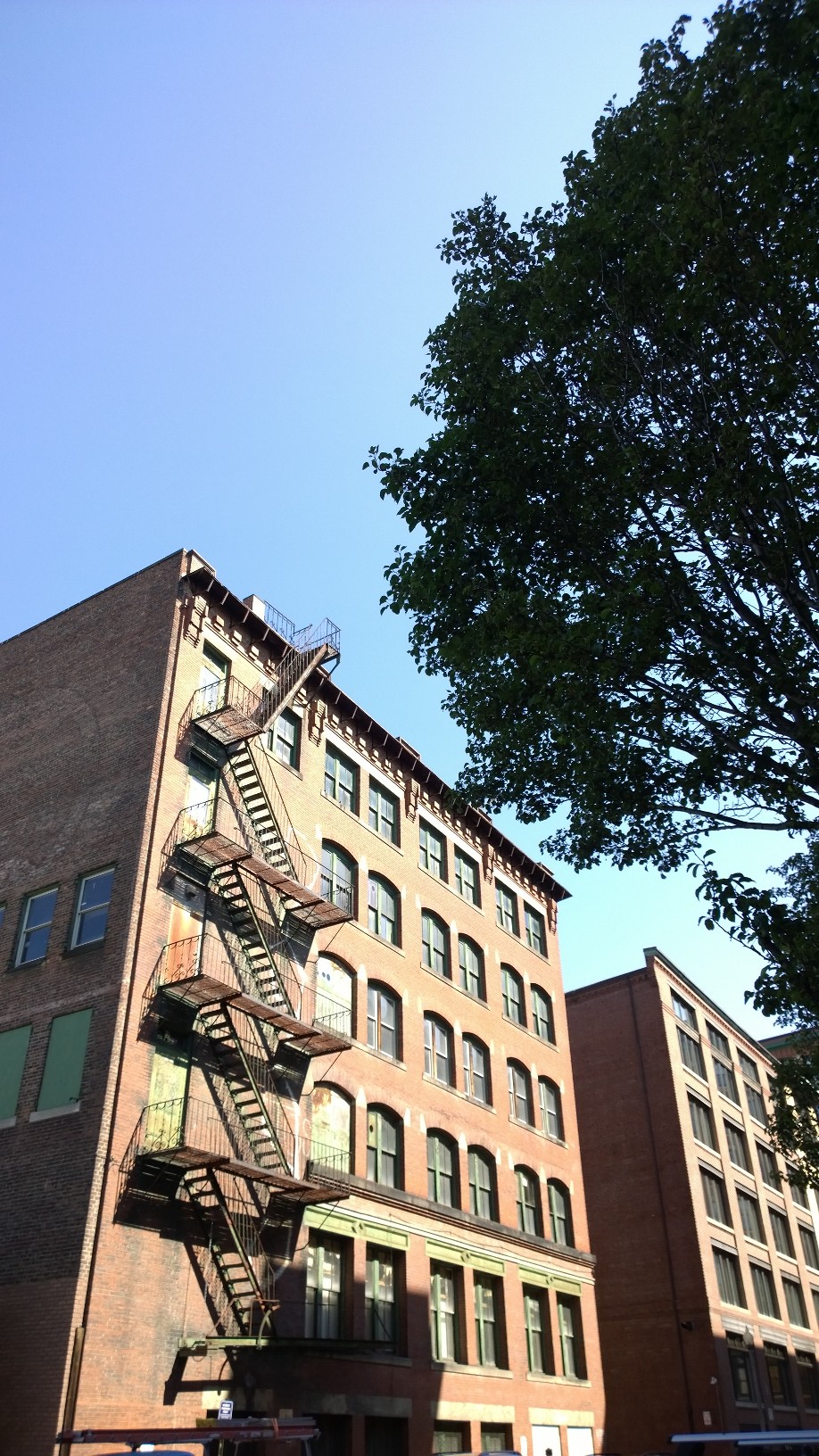
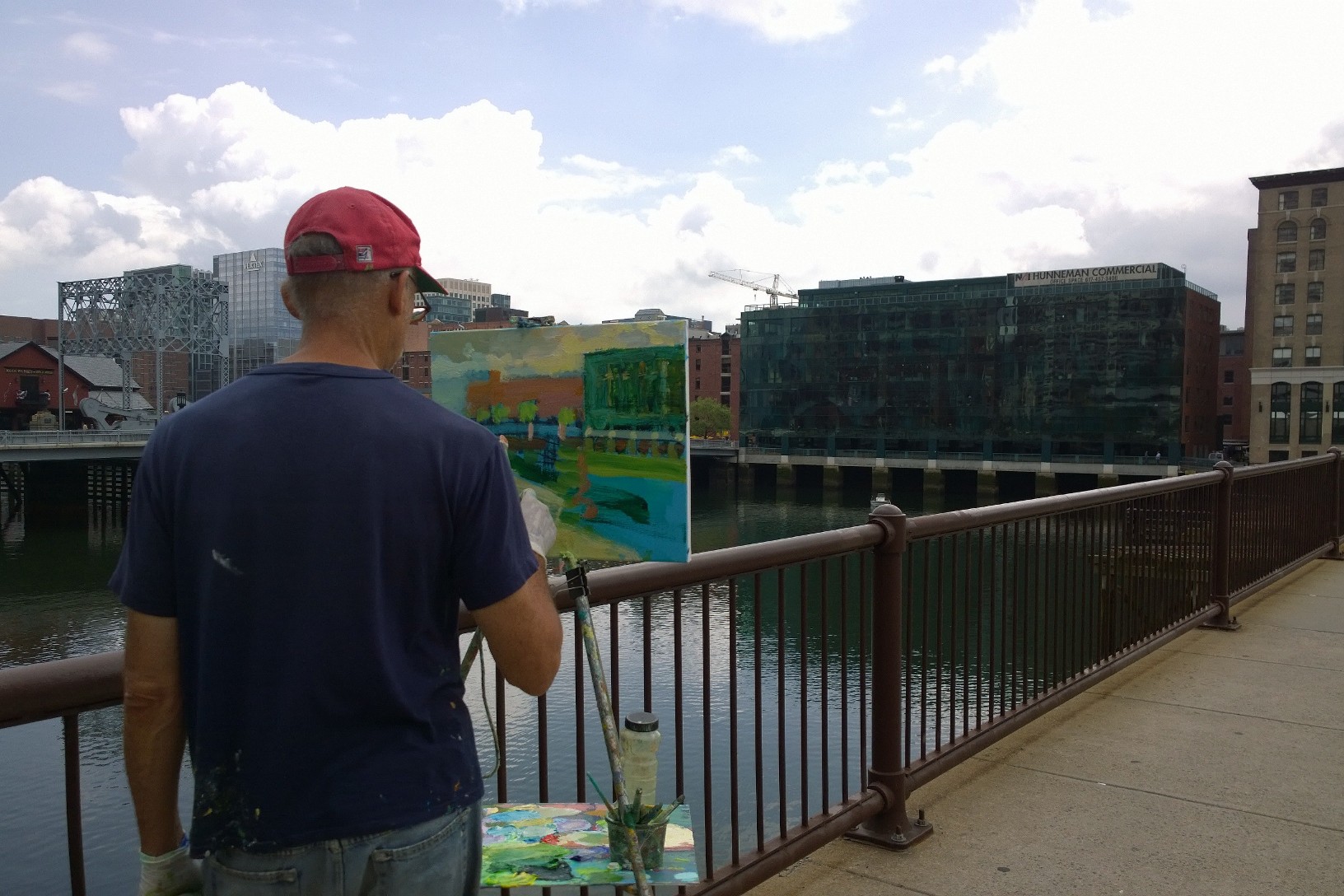
The old warehouse (I can’t resist old warehouses) is in Fort Point, a part of South Boston that the artist in the last photo is painting from the other side of the channel.

wildflowers-bell-like

morning-glory

warehouse-beauty

070715-artist-paints-fort-point

Read Full Post »

The pages, Schrope reports, “seemed oddly familiar. … Dr. Kessel realized that just three weeks earlier, in a library at Harvard University, he had seen a single orphaned page that was too similar to these pages to be coincidence.

“The manuscript he held contained a hidden translation of an ancient, influential medical text by Galen of Pergamon, a Greco-Roman physician and philosopher who died in 200 A.D. It was missing pages and Dr. Kessel was suddenly convinced one of them was in Boston.

“Dr. Kessel’s realization in February 2013 marked the beginning of a global hunt for the other lost leaves, a search that culminated in May with the digitization of the final rediscovered page in Paris. …

“In 2009, the Galen Palimpsest was lent to the Walters Art Museum for spectral imaging of its leaves by an independent group of specialists, which would reveal the erased Galen undertext. …

“The resulting images went online under a ‘creative commons’ license, meaning that anyone can use the material free for any noncommercial purpose. Once the images were online, William Noel, who was the curator of manuscripts and rare books at the museum, began organizing members of the tiny community of scholars who study Syriac scientific texts to study the new material.

“One of them was Dr. Kessel … By analyzing the page size, handwriting and other features, as well as the visible text, Dr. Kessel was able to determine that the Harvard leaf did indeed fill one of the gaps in the Galen Palimpsest. But six more were apparently missing. Dr. Kessel set out to find them.

“He began with a list of 10 libraries known to have ancient Syriac material, combing through online catalogs when available to look for clues such as the right dimensions or vague references to undertext. Sometimes, he traveled to the libraries himself. …

“It was not long before Dr. Kessel had good news. He found one missing page in a catalog from the Sacred and Imperial Monastery of the God-Trodden Mount of Sinai. It is known more commonly as St. Catherine’s in the Sinai Desert in Egypt, which has the world’s oldest continuously operating library.

“Another leaf turned up at the National Library of France in Paris. And at the Vatican’s vast library in Rome, he was able to identify the other three missing leaves, bringing the total to six.”

Read more here about the hunt, and learn what scholars hope to glean from the restored text.

Photo: Anonymous owner of the manuscript

Read Full Post »

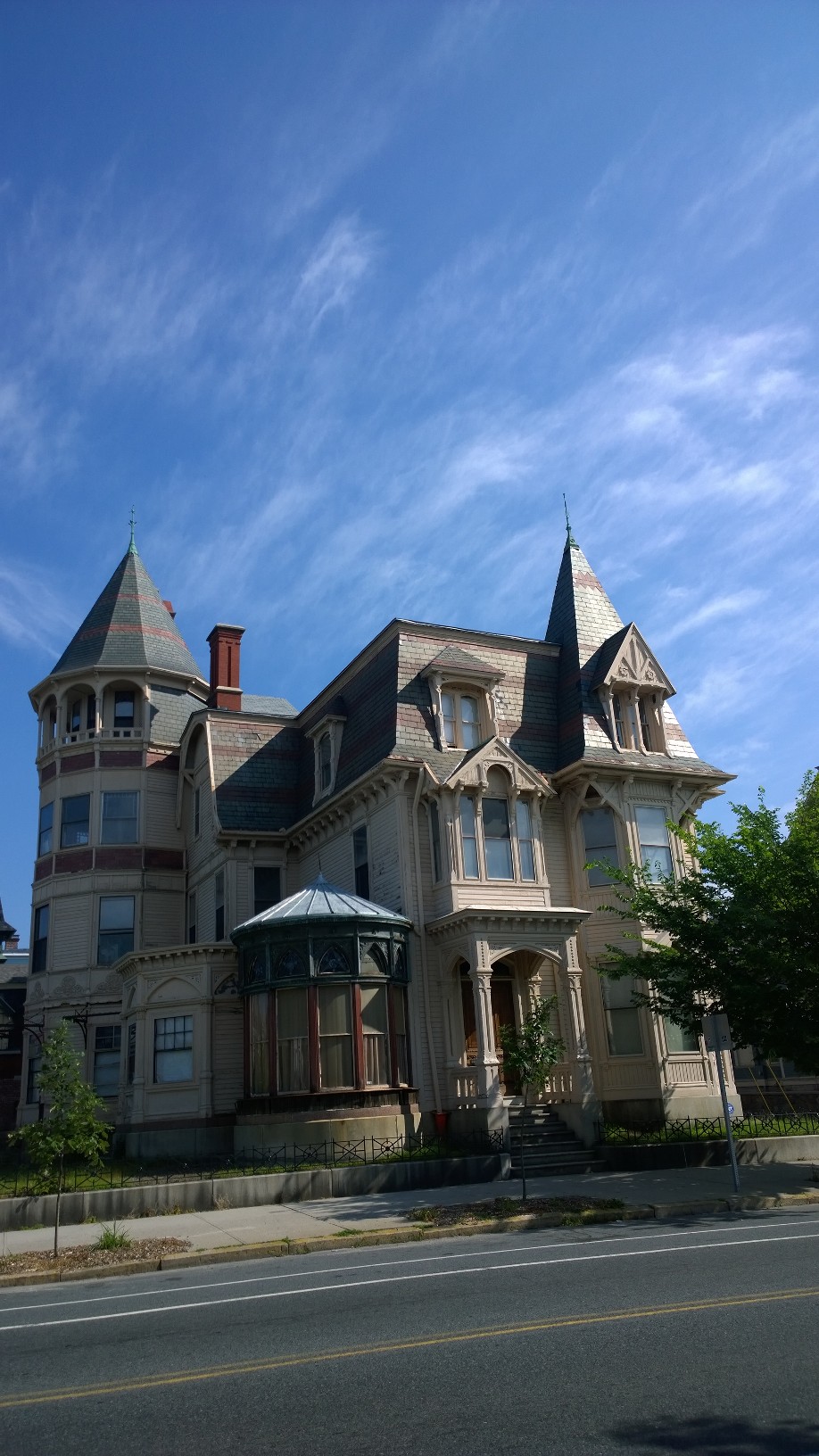
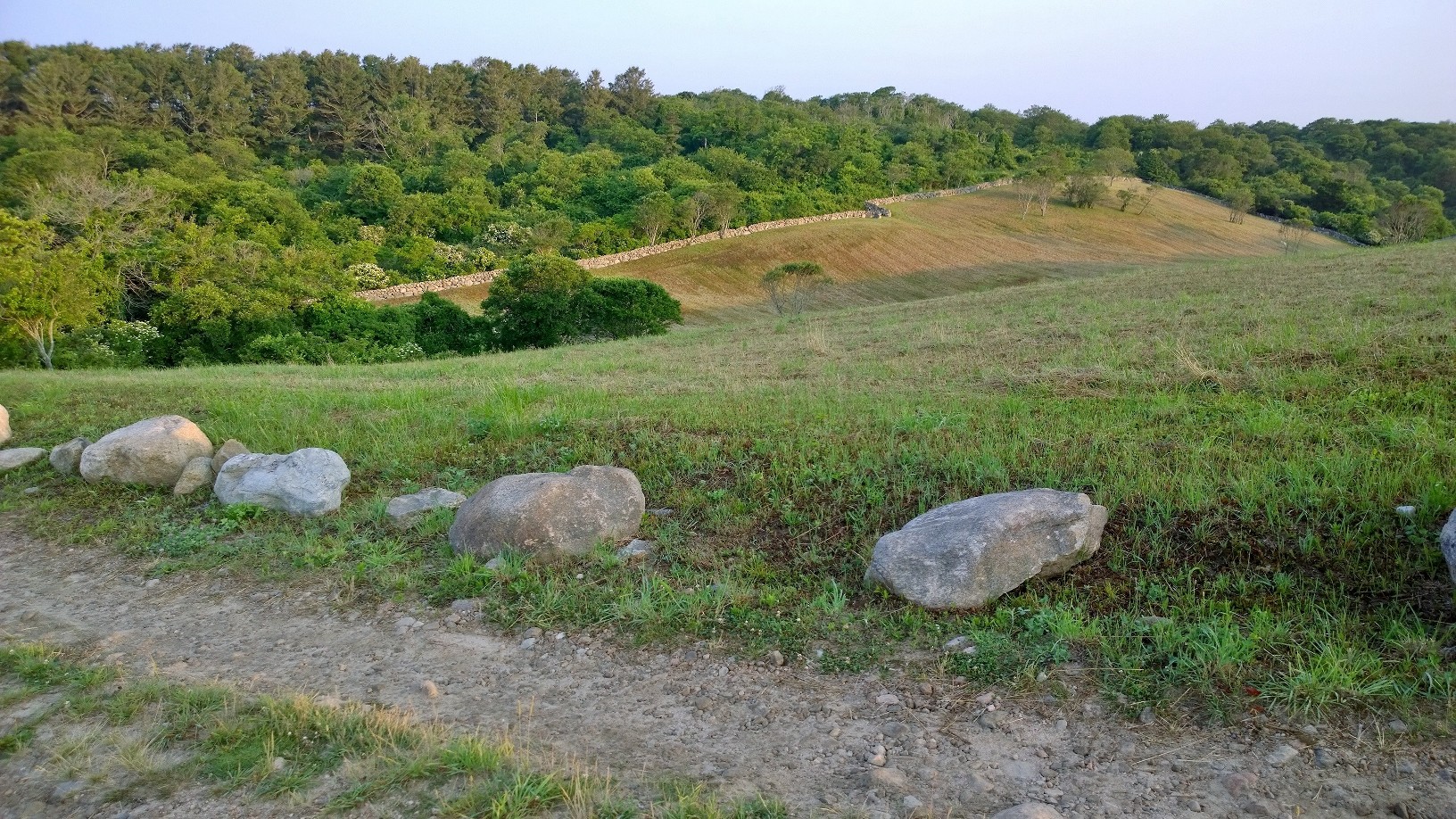
The little state with the big heart. Showing an intriguing old house in Providence, and island scenes in early morning and late afternoon.

This is the peaceful side of things, contrasting with the stories we just heard from an exhausted policeman we know who spent the last five days trying to control unruly 4th of July crowds, working from 5 a.m. to 11 p.m. “And we have only two cells to put them in,” he said in exasperation.

So hard to understand why, with all this beauty around them, people would do so much damage to themselves.

Providence-fixer-upper

stone-wall-morning

country-road-70515

fields-New_Shoreham

John-E-tughole

looking-down-the-bluffs

070515-beach-late-afternoon

Read Full Post »

Parade

parade-watching-7-4-15

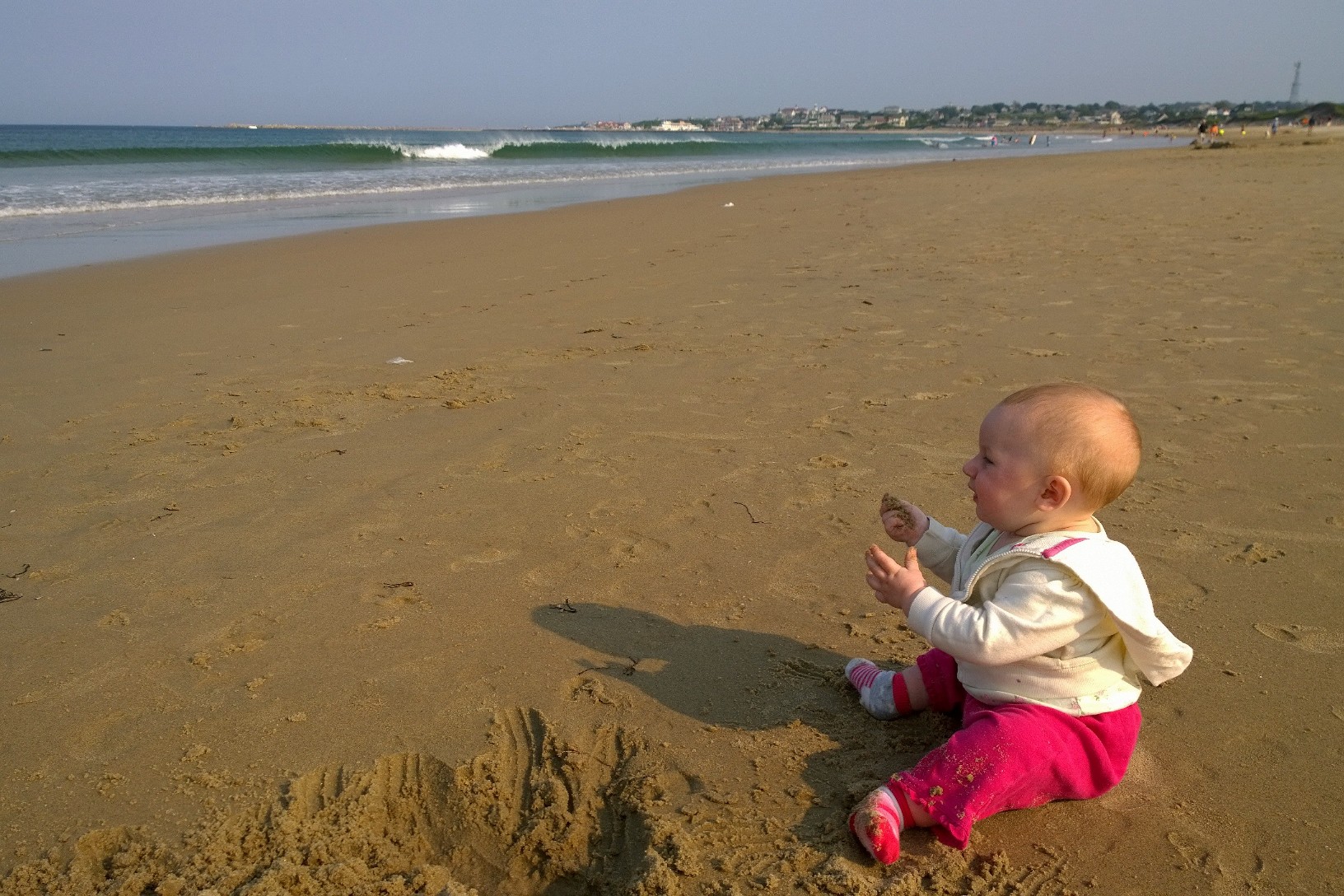
Calming down here as four grandchildren go to sleep. It was a day of running around, getting wet, and shrieking. Which explains why I personally have no still photos of the kids: they were never still. Fortunately, Suzanne caught this moment.

What I have is pictures of marching bands. The parade floats were mostly on the theme of Dr. Seuss, but the usual bars were also represented. The nature fund raiser Conserfest sent a good band out on a flatbed truck. The fire engines were loud.

It was John’s turn to be Boss of the Kitchen at diinertime. He made steaks and oversaw two sous chefs, who followed his meticulous directions for sauteed rosemary fingerling potatoes and kale with garlic. We tried to make a potential viral video of the baby watching fireworks, but she was a bit too laid back about it to become a YouTube sensation.

drums

drummers

taggart-band

marching-band

Read Full Post »

Some fourth graders in New York are experiencing a real archaeological dig: under the floor of the classroom closet.

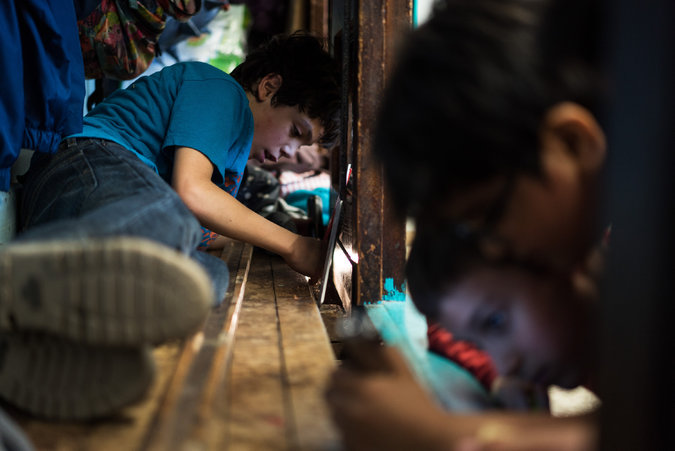
Paul Lukus reports at the NY Times, “Bobby Scotto, a fourth grader at the Children’s Workshop School on 12th Street in the East Village, wants to be an archaeologist when he grows up, and he is already off to a good start. In the past few months he has excavated dozens of old coins, a toy watch and other artifacts, all from an unlikely dig site: his classroom’s closet.

“Bobby, an earnest 10-year-old with a mop of dark hair and saucerlike brown eyes, was bitten by the archaeology bug four or five months ago, when his class read a book about a migrant farmworker who found old coins in a field. Bobby decided he wanted to collect old coins of his own, and he had noticed a small gap between the floorboards in the closet. So he reached into that gap as far as he could and, voilà, out came a bunch of wheat pennies (minted from 1909 to 1958), a buffalo nickel and other treasures. …

“And so began an improbable exercise in hands-on archaeology that soon attracted all 21 students in the class. ‘There’s something about the degree of difficulty that’s just perfect,’ said the class’s teacher, Miriam Sicherman, 43, who has been teaching at the school for 15 years. ‘You can’t just reach in and grab something, but it is possible to get something. There’s just enough gratification.’  …

“The variety of finds, including candy wrappers, ticket stubs, an old baseball card and a 1921 Red Cross service pin, has made the students more curious about the previous occupants of their classroom, and about history in general. …

“Along the way, the students have also become adept at research (when they find something, they try to learn more about it on the web); cataloging (each object is logged on a sheet that Ms. Sicherman helped the students design); preservation (the artifacts are kept in plastic bags); and documentation (Ms. Sicherman posts photos of the artifacts on an Instagram account).” More here.

That’s a smart teacher, adapting to her students’ interests. I can imagine some long-ago teachers or some of today’s stressed-out teachers putting a stop to the exploration. Like the policemen in comic books who stop kids trying to salvage a quarter in a grate using chewing gum on the end of a stick. (Such stories of city life always intrigued me as a comic-reading child who grew up in the country.)

Photo: Todd Heisler/The New York Times
Bobby Scotto, 10, left, a student at the Children’s Workshop School in the East Village, mining his classroom’s closet for treasures. 

Read Full Post »

Kate Colby (for whose offer of a room to Suzanne and Erik when they were house hunting there can never be enough gratitude) is a poet.

She came to the rescue when Suzanne was starting Luna & Stella and was having trouble finding a writer to capture the more ethereal qualities of the birthstones.

“What you need,” I said, “is a poet.”

“I know a poet!” she cried. She remembered Kate used to write copy for a catalog.

Beyond such marketing endeavors, Kate publishes poetry, choreographs offbeat theater, and co-leads art/poetry walks. An example of the latter will occur soon.

As Eryn Carlson writes at the Boston Globe, Kate is collaborating with artist Todd Shalom to offer “Duly Noted,” a participatory walk incorporating techniques from poetry, sound, and performance, at deCordova Sculpture Park and Museum in Lincoln, Massachusetts, July 18, at 2 p.m. and 5 p.m.

Carlson comments, “Shalom and Colby know that the very nature of tours makes it easy to overlook the ways in which artworks and their settings inform one another. … The pair created the collaborative walk ‘Duly Noted,’ a poetic exchange between participants and the Lincoln museum’s site and surroundings.

“ ‘Reading the art is apt because it’s so framed by woods and walls and water, and all this history,’ said Colby, who grew up in Wayland and lives in Providence. …

“ ‘It’s all about reframing the site,’ said Shalom, a Brooklyn, N.Y.-based artist who founded Elastic City.”

At a performance in May, “participants evolved from visitors to artists and performers. Individuals gave one-word soliloquies atop a stump, announcing their visual discoveries, and, guided by a partner, wandered the grounds with eyes closed to pay special attention to the surrounding cacophony. …

“Shalom and Colby, who met while working on their master’s degrees in fine arts at California College of the Arts, planned ‘Duly Noted’ meticulously over the course of a year, visiting the deCordova several times to perfect the route, pacing, and segues. But a degree of uncertainty and room for spontaneity remained.”

This could be a fun activity on July 18 if you live in the area. The grounds of the museum offer breathtaking views and sculptures everywhere you turn. Add to that a participatory happening like this, and you have the ingredients for a memorable day.

Read more here.

Photo: Barry Chin/Globe staff
Visitors at the deCordova Sculpture Park and Museum on a participatory walk titled “Duly Noted.’’

Read Full Post »

« Newer Posts - Older Posts »