Feeds:
Posts
Comments

Archive for the ‘Uncategorized’ Category

Photo: Kyle Peavey.
Kyle Peavey’s backyard in Richardson, Texas. He collects water in a 1,100 gallon rainwater tank to grow his flowers and vegetables.

One way that people are conserving natural resources these days is by being more thoughtful about the water they use in their homes and gardens.

To some extent this is going back to the old ways. On a recent Zoom panel discussing rural America, Montana Senator Jon Testa recalled how conservative with water his mother had to be when he was growing up. He said she could wash a sinkful of dishes with one cup of water.

Sen. Testa’s mother wouldn’t have been thinking about climate change, but she knew scarcity. Here is a report from Tara Adhikari at the Christian Science Monitor on conserving water today.

“In one Texas suburb, a battle of rainwater harvesting tanks is on. During a neighborhood garden tour in May, Kyle Peavy spotted Richard Townsend’s 260-gallon tank and decided to go even bigger. Just two months later, Mr. Peavy installed his own rainwater harvesting system – four times the size. 

“ ‘I’m both proud and slightly envious,’ says Mr. Townsend of Mr. Peavy’s system.

“The two neighbors use the tanks to water their backyard gardens. And while plants like rainwater better than sink water, the men installed these water systems for another reason besides gardening. Both see rainwater harvesting as a practical way to respond to water scarcity. They’re not alone.  

“Rainwater harvesting dates back more than 4,000 years to early Roman and Mayan civilizations. In its simplest form, it involves collecting water as it falls from the sky into barrels, so the water can be saved for later use. Today, this ancient solution is seeing a resurgence among homeowners, businesses, school districts, and at least one church. 

“Among green solutions to climate change, rainwater harvesting stands out in its potential to address two sides of a water paradox – flooding that destroys critical infrastructure, as well as drought conditions that threaten freshwater supplies. 

“ ‘We know that some areas are going to become drier. We know that storms are going to become bigger. And thinking about any practice that can help us address multiple of these issues is really important,’ says Sarah Sojka, associate professor of physics and environmental studies at Randolph College in Lynchburg, Virginia. 

“As Americans across the United States turn back to one of the oldest methods in the book, there’s a sense of empowerment that comes from knowing one small action can have a ripple effect. One small tank might just inspire something bigger.

“Typically, when rainwater falls on a roof, it is routed through a gutter system out into the yard or driveway and eventually into the road. Along the way, the water picks up pesticides and road contaminants, before flowing into curbside cuts that direct it into a nearby stream or lake. 

As the urban landscape has become more and more built up, the number of impermeable surfaces, such as paved roads, has increased, forcing larger quantities of water – and pollutants – into local waterways. …

“Rainwater harvesting tanks divert that flow path, reducing the amount of water that hits local systems all at once. As stored tank water replaces tap water for outdoor use, the draw on the municipal supply is reduced, and water that soaks in through the ground eventually helps to replenish baseline flow.

“But it’s not just an old-new way to water. It’s also a new way to think about water as more than an unending supply that spews from the tap. In drier climates especially, rainwater harvesting can provide a visual reminder of natural cycles, which can precipitate the ultimate goal: an actual reduction in water use. …

“Although Mr. Townsend doesn’t consider himself a ‘green warrior,’ he wants his children to understand these cycles. The rainwater tank, which shows natural ebbs and flows, helps him share greater water consciousness with his children. …

“Although one rainwater harvesting tank is unlikely to change local water quality and supply, when implemented at scale, the tanks can aid in overall water conservation – and local governments are taking notice. 

“To encourage widespread adoption, cities across the U.S. are subsidizing the costs of tank installation, which can range from a few hundred to several thousand dollars. Tucson, Arizona, started its rainwater harvesting rebate program in 2012, after residents had been living under drought conditions for over a decade. In Arizona, water is sourced from groundwater and the Colorado River, which was put under a drought contingency plan in 2019. …

“ ‘Americans just really like being self-sufficient, and … at its core, this is self-sufficiency,’ says Jaimie Galayda, a rebate participant who now works for Tucson Water. …

“When rainwater is collected, says [Fouad Jaber, a professor and water resources extension specialist at Texas A&M University] it reduces the amount of water used from the municipal supply, which comes from local waterways. And if used for outdoor purposes, the water will soak into the ground, eventually feeding back into local bodies of water. …

“St. Louis has a different problem, but rainwater harvesting is helping just the same. Like many older cities, St. Louis has a combined sewer system, meaning storm pipes connect with wastewater pipes. Normally, all the water is treated before entering the Mississippi River, but large storms overwhelm the system, creating direct overflow into the river. And when large quantities of water enter all at once, the water quickly swells out into the surrounding communities.  

“Large rainwater cisterns like the one at Jubilee Community Church help to divert the water before it overflows. In 2018 the church installed a 150,000-gallon cistern with funding and other support from St. Louis’ municipal sewer district and The Nature Conservancy. Rain flows off the church’s roof to the underground catchment, then irrigates a large garden and orchard, which includes tomatoes, cucumbers, beets, figs, and even juju berries.  

” ‘Building the rainwater tank with the garden on top is a way of reinvesting in the community, says Andy Krumsieg, the church’s pastor. ‘This is a very sustainable project because it will keep water out of the sewer system forever … and it created a tool for urban agriculture.’ “

More at the Monitor, here.

Read Full Post »

Photo: Phuong Tâm.
‘I was lucky – I sang every night’: Phuong Tâm on the front cover of Đẹpmagazine, Saigon, 1965.

I first heard this story at Public Radio International’s the World, but decided to use the Guardian version here because it has more details. It tells what a Vietnamese American woman did after discovering that her mother was once a rock star.

Here’s Sheila Ngoc Pham with an interview at the Guardian.

“In early 1960s Saigon, Nguyễn Thi Tâm would appear on stage in the city’s vibrant phòng trà (tearooms) and nightclubs. She embodied quintessential young womanhood, with long, straight black hair and wearing a white áo dài, an elegant Vietnamese dress. But instead of traditional songs, she would belt out music that recalled American hot rods, hip-swinging dance crazes and even teenage abandon: using the stage name Phuong Tâm, she was one of Vietnam’s first rock’n’roll singers. ‘Back then, everyone was singing Vietnamese, some French, but no one else was singing American music,’ says Tâm, now 76. ‘Just me.’

“Lost for decades, 25 of the brilliantly crafted songs she recorded – all rich in verve and atmosphere – can now be found on Magical Nights, a landmark compilation that required an international collective effort to recover a lost era of early Vietnamese rock.

“Tâm and I speak in Vietnamese, logging on from our homes in two of the world’s largest Vietnamese-diaspora communities: she is in San José, California; I am in Sydney, Australia. Given that we are talking about events from more than half a century ago, I’m astonished by her vivid recall. ‘Of course, these are precious memories. I was lucky. I sang every night.’ …

“When she was 12, she started learning music from a mandolin-playing neighbor who suggested she use the more feminine-sounding Phuong Tâm as her stage name. In 1961, at the age of 16, she auditioned for the Biet Doan Van Nghe, the art and culture brigade of South Vietnam: the government scheme enlisted performing artists to be part of the war effort. Her father wanted her to keep studying, but she had made up her mind – ‘I was in love with singing’ – and quit high school.

“During the 1960s, the live music and dance scene in Saigon was flourishing, flush with the injection of capital from American GIs and Vietnamese businessmen. Tâm’s voice was in high demand. During the day she would rehearse and at night she would perform to successive foreign and Vietnamese audiences. ‘I would sing from five in the afternoon until one in the morning. I would start at the airport base, then at 7pm I would sing at the officers’ club. I’d go to another dancing club after that.’ …

“When a position came up for her new husband hundreds of miles north of Saigon in Da Nang, as a flight surgeon in the South Vietnamese air force, she didn’t hesitate to follow him. Although she earned far more as a singer than he did as a physician, she left it all behind. ‘I forgot about all of it,’ Tâm says. ‘I didn’t have time to feel regret because I was soon busy taking care of three kids.’ In April 1975, in the final days of the war, the family fled to the US, where they were accepted as refugees.

“Tâm never divulged her musical past to her children. Only once while browsing in a Vietnamese music store in Orange County did she find a CD with some of her recordings, but she didn’t think to show it to them. …

“Tâm’s eldest daughter, Hannah Hà, joins the two of us on the call from St Louis, Missouri, where she lives and works as a doctor. Growing up in the US, Hà didn’t particularly like Vietnamese music compared with jazz, rock and pop, ‘but now I can’t get enough of it.’

“Hà always knew her mother wasn’t an amateur, thanks to the way she would steal the show at karaoke parties. As she writes in her moving essay in the liner notes: ‘Swaying and singing with her eyes closed, she transported the entire room back to a pre-1975 Saigon nightclub.’ She didn’t give her mother’s singing much thought, however, until the end of 2019, when a producer of the film Mat Biec (Dreamy Eyes) wrote to Tâm to discuss using her music. The approach piqued Hà’s curiosity: did her mother really sing rock’n’roll? Soon she found a 7-in vinyl single for sale on eBay with three tracks. …

“Hà put in a maximum bid of $2,000. ‘I just had this intense desire to have it,’ she says (in the end, she scored it for $167). Hà then sought the help of Mark Gergis, producer of the cult compilation Saigon Rock and Soul (2010), but finding the rest of Tâm’s music seemed impossible, given all they had to go on were three tracks and some incorrectly labelled YouTube videos.

“Gergis drew on his own collection and reached out to his extensive network; Hà messaged strangers on YouTube and Discogs before finding Adam Fargason, an American collector living in Vietnam.

‘Adam took me on these Saigon shopping trips which were virtual, because this was during the pandemic,’ Hà says.

” ‘He would visit these mom-and-pop antique shops and they would have these records on the floor in the back. They often had layers and layers of dirt, just naked albums without sleeves. He would put his phone to them so I could see, and we would go through them one by one.’ It was eventually discovered that Tâm recorded 27 tracks in total.

“ ‘When Hannah sent the music to me, I cried listening to every song,’ says Tâm. … ‘The project seemed tiring, but Hannah insisted,’ she says. ‘It’s taken 18 months because of all the scratched records; it’s been like climbing a mountain backwards. She’s very stubborn.’ “

More at the Guardian, here. Listen to the mother and daughter at the World, here.

Read Full Post »

Photo: Shawn Miller / Library of Congress / NYT / Redux via the New Yorker.
Joy Harjo, US Poet Laureate, is an enrolled member of the Muscogee Creek Nation. Her hometown is Tulsa, Oklahoma.

Are you familiar with the work of our current poet laureate, Jo Harjo? I felt moved to share an article about her today because I’m about to attend for the first time the online version of my local library’s poetry readings.

Jason Berry at the Daily Beast writes, “I started a Joy Harjo reading jag the summer before last in Santa Fe, New Mexico, at op. cit., a magical store in whose forest of books, new and older, I picked up her 2012 memoir, Crazy Brave. I knew Harjo was the U.S. Poet Laureate, the first Native American so exalted, but I had never read her work. Her memoir’s opening scene hooked me right away:

“ ‘Once I was so small I could barely see over the top of the back seat of the black Cadillac my father bought with his Indian oil money. He polished and tuned his car daily. I wanted to see everything. …

“ ‘I wonder what signaled this moment, a loop of time that on first glance could be any place in time. I became acutely aware of the line the jazz trumpeter was playing (a sound I later associated with Miles Davis). I didn’t know the words jazz or trumpet. My rite of passage into the world of humanity occurred then, through jazz. The music was a starting bridge between familiar and strange lands.’

“That bridge runs through Harjo’s impressive trek of 22 books of poetry, six albums as a jazz saxophonist and husky spoken-word poet, two children’s books, two plays, last year’s memoir sequel Poet Warrior, screenplays, and editor of major anthologies. …

“The scenic lilts of self-discovery in her early work never took Harjo far from a steely focus on the dynamics of identity, enduring and transcending government injustices heaped on Indians, a legacy she came, over time, to see as precursor to the greater earth plundered by pollution, heaving from convulsions of the climate. …

“In Poet Warrior, Harjo circles back to devastating childhood episodes initially described in Crazy Brave, with new details on how she survived her early years. The father she initially adored, who came from a family with land generating some oil lease revenues, was an airline mechanic and raging alcoholic who chased women, beat his wife, and terrorized his kids. Joy’s mother sang as she bustled in the kitchen to sweet radio songs, doing a memorable take on Patsy Cline’s ‘I Fall to Pieces,’ getting the girl into jitterbug dancing. …

“The child had a poetry anthology which opened a new world with the kindred spirit of Emily Dickinson: … ‘I liked to read aloud to myself: “I’m Nobody! Who are you?/ Are you — Nobody — Too?/ Then there’s a pair of us!”

“ ‘Two nobodies equal one somebody. Emily’s poems told me she found herself with words. Poetry was a refuge from the instability and barrage of human disappointment. When I read and listened to disappointment I was out of the crossfire of my parents.’ …

“As a teenager [Harjo] found rescue with acceptance to the Institute of American Indian Arts, a high school in Santa Fe where she boarded in the late 1960s, meeting young Seminoles, Sioux, Creek, and Pawnee students among those from other nations, awakening to a Native American renaissance as they found expression in classes on drama, literature, music, and the arts. …

“She fell in love with a Cherokee boy, became pregnant, ended up going to live with the boy and his cloying mother in Talequah, Oklahoma. After working day jobs to cover babysitting for her son while the boy-husband failed to get jobs, she took the baby and moved to Albuquerque, a single mom balancing work and classes at the University of New Mexico.

“She fell in love with a poet by whom she had another child, only to realize that his wild binges, jumping in hotel swimming pools where he wasn’t staying, crawling home with flowers and florid apologies, were a disaster she had to escape. …

“She [had earlier] joined the Creek-Muscogee nation, adopting the surname Harjo in honor of a grandmother whose artworks inspired her. ‘Just as I felt my grandmother living in me, I feel the legacy and personhood of my warrior grandfathers and grandmothers who refused to surrender to injustice against our peoples.’

“In Albuquerque, at U.N.M., Joy Harjo became a poet, charged with a spiritual sensibility given shape by the stories and tribal history she absorbed in the Muscogee Creek Nation. The challenge of poetry was stark, as she writes near the end of the first memoir.

“ ‘I could not express my perception of the sacred./ ‘I could speak everyday language: Please pass the salt. I would like … When are we going … I’ll meet you there./ I wanted the intricate and metaphorical language of my ancestors to pass through to my language and my life.’ …

“She experienced a conceptual turning point in 1990 while attending a conference of indigenous peoples in a mountain village near Quito, Ecuador, discussing a counter-response to the approaching celebration in the Americas of the 500th anniversary of Columbus’ arrival in 1492.

“ ‘I’ll never forget the arrival of the people from the Amazon villages,’ Harjo wrote in a 2010 piece for Muscogee Nation News. ‘They walked up to the encampment barefoot, with their beautiful, colorful feathers and spears. They came to share a story of American oil companies, and how the lands were being destroyed and their way of life irrevocably broken.’ “

More at the Daily Beast, here. I especially liked an insight about indigenous people that Harjo quotes from one of the elders of her tribe: “No matter how small a tribal people may be, each of them has a right to be who they are.”

Read Full Post »

Photo: turkey.theglobepost.com via History Daily.
Turkey’s ‘whirling dervishes’ strive to keep the practice sacred amid tourist demand.

Each of us in our own way tries to maintain some sort of balance in our lives. It might be a balance between hours spent at a job and hours spent with family, a balance between work and play, between nutritious foods and sweets, between ideals and pragmatism. I myself would like to keep a balance between being well informed and getting depressed. Although it’s impossible to unsee what one has just read, there has to be a way to stop oneself when more information is just going to be upsetting.

At the radio show The World, Durrie Bouscaren reported recently on Turkey’s whirling dervishes and the challenge they face keeping a balance between a wish to share their culture and respecting their religion.

Bouscaren writes, “On a recent Friday evening, spectators gathered around a circular, wooden stage at a cultural center in Konya, Turkey. A single beam of light shined down on a man who placed a red sheepskin cloth on the floor. 

‘A procession of semazen appeared wearing tall headpieces and long, white robes covered by dark cloaks. They ranged widely in age, but are all were men who enact the sema, a ritual meditation known in popular culture as actions of the ‘whirling dervishes.’ 

“ ‘The acts of the sema represent the other world,’ said 32-year-old Osman Sariyer, a semazen and tour guide with the Irfan Civilization Research and Community Center in Konya, where the ritual demonstration took place. ‘Remembering the other world, remembering the creator, all the time.’ 

“Countless semazen — those who do the sema — live in the modern Turkish city of Konya, the final resting place of Jalalluddin Rumi, the 13th-century Persian poet, Islamic philosopher, and Sufi mystic who first popularized the sema. 

Today, semazen must grapple with the push and pull between the promise of tourism income for the community and the nagging feeling that the sema should be a private affair.

“In December, Konya hotels sell out for weeks as tourists arrive from around the world to pay their respects on the anniversary of Rumi’s death. In 2008, UNESCO inscribed the sema as one of the ‘masterpieces of the oral and intangible heritage of humanity.’

“In this hubbub — where busloads of tourists arrive to buy tickets to sold-out ‘dervish shows,’ and flock to the shops where they sell tiny figures of semazen souvenirs — it can start to feel overwhelmingly commercialized. 

“But performing the sema for tourists is a way to share this ritual, Sariyer said. At the cultural center, the tickets are free, according to a long-held tradition that prohibits the exchange of money or engagement with politics when it comes to this practice. 

“As semazens, we believe in the brotherhood of other religions, and we do not exclude anyone. Anyone coming here from any religious energy will feel that energy, and that’s what we’re trying to do here,” he said.

“As the music begins, a solo from a type of flute known as the ney symbolizes the breath of God, blowing life into human forms. The semazen shed the outer layer of their clothing — an act of shedding the ego. They bow and begin to spin. …

“It’s a slow, controlled spin. One foot stays planted on the floor. At times, one hand reaches up to the sky, while the other points downward — a position meant to bring love from God down to Earth and its people. 

“But outside the ritual, Sariyer explained, most semazens live regular lives. They get married, have kids and work desk jobs. …

“Historically, semazens were organized in orders throughout the Ottoman Empire and beyond. The orders were banned in 1925, as Turkey became a secular republic. So, they went underground.

“The semazens grew and learned about the practice within these orders, explained Nadir Karnıbüyükler Dede, a leader at the International Mevlana Foundation. When they were abolished, it became harder to pass on the traditions to the new generation. …

“In his office at a construction firm, Adnan Küçük keeps a small square board on the floor — just 3-feet tall and 3-feet wide — to practice the turns of the sema. 

“ ‘It gives you this excitement, this feeling of being overjoyed,’ … Küçük said.  He’s been practicing sema for over 20 years.

“Küçük’s father was one of those who upheld the tradition in those difficult decades, from the 1920s through the 1990s. …

“By the 1990s, when Küçük was a teenager, there were very few young semazens in Konya. But one day, a Polish official called Konya’s tourism office to ask if they had any whirling dervishes they could send to participate in a youth festival. …

“ ‘They’d take us to a hotel, people would be eating — and as we’re preparing the sema they’re serving alcohol,’ he said. ‘Which completely contradicts the ritual.’ Alcohol is forbidden in Islam. …

“Now he only gathers with a small group of friends to do the sema privately, meeting at least once a week before the pandemic began.”

More at PRI’s The World, here.

Read Full Post »

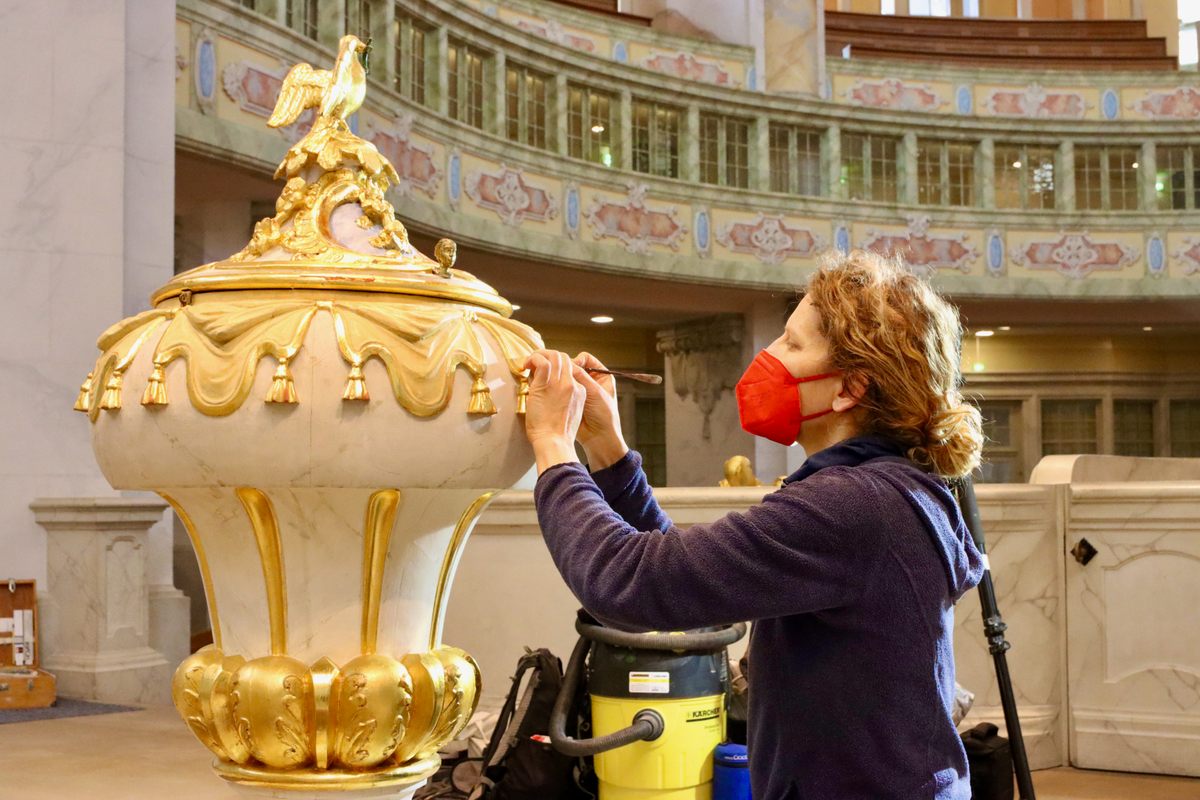
Photo: Grit Jandura/Frauenkirche Dresden.
Sweat from fingers and scratches from coat buttons take their toll on the highly ornamented interior of this historic German church. Every January, the doors close for a week so cleaners and craftspeople can get to work.

I’ve always admired people who do a real spring cleaning, a thorough “clean-up, fix-up, paint-up.” It’s not in my DNA, but I admire it. And I don’t mind lending a hand to someone else. I once helped an Orthodox friend prep her house for Passover. My job was to dig every bit of crumb and masticated baby food out of the high chair. Whew!

In Germany, a church is kept gorgeous by this kind of attention to detail. Gemma Tarlach reported at Atlas Obscura about “cleaning week at Dresden’s glorious Frauenkirche, a beloved house of worship and international symbol of reconciliation and resilience.

“ ‘It’s just a big praying room,’ says its lead architect Thomas Gottschlich, a soft-spoken man. … Gottschlich’s duties include overseeing the iconic church’s maintenance, including the annual January spruce-up, when every inch of the interior gets a once-over. …

“The Frauenkirche has been a part of the German city for a millennium, though its most famous iteration was a Baroque building envisioned by George Bähr and completed in 1743. The church earned the nickname Steinernen Glocke, or Stone Bell, thanks to Bähr’s unique design. ‘The dome construction is very special, you don’t have it that way in any other building in Europe,’ says Gottschlich. ‘Normally, the domes in other cathedrals are made with a wooden construction, which is covered with copper, lead, or whatever.’ Instead, Bähr used local sandstone for the entire dome.

“Because it is not the seat of a bishop, the Frauenkirche is technically a church, though it rivals many cathedrals in size. During construction, critics worried about the stability of that massive stone dome, which rises more than 300 feet above central Dresden. But it endured for centuries — until World War II. Although the church initially survived an intense bombing raid in February 1945, it collapsed days later.”

This is me again. In case you don’t know about the tragic US-British fire bombing of Dresden or haven’t read the novel Kurt Vonnegut wrote after he lived through it as a prisoner, Slaughter-House Five, I just want to state the obvious. Wars are bad. Let’s not have any.

Tarlach continues, “For decades the ruins of the Frauenkirche served as a war memorial and gathering point for peaceful protests under East German rule. Shortly after Germany’s reunification, an ambitious, decade-long project reconstructed the church using much of the original 18th-century sandstone. It quickly became a symbol of reconciliation and renewal. …

“While Gottschlich and his team also monitor the church’s exterior, where moss and crumbling mortar can be problematic, he says that it is the interior that demands much more attention. So, for the last 15 years, for one week in January, the church closes to visitors, and dozens of carpenters, painters, and other craftspeople and cleaners get to work. The crew repairs wobbly benches and worn wood, touches up paint, and scrubs, sands, and vacuums every nook and cranny of the highly ornamented space.

“Although the number of visitors has fallen since 2020 due to pandemic restrictions, the annual cleaning event went on as usual in early 2022. Like the constant monitoring of different climate zones around the building to ensure optimal conditions for the church’s organ, art, and load-bearing supports, the annual deep clean is an integral part of ensuring the Frauenkirche stays healthy and stands witness for several more centuries.

“Gottschlich notes that, during the reconstruction, the team chose a conspicuous interior location for the 18th-century cross that once topped the church’s tower. ‘We placed it so that, whenever you leave the church, you pass the old cross, and get an inkling of what it means to be both in history and in present time,’ he says.”

More at Atlas Obscura, here.

Read Full Post »

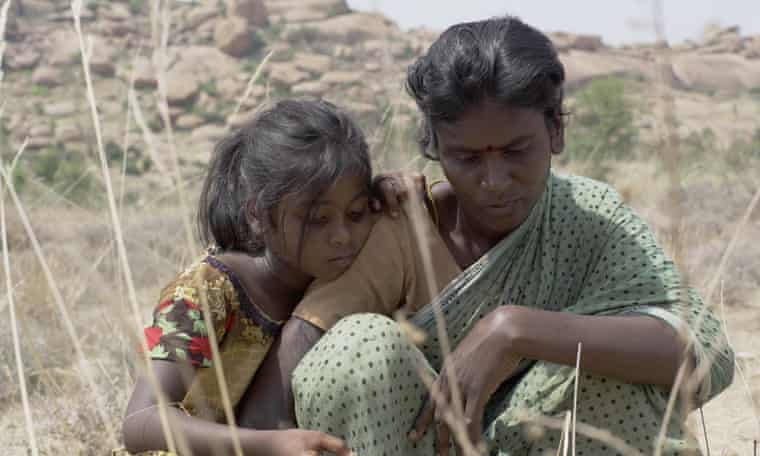
Photo: Pebbles.
India’s entry for the Oscars,
Pebbles, focuses on the inequalities that life inflicts on women in Tamil Nadu.

This year’s Oscars are scheduled March 27, and although I haven’t stayed up to watch the whole awards ceremony for years, I like reading about the winners later. I especially like getting ideas for foreign films my husband and I might eventually be able to order from our retro Netflix DVD service.

Hannah Ellis-Petersen, South Asia correspondent for the Guardian, describes one film that looks promising. The story of grinding poverty might be too painful for some potential viewers if they didn’t know that the director himself had lived that life and risen to be a filmmaker.

“As a child laborer working in the flower markets of Madurai, there was nothing more exciting for PS Vinothraj than when the film crews would descend. He would put down his sacks of petals and look up in awe at the camera operators who sat atop cranes to get dramatic sweeping shots. It was, to his nine-year-old mind, intoxicating. ‘I knew that’s what I wanted to do with my life,’ he said. …

“The odds were stacked heavily against him. Vinothraj was born into a poverty-stricken family of daily wage laborers in Tamil Nadu. He left school, aged nine, to support his family after his father died and by 14 was working in the sweatshops of Tiruppur.

“This month, his debut film Pebbles [Koozhangal] a Tamil-language movie made on a shoestring budget and set in the arid landscape where he grew up, was unanimously selected as India’s entry to the Oscars. In February this year, it had won the Tiger award for best film at the 50th International Film Festival Rotterdam. In a New Yorker review, Vinothraj was described as an ‘extraordinary observational filmmaker’ whose film presents ‘a gendered vision of rage.’

Pebbles is, as Vinothraj describes it, a ‘snapshot of a life.’ It depicts the journey of an abusive, alcoholic father and his son as they walk back home through the barren, overwhelmingly hot landscape of rural Tamil Nadu, after the father has dragged the boy out of school and taken him to a village where he wants to force his estranged wife to return home.

“It was inspired by true events; as Vinothraj says, ‘the story chose me.’ When his sister married a man from a neighboring village, the family were unable to provide a dowry. In a humiliating march, his sister was sent back to the family home by her new husband through the parched landscape. It was this walk of shame, that so many women are still forced to endure, that Vinothraj wanted to capture.

“ ‘But I wanted to make it so it was the husband who had to make the walk, not the woman,’ he said. ‘It was my small way of taking revenge for this humiliation of my sister.’

He also chose to portray the journey through the eye of a child, the son, to inject ‘hope and humanity’ into their journey.

“The film focuses on the small but devastating tragedies and inequalities that life in rural Tamil Nadu inflicts on women. … Women forced to get off buses in blazing heat when their babies, awoken by men aggressively coming to blows, need to be breast fed. Women forced to patiently scoop water from the ground and into jars as the merciless sun beats down.

“Tamil Nadu’s oppressive environment is omnipresent in Pebbles. ‘The landscape is the third main character in the film,’ Vinothraj said. ‘I wanted to explore it in detail, the role it plays in the plight of the people.’ For authenticity, he filmed during the hottest days of the year in May. Temperatures got so high during the 27-day shoot that cameras began to malfunction.

“Vinothraj’s determination to make films never wavered. While working in garment factories at 14, he enrolled into college between 6am and 10am before back-to-back shifts, realizing he would need education to go into cinema.

“Small things would bring glimmers of joy. In Pebbles a girl, whose family are depicted in such abject poverty that they hunt for rats to eat, is pictured momentarily euphoric as she collects helicopter seeds in her dress and then scatters them into the air. ‘This was how I used to feel when I was a child,’ said Vinothraj. ‘The conditions of my life were bad, but I could still find moments to be happy. I did not feel like I was suffering because I did not know anything else.’

“At 19, after his bosses tried to marry him off – a tactic used to keep child laborers working in factories once they grow up – he decided it was time to leave. He had heard that Chennai, the bustling main metropolis of Tamil Nadu, was where films were made and movie people mingled.

“ ‘I had no idea how I would survive; my only thought was that I had to pursue my passion for cinema,’ he said. On arriving in Chennai he slept in the streets until he convinced a DVD shop to hire him.

“ ‘In the DVD shop, I used to watch three films a day,’ he said. “English films, Korean films, Japanese films, Latin American films.’ … The DVD shop also gave Vinothraj access to film directors, who would borrow or buy films, often on his recommendation. After almost three years, he was hired as an assistant on a short film and began to work his way up. …

“The success of the film has left Vinothraj in a state of disbelief. He thought its only audience would be the villagers whose lives inspired the story.” More at the Guardian, here.

Click here to see 10 other foreign films submitted for this year. Several look like my cup of tea, maybe yours, too.

Read Full Post »

Photo: Central Sierra Snow Lab.
This is how the three-story Central Sierra Snow Lab on Donner Summit looked in 2011. The lab contains one of the longest sets of manually collected data on snow in the world.

As my neck of the woods gets back to normal (some family members got over two feet of snow last weekend), I’m thinking about places with traditionally high snowfall and wondering what might be happening under climate change. Step one: keeping good records.

Julie Brown reported at SFGate in November 2021, “At the top of Donner Summit, an old cabin rests in a thicket of tall trees. The structure is three stories tall, including the basement. Still, in the heaviest of winters, the snow drifts are deep enough to bury the front door, so the only way into the building is through a window on the top floor.

“The cabin is the home of an obscure laboratory, called the Central Sierra Snow Lab, that holds records of snowfall on Donner Summit dating back to 1878. That makes the laboratory’s measurements one of the longest sets of data on snowfall in the world — and many of those records were written by hand, in long-form cursive penned on dated entries in small red notebooks.

“The lab is just five minutes off an exit on Interstate 80. But there are no signs to mark the way to the cabin, which stands at the end of a dirt road and a steep hill. Even among UC Berkeley researchers and the biggest snow nerds in Tahoe, the laboratory has remained hidden, quietly collecting data for decades without much fanfare. 

“Then, two years ago, the laboratory and its valuable collection of data were almost lost amid the pandemic, university budget cuts and a hiring freeze. To save the laboratory, a small group of researchers banded together to prove the value of the work being done there, find funding and hire new blood to take the lab into the future. … A new station manager, who is an atmospheric scientist, moved in, and Google Maps even knows the lab’s location now.

“ ‘It was mind-blowing to me,’ said Robert Rhew, about the first time he visited the snow lab five years ago. Rhew is a faculty member in the department of geography at UC Berkeley and the director of the Central Sierra Field Stations, which includes the snow lab and Sagehen Field Station in Truckee. 

‘There’s this research gem just hanging out in the forest near Donner Pass, collecting all sorts of important data for California’s snowpack and for the future of water in California,’ Rhew said. …

“The Central Sierra Snow Lab is unlike those with stark white walls and spotless counters. Inside the old cabin, closets are stuffed full of winter boots and outdoor gear. Signs are posted to advise occupants to leave the doors open; the cabin is so old its walls tend to sway beneath the weight of the snowpack, making the doors stick shut in their frames. …

“ ‘You just continually find things,’ said Andrew Schwartz, the lab’s new researcher and station manager. Since he moved in, he’s spent a lot of time cleaning and organizing. ‘You find all kinds of weird stuff, peek through cabinets and look at what’s in them. And then you take a closer look and oh, there’s some $15,000 instrument in there.’ …

“The earliest records of snowfall stored at the laboratory come from the transcontinental railroad. The Central Sierra Snow Lab was built in 1946 by the Army Corps of Engineers and the Weather Bureau. … Since 1946, researchers at the laboratory have measured every inch of snowfall, stomping out into the snow with a ruler and a scale at 8 a.m. sharp. 

“Because of the Central Sierra Snow Lab, we know that the winter of 1982-1983 was the biggest winter since 1970, which is how far back the digitized records go. That winter, 671 inches of snow fell at the lab. That’s more than 55 feet. 

“Today, the Forest Service owns the building and the land, but UC Berkeley oversees the laboratory and the research. In 1996, Berkeley hired a snow researcher named Randall Osterhuber, who would become the lab’s longtime steward and sole employee. …

“During the tenure of Osterhuber, the snow lab hosted many research projects, including testing new technologies to measure how much water is in the snow, called the snow-water equivalent. This is an essential reading for California because it helps researchers understand how much water is stored in the snowpack, and subsequently, how much water will melt come spring and flow down the watershed into the lower elevation reservoirs and valleys. More than 60% of California’s water supply comes from the Sierra Nevada, according to the Sierra Nevada Conservancy.

“The data that Osterhuber presided over is also invaluable for determining trends in climate. The lab’s contributions were mostly for public knowledge, used by numerous government agencies. …

“The University of California was in a period of budget austerity, Rhew said, and the pandemic put even more pressure on already limited funding. The snow lab was at risk of being zeroed out in the budget. … Rhew convened a meeting for anyone in the landscape of research institutions and government agencies who had a vested interest in the snow lab to garner support to keep the lab’s work going. 

“ ‘It was very clear to everybody that we need to continue,’ Rhew said. …

“For Schwartz, who just finished a Ph.D. in atmospheric sciences in Australia, the job was a great fit. … When he arrived, though, the laboratory was abandoned save for the spiders and the mice. The internet was too slow to even send an email, and a lot of things needed to be fixed. 

“Behind the cabin, scientific equipment stands atop rickety scaffolding that could easily topple over. So Schwartz is building a new platform with a sturdy foundation to hold all that scientific equipment safely.

“He is also liberating the data, taking all those handwritten records in the red notebooks that are collecting dust on a shelf and putting them online so they’ll be available to anyone who wants to use them. He built a new website. He started posting snow measurements from recent storms and historical observations on a Twitter account he set up for the lab.

“ ‘A large portion of the knowledge that we have on snow hydrology now, on meteorology and climate in the region, is directly due to this lab,’ Schwartz said.”

At SFGate, here, there are more pictures, and you can read about research on atmospheric rivers the lab is undertaking. No firewall.

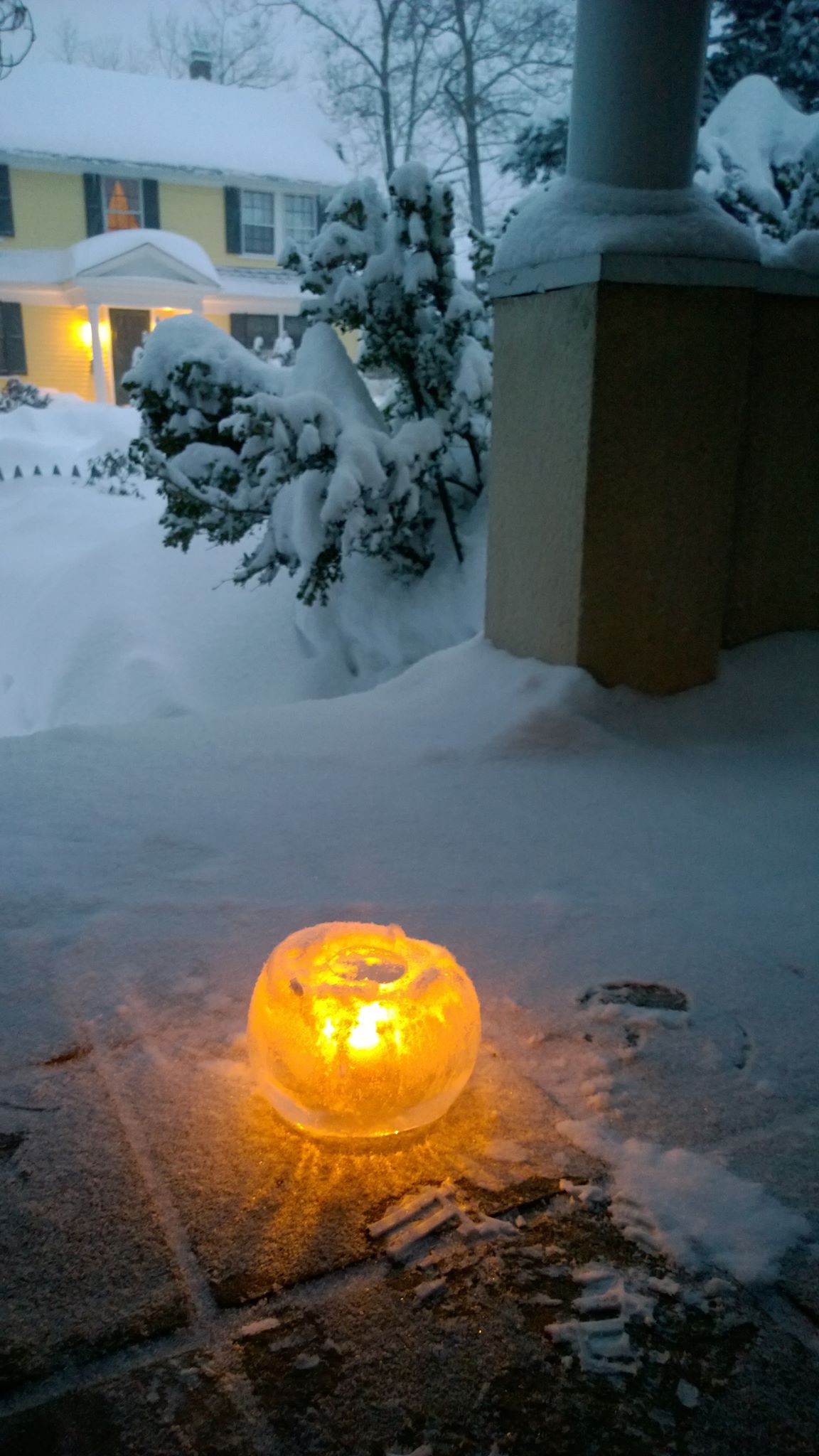
Our big snowfall last weekend reminded me of past snowfalls. Who remembers 2015, when I made ice globes?

Read Full Post »

Photo: Obinna Obioma via BBC.
Nigerian photographer Obinna Obioma using creative ways to display an iconic West African plastic bag.

Suzanne liked a recent plastic-recycling article in the New York Times, and we thought you would like it, too. (The Times blocks people from sharing photos, so the one above is from the BBC. You can also check out fashions made of plastic at the Guardian, here.)

Times reporter Ruth Maclean writes from Senegal, “A crowd of people holding curved metal spikes jumped on trash spilling out of a dump truck in Senegal’s biggest landfill, hacking at the garbage to find valuable plastic.

“Nearby, sleeves rolled up, suds up to their elbows, women washed plastic jerrycans in rainbow colors, cut into pieces. Around them, piles of broken toys, plastic mayonnaise jars and hundreds of discarded synthetic wigs stretched as far as the eye could see, all ready to be sold and recycled.

“Plastic waste is exploding in Senegal, as in many countries, as populations and incomes grow and with them, demand for packaged, mass-produced products.

“This has given rise to a growing industry built around recycling plastic waste, by businesses and citizens alike.

From Chinese traders to furniture makers and avant-garde fashion designers, many in Senegal make use of the constant stream of plastic waste.

“Mbeubeuss — the dump site serving Senegal’s seaside capital of Dakar — is where it all begins. More than 2,000 trash pickers, as well as scrubbers, choppers, haulers on horse-drawn carts, middlemen and wholesalers make a living by finding, preparing and transporting the waste for recycling. It adds up to a huge informal economy that supports thousands of families.

“Over more than 50 years at the dump, Pape Ndiaye, the doyen of waste pickers, has watched the community that lives off the dump grow, and seen them turn to plastic — a material that 20 years ago the pickers considered worthless.

“ ‘We’re the people protecting the environment,’ said Mr. Ndiaye, 76, looking out at the plastic scattered over Gouye Gui, his corner of the dump. ‘Everything that pollutes it, we take to industries, and they transform it.’

“Despite all of the efforts to recycle, much of Senegal’s waste never makes it to landfills, instead littering the landscape. Knockoff Adidas sandals and containers that once held a local version of Nutella block drains. Thin plastic bags that once contained drinking water meander back and forth in the Senegalese surf, like jellyfish. Plastic shopping bags burn in residential neighborhoods, sending clouds of chemical-smelling smoke into the hazy air.

“Senegal is just one of many countries trying to clean up, formalize the waste disposal system and embrace recycling on a bigger scale. By 2023, the African Union says, the goal is that 50 percent of the waste used in African cities should be recycled. …

“The recycled plastic makes it to enterprises of all stripes across Senegal, which has one of the most robust economies in West Africa.

“At a factory in Thies, an inland city known for its tapestry industry to the east of Dakar, recycled plastic pellets are spun out into long skeins, which are then woven into the colorful plastic mats used in almost every Senegalese household.

“Custom-made mats from this factory lined the catwalk at Dakar Fashion Week in December, focused this time on sustainability and held in a baobab forest. Signs were constructed out of old water bottles. Tables and chairs were made of melted down plastic.

“The trend has changed the focus of the waste pickers who have worked the dump for decades, gleaning anything of value. …

“The government says that in a few years, the giant landfill will close, replaced by much smaller sorting and composting centers as part of a joint project with the World Bank.

“Then, most of the money made from plastic waste will go into government coffers. The waste pickers worry about their livelihoods.” More at the Times, here.

As great as it is to keep reusing plastic, it would be best not to make it at all for most purposes. It eventually breaks down and ends up in the ocean and our bodies. When I read “plastic mayonnaise jars” in the article, I wanted to remind you that, at least in the US, there are lots of things you can buy in glass if you look: glass mayonnaise jars, glass olive oil jars, glass mustard jars, glass pasta sauce jars, glass lemon juice bottles, and more. I even get milk in glass bottles. Glass is better than plastic. And you can get both laundry and dishwasher detergent in cardboard.

Check out my 2019 post on Cambodian fashion made from recyclables, here.

Read Full Post »

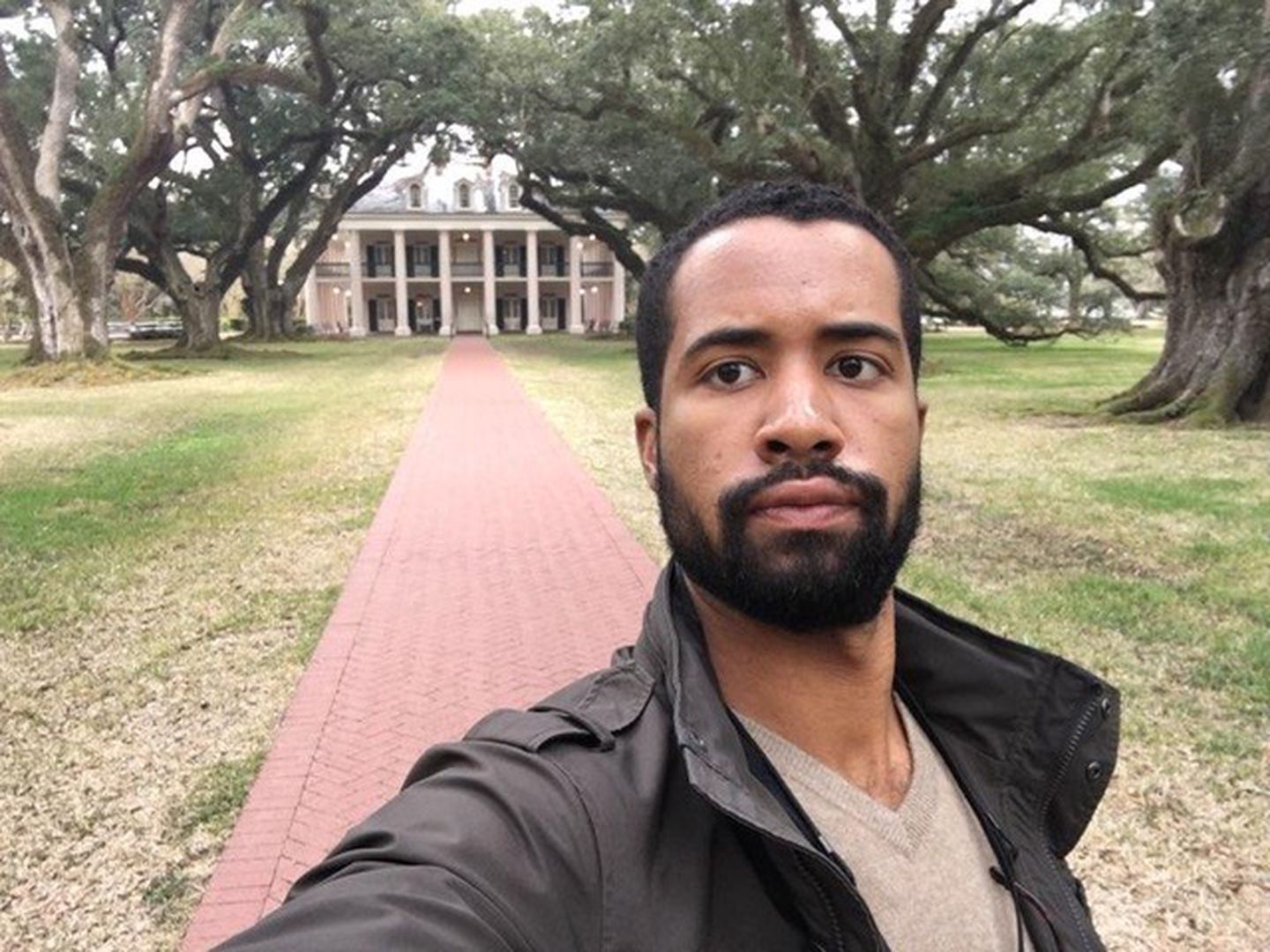
Photo: Kirk Brown/via Boston Globe.
Kirk Brown is the founder and CEO of the Black think tank Melanin MeetUps. The group launched The Better Together Project, which is demanding an end to what it calls the glorification of plantation houses, and the use of their grounds for parties and weddings.

In recent years, tourists at plantations in the South and stately homes in the North have started giving more thought to the people who kept the mansions running. There’s so much that wasn’t in our school histories. I, for one, was amazed to learn that when the colonial farmers fought the British at Concord’s North Bridge April 19, 1775, many of the folks minding the farm were slaves. What? In Massachusetts? Yes.

So I was interested in a recent Boston Globe story about a new, more thorough, house tour. Jon Marcus wrote, “After she graduated from Clark University in Worcester, Carolyn Michael-Banks worked as general manager for a tour company in Washington, D.C., where she quickly noticed that certain people and events were being left out of the script.

“ ‘We had absolutely nothing in there about African-American history,’ said Michael-Banks, who is Black. … So she added information about the Black abolitionist and writer Frederick Douglass. About Benjamin Banneker, a Black surveyor who helped lay out the district. About how enslaved people were among the builders of the White House.

“Then the CEO called. ‘His question to me was, “What’s all this Black stuff?” ‘ Michael-Banks remembered.

“Today Michael-Banks runs her own tour company, A Tour of Possibilities, in Memphis, which visits the birthplaces and workplaces of cultural icons including Aretha Franklin and Black investigative journalist Ida B. Wells, landmarks of the civil rights movement and sites of the city’s slave markets and lynchings.

‘History can be uncomfortable but it doesn’t mean we shouldn’t talk about it,’ Michael-Banks said. …

“Offerings like these are popping up all over the country, by and about people often excluded from the narratives delivered on those jump-on, jump-off bus and trolley tours.

“There are women’s history tours of Philadelphia, St. Louis, Buffalo, and Detroit, and LGBTQ tours of Charleston, S.C., St. Louis, New York’s West Village, and San Francisco’s Castro district. Native Americans tell their own stories on Navajo Tours USA in New Mexico and Nez Perce Tourism in the Pacific Northwest. The Wing Luke Museum of the Asian Pacific American Experience in Seattle offers tours of Chinatown that cover its history and not just its food.

“There are growing numbers of tours focused on Black history and culture, not only in Memphis, but in Austin, Texas; Birmingham, Ala.; Charleston; Chicago; Miami; Savannah, Ga.; Selma, Ala.; and Washington. Atlanta has Black history and civil rights tours and a cycling tour of off-the-beaten-track neighborhoods called Civil Bikes. In Tulsa, Okla., there are now tours of the places where the Tulsa Race Massacre occurred.

“A ‘truth and reconciliation’ tour of Montgomery, Ala., is run by a nonprofit from an office in a building where the words ‘white’ and ‘colored’ are still chiseled in the wall above a water fountain. And Alexandria, Va., last year launched a Black history trail and an Underground Railroad-themed tour. …

“Several house and plantation museums including Monticello and Belle Grove Plantation in Virginia and the Belle Meade Historic Site and Winery near Nashville, have started telling more about the enslaved people who built and worked at them. The state of Nevada last year converted the Stewart Indian School into a museum to illustrate the story of how Native American children were taken there to be assimilated. …

“When historic sites are treated solely as places for entertainment, said Stephanie Rowe, executive director of the National Council on Public History, ‘it becomes easier to focus on the furnishings and the stories of success and riches. But when we approach these sites as places to learn about our pasts, we’re called to broaden the narratives’ to include such things as who did the work, and under what conditions.

“In fact, said Paul Melhus, CEO of ToursByLocals, whose guides increasingly focus on the people who have been left out, ‘the history of America is the history of Black people. And gays are part of American history, and Hispanics. It’s all real, and you don’t really understand anything if all you’re doing is just looking at the pretty houses.’

“Others want to do more than change the script. The Better Together Project is demanding an end to what it calls the glorification of plantation houses, and the use of their grounds for parties and weddings.

“ ‘These were labor homes,’ said Kirk Brown, founder and CEO of the Black think tank Melanin MeetUps, which launched the project. … ‘Why is there this glamorization of these homes? It’s depressing and it’s disrespectful and it prevents us as a country from truly healing.’ …

“ ‘We haven’t been able to express ourselves in a way that’s proud,’ said Stacia Morfin, a member of the Nez Perce, or Niimíipuu, tribe and CEO of Nez Perce Tourism, which she started after finding that none of the tourism-related businesses in her part of Idaho were run by descendants of tribal people. … ‘The marginalized and the indigenous people are taking that power back.’ ”

More at the Globe, here.

Read Full Post »

Photo: SGW3 Club.
Glasgow club recycles dancers’ body heat for energy.

Today’s dance article was written by my former boss’s daughter, Margaret Fuhrer, in December, after the environmental summit in Scotland. (Her father was a wonderful boss, by the way, and a good sport. His daughter’s dance-writing career has roots in her childhood Nutcracker performances in which he gamely played Mother Ginger.)

Fuhrer reports at the New York Times that a club in Glasgow is using the heat from dancers’ bodies as alternative energy to power the building.

“At SWG3 — an arts center in Glasgow, Scotland, that hosts some of the city’s largest dance parties — tickets for club nights sold briskly during the summer and fall of 2021, before the arrival of the Omicron variant. ‘The appetite for these events has been stronger than ever, and it’s fueled by the long period of time we were all denied it,’ said Andrew Fleming-Brown, SWG3’s managing director. ‘We’ve missed that shared body-heat experience, being packed together in a full venue.’

“What if dance-floor catharsis could be good not only for the soul but also for the planet? This month, SWG3 and the geothermal energy consultancy TownRock Energy will begin installing a new renewable heating and cooling system that harnesses the body heat of dancing clubbers. The plan should eventually reduce SWG3’s total carbon output by 60 to 70 percent. …

“There is poetry in the idea: the power of dance, made literal. ‘Conversations about sustainability can be pretty abstract,’ said David Townsend, the founder and chief executive of TownRock. ‘But if you can connect it to something people love to do — everyone loves a dance — that can be very meaningful.’

“A mutual friend introduced Townsend and Fleming-Brown in 2019, after Fleming-Brown expressed interest in exploring low-carbon energy systems for SWG3. Townsend, 31, is a regular on the club scene and had been to the location several times. …

” ‘Trying to do a geothermal well would have [cost millions],’ Townsend said. ‘Instead, we thought, why not collect the heat you’ve already got in your customers and then use the ground to store it?’ …

“Dr. Selina Shah, a specialist in dance and sports medicine, said club dance floors can be especially good at creating heat. ‘If it’s really high-energy music, that generally results in very fast and high-energy movement, so you’re looking at a significant level of heat generation — potentially even the equivalent of running,’ she said.

“To capture that energy at SWG3, TownRock developed an application for an already widespread technology: the heat pump. … The SWG3 system, called Bodyheat, will cool the space by transferring the heat of dancing clubbers not into the atmosphere, as in conventional cooling, but into 12 boreholes approximately 500 feet deep. The boreholes will turn a large cube of underground rock into a thermal battery, storing the energy so it can be used to supply heat and hot water to the building.

“Development of the system began in 2019. Pandemic shutdowns, and the financial uncertainty that came with them, paused the project for several months. But with their events calendar emptied, SWG3 leadership had time to develop a larger sustainability plan for the building, setting the goal of achieving ‘net zero’ carbon emissions by 2025. ‘That moment allowed us to pause and really assess what’s important to us as an organization,’ Fleming-Brown said. ‘We decided to make it a priority.’

“Bodyheat became a central component of the plan when work on the project resumed in fall 2020. The first phase of installation should be complete by early spring [2022], and will provide heating and cooling to SWG3’s two main event spaces. Later phases will offer hot water to the bathrooms and heating to the foyer and art studios. At that point, SWG3 will be able to get rid of its three gas boilers, reducing its annual carbon output by up to 70 metric tons.

“The system is not cheap. … Glasgow’s hosting of the 2021 United Nations global climate summit created ‘a lot of momentum behind this kind of project,’ Fleming-Brown said. A grant from Scotland’s Low Carbon Infrastructure Transition Program covered half of the costs for phase one, and a government-backed low interest loan helped with the rest.

Fleming-Brown estimates that savings on energy bills will make the investment recoverable in about five years. …

“Dancing has been used to generate energy before. More than a decade ago, the Dutch company Energy Floors introduced a line of tiles that convert dancers’ steps into electricity. Club Watt in Rotterdam installed the tiles to media fanfare in 2008, and they have since been used in hundreds of other projects. …

“Kinetic dance floors make only small quantities of electricity. Bodyheat should have a more meaningful impact on carbon output, though broadly speaking, dancing isn’t a very efficient way to make body heat. … Gyms, with their emphasis on aerobic exercise, seem like more obvious fits for projects that harness the work of the body. Townsend mentioned that in addition to capturing body heat, gyms could use equipment like stationary bikes to help generate electricity.

“Dancing may not be the best source of renewable energy, but it has proved important in another way: storytelling. There is something vaguely grim about harvesting heat from gym rats pumping away on treadmills. Energy born of dancing — born of joy — captures the imagination in a different way. …

“To help tell the Bodyheat story to the crowd at SWG3, Fleming-Brown and Townsend are considering ways to illustrate the amount of heat dancers create, perhaps with a large thermometer, or a heat map similar to those used on weather reports.”

More at the Times, here.

Read Full Post »

Photo: Living Habitats and National Wildlife Federation.
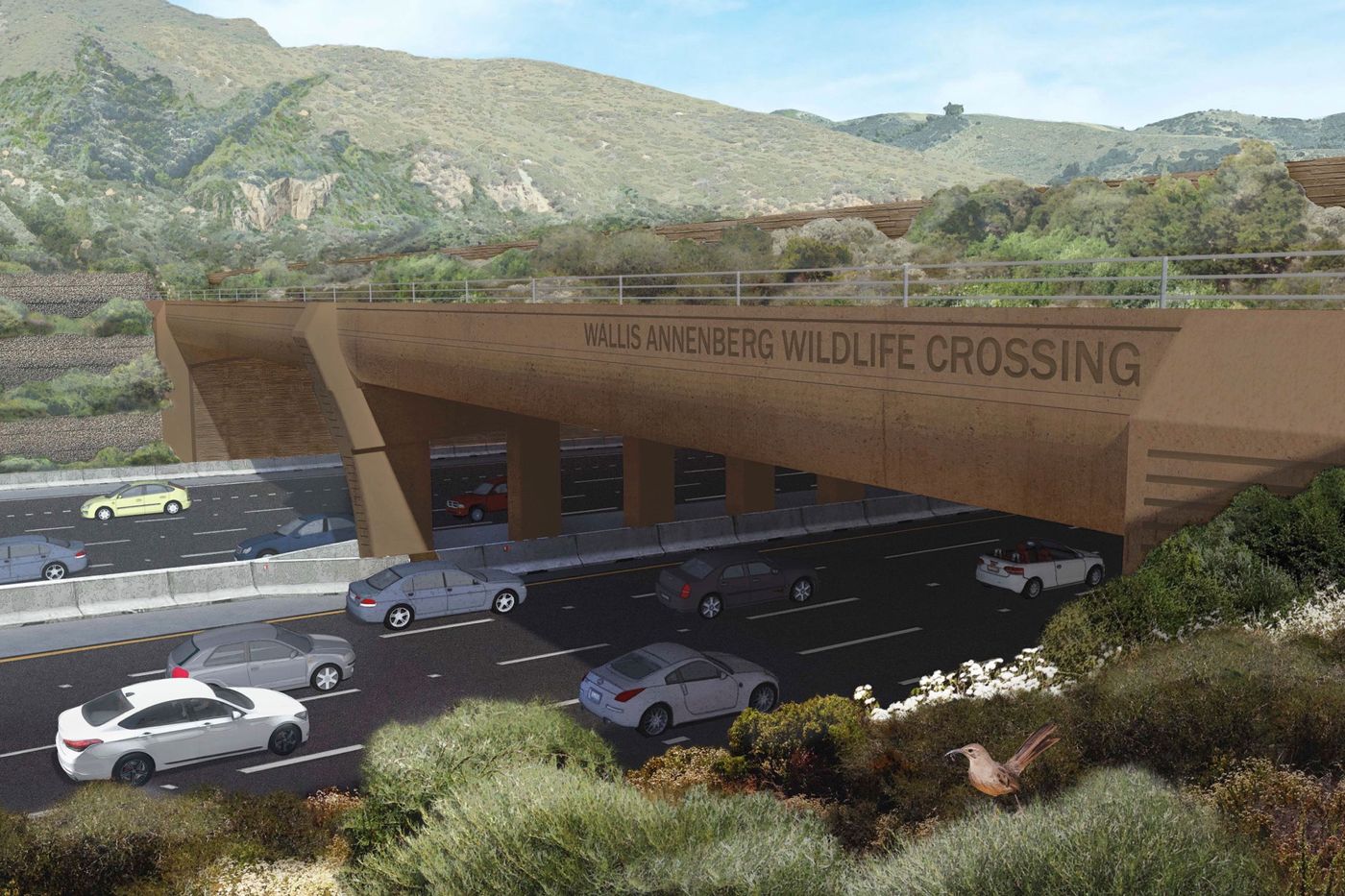
The Wallis Annenberg Wildlife Crossing should be completed over the Route 101 freeway on the western side of Los Angeles County by 2023, allowing mountain lions to easily cross eight lanes of traffic.

As the human species userps habitat from other species, there are at least a few efforts to mitigate the damage. At Curbed, Alissa Walker reports on California’s plans to build a freeway overpass that by 2023 should substantially expand the habitat of local mountain lions. It will be the largest animal crossing anywhere.

At the Guardian, Patrick Greenfield has an overview of safe passages around the world for elephants, tigers, sloths, and more.

Greenfield writes, “From a tiny railway bridge for dormice in the UK to elk, deer and bears benefiting from a slew of new animal crossings in Colorado, wildlife bridges are having a moment. …

“In January [2021], we reported on Sweden’s plans to build a series of ‘renoducts‘ to help reindeer traverse the country’s main roads. … In southern California, work is due to begin on the largest wildlife bridge in the world in 2022, to connect isolated mountain lion populations north of Los Angeles that are becoming dangerously inbred. [And there’s $350m of the] $1.2tn infrastructure package for wildlife bridges to lessen the multibillion annual cost of collisions.

” ‘Ten years ago, wildlife bridges were experimental. We didn’t know whether they would work or not. Now they’ve shown they get huge reductions in collisions. In some cases, 85% to 99% reductions,’ says Rob Ament, a road ecology expert at Montana State University. ‘You can design them for many species. Even out in the plains, we’re getting moose crossings in North Dakota.’

“Wildlife bridges are found on every continent: there is an elephant underpass near Mount Kenya; the Netherlands has a network of ecoducts that may help the country’s first wolf pack in more than 140 years gain a foothold across the densely populated country; suspended water pipes are helping Java’s endangered lorises; [below]; and a bison bridge may help the animals cross the Mississippi.

“Here are five projects from around the world helping animals make their way.

“Alligator Alley, Florida. The 129km (80-mile) stretch of road between Naples and Fort Lauderdale bisects the Everglades, an enormous wetland that is home to thousands of alligators, deer and the endangered Florida panther. … Dozens of underpasses and fencing help wildlife navigate the road.

A camera trapping exercise found panthers, black bears, skunks, deer, bats, birds and even fish use the crossings. …

” ‘Fencing is critical along Alligator Alley. It is a 10ft-high chain link fence with three-strand barbed wire on top. That’s to keep the wildlife off the roadway and on the crossing,’ says Brent Setchell, a design engineer at Florida Department of Transportation, who identifies potential crossing sites by monitoring road collisions with panthers and bears. ‘The fascinating thing is we just started monitoring the crossings four or five years ago. We found an abundance of wildlife.’

‘The tunnel of love’ on the Great Alpine Road, Australia. Stretching through the Victorian Alps in south-east Australia, the Great Alpine Road posed an existential threat to a colony of critically endangered mountain pygmy possums. Even though there are only about 150 of the marsupials on Mount Little Higginbotham, testing revealed genetic differences between sub-groups separated by the road, which are also threatened by fire, disappearing food sources and invasive species. Conservationists decided to build a ‘tunnel of love’ between the isolated groups to improve mixing and strengthen their chances of survival. …

“India’s tiger corridor. India’s first dedicated wildlife underpasses were a hard-fought victory for environmental campaigners. The nine crossings in the Pench tiger reserve were a court-ordered mitigation measure on the country’s longest road, the 4,112km National Highway 44, which runs down the middle of the country. Collisions with big cats still happen on the multi-lane motorway, but environmentalists say the underpasses have highlighted the need for more wildlife crossings on India’s road network. A 2019 camera trapping exercise found at least 18 species use the crossings, including tigers, wild dogs, sloth bears, civets and leopards. …

“Bhutan’s elephant crossing. Nearly 700 Asian elephants roam Bhutan’s forest on the eastern edge of the Himalayas. The small Buddhist country sandwiched between China and India is known for its dramatic landscapes and environmental leadership, as one of the few carbon negative countries in the world. On the 183km east-west motorway, Bhutan’s first elephant underpasses were constructed to help the threatened animals move through the landscape. Monitoring from 2015 to 2017 found that 70 groups of elephants were recorded near the passes, with three-quarters passing through the structures.

“Sloth bridges in Costa Rica. Wildlife passes are not always bridges or underpasses. In Costa Rica, canopy bridges are used to help sloths, monkeys and other wildlife cross roads to combat collisions, dog attacks and electrocutions on power lines. The rope bridges, which cost about [$200], are installed by the Sloth Conservation Foundation in areas where rainforest has been interrupted by human development on the country’s Caribbean coast. Crossing roads is often deadly for the slow-moving creatures and the canopy bridges also help combat inbreeding. ‘People look at them and think that they’re so poorly equipped to survive because you see them crossing roads and trying to move around and they look so awkward and useless,’ Rebecca Cliffe, head of the Sloth Conservation Foundation, told Bloomberg earlier this year. ‘But if you put them in a well-connected rainforest, then they are masters of survival.’ ”

Read the Guardian story here. Want more? The article at Curbed on the world’s longest animal bridge is here. Both of these publications are free although donations are encouraged.

Read Full Post »

Rent-a-Pub

Photo: Suzanne Kreiter/Globe.
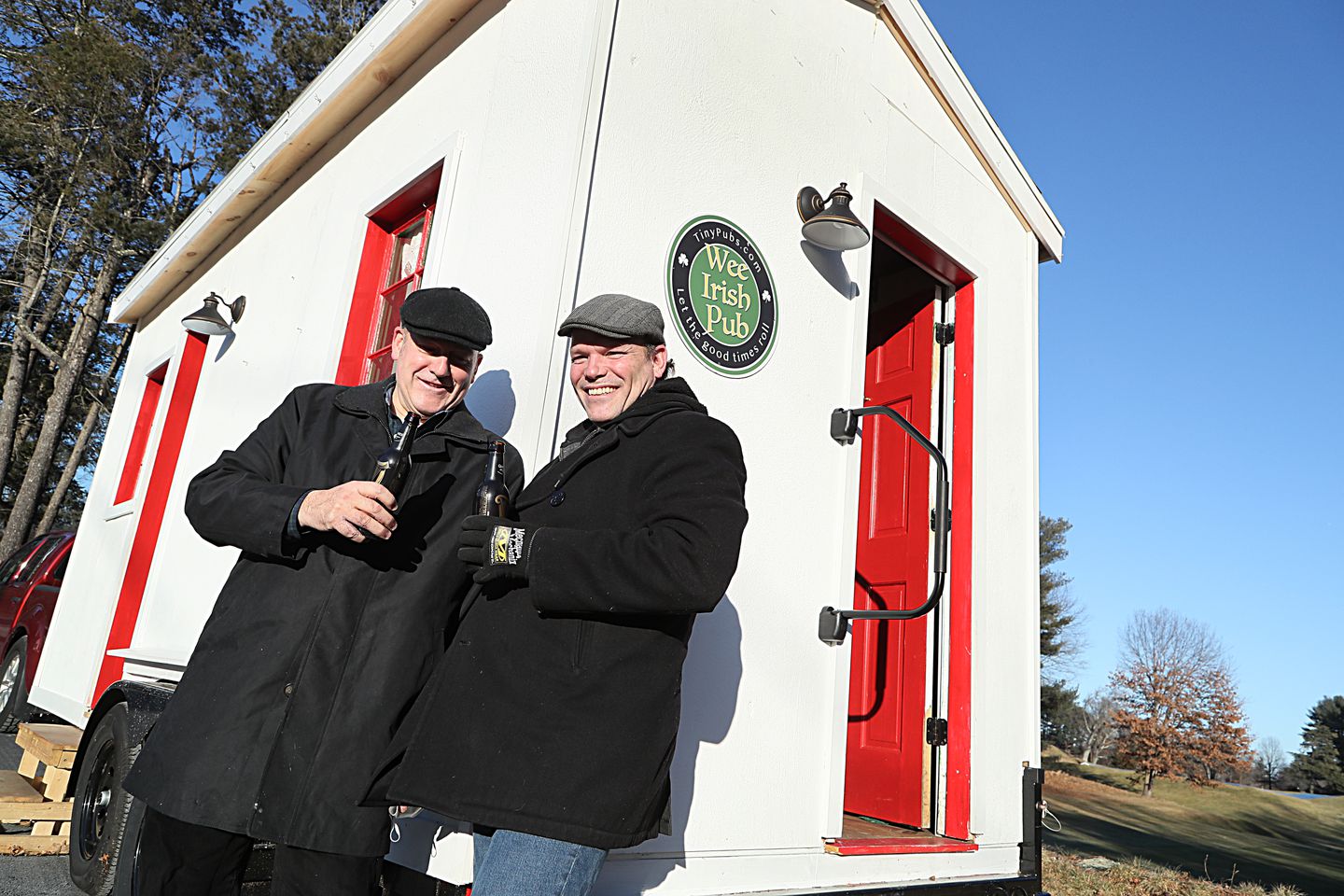
Brothers Craig and Matt Taylor built a miniature Irish-style pub on wheels, dubbed the Wee Irish Pub. Want to rent it?

Journalist Steve Annear at the Boston Globe gets all the fun assignments. This report is about a perfect little Irish pub available for rent.

“At first, brothers Craig and Matt Taylor thought building a miniature Irish-style pub on wheels, a traveling taproom they could rent for private events and parties, would just be a hobby — a pandemic project that would take their minds off the world’s problems and let people enjoy the familiar comforts of crowding into a bar (albeit a very small one) at a time when it had become almost impossible to do so.

“But within days of launching the ‘Wee Irish Pub’ in September, it became clear that the fireside chat-turned-business venture was going to be much more than a side gig. …

“ ‘The floodgates have opened,’ said Craig, 58. ‘We are getting requests [to rent it], at least two an hour, for the last week.’

“The idea to construct a tiny Irish pub, complete with a small bar, stools, bench seating, and many of the other features found in traditional venues of its kind, had been in the back of Craig’s mind for years, since he read about an inflatable Irish bar that people could rent for a day in their own backyard. …

“ ‘I had been talking about it sort of as a pipe dream that would never happen,’ said Craig, who works in marketing.

“But as the Reading residents found themselves spending a lot of time around a fire pit in Matt’s backyard early in the pandemic — one of the few activities that was still safe and allowed — the possibility surged to the forefront, like the head on a perfectly poured pint of Guinness.

“ ‘We’d talk about it night after night,’ said Matt, 49. ‘Finally it was like, “Alright, let’s just do this.”

‘It’s kind of the perfect pandemic project because people were having backyard get-togethers and staying outside.’

“Last February, after batting around the notion and discussing logistics, they decided to try their luck. They bought a large trailer for the tiny pub to be built on, so it could be towed from place-to-place upon request.

“When it was finally delivered in April, they got to work on construction, a joint effort bolstered by Matt — ‘an IT guy by trade’ with a penchant for carpentry.

“ ‘I’m definitely more about the overall impression and the ambiance,’ said Craig, who took a genealogical tour of Ireland in 2018 with his family, visiting the homeland of his wife’s ancestors. ‘Matt is precise to the micro inch on making sure that every rafter is exact.’ …

“They sourced materials from online marketplaces like Craigslist, and repurposed and recycled old furniture and other items to try and give it an authentic look and feel. Their siblings and other close family members pitched in considerably.

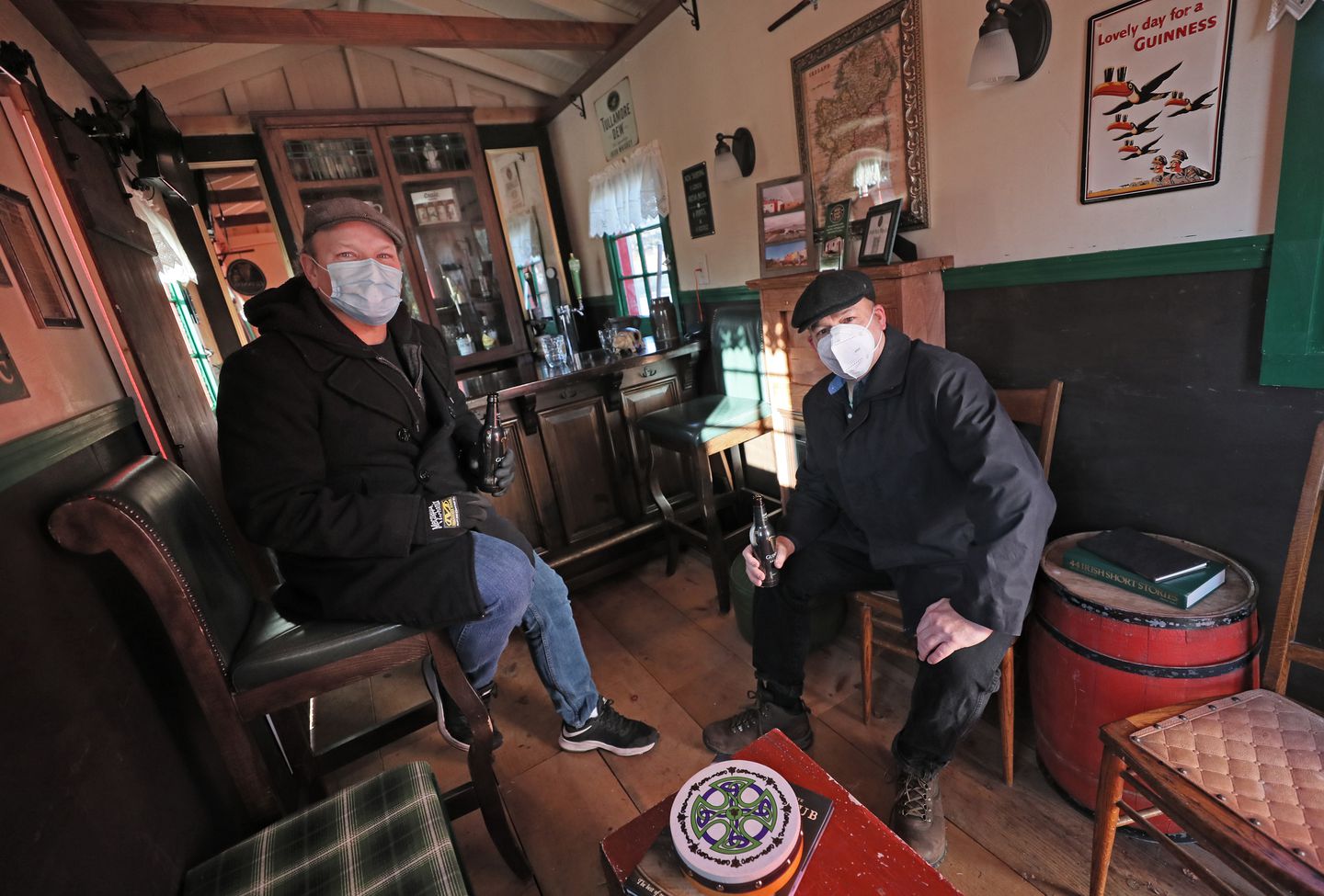
“Within months, the cozy pub had it all: A Sláinte sign graced one wall, under a weathered horseshoe. A framed map of Ireland hung above an electric fireplace. The small bar was installed, with a refrigerator and taps for kegs. A plaque dedicating the project to Craig’s late father-in-law — who was of Irish descent — went up behind the benches, forever holding a seat for him.

“The design of the cream-colored cottage is similar to mobile pubs built by the Irish-based company The Shebeen, which brought one of its units to Boston in 2015.

“The Wee Irish Pub, which can fit up to 12 people inside, finally rolled to its first event — a company gathering in Melrose — in September. It hasn’t slowed down since. …

“The company, officially dubbed ‘Tiny Pubs,’ is based in Reading. But the brothers will deliver the bar to people’s doorsteps up to 30 miles away (or more, depending on the situation). Rentals cost between $800 and $1,200 per day, with Craig and Matt arriving to help with the set-up in the afternoon and then whisking it away the following day. …

Photo: Suzanne Kreiter/Globe.

“Most people are renting it to celebrate a milestone birthdays and retirement parties, the brothers said. But they recently received one call from a customer who has a terminally ill relative who had always wanted to visit Ireland, but no longer can.

“Instead, ‘they’re bringing the pub over to her in the driveway, to have a little taste of Ireland,’ Craig said. ‘It’s very sweet.’ More at the Globe, here.

I want to expand on the idea of bringing a bit of Ireland to a patient who can no longer travel. I remember when Animals as Intermediaries (now the Nature Connection) was founded in Massachusetts in 1983. It all started with asking an elderly, disabled woman what would cheer her up and receiving the answer, “Bring me the ocean.” The nonprofit’s founder was able to bring her a collection of items that really made her feel like she was near the ocean. Read about that early, perhaps better, version of virtual reality here.

Read Full Post »

Photo: AP via Niagara Gazette.
Jetpack pilot William P. Suitor flew to the top of the flagpole at Super Bowl XIX in 1985.

When inventors were taking the cartoon Jetsons television show seriously, there was a man who stood ready to test a Jetsons-type invention. Today, despite his memorable flight at the Super Bowl and elsewhere, he keeps a low profile.

David A. Taylor reports at the Washington Post, “For many years, I wasn’t sure if what I saw was real or some sort of hopeful childhood vision: I was in a large crowd on the National Mall and a figure in a white spacesuit wearing a jetpack suddenly floated off the ground. He was flying! After rising straight up, he swept forward, then swooped back above the crowd. … My father was working as a NASA engineer. But this was way cooler.

“Then I forgot about it, for decades. But about a year ago, the image popped into my mind and I decided to do some research. I came across a 1967 newspaper clipping with a black-and-white photo. Billed as fun for children, the Pageant of Transportation included a ‘rocket belt’ flying man.

“The caption named the rocket man as Bill Suitor. In the photo he floats midair with a balloonist near the Washington Monument. I wondered if Suitor was still around. A Google hit said he’d given a talk in April 2021 in Maine to a local historical society, which agreed to pass along my request to contact him. Further research showed Suitor started flying the rocket belt as a teenager. He had flown the Buck Rogers-inspired jetpack more than any other human: By one count, he has logged 1,000 flights.

“When one day I got a phone call from just outside Buffalo.

‘I’d like to keep the idea of jetpacks alive,’ Suitor said when we spoke. ‘But I’ve become a nonbeliever.’

“Suitor got started in his space-age career when he was 19, not from dreams of being an astronaut (he was planning on architecture), but thanks to his lawn-mowing job. ‘I had never been outside of western New York,’ he told me. His neighbor was Wendell Moore, a rocket engineer with Bell Aviation who was working on a secret project for the U.S. Army: developing a tool to revolutionize battlefield mobility. Moore recruited his lawn boy as a guinea pig, Suitor joked. After tests, Bell Aviation made a short film to prove the concept.

“For that film, the company got permission to fly into historic Fort Niagara on Lake Ontario. It was a fine summer day, and the late sun cast long shadows. Suitor rose off the sea wall on the Niagara River and flew over the fortress. Soaring over historic buildings with Shaker rooftops … suddenly he realized the bird shadow was him. …

“Suitor’s first gig on the road was at the Sacramento racetrack and fairgrounds, just months after his first flight. ‘The higher you go, the nicer it is,’ he told the Sacramento Bee. ‘You feel free as a bird.’ …

“In early 1965, Suitor learned he was heading to Paris within a week. He and another Bell rocketeer would be stunt doubles for a scene in a new James Bond film, Thunderball. He couldn’t believe it: the popularity of Bond and Sean Connery as Bond was soaring after Goldfinger. In London, Suitor was outfitted in a gray suit matching Connery’s in the film, but made of a special flame-resistant Dacron.

“In Paris, Suitor was assigned a driver and taken west of the city. His mission: escape a chateau’s third-floor balcony, scoot over the castle wall, and land near the waiting Aston Martin. The director begged the flyboys not to wear their helmets: It didn’t match the shot of Connery. But they refused.

“The March day was chilly, which caused ignition problems. On his second flight, ‘I hit the cobblestones like a ton of bricks and bounced into the air.’ …

“One thing to consider about rocket-powered solo flight is the noise. The Bell model produced an earsplitting 130 decibels. The jetpack was powered by hydrogen peroxide, with steam shooting through two nozzles. It ‘screams rather than roars,’ said Suitor, ‘a high-pitched, very annoying noise about 16 inches from your ears.’

“Of that day when I saw him in 1967, Suitor’s main memory is of an air-cushion vehicle hovercraft, skimming over the Mall carrying the day’s VIP, Alan Boyd, the first U.S. secretary of transportation. Someone asked Suitor if he could fly up and circle the basket where the balloonist was hovering. ‘I loved flying unusual requests,’ he recalled. …

“Mike Neufeld, a senior curator at the National Air and Space Museum, said the rocket belt, or rocket pack, found its moment, though it never proved to be practical. ‘It was basically the Cold War, and the military was willing to throw money at some very crazy ideas.’ (It also tested a flying saucer.)

“But the jetpack, captivating as it was, was doomed. ‘It failed as a technology because its flight time was limited to a little over 20 seconds,’ Neufeld [said]. Even with later versions managing 30 seconds, ‘it’s basically a great stunt device.’ …

“Now 77, [Suitor] keeps a low profile, spending time on his woodworking and home projects, occasionally giving talks to groups about his rocket man exploits. … He was recently back from a family trip to Europe, where, driving toward Normandy, they suddenly came upon a building that looked familiar. It was the chateau of his James Bond adventure.

“ ‘It was surreal,’ he said. ‘As we were driving into the village, I could see the deer through the trees.’ It was the stone stag atop the chateau’s entrance, which he’d last seen as Bond’s airborne double.”

More at the Post, here.

Read Full Post »

Photo: Weronika Murray.
Dana Tizya-Tramm
, the youngest chief in his First Nation’s history, is leading the fight against climate change.

Today’s story is about a young man who overcame personal challenges to become a leader of his tribe in the fight against climate change.

Tik Root writes at the Washington Post, “Perched on the edge of the Porcupine river, Dana Tizya-Tramm pointed upstream to a stand of black spruce trees that jutted into the partially-frozen water. They were like lemmings marching off a cliff. Those at the tip were falling into the river, while those in back awaited the inevitable.

“ ‘Drunken forests,’ said Tizya-Tramm, a cigarette between his fingers. He says neither he nor the elders remember there being such a pronounced lean in the past. It comes at least in part, he explained, because the earth no longer stays frozen year-round, even [in Old Crow, Yukon].

“This stretch of the Porcupine runs past the approximately 250-person community of Old Crow. The most northwest habitation in Canada — roughly 80 miles above the Arctic Circle — the town sits at the heart of the Vuntut Gwitchin First Nation. September temperatures had already dropped below freezing, and Tizya-Tramm buttressed himself with tan moose hide mittens and a black puffy jacket. Embroidered on the right sleeve was ‘Chief.’

“At just 34 years old, Tizya-Tramm has risen not only through elected ranks, but from the depths of addiction and trauma to become the youngest known leader in the First Nation’s history. And he’s used that mandate to aggressively combat what he says is among the most pressing threats to his people: climate change.

“The shifting Arctic is squeezing the Vuntut Gwitchin on multiple fronts. Tizya-Tramm says less predictable caribou migration patterns have meant some villages can go years without a successful hunt, and the spawn of certain salmon species has dropped so low that fishing has been severely restricted in recent years. …

“Climate change is even threatening the First Nation’s identity as ‘people of the lakes.’ Scientists say that increased temperatures and higher precipitation have led to wetter conditions and thawing permafrost, which have contributed to the disappearance of dozens of large lakes in the region over recent decades. One study found that between 1950 and 2007, such ‘catastrophic drainages’ became five times more frequent.

“ ‘The hunters and trappers in our community, our harvesters, they’re the experts out on the land,’ said Lorraine Netro, a Vuntut Gwitchin elder. ‘They’ve been seeing and noticing the changes for the past 40 years.’

“These slow shifts can mean immediate hardship. When there’s less meat or fish, there’s more shopping at the Arctic Co-Op, the sole grocery store in town, where all the goods must first be trucked from Winnipeg to Whitehorse and then put on a plane north. A gallon of milk costs (CAD) $13.99. A bag of chips is $8. Tizya-Tramm remembers seeing a watermelon for $80 once. …

“One of the most expensive products in Old Crow, though, is diesel. Since 1961, the town has gotten its electricity through the use of gigantic generators, with fuel that’s flown in at a cost of nearly $11 per gallon. … So it’s hardly a surprise that one of the first questions Tizya-Tramm was faced with as Chief was: What are you going to do about climate change?

“It’s an issue that had been on his radar for years. As a Vuntut Gwitchin government councilor, part of his purview was the First Nation’s renewable energy efforts. While earlier feasibility studies indicated that solar was the best option, Tizya-Tramm inherited a proposed agreement that would have left the Vuntut Gwitchin owning less than half of the system. He helped renegotiate a deal in which the First Nation would own the entire solar array and sell the power back to the grid. The utility company would own the batteries and distribution network.

“By the Vuntut Gwitchin government’s estimate, the system would provide the community with about a quarter of its electricity needs — especially during the long, Arctic summer days. That would save tens of thousands of gallons of fuel per year, which at the astronomical prices in Old Crow is worth over (CAD) $400,000 annually. But the upfront cost for the solar power system was staggering: $7-9 million. Finding funding would take time.

“[Tizya-Tramm] recalled a community meeting after he became Chief during which the group discussed the Intergovernmental Panel on Climate Change’s bleak assessment of where the planet was headed. On the way home, he said he had an ‘epiphany.’

What if he declared climate change an emergency for his people? …

“Within a week the Vuntut Gwitchin First Nation had approved the declaration, which stated that ‘climate change constitutes a state of emergency for our lands, water, animals and people.’ …

“As news of Old Crow’s announcement spread, the town became a rising star in the climate world. Later that year, the Gwitchin built on the momentum when they voted to target net zero emissions by 2030. And, Tizya-Tramm was invited to speak around the globe. …

“Back home, Tizya-Tramm found that money for the solar project was now much easier to come by. ‘It went from knocking on doors, to them already being open when we approached,’ he said.

“The funding came primarily from the provincial and federal governments — support that Tizya-Tramm emphasizes was certainly deserved. Aside from suffering under years of colonial oppression, he said the First Nation is helping Canada achieve its goals under the Paris climate accord.

“Watching the Vuntut Gwitchin’s climate renaissance, Tizya-Tramm couldn’t help but see a personal parable. ‘It’s a terminal diagnosis,’ he said of climate change. ‘The entire world as a species needs to make the journey I did as an individual.’ …

“Tizya-Tramm was born into a history of Indigenous trauma. … By 13 his parents had divorced, and Tizya-Tramm was attending school either high or on hallucinogens. He then progressed to dealing drugs himself, building a client base within his friends. Then there was the fighting — both in school and outside of it, where he would face people far older. … He robbed and was robbed. On a few occasions he was stabbed. Then a suicide attempt became multiple attempts.”

At the Post, here, you can read about the slow, painstaking steps that allowed Tizya-Tramm to put all that behind him and gradually become the leader he is today.

Read Full Post »

Photo: Christopher Andrew Bray/Wikimedia.
A massive red-crab migration happens on Christmas Island, 932 miles northwest of Perth, Australia.

The annual red-crab migration on Christmas Island would be something to see. I hope the crabs survive human invasion better than the armadillo-like mole crabs (sand crabs) of my childhood on Fire Island. A Google search tells me that those have survived in North Carolina at least.

Photo: Outer Banks.
Mole crab, also called sand crab.

Here’s a report from the Ocean Conservancy on red crabs.

Katie Hogge writes that the name Christmas Island “traces back to 1643, when an English voyager sailed past it on Christmas Day. Today, nearly two-thirds of this incredibly biodiverse island is protected as a national park. While Christmas Island contains wetland, rainforest and marine ecosystems that host many remarkable creatures, there’s one species that steals the spotlight each year: Gecarcoidea natalis, appropriately nicknamed the Christmas Island red crab. …

“Every year as the first notable shower of the rainy season begins, a truly awe-inspiring event happens on Christmas Island: Millions of red crabs begin their annual migration across the island, moving with unwavering determination to reach the shoreline where mating and spawning occur. It’s estimated that 40 to 50 million of these crabs participate in the migration each year, braving tough terrain and prowling predators to play their part in establishing the species’ next generation.

“Once the migration begins, it will continue for around three weeks until the optimal spawning time when female crabs propel their eggs into the sea. The actual calendar dates for this event vary each year, but they usually occur sometime in October or November. ….

“The lunar cycle is why this migration, mating and spawning happens so consistently within the same time frame year after year. Without fail, the red crabs always spawn together before the sun rises during the final quarter of the moon as the high tide begins to turn. However, depending on how close the first rainfall occurs to this optimal lunar time frame, the crabs may have to dash to their destination faster in some years than others … and somehow, they always know exactly how fast they need to move to make their deadline.

“This mission to the sea isn’t an easy one, either. The journey across the island requires the crabs to avoid the threat of traffic as they move across roads (though some wildlife bridges have helped with this), and the heat of the sun can cause them to become dehydrated and easily exhausted. Although adult red crabs have no natural predators on land, their populations have been greatly affected by an invasive species known as ‘yellow crazy ants’ (Anoplolepis gracilipes). These invasive insects blind the crabs with acid, and scientists estimate they’ve killed tens of millions of crabs since they first arrived on the island.

“The challenges don’t end when the crabs reach their destination, though. First, male crabs who complete the journey must dig their own breeding burrows, and since millions of crabs are looking for space to burrow at the same time, this can become quite the competitive task. Once a male and female crab have successfully mated within a burrow, females will stay put, incubating their broods for a couple of weeks as the eggs develop. An amazing fact about mommy red crabs: They can produce up to 100,000 eggs per brood! …

“Once the moon reaches its last quarter phase, all the mother crabs know: It’s time to move! As the tide moves out before the sun breaks the horizon in the early morning, the females gather at the water’s edge and release their eggs into the waves. …

“As soon as the eggs are released into the water, larvae are triggered to hatch from the eggs, eventually developing to their final larval stage known as megalopae. For a couple of days, these tiny ‘almost baby crabs’ will group together near the shore until they finally grow into their full form as baby crustaceans. …

“These babies are tiny! Only about half a centimeter when they first arrive onshore, they’re so tiny that as millions of them emerge onto the shore, the unassuming eye may mistake them for a reddish algae covering the rocks and sandy shoreline. It will take these tiny trekkers a little more than a week to reach the protection of the edge of the forest, where they live and grow for the first few years of life. Once they reach ages four or five, the young crabs will participate in the migration that their species is famous for.

“Unfortunately, while so many eggs are released into the water, the majority of red crab larvae never get the chance to begin the trip home. These millions of larvae are an important food source for marine animals like manta rays and whale sharks that gather near Christmas Island each year for a festive seasonal feast. Most years, few baby crabs ever come out of the sea, and some years, no crabs make it out at all. But fear not: one to two times each decade, a massive number of baby crabs somehow make it to the beach, establishing a troop of enough survivors to keep the population at a healthy level. …

“Yet, as arduous as the red crabs’ annual journey to lay the foundation of the next generation is, there’s another danger to their survival that’s becoming increasingly threatening each and every year: climate change. Research notes that because these animals rely on the seasonal natural cycle of a wet season, anything causing potential changes in rainfall can throw off the entire process (or even eliminate the chance a migration will happen at all).  As such, both the red crabs and animals that depend on them for sustenance face new and greater risks to their survival.”


Are there critters where you grew up as a child that seem to have disappeared? I miss the mole crabs, fireflies, and those salamanders called red efts. I know they are still around, but I haven’t seen any in decades.

More at Ocean Conservancy, here.

Read Full Post »

« Newer Posts - Older Posts »