Feeds:
Posts
Comments

Archive for the ‘Uncategorized’ Category

Photo: NBC4 Washington.
In Potomac, Maryland, Har Shalom rabbi Adam Raskin has pulled together faith leaders help support Afghan refugees.

When leaders of differing faiths recognize they are all called to do the same kinds of good works, great things can happen. Today’s example is from Potomac, Maryland.

Sydney Page writes at the Washington Post, “Adam Raskin, a rabbi at Congregation Har Shalom in Potomac, Md., knew how difficult the situation was for Afghan refugees in the Washington region.

“Since the historic airlift out of Kabul last year, more than 3,700 Afghan evacuees have been resettled in the District [of Columbia, DC], Maryland and Virginia, overwhelming social service agencies and leaving some refugee families waiting for housing and in limbo.

“Raskin and his congregants decided to help by sponsoring a refugee family.

‘We thought it was very much in line with our values,’ Raskin said. ‘For Jews, many of whom were refugees from places of persecution, there is a special sensitivity for this issue.’

“As members of the congregation began researching the resettlement process, they quickly learned how complicated it can be, and how many resources are required.

“ ‘We could do this on our own,’ Raskin recalled thinking to himself, ‘but wouldn’t it be amazing to collaborate with a Christian and Muslim congregation? … This is a country where religions don’t have to be at odds with each other, but actually where religious communities collaborate and find common ground,’ Raskin said.

“He contacted St. Francis Episcopal Church and the Islamic Community Center of Potomac to gauge their interest in an interfaith initiative, and both congregations were enthusiastically on board.

“ ‘We definitely wanted to get involved,’ said Sultan Chowdhury, who was one of the founding members of the Islamic center, and currently serves as its trustee. ‘God gave us an opportunity to truly learn about each other. It is wonderful to see how close we are.’

“Kathy Herrmann, the parish life coordinator at St. Francis, agreed.

“ ‘I have felt such a kinship with them and such a warmth and love emanating from the other two,’ she said. ‘We all have the same goal to help this family become acclimated and feel the love that we have for them.’ …

“The congregations have recruited volunteers to collaborate, including Stew Remer, who has been a member of Congregation Har Shalom since 1982 and has spearheaded the effort.

“ ‘We created an informal partnership where we are working together to provide support for the family,’ Remer said. ‘It’s amazing that we’re doing this with other organizations.’

“He started by contacting various resettlement agencies to learn more about how to sponsor an Afghan family. He got in touch with the Immigration and Refugee Outreach Center, which connected him with the [Wahdat family — a 36-year-old father, a 30-year-old mother and their 19-month-old daughter].

“For the past month, the congregations have divvied up responsibilities to support the newcomers. The church has taken on a health-care advocacy role, identifying doctors and dentists willing to provide pro bono services for the family. The mosque, meanwhile, has been helping with translation services and assisting with cultural needs, such as providing traditional Afghan clothing. The synagogue has been organizing transportation, legal and financial support, as well as helping the family to apply for food stamps and Medicaid. …

“Christianity, Islam and Judaism are all considered Abrahamic religions that view Abraham, a prophet, as the patriarch of their faith. The Bible highlights Abraham’s hospitality and his willingness to welcome strangers. …

“ ‘We have enjoyed the privilege of being together, trying to understand each other better and propagate peace,’ Chowdhury said. ‘It’s eye opening for all of us, and it’s a blessing.’

“ ‘This isn’t a short-term project. We are in it for the long haul,’ said Herrmann.”

Check out the Post, here. It has details on the State Department’s sponsor program, which guides those who want to help resettle the Afghan families. Americans owe them.

Read Full Post »

Photo: Casa Dei Pesci.
A sculpture named ‘Acqua’ by Giorgio Butini is one of 39 underwater sculptures helping to deter illegal fishing off the coast of an Italian port.  

Here’s a creative idea to thwart illegal activity: attract enough sightseers to make it too public to pursue. Today’s story shows how environmentalists, artists, and a fishing community in Italy are collaborating on shared goals.

Veronique Mistiaen writes at National Geographic, ” ‘The stone is asking me to give it the right face: it is thoughtful, quiet,’ says British stone sculptor Emily Young. She carves boldly, clad in a thick jacket, leather hat, sturdy boots, face mask and ear plugs, but no gloves because ‘you need to feel what’s happening with the stone through the tool.’ …

“Young, who has been called ‘Britain’s greatest living stone sculptor,’ has work exhibited and collected around the world, but it is the first time that one of her creations reposes at the bottom of the sea.

“Young’s 18-tonne Weeping Guardian and two other colossal faces (The Gentle Guardian and the Young Guardian), which she carved in Carrara marble with the help of two associates over five days, were lowered down on the sea bed off the coast of Tuscany at Talamone, a town between Florence and Rome, in 2015. There, her massive stone guardians are protecting marine life against gangs trawling illegally at night.

“Young’s unusual work is part of an on-going project by local fisherman Paolo Fanciulli and his non-profit Casa dei Pesci to try to protect the sea in a creative way. There are now 39 underwater sculptures and marble blocks at Talamone, placed in 2015 and 2020, and another 12 are ready to join them as soon as necessary funds can be raised.

“Bottom trawlers drag their heavy-weighted nets multiple times over the sea floor, scraping it bare and destroying the Posidonia (Posidonia oceanica), known as Neptune grass, a flowering seagrass endemic to the Mediterranean, which forms large underwater meadows and acts as a nursery and sanctuary for all marine life.

The Posidonia also soaks up 15 times more carbon dioxide annually than a similar sized piece of the Amazon rainforest.

“For these reasons, the Posidonia is a protected species included in the EU’s Habitats Directive and the Marine Strategy Framework Directive, and bottom trawling is illegal within three nautical miles from the coast in Italy. But because it is very profitable, and impossible to police the 8000km of Italian coastline, boats carry on at night regardless. 

“Now in his 60s, Fanciulli has been fishing around Talamone since he was a teenager.  In the 1980s, he started noticing the devastation caused by bottom trawlers and the impact it had on his and other local fishermen’s catch and livelihood. He has been trying to fight them ever since.

“In 2006, he joined force with the municipality of Talamone and a few environmental organizations to drop big concrete bollards on the bottom of the Mediterranean to ‘serve as secret agents under the sea.’ The action received media attention and he became a national hero – but it wasn’t enough to deter the trawlers. The local mafia also retaliated by making sure he couldn’t sell his fish at the market, and threatening him.

“He needed to find another way. ‘He thought: “This is Italy. We do art. If we could put art and conservation together, we might have more impact,” ‘ explains Ippolito Turco, a friend of Fanciulli and president of the non-profit Casa dei Pesci, which they created together for that purpose with the support of several cultural and environmental associations.

“They asked nearby Carrara quarries if they could donate a few stones. Franco Barattini, the president of one of Carrara’s best-known quarries – Michelangelo cave, the very place where the eponymous artist came at the turn of the 16th century to select stones for his iconic David and Pietà statues – promised to donate not a few, but 100 huge blocks of marble.

“Young, along with Italian artists Giorgio Butini and Massimo Lippi, and other artists from four countries, was asked to carve the marble blocks. ‘We all donated our time. I thought it was a brilliant project: it would attract more attention to the problem,’ says Young. …

“The sculptures were placed in a circle, four metres apart around a central obelisk, carved by Massimo Catalani, another Italian artist. A bit further sleeps a mermaid, a collaboration by sculptor Lea Monetti and young artist Aurora Vantaggiato, and a reclining figure by Butini, among other works.

“The marble sculptures create both a physical barrier for the trawlers’ nets and a unique underwater museum, open to anyone either through arranged scuba diving tours or their own dive. “It’s really beautiful and it’s amazing to see how easy it is for nature to recover. …

“The scheme has completely stopped illegal trawling within three miles off shore in front of Talamone as far south as the mouth of the Ombrone river, Turco says. ‘But now the pirate boats have moved north of the Ombrone. Casa dei Pesci plans to protect this stretch of sea as well.’ “

More at the Geographic, here. Needless to say, the photos are wonderful. No firewall.

Read Full Post »

Photo: AEI.
Frederick Hess and Pedro Noguera turned their correspondence into a book, “A Search for Common Ground: Conversations About the Toughest Questions in K-12 Education,” published by Teachers College Press.

Back in the days before Covid, my friend Nancy bravely participated in a political discussion group organized by the town’s Council on Aging. The idea was to bring together people on different sides of the divide to listen respectfully and express their views calmly. She found it fascinating, but the respectful and calm aspect ultimately disintegrated and the group is no more. The lesson, I think, is that it can be hard work to do this and everyone needs to remember that an opponent is still a human being.

Chelsea Sheasley has a story at the Christian Science Monitor about two educators who managed the challenge well enough to publish a book on it.

“Rancor over COVID-19 policies, diversity and equity initiatives, and school choice,” she writes, “has divided communities and supercharged school board meetings. Is there any way to find common ground about education amid such divisions?  Some people say yes. 

“Frederick Hess and Pedro Noguera, two education policy leaders, published a book [in 2021] – A Search for Common Ground: Conversations About the Toughest Questions in K-12 Education – made up of in-depth emails they shared over seven months to better understand each other’s beliefs and unearth hidden agreement. They currently host a podcast, Common Ground, with recent episodes tackling the role of parents in education and anti-racist education. 

“The authors describe themselves in the book’s preface as having ‘spent much of the past few decades on opposing sides of important educational debates, with Pedro generally on the Left and Rick mostly on the Right.’ Dr. Hess is director of education policy studies at the American Enterprise Institute, a conservative Washington think tank, and Dr. Noguera is dean of the Rossier School of Education at the University of Southern California in Los Angeles.

The goal of their exchange, the two write in the book, is to offer a model for those who ‘desire to disagree with grace and explore differences without rancor.’ …

“Fred Campos, from Bedford, Texas, is an elected school board member of the Hurst-Euless-Bedford Independent School District. He was assigned to read the book for a leadership training program he’s participating in with the Texas Association of School Boards (TASB).

“Mr. Campos listened to the audio version of the book twice and says he ‘loves the premise that we should not go to the extremes.’ As a second-term board member, he’s adjusting to a ‘new era’ of more polarization and increased attendance after a fairly quiet first term. The book helped him better understand why some in his community wanted a mask-optional policy – which differed from his position in favor of mask mandates. 

“ ‘One thing I think both authors did well is they were complimentary of one another, respectful, and that modeling is huge, whether you’re dealing with parents, other board members, or staff,’ Mr. Campos says. …

“One November night in 2019, Dr. Hess says he was sitting in his office, staring into space, and pondering how to actually model a different style of conversation. He started thinking about who was someone who disagreed with him on major issues and might be willing to engage in a civil dialogue. 

“ ‘Education is supposed to be about teaching kids how to wrestle with things, how to look past our differences, and it felt like rather than leaning on this, we’ve been as bad as anyone,’ he says in a phone interview. ‘So I finally said, “I’m a big fan of ‘light a candle rather than curse darkness,’ ” … so I picked up the phone and called Pedro, and he was great about it.’  

” ‘I immediately said yes because I appreciated the need for dialogue on these issues, and like him, I was frustrated by the tenor of the debate and the kind of paralysis that I would say characterize the field,’ says Dr. Noguera. 

“The two wrote emails to each other from January through July 2020, on 11 hot-button education topics such as school choice, the achievement gap, testing and accountability, diversity and equity, and teacher pay. They also addressed major events that hit while they were writing, such as COVID-19, the shuttering of schools, and the murder of George Floyd. 

“Both men say they were provoked at various times by each other’s viewpoints. Because they were communicating in writing, they had time to reflect before responding and gather evidence to back their points. The two found areas of common ground on nearly every topic, especially on teacher pay and testing, after airing their differences.  

“In a joint Zoom interview with the Monitor, the pair easily banter with each other, but say it took time to develop rapport. They’re often asked for advice on how to start difficult conversations. Dr. Hess says he thinks anyone can do it, but it takes certain skills.

‘It takes an interest in listening to one another. It takes the habit of pausing on your first “that’s wrong” in order to listen, hear them, and ask a question instead of pushing back,’ he says. …

“Kay Douglas is a former school board member, a senior consultant at TASB, and the instructor who assigned Common Ground to the leadership cohort that Mr. Campos is a part of. She says the book offers a valuable example of intentionally trying to understand and work with others. 

“ ‘Otherwise, we are going to self-destruct. People are so stressed and the stress level keeps going up,’ she says.

“For Dr. Noguera, learning how to debate respectfully was something he learned around his kitchen table. When he was growing up, his dad, an immigrant from Trinidad, was a police officer in New York City. He would sometimes bring home friends with conservative views on crime.

“ ‘I was a kid and I’d listen to these conversations and get angry, but because they were adults and I was a kid and I wanted to engage, I had to figure out how to do that respectfully because my parents insisted on respect,’ he says. 

“As a professor, Dr. Noguera has invited people who disagree with him on policy to debate him in his classes, because he thinks it makes his ideas stronger and shows that people can disagree ‘without attacking an individual’s personhood.’ Conjuring up the worst intentions about other people, he says, is unproductive and unhealthy for democracy.”

More at the Monitor, here. Although it is not mentioned here, perhaps because the book is based on emails, I’m thinking that tone of voice matters a lot, too.

Read Full Post »

Photo: Taylor Luck.
The near-empty Souk Chaouachine, or traditional chachiya hat market, one of many historic souks facing closure from a pandemic-induced recession in the Medina in Tunisia.

The list of pandemic effects just keeps growing. Today’s story addresses what happened after Covid kept tourists from the colorful small shops in Tunis. Just like workers in the US that have decided they need to join unions, Tunisian businesses are realizing there’s strength in numbers.

Taylor Luck reports at the Christian Science Monitor, “It takes one glance to tell all is not well in the Medina. The walled, historic old city of the Tunisian capital – once marked by bustling markets and streams of people hustling between the shops, homes, and government offices along its narrow streets and hidden passageways – is nearly empty. …

‘We are waiting for nothing,’ a chachiya hatmaker says as he shuffles boxed hats from one wall of his shop to the other. ‘We just show up for a few hours out of habit. No one is coming.’

“The Medina’s shuttered shops serve as a stern warning that the pandemic and a recession are threatening to undo the old city’s rich tapestry of families and artisans who have made it their home for centuries. But not, it appears, without a fight.

“Banding together for the first time, Medina business owners and families are trying to reintroduce the UNESCO World Heritage Site to Tunisians and the world, sharing its secrets and inviting people to take part in its history – and save its identity in the process.

“M’dinti, or ‘My Medina,’ the brainchild of Leila Ben Gacem, a social entrepreneur and advocate for Tunisia’s artisans, is an initiative that has united two dozen boutique hoteliers, artisans, and restaurant owners into an economic lobby to advocate for the old city and search for new ways of resilience.

“ ‘By ourselves, we cannot survive the pandemic’s effects,’ says Ms. Ben Gacem, who is also a Medina hotelier. ‘But together we can make changes to improve the Medina.’ …

“For seven centuries, hatmakers, cobblers, silver and goldsmiths, and tailors have occupied craft-specific streets – separate ecosystems within the maze-like Medina. But with no business, unable to afford monthly rent … many of these artisans are now packing it up. … In their place are popping up cafes, cigarette stands, betting outlets, and fast-food joints – their chrome and blue plastic storefronts incongruous with the World Heritage Site’s cobblestone streets and wrought-iron windows. …

“Silversmith Mohammed Sidomou, whose family’s shop has stood on the narrow street of the birket al-fidhah (pool of silver) market for a century, [describes] the pandemic as the ‘greatest challenge’ the Medina has seen in his four decades in business.

“ ‘We have been hit by a revolution, terrorism, instability, but there was always some economic activity to keep us going. With the pandemic, everyone is affected. … It breaks my heart to see the Medina turned into shuttered storefronts. It’s as if the Medina is losing its soul.’

“Compounding troubles are the pandemic-induced jump in international shipping costs, inflation, and the devaluation of the Tunisian dinar, making it logistically difficult or financially prohibitive for artisans to get the raw materials they crafted, pounded, and molded into Tunisian heritage crafts for centuries. …

“The economic downturn is also fraying a unique community of 20,000 people who live in the Medina, including working- and middle-class families and transplants from rural villages.

“Before, residents say, families, shop owners, and artisans supported one another during lean months and years. … Neighbors would loan a few dinars, share groceries, and cook for each other’s weddings. Shop owners and artisans whose businesses were flush would divert customers to other craftsmen they knew were facing a rough patch. …

“Says Mohamed Ali Dweiri, a 26-year-old Medina resident and hotel worker, ‘People have become more selfish; no one is helping each other. This is the biggest change to the Medina I have seen in my lifetime, and it’s sad.’

“Enter M’dinti.

“With no foreign tourism, the joint initiative’s first priority was finding ways to attract Tunisians to the Medina. …

“Since October 2021, M’dinti has hosted weekend activities for families, inviting Tunisians into the district’s historic homes and businesses for culinary classes and workshops with artisans – such as carpenters or cobblers – offering a glimpse into the centuries of knowledge of the maalam, or craft master. …

“ ‘Each activity is bringing 100 guests to the Medina. They are learning there are days’ worth of sights to see, they are appreciating the traditional crafts we fight to keep alive,’ says Mr. Ghorghor, the perfumer. ‘Word-of-mouth is our best hope.’ ”

More at the Monitor, here.

Read Full Post »

Photo: Luisa Dörr.
ImillaSkate athletes practice skateboarding on a downhill road near Cochabamba, Bolivia. They use indigenous attire as a statement against discrimination.

We loved the movie Skate Kitchen about female skateboarders in New York. You may have seen my post about it here. Learning how outsiders find their people, their tribe, was a revelation.

My Cousin Claire knows I love stories like that. I think my whole extended family does. Maybe it’s in our DNA. Claire sent me today’s story about female skateboarders in Bolivia and the reasons they are using their sport to stick up for indigenous people.

Paula Ramón writes at National Geographic, “The colorful polleras are a symbol of identity in the Bolivian countryside. But these voluminous, traditional skirts worn by Indigenous Aymara and Quechua women have also been the object of discrimination, some seeing the appearance at odds with modern identity. Now a group of women athletes has brought them back to the city — donning them during skateboarding competitions — to celebrate the cultural heritage of the cholitas.

” ‘The pollerasare very valuable to me,’ says Deysi Tacuri López, 27, a member of ImillaSkate, founded in 2018 in Cochabamba, Bolivia’s third largest city. ‘I wear them with pride.’

“Tacuri sees in the polleras not only a cultural expression but also a form of empowerment. … More than half of Bolivia’s population is of Indigenous descent.

“Tacuri and fellow members at ImillaSkate also among those with Indigenous ancestors. Some of their relatives still wear polleras.      

“ ‘They are my mother’s and my aunts’ clothing, and I see them as strong women. Here in Bolivia, many women in pollerasare the head of their families,’ she said in a telephone interview. ‘For me, mujeres de polleras [pollera wearers] can do anything.’

“Tacuri and her teammates spend long hours practicing moves at Ollantay Park, one of two places in the city with ramps and other structures designed for the sport. …

“ImillaSkate was founded by Daniela Santiváñez, 26, and two friends. She learned to skate as a child thanks to her brother, though it was ‘rare to see girls on skateboards.’ …

“Without women role models to follow in the sport in Cochabamba — and growing tired of listening to her mom’s complaints about her bruises from falls — Santiváñez stopped practicing when she was a teenager. She took up skateboarding again after college, where she got a degree in graphic design. By then, Dani, as her friends call her, discovered she was not the only woman with a passion for the sport.

” ‘One day I was having a conversation with the girls about why all the boys get together to skate — why don’t girls do that?’ recalls Santiváñez. …

“Over the past three years, ImillaSkate has grown to nine skaters. Being an active member means making time to practice every week in order to be able to participate in competitions, and also sharing the same principles of acceptance of diverse groups and traditions. Although the collective is based in Cochabamba, the group has generated a wider audience on social media beyond Bolivia, with more than 5,000 followers on Instagram. They also maintain a Facebook page with more than 7,000 followers, and a YouTube channel where some of their videos get thousands of views.

“Santiváñez clarifies that they wear the skirts only for performances, not necessarily as their street clothing. ‘We do it as a demonstration, as a cry for inclusion,’ she says. … ‘Skateboarding is inclusive, it brings all kinds of people together. …

‘It’s a community, and we’ve taken advantage of this to make the world a kinder place.’

“Tacuri says they first challenged themselves to embrace their own roots. ‘We ourselves have decided to get to know our culture and our identity. We have decided to revalue our clothing and encourage new generations.’ …

“The polleras’ origins date back to the Spanish conquest in the 16th century. Orginally imposed by colonial rulers as a way to easily identify the native population and also have the attire conform to what was being worn in Spain by the poorer people, the skirts eventually were adapted as part of traditional Andean attire, most commonly associated with cholas — Indigenous women from the highlands. Just as their ancestors gave the skirts their own identity by mixing them with patterned blouses, local jewelry, and hats, the skateboarding imillas are making their own modifications to the garment — and trying to remove a stigma.

” ‘The pollera is associated with the countryside, with ignorant people without resources. We want people to understand that there is nothing wrong with wearing a pollera.’ …

“The group didn’t even know where to get the elaborate skirts, so they turned to their grandmothers for help.

“Not all of them jumped on board immediately, concerned they would be stigmatized. Even as the descendant of a mujer de pollera, Luisa Zurita struggled with getting her family to understand the premise behind the wardrobe. Only after she was invited to participate in a local television program for a skateboarding performance did her grandmother give Zurita her blessing — and her favorite pollera.”

More at National Geographic, here. As you would expect of National Geographic, the photos are terrific.

Read Full Post »

Photo: Suzanne’s Mom.

Dolls were an important part of my childhood, figuring prominently in what I called My Little House, a neglected corner of our third floor, and later in My Little School. So I was interested in recent research my husband saw about a role dolls can play in any child’s life.

Hannah Devlin reported at the Guardian, “Playing with dolls encourages children to talk more about others’ thoughts and emotions, a study has found.

“The research suggests that playing imaginary games with dolls could help children develop social skills … and empathy. The neuroscientist who led the work said that the educational value of playing with Lego and construction toys was widely accepted, but the benefits of playing with dolls sometimes appeared to have been overlooked.

“ ‘When children create imaginary worlds and role play with dolls, they communicate at first out loud and then internalise the message about others’ thoughts, emotions and feelings,’ said Dr Sarah Gerson, a neuroscientist at Cardiff University and the lead author.

‘This can have positive long-lasting effects on children, such as driving higher rates of social and emotional processing and building social skills like empathy that can become internalised to build and form lifelong habits.’

“The study, funded by the manufacturers of Barbie and published in the journal Developmental Science, involved 33 boys and girls, aged between four and eight who were given a collection of Barbie dolls and accessories such as an ambulance or horse to play with.

“They were left to play spontaneously, but their speech was monitored and they were also fitted with a specialized cap containing a form of brain imaging technology called functional near-infrared spectroscopy (fNIRS). The technique measures changes in blood oxygenation by shining light through the skull, which makes it possible to track brain activity while the subject is freely moving around.

“The study found that the children talked more about others’ thoughts and emotions, a concept known as internal state language, when playing with the dolls, compared with playing creative games on a computer tablet, such as a hairdressing game or a city-building game with characters.

“They were also more likely to address the dolls in the second person, talking to them directly, whereas the characters on the computer screen they tended to refer to in the third person. No difference was observed between boys and girls. …

“Benjamin Mardell, who researches the pedagogy of play at Harvard Graduate School of Education and who was not involved in the work, said: ‘The hypothesis that playing with dolls provides a scaffolding for young children to take the perspective of another, even if that other is inanimate, seems very reasonable.’ …

“Mardell added that the findings ought to apply to any kind of role-play toy, rather than being specific to Barbies. ‘I’d take a broader view of what a doll is,’ he said. ‘[It could be] any object that the child can invest a sense of other into – a stuffed animal, an oven mitt that talks to them, or even an imaginary friend.’

“Children typically start to show signs of internal state language around the age of four. At this age, they begin to voice their thoughts aloud, indicating that they are considering the thoughts, feelings and desires of themselves and others.

“ ‘These skills are really important for interacting with other people, learning from other people, and navigating a variety of social situations,’ Gerson said. ‘It becomes important for making and sustaining friendships, and how they learn from their teachers, and parents.’ ” More at the Guardian, here.

I’ll just add that dolls or “role-play toys” can be important to a child for other reasons, too. When I was a teacher, a mother told me about my student’s hostility to the family’s new baby. The girl was acting out (calling for help) when she kept throwing a baby doll off the dollhouse roof. I myself probably cherished dolls as substitutes for the baby that left our home when I was four. Long story. The point is that dolls become real little people to a child, and the thoughts and feelings experienced with the little people are important.

You might also like this NPR story on the importance of free play in preschool, here.

Read Full Post »

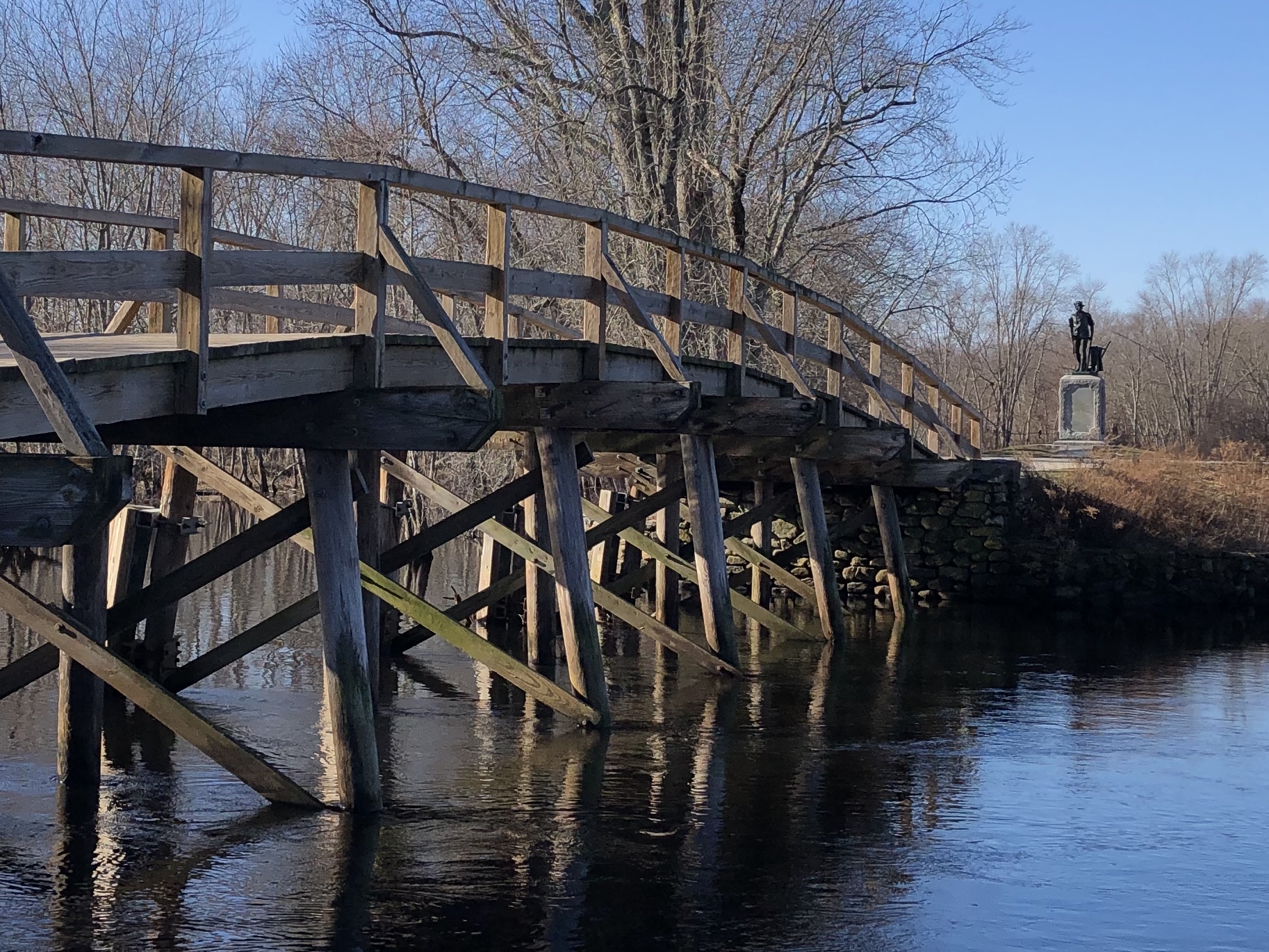
A girl photographs a bridge over the foggy Seekonk River.

What’s been hard about the most recent iteration of the pandemic is the feeling of going backwards. For a while, there was a sense of forward movement even though we were still taking some precautions. But with Omicron so transmissible, many of us chose isolation again.

It hit me right before Christmas when a friend stopped by. We both had had three vaccine shots and were used to being together without masks, but because I knew that some of her coworkers were not wearing masks, I decided we had better go back to masking when together. Sure enough, not long after that she caught Covid from a coworker. (Doing OK, thanks to the shots.)

Most of my photos reflect the grayness of this period. The view below of the Sudbury River was taken on New Year’s Day: outlook foggy.

I took a lot of snow photos, as you can see, but I’m also including a sunny one of the library’s brand-new children’s wing, several pictures from friends (Kim Gaffet’s snowy owl, a tiny island that Jean Devine’s students planted last summer), and scenes in Providence yesterday (the girl photographing a fogged-in bridge, an icy sandbox, a pond starting to melt). Sandra M. Kelly made the 2022 photo of snow in New Shoreham, where heavy snow is a rare event.

Read Full Post »

Art: Renoir.

When I was a child, I went through a period of wanting to be a ballet dancer. It was a thrill to have a small role in the Elysian Fields of Gluck’s Orpheus alongside grown-up ballerinas and opera singers. But as ballet lessons waned, other interests took their place.

Later, as a worrywort adult, when a dancer I knew kept getting injuries, I began to think of ballet as a dangerous sport. Today’s post celebrates a revolution in addressing ballet injuries.

From Nick Miller at the Age: “Is injury common among ballet dancers? Yes. But perhaps not for the reasons you might think. A study in Britain in 2014 found that professional dancers were far more likely to suffer injuries than rugby players: 80 per cent of dancers incur at least one injury a year that affects their ability to perform, compared to 20 per cent for rugby or football players.

“Muscles and joints were the most common sites for injury, according to the British Fit to Dance 2014 survey. Other studies found that over-use was the most common cause of injuries for female dancers while men were more susceptible to sudden, traumatic injuries. And they found that younger dancers were more likely to be injured than older ones. …

“[Matthew Wyon, professor of dance science at the University of Wolverhampton and one of dance science’s leading experts] believes it’s because of the way dancers train.

“ ‘None of their training causes them to get either stronger or fitter until right up close to a performance. Ballet dancers are technically unbelievable. They’ve got an economy of movement we never see in sport. But it means the dance no longer puts a stress on the body. They don’t have that physical adaptation. So, in fact, the better your dancer is, the less fit they are. Because dance doesn’t stress them any more.’

“On the face of it, the lifts and jumps that dancers perform seem to require extraordinary strength. But, behind the scenes, a lot is accomplished by perfect balance; by aligning bones and locking joints so that, rather than relying on muscles to hold your partner aloft, the weight transfers through your frame to the floor. …

“Evidence of their reliance on technique can also be found in dancers’ almost freakish ability to ignore fatigue when it matters.

“In one experiment, Wyon’s team made a dancer exercise until they were ‘absolutely dead on their feet’ and then perform a double pirouette on to arabesque (which is where they stand en pointe with one leg in the air behind). ‘And they could pull it off, even when they were having trouble doing the fatiguing dance in between. As soon as they were being watched, or having the data collected, they could pull it out. This is just a phenomenon and we’re trying to explain it – and it could be how they’re trained.’

“Technique, it seems, honed over hours of practice each day and since an early age, hides a multitude of flaws. Wyon has seen a male dancer ‘built like a stick insect’ who could lift any of the women in the company – purely through ability. ‘His technique was so good for doing it, beautifully. Once. But if you asked him to do it three times, he couldn’t. … They’re always training and dancing at close to their maximum.’ …

“The Australian Ballet is one of a group of pioneering dance companies around the world that have beefed up their in-house medical expertise and are leading the way in the search for better treatment, rehabilitation and – most importantly – injury prevention.

“Dr Sue Mayes is the director of artistic health at the ballet, where she’s worked since 1997 – at first in the littlest room in the building as the company’s first full-time touring physio, now leading a high-tech medical and physiotherapy operation. …

“ ‘We’re [always] going to see if we can do it non-surgically,’ says Mayes, ‘because a dancer loves that swan neck, that hyper-extended shape. If you lose even five degrees of that, it’s going to be obvious to the eye and harder to function with. So, we avoid surgery at any cost – we’ve done very few operations in the last 10 years.’

“For a year, [Benedicte Bemme, an injured dancer] had to run through a simple, repetitive exercise routine involving the movement method Pilates, little jumps, or jogging up and down a stairwell, designed to restore strength and function to her foot.

“It may sound simple, but in ballet it is a revolution. Rather than rushing dancers to hospital, they are experimenting with techniques to painstakingly rebuild the dancer from the inside out. Research published by Mayes and her team looks at each joint and each injury, and assesses what particular types, frequency and power of exercise are best to get a dancer back to the stage.”

Read more at the Age, here.

Read Full Post »

Photo: Chris Linder.
National Audubon Society government affairs coordinator Tykee James (second from left) has been leading monthly bird walks for congressional staff on Capitol Hill since 2019.

A while back I wrote how the Swiss ambassador in Washington, DC, got people there interested in birding (here). Today a story from Cornell Lab’s All About Birds touts the ability of bird walks to build common ground among government opponents.

Ariel Wittenberg writes, “It’s a busy morning on Capitol Hill when the gaggle of congressional staffers and their boss, U.S. Rep. Alan Lowenthal, gather on the back lawn. … This morning’s meeting isn’t about legislation in the House of Representatives. It’s about three visitors perched atop the chamber’s roof, backlit by the Capitol Dome’s soft gold glow.

“ ‘Will you look at that, House Sparrows sitting on the people’s House!’ exclaims Tykee James, the government affairs coordinator for National Audubon Society, eliciting a muffled chuckle from the dozen legislative aides and interns assembled. …

“He started the walks in 2019 as a way to forge connections with lawmakers and their staff who might work on bird-related legislation. … [And] they serve another purpose: building common ground in a place that is perhaps more partisan now than it’s ever been.

‘If you take down the political barriers and you just bird a little bit, if you calm down, smell the flowers, and look for some feathers, then I think that you can genuinely find where people are coming from and that gives you a better opportunity to find where you can meet in the middle,’ he says. …

” ‘I do no kind of lobbying on these walks.’ Instead, he gives pointers on using binoculars, fields questions about the difference between male and female House Sparrows, and mimics the different caws of Fish Crows and American Crows. …

“ ‘It’s not about me being an expert, it’s about me trying to find ways to connect people with the excitement of it all,’ he says. ‘Being present for moments like this makes you feel connected to birds and to their issues.’

“Congressman Lowenthal is no stranger to bird policy. He (a California Democrat) joined with Rep. Brian Fitzpatrick (a Pennsylvania Republican) to coauthor the that’s being considered in the 117th Congress. The Act would permanently codify protections for migratory birds that were rolled back. …. Reps. Lowenthal and Fitzpatrick have also reintroduced legislation calling for the U.S. to join the Agreement on the Conservation of Albatrosses and Petrels, a conservation treaty that covers 31 species of seabirds.

“But this is Lowenthal’s ‘first bird walk,’ he says, and he is genuinely surprised when James tells him that American Robins aren’t actually robins at all, but a type of thrush.

“ ‘Where are the robins, then?’ Lowenthal asks.

“ ‘They are in Europe,’ James says.

“To Lowenthal, participating in a bird walk is a means to escape the grind of the Capitol, where later in the day he will pay his respects to victims of the Covid-19 pandemic at a ceremony near the Washington Monument before returning to the House chamber for more debate on spending bills.

“ ‘There is so much going on, so much uncertainty and stress,’ Lowenthal says. ‘It’s nice to have a focus outside of ourselves.’

“Even though he doesn’t talk politics on his bird walks, James believes they do have policy impact. For example, the legislative director at Lowenthal’s office, Shane Trimmer, has been on almost every bird walk James has offered. And James says that he ‘suspects’ some cosponsors of Lowenthal’s bipartisan migratory bird legislation may have been inspired by the walks. …

“Today’s bird walk is full of first-timers. One aide from Long Beach, California, tells James he is only experienced at ‘identifying pigeons and seagulls,’ and another confesses she has ‘absolutely no birding experience.’ …

“James says he actually prefers to bird with people ‘who are picking up the bins [binoculars] for the first time. … It’s all about meeting people where they are with the birds,’ he says.

“That, and James hopes observing birds can help staffers and politicians think about their own environments in new ways. That was the case for James, when he started birdwatching during his first job out of college at the Cobbs Creek Environmental Center in West Philadelphia. …

“People of color in the United States are less likely to have adequate access to parks and green space. Lack of green space in communities of color often means those neighborhoods of mostly concrete feel hotter than areas with parks and ample tree cover. The phenomenon, called the heat island effect, can exacerbate health disparities because high temperatures can lead to heat exhaustion and stress, which complicate heart and respiratory conditions.

“The lack of access to green space is no accident, James notes, due to historic discriminatory mortgage lending and other practices that segregated neighborhoods. That’s one reason why, outside of his day job, James advocates for increasing diversity within the outdoors community. Last year, he cofounded Black Birders Week to promote the work of Black naturalists and raise the visibility of Black people within the birding community.”

More at All About Birds, here. For something extra entertaining about ornithology, read my post on so-called “birbs,” here.

Read Full Post »

Photo: Kyle Peavey.
Kyle Peavey’s backyard in Richardson, Texas. He collects water in a 1,100 gallon rainwater tank to grow his flowers and vegetables.

One way that people are conserving natural resources these days is by being more thoughtful about the water they use in their homes and gardens.

To some extent this is going back to the old ways. On a recent Zoom panel discussing rural America, Montana Senator Jon Testa recalled how conservative with water his mother had to be when he was growing up. He said she could wash a sinkful of dishes with one cup of water.

Sen. Testa’s mother wouldn’t have been thinking about climate change, but she knew scarcity. Here is a report from Tara Adhikari at the Christian Science Monitor on conserving water today.

“In one Texas suburb, a battle of rainwater harvesting tanks is on. During a neighborhood garden tour in May, Kyle Peavy spotted Richard Townsend’s 260-gallon tank and decided to go even bigger. Just two months later, Mr. Peavy installed his own rainwater harvesting system – four times the size. 

“ ‘I’m both proud and slightly envious,’ says Mr. Townsend of Mr. Peavy’s system.

“The two neighbors use the tanks to water their backyard gardens. And while plants like rainwater better than sink water, the men installed these water systems for another reason besides gardening. Both see rainwater harvesting as a practical way to respond to water scarcity. They’re not alone.  

“Rainwater harvesting dates back more than 4,000 years to early Roman and Mayan civilizations. In its simplest form, it involves collecting water as it falls from the sky into barrels, so the water can be saved for later use. Today, this ancient solution is seeing a resurgence among homeowners, businesses, school districts, and at least one church. 

“Among green solutions to climate change, rainwater harvesting stands out in its potential to address two sides of a water paradox – flooding that destroys critical infrastructure, as well as drought conditions that threaten freshwater supplies. 

“ ‘We know that some areas are going to become drier. We know that storms are going to become bigger. And thinking about any practice that can help us address multiple of these issues is really important,’ says Sarah Sojka, associate professor of physics and environmental studies at Randolph College in Lynchburg, Virginia. 

“As Americans across the United States turn back to one of the oldest methods in the book, there’s a sense of empowerment that comes from knowing one small action can have a ripple effect. One small tank might just inspire something bigger.

“Typically, when rainwater falls on a roof, it is routed through a gutter system out into the yard or driveway and eventually into the road. Along the way, the water picks up pesticides and road contaminants, before flowing into curbside cuts that direct it into a nearby stream or lake. 

As the urban landscape has become more and more built up, the number of impermeable surfaces, such as paved roads, has increased, forcing larger quantities of water – and pollutants – into local waterways. …

“Rainwater harvesting tanks divert that flow path, reducing the amount of water that hits local systems all at once. As stored tank water replaces tap water for outdoor use, the draw on the municipal supply is reduced, and water that soaks in through the ground eventually helps to replenish baseline flow.

“But it’s not just an old-new way to water. It’s also a new way to think about water as more than an unending supply that spews from the tap. In drier climates especially, rainwater harvesting can provide a visual reminder of natural cycles, which can precipitate the ultimate goal: an actual reduction in water use. …

“Although Mr. Townsend doesn’t consider himself a ‘green warrior,’ he wants his children to understand these cycles. The rainwater tank, which shows natural ebbs and flows, helps him share greater water consciousness with his children. …

“Although one rainwater harvesting tank is unlikely to change local water quality and supply, when implemented at scale, the tanks can aid in overall water conservation – and local governments are taking notice. 

“To encourage widespread adoption, cities across the U.S. are subsidizing the costs of tank installation, which can range from a few hundred to several thousand dollars. Tucson, Arizona, started its rainwater harvesting rebate program in 2012, after residents had been living under drought conditions for over a decade. In Arizona, water is sourced from groundwater and the Colorado River, which was put under a drought contingency plan in 2019. …

“ ‘Americans just really like being self-sufficient, and … at its core, this is self-sufficiency,’ says Jaimie Galayda, a rebate participant who now works for Tucson Water. …

“When rainwater is collected, says [Fouad Jaber, a professor and water resources extension specialist at Texas A&M University] it reduces the amount of water used from the municipal supply, which comes from local waterways. And if used for outdoor purposes, the water will soak into the ground, eventually feeding back into local bodies of water. …

“St. Louis has a different problem, but rainwater harvesting is helping just the same. Like many older cities, St. Louis has a combined sewer system, meaning storm pipes connect with wastewater pipes. Normally, all the water is treated before entering the Mississippi River, but large storms overwhelm the system, creating direct overflow into the river. And when large quantities of water enter all at once, the water quickly swells out into the surrounding communities.  

“Large rainwater cisterns like the one at Jubilee Community Church help to divert the water before it overflows. In 2018 the church installed a 150,000-gallon cistern with funding and other support from St. Louis’ municipal sewer district and The Nature Conservancy. Rain flows off the church’s roof to the underground catchment, then irrigates a large garden and orchard, which includes tomatoes, cucumbers, beets, figs, and even juju berries.  

” ‘Building the rainwater tank with the garden on top is a way of reinvesting in the community, says Andy Krumsieg, the church’s pastor. ‘This is a very sustainable project because it will keep water out of the sewer system forever … and it created a tool for urban agriculture.’ “

More at the Monitor, here.

Read Full Post »

Photo: Phuong Tâm.
‘I was lucky – I sang every night’: Phuong Tâm on the front cover of Đẹpmagazine, Saigon, 1965.

I first heard this story at Public Radio International’s the World, but decided to use the Guardian version here because it has more details. It tells what a Vietnamese American woman did after discovering that her mother was once a rock star.

Here’s Sheila Ngoc Pham with an interview at the Guardian.

“In early 1960s Saigon, Nguyễn Thi Tâm would appear on stage in the city’s vibrant phòng trà (tearooms) and nightclubs. She embodied quintessential young womanhood, with long, straight black hair and wearing a white áo dài, an elegant Vietnamese dress. But instead of traditional songs, she would belt out music that recalled American hot rods, hip-swinging dance crazes and even teenage abandon: using the stage name Phuong Tâm, she was one of Vietnam’s first rock’n’roll singers. ‘Back then, everyone was singing Vietnamese, some French, but no one else was singing American music,’ says Tâm, now 76. ‘Just me.’

“Lost for decades, 25 of the brilliantly crafted songs she recorded – all rich in verve and atmosphere – can now be found on Magical Nights, a landmark compilation that required an international collective effort to recover a lost era of early Vietnamese rock.

“Tâm and I speak in Vietnamese, logging on from our homes in two of the world’s largest Vietnamese-diaspora communities: she is in San José, California; I am in Sydney, Australia. Given that we are talking about events from more than half a century ago, I’m astonished by her vivid recall. ‘Of course, these are precious memories. I was lucky. I sang every night.’ …

“When she was 12, she started learning music from a mandolin-playing neighbor who suggested she use the more feminine-sounding Phuong Tâm as her stage name. In 1961, at the age of 16, she auditioned for the Biet Doan Van Nghe, the art and culture brigade of South Vietnam: the government scheme enlisted performing artists to be part of the war effort. Her father wanted her to keep studying, but she had made up her mind – ‘I was in love with singing’ – and quit high school.

“During the 1960s, the live music and dance scene in Saigon was flourishing, flush with the injection of capital from American GIs and Vietnamese businessmen. Tâm’s voice was in high demand. During the day she would rehearse and at night she would perform to successive foreign and Vietnamese audiences. ‘I would sing from five in the afternoon until one in the morning. I would start at the airport base, then at 7pm I would sing at the officers’ club. I’d go to another dancing club after that.’ …

“When a position came up for her new husband hundreds of miles north of Saigon in Da Nang, as a flight surgeon in the South Vietnamese air force, she didn’t hesitate to follow him. Although she earned far more as a singer than he did as a physician, she left it all behind. ‘I forgot about all of it,’ Tâm says. ‘I didn’t have time to feel regret because I was soon busy taking care of three kids.’ In April 1975, in the final days of the war, the family fled to the US, where they were accepted as refugees.

“Tâm never divulged her musical past to her children. Only once while browsing in a Vietnamese music store in Orange County did she find a CD with some of her recordings, but she didn’t think to show it to them. …

“Tâm’s eldest daughter, Hannah Hà, joins the two of us on the call from St Louis, Missouri, where she lives and works as a doctor. Growing up in the US, Hà didn’t particularly like Vietnamese music compared with jazz, rock and pop, ‘but now I can’t get enough of it.’

“Hà always knew her mother wasn’t an amateur, thanks to the way she would steal the show at karaoke parties. As she writes in her moving essay in the liner notes: ‘Swaying and singing with her eyes closed, she transported the entire room back to a pre-1975 Saigon nightclub.’ She didn’t give her mother’s singing much thought, however, until the end of 2019, when a producer of the film Mat Biec (Dreamy Eyes) wrote to Tâm to discuss using her music. The approach piqued Hà’s curiosity: did her mother really sing rock’n’roll? Soon she found a 7-in vinyl single for sale on eBay with three tracks. …

“Hà put in a maximum bid of $2,000. ‘I just had this intense desire to have it,’ she says (in the end, she scored it for $167). Hà then sought the help of Mark Gergis, producer of the cult compilation Saigon Rock and Soul (2010), but finding the rest of Tâm’s music seemed impossible, given all they had to go on were three tracks and some incorrectly labelled YouTube videos.

“Gergis drew on his own collection and reached out to his extensive network; Hà messaged strangers on YouTube and Discogs before finding Adam Fargason, an American collector living in Vietnam.

‘Adam took me on these Saigon shopping trips which were virtual, because this was during the pandemic,’ Hà says.

” ‘He would visit these mom-and-pop antique shops and they would have these records on the floor in the back. They often had layers and layers of dirt, just naked albums without sleeves. He would put his phone to them so I could see, and we would go through them one by one.’ It was eventually discovered that Tâm recorded 27 tracks in total.

“ ‘When Hannah sent the music to me, I cried listening to every song,’ says Tâm. … ‘The project seemed tiring, but Hannah insisted,’ she says. ‘It’s taken 18 months because of all the scratched records; it’s been like climbing a mountain backwards. She’s very stubborn.’ “

More at the Guardian, here. Listen to the mother and daughter at the World, here.

Read Full Post »

Photo: Shawn Miller / Library of Congress / NYT / Redux via the New Yorker.
Joy Harjo, US Poet Laureate, is an enrolled member of the Muscogee Creek Nation. Her hometown is Tulsa, Oklahoma.

Are you familiar with the work of our current poet laureate, Jo Harjo? I felt moved to share an article about her today because I’m about to attend for the first time the online version of my local library’s poetry readings.

Jason Berry at the Daily Beast writes, “I started a Joy Harjo reading jag the summer before last in Santa Fe, New Mexico, at op. cit., a magical store in whose forest of books, new and older, I picked up her 2012 memoir, Crazy Brave. I knew Harjo was the U.S. Poet Laureate, the first Native American so exalted, but I had never read her work. Her memoir’s opening scene hooked me right away:

“ ‘Once I was so small I could barely see over the top of the back seat of the black Cadillac my father bought with his Indian oil money. He polished and tuned his car daily. I wanted to see everything. …

“ ‘I wonder what signaled this moment, a loop of time that on first glance could be any place in time. I became acutely aware of the line the jazz trumpeter was playing (a sound I later associated with Miles Davis). I didn’t know the words jazz or trumpet. My rite of passage into the world of humanity occurred then, through jazz. The music was a starting bridge between familiar and strange lands.’

“That bridge runs through Harjo’s impressive trek of 22 books of poetry, six albums as a jazz saxophonist and husky spoken-word poet, two children’s books, two plays, last year’s memoir sequel Poet Warrior, screenplays, and editor of major anthologies. …

“The scenic lilts of self-discovery in her early work never took Harjo far from a steely focus on the dynamics of identity, enduring and transcending government injustices heaped on Indians, a legacy she came, over time, to see as precursor to the greater earth plundered by pollution, heaving from convulsions of the climate. …

“In Poet Warrior, Harjo circles back to devastating childhood episodes initially described in Crazy Brave, with new details on how she survived her early years. The father she initially adored, who came from a family with land generating some oil lease revenues, was an airline mechanic and raging alcoholic who chased women, beat his wife, and terrorized his kids. Joy’s mother sang as she bustled in the kitchen to sweet radio songs, doing a memorable take on Patsy Cline’s ‘I Fall to Pieces,’ getting the girl into jitterbug dancing. …

“The child had a poetry anthology which opened a new world with the kindred spirit of Emily Dickinson: … ‘I liked to read aloud to myself: “I’m Nobody! Who are you?/ Are you — Nobody — Too?/ Then there’s a pair of us!”

“ ‘Two nobodies equal one somebody. Emily’s poems told me she found herself with words. Poetry was a refuge from the instability and barrage of human disappointment. When I read and listened to disappointment I was out of the crossfire of my parents.’ …

“As a teenager [Harjo] found rescue with acceptance to the Institute of American Indian Arts, a high school in Santa Fe where she boarded in the late 1960s, meeting young Seminoles, Sioux, Creek, and Pawnee students among those from other nations, awakening to a Native American renaissance as they found expression in classes on drama, literature, music, and the arts. …

“She fell in love with a Cherokee boy, became pregnant, ended up going to live with the boy and his cloying mother in Talequah, Oklahoma. After working day jobs to cover babysitting for her son while the boy-husband failed to get jobs, she took the baby and moved to Albuquerque, a single mom balancing work and classes at the University of New Mexico.

“She fell in love with a poet by whom she had another child, only to realize that his wild binges, jumping in hotel swimming pools where he wasn’t staying, crawling home with flowers and florid apologies, were a disaster she had to escape. …

“She [had earlier] joined the Creek-Muscogee nation, adopting the surname Harjo in honor of a grandmother whose artworks inspired her. ‘Just as I felt my grandmother living in me, I feel the legacy and personhood of my warrior grandfathers and grandmothers who refused to surrender to injustice against our peoples.’

“In Albuquerque, at U.N.M., Joy Harjo became a poet, charged with a spiritual sensibility given shape by the stories and tribal history she absorbed in the Muscogee Creek Nation. The challenge of poetry was stark, as she writes near the end of the first memoir.

“ ‘I could not express my perception of the sacred./ ‘I could speak everyday language: Please pass the salt. I would like … When are we going … I’ll meet you there./ I wanted the intricate and metaphorical language of my ancestors to pass through to my language and my life.’ …

“She experienced a conceptual turning point in 1990 while attending a conference of indigenous peoples in a mountain village near Quito, Ecuador, discussing a counter-response to the approaching celebration in the Americas of the 500th anniversary of Columbus’ arrival in 1492.

“ ‘I’ll never forget the arrival of the people from the Amazon villages,’ Harjo wrote in a 2010 piece for Muscogee Nation News. ‘They walked up to the encampment barefoot, with their beautiful, colorful feathers and spears. They came to share a story of American oil companies, and how the lands were being destroyed and their way of life irrevocably broken.’ “

More at the Daily Beast, here. I especially liked an insight about indigenous people that Harjo quotes from one of the elders of her tribe: “No matter how small a tribal people may be, each of them has a right to be who they are.”

Read Full Post »

Photo: turkey.theglobepost.com via History Daily.
Turkey’s ‘whirling dervishes’ strive to keep the practice sacred amid tourist demand.

Each of us in our own way tries to maintain some sort of balance in our lives. It might be a balance between hours spent at a job and hours spent with family, a balance between work and play, between nutritious foods and sweets, between ideals and pragmatism. I myself would like to keep a balance between being well informed and getting depressed. Although it’s impossible to unsee what one has just read, there has to be a way to stop oneself when more information is just going to be upsetting.

At the radio show The World, Durrie Bouscaren reported recently on Turkey’s whirling dervishes and the challenge they face keeping a balance between a wish to share their culture and respecting their religion.

Bouscaren writes, “On a recent Friday evening, spectators gathered around a circular, wooden stage at a cultural center in Konya, Turkey. A single beam of light shined down on a man who placed a red sheepskin cloth on the floor. 

‘A procession of semazen appeared wearing tall headpieces and long, white robes covered by dark cloaks. They ranged widely in age, but are all were men who enact the sema, a ritual meditation known in popular culture as actions of the ‘whirling dervishes.’ 

“ ‘The acts of the sema represent the other world,’ said 32-year-old Osman Sariyer, a semazen and tour guide with the Irfan Civilization Research and Community Center in Konya, where the ritual demonstration took place. ‘Remembering the other world, remembering the creator, all the time.’ 

“Countless semazen — those who do the sema — live in the modern Turkish city of Konya, the final resting place of Jalalluddin Rumi, the 13th-century Persian poet, Islamic philosopher, and Sufi mystic who first popularized the sema. 

Today, semazen must grapple with the push and pull between the promise of tourism income for the community and the nagging feeling that the sema should be a private affair.

“In December, Konya hotels sell out for weeks as tourists arrive from around the world to pay their respects on the anniversary of Rumi’s death. In 2008, UNESCO inscribed the sema as one of the ‘masterpieces of the oral and intangible heritage of humanity.’

“In this hubbub — where busloads of tourists arrive to buy tickets to sold-out ‘dervish shows,’ and flock to the shops where they sell tiny figures of semazen souvenirs — it can start to feel overwhelmingly commercialized. 

“But performing the sema for tourists is a way to share this ritual, Sariyer said. At the cultural center, the tickets are free, according to a long-held tradition that prohibits the exchange of money or engagement with politics when it comes to this practice. 

“As semazens, we believe in the brotherhood of other religions, and we do not exclude anyone. Anyone coming here from any religious energy will feel that energy, and that’s what we’re trying to do here,” he said.

“As the music begins, a solo from a type of flute known as the ney symbolizes the breath of God, blowing life into human forms. The semazen shed the outer layer of their clothing — an act of shedding the ego. They bow and begin to spin. …

“It’s a slow, controlled spin. One foot stays planted on the floor. At times, one hand reaches up to the sky, while the other points downward — a position meant to bring love from God down to Earth and its people. 

“But outside the ritual, Sariyer explained, most semazens live regular lives. They get married, have kids and work desk jobs. …

“Historically, semazens were organized in orders throughout the Ottoman Empire and beyond. The orders were banned in 1925, as Turkey became a secular republic. So, they went underground.

“The semazens grew and learned about the practice within these orders, explained Nadir Karnıbüyükler Dede, a leader at the International Mevlana Foundation. When they were abolished, it became harder to pass on the traditions to the new generation. …

“In his office at a construction firm, Adnan Küçük keeps a small square board on the floor — just 3-feet tall and 3-feet wide — to practice the turns of the sema. 

“ ‘It gives you this excitement, this feeling of being overjoyed,’ … Küçük said.  He’s been practicing sema for over 20 years.

“Küçük’s father was one of those who upheld the tradition in those difficult decades, from the 1920s through the 1990s. …

“By the 1990s, when Küçük was a teenager, there were very few young semazens in Konya. But one day, a Polish official called Konya’s tourism office to ask if they had any whirling dervishes they could send to participate in a youth festival. …

“ ‘They’d take us to a hotel, people would be eating — and as we’re preparing the sema they’re serving alcohol,’ he said. ‘Which completely contradicts the ritual.’ Alcohol is forbidden in Islam. …

“Now he only gathers with a small group of friends to do the sema privately, meeting at least once a week before the pandemic began.”

More at PRI’s The World, here.

Read Full Post »

Photo: Grit Jandura/Frauenkirche Dresden.
Sweat from fingers and scratches from coat buttons take their toll on the highly ornamented interior of this historic German church. Every January, the doors close for a week so cleaners and craftspeople can get to work.

I’ve always admired people who do a real spring cleaning, a thorough “clean-up, fix-up, paint-up.” It’s not in my DNA, but I admire it. And I don’t mind lending a hand to someone else. I once helped an Orthodox friend prep her house for Passover. My job was to dig every bit of crumb and masticated baby food out of the high chair. Whew!

In Germany, a church is kept gorgeous by this kind of attention to detail. Gemma Tarlach reported at Atlas Obscura about “cleaning week at Dresden’s glorious Frauenkirche, a beloved house of worship and international symbol of reconciliation and resilience.

“ ‘It’s just a big praying room,’ says its lead architect Thomas Gottschlich, a soft-spoken man. … Gottschlich’s duties include overseeing the iconic church’s maintenance, including the annual January spruce-up, when every inch of the interior gets a once-over. …

“The Frauenkirche has been a part of the German city for a millennium, though its most famous iteration was a Baroque building envisioned by George Bähr and completed in 1743. The church earned the nickname Steinernen Glocke, or Stone Bell, thanks to Bähr’s unique design. ‘The dome construction is very special, you don’t have it that way in any other building in Europe,’ says Gottschlich. ‘Normally, the domes in other cathedrals are made with a wooden construction, which is covered with copper, lead, or whatever.’ Instead, Bähr used local sandstone for the entire dome.

“Because it is not the seat of a bishop, the Frauenkirche is technically a church, though it rivals many cathedrals in size. During construction, critics worried about the stability of that massive stone dome, which rises more than 300 feet above central Dresden. But it endured for centuries — until World War II. Although the church initially survived an intense bombing raid in February 1945, it collapsed days later.”

This is me again. In case you don’t know about the tragic US-British fire bombing of Dresden or haven’t read the novel Kurt Vonnegut wrote after he lived through it as a prisoner, Slaughter-House Five, I just want to state the obvious. Wars are bad. Let’s not have any.

Tarlach continues, “For decades the ruins of the Frauenkirche served as a war memorial and gathering point for peaceful protests under East German rule. Shortly after Germany’s reunification, an ambitious, decade-long project reconstructed the church using much of the original 18th-century sandstone. It quickly became a symbol of reconciliation and renewal. …

“While Gottschlich and his team also monitor the church’s exterior, where moss and crumbling mortar can be problematic, he says that it is the interior that demands much more attention. So, for the last 15 years, for one week in January, the church closes to visitors, and dozens of carpenters, painters, and other craftspeople and cleaners get to work. The crew repairs wobbly benches and worn wood, touches up paint, and scrubs, sands, and vacuums every nook and cranny of the highly ornamented space.

“Although the number of visitors has fallen since 2020 due to pandemic restrictions, the annual cleaning event went on as usual in early 2022. Like the constant monitoring of different climate zones around the building to ensure optimal conditions for the church’s organ, art, and load-bearing supports, the annual deep clean is an integral part of ensuring the Frauenkirche stays healthy and stands witness for several more centuries.

“Gottschlich notes that, during the reconstruction, the team chose a conspicuous interior location for the 18th-century cross that once topped the church’s tower. ‘We placed it so that, whenever you leave the church, you pass the old cross, and get an inkling of what it means to be both in history and in present time,’ he says.”

More at Atlas Obscura, here.

Read Full Post »

Photo: Pebbles.
India’s entry for the Oscars,
Pebbles, focuses on the inequalities that life inflicts on women in Tamil Nadu.

This year’s Oscars are scheduled March 27, and although I haven’t stayed up to watch the whole awards ceremony for years, I like reading about the winners later. I especially like getting ideas for foreign films my husband and I might eventually be able to order from our retro Netflix DVD service.

Hannah Ellis-Petersen, South Asia correspondent for the Guardian, describes one film that looks promising. The story of grinding poverty might be too painful for some potential viewers if they didn’t know that the director himself had lived that life and risen to be a filmmaker.

“As a child laborer working in the flower markets of Madurai, there was nothing more exciting for PS Vinothraj than when the film crews would descend. He would put down his sacks of petals and look up in awe at the camera operators who sat atop cranes to get dramatic sweeping shots. It was, to his nine-year-old mind, intoxicating. ‘I knew that’s what I wanted to do with my life,’ he said. …

“The odds were stacked heavily against him. Vinothraj was born into a poverty-stricken family of daily wage laborers in Tamil Nadu. He left school, aged nine, to support his family after his father died and by 14 was working in the sweatshops of Tiruppur.

“This month, his debut film Pebbles [Koozhangal] a Tamil-language movie made on a shoestring budget and set in the arid landscape where he grew up, was unanimously selected as India’s entry to the Oscars. In February this year, it had won the Tiger award for best film at the 50th International Film Festival Rotterdam. In a New Yorker review, Vinothraj was described as an ‘extraordinary observational filmmaker’ whose film presents ‘a gendered vision of rage.’

Pebbles is, as Vinothraj describes it, a ‘snapshot of a life.’ It depicts the journey of an abusive, alcoholic father and his son as they walk back home through the barren, overwhelmingly hot landscape of rural Tamil Nadu, after the father has dragged the boy out of school and taken him to a village where he wants to force his estranged wife to return home.

“It was inspired by true events; as Vinothraj says, ‘the story chose me.’ When his sister married a man from a neighboring village, the family were unable to provide a dowry. In a humiliating march, his sister was sent back to the family home by her new husband through the parched landscape. It was this walk of shame, that so many women are still forced to endure, that Vinothraj wanted to capture.

“ ‘But I wanted to make it so it was the husband who had to make the walk, not the woman,’ he said. ‘It was my small way of taking revenge for this humiliation of my sister.’

He also chose to portray the journey through the eye of a child, the son, to inject ‘hope and humanity’ into their journey.

“The film focuses on the small but devastating tragedies and inequalities that life in rural Tamil Nadu inflicts on women. … Women forced to get off buses in blazing heat when their babies, awoken by men aggressively coming to blows, need to be breast fed. Women forced to patiently scoop water from the ground and into jars as the merciless sun beats down.

“Tamil Nadu’s oppressive environment is omnipresent in Pebbles. ‘The landscape is the third main character in the film,’ Vinothraj said. ‘I wanted to explore it in detail, the role it plays in the plight of the people.’ For authenticity, he filmed during the hottest days of the year in May. Temperatures got so high during the 27-day shoot that cameras began to malfunction.

“Vinothraj’s determination to make films never wavered. While working in garment factories at 14, he enrolled into college between 6am and 10am before back-to-back shifts, realizing he would need education to go into cinema.

“Small things would bring glimmers of joy. In Pebbles a girl, whose family are depicted in such abject poverty that they hunt for rats to eat, is pictured momentarily euphoric as she collects helicopter seeds in her dress and then scatters them into the air. ‘This was how I used to feel when I was a child,’ said Vinothraj. ‘The conditions of my life were bad, but I could still find moments to be happy. I did not feel like I was suffering because I did not know anything else.’

“At 19, after his bosses tried to marry him off – a tactic used to keep child laborers working in factories once they grow up – he decided it was time to leave. He had heard that Chennai, the bustling main metropolis of Tamil Nadu, was where films were made and movie people mingled.

“ ‘I had no idea how I would survive; my only thought was that I had to pursue my passion for cinema,’ he said. On arriving in Chennai he slept in the streets until he convinced a DVD shop to hire him.

“ ‘In the DVD shop, I used to watch three films a day,’ he said. “English films, Korean films, Japanese films, Latin American films.’ … The DVD shop also gave Vinothraj access to film directors, who would borrow or buy films, often on his recommendation. After almost three years, he was hired as an assistant on a short film and began to work his way up. …

“The success of the film has left Vinothraj in a state of disbelief. He thought its only audience would be the villagers whose lives inspired the story.” More at the Guardian, here.

Click here to see 10 other foreign films submitted for this year. Several look like my cup of tea, maybe yours, too.

Read Full Post »

« Newer Posts - Older Posts »