Feeds:
Posts
Comments

Archive for the ‘Uncategorized’ Category

Photo: Henry Gass/Christian Science Monitor
Volunteers like Luis Guerrero, pictured above, reach out to migrants — after they are released from federal custody and their cases are proceeding — and help them to reunite with families around the country and get legal assistance.

At the end of 7th grade, after we had had a half year each of Spanish and French to get a taste, the Spanish teacher took me aside and begged me to take Spanish in 8th grade and not French. I spouted what my parents told me about French having more great literature, and the teacher was shocked at my ignorance. Still, I wasn’t one to go against my mother.

Today I think if only I could speak Spanish, maybe I could actually be some help as a volunteer at the border — like the people in this story.

The Christian Science Monitor writes, “At the U.S.-Mexico border, our reporter found an army of everyday citizens compelled to offer help where officials cannot.”

Henry Gass, the reporter, writes, “Luis Guerrero has been going to the central bus station here for six years now. He still hasn’t bought himself a ticket.

“It started when he saw a nun trying to help newly arrived migrants passing through the station and offered to translate for her. The migrants have kept coming, so he has kept making the ride to the station.

“Of course, migrants are crossing into this part of Texas in numbers not seen in over a decade. U.S. Customs and Border Protection (CBP) has already apprehended more migrants in the Rio Grande Valley sector this fiscal year than any other year this century besides 2014. Mr. Guerrero has responded to this latest surge with the calm enthusiasm of a retired firefighter who rescued children from a submerged school bus three decades ago. …

“The zero tolerance policy is no more, but the flow of migrants – primarily families from the Northern Triangle of Central America – has only increased. News and government reports of migrant deaths, as well as ‘dangerous’ and ‘squalid’ conditions in government holding centers, have thrust the issues back into the national spotlight in recent weeks. …

“Immigration lawyers, local officials, and volunteers across the border [have] been feeling the strain.

“Bus stations have been a consistent area of need, and that is where Juanita Salazar Lamb found herself this week after driving down to McAllen from Benton County in northwest Arkansas. She had been following the news coverage of the border crisis, unsure of whom to believe – people who say the migrants need asylum, or people who say they’re exploiting loopholes in immigration law; people who say they’re being treated horribly, or people who say they’re being treated well. …

“Thirteen months ago [Joyce Hamilton] and four friends formed a group, Angry Tias and Abuelas, focused on helping migrants on international bridges and reuniting separated families. The group expanded to a core of eight regular volunteers, and six months ago got a fiscal sponsorship from an Austin-based nonprofit (so it can attract donors even though it’s not yet recognized as a tax-exempt organization).

“ ‘By August [2018] I just really, I didn’t feel like I had a center. I was just shaky a lot,’ she says of the toll her work has taken over the past year.

“As government policies have changed, the group has had to shift where it devotes resources. … In January the administration began implementing Migrant Protection Protocols, a policy also being challenged in court in which migrants may be returned to Mexico while their immigration case is proceeding.

“International bridges are now mostly empty, while shelters in Mexican border cities are overwhelmed with migrants. Ms. Hamilton’s group is now focused on helping at the bus stations and sending money and supplies to shelters in Mexico. …

“Things have slowed down recently in her hometown of Harlingen, Texas. When she arrived at the local bus station on Monday morning – a station so busy on some days this summer she couldn’t hear herself talk – there was only one Guatemalan girl. It was her 18th birthday, so she had been released from the Norma Linda child detention center nearby and dropped off there.

“The girl’s bus ticket – to Georgia, where she says her uncle lives – was for the next day, so Ms. Hamilton arranged for her to spend the night at Loaves & Fishes, a homeless shelter in Harlingen. The 18-year-old says she hopes to work in the U.S. and send back money to support her parents still living in rural Guatemala. After she had crossed the border into Arizona, she spent eight months in Norma Linda, an experience she had only a few complaints about.

“ ‘There were lots of rules,’ she said in Spanish, fidgeting with a bracelet she had made at Norma Linda bearing the names of her grandparents.

“ ‘I made a couple of friends,’ she added. ‘I’m going to miss them.’ ”

As a colleague at my last job used to say about migrants who had made the trek, “People who go through all that sound like the kind of people I would like to know.”

More at the Christian Science Monitor, here.

Read Full Post »

073119-bathroom-window-with-tree

In July I took pictures in Rhode Island, Massachusetts, and New York and will be sharing them bit by bit. These are from New Shoreham, Rhode Island.

The first one is a view that caught my eye through a bathroom window. You have to grab these shots when you see them.

Next is the endangered wildflower Blazing Star, which is doing very well in the protected Land Trust area. Then we have an offbeat signpost. People seem to get especially creative in summer. There’s a feeling of “Well, why not?”

In the backyard of the tiny Three Sisters restaurant, you see some of the goodies that go into the delicious sandwiches. In the front yard, Queen Anne’s Lace. By the way, today I helped chef extraordinaire and walking partner Sandra pick Queen Anne’s Lace so she could make a jelly that the late taxi maven Thelma used to make. Here is a recipe we found from the Edible Wild Food site. If you make it, be sure you know what you are picking. As my husband reminds me, there are plants that look like Queen Anne’s Lace that are not safe to eat.

At John E’s tughole, I loved the shadows beneath the still water. And at the beach I saw dragons in the driftwood. (Do you see them? I admit, the photo would benefit from sharper contrast between the sleepy dragons and the background.)

As the tide came in, it drenched my favorite Tom’s shoes, given to me by my daughter-in-law some years ago. I may have to get new beach shoes soon.

No New Shoreham post would be complete without a photo of the Painted Rock. This one features a Ninja Turtle. Read how the rock first came to be painted for a Halloween prank in the 1960s, here. (And for some of the better Painted Rock art, check out Tumblr, here.)

The final picture shows the excellent job the state is doing to plant beach grass and protect the island’s west side from erosion. (Can you see the burlap-like covering holding the plants in place as they establish themselves? It’s a tried and true conservation technique at the shore.)

080119-Blazing-Star-wildflower

072219-intriguing-signpost

080119-Three-Sisters-for-sandwiches

080119-.Queen-Anne's-Lace

072219-John-E-tughole

080119-driftwood-might-be-dragons

080119-the-tide-rushes-in

080219-Ninja-Turtle-Painted-Rock-B!

073019-beach-grasses-protect-dunes


Read Full Post »

Photo: Christian Chavez/AP
Children on the Mexican side play on a cross-border seesaw that two professors designed to highlight human connection.

The language of illegality has for many decades gotten in the way of our communal understanding that seeking asylum is a basic human right. Seeking asylum doesn’t necessarily mean being granted asylum — efficient processes have to be put in place to weigh individual circumstances — but it is not illegal to ask.

I get very discouraged about the way our country has long been treating human beings who have run for their lives. Then I see that not everyone is on board with the policies.

Lanre Bakare writes at the Guardian, “A set of fluorescent pink seesaws has been built across the US-Mexico border by a pair of professors seeking to bring a playful concept of unity to the two sides of the divide.

“Installed along the steel border fence on the outskirts of El Paso in Texas and Ciudad Juárez in Mexico, the seesaws are the invention of Ronald Rael, a professor of architecture at the University of California, Berkeley, and Virginia San Fratello, an associate professor of design at San José State University, who first came up with the concept 10 years ago.

“In an Instagram post that has received tens of thousands of likes [see @rrael ], children and adults can be seen playing and interacting on both sides of the fence using the seesaws, which provide ‘a literal fulcrum’ between the countries, according to Rael. He said the event was about bringing ‘joy, excitement and togetherness at the border wall.’

“He added that it was also about finding ‘meaningful ways on both sides with the recognition that the actions that take place on one side have a direct consequence on the other side.’ …

Photo: Carolina Miranda/ LA Times
Japanese art collective Chim↑Pom is one of many groups to build art projects along the U.S.-Mexico border. This one is a tree house called USA Visitor Center.

“Other art projects have been planned for the border. Estudio 3.14, an architectural practice in Mexico, designed a pink interpretation … inspired by the 20th-century Mexican architect Luis Barragán, employing the pink pastel colour he often used in his designs.

“Dozens of artists have used the wall as a setting for projects, including the Japanese art collective Chim Pom, which created a treehouse in Tijuana with ‘USA Visitor Center’ written on the side.” More at the Guardian, here. And for the Carolina A. Miranda Los Angeles Times report on the treehouse, click here.

Read Full Post »

072519-love-Central-Park-rock-formations

I can’t stop talking about how much I love New York’s Central Park in the morning, especially as I remember being 14 and told not to walk my aunt’s Corgi anywhere near there in the morning.

In those days, the park had fallen on hard times and wasn’t being loved and protected. Nowadays in the mornings, half the word is there — bikers, walkers, runners, dog exercisers, tennis players, baseball teams, New Yorkers doing tai chi or push-ups or taking a detour to the office surrounded by birdsong and beauty. It’s a welcoming place for people of every background and income, who mingle there unselfconsciously, often with friendly smiles.

The experience is the genius of 19th century landscape architect Frederick Law Olmstead and the ordinary people who supported his vision. Perhaps you have an Olmstead park near you. You do if you live near Buffalo, Niagara Falls, New York City, or Rochester in New York State, or Boston in Massachusetts, Trenton in New Jersey, Riverside in Illinois, Detroit in Michigan, Louisville in Kentucky, Milwaukee in Wisconsin, Asheville in North Carolina … the list goes on.

I took a few highlights from the Wikipedia entry on Olmstead, here.

“The design of Central Park embodies Olmsted’s social consciousness and commitment to egalitarian ideals. Influenced by [landscape architect Andrew Jackson] Downing and his own observations regarding social class in England, China, and the American South, Olmsted believed that the common green space must always be equally accessible to all citizens, and was to be defended against private encroachment. This principle is now fundamental to the idea of a ‘public park,’ but was not assumed as necessary then. Olmsted’s tenure as park commissioner in New York was a long struggle to preserve that idea. …

“Olmsted’s principles of design, generally speaking, encourage the full utilization of the naturally occurring features of a given space, its ‘genius’; the subordination of individual details to the whole so that decorative elements do not take precedence, but rather the whole space; concealment of design, design that does not call attention to itself; design which works on the unconscious to produce relaxation; and utility or purpose over ornamentation. …

“The pastoral style featured vast expanses of green with small lakes, trees and groves and produced a soothing, restorative effect on the viewer. The picturesque style covered rocky, broken terrain with teeming shrubs and creepers and struck the viewer with a sense of nature’s richness. The picturesque style played with light and shade to lend the landscape a sense of mystery.”

Above you see his characteristic use of the elephantine rocks that jut out of the Manhattan landscape. I can’t tell you how mysteriously happy these sleeping giants make me, having grown up in Rockland County, where rocks are king.

Below are my photos of one of Central Park’s fairylike bridges over a babbling brook, a musical waterfall, and a beckoning path under an arched bridge.

072419-Central-Park-stream

072619-babbling-brook-Central-Park

072419-Central-Park-NYC

Read Full Post »

072619-.NYC-rooftop-garden

For the princely sum of $10 a year, a New York senior — my sister, for example — can visit a serene rooftop flower garden any day in the week. And the public can come for free on Sundays.

We made a pilgrimage to the Lotus Garden last Thursday, and it was delightful. The only people who were there at the time were two nannies and two toddlers.

Here is some history from the website. “Once upon a time back in the 1960s, two grand old movie theaters (the Riverside and Riviera) stood on the west side of Broadway, north of 96th Street. Eventually the theaters closed, the building fell into disrepair and was demolished — leaving an empty lot. Would-be gardeners in the neighborhood took over, planting a riot of flowers in the ‘Broadway Gardens,’ while the local politicians, realtors and bankers squabbled over the future of the lot. (Would an Alexanders department store serve the community better than an apartment house?) In the face of fierce community opposition a number of development projects fizzled.

“Determined Upper West Siders organized; local block associations joined the gardeners, along with the City Planning Commission, Community Board 7, and the Trust for Public Land, among others. Out of this emerged a committee, spearheaded by community activists Carrie Maher, a horticulturist, and Mark Greenwald, an architect, which worked with would-be real estate developer William Zeckendorf Jr. on the project for more than a year, persuading him to translate this neighborhood green space into an amenity that would enhance his building’s charm and value.

“Zeckendorf built stairs to the roof from a gate on the street; a cherry picker lofted 3-1/2 feet of topsoil onto the garage roof. Then Carrie and Mark, who headed the garden, laid out winding paths, installed two fish ponds and planted fruit trees and flowering shrubs. At last in the spring of 1983, a group of local residents, including new residents of the Columbia, began to plant flowers and herbs beneath the north facing windows of the Columbia’s tower.  Today 28 families tend garden plots there.  Thus the Lotus Garden, a community garden, came to be built on the roof of the garage of the Columbia condominium, on West 97th Street in Manhattan.” See pictures of the development stages here.

The only drawback I can think of is that the space is not wheelchair accessible. But if you can climb stairs, you are in for a treat. Here are the pictures I took. The peaches on the tree had just started to ripen.

072619-.stairs-to-roof-garden

072619-.Lotus-Garden

072619-peach-tree-Lotus-Garden

Read Full Post »

072719-Jae-has-healing-plants

When in New York, I like to walk from the Upper West Side to Central Park in the morning. I often walk east on the West 101 Street path that goes past the Frederick Douglass Houses. On the right is a playground and a popular little swimming pool (three feet deep, lifeguards provided), and on the left is a big field for sports and an empty lot converted to a garden.

When the garden fence was open recently, I stopped in and talked to Jae the gardener, whose passion for growing and feeding people is an inspiration.

Jae says she used to overthink food shopping, experiencing a kind of paralysis in the market as she asked herself, Where was this fruit grown? Who grew this vegetable? Were they paid a fair wage? Were pesticides used?

But she found her calling when she started growing her own food. First she helped gardeners by learning to compost, and she is still crazy about the whole idea of composting. “That’s where I come from as a gardener. I love worms!”

A full-time volunteer, Jae is eager to show visitors around the converted tennis-court farm. The garden has been built on top of the court, starting with piles of compost. Although her partner organization, Project EATS, notes the garden is not an official production farm this year, Jae sells some produce in hopes of saving up to hire a Haitian neighbor as a full-time gardener at some point. (“I don’t speak Haitian, he doesn’t speak English, but we both speak Farm.”) She gives half to the partner organization.

Jae has a completely organic approach (no pesticides or herbicides), and she expresses a feeling of awe at how nature works without such interventions. She shows how Mother Nature has let her plants flourish despite the views of “schooled farmers” that there was inadequate sun in that space.

When I told Jae I come to the city to visit my sister, who has cancer, she said my sister should come enjoy the garden’s healing aura and should bless the plants by breathing out carbon dioxide to help them grow.

I left Jae hand-removing squash borer eggs. (“Look how symmetrically they are laid! Isn’t it beautiful?) As beautifully as those eggs are laid, she knows she has to destroy them to protect the squash plants. Follow Jae on Instagram, @growwithjae .

Jae’s partner organization describes its own mission thus: “Social inequalities lead to health inequalities and ill-being in our communities. They affect our access to fresh food, life expectancy, physical and mental well-being, quality of education, employment opportunities. income, and share of public resources. They shape our behavior and expectations, and what we perceive and believe is possible for our communities, our society, and us.

“To achieve its mission of a fair society, Project EATS is a neighborhood-based project that uses art, urban agriculture, partnerships, and social enterprise to sustainably produce and equitably distribute essential resources within and between our communities. Especially those where people live on working class and low-incomes.

“To do this, we bring diverse neighbors together to take agency over the use of land in their neighborhood, provide the infrastructures and support for a community to develop their resources into productive spaces. We share knowledge and skills that support the ability of people to turn these relationships and resources into sustainable social enterprises employing community residents and stimulating local economies.”

Note the happy sunflower, one of several that Jae rejoices in, especially as she was told there was not enough sun to make gardening worthwhile in that space.

072719-squash-west-101-st-NYC

072719-Jae-in-organic-garden

072719-checking-squash-for-borers

072719-Jae-loves-her-sunflowers

Read Full Post »

Photo: The Providence Journal / David DelPoio
Refugee campers line up for lunch beneath a portrait of George Washington at Camp RYSE in Providence. The camp is specifically targeted to cater to refugee children.

I work with refugees and other immigrants as a volunteer in Providence, and I thought I knew about most of the refugee initiatives there. Then along came a Providence Journal article about a summer camp for refugee kids that reminded me I am still learning.

Kevin G Andrade reports, “If you sit down with Jetu Neema in the Highland Charter School cafeteria this summer, you are likely to get a quick and enthusiastic Swahili lesson.

” ‘Jena laka nani? [What is your name?]’ she asked the Journal reporter at Camp RYSE Tuesday afternoon, before teaching him how to respond. ‘Jena langu nina etwa … [My name is…]’

“Though energetic and friendly, as children tend to be, those at RYSE — an acronym for Refugee Youth Solidarity through Education — all have one thing in common. They are refugees from war, disaster or dictatorship all over the world. …

“Tanzania — which has had a relatively stable government compared with those of its neighbors such as Mozambique, Burundi, Uganda, Rwanda and the Democratic Republic of the Congo — has hosted many refugees over the years according to Bienfait Jaigado, a 14-year-old junior camp counselor whose family came to the U.S. after escaping unrest in Burundi about 5 years ago.

” ‘I was little, I did not know why we were coming,’ Jaigado said, a common story among campers who knew only that they and their parents had to leave their homes. … ‘I was getting bullied a lot in school [when I immigrated] because of my skin color and … basically because I was new and did not know the language.’ …

“Jaigado said that when he came to the camp as a camper, it was a cathartic experience that made him want to give other refugee children the same opportunity.

‘All I know from my first days in camp is that I felt welcome,’ he said. ‘In camp, people were respectful of my race and my traditions.’ …

“Beginning in 2011 as the Brown Refugee Youth Tutoring Initiative, the RYSE program’s mission is two-fold, to provide a safe space for refugee children and to catch them up on education they may have missed out on due to the chaos of life. …

“The camp includes classes in the mornings that focus on improving literacy and mathematics skills to prepare the students for entering the next grade level. Yet the courses also make sure to incorporate folklore and history from the dozens of languages, cultures, and nations represented there. …

“RYSE also concentrated on hiring support staff from the communities where the children live to offer additional support to the campers and their families.

” ‘We work with translators from the community,’ said Donia Torabian, the camp’s director of family and community outreach. ‘We try to hire drivers from the community … It is exhausting, but it is work that fills your soul.’ ”

More here.

Read Full Post »

072619-unicorn-tapestry-Cloisters

I’m in New York for a few days to spend some time with my sister and brother-in-law. They indulged me in a trip to the Cloisters, an amazing castle that is part of the Metropolitan Museum. I hadn’t been there since childhood, when my family went to see the Medieval tapestries, especially the unicorn tapestries.

The Cloisters are way up north in the Washington Heights part of Manhattan, and it was a little challenging to get there. We decided not to take public transportation as my sister’s cancer has slowed her down somewhat. The taxi driver said that in his 35 years of driving a cab, he had never been to the Cloisters. But he seemed pleased to learn about it.

Here’s what Wikipedia has to say. “The Cloisters museum in Fort Tryon Park in Washington Heights, Manhattan, New York City, specializes in European medieval architecture, sculpture and decorative arts, with a focus on the Romanesque and Gothic periods. Governed by the Metropolitan Museum of Art, it contains a large collection of medieval artworks shown in the architectural settings of French monasteries and abbeys. Its buildings are centered around four cloisters—the Cuxa, Saint-Guilhem, Bonnefont and Trie—which were purchased by American sculptor and art dealer George Grey Barnard, dismantled in Europe between 1934 and 1939, and moved to New York. They were acquired for the museum by financier and philanthropist John D. Rockefeller, Jr. …

“The museum’s building was designed by the architect Charles Collens, on a site on a steep hill, with upper and lower levels. It contains medieval gardens and a series of chapels and themed galleries. …

“It holds about 5,000 works of art and architecture, all European and mostly dating from the Byzantine to the early Renaissance periods, mainly during the 12th through 15th centuries. The varied objects include stone and wood sculptures, tapestries, illuminated manuscripts and panel paintings. … Rockefeller purchased the museum site in Washington Heights in 1930, and donated it and the Bayard collection to the Metropolitan in 1931.”

We had a beautiful day and enjoyed walking around indoors and outdoors, listening in on guided tours and taking pictures. More here.

Update: I just added my brother-in-law’s photo of a beautiful Madonna, carved in wood. He was drawn to her because she looked so contemporary and because the weight of the world seemed to be on her shoulders. (The carved Baby Jesus didn’t survive intact through the centuries.)

072619-Cloisters-Met

072619-Cloisters-garden

072619-weight-of-the-world-Madonna-Cloisters

072619-Jesus-on-donkey-Cloisters

072619-Benedictine-chapel-Cloisters-NYC

Read Full Post »

Photo: George Chernilevsky
A basket of wild mushrooms in Ukraine. Hunting mushrooms is a popular activity in Eastern Europe. And it’s good for the environment.

Danger, wild mushrooms! That’s what I was taught and that’s what I taught my kids and grandkids. But it’s only because the only way I know if mushrooms are edible is if they are in a supermarket bin. In places like Eastern Europe, however, identification skills are learned young.

A story from UN Environment explains why using forest products like mushrooms is important both for subsistence living and environmentally sound forest management. (Boy, how I wish I’d known all this about Bulgaria when I was in sixth grade and had to write a fancy report: there was no information anywhere.)

“Wild mushroom picking in Eastern Europe is more than a tradition. It is a social event. Every year, in late summer and early fall, thousands of people roam the woods for the biggest, most perfect specimens. They take their children along to teach them which mushrooms are edible and which are poisonous, which are ripe and which should be left for another week or so, passing on generations-old teachings and care for the woods. In the evenings, families share their harvest around a plateful of tasty, butter-fried delicacies. Together, they celebrate their love for the forests, sharing the best spots they found and recalling the animals or birds they sighted along the way.

“Forests are among the most valuable treasures on earth: they supply energy from timber, help with water regulation, soil protection and biodiversity conservation. Yet in traditional forest management, trees are still primarily viewed as a source of wood. All other products derived from wooded lands — such as honey, mushrooms, lichens, berries, medicinal and aromatic plants, as well as any other products extracted from forests for human use — are considered of secondary importance.

“Non-timber forest resources, however, have far-reaching benefits for millions of households, both in terms of subsistence and income. These by-products go into food and everyday items like cosmetics or medicines. The protection of their environment is therefore a vital need.

“Bulgaria, whose forests cover more than a third of its land area, is one of Europe’s richest biodiversity hotspots. Brown bears, lynxes and wolves can be found in its woods, which also harbour hundreds of bird species as well as a great variety of tree types, including beeches, firs, spruces and oaks.

“The country has a long tradition of forest management practices. Large-scale monitoring programmes are in place, and local communities are known to keep a close eye on the natural environment. Together, these factors have allowed national authorities to make the most of their biodiversity.

“Over 90 per cent of the annual yields of wild and cultivated herbs are sold as raw material to Germany, Italy, France and the United States, making Bulgaria one of the world’s leading suppliers in this sector. By gaining expertise in the protection and sustainable use of non-wood forest products, they have become a model for other Balkan countries. …

“Around 80 per cent of the developing world’s population use these products for health and nutritional needs, notes Anela Stavrevska-Panajotova, Project Coordinator at the Connecting Natural Values and People Foundation. The practices and skills learned from Bulgarian experts are crucial to work on identifying non-wood forest products and pilot testing in [places that have not protected their resources].

“Educating local office managers and the business sector on the sustainable use of forest resources is a cost-effective solution to address climate change. Sustainable resource use helps to improve the state of forests and habitats and, by extension, ensure economic and food security for local communities.

“In addition, forests act as carbon sinks and can remove pollutants from the atmosphere, making them a highly versatile tool to fight air pollution and mitigate climate change. Every year, they absorb one third of the carbon dioxide released from burning fossil fuels worldwide.” More here.

By the way, an amazing book about subsistence living, Ramp Hollow, permanently changed everything I thought I knew about history. Recommended.

Read Full Post »

Photo: Lucas Jackson/Reuters
More than just a tourist attraction, Manhattan’s High Line is a development destination, says author Richard Florida.

Have you walked on Manhattan’s High Line when it’s not too crowded? It is a magical linear garden high above the dusty streets of the city.

And what about the magnificent parks in New York?

I’m in the city now and, having had beautiful walks in the extraordinary Central Park, am determined do a post soon on the genius of designer Frederick Law Olmsted and the supporters who made his urban landscapes possible.

Today’s post, however, is on the economic value of beauty in cities — not that beauty ever needs to be justified in terms of dollars and cents. But it’s worth noting.

Richard Florida asks at CityLab whether cities “benefit from a beauty premium? According to a new study by two urban economists, it seems that they do.

“The study by Gerald A. Carlino of the Federal Reserve Bank of Philadelphia and Albert Saiz of Massachusetts Institute of Technology, examines the connection between a city’s beauty and key growth indicators. A raft of previous studies have found a connection between economic and population growth and urban amenities (a broad category ranging from parks to restaurants, art galleries, and museums). But this study takes a much closer look at the effects of beauty itself.

“To get at this, the researchers measure attractiveness in a unique way: through tourist visits and photos of picturesque locations. … The study compares its own measure of urban beauty to more established measures of urban amenities such as parks, historic spaces, proximity to coastlines, bodies of waters or mountains, the size of the tourism industry, and more. ..

“The study finds evidence of a significant beauty premium for cities and neighborhoods. A city with twice as many picturesque locations as another city saw 10 percent growth or greater in population and jobs from 1990 to 2010. In fact, urban beauty ties with lower taxes as the most important predictor of overall population growth in cities. Plus, these cities disproportionately attract greater numbers of college graduates. Cities in the top 25 percent of picturesqueness saw nearly 3 percent higher growth in the number of college grads than those in the bottom 25 percent. …

“City beauty is not an effect of size, the study finds: Smaller and medium-sized places with more parks, historic buildings, proximity to water and mountains, and clearer skies and less rain are perceived as beautiful as well.

“It’s not just metros broadly that benefit from an urban beauty premium, it’s specific neighborhoods within them. A large number of studies have documented the back-to-the-city movement of younger, more educated, and more affluent people to the urban center. These studies typically document the urban influx into neighborhoods near the Central Business District (CBD), the downtown commercial core of a city. …

“Urban beauty is a powerful tool for economic growth and urban resurgence, but with it comes gentrification and displacement. As the authors of the study put it: ‘Rents, incomes, and educational attainment increased faster in urban beautiful neighborhoods but at the cost of minority displacement.’

“Urban policy makers have to take in the full costs, as well as the benefits, of urban beautification into account. They could mandate that developers who create new condominiums adjacent to publicly created and valued amenities pay more in taxes, provide some affordable housing, or employ local residents in their projects. Cities can devote the increased revenues from beautification projects to affordable housing, workforce development, and the reduction of concentrated poverty.”

Read more here.

Read Full Post »

Photo: Jeff J Mitchell/Getty Images
North Sea fishing crews have discovered archaeological artifacts in their nets.

I was saying to my husband the other day that I don’t know why scammers think older people are such a good target. Don’t we know more to watch out for after a lifetime of testing reality? But then I find myself susceptible to stories that for one reason or another I want to believe. So maybe it’s true about old folks.

Those of us who want to believe in things like the Lost City of Atlantis will have fun with this story about human settlements that may be submerged under the North Sea.

Nazia Parveen writes at the Guardian, “Lost at the bottom of the North Sea almost eight millennia ago, a vast land area between England and southern Scandinavia which was home to thousands of stone age settlers is about to be rediscovered.

“Marine experts, scientists and archaeologists have spent the past 15 years meticulously mapping thousands of kilometres under water in the hope of unearthing lost prehistoric tribes.

“[In May] a crew of British and Belgian scientists set off on their voyage across the North Sea to reconstruct the ancient Mesolithic landscape hidden beneath the waves for 7,500 years.

The area was submerged when thousands of cubic miles of sub-Arctic ice started to melt and sea levels began to rise.

“The ancient country, known as Doggerland, which could once have had great plains with rich soils, formed an important land bridge between Britain and northern Europe. It was long believed to have been hit by catastrophic flooding.

“Using seabed mapping data the team plans to produce a 3D chart revealing the rivers, lakes, hills and coastlines of the country. Specialist survey ships will take core sediment samples from selected areas to extract millions of fragments of DNA from the buried plants and animals.

“Prof Vincent Gaffney, from the University of Bradford’s school of archaeological and forensic sciences, said: ‘If this is successful it … would be new knowledge of what is really a lost continent.’ …

” ‘We can’t walk those fields looking for pottery or stone fragments, we can’t dig. We’re going to drop “grabs,” or do very small-scale dredges, to see if we can find these stones or tools, to give us a clue as to what is there. We are talking about an area that is the size of a modern European country. And we know almost nothing about it.’ …

“In previous studies funded by the European Research Council, the Lost Frontiers team mapped the Doggerland region, which is about the size of the Netherlands. The team could identify the location of river valleys, marshlands, hills and even white cliffs, but was unable to find evidence of human activity.

“Gaffney said … ‘Vast areas of the North Sea were dry land and inhabited. Then sea levels rose, and pretty much everything about the world changed in this period. The most pleasant places to live would have been on the great plains – which are now out at sea. This is where they would have wanted to be, not in the hills. But it’s all been lost.’ …

“It is understood the ancient civilisation originally covered about 260,000 sq km (100,000 sq miles). However, after the ice age ended, coastal zones became increasingly vulnerable to catastrophic flooding and entire civilisations would have been lost.”

More at the Guardian, here.

Read Full Post »

Art: Egon Schiele, 1913
“Gustav Klimt in a Light Blue Smock.” UniCredit in Milan will sell most of its collection of works by Klimt, Giorgio de Chirico, Fernand Léger, Gerhard Richter, and others to fund good works.

When I worked at a Federal Reserve bank, I was astonished by the beauty of the bank’s art collection — and shocked that the public didn’t get to see it. A few works were in public hallways, but most were in private bank offices, in storage, or in the offices of wealthy tenant companies. I think the collection was a lure for some corporate tenants.

So I was intrigued to read what the Italian bank UniCredit had decided to do with its own valuable collection: sell off pieces to fund social initiatives across Europe.

As Anny Shaw wrote in May at the Art Newspaper, “The Italian bank UniCredit has announced plans to sell off its art collection — one of the largest corporate holdings in the world — to help finance social initiatives across Europe.

The impetus has come from the firm’s chief executive Jean Pierre Mustier, who publicly sold the bank’s private jet, opting to drive a Fiat 500 instead.

“Earlier today, the Milan-based bank announced a €1.4bn profit for the first quarter of 2019, up nearly 25% from the same period last year, and Mustier stated he intended to sell of non-core assets.

“The collection of 60,000 works includes those by Gustav Klimt, Giorgio de Chirico, Fernand Léger and Gerhard Richter. A spokeswoman says the bank has not yet decided exactly how many works will be sold, and when, but sales are expected to begin later this year. Pieces are currently displayed in the bank’s premises in Italy, Germany and Austria. …

“The decision to sell the collection comes after UniCredit extended its Social Impact Banking (SIB) initiative beyond Italy to countries including Germany, Austria, Croatia, Bulgaria, Romania, and Bosnia and Herzegovina.

Education, gender equality and job creation are among the bank’s goals, which last year approved €73m in financing to social entrepreneurs and startups in Italy.

“According to the spokeswoman, some of the art will also be donated to local museums ‘and the rest of the proceeds will be dedicated to other relevant projects, including the support of young artists locally.’ ” More here.

Federal Reserve folks would probably never be able to agree on doing something like that with their art collection, but I hold out hope that someday they will decide to make it available for viewing by the public. (Question for art critics: How about reporting on corporate collections, especially government ones that technically belong to the public?)

Read Full Post »

I have often noticed how absorbed and peaceful an ordinarily boisterous child can be when doing artwork. I myself feel happy when I have accomplished something creative —  even a little bit creative.

It’s nice to know but will surprise no one that research supports the idea that being creative makes people feel good.

Here’s a report from the BBC.

“Whatever gets your creative juices flowing will boost your mood, according to new research.

“Almost 50,000 people took part in the BBC Arts Great British Creativity Test. It suggested that being creative can help avoid stress, free up mind space and improve self-development, which helps build self-esteem.

“The findings also said there are emotional benefits from taking part in even a single session of creativity. But there are cumulative benefits from regular engagement in arts activities and trying new pursuits is particularly good for our emotions and well-being. …

“76% of participants used creative activities as a ‘distraction tool’ to block out stress and anxiety; 69% used them as a ‘self-development tool’ to build up self-esteem and inner strength; 53% used them as a ‘contemplation tool’ to get the headspace to reflect on problems and emotions.

“The survey also revealed that the most benefit comes from taking part in live creative activities that involve face-to-face social interaction, like singing in a choir or taking part in a group painting class. …

“Dr Daisy Fancourt, a senior research fellow at UCL [said], ‘You don’t actually have to take part for a long time for it to have benefits. … Also, we find that for somebody who’s been doing the same activity for more than 10 years, it actually starts to have less of an effect. So there’s a definite benefit to novelty.

” ‘And we also found that talent doesn’t affect this relationship. It’s not about being good at it — it’s genuinely the taking part that counts.’ ”

Of the top ten creative choices reported, singing comes in first. Read the others at the BBC, here.

I loved the part about getting headspace. That makes so much sense to me. If you are going around in circles with a problem, do something creative for a while. When you come back to the problem, you will be able to see new possibilities.

Read Full Post »

Photo: The Guardian
Mashed Mahjor says she started Book Cottage in Afghanistan because there children don’t have a lot of opportunities to talk freely and ask questions.

Today’s post is another in a series about what books mean to people. At least since the age of 10, I myself have found that getting lost in a book is about the most consistently comforting thing I do, and it seems that many other people feel the same.

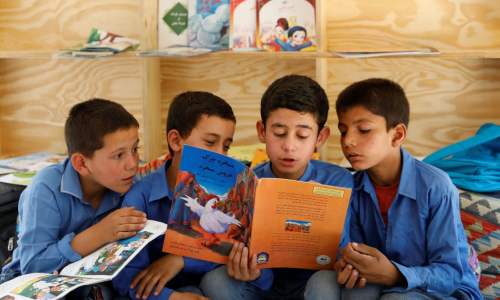
Stefanie Glinski writes for the Guardian, “In a dimly lit room in west Kabul, stacked with shelves full of books, a small crowd gathers around the warmth of a gas heater. Books clamped under their arms, they are eager to share the stories they’ve read over the course of the week.

“Members of Afghanistan’s youngest reading club, the Book Cottage, range in age from four to 13. The club is just one of many reading circles that are springing up across the capital and reviving a book culture that, once lost, is now vibrant, liberal and expanding once again.

” ‘You have to start them young,’ explains the initiative’s founder, 25-year-old Mashed Mahjor. ‘The country is still at war, so children don’t have a lot of opportunities to talk freely and ask questions, especially girls. We have to bring our book culture back to life.’

“After starting the reading club six years ago, she now has up to 20 regular members – and hundreds of book donations from all over the world.

“But trends are shifting. In west Kabul, a neighbourhood with laid-back coffee shops, small startup businesses, a quick-growing dating scene and – at its heart – Kabul University, reading circles for all ages are expanding. They have started to provide a platform for Afghans to discuss, in a mixed-gender environment, issues not on the public agenda of a conservative society. …

“One such space is found in a basement room of one of the city’s universities, where a group of up to 20 book lovers meets weekly. Some travel the length of the city to participate.

“ ‘It’s worth it,’ says Attash Mashal, a civil engineer and government employee. ‘Most of the books we read can’t be accessed in Afghanistan, so we search for them online and print out copies. We read novels, poetry and philosophy.

“ ‘This one is censored though,’ he adds, holding a copy of Albert Camus’ The Fall. ‘We just found out.’ …

“It’s the translations that most people are after, as it can be difficult to read books in English or other languages. At Aksos, the city’s biggest and most diverse book store, people squeeze into the tight space, examining new titles, reading in corners, or taking selfies against a backdrop of bookshelves. Books are the new cool.

“Aksos holds anything from The Kite Runner – another book previously banned in the country – to The Daydreams of Ashraf Ghani, the country’s president.

“ ‘Once again, the city is boasting poets, writers and creatives pushing against the recent norm,’ says [Syeda Quratulain Masood, who has been researching Kabul’s book culture for her PhD at Brown University in the US].

“ ‘I think it’s because in book clubs, or when writing poetry, we can share our ideas and beliefs without restrictions,’ says Yalda Heideri, a student in her twenties who attends a university book club.

“ ‘Afghanistan has restricted us a lot, especially us women, so we found a way to have discussions that would be embarrassing or even impossible outside.’ But for Heideri, literature has also become an escape from daily life in a wartorn country where there were 3,804 civilian deaths last year, according to the UN assistance mission in Afghanistan.

‘When I get tired of it all, I escape into poetry. It’s a whole different world.

” ‘Kabul is improving and becoming more open, which makes me hopeful. But regardless of where peace negotiations are going, we have to find our own way to cope, and books are just that for me.’ ”

More at the Guardian, here.

Read Full Post »

Photo: Jen Siska
Shreya Ramachandran holds workshops on how to install graywater systems.

I know we shouldn’t be leaving up to kids the solutions to our intractable problems, but sometimes it seems that they’re the only ones showing leadership. At least, they’re the ones who focus their leadership on a single issue. Thanks to their focus, energy, and not knowing what’s impossible, they them seem more likely to succeed than political leaders who must address a million issues at once. I think of David Hogg on the issue of gun violence and Greta Thunberg on climate change.

Here is a Sierra Club story on Shreya Ramachandran, who started very young with big, practical ideas on water conservation.

Wendy Becktold writes at Sierra, the Sierra Club magazine, “When Shreya Ramachandran was in sixth grade, she became obsessed with water scarcity. It was an unusual preoccupation for an 11-year-old, but when visiting California’s Central Valley for an archery competition, she had learned about the historic drought then underway that was devastating the area’s farmers. Not long afterward, she visited her grandparents in India and encountered taxi drivers who’d been forced to abandon their farms when the annual monsoon had failed to arrive.

“Ramachandran began researching water conservation online. She grew fascinated with graywater systems–plumbing designed to reuse household water by redirecting water from washing machines into lawns and yards, for example. ‘It’s water conservation on a whole different level,’ she says.

“But Ramachandran also learned that toxic chemicals in some laundry detergents can render water unsuitable for reuse. She started to experiment with soap nuts – the berry shells of Sapindus mukorossi (a tree in the lychee family), which release a natural cleaning agent and are traditionally used for shampoo in India – and determined that they were safe to use in graywater systems. She presented her findings at various science fairs, and people were intrigued.

“By the time she was in eighth grade, Ramachandran had built her own graywater system; her parents let her drill a hole in the side of their house to install the PVC piping that channels water to the plants and trees in their yard. Shortly after, she started the Grey Water Project (thegreywaterproject.org) to teach others how to install their own systems.” More at Sierra, here.

And in case you want to learn more about soap nuts, the Australia-based environmental group 1 Million Women has a post about them, here.

“They’re really simple to use, you just pop them in a small fabric bag, chuck them in with your load of washing, the berries contain saponin which is a surfactant that can be used like soap. …

“[But] here is one little point that planet friendly women have pointed out and that is that they only work in hot water.

“Most of us self-proclaimed eco-warriors have never washed a load of clothing in hot water in our life, or for at least a very long time. The amount of energy that is takes to heat up a load of washing seems pretty wasteful and pointless, but for without hot water soap nuts don’t turn soapy.

“Some have figured out that by adding the soap nuts to a cup of boiling water and then pouring the water into the wash eliminated the need to waste … However a few have expressed that this step was inconsistent and made switching to soap nuts from their current homemade, planet-friendly laundry detergent not worthwhile.

“While the warm water and make-your-soap-nuts-into-tea step may be a deterrent for some, others have made another valid point, soap nuts are better for your skin. They’re all natural and non-toxic, which makes them especially good for sensitive skin and those prone to allergies. Also, due to the very gentle, mild detergent they produce they’re safe for your delicates. (Excluding dry-clean only items.) Read next: 9 Ways to lower the carbon impact of laundry day.

No perfect answers, I guess.

Read Full Post »

« Newer Posts - Older Posts »