Feeds:
Posts
Comments

Archive for the ‘Uncategorized’ Category

blue-flower

The word is we are to expect a dusting of snow tomorrow. So before I start taking winter photographs, I think I will round up a few from balmier days.

What are these pictures of? you ask.

In Concord: mysterious blue flowers (I need to ask MisterSmartyPlants.com about them), a French style house, and a flower box at the second-floor shop called Nesting.

In Boston: An autumnal plant display on Congress Street and another on the Northern Avenue bridge overlooking Boston Harbor.

In Vermont: an all-you-can-eat breakfast inn.

In Claremont, New Hampshire: The Elks’ elk.

In Rhode Island: The Assistant Bicycle Inspector.

Now if I only had recent photos of Maine and Connecticut, I would have New England covered. Maybe next summer.

congress-st-planter

all-u-can-eat-brunch-vt

claremont-nh-elks

Boston-Harbor-Northern-Ave

French-style-house

flower-box-concord

pumping-the-bike-tire

Read Full Post »

In April, singer Will McMillan read a post at Suzanne’s Mom’s Blog, here, about research on why people feel joyful when singing with others.

Having dug into the physiological research and found that heartbeats often synchronize, Will wrote a blog post of his own and included an MP3 of singing “Blue Moon” with his frequent collaborator, Bobbi Carrey. “(They perform at Scullers in Cambridge this coming Thursday.)

It was in the comments at Will’s blog, here, that I found this YouTube recommendation — a deeply empathetic baby listening to a sad song. You see what music can do.

I hasten to add that for me, there are fewer happier moments than crying to a sad song. Don’t know how old you have to be to feel  happy-sad. I hope the baby feels good.

Read Full Post »

As the lowest of the “higher belts,” I’m exhibit A demonstrating that anyone can learn tai chi chuan.

It was really hard getting started. I couldn’t relate the moves to anything I knew before: not ballet, modern dance, yoga, ballroom dancing, folk dance … .

Then I learned that this kind of movement relates to nature. We practice moves called White Crane Spreads Wings and Ocean Breathing. We breathe like a tortoise taking a dive, we float our arms like a butterfly, and from a crouch postion, we rise like a phoenix. Now I get it.

For someone who nearly every year discovers that the lower back or a knee or the neck is far enough gone to require physical therapy, tai chi chuan has been a big help. It’s also great for exercising all your muscles and for balance. It’s constantly flowing.

Longevity in the class pays. If you just stick with it, eventually you can do some of the routines moderately OK, and you get to be referred to as a “higher belt” in front of brand-new students. Which is nice, even though you know it won’t last.

Photo: Zhen Ren Chuan

Read Full Post »

What a magnificent beast is the endangered snow leopard, so rare that pretty much the only way to get a gorgeous photo like the one below is to set up a camera with a spring that takes a picture when jostled!

The radio show Living on Earth recently had a story about snow leopards and how Tibetan monks are helping to save them.

Steve Curwood interviewed Tom McCarthy of Panthera, a nonprofit that protects wild cats.

“CURWOOD: So, Tom, your organization, Panthera, has enlisted the services of Buddhist monks to help conserve the snow leopard. Can you describe this program for us please?

“MCCARTHY: Yes. Correct. It actually came from a PhD research project of a Chinese graduate student … and one of the things in mapping [snow leopard] occurrence that she happened to notice was that snow leopard range corresponded very closely to where most Buddhist monasteries were in the region.

“Around each of the Buddhist monasteries, there’s a number of sacred mountains, sacred lakes that they routinely patrol to keep people from violating any of their regulations or for killing any animals. And so she kind of put two and two together …

“So our partners at ShanShui, the conservation organization, went out and formed a partnership initially with four different monasteries, and what Panthera and Shan Shui do is provide the monasteries with a little bit of extra training, some of the basic tools that they need to do snow leopard monitoring, so now they can go out and not only protect snow leopards, but also count snow leopards. They do an awfully good job of talking to their followers about protecting snow leopards and the value of snow leopards in the ecosystem, and the end result is we have a much stronger conservation ethic being imparted to the people across the plateau through the Tibetan monks.”

More.

Photo: Panthera
Camera trap photo of a snow leopard on the Tibetan plateau

Read Full Post »

The-hammering-toy

When I arrived at Suzanne’s house after work yesterday, my grandson was having a bath. I hadn’t seen him for a few weeks. I stood in the bathroom doorway and smiled. When he saw me, he stared for a few moments. Then he got a funny little smile on his face and said, “Huh.”

Today we went with Suzanne to the Music Together class. I had decided to take a vacation day. His other three grandparents had already seen music class, and I was determined to get there, especially after hearing that last time he crawled into some unknown grandma’s lap for the lullaby!

Music Together is a great thing for babies and toddlers and their grownups. It’s franchised around the country. My husband and I attended one session a couple years ago with my older grandson in Arlington (where I believe Will McMillan now teaches, and wouldn’t I like to attend that one!)

Today’s class was chaotic and fun, with lots of rhythm and movement activities and little kids running around and banging percussive toys. They were all very good about putting the instruments back in the proper bins. (There’s a special bin called Taster’s Choice. That’s for the instruments that have gone in someone’s mouth during the exercises and thus need extra attention.)

After the little man and I both had a nap, we went to the Children’s Museum. 🙂

Prov-RI-Children-Museum

Read Full Post »

Trust Vermont to figure out how to do this.

The state had a highway rest stop in Guilford that was overwhelmed with visitors. The toilets could not keep up. Portable toilets were brought in to help, and everyone hated them.

“State officials,” says the Federal Highway Administration website, “needed a solution that could be designed and built quickly for the next foliage season.

” ‘We were looking for an alternative because we couldn’t continue with that high level of frustration,’ said [Dick Foster, director of the Vermont Information Center Division of the state’s Department of Buildings and General Services.]

“To further complicate matters, the welcome center was slated to be replaced by a newer facility in 2000, so the ‘quick fix’ also needed to be low cost. Tom Leytham, an architect who had designed other rest areas in the state, suggested the concept of using a Living Machine to Foster. …

” ‘I’d heard about Living Technologies, who had come up with a very elegant, simple solution that cleaned wastewater through a natural process involving plants.’

“Leytham drove Foster to South Burlington, Vt., where Living Technologies had installed a Living Machine to treat municipal wastewater. …

“In December 1996, in response to an inquiry from state officials, Living Technologies proposed a sewage-to-reuse system to reduce flows to the leachfields by recycling treated wastewater back into the restrooms to flush toilets. The Living Machine could be installed to serve the existing facilities at the Guilford center, and because the system was a modular design, it could be moved to another rest area when the center was relocated.

“In only eight months, the system was approved by the Vermont Agency of Natural Resources, funded by the Federal Highway Administration (FHWA) and Vermont Department of Buildings and General Services, and installed by Living Technologies.”

The rest of the FHWA story by Molly Farrell, Liz Van der Hoven, and Tedann Olsen is here.

Katie Zezima at the NY Times adds more: “In a wing of the building, in the glass greenhouse, visitors look down on the vegetation from a grated ledge. The room, which offers spectacular mountain views, smells like a combination of mulch and chlorine.

“The building is heated and cooled by 24 geothermal wells. A similar system lies under the sidewalks to melt snow in the winter.” More from Zezima here.

Photo: Federal Highway Administration

http://www.fhwa.dot.gov/publications/publicroads/00mayjun/vermont.cfm

Read Full Post »
I remember many days with Carole on the playground at recess playing house and gathering “grain,” which we pulled off a common weed and sometimes pretended to eat and sometimes buried — in case we might need extra food someday. Carole was a great kid to play with.

Asakiyume, whom I met in adulthood, is the kind of person I would have wanted to play with in childhood. She has a wild imagination that seems to fire on all burners 24/7. And now that she is old enough to carry out some wishes from age 10 or so, she is going right ahead with them.

For example: acorn cake. At Asakiyume’s blog, followers watched her leach the tannin out of her acorns over a period of days, changing the water repeatedly. We kept tabs as she next roasted the acorns, made acorn flour, and finally baked a cake.

“Today I baked an acorn cake,” she wrote on Nov. 3. “I used my ground-up, leached acorns, and a recipe from Hank Shaw (posted here). The body of this cake is equal parts acorn flour and wheat flour.

“And–it tastes fabulous. It has a flavor like molasses with a hint of ginger, and your tongue tingles a little afterward, like when you eat something peppery. …

“It’s a tiny childhood dream come true–feasting on the abundance of acorns! (Okay, helped by honey, oil, and eggs, not to mention that wheat flour, but still.)”

Read more here.

Photo: Asakiyume
Acorn cake with sugar outlining an oak leaf.

Read Full Post »
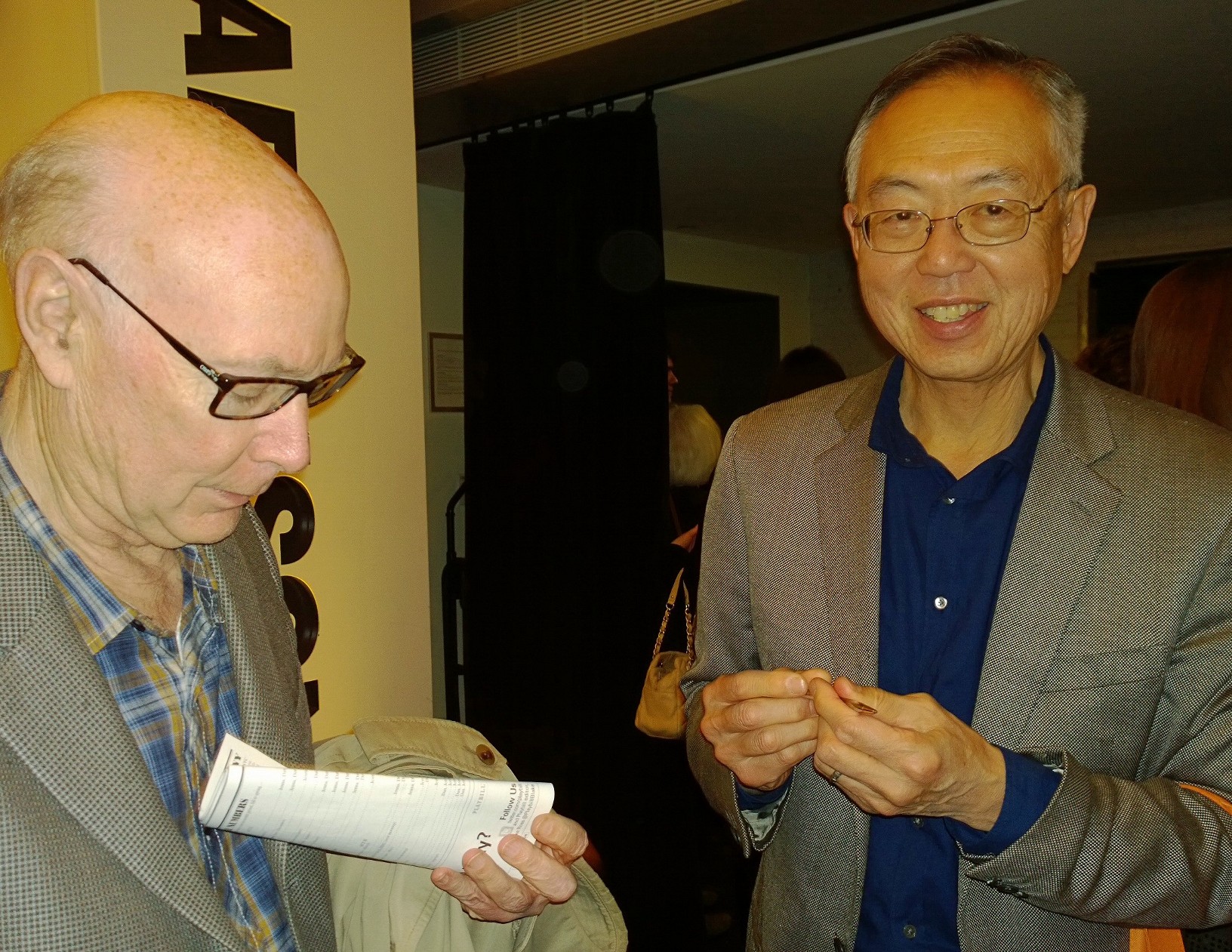
When I was a child, circuses still had side shows. I remember standing in a crowd and looking up at “a giant.” My father, who regarded side shows as part of the circus experience, eventually was won over to my mother’s view that side shows were a sad abuse of people who were born different.

We didn’t go again.

Who would ever think of making a musical on the subject?

Answer: Henry Krieger and Bill Russell, two very creative people who saw in the side show a metaphor for the human experience, the longings, the feeling of being a square peg in a round hole, and the difficulties and comforts of closeness.

I saw Side Show several years ago and loved it. So when it came to the Emerson Umbrella Center for the Arts, I told my husband we had to go. He ended up loving it, too.

The musical centers on pretty, singing Siamese twins whom a talent scout discovers in a side show among their circus “family”– the bearded lady, the cannibal, the rubber man, the fortune teller, a wide array of misfits.

The story is odd and wonderful at the same time — the sisters’ longing “to be like everyone else” likely to strike a chord with anyone who has ever felt different.

What came across in this production more than in the one I saw at the Lyric Stage, was how completely different the two personalities are. The girls are sensitive to each other and comforting, but one is outgoing, one is shy, and they have very different ideas about what a happy future would look like.

Side Show has wonderful songs, some poignant, some raucous, and the current production features excellent acting from the mainly nonprofessional performers. It was polished and moving (a two hanky event for me), and it runs through Nov. 10.

If you want to to see Side Show with professionals, it looks like it is going to be revived on Broadway. More on that at Playbill, here.

Photo: Playbill.com
Alice Ripley and Emily Skinner in the original production. It’s amazing how quickly you see actresses in this show as conjoined just because they sit close.

Read Full Post »

Got to share this movie: Le Havre (in French with subtitles).

Lately, nearly all the movies we see are on Netflix. Our taste seems to run to animation, documentaries, and foreign films. Not exclusively, but in general.

Last night we watched an odd, wistful comedy about an old guy in Le Havre,
France, who makes up his mind to help a boy whose family is arrested after being discovered in a packing crate near the harbor, on route from Africa to London.

Every shot in the film was like a painting, every gesture true. The characters were good-hearted, down-and-out types in the roughneck port, where many undocumented immigrants come looking for work. There they find squatter camps, deportation, kindness, hostility, drugs, poverty, crime, and sometimes a living.

The dialogue in the bar scenes reminded me of Mike Leigh films, the ones where he has his actors ad-lib their lines. It was just so funny and believable. And the “trendy” charity fundraiser the old guy arranges with the graying rock band has to be seen to be believed.

The “2011 comedy-drama film written and directed by Aki Kaurismäki, starring André Wilms, Kati Outinen, Jean-Pierre Darroussin and Blondin Miguel. It tells the story of a shoeshiner who tries to save an immigrant child in the French port city Le Havre. The film was produced by Kaurismäki’s Finnish company Sputnik …

“The film premiered in competition at the 2011 Cannes Film Festival, where it received the FIPRESCI Prize. Kaurismäki envisions it as the first installment in a trilogy about life in port cities. His ambition is to make follow-ups set in Spain and Germany, shot in the local languages.”

More at Wikipedia, here.

Read Full Post »

Here’s an inventor who doesn’t know the meaning of giving up. After 19 years of keeping the faith, she finally got the attention she needs for her culinary invention — a marinating stick.

Jack Hitt has the story at the NY Times.

“Mary Hunter has always been happy to cook for her congregation at the Yes Lord Church in Gary, Ind. Her recipes, she told me, come directly from God.  … Prayer is ‘where I get 99 percent of my recipes.’

“Mrs. Hunter, who is 73, likes to cook big roasts for her church, ‘and if I had a difficult piece of meat I might marinate it in some beer and celery’ with a blend of her secret seasonings. When she learned that she had diabetes and high blood pressure, though, she had to cut out her salty marinades and cook the meat more blandly.

“Then, one day, God had an idea. ‘I was writing down some recipes and God said to me that I should take that ink pen and stick holes all through it and put a clip on one side so that you can open it’ — lengthwise — ‘and then put your onions and your garlic and your aromatics down the middle and put it inside your meat — then, you won’t have to eat bland foods.’ And so was born her invention, a long stainless steel device that, according to tests in restaurants and elsewhere, far outperforms those herbal injectors and other disappointing methods for introducing flavors into the interior of a big piece of meat.

“Later this month, Mary’s Marinating Sticks are scheduled to go on sale in Target stores.”

It was a long road, and it started back  in 1994. Read how stick-to-it-iveness and determination finally won the day, here.

Photo: Sally Ryan for The New York Times
It was 1994 that Mary Hunter got her idea for an innovative marinating stick. Today her persistence has paid off.

Read Full Post »

Could this be real? It’s a bike path above the traffic.

Well, why not? If Minneapolis can build a complex system of second-floor skyways that allowed me to walk to work without a coat in deep winter 1997, why not?

Ben Schiller at FastCoExist explains.

“In most cities, cycling infrastructure isn’t much more than a few dotted lines on the road. But that’s not how it is in the Netherlands, one of the world’s most cycle-friendly nations. Dutch cities have dedicated lanes that separate cars and bikes, making cycling an activity for young and old, female and male–not just the adventurous few.

“A good example is [an] elegant circular bridge in Eindhoven, in southern Holland. Called the Hovenring, it lets cyclists completely avoid other road users and cross the busy A2 highway with minimal fuss. It also makes for better road flow, according to Gerhard Nijenhuis, an employee at IPV Delft, the firm that designed it.” Read more.

Photo: FastCoExist
In the Netherlands, bikers ride on top of this rotary.

Read Full Post »

More pictures of the season, including a Pumpkin Fest in Concord and a Halloween party in the neighborhood where my older grandson and his sister live.

Today there must have been 40 costumed kids, from infants to 10-year-olds, rolling down the hill, posing for pictures, and eating hotdogs in the playground. After the parade, everyone went down the street to knock on doors looking for treats. (Meran’s treat for my husband and me was homemade potato and leek soup and some very yummy bread.)

John wore his scary fangs and asked a little Yoda if he was tasty to eat.

“This is what I look like,” he explained to friends, “after a week of being up all night with two kids who have fevers.”

light-on-leavesAh, yes. All part of the season!

pumpkin-fest


cowboy

Halloween-pirate-2013


Read Full Post »

A woman running for school committee advertised for a campaign manager at Harvard’s Kennedy School of Government and ultimately chose an 11-year-old boy for the job.

Brock Parker writes at the Boston Globe, “If he were a foot taller, shaved, and cursed a bit, 11-year-old Zev Dickstein just might pass for the typical political campaign manager.

“Every day after school, using a database he developed, Zev identifies people he thinks he can persuade to vote for School Committee candidate Joyce Gerber. Bounding from house to house, he knocks on doors, shakes hands, pets dogs, makes his pitch, and reminds voters that election day is Nov. 5 . Sometimes he even high-fives supporters.

“Then Zev confers with his chaperone (usually his mother).

“ ‘I can’t go by myself,’ said the sixth-grader from Cambridge Street Upper School, who has to persuade one of his parents or sometimes his grandmother to tag along. ‘That is the hardest thing I have to do in my history of campaigning — finding someone to go with me.’

“Since the summer, Zev has been serving as the campaign manager for Gerber as she challenges eight other candidates for six Cambridge School Committee seats in this fall’s municipal election.

“Gerber had posted a job listing for a campaign manager at the Harvard Kennedy School of Government looking for someone to fill the job. But then the 48-year-old attorney said she had a conversation with Zev, and she was impressed by his knowledge about databases and finding likely voters, so she offered him the job.” More here.

Photo: Barry Chin/Globe Staff
Zev Dickstein, 11, campaign manager for a Cambridge School Committee candidate, on the job talking to voters recently.

Read Full Post »

The Nature Conservancy magazine had a story recently by Julian Smith on Patagonian sheep farmers who are learning to improve the grasslands where the sheep graze.

“One promising option, called holistic management,” writes Smith, “was first developed in the 1960s by Zimbabwean biologist Allan Savory. Healthy grasslands, like those formerly found in Patagonia, need herbivores, grasslands expert [Pablo] Borrelli says. The animals’ grazing and trampling encourage plant growth and help return nutrients to the soil. Sheep may have replaced wild horses and guanacos as the dominant grazers in Patagonia, but they can still play the role of the animals they replaced. This runs counter to the traditional practice of trying to help grasslands recover by simply grazing fewer and fewer animals.

“Under holistic management, stocking rates can actually increase. Periods of heavier grazing, with longer intervals in between for the land to recover, can mimic the movement of native herds in the past. The key is the timing of the grazing and the length of the rest periods.

“Getting that balance right isn’t easy, and finding it requires a few years of training with an accredited [Grassland Regeneration and Sustainability Standard] educator. Ranchers, Borrelli says, ‘need to learn how to see the land, to recognize the indicators of good and bad trends, to learn how to move their sheep.’

“To cover the up-front costs of implementing the standards, which run about 30 cents per acre for measures like new fencing, Patagonia and the Conservancy have donated more than $80,000. That kind of investment can quickly pay off. …

“ ‘They were impressive results,’ Borrelli says. ‘Things we hadn’t seen in 30 years.’ The prospect of being able to graze more sheep has brought new hope to struggling ranch owners, he adds. More than 30 ranches in Argentina and Chile are now trying holistic management in some form.”

More here, where you also can enjoy Nick Hall’s beautiful photos.

Read Full Post »

The Christian Science Monitor recently ran a story by Bryan Kay about an ongoing  community service project.

“Not even the recent furlough of federal workers was enough to snuff out the latest community outreach effort of Masjid al Islam mosque in Dallas.

“On a weekend in early October, the mosque was participating in a national initiative known as the Day of Dignity, an annual event during which mosques feed, clothe, and equip people living in poverty. But federal workers who had been scheduled to attend to speak about the details of the Affordable Care Act …  had been forced to cancel because of a partial federal government shutdown.

“It was a blow to the mosque’s boosters, says Muhammad Abdul-Jami, treasurer of Masjid al Islam and coordinator of the Day of Dignity event. But it didn’t deter them from pursuing the same purpose they have had for the last several years, he says: aiding homeless people … .

“Masjid al Islam is in an area where the homeless are a ubiquitous sight. … Because of the great need every weekend, the mosque seeks to do what the Day of Dignity event, organized in conjunction with the national charity Islamic Relief USA, does on an annual basis. Through its Beacon of Light community center, Masjid al Islam feeds approximately 300 individuals in need on Saturdays and Sundays each week, Mr. Abdul-Jami estimates. That’s more than 15,000 meals per year, paid for with donations from individuals and other mosques and served by volunteers, he says. …

” ‘There are millions of Muslims in this country who are very regular people, people who [other] Americans might consider much like them,’ Abdul-Jami says. …  ‘These events help us showcase that we are concerned about the rest of humanity, not just wanting to help Muslims.’ ”

Read more here.

Photo: Walid Ajaj

Read Full Post »

« Newer Posts - Older Posts »