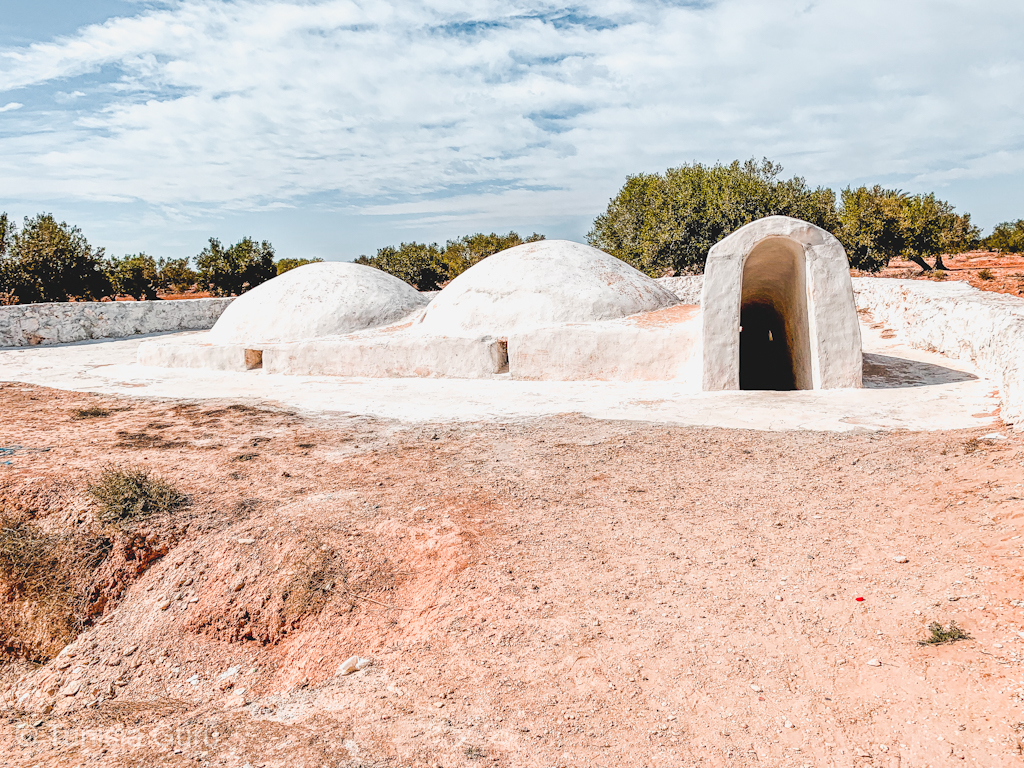
Photo: Tunisia Guru. An underground mosque on the island of Djerba in Tunisia.
I got interested in finding out more about underground mosques after seeing a photo of one on the island of Djerba in Tunisia — an island thought to be the same that Homer had in mind when writing about the Lotus Eaters in the Odyssey.
An entry at Wikipedia says that underground mosques are “either erected beneath other buildings or lay freely in the ground with an inconspicuous appearance. The prayer rooms in underground mosques are usually very small, and they also have no minarets. Underground mosques are very rare. [The Djerba mosque] served as a hidden place of prayer for the Ibadis.”
From a different Wikipedia page, we learn that the mosque is near Sedouikech, Tunisia, and dates from the 12th or 13th century. “Surrounded by an olive grove, it opens to the outside by a very steep staircase that leads to the main room; next to it is a large underground tank fed by a well. Another of these underground mosques is located on the Ajim road. Not being used for worship, these mosques can be freely visited.”
An underground mosque in Turkey was built only recently, not because worshippers needed to hide like the Ibadis but because underground worship can feel peaceful.
Menekse Tokyay writes at Alarabiya, “The uniqueness of the Sancaklar mosque is that it departs from standard mosque design in a bid to break architectural taboos and encourage worshippers to focus on the essence of the religious space and on the Islamic faith. …
“Strolling around the mosque’s outdoor area, you will notice a long canopy running along one side where two olive trees and one linden tree are located. From this point, you have to descend natural stone stairs to reach the building.
“The cavernous prayer hall of the mosque is large enough to host more than 650 worshippers, while it aims to isolate believers from the outside world and invite them to delve deeper into their inner world.
“What strikes one about the Sancaklar mosque is that its design is humble and simple, perhaps to deepen worshippers’ relationship with their faith, and with this underground concept, visitors can leave behind all the challenges of the outside world. …
“Sancaklar mosque stands in Istanbul’s suburban Buyukcekmece district and is spread over an area of 1,200 square meters. The architecture combines Islamic and Ottoman designs with a modern touch, seemingly free from mainstream architectural typology.
“In 2013, out of 704 projects from 50 countries, the building won first prize in the World Architecture Festival competition for religious places. In 2015, the project was selected for the Design of the Year award, organized by the London Design Museum and it was also shortlisted among the 40 nominees for the Mies Van der Rohe Award.
“The mosque was designed by Turkish architect Emre Arolat for the Sancaklar Foundation. …
“The only decoration on the walls is the Arabic letter ‘waw’ and verse 41 of Surat al-Ahzab, a chapter in the Quran: ‘O you who have believed, remember Allah with much remembrance.’
“The main space is free of any decorative ornaments unlike many modern mosques built recently in Turkey. Daylight penetrates the prayer hall along the Qibla, or Mecca-facing, wall. …
“ Every time I come here for worship I feel an enormous [sense of] inner peace. It is also a place of meditation for me when praying under daylight infiltrating into the hall,’ Asli Karacan, a youngster living nearby, told Alarabiya.”
More at Wikipedia, here and here — also at Alarabiya, here.
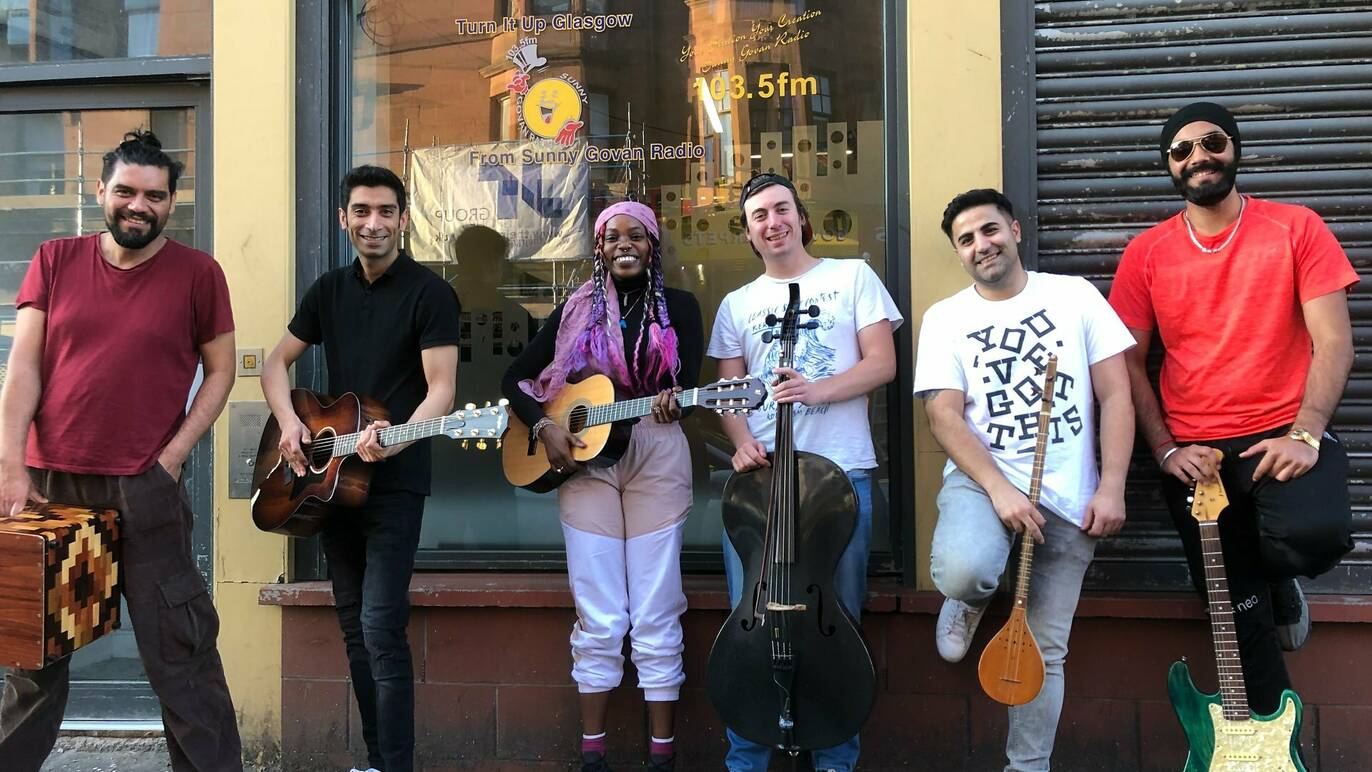
When musicians bring their music to a new country, they influence and enrich the local music scene while healing themselves from the trauma of uprooted lives. Consider Musicians in Exile, a refugee orchestra in Scotland. Malcolm Jack wrote about it for Time Out.
“When Angaddeep Singh Vig arrived in Glasgow from India as an 18-year-old asylum seeker in January 2020, without any of his beloved musical instruments, he remembers feeling like ‘a guy without a soul.’ …
” ‘Music is part and parcel of my life,’ he says, and it has been ever since his father bought him a set of tabla hand drums aged just four. By his mid-teens Singh Vig had mastered not only that instrument but also the harmonium and flute, as well as singing. He had even begun teaching music. But when he and his parents were forced to flee India due to violent persecution by criminal gangs, they left with next to nothing, arriving in a strange and faraway land unable to work, study or begin rebuilding their lives.
“More than two years later, Singh Vig lives with his mother and father in temporary accommodation in Govan, as they continue their long and agonizing wait for leave to remain in the UK. But thanks to Musicians In Exile – Glasgow’s asylum seeker and refugee orchestra – he has got his soul back, and then some.
“Started in 2019, the project is the brainchild of Paul MacAlindin, a freelance conductor who has worked with orchestras and ensembles all over the world, from the New Zealand Symphony Orchestra to the Armenian Philharmonic and the Düsseldorf Symphoniker. From 2009 to 2014, MacAlindin was music director of the National Youth Orchestra of Iraq – a maverick mission to help young musicians in the country pull themselves out of the horrors of war. ‘And it worked,’ he says, ‘until the invasion of Islamic State.’
“The orchestra collapsed, and so did MacAlindin, ‘mentally and physically,’ he says, ‘because after investing all the energy of keeping that thing alive and then having it stopped in such a dramatic fashion, I was just left completely floored.’ He moved back to his native Scotland to heal, choosing Govan purely as a cheap place to put a roof over his head. There, quite by luck, he suddenly found himself among the diverse and in many cases displaced communities of the former shipbuilding district on the south bank of the River Clyde – which is also the location of a branch of the Home Office, and thus is home to a lot of asylum seekers and refugees.
“MacAlindin founded The Glasgow Barons – an award-winning ‘regeneration orchestra’ set up to help revitalize Govan through performances in local venues by musicians of all backgrounds. Musicians in Exile grew out of that, as a way of helping to give musician asylum seekers and refugees in the area a chance to gather every Tuesday evening to sing, play and share their talents, experiences, stories and songs. …
“If members don’t have instruments, then MacAlindin – who receives funding from the People’s Postcode Trust, the Robertson Trust, and Creative Scotland Lottery – sources and buys them one, however rare it may be (he’s currently in the market for an Albanian two-string plucked instrument called a çifteli).
During lockdowns, when sessions had to be moved online, he also helped his members to buy digital devices and access to the internet so they could keep communicating and playing together.
“Through Musicians in Exile, as well as the generosity of others in his local community, Singh Vig now not only has a tabla again, but also a harmonium, a violin, a mandolin and an electric guitar (which he quickly learned to play, despite never having touched one before). ‘Now I’ve got many souls,’ he laughs. His father and mother, who are also musicians, come along to sessions too – Singh Vig credits it with helping to pull them both out of a deep malaise and, in his father’s case, even clinical depression.
“Singh Vig and Musicians In Exile have played several high-profile concerts. They included … a pre-recorded video performance for the opening of the new parliamentary session in October 2021. It was broadcast in the chamber to an audience of dignitaries including, among others, The Queen. Singh Vig was impossible to miss, sat at the centre of the ensemble in a bright red turban and denim jacket. ‘The Queen is watching me,’ he remembers thinking. ‘I cannae believe it.’ “
Photo: El País. A Corinthian capital and fluted drum with a shaft located in a city discovered at the foot of the Pyrenees in 2018.
Do you ever wonder what sort of report archaeologists of a future civilization would write about your town? What if they had only the location and a few crumbled buildings to go on, no contemporary testimony? That was the plight of a group of archaeologists in Spain who investigated a “new” ancient city.
Vicente G. Olaya says at El País that archaeologists were surprised that they didn’t know the name of a recently unearthed city, but there were simply no historical documents mentioning it.
“In 2018,” he says, “the City Council of Artieda — located in northeastern Spain in the province of Zaragoza, and part of the country’s Aragon region — asked the University of Zaragoza’s Archaeology Department for help in studying some ruins located around the San Pedro hermitage, known variously as El Forau de la Tuta, Campo de la Virgen, or Campo del Royo.
“Three years later, the experts have confirmed that these sites formed a large single archaeological complex, and they detected two phases of occupation on the surface of the site: one during the imperial Roman period (the 1st to 5th centuries) and another during the early-medieval Christian era (the 9th to 13th centuries). Now, the research team has published the results in a report, El Forau de la Tuta: A Hitherto Unknown Roman Imperial City on the Southern Slopes of the Pyrenees. …
“The report notes that based on important evidence from the ruins preserved in the hermitage, as well as artifacts held in various public and private collections and the findings at the site, the settlement was ‘of urban character — the city’s name is currently unknown — and it developed during the [Roman] imperial period. Later, the same site took on another iteration as a rural habitat during the Visigoth and early Andalusian periods.’
“The specialists have also found that, between the 9th and 13th centuries, another peasant habitat-type town or village was superimposed on top of the Roman settlement. They have identified the village as Artede, Arteda, Artieda or Arteda Ciuitate. The medieval enclave’s ruins include the apse area of the church, which was part of the San Pedro hermitage; numerous silos with circular openings, which were excavated from the subsoil and only perceptible by geo-radar; and an extensive cemetery consistent with Christian burial rites. …
“The El Forau de la Tuta site is located 1.5 kilometers from Artieda’s city center, on the fertile plain of the Aragón River. … It is possible that the site’s dimensions are even larger and that it extends to other — still unexplored — agricultural lands.
“The Roman settlement stood next to the road connecting three northern cities. … Currently known as Camino Real de Ruesta a Mianos (the High Road from Ruesta to Mianos), the road lasted through the Middle Ages as a stretch of the French Route, the Arles Way or the Via Tolosana (Tolouse Route), as part of the Way of St. James (Camino de Santiago). …
“Inside the hermitage, the study’s authors have identified two Corinthian capitals, three Italic Attic bases, a classical Attic base, several flat-edged fluted shaft drums, and a fragment of cornice. The huge dimensions and typology of the artifacts indicate that they came from several early [Roman Empire] public buildings. …
“The study confirms that these pieces come from at least two different monuments. Their typologies indicate that they were sculpted more than half a century apart, ‘which demonstrates a prolonged period in the process of monumentalizing the city.’
“To the west of El Forau de la Tuta, next to the San Pedro ravine, ‘an impressive set of public works made of opus caementicium (the Romans’ early version of concrete) including at least four sewer outlets, a powerful massive abutment, a foundation, and a series of quadrangular structures,’ possibly supply cisterns, is also preserved. … The presence of these works is typical of urban settlements, where water drainage was a problem that had to be addressed, especially in relation to buildings, such as bath houses, that produced a large amount of water waste. …
“Archaeologists are also currently studying a sculptural fragment that is preserved in an Artieda private collection. The artifact — which was collected near the hermitage — is an incomplete, nearly life-sized left hand that holds a patera umbilicata [an offering bowl], which would have been part of a statue representing an offering figure. …
“In the first round of excavations in 2021, the archaeologists confirmed the existence of an intersection of two roads. ‘On one of the roads, possibly one of the settlement’s main streets, we documented the ruins of a sidewalk and a surface channel for draining water, which pedestrians could circumvent by means of three steppingstones.’ …
“In one of the excavations they performed, the archaeologists found ample remains of black and white mosaics made with tesserae (small cubes of stone or glass) and fragments of rudus (a layer of material placed under the tesserae). …
“Inside this structure, under a large number of slabs that fell in the building’s collapse, archaeologists found a practically complete black-and-white tessellated pavement (with some isolated red and yellow tesserae); it was extraordinarily preserved. Decorated with iconographic motifs in white on a black background, it has shells or scallops in the four corners, while the central emblem features seahorses, ridden by little Cupids, facing each other next to three representations of marine animals, a fish in the upper part and possibly two dolphins in the lower part.
“Thus, the archaeologists are certain that everything they’ve found so far ‘corresponds to a single urban complex from between the first and second centuries, and that the city had infrastructure and public monuments, including baths, a water supply system, regular urban planning, sewers, and possibly a temple.’ ”
I can’t help thinking about the way early archaeologists (Schliemann, say, at Troy) barged in and dug at random, destroying historical records. Imagine how carefully and boringly the archaeologists in today’s story had to sift every little thing to discover the town built on top of the Roman city — and date both!
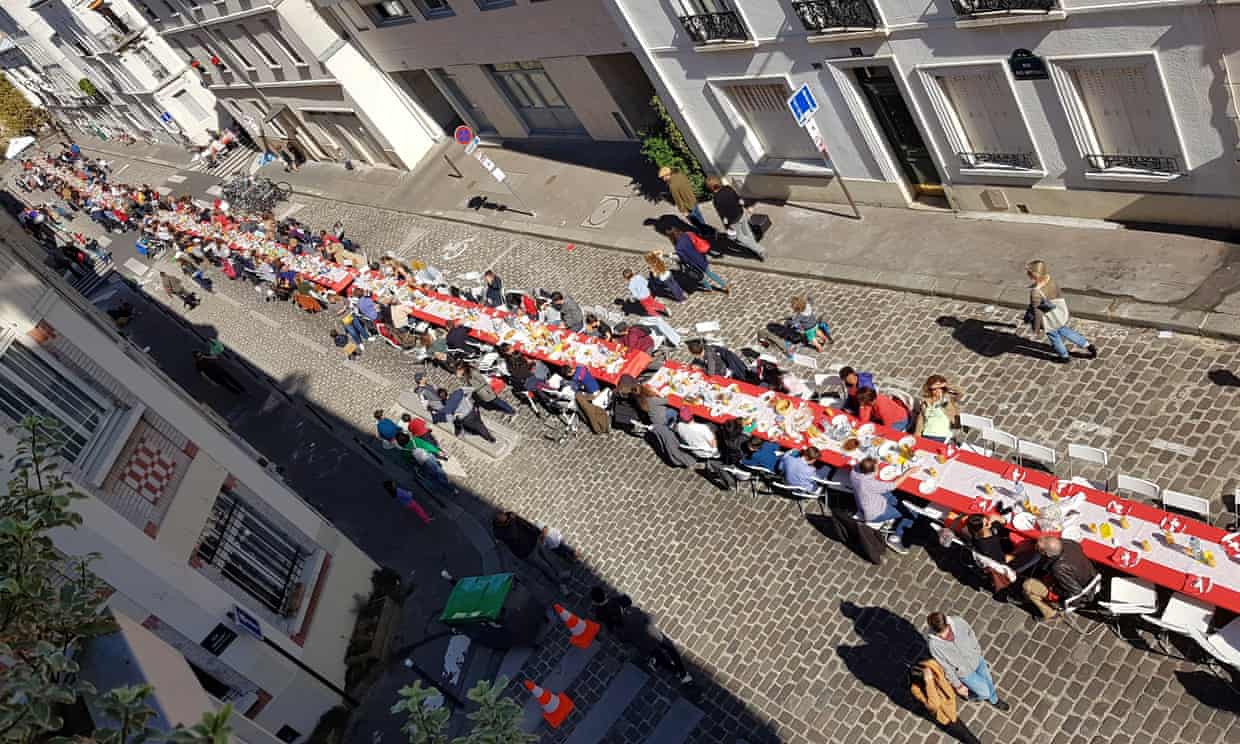
Photo: Hyper Voisins. A 705-foot banquet table meant to seat 648 people in a Paris neighborhood that’s seeking a more neighborly lifestyle.
It’s that time of year again — time for our valiant but hopeless block party, when we smile and reintroduce ourselves to neighbors that we will look right through when we bump into them in the market in January. If New England can’t make mutual support and cooperation work, how in the world can Paris?
Peter Yeung at the Guardian describes an experiment in France.
“It was a distinctly un-Parisian revolution although it began on an inner city street. No barricades were assembled to block the nearby boulevards and no radical students hurled cobblestones ripped from the pavement. …
“Instead, a 215-meter-long [about 705 feet] banquet table, lined with 648 chairs and laden with a home cooked produce, was set up along the Rue de l’Aude and those in attendance were urged to openly utter the most subversive of words: bonjour.
“For some, that greeting led to the first meaningful exchange between neighbors. ‘I’d never seen anything like it before,’ says Benjamin Zhong who runs a cafe in the area. ‘It felt like the street belonged to me, to all of us.’
“The revolutionaries pledged their allegiance that September day in 2017 to the self-styled République des Hyper Voisins, or Republic of Super Neighbors, a stretch of the 14th arrondissement on the Left Bank, encompassing roughly 50 streets and 15,000 residents. In the five years since, the republic – a ‘laboratory for social experimentation’ – has attempted to address the shortcomings of modern city living, which can be transactional, fast-paced, and lonely.
“The experiment encourages people not just to salute each other more in the street but to interact daily through mutual aid schemes, voluntary skills-sharing and organized meet ups.
“ ‘The stereotype of a Parisian is brusque and unfriendly,’ says Patrick Bernard, the former journalist and local resident who launched the project. ‘But city living doesn’t have to be unpleasant and anonymous. We want to create the atmosphere of a village in an urban space. [Conviviality] can become a powerful asset, an essential economic and social agent in the construction of tomorrow’s cities.’
“Nearly 2,000 people now attend weekly brunches and apéritifs in local restaurants, cultural outings, memory exchanges, children’s activities and more. During the pandemic, residents mobilized to make masks, deliver shopping to vulnerable neighbors and bake cakes to support a local charity. Crucial, too, is the digital aspect: dozens of WhatsApp groups include those dedicated to repairing broken devices, selling second-hand goods, and sharing healthcare resources. …
“Mireille Roberdeau, an 86-year-old widow who moved to the area in 2000, says the scheme has given her a reason to get up in the morning. ‘I was quite timid before,’ she adds. ‘I wouldn’t speak to anyone. I would scowl at people. But now I look forward to going out. It’s good because my doctor says I need to get out.’
“Roberdeau, now a keen user of the WhatsApp groups was hospitalized in March but says neighbors delivered her groceries when she got home. …
“Beyond the ‘eating, drinking and celebrating as social engineering,’ in the words of Bernard, that defined the initial stages of Hyper Voisins, the long-term targets – aimed at transforming the very nature and functioning of an urban neighborhood – come under four pillars: environment, healthcare, public spaces and mobility.
“It has, for example, collaborated with non-profit Les Alchimistes to install organic waste disposal points in former parking spaces and to turn the matter into compost. Perhaps more radically at a time of strained healthcare provision in France, it is launching a health clinic geared towards local needs. [It] will have a staff of 10 and offer extended opening hours, consultations without appointment and home visits. …
“To reduce local car use by residents and traders, Hyper Voisins plans to buy electric bikes with trailers and install a communal electric bike charger. It is also in talks with the mayor to potentially levy a local tax on unwanted businesses such as estate agents, banks and delivery hubs and give residents a vote on whether they can even move in. ‘We want to promote stores that improve our daily life,’ adds Bernard. ‘If not, like a polluter, they should pay.’ …
“A study by sociologist Camille Arnodin found that Hyper Voisins – and two other community volunteer projects in Paris – had reinforced pandemic resilience, transformed weak neighbourly links into strong bonds, improved social mixing and reduced social isolation. …
“[But it] noted issues over inclusion: the scheme could risk leaving out either those who don’t wish to participate in activities or those who ‘don’t feel included or informed.’ ”
What do you think? Several readers are more intimate with Paris than I am, having been there only once, decades ago. So I would love to hear what you think of the experiment. Good idea? Can’t possibly survive?
Photo: Everybody Dance. Summer dance participant in Los Angeles.
There are certain kinds of opportunities that are taken for granted in higher-income families. Being able to participate in sports that require equipment, tutors, summer camp, music and dance and art classes, college. Mary McNamara writes at the Los Angeles Times about a dance class that gets lower-income children and families thinking that opportunity might be possible for them, too.
“We could all use some good news these days, and that’s what Natasha Kaneda offered when she said [‘You can’t be scared when you’re dancing’] to her Jazz I class of 8- and 9-year-olds. …
“She was reminding them to stay focused even if something went wrong during a routine — to resume their dance without fear. She said it quickly, almost as an afterthought, but it should be on a T-shirt, like the Everybody Dance LA! T-shirts these kids were wearing.
“Practicing for their upcoming spring recital, these boys and girls could be part of any dance program. Well, maybe not any — their execution of steps exhibit grace, precision and energy, and their teachers, though unfailingly patient, are not about to let an imperfectly pointed toe or lethargic arm movement pass uncorrected.
“Whatever the skill level, the courses at Burlington studios, part of the building that also holds Camino Nuevo Charter Academy, are so instantly familiar they could be anywhere.
“Except that … for kids living below a certain income bracket, dance class is too often an impossibility. Clothing and lessons cost money; access to those mirrored rooms, even the ones at the local Y, is often out of reach.
“The dancers and the parents at the Burlington studios … wouldn’t ordinarily be taking pride in last summer’s performance with the Youth Orchestra of Los Angeles and the Los Angeles Dance Project, or preparing to send all of their graduating seniors off to college.
“Yet here they all are, part of the Everybody Dance LA!, an almost-too-good-to-be-true program founded more than 20 years ago by a grieving mother who believed that things should not remain unequal — and that you can’t be scared when you’re dancing.
“In 1999, 13-year old Gabriella Axelrad was hit by a car while biking in the Grand Tetons National Park. After Gabriella died, her mother, Liza Bercovici, found herself unable to simply return to her life as a family law specialist. Instead, she decided to commemorate her daughter, who loved to dance, by creating a program for low-income children. She would employ top dance teachers at professional wages and emphasize excellence and life skills along with creativity and collaboration.
“Bercovici’s biggest fear when she opened the doors to those first classes a year later, in the ballroom of the renovated Sheraton Town House hotel near Lafayette Park, was that no one would come.
“ ‘I looked out the window and saw this huge crowd,’ she says now. ‘I thought it was people wanting to rent apartments in the [low-cost] building. But it was people who had come for the dance classes.’
“What started as 35 children in 12 extra-curricular classes grew to more than 5,000 served by in-school, after-school and summer camp classes; in 2014, Everybody Dance won a 2014 National Arts and Humanities Youth Program Award.
“Many students enter the program when they are 4 or 5 and stay until they graduate high school; a few, like Zuleny Ordonez and Kimberly Gomez, returned to work for EDLA!
“ ‘When you’re a low-income family, there’s a stigma about asking for help,’ says Gomez, now a teaching artist with the program, who joined the staff as a dance site coordinator after graduating from UC Irvine. ‘The teachers here gave us someone to talk to, someone to listen to us. I would be here from right after school until 9. Change in the car, do homework here, it was my second home.’
“Ordonez works here as teacher’s assistant while taking classes at Santa Monica College. ‘I was very hyper as a child and my mom found this,’ she says. ‘I grew up with the other students here.’ …
“Bercovici realized she could do even more good if she ‘had the kids for eight hours instead of two.’ So she founded the Gabriella Charter Schools; in 2015, she stepped down as Everybody Dance’s director, turning it over to Tina Banchero, a former dancer and artistic director of Dance Mission Theater’s Youth Program in San Francisco. Banchero has run it ever since. …
“EDLA! lost about 1,100 students during the peak of the pandemic. For those who stayed, dance class, like everything else, went virtual. ‘We pivoted to online in less than two weeks,’ Banchero says. ‘I was so proud of everyone.’
“Children across the country were trapped at home for more than a year, struggling with online learning and isolation. But Banchero’s students, Banchero’s families, have had a harder time than most. For low-income, urban families, COVID-19 has been particularly devastating. Many parents lost their jobs and many of those who didn’t continued to work in person. Cramped housing, which often included multiple generations, left little space for kids to study, much less dance.
“ ‘We had kids dancing between two bunk beds,’ Banchero said. ‘But it was so important for them to turn their cameras on, see our teachers and other students, and dance. We had a number of kids who were struggling with depression. So many of our families lost a loved one. …
“ ‘I realized how much l love my job during that time,’ Kaneda says. ‘Because when I ended my Zoom class, I would feel happy for the first time that day.’ “
Photos: Iryna Dobryakova. Young creatives who stayed behind in war-torn Ukraine.
Blog readers know that Asakiyume and I spent a few months helping media people in Ukraine with their English social-media outreach. (See this post.)
It’s not the same, but the native English speakers and Ukrainians on the team do keep in touch via Facebook. And we donate to former colleague Vitali’s work to help children traumatized by war in Rivne. Vitali has not seen his little daughter since the war started, which makes me sad. At least he knows she’s safe outside the country. And while he stays behind, he volunteers to help other children.
Shelby Wilder writes at Mic about some others who stayed behind.
“Russia’s war on Ukraine has disrupted the lives of millions. Many people fled their homes when mounting evidence of the impending ‘special military operation’ surfaced. As the country’s economy nosedived and the possibilities of work and earning a living wage evaporated, Ukrainians have pivoted their careers and reinvented themselves for the sake of survival. … It’s young people — the future of the country — who areleading the charge. History has shown that wars are not just fought with guns; they are fought with art and stories by creatives with the capability to fortify hearts and minds.”
MICHAEL FOSTIK | МИХАЙЛО ФОСТИК Profession: Director, Cinematographer, age 32
“Michael Fostik, a director and cinematographer by trade, resides in London but returned to Ukraine during the COVID pandemic to be closer to family. He was shooting commercial and creative projects while in his home country, but just as the pandemic began to wind down, news of a potential war with Russia started to spread. At the beginning of February, Michael relocated his mother and grandmother from Kyiv’s northern suburbs to his hometown in Transcarpathia, a remote region in western Ukraine. His family initially resisted immediate evacuation, but in time, Michael’s insistence would prove vital. Russia’s invasion began on Feb. 24, 2022, and within a matter of days the Russian military was within reach of the family’s by-then-vacant home.
“Once Michael moved his family to safety, he had planned to return to the U.K. ‘My life was in London,’ he tells Mic.‘I have an apartment there, I had jobs lined up, everything was waiting for me, and then overnight it suddenly stopped.’ Less than 24 hours after Russia invaded, Ukrainian President Volodymyr Zelensky signed a decree of martial law that banned male citizens ages 18 to 60 from leaving the country, in case they were needed to defend their homeland. So Michael stayed in Kyiv. …
“Beyond being physically constrained within his country’s borders, Michael’s creativity was restricted by the conflict too. ‘The digital and creative content being produced in the country is centered around war,’ he says. ‘There isn’t capacity to create in other genres or to cover anything else; it’s not relevant. As a result, there’s currently an undeniable heaviness in our culture.’
“So, Michael pivoted to journalism, covering the unfolding conflict in order to make ends meet. He visited the front lines as Russia’s army made advances on the capital. Ukraine’s Armed Forces required that individuals reporting to the war zone have their own body armor, but Michael knew that it would be nearly impossible to acquire a bulletproof vest during the chaos. He tried to be resourceful and ordered a flak jacket on Amazon. But when it arrived, the vest was empty; the essential Kevlar was not included.
“In true Ukrainian spirit, Michael filled the lining of the vest with books instead and headed towards combat. Michael says he deliberately selected the books that would serve as makeshift armor: ‘I chose carefully. I couldn’t just fill it with any random book! I chose books that meant something to me.’ The literature ended up coming in handy when he was forced to retreat to a bunker for several days. He passed the time by removing and reading the books one by one. When he emerged from the bunker, he says, someone remarked that his vest looked different.
“ ‘I’d finished all the books by that time and left them behind,’ Michael says.”
“Viktoriia Petrova and Oleksii Stepankov are a husband and wife who have been separated by the war. A trained dancer, Viktoriia has worked as a choreographer in independent theater productions, specializing in modern dance with a focus on free form. ‘Improvisation is imagination,’ she says. Oleksii is an artist and director of photography who works in theater, cinema, and sculpture. He works with materials in their natural surroundings to combine textures and light, allowing the imaginations of viewers to interpret their own stories. Oleksii comes from a legendary family of artists: His grandmother is the famous theater and cinema figure Ada Rogovtseva.
“Since Feb. 24, the lives of Oleksii and Viktoriia have completely changed. On the second day of Russia’s invasion, Oleksii joined the Ukrainian Volunteer Corps for the defense of Kyiv. After Russia’s military retreated, he joined the Armed Forces of Ukraine and was deployed to the Donbas region in eastern Ukraine, while Viktoriia has remained in the capital city.
“Viktoriia describes how their priorities shifted: ‘Men fight, and the volunteer movement rests on the women left behind. The theater that our family is involved in has become a volunteer center. Instead of rehearsals, we’re coordinating humanitarian aid.’ On March 27, the International Day of Theatre, Viktoriia, along with others from her theater troupe, helped organize an evening of poetry for Ukraine’s military. ‘We continue to hold theatre performances and film screenings whenever possible to support the Armed Forces,’ Viktoriia shared. She has held dance workshops since Russia’s invasion, and she sends all the proceeds to her husband’s unit in the military.
“Facing long periods of separation, the couple is never sure exactly when they’ll be able to see each other. So they communicate through art. Viktoriia sends videos of her improvisational dances, and Oleksii sends back photo collages from the front lines. Viktoriia insists that the ‘four days of vacation with him once every few months is still a gift.’ Of course, even when Oleksii is on ‘vacation,’ he continues to check in with his unit and deal with internal military affairs, ‘We know what we are sacrificing and fighting for,’ he says.‘We dream of a free Ukraine and of love. This is our salvation.’ “
Also at Mic, here, you can read about BOGDAN ZHDANOV | БОГДАН ЖДАНОВ, actor, age 28 — “We all cry these days. It’s okay. We cry and then we carry on” — and VLADYSLAVA SHLIAMINA | ВЛАДИСЛАВА ШЛЯМІНА, line producer, age 31 — “We are united as a nation, and we are not giving up.”
At the New York Times, here, you can find out more about the publication Mic, which was new to me.
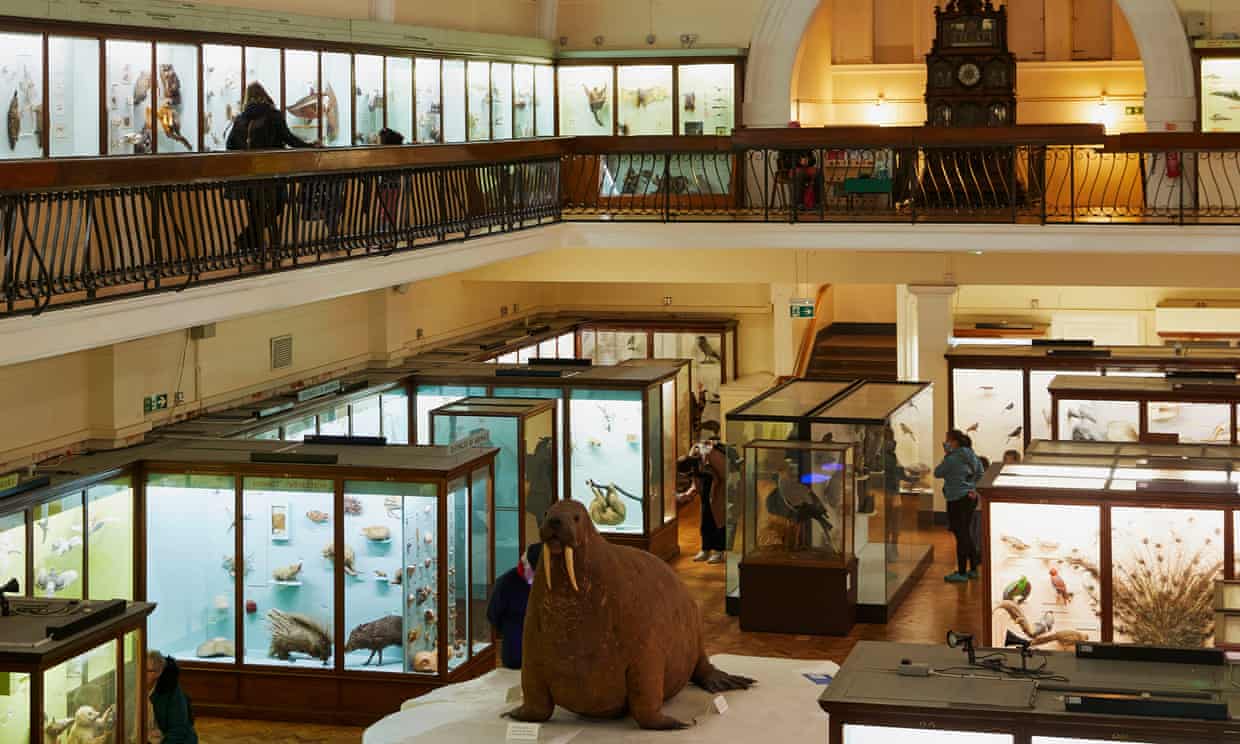
Photo: Emli Bendixen/Arts Fund/PA. The venue in London’s Forest Hill, says the Guardian,”is the capital’s only museum where environment, ecology and human cultures can be seen side by side.”
What special features are people looking for in museums these days? The traditional recorders of art and history keep changing. A look at a museum award in the UK may provide an insight into what is currently valued.
Nadia Khomamiwrites at the Guardian, “The Horniman museum in London has been crowned the Art Fund museum of the year 2022 for its work to inspire the next generation. …
“Its director, Nick Merriman, was presented with the £100,000 [about $117,000] prize – the world’s largest museum prize – by the DJ and broadcaster Huw Stephens at a ceremony at the Design Museum. … The Horniman was commended for completely reconfiguring its program in 2021 after the pandemic, Black Lives Matter and the increasing urgency of the climate crisis.
“It set up its ‘Reset Agenda,’ which focused on reorienting activity to reach diverse audiences more representative of London. This included embedding a Climate and Ecology Manifesto – from an online club of Environment Champions to the creation of a microforest to combat local air pollution.
“ ‘From a takeover of the galleries by children to its youth panel of 14-19-year-olds, work experience opportunities and Kickstart apprenticeships, the museum is inspiring the next generation,’ Art Fund, the UK’s national art charity, said.
“A further focus of the Reset Agenda was the 696 Program, an interrogation of the power and responsibility that public organizations have in supporting local music.
“The museum was said to showcase Black British creativity through a sold-out festival that reached 8,000 visitors, while nearly 20,000 experienced the related exhibition.
“Jenny Waldman, Art Fund director and chair of the judges, said: ‘The Horniman museum and gardens has now blossomed into a truly holistic museum bringing together art, nature and its myriad collections.’ …
“Dame Diane Lees, director-general of the Imperial War Museums and fellow judge, said the museum was championing the natural environment and commissioning artists and music festivals ‘to bring the eclectic collections of Frederick Horniman new relevance with diverse communities.’ …
“The 2022 edition of the annual award championed organizations whose achievements told the story of museums’ creativity and resilience, and particularly focused on those engaging the next generation of audiences in innovative ways.
“The other four shortlisted museums – the Story Museum in Oxford, the People’s History Museum in Manchester, Ty Pawb in Wrexham [Wales], and the Museum of Making in Derby – each received a £15,000 [about $18,000] prize in recognition of their achievements.”
I’m looking at an example form the Horniman website. An upcoming show, “We Breathe, Together: A Day of Community Air Action and Exploration” invites all who “dream of a clean air future – and want the tools to take action.
“From building (and racing!) your own hydrogen car, learning the skills to create a 2D stop motion clean air animation, to co-designing immersive climate adventures and ink breath painting. Meet incredible local campaigners in our Clean Air Village and listen to expert talks.
” ‘We Breathe, Together’ extends the conversation around ‘Breathe:2022‘ by artist Dryden Goodwin, the ambitious multi-site artwork exploring air pollution produced by Invisible Dust. ‘Breathe:2022’ combines over 1,000 new drawings, appearing as large-scale still and moving images on sites close to the heavily polluted South Circular Road and beyond, from May to December 2022.
“As part of the day, you can also immerse yourself in ‘Airborne,’ artist Sarah Stirk’s audio-visual installation that seeks to make the invisible threat of pollution visible.”
More at the Guardian, here. I know I have friends in the UK. If you go, will you share your reactions?
In July, Princess Mononoke, the animated film for grown-ups of all ages, turned 25. I have thought about it often since Asakiyume first pointed me toward the work of the brilliant Hayao Miyazaki. So many things in life remind me of the movie’s wisdom.
The BBC highlighted the Princess Mononoke birthday with a deep think.
Stephen Kelly reports, “In 1997, the British fantasy author Neil Gaiman received a call out of the blue from then-head of Miramax, Harvey Weinstein. ‘This animated film, Princess Mononoke,’ Gaiman recalls him saying, ‘it’s the biggest thing in Japan right now. So I thought I’ve got to get the best to do it. I called Quentin Tarantino and said, “Quentin, will you do the English language script?” And he said, “You don’t want me, you want Gaiman.” So, I’m calling you.’ Miramax, a then-subsidiary of Disney, had acquired the rights to distribute Princess Mononoke, the newest film from Japanese animation studio Studio Ghibli, in the United States, and Weinstein wanted to fly Gaiman to Los Angeles to watch a cut of the movie.
” ‘I had zero plans to do it,’ Gaiman tells BBC Culture. ‘But the moment that changed everything for me was the scene where you’re looking at this large pebble. And then a raindrop hits it. And then another raindrop hits it. And then another raindrop hits it. And now it’s raining and the surface is slippery and wet. And I’m like, “I have never seen anything like this.” ‘ …
“When Princess Mononoke was first released … it represented something of a departure for master animator and director Hayao Miyazaki. During the late 80s, Miyazaki had built his reputation (along with the success of Studio Ghibli, which he founded with fellow director Isao Takahata) on films like Kiki’s Delivery Service and My Neighbor Totoro; formally ambitious, thematically rich works, but generally affirming in tone and family-friendly in nature.
“But something changed during the 90s. Firstly, he began to bristle at the popular idea that Studio Ghibli only makes gentle movies about how great nature is. … Even more significant was his growing despair at a world which he had increasingly come to believe was cursed.
” ‘He used to be what he called leftist in sympathy, a believer in people power,’ explains Shiro Yoshioka, lecturer in Japanese Studies at Newcastle University. ‘But for obvious reasons [the collapse of the Soviet Union, and the escalation in ethnic conflicts across Europe], his political beliefs were totally shaken in the early 1990s.’
“Japan itself was also going through something of an existential crisis. The country’s bubble period, an economic boom during the late 80s, burst in 1992, stranding Japan in a seemingly endless recession. Three years later, in 1995, the country was hit by the Kobe earthquake, the worst earthquake to hit Japan since 1922. It killed 6,000 people, and destroyed the homes of tens of thousands more. Only two months after that, a terrorist cult by the name of Aum Shinrikyo launched a sarin gas attack on the Tokyo Metro, killing 13 and injuring thousands. Miyazaki, who was sickened by the materialism of the bubble period, was now living in a country traumatized and confused – both by its relationship with nature, and a creeping sense of spiritual emptiness.
” ‘He began to think,’ says Yoshioka, ‘maybe I should not make this entertaining, light-hearted stuff for children. Maybe I should make something substantial.’
“Set during the 14th Century, the Muromachi period of Japan, Princess Mononoke tells the story of Ashitaka, a young prince cursed by the hatred of a dying boar god, who has been corrupted by an iron ball lodged in his body. … To seek a cure for his curse, Ashitaka travels across the land, hoping to find the Shishigami, a deer-like forest spirit with the power to bring life and death.
“Along the way, Ashitaka discovers a world out of balance. The ironworks community of Tatara, run by the enigmatic Lady Eboshi, is ravaging the nearby forest for resources, provoking the wrath of ferocious wolf god Moro and her feral human daughter San (the titular Mononoke, which roughly translates to spectre or wraith). Caught in the middle is Ashitaka, who must figure out how to navigate this difficult world with ‘eyes unclouded.’ …
” ‘I believe that violence and aggression are essential parts of us as human beings,’ Miyazaki once told journalist Roger Ebert. ‘The issue that we confront as human beings is how to control that impulse.’ …
“Hayao Miyazaki is a self-confessed bundle of contradictions. Read his writings, listen to his interviews, watch him speak, and he paints a portrait of an artist caught between idealism and nihilism, optimism and despair. …
“This idea of a man at war with himself is obvious to see in the characters and world of Princess Mononoke: a film that, as Miyazaki told a press conference at the Berlin Film Festival in 1998, ‘was not made to judge good and evil.’ Take Lady Eboshi, whose mining colony is manufacturing an arsenal of guns to use against the forest gods. In most animated movies, she would be cast as the greedy, villainous scourge of nature. But Eboshi is also a generous leader, someone who has liberated women (implied to be former sex workers) from feudalistic oppression, who has provided a safe haven for leprosy sufferers and outcasts, and whose industrialization work is raising the standards of human life.
” ‘It would have been so easy to have a “technology is bad versus the good beasts of the forest” story,’ says Susan Napier, professor of the Japanese Program at Tufts University, Massachusetts, and author of Miyazakiworld: A Life in Art. ‘But the foundry helps these marginalized people live. It gives them jobs, a source of community, pride.’ Speaking in 1997 to Cine Furontosha magazine, Miyazaki himself once rationalized Lady Eboshi with ‘often, those who are destroying nature are in reality people of good character. People who are not evil diligently take actions thinking they are for the best, but the results can lead to terrible problems.’ “
It’s a long and thoughtful article. Read more at the BBC, here. No firewall.
Photo: Katherine Rapin. Camden Mayor Vic Carstarphen hands a flat of wild celery to an EPA diver for transplant. Local grasses and oysters are bringing hope to rivers.
We can rescue our environment if we try. Even the infamous city Camden is getting into the act.
Katherine Rapin writes at YaleEnvironment360, “On a recent summer morning near Camden, New Jersey, two divers from the U.S. Environmental Protection Agency hovered over a patch of sediment 10 feet below the surface of the Delaware River. With less than two feet of visibility in the churning estuary, they were transplanting a species crucial to the ecosystem: Vallisneria americana, or wild celery grass. One diver held a GoPro camera and a flashlight, capturing a shaky clip of the thin, ribbon-like blades bending with the current.
“Watching the divers’ bubbles surface from the EPA’s boat was Anthony Lara, experiential programs supervisor at the Center for Aquatic Sciences at Adventure Aquarium in Camden, who had nurtured these plants for months in tanks, from winter buds to mature grasses some 24 inches long. …
“This was the first planting of a new restoration project led by Upstream Alliance, a nonprofit focused on public access, clean water, and coastal resilience in the Delaware, Hudson, and Chesapeake watersheds. In collaboration with the Center for Aquatic Sciences, and with support from the EPA’s Mid-Atlantic team and the National Fish and Wildlife Foundation, the alliance is working to repopulate areas of the estuary with wild celery grass, a plant vital to freshwater ecosystems. It’s among the new, natural restoration projects focused on bolstering plants and wildlife to improve water quality in the Delaware River, which provides drinking water for some 15 million people.
“Such initiatives are taking place across the United States, where, 50 years after passage of the Clean Water Act, urban waterways are continuing their comeback, showing increasing signs of life. And yet ecosystems still struggle, and waters are often inaccessible to the communities that live around them. Increasingly, scientists, nonprofits, academic institutions, and state agencies are focusing on organisms like bivalves (such as oysters and mussels) and aquatic plants to help nature restore fragile ecosystems, improve water quality, and increase resilience.
Bivalves and aquatic vegetation improve water clarity by grounding suspended particles, allowing more light to penetrate deeper
“They also have exceptional capacity to cycle nutrients — both by absorbing them as food and by making them more available to other organisms. Thriving underwater plant meadows act as carbon sinks and provide food and habitat for scores of small fish, crabs, and other bottom-dwellers. Healthy bivalve beds create structure that acts as a foundation for benthic habitat and holds sediment in place.
“ ‘Why not take the functional advantage of plants and animals that are naturally resilient and rebuild them?’ says Danielle Kreeger, science director at the Partnership for the Delaware Estuary, which is spearheading a freshwater mussel hatchery in southwest Philadelphia. …
“One hundred miles north of Philadelphia, the Billion Oyster Project has been restoring the bivalves in New York Harbor since 2010, engaging more than 10,000 volunteers and 6,000 students in the project. [See my post on that here and search on ‘oyster’ for related posts.] Oyster nurseries are being installed in Belfast Lough in Northern Ireland, where until recently they were believed to have been extinct for a century. And a hatchery 30 miles west of Chicago has dispersed 25,000 mussels into area waterways, boosting the populations of common freshwater mussel species.
“Underwater vegetation restoration projects have been underway in the Chesapeake Bay and Tampa Bay for years, and more recently in California where seagrass species are in sharp decline. (Morro Bay, for example, has lost more than 90 percent of its eelgrass beds in the last 15 years.) The California Ocean Protection Council’s 2020 Strategic Plan to Protect California’s Coast and Ocean aims to preserve the mere 15,000 acres of known seagrass beds and cultivate 1,000 more acres by 2025.
“Scientists stress that these projects must be implemented alongside strategies to continue curbing contaminants, mainly excess nutrients from sewage and fertilizers, flowing into our waterways — still the most critical step in improving water quality. After several decades of aquatic vegetation plantings in the Chesapeake Bay, for example, scientists say that the modest increase of plants is largely due to nature restoring itself following a reduction in nutrient pollution.
“And any human intervention in a complex ecosystem raises a host of compelling concerns, such as how to ensure sufficient genetic diversity and monitor competition for food and resources. Scientists say that, in many cases, they’re learning as they go.
“Still, in areas where the natural environment is improving, bringing back bivalves and aquatic plants can create a lasting foundation for entire ecosystems. And restoration initiatives are an active form of stewardship that connects people to their waterways, helping them understand the ecosystems we depend on for our survival.”
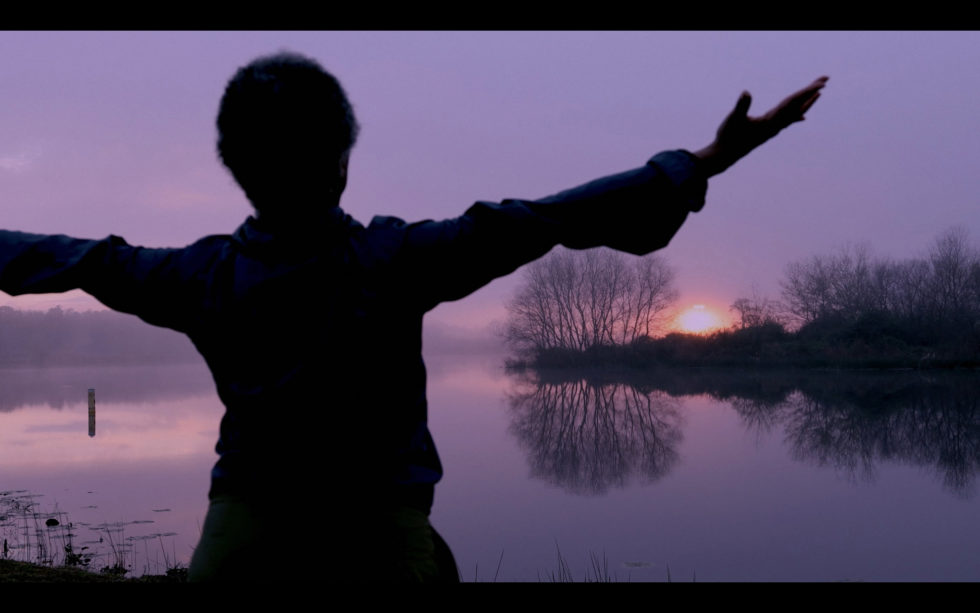
Video still: Millicent Johnnie Films. Filmed by a drone, Jawole Willa Jo Zollar dances in Lafayette Heritage Trail Park in Where Water Is Not Thirsty.
The shut-in days of the pandemic made changes in everyone’s life and work. Many kinds of artists accepted the challenge to their own work and responded with bursts of creativity that made use of weird circumstances. Today’s article addresses what some choreographers did.
Zachary Whittenburg reports at Dance Magazine, “On a bright but chilly day in April 2022, choreographer Biba Bell and composer-director Joo Won Park premiered A DREAM IS A HOUSE for remembering the future. Created specifically for the McGregor Memorial Conference Center in Detroit, the hourlong performance by 21 dancers, nine musicians and Park embraced architect Minoru Yamasaki’s prismatic jewel box of marble and glass, built in 1958.
“Taking advantage of the faceted atrium’s unusual acoustics, Park’s original score for electric guitar, percussion and eight laptop computers emanated from small amplifiers distributed throughout the skylit room, whose tall panels of teakwood resonated with every whisper and rhythm. At one point, the entire ensemble of dancers rushed from one end of the space to the other, as if the McGregor Center was a cruise ship rocking and rolling in turbulent seas. Cloud cover during the 3 o’clock performance brought somber qualities to the action, but, when repeated at 5 o’clock and lit vividly by the setting sun, it was an ascension.
“Every dance is site-specific in some sense, but, in a warming world changed by war, political upheaval and a pandemic, some choreographers forgo traditional venues entirely. Whether their work is about climate change, social dynamics, systemic oppression or community vibrance, they’re all drawn to the friction between moving and staying in one place.
“ ‘Sites outside of a dance studio are fields of infinite potential that can be very generative as places we have relationships with,’ says transmedia artist d. Sabela grimes, a professor at the USC Glorya Kaufman School of Dance, who grew up on California’s central coast and attended UCLA. While he lived and worked in Soweto, South Africa, and Philadelphia, grimes maintained a connection with the Leimert Park Village neighborhood of Los Angeles, where the community weaves performance — both planned and spontaneous — into daily life along Degnan Boulevard. …
” [During the pandemic] ‘I can’t explain to you how important it was, how valuable it was, how special it was, to be in public space with people making music, to see them dancing, to be in communion and fellowship,’ grimes says. …
“ ‘The streets continue to be a driving force and wellspring of knowledge production and transmission,’ he says. One night reminded grimes how performance can be not only site-specific but a way to bring the essence of one place to another: TOB, a band that plays go-go, a variant of funk music specific to the nation’s capital, played Leimert Park Village from a stage on top of a bus booked by Jolly and Long Live GoGo DC. Dancing ensued. ‘I had no idea so many people from Washington were living in L.A. … It literally was like the spot turned into a street in DC.’ …
“At a May 2022 work-in-progress showing in Chicago of reorientations, by SLIPPAGE resident artists Kate Alexandrite, who is white, and Thomas F. DeFrantz, Ayan Felix and MX Oops, who are Black, Alexandrite wore virtual-reality goggles while the other three interacted and made eye contact. The four artists might technically have shared space, but, experientially, Alexandrite was often somewhere else. A large screen periodically displayed a live feed of video from inside the goggles, revealing to the audience where Alexandrite ‘was.’ …
“As a choreographer of mixed European and Moose Cree First Nation ancestry, Starr Muranko’s work as co–artistic director of Raven Spirit Dance in the Canadian city of Vancouver is informed, she explains, by Indigenous values.
“ ‘A lot of our research is land-based and takes place outside,’ says Muranko. ‘Even though the work might eventually end up on a stage, it’s often rooted in a particular place or in going home.’
“For a piece titled Before7After, about seven generations of Cree women, Muranko traveled to an island in the Moose River in northern Ontario, 500 miles from Toronto. ‘The idea that I wouldn’t go back to the land for that project made no sense. How your body moves is influenced by certain surfaces, by the land around you, by the temperature, by the climate, by the time of year.’
“After developing material on location, Muranko and her collaborators sometimes return to the studio, where ‘we then have that landscape and that map within our bodies, as well as within the space. It’s not a “blank studio” or a “blank theater.” It’s where that river is, where that mountain is.’
“In creating The Sky Was Different for Hubbard Street Dance Chicago’s Season 43: A Virtual Homecoming, the company’s 2020–21 virtual season, company alumni Jonathan Fredrickson and Tobin Del Cuore collaborated with Hubbard Street’s dancers on a 50-minute film, shot in and around the 1938 home and studio of architect Paul Schweikher in the Chicago suburb of Schaumburg.
“ ‘For me, site-specificity is about utilizing a space by being aware of it and letting it dictate what happens,’ says Fredrickson, a choreographer now based in Germany and a guest artist with Tanztheater Wuppertal Pina Bausch. ‘The house itself was a character, this body in which the dancers were its organs, its bloodstream, its brain, its heart. The narrator of the piece was the house itself.’ In long, meticulously choreographed takes, Del Cuore’s eye-level camera glides through the house’s rooms. …
“Fredrickson choreographed a solo for Alvin Ailey American Dance Theater’s Jamar Roberts in director Bram VanderMark’s I Carry Them, produced by Jacob Jonas The Company. Released in May 2022, the five-minute film uses an editing technique called cross-cutting to move Roberts from place to place, while his fluid dancing continues uninterrupted. …
“Site-informed performance can be a way to raise awareness of threats to a community’s existence, says Millicent Johnnie, founder and CEO of Millicent Johnnie Films and chief visionary producer at 319 productions.
“In 2013, Johnnie and her collaborators, including New Orleans–based companies ArtSpot Productions and Mondo Bizarro, won a Creative Capital Award to develop Cry You One, which addressed the impact of climate change on wetlands in southeast Louisiana. …
“Johnnie says that Cry You One asked the question ‘What happens to art and culture that’s tied to land when that land disappears?’ After premiering in St. Bernard Parish, the project toured for two years, bringing with it the artists’ embodied knowledge of its source.
“Sometimes, site-specific research plants seeds for works that bloom elsewhere. During the four years Johnnie lived in Rio de Janeiro, Brazil, she would often visit the Tijuca rainforest to write, improvise movement and develop studies for future projects. When Toshi Reagon, then the festival curator for the Women’s Jazz Festival at the Schomburg Center for Research in Black Culture, paired Johnnie with Ethiopian American musician Meklit Hadero, ‘that wasn’t intended to be a site-responsive work,’ Johnnie says, ‘but there were certain sounds and textures I kept hearing in Meklit’s music that paralleled sounds and textures from the Tijuca rainforest. That helped me create and build the world that I needed to improvise with Meklit.’
“Johnnie recently collaborated with Urban Bush Women founding artistic director Jawole Willa Jo Zollar on Where Water Is Not Thirsty, responsive to Tallahassee, Florida’s Lafayette Heritage Trail Park and Lichgate on High Road, and captured on video by a camera built into a remote-controlled drone. …
“Dance companies large and small pivoted to site-specific, digital filmmaking as part of their pandemic responses. … Time will tell whether major dance institutions continue such location-based experimentation.” More at Dance, here. No firewall.
If you love dance, consider signing up, here, for short, free videos from the summer dance festival Jacob’s Pillow, in the Massachusetts Berkshires.
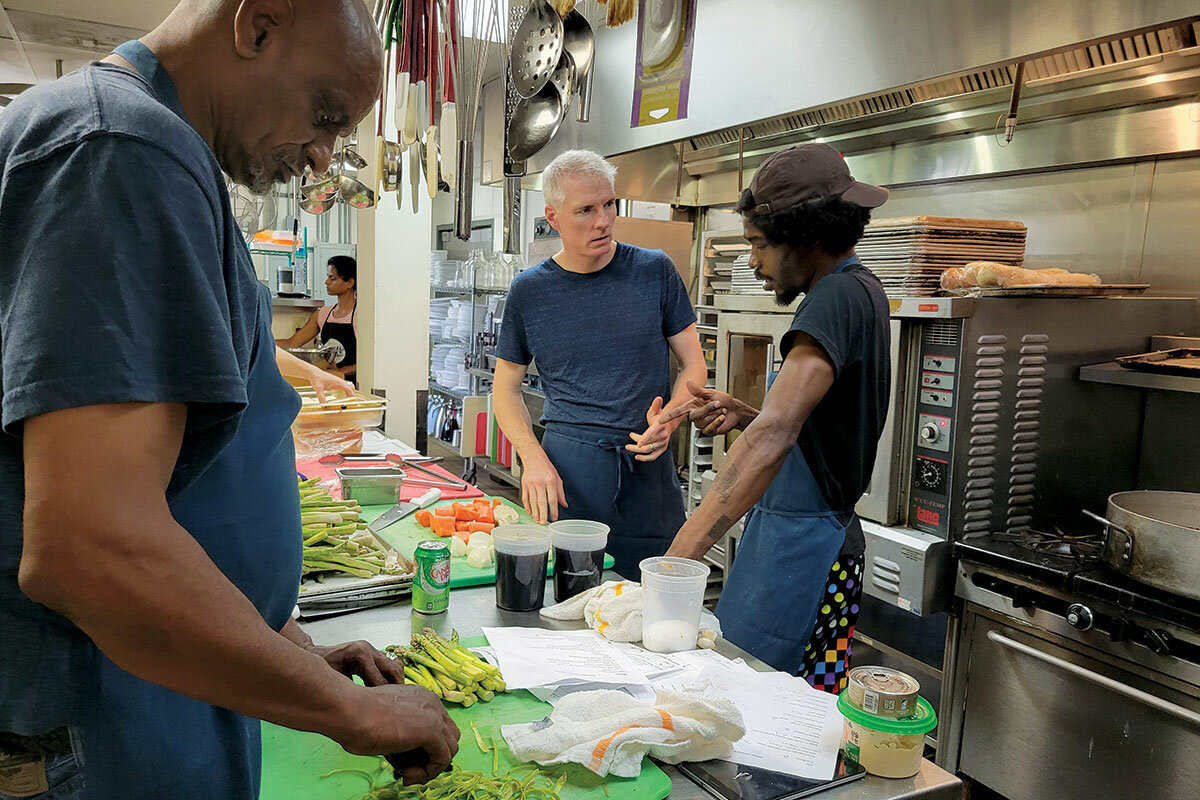
Photo: Stephen Humphries/Christian Science Monitor. Chef Brandon Chrostowski (center) teaches trainees inside the kitchen for Edwins Too, one of his two French fine dining restaurants on the East Side of Cleveland.
When you take a wrong path in life, does it have to determine everything that happens later? At the Christian Science Monitor, Stephen Humphries writes about a chef who is making sure that some people are successful when they start over.
“Brandon Chrostowski is telling his origin story for probably the thousandth time. He’s pacing the stage of a local high school, holding his microphone with the confidence of a rock star. Mr. Chrostowski is a distinguished chef – he was a restaurateur semifinalist in the 2022 James Beard awards – and founder of a Cleveland restaurant with a philanthropic mission. Yet he’s ambivalent about all the acclaim. He’s tasted what it’s like to be stripped of dignity. At 18 he was arrested for fleeing and eluding the police. He and some friends had been in a car with drugs they intended to sell.
“ ‘I learned a lot of things. One, the dehumanization in the criminal justice system,’ he tells the students at Gilmour Academy. ‘Also, the idea of freedom. You don’t really know what freedom is until you lose it.’
“A lenient judge decided against sentencing him to prison. Mr. Chrostowski has never forgotten that he was fortunate not to serve a 5-to-10-year sentence. It’s the reason he launched Edwins Leadership & Restaurant Institute on Cleveland’s East Side.
“What makes Edwins unique isn’t just its French cuisine, but its workers – they’re formerly incarcerated adults. Over six months, those in training learn skills for employment in the culinary world. More than that, Mr. Chrostowski tries to draw out a sense of self-worth in those who’ve served time by showing them how to attain excellence.
‘The single hardest thing we have to do at Edwins is really build esteem in someone that has lost that, or that sense of humanity, through incarceration,’ says Mr. Chrostowski.
“Hours before giving his speech at the high school, Mr. Chrostowski strides into a kitchen where two trainees are singing along to a Bobby Womack tune on the radio. Tying a half apron around his waist, the chef quickly assesses a hunk of braised beef inside a pot as large as a bassinet. …
“As Mr. Chrostowski shares tips with Richie, he picks up a knife and demonstrates how to slice asparagus. In 2017, Edwins was the subject of an Oscar-nominated short documentary titled Knife Skills. …
“Abdul El-Amin enrolled in the program in June after being incarcerated for 20 years. ‘When you come here, it is sincere. You’re welcome. You can feel it,’ he says after his first two weeks of training. He adds, ‘I’m seeing so many other opportunities that I didn’t think about when I was incarcerated.’
“That’s not to say the program isn’t demanding. Over 2,000 people have trained at Edwins since its opening in 2013. Of those, only 600 have graduated because most drop out, often within the first two weeks. (They’re always welcome to reapply.) The program boasts a 95% employment rate for its alumni, and fewer than 1% of graduates are re-incarcerated. Star pupils have gone on to work in restaurants across America and even in France.
“ ‘[Mr. Chrostowski] really doesn’t care what walk of life you’re from, who you are, what you’ve done,’ says William Brown, a staff member at Cleveland’s Community Assessment & Treatment Services, a rehabilitation organization that enrolls promising individuals in the Edwins program. ‘He wants to see you succeed. And he will go the extra mile.’
“Mr. Chrostowski has a hectic daily schedule. During peak restaurant rush hours, the chef admits to hurling pans in frustration, but they’re not aimed at anyone. … He pursues the exacting standards he learned as an apprentice at restaurants such as Charlie Trotter’s in Chicago, Le Cirque in New York, and Lucas Carton in Paris. He rose fast. But he’s never forgotten his first break. In the late 1990s, a Detroit chef named George Kalergis took him in while he was still on parole.
“Years later, Mr. Kalergis called from Detroit with bad news. A man named Quentin, who’d learned the rudiments of restaurant cooking alongside Mr. Chrostowski, had been stabbed to death. …
“ ‘I started to think, “How is it possible I’m here, and others are not?” ‘ says Mr. Chrostowski. … He wanted to help others, just as Chef Kalergis had helped him. But it took another decade of working in restaurants – including a move to Cleveland in 2008 – before he was able to raise the money to fulfill his vision.
“Mr. Chrostowski came up with the name, which is shorthand for ‘Education wins.’ Edwin is also the chef’s middle name. A few years after moving to Cleveland, he opened his restaurant in a historic, racially diverse area called Shaker Square. In 2020, he expanded by opening a second restaurant, Edwins Too, on the opposite side of the town’s leafy square. He’s also launched a French bakery and a butchery. The expansions have helped the area become a dining destination.
“Just off the main street in Shaker Square, Mr. Chrostowski proudly shows off his latest project, which will become a child care center. ‘We’ve raised about $250,000 for a family center or day care,’ he says. ‘Free day care for staff and students, because 80% of our students with children don’t finish. It’s a big number and we want to change that.’
“The chef also wants to help outside Ohio. In April he traveled to his ancestral home of Poland to cook for refugees fleeing Ukraine. He’s also created a 30-hour curriculum and distributed it on 400,000 tablets to prisons in the United States. Dee and Jimmy Haslam, co-owners of the Cleveland Browns football team, will pay for transportation for anyone in the U.S. who completes the virtual instruction and applies to join the Edwins program.”
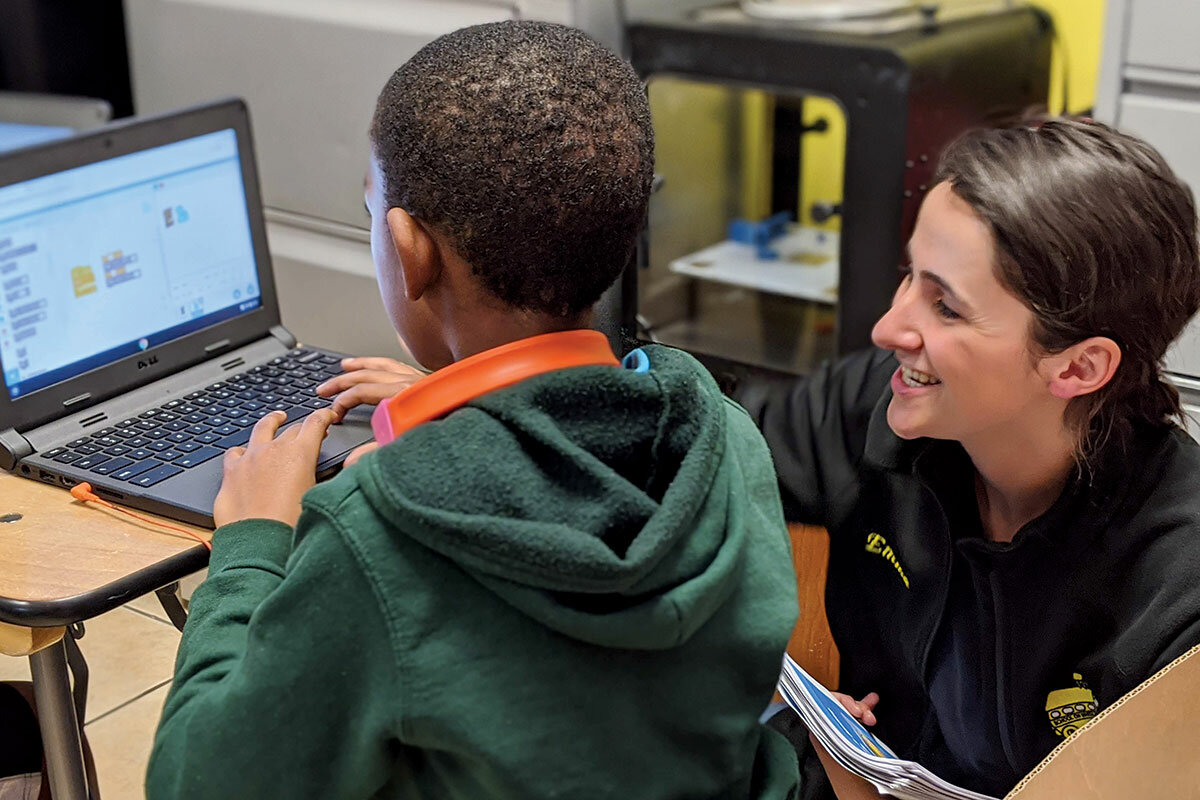
Photo: School on Wheels. A student at School on Wheels’ Skid Row Learning Center works with staff member Emma Gersh.
All children need an education, but those experiencing homelessness get a spotty one at best. That’s a situation the nonprofit School on Wheels is aiming to rectify.
Magda Hernandez wrote about it at the Christian Science Monitor. “The little girl was 6 years old, and life hadn’t been kind to her.
“When Catherine Meek walked into a homeless shelter for their tutoring session, she found the child hiding under a desk.
“No questions asked, the volunteer joined her on the floor and began reading to her. For an hour a week, the session would allow the girl to be just a kid, getting the assistance she needed, and for at least a moment forgetting about the circumstances that put the girl educationally behind by about a grade.
“The space remained their meeting spot for six sessions until, one day, Ms. Meek walked in to find the girl sitting at the desk waiting for her.
“ ‘I had, I remember, the biggest smile on my face, and she did too,’ Ms. Meek says. ‘I think even at that young, vulnerable age she understood that something had changed, that there was a set level of trust, that she could trust me.’
“Ms. Meek lights up recalling that moment – one of her greatest success stories as a volunteer tutor for School on Wheels, a nonprofit addressing educational needs of children K-12 who are experiencing homelessness. She and the girl worked together for about two years until the child moved out of state and they lost touch.
“Recently, Ms. Meek – now executive adviser to the organization – attended that no-longer-little-girl’s wedding after they reconnected through social media.
“A brainchild of the late Agnes Stevens, a retired schoolteacher, School on Wheels began in 1993 when she started tutoring kids living in shelters on Skid Row, an area of Los Angeles known for its large homeless population. In the next few years, she formalized her efforts, recruited more volunteers, and grew the organization with the help of Ms. Meek, who joined in 1999.
“ ‘She was the inspiration and teacher and had the education background, and I had the business and financial background,’ says Ms. Meek.
‘The need was there in 1993, and it’s just grown astronomically since then. One in 30 kids in California in a classroom is homeless.’
“The organization grew steadily, partnering with shelters, school districts, motels, libraries, anywhere homeless families could be – even reaching those living in cars, in foster homes, and on the streets. With year-round operations in six counties, prior to the pandemic, the organization reached more than 3,000 homeless children a year, and it recruited and trained more than 2,000 tutors annually. …
“ ‘Students experiencing homelessness move on average about three to four times a year, and with each move, it’s estimated that they fall behind four months academically,’ says Charles Evans, the organization’s executive director. …
“School on Wheels doesn’t get into the students’ backgrounds but focuses solely on assessing the kids’ educational needs – like a fourth grader who is two grades behind in reading or a 10th grader who’s struggling with pre-algebra and biology – and matching them with tutors. …
“Says Mr. Evans. ‘We don’t pry and try to figure out why a family became homeless.’
“The children are assessed every few weeks to make sure they’re improving. Ms. Meek says that in 2021, K-4 students improved their literacy skills by 21%; in the past six months, fifth through eighth grade students increased math skills by almost one grade level, and self-efficacy surveys showed a 40% increase in confidence in ninth through 12th graders.
” ‘Before the pandemic, tutors would meet students wherever they were – motels, shelters, libraries. But tutoring sessions have been remote – via donated Chromebooks and laptops – in the past couple of years. The drastic change had benefits and drawbacks. On one hand, students could stay in touch with tutors even on the move. On the other, School on Wheels had to pivot from handing out backpacks and school supplies to figuring out how to get digital equipment into kids’ hands and making sure they had Wi-Fi access. … Now, the organization is returning to in-person sessions, particularly for younger kids. But it will keep the hybrid model. …
“Outside of tutoring, School on Wheels is out to erase the stigma of homelessness. Many of the families the organization works with found themselves homeless through no negligence of their own – victims of domestic violence or economic hardship, doing their best to get back on their feet.
“For example, one single mother in her 20s, who for security reasons asked not to be named, left an abusive relationship, and ended up in a shelter with her four young kids. When she noticed her children falling behind in school, she connected with School on Wheels.
“ ‘It’s been the best thing ever, because my kids love their tutors,’ says the young woman, who works and goes to school. She now gets reports from school that her kids are doing much better: ‘The teacher did see a lot of improvement in [my daughter’s] math and her spelling.’ That motivates her to do better herself, says the mother.”
Read at the Monitor, here, about Angela Sanchez and how she got math help from a rocket scientist. No firewall.
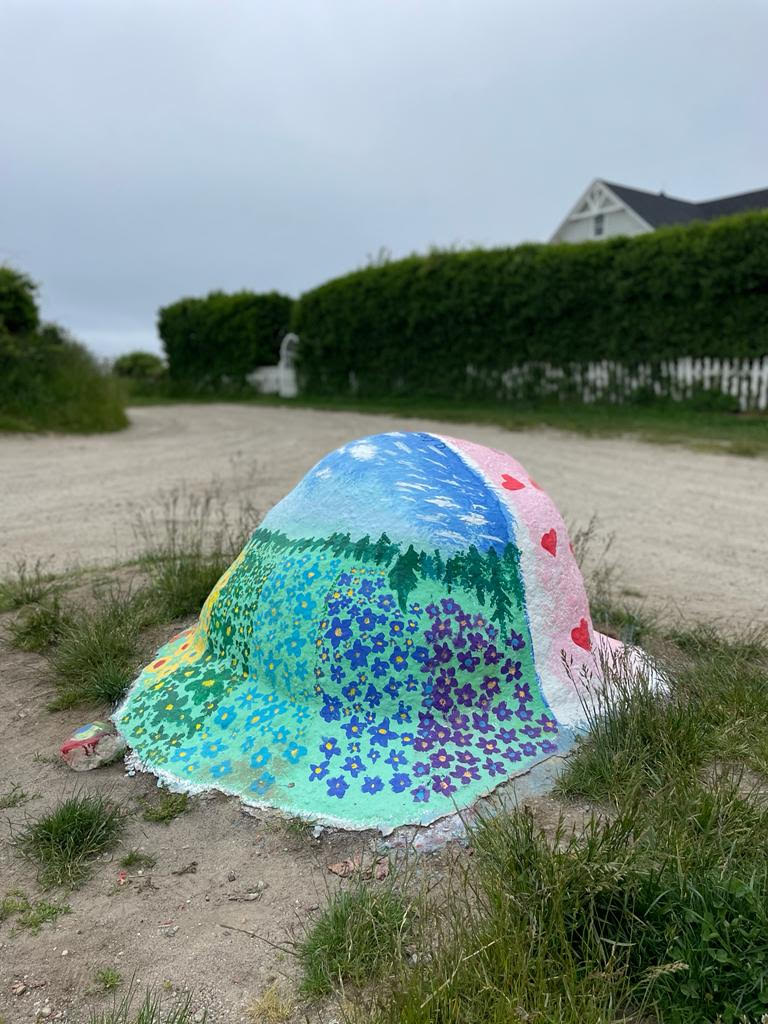
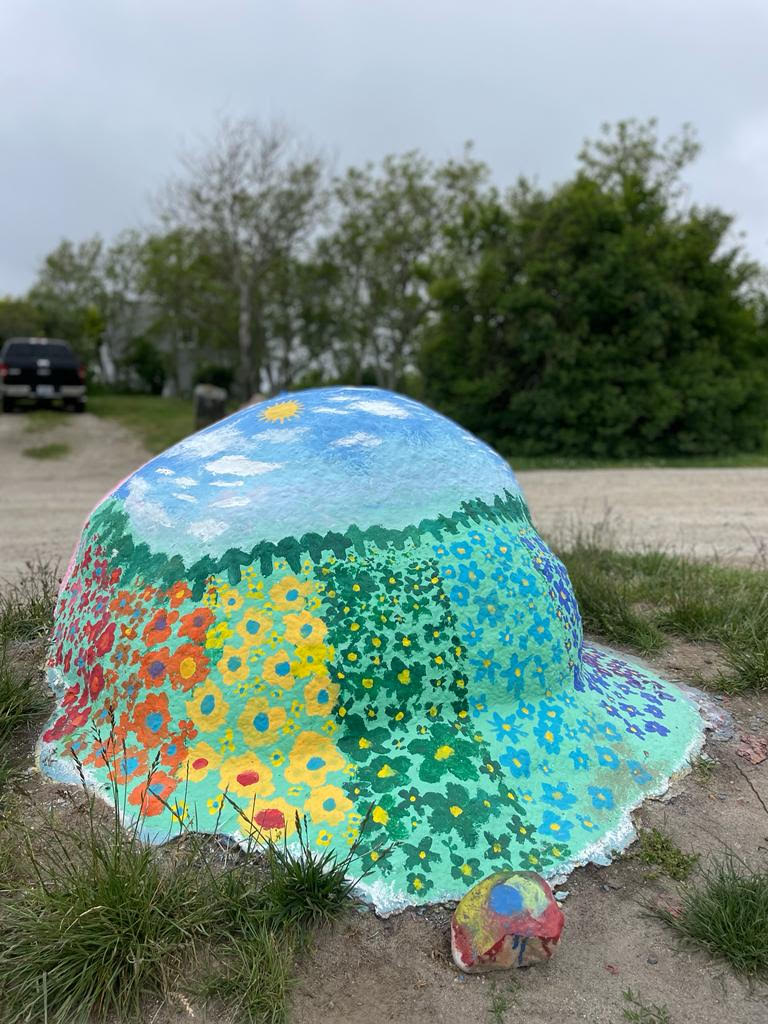
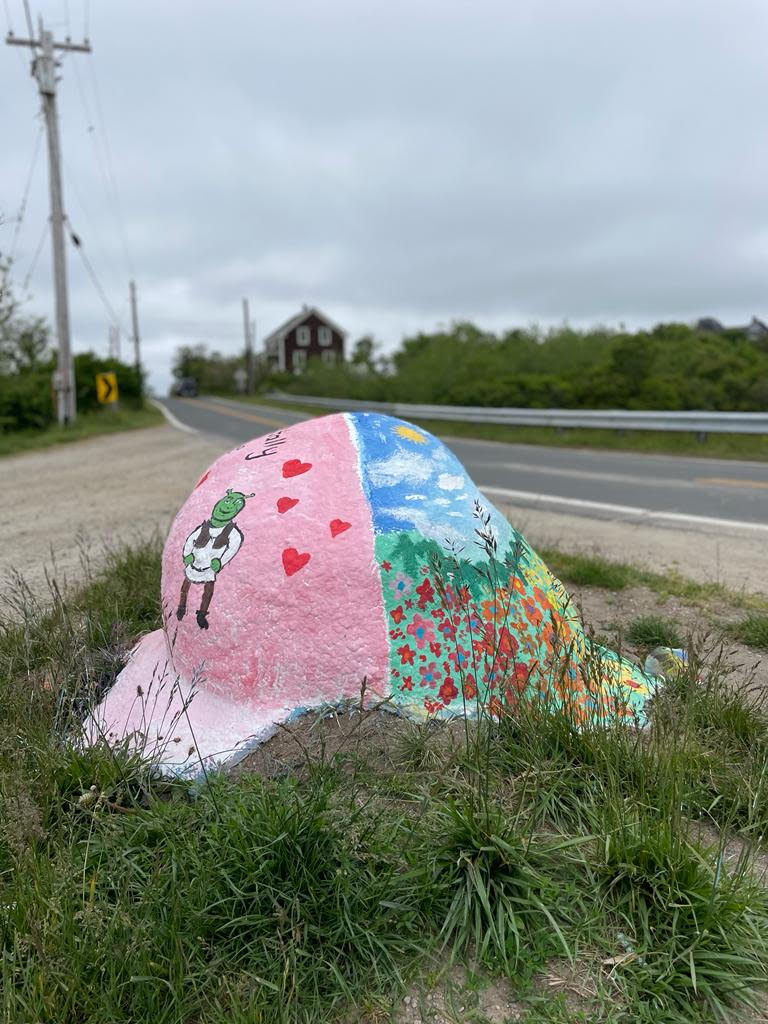
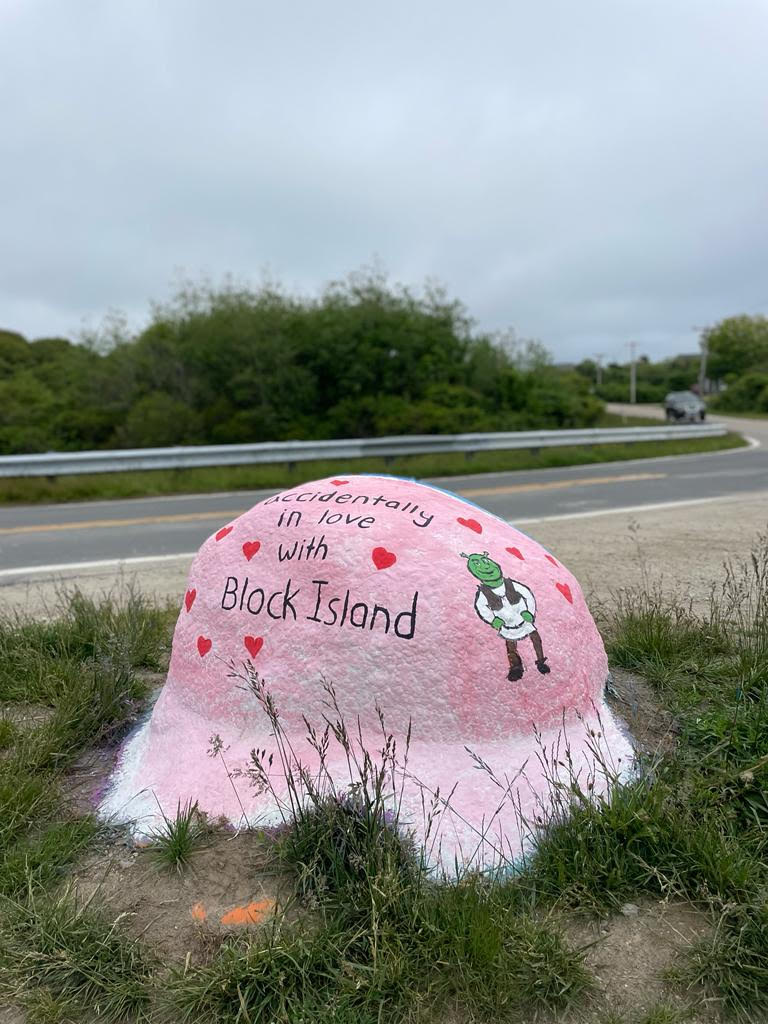
Photo: Suzanne. The Painted Rock gets the best art in the off-season. This was in early June.
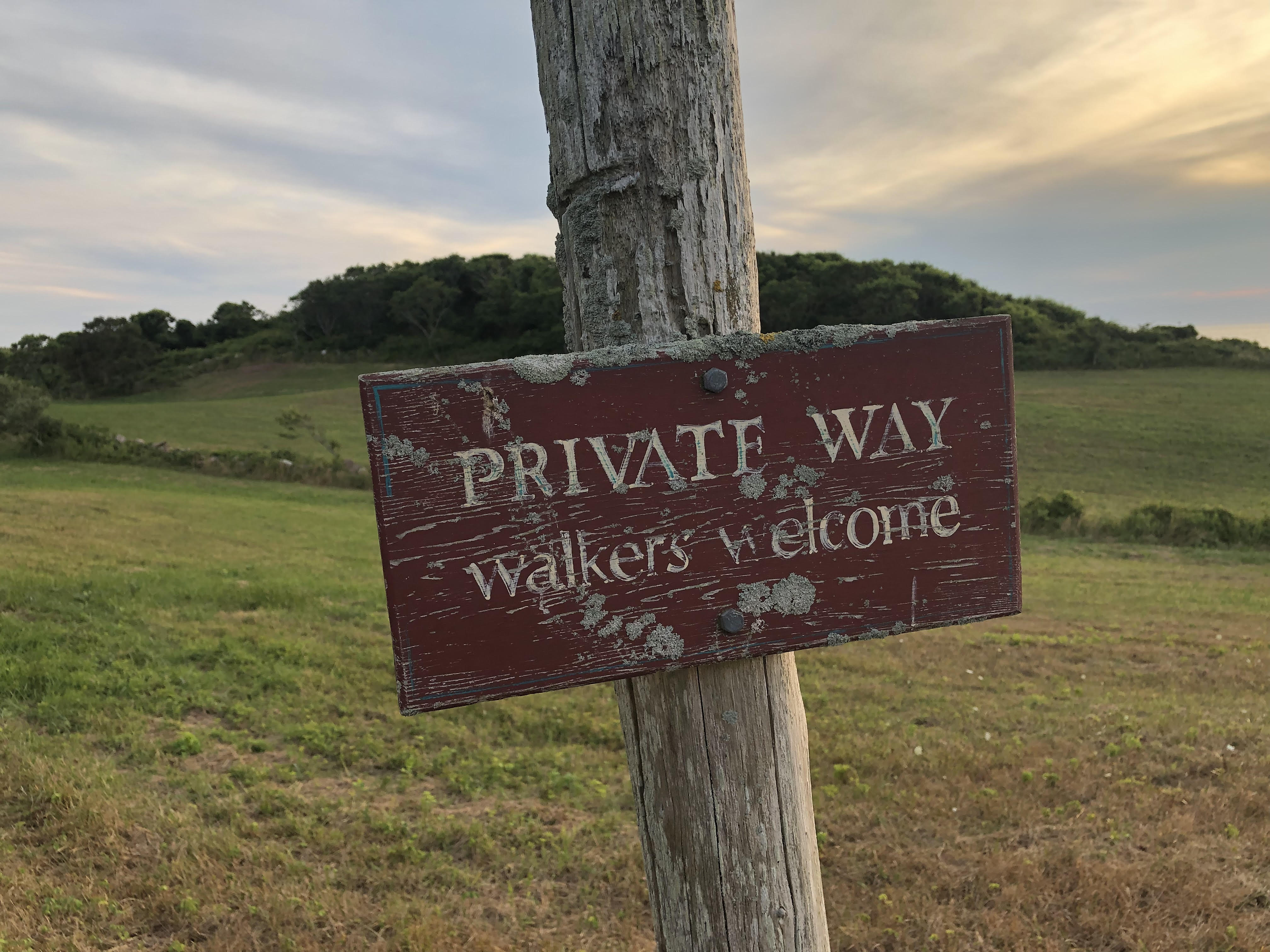
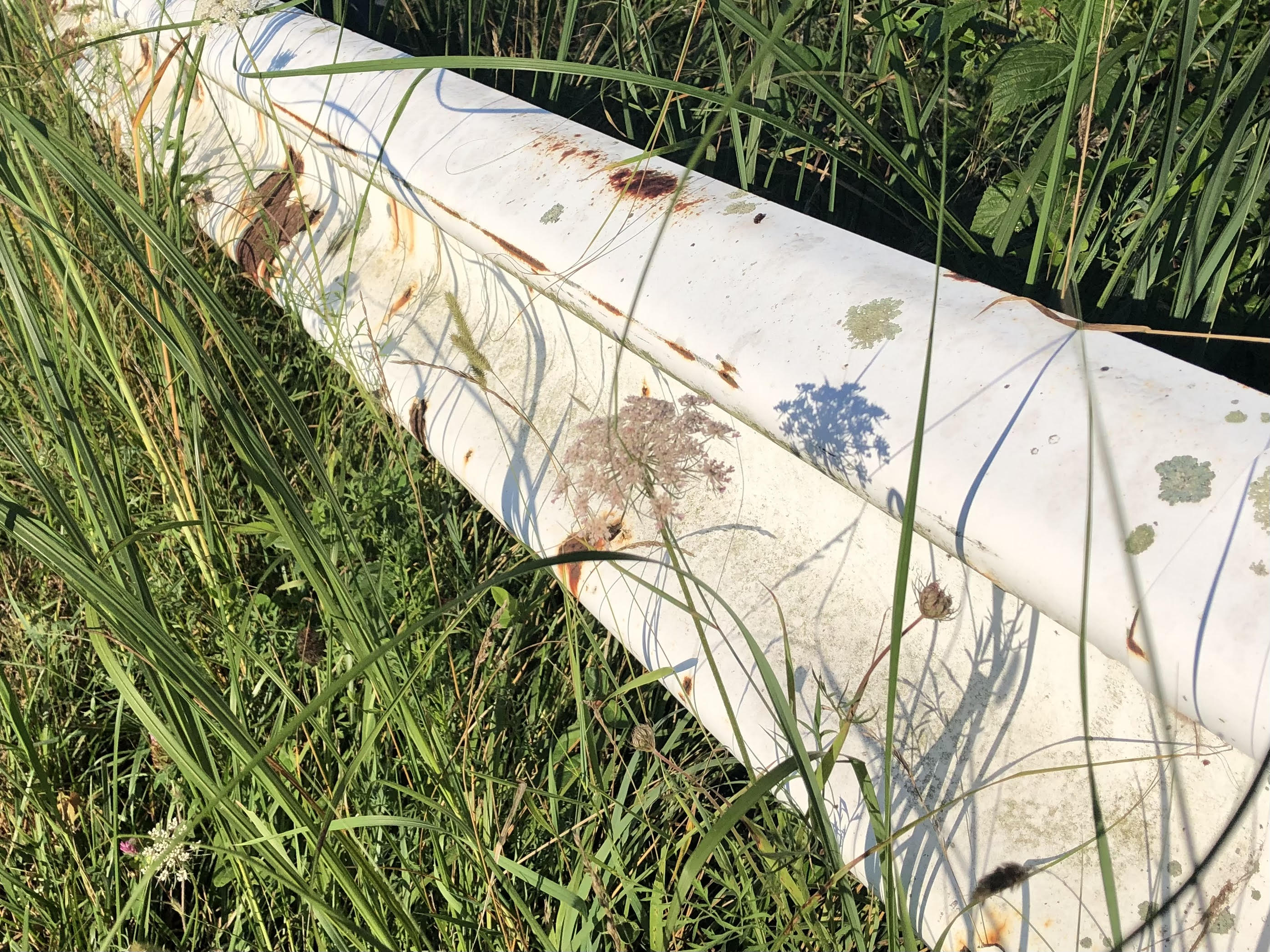
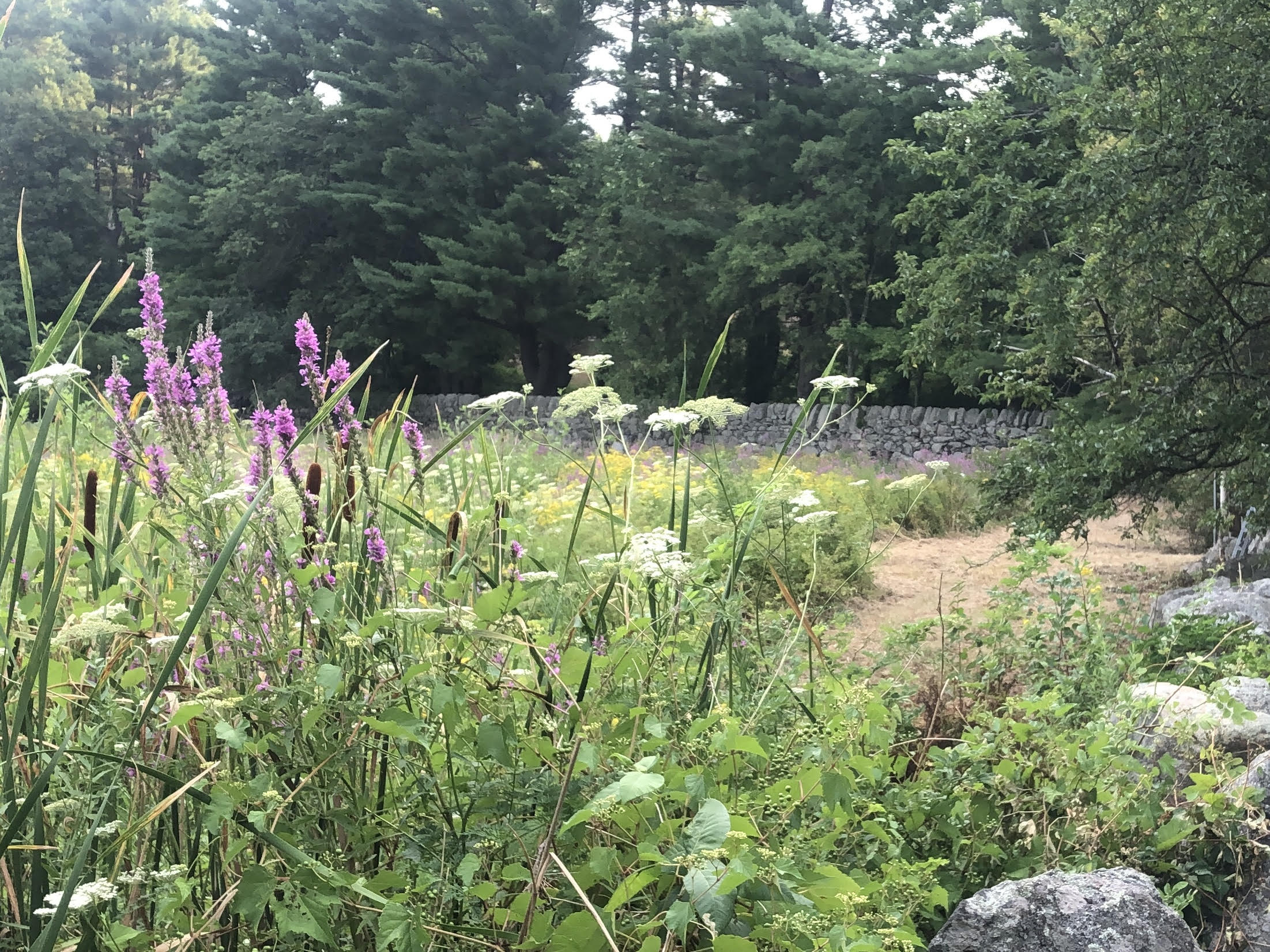
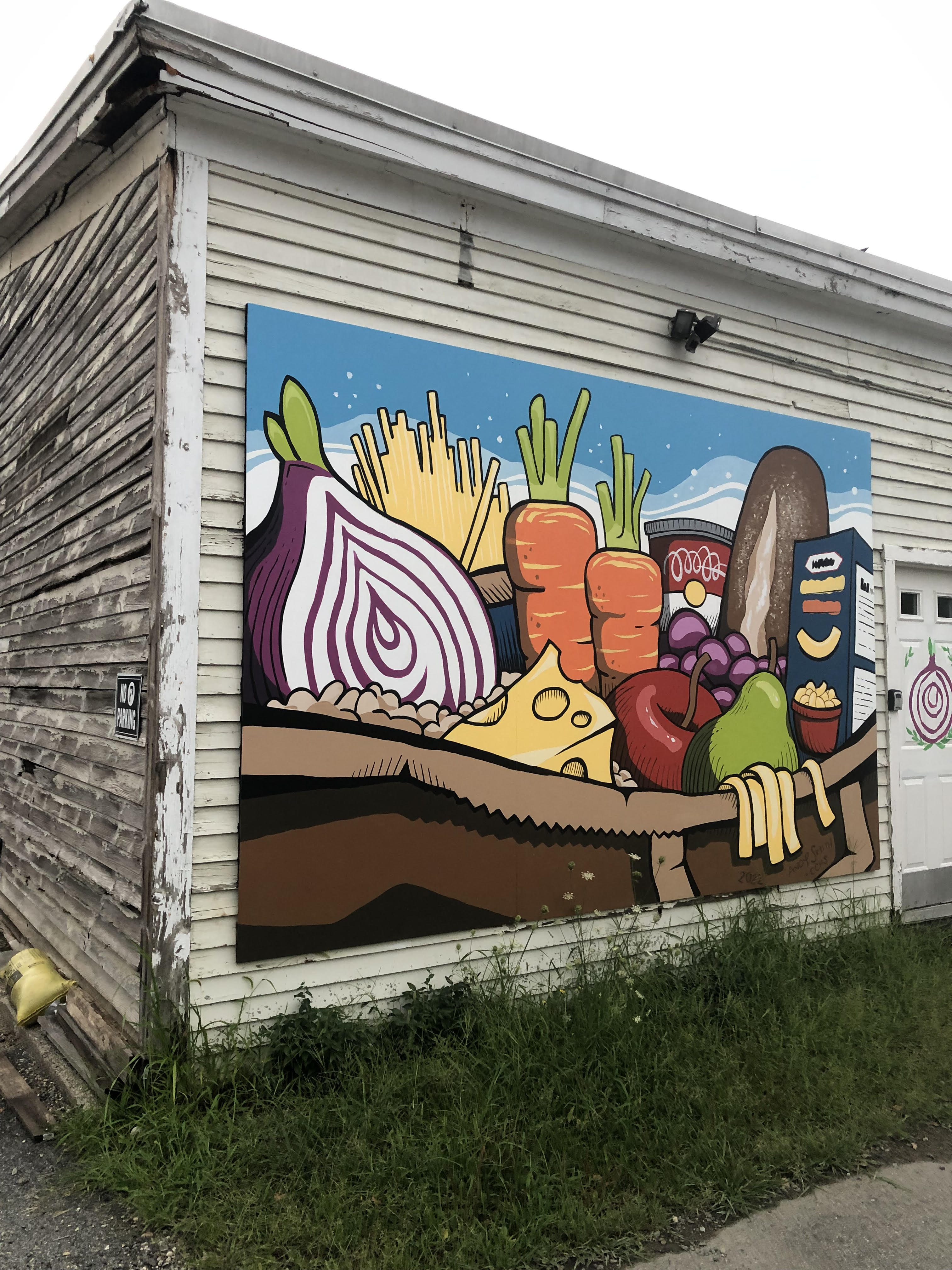
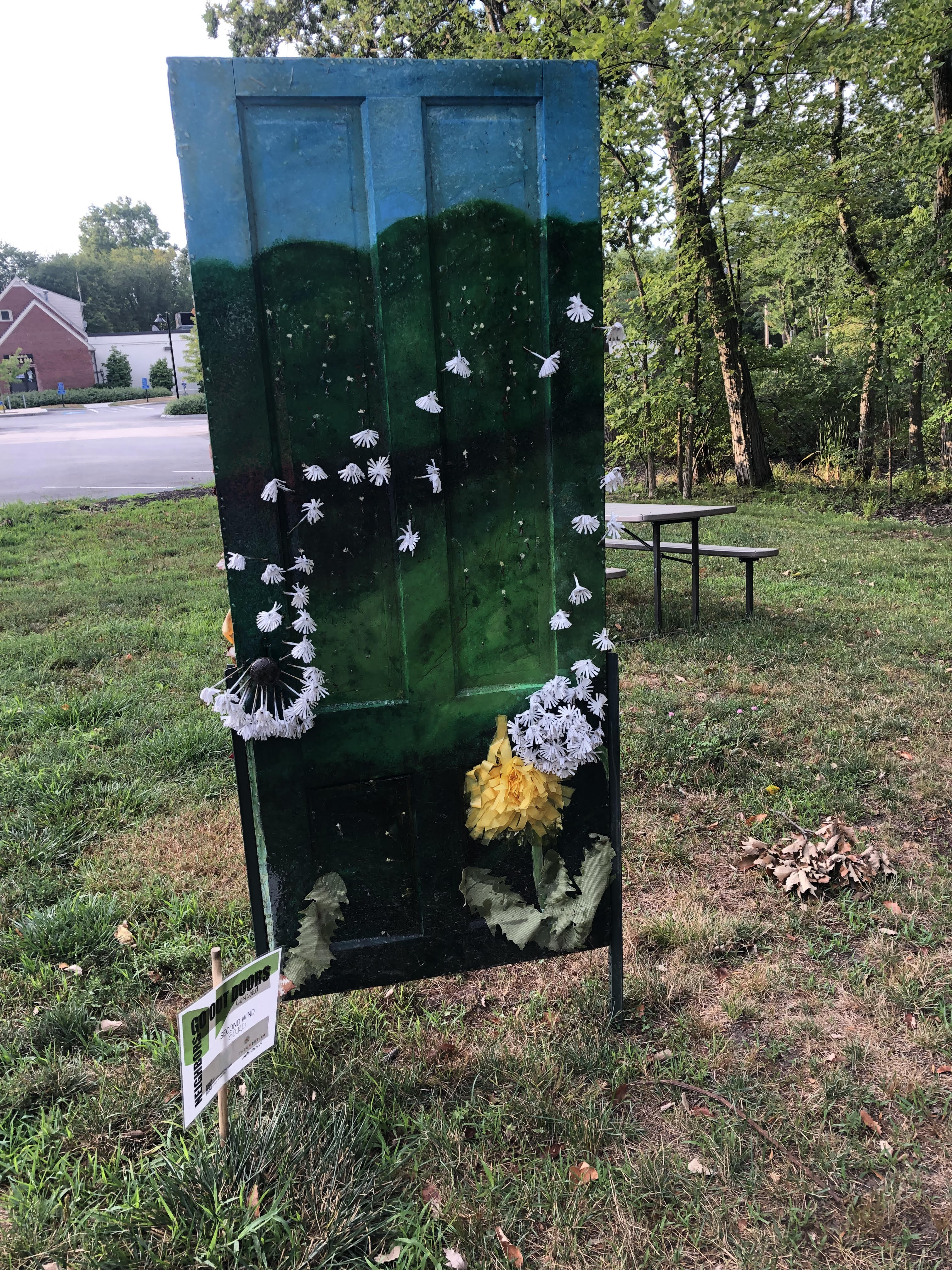
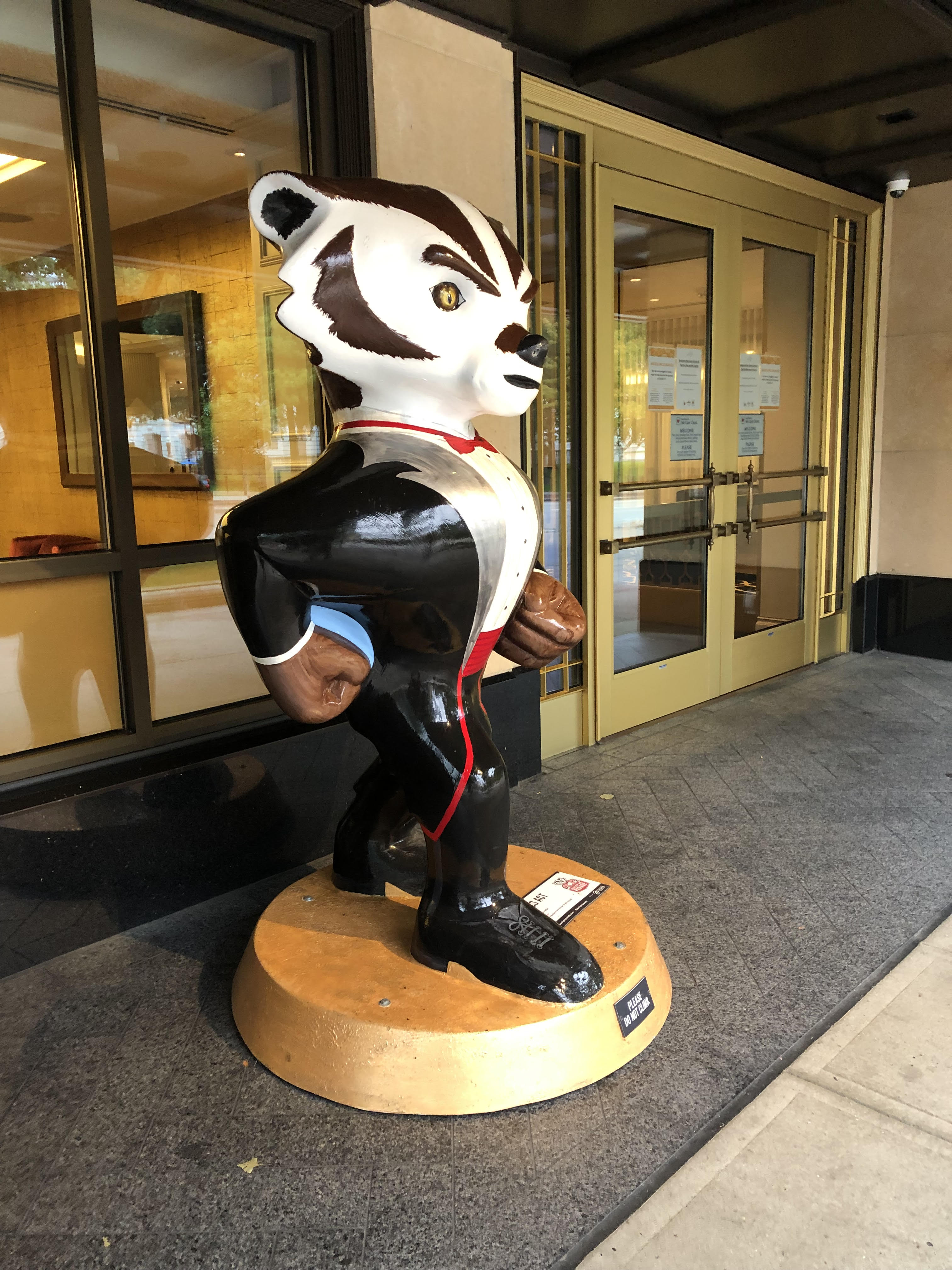
Today I’m rounding up a few photos from summer in New England (although, of course, the badger photo was not taken in New England but on that wedding trip).
There are four photos of some really artistic work on the Painted Rock. Next comes a typical island clothesline in the mellow light near sunset. That’s followed by a pile of rocks that someone (a child?) collected at the edge of the Tug Hole, a sign showing that some landowners are welcoming, and a sharp Queen Anne’s Lace shadow on a guard rail. Those photos were all taken in New Shoreham,, Rhode Island.
The next few are from Massachusetts: Purple Loosestrife near a stone wall, a food-themed mural, a painted door with 3-D touches, and a juvenile red-tailed hawk at Minuteman Park. There were three of the young hawks horsing around that morning. They threw me off the identification until I learned that red tails whistle and that the tail isn’t red in the first year.
Photo: A24. This is Marcel the Shell. Says stop-motion storyteller Kirsten Lepore, “No one in the industry ever works with puppets that small.”
As a child, I was fascinated with shells, and I have noticed that other children are, too. My grandchildren, when they were younger, liked a picture book series that featured photos of clay-sculpted child figures and the shells the children collected at the beach.
Carlos Aguilar writes at the Los Angeles Times about a shell that has become an unlikely star.
“ ‘Marcel the Shell’ began as a series of lovingly crafted homemade shorts for YouTube by Dean Fleischer Camp and Jenny Slate. So when it came time to give the diminutive breakout star the feature film treatment — in A24’s ‘Marcel the Shell With Shoes On,’ now playing in theaters nationwide — some technical concerns needed to be addressed.
“ ‘The challenge for me was always, “How do we maintain that authenticity and the texture from the shorts?” ‘ Camp recently told the Times. …
“He enlisted independent stop-motion storyteller Kirsten Lepore as his animation director to lend her expertise to the meticulous frame-by-frame technique. Her seasoned ability for subtlety of movement in the performance of stop-motion characters was paramount in the decision.
“ ‘It’s a very mechanical process and because of the technical elements, it’s hard to get stuff that feels loose and organic. Every time you watch a stop-motion anything, you’re watching a time lapse of a sculpture being manipulated. Kirsten, more than any other young stop-motion artists I know, really embraced that in her work,’ Camp said. …
“To that end, Lepore and the animation crew first had to create a puppet of Marcel suitable to make multiple copies of.
For the short films, Camp used an actual shell, but since carapaces vary in shape and size, it would have been nearly impossible to naturally find enough similar ones.
“Instead, they did 3D scans of the actual original Marcel figure and then worked with a company called Stratasys. They were able to 3D print a large number of them in a way that the inner translucency and luster of real shells would come across. …
“The petite size of the Marcel puppets, which don’t have any internal armature as most stop-motion characters do, also required added precision when bringing it to life. ‘It’s literally 1 inch by 1 inch. It’s the smallest puppet that any of the animators had ever worked with before,’ said Lepore. …
“ ‘The work that they did is not just a feat of stop motion. It’s a feat of expressing emotion in all the little movements of Marcel’s eye and the nuanced postures they got him to make. They did that acting,’ Slate said. …
“In order to create the illusion that Marcel coexists with our reality, the film had to be shot twice with two different cinematographers.
“First, the live-action shoot in a real house was lensed by Bianca Cline, which occurred like most other productions, except that for the most part the shots were devoid of characters. Lepore had a stand-in of Marcel that she would place in the location to mark where the puppet would go once the stop-motion scenes were composited into the frame. They filmed with the stand-in present, and then again without it. Twice for every single shot.
“For the sake of light continuity, it was pivotal for the stop-motion director of photography, Eric Adkins to be present for the live-action operation in order to take copious notes on how each shot was lighted — down to the measurements of the distance between the light source and the character — to be able to re-create them on the stop-motion stages months later.
“One of the most impressive examples of Adkins’ skills, Lepore recalled, is the car ride that Marcel takes with Dean early in the film. After studying the live-action footage of that sequence and creating an equivalent of the dashboard, where Marcel stands, on a stop-motion stage, Adkins had to program his lights frame by frame to flicker in a way that would perfectly match how trees or other objects block the light from hitting Marcel as the vehicle moves.
“Lepore had a stop-motion staff of around 50 artists working on 10 stages running simultaneously.
“ ‘For every interaction that Marcel has with a live-action character or a live-action prop, there was nothing spontaneous about it,’ she noted. ‘It was all meticulously choreographed to make it look ultimately like it’s just off the cuff, as if it just happened.’ ”
Photo: Philip Brown/Unsplash. Led by tribes, conservationists are helping bison make a comeback.
Having recently watched an appalling old Annie Get Your Gun film with Betty Hutton (appalling on the subjects of poverty, women, and especially indigenous people), I was relieved to learned from today’s article that attitudes may have evolved into something more promising.
Back in the day, settlers fought natives in underhanded ways. One way was killing bison, a sacred food source. Today European descendants and tribes are actually collaborating to bring the animals back from the edge of extinction.
Jess McHugh reports at the Washington Post, “Miles of prairie stretched out across the Wichita Mountains Wildlife Refuge in southern Oklahoma, acre after acre of brush, grasses and hearty vegetation creeping toward the low-range granite mountains rising in the distance. Like in much of Oklahoma, the road is flat here, but the speed limit remains 30 mph. That’s because of the bison.
“They appeared seemingly out of nowhere: dozens of massive animals lumbering up the shoulder of the road to cross to the fresh vegetation on the other side. The herd moved slowly, their soft, bovine eyes barely registering the stopped cars awaiting their passage. They quickly set to work mowing down the fresh springtime grass.
“The bison’s quiet munching does more than nourish their bodies — it’s one of many things they do to nurture their entire ecosystem, one that is increasingly under threat from climate change. Grazing bison shaving down acres of vegetation leave more than dung behind:
Their aggressive chewing spurs growth of nutritious new plant shoots, and their natural behaviors — the microhabitats they create by rolling in the ground, the many birds that forged symbiotic relationships with them — trickle down the food chain.
“Once bordering on extinction, bison now serve as a great provider for their ecosystems, standing as an example of the ways in which animal conservation and ecological protection can work in tandem.
“ ‘Buffalo is the original climate regulator,’ said Troy Heinert, a member of the Sicangu Lakota (Rosebud Sioux) tribe and executive director of the InterTribal Buffalo Council, a coalition working to restore the animal on tribal lands. ‘Just by how they use the grass, how they graze, how their hoofs are designed, the way they move.’ …
“Tribes are leading the effort to bring back the bison, Heinert says, which in turn allows for the return of other native grasses, animals and insects — all of which will ‘help fight this changing climate.’
“Bison, called buffalo by some Indigenous peoples, are mammoth creatures. Weighing up to 2,000 pounds, they are the largest land mammal in North America. … Two centuries ago, bison dominated much of the continent from Canada to Mexico, when tens of millions roamed North America. They were so numerous that the pounding of their hoofs beating across the land sounded like rolling thunder. For the many tribes of the plains region — the Lakota, the Shoshone, the Arapaho, to name a few — buffalo was a sacred animal that nourished their people and played an important ceremonial role.
“For European colonizers, the bison were both a commodity and a weapon. Americans massacred them by the thousands, selling their pelts and organizing vast sport hunts. As the United States pushed West in the 1800s, bison became a pawn in their quest to wrest Indigenous tribes off their ancestral homes. …
“By the turn-of-the-20th century, millions of bison had been killed. In 1900, fewer than 1,000 — of an estimated 30 to 60 million — remained, many in zoos.
“President Theodore Roosevelt ordered federal bison herds to be put into place (some, such as Custer State Park, were ironically sourced from tribal herds). The bison observed in the Wichita Mountains are descended from 15 animals commandeered from the Bronx Zoo in 1907 and brought to Oklahoma via train car. In the intervening century, federal, tribal and private herds have brought the species back from the brink of extinction. The estimated number of bison nationwide — while far from the millions — now hovers in the low hundreds of thousands.
“Indigenous peoples have been integral to this effort from the start, both by managing herds and by introducing legislation to protect and expand bison territory. In the past few decades, tribal herd numbers have soared: The InterTribal Buffalo Council, which began as a modest coalition of fewer than 10 tribes in the early 1990s, will soon count 76 tribes across 20 states from New York to Hawaii among its members, managing a total of more than 20,000 animals across 32 million acres.
“The return of the bison is a victory not only for the sake of biodiversity but for the entire ecosystem in which they live. As a keystone species, the bison sustain their environment from the top down.
“ ‘They move through, graze everything down. It’s a type of disturbance — like fire would be,’ said Dan McDonald, lead wildlife biologist at the Wichita Mountains Wildlife Refuge. ‘The fresh green [draws] other animals that would feed on it: elk and deer and whatever other type of grazers that would consume some of that new forage.’
“The herd in Oklahoma is approximately 625 animals, but when large herds move synchronously across the land, they create what scientists have dubbed a ‘green wave.’ The bison’s vigorous grazing stimulates plant growth, creating a flood of new vegetation that follows in the bison’s wake to be ‘surfed’ by animals large and small. Green waves can be so dramatic that some — such as the one created by Yellowstone’s bison herd — can be seen from space.”
Read about the extraordinary side benefits of herd restoration at the Post, here.










 Suzanne's Mom's Blog