Feeds:
Posts
Comments

Archive for the ‘Uncategorized’ Category

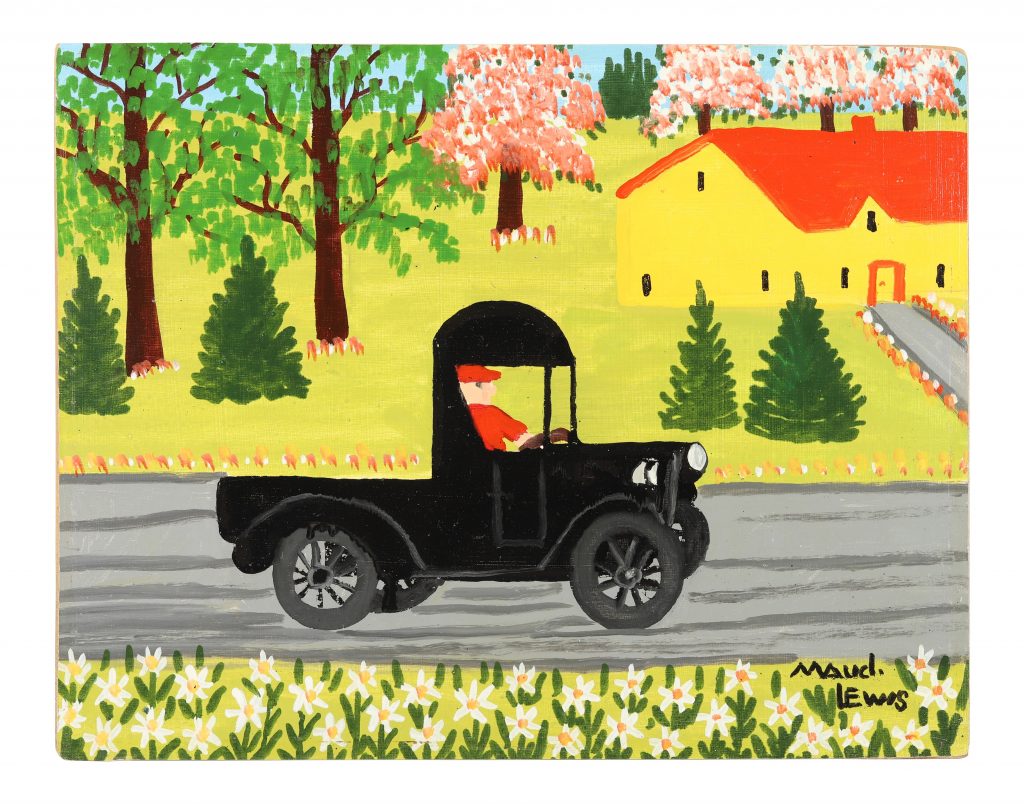
Art: Maud Lewis via Artnet.
The Maud Lewis painting “Black Truck” was once traded for grilled cheese sandwiches. Recently, it fetched 10 times its estimate at auction.

Maud Lewis was a self-taught folk artist in Canada, the kind of person no one takes seriously until they burst onto the world stage. Something similar happened to one of her paintings, “Black Truck.”

Sydney Page reports at the Washington Post, “Like clockwork, John Kinnear and his wife, Audrey, would go to the same restaurant each afternoon and sit at the table by the circular window. Kinnear would order only one thing: a grilled cheese sandwich.

“ ‘I could not convince Mr. Kinnear to have anything else,’ said Irene Demas, 69, who owned the Mediterranean restaurant The Villa with her husband Tony in Ontario for about a decade in the 1970s.

“The sandwich, priced at $1.95, was made with fresh bread from a local Italian bakery, aged cheddar cheese and a substantial smear of butter to make it perfectly crispy — exactly how Kinnear liked it.

“Kinnear, an artist, lived around the corner from The Villa, and he and his wife, both in their 50s, made it their regular hangout for several years in the early 1970s. The Kinnears, who are no longer alive, developed a close friendship with the Demases.

“ ‘My husband made a deal with them to trade food for art,’ said Demas, adding that Kinnear would often show up for lunch clutching a painting or two under his arm. ‘We needed art for our walls, and he needed to eat every day.’

“Demas said their arrangement with Kinnear wasn’t unusual back then.

“ ‘In the ’70s, it was different. We didn’t think so much about ourselves; we thought about our neighbors and how we could help each other out,’ she said. ‘They were very generous, and in return we did what we could for them.’

“Still, Demas and her husband, who is now 90, never imagined that a painting Kinnear traded them for a simple sandwich would one day be worth a small fortune.

“While Kinnear mainly brought his own work to the restaurant, he once arrived with several colorful paintings by an artist from Nova Scotia named Maud Lewis. …

“Lewis was a poor painter in Eastern Canada who could barely afford supplies, and she had suffered from crippling rheumatoid arthritis since she was a teen. Kinnear read about her in a 1965 newspaper article with the headline ‘The Little Old Lady Who Painted Pretty Pictures.’

“As a fellow artist, Kinnear was touched by her story and began sending her supplies, including brushes and paints. In exchange for his kindness, Lewis gave Kinnear several paintings. She typically sold her artwork at the side of the road for $10 per piece.

“Demas said the paintings — which Kinnear propped up on chairs in the restaurant that day — had a playful quality that intrigued her.

“ ‘I had never seen anything like that,’ she said. One in particular, featuring a black truck, ‘just jumped out at me.’ …

“The Demases had no idea that Lewis, who died in 1970, would become one of Canada’s foremost folk artists, despite never achieving wealth or prominence in her lifetime.

“Alan Deacon, an expert on Lewis’s work who authenticates her paintings, said her art skyrocketed in value after her death. …

“About a year ago, as the couple downsized their home, they decided to appraise a few items — including the black truck painting and the letters that authenticated Kinnear’s relationship with Lewis. …

“First, the Demases offered the artwork to their two children, both of whom urged their parents to sell it and enjoy the profits in their retirement. The couple decided it was time to part with the painting. …

“In a virtual auction on May 14, the painting sold for $272,548 — more than 10 times its assessed value. The letters fetched more than $54,500.

“ ‘I was just speechless,’ said Demas.

“Ethan Miller, chief executive officer at the auction house, was also stunned.

“ ‘Off the charts is an understatement,’ he said. ‘I think everybody saw in this painting exactly what Maud intended, which is brightness, optimism and fun. …

“ ‘Just given the heaviness of this era that we’ve managed to survive, suddenly someone mentions a grilled cheese sandwich and a celebrated artist that has overcome physical adversity,’ Miller said. ‘All of those things combined is as irresistible as a grilled cheese sandwich.’

“The buyer, a Canadian man who asked to stay anonymous to protect his privacy, said that was precisely what propelled him to purchase the painting. … ‘I’m not an art collector by any means.’

“The evening before the auction, he and his wife watched the 2016 film Maudie, which chronicles Lewis’s life. After learning her story of resilience, he wanted the piece.”

More at the Post, here. And if you have never seen the lovely Sally Hawkins film about the artist, Maudie, please check it out here.


Read Full Post »

Photo: Nils Herrmann, Cartier Collection via Dallas Museum of Art.
From the Dallas exhibition: Tiara, Cartier London, special order, 1936; Bandeau, Cartier Paris, special order, 1923; Bandeau, Cartier Paris, 1922.

Even though this blog is based at my daughter’s jewelry company (where it’s been known to reassure an anxious online shopper that Luna & Stella is “good people”), I was encouraged to be eclectic, and I don’t write about jewelry that often.

But today I want to tell you about a jewelry exhibit in Dallas that’s unusual. It’s all about how designs in Islamic art influenced the renowned jewelry company Cartier.

Shirin Jaafari reports at Public Radio International’s the World, “The name Cartier has been synonymous with opulence and luxury going back nearly two centuries. British King Edward VII described Cartier as the ‘jeweler of kings and king of jewelers,’ according to Francesca Cartier Brickell, whose ancestors founded the company in 1847.

“Now, a new exhibition at the Dallas Museum of Art [DMA] called ‘Cartier and Islamic Art: In Search of Modernity,’ tells the story of how some Cartier pieces were inspired by Islamic art. …

“The family business was started in Paris by Louis-François Cartier and later, his son and grandsons took over. They expanded the company and found inspiration from the art and designs of places such as Russia, India and the Middle East.

In 1903, Louis-François Cartier visited the Musée des Arts Décoratifs in Paris, which was running an exhibition on Islamic art.

“That was the beginning of Louis-François Cartier’s fascination with the format, shapes and techniques used in Islamic art.

“ ‘There were a series of major exhibitions that were happening in Europe at the beginning of the 20th century, and of course, with things like the Ballets Russes and “Scheherazade.” … So, there becomes this big zeitgeist, synergistic sort of moment of interest, and that really spurs this as a sort of source of a modern expression,’ said Sarah Schleuning, senior curator of decorative arts and design at the Dallas Museum of Art.

“Louis-François Cartier collected pieces from those exhibitions — Persian miniatures, cigar boxes with geometric designs and photos of Islamic architecture. And slowly, those designs were incorporated into Cartier pieces.

“ ‘It looks like this colonnade of arches, and we were able to trace back this connection with a mosque in Cairo and these photographs that were in the Cartier archives,’ she said. ‘It was something that was exhibited at the 1903 exhibition of Islamic art at the Musée des Arts Décoratifs.’

“Cartier clients would often have their own gemstones and asked Cartier to design around them, Schleuning explained. But the company also sourced its own material from different parts of the world.

“For example, in the fall of 1911, Jacques Cartier, the youngest son of Alfred Cartier and grandson of the company’s founder Louis-Francoise Cartier, set off on a trip to India. Along the way, he visited the Gulf country of Bahrain, where pearl diving was popular. …

“Schleuning pointed out that we know a lot about how Cartier pieces came together because the family meticulously documented everything.

“ ‘These books and portfolios and resources were available to the designers as was the fact that the works of art that Louis privately collected, he photographed,’ she said.

“One diamond and turquoise tiara has the Persian motif boteh or what’s become known in the West as paisley, as the main part of its design. …

“Schleuning said that a part of the project at the Dallas museum is to connect Cartier’s designs with the sources that inspired them. The bandeau is just one example.

“ ‘[It’s] to say, “Hey this wasn’t just a phenomenal colonnade of arches but this came probably from this mosque in Cairo and here, we can trace that and so now, we’re broadening that understanding,” ‘ she said.

“The exhibition is a collaboration between the Dallas Museum of Art, the Musée des Arts Décoratifs in Paris and Maison Cartier. It runs until Sept. 18.”

Jean Scheidnes at Texas Monthly adds a thought: “I found myself wrestling with the question of appropriation, because we must. My assessment after absorbing the show is that no single tradition could have given rise to Cartier style. Only Cartier, with its unique alchemy of inputs and individual creativity, could give us Cartier. This show is here to recognize and honor the Islamic influence, and it taught me a lot.”

More at Texas Monthly, here, and the World, here. (No firewall. Great journalism.)

Read Full Post »

Photo: Luba Petrusha via Wikimedia.
A mix of traditional Ukrainian, diasporan and original pysanky (Ukrainian Easter eggs).

Today’s story shows how artists help a country’s culture survive.

Katya Zabelski writes at Hyperallergic, “Last year, when I was writing my dissertation on the history of Ukrainian folk [art], my research found a repeated pattern: Despite long histories of suppression, erasure, and destruction, Ukrainian people often used folk art as a tool of resistance and a symbol of hope and preservation.

“During the Soviet era, artists found sly ways to incorporate folk art into their work, despite the possibility of serious consequences. During the Euromaidan revolution [of 2013], vyshyvankas (traditional Ukrainian embroidered shirts) became extremely popular and are now a part of daily fashion. …

“Now, over 100 days since the war began, there is a resurgence of Ukrainian folk art symbols throughout media, art, and everyday Ukrainian life. And for the first time, the international community is using Ukrainian folk art to show solidarity with the Ukrainian people. …

Pysanky are one of the most recognizable Ukrainian folk art forms. The decorative eggs are an indigenous art associated with Carpatho-Rusyn women in Western Ukraine; they were often planted in the ground to encourage fertility and growth. The legend goes that the fate of the world depended on the pysanka.

Each year, an evil monster, chained to a mountain cliff, sent his henchmen to see how many [decorated eggs] were created in the land. If the number of pysanky was high, then the monster’s chains would tighten up.

“If the number of pysanky went down, then the monster would be unleashed to sow destruction. As long as Ukrainians continue to create pysanky, the world continues to exist. 

“Sofika Zielyk, a Ukrainian ethnographer and pysanka artist, has organized the exhibition The Pysanka: A Symbol of Hope at the Ukrainian Institute of America in New York. … Once the war is over, the eggs will be taken to Ukraine and planted in the soil, to help rebuild and fertilize Ukraine, in line with the ancient tradition. …

“Olya Haydamaka is a Kyiv-based illustrator whose work is influenced by traditional clothing. As a response to the Russian invasion, Haydamaka has created multiple illustrations of women in traditional clothing acting as protectors and healers of Ukraine. In ‘Чернігів. Сильне коріння. (Chernihiv. Strong Roots.)’ (2022), Haydamka responds to the particularly brutal attacks on Chernihiv in northern Ukraine. The woman wears a traditional embroidered vyshyvanka with exaggerated embroidered sleeves, along with a traditional red coral namysto (necklace). The iconic St. Catherine’s Church levitates in the air, with deep red roots dangling under it. This piece not only highlights Ukrainian folk clothing but also elevates the clothes to be otherworldly and ‘healing.’ …

“Danylo Movchan, a contemporary painter from Kyiv, created ‘Struggle’ (2022) in response to news that 25 paintings by Maria Pryimachenko, Ukraine’s most loved folk artist, had been destroyed. In this work, Movchan painted a Pryimachenko-inspired creature in yellow and blue, with a tongue that attacks a dark figure to the right of the composition. …

“It was not just Ukrainian artists who were impacted by the destruction of Pryimachenko’s works. The international community has also used her illustrations to show solidarity with the Ukrainian people. The group Justice Murals, which uses the medium of murals to inspire change and action, partnered with the Ukrainian Institute to project Pryimachenko works on buildings in California. Murals featuring Pryimachenko’s work were showcased in Oakland and San Francisco, with a text that read: ‘Art bombed by Putin. Boycott Russia.’ 

“The international music community is also seeking inspiration from Ukrainian folk art. Florence Welch of Florence and the Machine has recently released a new music video entitled ‘Free,’ featuring the British actor Bill Nighy. In parts of the video, Nighy and Welsh can be seen seated in front of a backdrop of petrykivka-style flowers, painted by Ukrainian artist Katerina Konovalova. At the end of the music video, Florence Welsh makes the connection between the title, the Ukrainian folk art paintings, and the war by dedicating the song to ‘the spirit, creativity, and perseverance of our brave Ukrainian friends.’ ” 

More at Hyperallergic, here. No firewall, but memberships welcomed.

Read Full Post »

Photo: PriyaShakti.com.
Indian superhero Priya Shakti was named Gender Equality Champion in 2014 by UN Women.

Superheroes are not all brawn these days, bending steel and throwing cars around. They are not all white males, and they don’t spend all their time chasing gangsters. Gangsters may be bad, but there are other problems in the world that need to be addressed just as urgently.

Chhavi Sachdev writes at the radio show the World, “India’s first female comic superhero has previously tackled issues like masking up during COVID-19, surviving assault, trafficking and acid attacks. On Earth Day, Priya [returned] — astride her faithful flying tiger — to show young children the power of collective action in tackling air pollution.

“When Ram Devineni decided to create India’s first female comic superhero, he had plenty of inspiration.

“Indian mythology is full of gods and goddesses who come to the aid of mortals in trouble. The goddess of fortune, Laxmi, shows up riding an owl. The goddess of knowledge, Saraswati, travels on a peacock.

“Devineni’s hero, Priya, travels around the world on a flying tiger named Sahas, helping people find solutions to the problems they face. In the seventh comic of the series, Priya and the Twirling Wind, she tackles climate change in northern India and the toxic haze that affects New Delhi.

“The comic book is 18 pages long, but there are also puppets and a short animated film online. And the physical comic book itself has an extra element: augmented reality. If you scan certain panels, you can see and hear the puppets on a smart device.

“The story is fairly simple. Little Somya’s asthma is so critical that she ends up in a hospital. Her cries for her mother catch Priya’s attention, who is passing by with Sahas. So, Priya takes her to a magical land where the air is clean and easy to breathe. But unfortunately, there’s trouble even there — miners are cutting down trees. 

“ ‘And then, it becomes up to Somya, Priya and the women in the village to stop deforestation of this forest that Priya and they live in,’ Devineni said. 

“Somya, Priya and the village women put their arms around the tree trunks, forming a human chain so that the miners’ henchmen cannot cut them down — a direct homage to what’s known as the chipko movement that began in 1973 in the Himalayan region of Uttarakhand, referring to how women pressed their bodies against trees to defend them. It’s been hailed as one of the earliest women-led environmental movements.  

“Devenini said that they found images from the 1970s in northern India. Village women had realized that deforestation was affecting not only their food chain and natural resources, but also causing unprecedented flooding, so they decided to take a stand.  

“In her first five comics, Priya tackled gender issues — like women who survive acid attacks and trafficking. …

“Priya survives an assault and finds herself being judged and blamed. She flees to the jungle, where she notices a tiger stalking her. Finally one day, she finds her shakti, or ‘power,’ and looks it in the eye. Since then, the tiger (whose name Sahas means courage) remains her loyal companion in the fight against injustice. …

“Devineni is a documentary filmmaker, but he chose to address these issues in graphic novel format to reach wider audiences.  

‘I felt it was important that Indian men needed to talk to teenage boys about how we treat or mistreat women,’ he said. ‘And I know teenage boys just don’t watch documentaries.’ …

“The new comic, Priya and the Twirling Wind, is for younger children. And the goal is to make the problem of air pollution feel less overwhelming. … Devineni hopes that children will channel their own superpowers to find a solution.”

More at the World, here, where you can also listen to the news report. No firewall.

Read Full Post »

Photo: Regional Conservation Needs.
Wood turtles are said to make nice pets. Too nice for their own good: their reputation leads to poaching.

There’s a popular kind of turtle that’s losing habitat, like so many species these days. Here’s a story about a man who was determined to preserve his own land for these turtles, particularly for one specimen — his friend Stumpy.

Sadie Dingfelder reports at the Washington Post, “With his brow furrowed, Tom, 70, stomps on the damp leaf litter — thump, thump, thump, thump — and then we wait. A woodpecker cackles; bluebells tremble in the breeze. Stumpy is nowhere to be found. …

“A wild turtle, Stumpy has been meeting up with Tom in these West Virginia woods every spring for more than 30 years. Like his fellow wood turtles, Stumpy spends his winters brumating (the reptile equivalent of hibernating) in a clear, fast-moving stream. As days warm, he emerges from his aquatic home and roams the nearby woods in search of food ⁠— first tender leaves, then flowers and, finally, berries. Early on Stumpy’s circuit is Tom’s former house, where the human tosses him huge, juicy strawberries — months before the wild berries are ready to eat.

“It took a while for Tom to figure out Stumpy’s species, because Stumpy’s shell is worn and scuffed. Usually, wood turtles have gorgeous shells that appear to have been hand-carved from mahogany.

‘He was already old when I first saw him, so he must be really old now,’ says Tom. ‘Of course, he could say the same thing about me.’

“Curious, personable and uncommonly pretty, wood turtles are highly sought-after as pets, says Andrew Walde, chief operating officer of the Turtle Survival Alliance, whom I called after my first visit to Stumpy Acres. This combination of characteristics makes them vulnerable to poachers, who sell them as pets. ‘Whenever anything gets published about a particular population, that population is done for,’ Walde says. (To protect Stumpy and the other wood turtles from poachers, we aren’t publishing his exact location or his human friends’ last names.)

“The eastern panhandle of West Virginia is among wood turtles’ last strongholds, Walde says. Across most of their range, they are in steep decline. Indeed, half of the world’s 357 turtle species are threatened with extinction due to habitat loss, poaching and other human pastimes. This is an animal that survived not one, but two mass-extinction events. …

“Tom no longer lives in Stumpy’s territory. Last spring, he sold his house and moved to a more remote spot, high on a nearby mountain. He loved being by the river, but the pandemic brought an influx of tourists and new homeowners. The noise and traffic were bad enough, but worst of all was their aggressive landscaping.

‘One family clear-cut all the way down to the river,’ Tom says. ‘They didn’t want any brush or shrubbery — they are afraid of snakes or this or that — and they kinda destroyed the habitat.’

“He was determined to find a buyer who would be a good steward of the land — not just for vague environmental reasons, but for Stumpy’s sake, too. Luckily, the first person who came to look at the house fit the bill. Tommy, a 28-year-old computer programmer from D.C., told Tom about the sea turtle conservation project he had worked on one summer in Costa Rica, and he promised not to clear-cut the property to get a river view or better internet access. …

“Does Stumpy represent nature? Survival against the odds? The relentless ravages of time? Tom dismisses all these possibilities. ‘Stumpy is just Stumpy,’ Tom says. ‘He’s an individual. That’s what makes him special.’

“We drive to Tommy’s house and commence stomping. Stumpy should really be out of hibernation by now, but he’s not in their meeting spot near a large fallen tree, and he’s not on the berm by the river. He’s not basking on his basking log, and neither is he napping beneath the papaw trees. …

“If you spend time outdoors, you’ll eventually see something brutal, and you’ll be forced to accept it with equanimity, because nature is obviously beyond our judgment. Loving nature also feels a little tragic, because no matter how much you care about it, it will never care about you.

“But perhaps I’m wrong, because suddenly I hear a rustle in the leaves. Tom makes an excited sound. ‘There he is!’ he says, pointing. About 10 feet in front of us, a little brown turtle is running on his tiptoes — who knew turtles could run? And even though I’m closer and I’m also carrying strawberries, he’s beelining straight to Tom. …

“Pretty soon, Stumpy’s face is covered in pink pulp, and he’s got half a strawberry hanging from his chin. His species may be threatened, his habitat may be imperiled, but in this moment Stumpy seems delighted. ‘He’s such a messy eater,’ says Tom. ‘Do you see that? What a pig.’ Stumpy usually hangs out for a few weeks, making intermittent appearances, Tom says. As to where he goes afterward, no one knows — but Tom has a theory. ‘Maybe he visits lots of people, up and down the river, and we all think he’s ours.’ ”

More at the Post, here.

Read Full Post »

Photo: Guinness World Records.
“Walter Orthmann has been working at the same company for 84 years and 9 days, as verified on Jan. 6. He started work as a shipping assistant on Jan. 17, 1938, when he was 15 years old,” the Washington Post reports.

I didn’t love every job I ever had, but when I had one I liked, I looked forward to Mondays and never rejoiced with colleagues just because a Friday was a Friday. Today I have a story about a man who really, really loved his job. His enthusiasm for work seems to have added to his longevity. I’d surely take some of those longevity pills if I could.

Dave Kindy reported at the Washington Post, “Walter Orthmann vividly recalls his first day of work. He was 15 and eager to make a good impression. Young Walter woke at 4 a.m. and began the long trek to the factory an hour later. The apprehensive teenager covered the five-mile route with plenty of time to spare before his 6 a.m. shift in the shipping department.

“That was 84 years ago, and Orthmann is still on the job. He turned 100 on April 19 and holds the title for the longest career at the same company, according to Guinness World Records. In fact, his birthday was celebrated as a holiday at the firm, RenauxView, a textile manufacturer in Brusque, Brazil.

“ ‘The whole plant was shut down and all employees were invited along with clients, suppliers, my family, friends and dignitaries,’ Orthmann said through an interpreter.

“Not only does Orthmann work every day, but he also still drives a car, cares for his ill wife (who is 31 years his junior) and even exercises for an hour each morning.

He rises early to stretch, meditate and breathe in preparation for another day of work.

“These days, Orthmann works as a sales manager: taking orders from old clients, helping colleagues in sales and overseeing sales in all departments. Until 2016, he was still traveling across Brazil to meet with accounts.

“ ‘Informally, he’s a lifestyle guru,’ said Roberto Sander, a co-worker. ‘Lots of people seek his advice on how to lead a long and productive life. His philosophy? “Just avoid sugar, junk food and soda. Find a job you like and never retire!” ‘

“Actually, Orthmann has technically retired. He was forced to take mandatory retirement by the company in 1978, but he was rehired the next day because he was so good at his job.

“ ‘The CEO of the company at the time invited me to rejoin and keep selling,’ he recalled. ‘Today, I receive a pension and a salary.’ …

“During World War II, Orthmann was drafted into the Brazilian army, which sent an infantry division to Italy to fight with the U.S. Fifth Army. He did not have to ship overseas. …

“The war years also meant other changes for Orthmann. He grew up in a German enclave in Brusque and spoke only German, which was outlawed when Brazil declared war on Germany in 1942.

“ ‘I was kind of forced to learn Portuguese as quickly as possible,’ he recalled.

“For Orthmann, working has been the key to survival — and longevity. He was elated when he got his job with the fabric producer because that meant he didn’t have to work on a farm. There weren’t too many career opportunities in Brazil in 1938, he said. …

“As Orthmann grew with the company, he took on more responsibilities, eventually moving into a sales position. During his first week in that capacity, he sold enough orders to keep the plant busy for three months. Orthmann realized this was what he wanted to do for the rest of his life.

“ ‘It gives me a routine and a reason to get up in the morning,’ he said. ‘Work prevents you from getting sick and lazy, which is the beginning of the dying process. Most of my friends who retired are gone already. When you don’t occupy yourself with something, you are actually just waiting to die.’

“Orthmann keeps himself sharp — physically, mentally and emotionally. He tries to stay on top of technological advancements, even though he might be distrustful of some of them at first. A case in point is the modern calculator.

“ ‘I was in charge of the department that dealt with daily billing, and I made all calculations in my mind,’ he said. ‘When the calculator arrived, I doubted it could be as precise as I was, so I kept doing it my way and checking the calculator’s result for one week until I was sure it worked.’ …

“Of course, his life has not been without challenges. Orthmann’s first wife died in 1978. When he was 75, he had a kidney removed because he wasn’t drinking enough water. (He now consumes two quarts every day.) …

“Despite the setbacks, Orthmann remains upbeat. He arrives early at work in the mornings and drives home at lunch each day to help his wife, who suffers from Parkinson’s disease. Then he returns to the office for a full afternoon of work.

“ ‘Having a routine is what makes me feel like getting up every day,’ he said. ‘Now I’m looking forward to celebrating the 100th anniversary of the company in three years’ time.’ ”

More at the Post, here. At Guinness World Records, here, there’s no firewall.

Read Full Post »

Photo: Sunphol Sorakul/Moment via Getty Images.
Some of Kyoto’s machiya homes that mix work and living space took on a new life during the pandemic, Bloomberg reports.

The places where people worked and the places where they slept merged during the pandemic. In Japan, that change gave an ancient style of architecture renewed prominence.

As Max Zimmerman wrote at Bloomberg CityLab in May, “While the pandemic has turned many kitchens and bedrooms into makeshift home offices around the world, there’s one style of housing in Japan that’s been mixing business and living space for centuries.

“The city of Kyoto is known for its stock of unique historical structures called Machiya, which get their name from two Japanese characters: machi — which in this context can mean a neighborhood, market or group of workshops — and ya, meaning dwelling. These beautiful wooden townhouses, which mingle residences with storefronts and workshops, offer a rare window into traditional Japanese life and architecture. Their design also raises an important contemporary question: How can aging homes created for a bygone lifestyle be incorporated into a modern city?

“Despite economic and cultural headwinds, machiya have proven capable of adapting to the present — and even influencing homes in the future.  An influx of tourists before Covid-19 saw many machiya find renewed purpose as restaurants or vacation rentals, while their mixed-use design provides lessons for people adjusting their lifestyles to working at home during the pandemic. 

Kyoto’s machiya reached their maturity as an urban form as early as the 17th century when, during a tumultuous period that still preoccupies Japanese culture today, the Tokugawa Shogunate ended more than a century of political violence.

“As the city rebuilt, massive demand for housing led to a standardization of designs, materials, measurements and fittings that allowed them to be erected quickly and inexpensively throughout the city. 

“It was during this time that machiya emerged as not just homes and businesses but also the basic building blocks for the city’s wider administrative structure. In times of conflict, communities within Kyoto banded together to defend themselves, even building stockades around their neighborhoods to protect themselves from the violence. When peace was restored, the Shogunate made these groups a permanent part of the city’s administration as semi-autonomous units with the power to establish local bylaws.

“Chief among their concerns was the uniformity of each machiya, whose size and design were crucial for fostering equality and harmony among its members. These neighborhood groups regulated the width of plots, forbidding the creation of larger parcels or combining homes, and imposed strict rules on various design elements. This ensured a relatively even distribution of taxes, light, ventilation and safety — as well as a pleasing aesthetic.

“These plots became known as unagi no nedoko, or ‘eels’ beds,’ for their long and narrow proportions. These ‘beds typically started at the street with a shop unit, fronted not with walls or glass but wooden lattices that provided some visibility from the inside and privacy from the outside. The typical unit was covered in a sloping roof, clad in lines of curved tiles producing a characteristic wave-patterned surface.

“Behind the shop was the residence, composed of multipurpose rooms with tatami mat floors and sliding doors. The deepest room was reserved for the head of house and important guests, with a small courtyard garden for light and ventilation. The spine of the house was a broad corridor with a packed earth floor running down one side of the house, connecting the commercial and residential portions. This hallway was where daily functions like cooking were performed, with a toilet and bathing space at the end. While the earliest machiya were single-storied, most later examples have an upper floor used as storage or sleeping space with slitted apertures to let in light. …

“For more than 250 years, machiya were the economic, political and social glue of Kyoto — as small businesses powering the economy, as households organizing community events such as festivals, and as administrative units by which local affairs were managed. 

“They began to change in the mid-19th century, when reform-minded revolutionaries overthrew the shogunate, destroying much of Kyoto and ushering in Japan’s modern era. In its rebuilding process, the city embarked on a period of modernization by incorporating western technologies and culture. …

“Although Kyoto was spared from destruction in World War II, its aftermath endangered machiya more than any other conflict. Japan’s postwar recovery redoubled modernization efforts that produced major housing changes. In their heyday, the machiyas’ use of gardens for natural light and ventilation would have made them relatively comfortable dwellings. By new standards, however, they were cold in the winter, lacked novel necessities like modern kitchens, had poor lighting and were expensive to maintain. …

“Many owners demolished or sold their machiya to make way for western-style housing like danchi apartments. Those that held on refurbished them with modern appliances, materials and layouts. New laws also made it impossible to build machiya with traditional construction techniques, leading to a decline in their number and skilled workers who can build them. There were 40,146 surviving machiya in Kyoto as of March 2017, down from 47,735 in 2011, according to a city survey. …

“Since the early 2000s, many machiya have found new life as restaurants, cafes, and museums thanks to a nostalgic aesthetic popular among young people and tourists. Some people still use their machiya to make traditional crafts like sake and textiles, while others have been preserved as cultural landmarks. …

Garden Lab, a co-working space and residence built out of two machiya that were uninhabited for four decades, is one such example of reuse. It forms part of a restored machiya cluster that includes a coffee shop and roastery, which makes use of the machiya’s capacity to accommodate machinery. Garden Lab’s founder, Drew Wallin, says that neighbors have noted the renovation’s positive impacts on the area after their long-term abandonment. 

“Wallin founded Garden Lab, however, to demonstrate how machiya can help balance private and professional life, a struggle for many still working from home as the pandemic endures. He found that machiya’s incorporation of natural light and outside air fostered healthier routines in ways that artificially lit, climate-controlled  homes fall short. Their reliance on the sun for light and warmth, for example, can help residents detach from work in the evenings and improve sleep habits as night set in. “

More at Bloomberg, here. Great photos. No firewall.

Read Full Post »

Photo: Debbie Long.
Debbie Long, “Willa (interior)” (2015-2020), RV, light, glass. The Taos-based artist has outfitted two vintage RVs with hundreds of cast glass pieces that collect light from the desert sky.

In today’s story, we learn about an artist in the US Southwest who was moved by the light of the desert sky and wanted to capture the feeling of awe in her work.

Molly Boyle reports at Hyperallergic, “Nearly a thousand years ago, the ‘great houses’ at Chaco Canyon and Aztec Ruins, both in New Mexico, were aligned to track and highlight celestial events. The same basic idea is behind Debbie Long: Light Ships, the artist’s first solo museum exhibition, which pays tribute to the desert sky and its continuous but mercurial shifting of light.

“Over the past decade, the Taos-based Long has outfitted two vintage RVs with hundreds of cast glass pieces that collect light from the sky via a transparent ceiling. Inside the pristine white chamber of ‘Willa, stationed outside the Harwood Museum of Art, viewers lounge in cream-colored beanbag chairs for a one-hour immersive viewing experience (no phones or recording devices are allowed). Clouds pass overhead, light trickles from sunrise to sunset to twilight to moonlight, and every movement of the sky orchestra flickers in the handmade glass pieces. Like many of the most successful Light and Space pieces, ‘Willa’ and her predecessor, a trailer called ‘Naima,’ rely on the simplest of gimmicks: light collection. …

“Long says the ideal viewing experience of one of her ‘light ships’ (a wordplay on the Earthship houses that dot the Taos Mesa) involves a trip to the isolated desert landscape where it will be at least semi-permanently installed. ‘For me, it’s not a regional piece,’ she tells me.

‘Once you’re inside, it almost doesn’t matter where you are. You go somewhere else. But placing them in the landscape, my intention is for the RV to be someplace you need to travel to, so that slowing down and remoteness is part of the whole experience.’ …

“[For ‘Naima,’ glass orbs were] crafted via a lost-wax casting process during which each mold is annihilated in the firing process, making every piece unique. Long says her process of building each glass piece into the RV is intuitive. ‘I started up in one corner and composed my way out.’ …

“Filled with amber light, the small glass clusters resemble globs of honey dripping from the ceiling — or malformed stalactites. … The light changes almost imperceptibly, shifting in the glass, moving your eyes around the shape of new forms and shadows. …

“It’s possible to see a Light and Space lineage in Long’s work. Having moved to Taos in the early 1990s, she befriended artists Larry Bell and Ron Cooper. For a time, ‘Naima’ was stationed in Bell’s yard, and it saw its first installation in a dry lakebed as part of High Desert Test Sites 2013, in the Mojave Desert. But Long also says the work benefits from her long relationship with the vast landscapes and uninterrupted skies she got to know as a child growing up in New Mexico.

“Long is emphatic that Light Ships is not meant to be experienced in 10- or 15-minute glimpses, and the Harwood is offering periodic ticketed sunset viewing experiences of ‘Willa,’ led by the artist herself. Viewers report that at twilight, the ceiling of a light ship recedes into nothingness, leaving only the floating glass to fix your eyes on. It sparks a meditation on the passage of time in a day, on the subtle sway of light and darkness and our up-to-the-minute experiences of both.”

Isn’t it kind of moving that the most common things in our lives are the most beautiful and mysterious?

More at Hyperallergic, here.

Read Full Post »

Photo: Yehor Milohrodskyi via unsplash.
The flag of Ukraine.

This will be a short post. I want to tell you about something inspiring I got involved with that ended yesterday.

Full-blown war in Ukraine started February 24 when Russia invaded the sovereign nation, but Russia had been attacking and nibbling away at Ukrainian territory for years, and Ukraine was ready to defend itself.

Shortly thereafter, a Ukrainian journalist called Igor Nalyvaiko, alarmed at the Russian disinformation he was seeing all over social media, especially English-language social media, set up a counter-effort.

Working with Ukrainian media people who spoke English, and reaching out to editor types like blogger Asakiyume and me who are native English speakers, he launched a noble experiment that lasted until July 11, when the media company backing him shut down. In the process, he built a team of new friends — Ukrainian and American — who feel invested in one another’s lives because we were interacting 24/7 across a seven-hour time difference.

If you have ever been devastated by an injustice in the world and learned that in addition to donating money, you could contribute a skill you happened to have, you will understand what a gift this was to the volunteer “proofreaders.”

I will quote from an explanation of the initiative that Igor wrote for the new proofreaders who kept signing on.

“Ukraine: Battling Disinformation In the Fight for Existence – A Voice From Ukraine 25 March 2022

“Hi Guys, 

“I was requested to shortly outline the principles of this translation initiative and its purpose for the new coming proofreaders. 

“U24 World is a 24/7 news outlet covering the current situation in Ukraine following the Russian invasion. Its aim is delivery of truthful information to fight Russian propaganda worldwide. The initiative was urged by a group of enthusiasts and workers of the national TV Channel Ukraine and volunteers who were able to join in the fight on the information frontline.

“Being assigned as a translator and a coordinator of the translators’ team (In my past life I used to be a host and a journalist but had to join the ‘international battalion’ and really think that can do much more here at the moment), I started to look for native speakers (English) proofreaders who could help in adaptation of the news for the western audiences (making the information readable), refining the word flow and delivery ,since we are working non-stop to cover every event that might be useful and can shed light onto the actual state of affairs taking place here in Ukraine.

“The work is arranged as follows: as we work 24/7 for optimization reasons we operate in 4-hour shifts. However the times are quite hard and not each one can afford 4 hours to devote to the project, so I am coordinating the group to make the process as comfortable as possible to the realistic extent under warfare conditions.

“There are editors who send Ukrainian news in the group chat, a translator (who is on the shift) picks up the news and sends a translation back into the chat tagging a native speaker who is on the shift. the English proofreader checks the translation and refines it so that it looks readable for English-speaking audience and then tags a Ukrainian proofreader (who is on the shift). The latter one checks if the information is not distorted in the final proofread adaptation compared to the initial Ukrainian news and tags an editor, which means that the editor can pick it up and post the news on one of these three platforms: Facebook, Twitter, and TikTok. …

“Thank you for your assistance and support. Yours,  Igor.” 

I think it’s safe to say, that grateful as we are to have been part of the collaboration, it also meant something special to our Ukrainian partners running to bomb shelters that strangers across the world were donating hours of their time, expecting nothing in return — just wanting to say, “You are not alone.”

My team may never know why this noble experiment shut down so suddenly, but we will cherish the experience and will, of course, continue to support Ukraine in other ways.

If interested, check out an audio summary at Happiness Quotient, here.

Read Full Post »

Photo: Chris Willson/Alamy.
Round herrings were one of the species that performed lower on the aesthetic-rankings and were deemed ‘uglier’ by the public. But even ugly fish fish need love.

In the fight to protect the ocean, it helps if the creatures needing human assistance are brightly colored and beautiful — the kind you are drawn to at a fancy restaurant’s fish tank. But aesthetic judgments like that can get in the way of important work.

Several media outlets have been covering recent research on how human attitudes are affecting protection of reef ecosystems. I’ll reference a couple.

Sophia Quaglia wrote at the Guardian, “There are plenty of fish in the sea, but ‘ugly’ fish deserve love too, according to a study.

“The reef fish people rate as most aesthetically pleasing are also the ones that seem to need the least conservation support, while the fish most likely to rank as ‘ugly’ are the most endangered species, the research has found.

“ ‘There is a need for us to make sure that our “natural” aesthetic biases do not turn into a bias of conservation effort,’ said Nicolas Mouquet a community ecologist at the University of Montpellier, and one of the lead authors of the study. This discrepancy between aesthetic value and extinction vulnerability could have repercussions in the long run, he said.

“Mouquet’s team first conducted an online survey in which 13,000 members of the public rated the aesthetic attractiveness of 481 photographs of ray-finned reef fish. The scientists fed the data into an artificial intelligence system, enabling them to generate predictions for how people would probably have rated a total of 2,417 of the most commonly known reef fish species from 4,400 different photographs.

“The combined results suggested that bright, colorful and round-bodied fish species – such as the queen angelfish and the striped cowfish – were most often rated as more ‘beautiful.’ But they were also the less ‘evolutionarily distinct’ species – meaning they are more similar, genetically, to other fish.

“Fish species that were lower in the aesthetic rankings and were deemed ‘uglier’ by the public – usually ‘drab’ fish, Mouquet notes, with elongated body shape and no clearly delineated color patterns, like the telescopefish or the round herring – were also more ecologically distinct, at greater ecological risk, and listed as ‘threatened’ on the International Union for Conservation of Nature Red List.

“The more ‘unattractive’ species have adapted to look this way because they often live in the water column and have to hide within a more homogeneous habitat, but this also makes them of greater commercial interest and more likely to be overfished, according to the study, published in PLOS Biology.

“ ‘Our study highlights likely important mismatches between potential public support for conservation and the species most in need of this support,’ said Mouquet. …

“ ‘Species such as clownfish and colorful parrotfishes are definitely the easiest for people to connect with … and it makes sense why they are often used as the figurehead of conservation efforts,’ said Chloe Nash, a researcher of biogeography of marine fish at University of Chicago, who was not involved in the study. ‘But the majority of fish biodiversity is actually composed of species that would not be considered to be “aesthetically beautiful.” ‘

“While aesthetics are recognized as a fundamental ecosystem service, they’re often underestimated for their effect on policy and conservation decisions, said Joan Iverson Nassauer, a scholar of landscape ecology at the University of Michigan. … ‘This research vividly quantifies the power of aesthetic experience to affect science and management,’ said Nassauer. …

“According to Mouquet, findings such as these can help researchers understand ‘non-material aspects of biodiversity,’ which make up what scholars call ‘nature’s contribution to people’ – the harmful and beneficial effects of the natural world on people’s quality of life.”

Not that nature needs to be justified in human terms, but there’s no doubt that humans have an impact. Sometimes just raising our consciousness about what we are doing can help us make a correction. Read more at the Guardian, here. Or listen at the radio show the World, here.

Read Full Post »

Photo: Marc Domage/© Private collection.
A detail from one of Picasso’s sketchbooks for his daughter. 

I have read things about Picasso over the years that have made me think that he might not have been a person I would enjoy knowing. Then he goes and does something like this, and I have to remind myself that people are complicated: almost everyone weaves the good with the not good.

Dalya Alberge has a charming story about Picasso at the Guardian.

“They are the ultimate ‘how to draw’ books for a young child,” Alberge writes, “created by a doting dad who just happened to be one of the greatest artists of the 20th century. The granddaughter of Pablo Picasso has discovered an extraordinary collection of sketchbooks used by the artist to teach his eldest daughter to draw and color.

“Picasso filled the pages with playful scenes – animals, birds, clowns, acrobats, horses and doves. … He created them for Maya Ruiz-Picasso when she was aged between five and seven. On some pages, the little girl made impressive attempts to imitate the master. She also graded her father’s work, scribbling the number ’10’ on a circus scene, to show her approval.

“He drew two charming images of a fox longing for grapes – inspired by the 17th-century fabulist Jean de La Fontaine’s sour grapes fable, The Fox and the Grapes – and Maya colored in one of them. He also drew simple but beautiful eagles in a single movement, without raising the pencil from the paper, conveying his love of form and pure line to her.

“The previously unseen collection includes exquisite origami sculptures of birds that he brought to life for Maya from exhibition invitation cards.

“His granddaughter, Diana Widmaier-Ruiz-Picasso, found the works by chance while looking through family material in storage. Intrigued, she showed them to her mother, now 86, for whom memories came flooding back.

“Widmaier-Ruiz-Picasso told the Observer: ‘She said, “Of course, those are my sketchbooks when I was little.” ‘ …

“Picasso, who died in 1973, had been taught to draw by his father, a professor of drawing, ‘so that was something natural for him to do’ with Maya, his granddaughter said: ‘There’s a beautiful page where he’s drawing a bowl and she’s drawing a bowl.

“ ‘Sometimes she’s making an image and he’s doing another, showing her the right way to do it. Sometimes they would depict different scenes. Other times, he would draw a dog or a hat. Sometimes he’s using the whole page to draw one particular thing. Other times, he’s depicting certain scenes, scenes of the circus.’ …

“Maya particularly remembers that, during the second world war, color pencils and notebooks were in short supply: ‘That’s probably why my father wrote in my exercise books and colored with my pencils. I still have fond memories of those moments when we met up in the kitchen to draw together. It was the only place in the apartment where it was warm.’

“Widmaier-Ruiz-Picasso is an art historian, curator and jewelry designer, who has just published her latest book, Picasso Sorcier, exploring his superstitions and belief in magic.

“She described the discovery of the sketchbooks as ‘fortuitous’ because she was co-curating a major exhibition for the Musée Picasso-Paris on his close bond with his first daughter. … The exhibition, Maya Ruiz-Picasso, daughter of Pablo, runs until 31 December and includes his many portraits of Maya, personal possessions and photographs, along with the sketchbooks and origami sculptures, which are being shown for the first time. …

“In the exhibition’s accompanying book, [his granddaughter] writes: ‘Who has never heard it said when looking at a canvas by Picasso, “A child could have done that!” Many of the artistic revolutions of the 20th century were greeted with mockery and scandal, it is true, but in Picasso’s case there is a hint of truth in that judgment. As Maya, his first daughter, recalls, “the mystery of life, and therefore of childhood, always filled that father of mine with interest.” …

” ‘Picasso borrowed extensively from the unruly lines of children’s drawings. Where Van Gogh, Gauguin and Matisse concentrated on the graphic and pictorial naivety with which children draw, Picasso emphasized more the elements that upset figurative traditions, that is to say, distortion and deformity.’ ”

More at the Guardian, here.

Read Full Post »

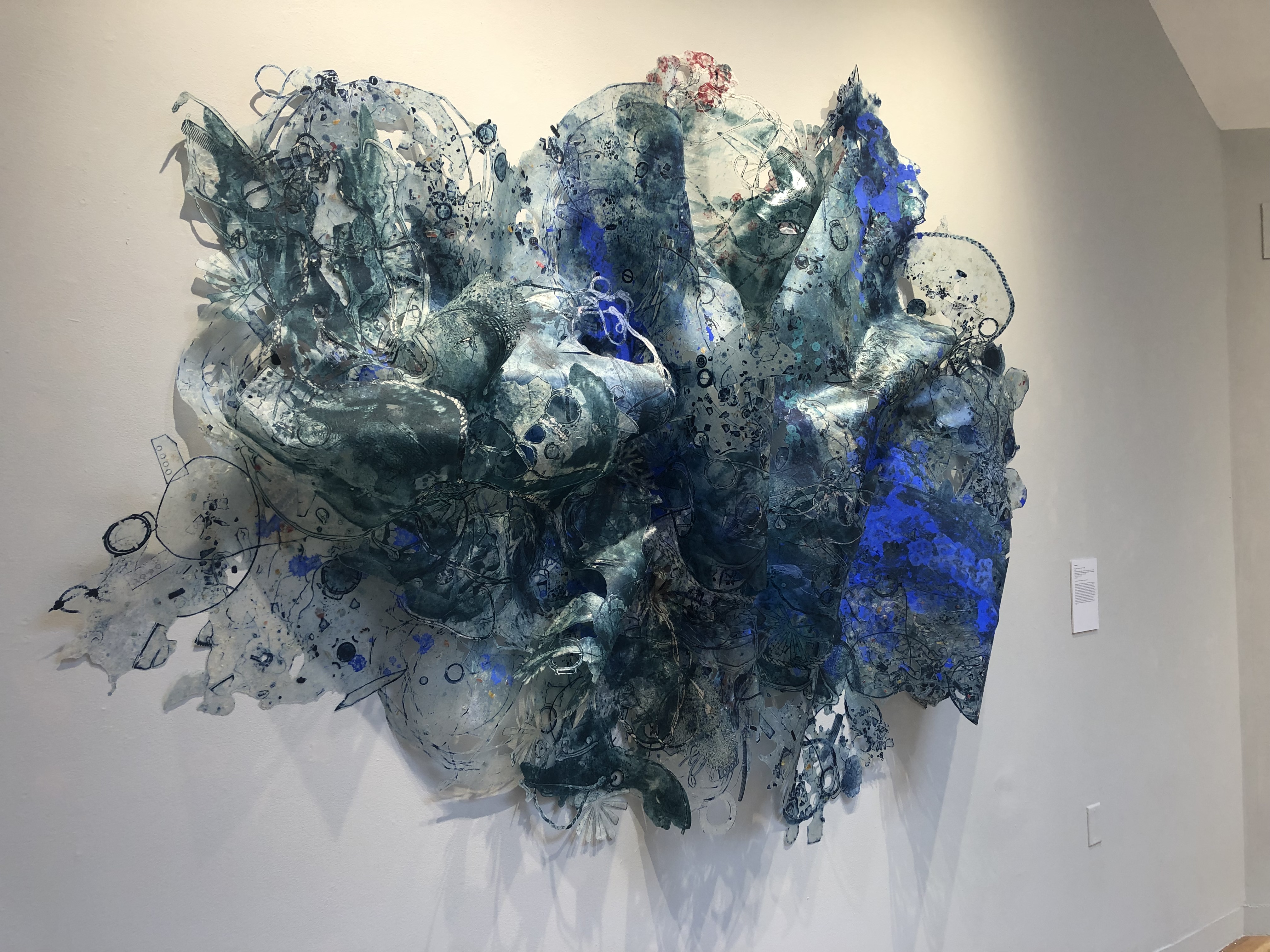
In my last batch of photos, I showed a piece from an Art League of Rhode Island exhibit to which my friend Ann Ribbens had contributed. The show, “Below the Surface,” had a humanity-versus-water theme, and the quilt I shared in that post featured a warning about toxins in fish. Today I’m displaying Ann’s lovely “Undersea Tapestry” and two other pictures from “Below the Surface.”

Now I’m wondering if there’s something in the water that New England artists are drinking. The next group of photos is from a recent exhibit at a Massachusetts gallery, and the subject is “Undercurrents: Water and Human Impact.” If artists are to be believed (and they are), things are not looking good for water and it’s all our fault.

At “Undercurrents,” I especially liked Henry Horenstein’s photograph “Cownose ray” and Joan Hall’s “The New Normal,” which hints at manmade items that wash in with the tide.

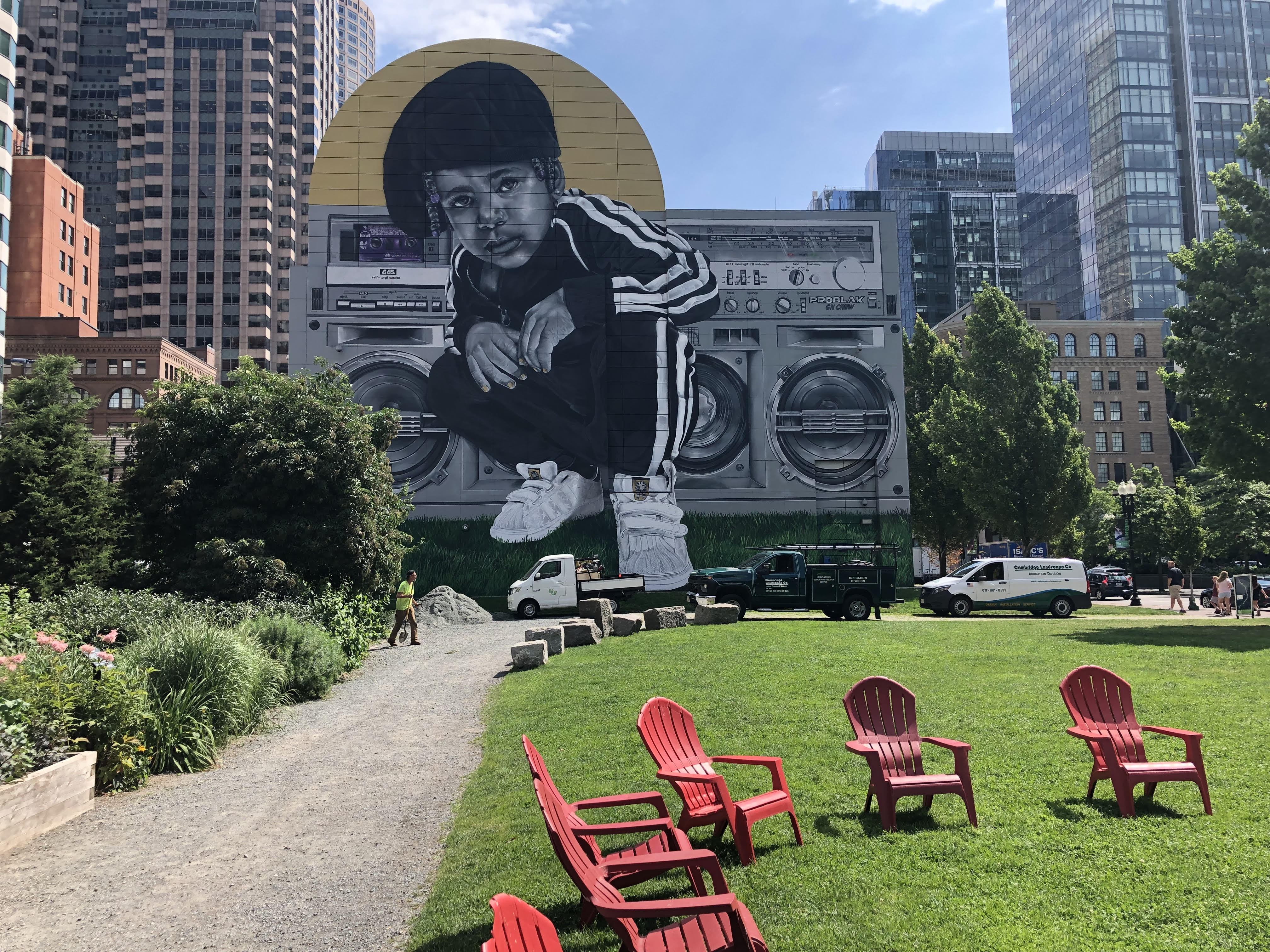
Still on the subject of art, I want to mention that yesterday I checked out the new mural on the Boston Greenway, where I used to love walking when I worked downtown. There are many post-Covid changes in the area (I felt like Rip Van Winkle gazing around in wonder after a long nap), but the Greenway is still hiring artists to paint the wall of the giant Air-Intake building over the Big Dig. The latest painting, of a little boy with a boombox, has a wistful feeling about it.

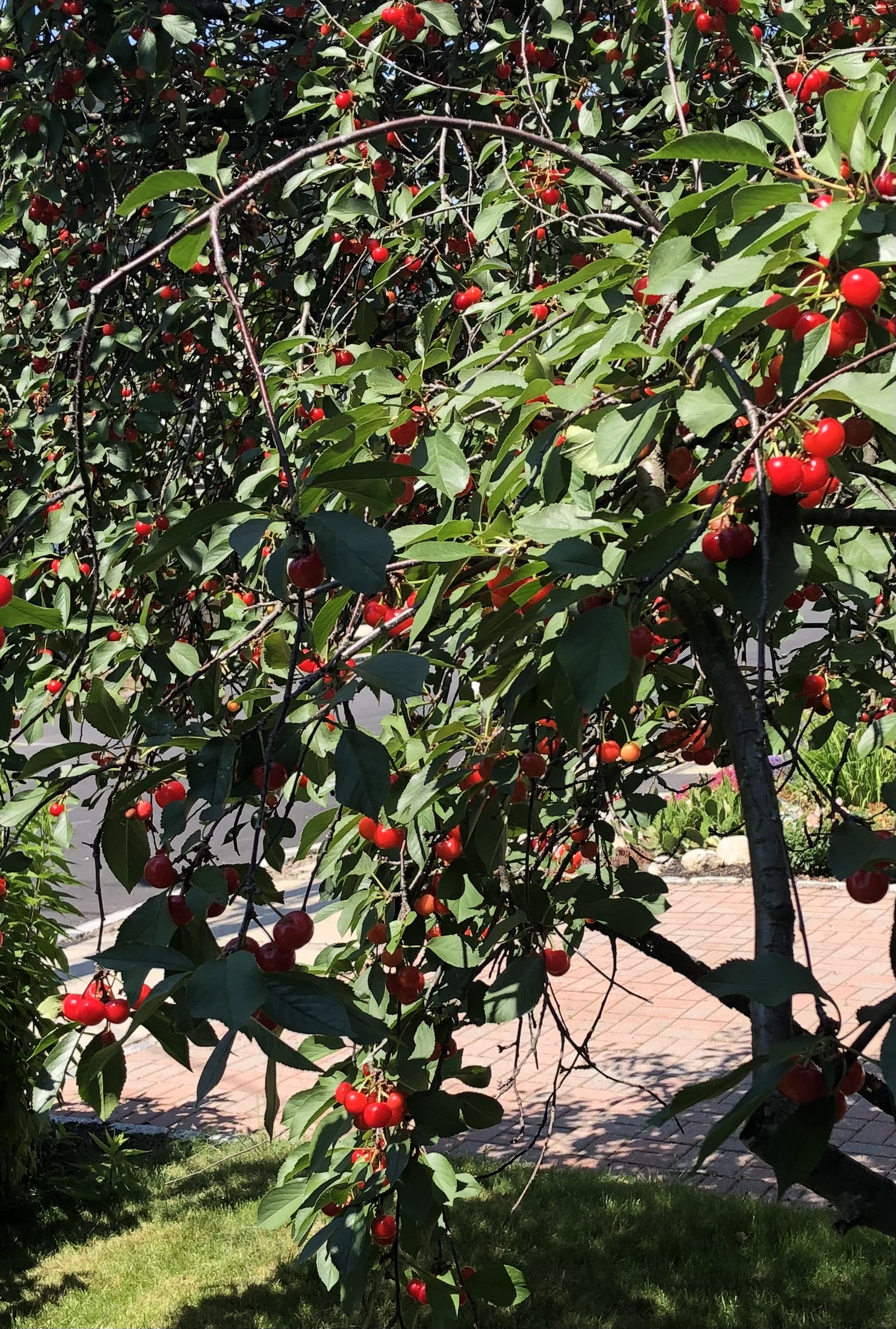
The mural photos are followed by several local scenes, including a look at the bright cherries next to John’s front porch.

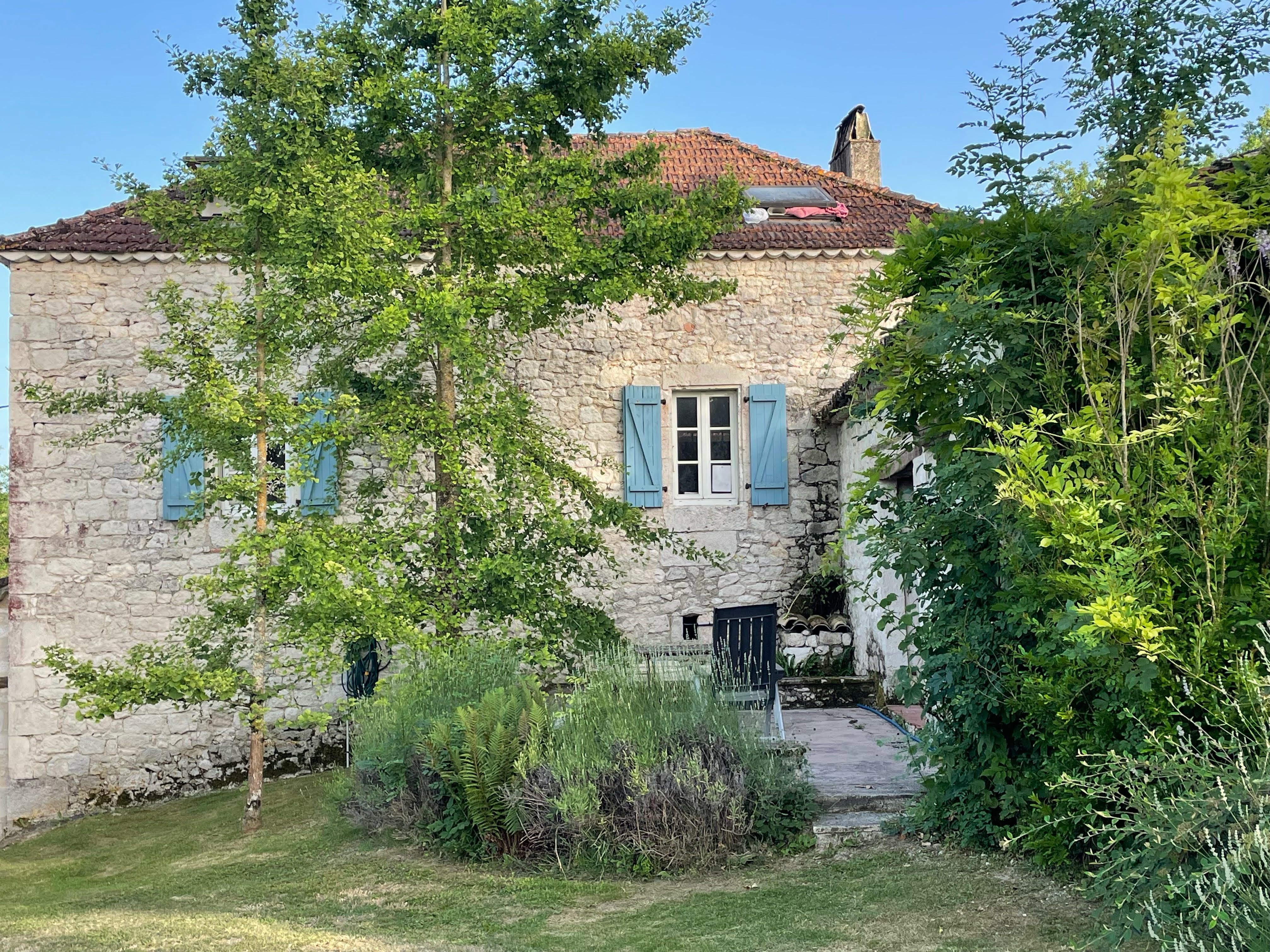
I end with a picture that Ann took last month while traveling in France. I couldn’t resist. It looks so utterly French to me.

Read Full Post »

Photo: Laura Young via LiveAuctioneers.
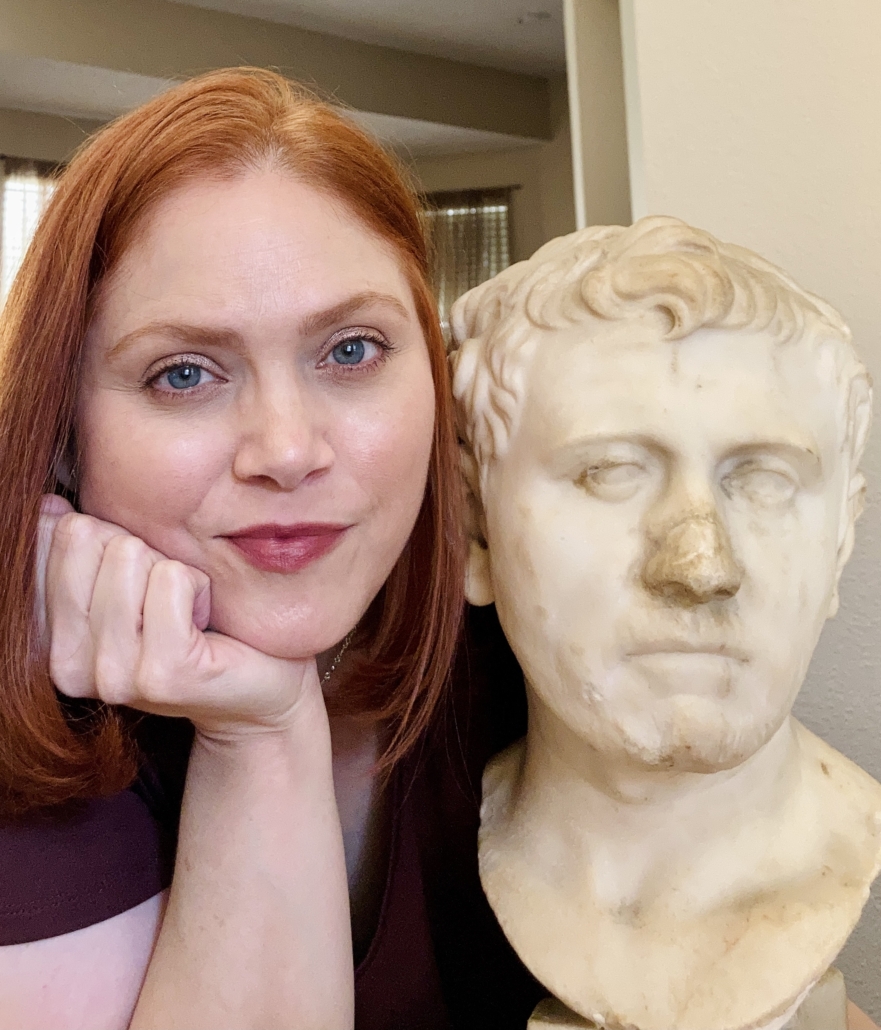
Laura Young with the Roman sculpture she found at a Goodwill in Austin, Texas.

Here’s a fun story. You may have heard it before as it was all over the media for a while. This version is by Matt Largey, reporting for KUT, an NPR station in Austin, Texas.

“When Laura Young found a human head under a table at the Goodwill store on Far West Boulevard in 2018, she had no idea what she was getting herself into.

“The price tag said $34.99. Seemed like a deal. It was all white. Made of marble. Weighed about 50 pounds.

“ ‘Clearly antique — clearly old,’ said Young, who runs her own business as an antiques dealer and goes to a lot of thrift stores looking for treasures.

“So she bought the head and lugged it out to her car, buckled it into the passenger seat and took it home.

“Young wanted to figure out what the sculpture was, so she did some Googling and she started to piece things together. She contacted an auction house in London that confirmed it was really old — like first century old. Another auction house managed to find the head in a catalog of items from a German museum in the 1920s and 1930s.

“It was listed as a portrait bust of a man named Drusus Germanicus.

“And so began Young’s four-year ordeal trying to get rid of a 2,000-year-old sculpture.

“How did a 2,000-year-old sculpture of a Roman general’s head wind up in a Goodwill in Austin, Texas?

“ ‘There are plenty of Roman portrait sculptures in the world. There’s a lot of them around. They’re generally not in Goodwills,’ joked Stephennie Mulder, an art history professor at UT Austin. ‘So the object itself is not terribly unusual, but the presence of it here is what makes it extraordinary.’ …

“The marble bust was cataloged at a museum called Pompejanum in the German city of Aschaffenburg. The museum was a replica of a villa in Pompeii, which was buried in volcanic ash in the first century. The German king, Ludwig the First, had something of an obsession with Pompeii, so he built this villa in the 1840s to house a bunch of Roman art. Germanicus was among the collection.

“Almost 100 years later, World War II was raging. In spring of 1945, Aschaffenburg was the site of a battle between the Nazis and the U.S. Army. …

“ ‘We know that many of the objects [in the museum] were either destroyed in the Allied bombing campaign or looted afterward,’ Mulder said. ‘So unfortunately in this case, it might have been a U.S. soldier who either looted it himself or purchased it from someone who had looted the object.’ …

“Perhaps the person who took it died or perhaps they gave it away. But somehow, someone decided they didn’t want it anymore and dropped it off at Goodwill. Workers slapped a price tag for $34.99 on it and put it out for sale. …

“Back at home, Young had a problem: She was in possession of a looted piece of ancient art. She couldn’t keep it. She couldn’t sell it. And giving it back to its rightful owners was a lot harder than it sounds.

“ ‘At that point, I realized I was probably going to need some help,’ Young says. ‘I was probably going to need an attorney.’

“So she hired a lawyer in New York who specializes in international art law, Leila Amineddoleh.

“Negotiations began. It was complicated. It takes a long time to figure out all this stuff — even in the best of times. But the pandemic complicated things even further. It was slow going and in the meantime, she was stuck with this 2,000-year-old head on display at her house. …

“It looked great in the house, she says. In a weird way, Young started to get attached. She named him — half-jokingly — after Dennis Reynolds, a narcissist character from the TV show It’s Always Sunny in Philadelphia.

“ ‘He was attractive, he was cold, he was aloof. I couldn’t really have him. He was difficult,’ she says. ‘So, yeah, my nickname for him was Dennis.’ …

“Finally, they got a deal: The Germans would take Dennis back. The exact terms of the deal are confidential, but the head will stay in Texas — on display — for about a year. Last month, the movers came to get him. …

“Young says, ‘It’ll be a little bittersweet to see him in the museum, but he needs to go home. He wasn’t supposed to be here.’

“[You] can see Dennis at the San Antonio Museum of Art, which already has a significant Roman antiquities collection.

“ ‘It actually ended up being a really, really good fit. He’s just right down the road,’ Young says. …

“In a way, Dennis will always be with Young. Before she let him go, she had a half-size copy of him 3D-printed. ‘I do have a collection of busts at home,’ she says. ‘So he’s with my other heads.’ “

More at station KUT, here.

Read Full Post »

Photo: Tony Jolliffe/BBC.
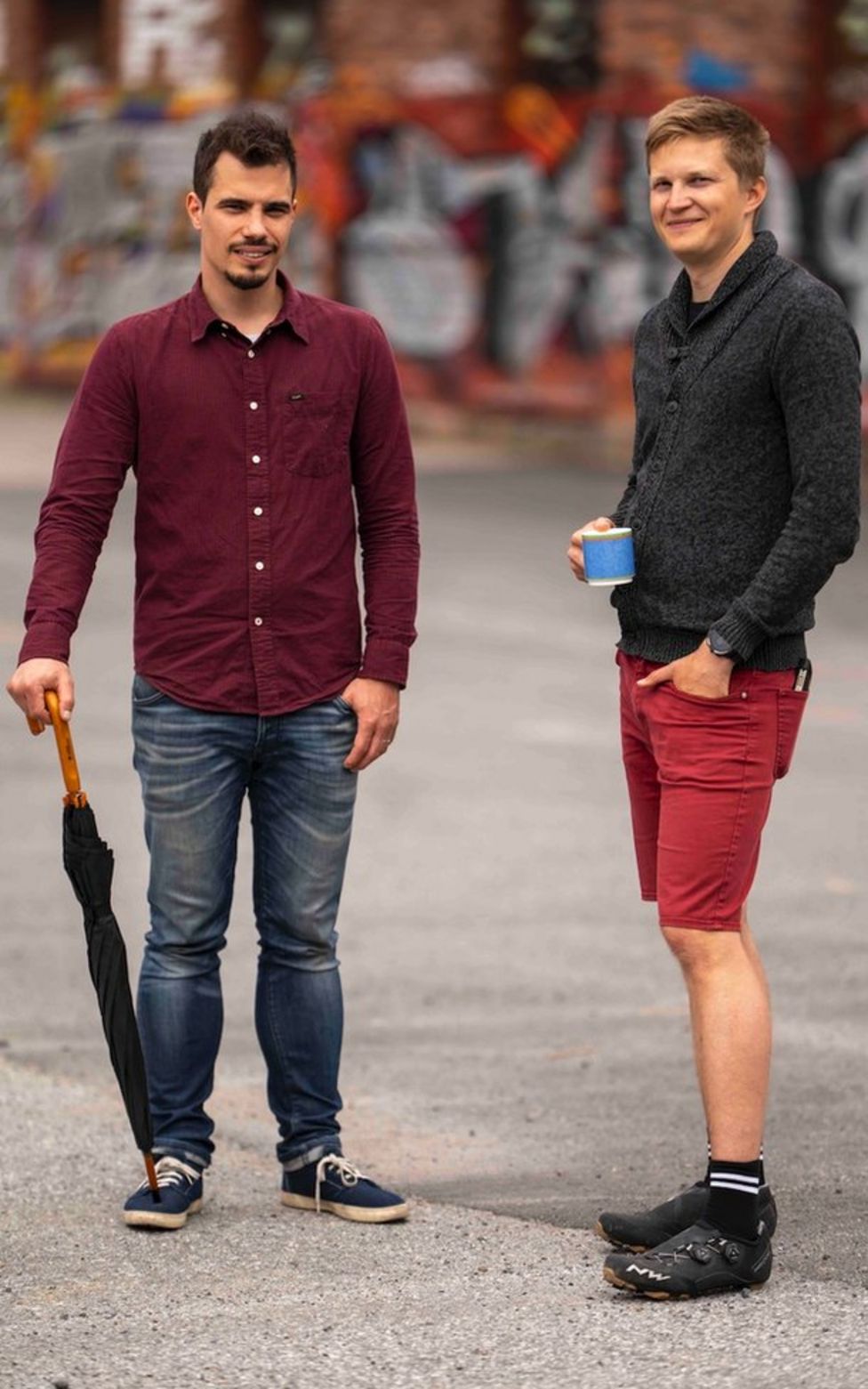
Finnish researchers Markku Ylönen and Tommi Eronen, who came up with the sand-battery idea. Don’t these guys look just like the kind of young people you’d expect to tackle something impossible?

The big challenge for renewable energy sources like solar and wind has always been storage. Where is there a battery big enough and powerful enough to store the energy until it’s needed?

Bring on a couple wiz kids who think about daunting problems like global warming and overdependence on Russian gas.

Matt McGrath writes at the BBC, “Finnish researchers have installed the world’s first fully working ‘sand battery,’ which can store green power for months at a time. …

“Using low-grade sand, the device is charged up with heat made from cheap electricity from solar or wind. The sand stores the heat at around 500C (~932 degrees Fahrenheit), which can then warm homes in winter when energy is more expensive.

“Finland gets most of its gas from Russia, so the war in Ukraine has drawn the issue of green power into sharp focus. It has the longest Russian border in the EU and Moscow has now halted gas and electricity supplies in the wake of Finland’s decision to join NATO.

“Concerns over sources of heat and light, especially with the long, cold Finnish winter on the horizon are preoccupying politicians and citizens alike. But in a corner of a small power plant in western Finland stands a new piece of technology that has the potential to ease some of these worries.

“The key element in this device? Around 100 tonnes of builder’s sand, piled high inside a dull grey silo.

“These rough and ready grains may well represent a simple, cost-effective way of storing power for when it’s needed most.

“Because of climate change and now thanks to the rapidly rising price of fossil fuels, there’s a surge of investment in new renewable energy production. But while new solar panels and wind turbines can be quickly added to national grids, these extra sources also present huge challenges.

“The toughest question is about intermittency — how do you keep the lights on when the sun doesn’t shine and the wind doesn’t blow? …

“The most obvious answer to these problems is large-scale batteries which can store and balance energy demands as the grid becomes greener.

“Right now, most batteries are made with lithium and are expensive with a large, physical footprint, and can only cope with a limited amount of excess power.

“But in the town of Kankaanpää, a team of young Finnish engineers have completed the first commercial installation of a battery made from sand that they believe can solve the storage problem in a low-cost, low impact way.

” ‘Whenever there’s like this high surge of available green electricity, we want to be able to get it into the storage really quickly,’ said Markku Ylönen, one of the two founders of Polar Night Energy who have developed the product.

“The device has been installed in the Vatajankoski power plant, which runs the district heating system for the area.

“Low-cost electricity warms the sand up to 500C by resistive heating (the same process that makes electric fires work). This generates hot air which is circulated in the sand by means of a heat exchanger.

“Sand is a very effective medium for storing heat and loses little over time. The developers say that their device could keep sand at 500C for several months.

“So when energy prices are higher, the battery discharges the hot air which warms water for the district heating system which is then pumped around homes, offices and even the local swimming pool.

The idea for the sand battery was first developed at a former pulp mill in the city of Tampere, with the council donating the work space and providing funding to get it off the ground.

” ‘If we have some power stations that are just working for a few hours in the wintertime, when it’s the coldest, it’s going to be extremely expensive,’ said Elina Seppänen, an energy and climate specialist for the city. ‘But if we have this sort of solution that provides flexibility for the use, and storage of heat, that would help a lot.’ …

“One of the big challenges now is whether the technology can be scaled up to really make a difference — and will the developers be able to use it to get electricity out as well as heat? The efficiency falls dramatically when the sand is used to just return power to the electricity grid. …

“Other research groups, such as the US National Renewable Energy Laboratory are actively looking at sand as a viable form of battery for green power. But the Finns are the first with a working, commercial system, that so far is performing well, according to the man who’s invested in the system.

” ‘It’s really simple, but we liked the idea of trying something new, to be the first in the world to do something like this,’ said Pekka Passi, the managing director of the Vatajankoski power plant.”

One of the aspects of this approach that I like best is that it doesn’t use lithium, a “blood mineral,” the mining of which often hurts local communities.

Check out the graphic at the BBC, here, to see how the sand-battery works.

Read Full Post »

Photo: Bruce Bennett/Getty Images.
Fireworks in the shape of smiling faces at the Opening Ceremony of the PyeongChang 2018 Winter Olympic Games on February 9, 2018, in South Korea. 

Did you get to see fireworks over the Fourth this year? Ours were to be launched from a barge in the ocean, but there was too much wind, so no dice. There’s talk about doing them at Labor Day instead.

If we had had fireworks, it would have been good for my attitude this year. Fireworks have a certain nutty innocence about them, whereas my patriotic fervor has really been put to the test by events in our country the last few years, coming to a head in spring. It feels like only a handful of people are running what’s supposed to be a democracy. I don’t get it. For example, how can it possibly be the case that nothing gets through our elected Congress unless one senator likes it? Whew.

So, fireworks. Salon magazine has a nice story about some of the finer points of producing dazzling, Gandalf-like artistry. I don’t know about you, but I’m smitten with wonder just as much as a hobbit child when rockets turn into elaborate, endlessly unfolding displays.

Nicole Karlis reports, “Fireworks have come a long way since they were first discovered in 200 B.C.in China. Historians believe that fireworks were created by accident when bamboo was tossed into fire. Then, around 800 B.C., an alchemist* allegedly mixed sulfur, charcoal, and potassium nitrate in a search for eternal life— instead, the mixture led to gunpowder.

“Gunpowder was used in early wars, but it didn’t take long for people to notice that the mixture being shot into the night sky also led to something [colorful and bright]. …

“The tradition of launching fireworks to commemorate Independence Day dates back to a letter John Adams wrote to Abigail Adams in 1776. In it, he wished for future generations to observe the day with ‘[Shows], Games, Sports, Guns, Bells, Bonfires and Illuminations from one End of this Continent to the other from this Time forward forever more.’ The first official Fourth of July fireworks reportedly occurred the following year.

“Today, firework shows … don’t always look like wilting willow trees or shooting stars in the sky. Instead, they come in various shapes and sizes — from animals to flowers to written text. Known as ‘patterned fireworks,’ these types of fireworks are relatively new to the fireworks world. We asked pyrotechnician Mike Tockstein, a licensed pyrotechnic operator in California, and owner and operator of Pyrotechnic Innovations, more about how these fireworks work.

Salon: How long have these existed?
“Tockstein: Pattern shells have been around since at least the 1990s in the United States, but it’s hard to say they were not used before that in other countries or even further back in time. …

“I would certainly call it old technology. They don’t differ much at all from your standard peony shell, which is the most basic of all aerial fireworks, being a round shell which breaks in a large spherical pattern in the sky. [A] spherical shell will break symmetrically due to a number of well-known principles in physics, such as conservation of momentum, which says momentum before and after the explosion must be equal, therefore the momentum of the material moving in one direction has to equal that of the material moving in the exact opposite direction. …

“There are other physics at play, but if a shell is built properly and the casing fails in a uniform fashion, a spherical shell will break in a spherical pattern. Now that we understand that, the only thing you have to do is lay the stars out inside the shell in the same pattern you want to see in the sky. …

“Pattern shells started with simple shapes such as hearts, but now-a-days you are only limited by your imagination.  Happy faces, rings, cubes, stars, spirals, alphanumeric letters, Saturn shells which look like a planet with a ring around it. I think I even saw a Bozo the Clown face one time. Here is a video of a few Jelly Fish shells, where you can clearly see the cap and tentacles.

Could someone request a custom, complicated shape, e.g. an @ sign? How complicated is it for these kinds of fireworks?
“Yes, if far enough in advance, a custom pattern shell could be made in most cases.  An @ sign would be fairly simple since it is a simple 2D spiral shape.  More complicated shapes could take longer to figure out, fabricate, and test.

How are they designed so that they explode in a manner that the shape is visible from the ground?
“Given that a smiley-face is 2D, presumably if it exploded such that its plane were perpendicular to the viewer, it would appear to look like a straight line.

“They are designed as a 2D shape, so the orientation they explode in the sky is important to being able to see the pattern. The shells themselves cannot orient themselves a certain way when shot out of a mortar. To overcome this, whenever we do a happy face or other pattern shell ‘look’ during a show, we send multiple shells up so that statistically one or more will likely break with the proper orientation to the audience.” More at Salon, here.

* A modern-day Alchemist and blogger in Canada makes beautiful Raku pottery full of mysterious starbursts like fireworks. Check him out, please. He can mail to the US and elsewhere.

Read Full Post »

« Newer Posts - Older Posts »