Photo: Suzanne’s Mom. One of my granddaughters made this gingerbread house from a kit. The idea for a carrot was her own.
Time for another photo round-up.
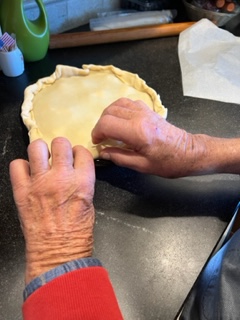
Sandra M. Kelly surprised us with a picture of Patrick making a mince pie for Thanksgiving. And, here, we thought Sandra was the only chef!
The hellabore below loves cold weather. You can understand why it’s sometimes called Christmas Rose.
My husband sent me photos of mysterious “ice flowers,” taken by Ned Friedman, director of Harvard’s Arnold Arboretum. The flowers formed the other day on a herbaceous Chinese plant called Isodon henryi, and even Friedman doesn’t know for sure what conditions cause the phenomenon.
Sandra also sent the photograph of the Christmas cactus. She’s a genius at rescuing cacti that people like me can never get to bloom. I have her instructions if you want to try.
In the next picture, you see our niece, who’s a genius with youth orchestras in North Carolina. She gets pretty worn out with concerts at this time of year.
Stuga40’s snowy image was shot in Stockholm. She is now in New England for a visit with Erik, Suzanne, and our half-Swedish grandchildren. Maybe she’ll have other snowy photos after the family goes skiing in Vermont.
The next snow scene was shot in my own yard. Our first snow this year. The last two photos need no explanation.
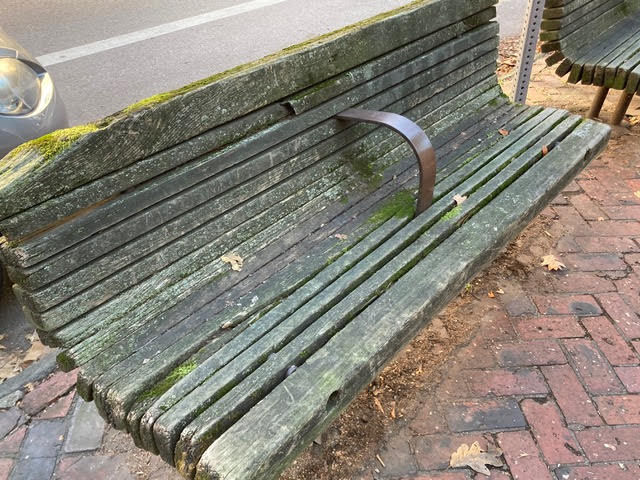
PS. 12/22/22. I’m sharing the worn bench at Hannah’s church in Philadelphia, because I love worn benches. I wish I had photographed the really beat-up one I admired on a train platform yesterday.
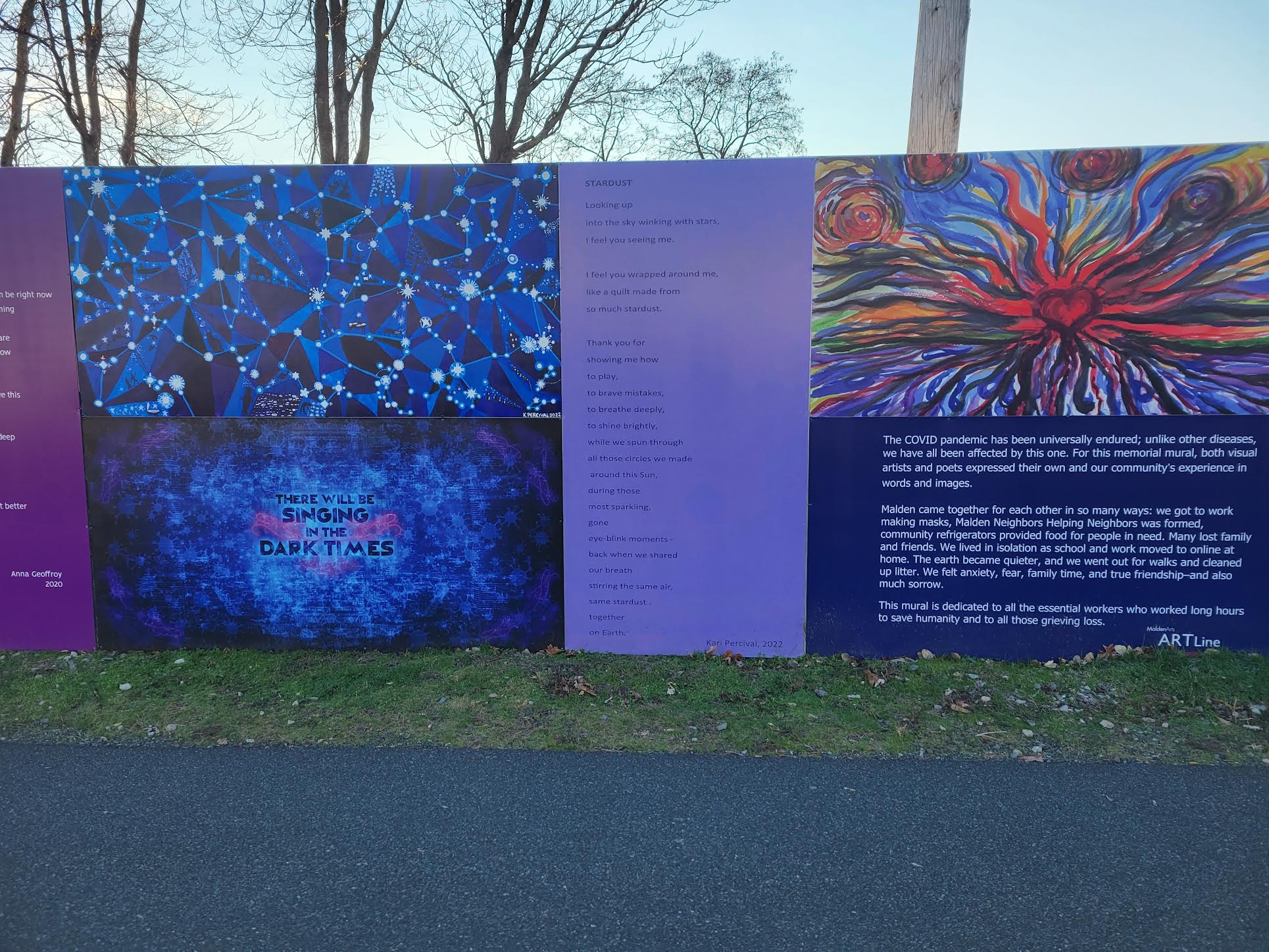
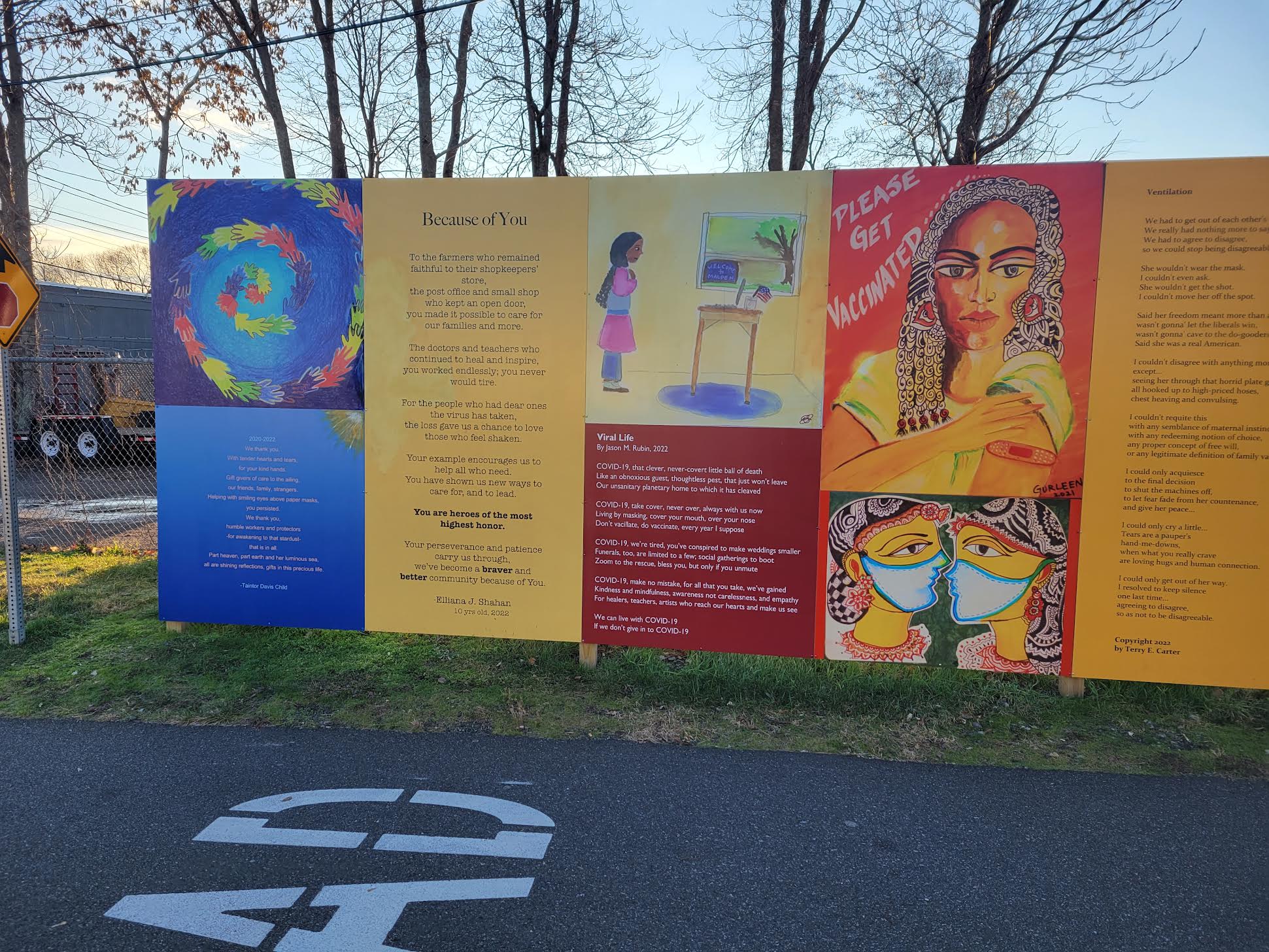
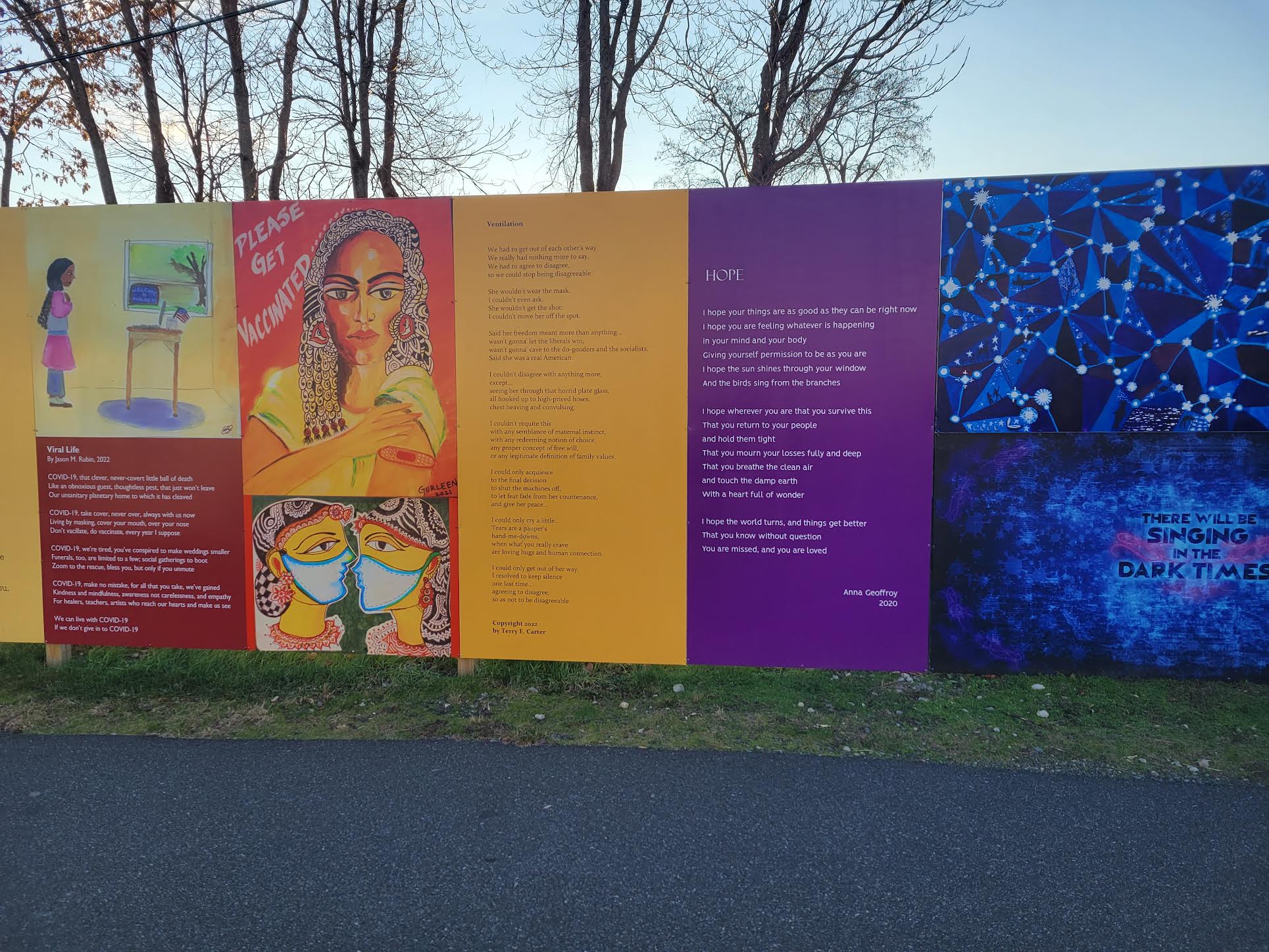
John was in Malden yesterday and saw the Covid murals on the bike path. He was stunned. I tried to find a descriptive article about them online but ended up having to copy lines of poems from the photos on Flickr. I hope I got all the punctuation right. Poets care about such things.
How soon we forget what it was like to be deep in the midst of this! When we thought protecting ourselves meant wiping down the groceries with bleach. When doctors and nurses were having to reuse masks and were sending out pleas for people to find old masks in their garage workshops and take them to emergency rooms. When there were few test kits and no vaccines. How soon we forget it was all about breath and breathing!
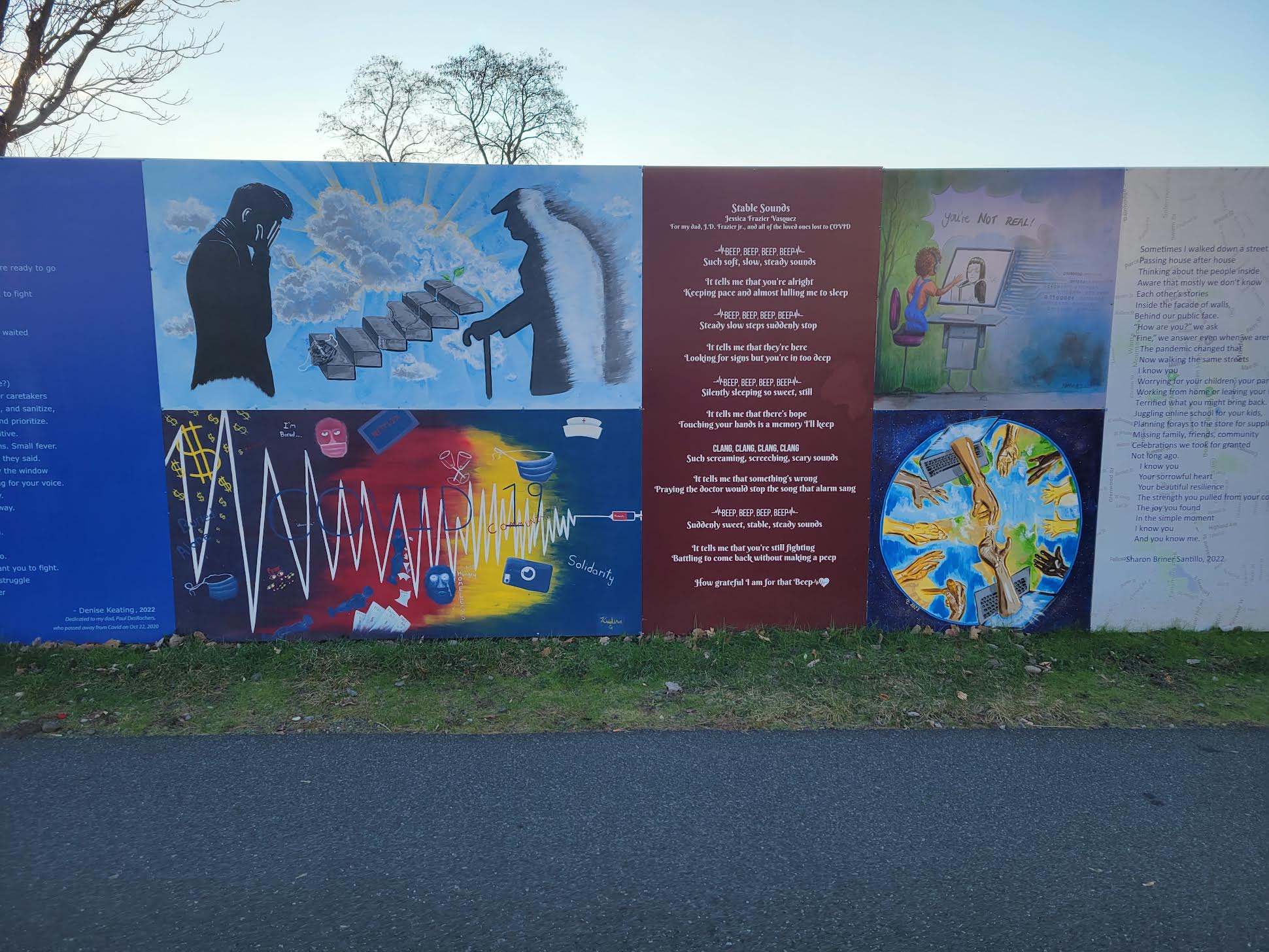
The memorial to lost lives in Malden features both art and written words. These are excerpts from the poems.
Terry E. Carter wrote a poem about his mother called “Ventilation.”
“She wouldn’t wear a mask. “I couldn’t even ask. … “Said her freedom meant more than anything — “wasn’t gonna let the liberals win.”
Ten-year-old Elliana J. Shahan’s poem “Because of You” honors farmers, shopkeepers, postal workers, doctors, teachers, and all who kept the world running in the dark times.
Jessica Frazier Vasquez’s is poem about the beep beep beep of her dad’s ventilator showing he was at least still alive: “It tells me that you’re still fighting/Battling to come back.” At least for a while.
Sharon Briner Santillo’s poem noted how one never used to know what was going on behind a neighbor’s windows and how one may feel more connected now.
“I know you “Your sorrowful heart “Your beautiful resilience … “I know you “And you know me.”
There is another by Dina Stander called “Breath”: “May her memory be for a blessing.” And one by Denise Keating called “A Slow Goodbye” about her father, who had already been paralyzed by a stroke for 10 years.
“We hovered by the window “Moths fluttering for your voice “We went away. “You slipped away. “And now. “Guilt-stricken. “Paralyzed. “We let you go. “We didn’t want you to fight. “But we still struggle “To remember “To breathe.
More at MaldenArts, here. Be sure to look at the Flickr pictures, here: you can zoom in to read the words. Most of the poems are not literary, but all are heartfelt.
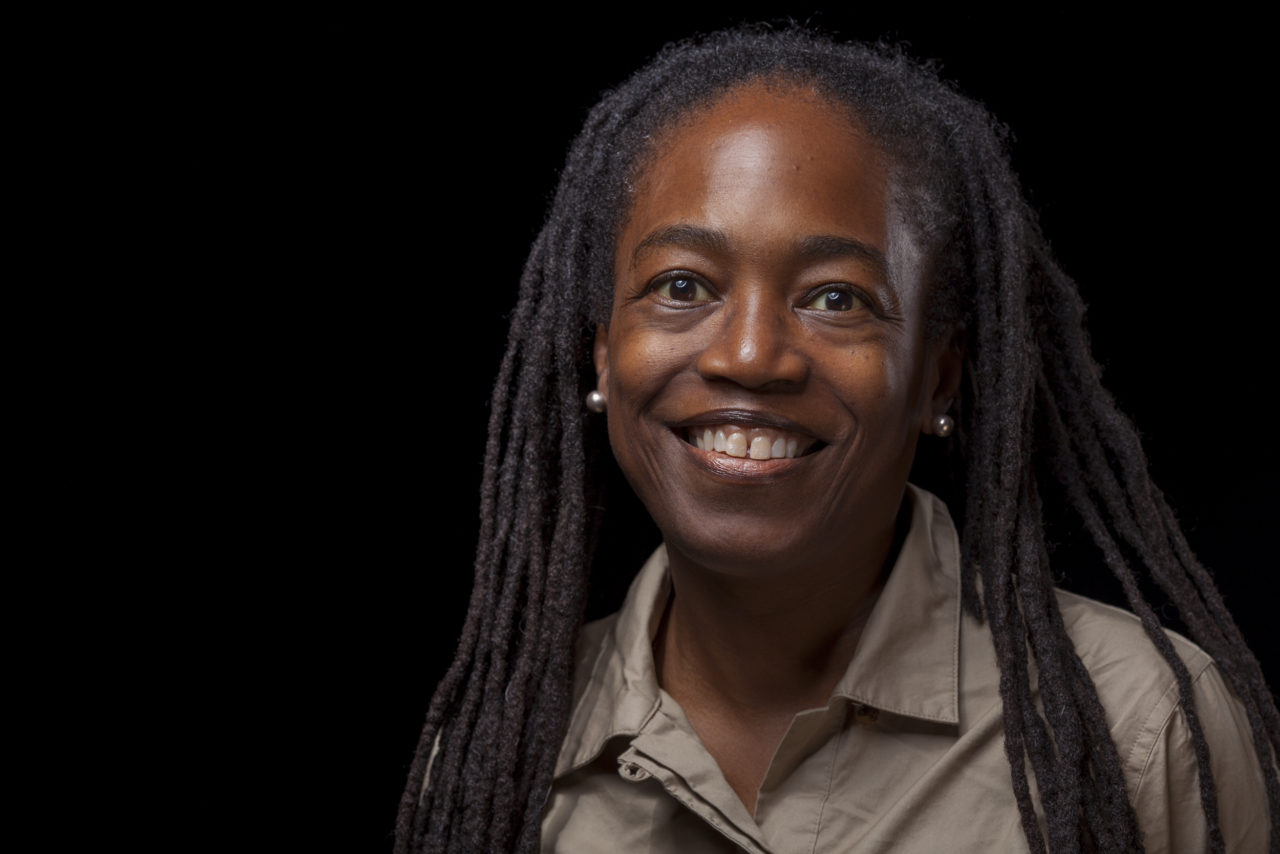
Photo: African American Design Nexus. The innovative architect and designer Felecia Davis can make buildings out of wool and fungus.
More on human ingenuity today. At the Washington Post, Elizabeth Evitts Dickinson writes about a woman who is pioneering all-fiber construction materials and “clothes that monitor your health.” And that’s just the beginning.
“Imagine you’re standing in an outdoor pavilion,” Dickinson suggests, “one that’s similar in design to a covered picnic area at a local park or an amphitheater, only instead of support columns made from concrete, wood or stone, this structure is propped up by what appear to be posts of crocheted wool. Above you, a vast expanse of undulating roof is made of the same knitted material. Fungus coats this wool frame, forming the walls and the ceiling, not unlike the way plaster might cover the wood framing of a wall.
“This is the premise of an experimental material known as MycoKnit. ‘We’re trying to make an all-fiber building,’ says designer Felecia Davis, an associate professor of architecture and a lead researcher in the Stuckeman Center for Design Computing at Pennsylvania State University. She is part of an interdisciplinary team testing how knitted materials, such as wool yarn, might function as the framing for a building while a mixture of straw and mycelium fungus embeds itself onto this knitted fabric to create the rest. Mycelium is composed of individual fibers known as hyphae, which, in nature, create vast and intricate networks through soil, producing things like mushrooms. The amazing thing, Davis tells me, is that something as basic as fiber can become both the structure (the wool yarn) and the infill (the fungus).
“Davis and her partners are harnessing mycelium’s fast-growing power by regulating environmental conditions in the lab to encourage the fungus’s expansion on their knitted edifice. With the assistance of a computer algorithm made by one of Davis’s PhD students, the team can virtually assemble and examine the structure stitch-by-stitch in order to predict its shape, before building it and letting the fungus propagate overtop. …
“Davis is now working with her students to create a 12-by-12-by-12-foot MycoKnit prototype that can be fabricated and grown in one place, and then taken on-site to build, like an Ikea kit. She imagines a future where biofabricated materials replace less-sustainable building supplies, many of which wind up in landfills.
“Davis is a triple threat designer: trained as both an architect and an engineer, and with a penchant for technology. In her Penn State lab and through her firm, Felecia Davis Studio, she mixes time-honored craft techniques and humble materials with the high-tech — so that clothing might, for instance, alert the wearer to excess carbon monoxide in the air or signal when an infant stops breathing in their crib. Davis works with textiles, she says, because ‘you can address it at the nano- and micro-scale with tiny particles that you can spin to make a thread or yarn, or you can look at it from the massive scale. A building. A city.’ …
“Davis has always loved experimenting with objects and material. The oldest of three siblings, her earliest collaborator was her sister Audrey (now a neonatologist). As kids in the ’60s and ’70s, they explored the foothills of Altadena, Calif., near their home, gathering fresh bay laurel leaves and other natural materials for projects. With their friends, they fashioned dolls out of flour-based papier-mâché, carving apples for the heads. …
“Davis’s mother volunteered at the Pasadena Art Museum and introduced her children to abstract art and modernism; she was also a docent at the Gamble House in Pasadena, one of the country’s most well-preserved examples of Arts and Crafts design. Davis credits that house, in part, for her early desire to pursue architecture. ‘We would do our homework in the attic while she gave her tours,’ Davis says. ‘That house was mind-blowing.’
“On a recent October day, the SoftLab at Penn State is ‘messy,’ Davis says. … Fabric samples have been stretched and pinned to a corkboard, sharing space next to thin electrical conduits and sketches of networking design. There are clear boxes filled with copper-coated yarn and fabrics twisted with stainless steel that are capable of conducting electricity. Davis is refreshingly agnostic about her sourcing, using a combination of existing craft techniques and materials — from wool to human hair — in combination with the latest in software and hardware, such as the LilyPad Arduino, a microcontroller designed to work with e-textiles.
“A pair of black leggings stretch across the bottom half of a dress form. From a distance, they resemble something a rock star might wear, bedazzled and tricked out with lines of metallic thread, but on closer inspection these accents are electrical threads and processors. The leggings are the result of a partnership with Penn State engineer Conrad Tucker, who wanted to create a way of alerting people with Parkinson’s disease to subtle changes in their walking gait, which can foreshadow the onset of more debilitating symptoms. …
“The leggings were originally an information-gathering experiment, but ‘we’ve circled back on this project now that we have a yarn that is washable,’ she says. ‘We think we can make a simpler version of our leggings.’ Davis sees the potential for other ‘smart’ clothing like
a hospital shirt that frees patients from the tether of wires affixed to machines, allowing them to move freely or, ideally, go home sooner because their clothes, connected to the internet, would be able to communicate critical data to doctors.
“While Davis was earning her master’s in architecture at Princeton University, she ‘noticed how little people talk about the emotional experience of people in [a] space. … You’re in basic response with your environment all the time … You’re meshing with it, which is why it’s so important to think about human emotion in design.’ In this view, the aesthetics of what we design is more than an accessory, but a fundamental need in support of human emotional health. …
“As humans we tend to imbue the materials in our lives with emotional resonance — a child’s security blanket or a favorite sweater — and Davis has wondered whether we could also imbue the materials themselves with emotional feedback capacities. In 2012, she partnered with two other designers to create and install a project called the Textile Mirror at Microsoft Research Lab in Redmond, Calif. In the back of a fabric panel, Nitinol wires, made of a shape-changing nickel-titanium alloy, were activated after a person entered information about their state of mind into a mobile phone. The panel would adjust, shrinking and crumpling to reflect pain or sadness, for instance, and then release. As the textile ‘relaxed,’ it helped those in an agitated state to relax as well. Textiles capable of reflecting emotion have the potential to alert architects, building owners and inhabitants to the effect that specific design and material choices have. We can begin to create emotionally reactive dwellings and objects, as Davis calls them. …
“As someone who believes in the scientific method of showing data and results, Davis recognizes that working with emotions is tricky. It’s nearly impossible to scientifically pin down, precisely, what people are feeling at any given time. ‘This is kind of at the edge of what computation can actually tell you,’ she says. ‘We can’t read people’s minds, and yet we function as a species because we can intuitively read emotions.’ “
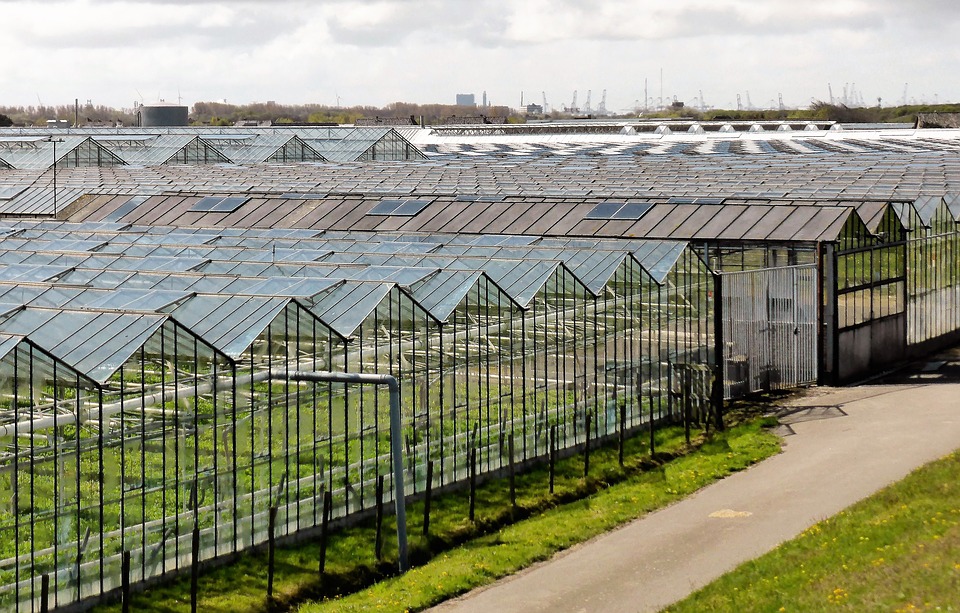
Photo: Pixabay. Believe it or not, little Holland is the world’s second-largest food exporter.
We know from childhood stories that the Dutch have always been innovative. Think about all that land taken from the sea by means of dikes. But who knew that such a little country as the Netherlands was the world’s second-largest food exporter? How do they do it?
Laura Reiley at the Washington Post has the details.
“The rallying cry in the Netherlands started two decades ago, as concern mounted about its ability to feed its 17 million people: Produce twice as much food using half as many resources.
“The country, which is a bit bigger than Maryland, not only accomplished this feat but also has become the world’s second largest exporter of agricultural products by value behind the United States. Perhaps even more significant in the face of a warming planet: It is among the largest exporters of agricultural and food technology. The Dutch have pioneered cell-cultured meat, vertical farming, seed technology and robotics in milking and harvesting — spearheading innovations that focus on decreased water usage as well as reduced carbon and methane emissions.
“The Netherlands produces 4 million cows, 13 million pigs and 104 million chickens annually and is Europe’s biggest meat exporter. But it also provides vegetables to much of Western Europe. The country has nearly 24,000 acres — almost twice the size of Manhattan — of crops growing in greenhouses. These greenhouses, with less fertilizer and water, can grow in a single acre what would take 10 acres of traditional dirt farming to achieve.
Dutch farms use only a half-gallon of water to grow about a pound of tomatoes, while the global average is more than 28 gallons. …
“With their limited land and a rainy climate, the Dutch have become masters of efficiency. But there are challenges: The greenhouse industry has flourished in part because of cheap energy, but Western Europe is facing soaring gas prices. And the country’s intensive animal agricultural practices are also at risk. This summer, a conservative government coalition pledged to halve nitrogen emissions by 2030, which would necessitate a dramatic reduction in the number of animals raised in the country. Farmers and ranchers have protested. …
“Dutch companies are the world’s top suppliers of seeds for ornamental plants and vegetables. There is an area in the northwest called Seed Valley, where new varieties of vegetables and flowers are in constant development. Enza Zaden is headquartered here, just north of Amsterdam.
“In three generations, Enza Zaden has evolved from a family-owned seed shop into a global market leader in vegetable breeding, with more than 2,500 employees and 45 subsidiaries in 25 countries.
“Jaap Mazereeuw, Enza Zaden’s managing director, said the company spends $100 million annually on research, introducing about 150 new vegetable varieties each year.
“ ‘We are very much a research company,’ he said. ‘With climate change, we are seeing the weather becoming more extreme. We’re looking at resilient varieties, seeds for organic farms as well as varieties that are more salt tolerant for places where water quality is not good. We need to find solutions for subsistence farmers all the way up to large-scale farmers. …
“ ‘We have our own indoor farm here where we develop the varieties of the future, crops that can grow quickly and be harvested quickly: lettuce, herbs, leafy crops. The genetics can be improved, as well as the whole technology — indoor farming will only become cheaper.’ …
“More than 12 billion heads of lettuce are grown each year from Enza Zaden’s seeds, but it was a tomato in the early 1960s that really put the company on the map — and perhaps what, in turn, put the Netherlands on the map for tomatoes. The country’s greenhouses produce nearly a million tons of tomatoes a year, with exports totaling around $2 billion annually.
“ ‘There’s a new tomato virus and we recently found the resistance to that virus in our seed bank,’ Mazereeuw said. The company stores its seeds in a temperature-controlled vault — called a seed bank — to preserve genetic diversity, but because seeds don’t stay viable forever, each stored variety must be grown out and those seeds, in turn, saved. …
“ [Eelco Ockers is] chief executive of PlantLab, which develops and operates custom-built indoor farms worldwide — systems they call ‘plant production units.’ Indoor vertical farmers trade in the free power of the sun for much more expensive electric light, but the benefit is they can much more easily control every variable to get consistent and reliable yield, Ockers said.
“The three founders put together their first prototype in 2008 and launched the company in 2010, helping Dutch greenhouse and indoor farmers increase yields with LED lights even when the technology was in its infancy. They have a system whereby enough crops to supply 100,000 residents daily with nearly half a pound of fresh vegetables each can be grown in an area no larger than two football fields. …
“PlantLab’s research and development center in Den Bosch is the largest such center for vertical farming in the world, and it uses limited light spectrum LEDs and plastic stacked production trays, and the plants grow in vermiculite with their roots in water. ‘Nothing is hand-harvested, nothing is touched by human hands,’ Ockers said. The water is recirculated, meaning no water is lost in the growing process. For now, the system is most effective for growing leafy greens, herbs and tomatoes, but he said cucumbers, zucchinis and all types of berries are suited to this growing system. And by limiting the time between harvest and consumption, he said, food waste is minimized and nutrient density is much higher than traditionally grown crops.”
Outdoor farming in Holland is really creative, too. The article covers not only growing vegetables outdoors but raising pigs, cows, and chickens. Read it all at the Post, here.
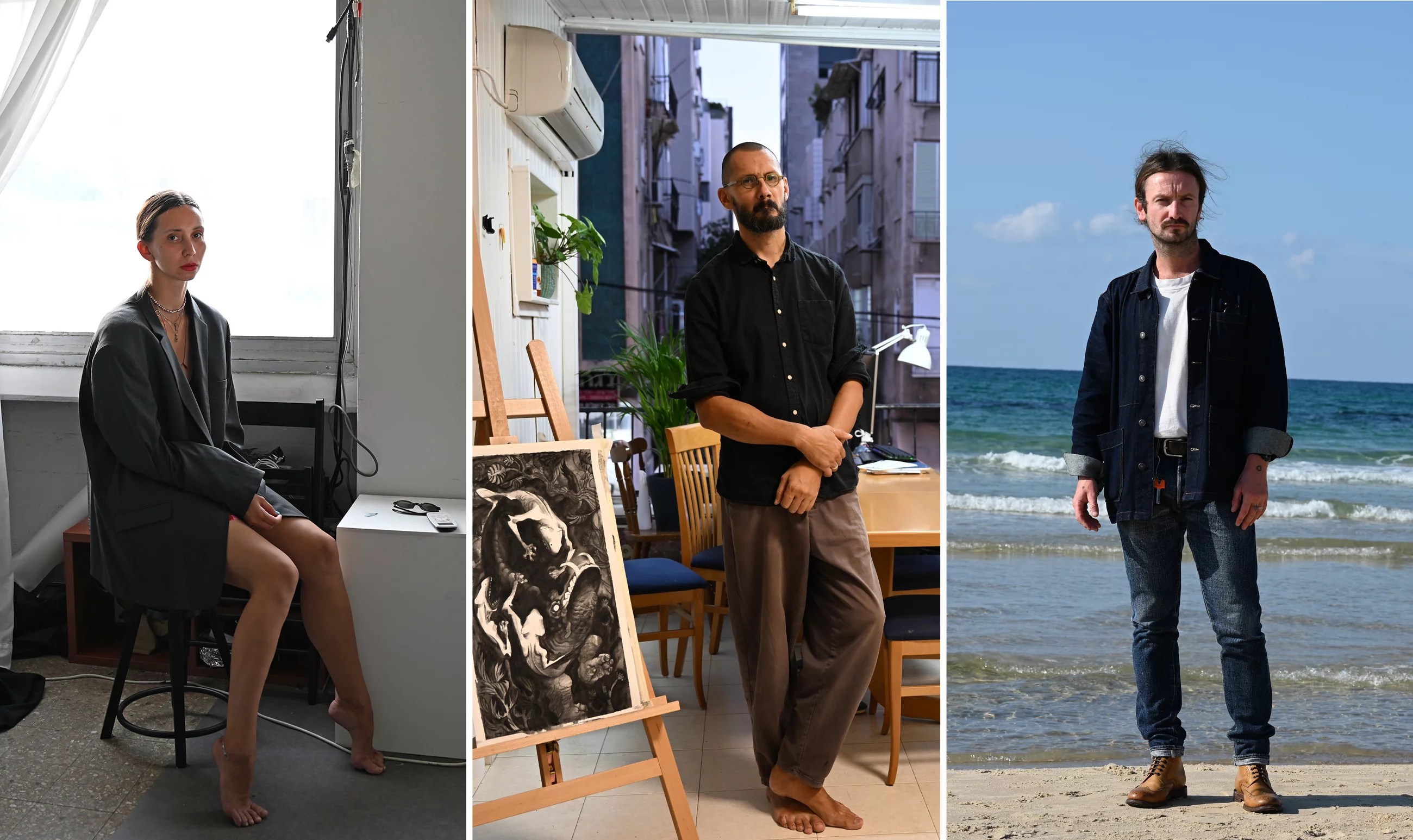
Photos: Tanya Habjouqa/NOOR for NPR. Choreographer Polina Mitryashina, artist Victor Melamed, and jazz producer Evgenii Petrushanskiy are Russian artists who have recently fled Russia to live in Israel.
Most of the Ukrainians I worked with for those precious few months after the Russian invasion believe that all Russians support Putin’s war. But although I would probably feel the same if I were constantly being bombed and had no electricity and was running out of food, I believe that nations aren’t monoliths.
Today we learn about some Jewish Russian artists who are against the war and have left their country. It’s not just about saving their own skin. It’s outrage.
As Daniel Estrin reports at National Public Radio, “Some of Russia’s biggest artistic talents have immigrated to Israel this year, finding a safe place to rebuild their careers and voice their conscience about their country’s war in Ukraine.
“Since Russia invaded Ukraine in February, it has cracked down on even the slightest opposition to the war, forced thousands of citizens to enlist to fight and drawn tough sanctions from the West. All this has prompted many Russians to flee.
“More than 28,000 Russian nationals have acquired Israeli citizenship since the war began, according to Israeli government figures. …
” ‘Staying behind the Iron Curtain was incredibly scary,’ Russian artist Victor Melamed says. … Melamed, whose portraits have appeared in the New Yorker magazine, fled to Israel in June.He says: ‘I want to be a person of the world.’
“Russians are relocating mostly to Turkey, Kazakhstan and Georgia. But Israel offers one big advantage: Those with at least one Jewish grandparent can get Israeli citizenship for themselves and their close family.
” ‘When the war started, I think, like, everybody literally remembered their Jewish grandma,’ says Liza Rozovsky, a Russian-born Israeli journalist tracking Russian celebrity arrivals for the Haaretz newspaper. …
“Some Ukrainian immigrants in Israel wish the Russian newcomers would stay in Russia to protest their leadership, despite the risks. ‘They’re trying to run away,’ says Ilona Stavytska, 33, a Ukrainian-born barista in Tel Aviv.
“But Russian exiles say their protest is more effective here. ‘Go protest in Moscow. I will support you. I will say, “Oh, look, this person is protesting.” Then I will send you letters to jail,’ says Maxim Katz, 37, a Russian YouTube blogger and former opposition politician who escaped to Israel and publishes anti-war videos to audiences in Russia. …
“What a difference a year has made for jazz producer Evgenii Petrushanskii. Last year, his record label in Russia, Rainy Days Records, produced a jazz album which got nominated for a Grammy. This year, the record label has gone silent.
” ‘I don’t feel it’s the right time now to release music as a Russian label,’ Petrushanskii, 36, says at a Tel Aviv coffee shop. ‘For the ethical reasons, I stopped.’ Days after Russia invaded Ukraine, he left St. Petersburg for Tel Aviv, claiming Israeli citizenship based on his father’s Jewish roots.
” ‘It’s impossible to release a record in Russia so it goes to the foreign audience,’ Petrushanskii says. ‘A majority of music aggregators who release music toward the platforms like Apple Music, Spotify … are not presenting in Russia anymore.’ Now he’s re-registering his record label in Israel, hoping to release new records of Russian artists next year.
“Polina Mitryashina, 28, worked at one of the world’s leading dance institutions, Russia’s Mariinsky Theater. Then when the war broke out, her dancers began to vanish.
” ‘Now they’re in Oslo,’ she says. …
“Mitryashina attended a recent networking event at the Israel Festival in Jerusalem, which brought 100 Russian and Ukrainian artists in film, music, art and dance — new immigrants like her — to meet veteran Israeli artistic directors and try to rebuild their careers in Israel.
‘Sometimes I’m angry [at] the people who stay … and continue to work for the big companies, and continue to make money’ in Russia, she says. ‘I am like, “Are you crazy? You, you’re like a sponsor of the war.” ‘
“Artist Victor Melamed, 45, moved his family to a quiet Tel Aviv suburb to keep his teenage boys out of a potential Russian military draft — though they will likely be drafted into the Israeli army.
” ‘I have no romantic visions of, you know, Israel’s policies,’ he says. ‘The Israeli army is an institution that cares for every person they have … as opposed to the Russian army.’
“Each morning he draws a black-and-white portrait of a Ukrainian civilian killed in a Russian attack, and posts it on Instagram. He says it’s his way of pinching himself, not to get too comfortable in his new home in Israel. …
” ‘We need to grow up,’ he says. ‘We cannot afford to stay the same.’ “
Photo: Felipe Milanezvia Wikimedia. Fire at the National Museum of Brazil, in Rio de Janeiro, on 2 September 2018.
Do you remember reading about the disastrous fire at Brazil’s national museum? It was before Covid. Many irreplaceable artifacts were destroyed. I recall, for example, that the curator of entomology at the University of Texas, Austin, was devastated by the loss of that museum’s priceless insect collection.
Also lost were indigenous artifacts. But since that part of the collection had been created without tribes’ input, the rebuilding is a chance to make something better.
Mariana Lenharo and Meghie Rodrigues report at the New York Times, “In the evening of Sunday, Sept. 2, 2018, the National Museum of Brazil in Rio de Janeiro was closed, and its hallways were empty. Silent activity, however, coursed within its walls. Electricity hummed through wires connected to computers; climate-controlled storage and three air-conditioning units connected, improperly, to a single circuit breaker in the ground-floor auditorium. When one unit most likely received a surge of electricity it couldn’t handle, the overburdened system sparked. The museum’s smoke-detector system was not set. There were no sprinklers or fire doors, and a flame bloomed.
Seeing the news, staff members rushed to the building and pleaded with firefighters to let them enter and rescue something — anything. …
“Much of what was lost or severely damaged was irreplaceable: the mummy of an Ancient Egyptian priestess, a 110-million-year-old fossilized turtle, a vast collection of butterflies, the oldest known human remains in Latin America.
“The fire also obliterated an enormous assemblage of artifacts representing the cultural history of Brazil’s Indigenous populations. Masks, vases, weapons, mortars and elaborately feathered ceremonial capes dating back at least a century from the Ticuna, the Kadiwéu, the Bororo, the Tukano — at least 130 peoples in all — were gone. Researchers worked to salvage what they could from the ashes. Astonishingly, a few ceramic vases kept their original paint. One Karajá animal sculpture was found almost intact. But most ‘were fragments, scraps that would no longer be recognized by the people who made them,’ says João Pacheco de Oliveira, the head of the museum’s ethnology and ethnography division. When Ananda Machado, a social historian at the Federal University of Roraima, told members of the Wapichana people about the fire, they were devastated. ‘To them, these objects were much more than material,’ she said; they carried with them the strength of the people who made them. …
“In 2018, after 40 years with the museum, Oliveira planned to retire. But the fire pushed those plans aside. Even while mourning the tragedy, he saw possibility. Yes, the ethnographic collection was in some ways unparalleled, but he had long been vexed by what was missing from it. Many objects were collected by European travelers in the 19th and early 20th centuries who didn’t grasp the purpose that the objects served. A pot or a cape might have been chosen simply because it seemed beautiful or peculiar to a Western eye. As a curator, he found this lack of cultural context deeply frustrating.
“As an anthropologist, Oliveira was even more troubled. Since the 1970s, he has spent long periods with the Ticuna in northern Brazil trying to understand them on their own terms and to communicate their culture to a wider world. The museum was an important vehicle for his aims, but the institution came with its own inglorious history. As with other 19th-century museums, the National Museum was a repository of items plucked, purchased or plundered from Indigenous communities and had presented the people themselves as curiosities, papier-mâché figures in dioramas alongside taxidermied animals. And sometimes worse. …
“With no building to return to, Oliveira met with his team members on park benches and in cafes and explained his vision for a new collection. Indigenous people would be consulted not only about what items would go into the museum but also on how they should be identified, stored and exhibited. One of the first people he turned to was a former student named Tonico Benites.
“Benites grew up in Mato Grosso do Sul in midwestern Brazil on a reserve for the Guarani-Kaiowá, one of the country’s 305 surviving Indigenous groups. His parents never learned to read and write, but he finished high school and went on to study for a degree in education, picking up work on the side as an interpreter for anthropologists. Drawn to the questions the researchers asked, he applied to a master’s program in social anthropology offered at the museum.
“Benites’s first visit to the museum in 2006 was also his first day as a student there. Entering the ethnographic exhibition area, he saw a collection of spears and arrows and then rounded a corner. He froze, sickened. Covering an entire wall was an outsize reproduction of a woodcut from a 1557 book by the German explorer Hans Staden. The account of Staden’s captivity by the Tupinambá was immensely popular in its day, and some scholars now assert that its sensational depictions of cannibalism were used to justify European conquest of Indigenous peoples. …
“Benites raised his concerns with Oliveira, who was his research adviser. Oliveira sympathized but suggested that Benites use his research to change people’s minds. The image was removed months later, but almost a decade would pass before Benites, who had just finished his anthropology Ph.D. — the first Indigenous person to do so at the museum — began research for what he hoped would be a Guarani-Kaiowá exhibition. The fire decimated his plans. …
“The absence of Indigenous perspectives in exhibitions about Indigenous people has been acknowledged, if rarely remedied, at natural-history museums. … Unlike Indigenous groups in other countries, those in Brazil have traditionally maintained a sense of ownership over the museum, which was conceived as a museum of the nation’s history as well as of natural history, Oliveira says. Even the Wapichana, so distraught by the loss of their heritage, have committed to working with curators. Had there been arguments over ownership of older objects, the fire, in its indiscriminate destruction, made them moot. The National Museum has a unique opportunity, says Mariana Françozo, an associate professor of museum studies at Leiden University in the Netherlands. Museums in Europe would find it difficult to build a collection entirely based on collaboration, she says, ‘because they still have the old collections that carry the weight of colonialism.’ ”
Art: Artemisia Gentileschivia Wikimedia Commons. Artemisia Gentileschi, an an Italian Baroque painter, is considered one of the 17th century’s most accomplished artists. Shown here is her “Allegory of Inclination” (1616).
Have you been seeing the name of seventeenth-century painter Artemisia Gentileschi mentioned more these days? I have. Finally the world is coming to grips the astonishing proposition that some female artists are better than many male artists.
Elaine Velie has some thoughts on Gentileschi at Hyperallergic.
“In 1616, the 22-year-old artist Artemisia Gentileschi painted a nude woman perched in the clouds and holding a compass at the Florence home of Michelangelo Buonarroti the Younger, Michaelangelo’s great-nephew. The work was the first in the Buonarroti family’s home gallery dedicated to their famous ancestor, and the impasto ceiling painting, likely a self-portrait, was also one of Gentileschi’s first commissions. ‘Allegory of Inclination’ remained untouched for around 70 years until a descendant of Michelangelo Buonarroti commissioned the Late Baroque painter Baldassarre Franceschini (il Volterrano) to paint draping over the nude figure in the interest of modesty.
“Now, the former Buonarroti residence is the Casa Buonarroti museum, and a team of conservators there is working to ‘virtually restore the original appearance’ of the painting in a project called ‘Artemisia Unveiled.’ Using imaging techniques such as X-rays and raking light to examine the over 400-year-old brush strokes, the team will determine which additions were Gentileschi’s and which were Franceschini’s, and the final result will be an uncensored image.
“Elizabeth Wick, the restorer leading the project, told the Florentine that the team will not physically alter the existing painting for two reasons: Franceschini’s layer is considered a historic addition that contributes to the painting’s story, and since the two layers of paint were applied only 70 years apart, removing Franceschini’s draping would likely damage Gentileschi’s original coat of paint. …
“Gentileschi’s success in the male-dominated art world of 17th-century Italy, and the woman-focused subject matter of her work, have turned her into somewhat of a feminist icon. Although she earned recognition during her lifetime, Gentileschi’s work has been revisited in recent years through museum shows and other conservation projects.”
More at Hyperallergic, here. No firewall, but contributions are sought.
At Wikipedia, we learn that Gentileschi started out working in the style of Caravaggio and “was producing professional work by the age of 15. In an era when women had few opportunities to pursue artistic training or work as professional artists, Gentileschi was the first woman to become a member of the Accademia di Arte del Disegno in Florence, and she had an international clientele.
“Gentileschi was known for being able to depict the female figure with great naturalism and for her skill in handling color to express dimension and drama. … For many years Gentileschi was regarded as a curiosity, but her life and art have been reexamined by scholars in the 20th and 21st centuries. She is now regarded as one of the most progressive and expressive painters of her generation.”
P.S. Check out SJ Bennett’s Queen Elizabeth II murder mystery, All the Queen’s Men, in which the Queen’s Gentileschi painting plays an important role.
Photo: Baileigh Industrial. Above, using the Action Trackchairaround the house. Wilderness adventurers love it, too.
Technology is erasing the barriers for people with disabilities who want to do everything other people do. At the Washington Post, Andrea Sachs and Natalie B. Compton wrote on Nov. 8 about a 500-pound miracle arriving in US parks: all-terrain wheelchairs.
“Cory Lee has visited 40 countries on seven continents,” they write, “and yet the Georgia native has never explored Cloudland Canyon State Park, about 20 minutes from his home. His wheelchair was tough enough for the trip to Antarctica but not for the rugged terrain in his backyard.
“Lee’s circumstances changed [recently], when Georgia’s Department of Natural Resources and the Aimee Copeland Foundation unveiled a fleet of all-terrain power wheelchairs for rent at 11 state parks and outdoorsy destinations, including Cloudland Canyon.
The Action Trackchair models are equipped with tank-like tracks capable of traversing rocks, roots, streams and sand; clearing fallen trees; plowing through tall grass; and tackling uphill climbs.
“ ‘I’ll finally be able to go on these trails for the first time in my life,’ said the 32-year-old travel blogger, who shares his adventures on Curb Free With Cory Lee. …
“South Dakota is [expanding] its squadron: On Tuesday, the South Dakota Parks and Wildlife Foundation unveils its second all-terrain chair. South Dakota resident Michael M. Samp is leading a fundraising campaign to purchase up to 30 chairs. Last year, Samp’s father packed up his fishing pole and piloted a track chair to Center Lake in Custer State Park. He reeled in trout, just as he had before he was diagnosed with spinal cerebral ataxia. …
“This month, the Minnesota Department of Natural Resources will wrap up its months-long pilot program that tested out the chairs in five parks. … Said Jamie McBride, a state parks and recreation area program consultant with the Parks and Trails division of the Minnesota DNR, ‘People have told us this is life-changing.’
“The Georgia initiative was spearheaded by Aimee Copeland Mercier, who suffered a zip-lining accident in 2012 and lost both hands, her right foot and her left leg to a flesh-eating bacterial infection. Copeland Mercier, a psychotherapist and licensed clinical social worker, tested several types of all-terrain chairs before committing to the Action Trackchair, which several other state programs also use.
“The Minnesota-based company was founded by Tim and Donna Swenson, whose son, Jeff, was paralyzed in a car accident. The original design resembled a Frankenstein of sporting goods parts, with snow bike tracks and a busted boat seat. Today’s model could be an opening act at a monster truck rally.
“ ‘I was floored by what it could do,’ said Copeland Mercier, whose foundation raised $200,000 to purchase the chairs at $12,500 each. ‘Oh my gosh! I can go over a whole tree trunk, up a steep incline and through snow, swamps and wetlands. If I took my regular wheelchair, I’d get stuck in five minutes.’
“Each program has its own reservations system and requirements. For Georgia’s service, visitors must provide proof of their disability and a photo ID, plus complete an online training course available through All Terrain Georgia. Once certified, the organization will forward the rental request to the park. Copeland Mercier urges visitors to plan ahead: The certification course takes about an hour, the foundation needs 72-hour advance notice and the park requires a 48-hour head’s up.
“ ‘These are 500-pound chairs,’ she said. ‘There are some risks involved.’
“The Minnesota DNR, which owns and maintains its five chairs, advises visitors to call the park to reserve a chair. …
“Track chairs can conquer a range of obstacles, but they do not work in all environments.
“ ‘You need the width. If two trees are too close together, the wheelchair can’t pass between them,’ Copeland Mercier said. ‘And some inclines are too steep. The chair also can’t go down staircases.’
“To steer visitors in the right direction, parks have created maps highlighting the trails designated for the track chairs, such as Staunton State Park’s trio of routes that range from roughly three to four miles. … McBride said one goal is to erect markers that would provide detailed information about the hike, such the extent of accessibility. ‘We want to let people know if they can get all the way to the waterfall or halfway,’ he said, using a hypothetical example.
“Copeland Mercier also has a wish list. She hopes to expand the network of chairs to other parts of Georgia, such as the coastal, southern and central regions. Once the foundation acquires several vans (another aspiration), the staff could move the 30 to 40 chairs (ditto) around the state to fill fluctuating demand. She is also eyeing other states.
“ ‘North Carolina is next,’ said Copeland Mercier, who divides her time between Atlanta and Asheville, N.C. But the grand plan is even bigger. ‘The goal is to alter the U.S.A.,’ she said.”
Our history with indigenous tribes is dark, and reconciliation must start with facing facts. In this endeavor, archaeology can help.
From St. Clement’s Island, Maryland, Dana Hedgpeth writes for the Washington Post on recent discoveries about a tribe’s long-ago presence.
“The small pieces of oyster shells and ceramic shards in the palm of archaeologist Julia King don’t look like much. But her team’s discoveries of roughly 1,500 pounds of shells and 200 pieces of ceramics bring new and more concrete evidence of the dominance of Native Americans who once lived at St. Clement’s Island and along the surrounding Potomac River shoreline in Southern Maryland. Native American leaders said their archaeological findings shed fresh light on their tribes’ historic presence in the state — which continues to this day but is often unknown, forgotten and ignored.
“ ‘This work is showing a reclamation of the long history of Native Americans in that area and what it means to our people,’ said Gabrielle Tayac. Tayac is a historian and member of the Piscataway Indian Nation, which considers the area its tribal homelands. ‘There’s been a willful and problematic negligence in the record about us.’
“St. Clement’s Island — an uninhabited 40-acre plot of land only accessible by boat — sits where the Potomac and Wicomico rivers meet, about half-mile off the shoreline of St. Mary’s County. There are roughly 4,500 Native Americans who are part of two state-recognized tribes — the Piscataway Conoy Tribe and the Piscataway Indian Nation — who trace their roots to the area. Piscataway means ‘the people who live where the waters meet’ in the Algonquian language.
“To many, St. Clement’s Island is best-known as the spot where roughly 150 European colonists arrived on March 25, 1634, and held the first Roman Catholic Mass in the British American colonies. …
“Few people had explored the sandy shores and grassy lands of the island until King’s research team spent several months this summer carefully digging up grass and sifting through dirt. … They found scores of Native American artifacts at the site and in collections of area residents and of a small museum on the mainland. The items included stone tools, tobacco pipes, ceramics and oyster shells, along with bits of copper, polished tubes and stone beads. All of it is evidence, said King, an archaeologist with St. Mary’s College of Maryland, of the ‘extensive exchange and network of trade’ between Piscataways and tribes from areas now known as Virginia, New York and as far away as Ohio andWest Virginia — centuries before Europeans came. …
“For Native American leaders in Southern Maryland, King’s work is a validation of their long history and continued presence in the area that’s rarely highlighted.
‘History was not written for us — or about us,’ said Francis Gray, chairman of the Piscataway Conoy Tribe. …
“Archaeological records show Native Americans were in the St. Clement’s Island area as far back as 3500 B.C., according to King. The island itself was once 400 acres, but erosion shrank it. Historians say there were an estimated 5,000 Piscataways living in the Potomac Valley area in the 1600s. …
“Rico Newman, an elder in the Choptico Band of Piscataways, said he remembers when growing up that he heard oral histories from his elders of how Piscataways followed the shad and herring runs along the nearby Wicomico River and went to St. Clement’s Island. Native Americans called it Heron Island after the bird that is fond of nesting in the area.
“ ‘There was no better place to live off the water and the land than there,’ Newman said. He recalled how his grandfather used to tell him, ‘if the heron isn’t fishing, then you weren’t fishing.’ It meant there was ‘something wrong with the fish or the water that day.’ …
“In the early 1600s, Piscataways traded with Europeans from the sister colony in Jamestown, Va. For the Piscataways, the trade meant protection for their homeland from Iroquois. English copper, beads and metal tools ‘made the newcomers useful that they need not be killed or left to starve,’ according to Piscataway leaders and historians.
“The Piscataways’ homeland changed dramatically when in March 1634, two ships — the Ark and the Dove — arrived with colonists looking to create a settlement. To celebrate their arrival, the colonists held the first Catholic Mass in the New World.
“The colonists knew of the disagreements and slayings between Native Americans and settlers at Jamestown, so they planned a different approach. The Calvert family, who founded Maryland as a colony, ‘didn’t want to pay for the costly kinds of wars experienced in Virginia,’ King said, ‘so they made the decision to forge diplomatic relationships with the Indians.’
“They went from St. Clement’s upriver to see the Piscataway tayac — the word for leader in the Algonquian language. They told Wannas, the Piscataway tayac at the time, they’d ‘come not to make war, but out of good will toward them,’ according to records at the St. Clement’s Island museum.
“Wannas, the tayac, cautiously responded to them, saying the Native Americans did not welcome the colonists, but also was not going to force them to leave. The colonists decided St. Clement’s was too small and well-established as ‘Indian country,’ so they returned and went down the river to what would become St. Mary’s City, where they bought land from the Yaocomicos and set up the first English settlement in Maryland.
“By 1650, more colonists moved to the area, and they created a reservation for the Piscataways, but eventually, King said, the Native Americans were pushed out as colonists took over. Some Piscataways went north to what’s now Frederick. Others went to Virginia. And some stayed, but they were ‘no longer considered a sovereign nation,’ King said. …
“Karen Stone, the executive director of the St. Clement’s Island museum, said a major renovation will start early next year with new exhibits that will tell Maryland’s history from the points of view of the colonists and the Piscataways. She said local Native American leaders are involved in designing the materials and exhibits for the new museum to give a more complete story and more accurate history of the Piscataways.”
Photo:MB Media/Getty Images. Brazil’s players celebrate by dancing the samba after their win over South Korea.
Is it my imagination or is there new excitement in the US over the World Cup this year? We have never been prominent among soccer teams, and that’s changing. Also, we have many immigrants and naturalized Americans from big “futball” nations. So there’s that.
In any case, it’s been fun. Suzanne and Erik and the kids each picked a team at the start, and three of them have had to swallow their disappointment and choose a second favorite. Suzanne is still standing.
Every soccer country has its own way of reacting to wins and losses. Not many are subdued. Today’s story is about the form that Brazilian soccer celebrations take.
Ed Aarons opens his story at the Guardian with a player’s memories of games in the 1930s.
” ‘I was afraid of playing football [soccer] because I had often seen a black player get struck on the pitch for committing a foul,’ said Domingos da Guia, a defender who played for Brazil in the 1938 World Cup. ‘But I was a very good dancer and that helped me on the pitch. I invented the short dribble by imitating the miudinho, a form of samba.’
“Roy Keane did not like it but when Brazil’s players – and the coach, Tite – celebrated scoring against South Korea in their last-16 victory on Monday by performing Richarlison’s trademark pigeon dance, they were following a historic tradition that represents the very soul of the Seleção. Samba, which has its roots in Angola and the Democratic Republic of Congo via the African slave trade, and football were adopted by Brazil’s working classes just as Da Guia was making his international debut in 1931.
“According to Brazilian sociologist Gilberto Freyre, the distinctive style of play Brazil has become known for comes from the indelible link between the two:
‘In football, as in politics, a feature of the Brazilian racial blend is a taste for bending the rules, an element of surprise or frills that calls to mind dance steps and the Capoeira.’ …
“When a 17-year-old Pelé and the winger Garrincha inspired them to their first World Cup victory in 1958, the song A Taça do Mundo é Nossa – The World Cup is Ours – left no doubt about the vital importance of music to the team’s success. …
“According to legend, the celebrated samba singer Elza Soares fainted in the stands at the end of Brazil’s 3-1 win over Czechoslovakia in the final but recovered in time to perform a song in honor of her future husband Garrincha in the changing room.
“Pelé was among those to pay tribute to Soares in January after her death at the age of 91, describing her as a ‘legend of our music, historic, genuine, unique and unparalleled.’ …
“The tradition of celebrating goals with dance routines is generally a more recent phenomenon that has not been restricted to Brazilians. Roger Milla’s corner flag wiggle at Italia 90 and again at USA 1994 were inspired ‘by his own imagination’ according to the Cameroon striker, while Papa Bouba Diop celebrated his goal against France, the holders, in 2002 by removing his shirt and performing a mbalax dance with his Senegal teammates. But after Bebeto and Romario’s cradle-rocking routine in 1994 that was a tribute to the former’s newborn Mattheus Oliveira – now 28 and playing in the Portuguese second division – it is Brazil that has always had the strongest tradition to uphold.
“ ‘Dance is the symbol. We symbolize the joy of scoring a goal. We don’t do it to disrespect, we don’t do it in front of the opponent,’ said West Ham’s Lucas Paquetá after the South Korea match. ‘We get together, you can look. Everyone is there and we celebrate. It’s our moment, we scored the goal, Brazil is celebrating.’
“For Vinícius Júnior, who scored the first goal against South Korea, the criticism will have had particular resonance. In September, the Real Madrid forward was accused of not respecting his opponents and told to ‘stop playing the monkey’ by Pedro Bravo – a leading agent and president of the Association of Spanish Agents – on live television after celebrating his goals by dancing. …
“ ‘They say happiness upsets. The happiness of a black Brazilian successful in Europe upsets much more,’ Vinícius wrote. ‘Weeks ago they began to criminalize my dances. Dances that are not mine. They belong to Ronaldinho, Neymar, Paquetá, [Antoine] Griezmann, João Félix and Matheus Cunha. … They belong to Brazilian funk and samba artists, reggaeton singers, and black Americans. Those are dances to celebrate the cultural diversity of the world. Accept it, respect it. I’m not going to stop.’ ”
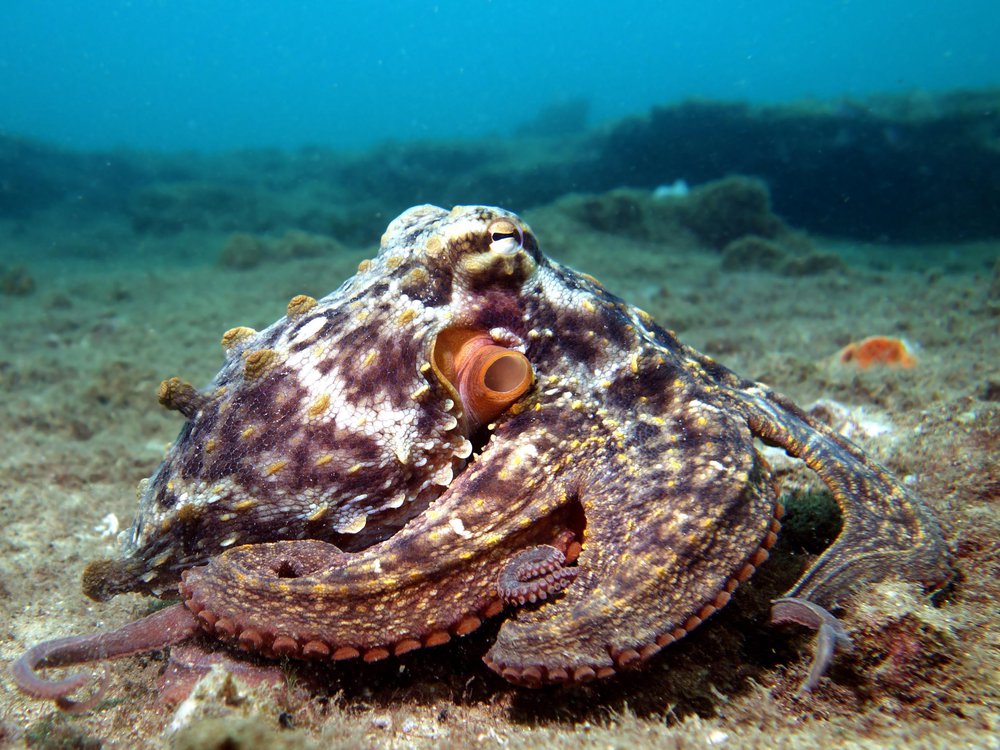
Photo: John Turnbull via Flicker via the Smithsonian. Female octopuses are far more likely than males to ‘throw’ objects at others.
Have you ever read a book by the popular naturalist Sy Montgomery? She loves every kind of creature (except the Bobbitt worm) and can write and talk engagingly about them all. She’s a regular visitor to the radio show Boston Public Radio (BPR). I hear her Wednesdays as I go to visit the Rhode Island grandchildren, and she loads me up with implausible but true animal stories to share.
Recently, Montgomery talked with BPR hosts Jim and Margery about octopuses throwing things to defend their space. Later, I read about this mostly female behavior at the Washington Post.
Jennifer Hassan wrote, “It looks like a scene from a tense thriller movie — a dark octopus rises from its lair on the ocean floor, sneaking up toward another octopus that lurks, barely visible, nearby among a blanket of shells and algae.
“The second octopus shrinks away, while the first attacks by raising its arms and shooting a cloud of debris through the water toward it. … While octopuses have long been known to thrash around underwater, researchers now believe they have video evidence that shows the creatures can not only throw objects — an uncommon behavior in animals — but may also be capable of deliberately targeting each other. Perhaps out of rage, perhaps to protect their eggs — or possibly because they are seeking the octopus equivalent of personal space.
“Researchers from the University of Sydney described several incidents of octopuses throwing debris during social interactions, including attempted sexual exchanges, which they said provided evidence that octopuses were targeting each other on purpose.
“They had analyzed more than 20 hours of footage from Jervis Bay, off the south coast of New South Wales, Australia, from 2015 and 2016, observing 10 octopuses from the octopus tetricus species — also known as gloomy octopuses or the common Sydney octopus. Their findings published [in November] in the peer-reviewed PLoS One journal.
“In one clip, a female octopus threw 17 objects in 60 minutes — hitting other octopuses nine times.
On another occasion, a single female threw material 10 times, with half of those attempts successfully hitting a male in an adjacent den who had been attempting to mate with her. …
” ‘We can’t be sure, but we think some hits are probably intentional,’ Australian researcher and professor Peter Godfrey-Smith told the Washington Post, adding that they found the wild octopuses used a ‘jet-propelled throw’ to project material through the water — essentially, by releasing the debris from their arms while also creating a powerful jet from the siphon located under their arm web.
“Researchers say the frequent octopus throws ‘appear to be mildly aggressive’ and that this apparent targeting of members of the same species ‘is a rare form of nonhuman projectile use,’ which has only been documented among a handful of social mammals.
“ ‘We doubt if it’s playful,’ Godfrey-Smith said of the behavior caught on camera. ‘I think a lot of it is probably about the octopus equivalent of “personal space.” ‘ …
“The report acknowledges that it is difficult to prove the gesture is targeted, as ‘showing intention in a behavior is difficult in non-human animals.’
“ ‘Some throws hit other octopuses, but is this deliberate? We certainly don’t think it’s 100 percent clear, or close to that. But I do think it is more likely than not,’ Godfrey-Smith said.
“Nonetheless, the study adds, the throws are significant even if there is no deliberate targeting — because ‘they do have social effects in interactions between individuals’ studied at the sites.
“Octopuses hit during such throws ‘often altered’ their behavior in response — many ‘octopuses in the line of fire ducked, raised arms in the direction of the thrower, or paused, halted or redirected their movements,’ researchers said.
“Researchers say they hope to do further research and plan more recordings, though they have faced challenges in recent years due to the coronavirus pandemic and storms and flooding in Australia.”
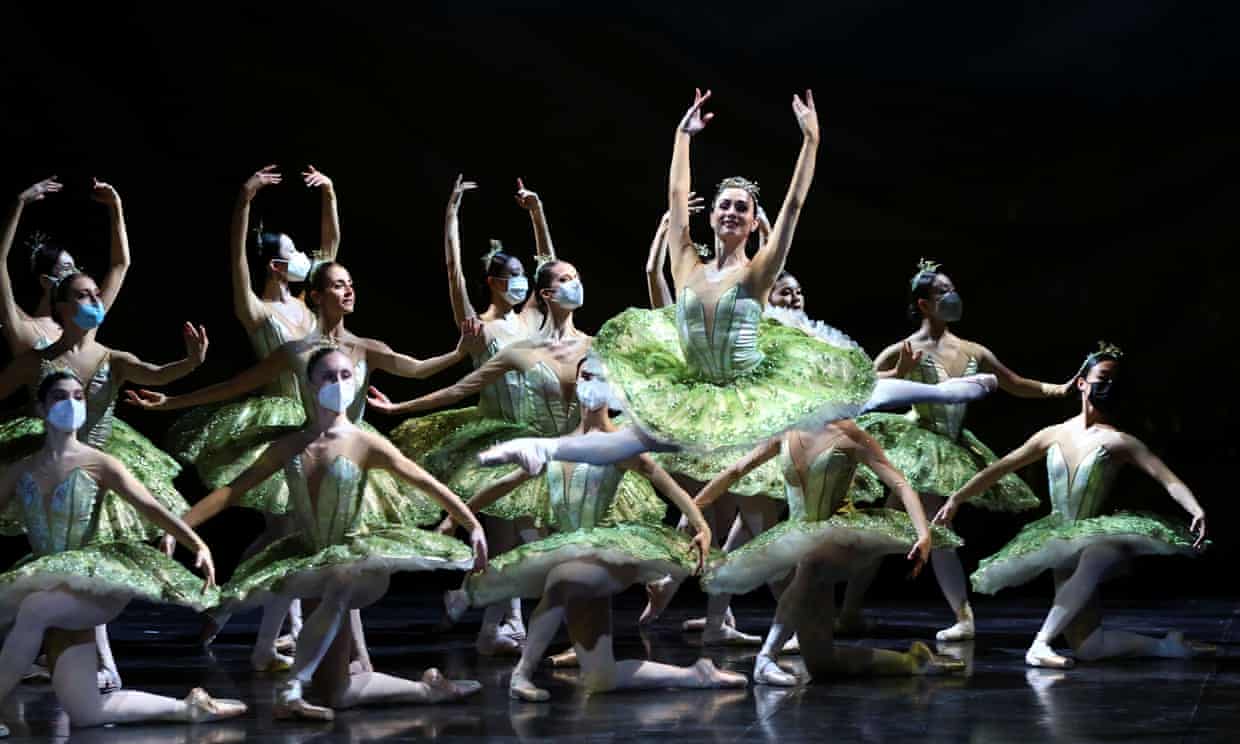
Photo: Fabrizio Bensch/Reuters. Dancers from the Berlin State Ballet during the dress rehearsal for a production of Don Quixote in Berlin last December.
I am often surprised to see how much “Old Europe” leads the way into the future. Not only do we count on Europe to curtail the monopolistic excesses of tech companies like Apple and Google, but we look to thought leaders there for ideas on dealing with everything from climate change to improving arts access.
“Young Germans are to join other Europeans in being offered a voucher to spend on their choice of cultural offerings under a scheme launched by the government. The €200 Kulturpass, whichwill be made available to all 18-year-olds, has twin aims: to encourage young adults to experience live culture and drop stay-at-home pandemic habits; and give a financial boost to the arts scene, which has yet to recover from repeated lockdowns.
“Germany’s culture minister, Claudia Roth, described the cultural passport as the ‘equivalent of a birthday present’ for the 750,000 people who will turn 18 in 2023. It will bring the EU’s most populous country in line with France, Italy and Spain, which have introduced similar schemes.
“The finance minister, Christian Lindner, described the pass as ‘cultural start-up capital’ that its recipients can use within a two-year period for everything from theatre and concert tickets to books or music. It will be managed via an app and a website that provides a direct connection to a virtual marketplace of everything from bookshops to theaters. …
“Online platforms such as Amazon and Spotify have been excluded from the scheme, which places an emphasis on smaller, often local organizations, such as independent cinemas and bookshops.
Individual purchases will be limited in value to prevent someone from using the voucher to buy, for example, a single concert ticket for €200.
“Launching the Kulturpass, Roth and Lindner said that if successful, the scheme would be extended and probably rolled out to a wider age group, possibly from the age of 15 upwards.
“A similar scheme, announced last year by Spain’s Socialist-led coalition government, offers young people a €400 culture voucher when they reach 18. According to the Spanish government, 57.6% of all those who turned 18 in 2022 registered for the voucher scheme in its first year.
“France’s Pass Culture, or youth culture pass, a promise from President Emmanuel Macron’s 2017 election campaign, was trialled across the country the following year and – after a lengthy delay due to the pandemic – officially launched in 2021.
“The app-based pass gives every 18-year-old €300 to spend on cinema, museum, theatre and concert tickets, as well as on books, art materials, arts courses, musical instruments or a subscription to a French digital platform. …
“This year the €200m-a-year scheme was extended to over-15s, in two parts: a collective allowance of (depending on age) €25-30 per pupil per year available to teachers for class visits to exhibitions, films, plays, concerts or workshops, plus from €20-30 that each teenager can spend individually.
“In 2016, Italy introduced a ‘culture bonus’ of €500 for every 18-year-old under prime minister, Matteo Renzi, It has been maintained by the culture ministry despite various changes of government since then and an attempt by populist leaders to scrap it in 2018. …
“Roth said the German pass would open up a range of cultural opportunities for young people comparable with the Interrail Pass, a train ticket that has allowed generations of Europeans the opportunity to travel cheaply around the continent.
“Olaf Zimmermann, the chairman of the German Cultural Council, an umbrella organization representing more than 200 cultural associations, said the voucher was a ‘meaningful way to support both young people and the world of culture which have suffered in particular from the pandemic.’ But he said that establishing what young adults … should cover as many areas as possible, from drawing classes to the purchase of a musical instrument.”
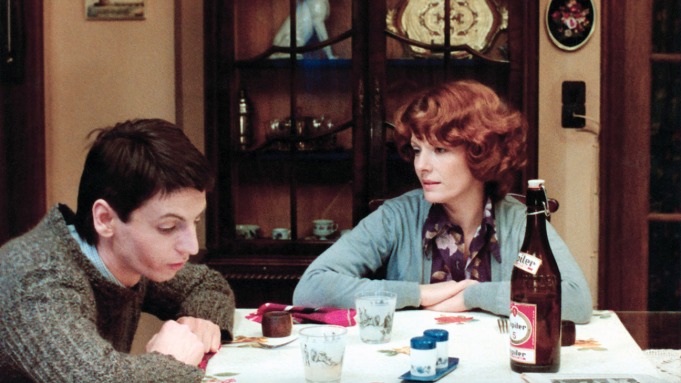
Photo: Everett Collection. A scene from the French film Jeanne Dielman, voted best of all time at Sight & Sound magazine recently. It’s the first time the best-film honor has come to a female director, Chantal Ackerman.
Do you follow “best of” lists? I find them interesting, and I especially like seeing how judgments change over the years. Today’s story is about voting for the best film of all time. I’ve seen hardly anything on the list, but what caught my attention is that the film that has moved to the top was made by a woman. A first for the poll.
Alex Ritman writes at the Hollywood Reporter, “Almost 50 years after its release, Jeanne Dielman, 23 quai du Commerce, 1080Bruxelles — Chantal Akerman’s groundbreaking 1975 drama following the meticulous daily routine of a middle-aged widow over the course of three days — has become the first film by a female director to top Sight & Sound magazine’s once-a-decade ‘Best Films of All Time’ poll in 70 years.
“More than 1,600 film critics, academics, distributors, writers, curators, archivists and programmers voted in the poll, which the BFI-backed [British Film Institute] publication has been running since 1952, with the results, announced Thursday, seeing Akerman’s feature — which was heralded by Le Monde in January 1976 as ‘the first masterpiece of the feminine in the history of the cinema’ — leapfrog from 36th position in 2022 to No. 1.
“The 2012 winner, Alfred Hitchcock’s Vertigo, now sits in second place, with Orson Welles’s Citizen Kane (which held the No. 1 spot for 50 years) placed third and Yasujirō Ozu’s Tokyo Story fourth. Three more films are new to the top 10, including Wong Kar Wai’s In The Mood for Love in fifth place (up from 24th in 2012), Claire Denis’ Beau travail at number seven (up from 78th) and David Lynch’s Mulholland Dr. in eighth place (up from 28th). Only four new films released since 2012 managed to break into the top 100 of the poll. …
“ ‘Jeanne Dielman challenged the status quo when it was released in 1975 and continues to do so today. It’s a landmark feminist film, and its position at the top of list is emblematic of better representation in the top 100 for women filmmakers,’ said Mike Williams, Sight and Sound editor. ‘While it’s great to see previous winners Vertigo and Citizen Kane complete the top three, Jeanne Dielman’s success reminds us that there is a world of under-seen and under-appreciated gems out there to be discovered, and that the importance of repertory cinemas and home entertainment distributors cannot be overestimated in their continued spotlighting of films that demand to be seen. What currently undervalued masterpieces might emerge in 10 years thanks to this tireless work?’
“Added BFI executive director of public programs and audiences Jason Wood: ‘As well as being a compelling list, one of the most important elements is that it shakes a fist at the established order. Canons should be challenged and interrogated and as part of the BFI’s remit to not only revisit film history but to also reframe it, it’s so satisfying to see a list that feels quite radical in its sense of diversity and inclusion.’
“See the top 20 greatest films of all time, according to Sight & Sound‘s 2022 poll, below
10 Singin’ in the Rain (Stanley Donen & Gene Kelly, 1951)
11 Sunrise: A Song of Two Humans (F.W. Murnau, 1927)
12 The Godfather (Francis Ford Coppola, 1972)
13 La Règle du jeu (Jean Renoir, 1939)
14 Cléo from 5 to 7 (Agnès Varda, 1962)
15 The Searchers (John Ford, 1956)
16 Meshes of the Afternoon (Maya Deren & Alexander Hammid, 1943)
17 Close-Up (Abbas Kiarostami, 1989)
18 Persona (Ingmar Bergman, 1966)
19 Apocalypse Now (Francis Ford Coppola, 1979)
20 Seven Samurai (Akira Kurosawa, 1954)
More at the Hollywood Reporter, here, and at the Boston Globe, here. I imagine that the reason several movies jumped higher up the list is that voters who had never heard of them found them and watched.
I am going to research a few and order them through our retro Netflix DVD service. Jeanne Dielman might be a bit dark for me. At least from what I’ve read about it. The selections I’ve already seen are the kinds I like: Vertigo, Citizen Kane, 2001. (How funny to think the the year 2001 is futuristic. Kubrick, you have no idea!)
If any of you were following this blog in 2015, you might have seen what a stealth artist was doing in Boston to highlight crumbling infrastructure. Check out that artist’s Lego patchwork here.
Today, a different artist is working on potholes — using mosaics, not Legos. And he’s not anonymous.
Cathy Free reports at the Washington Post, “Jim Bachor travels across the country filling potholes for a living. He doesn’t just fill the unsightly road gaps with cement, he actually turns them into art — and often, social commentary.
“Bachor uses hundreds of pieces of Italian glass and marble that he cuts to create the sometimes subversive mosaics, which he installs on the ground to beautify unsightly city streets. He doesn’t work with cities on the installations, he works rogue, and he places the mosaics himself.
“ ‘People loved it and thought it was funny,’ he said. ‘Was it legal? I still don’t know. I decided to turn my hobby into a bit of a Robin Hood thing. If I had to ask for permission, I wouldn’t be doing this.’ …
“In D.C., Bachor was hired by the #RelistWolves Campaign, a privately-funded group that is working to get Northern Rocky Mountain wolves reclassified as an endangered species in an effort to get them the same protection as other gray wolves.
“Samantha Attwood, one of the group’s co-founders, said they decided to hire Bachor to fill several potholes with mosaics of wolves to help draw attention to their efforts. …
“He made the pieces earlier in his basement studio in Chicago, then selected the locations himself after asking a few of his Instagram followers in D.C. to narrow down the possibilities. Attwood said she was pleased to see the campaign take off in front of Solid State Books at the 600 H Street location.
“ ‘The store put up a display with books and information about relisting the wolves, and they made sure that Jim’s pothole didn’t get covered up by cars parking there,’ she said. …
“He diligently scouts before he decides on a work site for his art, which usually measures 18 inches by 24 inches.
“ ‘The perfect pothole is actually really hard to find,’ said Bachor. ‘It has to be on the edge of a road that isn’t too beat up, and people have to be able to see it from five or six feet away.’ …
“Bachor said he first became intrigued by mosaic art in the late 1990s during a trip to see the archaeological ruins of Pompeii, Italy.
“ ‘A guide pointed out a mosaic on the site and said the art looked the same as the artist intended 2,000 years ago because marble and glass don’t fade,’ he said. ‘It blew me away to think that an art form could endure for centuries after I was gone.’
“Bachor returned to his advertising job in Chicago and began dabbling in mosaics. When he was laid off from his job and decided to make a living as an artist, his inspiration came from an unlikely place.
“ ‘In 2013, the potholes in my neighborhood were particularly bad,’ Bachor said. … Bachor filled the pothole with cement and stuck a flat piece of artwork on the top, making his first in-ground art very meta with the word ‘pothole.’
“After that first project, Bachor said he decided to transform other ugly potholes in his neighborhood into asphalt masterpieces. …
“Bachor enjoyed turning the streets into a drive-over gallery and was soon installing mosaic hot dogs, Cupids and flowerpots. For some of the designs … he installed the phone numbers of car repair places he liked, which he considered a public service.”
More at the Post, here. There is one mosaic based on Edward Hopper’s “Nighthawks” and another showing Van Gogh’s “The Bedroom.” The “Dead Rat” mosaic made me laugh.
Photo: Serious Shea. Community members stand by a tree planted in Senegal during the launch of the Great Green Wall Corporate Alliance, an initiative that is part of larger efforts to prevent desertification in Africa’s Sahel region. “Serious Shea,” says the Christian Science Monitor, “is transforming a previously firewood-dependent shea industry in Burkina Faso.”
When it comes to human rights and climate justice, corporations can get into the act. It can even boost their brand. Blogger Rebecca told me about a clothing company, Fair Indigo, where she buys clothes because the cotton is organic and she knows the workers are paid a fair wage. I myself have bought cotton towels at Patagonia, which has protected the environment for decades and now promises not to use cotton from Chinese forced labor.
At the Christian Science Monitor, Taylor Luck, Whitney Eulich, Ahmed Ellali, and Sandra Cuffe write about how various countries are working on water conservation — and how certain companies are helping.
“In Guatemala, farmers are setting up ‘living fences’ around fields, creating a buffer of roots to protect their soil during increasingly strong rainy seasons. In Jordan, local Bedouin communities and authorities are pioneering resilient desert agriculture in a region that has been hit by longer and more intense heat waves.
“And in Burkina Faso, William Kwende has been working to revolutionize shea butter production – by substituting renewable energy for traditional wood-burning methods that result in deforestation. He has introduced an approach with 100% renewable energy, self-sustaining biomass burners, and a closed water system, which is curbing emissions while also reducing crop losses.
“At a time of global strain on food production, including an emerging famine in parts of East Africa, his story symbolizes the potential for using innovation to adapt to a changing climate.
The business Mr. Kwende co-founded, called Serious Shea, is designed to promote reforestation and to secure fairer wages and independence for the local women at the heart of the process.
“A key part of the innovation: Serious Shea’s eco-processing centers transform shea tree biomass into natural biofertilizer and biochar, enriching soils that are at risk of desertification and reducing reliance on expensive imported chemical fertilizers.
“ ‘People talk about water and food imports, but when you talk about food crises and adaptation, fertilizer is at the heart of it,’ Mr. Kwende tells the Monitor on the sidelines of COP 27 [Conference of Parties 27], this year’s global climate summit, at Sharm el-Sheikh. …
“Across the globe, innovative ideas like that are greatly needed. Extreme weather events are affecting the vital sector of food production – with the shifts especially hard for Indigenous communities and small-scale farmers. In Peru, rising temperatures have upended the livelihoods of alpaca farmers. In Pakistan, massive floods have sidelined several million acres from crop production. In Somalia and Kenya alone, drought threatens to push millions into food-poverty and starvation. …
“With its own farmers suffering losses amid intense heat waves and drop in Nile waters, atop the food-security crisis in the Horn of Africa, Egypt has placed agriculture front and center to an unprecedented degree at the current [COP]. …
“Agriculture experts say some of the solutions will involve mass-produced technologies such as battery-operated farm equipment. But it will also involve the rise and transfer of hundreds of local, homegrown solutions emerging across the world, many of which advocates say can cut carbon, improve resilience, and be replicated elsewhere.
“In Mexico, where last summer eight of 32 states experienced moderate to extreme drought and where half of all municipalities in the country face water shortages, some farmers turn 2-liter soda bottles upside down over saplings to capture morning dew or dig holes and line them with organic materials like leaves, to retain rainfall around young trees.
“To the south in Peru, Alina Surquislla’s family has never seen anything like the current effects of rising temperatures in their three generations of alpaca herding.
“There’s no water; the grass is turning yellow and disappearing for lack of rain,” says Ms. Surquislla. Alpacas are dying out at worrying rates. Speaking over a Wi-Fi satellite connection while walking at nearly 16,000 feet above sea level in the Apurimac region … for now, she says the answer for herders is to go to higher and higher elevations in search of water and grazing.
“Water is also scarce in Jordan. There, local Bedouin communities and authorities are scaling up pioneering desert agriculture in Al Mudawara, a border region near Saudi Arabia that has been hit by longer and more intense heat waves in the past few years.
“Since 2019, under a directive by Jordan’s King Abdullah, each family in the area has been tending to 6-acre plots of yellow corn and green onions, watered from an underground aquifer. The crops have proved resilient to more frequent 120 degree F temperatures, sprouting up into green waves amid reddish desert sands that have not been utilized for agriculture in modern history.
“Now over 4,000 acres of corn stalks stand 3 feet high and onions sprout in Al Mudawara. These provide alternative sources of income and living for Bedouin families, many of whom have been forced to abandon traditional camel shepherding due to the mounting costs of imported animal feed. …
“Says Abu Fahed al Huweiti, former director of the Al Mudawara Agricultural Cooperative that has steered the project. ‘It has given a new hope for people here.’
“In Tunisia, amid the lush fig and olive groves of Djebba, clinging to the tops of the Gorraa mountain, farmers continue a centuries-old terraced farming that has helped them cope with massive heat waves and drought that has hit much of Tunisia.
“A series of cement-lined canals crisscross down the hill through the terraced farms, carrying water from natural springs fed by winter’s snow to groves of figs, pomegranates, quince, and olives on a rotating basis of collective water-sharing.
“This ingenious method of traditional Berber farming provides timed irrigation of entire land plots, allowing local farmers to grow not only trees but also herbs and diverse flora and fauna, feeding livestock and chickens – all from the same measured water delivery. …
“ ‘We in Djebba keep using the same old techniques because it has shown success. It is an inherited model of coexistence and represents the ideal use of available water resources,’ says Fawzi Djebbi, Djebba farmer, activist, and head of the annual Djebba Fig Festival. ‘Here we use the water as a collective resource from the mountains. This water belongs to all of us.’
“Knowledge- and expertise-sharing has also been critical to speeding up farmers’ adaptation to the pummeling effects of severe weather events.
“The CCDA, an Indigenous and small farmers movement for land rights and rural development in Guatemala, is working with many of their 1,300 affiliated communities around new techniques to help farmers adapt. This year’s rainy season has been one of the longest and heaviest this century, for example.
“One technique is planting trees and plants with deep roots around crop plots. The plants are a buffer against erosion, provide shade during the hot and dry season, and sometimes include edible plants as well. …
“Global organizations are seeking to spread helpful practices and information. The United Nations Food and Agriculture Organization (FAO) has been teaming up with Vodafone to get early warning systems and messages to rural farmers across Africa to better prepare for projected climate trends and to provide advice on mitigation measures.”