Feeds:
Posts
Comments
Photo: United Airlines via Flight Global.
United Airlines will invest in carbon capture to try to limit the bad effects of its fuel on the climate.

It would be better for the planet if we all took fewer airplane trips, but consumer demand just keeps increasing. Especially after the pandemic, everyone wants to get away by plane. So here is an alternative way to deal with aviation pollution. Would love to know if you regard this as a good solution.

Steven Mufson reported for the Washington Post in January, “United Airlines is … backing carbon capture — the nascent technology designed to suck carbon dioxide from the atmosphere.

“United Airlines is the first major U.S. air carrier to take a step toward trying to remove some of the greenhouse gases spewed by it and every other airline, pollution that is driving up global temperatures.

“For United, it’s an alluring project. Governments, particularly in Europe, are beginning to crack down on emissions from airlines. Last month, the U.S. Environmental Protection Agency for the first time regulated greenhouse gas emissions from commercial aircraft. … United is increasingly focused on its voluntary goal of net-zero emissions by 2050 — good publicity at a time of growing alarm about climate change.

“But it may also be placing an early bet that carbon-capture technology could — with the help of federal tax credits — prove profitable. …

“Steve Oldham, chief executive of Carbon Engineering, which has developed carbon-capture technology, said United is taking an unusual approach to decarbonization. ‘When most are thinking they have to stop emissions, here you have a very credible company with a real need saying that the best way of dealing with emissions is removing them,’ he said.

“A lot is at stake. If global airlines were lumped together as one country, they would rank among the world’s top five or six emitters of carbon dioxide, according to the International Energy Agency. Aviation accounts for 3.5 percent of the planet’s man-made greenhouse gas emissions, a recent Manchester Metropolitan University study says. At high altitudes, the planes leave behind contrails of carbon dioxide, nitrogen oxide, water vapor and soot.

“When it comes to commercial aviation, there are no low-carbon alternatives. In the summer, a small white-and-red all-electric-powered Cessna e-Caravan flew safely over Washington state — for only 28 minutes. The plane had room for nine, but only the pilot was on board.

“Solar-powered flights are even less practical. A plane called Solar Impulse 2 went around the world over 14 months, but it could only hold the pilot in an unheated, unpressurized phone-booth-size cockpit whose single seat doubled as a toilet. The plane flew at an average of 30 miles per hour to maximize energy savings, and, despite an enormous wingspan, it was only able to carry the equivalent weight of one automobile.

” ‘The aviation sector is one of the hardest to decarbonize,’ Oldham said. ‘Planes require fuel and burn a lot of fuel. At high altitude, the impact of those carbon emissions is greater than if they were released on the surface.’

“So United says it will become a partner in 1PointFive, a joint venture designed to finance and deploy a large-scale direct-air-capture plant. The firm, formed in August by a subsidiary of Occidental Petroleum and Rusheen Capital Management, will use technology created by Carbon Engineering.

“The name 1PointFive refers to the U.N. goal of limiting the average increase in global temperature to 1.5 degrees Celsius compared with preindustrial times. Constraining global warming to that level could avert the most catastrophic fallout from climate change, scientists say. The company will build its first plant somewhere in the Texas Permian Basin, an area rich in shale crude oil and natural gas.

“Occidental, the biggest oil and gas operator in the Permian, will take the carbon dioxide from the air and pump it into old wells to extract more oil. Legislation gives firms a $35-a-barrel tax credit for this capture and use. Occidental will leave the carbon dioxide underground; it has said it has enough geologic storage capacity to bury 28 years worth of U.S. emissions. …

“Scale remains a problem. United has improved its fuel efficiency by more than 45 percent since 1990, the year often used as a benchmark for climate-oriented energy savings. It has added aerodynamic fins on wingtips, used only one engine when taxiing on runways and bought planes that weigh less. But the number of travelers has soared, and airline fuel consumption has gone up. The federal Energy Information Administration estimates that jet fuel demand will more than double by 2050.

“Each carbon-capture plant will take up about 100 acres and capture 1 million tons, equivalent to the work of more than 40 million trees. To put that into perspective, worldwide emissions are 40 gigatons. Offsetting that would require 40,000 carbon capture plants. …

“David Victor, a professor and climate expert at the University of California at San Diego, said, ‘The airlines are an example of a sector where firms are starting to see the writing on the wall … and a lot of them don’t know what to do.’ “

More at the Washington Post, here.

They Roam America

Photo: Angie Smith/Redux/eyevine.
Bob Wells: ‘Then came the first of the month, and something clicked: he didn’t have to pay rent.’

Although many of us have yet to see the award-winning film Nomadland, we can get a taste of the characters’ way of life from this article at the Guardian.

Reporter Stevie Trujillo describes living off the grid in the back roads of America. “If you look closely on city streets, campgrounds and stretches of desert run by the Bureau of Land Management, you’ll see more Americans living in vehicles than ever before. It was never their plan.

” ‘I wasn’t prepared when I had to move into my SUV. The transmission was going. I had no money saved. I was really scared,’ said April Craren, 52, bundled in blankets atop a cot inside her new minivan, a 2003 Toyota Sienna.

“She flipped the camera on her phone to show me the camp stove she uses to make coffee and her view of the sun rising over the Colorado River. She has no toilet, shower or refrigeration.

“After separating from her husband, April found herself homeless in June 2020, exacerbating the depressive disorder for which she receives $1,100 a month in disability benefits.

“ ‘I could have gotten an apartment but in a crappy unsafe place with no money to do anything at all,’ she explained.

“Last year, where April lived in Nixa, Missouri, the average rent for an apartment was $762, slightly less than the national average. Like nearly half of American renters, she would have been crippled by the cost.

“It’s not surprising, then, that job loss, divorce or, say, the sudden onset of a global health or financial crisis can push so many over the edge.

“ ‘If the Great Recession was a crack in the system, Covid and climate change will be the chasm,’ says Bob Wells, 65, the nomad who plays himself in the film Nomadland. …

Today, he lives exclusively on public lands in his GMC Savana fitted with 400 watts of solar power and a 12-volt refrigerator. His life mission is to promote nomadic tribalism in a car, van or RV as a way to prevent homelessness and live more sustainably.

“Before becoming a nomad in 1995, Bob lived in Anchorage, Alaska, with his wife and two boys. He worked as a union clerk at the same Safeway where his father had worked until retirement, only to die two years later. … By his own telling, he was the living embodiment of Thoreau’s ‘quiet desperation.’ …

“Then, when he was 40 years old, the divorce happened. After paying alimony and child support, he was taking home $1,200 a month, $800 of which went towards rent.

“One day, fretting about impossible finances, he saw a green box van for sale and thought: ‘Why don’t I buy that van and move into it?’ The idea struck him as crazy, but with the prospect of homelessness closing in, he drained the last $1,500 in his savings account and bought the van. …

“Then came the first of the month, and something clicked: he didn’t have to pay rent. As his finances improved, he installed insulation, a proper bed, even a dream-come-true PlayStation fortress for his boys. He started working only 32 hours a week, and since every weekend was a three-day weekend, he spent more time camping with his kids, which ‘tremendously helped’ his mental outlook on life. …

“Realizing he had something valuable to share, he bought the domain name Cheap RV Living in 2005. He posted tips and tricks about better vehicle-dwelling, but what he was really offering was a road map to a better life.

“Four years later, when close to 10 million Americans were displaced after the Great Recession, traffic to his site exploded. Finding himself at the center of a growing online community, he decided to create a meet-up in Quartzsite, Arizona. He dubbed it the Rubber Tramp Rendezvous (RTR), and in January 2011, 45 vehicles showed up. Eight years later, an estimated 10,000 vehicles convened for what was said to be the largest nomad gathering in the world. …

“While Bob concedes the limits of his solution – it doesn’t address PTSD, mental illness or drug addiction, three main causes of homelessness – he does see it as a way to lower our carbon footprint and make ourselves more financially resilient in trying times ahead.”

At the Guardian, here, read why it’s mostly older women seeking advice and assistance from Bob’s programs.

Photo: Waterloo-Cedar Falls Courier.
Listening to music can soothe people of any age. The woman above was 108 when the photo was taken.

We have been keeping an eye on the use of music to connect dementia patients to calming memories. (For example, in this post.)

Today we have Robert Booth reporting at the Guardian that when hospital staff in the UK worked with Alzheimer’s patients on a targeted playlist for each person, the results included lowered heart rate and less agitation.

“Trials are under way at an NHS trust to see if an algorithm can curate music playlists to reduce suffering in Alzheimer’s patients as well as in stressed medical staff.

“A test among people with dementia found an algorithm that ‘prescribes’ songs based on listeners’ personal backgrounds and tastes resulted in reductions in heart rate of up to 22%, lowering agitation and distress in some cases.

“[Now] Lancashire teaching hospitals NHS trust is extending trials to medical staff who worked in critical care during Covid to see if it can ease anxiety and stress. It is also planning to test it on recovering critical care patients, needle-phobic children and outpatients coping with chronic pain in the hope of reducing opiate prescriptions.

“The technology operates as a musical ‘drip.’ playing songs to patients and monitoring their heart rates as they listen. … An algorithm allows the software, which is linked to a streaming service like Spotify, to change forthcoming tracks if the prescription doesn’t appear to be working. Its artificial intelligence system assesses the ‘DNA’ of songs, examining 36 different qualities including tempo, timbre, key, time signatures, the amount of syncopation and the lowest notes. Gary Jones, the chief executive of MediMusic, the company developing the software, said these were among the factors that can shape the heart rate and blood pressure response to a track.

“A trial of 25 people with Alzheimer’s aged from their 60s to their 90s conducted at the Lancashire NHS trust has shown some promising results, the trust said. …

Said Dr Jacqueline Twamley, academic research and innovation manager, ‘Some people it doesn’t affect the heart rate at all, but you can see the effect in their facial expressions and in them tapping along. One patient burst out crying. He said the song brought back happy memories and they were happy tears.’ …

“When Twamley tried it, she was surprised to see the algorithm prescribed her songs by Gloria Estefan, the Pretenders, Lionel Richie and Billy Ocean. She is a fan of more raucous bands, including Led Zeppelin, Queens of the Stone Age and the niche progressive rock outfit Porcupine Tree. But it still had an effect.

” ‘I was quite stressed at the beginning of it, but I just felt calm afterwards,’ she said.

“The system aims to select songs that create a gradation in heart rate, starting with something bracing like Tchaikovsky’s 1812 overture and moving towards a lullaby.”

At the Guardian, here, you can check out the playlists recommended for patients of different ages.

These are real New Yorker covers, but for a laugh (or a tear), check out fake pandemic covers created for an art class, here.

In New York, an art teacher’s creative idea in the pandemic was to make magazine covers in the style of the New Yorker magazine. The next thing the students knew, their work had gone viral on social media.

Michael Cavna writes at the Washington Post, “A masked woman pauses to perch between two worlds: the Zoom-room confines of her virtual life this past year, and the real physical realm of a post-pandemic future. As her classmates spring across a laptop keyboard, the emotional moment resonates, a split-second frozen in art.

“Its creator, Lauren Van Stone, a New York college student originally from Connecticut, rendered the work to empathize with anyone else enduring virtual learning. ‘I felt inspired to illustrate a piece that focused on the tentative reopening of schools,’ she says, ‘and the mixed feelings that many students will inevitably have upon re-entering society.’

“Van Stone created the artwork for her third-year illustration class taught this semester by Tomer Hanuka [@tropical_toxic on Twitter] at the School of Visual Arts in New York. Hanuka had asked his students to create moving-past-the-pandemic works in the style of a New Yorker magazine cover — and was so impressed with the finished pieces that he shared some of them last week on Twitter.

“Soon, the virtual world was as moved by the students’ art as Hanuka was. Within a few days, the first tweet in the viral thread of 17 works attracted more than 130,000 likes and more than 30,000 retweets. Nearly 60,000 liked Dou Hong’s poignant image of two figures on a park bench: One is of a woman, the other an outline filled with names of covid victims. …

“Hanuka, a veteran illustrator who has contributed covers to the New Yorker, was shocked by the public response. … He had merely sought to give the student artworks some exposure beyond the classroom. But his timing couldn’t have been better: As millions of Americans are vaccinated daily amid cultural debates over evolving social and medical protocol, the art reflects the year we’re emerging from — and where we hope soon to be. …

“The assignment was to analyze the storytelling mechanisms within ‘classic’ New Yorker covers and create original ideas using some of that visual vocabulary.

‘It’s about observing a seemingly mundane detail that, by the way it’s presented, illuminates a bigger story,’ says Hanuka. …

“Amy Young, who’s originally from Vancouver, British Columbia, created a powerful cover showing a family around the table with the deceased matriarch missing, her living husband and their wall picture bathed in the lavender tint of loss. Existing alongside the buoyant hope of vaccination, she says, is the ‘grief, sorrow and perhaps even bitterness experienced by those whose loved ones have already passed away. I wanted to show that duality of emotions in my cover, and how they can find co-existence in a family.’ …

“Katrina Catacutan, from Baltimore, drew a reunion with her significant other, in a home brimming with her collection of pandemic plants that evolved to include ‘propagating cacti’ and various vegetables.

“Once their works were posted on Twitter, the students were stunned by the impassioned response. ‘It really showed me just how powerful art is, in the way it can connect countless people from across the world over one shared feeling or image,’ says Jane McIlvaine of New York, who depicted a cat watching its formerly locked-down owner exit their home. …

“As for their teacher, he is not only wowed by the outcome, but also by how his young artists have persevered academically during the pandemic. Some of them hold day jobs, and some have been cut off from their families for a year. Yet, Hanuka says, ‘They had the emotional bandwidth to gather for four hours a week — and that’s just my class — to discuss color choices and compositions with all the gravity and focus these topics demand. … They were asked to find logic in the chaos — to make sense of it, by way of beauty. They practiced their craft rigorously and showed up.’ ”

See the covers at the Washington Post.

Photo: Reuters.
‘Lost golden city’ found in Egypt reveals lives of ancient pharaohs.

Archaeologists in Egypt have had a run of successes lately. The most recent find of a whole city is expected to generate clues to the daily lives of the pharaohs.

The BBC reports that “the discovery of a 3,000-year-old city that was lost to the sands of Egypt has been hailed as one of the most important archaeological finds since Tutankhamun’s tomb.

“Famed Egyptologist Zahi Hawass announced the discovery of the ‘lost golden city’ near Luxor. [He] said the find was the largest ancient city, known as Aten, ever uncovered in Egypt. It was unearthed within weeks of the excavation starting in September 2020.

“The city dates to the reign of Amenhotep III, one of Egypt’s most powerful pharaohs, who ruled from 1391 to 1353 BC. …

“Betsy Brian, professor of Egyptology at Johns Hopkins University in Baltimore, US, said … the city would ‘give us a rare glimpse into the life of the ancient Egyptians’ at the time when the empire was at its wealthiest.

“The dig revealed a large number of valuable archaeological finds, such as jewelry, colored pottery, scarab beetle amulets and mud bricks bearing seals of Amenhotep III. …

” ‘Within weeks, to the team’s great surprise, formations of mud bricks began to appear in all directions,’ Dr Hawass said in his statement. ‘What they unearthed was the site of a large city in a good condition of preservation, with almost complete walls, and with rooms filled with tools of daily life.’

“Now, seven months after the dig started, several areas or neighborhoods have been uncovered, including a bakery, an administrative district and a residential area.”

More at the BBC, here. Check out the photos.

Photo: Suzanne Kreiter/ Globe staff.
Henrietta Nyaigoti with her mother, Veronicah Nyaigoti (right), working with baskets of chinsaga spider plant seeds.

Some years ago, for the magazine I edited, I acquired an article about Hmong immigrants in Lancaster, Massachusetts, and the role that their community garden played in their new life. The garden was called Flats Mentor Farm, and I’m excited to see it’s still going strong.

Jocelyn Ruggiero wrote recently at the Boston Globe about a Kenyan transplant whose family’s garden inspired a new business. “Six days a week, May through October, 33-year-old Henrietta Nyaigoti arrives at Flats Mentor Farm by 7 a.m. She waters the inside of her two high tunnels, checks the progress of the vegetables growing there, and walks her family’s 2 acres to assess any damage from pests and weather.

“During planting season, she puts seeds in the ground, and during growing season, tills weeds and makes any necessary soil amendments. At 2:30 p.m. on weekdays, she drives 15 minutes home, where she lives with her two young daughters, then showers and changes before heading to her job as an assistant program manager at a group home for individuals with traumatic brain injuries. She works there 50 to 70 hours per week during farm season, and 80 to 100 hours in the off-season. All year round, Nyaigoti spends 30 hours a week as a home health aide at an assisted living facility. She recently began a position as a sales coordinator for World Farmers — the nonprofit that operates Flats Mentor Farm — which has so far been a 10-hour a week commitment. … And this May, after three years of hard work, she will complete coursework for her Master’s in Public Health at Southern New Hampshire University.

Nyaigoti says, ‘I work hard because I have an opportunity that many people don’t, especially in Kenya.’

“Nyaigoti was almost 14 in 2001 when, ‘seeking greener pastures,’ her family immigrated to Massachusetts from a small town in Kenya called Rigoma Market. Her parents were teachers and, like everyone they knew, grew the vegetables — managu, chinsaga, amaranth, maize, and kunde — that their family ate. When they packed their bags, Nyaigoti says, ‘we did … what a lot of people did back then. We dried our vegetables and traveled with them … because we didn’t know if we were going to find them here. And lo and behold, we didn’t.’ …

“TIn [2003] Nyaigoti’s mother first visited Manny’s Dairy Farm in Lancaster. She was delighted to discover something she hadn’t seen since her time in Kenya: amaranth. She struck up a conversation with Manny, who invited her to pick the vegetable. Shortly after, he introduced her to Maria Moreira, the executive director and cofounder of World Farmers, the Lancaster-based nonprofit whose mission is to support small farmers in sustainable agricultural production.

“In 2004, Moreira offered her a parcel of land at the 70-acre Flats Mentor Farm, where World Farmers provides infrastructure and marketing assistance to small refugee and immigrant farmers — today approximately 25 countries represented — whose ethnic specialty crops (cleared by the government for planting and growing) make their way to more than 15 farmers’ markets, dozens of direct-to-consumer outlets, and a World Farmers’ CSA. …

“By 2006, [Nyaigoti] wanted to help her mother more, who she saw ‘working crazy hours [at her day job], and still struggling at the farm.’ She knew, though, she wasn’t going to farm the way her mother did. She explains, ‘When we came to the States, we were put into a system where you have to work for somebody in order to survive.’ She saw the farm as an opportunity for a degree of economic independence. ‘When I started working it [the farm], I said, I’m not going to sweat for free.’ Nyaigoti’s personal network of Kenyan friends had grown at UMass Lowell, and she was increasingly aware of the wider Kenyan diaspora in the region. She recognized the potential value of their Kenyan crops in this narrow target market.

“She began in 2007 with a single Kenyan church. ‘I would literally just get there, and in 30 minutes’ time, I’m done selling my produce, and I’m heading home.’ The more she sold, the faster word spread within the Kenyan community. The demand became so great that by 2008, she didn’t have enough supply to keep up. She went to Moreira, who helped facilitate ‘farmer-to-farmer sales’ between Nyaigoti and approximately 10 Flats Mentor farmers. The growers Nyaigoti subcontracts from are mostly Kenyan, however, she also buys from Tanzanians, Liberians, Burundians, and Haitians. …

“Once CDC regulations prevented large numbers of people from gathering in church parking lots to pick up their orders, Nyaigoti pivoted, fast: ‘If I know you’re not coming to the church, how can we make our relationship still work? Where can you get the vegetables where you are at? My commitment to people is: “Don’t worry about it, I will deliver.” ‘ …

“Nyaigoti wants to pack more and more of these orders: ‘my personal goal is to find a new community every year.’ She has her sights set on Cambodian, Tanzanian, and Ugandan communities next. In her own business and as sales coordinator for World Farmers, she wants to familiarize Massachusetts residents with Kenyan and other cultural crops grown by farmers at Flats Mentor Farm. She plans to share recipes and cooking videos to introduce new customers to these vegetables.”

More at the Globe, here. For information on Henrietta Nyaigoti and her business, visit www.facebook.com/Lexavahproducts. And there’s more about the Flats Mentor Farm at www.worldfarmers.org/flats-mentor-farm.

Photo: Ibl/REX/Shutterstock.
Art detective Christopher Marinello, left, returning the long-lost Le Jardin by Matisse to Lars Bystrom of the Modern Museum in Stockholm in 2013.

Now for something completely different, how about we delve into the life of a lawyer who walks some dangerous paths to recover stolen art?

Alex Daniel writes at the Guardian, “One summer morning in 2008, Christopher Marinello was waiting on 72nd Street in Manhattan, New York. The traffic was busy, but after a few minutes he saw what he was waiting for: a gold Mercedes with blacked-out windows drew near. As it pulled up to the kerb, a man in the passenger seat held a large bin-liner out of the window. ‘Here you go,’ he said. Marinello took the bag and the car sped off. Inside was a rolled-up painting by the Belgian artist Paul Delvaux, Le Rendez-vous d’Ephèse. Its estimated worth was $6m, and at that point it had been missing for 40 years.

“Marinello is one of a handful of people who track down stolen masterpieces for a living. Operating in the grey area between wealthy collectors, private investigators, and high-value thieves, he has spent three decades going after lost works by the likes of Warhol, Picasso and Van Gogh. In that time, he says he has recovered art worth more than half a billion dollars. …

“Cases tend to go the following way. A stolen artwork – in this instance, a bird by the Martin Brothers pottery makers, which was swiped from a London library in 2005 – will often turn up at auction or on social media. It then falls to Marinello to establish whether it is actually the missing work and, sometimes, to get it back. This, he says, is usually relatively simple.

“Stolen works often change hands several times before resurfacing, leaving subsequent possessors in the dark about their provenance. This is most likely what happened with the Delvaux. The painting, completed in 1967, depicts several nude women in a dreamlike landscape that’s part classical architecture, part mid-century tram station. Delvaux himself sold it a year later, but it was stolen before it reached the buyer. In 2008, Marinello got a call from somebody who wanted to return it. What happened to it in the intervening 40 years is unclear, although its final location is known. It was rolled up, says Marinello, in the wardrobe of ‘a very well-heeled celebrity. And their very expensive lawyer made it clear they would never be named.’ …

“A slight, 58-year-old Italian American with a soft Brooklyn accent, Marinello … trained as a lawyer, cutting his teeth as a litigator in New York representing galleries, collectors and dealers in cases involving disputed works. ‘Eventually, it developed into a full-time art recovery practice,’ he says. In 2013, he formed his own company, Art Recovery International, which is based in Venice but has offices in London. …

He says. ‘[I’m] a pretty good negotiator. I can convince people to do the right thing. … The bottom line [is] that if you are trying to sell something that is stolen, you’re the one with a problem, not me.’ …

“He adds: ‘With a lot of art crime, there is nobody to arrest and people rarely go to prison. It’s just a matter of recovering the work.’

“However, sometimes a suspect will refuse to cooperate. Then, things are different. ‘We go after them like pitbulls and never let go,’ he says. ‘And that is when they start getting nasty, when they are concerned they’re going to go to prison.’ “

More at the Guardian, here. If you don’t follow the Guardian online, do check it out. I really love it. It’s free, but grateful readers volunteer to pay what they can.

Photo: Andrew Harnik/Associated Press.
Vice President Kamala Harris poses for a photo after a roundtable with women-led small business owners in Providence, R.I. From left: Christine Paige, owner of Bliss Medical Hair Replacement Center, Vice President Kamala Harris;; Minnie Luong, founder and owner of Chi Kitchen Foods; Suzanne Ellis Wernevi, founder of lunaandstella.com; and Commerce Secretary Gina Raimondo.

Sending out an extra post this evening to tell you that Luna & Stella, the jewelry company that hosts this blog, was in the news when Vice President Kamala Harris came to Providence with Gina Raimondo, Rhode Island’s former governor, now Secretary of Commerce. On Harris’s agenda was a discussion with women entrepreneurs. You can tell which one is Suzanne: she’s the one wearing all the Luna & Stella jewelry.

Edward Fitzpatrick and Dan McGowan reported on the visit at the Boston Globe, here.

Photo: Noah Robertson/The Christian Science Monitor.
Kwesi Billups (right) and volunteers at Project Eden hold homegrown Swiss chard at the greenhouse in Southeast Washington, DC, April 17, 2021. Project Eden distributes its produce, along with donations from the Capital Area Food Bank, at a nearby church.

As many people learned during the pandemic, small, hopeful things can make a big difference in how a person feels. The same is true of neighborhoods. Even in areas characterized by blight and despair, a bunch Swiss chard that people grow together can make them believe that better days are ahead.

Noah Robertson writes at the Christian Science Monitor, “Three years ago, when Jevael German received his assignment through Washington’s Summer Youth Employment Program, he wanted nothing to do with it. He would be working with Project Eden, a community garden in the city’s troubled Southeast – known for police sirens much more than produce.

“A Washington native himself, Mr. German dreaded the months of labor in the district’s humidity. He didn’t even like vegetables. While meeting his supervisors on his first day, Mr. German laid his head facedown on the desk. 

“ ‘Sir, if you don’t want to be here, you’re welcome to leave,’ he heard back. ‘But you can’t put your head on the desk.’

“Mr. German stayed, and the summer surprised him. He enjoyed the outdoor work, which reminded him of childhood gardening with his grandmother. As an older member of the summer group, he began mentoring some of his younger co-workers. He even started eating greens. 

“At the program’s end, Mr. German asked to continue with Project Eden for another summer.

After returning, he learned that a former summer employee at the garden had died in a shooting. Mr. German, who was still living with one foot in the streets at that time, saw in that tragic death a version of himself if he didn’t change.

“ ‘Right then and there, I was like, I’ve got to leave the streets alone,’ he says. …

“Almost 10 years ago, Cheryl Gaines, a local pastor, started the garden as a response to the South Capitol Street massacre, one of Washington’s worst mass shootings in decades. Her idea then, as now, was that no community chooses violence when it has another option. Since then Ms. Gaines, her son Kwesi Billups, and hundreds of local employees and volunteers have sought to offer such an option.

“While simultaneously addressing challenges of health, food insecurity, and unemployment, Project Eden is at its roots an alternative. The work is rarely convenient, and resources are often low. But the garden’s legacy is that seeds can grow on what may seem like rocky soil – if only there’s a sower.

“ ‘This garden gives back to you what you give to it,’ says Mr. Billups. 

“In 2012, Ms. Gaines was Project Eden’s sower, though an unlikely one at that. She grew up with an abusive, alcoholic father in public housing outside New Orleans, only to trade that past for a career in law, and later the ministry. While at seminary in Rochester, New York, she had a persistent vision that God was calling her to live in Southeast Washington, begin a church, and plant a community garden. In 2010, after having lived in the Washington area for years, she felt the time had come.

“Leaving four dead and six more injured, the South Capitol Street massacre rattled Southeast, and brought the community together to mourn. At a vigil, Ms. Gaines met the owner of an apartment building just blocks away from the the shooting. In that conversation, she eventually shared her vision. Before long, the owner told her she could use her building’s backyard.

“On that land two years later, Project Eden (‘EDEN’ stands for Everyone Deserves to Eat Naturally) began as a 10-by-20-foot patch of dirt, with only rows of tilled soil. The next year Ms. Gaines and her team turned that plot into a 28-by-48-foot greenhouse, complete with aquaponics, and have since expanded to another location at nearby Faith Presbyterian Church.

“A community garden may seem like a boutique project in some areas, but not in Southeast, says Caroline Brewer, director of marketing and communications at the Audubon Naturalist Society, which recently named Mr. Billups its yearly Taking Nature Black youth environmental champion. …

“ ‘When people have opportunities to give back … that allows them to grow and develop and mature and make [an] even greater contribution to their families and their communities,’ says Ms. Brewer.

“Project Eden isn’t just resisting material challenges of nutrition and income, says Ms. Brewer. It’s helping the community resist despair. ‘It’s a constant battle,’ she says, ‘and they’re winning that battle.’ “

More at the Monitor, here.

Photo: Hikespeak.
Because it’s possible to get permanently lost in the Mt. Waterman area of the Angeles National Forest, a hiker was lucky that someone in a different part of California had a hobby identifying the location of photos
.

People have unusual hobbies, things they like to dig deep into just because. A stranger’s passion for figuring out where photos were taken turned out to be lucky for hiker Rene Compean. Sydney Page at the Washington Post has the life-and-death story.

“When Rene Compean snapped a photo of his soot-stained legs hanging over a steep cascade of rocks, he feared it was the last picture he’d ever take. Hopelessly lost while hiking in Southern California, he thought he might die. … He repeatedly yelled for help and used charred sticks to write SOS on any open surfaces he could find.

“Compean had trekked through the Angeles National Forest trails more times than he could count, he said, but after venturing along a new path April 12 — for what he intended to be a two-hour outing — he lost his way.

“Several hours into the solo hike, after many failed attempts at getting his bearings, he was scared. The temperature was dropping fast in the remote, rugged terrain, and the winds were whipping.

“Compean grabbed his cellphone, which had less than 10 percent battery remaining, and climbed to a spot where he was able to get at least one bar of signal.

” ‘SOS. My phone is going to die. I’m lost,’ Compean texted a friend, along with two photos showing where he was — though only one went through. It was the picture of his legs.

“The photo offered minimal information and, given Compean’s lack of cellphone signal, the resolution was very low. More importantly, though, Compean didn’t realize his location settings were disabled on his phone.

“Still, the grainy image was somehow detailed enough for a total stranger to decipher the hiker’s exact location.

“Ben Kuo was working at his home about 60 miles away in Ventura County, Calif., when he stumbled upon a tweet from the Los Angeles County Sheriff’s Department, along with the photo of Compean’s legs.

“The sheriff’s search-and-rescue teams had already spent the previous night unsuccessfully looking for Compean, so they released the photograph to the public hoping someone could help.

“Sgt. John Gilbert said they figured Compean was on the mountain at about 7,000 feet elevation, and the blasts of wind were ‘definitely a concern.’ …

“The department tweeted: ‘Are You an Avid Hiker in the Mt. Waterman Area? #LASD SAR Teams need help locating a #missing hiker.’

Kuo, 47, inspected the image and thought, ‘I bet I could find that spot,’ he recalled.

“Kuo works in the tech industry, but he is also an amateur radio operator. For several years, as a hobby, he has used his Twitter account to alert the public about natural disasters. He regularly examines satellite imagery to identify and track local wildfires.

“Plus, he has another unusual pastime: ‘I have always loved looking for where photos are taken,’ Kuo said. He frequently tries to identify where movie scenes, television shows or commercials were filmed. …

“So when he came across the blurry image of Compean’s legs surrounded by an endless landscape of rocks and vegetation, he instinctively pulled up a satellite map. Since the sheriff’s department said Compean’s car was found near Buckhorn Campground, he narrowed his search to the surrounding area.

‘There’s an amazing amount of information you can get from satellites,’ said Kuo, who is also a hiker, though he has never visited the area where Compean was lost.

“The first thing he noticed in the picture were patches of greenery. ‘I realized he’s got to be on the south side because there’s not really any green valleys on the north side,’ he explained.

“That finding tightened his search considerably and helped him zero in on one area that closely resembled the terrain in the image. The final step was cross-referencing the original photo with Google Earth and comparing specific details.

“ ‘By punching in the time and date that the photo was taken, you can compare the view in Google Earth,’ said Kuo. ‘They matched.’

“He shared a screenshot of the satellite imagery on Twitter and called the sheriff’s department to notify officials of the coordinates he uncovered.

“After vetting the findings in relation to the information they were able to glean about Compean’s whereabouts, ‘we felt pretty confident that Ben’s information was good,’ Gilbert said. A search-and-rescue team swiftly boarded a helicopter and flew to the area.”

Read what happened next at the Washington Post, here.

Photo: David Melancon.
For inventive builders today, origami is less about paper cranes and more about fitting useful structures into tiny spaces.

The uses of origami continue to amaze. There are so many variations on this ancient Japanese art! I have written posts on origami and engineering, origami ballet costumes, and origami microscopes, just to mention a few. Today we learn how the principles of origami could be used to create temporary emergency shelters.

Max G. Levy reports at Wired, “One bright April day on a Harvard University lawn, David Melancon stepped out of a white plastic tent carrying a table. Then another. Then he made a few trips to produce 14 chairs. Then a bike, followed by a yellow bike pump. Finally, he carried out a large orange Shop-Vac. Melancon, a PhD candidate in applied mathematics, then closed the tent’s makeshift door behind him. This was what his team dubbed their ‘clown car’ demonstration — proof that a huge number of objects could fit inside a tent which, only a few moments before, had been a flat stack of plastic about the size of a twin mattress, then inflated into an origami-inspired shelter. …

“ ‘There are a number of situations — emergency situations, for example — when you need a structure,’ says Katia Bertoldi, Melancon’s advisor and a professor of applied mechanics at Harvard. For example, people displaced by natural disasters need immediate shelters. ‘I can build a shed, and then it’s there. But then if I have to move, either I take it apart or I move this huge volume. It is very impractical,’ she continues. …

“A standalone origami needs to be bistable. The word is often used in electronics and computer science to describe a circuit with two stable states, but in mechanical design, it basically means the structure has to be sturdy both when it’s flat-packed and when it’s expanded. It would have to hold its shape while folded, and stay that way while unfolded without sealing in air. …

“Last Wednesday in the journal Nature, [Bertoldi’s team] presented an unprecedented collection of bistable inflatable origami. Folded from either cardboard or corrugated plastic sheets, the pieces snap into place with pressure from an air pump, and hold their own without it. … One stands out: an 8-foot-tall shelter with an 8-foot-wide octagonal floor and a door, unfolded from one single material. …

“ ‘It’s exciting work,’ says Joseph Choma, an associate professor of architecture and founder of the Design Topology Lab at Clemson University. Choma, an expert in foldable structures and materials who was not involved in Bertoldi’s project, says the world needs smarter disaster relief architecture, ‘especially ones that can be flat-packed, deployed, and then flat-packed again.’ …

“Bertoldi points out that we already have a well-known deployable shelter: camping tents. Light, tightly-packed tents make it easier to backpack through the wilderness. But assembling one into an enclosed space takes time. You have to link metal bars, thread them through narrow holes in fabric, and lock it all in place. Setting up bar-based structures en masse takes even more time and hands. An ideal emergency shelter gets set up quick when it’s needed, and comes down quick when it’s needed elsewhere. …

“The origami magic happens at the hinges. The faces won’t bend, so something’s got to give. The hinges were either two-sided tape connecting laser-cut cardboard, or lines mechanically scored into plastic sheets. That allows the structure to bend around itself for inflation and deflation. And in order to make all the hinges swing into place automatically, her team decided, maybe they could just inflate the folds all at once using air pressure.

“But blowing air into an inflatable object is more like compressing a spring then assembling a building. It’s not bistable. ‘You compress it and it deforms,’ Bertoldi says. ‘But as soon as you remove your load, it springs back.’ In other words, you can use force from air pressure to deform a folded bundle of cardboard and turn it into an inflatable tent, but then you’re stuck making sure the air stays in — which, of course, rules out having a door.

“Stability is all about minimizing excess energy: a ball parked in a valley is more stable than one halfway up a steep hill. Bistability means designing a structure so that its energy barrier, or the amount of energy needed to lock it into its inflated or deflated states, is just right. The barrier can’t be too high, or else it’s impossible to inflate. But the barrier also can’t be too low, because then a gust of wind could collapse it: ‘It’s gonna flip back and deflate,’ Bertoldi says. ‘You need to carefully design its energy barrier,’ she continues. ‘And that’s most of the engineering game.’ ”

At Wired, here, read how a lot of trial and error led to something that works.

Photo: Rob Hitt.
A kitten is on duty in a New York shop.

New Yorkers seem to love the cats that hang out in little food shops and chase mice. More often than not, local culture overrules concerns about health regulations. And shoppers love to share photos of their favorite bodega cats on social media.

Hakim Bishara writes at Hyperallergic about one such enthusiast. “Who doesn’t like bodega cats? The feline sheriffs, tasked with warding off rodents and pests in New York’s convenience stores and delis, have long signified a unique and beloved local phenomenon.

“Since 2012, Rob Hitt, a Brooklyn-based web developer and music producer, has been taking and collecting photographs of domesticated cats in bodegas across the city and posting them on his social media. Since then, his Twitter and Instagram accounts have gained a massive following, with hundreds of contributions featuring adorable bodega cats patrolling stores, perching on shelves among products, climbing onto ATM machines, or examining customers with a suspicious eye. …

“While New York’s public health department codes prohibit bodega cats, they have been valuable assets to their owners, who prefer to pay the $200 to $350 fine for holding the cat than dealing with a rodent infestation, which can harm products while also incurring a penalty of $300.

“As Hitt’s social media clout grew, he started an online shop selling bodega cats-themed merchandise, from shirts and tote bags to baby onesies. A portion of the profits goes to NYC animal rescue and trap–neuter–return organizations including FlatbushcatsTrapKingPets Are Wonderful Support (PAWS) NY, and others. Hitt also promotes the work of such organizations on his blog.”

By the way, when a bodega cat was kidnapped a couple years ago, the neighborhood was outraged. The New York Times had that story.

Azi Paybarah wrote, ” ‘The incident happened at 7:19 a.m. Friday,’ Anik Ahmed said. ‘She went outside at like 7:20, and the guy picked her up at like 7:23. And we noticed the cat was missing by 7:35.’

“Mr. Ahmed, 27, was referring to Lexi, the year-and-a-half-old tabby who has been a fixture at 71 Fresh Deli and Grocery, his store in Kips Bay, Manhattan. Surveillance video appears to show the cat vanishing when a man passes by. …

“She was ‘the neighborhood’s cat,’ one worker told NY1. The Daily News described how ‘bereft’ workers were searching for ‘the furry darling.’ …

“Fliers with Lexi’s picture are being distributed. Mr. Ahmed said he thought the catnapping was intentional, but added, ‘I’m not going to press charges.’

“Lexi came into Mr. Ahmed’s life when a friend’s cat had a litter. Soon, Mr. Ahmed said, he found himself with a curious kitten who befriended customers and workers alike.

“She even started helping around the store: Mr. Ahmed said the building’s superintendent noticed a reduction in the rodent population.

“Before opening the deli about five years ago, Mr. Ahmed was a software engineer tester, looking for potential breaches in new websites and apps. He acknowledges now that he could have kept Lexi more secure.”

More at the New York Times, here. I haven’t been able to discover if Lexi was ever returned to Ahmed. If you know, please comment below. And you can enjoy lots of pictures of other bodega cats at Hyperallergic, here.

Photo: Library of Congress.
Maypole dancers at the Bavarian Celebration of Spring festival in Leavenworth, Washington.

Since 1889, May 1 has been recognized as International Workers’ Day around the world. But a much more ancient May 1 tradition involves dancing around “maypoles” to celebrate spring.

According to Wikipedia, maypole “festivals may occur on May 1st or Pentecost (Whitsun), although in some countries it is instead erected at Midsummer (June 20-26). In some cases the maypole is a permanent feature that is only utilized during the festival, although in other cases it is erected specifically for the purpose before being taken down again.

“Primarily found within the nations of Germanic Europe and the neighboring areas which they have influenced, its origins remain unknown. It has often been speculated that the maypole originally had some importance in the Germanic paganism of Iron Age and early Medieval cultures, and that the tradition survived Christianisation, albeit losing any original meaning that it had. It has been a recorded practice in many parts of Europe throughout the Medieval and Early Modern periods, although it became less popular in the 18th and 19th centuries. Today, the tradition is still observed in some parts of Europe and among European communities in the Americas.”

Olivia Waring and Jack Slater offer more details at Metro. “As today is the first of May, communities across the world might be getting on their sunny day best and heading to dance around a maypole – a tradition which is around 600 years old. But what does dancing around a maypole on May 1 involve, and what does it represent? Here’s all you need to know.

“Dancing around a maypole involves a group of people taking a colored ribbon attached to it and weaving around each other, often to music. Traditionally the dancers position themselves in pairs of boys and girls before beginning their routine.

“The dance creates a multi-colored pattern which creeps steadily down the pole. The dancers then reverse their steps to undo the ribbons. This is said to represent the lengthening of the days as summer approaches, but the significance of the pole itself is not really known. Some communities have a permanent maypole up all year round on village greens and in squares. …

“In Austria and Germany, the maypole is known as a ‘maibaum’, is painted with Bavarian white and blue stripes and is erected (sometimes by villagers) in the middle of a village. This may be accompanied by a procession. …

“Though not always held on May 1, maypole celebrations also happen in the States, Malta, Scandinavia, Canada, and Italy – with Italians using the pole to celebrate International Worker’s Day, too. In other countries, including Sweden, a maypole is referred to as a Midsummer pole and is a part of their annual Midsummer celebrations in late June.”

Watch the video below to see how the weaving works. Trust me: it takes many rehearsals to get those ribbons to lie flat and smooth. More at Wikipedia, here, and at Metro, here.

Here come more spring photos. Most are from my walks, but the pictures of the gorgeous Isabella Stewart Gardner Museum in Boston were take by Suzanne. She put lots more photos of the Gardner on Instagram, @lunaandstella.

The top picture illustrates for me how spring is a time of becoming. The tree is budding lustily over the lichen-covered branch.

But we weren’t quite done with snow. As you can see from the next image, the April 16 snowfall decorated trees already flowering out.

Patriot’s Day, traditionally April 19 in my neck of the woods, has had to be subdued during the pandemic. No parades. But as you can see, a few Minutemen mustered anyway. I guess that after starting the Revolution a year before Independence Day, they imagine germs, however deadly, can’t slow them down. I wonder if they ended up wearing masks.

I went looking for Jack-in-the-pulpit plants in the town forest as I haven’t seen one in years, but what I found was skunk cabbage and lots of it.

It was only last year while walking and asking questions of my phone that I realized the green tassels you see below are on oak trees. Takes a lifetime to learn basic things.

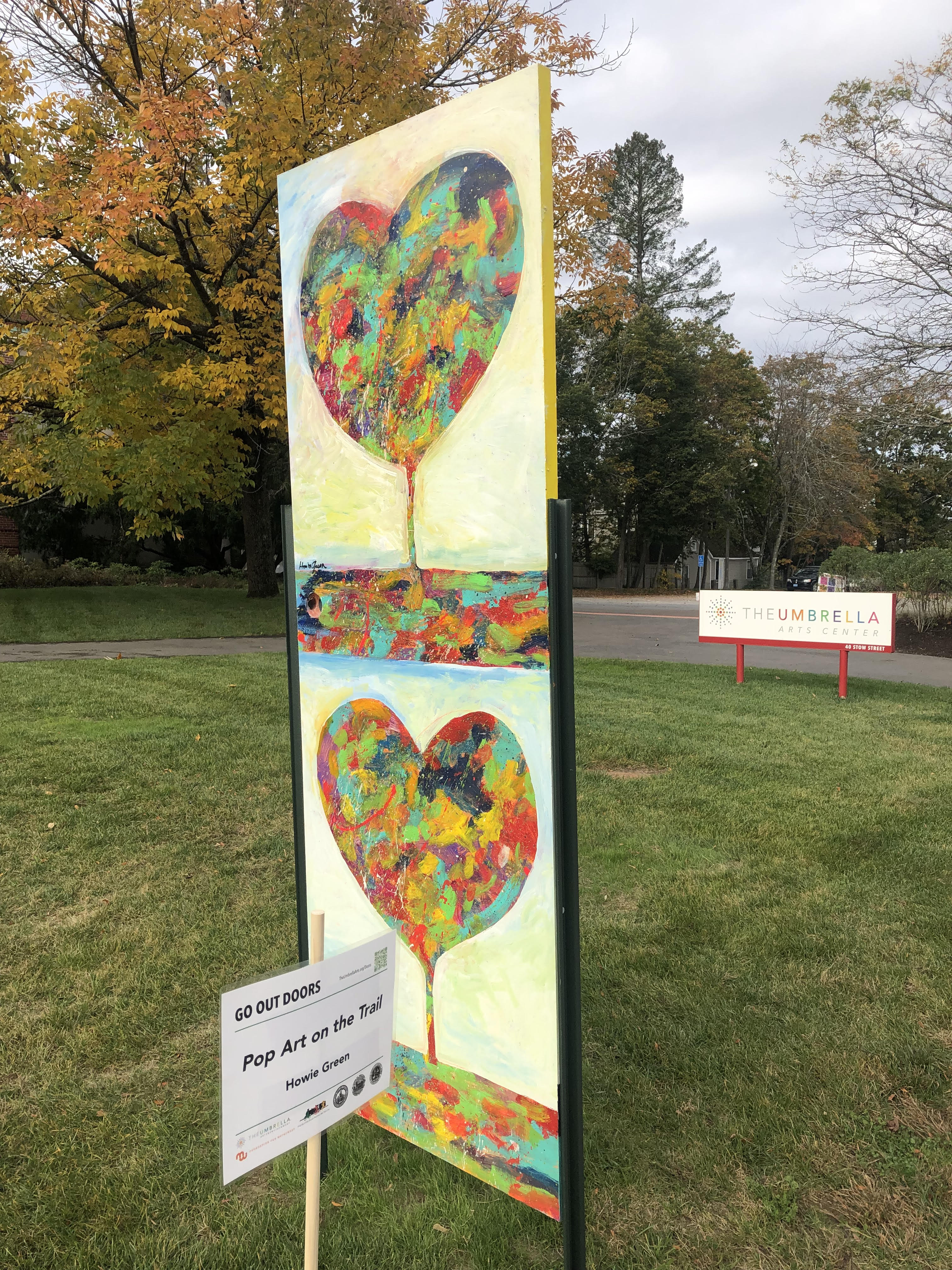
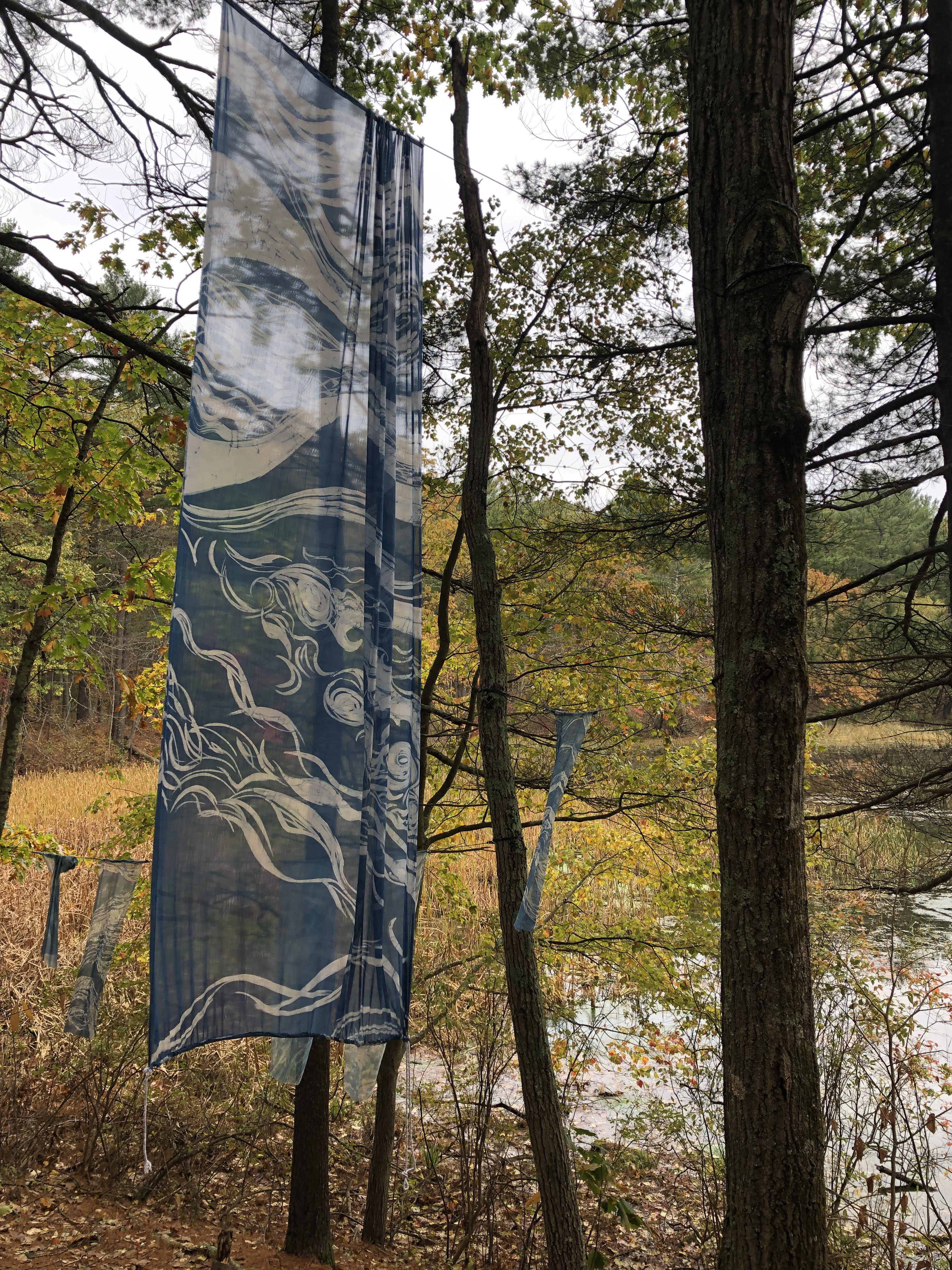
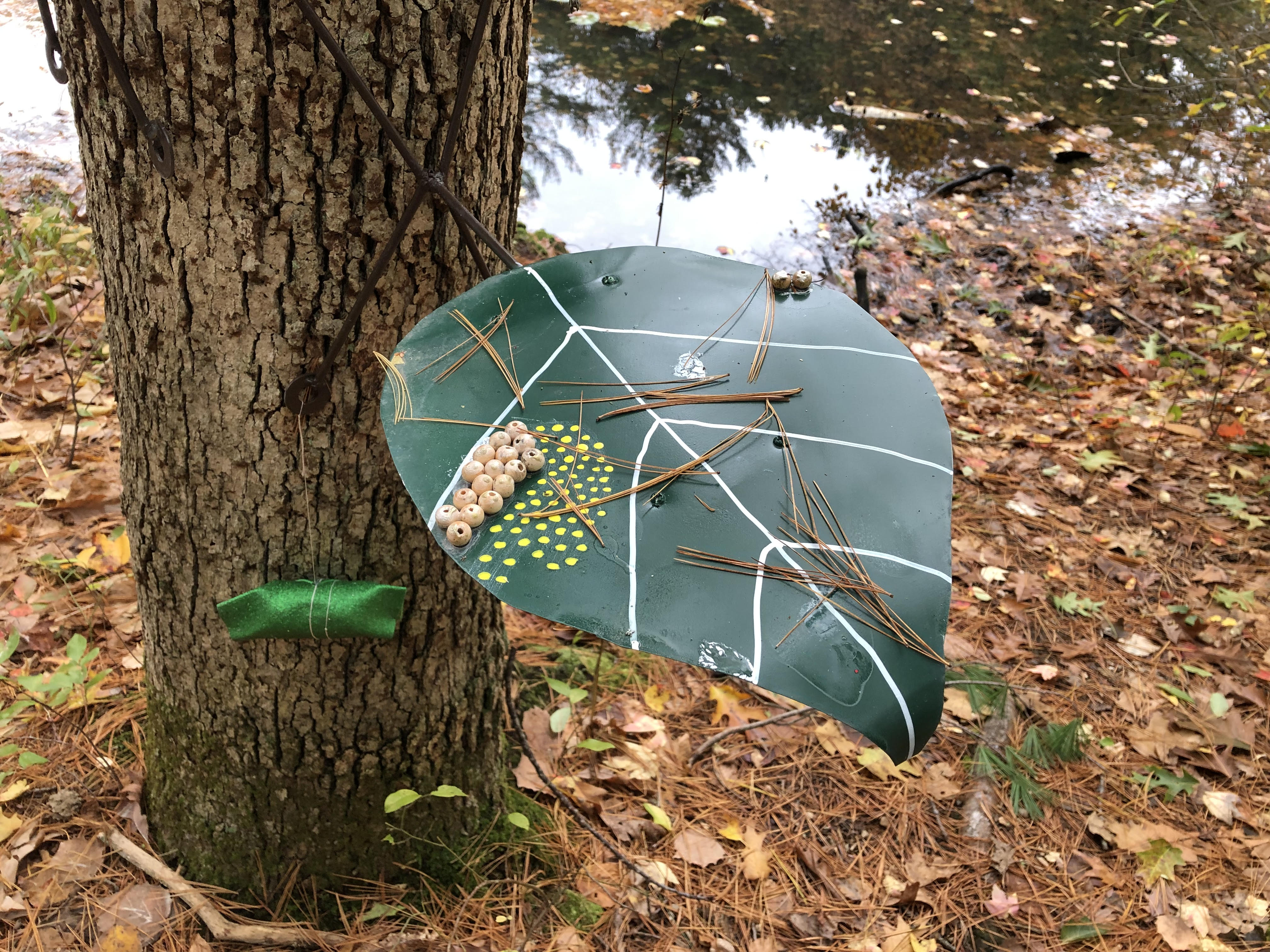
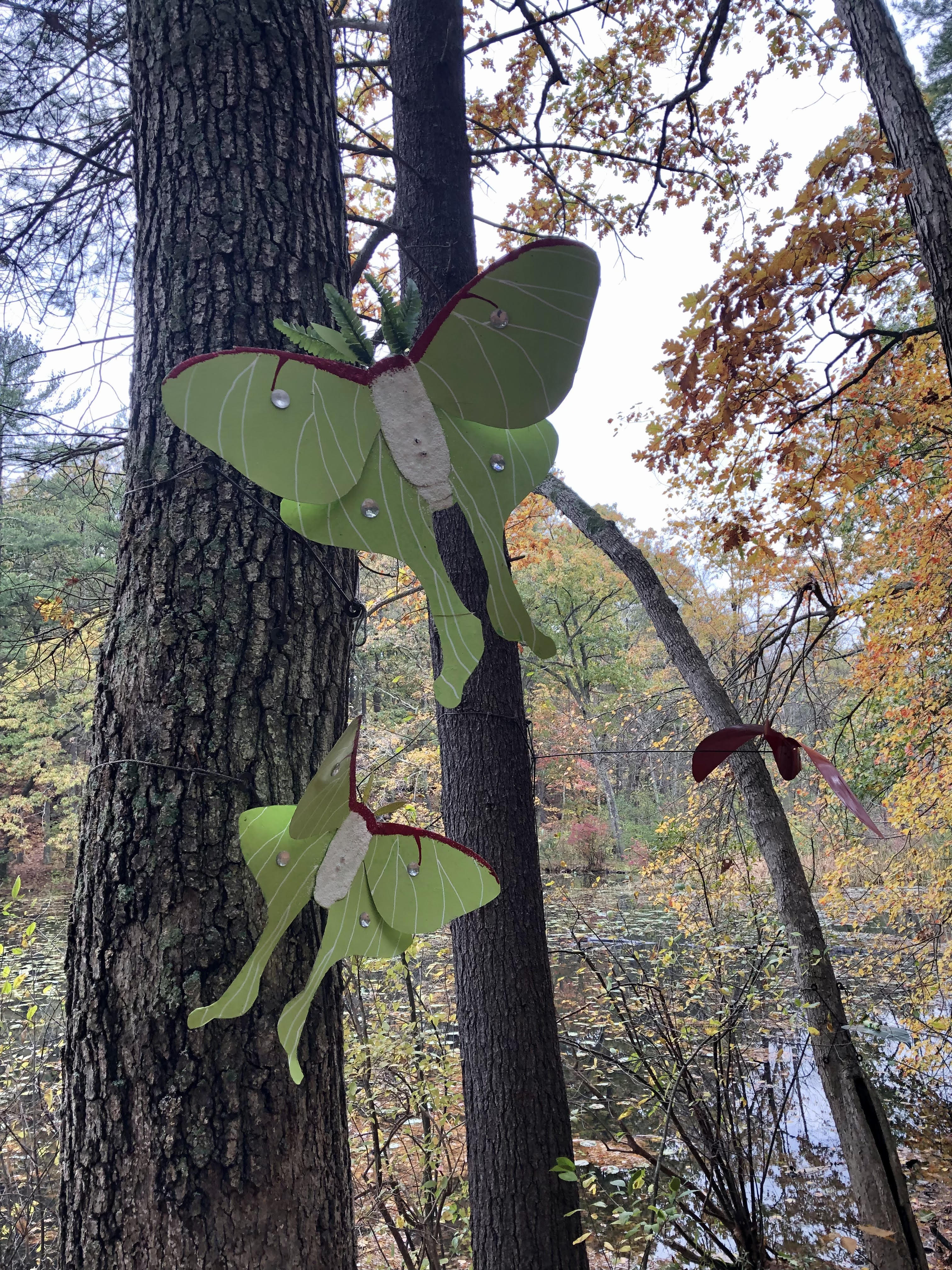
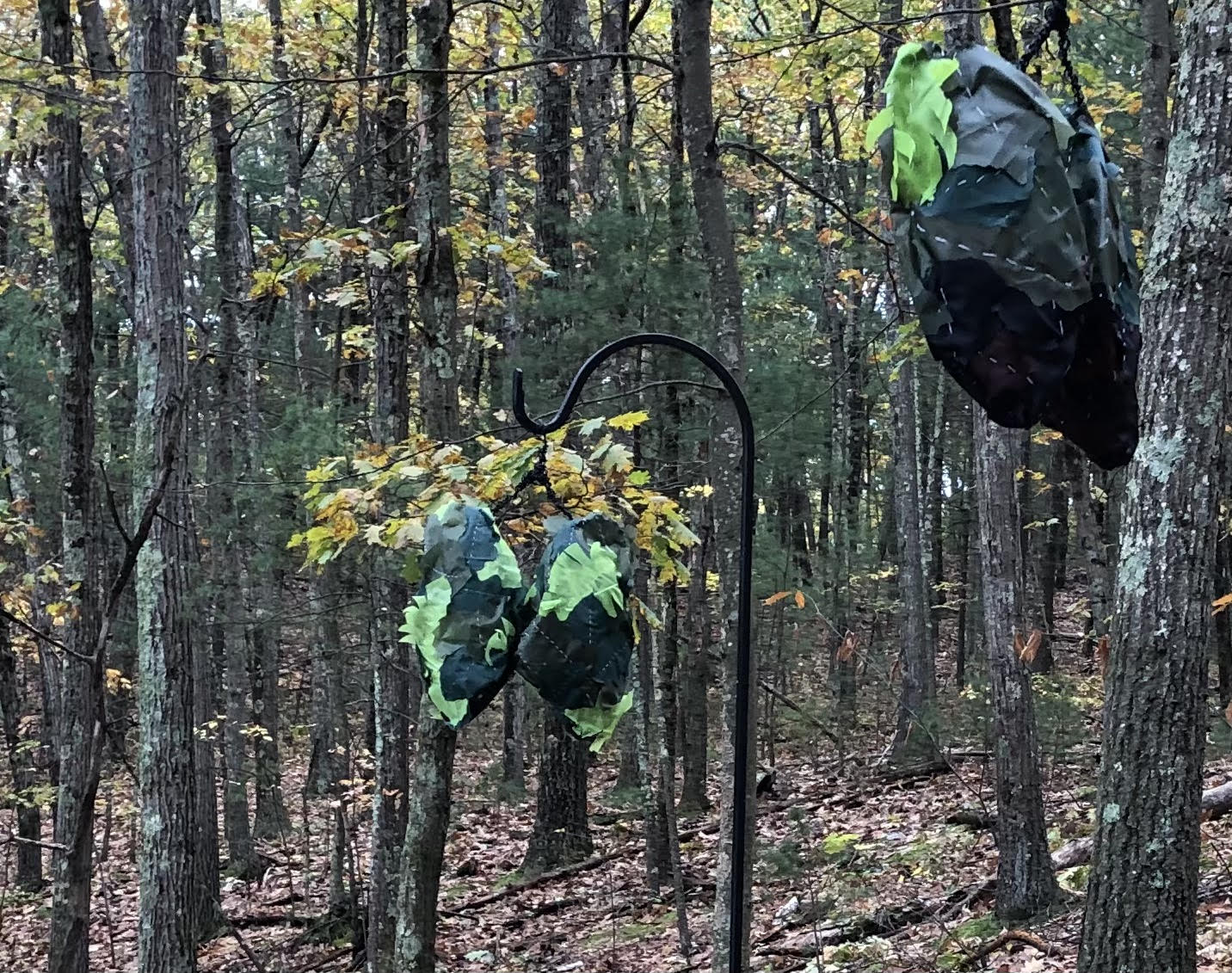
Umbrella Arts is doing a lot outdoors this year. I recently happened upon this jelly-fish-like hanging on a conservation trail, part of the Umbrella’s Change Is in the Air art walk. So pretty. The artists are Nicole Harris and karen [sic] Krolak.

At the Umbrella building itself there was a kind of awning made of paper cranes floating in a net.

Next three pictures: something called an Interrupted fern, a fuzzy thing beginning to unfurl; a Japanese quince; daffodils; and grandchildren at the New England Aquarium for a birthday celebration of Suzanne’s son.

Finally, the Gardner.

Photo: Reuters.
A man attempts to fend off a swarm of desert locusts at a ranch near the town of Nanyuki, in Laikipia county, Kenya.

Talk about citizen scientists! Tribal elders in Africa could teach Westerners a few things about enlisting everyone to solve problems.

Rachel Nuwer reports at the New York Times, “Melodine Jeptoo will never forget the first time she saw a locust swarm. Moving like a dark cloud, the insects blotted out the sky and pelted her like hail.

“ ‘When they’re flying, they really hit you hard,’ said Ms. Jeptoo, who lives in Kenya and works with PlantVillage, a nonprofit group that uses technology to help farmers adapt to climate change.

“In 2020, billions of the insects descended on East African countries that had not seen locusts in decades, fueled by unusual weather connected to climate change. Kenya had last dealt with a plague of this scale more than 70 years ago; Ethiopia and Somalia, more than 30 years ago. Nineteen million farmers and herders across these three countries, which bore the brunt of the damage, saw their livelihoods severely affected. …

“But as bad as 2020’s swarms were, they and their offspring could have caused much worse damage. While the weather has helped slow the insects’ reproduction, the success, [said Keith Cressman, a senior locust forecasting officer at the United Nations Food and Agriculture Organization], has primarily resulted from a technology-driven anti-locust operation that hastily formed in the chaotic months following the insects’ arrival to East Africa. This groundbreaking approach proved so effective at clamping down on the winged invaders in some places that some experts say it could transform management of other natural disasters around the world.

‘We’d better not let this crisis go to waste,’ said David Hughes, an entomologist at Penn State University. ‘We should use this lesson as a way not just to be adapted to the next locust crisis, but to climate change, generally.’ …

“The locust plague that hit East Africa in 2020 was two years in the making. In 2018, two major cyclones dumped rain in a remote area of Saudi Arabia, leading to an 8,000-fold increase in desert locust numbers. By mid-2019, winds had pushed the insects into the Horn of Africa, where a wet autumn further boosted their population. An unusual cyclone in Somalia in early December finally tipped the situation into a true emergency. …

“Countries like Sudan and Eritrea that regularly deal with small, seasonal swarms have teams of locust trackers who are trained to find the insects and recognize which life cycle stage they are in. They use a tablet-based program to transmit locust data by satellite to national and international authorities so experts can design appropriate control strategies.

“But people outside of those frontline locust nations who may want to start using this system today would encounter a typical technology problem. … Even if the hardware were available, in 2020, East Africa lacked experts who could identify locusts.

“ ‘We’d never had a dress rehearsal for the real thing,’ said Alphonse Owuor, a United Nations Food and Agriculture Organization specialist in Somalia. ‘We had people who were very familiar with locusts in theory, but who didn’t have the experience or equipment required to carry out this massive operation.’

“With swarms suddenly covering an area of Kenya larger than New Jersey, officials were tasked with creating a locust-combating operation virtually from scratch. Collecting dependable, detailed data about locusts was the first crucial step.

” ‘Saying “Oh, there’s locusts in northern Kenya” doesn’t help at all,’ Mr. Cressman said. ‘We need longitude and latitude coordinates in real time.’

“Rather than try to rewrite the locust-tracking software for newer tablets, Mr. Cressman thought it would be more efficient to create a simple smartphone app that would allow anyone to collect data like an expert. He reached out to Dr. Hughes, who had already created a similar mobile tool with the Food and Agriculture Organization to track a devastating crop pest, the fall armyworm, through PlantVillage, which he founded.

“PlantVillage’s app uses artificial intelligence and machine learning to help farmers in 60 countries, primarily in Africa, diagnose problems in their fields. Borrowing from this blueprint, Dr. Hughes and his colleagues completed the new app, eLocust3m, in just a month

“Unlike the previous tablet-based program, anyone with a smartphone can use eLocust3m. The app presents photos of locusts at different stages of their life cycles, which helps users diagnose what they see in the field. GPS coordinates are automatically recorded and algorithms double check photos submitted with each entry. Garmin International also helped with another program that worked on satellite-transmitting devices.

“ ‘The app is really easy to use,’ said Ms. Jeptoo of PlantVillage. Last year, she recruited and trained locust trackers in four hard-hit Kenyan regions. ‘We had scouts who were 40- to 50-year-old elders, and even they were able to use it.’ ”

More at the New York Times, here.

I love how many apps there are for identifying things these days. PictureThis has been a great help to me in identifying unfamiliar flowers. Now if I could just get one for birds!