Feeds:
Posts
Comments
Photo: Milwaukee Symphony Orchestra.
Robert Black started playing tuba with the Milwaukee Symphony Orchestra at 19.

The photo above reminds me of a long-ago time that one of my brothers played the tuba. Even today, people remember how it hung out the door of the VW bug when my mother drove him to junior high.

A tuba is a mighty big instrument, and it takes a certain kind of musician to fall in love with it. For example, the young man in today’s story.

Jim Higgins writes at the Milwaukee Journal Sentinel, “If Robert Black drops out of college, and that day could be coming soon, his professor and his parents aren’t going to cry or scold.

“Black, 19, beat out dozens of older musicians to win the job of tuba player in the Milwaukee Symphony Orchestra through a blind audition process. He’s the orchestra’s youngest musician and only member of the Gen Z cohort.

“He signed his contract in early 2020, but the COVID-19 pandemic disrupted chances to play last spring. So Black [made] his MSO subscription debut March 6, playing Paul Hindemith’s ‘Morgenmusik,’ though he did play a Christmas music quintet with MSO colleagues in December. 

“A calm speaker, Black finds it easy to explain why he enjoys being an orchestra tuba player. A tuba — and the low brass section — adds fullness in an ensemble filled with higher register instruments.

” ‘I just really love being … the person that gets to add that (depth) to the whole sound of the ensemble,’ he said.

“Black said he likely became a tuba player because his late godfather, who played the instrument, gave his family a small E-flat three-valve tuba. Black’s mother was a middle school and high school band teacher, and both his mom and his older sister played horns, so brass music was a regular part of family life in Vernon Hills, Illinois. …

“After finishing his college auditions and choosing Rice University in Houston, Black took part in the 2019 auditions for the Milwaukee Symphony’s open tuba position with 61 other musicians. He did not expect much to come from it.

” ‘My kind of goal was if I can advance past the first round, I’ll consider it a success,’ he said. 

“In the ‘elephant room’ where the tuba auditioners warmed up, he recognized musicians he knew from Facebook, people who already had jobs. But to his pleasant surprise, Black made it through to the final round, playing excerpts from Bruckner’s Seventh with a professional trombone section for the first time.  

“The MSO didn’t hire a player out of that audition, but Black went off to his freshman year at Rice with helpful feedback. … At Rice, he worked closely with professor David Kirk, who is also the principal tubist of the Houston Symphony. 

‘It was clear to me from when I first heard him that he would have a very short time as a student. He was destined for professional success,’ Kirk said during a telephone interview.

“For his second audition in January 2020, in attempting to prepare as much as possible at Rice while still making his flight to Milwaukee, but with dorms closed for winter break, Black slept on a couch in a practice room for a few days. …

“After the final round, assistant personnel manager Rip Prétat took him to meet the panel of musicians and music director Ken-David Masur, who welcomed him to the orchestra. …

” ‘Robert is an incredible musician,’ principal trombonist Megumi Kanda said in an email message. ‘He is sensitive to his surroundings and has great style. His playing and blending skills are remarkably mature, especially given his youthfulness! His ability and willingness to musically interact and adjust quickly will make him a great fit.’

“Lest Black’s parents have any concern about his adjustment to life in the MSO, Kanda wrote: ‘As his neighbors in the orchestra, the trombones are a nurturing bunch; we will take good care of him!’

“Kirk said he has counseled Black on integrating himself into the orchestra. Ask questions, don’t make statements, he has told the young musician: ‘You have to be respectful of the fact that those people have been playing music together for so long. They have their own habits, their own customs and they must be respected.’ “

More at the Milwaukee Journal Sentinel, here.
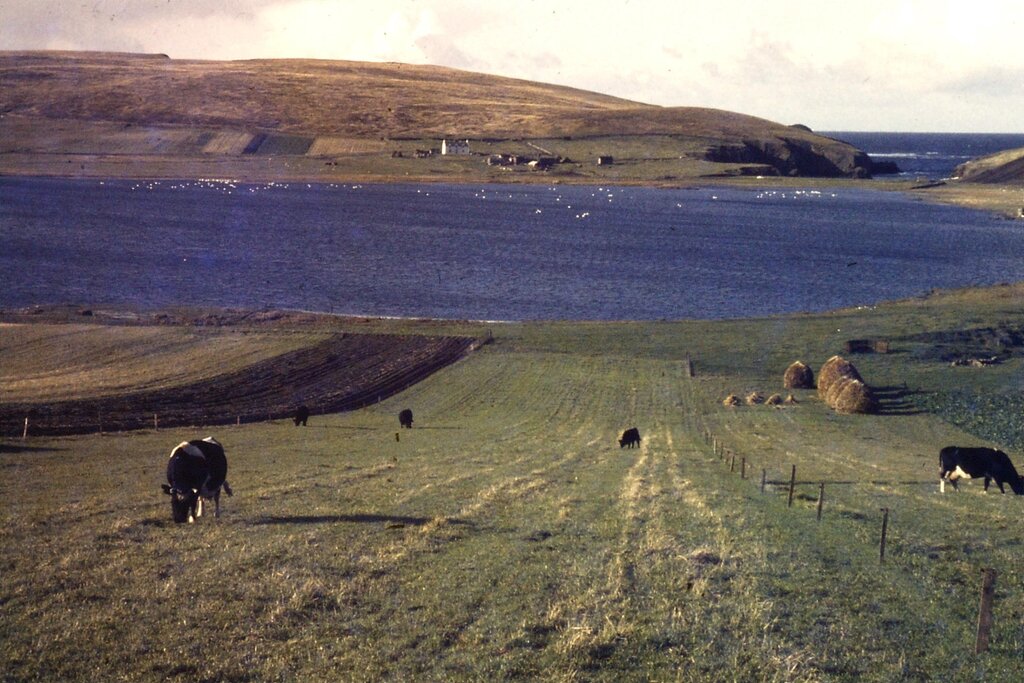
Photo: Nick Dymond.
Nick Dymond took his bags of old slides to the Shetland Islands recycling center. Paul Moar rescued them for posterity.

This why I have such a hard time throwing anything out. I say to myself that I really need to deal with the clutter here and leave less of a mess for my children. But then I think, what if these old letters, these old photos, etc., turn out to have value for posterity? I have read too many biographies that lament someone’s friend or grandmother burning precious material!

Megan Specia reported recently at the New York Times that a Shetland Islands resident who was cleaning house never considered that anyone would care about his slides of the old days. Fortunately, someone who did care saw them.

“After working for years at a recycling center in the Shetland Islands, at the northernmost reaches of the British Isles, Paul Moar is used to helping the public get rid of unwanted items.

“But when an older man walked into the recycling center in Lerwick, the capital of the archipelago in the North Atlantic, carrying two large bags heaving with old photograph slides, he quickly realized that this intended trash might be worth keeping.

“In the bags, he found a wealth of old pictures of the Shetland Islands taken in the 1960s and ’70s — old farmers shearing sheep by hand, views of dirt roads winding between small stone houses, and fishers rowing small dinghies ashore.

” ‘My jaw hit the ground,’ said Mr. Moar, a local history buff. ‘Some of them were these amazing snapshots into island life, and other ones were just scenic photos,’ he said. ‘But I knew I’d stumbled on a little bit of treasure.’

“In the days since, Mr. Moar has worked on digitizing the 300 images, tracked down the photographer and shared dozens of the pictures online. There, they have proved a sensation for residents of the islands, which have a population of just 22,000 or so, who have helped piece together when they were taken, identified the people in the photographs, and shared their own memories of the islands. …

“Through a neighbor, Mr. Moar reached out to Nick Dymond, the local resident who dropped off the bags and who took the photographs, and with his permission, uploaded a number of the images to a Shetland memories Facebook group

Overnight, dozens of people [on Facebook] were leaving messages and helping to identify the people featured, chiming in with notes on family homes and sharing memories of places they spent time as children. …

“One member of the Facebook group where Mr. Moar first shared the images said it was ‘giving everyone such a boost in these dark times.’

“Mr. Moar said his own passion for the history of the islands — where his family can trace ancestors back to the 1400s — was what had initially drawn him to save the pictures. …

“Mr. Dymond, 77, … is originally from Bedford, England, but in the 1960s, he made his home on the Shetland Islands, … and in the 1970s, he began leading bird and wildlife tours in the summers. He served as a warden for the Royal Society for the Protection of Birds, a charity, and later wrote a book on birding in the islands

“Mr. Dymond said that viewing the photographs was a journey back into small moments of his life that he had not thought of in some time. … One of his favorites is a photograph of a farmer kneeling to feed a lamb, taken on the tiny island of Fetlar, which had a population of just 100 during the seven years that Mr. Dymond lived there. He recognized the man, Lollie Brown, a neighbor, who died years ago.

“ ‘He was just a wonderful man,’ he said. ‘That was a great reminder for me.’ ”

More at the New York Times, here. See the Shetland Museum site, here.

Photo: Camilla Forte.
Nikkie Bauer sticks social distancing reminders for spectators onto the window of Chicago’s Reckless Records, where she performs her window play.

This story reminds me of being a kid. I had a passion for theater and many impractical ambitions. For instance, I was certain that if I put together a production of “Snow White and Rose Red” from the Brothers Grimm, my friends and I would be welcomed to perform it before a movie at the Lafayette Theatre. The grownups laughed.

In today’s article, frustrated theater people who persevered made surprising things happen.

Camilla Forte writes at American Theatre, “When the pandemic shut down live theatre in March of 2020, the ensemble members behind Chicago’s Stop Motion Plant were in the middle of producing a performance commissioned by Theatre Evolve. With the stages shut down and their play canceled, they found themselves having to pivot.

“As the world adapted to a new reality, the group began meeting virtually to discuss the possibility of producing and performing live theatre in a way that would keep both the performers and the audience safe. Eventually, inspired by Macy’s dioramas [and] Chicago performers who put on ‘porch concerts’ throughout the summer, the concept for Window Plays was born.

“Presented as a ‘walking tour with theatrical displays,’ and running Feb. 19-21, the performance was not a traditional narrative play, but rather a collection of six short individual vignettes performed within the storefronts of six separate businesses in Chicago’s Andersonville neighborhood.

In order to secure each storefront venue, members of Stop Motion Plant went door to door to explain the concept to shop owners.

“After receiving what they described as overwhelming support, the group landed on performing out of the Neo-Futurist Theater, Rattleback Records, Enjoy, Women and Children First, *Play, and Raygun.

“Each two- to five-minute play was acted out on a loop for an hour in its storefront window, allowing audience members to cycle between performances in a way that encouraged social distancing while making the experience accessible to a fairly large number of people. …

“Ensemble member Kevin Michael Wesson … drew on his puppetry background when determining the music and scale for his window play, Badvice. During his two-minute performance, Wesson asked audience members increasingly personal questions through the phone while pressing his hand against theirs through a pane of glass sanitized after every act. After the interaction concluded, he bestowed attendees with an envelope with three pieces of advice —two good and one bad — as a parting gift. …

“[Perry] Hunt placed a cardboard cutout of herself herself behind a screen and illuminated the cutout from behind. She then Facetimed her audience, convincing them the person they were speaking to on the phone was the person whose silhouette they could see in the window, only to reveal she was never actually there. …

“Although the performances were a revival of live theatre, the actors still had to grapple with the challenges of a virtual format throughout the six months it took them to put together the piece. …

“Despite the challenges this format presented, some ensemble members found the innovations born from working around these challenges refreshing. Hunt, for instance, found that working within a more limited format allowed her the freedom to think about theatre in more abstract ways, with this experience being something that will influence her work beyond the pandemic.

“ ‘I think it’s given me permission and space to think about more innovative ways that I can produce art,’ Hunt said. ‘This project has pushed me to be challenged and make challenging things.’ “

More at American Theatre, here.

Photo: Shelby Sherritt.
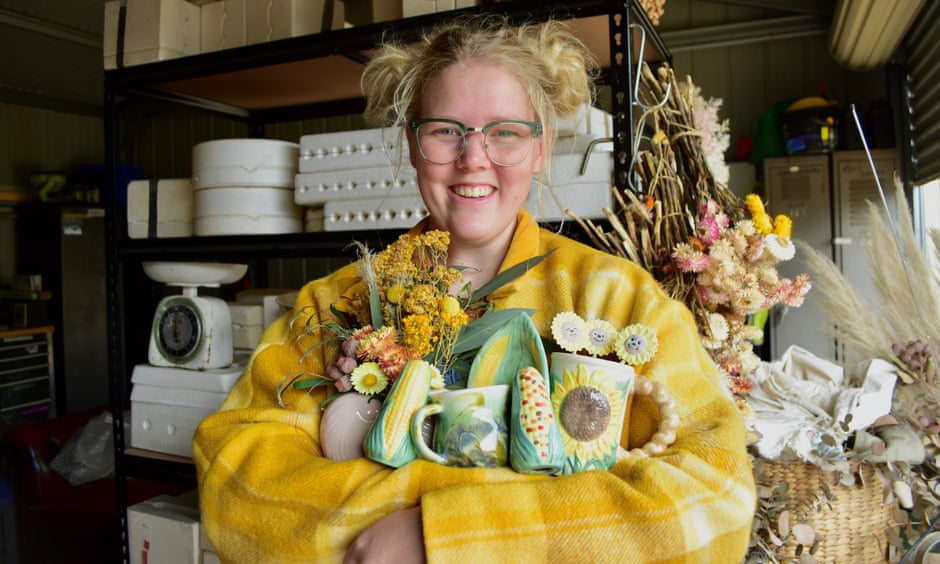
Shelby Sherritt is relieved to be known on TikTok for something other than surviving cancer, writes the Guardian. She started off making pottery koalas, echidnas, possums. Now she grabs a random slip-casting mold, enjoying the surprise at the end.

People started following a young lady in Australia because of her rare cancer, but she’s much happier being followed for her cheery slip-cast pottery.

Matilda Boseley reports at the Guardian, “For years, Shelby Sherritt was known as the ‘cancer girl.’ …

“Sherritt had been featured in videos about young people going through cancer. … Now hundreds of thousands of people are following her online, but much to her surprise it has nothing to do with cancer. Instead, Sherritt has become internet famous for reviving the 70s craze of slip casting pottery.

‘It’s now become, “Oh she’s the artist,” it’s about my pottery, and I find that so empowering,’ she says with a laugh.

“Sherritt has gained half a million followers on TikTok by hosting a wildly successful series from her Ballarat art shed, where every week she makes a new piece from a giant pile of mystery slip-casting molds she got free from a man on Gumtree.

“In the one-minute videos, she walks to her giant pile of plaster molds, picks one, and pours in watery clay or ‘slip.’ Once it’s dried she reveals the model, usually a kitsch 70s mug or garden gnome. Sherritt then paints it. … Many are looking forward to these videos every week. …

“ ‘I think it’s about the mystery. The molds are so elusive on the outside, people are just like “oooh what could actually be in that?” ‘

“Her videos now regularly top a million views, something Sherritt says she could have never imagined when her life was focused solely on surviving.

“When Sherritt was 20 she came down with what felt like run-of-the-mill appendicitis.

“ ‘I was on holiday in Perth and I just could not get out of bed, I was in that much pain. And then we went to a doctor. … By the time I went into surgery, it had ruptured,’ she says.

“During the surgery her doctors discovered she was suffering from a rare form of appendiceal and bowel cancer. … The doctors spoke in a serious, quiet tone that filled Sherritt with fear. …

“ ‘I obviously had to put my life on pause,’ she says. ‘I couldn’t work, I couldn’t study, I had to just do the treatment.’ …

“In the deepest pits of her boredom, Sherritt says she gravitated towards her old art equipment that had been gathering dust, painting, drawing, and even sculpting from her bed. …

“ ‘My original work started off as Australiana pieces. So koalas, echidnas, possums, paying homage to the bushland.’

“As Sherritt’s treatments went on her pottery got better and better, and after the chemotherapy and more surgeries beat the cancerous cells back she started selling her work, and wondered if maybe this was her new path. At the start of 2020 Sherritt was able to make pottery her full-time job, and with her extra hours began uploading videos to TikTok to promote her business. …

“Her views rapidly grew when she began the slip-casting series, and the bump in sales meant she was well and truly making enough money to live off. …

“When Sherritt first went into remission the doctors told her if her cancer was going to come back, the chances are it would be in the first five years. But on 18 January this year, Sherritt finally completed that long and nerve-racking countdown, totally cancer-free. …

“ ‘The cancer definitely inspired me to grow, but now it’s the pottery itself that’s my narrative. … I feel really, really fulfilled now that I’m on this path.’ ”

More at the Guardian, here.

When I was in junior high, my parents were dismissive of the slip-cast dish I made for them because the school used molds (ie, not creative), but I was proud of it. Kids should be encouraged in whatever version of art interests them. You never know where an interest will take them — or what it will mean to them.

Photo: University of Canterbury.
Maoris teach that we’re all in the same canoe, an understanding that enough New Zealanders have absorbed to make Covid restrictions successful there.

I don’t know much about the Maoris of New Zealand (does the Disney movie Moana count?), but having seen how successful New Zealand and its prime minister have been in dealing with Covid, I’m not surprised to learn that the high level of cooperation among the populace relates to absorption of Maori values.

In an opinion piece at the Washington Post, Matthew Milner and Richard Ngata explain.

“Life in New Zealand is almost back to normal. While the United States has seen more than half a million deaths from covid-19 — with a death rate of more than 160 per 100,000 of population — New Zealand has lost only 26 people at a rate of 0.53 per 100,000.

“Two months ago, one of us, Richard, went to a New Year’s festival with more than 12,000 fellow revelers — something barely imaginable in the United States, where most concerts are online-only. Meanwhile, teachers, including Matthew’s parents, have been instructing in person since May [2020] without requiring masks or social distancing measures.

“Why has New Zealand fared so much better? Many people argue that these differences stem from New Zealand’s geographic advantages, and there is no doubt that being an island nation has helped. But … there is a deeper reason: Manaakitanga.

“While New Zealand hasn’t always been great at recognizing or celebrating our indigenous Māori culture, campaigning by Māori advocates has helped to ensure that Māori culture is now well-incorporated into society.

Manaakitanga is one of many customs of the Māori people that are now taught in New Zealand schools. It holds that others have importance equal to, and even greater than, one’s own.

“Manaakitanga is about understanding the power of the collective. It derives from the Māori term ‘mana,’ which is the spiritual life force and energy that every living thing possesses. When you honor the mana of others, your own mana will increase through the respect you have earned. When you acknowledge these connections, you understand that your freedom as an individual is only as strong as your place in the community.

“This community approach underpins many aspects of life in New Zealand. We provide health care to anyone who needs it. Our gun safety laws focus on keeping the community safe. And manaakitanga is one of four key values the Teachers Council for New Zealand wants teachers to focus on in the classroom.

“But never has the importance of manaakitanga to our society been more evident than at the start of the covid-19 pandemic. Last March, when New Zealand went into full lockdown, people were not permitted to see others outside their ‘bubble’ (such as a household); only one person from each bubble could leave at any given time, and not travel farther than five miles from the house.

“This strict lockdown lasted six long weeks, and while there was political pushback, the ‘team of 5 million,’ as Prime Minister Jacinda Ardern calls New Zealanders, stayed home and stamped out the virus.

New Zealanders were willing to give up many of their individual freedoms and face personal hardship for the benefit of the community. …

“Still, people found ways to connect and support each other. The lesson of the coronavirus is that an individual approach is not sufficient and that it takes a team for us all to gain true freedom. The Māori proverb ‘He waka eke noa’ expresses these sentiments clearly: We are all in this canoe together. …

“While [the US president] was playing down the virus, Ardern was running daily broadcasts alongside the nation’s director-general of health to clearly communicate the latest updates and restrictions. The central message: ‘Stay Home, Stay Safe, Be Kind.’ ” More at the Washington Post, here.

If you want to dig deeper, check out research by Diane Ruwhiu and Graham Elkin at the Leadership journal on the “converging pathways of contemporary leadership,” here. The authors describe “two emerging domains in leadership – servant leadership and Indigenous Māori leadership. Both not only have strong resonance with each other,” they say, “but also reflect a common concern with individual and collective morality that draws us to the significance of human relationships.”

Singing in the Dark

Photo: The Telegraph.
The United Kingdom’s Marsh family has been singing spoofs of popular songs since the beginning of the pandemic.

Probably at some point during the pandemic, you saw the Marsh family’s early 2020 spoof of the song “One Day More” from Les Miserables. But did you know the funny, sometimes off-key, UK family has kept going?

Isabella Kwai has the backstory at the New York Times. “The family of six is lined up in front of microphones, ready to perform. The stage: their living room, complete with flowery curtains and family photos. The costumes: for the children, pajamas and bathrobes. The song: Bonnie Tyler’s 1983 raspy-voiced power ballad ‘Total Eclipse of the Heart’ [below], tweaked for the pandemic era.

“ ‘Third lockdown,’ the father croons, before his son Alfie cuts in: ‘2021 … and it’s a little bit lonely, no one’s ever coming ’round.’

“Meet the Marshes — Ben, Danielle, and their four children Alfie, 14, Thomas, 13, Ella, 11 and Tess, 9 — a family from the English town of Faversham that has gained unexpected fame for their revamped, tongue-in-cheek cover tunes about life in times of Covid. This six-voice choir, with its sweet harmonies and the occasional wobbly note, is creating songs that dramatize the mundane moments of lockdown life, from too much screen time to the horrors of remote learning.

” In their version of ‘One Day More,’ from the musical Les Misérables, the parents groan about grocery shopping online during the first lockdown as the children lament: ‘Our grandparents can’t Skype, we’re brokenhearted.’ …

“And with England crawling through a third national lockdown, they felt the time was ripe for ‘Total Eclipse’ — ‘Used to be bright eyes. Struggling to tell the days apart. Now we’re Lords of Flies.’ …

“In a time when there has been little cause for celebration, the Marshes are just some of the many people around the world who have embraced music as a way to boost morale or income, and to cope with a pandemic that has confined many people inside. During the first wave, Italians sang from their balconies, mariachi bands in Mexico played in the streets, and the percussion of people banging pots to celebrate frontline workers became a nightly soundtrack in New York and other cities.

The Marshes have not limited themselves to song; their performances have included moments of bickering, dance — captioned ‘interpretive angst dance’ — and dramatic flourishes that have amused an audience around the world.

“ ‘This is the first thing that made me not just smile but laugh out loud,’ said one fan online who had been depressed about Germany’s extending restrictions. ‘Can you adopt me?’ another joked.

“The fame is new but the singing isn’t. Mr. Marsh, 44, and Mrs. Marsh, 43, who both work at the University of Kent, met as students at Cambridge, where they sang in low-budget university productions. Reworking lyrics was a family affair even pre-pandemic. … The difference is those earlier spoofs were mainly for their own entertainment. Then the pandemic hit.

“In late March [2020], the family was searching for ways to celebrate some birthdays that suddenly had to go remote, including that of Mrs. Marsh’s mother. Their gift, they decided, would have to go virtual.

“ ‘There was no schoolwork, there was no nothing,’ Mrs. Marsh said. ‘That’s when the music became a focus for us all.’ …

“So now they’re famous, but are they cool? Well, no, Mr. Marsh said. ‘I think if we tried to do “cool,” it would all fall apart.’ But at a time when ‘so few can sing together in one place,’ the family members hope to use their sudden fame, which Mr. Marsh called ‘bewildering and incredible,’ to do some good.

“They said they are donating the proceeds from guest appearances to the W.H.O. Covid-19 Solidarity Response Fund, which supports efforts to end the pandemic, and Save the Children. But recently they also decided to take a chance by encouraging people to get vaccines, a departure from their more comedic fare. …

“How did they deliver the message? Try replacing ‘Hallelujah’ in Leonard Cohen’s iconic song with this: ‘Have the new jab. Have the new jab. Have the new jab. Have the new-ew-ew-ew jab.’ (Sung by Tess, in fuzzy p.j.’s, as her father strums the guitar.) …

“ ‘I would have never spent this much time with my 14-year-old,’ said Mrs. Marsh.”

More at the New York Times, here.

Former Minnesota Twin Brian Dozier’s trading card on eBay.

Both Asakiyume and I work with Spanish-speaking students who are learning English, but she has gone above and beyond in her efforts. She learned Spanish on Duolingo and began listening to Spanish songs in order to connect better with high school students.

I know that Tina, who’s in one of the classes where I volunteer, is getting impatient with me for not doing the same after four years, but if I decide to learn a language, it’s going to be Swedish. So I can understand what Erik is saying to my grandchildren.

Barry Svrluga reports at the Washington Post about a baseball player who was more like Asakiyume in this regard.

“Brian Dozier had 4,900 major league plate appearances, and only 482 of them came with the Washington Nationals. When he retired from baseball last month, he did so as a Minnesota Twin, the team that drafted him, developed him, brought him to the big leagues and made him an all-star.

“And yet in Washington … Dozier is best remembered as the shirtless dude from Mississippi, … crooning reggaeton lyrics in … Spanish? …

‘I think we, as Americans, need to take it upon ourselves to say, “Hey, these guys are going to be playing for a championship just like us, and you need real camaraderie to make that happen, and in order to have that, we need to take it upon ourselves to learn Spanish,” ‘ Dozier said. …

“[Baseball is] a team sport, and in some ways — ways as undeniable as they are difficult to pin down — team dynamics matter deeply. Baseball players spend ungodly amounts of time with one another, from early in the afternoon until late at night, on buses and planes, in hotels and restaurants (at least when there’s not, um, a pandemic), for eight months of the year. They come from backgrounds both affluent and poor. They are Black and White, American and Asian and Latino.

“That last part, it’s important. According to data released by Major League Baseball, nearly one in four players on 2020 Opening Day rosters or injured lists came from a Spanish-speaking country. That would affect any company trying to get its employees to work together, so it has to affect baseball teams.

“ ‘There’s so many times where things have gotten lost in translation,’ Dozier said. ‘Just small stuff, on the field, off the field, in the dugout, in the clubhouse. And all you need — it could be one word. An expression. It could be anything.’ …

“Long ago, when he was in the minor leagues, … he decided to learn Spanish.

“ ‘There were so many great guys that I became friends with, but I really couldn’t break that real true friendship barrier,’ Dozier said by phone last week, ‘because you couldn’t really communicate in the way that you need to communicate in to have that real bond.’

“Dozier had no experience with Spanish, but he took up Rosetta Stone, the language immersion software, and began teaching himself after ballgames and on bus rides. He learned the basics, but there were issues.

” ‘Rosetta Stone kind of taught you the proper way to speak Spanish,’ Dozier said, ‘but not the slang you use in the clubhouse.’

“During one of his offseasons in the minors, he played winter ball in Venezuela. Around that same time, he met Eduardo Escobar, who was new to the Twins organization. They didn’t know they would play seven years together. Still, they made a decision: make each other better.

” ‘I taught him English,’ Dozier said. ‘He taught me a lot of Spanish, just how to communicate day in and day out and stuff like that. I took it upon myself to start reading books on planes and bus rides just to kind of teach myself more. And then obviously the best way to learn it is being around it every day and actually using it.’

“A funny thing then happened for Dozier: He became friends — close friends — with many of his Latin teammates. Go figure. Escobar, now with the Arizona Diamondbacks, missed the beginning of a team meeting last week to call into Dozier’s retirement ceremony. ‘I call him one of my best friends to this day,’ Dozier said.

“[Major League Baseball] has come miles and miles in fostering a more welcoming culture for its Latin players. Most clubs offer some sort of Spanish instruction, and MLB has mandated that each team designate an interpreter so players who aren’t comfortable speaking English can conduct interviews and therefore convey their thoughts and personalities to largely English-speaking fan bases.

“But Dozier’s approach is the right one. Why not meet teammates where they are, making them comfortable rather than demanding they conform — or at least allow them time to develop? …

“Dozier took the time. And now, even though he was in Washington for just one season, his imprint remains here. Not because of much that he did with his bat or glove. But because when the Nationals celebrated their postseason victories, there was Dozier — bare-chested, in the center of a group of Latin players — crooning the song ‘Calma’ by Puerto Rican star Pedro Capó, which became the Nats’ anthem.”

More here.

Photo: Photoquest/Getty Images.
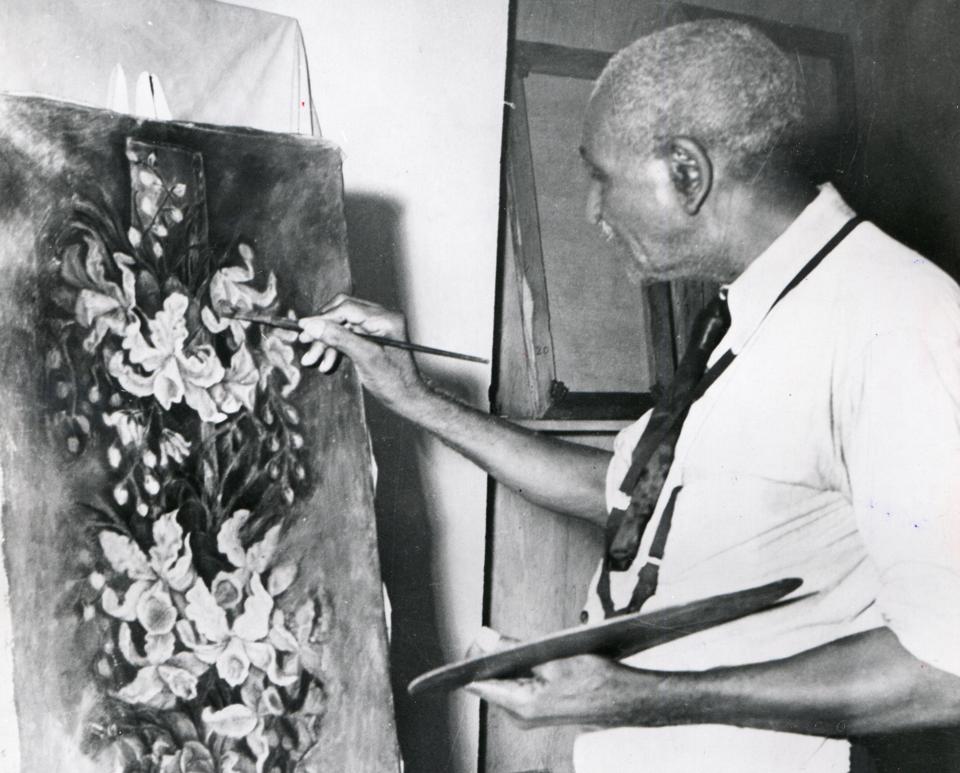
American scientist and educator George Washington Carver (1864 – 1943) was also an artist. Above, he works on his painting “The Yucca.”

It’s reasonable to ask, Why celebrate women or Black Americans only one month a year each? But one advantage is that there’s an incentive for the media to dig out stories about interesting people we either wouldn’t know about at all or wouldn’t know about in detail. For example, most Americans know that a Black scientist called George Washington Carver did research on peanuts that helped farmers in the South. But I, for one, didn’t know anything about his paintings.

Eva Amsen reports at Forbes, “Last month, the Getty Foundation announced the grant recipients for the 2024 exhibit series ‘Pacific Standard Time 2024: Art x Science x LA.’ This event will include different galleries and institutes in California, which will each focus on the theme of science and art. While some of the planned exhibits focus on current and future science, one grant recipient is featuring an artist from science history. The California African American Museum received $120,000 for their exhibit ‘World Without End: The George Washington Carver Project.’

“Although George Washington Carver is best known for his research on new uses for peanuts, he was also an artist. In 1941, two years before his death, Time Magazine featured a piece about Carver in which they mentioned that 71 of his paintings were being shown at Tuskegee at the time.

“Carver spent most of his career as an agricultural researcher at Tuskegee, but he didn’t start his university career in science. When he initially enrolled in college (after searching for a place that would accept Black students in the 19th century) he studied art and piano at Simpson College in Indianola, Iowa. He’d always loved plants and particularly excelled at painting them. …

His art teacher, Etta Budd, encouraged him to enter one of his paintings to a local art exhibit, where it was selected as one of the artworks to represent Iowa at the World’s Fair in Chicago in 1893. Carver’s painting, ‘Yucca and Cactus,’ got an honorable mention at the fair.

“Despite his talents, Budd worried that Carver wouldn’t be able to make a living as an artist, so she suggested that he take his plant illustration skills to the botany department at Iowa State Agricultural College. After receiving his bachelor’s degree here in 1894 and his master’s in 1896, Carver took on a research position at Tuskegee Institute. 

“One of his initial interests was to help farmers increase the yield of their crops. Besides doing research, he invested a lot of time in talking to farmers and explaining the benefits of fertilization and crop rotation to restore nutrients to the soil.

“Partly thanks to Carver, crop production in the South did indeed increase, but this led to a new problem. Now farmers were stuck with an agricultural surplus of crops they had harvested but could not sell. … Carver invented more than a hundred new uses for sweet potatoes and over three hundred different ways to use peanuts. …

“Unsurprisingly, considering his art background, one of the new uses he found for peanuts was to develop paints.  He didn’t just use peanuts to make dyes, but other natural resources as well. Carver even created a line of household paints using pigments from Alabama soil that he envisioned would be more affordable for poor families.

“Carver used some of his self-created paints for his art as well. In the 1941 profile about his art, Time Magazine noted that he used a series of plant-based earth tones created by his assistant A. W. Curtis Jr.”

Using Alabama soil to make dyes caught my attention because I love the work of natural-dye scarf artist Jamie Bourgeois. Sometimes she augments nature to document the polluted waters of Cancer Alley in order to help the Louisiana cleanup efforts. It’s amazing to see how pollution changes the colors. Read about that work here. And support the pollution cleanup here.

More at Forbes on George Washington Carver, here.

Photo: Business Trip Friend, 2017.
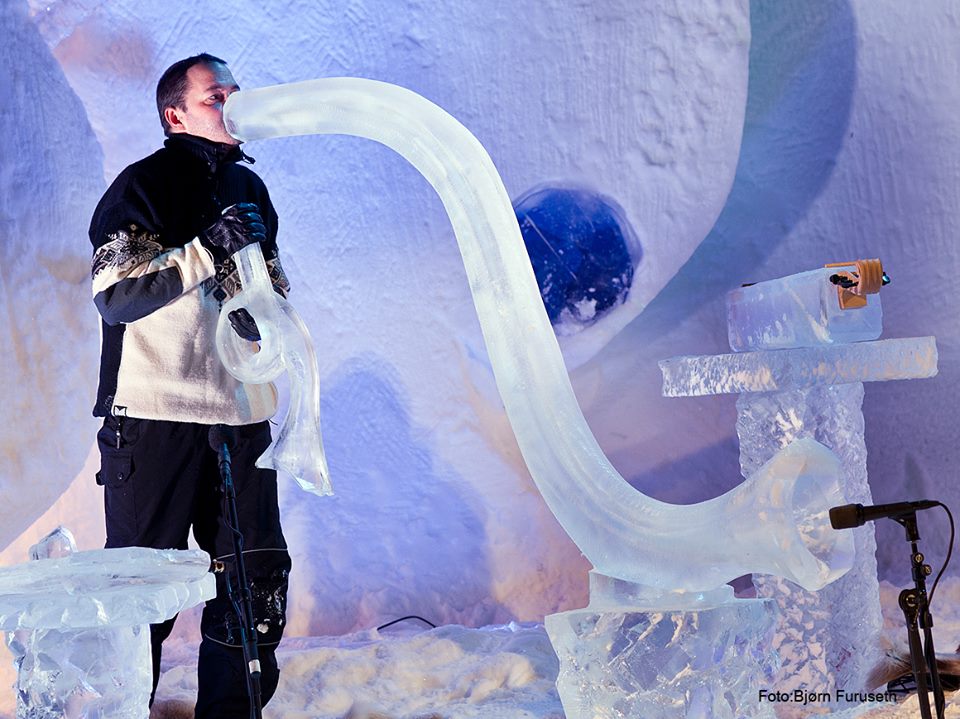
An Ice Music Festival is held in Norway most every year, although it was cancelled for 2021 because of Covid. In 2020, it was held in the village of Finse, near the Hardangerjøkulen glacier.

Finally, the ice is melting where I live. I can’t help but think “good riddance” after an outdoor birthday party Sunday that saw us slipping and sliding with the grandchildren through the woods. But I have to remind myself that they actually love the ice (two kids are hockey players), and in fact, there are a variety of reasons to love ice.

Consider Lola Akinmade Åkerström’s report at National Geographic.

“Brittle bursts that mimic cymbals. Deep hollowed notes reminiscent of metal drums. These are some of the surprising sounds that Siberian percussion group Ethnobeat created from Russia’s frozen Lake Baikal in a 2012 viral video that introduced millions around the globe to ice music.

“But similarly haunting melodies had been filling dark Arctic nights across Norway and Sweden for several years. In 2000 Norwegian composer and percussionist Terje Isungset performed the world’s first ice music concert inside a frozen waterfall in Lillehammer.

“Six years later Isungset founded the annual Ice Music Festival Norway, drawing curious adventurers willing to brave subzero temperatures in order to experience this unique way of bonding with nature through music. (This winter’s festival was canceled due to the pandemic, but he’s planning to livestream a concert on March 14.)

“For Isungset, who was already experimenting with natural elements such as stone and wood when composing music, his foray into ice was an organic next step.

‘When I first started playing on clear ice, I found its pure sound surprisingly warm and gentle compared to the sound of crushed ice beneath your feet.’ …

“So what exactly is ice music? Musicians tap beats out of naturally occurring ice or play instruments crafted from ice. Many of the instruments may seem familiar, but with ice music, nature takes center stage—and brings more than a few notes of unpredictability. Both the making and playing of the instruments are processes that can’t be fully controlled, which only adds to the art’s appeal.

“Carved instruments can be either completely made of ice, such as horns and percussion, or hybrids, like harps, in which the main body is ice with metal strings attached. Isungset collaborates with award-winning ice sculptor Bill Covitz, who is based in the United States but travels to concert destinations around the world to make instruments on location.

“Another American artist, Tim Linhart focused on snow and ice sculptures in the U.S. before moving to Europe and building a reputation for crafting ice instruments. Thirty-six years later he has created hundreds of them. …

“By studying and intricately blending materials — such as homemade clear ice and carbonated water, plus crushed mountain snow — Linhart can make instruments like violins and tune them as close to perfect as nature allows. …

” ‘When you approach that breaking point between the tension of the string and the thickness of the material, right there is where music truly happens,’ says Linhart, who honed his craft through trial, error, and a few exploding instruments. …

“When the show starts, other complications arise. “’Ice is always in motion; expanding, contracting and sublimating away into the atmosphere,’ says Linhart. ‘Warm bodies melt instruments. Audiences increase temperatures because they are breathing. Instruments need to be re-tuned differently. Some drop several notes, others rise.’ To mitigate this, he designs domed concert venues that ventilate heat away from the instruments.

“Another hazard? Horn players’ lips can stick to the mouthpieces of their instruments. And most of the time, the performers can’t practice on their delicate tools, so they often compose music live and improvise in front of the audience. …

“Other instruments such as the ‘iceofon’ — a cross between a xylophone and a marimba that pairs nicely with the harp — need to be tuned differently to avoid playing entire concerts in one tone.”

Lots more about musicians up for a challenge at National Geographic, here.

Photo: Nadia Tugwell.
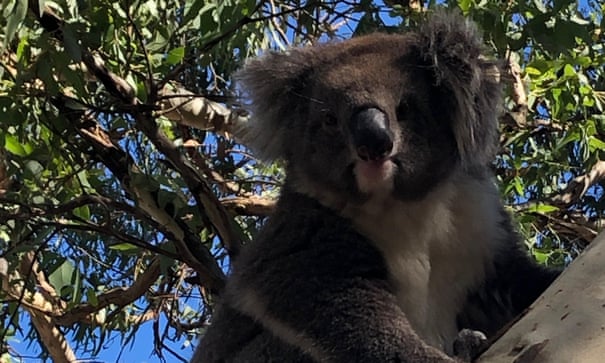
After the koala caused a multi-vehicle crash by ‘stomping’ on an Australian freeway, Nadia Tugwell put it in her car and called for help. The koala played around with the car’s steering wheel while waiting for Adelaide Koala Rescue and was ultimately released at a safe distance.

It was only last summer, when bushfires raged through koala habitat in Australia, that the adorable marsupials were threatened with extinction (story). Here’s a recent article about one that got itself into a different kind of danger but stayed calm and carried on.

Josh Taylor reported at the Guardian, “A koala crossing one of South Australia’s busiest freeways has led to a six-car pile-up as drivers abandoned their vehicles to mount a rescue of the ‘calm’ marsupial.

“[South Australia] police confirmed the multi-car crash occurred on Adelaide’s South Eastern Freeway. … A male driver reportedly was the first person to stop his car to try to rescue the koala before 7am. His car was then hit from behind, causing a chain reaction.

“An Adelaide woman, Nadia Tugwell, was behind the pile-up and said at first she couldn’t tell what was causing the delay in traffic. … Then Tugwell saw the koala moving between the cars and a concrete barrier in the middle of the freeway.

“ ‘The koala was just cute … sort of stomping between the cars and the barrier. Then I saw a lady running behind it, trying to catch it with a blanket or something.’

“Tugwell grabbed a jacket from her car and also raced towards the koala.

‘When it saw me it instantly turned around to run backwards but the other lady was there and so we jumped it, bundled it up, and it ended up in my car because she had children,’ she said.

“Tugwell had previously rescued animals from other roads so she had the number for the Adelaide Koala Rescue centre saved in her phone. She arranged to meet them at a nearby service station.

“While she waited an hour for the rescuer to arrive, Tugwell said the koala made itself at home in her car, including on the steering wheel.

“ ‘I was sitting there entertaining myself but I had to jump out of the car at that stage when he decided to take over,’ she said. …

“ ‘He was actually quite a calm koala, he didn’t even fight about being in the bag, he was just calm and went into the basket,’ Tugwell said.

“The volunteer released the uninjured koala back into the wild a kilometre from the freeway.

“An Adelaide Koala Rescuer volunteer, Ann Bigham, told the ABC, … ”The koala was in really good condition, it was lucky it hadn’t been hit at all and thanks to the rescuers it was kept safe.’ “

Wouldn’t it be something to have that experience? I’d love to be a koala hero like Tugwell. Can’t see it happening in New England, though.

More at the Guardian, here.

Photo: Attributed to Eugène Atget.
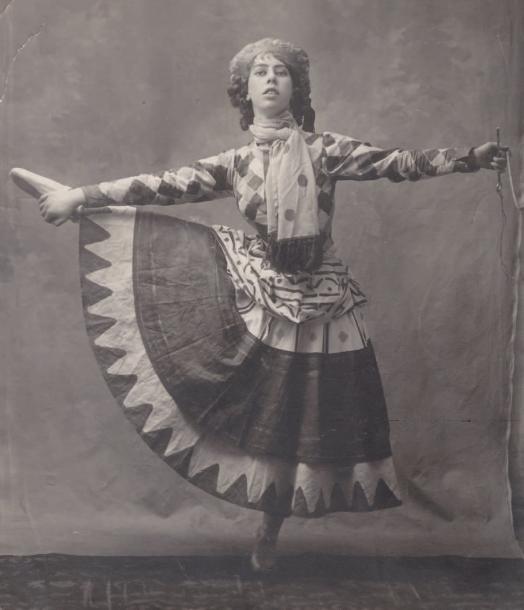
The great ballerina and choreographer Bronislava Nijinska performing in Stravinsky‘s Petrushka.

A sweet text message and a post on Facebook from my mentee reminded me early this morning that it’s International Women’s Day. With her example of accomplishment — and Suzanne’s and my daughter-in-law’s — an old-fashioned grandma like me is starting to pay attention to the issues behind the need for an International Women’s Day.

It isn’t news to me, of course, that women have long taken a back seat, but I have “leaned in” to the idea that one can make a virtue of invisibility. I’d make a good spy.

Even so, I feel a bit outraged that I’d never heard of the subject of today’s post, only her famous brother. Nadia Beard at the Calvert Journal enlightened me.

“Dancer and choreographer Bronislava Nijinska, a Minsk-born Pole, was an instrumental force in redirecting the choreographic cannon towards a vision of process and motion. Despite her pioneering choreography, Nijinska’s legacy is often overshadowed by that of her brother, ballet dancer and choreographer Vaslav Nijinsky. …

“The Nijinsky name, however, does not belong to him alone. In an era where static positions were the marrow of classical dance, Nijinska envisioned a modernist ballet, one which saw focus shift towards the movement which connected these positions.

Ultimately, she believed it was not the final posture that encapsulated the beauty of ballet, but the spaces in between.

“The daughter of two Polish dancers, Bronislava Nijinska was born in Minsk on 8 January 1891, and accompanied her parents to shows across provincial Russia even as a baby. It was through their parents that both Nijinska and her brother, Vaslav, first absorbed dance, learning movements outside of ballet’s traditional canon — Polish folk steps danced by her parents and acrobatics from the circus performers they met on their travels — which would influence the subversive, minimal choreography of their later years.

“Later in life, Nijinska’s contributions to performance and choreography would be dominated by her brother’s, but at the turn of the century, the pair both joined the Imperial Ballet School in St Petersburg, briefly graduating from the Imperial Ballet (now known as the Mariinsky) in 1908 before leaving together for Paris to join the Ballet Russe.

“The radical, itinerant ballet corp, founded by Russia-born arts impresario Serge Diaghlev, became legendary, a crucible for the radical performance that encapsulated the strange daring seen across the artistic spectrum of the time.

“Nijinska helped her brother choreograph some of the Ballets Russes’ earliest controversial works: L’Après-midi d’un Faune, premiered in Paris in 1912, and 1913 ballet Le Sacre du Printemps. Marriage and pregnancy precluded Nijinska from starring in some of Diaghlev’s ballets, much to the dismay of her brother, but where her brother’s creative life was cut short by deteriorating mental and physical health, Nijinska’s endured alongside family life, until she had made her mark on both sides of the Atlantic. …

“Her 1920s treatise on ballet, The School of Movement (Theory of Choreography), now lost to posterity, foregrounded the idea that movement is the essence of dance. Today this seems an obvious point, but it is so only because of the legacy of fringe luminaries like Nijinska; in early 20th century Europe, movement in dance was largely auxiliary, used in service to the final aim of achieving a complete position which could be held and admired. For Nijinska, motion became more important.”

More at the Calvert Journal, here, where you can watch a video of Nijinska’s dark choreography for Stravinsky’s Les Noces. Talk about women’s issues!

Photo: Xinhua/Rex/Shutterstock.
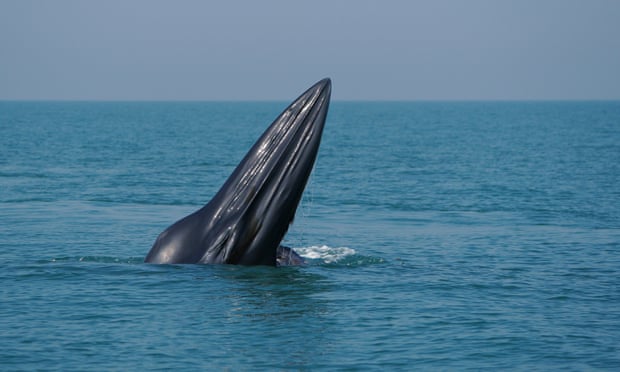
This is a Bryde’s whale, related to the newly described whale species called Rice’s whales. Rice’s whales were previously believed to be a population of Bryde’s but were recently found to be a whole new species.

Lately, I’ve noticed how many mainstream publications reuse stories from other publications, which helps me feel less guilty sharing others’ work at Suzanne’s Mom’s Blog. As a former magazine editor myself, I am pretty scrupulous about providing links and credits and not using the whole original piece.

And if the use of a photo is blocked, I try to find a different photo elsewhere. But I must say that blocking your photo reduces the number of ways people online can find your article.

In an article from Hakai magazine (an online publication about science and society in coastal ecosystems), Joshua Rapp Learn reported on a unique whale. I learned about it from a reprint at the Guardian.

“Genetic analysis and a close examination of the skulls from a group of baleen whales in the north-eastern Gulf of Mexico have revealed that they are a new species.

“ ‘I was surprised that there could be an unrecognized species of whale out there, especially in our backyard,’ says Lynsey Wilcox, a geneticist with the US National Oceanic and Atmospheric Administration who helped uncover the new species. ‘I never imagined I would be describing a new species in my career, so it is a very exciting discovery.’

“The newly described whales weren’t exactly hiding in plain sight. With a population estimated at fewer than 100, the new whales – which researchers have dubbed Rice’s whales after American biologist Dale Rice – aren’t commonly seen even in the corner of the Gulf of Mexico they call home. It doesn’t help that the whales, previously believed to be a population of Bryde’s whales, have a feeding strategy that takes them deep under the water around DeSoto Canyon, about 100km south of Mobile, Alabama.

“Researchers have long known that this group of Bryde’s-like whales in the Gulf of Mexico was different. They seemed to mostly stay put in the north-eastern corner of the gulf, and didn’t mingle with Bryde’s whales, which … typically forage near the surface.

“But it’s difficult even for experts to tell large baleen whales apart in the field – so much so that Bryde’s whales sometimes get confused with fin whales, says John Hildebrand, a biological oceanographer at Scripps Institution of Oceanography at the University of California San Diego who was not involved in the recent study. …

“Wilcox’s colleagues first began collecting tissue samples from Rice’s whales in 2000, eventually collecting samples from 36 different individuals.

Comparing their genes with Bryde’s whales, Wilcox says she and her colleagues ‘noticed that they weren’t quite what was expected.’

“To compare their morphologies, the scientists inspected skeletons held in museums. Then, in January 2019, an 11-meter-long Rice’s whale washed up on a key in the Florida Everglades. Examining the whales’ skulls revealed some differences in the shape and size of the bone material around the blowhole. …

“Rice’s whales are already considered endangered by the United States. They were listed under the Endangered Species Act as a population of Bryde’s whales in April 2019, and the discovery that they are a distinct species is unlikely to change much – other than requiring an update of their name. Living in the Gulf of Mexico, the whales face threats from oil spills, ship strikes, ocean noise and entanglement in fishing gear.

“Hildebrand says the whales are particularly vulnerable to ship strikes because they have the ‘unfortunate habit’ of sleeping at night just under the sea’s surface. … Hildebrand speculates that the whales might once have been more widespread in areas with deeper water, but they are now holing up in an area that sees less ship traffic.

“ ‘They are the most endangered, or nearly the most endangered, baleen whales in US waters,’ Hildebrand says. ‘In terms of the responsibility for the health of the whale, it really does fall on us.’ ”

Read some really wonderful stories about sea life at hakaimagazine.com.

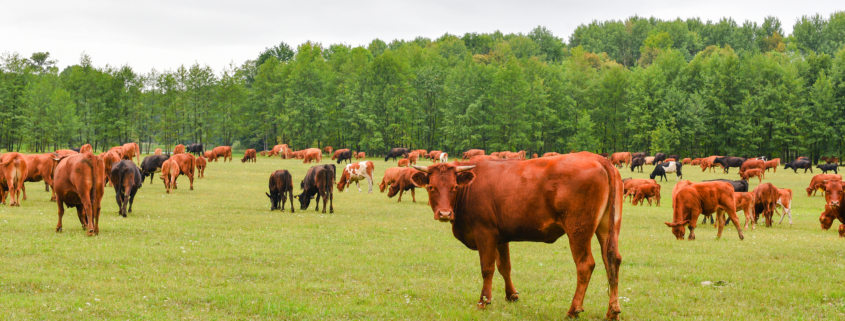
Photo: Regeneration International.

We are told we have to give up meat if we want to fight global warming, but I know that livestock farmers are not going to give up farming. Some are experimenting with techniques to have less harmful effects on the planet — for example, using methane from farm waste to power their farms. But, as Earle keeps reminding me, methane is also a greenhouse gas, and it’s better to put a greenhouse gas into the soil, not the air. It’s called sequestration.

In today’s article, we learn about a Texas farmer who is improving the quality of his land by avoiding herbicides and letting the cows stomp down weeds and brush. At the same time, he is practicing sequestration.

Henry Fountatin writes at the New York Times, “Adam Isaacs stood surrounded by cattle in an old pasture that had been overgrazed for years. Now it was a jumble of weeds.

“ ‘Most people would want to get out here and start spraying it’ with herbicides, he said. ‘My family used to do that. It doesn’t work.’

“Instead, Mr. Isaacs, a fourth-generation rancher on this rolling land in the northeast corner of the Texas Panhandle, will put his animals to work on the pasture, using portable electrified fencing to confine them to a small area so that they can’t help but trample some of the weeds as they graze.

“ ‘We let cattle stomp a lot of the stuff down,’ he said. That adds organic matter to the soil and exposes it to oxygen, which will help grasses and other more desirable plants take over. Eventually, through continued careful management of grazing, the pasture will be healthy again.

‘These cows are my land management tool,’ Mr. Isaacs said. ‘It’s a lot easier to work with nature than against it.’

“His goal is to turn these 5,000 acres into something closer to the lush mixed-grass prairie that thrived throughout this part of the Southern Great Plains for millenniums and served as grazing lands for millions of bison.

“Mr. Isaacs, 27, runs a cow-calf operation, with several hundred cows and a dozen or so bulls that produce calves that he sells to the beef industry after they are weaned. Improving his land will benefit his business, through better grazing for his animals, less soil and nutrient loss through erosion, and improved retention of water in a region where rainfall averages only about 18 inches a year.

“But the healthier ranchland can also aid the planet by sequestering more carbon, in the form of roots and other plant tissues that used carbon dioxide from the air in their growth. Storing this organic matter in the soil will keep the carbon from re-entering the atmosphere as carbon dioxide or methane, two major contributors to global warming. …

“Soil sequestration has gained favor as a tool to fight climate change. Done on a large enough scale, proponents say, it can play a significant role in limiting global warming.

“But many scientists say that claim is overblown, that soils cannot store nearly enough carbon, over a long enough time, to have a large effect. And measuring carbon in soil is problematic, they say.

“The soil-improving practices that ranchers like Mr. Isaacs follow are referred to as regenerative grazing, part of a broader movement known as regenerative agriculture.

“There are no clear-cut definitions of the terms, but regenerative farming techniques include minimal or no tilling of soil, rotating crops, planting crops to cover and benefit the soil after the main crop is harvested, and greater use of compost rather than chemical fertilizers.

“Regenerative grazing means closely managing where and for how long animals forage, unlike a more conventional approach in which animals are left to graze the same pasture more or less continuously. Ranchers also rely more on their animals’ manure to help keep their pastures healthy.

“These practices are spreading among farmers and ranchers in the United States, spurred by environmental concerns about what industrialized farming and meat production have done to the land and about agriculture’s contribution to global warming. In the United States, agriculture accounts for about 10 percent of greenhouse gas emissions.

“Agribusiness companies and large food producers are launching initiatives to encourage regenerative practices, part of efforts to appeal to consumers concerned about climate change and sustainability.

“[The] administration, in its initial moves to combat climate change, has cited agriculture as a ‘linchpin’ of its strategy. One idea is to allocate $1 billion to pay farmers $20 for each ton of carbon they trap in the soil.

“Proponents of regenerative agriculture have sometimes made extravagant claims about its potential as a tool to fight global warming. Among them is Allan Savory, a farmer originally from Zimbabwe and a leader in the movement, who in an often-cited 2013 TED Talk said that it could ‘reverse’ climate change.

Some research has suggested that widespread implementation of regenerative practices worldwide could have a significant effect, storing as much as 8 billion metric tons of carbon per year over the long term, or nearly as much as current annual emissions from burning of fossil fuels.

“While there is broad agreement that regenerative techniques can improve soil health and bring other benefits, some analyses have found that the potential carbon-sequestration numbers are vastly overstated. …

“ ‘It’s really great to see the private sector and the U.S. government getting serious about reducing agricultural emissions,’ said Richard Waite, a senior researcher at the World Resources Institute, an environmental research organization in Washington. But for carbon sequestration in soils, the institute’s analysis suggests that ‘mitigation opportunities are on the smaller side.’

“Focusing on carbon sequestration through soil also risks drawing attention from other important ways to reduce agriculture’s carbon footprint, Mr. Waite said, including improving productivity, reducing deforestation and shifting food consumption to more climate-friendly diets.”

My gut feeling is that we should use as many techniques as possible to reduce carbon emissions — that every little bit helps. Read more at the New York Times, here, and me know what you think.

Photo: Mark Humphrey/AP.
National Museum of African American Music, Nashville, Tennessee.

I haven’t headed back to museums yet, but I’m pretty sure I will be allowing myself to go this year. I’ve been interested to read that many museums plan to keep some presentation techniques they’ve used during the pandemic. Meanwhile, other museums are actually just launching.

Kristin M. Hall reports at the Associated Press (AP), “A new museum two decades in the making is telling the interconnected story of Black musical genres through the lens of American history.

“The National Museum of African American Music, which opened with a virtual ribbon-cutting on Martin Luther King Jr. Day, is seated in the heart of Nashville’s musical tourism district. …

“Even as Nashville has long celebrated its role in the history of music, the new museum fills a gap by telling an important and often overlooked story about the roots of American popular music, including gospel, blues, jazz, R&B and hip-hop.

” ‘When we think of the history of African American music and the important part it has played in our country, it was long overdue to honor it in this type of way,’ said gospel great CeCe Winans, who serves as a national chair for the museum.

“The idea for the museum came from two Nashville business and civic leaders, Francis Guess and T.B. Boyd, back in 1998, who wanted a museum dedicated to Black arts and culture. And while there are museums around the country that focus on certain aspects of Black music, this museum bills itself as the first of its kind to be all encompassing. …

“Said H. Beecher Hicks III, the museum’s president and CEO, ‘[It’s]it’s one thing to say that I’m a hip hop fan or I’m a blues fan, but why? What was going on in our country and our lived experience and our political environment that made that music so moving, so inspirational, such the soundtrack for that part of our lives?’

The museum tells a chronological story of Black music starting in the 1600s through present day and framed around major cultural movements including the music and instruments brought by African slaves, the emergence of blues through the Great Migration, the Harlem Renaissance and the civil rights movement.

“When Winans recently took a tour of the museum, she saw her own family of gospel singers, the Winans, represented in the museum’s exhibit on spiritual music alongside the artists that influenced her own musical career.

” ‘You never start out doing what you’re doing to be a part of history or even be a part of a museum,’ said the 12-time Grammy-winning singer. She noted that the museum put gospel music in context with how it inspired social change, especially during the civil rights era. …

“The museum has 1,600 artifacts in their collection, including clothes and a Grammy Award belonging to Ella Fitzgerald, a guitar owned by B.B. King and a trumpet played by Louis Armstrong. To make the best use out of the space, the exhibits are layered with interactive features, including 25 stations that allow visitors to virtually explore the music.

“Visitors can learn choreographed dance moves with a virtual instructor, sing ‘Oh Happy Day’ with a choir led by gospel legend Bobby Jones and make their own hip-hop beats. Visitors can take home their recordings to share via a personal RFID wristband.

“There will be a changing exhibit gallery, with the first topic to be the Fisk Jubilee Singers, an a cappella group originally formed in 1871 to raise money for Fisk University. The group sang slave spirituals at their concerts. The tradition continues today.

“After a year of racial reckoning through the movement of Black Lives Matter, Hicks said the timing couldn’t be more perfect to highlight the contributions of Black music to our shared American experience.

“ ‘[It] is not an accident that we are able to finish and get the museum open in this moment, in this moment where we need to be reminded, perhaps more than others or more than in the recent past that we are brothers and we share more together than we do our differences.’ “

More at AP, here

In one of the Rhode Island English classes where I volunteer, there’s a former soccer pro. I do not know if he’s following this blog, but I would love to hear from any soccer player about the topic for today: ballet for sports agility and strength.

From an article by Toby Bryant in the Irish Times: “It’s November 29th, 2020, and Manchester United are 2-0 down at Southampton. Bruno Fernandes skews a shot goalward, it’s off target. Defeat seems inevitable.

“Out of nowhere, gliding across the box unnoticed with long black locks flowing, Edinson Cavani springs into the air and nods the misfired shot into the back of the net. With movement so stealthy and so swift, you’d easily mistake Cavani for a ballet dancer.

“As it happens, two months earlier the striker had swapped the football boots for the pointe shoes of ballet to train in his homeland of Uruguay at the Ballet Nacional de Sodre (BNS). … The images shared by the ballet company had soccer fans’ heads turning when they emerged. Such a sports star dabbling in ballet may have seemed unheard of, but it wasn’t a new trend.

“In 2017, over in the United States, St Paul Ballet and Element Gym’s boxers formed a partnership. The premise was simple: the ballet dancers box and the boxers dance ballet. Not simply as a social experiment but, for the boxers, to enhance footwork and balance. …

“American Footballer Eddie George spent hours forcing his 245lb body into demi-pliés and spins so it would become second nature on the field. England women’s rugby star Zoe Aldcroft spent her formative years balancing rugby with ballet and is now the Rugby Players’ Association England player of the year. … Former England rugby league international Darrell Goulding now coaches Wigan Warriors’ under-19 squad, another group who have dipped into ballet in the past.

“ ‘The season before we started we had quite a lot of ankle injuries and stability issues, so it was something we were keen to look at.’

Goulding tells the Irish Times, ‘Obviously our lads are not built for some of the ballet work, so a lot of the delicate stuff we didn’t progress to, but we used a lot of the simple drills to focus on that ankle area.’ …

” ‘Pound for pound, ballet dancers are the strongest athletes you will find,’ remarks ballet physiotherapist Luke Abnett, who believes the cross-sport benefits that ballet can offer are evident. ‘In ballet, there’s a need to not only have strength of movement but precision of movement. It’s a combination of the strong movement muscles with the fine-tuning stability muscles. …

“ ‘When you get to more advanced levels of ballet skills, you’re working on jumping, turning, pirouettes, control and rotation,’ Abnett says. ‘Landing in interesting positions and transferring your weight as you move into the next step – all of that would apply to situations like that.’

“Injury prevention is another benefit. While ballet can’t help stop the collisions that come with sports such as rugby and soccer, its muscle development can reduce the risk of any overuse injuries.

“One study compared basketballers, prone to ACL problems, and ballet dancers. Even though dancers would land at more difficult angles, their training meant they suffered far fewer ACL injuries. …

“ ‘Cavani’s movements have always been sharp but at his age and with the physical demands of the Premier League, it’s impressive,’ one fan tells the Irish Times. ‘Cavani’s spatial awareness and manoeuvrings are so incredible, it has me wishing he’d make ballet a thing in the United dressingroom too,’ another admits. …

“As well as the physical benefits, mainstream sports stars are entering the ballet studio to improve mentality and actively combat stereotypes.

“When speaking of his Wigan Warriors youth team, Goulding believes that ‘people only grow when they are outside of their comfort zone.

“ ‘As you can imagine, the idea of these physical rugby lads from tough working-class areas is a total contrast from ballet and how graceful it is. From the first session there was a lot of embarrassment – it wasn’t a comfortable situation for the lads. They grew a lot of respect, even from just trying the basics. They came back really sore and couldn’t believe some of the muscle they used.’ ”

More at the Irish Times, here.

Photo: ESPN.
Manchester United fans’ hopes of seeing … Edinson Cavani dancing through Premier League defenses may be helped by the striker’s passion for ballet,” says ESPN.