Feeds:
Posts
Comments

Photo: Thomas Turner/Reuters
This hoodwinker sunfish, a species discovered only in 2017, has washed up on a California beach. Scientists believe it belongs in the Southern Hemisphere.

As much as I love learning about new species like this giant sunfish from the Southern Hemisphere, I can’t help feeling concerned that it ended up on a beach where it doesn’t belong. Is this another sign of global warming? Not likely. This fish likes temperate water and would have had to pass the hot Equator. A mystery.

Christina Zdanowicz has the story at CNN. “This is the extraordinary tale of how a massive, strange-looking fish wound up on a beach on the other side of the world from where it lives. The seven-foot fish washed up at UC Santa Barbara’s Coal Oil Point Reserve in Southern California [in February]. Researchers first thought it was a similar and more common species of sunfish — until someone posted photos on a nature site and experts weighed in. …

“It turned out to be a species never seen before in North America. It’s called the hoodwinker sunfish.

‘When the clear pictures came through, I thought there was no doubt. This is totally a hoodwinker,’ said Marianne Nyegaard, a marine scientist who discovered the species in 2017. ‘I couldn’t believe it. I nearly fell out of my chair.’

“Nyegaard … works in the marine division at the Auckland War Memorial Museum in New Zealand. … ‘We know it has the temperate distribution around here and off the coast of Chile, but then how did it cross the equator and turn up by you guys?’ …

“An intern at Coal Oil Point Reserve alerted conservation specialist Jessica Nielsen to the dead beached sunfish on February 19. When Nielsen first saw it, the unusual features of the fish caught her eye.

” ‘This is certainly the most remarkable organism I have seen wash up on the beach in my four years at the reserve,’ Nielsen said in a UC Santa Barbara press release. She posted some photos of the fish on the reserve’s Facebook page. When colleague Thomas Turner saw the photos later that day, he rushed to the beach with his wife and young son. …

“He snapped some photos of what he thought was an ocean sunfish, a rare sight up-close, he said.

” ‘It’s the most unusual fish you’ve ever seen,’ said the UC Santa Barbara associate professor.

‘It has no tail. All of its teeth are fused, so it doesn’t have any teeth. It’s just got this big round opening for a mouth.’

“Turner posted his photos on iNaturalist, a site where people post photos and sightings of plants and animals. A fish biologist commented and alerted Ralph Foster, a fish scientist and the fish curator at the South Australian Museum.

“It was Foster who first said this may be a hoodwinker sunfish and not an ocean sunfish in the comments on iNaturalist. …

“Foster excitedly emailed Nyegaard, the woman who discovered the species, and told her what he was thinking. …

“It had been two days since Nielsen had first seen the fish. When Turner and Nielsen went back to the beach [to get sharper photos], the creature was no longer there.

“They started two miles apart from each other on the beach and kept looking, walking toward each other until they found the missing fish. It had refloated on the tide and washed up a few hundred yards away, Turner said. …

“All of the features in the photos matched up with the hoodwinker. When Nyegaard saw the photos, she knew she had a hoodwinker case on her hands. …

“Both Nyegaard and Turner marveled at how social media and the iNaturalist site can help bring researchers closer to an answer. …

“Turner said it was exciting for him to help identify the first recorded sighting of a hoodwinker sunfish in North America — and only the second in the Northern Hemisphere.

” ‘I’m a professor, I’m a biologist but I didn’t actually know what was special about this fish,’ Turner said. ‘I just posted a picture and that connected me with the world’s expert and the discoverer of the species.’ ”

Super photos at CNN, here.
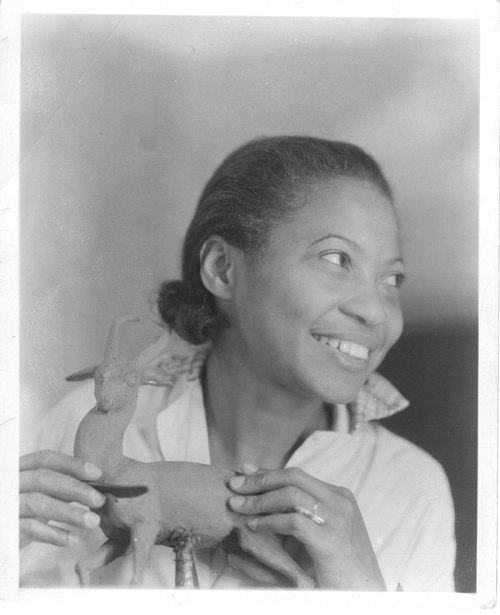
Photo: Katherine Anne Rose
On the south side of Glasgow every year the residents of Strathbungo decorate their windows with weird and wonderful displays for other locals to enjoy.

Here’s a grand idea to light up winter in a city. It reminds me a little of the mega jack o’lantern displays that Providence’s Roger Williams Park puts on at Halloween. Any city could do this.

Peter Ross writes at the Guardian, “Window Wanderland is a festival of lights that sees people transform their neighbourhood into a colourful playground using paper cutouts in their windows. In the streets of Strathbungo, Glasgow, the result is a night-time explosion of pop culture: Mary Poppins, the Moomins, Peter Pan, Paddington.

“The festival was founded in Bristol in 2015 by Lucy Reeves Khan, a set designer who had developed mobility problems, chronic pain and feelings of isolation following a car accident. As part of her rehabilitation, she took short walks in the streets around her home – at night, so few would see her struggling. Lonely, she glanced in lit windows at the people inside, and one evening the idea struck.

“Khan set about trying to articulate her concept to her neighbours. That wasn’t easy. ‘Nobody could understand what I was on about,’ she recalls. It wasn’t quite like Halloween, it wasn’t quite like Christmas. So she created a number of displays in her own windows as examples – and it took off from there, and has now spread to around 20 UK locations. …

“One home in Strathbungo is an angry lament for the Glasgow School of Art, which burned down recently for the second time; the windows of the home are bright with painted flame. On nearby Queen Square, Bernie Hunter, who is 24 and has cerebral palsy, has created a fond tribute to Still Game, the beloved Scottish sitcom, on the eve of its farewell series. …

“The politics of the event tend instead towards the environmental. On Regent Park Square, Emily Munro has decorated an upstairs window with the hourglass logo of Extinction Rebellion, the direct action campaigners. Her other windows show cutouts of insects, which Munro removes as the night wears on, symbolising their catastrophic decline, leaving just one – a bee.

“One home has been tricked out like a giant jukebox, with a real seven-piece band playing on the upper floor through an open window. …

“ ‘It’s beautiful, unplanned, chaotic,’ says Sarah Reid, who started this Scottish leg of the event. ‘Such a simple idea, but when people come together it creates something beautiful and powerful.’ ”

More here.

Photo: Lee Allen Photography
Dispensing poetry on prescription: Shropshire’s Emergency Poet, Deborah Alma.

Sometimes poetry can play a role in emotional healing. I think that’s because ordinary sentences often miss the mark but poetry is fluid enough to go where it’s needed. In the UK, a Shropshire poet is putting her faith in this art and opening a “poetry pharmacy.” She notes that a recent report shows “poetry sales were up by more than 12% in 2018, driven largely by younger buyers.”

Alison Flood writes at the Guardian, “Following in the hallowed footsteps of Milton, who wrote in 1671 that ‘apt words have power to swage / The tumours of a troubled mind / And are as balm to festered wounds,’ the poet Deborah Alma is preparing to open the UK’s first poetry pharmacy. Here, instead of sleeping pills and multivitamins, customers will be offered prescriptions of Derek Walcott and Elizabeth Bishop.

“Alma, who as the ‘Emergency Poet’ has prescribed poems as cures from the back of a 1970s ambulance for the last six years, is now setting up a permanent outlet in a shop at Bishop’s Castle in Shropshire. An old Edwardian ironmonger’s, it still has the original fixtures and fittings, and, together with her partner, the TS Eliot prize-shortlisted poet James Sheard, Alma is preparing to turn it into a haven ‘to help ease a variety of maladies with the soothing therapy of Poetry.’

“Dressed in a white coat and stethoscope, Alma says she was invited to appear as the Emergency Poet at ‘schools, hospitals and festivals all over the place, but I’m a middle-aged woman and I’m getting a bit old for driving around.’ …

“The [pharmacy’s] mortgage was approved [in January], and Alma is buzzing with plans for how the shop will be divided like a pharmacy ‘into areas for particular ailments.’ … The sections will be set up along the lines of a poetry anthology she edited in 2016, The Everyday Poet, which was split into poems ‘addressing areas of emotional need’ such as love, ageing, grief and hope. …

“ ‘I think probably more than any other art it speaks directly as though from one person to another,’ says Alma, who published her own first collection, Dirty Laundry, last year. ‘It’s intimate and it’s empathetic. It can be a prayer or a curse, or something just to hang on to.’ ”

More at the Guardian, here. I’m glad to know something more about Shropshire poets beyond “The Shropshire Lad,” which I know only by reputation.

Hat tip: Wisconsin poet Ronnie Hess on Facebook.

Image: Casto Vocal
Virtual reconstruction of northernmost section of pre-Incan temple in Bolivia.

Here’s why a general education may equip the workforce of the future better than job-specific training: you never know what skills will be needed. In this example, a new breed of adaptable archaeologist is expanding the use of 3-D technology to reimagine lost worlds.

George Dvorsky writes at Gizmodo, “The 1,500-year-old Pumapunku temple in western Bolivia is considered a crowning achievement of Andean architecture, yet no one knows what the original structure actually looked like. Until now.

“Using historical data, 3D-printed pieces, and architectural software, archaeologist Alexei Vranich from UC Berkeley has created a virtual reconstruction of Pumapunku — an ancient Tiwanaku temple now in ruins. Archaeologists have studied the site for over 150 years, but it wasn’t immediately obvious how all the broken and scattered pieces belonged together. The surprisingly simple approach devised by Vranich is finally providing a glimpse into the structure’s original appearance. Excitingly, the same method could be used to virtually reconstruct similar ruins. The details of this achievement were published [last December] in Heritage Science.

“First, some background on the structure. Pumapunku, which means ‘door of the puma,’ was a temple designed and built by the pre-Incan Tiwanaku culture, who lived and thrived in what is now western Bolivia from 500 AD to 1,000 AD. …

“Pumapunku displayed a level of craftsmanship that was largely unparalleled in the pre-Columbian New World, and it’s often considered the architectural peak of Andean lithic technology prior to the arrival of the Europeans. …

“Unfortunately, the ruins of Tiwanaku, and the Pumapunku temple in particular, have been ransacked repeatedly over the past half-millenium. Archaeologists have virtually no idea what the structure actually looked like. None of the blocks that once comprised the original structure are currently located in their original place, and many of them are badly damaged or decayed. …

“To overcome these difficulties and limitations, Vranich and his colleagues integrated historical archaeological data with modern computer software and 3D-printer technology to reconstruct the ancient temple, and by doing so, devised an entirely new approach to reconstructing and visualizing ancient ruins that would otherwise be impossible to build.

“The team created miniature 3D-printed models, at 4 percent actual size, of the temple’s 140 known pieces, which were based on measurements compiled by archaeologists over the past 150 years and Vranich’s own on-site observations of the ruins. … The researchers could have performed this work exclusively in the virtual realm, but they had better luck with tangible, physical pieces they could freely move around.

“ ‘It was much easier to use the 3D-printed models,’ Vranich told Gizmodo. ‘You can quickly manipulate them in your hand and try position after position. It is much slower and less intuitive on the computer.’ …

“Satisfied with their Lego-like configurations, the researchers keyed their creations into an architectural modeling program, culminating in a single hypothetical model of the temple complex. This wasn’t terribly difficult, as the construction methods used by the Tiwanaku people, and how they formed their incredibly geometric stones, are well documented, explained Vranich. But the exercise yielded some new findings.

“ ‘What we found out is that it appears they were making prototypes for each type of stone type, and then would have copied one after the other. It’s almost like it was a pre-Columbian version of Ikea.’ …

“Another interesting finding was that the gateways scattered around the site were lined up in a way to create a mirror effect. That is, ‘one big gateway, then another smaller one in line, then another,’ he said. ‘It would create an effect as if you were looking into infinity in the confines of a single room.’ ”

Read more here.

Photo: Playhouse Records
Back in the day, Jim Copp (right) “made recordings [with Ed Brown] that offered children funny fables replete with sound effects, and were literate and charming enough for adults,” says the
New Yorker.

Years ago, the older of my two younger brothers received a record player that looked like a jukebox and flashed colored lights. It was the beginning of his long romance with records. Neighbor kids came over to see this wonder, and we listened not only to music on the records but also to stories. Call it an early podcast platform. David Owen has a bit of history at the New Yorker.

“When my wife was a kid, in the early nineteen-sixties, she and her siblings listened, over and over, to records by Jim Copp. … Copp made nine records between 1958 and 1971. They contain stories, poems, and songs that he wrote, performed, and recorded with the help of his friend Ed Brown. …

“Stories involve a family that takes a cross-country car trip with a cow; a duck that, with excruciating effort, manages to speak just enough English to warn his housemate, a carpenter, that their kitchen is on fire; a dog with the longest name in the world who goes to Yale; … a nearsighted heron; and a feeble-minded old man, Mr. Hippity, who thinks his chicken pull toy is sick. Copp may be the reason that my wife and her siblings and both our children have always had good vocabularies: destitute, vituperative, locality, inauspicious, gauche, megalomaniac, union suit. …

“Not long after my wife received [tapes] from her brother, she noticed a tiny advertisement in The New Yorker for rereleases of Copp’s records, on cassette. She called the telephone number in the ad, and eventually realized that the person taking her order was Copp himself. … In 1993, I [interviewed] Copp in his home. …

“In 1939, friends whom he was visiting in Chicago dared him to enter a talent contest at the old Edgewater Beach Hotel, whose ballroom was popular with movie stars and mobsters. He performed several humorous pieces that he’d written as a student — ‘Arabella and the Water Tank,’ ‘Peaches and Myrtle’ (about two showgirls, one of whom murders the other), ‘The Mystery of the Revolving Tree Trunk’ — and won. …

“Copp got hooked on performing. During the next three years, he appeared, as James Copp III and His Things, in some of Manhattan’s most famous night spots, among them the Blue Angel, Le Ruban Bleu, the Rainbow Room, and Café Society. … In 1941, Liberty released six of his night club pieces, on a set of three 78s.

“He was drafted a year later, and became the adjutant of an intelligence unit that took part in the Normandy invasion. … He returned to the United States in 1946, but decided that New York and its night clubs had changed in ways he didn’t like.

“Copp decided that his best chance of preserving his night-club material was to rework it, slightly, for children. He experimented with a wire recorder — a tape precursor, which recorded magnetically on steel wire. He sold one piece, ‘The Noisy Eater,’ to Capitol Records, which Jerry Lewis recorded, in 1952. … He decided that from then on he would make his own records. He … would record a single character or instrument or effect on one machine, then play that tape in the background as he recorded another on one of the others. For some pieces, he ‘ping-ponged’ as many as ninety layers. He sped up some voices and slowed down others, all without fancy equipment, and he added homemade sound effects.” For the long read, check out the New Yorker, here.

The story brought back memories, especially of my father’s wire recorder. He had a couple of his recordings made into actual records, and when I grew up, I found someone to turn a record featuring my squeaky voice (“The Birth of Willie”) into a cassette tape.

800px-Augusta_Savage2C_H-HNE-20-87Augusta Savage, 1892-1962, American sculptor, an important figure in the Harlem Renaissance.
Last night I watched a fascinating documentary about a glamorous movie star who would have preferred to be recognized as the brilliant inventor that she actually was: Bombshell: The Hedy Lamarr Story. And I realized that lately I seem to be learning about many women whose achievements failed to garner the fame of their male contemporaries.

No time like the present to start honoring them. Here is the story of an African-American sculptor of the Harlem Renaissance.

Wikipedia has a good entry. “Augusta Christine Fells was born in Green Cove Springs (near Jacksonville), Florida on February 29, 1892, to Edward Fells, a Methodist minister, and Cornelia Murphy. Augusta began making figures as a child, mostly small animals out of the natural red clay of her hometown, Green Cove Springs Florida.

“Her father was a poor Methodist minister who strongly opposed his daughter’s early interest in art. ‘My father kicked me four or five times a week,’ Savage once recalled. … She persevered, and the principal of her new high school in West Palm Beach, where her family relocated in 1915, encouraged her talent and allowed her to teach a clay modeling class. This began a lifelong commitment to teaching as well as to creating art.

“In 1907 Augusta Fells married John T. Moore. Her only child, Irene Connie Moore, was born the following year. John died shortly thereafter. In 1915, she married James Savage; she kept the name of Savage throughout her life. …

“In 1919 [she] was granted a booth at the Palm Beach County Fair where she was awarded a $25 prize and ribbon for most original exhibit. Following this success, she sought commissions for work in Jacksonville, Florida, before departing for New York City in 1921. She arrived with a letter of recommendation from the Palm Beach County Fair official George Graham Currie for sculptor Solon Borglum and $4.60. Borglum declined to take her as a student, but encouraged her to apply to Cooper Union in New York City where she was admitted in October 1921.

“She was selected before 142 other men on the waiting list. Her talent and ability so impressed the Cooper Union Advisory Council that she was awarded additional funds for room and board when she lost the financial support of her job as an apartment caretaker. …

“In 1923 Savage applied for a Summer art program sponsored by the French government; although being more than qualified, she was turned down by the international judging committee solely because she was a black person. … The incident got press coverage on both sides of the Atlantic, and eventually, the sole supportive committee member sculptor Hermon Atkins MacNeil – who at one time had shared a studio with Henry Ossawa Tanner – invited her to study with him. She later cited him as one of her teachers.

“After completing studies at Cooper Union, Savage worked in Manhattan steam laundries to support herself and her family. … During this time she obtained her first commission for a bust of W. E. B. Du Bois for the Harlem Library. Her outstanding sculpture brought more commissions, including one for a bust of Marcus Garvey. Her bust of William Pickens Sr., a key figure in the NAACP, earned praise for depicting an African American in a more humane, neutral way as opposed to stereotypes of the time. …

“Knowledge of Savage’s talent and struggles became widespread in the African-American community; fundraising parties were held in Harlem and Greenwich Village, and African-American women’s groups and teachers from Florida A&M all sent her money for studies abroad. …

“Savage received a commission from the 1939 New York World’s Fair; she created Lift Every Voice and Sing (also known as ‘The Harp’), inspired by the song by James Weldon and Rosamond Johnson. The 16-foot-tall plaster sculpture was the most popular and most photographed work at the fair; small metal souvenir copies were sold, and many postcards of the piece were purchased. … Savage did not have funds to have it cast in bronze or to move and store it. Like other temporary installations, the sculpture was destroyed at the close of the fair. …

“In 1945 Savage moved to Saugerties, New York. … While she was all but forgotten at the time of her death, Savage is remembered today as a great artist, activist, and arts educator; serving as an inspiration to the many that she taught, helped, and encouraged.”

More at Wikipedia, here. I love all the random details at Wikipedia — like her cultivating a garden at her Saugerties home and selling pigeons, chickens and eggs. Check it out.

Photo: Andrew Herman
Augusta Savage posing with her sculpture
Realization, 1938, created as part of the Works Progress Administration’s Federal Art Project.

800px-archives_of_american_art_-_augusta_savage_-_2371

e169ea18-af31-11e8-b224-884456d4cde1_1280x720_122041

Photo: Didem Tali
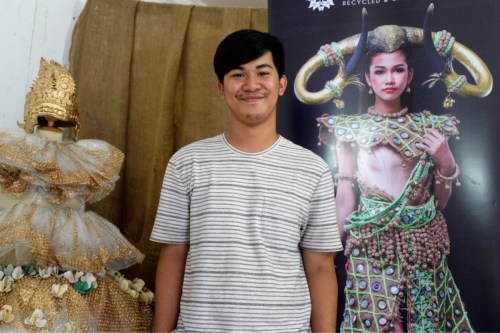
Seng Super is a co-founder of La Chhouk, a Cambodian creative fashion initiative that makes clothing out of recyclables. The group, which includes gay and straight designers, hopes to both encourage people to reduce trash and also “show people that LGBT individuals are capable of creating beautiful things.”

Never underestimate the power of a creative mind to make something lovely out of something ugly. I remember surprising myself with how much I loved certain luminous oil paintings of factories spewing out air pollution. The sad Depression-era photos of Appalachian poverty also have a certain beauty. These works draw you to them without any undertone of “poverty is good” or “pollution is good.”

In Cambodia, young designers aren’t repurposing plastic to praise it but, you might say, to bury it.

Didem Tali writes at the South China Morning Post, “Members of the recycling collective La Chhouk started with a dress made from brown rice sacks decorated with beer bottle tops and broken CDs which was later worn by a Miss Cambodia runner-up at an international beauty pageant.

“Most visitors to Cambodia are eager to see the ancient temple complex of Angkor or the beaches of Sihanoukville, but there is one sight they may want to shield their eyes from: mountains of plastic bags, bottles and styrofoam boxes. …

” ‘Plastic waste is everywhere,’ says Seng Super, a 22-year-old Cambodian designer. ‘It’s in the streets, rivers, lakes. It’s very upsetting.’

“Seng Super studied at the Royal University of Fine Arts in Phnom Penh. He was born in the 1990s, a time when millions of Cambodians were beginning to lift themselves out of extreme poverty, bringing environmental degradation in its wake.

“For many young and urban Cambodians, pollution is a huge concern. So when it was time to prepare for the university’s annual art show in 2014, Seng Super and his classmates decided to create a project that would challenge people to rethink their wasteful ways. The result, La Chhouk, is a creative fashion initiative geared towards making clothing out of trash and other recyclable materials. …

“Seng Super and his classmates wanted not only to challenge the way Cambodians think of waste, but also capture their attention in the most remarkable and elegant way. Using only recyclable materials they found in the trash, they created several flamboyant dresses of the sort usually worn by traditional apsara dancers. …

“Many people thought the goal was too far-fetched and ambitious – especially as none of them had any training in fashion. That is why the designers named their collective La Chhouk, which means ‘lotus’ in Cambodia’s Khmer language.

“ ‘The lotus is a beautiful flower that can grow in muddy or dirty waters,’ Seng Super says. ‘We thought it was a beautiful metaphor for what we wanted to do with trash and our dresses.’ …

“Last year the members of La Chhouk were given a vote of confidence for what many regarded as a wacky project when Em Kunthong, first runner-up in the Miss Cambodia 2016-17 beauty pageant, opted to wear the dress for the Miss Earth environmental awareness beauty competition held in the Philippines.

“ ‘This dress represents the perfect Cambodian woman,’ Seng Super says … ‘She’s empowered, close to the Earth and strong like a bull. She has the soul of a wild cow, which is a very important element of Cambodian identity and culture.’ …

“Since the creation of that first apsara dress, La Chhouk has gone on to design dozens of other dresses inspired by Cambodian culture and mythology. In a recent project called Saving Wild, they sought to bring attention to animals facing extinction in Cambodia, such as the Indochinese tiger, river dolphins and various bird species. Seng Super designed dresses representing these animals using plastic waste.

“The project is ongoing, and the collective recently held an exhibition in collaboration with the WWF and Tiger Beer.

“The collective’s members still hold down day jobs to pay the bills, and work on their recycled fashion projects in the evenings and on weekends.” More here.

Hat Tip: @BeingFarhad onTwitter

Photo: John Reynolds for the Boston Globe
Guilherme “Gilly” Assuncao reprised his impromptu concert of 2017 recently at Russo’s Market in Watertown.  

Talent will out. Don’t you love stories about talent being discovered in unlikely places? I like to think that it’s irrepressible and will be recognized one way or another. In this story, a sound check by a Brazilian baritone working as a dishwasher in a Massachusetts grocery store went viral and led to an unexpected opportunity.

Cristela Guerra writes at the Boston Globe, “In the produce aisle at Russo’s [in December], a group of customers waited eagerly to hear the golden voice of Guilherme ‘Gilly’ Assuncao.

“[At Christmas 2017], Assuncao was a dishwasher and deli worker at the Watertown market, when he broke into song while doing a soundcheck the night before a holiday concert there — and stopped shoppers in their tracks.

“Videos of him singing that evening at Russo’s went viral and propelled him into the limelight — and into Berklee College of Music.

“ ‘I never expected any of this to happen,’ said Assuncao [said]. ‘It’s emotional in a way that’s hard to explain. It’s just amazing and makes me really happy.’

“Raised in Brazil, Assuncao said he sang in the shower as a boy and loved belting out Whitney Houston songs. … The breakthrough performance at Russo’s [led] him to an invitation to audition and be interviewed at Berklee in the spring. Assuncao began classes at Berklee in August. …

“Assuncao has raised enough to pay for one year of schooling at Berklee so far with the support of fans locally and across the country, and through a GoFundMe page. ‘This place changed my life last year,’ Assuncao said. …

“ ‘Gilly is definitely an exceptional artist,’ said Olga Lisovskaya, a soprano, who sang with Assuncao. … ‘His voice comes straight from his soul and goes straight to your heart.’ …

“ ‘We knew his life was going to change,’ said Tony Russo, the market’s owner. ‘From that moment that he started to sing. It was just a beautiful moment. He’s a great talent and a great personality.’ ”

More at the Boston Globe, here.

Photo: Michał Iwanowski
Michał Iwanowski came across graffiti in Wales that said: ‘Go home, Polish.’ Eventually he did. The
Guardian writes that his 105-day slog restored his faith in the people of a volatile, fractured Europe.

Today’s divisiveness is exaggerated. There are certainly times I chide myself for naïveté, for believing that divisiveness is exaggerated only because I want to. Maybe it isn’t true. Then I read an article like this one about a photographer in Wales who, buffeted by Brexit xenophobia, decided on an experiment.

Sean O’Hagan writes at the Guardian. “On 27 April this year, Michał Iwanowski left his house in Cardiff to walk to his home village of Mokrzeszów in Poland. Carrying British and Polish passports and wearing a T-shirt bearing the word ‘Polska,’ he began his 1,200-mile journey east, sticking as closely as possible to a straight line he had drawn on a map. Over 105 days, it would take him through Wales, England, France, Belgium, the Netherlands, Germany and the Czech Republic. Along the way, Iwanowski posted a [diary] on Instagram,. …

“ ‘I saw the project as a way of thinking about the idea of home,’ he says, ‘not least because it would take me from the place I have lived in for 18 years to the place I come from. And I would be doing it at a time when Brexit had made the idea of home, identity and belonging a very politicised subject.’

“Iwanowski had been thinking about walking to Poland for several years, after being confronted in 2008 by graffiti scrawled on a wall in the Roath area of Cardiff, where he lives. ‘Go Home, Polish,’ it read. …

“He often appears in the images, sometimes as himself, sometimes as a generic wanderer lost in an unfamiliar landscape. In one self-portrait, he clings to a tree as if in danger from a threat just out of the frame. In another, he tries in vain to squeeze between two concrete posts – the immigrant’s experience distilled.

“Central to the project was his desire to meet people. It was not always easy. In France, he did not really connect with anyone. In Germany, an enraged local chased him off an allotment he had wandered on to to ask for directions.

“Most of the time, though, it was the sheer energy-sapping doggedness of the undertaking – ‘the drudgery and sweat’ – that tested him as he trudged wearily through often empty, unchanging landscapes. On 8 July, his Instagram post read: ‘On Wednesday I crashed and decided to throw in the towel.’ For a few hours, he sat at the side of a road, dehydrated and exhausted, having thrown his rucksack into the bushes in a tantrum. ‘It lasted a few hours,’ he wrote. ‘I got back up.’ …

“Iwanowski’s long walk ultimately proved both cathartic and life-affirming. … ‘I had become more cynical of late. The experience has banished that cynicism. People are OK. In fact, they are often gloriously generous.’ …

“ ‘Look, I know I am a white male and that I passed quickly through towns and villages, where I was not perceived as a threat. But my experience was so overwhelmingly positive that it has made me question everything I read in the media about the hardening of attitudes that Brexit has supposedly provoked.

I think that a few loud, extreme voices dominate the debate, but ordinary people are stoical or confused – and perhaps a little angry. But they are also decent.’ …

“Has this odyssey changed his way of thinking about home? ‘It confirmed something. I feel utterly at home walking in the landscape, wherever that landscape is. I don’t need to be told by a government, “This is your home.” The ground beneath my feet sanctifies my belonging in this world – not the passport given to me by a country.’ ”

More at the Guardian, here.


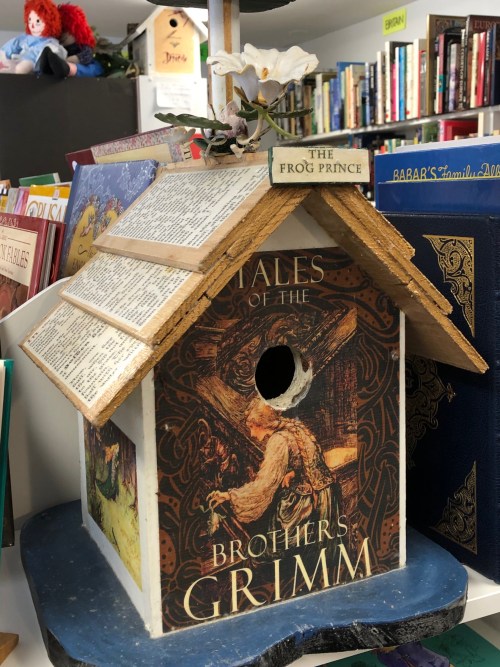
022319-literary-bridhouse-Grimm-Tales

Jaimee Leigh sells books at the Barrow Bookstore in Concord, Massachusetts, but during after hours, she makes literature-themed birdhouses designed for actual birds. 

Betsy Levinson was the editor of the Concord Journal for many years and was responsible for the majority of the articles, writing with exceptional grace and insight. Nowadays, she contributes as a stringer, and I see her byline most often on infomercials for local real estate, which don’t interest me as much. But in a recent front page article she did herself proud. And when I went to the locale to take pictures, I could see that other readers had been inspired to follow up, too.

This is what she reported for the Journal. “Jaimee Leigh sells books at her sister Aladdine Joroff’s shop Barrow Bookstore in Concord, but a talent for creating one-of-a-kind birdhouses keeps her busy during her hours away from the shop.

“The birdhouses aren’t just functional, either. Her creations are pieces of art, each one designed around a work of literature.

“For instance, the roof of her ‘The Hobbit’-inspired birdhouse has glow-in-the-dark lettering on the roof in the same original font that J.R.R. Tolkein made for his books.

“Then there is the suet bird cage, inspired by Henry David Thoreau’s ‘Civil Disobedience,’ which she noted was written from a Concord jail cell where he was ordered after refusing to pay taxes. Leigh inscribed words from the book inside. …

“It was four years ago that the idea of making a book-themed birdhouse came to Leigh. She was visiting her godmother in Sligo, Ireland, and attended a creative arts competition as a fundraiser for a storied estate there. She made a ‘memory box’ featuring seashells found in the area, photos and poetry. Though it wasn’t a birdhouse, it inspired her to create ‘similar things for the bookstore in Concord.’ …

″Each birdhouse ‘aims to summarize the essence of a book or story,’ Leigh wrote.

They are sealed from the elements on the outside, but she leaves the interior free of chemicals or noxious fumes that might hurt the birds.

“She bores holes of different sizes to accommodate larger or smaller birds. Recently she started fitting inch-wide ’emergency egress steps’ inside the house in case the bird finds the inside too smooth and can’t get a toehold or clawhold to get out. Leigh’s careful about using a perch on the outside because sometimes predator birds can lurk outside. …

“She has shipped birdhouses to South Korea, Canada and Texas. Others are scattered around the floor-to-ceiling stacks of books at the shop. She has donated houses to local charities for fundraising auctions. Each one can take 60 to 80 hours to complete, she said. … For information, email Leigh at barrowbookstore@gmail.com, or visit barrowbookstore.com.”

More at the Concord Journal, here.

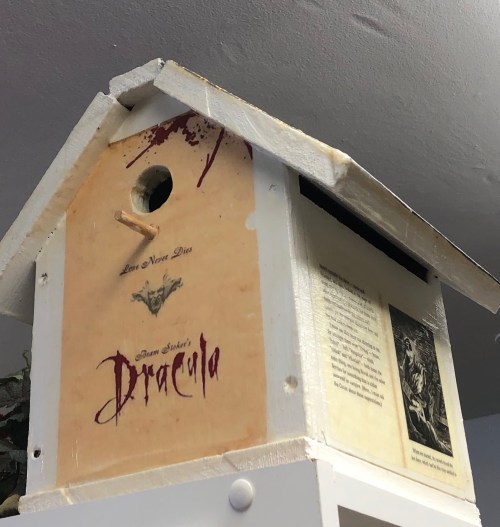
I took pictures of birdhouses featuring the Brothers Grimm, Dracula, and Great Expectations. Regarding the latter, note that Miss Havisham’s wedding dress is evoked by lace, and the clock is stopped at the moment her bridegroom ditched her, twenty minutes to nine.

022319-literary-birdhouse-Dracula

022319-Havisham-frozen-clock-wedding-lace-birdhouse


Photo: Metro Arts
This
student is engaged in a restorative justice program that uses the arts to reach young offenders. Cecilia Olusola Tribble, Community Arts Coordinator of the Metro Nashville Arts Commission, says, “We have been able to work and watch miracles happen every day.”

My friend Diana was the first to explain to me the concept of restorative justice, and I wrote about it here. The idea is to bring a young perpetrator and his or her victim together, if the victim is willing, to learn about the effects of the crime and make restitution. When the process works, the young person turns aside from wrongdoing and keeps a clean record. Today I have a story about how the arts can be part of a restorative justice outreach to youth who are already incarcerated.

Cecilia Olusola Tribble writes at ArtsBlog, “The purpose of the Restorative Justice + the Arts program is to enable artists and arts organizations to provide dynamic program opportunities for youth and families who have interacted with the criminal justice system. Our aim is to equip teaching artists with the tools they need to bolster their practice in ways that lead youth toward productivity, resiliency, and well-being.

“In 2016, photographer and musician Nduka Onwuzurigbo heard about the transformation happening in the juvenile justice system and wanted to create a project with the youth in the detention center.

“Since her election in 2014, Judge Sheila Calloway has been restructuring the juvenile justice system in Metro Nashville/Davidson County to include resources to divert children and families in trouble, providing them creative paths toward a better, brighter, and more productive future. …

“[She] mobilized her team to make sure the children in the detention center were able to participate in the photography project. As that singular project was seeing success with the youth who were incarcerated and had a positive community response, Metro Arts in Nashville approached the judge about establishing an ongoing partnership. Since then, Metro Arts and the Juvenile Court in collaboration with the Oasis Center have been able to build the Restorative Justice + Arts program.

“It costs roughly $88,000 to incarcerate one youth for a year in Nashville. For the same amount of money, we have been able to pitch, build, and pilot the Restorative Justice + Arts program. …

“To start the program, Metro Arts held focus groups with our artist community, grantees, arts educators, and other stakeholders. … Next, Metro Arts spent time in the various departments in Juvenile Court. The focus in the court is in the process of shifting from solely emphasizing penalty to giving children and parents the tools to restore healthy relationships and communities. Judge Calloway has explained Restorative Justice in the following way:

‘Restorative Justice moves the conversation from “Who did the crime & what do they deserve?” to “Who has been harmed?”, “What are their needs?” [and] “Whose obligation is it to fix their harm?” ‘ …

“In FY 2018, the artists have been able to serve 424 youth who have been incarcerated, had other involvement with the court, or who are deemed at-risk due to poverty, school attendance, neighborhood crime, poor school performance, or living in an area where fresh food is scarce. …

“It is because of the partnership between multiple government agencies, youth-centered organizations, arts organizations, and artists that we have been able to work and watch miracles happen every day. We have witnessed youth leaving the detention center and seeking out their yoga and dance teacher. … We have watched the miracle where former gang members admit to shooting at each other, but theater and painting classes have bonded them together as brothers with arms entangled. Our hearts are full at experiencing young folks arguing with the characters of an August Wilson play to make a better choice. …

“This spark came from one artist who asked the question and made the difference.” One and one and 50 make a million. More here.

Photo: Ryan Donnell/Sesame Workshop
Grover from “Sesame Street” in a Rohingya camp in Bangladesh. The Lego Foundation will provide $100 million over five years to the makers of “Sesame Street” and their partners for a program for refugee children.

Most of what we know about the situation of Rohingya refugees — expelled from Myanmar (Burma) for their Muslim beliefs — is pretty dire. But here and there we see positive efforts to lessen the pain of living in overcrowded camps in Bangladesh, especially for children. Read about this partnership among humanitarian relief organizations, Sesame Street, and Lego.

Karen Zraick writes at the New York Times, “Can play help refugee children heal from trauma?

“That’s the belief behind a new partnership formed by the Lego Foundation, Sesame Workshop and organizations working with Syrian and Rohingya refugees. In its first major humanitarian project, announced [in December], the foundation will provide $100 million over five years to the makers of ‘Sesame Street’ to deepen their work with the International Rescue Committee in the countries around Syria, and also to partner with the Bangladeshi relief organization BRAC.

“The aim is to create play-based learning programs for children up to age 6 in Lebanon, Jordan, Iraq and Bangladesh. The programs will teach basics like the alphabet and numbers, but will also emphasize social and emotional development to counter the effects of stress and suffering. They will be offered both to displaced children and to some of their potential friends in host communities.

“Officials at the organizations involved said that helping children’s brains develop during their first years — when they are absorbing information like sponges — is crucial to helping them become healthy and successful later in life, and that play is an excellent way to do it.

“ ‘We know from child development research that the best way for children to learn is through exploring their world and play,’ said Sarah Smith, the senior director for education at the International Rescue Committee. …

“The families’ needs are great. In addition to basics like adequate food and shelter, children need to foster ties with nurturing caregivers to heal from what they have witnessed and endured, said Hirokazu Yoshikawa, a director of Global TIES for Children, a research center at New York University that will conduct testing and evaluation for the program.

‘Part of the magic of human development is that very few experiences doom a child to ruin,’ Dr. Yoshikawa said. ‘But we have to address the risks early. This is particularly critical in these first years.’ …

“Erum Mariam, a program director for BRAC, said that many of the 240 play labs the organization has created for refugees were built by the children’s fathers and painted and decorated by mothers and children.

“ ‘We place a lot of emphasis on culture and on strengthening community engagement,’ she said. Within those centers, trained facilitators focus on providing enough structure to make children feel safe, while allowing for spontaneous joy.

“ ‘When a child enters the humanitarian play lab, we want the child to feel very happy and very connected to their culture and heritage,’ she said.” More here.

You may recall I wrote about Sesame Street helping Syrian refugee children, here.

Photo: Kagin’s
A detail from a 4×5-inch photo depicting Billy the Kid, left, playing croquet in 1878. Worth millions of dollars, the picture was found in a junk shop and bought for $2.

When I was growing up, kids regularly played games of “cowboys and Indians.” My brother and I had cowboy and cowgirl outfits and toy guns, “six-shooters.”

How times change! Today I am much more aware of the injustices done to tribes, and my preoccupation with better gun laws makes kids running around and shooting seem uncool.

But for sure, back then we thought cowboys were great: Roy Rogers, Gene Autry, Hopalong Cassidy — and the real Wild West holy terror, Billy the Kid.

I hadn’t thought about these guys for years, and then my husband pointed me to this article on a Billy the Kid photo.

Peter Walker writes at the Guardian, “Henry McCarty, known in Wild West lore as Billy the Kid, lived a brief and violent life, stealing and killing before his death in a gunfight aged 21. He lived with a gun in his hand – and sometimes, it seems, a croquet mallet.

“In a surprising historical twist, the second photo of McCarty ever to be authenticated shows him and his posse, the Regulators, playing the sport in New Mexico in 1878.

“The faded image was among a pile of photos inside a cardboard box at a junk shop in Fresno, California, unearthed by a collector in 2010. Randy Guijarro paid $2 for the image, which is now estimated to be worth millions of dollars. The only other confirmed photo of Billy the Kid, from 1880, sold for $2.3m in 2011.

“The photo was authenticated by a San Francisco-based Americana company, Kagin’s, which identified Billy the Kid along with several members of the Regulators, as well as friends and family. It was taken after a wedding in the summer of 1878, just a month after the gang took part in the brutal Lincoln County war.

“When the photo was first brought to the company, its experts were ‘understandably skeptical,’ said David McCarthy from Kagin’s. ‘An original Billy the Kid photo is the holy grail of Western Americana.

“ ‘We had to be certain that we could answer and verify where, when, how and why this photograph was taken. Simple resemblance is not enough in a case like this – a team of experts had to be assembled to address each and every detail in the photo to ensure that nothing was out of place.’

“The team spent a year investigating the photo, and even found the location where it was taken, in Chaves County, New Mexico. There they unearthed the remains of the building shown. …

“Liz Larsson, from the UK’s Croquet Association, said the series of photos from the scene left little doubt what game was being played: ‘It’s clearly croquet. You can see the hoops, the balls, the mallet, the centre peg. They’re all there. It’s a fascinating picture.’

“The first croquet club in England was founded in 1865, the same year the game was immortalised in Lewis Carroll’s Alice in Wonderland, Larsson said. …

“[It was] not a game for the masses. … Things were, however, slightly different in the US, where companies making croquet gear created a smaller-scale version of the sport, which could be played on rougher turf, using cheaper, lightweight equipment. …

“All types of Americans played. In 1867, General George Custer wrote to his wife, Elizabeth, from his frontier fort in Kansas, asking her to ‘bring a set of field-croquet’ when she next visited. Thom Ross, a US artist specialising in historic scenes, has previously painted both Native Americans and cowboys playing croquet, saying this is based on extensive historical research.”

More here.

My brother’s cowboy hat.

when-cowboy-hats-were-cool

Photo: The Music Lesson, by Frederic Leighton, 1877. The young girl being taught to play the saz (a Turkish lute) is Connie Gilchrist. She was not a musician but became famous as an artist’s model and jump-rope entertainer.

The little girl in this story, born to a stage mother in a 19th century London slum, appears to have had a very successful life. But do click on Little Fatima, a painting by Frederic Leighton, and tell me what you see.

Vanessa Thorpe writes at the Guardian, “Fame is a fickle thing – and this point is well made by the painting of an opulently dressed girl being taught to play a stringed instrument that now hangs in the City of London’s Guildhall Art Gallery.

“Researchers preparing for an exhibition on Victorian attitudes to childhood, called Seen and Heard, have found that Connie Gilchrist, the forgotten young musician in painter Frederic Leighton’s canvas entitled The Music Lesson, was once the toast of England. …

“The child star, then known as ‘the original Gaiety Girl,’ made her name on stage at 12 with a novelty skipping rope act. But even at that early age, Gilchrist’s face was well known across London.

From the age of four she had posed for many of the great artists of the era, including Frank Holl, William Powell Frith and James McNeill Whistler, and for photographs taken by Lewis Carroll. …

“Gilchrist’s is a remarkable rags-to-riches story, yet one masked by her later identity as Countess of Orkney, the name by which she went until her death in 1946.

“Leighton’s sumptuous 1877 painting shows Gilchrist playing the saz, a Turkish stringed instrument, in a scene influenced by the artist’s visit to Damascus in 1873. But it is not the portrait of a child of the English aristocracy. In fact, Gilchrist had been born in the slum area behind King’s Cross station – a district described in 1851 by the writer WM Thomas as ‘a complete bog of mud and filth’ – which was demolished the year after her birth in 1865.

“ ‘Connie had been pushed into celebrity by her mother, it seems, in the hope she would be able to pull the family out of poverty – which she eventually did,’ said [Katty Pearce, curator at the Guildhall gallery]. ‘But although she appeared in hundreds of stage shows, becoming a star turn, those who met her in artists’ studios remembered her as quite a sad little girl.’

“Gilchrist was six when she began sitting for Leighton, and she is the Arab girl in his painting Little Fatima. Whistler even attempted to depict her skipping rope routine in an etching. …

“Gilchrist was able to quit the stage for good after doing an American tour in 1886. Her two wealthy benefactors, Lord Lonsdale and the Duke of Beaufort, had introduced her into high society, one buying a London home for all the Gaiety theatre girls, which he then left to Gilchrist, and the other becoming in effect her adoptive father. In 1892 Gilchrist married a Scottish peer, the 7th Earl of Orkney in London, and they lived quietly together for 53 years in his home near Leighton Buzzard.

“The painting of Gilchrist is one of 50 on show until the end of April in Britain’s biggest exhibition to examine Victorian representations of childhood.”

More images of Gilchrist, here, including the Whistler painting. More of her story at the Guardian, here.

I love how the various strands of this story could lead to many different investigations: on the sadness of child stars, on benefactors that do things like making a home for girls working in a theater, on how a town got a name like Buzzard. Leighton Buzzard — such an English name! Can you say it without affecting an English accent?

Photo: Pinecone.org
Becoming a musician should not stress students out. That’s why students at a music school in Manchester, England, are encouraged to take time for a well-rounded life.

Our niece is a music teacher and youth orchestra conductor in North Carolina. Her husband and all three of her children are also accomplished musicians. One thing that’s hard to remember now is that when she was studying music in college, she was very stressed out.

That’s something a music school in Manchester, England, is determined to prevent as it launches its new wellness program.

Photo: UIG/Getty Images 
The Royal Northern College of Music in Manchester, which has about 800 students, is promoting physical and mental wellness for students.

Sally Weale writes at the Guardian, “The Royal Northern College of Music has become the first conservatoire to appoint a lecturer in musicians’ health and wellbeing, to help equip students to deal with the pressures of a career in music.

“The number of students reporting mental health concerns has risen sharply across higher education in recent years, and the RNCM is concerned its students have to deal with the additional pressure of concerts and recitals as well as long hours of practice.

“Sara Ascenso, a clinical psychologist and trained pianist, will start at the college in January. Her role will include lecturing and research, and she will also develop the health and wellbeing provision across the college, ensuring it is tailored to musicians’ needs.

“Kathy Hart, the RNCM students’ union president, said … ‘The work needed to build such a difficult career can come at a price, both physically and psychologically. … The more work we put in, the higher the stakes become – and the more devastating the impact if we are held back by injury or mental health struggles.’

“The Manchester college plans to lay on extra counselling sessions for students, particularly when performance pressures are at their peak, plus wellbeing activities such as yoga to help prevent injury. The RNCM also intends to extend its community outreach so more students get to work with people in need.

Ascenso said: ‘We want our students to learn how to make music with excellence, but also how to live fulfilling lives as musicians and as human beings more generally.’

More at the Guardian, here.

Photo: Mark Bell
A relaxed family recital communicates even to the dogs that music is something to enjoy.
021719-mother-and-sons-and-dog-enjoy-music