Feeds:
Posts
Comments

13-mobilehomestead-atsidewalkdetroit-2018-720x405

Photos: Museum of Contemporary Art Detroit (MOCAD)
Visitors to the Sidewalk Festival enjoy a µTopian Dinner with Hinterlands performers outside the Mobile Homestead.

Kristina and I were discussing the other day all the different kinds of yoga that are popping up. Suzanne’s friend Liz tried goat yoga. Kristina had heard of knitting yoga and laughter yoga.

Similarly, it seems like I’m constantly hearing about new ways of extending the boundaries of theater. In this story from Hyperallergic, sharing food with audiences in person and through Skype is the focus.

As Sarah Rose Sharp writes, artists are practiced “in finding ways to forge interpersonal connections through gesture, metaphor, and performance — or sometimes just by inviting people to dinner.

“ ‘Food is so interesting, because it evokes memory, and it’s a multi-sensory experience,’ said Liza Beilby, in an interview with Hyperallergic during preparations for one in a series of µTopian Dinners, staged by Detroit-based experimental theater ensemble The Hinterlands and co-produced with Poetic Societies, a performance lab fostering cross-cultural and poetic connections. …

“Since 2017, the group has been staging permutations of the µTopian Dinners as a subset of a larger work, The Enemy of My Enemy, a hybrid, digital-live performance project that simultaneously links performers and audiences in the US and so-called ‘enemy’ nations of China, Russia, and Iran. …

“The Hinterlands views the µTopian Dinner projects as a kind of a laboratory to investigate the cultural values that are reinforced through eating, meals, and cooking. [In August], µTopian Dinners took literally to the streets, as the ensemble presented a four-part performance and rotating series of events, during the homegrown and wildly popular Sidewalk Festival of Performing Arts. …

“[The group] — as well as their foreign counterparts tuning in from Moscow, Bejing, and Tehran — operated out of the modular traveling unit from Mike Kelley’s Mobile Homestead, which is permanently housed at the [Museum of Contemporary Art], making one of the rare forays into the farther-flung Detroit neighborhoods for which it was expressly designed. …

“Artist and designer Yi Zhou, who runs a studio out of Beijing called Body Memory, met The Hinterlands during her 2016 residency at Popps Packing, and the ensemble has visited her twice over the last two years, touring with their previous show, The Radicalization Process, and other performances.

“ ‘In between the first year that we went and the second year that we went, she and a bunch of friends who are designers and architects started this group called TGIS,’ said Beilby. ‘It’s a Sunday brunch in this little courtyard at the studio of one of the members, and they invite people to come and have brunch, and then there’s a lecture, or talk, or conversation, which are themed.’ During the Sidewalk performance, Hinterlands Skyped into the beginning of the brunch taking place in Bejing. …

“ ‘It’s like translation, in a way. You’re trying to contextualize something for the people where you are, that’s meaningful, and then express something about the people here to another group. … It’s an interesting way to try to bridge two spaces or times or peoples, through sensory experiences that aren’t just talking.’ …

“One could call it a new medium, enabled by the tools of our increasingly interconnected world, or one might consider it the mission of any meal undertaken by people who begin as strangers, and perhaps leave with a better understanding of each other.”

More here.

Mike Kelley’s Mobile Homestead traveling unit at the Sidewalk Festival for the Performing Arts in Detroit.

14-mobilehomestead-atsidewalkdetroit-2018-720x405

072018tb_berrylaser_wide-ce270980ab8d553df98e403fb22f55694ee9c7a1-s900-c85

Photo: Tom Banse/Northwest News Network
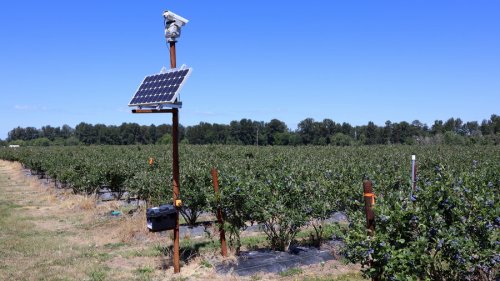
This laser unit is one of six that repel thieving birds from the blueberry fields of Meduri Farms near Jefferson, Oregon.

Are you familiar with the arch-criminal Moriarity, featured in Sherlock Holmes stories? “Moriarity” is what my husband called every devious catbird that got through his garden defenses last summer, eating many of the best berries. No sooner had my husband patched a piece of netting that the birds had sneaked through than they collaborated with one another to extend some tiny opening. And then they would get all tangled up and have to be rescued. (As Kim says, “Catbirds have such disorganized feathers.”)

Suzanne suggested the Scare-Eye Bird Chaser she had seen at a Rhode Island farm, but New Shoreham is too windy for a balloon defense.

A plastic hawk interested the grandchildren, but Moriarity was bored.

Next year it might be necessary to think about lasers.

Tom Banse writes at NPR, “During every berry-picking season in the Pacific Northwest, blueberry and raspberry growers fight to prevent birds from gobbling up the crop before harvest. This year, some farmers are trying something new to scare away the thieving birds: lasers.

“Justin Meduri manages a large blueberry farm and cherry orchard outside Jefferson, Ore. Birds like both fruits.

” ‘Flocks can move in of up to 2,000 to 3,000 starling birds,’ Meduri says. The starlings gorge themselves and knock down berries right as the crop is ready to pick. When he didn’t take countermeasures, Meduri says the damage was ‘inconceivable, huge. We had almost a 20 to 25 percent, maybe even 30 percent damage loss.’

“Meduri says he previously hired a falconer to protect his fields. But the falcons were expensive, temperamental and sometimes flew away. Then last year, he became one of the first farmers in the U.S. to install automated lasers. … Meduri is thrilled with the results.

” ‘[The lasers are] running right now as we speak. You’re out here in over 175 acres of blueberries,’ he says, punctuating the observation with a staccato of hand claps. ‘There’s not one bird that you see flying around.’ Meduri says that had any birds been in the bushes, the clapping would have made them come out. …

“[Laser maker] Bird Control Group started out in Europe, for the most part using lasers to shoo pesky birds away from industrial sites and airports. In the U.S. market, the agricultural industry appears to be the most promising.

“[Director of North American business development is Wayne] Ackermann says some of his initial sales have come from farmers trying to appease neighbors. …

“The silent lasers proved a friendlier — and sometimes better — bird repellent than traditional tools such as propane cannons or squawk boxes. The lasers are also friendlier than using poison or a 12-gauge shotgun.”

On second thought, the price is prohibitive for a backyard gardener, and not enough is known about whether the lasers are harmful to the birds. Researchers at Purdue University are studying that very question. So stay tuned for that — and for more on the misadventures of Moriarity.

The story is originally from the Northwest News Network. You can read the rest of it here.

Photo: Scare-Eye Bird Chaser
Another possible bird-control option if you don’t live in a windy region.

bird-x-animal-rodent-control-se-pack-64_1000

092618-basket-ordered-direct-from-Ghana

Look at this thing of beauty! I ordered it direct from Ghana to replace my old laundry basket. Here’s how I learned about the amazing Baba Tree.

The story starts with Suzanne’s bicycle. She wanted a bicycle basket and went online to see what might be available. That’s when she found a company in Ghana that helps basket-making artisans sell their works in the global marketplace.

Suzanne ordered a bicycle basket, and when it arrived safe and sound a few weeks later, I happened to be at her house. I starting thinking, What kind of basket do I need? I went online.

Founder Gregory MacCarthy writes an oddly defensive blog at Baba Tree in which he explains about the company, the prices, and the reasons he is not applying for “fair trade” status. As I read it just now, I was reassured — I have a lovely basket in front of me and I like finding quirky individuals behind something good.

MacCarthy writes, “We are not a ‘project,’ a charity, a foundation or a non – governmental organization (NGO). Though we engage small acts of charity every day, we are here, in Bolgatanga, to do business and do our best to empower the folks with whom we work through the open market. …

“The people with whom we work are very capable. Though we have customers who are very committed to their charities and purchase our baskets wholesale to raise money for them, the Baba Tree chooses to empower our people in the market place. It’s not that the Baba Tree is fundamentally opposed to aid and charity, it’s that it is rarely carried out honestly, efficiently and effectively which creates further dysfunction.

“The weavers with whom the Baba Tree works are more than capable of taking care of themselves, excelling through their own sweat and creativity that ultimately produces Excellence. The Baba Tree refines and cultivates the excellence brought forth through our weavers, and does an excellent job organizing and marketing that excellence throughout the world. …

“We are not subsidized in any form at all. All that is produced, and received, by the Baba Tree, is through our own sweat and creativity. At the Baba Tree everyone gets paid.”

A card inserted with my basket describes the hours spent stripping and dying elephant grass fibers, then braiding them in the Baba Tree compound to the accompaniment of “laughter and singing … interwoven into the very folds of our baskets.”

In the picture of my new basket (created by Martha, I’m told), you can see that “Do Not Crush” was written on the box. Although neither my basket nor Suzanne’s got crushed, the boxes and the baskets inside sometimes do suffer in transit from Ghana. For that reason, a paper was enclosed telling me how to fluff out a crushed basket by soaking it first in a tub of water.

I loved tip no. 8 on that paper: “Please do your best to use the water to water a tree or plant” after finishing. That tells me so much about Africa and about this company. And it reminds me that we should all be more thoughtful and thrifty with our abundant water.

Read more at Baba Tree and enjoy the gorgeous pictures there.

sidebar_staticblock

A Unique Pollinator

dl_514blueorchardbees_bee_on_phacelia_tanacetifolia_wide-026b809eb16b094939e36911aa87b02aad62ddca-s900-c85

Photo: Josh Cassidy/KQED
A female blue orchard bee forages for nectar and pollen on blue (or purple) tansy. Blue orchard bees are solitary bees that help pollinate California’s almond orchards.

There’s been a lot of attention to honeybees in recent years and to chemicals that may be responsible for the bee die-offs threatening our food supply. But apparently honeybees are just one of the pollinators that benefit the oblivious human race.

Gabriela Quirós reports at KQED, “While honeybees and their buzzing hives and hyper-fertile queens get all the press for pollinating our food supply, the hard-working blue orchard bee is one of 4,000 bee species native to North America that does its solitary work in relative obscurity. That is, until now.

“In the video, you can see how this bee builds its nests, alternating mud and a purple nectar-pollen mixture in hollow, skinny spaces. The blue orchard bees are preparing a purple lunch box of sorts for their offspring so they have food to eat in the tunnel. …

“But the blue orchard bee is more than a pretty face. It is an efficient pollinator that some farmers are exploring as a possible alternative or supplement to honeybees in sweet cherry and almond orchards.

“Honeybees are more prolific, but 40 to 50 percent of colonies die every year, according to a yearly National Honey Bee Survey, taken by universities and sponsored by the U.S. Department of Agriculture and the California Almond Board, among others. Enter the blue orchard bee.

” ‘This is, I think, the moment for these bees to shine,’ says entomologist Natalie Boyle, who studies blue orchard bees at the USDA in Logan, Utah. …

“Research has found that 400 female blue orchard bees are as effective at pollinating almonds as the more than 10,000 bees in a honeybee hive, says Boyle.

“Finding other bees that could work side by side with honeybees could offer what she calls ‘pollination insurance.’

“But it’s not a simple swap. Blue orchard bees take their time reproducing. They lay only about 15 eggs a year, while the queen honeybee can lay 500 or more a day. And the blue orchard bees wander off, rather than return to a hive every night.” More here.

There’s an awful lot we don’t know about insects because we just don’t pay attention. Maybe if we paid more attention, we would understand that we need them.

091918-Banksy-tagged-5-NYC-boroughs-in-2013

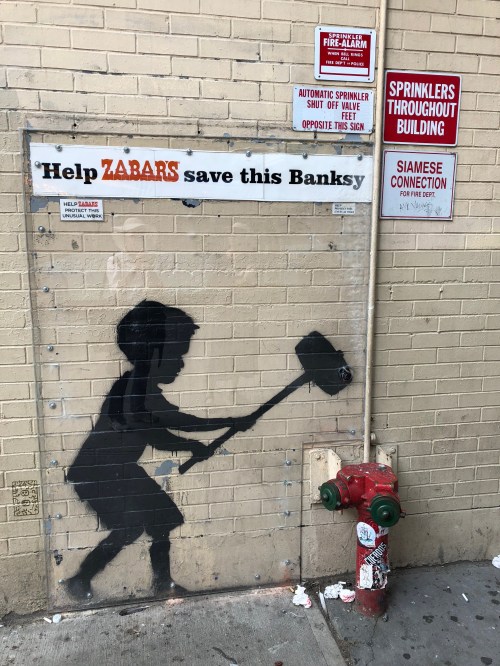
When I was last in Manhattan, I took a photo of a putative Banksy stencil. It’s one that the gourmet food emporium Zabar’s helped to preserve in 2013, when the British street artist was said to be tagging all five New York City boroughs.

I have written often about Banksy — here, for instance. I get a real kick out of his ideas and the fact that he works by stealth. (Speaking of that, if you search on the word “stealth” at the blog, you will find all kinds of examples.)

Banksy’s art, like other street art, is not necessarily meant to last for the ages, but he has become such a phenomenon that there are now efforts to restore murals that have been painted over.

The BBC reports from Scotland, “Restoration work is under way on three early works by the artist Banksy which were accidentally painted over with grey emulsion in a Glasgow nightclub.

“The murals, which feature a gun-toting monkey in a tutu and a framed Mona Lisa, were created as part of an exhibition at The Arches in 2001. But they were mistakenly covered in 2007 then left after the club went into administration [bankruptcy] in 2015.

“A team of restorers are expected to take five months to uncover the works. … Banksy created the works, which also feature the words ‘Every time I hear the word culture I release the safety on my 9mm’ when he was beginning his career as a graffiti artist.

“They were shown as part of the ‘Peace is Tough‘ exhibition in March 2001, … but six years later, and long after Banksy had established himself as an international artist, the murals were covered with grey emulsion during refurbishment work at the nightclub.

“When the club went into administration in 2015, the then owners had considered restoring the murals and selling them to clear the club’s debts.

“Chris Bull, technical director at Fine Arts Restoration Co (Farco), which is carrying out the restoration, said the murals were the only known works by Banksy in Scotland with any provenance. …

“The new owners of the venue, Argyle Street Arches, say they now want to save the works for the nation. … Once complete the works will be put on permanent display.”

More at the BBC, here.

4899

Photo: Arco Images GmbH/Alamy
Crows at a park in France have been trained to pick up cigarette butts and trash. 

You may have already heard about crows in France that are improving the environment. The stories were all over the news in August. I include two articles here — the first from the Guardian and the second from USA Today.

” ‘The goal is not just to clear up, because the visitors are generally careful to keep things clean’ but also to show that ‘nature itself can teach us to take care of the environment.’ said Nicolas de Villiers of the Puy du Fou park, in the western Vendee region.

“Rooks, a member of the crow family of birds that also includes the carrion crow, jackdaw and raven, are considered to be ‘particularly intelligent’ and in the right circumstances ‘like to communicate with humans and establish a relationship through play,’ Villiers said.

“The birds will be encouraged to spruce up the park through the use of a small box that delivers a nugget of bird food each time the rook deposits a cigarette end or small piece of rubbish.” More from the Guardian.

And from USA Today, “Crows have been trained to collect other items in a similar way. In 2008 a man created a ‘crow vending machine’ — a box that would dispense a peanut every time a crow found a coin and put it in the machine’s slot. The inventor, Josh Klein, surmised at the time that if a crow can be trained to collect coins it can be trained to help improve human lives, such as picking up trash or sorting electronics.

” ‘Don’t hate the crows,’ Klein told NPR in 2008. ‘Just let them save you.’ ”

wpdms_ev26188_fishers_island

Fishers Island is located at the eastern end of Long Island Sound. Long a summer enclave for the wealthy, it may soon become known for a seaweed farm in Fishers Island Sound.

When my three-year-old grandchild was upset because the seaweed snacks were all gone, I knew the world had changed. Seaweed snacks? Yes, indeed. Seaweed has become big in the US. It’s not considered an exotic food anymore.

At the Connecticut newspaper the Day, Joe Wojtas wrote recently about one of the many entrepreneurs moving into seaweed.

“A local man is seeking approval from state and local agencies to run a sugar kelp farm in Fishers Island Sound about one mile southeast of Enders Island.

“Thomas Cooke of LionMind Ventures LLC is seeking a permit from the state Department of Energy and Environmental Protection to install up to 10 long lines, each 500 feet long and anchored at each end and in the middle. The kelp seeds are embedded in the ropes when they are put out in the water and then harvested six months later after the plants have grown to 12 feet or more. Cooke said the work will begin in late October and end in May, which means it will not occur during the busy recreational boating season in Fishers Island Sound. …

“Cooke, who now lives on Masons Island and is an attorney, director for a professional choral group and the former Simsbury town administrator, … said he learned about kelp farming a few years ago, when he heard a program on the popular TED Talks series about a New Haven-based organization called Greenwave and its executive director, Bren Smith, who farms kelp in the Sound.

“ ‘It’s really good for the Sound,’ Cooke said about kelp farming. ‘It removes nitrogen and carbon dioxide and leaves a much healthier body of water.’ …

“The uses for nutrient-filled kelp include food — growers like to call it sea greens and not seaweed — cosmetics and fertilizers, just to name a few. Cooke said Greenwave works with kelp farmers to provide seed, find buyers and provide technical advice.

Everyone says it’s the new kale but I think it tastes better,’ he said.

More at the Day, here. I blogged about a Rhode Island kelp farmer here.

Photo: NOAA Fisheries
Here’s what sugar kelp looks like. There are different kinds of kelp, but this is the kind mentioned in the story.

1280_18l2o3dcg8gp

12801

Modern reusable nappies are available in cotton, bamboo, and hemp and have more designs than the diapers of old.

When John and Suzanne were babies, disposable diapers weren’t very reliable, and I rarely used them. I chose a diaper service that delivered clean ones every week and picked up dirty ones. I not only thought cloth diapers worked better, but I thought I was doing something good for the environment. It was only later that I realized that all the hot water and bleach the diaper service used wasn’t good for the environment either. My four grandchildren all used the Pampers/ Huggies type of diaper.

In England, where they called diapers “nappies,” Tess Reidy explains at the Guardian that reusables are coming back. But the change involves doing your own washing.

“If the idea of cloth nappies conjures images of towelling squares loosely held by a large safety pin, think again. Modern versions have come a long way and are now available in bright colours and a variety of materials, including cotton, bamboo, microfibre and hemp.

“Growing consumer concern over plastic waste, and a more pragmatic desire to save money, means boom times for the reusable nappy industry.

“ ‘There is increased awareness of the impact of disposable nappies – they are a single-use plastic. It started with coffee cups, then disposable wipes, and the jump from wipes to nappies is clear,’ said Wendy Richards, director of UK online provider The Nappy Lady. She says the number of people using the service has grown by 80% in the past year. The business has doubled its staff since the start of  2018.

“About 25% of a disposable nappy is plastic and three billion nappies a year end up in landfill. Some councils in Britain now give new parents vouchers worth up to £55 [$72] to help pay for a set of reusable nappies. …

“Data from Nottinghamshire county council’s nappy project finds that using real nappies and washing them at home saves £200 a year compared with buying disposables. ‘This could help UK parents save as much as £360m a year, while helping us move towards a zero-waste society,’ said Amelia Womack, deputy leader of the Green party. …

“Social media platforms have also helped spread the word. Kasia Reszel has a two-month-old son, Julian. …’ We do one wash a day and it’s pretty easy. You rinse before putting on a longer cycle and wash at 60C [140F].’ …

“Upfront costs can, however, be a deterrent. With full nappy starter kits ranging from £100 to £350, some low-income parents are wary. …

“According to Charlotte Faircloth, sociology lecturer at University College London, it is often socially aware middle-class parents who have the luxury of worrying about natural styles of parenting. ‘Other people are more concerned about meeting bills,’ she said.” More at the Guardian, here.

I got curious to know whether safety pins were still used. Not necessarily! Look at the array of new fasteners here.

img_5016-f520f9fd787c7488d3b9ceda7cf25a3dd9ca05aa-s800-c85

Photo: Martin Kaste/NPR
Tempelhof, a German airfield once used for the Berlin airlift, is now a big, open park featuring recreational activities and temporary housing for refugees.

I recently learned that Germany has a reputation for repurposing old buildings in ways that maintain aspects of historical significance. That seems to be true of how the country is adapting an old airfield to modern uses.

Sam Shead reported at Business Insider, “Berlin is a city full of abandoned buildings with long and troublesome histories. But one building has been through more turmoil than most: Tempelhof Airport. …

“Tempelhof has been used to test some of the world’s first aircraft, house World War II prisoners, and give the people of West Berlin a vital lifeline to the outside world during the Cold War. It’s also been used to film movies such as ‘The Hunger Games,’ ‘The Bourne Supremacy,’ and ‘Bridge of Spies.’ …

“Tempelhof was designed to wow visitors to the new Third Reich capital of Germania. It represents the monumental thinking behind Nazi architecture and it’s a landmark in civil engineering. …

“Berliners flocked to the airfield to see early airships and balloons being tested. It was here, for example, that the Humboldt balloon was launched on its maiden voyage on March 1, 1893. …

“At the end of World War II, the US, British, French, and Soviet military forces divided and occupied Germany. Berlin, which was also divided into occupation zones, was located far inside Soviet-controlled eastern Germany.

“There was initially an alliance between the Western Allies and the Soviet Union in Berlin, but on June 24, 1948, the Soviet forces blockaded rail, road, and water access to parts of Berlin that were controlled by the Western Allies.

” ‘The United States and United Kingdom responded by airlifting food and fuel to Berlin from Allied airbases in western Germany,’ the US Office of The Historian website says. ‘The crisis ended on May 12, 1949, when Soviet forces lifted the blockade on land access to western Berlin.’ …

“The airport eventually ended up with many of the things that are commonplace in airports today, such as restaurants.” Shead adds that the airfield is now used by “kite surfers, rollerbladers, allotment enthusiasts, artists, cyclists, joggers, jugglers, batton twirlers, and dancers. …

“Tempelhof is also home to Germany’s largest refugee shelter. There were 3,000 refugees from countries like Iraq and Syria living in a hangar at one point, but that number has fallen to about 600 as German authorities have relocated many of them, while others have returned home. There is enough space in the hangar for 7,000 refugees. … The shelter is closed to the public, but there is a refugee cafe in Hanger 1 the public can visit and provide German lessons.”

I must say, I like to think how very unhappy the WW II owners of this airfield would be about that. Justice served.

More at Business Insider, here.

Songwriting Camps

3-nocrop-w1024-h2147483647

Photo: Michelle Groskopf
Scenes from the fifth annual Write On Song Camp at Atlantic Records in Los Angeles. From left, Federico Vindver, Angel Lopez, Oscarcito, Sam Derosa, and Adriel Favela.

I know almost nothing about popular music these days or the names of current stars, but I thought this article about songwriting camps was interesting. The artists’ collaborative process might be fun for creatives in other arts to try once in a while.

Steve Knopper writes at Vulture, “At a studio in 2016, Dave Longstreth was working by himself on a chord progression, as he usually does when writing for his band, Dirty Projectors.

” ‘It’s normally a pretty solitary process,’ he says now. But that time, Solange was there, as were Sampha, a British songwriter and producer; Blue, Solange’s engineer; and a bunch of other creative people, all part of what Longstreth calls ‘the camps,’ to make Solange’s 2016 album, ‘A Seat at the Table.’

“ ‘I’d have a melody from her, and would be just harmonizing on it, and she would come over and say, “Ooh, I really love this chord and that chord, but this one is too dissonant,” ‘ he recalls. ‘To be just a spoke on the wheel was a novel experience, and to be thinking in a collective way was just really fresh for me.’

“As long as there has been indie rock, songwriters have worked in their own band bubbles. … But over the past decade, the genre’s biggest names … have substantively contributed to albums by Beyoncé, Rihanna, Kanye West, Lady Gaga, and others. Many of these connections happen by serendipity — Beyoncé’s ‘They don’t love you like I love you’ hook in ‘Hold Up,’ [was] the result of Koenig tweeting a slightly misremembered line from Yeah Yeah Yeahs’ 2003 single ‘Maps,’ then recording it with Diplo. …

“When I walked into a room at the Lakehouse Recording Studios in Asbury Park, New Jersey, in late June,” reporter Knopper continues, “my eyes took a few seconds to adjust from the fluorescent hallway lighting. Through flickering candles, I made out Chelsea Jade, a New Zealand singer-songwriter, dressed in black, singing in a high, glassy pitch; Danny Mercer, a Colombian-American guitarist and singer, tapping out a Depeche Mode–style riff on a keyboard; and Randy Class, a Bronx producer, capturing everything on a laptop and looping it back. This was the BMI songwriters’ camp, which split up ten top writers into groups of three or more with the hope of regurgitating multiple daily songs. … Jade improvised: ‘I’m a psychopath.’ Class quickly discerned a double meaning about a ‘psycho’s path.’ Mercer fleshed out the melody with Spanish-guitar runs. …

“Ben Dickey, manager of Future Islands, Washed Out, and other indie-rock stars, believes the trend begins with hip-hop, in which artists are more experimental and willing to take chances than those in any other genre. Whereas a songwriter in a rock band can be stuck in a routine, collaborating with the same people in the same configurations, West, Drake, and Beyoncé pick the best material from whoever inspires them at the time. ‘You come up with what can be a really interesting song that has way more diverse influences than what one singular singer-songwriter would come up with — then you have Kanye or Drake come in and rap over it,’ Dickey says.” Read more at Vulture, here.

092518-pod-of-whales-in-Panorama

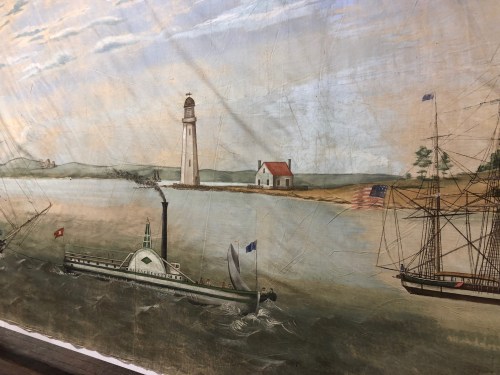
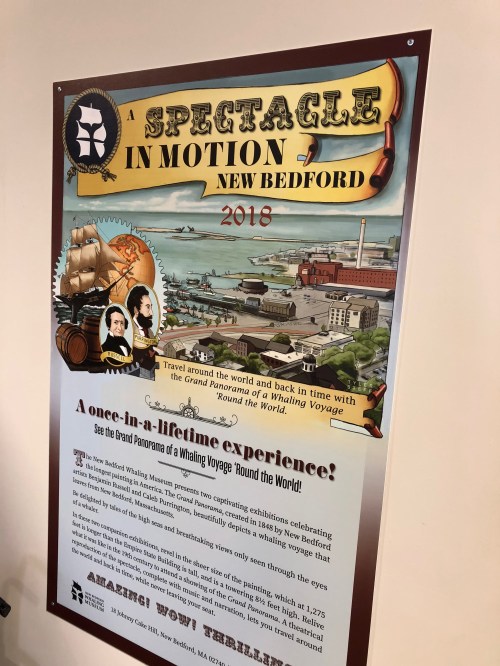
Back in the 1800s, two artists made a painting more than 1,200 feet long, which they then displayed in cities around the country. They charged admission to audiences interested in learning about the whaling life and the exotic places whaling ships dropped anchor on their long voyages.

Until October 8, the New Bedford [Mass.] Whaling Museum is offering free admission to see the painstakingly restored panorama. The venue is an old warehouse, the only place big enough to hold the painting in its extended form.

In the old days, this marvel traveled by train, sparks flying and burning holes in the painted sheeting, and audiences got to see it unscrolling in a frame that looked a bit like the whaling museum’s draped arch in the picture below.

Back then, people would not have been able to walk up and down and go back to an interesting spot to take a picture. At any given moment, they saw only the part that a narrator was describing. Because I could walk back and forth along the extended artwork, the pictures here may not be in sequence — I might be misleading you into thinking the ships got to Fiji before the Azores, for example. (By the way the volcano picture is from Cape Verde.)

Be sure to check out the whaling museum’s information. This link offers a short video. And this one talks about the conservation work: “Created by Benjamin Russell and Caleb Purrington in 1848, this Panorama has been displayed in a host of venues – from a national tour when it was created to the 1964 New York World’s Fair. It was donated to the Museum in 1918 and was displayed for many years. However, one can easily imagine what a century and a half of rolling, unrolling, display, and light can do to deteriorate nearly a quarter-mile of painted cotton sheeting. It has not been exhibited in its entirety for more than 50 years, and the Museum thanks Mystic Seaport for kindly storing this monstrous painting over the past year.”

At the Boston Globe last year, Jennifer McDermott wrote a good preview of the work, which was created, she says, “to capture all aspects of a whaling voyage. The panorama would be mounted on a system of cranks and reels to go across a theater stage as a narrator told stories of hunting whales and processing their carcasses. A poster for the Boston stop in 1849 advertises tickets for 25 cents. The audience members would hear what it was like to round Cape Horn and visit Fiji and other far-flung destinations as they saw painted scenes of those locations.” …

McDermott adds that D. Jordan Berson, who managed the project, “spent a year spraying the panorama with an adhesive to stabilize a paint layer that had powdered over time. The conservator stitched sections that were taken apart, repaired thinning areas of the cotton muslin fabric and fixed holes and tears.”

Nowadays, most of us think it’s a crime to kill these magnificent creatures, but it’s worth knowing how it was done if only because there are still people in places like Japan and Norway whose job it is to do just that.

092518-Panorama-billboard-New-Bedford

092518-exhibit-entrance-mimics-scrolling-frame

092518-whalers-visit-Fiji

092518-whalers-travel-the-world

092518-19th-century-harbor

092518-Azores-in-Whaling-painting

092518-Cape-Verde-volcano-at Panorama

092518-scrimshaw-whaler


092518-Polynesian-sailboat

092518-Polynesia-and-whaler

092518-thar-she-blows

092518-ad-for-whaling-spectacle

shmds7f6uui6rb4spbyzc5zfb4

Photo: Katherine Frey/The Washington Post
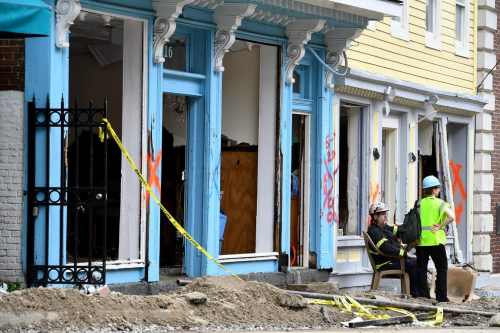
Stores along Main Street in the refugee-welcoming town of Ellicott City sustained severe damage after flooding in May. Grateful refugees were determined to help out after all the kindness shown them.

Not only do refugees contribute to both the US economy and the budget, but many are eager to return kindnesses shown to them when they were first finding their way in an unfamiliar land. In this article, Syrians did some fund raising for a small, flooded town that had welcomed them. Terrence McCoy reported the story for the Washington Post.

“The first time Majd AlGhatrif saw this historic mill town of colonial buildings at the confluence of the Patapsco and Tiber rivers [in Maryland], he thought of Syria.

“The structures, built of gray stone, and the history they evoked, reminded him of the timelessness and architecture of his hometown, Sweida, in southern Syria. He soon bought a house here, in 2013, then opened Syriana Cafe & Gallery, in 2016, and came to view everything about Ellicott City’s people — their kindness and decency — as an antidote to the fear others were expressing over Syrian immigrants like him.

“So when floods again ripped through here in May, killing a Maryland National Guardsman, closing businesses up and down its historic district and producing images of destruction recalling the floods of 2016, he vowed to do anything he could to help a community that had become his own.

“The result of that vow came to fruition [September 22] at Syriana, where he presented the city with a check for $10,000, which he had raised from Syrian Americans from all over the country who had seen the destruction and wanted to show their gratitude not just to Ellicott, but also to the United States for accepting them.

We wanted this to be a payback from Syrian Americans to a generous America,’ said AlGhatrif, a physician at Johns Hopkins Bayview Medical Center, handing an oversize check to community leaders.

“The check was a rare bit of good news in a city that has survived 246 years but is now reckoning with its own mortality — one more town grappling with existential questions, as the globe warms and natural disasters increase in frequency and ferocity. …

“The community is considering a sweeping $50 million plan to mollify future damage from flooding, but it would require the demolishment of as many as 19 buildings, cleaving out a piece of history in a city whose livelihood to a large degree depends on that very history.

“What we have to realize is that if we don’t do something, the town will die,” said Howard County Executive Allan Kittleman (R). … After the last flood, he said, ‘the calculus changed.’

“AlGhatrif witnessed that firsthand. … He knew that the community meant a lot not just to him, but also to other Syrian immigrants and refugees. His cafe employed several who, after years of fear during the Syrian war, had come to feel safe in Ellicott City.

“One was Safa Alfares, 17. She was born in Aleppo, whose scenes of war and bodies still dominate her thoughts. [She] had arrived expecting to face Islamaphobia. …

“But as she learned English, in which she became fluent in less than two years, and after she found a job at Syriana, her sense of foreboding gave way to something she had not experienced since the beginning of the war: calm.”

This is such a touching story. Read more here.

Hat tip: @bostonmigration ‏on twitter.


Detective Archaeologists

2251

Photos: British Museum
Tello in Iraq is the site of one of the oldest cities on earth. After the fall of Saddam, looted treasures ended up in London and, thanks to archaeological detective work, have been returned. Today the site is protected by both Iraqi archaeological police and a local tribe.

When you think something is lost forever, hold on to hope. If looted archaeological fragments that have been smuggled to another country can be identified and returned, you can find the family heirloom you put in a too-safe place. You can find the delight you once took in simple things back when you were too young to read the news.

Maev Kennedy reported for the Guardian in August, “A collection of 5,000-year-old antiquities looted from a site in Iraq in 2003 after the fall of Saddam Hussein, and then seized by the Metropolitan police from a dealer in London, will be returned to Baghdad this week.

“It comes after experts at the British Museum identified not just the site they came from but the temple wall they were stolen from.

The eight small pieces had no documentation of any kind to help the police, but the museum experts could literally read their origin.

“They included cone-shaped ceramics with cuneiform inscriptions identifying the site as Tello, ancient Girsu in southern Iraq, one of the oldest cities on earth recorded in the earliest form of true written language.

“The inscriptions named the Sumerian king who had them made almost 5,000 years ago, the god they were dedicated to, and the temple. And by an extraordinary coincidence the museum had an archaeologist, Sebastian Rey, leading a team of Iraqi archaeologists at the site, uncovering the holes in the mudbrick walls of the temple they were torn from, and the broken pieces the looters had discarded. …

“Iraqi ambassador Salih Husain Ali [said] the protection of antiquities was an international responsibility and praised the British Museum and its staff ‘for their exceptional efforts in the process of identifying and returning looted antiquities to Iraq.’ …

“St John Simpson, the assistant keeper at the Middle East department of the museum, said: ‘Uniquely we could trace them not just to the site but to within inches of where they were stolen from. This is a very happy outcome, nothing like this has happened for a very, very long time if ever.’ …

“The site of the Eninnu temple at Tello is now protected, not just by the reformed Iraqi archaeological police, but by a local tribe. …

“With no apparent way of tracing their origin, they sat in police stores until some of the antiquities cold cases were reopened with the reforming of the Met’s art and antiquities squad, and brought to the museum earlier this year. …

“The museum experts hope their methodology could be used to create maps of specific sites and types of antiquities, making the work of looters much more difficult.”

More at the Guardian, here. Wouldn’t you like to reach across time and tell the craftsman of the sweet little bull below that people in 2018 are still enjoying it?

Treasures looted from the site of an ancient city in Iraq include a tiny marble amulet of a bull.

1793

PUBLIC WORKS Musical Adaptation of William Shakespeare's
TWELFTH NIGHT

Conceived by Kwame Kwei-Armah and Shaina Taub 
Music and Lyrics by Shaina Taub
Choreography by Lorin Latarro
Directed by Oskar Eustis and Kwame Kwei-Armah

Featuring Kim Blanck (Femal

Photo: Joan Marcus
From left, Daniel Hall, Lori Brown-Niang, Shaina Taub, and Shuler Hensley in “Twelfth Night” at the Public Theater’s Shakespeare in the Park. Brown-Niang’s peignoir is usually “the first to go” on exceptionally hot nights when the feathers start shedding.

On this second day of fall in Massachusetts, the temperature was only 45 degrees at 6 a.m., when I wrote this. I felt very glad that 2018’s overpowering heat and humidity were past.

I can only imagine what it must have been like for outdoor actors under fierce stage lighting in summer 2018. At American Theatre, there’s a fun article about designing costumes for actors performing in all kinds of weather.

Billy McEntee wrote, “Across the country, as actors and audiences endure rain, heat, and bugs to present and partake of free professional performances of the Bard’s classics, one group of designers has a special challenge: costume designers. …

“ ‘Designing for outdoor environments is challenging yet fascinating,’ said Ying-Jung Chen, the costume designer for Independent Shakespeare Company’s ‘Titus Andronicus’ in Los Angeles. … ‘I’ve learned a lot through each outdoor experience about fabric technology and construction techniques.’ …

“It’s the dry heat that can prove most threatening. Evenings in the summer can stay above 80 degrees in Southern California; couple that with acrobatic performances, bushy wigs, and blaring stage lights, and actors are sure to sweat through even the thinnest of fabrics. …

“But heat invites more than just exhaustion and sweat; it’s also a magnet for bugs, something that Chen had to account for when creating stage blood for her costumes.

” ‘Blood is integral to Titus,’ Chen says. ‘My recipe was successful in past indoor productions. With a corn syrup base, it’s easy to wash out, edible, and realistic. But when doing outdoor performances, the sugar-based corn syrup attracts bugs. Fortunately, the theatre company has years of outdoor performance experience and provided a great recipe that’s washable, edible, and doesn’t allure insects.’ …

“Rain is no stranger to American Players Theatre in Spring Green, Wisc., though the threat of precipitation doesn’t change the creative process. As costume designer Robert Morgan succinctly puts it: ‘Design first, problem-solve later.’ He’s the costume designer for APT’s ‘As You Like It’ (running through Oct. 7). …

“ ‘Shoes are covered with non-slip dance rubber,’ he says. ‘But evening dew can make our outdoor stage slippery, so at APT we add sand to paint’ to give the stage’s surface extra traction.

“As in L.A., Morgan must also consider sweltering temperatures. This includes having freezer packs on hand for actors to wear beneath their costumes and crafting a ‘heat plan.’ which is ‘meant to accommodate the actors’ well-being on exceptionally hot, muggy nights and matinees under an unforgiving midsummer sun,’ Morgan said. …

“Oppressive heat and humidity are staples of New York summers as well. After a successful first run in 2016, Andrea Hood returned to design costumes for the Public Theater’s current Shakespeare in the Park production, ‘Twelfth Night,’ a Public Works musical adaptation with songs by Shaina Taub. …

“Hood plans not only the intricacies of [the] fabrics but also how costume pieces may adjust with unexpected precipitation. ‘Fuchsia feathers often come loose on [the character] Maria’s peignoir in “Twelfth Night,” ‘ she notes. ‘It isn’t the most practical costume for an outdoor space, so if it’s raining she would likely skip that change altogether. It’s the one piece that would probably not go onstage in the rain.’

“But a light drizzle doesn’t always signal a costume adjustment, or even a cancelled performance. In fact, its effect—combined with stellar acting, of course—can be as spellbinding as any theatrical flourish, more dazzling than any stage magic.

“ ‘Last year it was pouring for the first night of tech for “As You Like It,” ‘ Hood recalled. ‘The actors didn’t get into costume at all.’ Instead they wore street clothes, covered with plastic ponchos. ‘It was wonderful,’ she enthuses. ‘By midnight there were only five actors left running a number over and over again, still managing to smile. I loved being in the audience watching them—the rain didn’t even matter.’ ”

More at American Theatre, here.

savoirbedsxnationalgallery_savoir_felix_with_jan_van_de_cappelle__a_shipping_scene_with_a_dutch_yacht_firing_a_salute__detail__portr-1080x1446

Art: Jan van de Cappelle
Photo: Savoir Beds
Detail from “A Shipping Scene with a Dutch Yacht firing a Salute” (1650) used on a bed’s headboard.

I thought this was an interesting idea, but if I were going to have art that close to my pillow, I would want it to be soothing, wouldn’t you? A yacht firing a salute would surely wake me up.

Monica Uszerowicz reports at Hyperallergic about a new concept in headboards.

“When Gherardo di Giovanni del Fora painted ‘The Combat of Love and Chastity’ sometime between 1475 and 1500, he was likely illustrating two of the poet Petrarch’s ‘Triumphs,’ translating the allegories into a visual battle of love and the thing that quells it. …

“The London’s National Gallery’s website states that the work is part of a series, ‘probably made for a piece of Florentine furniture towards the end of the 15th century.’

“It’s unclear if British bed maker Savoir Beds’ National Gallery Collection, which debuted earlier this year, was an attempt to accomplish the painter’s vision. … Savoir Beds, known for their hefty price tag and their extraordinary contents (think cashmere made from the necks of Mongolian goats), have partnered with home décor specialist Andrew Martin and London’s National Gallery to create custom beds, each upholstered with artwork on the headboard and the base.

“ ‘The Combat of Love and Chastity’ is one choice, but you can make your own: every single artwork owned by the National Gallery can be reproduced onto a selection of handmade beds. … Claude Monet’s ‘Water-Lilies, Setting Sun’ (1907), spread across the Harlech Savoir No. 2, will cost you £29,587 [$38,679]. …

“They’re calling it ‘the fine art of sleeping beautifully.’ But why now — why this sort of patrician indulgence? Alistair Hughes, Savoir Beds’ Managing Director, told Hyperallergic over email that ‘our clients and artisans have always seen our mattresses and designs as works of art.’ ” OK. And?

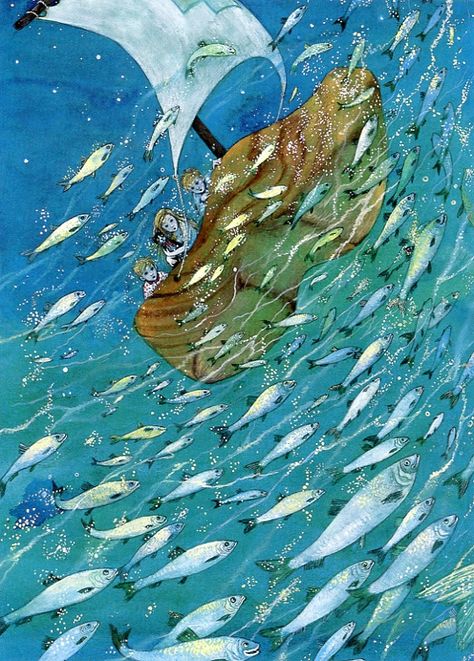
Well, just for fun, what work of art would you want on your headboard if you wanted to go that route instead of giving the money to some worthy cause? I would probably pick something with a moon and stars from a children’s book. Maybe one of the Wynken, Blynken, and Nod illustrations. Someone has collected a glorious array of different artists’ illustrations of that poem, here.

More on the extreme beds at Hyperallergic, here.

632aeccc4e42db4463570117b37b43d7-chloes-closet-wooden-shoe