“Will you, won’t you, will you, won’t you, will you join the dance?” go the lyrics of the “Lobster Quadrille” (the “Mock Turtle’s Song“) in Alice in Wonderland.
And Wonderland is where you may imagine you have landed if you stumble upon this irresistible invitation to dance with your shadow.
At FastCoDesign, Mark Wilson explains how the dancers are drawn in.
“At some point between ages 3 and 13, we go from the life of the wedding dance floor to being the awkward kid standing at the edge of the gym wondering why we wore a silk shirt. …
“But what if our environment could encourage us to dance — without any balloons, bridal parties, or booze? A project called Mesa Musical Shadows, by Montréal’s Daily Tous Les Jours studio, is doing just that. It’s a public installation that turns a chunk of pavement in Arizona’s Mesa Arts Center into a giant game of Dance Dance Revolution that you play by moving your shadow.
“As detailed by Creative Applications, the system itself uses light sensors, coupled with speakers built into the mosaic tiles. If the tiles sense a shadow—or even just you stepping directly on the sensor—it plays a note. And so as many people swing and kick together, these notes combine into a harmonious soundscape generated in real time. …
“Now that the physical installation of sensors and speakers is done, the studio can see how people use it, and actually program the system’s entire logic to react in more complicated ways to a user’s behavior, like ramping up with more and richer sounds as a person becomes more and more engaged.” More.
I liked this local story about a new approach to helping students who have special needs master independent-living skills while still connected with high school. It’s not hard to imagine the satisfaction students will gain from this volunteer-powered opportunity.
Brittany Ballantyne writes at the Valley Breeze, “Thanks to $15,000 donated from Lowe’s Home Improvement stores and the help of volunteers, students in the transition program at North Providence High School [NPHS] will start the school year in a new state-of-the-art transitional apartment space.
“Christopher Jones, special education director, said six Lowe’s stores donated $2,500 each to help build a studio apartment in the building at 1828 Mineral Spring Ave., where students will learn how to prepare and cook food, do laundry, type up resumes, make a bed and become [nursing assistant] certified if they choose.
“By the start of the academic year, Jones said, students ages 18 to 21 in the program will be able to get to work in the space …
“Jones envisioned giving the students an experience where they moved up not just in academics, but also in the NPHS building after receiving their diplomas. What were two in-school suspension classrooms [have been] transformed into the apartment after space was reconfigured in the high school, Jones explained. …
“He said the apartment space will be used anytime students aren’t out in the community getting hands-on work experience.”
Photo: The Valley Breeze
Students in the transition program at North Providence High School get apartment-style space to practice how to prepare food and cook, do laundry, make beds and write resumes.
As I noted the other day, the approach to saving the Harlem home of Langston Hughes is online fund-raising.
Meanwhile in France, the home of James Baldwin may be saved by a squatter and a quirky French law.
Shannon Cain writes at LitHub.com, “To clean the floor of James Baldwin’s guest room would take 32 disposable cleaning wipes. I figured this out on my hands and knees, estimating the square footage of the terra cotta tile surface. There were 40 wipes in the package. If I used one wipe per roughly two square feet, I’d have enough. I was camping here without running water or electricity, but damned if I was going to live inside a dusty mess.
“Four days earlier, struggling under the weight of a camping backpack laden with supplies, a duffel of linens, bag of books and a deluxe inflatable bed, I’d pushed aside the unlocked wire barrier of the ten-acre property and entered the 17th-century stone house, illegally.
“It wasn’t hard to do; the door had been busted off its frame long before I arrived and the place was wide open. I was sweating, exhausted and elated; I’d spent the previous six hours traveling by trains and buses from Paris, stressing hard about this moment, worried I’d be detected. …
“I needed to establish my squatters’ rights, which according to French law would be mine after 48 hours. The cancelled postage on the postcard I was about to send to myself would serve as one of these proofs. … To send a letter, one addresses it to the Ancienne Maison Baldwin, chemin du Pilon, St. Paul de Vence 06570. It seems the post office, at least, remembers James Baldwin. …
“The squatter’s law in France is meant to dissuade land speculation and absentee ownership. It is perhaps one of the purest manifestations of socialism. For seven years, the real estate developer that owns the Baldwin house has let this historic structure and its magnificent gardens go to seed. In the meantime, they’ve been busy with other projects, including the construction of an enormous American-style shopping center in Nice, all superstores and parking lots, reputedly built within a flood plain.
“In my research over the last months I have heard nothing but disdain and outright hatred for this corporation among the local people. ‘He’s a bandit, that one,’ muttered a local business owner.”
Read the whole crazy adventure and how Cain outfoxes the “bandit,” here.
Photo: Shannon Cain
Former home of writer James Baldwin on the French Côte d’Azur.
Sandra and I have been keeping an eye on a neighbor’s lotus all week, hoping to see it bloom. Today was the day. Above is what the lotus looked like at 7:30 a.m. Below is the lotus at 8 a.m., at the end of our walk.
This exciting development sent me to the Tennyson poem about Odysseus landing on the island of lotus eaters. I don’t think I had ever read the whole thing. Here are excerpts.
A land where all things always seem’d the same!
And round about the keel with faces pale,
Dark faces pale against that rosy flame,
The mild-eyed melancholy Lotos-eaters came.
Branches they bore of that enchanted stem,
Laden with flower and fruit, whereof they gave
To each, but whoso did receive of them,
And taste, to him the gushing of the wave
Far far away did seem to mourn and rave
On alien shores; and if his fellow spake,
His voice was thin, as voices from the grave;
And deep-asleep he seem’d, yet all awake,
And music in his ears his beating heart did make. …
Surely, surely, slumber is more sweet than toil, the shore
Than labour in the deep mid-ocean, wind and wave and oar;
O, rest ye, brother mariners, we will not wander more.
I’d say that’s an early example of an altered state.
According to wikipedia, however, our lotus is Nelumbo nucifera, whereas the one that hooked the Greek mariners was probably Ziziphus lotus, which doesn’t look nearly as pretty.
Sandra was interested in the showerhead-like seed pod. If you get close, you can see a blue-ish seed peeking out of every hole.
And what amazing seeds they are! As the invaluable wikipedia reveals, “An individual lotus can live for over a thousand years and has the rare ability to revive into activity after stasis. In 1994, a seed from a sacred lotus [in Northeastern China], dated at roughly 1,300 years old ± 270 years, was successfully germinated.”
Every once in a while reporter Ted Nesi adds a tidbit to his valuable “Saturday Morning Post” that doesn’t seem to fit with the news from Rhode Island and yet fits everywhere. This link from the Virginia Quarterly Review (VQR), a “national journal of literature and discussion,” is one such example.
Amanda Petrusich writes in part, “Darkness is a complicated thing to quantify, defined as it is by deficiency. … Unihedron’s Sky Quality Meter is the most popular instrument for this kind of measurement, in part because of its portability (about the size of a garage-door opener) and also because it connects to an online global database of user-submitted data.
“According to that database, Cherry Springs State Park — an eighty-two-acre park in a remote swath of rural, north-central Pennsylvania, built by the Civilian Conversation Corps during the Great Depression—presently has the second darkest score listed …
“The International Dark-Sky Association (IDA), a nonprofit organization that recognizes, supports, and protects dark-sky preserves around the world, designated it a Gold-tier International Dark Sky Park in 2008, only the second in the United States at the time, following Natural Bridges National Monument in San Juan County, Utah.
“Earlier this year, I drove the six hours to Cherry Springs from New York City to meet Chip Harrison, the park’s manager, his wife, Maxine, and a park volunteer named Pam for a 4:30 p.m. dinner of baked fish. Afterward, Chip had promised, we’d go see stars. …
“On a clear night, from the proper vantage, watching constellations emerge over Cherry Springs is like watching a freshly exposed photograph sink into a bath of developer, slowly becoming known to the eye: a single crumb of light, then another, until the entire tableau is realized. Pam pointed the telescope toward Jupiter, which had risen over the east end of the field. The four Gallilean moons—Io, Europa, Ganymede, and Callisto—were clearly visible through the lens. …
“When I got back to New York, I visited with Matt Stanley, a beloved colleague at the university where I teach. Stanley … has a particular interest in how science has changed from a theistic practice to a naturalistic one. He leads a seminar called ‘Achilles’ Shield: Mapping the Ancient Cosmos,’ and another called ‘Understanding the Universe.’
“ ‘I’ve found that probably 95 percent of my students come from either an urban or suburban environment, which means they can only see a dozen stars at night, and no planets,’ Stanley said. ‘When you say the Milky Way to them, they imagine a spiral galaxy, which is fine, but that’s not what the Milky Way looks like — it’s a big, whitish smear across the sky. I have to do a lot of work to orient them to what human beings actually saw when they looked at the sky. They don’t know that stars rise and set. Their minds explode.’ ” More here.
In Rhode Island, New Shoreham offers a pretty good look at the night sky. There are shooting stars in August. I feel lucky about that and hope that the five nearby offshore wind turbines don’t change anything.
When dollar bills of any denomination get too beat up to use, the federal government shreds them. For a long time, the various Federal Reserve banks gave out small bags of shredded money to visitors as a souvenir — always a big hit with kids.
But for the last few years, shredded money has been used as compost in gardens. Here’s a story from Seth Archer at Business Insider about the new approach.
“Have you ever wondered what happened to currency that gets damaged? If you have a paper shredder in your home, you already have a pretty good idea. But that’s just the start….
“The New Orleans branch of the Federal Reserve shreds $6 million in cash each day. They mainly shred bills that are dirty, taped, graffitied or otherwise unfit to be used as cash.
“The bills are shredded to a fine texture to make compost. … The cash is transferred to a compost facility, where it is mixed with other materials to make nutritious plant food.
“After the compost is made, it is sold to local farmers, who use it to grow peppers, tomatoes and cucumbers.
” ‘It is very fulfilling to be growing using a material that would otherwise go to waste.’ — Simond Menasche, founder and director of Grown On.”
Photo: Robert W Kelley/Time Life Pictures/Getty Images
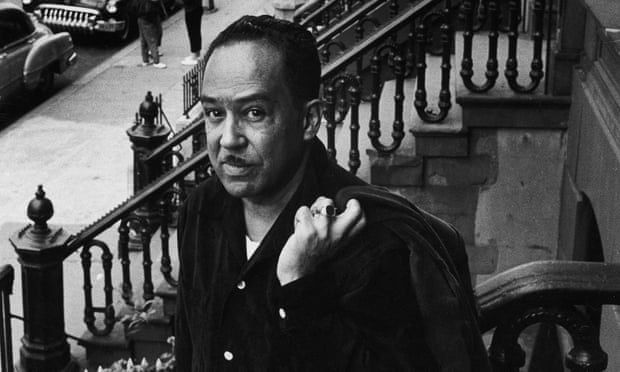
Langston Hughes on the front steps of his house in Harlem, June 1958.
Before Suzanne and Erik moved to Providence, they were living in a lovely renovated brownstone in Harlem.
There’s a fine line between newcomers investing where there’s been too much disinvestment — and gentrification. The early changes seem to benefit a neighborhood and its people, but inevitably rising property values push out many longtime residents and institutions.
Today, a group of Harlem artists from various disciplines are banding together to keep a significant piece of the Harlem Renaissance around to nourish African American arts.
Tom Kutsch writes at the Guardian, “All that signifies the legacy of a house once occupied by the poet laureate of Harlem is a small bronze plaque, partially covered by a cedar tree’s branches and the green ivy that envelops much of the building.
“The onetime home of Langston Hughes has sat largely unoccupied for years, but a new movement is trying to reclaim, for a next generation of artists, the space of a man who is forever intertwined with the Harlem Renaissance.
“Spearheaded by writer, performer and educator Renée Watson, the collective effort is busily trying to raise the necessary funds to purchase a lease and make needed renovations to the house. …
“Watson plans to make the Hughes house the home of the I Too, Arts Collective that she launched alongside the effort, which aims to, in her words, have ‘programming that nurtures, amplifies, and honors work by and about people of color and people from other marginalized communities.’ …
“The collective gets its name from one of Hughes’s most famous poems – I, Too – in which his narrator concludes by intoning:
They’ll see how beautiful I am
And be ashamed—
I, too, am America.
“Watson is using the crowdfunding website Indiegogo to solicit donations for the project, for which they’re hoping to raise at least $150,000 to cover a lease and begin the renovation process. By the time of publication, they had raised more than $54,000, already exceeding the $40,000 Watson says would cover at least a six-month lease. …
“For more than a century, Harlem has been inextricably linked to black life and culture in America; the birthplace of the aforementioned Harlem Renaissance, which fostered a wide array pre-eminent black artists and writers, from Zora Neale Hurston to Claude McKay and Duke Ellington. …
” ‘The erasure of black Harlem may come despite our best efforts …’ said Tracey Baptiste, a local children’s author who is involved with Watson’s collective. ‘But this project is about making sure that gentrification doesn’t also happen in the hearts and minds of our artists.’ ”
Not long ago, Julia Griffin of PBS NewsHour interviewed an artist who has turned plastic trash into sculptures with a message.
“JULIA GRIFFIN: Octavia the octopus, Priscilla the parrot fish, and Flash the marlin, all sculptures now on display at Smithsonian’s National Zoo in Washington, D.C., and all made of trash pulled from the Pacific Ocean. …
“Angela Haseltine Pozzi is the lead artist and executive director of Washed Ashore, a nonprofit seeking to educate the public on the plastics polluting the word’s oceans.
“ANGELA HASELTINE POZZI: We create sculptures that can teach people about the problem. And, as an artist, it is a real challenge to use everything that comes up off the beach.
“JULIA GRIFFIN: In six years, Haseltine Pozzi and her team of volunteers have created 66 sculptures from more than 38,000 pounds of debris collected from a stretch of Oregon’s coastline.
“The countless bottle caps, flip-flops and beach toys are just a fraction of the more than 315 billion pounds of plastic estimated to be in the world’s oceans.
“Such plastics not only pose entanglement threats to Marine animals, but are often mistaken for food. …
“JULIA GRIFFIN: As scientists debate how to clean the water, Haseltine Pozzi hopes her sculptures will inspire visitors to curb pollution in the first place.”
The exhibit can be seen at the zoo until September 16, 2016. More at PBS here. Check out the Smithsonian’s site, too.
Wish I could remember where I first saw that this Ephrata-based magazine had a story on a farm that I have been driving past for 30-plus years without knowing much about it.
Sarah L. Hamby writes at Lancaster Farming, “Since 1999, the Farrell family has lived and worked at Sunset Farm, transforming nearly 150 acres into a well-known destination for freshly baked pies, heirloom tomatoes, and quality, all-natural meats not just for sale to the public, but also served at dozens of beach-front restaurants.
“Located on a four-lane highway in the south end of Narragansett, a small beach town in Rhode Island with a population that doubles during the summer months, Sunset Farm is one of a kind.
“In 1986, the Narragansett Land Trust was established to preserve open land in the largely developed Rhode Island town. …
“In 1991, historic Sunset Farm, established in 1864, along with Kinney Bungalow, a turn-of-the-century landmark and picturesque spot for weddings, was acquired by the town. … Since 2013, both the farm and bungalow have been on the National Register of Historic Places.
“The farm has been so successful that in 2014 the family signed a 25-year lease with the town of Narragansett. In return for taking care of the farm, the Farrells live rent free, though they do pay utilities. Maintenance and restoration work is part of the job, too, and must be up to historical standards.
“If you ask farmer and landscaper Jeff Farrell why he and his family applied to be caretakers of Sunset Farm, the last working farm in Narragansett, he will answer you with the candor and humor of most who work the land for a living.
“ ‘I lost my mind.’
“Ethan Farrell, who is now 25, has put a marketing degree from Johnson and Wales University to work at Sunset Farm. His phone constantly rings with calls from local restaurants and delivery trucks. … Last July, he started a food truck designed for local festivals and events, bringing his own flare to the farm-to-table movement. …
“The family donates to the local food pantry, supports area events for veterans and charities, and recently introduced gift certificates to increase activity from the local community.”
Back in 1987, Frank J. Popper and Deborah Popper argued that the former manufacturing hubs of the Midwest should accept that they were now shrinking and that new realities called for new approaches.
Youngstown, Ohio, never saw itself going as far as the Poppers envisioned (turning large swaths of the country back into “Buffalo Commons“), but it did adopt its own way of making lemonade out of lemons.
As Alexia Fernández Campbell writes at City Lab, “Youngstown, Ohio, created quite a stir a decade ago when it unveiled a novel plan for the city: It would stop trying to return to its glory days as a city of 170,000 people and instead embrace the idea that maybe smaller is better.
“The Youngstown 2010 plan reoriented the former steel-mill town toward providing services to the neighborhoods with the most people, converting abandoned land into green space, and supporting the burgeoning healthcare industry. In doing so, it hoped to keep the remaining 66,000 people from leaving. Since unveiling the plan in 2005, the city has lost only about 1,000 people.
“The Youngstown plan … put into motion aggressive action to fight urban decay and revitalize many parts of the city, says Ian Beniston, director of the Youngstown Neighborhood Development Corporation … Part of his group’s job is to identify the healthiest neighborhoods and fix up the houses there, while demolishing abandoned ones and finding new uses for the land. …
“Ian Beniston: The way I view that is, planning within the realms of reality. It’s not that we don’t want to grow. Given the option to shrink or grow, anyone is going to pick grow. But we’re not operating in such a way as if we’re going to grow tomorrow or even growing now. I think it’s really a common-sense approach. …
“That impacts everything you do … Embracing shrinkage has to do with the fact that we had the infrastructure for 250,000 people and we currently have 65,000. …
“The 2010 plan was very basic, so there was the clean-and green-portions of it, improving quality of life, redefining the regional and local economy, but it didn’t get down to the property level of detail. [The Youngstown Neighborhood Development Corporation] has taken the next step to developing detailed plans with a more market-and-data-driven strategy on the varying health of neighborhoods …
“In stable neighborhoods, for example, we really shouldn’t be demolishing housing. This is oversimplifying this, but if there is a vacant home there, it is likely something that should be rehabilitated, whereas the neighborhood that is already 70 percent vacant, the strategy is probably demolition and reusing the land for another purpose. For example, recently we started working with a company that grows hybrid poplar trees on these acres of vacant land, which are then harvested.” More at City Lab, here.
Here’s hoping efforts like these improve life for all residents in Youngstown. Pretty sure you have to have everyone on board to make it work.
I’m on the email list of 13 Forest Gallery in Arlington, Mass. The first time I went there, the owner enlivened his art opening with guest opera singers.
This time, he had a printmaker demonstrate a type of linoleum printing that Picasso dubbed “suicide” printmaking. Others use the word “reduction” instead of “suicide.”
When I tell you how the work is done, you will understand why Picasso felt as he did.
Instead of carving, say, four different blocks for a four-color print, the artist uses only one block. A mistake at one stage can end the whole project.
Lowell resident Susan Jaworski-Stranc has been doing reduction linoleum printmaking for more than 30 years. As the website for 13 Forest explains, “with each layer, you carve more of the block away — so once a layer has been printed and you start carving for the next layer, there’s no going back.”
The artist herself says, “After each successive printing of a color, the surface of the block is reduced while at the same time the printing surface is built up with multi-layered colors. Born from one block of linoleum, my relief prints have the nuance and rich textural surfaces of an oil painting.
“Although Picasso coined this method of working a ‘suicide print,’ I rather think of this printmaking process as emulating the journey of life. While creating my prints, I am never able to re-visit past stages. I can only proceed forward with the acceptance of all good and not so good choices which were mediated and acted upon with the hope and joy of completion.”
On August 13, the gallery was packed as Jaworski-Stranc demonstrated. Many in the audience were experienced printmakers who asked intelligent questions that showed the rest of us what sorts of issues matter to artists.
One person asked if Jaworski-Stranc knew what the picture was supposed to look like in advance, and she explained that she started with a detailed drawing. Another artist wanted to know if the colors of Jaworski-Stranc’s very first reduction print (which she showed us) were what she anticipated.
The artist laughed, holding up that print. “Are you kidding? How would I ever think up a color like this!?”
Clearly, despite all the careful planning that goes into a print, Jaworski-Stranc relishes the beauty of randomness.
I just went back to bathe in the golden glow of blogger KerryCan’s early summer memories here. I’ve been planning to take her up on the idea of sharing a childhood summer photo and letting train of thought take over.
KerryCan says she and her cousins had “absolutely nothing to worry about except breaking a plastic flip flop or getting sticky drips of Popsicle running down an arm,” which doesn’t quite fit my childhood. But I was always looking forward and believing something nice was coming.
I began dreaming of Fire Island in January or so — creating a paper pocket on our front door with Ocean Beach postcards tucked in and badgering grown-ups with “When are we going?”
And goodness knows, I dearly loved the ocean, swimming every day in my early teens unless there was a red warning flag. On choppy mornings, I might be the only one out there in front of the lifeguards.
Here I am at about age 10 with the older of my two brothers, probably competing for who could run fastest.
I didn’t learn until I was practically a grandmother that some kinds of competition with him might be ill-advised — like the time I tried to bend back my thumb the way his joints allow him to and ended up with a trigger finger and a hand operation! Ha, ha. Laughing now.
On this Atlantic beach, we used to dig for the tiny armadillo-like mole crabs that we called “jumpies.” Where are they now?
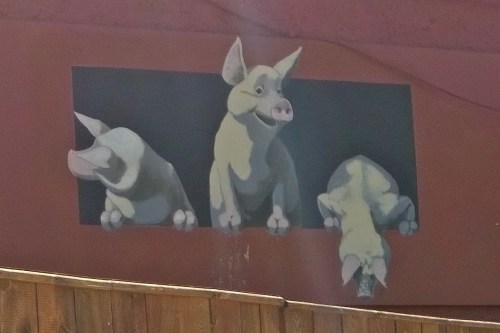
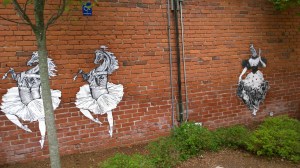
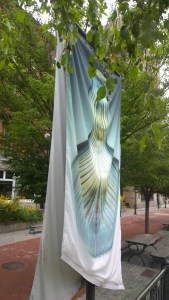
The three cheerful and unsuspecting little pigs are hanging out at Chez Pascal in Providence. French-inspired, the restaurant features wurst and local produce. The horse dancers grace a wall of AS220, an arts powerhouse. The Roy Lichenstein POW! art is on a Rhode Island School of Design Museum banner. I think the iris-like banner is of a vase.
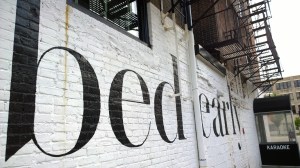
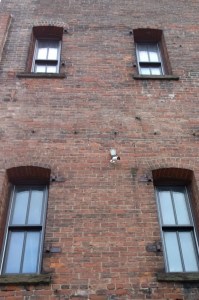
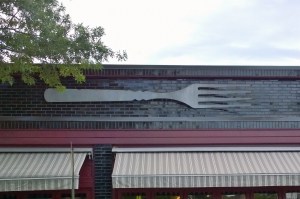
The “Bed Early” mural is part of a longer thought at the charming Dean Hotel. The skinny windows are just skinny windows. The fork, which I just noticed after several years of walking past, is on a Wayland Square restaurant called the Red Stripe.
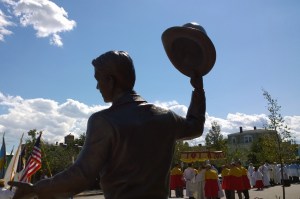
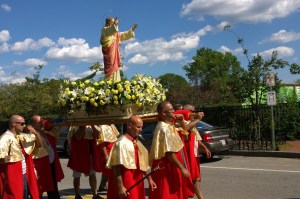
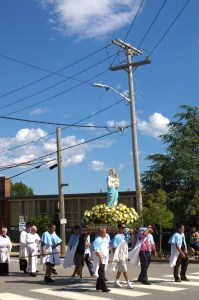
Providence is not all food and fun. If anyone can tell me what church was behind the Assumption of the Virgin parade on August 7, I’d be much obliged. It was impressive. I Googled everything I could think of. I can at least tell you that the guy waving the hat is George M. Cohan at Fox Point. A king of parades, he nevertheless probably composed no music for the one I saw.
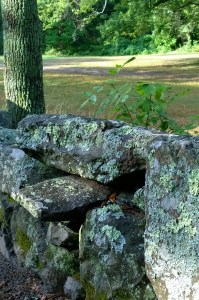
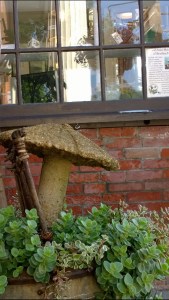
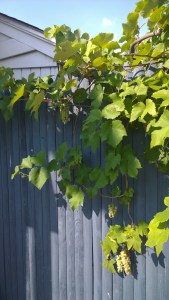
From Concord, we have a typical lichen-covered stone wall near the North Bridge, a garden ornament in the shape of a mushroom and grapes hanging on a blue fence.
Sometimes KerryCan tells me which photo she liked best. I’m always grateful for signs that someone’s reading.
Photo: Big Belly
Foot-pedal version of Big Belly for those who are squeamish about handles. (That would be me.)
Those Swedes! What will they think of next?
Are you familiar with the Big Belly solar-powered trash compactors sprouting up in public places? Well, in Uppsala, Sweden, the trash compactors have been taught to sing.
From a company post on Youtube: “Bigbelly International Partner, EWF, introduced an innovative and inspiring campaign to raise awareness of the Bigbelly Smart Waste & Recycling system in the metropolitan city of Uppsala, Sweden – home to one of the largest deployments in the world.
“The Uppsala ‘Waste Choir’ had their first performance during the Valborg celebrations on April 30th. Valborg is an annual holiday to welcome spring in Sweden. …
“The beautifully wrapped Bigbellys – each as a unique character and voice in the choir – stood together in front of 60,000+ visitors to the city and sang traditional Swedish songs in celebration of spring! …
“As noted in a press release regarding the campaign: ‘Citizens and visitors could for the first time listen to a garbage choir during the famous celebration of Walpurgis in the University City of Uppsala. The choir consists of 20 so called smart dust bins run by solar energy. Uppsala and Sweden are known for their many choirs.
“Maria Gardfjell (MP), chairman of the responsible municipal board had the honor of introducing the choir and informing the audience about other commitments to diminish littering.
“Fundamentally, it is an issue of changing attitudes and to encourage all of us to put our litter where it belongs, in a dust bin. … Since Uppsala introduced smart dust bins in 2013, the visible litter in the City Park and other main parks has decreased by 20 percent. The work environment for the sanitary workers has improved and the usage of plastic bags has decreased by 80 percent.”
Read the press release in full, here. And listen to the singing trash cans here:
I like reading that the numbers of socially conscious companies are increasing. Recently, Naz Akyol at Social Enterprise Greenhouse in Providence wrote about one such business.
“Three years ago, active duty airman Michael Gnoato lost his life in a fatal car accident in Wyoming. Major Pettaway, a Marine who knew Mikey since high school, missed the funeral because he was deployed in Afghanistan at the time, but Navy Seabee Sadam Salas was there to speak at their best friend’s funeral. …
“The two young men are the co-founders (as well as CEO and CFO, respectively) of Mike’s Ice, a deliciously novel idea that pays tribute to their fallen friend, and also a social enterprise committed to fighting veteran homelessness and more.
“Sadam and Major [sell] Thai style ice cream rolls that come in seven fun flavors, … a commodity that only recently hit US markets with only a handful of stores in New York City. They also decided to give their venture four wheels and make Mike’s Ice a mobile truck. …
“Everything that is sold at Mike’s Ice is made from scratch, which means the truck needs to be equipped with special ice cream making machines as well as equipment for storing their ice cream bases and toppings. When asked about the greatest challenge they have faced so far, Sadam smiles and says: ‘You don’t sleep a lot.’ …
“Mike’s Ice received a SEG Hub Scholarship from Social Enterprise Greenhouse … [and] is partnered with Backpacks For Life, a nonprofit that provides homeless veterans with backpacks that contain essentials for survival.
‘We are both veterans, and now we are also entrepreneurs, and entrepreneurs exist to solve problems,’ Sadam says. ‘Veteran homelessness, suicide …. these problems shouldn’t exist. These are people who fought for their country.’