Suzanne’s friend Sara Van Note is heading off to Central America to research a story, but before leaving, she filed this report on a wasp that is being used to fight the emerald ash borer.
“A swampy forest in the floodplain of the Merrimack River is one of the first places in New Hampshire where the dreaded emerald ash borer was discovered. These days, Molly Heuss of the New Hampshire Division of Forestry and Lands knows just how to find the tree-munching beetles lurking in green and black ash. …
“In recent years, the emerald ash borer has chewed its way through tens of millions of ashes across 24 states and two Canadian provinces, and counting.”
So scientists have decided to use a parasitic wasp to combat the menace.
“The parasites are descendants of wasps brought to the US from China, where the borer is also from. And they are very tiny. ‘About the size of a pin,’ says entomologist Juli Gould, of the US Department of Agriculture in Massachusetts. …
“The borers themselves were discovered in North America in 2002. They probably got here by stowing away in shipping crates. Scientists here knew nothing about them at the time, so Gould says they began working with colleagues in China to find a way to control the bugs.” More here.
Using the parasitic wasp is a last-ditch effort, and other scientists worry that the wasp could end up doing other things that are less desirable. That’s always a possibility, as Erik pointed out the other day when I showed him an article in the Providence Journal about a local effort to beat back a winter moth infestation. The article said that the parasitic fly Cyzenis albicans dines only on winter moths, so no worries. But Erik was skeptical. The best laid plans of mice and men …
I thought you would like this story from the National Deseret News about refugees making a new life for themselves in Arizona.
Lourdes Medrano writes, “In a small field on the outskirts of [a] desert town near the Mexican border, close to 30 women and men stoop over rows of pumpkins, carefully picking the pulpy autumn fruit along with its flowers, stems and leaves.
“The volunteers are part of an innovative program that helps refugees from war-torn countries find work and food. Called the Iskashitaa Refugee Network, the Arizona-based organization consists of a diverse group that harvests donated crops from local farms and people’s backyards to feed displaced populations from Africa, Asia and the Middle East.
“On this recent fall afternoon, Adam Abubakar, a refugee in his early 30s who came to Arizona two years ago from the conflicted Darfur region of Sudan, quickly clips pumpkin leaves and drops them in a tote bag for later distribution to newcomers who eat them. For Abubakar, picking fruits and vegetables comes second nature. Back in his homeland, he grew most of the food his family consumed …
“The government provides refugees limited resettlement assistance and organizations such as Iskashitaa work to help the newcomers become self-sufficient as they adapt to American society. Refugees working in the pumpkin field not only harvest the fruits and vegetables they eat, but they also distribute crops to fellow newcomers, learn about urban gardening, market what they grow, and participate in cross-cultural food exchanges. …
“The number of incoming refugees has fluctuated over time and reflects shifting world conflicts and heightened security concerns. In 1980, for instance, 207,000 refugees — including many displaced by the Vietnam War — resettled within the country.
“Iskashitaa was founded in 2003 by Barbara Eiswerth, an environmental scientist, with help from Somali Bantu refugee students who began harvesting crops no one was picking to boost their diet. The refugees inspired the name of the fledgling group: ‘working cooperatively together.’ …
“By tapping into the agricultural roots of refugees, Iskashitaa aims not just to provide food, but also to empower those they’re helping.”
I’ve been following David Guttenfelder on twitter and Instagram for about a year, initially because of a stunning photo of North Korea that appeared in the NY Times. Guttenfelder has made a specialty of North Korea, although he now works for National Geographic and travels extensively. He has recently been promoting a group of instagrammers who spend time in North Korea.
Writing for Time magazine’s Lightbox column, Olivier Laurant quotes Guttenfelder: “ ‘My motive has always been to open a window on North Korea,’ says David Guttenfelder. ‘There are so few images coming out of there, and yet there’s so much interest.’
“A former chief photographer at Associated Press, Guttenfelder helped open the agency’s first bureau in the Democratic People’s Republic of Korea (DPRK) in January 2012. Now, after he resigned from AP to continue his career as a freelance photographer and one of National Geographic’s Photography Fellows, he’s not turning his back on the reclusive country. In September 2014, he quietly launched the Everyday DPRK Instagram account, which features pictures by North Korean residents and photographers. …
“Kelly first visited Pyongyang in June 2012, and he usually spends three to four months a year in the country. ‘I had come right out of graduate school and learned of an opportunity to teach at a university here in the capital,’ he says. ‘I wanted to do something different, not sit around in the U.S. hoping the”right” job would come along.’
“When he’s not teaching English, Kelly is using Instagram to offer an ‘expat point-of-view’ on North Korea and to show that ‘there are real people living, working and striving for a better life with the cards dealt to them,’ he says.” More here, at Lightbox.
Guttenfelder comments at Instagram, “We are a small group of photographers who have, with different routes, unique access to North Korea. @andrea_uri started a tour company for example. @drewkelly is a teacher at a nkorean university. @dguttenfelder is a photojournalist. @sunbimari is a translator and working on major cultural exchange programs. @simonkoryo is a British nations with more trips inside nkorea than any other foreigner that I know of, more than 150. @soominee works on a farm in Rason.”
Photo: @drewkelly
North Korean kindergarten students stand outside a school at a collective farm near Wonsan, North Korea.
Photo: Geoff Childs
Cleaning harvested yartsa gunbu prior to sale.
Thanks so much to the folks who recently signed up to follow this blog. If you joined hoping that I would blog often about the topic that drew you here, you will soon find that the posts are rather eclectic. A couple years back, Suzanne thought it would be nice to have a blog tied to Luna & Stella, and she said I could write about anything that interested me. I thought, Wow! What an opportunity!
Today’s story is from the radio show Living on Earth. It’s about Tibetans in Nepal who have managed to avoid overharvesting a fungus that’s wildly popular in China.
“Anthropologist Geoff Childs of Washington University tells host Steve Curwood how one [area] is managing to harvest the resource sustainably. …
“Nubri is a valley in Gurkha district in the country of Nepal. The residents are ethnically Tibetan. They’ve been living there for about 700 or 800 years, so it’s an indigenous population of Nepal. What they have done in contrast to other areas is they’ve limited the number of collectors to only residents of the villages, and so that keeps the number of collectors way down. …
“CHILDS: What they’ve arrived at in Nubri is a combination of what they call ‘yultim,’ which we could translate as village regulations, secular regulations, and ‘chutim,’ which are religious regulations. … What they will do is, they will decree certain areas off-limits to human exploitation, and usually that’s a sacred grove of trees, a certain slope of a mountain that a deity inhabits or something like that. … In terms of the sustainability of Yartsa Gunbu, that’s going to be important because those are areas where annually nobody will harvest it. So it can come to fruition. It can spore. It can live out its normal life cycle.
In terms of the village regulations the first one that I just mentioned is the exclusion of all outsiders. The second one is they’ve got a designated starting date, and they arrive at that by looking at the snow melt, looking at the conditions in the alpine pasture and figuring out what’s going to be the likely time when it’s best to gather it.
“And so for a couple weeks prior to the official starting date, every adult in the village has to check in four times daily to the village meetinghouse to prove that you’re not collecting early. A third thing that they do is they tax it. For the first member of your household, the tax is very low; it’s 100 rupees or approximately $1 dollar … they gather that tax and use it for communal purposes.
“CURWOOD: So this consensus process, everybody agrees, everybody trusts, but they also verify. … looking at this from a broader resource management perspective, what are some lessons that we can take away from what’s happening in Nubri?
“CHILDS: Trust indigenous people. Don’t immediately assume that as outsiders with more education we can come in and devise a system that will work for them. I think, first of all, study what’s in place. Study with an open mind and move from there.”
Photo: Geoff Childs Mt. Manaslu (26,759ft.) in Nubri is the 8th highest mountain in the world.
Because I have tried and failed repeatedly to upload my video of this art installation, I offer instead a still shot from the Boston Cyber Arts website. The video would have shown you the generative art installation as the tadpole becomes a frog. Having been around a newborn and a two-year-old this week, I’ve been thinking a lot about how new beings grow into beings that are both different and the same.
Elder Brother is currently more interested in the washer-dryer than anything else on earth. I heard about a man who drives big rigs with ease and was obsessed with gear shifts as a toddler. Will Elder Brother grow into a washer-dryer inventor, repairman, or salesman? Will he just be the guy who is always happy to help out with the wash? Or will this tadpole grown into a man who has no interest in washer-dryers but, for reasons unknown to him, loves the smell of detergent? Time will tell.
Getting back to the art installation, there’s a good description on the Cyber Arts website: “Chunky Frog Time is a new generative art installation by Brian Knep, created for the Boston Harbor Islands Welcome Center located on Boston’s Rose Fitzgerald Kennedy Greenway. The … animation is of a frog swimming against the tide of time, cycling from tadpole to juvenile and back with each kick. Moving across an ever changing made-made landscape, the frog’s struggles represent the ebb and flow on the islands, as well as the relationship between nature and our idea of nature.
“Brian Knep is a media artist whose works range from large-scale interactive installations to microscopic sculptures for nematodes. He was the first artist-in-residence at Harvard Medical School, working side-by-side with scientists, using their tools and techniques to explore alternative meanings and ways of connecting to the world.”
And while we’re on the subject of the energy-saving bike trails in the Netherlands, we note a brief report in the NY Times to the effectthat those clever Dutch also have a road that powers houses.
SolaRoad, according to its website, “is a pioneering innovation in the field of energy harvesting. It … converts sunlight on the road surface into electricity: the road network works as an inexhaustible source of green power.”
Adds the Times, “Sten de Wit of the engineering firm TNO said … that each square meter of road generated 50 to 70 kilowatt-hours of energy per year, or enough for the initial strip to supply power to one or two Dutch households. The test is scheduled to run three years and will cost 3 million euros ($3.7 million). Mr De Wit said despite the high costs of developing the first SolaRoad, successor projects may be more profitable as solar cells grow cheaper and more efficient.”
Liz Stinson writes at Wired magazine about a bike lane in the Netherlands created to evoke Van Gogh’s painting Starry Night.
“If you happen to be near Eindhoven in the Netherlands, you can walk or bike down a glowing path modeled after Van Gogh’s masterpiece. The one kilometer lane is the work of Daan Roosegaarde …
“The Van Gogh-Rooosegaarde bike path (located near where Van Gogh himself lived from 1883-1885) uses a luminescent material that charges during the day and glows at night. These glowing bits look like little pebbles, but they’re actually not rocks at all. Using the smart coating material developed with Dutch infrastructure company Heijmans, Roosegaarde was able to create 50,000 fluorescent ‘rocks’ that he then embedded into wet concrete in a swirling, pointillism pattern reminiscent of Starry Night. …
“The big goal is to make the coating as dynamic as possible—shifting colors, markings or appearing and disappearing altogether—to account for our ever-changing urban spaces. …
“The designer suspects the path’s real draw will change from person to person. ‘Some people will come because they’re interested in safety and energy-friendly landscapes, others will come because they want to experience art and science,’ he says.”
In John’s house, I am Grandma. In Suzanne’s house, I am Mormor. Mormor means mother’s mother in Swedish. My husband is Morfar (mother’s father). Erik’s mother is Farmor (father’s mother), but when she is with her daughter’s children, she is Mormor. Got it? There will be a quiz.
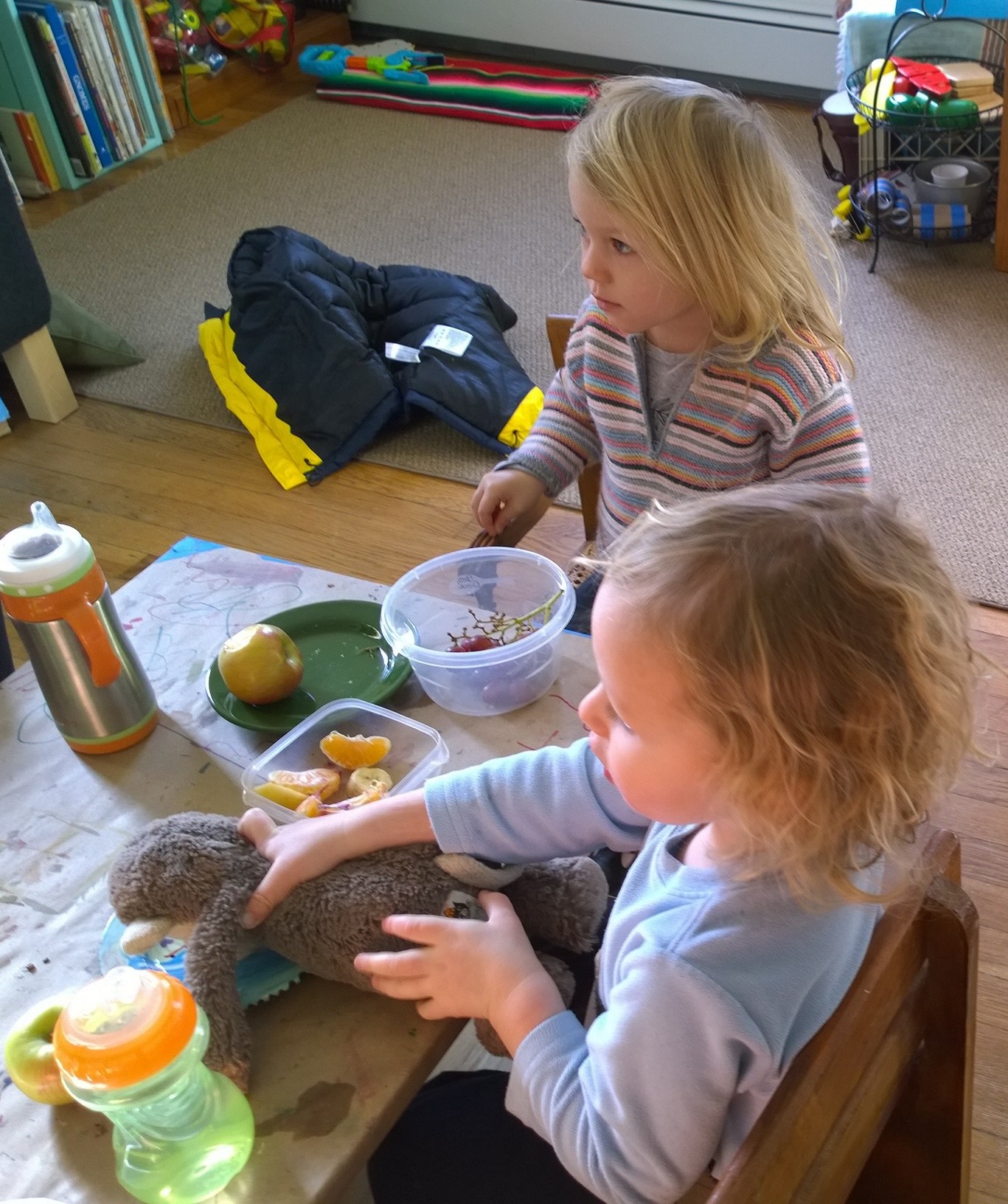
Mormor and Morfar have been hanging out with the new baby’s big brother, who has his own life to live. Yesterday we picked him up at his morning-only school. Here he is offering his monkey a snack. The monkey’s name is Kompis. It means friend.
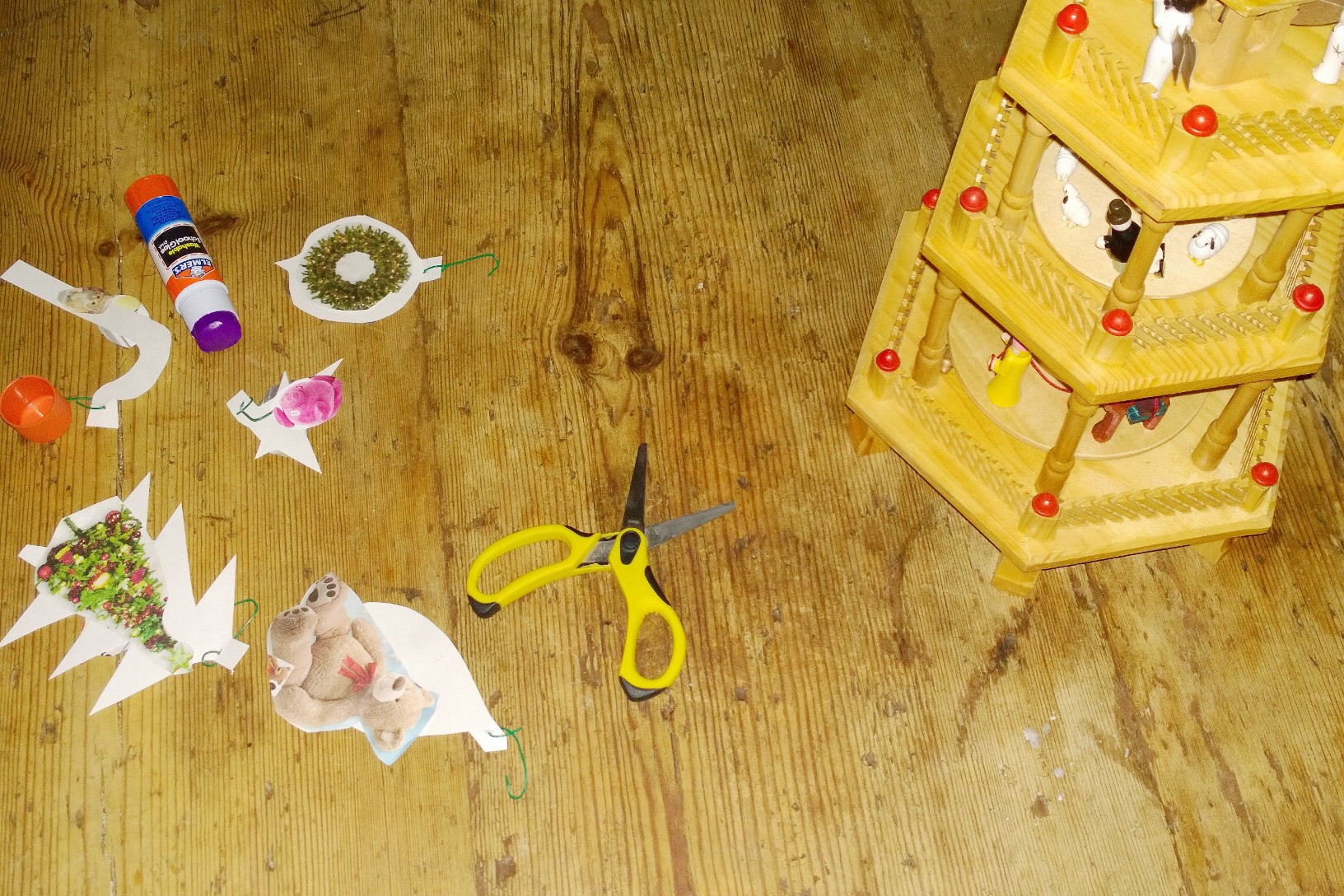
Back at the house, I cut cardboard pieces in the shape of Christmas ornaments and punched holes in the tops for hooks. We had fun gluing seasonal cutouts from magazines on the ornament shapes. (Well, to be honest, the purple glue stick was what was fun. We lost interest by the time it came to hanging our creations on the tree.)
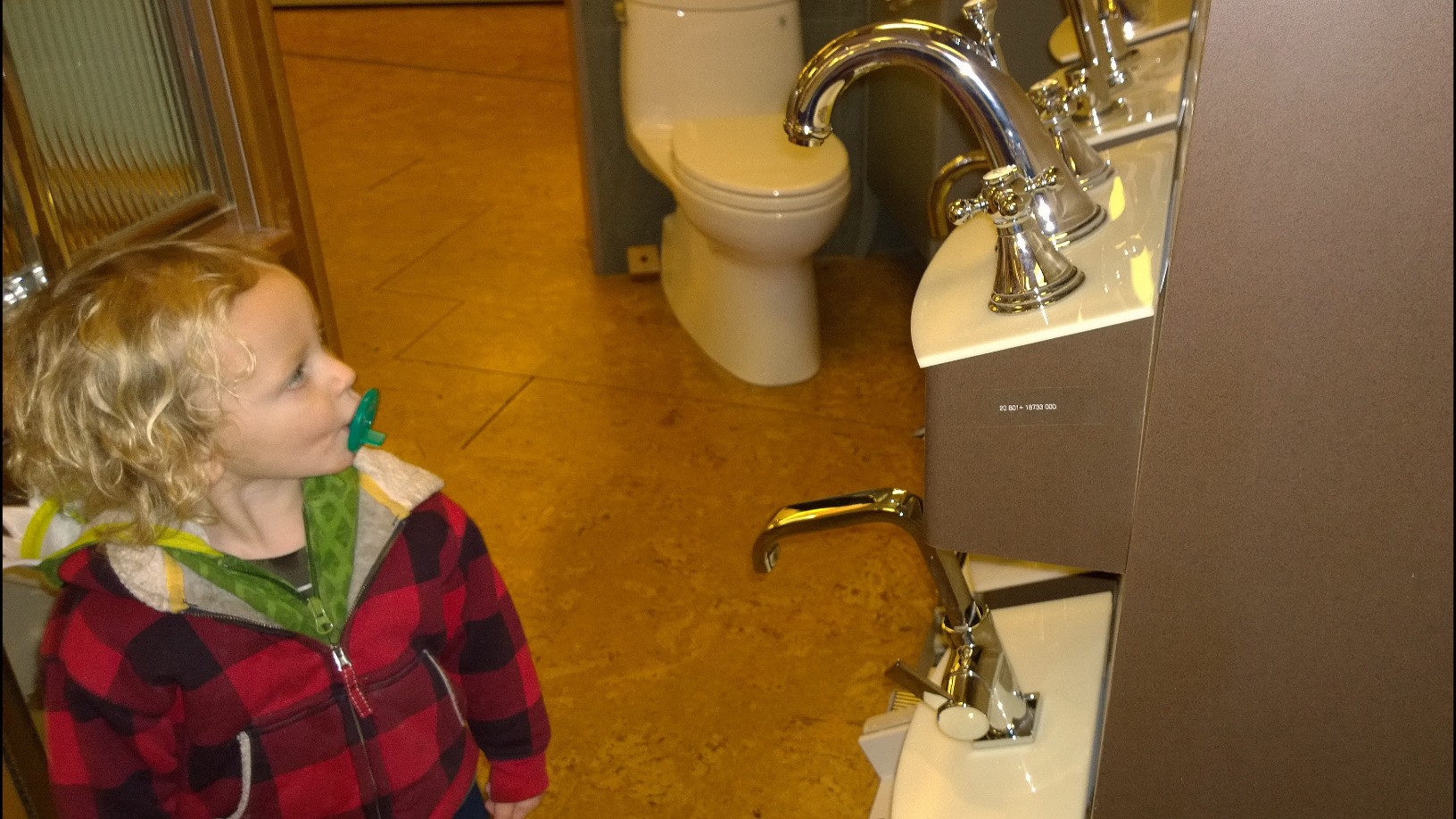
Today we ran errands with Papa. Here you see Elder Brother checking out bathroom fixtures with the level of intensity he brings to serious activities.
Thanks for the nice comments yesterday. I’ll have more anon on hanging out with Suzanne’s family this week, but for now, I’m back to quirky stories from near and far. This one is about do-it-yourself theater in England.
Lyn Gardner covers at the topic at the Guardian theater blog.
“A great deal of the most interesting theatre being made at the moment might be called DIY. But what do we really mean by that term? It’s a question explored in a great little book DIY (Do.It.Yourself.) curated by Bootworks’ Robert Daniels and appropriately enough self-published by the University of Chichester. …
“DIY is often associated with an aesthetic that celebrates the imperfect and the make-do-and-mend mentality. But that’s not to mean that it is inexpertly crafted or just throwing a show together and plonking it down in front of an audience and hoping for the best. In times of financial hardship or when buildings and programmers act more like gatekeepers than midwives, DIY can be born of necessity. … DIY is not just about doing it yourself, but also about doing it together and in the process enabling other artists, audiences and institutions through the spirit of generosity.” More here.
Photo: Murdo Macleod
Squally Showers by Little Bulb at Zoo Southside in Edinburgh in 2013.
Last night Suzanne and Erik’s little boy got a baby sister.
My own baby sister e-mailed me, saying, “Sagittarius!” So I looked it up: “adventurous,” “relaxed,” “optimistic.” The constellation Sagittarius represents the centaur Chiron from Greek mythology, an archer and a mentor to Achilles.
Meanwhile, Suzanne says the birthstone for December is blue topaz. Lovely. I don’t have that one yet. The qualities of the stone can be found at the Luna & Stella website, here. (Suzanne’s friend Kate Colby wrote all the gemstone descriptions for the company — because, as Allen Ginsberg would say, when a poet was needed, a poet appeared.)
I am camping out in Suzanne and Erik’s guest room and will be blogging from here for a week.
The radio show Living on Earth (LOE) reported recently on work to restore seaweeds that are a key part of the ecosystem.
From the LOE website: “Ripped from the seafloor by strong swells, massive amounts of kelp recently washed ashore in southern California. But the uprooted algae may actually be a sign of successful kelp restoration efforts. Marine biologist Nancy Caruso discusses the fragile ecosystem and how she and a community are helping to rebuild the majestic kelp forests.”
Radio host Steve Curwood interviewed Caruso. She recounts how she began 12 years ago with a group of students and volunteers “to restore the kelp forests off of Orange County’s coast.”
After a storm, she says, big holes get ripped in the forest of kelp, often 10 feet high. Then “new life can grow from the bottom up, and so if we see this happen, which we’re seeing right now, the kelp returns immediately after this event, then we know that our restoration efforts are successful, and after 30 years of our local ecosystem not having healthy kelp forests, we can rest assured that it’s now restored.”
To Curwood’s question about how restoration is done, Caruso answers, “It was actually quite an effort because I had the help of 5,000 students from ages 11 to 18 as well as 250 skilled volunteer divers, and we planted this kelp in 15 different areas in Orange County. There’s a spot down in Dana Point. It’s the only kelp forest that was left in Orange County so we would collect the reproductive blades from those kelp plants, and I would take them into the classrooms for the students to clean them and we would actually stress them out overnight. We would leave them out of water in the refrigerator, kind covered with paper towels, and then the next morning we would put them back in the ice-cold seawater and the kelp blade would release millions of spores” that would then be raised in nurseries and returned to the ocean.
“All those animals that get washed up on the beach inside the wrangled tangled kelp become a food source for shorebirds that live along our coast.”
More from Living on Earth here. For more on the importance of seaweed, see also Derrick Z. Jackson’s article in the Boston Sunday Globe: “Eelgrass Could Save the Planet.”
Photo: NOAA’s National Ocean Service
Kelp forests can be seen along much of the west coast of North America.
Looking for an indoor sport this winter? Have you considered belt-sander racing? Bill Littlefield has been covering the unusual sport at WBUR’s Only a Game since 2002, and as Karen Given reported recently, the sport could probably use some new blood — er, participants.
She begins by revisiting the 2002 broadcast.
” ‘Two by two, they come screaming down the 85-foot-long, waist-high wooden track, trailing rooster tails of sawdust and long, yellow extension cords that power them to the finish line.’
“That is how reporter Sean Cole began his treatise on the New England Belt Sander Racing Association,” continues Givens, “which first aired on Only A Game on April 13, 2002. But here’s the bit everyone remembers:
“NEBSRA co-founder Dave Kenyon: ‘It’s a real family event. It’s a family event with beer.’ …
“There is still beer, so there is still belt sander racing. Or is there? I went to Jamaica Plain in Boston to investigate. …
” ‘You are at the 2014 Fall Nationals Belt Sander Drag Race and Costume Ball,’ Glen Gurner tells me.
“Gurner is a woodworker and former champion of this sport. But for some reason he’s really enthusiastic about the idea that this might be the last time NEBSRA, an organization he helped found, holds a belt sander race. …
” ‘It takes a village.”
“ ‘And the village is tired?’ I ask.
“ ‘Yeah, the village is getting old.’ …
“For about 10 minutes, Kenyon fusses over the position of the crowd and a 60-pound, lithium-ion-powered sander outfitted with a motorcycle engine. It has a theoretical maximum speed of 85 miles per hour, and its name is Bruce….
“I stay long enough to watch Bruce surge to life and almost immediately slam into the spring-loaded preventer at the end of the track. It’s spectacular, but no one dies. So the crowd goes back to reminiscing about old times.
“There are other belt sander races around the country. Some even have corporate sponsors and professional crews. But NEBSRA likes to believe theirs is the first — and the best. Kenyon is proud of how far this event has come in the past quarter-century.
“ ‘It’s so much more now. It’s homecoming. This is real homecoming. People have come up to me and said, “Thank you, thank you for doing this.” That’s nice,’ Kenyon said. … ‘There’s not enough rituals in our life anymore — not enough tradition. This is what passes for tradition.’ ”
Tradition! I can almost hear Tevye singing, “Tradition!”
Photo: Jessica Coughlin/Only A Game Two competitors get ready to race at the 2014 Fall Nationals Belt Sander Race and Costume Ball.
National Public Radio recently featured a story on the discovery of the skeleton of Richard III, the English king that Shakespeare fans love to hate. What does the unearthing of the king’s 15th century remains have to tell the 21st century?
The woman who found him, Philippa Langley, is decribed by NPR as “an amateur historian with a passion for Richard III. And one day, a good decade ago, her research took her into Leicester, and she had a kind of bizarre experience in a car park in Leicester, where she suddenly thought, for no particular reason at all, that she was standing on Richard’s grave. And at that moment, she just said to herself, ‘I just want to excavate Richard.'”
It was as if Richard III was sending a message.
“It happened in stages. The remarkable thing was that they actually found it on the first day of the dig. They were just preparing the ground and [archaeologist Jo Appleby] found a small bit of leg, a leg bone. So she carries on digging, and gradually she uncovers this complete curved spine, and it connects up with the neck, and she sits back and she looks at it, and she says to herself, ‘This is Richard III.’
“The statistical likelihood of them hitting the skeleton is zero — there were so many coincidences and chances that made this happen. …
“The radiocarbon dating showed the man had died at the right time to be somebody who had died at the Battle of Bosworth. The anatomy of the man matched very precisely the phyiscal descriptions we have of Richard. For example, he’s described quite clearly as being quite a frail man, and that is exactly how the skeleton is.”
Richard’s defenders have always said that Shakespeare may have written an amazing play, but he gave Richard a bad rap. Since I have a tendency to believe the truth of fiction more than the facts of history, I better stay out of the argument and let you read the rest of the story for yourself. More here.
Maria Popova, at Brain Pickings, spends a lot of time in the library. Although she blogs about all manner of interesting things, I have especially liked her reports on children’s picture books, including the breathtaking array of illustrated Alice in Wonderland editions out there.
A recent post highlighted a fancifully illustrated biography of the late Chilean poet Pablo Neruda.
Popova opines, “Nobel laureate Pablo Neruda was not only one of the greatest poets in human history, but also a man of extraordinary insight into the human spirit — take, for instance, his remarkable reflection on what a childhood encounter taught him about why we make art, quite possibly the most beautiful metaphor for the creative impulse ever committed to paper.
“The story begins with the poet’s birth in Chile in 1904 with the given name of Ricardo Eliecer Neftalí Reyes Basoalto — to evade his father’s disapproval of his poetry, he came up with the pen name ‘Pablo Neruda’ at the age of sixteen when he first began publishing his work — and traces his evolution as a writer, his political awakening as an activist, his deep love of people and language and the luminosity of life.
“Embedded in the story is a sweet reminder of what books do for the soul and a heartening assurance that creative genius isn’t the product of conforming to common standards of excellence but of finding one’s element.”
Have you started getting (or sending) seasonal greeting cards? I have received and answered two already: one from a cousin who wants to be sure folks have her new address, another from a friend in England who has to get a lot done before spending Christmas with her daughter in Hong Kong.
It’s the season of relationships.*
The Christmas cards I love best are photographic or newsy or beautiful or offbeat. Here’s something that would be offbeat. Imagine getting a holiday version of the leather postcards I read about a while back!
“Leather postcards were first made in 1903. They were a novelty that appealed to tourists. When stitched together, they could be used as a pillow cover or wall hanging. The holes along the edge could also be used to attach fringe. The cards were made of deer hide and the pictures burned in. The U.S. post office banned leather postcards in 1907 because they jammed postage-canceling machines. Leather cards continued to be made as souvenirs until about 1910. Value of the cards today depends on their condition and design. Common postcards, including those with comical pictures, have sold at auction for less than $1 per card. Those with pictures of important people, like the U.S. president, sell for more. One very special leather card cut into the shape of Theodore Roosevelt sold for $325.” More at Kovels, here. Still more here, at Andrew Sullivan’s eclectic blog.
* Because I have somenew followers, I will point out here that Suzanne’s Mom’s Blog is for my daughter’s company, a contemporary birthstone-jewelry business that is about relationships all year long, Luna & Stella. There are some lovely stars and angels there, in case you were wondering.
Photo: Chris Bodenner
Leather postcards from the Albany Rare Book Fair





 Suzanne's Mom's Blog