Feeds:
Posts
Comments

AI Reads the Unreadable

Photo: R.L. Easton, K. Knox, and W. Christens-Barry/Propietario del Palimpsesto de Arquímedes.
AI was used to translate this palimpsest with texts by Archimedes.

In general, I am wary of artificial intelligence, which one of its first developers has warned is dangerous. I use it to ask Google questions, but it’s a real nuisance in the English as a Second Language classes where I volunteer. Some students are tempted by the ease of using AI to do the homework, but of course, they learn nothing if they do that.

There’s another kind of translation, however, that AI seems good for: otherwise unreadable ancient texts.

Raúl Limón writes at El País, “In 1229, the priest Johannes Myronas found no better medium for writing his prayers than a 300-year-old parchment filled with Greek texts and formulations that meant nothing to him. At the time, any writing material was a luxury. He erased the content — which had been written by an anonymous scribe in present-day Istanbul — trimmed the pages, folded them in half and added them to other parchments to write down his prayers.

“In the year 2000, a team of more than 80 experts from the Walters Art Museum in Baltimore set out to decipher what was originally inscribed on this palimpsest — an ancient manuscript with traces of writing that have been erased. And, after five years of effort, they revealed a copy of Archimedes’ treatises, including The Method of Mechanical Theorems, which is fundamental to classical and modern mathematics.

“A Spanish study — now published in the peer-reviewed journal Mathematics — provides a formula for reading altered original manuscripts by using artificial intelligence. …

“Science hasn’t been the only other field to experience the effects of this practice. The Vatican Library houses a text by a Christian theologian who erased biblical fragments — which were more than 1,500-years-old — just to express his thoughts. Several Greek medical treatises have been deciphered behind the letters of a Byzantine liturgy. The list is extensive, but could be extended if the process of recovering these originals wasn’t so complex.

“According to the authors of the research published in Mathematics — José Luis Salmerón and Eva Fernández Palop — the primary texts within the palimpsests exhibit mechanical, chemical and optical alterations. These require sophisticated techniques — such as multispectral imaging, computational analysis, X-ray fluorescence and tomography — so that the original writing can be recovered. But even these expensive techniques yield partial and limited results. …

“The researchers’ model allows for the generation of synthetic data to accurately model key degradation processes and overcome the scarcity of information contained in the cultural object. It also yields better results than traditional models, based on multispectral images, while enabling research with conventional digital images.

“Salmerón — a professor of AI at CUNEF University in Madrid, a researcher at the Autonomous University of Chile and director of Stealth AI Startup — explains that this research arose from a proposal by Eva Fernández Palop, who was working on a thesis about palimpsests. At the time, the researcher was considering the possibility of applying new computational techniques to manuscripts of this sort.

“ ‘The advantage of our system is that we can control every aspect [of it], such as the level of degradation, colors, languages… and this allows us to generate a tailored database, with all the possibilities [considered],’ Salmerón explains.

“The team has worked with texts in Syriac, Caucasic, Albanian and Latin, achieving results that are superior to those produced by classical systems. The findings also include the development of the algorithm, so that it can be used by any researcher.

“This development isn’t limited to historical documents. ‘This dual-network framework is especially well-suited for tasks involving [cluttered], partially visible, or overlapping data patterns,’ the researcher clarifies. These conditions are found in medical imaging, remote sensing, biological microscopy and industrial inspection systems, as well as in the forensic investigation of images and documents. …

“The researchers themselves admit that there are limitations to their proposed method for examining palimpsests: ‘The approach shows degraded performance when processing extremely faded texts with contrast levels below 5%, where essential stroke information becomes indistinguishable from crumbling parchment. Additionally, the model’s effectiveness depends on careful script balancing during the training phase, as unequal representation of writing systems can make the deep-learning features biased toward more frequent scripts.’ ”

More at El País, here. What is your view of AI? All good? Dangerous? OK sometimes? I can’t stop thinking about the warning from Geoffrey Hinton, the ‘godfather of AI,’ that it could wipe out humanity altogether. 

Catching Up with Photos

Photos: John and Suzanne’s Mom.
Photos from Massachusetts.

I wanted you to see a few recent photos. The one above is of a cake that Lisa and her daughter Emmie made for a family birthday, an exercise they apparently perform regularly. This time the cake was for a great niece who wanted pistachio. Isn’t it great?

The day I was visiting them Lisa and I had a walk in the cranberry bog near her house. See the view through the trees. The gnawed tree that follows was along a well-traveled trail in a different town that seemed like a surprising place for a beaver to work.

Also surprising to me is the way the sun seems to rise from a hole in the ground near our parking lot. A kind of cliff in that location creates the magical effect. It’s hard to capture the feeling.

Near a big indoor rink where our granddaughter plays ice hockey, is an adorable little old-time farm we had never noticed, although it’s only one town away. Note the old-time refrigerator indoors.

From my walks: a decommissioned church that is now a youth theater, a decorative birdhouse, a fierce sculpture in Boston honoring the Bruins, Boston’s ice hockey team, and a fire and rescue boat on Boston Harbor.

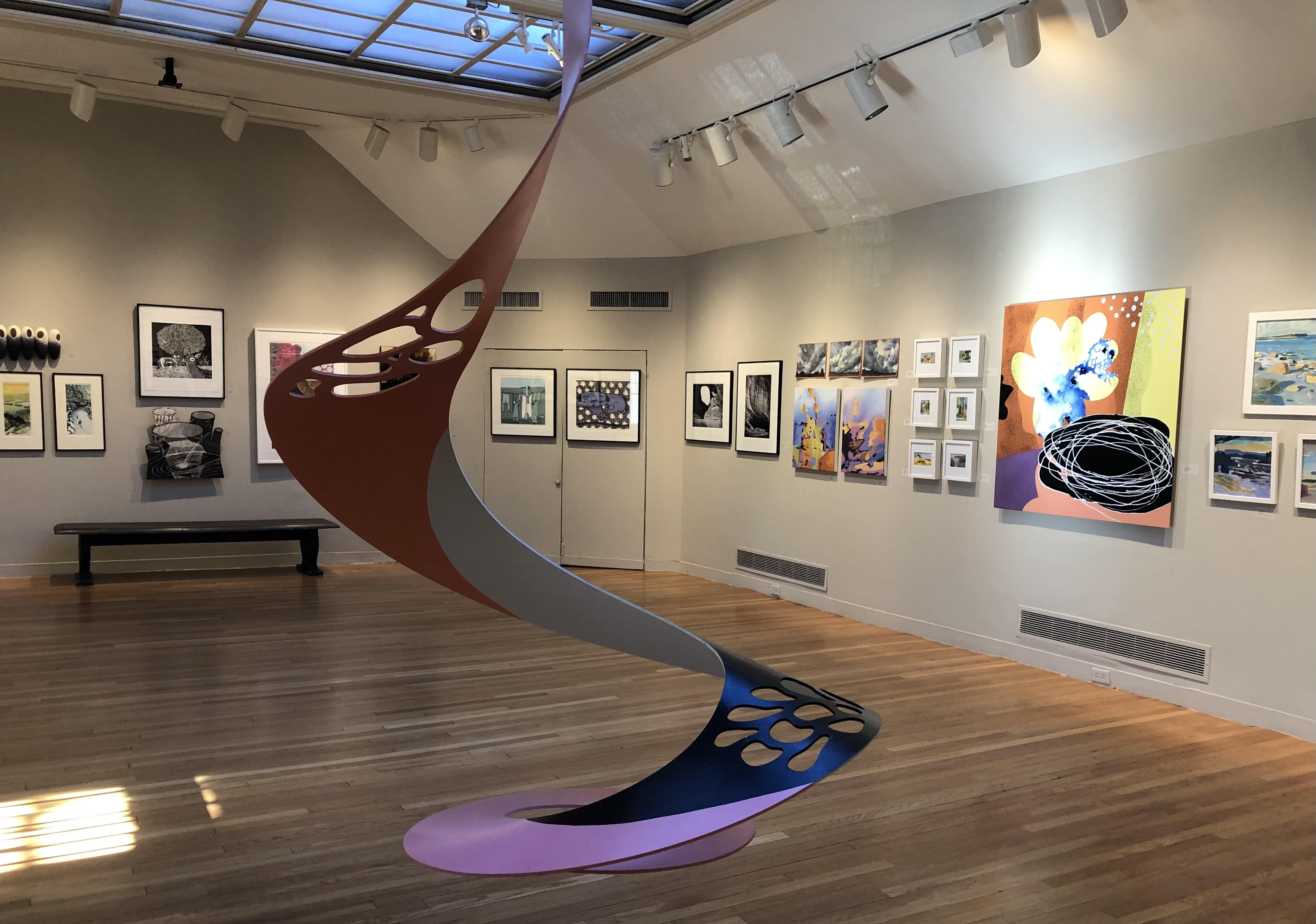
Next we have Jill Goldman Callahan’s hanging at a local gallery. She calls it “Safety,” a title I kind of get although she may mean something different. The impressive auditorium is in Groton, Massachusetts, where we went for a free lunchtime concert. On that particular day the concert was performed by five of the education wing’s jazz teachers.

Lastly, a scene I never tire of photographing: the view of dawn from our fitness center.

Photo: Alfredo Sosa/CSM.
Community MusicWorks, a program that allows students to use stringed instruments at no cost, is shown presenting its end-of-year gala in Providence, Rhode Island.

When I was visiting Nancy on Thursday, we talked about an amazing new music hall and school in our area and how it provides free noontime concerts to all comers. My husband and I had just attended one where some of the jazz teachers performed new compositions.

Looking at the huge crowd reminded me what music means to people, and how the word “free” in connection with “music” can make a real difference in people’s lives.

Troy Aidan Sambajon reports at the Christian Science Monitor about how it can make a difference for low-income children.

“The melodies drifting from Community MusicWorks’ spacious building are more than just the sounds of young musicians practicing. They are the heartbeat of the neighborhood.

“For 28 years, an after-school program run by the Providence, Rhode Island-based nonprofit has been reimagining what access to classical music education looks like. Community MusicWorks operates in areas of the state where K-12 students might not otherwise be able to afford to play stringed instruments. The program allows students to use instruments at no cost, offers mentorship, and hosts free concerts and workshops for the wider community to attend.

“Eli Arrecis, 10, is starting his fourth season in CMW this fall. On the last day of summer camp in late July, he and his fellow campers are performing original songs for their parents, using violins, violas, cellos – and shakers they crafted out of cardboard.

“Since joining the program, Eli listens to music with a newfound appreciation and even picks up sheet music at home to read for fun. His parents hope to enroll Eli’s siblings in the program. …

“In an era when many schools’ arts budgets are dwindling, CMW offers something increasingly rare: a space where young people find joy, purpose, and camaraderie through music.

“CMW’s beginnings were modest. In 1997, while he was a senior at Brown University, Sebastian Ruth launched the program with a $10,000 grant and a vision for what he termed ‘musicianship working for positive social change.’

“Mr. Ruth grew up in Ithaca, New York, and was first inspired by a high school violin teacher, who encouraged him to think about the social and spiritual impact of music on people. He and a small team rented a tiny storefront in Providence’s West End neighborhood – one of the city’s most diverse but also most economically disadvantaged areas – and began offering free violin lessons. …

“Within a few years, CMW expanded to the building next door to accommodate its growing after-school program. Hundreds of students later, CMW has cemented its place in the neighborhood with a new state-of-the-art facility, which opened in September 2024. …

“The three-story building has a performing arts center, group practice rooms, an instrument repair workshop, and plenty of space for lessons. Financing for the $15 million project came from state and local funds, as well as individual donations.

“AlexisMarie Nelson started her CMW journey in the sixth grade in 2006. It led her to study violin and viola and to eventually graduate from the Boston Conservatory at Berklee College of Music. Now a program coordinator at CMW, she says … ‘The connections that we’re making are so important.’

“Inside the building, teens such as Cesar Mendez shuffle in and out of lessons and jam sessions. They engage in soul-searching discussions about music and identity.

“ ‘This place feels like home,’ says Mr. Mendez, an 18-year-old violist who joined the program nearly a decade ago. ‘It’s just full of life.’

“But the real impact goes beyond mastering scales. ‘The arts aren’t just about skill-building or learning to play an instrument,’ Mr. Ruth says. ‘It’s a different way of being with other people. Many communities, particularly urban communities, are just doing a disservice to the children by not having adequate opportunities to learn the arts.’ …

“Notes Cecil Adderley, chair of music education at Berklee College of Music and president of the National Association for Music Education. ‘It’s a way to model how to excel at something artistic.’

“Even if students never go pro, he adds, they’re using their creativity as well as fostering collaboration and a sense of belonging. ‘You’re learning not just how to be a musician – but how to be a better neighbor.’ …

” ‘A lot of the time, we talk just so we don’t feel alone in the questions we have,’ says Mr. Mendez, who will study biomedical engineering at the University of Rhode Island this fall.”

More at the Monitor, here.

Photo: Jordan Freeman/Sam Shoemaker.
Sam Shoemaker made a kayak entirely from mushrooms.

Mushrooms! What next?

This week I chatted with Ann about a class where she learned to use mushrooms for natural dyes. And you may remember a post, here, about human caskets made from mushrooms.

But, wait! There’s more, says Open Fung, a nonprofit advancing the future of fungi-based technologies, materials, and the arts. Their latest endeavor: making a kayak from mushrooms.

Lisa Kwon reports at the Guardian, “On a clear, still morning in early August, Sam Shoemaker launched his kayak into the waters off Catalina Island and began paddling. His goal: to traverse the open ocean to San Pedro, just south of Los Angeles, some 26.4 miles away.

“But upon a closer look, Shoemaker’s kayak was no ordinary kayak. Brown-ish yellow and bumpy in texture, it had been made – or rather, grown – entirely from mushrooms. His journey, if successful, would mark the world’s longest open-water journey in a kayak built from this unique material.

“With his phone, GoPro camera, walkie talkie, and a compass affixed to his life vest, Shoemaker left shortly before 6am in order to avoid the worst of the swells in the forecast. But three hours in and powering through his ninth mile, the coastline still out of sight, Shoemaker began feeling seasick.

“Suddenly, he heard the sound of a large animal breaching the waters. To his left, a fin whale flashed its glistening tail, then trailed slowly behind him. As the 50-ft creature followed him for three more miles, Shoemaker found the strength to finish out the maiden voyage … which took him 12 hours.

“As he stumbled onto shore with his mushroom kayak still intact, the artist and mycologist embraced his friends and family. …

“Shoemaker began his career as an artist creating sculptures with propagated mushrooms. Upon returning to Los Angeles after graduating from Yale with an MFA in 2020, he began exhibiting artwork that captured the unique behavior of mushrooms as they grew out of hand-built ceramic vessels and blown glass. … Shoemaker now belongs to a small community of scientists and artists exploring the potentiality of fungal innovation as an alternative material that could be used in everything from kayaks and buoys to surfboards.

“Their focus is on mycelium … a pivotal connective tissue in the animal kingdom. Mycelium-based materials in an aquatic context are known as AquaFung, a term coined by Shoemaker’s mentor Phil Ross, an artist and the co-founder of a biotechnology company called MycoWorks that engineers mycelium-based materials including a mushroom ‘leather‘ that can be used in furniture, handbags and biomedical equipment. After cofounding MycoWorks, Ross cofounded Open Fung. …

“Ross argues that AquaFung has many of the appealing properties as plastic – such as being lightweight and buoyant – but without the harmful footprint. …

“Shoemaker began working on his first mycelium boat in 2024. …

He modified a used fishing kayak to serve as his fiberglass mold, then grew the mycelium network inside the mold …

“Shoemaker meticulously dried the resulting kayak composite structure using fans over the course of several months. …

“Confident in his prototype, Shoemaker began searching for appropriate support. Shoemaker met Patrick Reed, the lead curator of the Pasadena-based arts organization Fulcrum Arts, in December 2023 through mutual friends. After a studio visit, Reed was blown away by everything that the artist had to show him. … Shoemaker completed his second mushroom boat in June; grown from the same wild Ganoderma polychromum mycelium. …

“The completion of Shoemaker’s boat marks the second ever water-tested mushroom boat to be made after Katy Ayers, who holds the Guinness World Record for growing, then testing, what was then the world’s longest fungal mycelium boat on a Nebraska lake in 2019.

“ ‘A lot of people really didn’t think it was possible,’ says Ayers, who grew her boat after being inspired by a documentary called Super Fungi. …

“Ayers and Shoemaker credits mycology pioneers like Ross for making the technology more accessible. And mushroom-based materials are slowly beginning to pop up in the mainstream: In 2021, Stella McCartney made headlines with its launch of the world’s first-ever garments made from lab-grown mushroom leather, in consultation with Ross.”

More on the future of fungal materials at the Guardian, here. No paywall: Please consider offering some financial support to the Guardian.

Photo: Rory Murphy.
Chemical dyes are often toxic for the environment and bad for human health, and that is why the National Theatre in London is planning to use natural dyes from a rooftop garden in its costumes.

My friend Ann is deep into using natural dyes for her textile art, and she even grows the plants that are used for those dyes. It is not just that she is concerned about all the synthetics in our environment, she loves the colors that nature produces.

In London, the National Theatre is on the same track.

Helena Horton  writes at the Guardian, “Squint at the roof of the grey, brutalist National Theatre on London’s South Bank and you might be able to spy a riot of color spilling from the concrete. This is the theater’s new natural dye garden, from which flowers are being picked to create the colors for the costumes worn in the theater’s plays.

“Chemical dyes are often toxic for the environment and bad for human health, so the costume designers at the theater are experimenting with using flowers including indigo, dahlias, hollyhocks, camomile and wild fennel to create the vivid colors used in their productions.

“The textile artist, Liz Honeybone, is buzzing with excitement about the opportunities the new garden is bringing. … She has been very concerned about the health impacts of using harsh, synthetic chemical dyes, which require users to be swaddled in protective clothing. …

“ ‘There used to be a thing called dyer’s nose, which is basically when the aniline dyes came in,’ Honeybone said, ‘They used to destroy your nasal membrane.’ …

“The theater is planning to use natural dyes from the garden in every production at the South Bank going forward, starting with Playboy of the Western World, which is on this autumn and winter.

“Claire Wardroper, costume production supervisor at the theater, said it was ‘a beautiful early 19th century piece, with lots of nice woolly jumpers, because it’s set in rural Ireland, and we can certainly get some nice colors into them.’ …

“They are trying to bring a gentler, more environmentally friendly way of dyeing into the mainstream. ‘We are saying that if you want to use this horrible synthetic dye, you can do that, but you can achieve this beautiful look by using a natural dye, and we can do it a little bit slower and a bit more sort of organically,’ said Honeybone.

“Wardroper added: ‘It’s unfortunate to say, but the theatre and film and anything creative in one-shot opportunity entertainment has a history of being incredibly wasteful.’ …

“Honeybone said: ‘It’s been such a good harvest. My indigo is more than I can cope with. I’ve got three shows going on at the moment, so I’ve had to recruit people to help me.’

“People may imagine the colors extracted from flowers will be muted compared with synthetic dyes, but Honeybone said this could not be further from the truth and she has been able to create neon greens and yellows. ‘Our forefathers were drowning in color. They loved it, it wasn’t hard to get and all the tapestries that were up on the wall were a riot of color. What we’re seeing now is the sad, faded leftovers,’ she said.

“Honeybone says she has become ‘obsessed’ with natural dyeing. ‘My daughter gave me a bunch of flowers on Mother’s Day, and I noticed there was some golden rod in it, so whisked that out and dyed with it just to see what it yielded. And it was the most glorious, strong yellow.’

“The garden is not only used for dyes but also as a refuge from the hustle and bustle of the theatre. The pair said actors were frequently seen pacing among the flowers, or sitting down on benches to learn their lines.

“The space is also a haven for wildlife. The grey concrete of the South Bank does not have a huge amount to offer pollinators, and they have been swarming to the garden to sample the nectar from the varied dye plants.

“Wardroper said: ‘We’re seeing so much more wildlife, like hummingbird moths, and we’ve got bees on the National Theatre roof which produce honey for the National Theatre. And they’re loving the variety of plants that we’ve planted as well. These are a new stock of plants that they just haven’t had access to. So the bee person that comes in and caters to the bees is very happy.’

“The pair hope that most if not all of the costumes at the theatre can eventually be produced using natural methods. But for now, Honeybone is enjoying the opportunity to start using these dyes.

“She said: ‘This is such an all round sensory experience, totally engulfed in the smells and the feeling. … It is just wonderful.’ ”

More at the Guardian, here. (Gotta love that someone in this earthy-crunchy field has a name like Honeybone and that Wardroper oversees the wardrobe!)

Photo: Jaida Grey Eagle via MPR News.
Among her many accomplishments, Twin Cities-based author Marcie Rendon writes a mystery series about indigenous investigator Cash Blackbear. 

I read a lot of mysteries, and I gravitate toward those about different cultures, often outside North America. But indigenous cultures here are equally foreign to me, which is why I have enjoyed Marcie Rendon’s Cash Blackbear series, about a tough young Ojibwe woman who investigates crimes against members of Upper Midwest tribes, often women.

I have several articles here for you to click on if interested, but I’m going to focus on what the Minnesota-based McKnight Foundation said about Rendon when they gave her an award.

“The McKnight Foundation is pleased to announce the selection of Marcie Rendon for its 2020 Distinguished Artist Award—a $50,000 award created to honor a Minnesota artist who has made significant contributions to the state’s cultural life. Rendon, an enrolled member of the White Earth Nation, is a writer whose poems, plays, children’s books, and novels explore the resilience and brilliance of Native peoples.

“ ‘Marcie brings a strong and necessary voice to so many genres,’ said Pamela Wheelock, McKnight’s interim president. ‘She has created a tremendous body of work, including poetry, plays, lyrics, and award-winning crime novels, all while raising up other Native voices in our community. Her commitment to making art in community embodies what a distinguished artist means to Minnesota and to McKnight.’ …

“A gifted storyteller and prolific writer, Rendon is the author of the award-winning Cash Blackbear mystery series, set in Minnesota’s Red River Valley. The first novel in the series, Murder on the Red River, earned the 2018 Pinckley Prize for Debut Novel, and the second, Girl Gone Missing, was nominated for the Mystery Writers of America – G. P. Putnam’s Son’s Sue Grafton Memorial Award. Rendon … is also the author of four nonfiction children’s books, including Powwow Summer (Minnesota Historical Society Press, 2013).

“Rendon’s plays include Sweet Revenge, chosen for the Oklahoma Indigenous Theatre Company’s 2020 New Native American Play Festival. She has also curated and produced a variety of Native-focused performances at the History Theatre, the Minnesota Fringe Festival, and Patrick’s Cabaret. She is the founder of Raving Native Theater, a platform that brings voice and visibility to other Native American artists and performers.

“ ‘We are more resilient than we are traumatized,’ said Rendon. ‘Art keeps us thriving, not just surviving. I try to make room for other Native artists. Every time someone steps forward, it makes room for others to step forward.’ …

“Rendon’s poem ‘Resilience’ is also included in US Poet Laureate Joy Harjo’s digital project ‘Living Nations, Living Words: A Map of First Peoples Poetry,’ which will join the permanent collection of the American Folklife Center at the Library of Congress.

“Rendon’s awards include a 2020 Ensemble/Playwright Collaboration Grant from the Network of Ensemble Theaters and the Playwrights’ Center, and a 2020 Covid-19 artist grant from the Tiwahe Foundation for demonstrating resilience during the pandemic. Rendon was named a 2018 50 Over 50 honoree by AARP Minnesota and Pollen Midwest and received Loft’s 2017 Spoken Word Immersion Fellowship with poet Diego Vazquez. …

“Said Sandy Agustin, a member of the Distinguished Artist Award selection committee, ‘Whether she is writing about boarding schools, incarceration, or the epidemic of missing and murdered Indigenous women, she is nurturing Native voices and amplifying communities that are too often unheard, especially Native women.’

“Born in northern Minnesota in 1952, Rendon was a voracious reader, creative writer, and poet from an early age. While studying criminal justice at Moorhead State College in the early 1970s, she was part of a group of Native student activists who successfully demanded the launch of the university’s first American Indian studies department.

“After moving to the Phillips neighborhood of Minneapolis in the late 1970s, she worked as a counselor and therapist, while raising her three daughters. In 1991 she saw a performance by Margo Kane, a Cree-Saulteaux artist, that inspired Rendon to share her own poetry and writing with a wider audience. …

“She is currently collaborating with artist Heather Friedli on an upcoming installation at the Weisman Art Museum about the high rates of incarceration among Native women.”

I have read most of the Cash Blackbear books (there’s a new one just out), and I find the urgent educational energy of the series both its strength and its weakness. Rendon feels empowered by a need to educate unenlightened readers like me, and I appreciate what she’s doing. After all, injustices continue and indigenous women in particular still disappear at an intolerable rate. I’ll just say that sometimes the mission overwhelms a good yarn.

More at the McKnight Foundation, here. See also Minnesota Public Radio, here, and Visual Collaborative, here.

A Library in the Subway

Photo: Biblioteka Publiczna w Dzielnicy Targówek m.st. Warszawy.
A library has opened in a new metro station in Warsaw. 

Fans of libraries know that libraries have a way of popping up in all sorts of unlikely — even inimical — places. If you search on the word at this blog, you will find stories about libraries on horseback, in impoverished countries, in war zones, and wherever people find comfort from reading.

Jakub Krupa reported for the Guardian about a new library in a Polish subway station.

“An ‘express’ library has opened in a new metro station in Warsaw, aiming to provide an appealing cultural space to encourage residents and commuters to forgo smartphones in favor of books and, thanks to fresh herbs growing in a vertical garden, a dash of subterranean greenery too.

“The stylish Metroteka [in] the Kondratowicza M2 line metro station in the Polish capital’s Targówek district offers two reading areas for adults and children, as well as a space for public readings and events.

“About 16,000 books are on offer. … Readers can return them on site or through a street-level parcel locker for books, available 24/7.

“Visitors can study or work in a communal area, borrow a laptop to browse the internet, or simply sit down with a complimentary coffee or hot chocolate to unwind after rush hour travel on the metro. …

” ‘Our dream is for Metroteka to become an educational and cultural centre, and not just a place where you borrow your books from,’ says the deputy director of Targówek library, Grażyna Strzelczak-Batkowska. …

“She says the unique subterranean location brings the library closer to busy commuters, ‘both geographically and in terms of time you need to spend on getting the book.’ …

“More than 400 books were leased on the first day, mostly recommended school readings, as well as travel guides and ‘all sorts of how-to books.’

“The library’s innovative model aims to encourage Poles to read more. The annual survey by the National Library of Poland found that only 41% of respondents had read at least one book in 2024, down from the high 50s in the late 1990s and early 2000s, as people turn to TV, streaming services, and phones for entertainment instead.

“These numbers are higher than in southern Europe, but lower than in the Nordic countries, or even the neighboring Czech Republic, the National Library’s director, Tomasz Makowski, says.

“He says there are historical reasons for it – with Poland losing 70% of libraries in the second world war, ‘we had several generations that did not see their parents or grandparents in front of a wall of books’ – but also cultural as ‘reading is not something associated with adulthood,’ but with ‘schools, teachers, librarians, and usually mothers reading to children.’

“ ‘Opening a library in a metro station is like a dream for us,’ Makowski says, as it challenges that stereotype. ‘Libraries should be beautiful and open; inviting, not intimidating. It’s not a shrine, but a place where you can spend time freely, take part in discussions, public consultations, or meet people,’ he says.

“He says the National Library has also opened a ‘loud’ reading room, breaking with the tradition that such areas need to maintain silence, where ‘no one shushes you or tells you to keep quiet. To our surprise, it’s still pretty quiet, but they also talk, give tutoring, different kinds of lessons.’ ”

Good photos at the Guardian, a free paper, here.

What do you think of the library’s chances? I love the optimism behind this effort but can’t help picturing what the subways I know well are like. Has anyone else commuted to work this way?

The Story of the Jukebox

Photo: Lisa Guerriero.
A restored 1946 Wurlitzer jukebox model 1015, known as “the Bubbler” for the bubble tubes on its front.

In the 1950s, when the jukebox was at the height of its popularity, one of my brothers received for Christmas a magnificent toy version. I remember it lighting up in bright colors when you turned it on. It could not exchange records like tan authentic jukebox, but it was real enough to become the wonder of the neighborhood, at least for a while.

At the Smithsonian, Steven Melendez reminds us that the basic concept was launched long before the 1950s.

“In 1889, a San Francisco tavern called the Palais Royale debuted a hot new attraction: a modified Edison phonograph that, when a customer inserted a nickel, played music from a single wax cylinder. Electrical sound amplification was still years away, so customers had to insert stethoscope-like tubes into their ears to hear anything. …

“Despite this unwieldy setup, the machine reportedly brought in more than $1,000 (some $34,000 today) in less than six months, and coin-operated music machines soon proliferated in bars, at drugstores and even in new listening parlors across the country. Alas, poor sound quality meant selections couldn’t be soft or subtle, so popular offerings included such earsplitting numbers as John Philip Sousa marches and the novelty whistler John Yorke AtLee performing popular ditties of the day. By the early 1900s, the machines struggled to compete against player pianos and other automated instruments that could entertain whole venues with higher-quality audio. …

“Record players continued to improve in quality and volume, and pay-to-play phonographs made a huge comeback in the 1920s, paving the way for the jukebox era. In 1927, the Automatic
Musical Instrument Company unveiled the first amplified, multi-record coin phonograph.

“Jukeboxes — they took on this nickname in the 1930s in reference to African American ‘juke joints’ of the South — introduced the world to music on demand, for far less than buying a record (and on better equipment than people had at home). … Danceable big-band numbers and tunes like the ‘Beer Barrel Polka’ were early hits, and the irrepressible popularity of jukeboxes soon rocketed artists like swing impresario Glenn Miller to national fame, creating an audience for loud, catchy, rollicking tunes. …

“Jukebox operators came to account for a majority of record sales, as they frequently changed out selections to keep customers dropping nickels. Using meters within the machines, operators could track which tunes were most popular at which locations, and they programmed boxes accordingly, offering a mix of national hits and more regionally specific selections. The latter included many tunes by Black and working-class musicians, in folk genres such as country and blues that tended to get scant airplay on the radio of the day but soon found appreciative listeners on jukeboxes. 

“By the early 1940s, about 500,000 jukeboxes dotted the country, sometimes inspiring too much of a ruckus: Newspapers frequently reported on bar fights over music selections. …

“Jukeboxes had a chance to prove their patriotic bona fides during World War II, when they provided vital entertainment on military bases and at troops’ canteens, sometimes on machines donated by public-spirited American operators — not a single nickel required. …

“After the war, stylish and streamlined jukebox cabinets in diners let teenagers listen to rock ’n’ roll at volumes generally impossible (or at least inadvisable) to achieve at home. Jukeboxes became indelibly associated with 1950s youth culture. … The format of hit-after-hit music queues also helped inspire teen-friendly Top 40 radio, replacing older formats that defaulted to playing several songs in a row by a single artist.

“Over the next couple of decades, jukeboxes would see their numbers dwindle as fans turned to other sources of entertainment, including increasingly high-fidelity home stereos, television and the transistor radio.”

Teddy Brokaw continues the jukebox story at Smithsonian with a description of how mobsters saw easy money in the phenomenon.

“The jukebox,” Brokaw reports, “with its all-cash business model and fungible record-keeping, showed clear potential for tax evasion and money-​laundering operations and quickly caught the attention of organized crime.

“By the 1940s, Mafiosi, foremost among them Meyer Lansky, had pioneered the typical racket: Buy up all the jukeboxes in an area and lease them to businesses in exchange for 50 percent or more of the take. But the scheme’s true brilliance was its scope: The mob owned not only the jukeboxes, but also, often, the record companies supplying the discs and the contracts of the artists cutting the records. It was a masterpiece of vertical integration, and it worked gangbusters.

“By the mid-1950s, one enterprising gangster — Chicago Outfit member Jake ‘Greasy Thumb’ Guzik … controlled 100,000 of America’s half-million jukeboxes and was raking in several million dollars a year. 

“With made men at the helm, the jukebox industry relied on hits — of both kinds. Mobsters could make or break an artist’s career through their control over what made it into the machines and thus climbed the charts. And beatings, bombings and even murders were just ‘one of the liabilities of the business,’ as a Wurlitzer sales executive testified to a Senate investigative committee in 1959. Jukebox owners who didn’t play nice risked seeing their machines destroyed, while rival jukebox distributors who refused to cut the mob in on their operations were whacked on more than one occasion.

“The jukebox may be a relic of a bygone era, but the mob’s influence in jukeboxes remains. As recently as 2018, a reputed mobster was gunned down. … The victim’s funeral procession was led by a car carrying — what else? — a jukebox made of flowers.”

More at Smithsonian, here.

Photo: Maggie Penman/The Washington Post.
Marci Johnson shows off a tiny watering can from deep in a pond. Johnson is a member of Susan Baur’s group Old Ladies Against Underwater Garbage, OLAUG.

A question from today’s article is a perfect example of the real meaning of “begging the question.” Although nowadays the phrase seems to mean “leads to a new question,” good old Fowler’s says it really means something more like “making an unproved assumption.”

Thus “why does diving for trash in a pond make people so happy?” makes the assumption that diving for trash does make people happy.

Let’s read more about the person who begged the question: Susan Baur, founder of the group Old Ladies Against Underwater Garbage.

 ‘It’s a reminder when things feel too overwhelming — it’s not overwhelming if you do it together.’

Maggie Penman writes at the Washington Post, “On an overcast chilly morning in late August, a group of women gather in a sandy parking lot, nearly all of them sporting a bright orange hat with the letters OLAUG — Old Ladies Against Underwater Garbage.

“Founder Susan Baur gets the group’s attention to go over the plan: Two groups of swimmers with masks and snorkels will be dropped off by a pontoon boat in different sections of Johns Pond in Mashpee, Massachusetts.

“Each group, accompanied by a kayaker, will swim in zigzags toward each other, diving as deep as 12 feet to pull trash from the pond’s muddy depths.

“All of the divers — women between 65 and 85 years old — have an enthusiasm for litter. …

“ ‘You literally never know whether you’re going to be excited, humbled, saddened. It’s all there, the whole emotional range you go through on a dive,’ Baur said.

“This area has been cleaned up before, but they know there’s more trash, in particular from a nearby construction site, that is getting dumped in the pond, Baur said. …

“Baur is a retired psychologist. At 85 years old, she is tiny but strong, moving quickly and fluidly as she checks equipment and greets swimmers. She says this project started on a whim in 2018, inspired by her daily swims in freshwater ponds and lakes near her home on Cape Cod.

“ ‘It was three or four or five friends that would get together and clean up a pond and laugh,’ she said.

“They were astounded at how much trash was in local waterways and ponds, and thought they could use more hands. In 2023, OLAUG held tryouts for the first time, making sure volunteers could swim half a mile in under 30 minutes and finish the mile comfortably. They also had to be able to dive repeatedly down 8-10 feet. Overnight, the group expanded to 21 women. The youngest was 64. …

“The dives are organized with walkie-talkies and safety protocols, and coordinated with local homeowners, who often express appreciation with baked goods. Each dive is run by an assigned ‘beach boss’ who handles logistics and checks swimmers in and out of the water. Each diver has an area of expertise. If it’s deep, call Marci. If it’s disgusting, call Susan. …

“Many of the women involved in OLAUG are motivated by environmentalism: wanting to clean up ponds and lakes for the fish and turtles that populate them.

“Some are motivated by the camaraderie or the exercise. For others, it’s the joy of imagining the provenance of the objects pulled out of the mud.

“ ‘Where did this garbage come from?’ asked kayaker Diane Hammer, 70. ‘And how did it get in the pond in the first place?’

“She got involved with OLAUG after moving from Boston to Falmouth in 2020. She looked out her window and saw people in wet suits digging in her pond. Hammer had been watching a lot of true crime during the pandemic, and her first thought was that the divers were FBI agents looking for dead bodies. She soon learned it was Baur and a friend looking for trash.

“ ‘There’s nothing better than doing something good with good people,’ Hammer said. ‘It’s a reminder when things feel too overwhelming — it’s not overwhelming if you do it together.’ …

“This particular Monday morning, divers find a makeshift anchor and a rusted rudder, as well as two shoes — one a woman’s strappy sandal. On another day they found a blue toilet. On another, the back end of a Corvette. They’ve found old beer bottles that seem to have been dumped after an ice fishing expedition a century ago, lots of golf balls and so many baby doll heads. …

“The main reason Baur thinks the women keep coming back to OLAUG is because in the water, they reach a state of flow — the concept in psychology that some researchers believe holds a critical key to happiness.

“ ‘The cool thing about flow is there’s no one thing you have to do to achieve it,’ said Richard Huskey, an associate professor in the communication department at the University of California at Davis who has written about flow. He says the easiest way to understand it is as ‘being in the zone’: being so fully engaged in a task that you are entirely present, totally unselfconscious, not thinking about anything else.

“ ‘There’s nothing like cold water, icky garbage and a little bit of danger to get you out of your head,’ Baur said.

“Marci Johnson agrees. She’s one of the swimmers who joined the group in 2023. Johnson grew up on Cape Cod and moved back with her husband when she retired, but then he died. She was diagnosed with breast cancer. She was feeling isolated and struggling — and then she saw OLAUG was having tryouts.

“ ‘I never was good in gym, I wasn’t on a sports team in school, but I do love swimming,’ she said. ‘You get into a rhythm when you’re swimming long distances, and your mind just goes somewhere else. You work through those problems you’ve been trying to figure out, sitting there thinking about it. But when you’re swimming the answer comes to you. It’s a happy place.’ ”

More at the Post, here.

Photo: Robles Casas & Campos.
The painting by Italian artist Giuseppe Ghislandi in a living room in Mar del Plata. The 18th-century painting ‘Portrait of a Lady’ (Contessa Colleoni) was stolen by an SS officer and rediscovered this year in Argentina.

Guilty secrets don’t stay hidden forever. It may take a long time, as in today’s story about Nazi loot, but more often than not, truth eventually surfaces.

Facundo Iglesia  and Jon Henley write at the Guardian, “There was nothing very remarkable about the middle-aged couple who lived in the low, stone-clad villa on calle Padre Cardiel, a quiet residential street in the leafy Parque Luro district of Argentina’s best-known seaside town, Mar del Plata.

“Patricia Kadgien, 59, was born in Buenos Aires, five hours to the north. Her social media described her as a yoga teacher and practitioner of biodecoding, an obscure alternative therapy that claims to cure illness by resolving past traumas.

“Her husband, Juan Carlos Cortegoso, 61, built and raced go-karts. Like many in this neighborhood, the couple were comfortably off, and discreet. …

“Then, last month, they put their house up for sale. A photographer from a local estate agent, Robles Casas y Campos, came round to shoot the spacious, elegantly furnished interiors. The pictures went up. And their quiet existence came crashing down.

“The fifth photograph on the agency’s listing showed a general view of the villa’s living room. Hanging on the wall, above a buttoned sofa in plush green velvet and next to a polished antique commode, was a highly distinctive oil painting of a woman.

“More than [6,000 miles] away, the Dutch news outlet AD had, for several years, been quietly investigating the fate of old master paintings looted by the Nazis and still listed by the Dutch culture ministry as ‘unreturned‘ after the second world war.

“Journalists had made several attempts to speak to Patricia Kadgien, the owner of the property, and to her elder sister, Alicia, the daughters of a high-ranking Nazi official Friedrich Kadgien, who was known to have settled in Argentina after the war.

“Their calls and messages had consistently gone unanswered, or been rebuffed. But then a Dutch reporter based in Buenos Aires, Peter Schouten, went knocking on the door of the villa – and spotted a ‘for sale’ sign.

“What followed, after Schouten and his colleagues in Rotterdam clicked on the link to the property and instantly recognized the work, made headlines around the world as the story unfolded of the unlikely recovery of an 18th-century portrait missing for 80 years. …

“After the media reports of the work’s likely location, and before a police search, the couple had tried to obstruct the investigation, the prosecutor argued, by taking down the online property listing and for sale sign and replacing the portrait with a tapestry.

“Despite knowing they were under investigation, it was alleged that the defendants had also attempted a civil action claiming the painting was rightfully theirs, turning it over only after they were placed under house arrest and facing further police raids.

“Through their lawyer, Kadgien and Cortegoso have denied concealment, saying they had always been willing to hand over the painting, and obstruction, arguing that their civil action was aimed at establishing ownership and not at hiding the artwork. …

” ‘Portrait of a Lady’ belonged to Jacques Goudstikker, a Jewish-Dutch art dealer who fled Amsterdam in mid-May 1940 to escape the Nazis, but died after falling through an open hatch into the hold of the SS Bodegraven, the ship carrying him to the UK.

“Goudstikker carried with him a notebook detailing his collection of more than 1,100 artworks, including pieces by Rubens, Giotto, Titian, Rembrandt and Van Gogh, all of which were snapped up for a fraction of their value by Nazi officials.

“Some were later recovered and displayed as part of the Dutch national collection in the Rijksmuseum, before 202 works were restored to the dealer’s sole heir, his daughter-in-law, Marei von Saher, in 2006. ‘Portrait of a Lady’ was not among them. …

“Born in 1907, Kadgien joined the Nazi party in 1932 and the SS in 1935. By 1938, he was a special representative working for Göring on the four-year economic plan drawn up by Adolf Hitler to rearm Germany and prepare it for self-sufficiency by 1940. …

“Kadgien ‘confiscated a large amount of property from Jewish merchants, including jewelry and diamonds in Amsterdam, and oversaw the sale of expropriated shares and securities through banks and front companies in Switzerland’ [federal prosecutor Carlos Martínez] said.

“He fled to Zurich early in 1945, then to nearby Baden, where in 1948 he set up a successful finance and trading firm, Imhauka. With pressure growing after questioning by Swiss and US investigators, Kadgien left for South America in 1949. …

“Kadgien resurfaced in Rio de Janeiro in 1951, settling in the Santa Teresa district and establishing a Brazilian branch of Imhauka. … Imhauka secured valuable contracts with Juan Perón’s government, including acting as an intermediary for major German engineering firms such as Siemens. …

“The fate of ‘Portrait of a Lady,’ which will be registered with Argentina’s supreme court, is now uncertain. Prosecutors have requested it be held, but not displayed, at the Holocaust Museum in Buenos Aires while its ultimate ownership is determined. This week von Saher, Goudstikker’s heir, lodged a legal claim to the work with the FBI in New York.”

More at the Guardian, here. No firewall.

Photo: Elliott Jerome Brown Jr. for the New York Times.
Recently, the New York City subway system featured an audio-based public art project by Chloë Bass. Composer Jeremy Toussaint-Baptiste created the distinctive sound that starts each announcement. His shirt says, “If you see something, free something.”

In September and October, the New York City subway system, the MTA, had some fun with an art installation that involved the public address system. If you’ve ever traveled underground in New York, you know that there is art everywhere, some of it permanent, like mosaics, others ephemeral like this one.

Aruna D’Souza announced it at the New York Times: “Through Oct. 5, commuters making their way through the crowds at 14 subway stations throughout New York may notice a new type of announcement on the public address system. ‘What we hear changes how we feel. How we feel changes what we do. And what we do changes the world around us, even if just for a moment,’ one says.

“Some sound like snippets of overheard conversations: ‘Remember when Aretha Franklin died and people were singing her songs together on crowded train cars?’

“Each will end with the words ‘If you hear something, free something,’ which is also the title of this ambitious public art project by the conceptual artist Chloë Bass. …

“Bass turns around the instruction to be ever-vigilant in the face of threat, coaxing us instead ‘to return to ourselves in public space, and to experience it as a place where we engage with others instead of only being suspicious of others.’

“The project is a collaboration among Bass, the public art organization Creative Time and the Metropolitan Transportation Authority’s Arts & Design department. The M.T.A. has had a robust public art program over the years … but this is the first time they’ve allowed an artist to broadcast over the M.T.A.’s public address system.

“The 10- to 45-second announcements, 24 in all, will be aired in English, Spanish, Arabic, Bangla, Haitian Kreyòl, and Mandarin — six of the top 10 commonly spoken languages in New York City. (ASL translations will also be available on the Creative Time website.)

They are voiced by a range of vocalists, assembled in part through an on-the-street casting of regular New Yorkers. …

“Bass, 41, conceived the project over the course of her long train and bus commutes between Brooklyn and Queens College, where she taught in the visual arts program for more than eight years. [She says] ‘after 2016, there were more and more announcements, and they were really wrecking my emotional landscape.’

While broadcasts conveying basic information or emergency instructions were understandable and necessary, she said the constant reminders of police presence and increasingly frequent attempts to shape people’s behavior disrupted her thoughts. ‘We’re constantly being asked to internalize the idea that we are supposed to be watchful over each other, not in a supportive or caring way, but to report things to someone else,’ she said. …

“Diya Vij, curator at Creative Time, said that when she and Bass started thinking about what the project could achieve, they realized ‘it could help people see themselves and each other again and think about being neighbors and community differently in a space that might feel more tense than it should.’ …

“In addition to voices, the messages include sonic elements made in collaboration with the musician Jeremy Toussaint-Baptiste, who created the musical tone that opens each. (It draws in part from Bass’s research into the healing qualities of certain frequencies.)

“Before writing the scripts, Bass convened a series of focus groups composed of commuters, M.T.A. employees, transportation advocates and teenagers. (‘Large groups of teens are everybody’s subway nightmare, but they’re New Yorkers, too,’ she said.)

“Maggie Murtha, part of the project team at the M.T.A., said one of her takeaways from the focus groups was that ‘there was a longing to feel connected to the people around you.’ ”

More at the Times, here.

Photo: Handout of a miniature by Nicholas Hilliard.
Shakespeare’s friend Henry Wriothesley, 3rd earl of Southampton, was known for his androgynous beauty and vanity. A newly discovered miniature from his teenage years adds mystery to his story.  

There is always something new to learn about Shakespeare. Blogger Carol let us know a while back about her brother-in-law’s research into Thomas North as an important source for Shakespeare. More recently, there was “news” about Shakespeare’s wife.

Now Dalya Alberge writes at the Guardian that “the discovery of a previously unknown portrait miniature by one of Elizabethan England’s greatest artists would be significant enough. But a work by Nicholas Hilliard that has come to light is all the more exciting because it has a possible link to William Shakespeare, and a 400-year-old enigma of a defaced red heart on its reverse, suggesting a love scorned.

“Hilliard was Queen Elizabeth I’s official limner, or miniature painter. His exquisite portraits, small enough to fit in the palm of one’s hand, are among the most revered masterpieces of 16th-century British and European art.

“This example depicts an androgynous, bejeweled young sitter with long ringlets, thought to be the earliest known likeness of Henry Wriothesley, 3rd earl of Southampton, Shakespeare’s friend and patron – and possibly the ‘fair youth’ of the sonnets, as some have speculated.

“Shakespeare dedicated [‘Venus and Adonis’] and ‘The Rape of Lucrece,’ to Southampton, declaring: ‘The love I dedicate to your lordship is without end.’

“Such miniatures were painted on vellum as thin as onion skin that was pasted on to playing cards for a stiff support. This portrait’s reverse reveals a card whose red heart has been painted over with a black spear or spade, seemingly indicating a broken heart.

“The portrait has been identified by the leading art historians Dr Elizabeth Goldring and Emma Rutherford, who were taken aback by the defacement.

“Goldring, an honorary reader at the University of Warwick and author of an award-winning Hilliard biography, told the Guardian: “You always know that there’s a chance that there could be a clue on the back or tucked inside the frame, but there almost never is. On this occasion, there was – and it was absolutely thrilling. Shivers down the spine. Someone had gone to great effort to spoil the back of this work.’

“Rutherford, the founder of the Limner Company, a consultancy and dealership, said … ‘Everybody would have known that a miniature would be backed by a playing card, but the playing card back was never visible. Originally, this would have been encased in a very expensive, possibly jeweled locket. You’d have to get the miniature out of the locket in order to vandalize the back like this.’ So it is an extraordinary discovery, a 400-year-old mystery.”’ …

“Their research, jointly written with Prof Sir Jonathan Bate, a leading Shakespeare scholar, is published in the Times Literary Supplement on 5 September.

“They write: ‘The fact that the heart has been painted over with a spade, or spear, inevitably calls to … mind thoughts of Shakespeare, whose coat of arms, drawn up c1602, incorporated a spear as a pun on his surname. …

“The historians suggest there is the possibility that this portrait was a gift from Southampton to Shakespeare who returned it, perhaps in 1598, the year that he married. …

“The portrait’s owners have a family connection to Southampton, but they were unaware of Hilliard’s hand or the work’s significance, having long kept it in a box. They contacted Goldring and Rutherford after reading of [the researchers’] discovery of another Hilliard miniature. …

“They write: ‘Again and again, the sonnets return to the fair youth’s androgynous beauty. So, for example, in sonnet 99 his hair is compared to “marjoram,” the tendrils of which are long and curly: could this be an allusion to Southampton’s distinctive long ringlets?’

“They argue that everything about this miniature, including the sitter’s gesture of clasping his cascading ringlets of auburn hair to his heart, suggests an intimate image.

“Long hair was unusual at the late Elizabethan court, Rutherford said. ‘We know there was some criticism of how long hair made men “womanish.” ‘

“Two pearl bracelets adorn the sitter’s wrist. Rutherford said bracelets, though frequently encountered in portraits of women in this period, were rarely seen in portraits of men.”

More at the Guardian, here. And check out the post on Carol’s brother-in-law and his hunt for a little-known Shakespeare source, here.

Photo: Wikimedia commons.
The world’s largest version of Sweden’s famous Dalecarlian horse. Controversy has erupted in Sweden recently over what exactly represents Swedish culture.

Suzanne and Erik took the kids to Sweden for five months to learn Swedish, spend some quality time time with Farmor (father’s mother) and Erik’s sister’s family, and experience Swedish culture. The children are attending an international school in English but are having lots of opportunities to learn Swedish and soak up Swedish culture.

Sweden recently conducted a survey to determine what exactly could be considered part of Swedish culture, a tricky enterprise for any country. Needless to say, not everyone agreed on what should be on the list.

At the New York Times, Alex Marshall asks, “What are the 100 things that unequivocally define Swedish culture? Flat-packed furniture from IKEA? Of course. Pippi Longstocking? Indeed. The touchstone films of Ingmar Bergman? Absolutely.

“Abba and meatballs? Apparently not.

“[In September] the Swedish government published the country’s first Cultural Canon, a document that lists 100 artistic works and social, political and economic phenomena, that a panel of academics, authors and historians say have played a key role in shaping the country’s culture.

“The idea of creating such a canon, a pet project of the right-wing Sweden Democrats, has divided the country’s cultural world. Supporters call it a simple attempt to foster civic pride and help newcomers integrate into society. But detractors, including an expert who left the committee, see it as an effort to create a narrow view of Swedish identity that excludes minorities or contemporary life. …

“Among the canon’s 100 entries are movies (Ingmar Bergman’s The Seventh Seal), books (Astrid Lindgren’s Pippi Longstocking) and paintings (Hilma af Klint’s ‘Paintings for the Temple‘), along with inventions (the ball bearing, the Nobel Prizes, paternity leave), key parts of Sweden’s economic history (ancient copper mines) and longstanding laws (including the separate taxation of spouses).

“Björn Wiman, the culture editor for Dagens Nyheter newspaper, said in an interview that he had laughed upon first seeing the list. …

‘It’s a bit ludicrous really.’ …

“The document says that Abba did not make the list because the pop group’s ‘most lasting contributions’ to Swedish culture came after 1975, the cutoff date for inclusion in the canon so as to highlight only things that have endured. …

“Leif Mannerström, a well-known chef, has criticized the absence of any culinary items, given Sweden’s contributions to global cuisine, including meatballs and herring. Observers have also raised eyebrows at the inclusion of the Swedish-made Saab Viggen fighter jet.

“Kerstin Bergea, the president of the Swedish Peace and Arbitration Society, an antiwar organization founded in 1883, said in an interview that the aircraft’s inclusion in a cultural canon ‘was something an authoritarian state would do.’ …

“Sweden’s coalition government began the initiative in 2023 as part of an agreement to secure the Sweden Democrats’ support. Alexander Christiansson, the Sweden Democrats’ culture spokesman … argued that detractors who said the canon excluded minorities were talking ‘nonsense’ and that the growth of multiculturalism had undermined Swedish culture.

“Lars Trägårdh, the historian whom the government appointed to lead the project, said in an interview that the members of the expert team were kept ‘arm’s length’ from the government — and even himself — so the choices for the 100 artworks and phenomena ‘weren’t tainted by politics.’ …

“Still, Wiman said that right-wing lawmakers’ trumpeting of the list showed that it was a political project. Debating what constitutes Sweden’s culture was important, he said, but it would be better to combine the initiative with ‘serious political ambition to raise culture and education spending.’

“To compile the list, the project had two streams, with this canon decided by the academic panel, and then a people’s one, consisting of submissions to a website.

“The website received over 9,500 submissions, many of them more reflective of contemporary tastes and a country in which about a fifth of the population was born abroad. Unlike the canon’s trumpeting of poetry, prose and Christian monuments, the public’s many suggestions included kebab pizzarap songs and the Swedish Church of Satan.”

So Lars Trägårdh says the method of compiling the list ensured that it wasn’t “tainted by politics.” Is that the impression you get? What aspects of Sweden have always stood out to you?

More at the Times, here.

Permission to Be Silly

Photo: Barbara Lowing/Common People Dance Project.
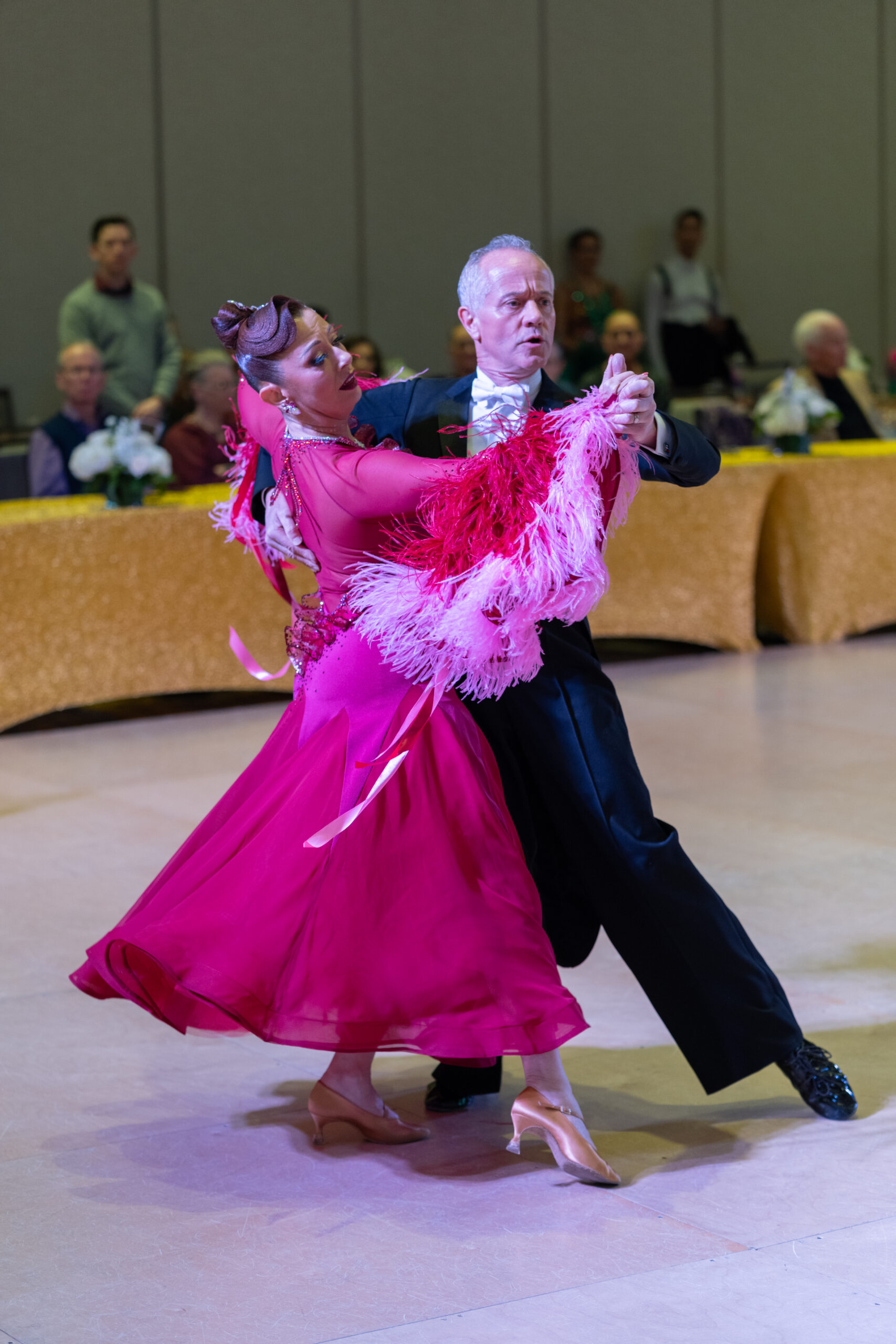
Goofing around on stage is the whole point at Australia’s Common People Dance Eisteddfod.

You could pull many different lessons from today’s story, but one that stands out to me is the way that a mother’s insecurity can warp a young child’s self-image, making a revolution necessary. The revolution may turn out playful and silly, a childlike release like a new dance style in Australia.

Dee Jefferson interviews an enthusiast called Bryony Walters, whose mother used to shame her about her weight. Bryony tells Jefferson it “affected her relationship with exercise, and movement in general. ‘It always seemed like a punishment that I was inflicting upon myself. … It wasn’t a thing you were engaging with to have fun or to feel good.’

“But when she saw a post in her community Facebook group about dance classes for a DIY eisteddfod, Bryony’s curiosity was piqued. …

“Neridah Waters and her Facebook post set off the amateur dance revolution known as Common People Dance Eisteddfod. Now in its seventh year, the project invites people of all ages, abilities and bodies to dance together – to 80s and 90s music, while wearing leotards, sequins, sparkles and glitter – culminating in a dance-off as part of the Brisbane festival. ….

“Waters, a stalwart of Brisbane’s alt cabaret scene, describes the project as a mix between Young Talent Time, sports carnivals, 80s gameshow ‘It’s a Knockout’ – and, of course, the Australian Rock Eisteddfod Challenge: a nation-wide high school competition that was popular in the 80s and 90s.

“Bryony, who has performed in five Common People Dance Eisteddfods, says it’s a ‘rare and special’ opportunity to ‘engage in really joyful movement in circumstances where the concern isn’t how you look.’ …

“Like Bryony, Amanda [Dell] came to Common People with an unfulfilled childhood dream of dancing. This year, she is dancing for Southside, one of seven teams of between 30 and 65 people competing in the eisteddfod, each performing their own routine of around five minutes – featuring moves with names like Jazz on Ya Face, Chicken Chicken Pelvis and Aunty Pat’s Christmas Trifle.

“Waters, who came up with the idea for the eisteddfod during a middle-of-the-night burst of inspiration, had no idea it would snowball into an annual juggernaut attracting hundreds of participants. Back in 2019, she was experiencing a lull in her career after becoming a mother. She’d been teaching community dance classes that were attracting middle-aged men and shy people who ‘wanted me to teach them seriously, from scratch, how to dance,’ she says.

“ ‘I wanted to do something more theatrical. I wanted participants who were as silly [as me].’

“As soon as she posted her alternative rock eisteddfod idea ‘it went nuts.’ she says. ‘People understood immediately the sense of humor behind it.’

“Starting off in her local community hall, the project spiraled into classes and teams in different suburbs. Brisbane festival came on board to host the eisteddfod as part of their program, and before the inaugural event the dancers of each team marched through the streets of South Bank to converge in a dance battle outside the festival’s Spiegeltent – set to Survivor’s ‘Eye of the Tiger.’

“Amanda, who was part of the march – wearing a leotard for the first time, not to mention in public – remembers it being nerve-racking. ‘The way that women think about their bodies, that’s a big thing to do,’ she says. ‘But you’ve got the power of the group. And that day is one of the best days of my life – it was just such joy and excitement.’

“Waters says, ‘We had women who were size 20 or 24 in leotards who looked like superhero versions of their suburban selves.’ …

“From the get-go, Common People Dance Eisteddfod has predominantly attracted middle-aged women. … Some are former dancers looking to let their hair down, most are amateurs or people who have never danced. Whatever their reasons for coming, they stay for the sense of community, the confidence boost – and the endorphins.

“Amanda, who describes the last few years of her personal life as ‘a shocker,’ rarely misses a class. ‘I know that no matter how I’m feeling beforehand, I will feel better afterwards,’ she says. ‘Having people that you meet with regularly, who you can rely on for that emotional support and friendship and fun – those things are invaluable.’

“For some, the eisteddfod is life-changing. Waters tells me about Zak, a shy teenage boy who slowly came out of his shell doing Common People’s living-room dance parties during lockdown. When IRL classes resumed, Waters encouraged him to take more of a leading role – culminating in him dancing and lip-syncing to a packed house for the eisteddfod.

“A couple of months later, Zak decided he wanted to run for school captain. ‘His mum said “Are you sure?” and he said, “Mum, look, I stood in front of 1,500 people and did the dance battle. I can do anything now,” ‘ Waters says. ‘And so he did it – and he ended up becoming school captain.’ “

More on the Brisbane Dance Festival at the Guardian, here. The Guardian has no paywall, but please consider donating to them — any amount.

Waking Up Our Earthworms

Photo: David Kohler via Unsplash.
Vintners are discovering the importance of bringing back earthworms.

In many parts of the world, growers who have relied on herbicides and pesticides are learning about the benefits of healthier soil, and so they’re getting rid of soil-damaging practices.

In today’s story, we have an example of vintners in the UK who have caught up with recent bio-friendly practices in France. They have not made their changes out of kindness to the planet, although that’s a side effect. They’ve done it to produce a better grape.

Helena Horton writes at the Guardian, “Vineyards are generally the most inhospitable of landscapes for the humble earthworm; the soil beneath vines is usually kept bare and compacted by machinery.

“But scientists and winemakers have been exploring ways to turn vineyards into havens for worms. The bare soil is problematic because worms need vegetation to be broken down by the microorganisms they eat. Pesticides are also highly harmful to the invertebrate, as is the practice of compacting the earth: worms need the soil to be porous so they can move through it.

“Earthworms … aerate soil, and they pull fallen leaves and other organic matter into the earth and recycle them. But their populations have declined by a third in the UK over the past 25 years due to pesticide use and over-tilling of soil.

“Marc-André Selosse, a professor at the National Museum of Natural History in Paris, has been urging vineyards to increase grass and plant cover on their soil, and reduce the amount they till, to save the worms.

“Selosse said: ‘In France, the vineyards are 3% of the agricultural area, and they are using 20% of the chemicals. In vineyards, for the soil there is a lot of treatments, so there’s a lot of compaction, and there is a lot of pesticides used.’ …

“Worms had not yet vanished from the most intensively farmed vineyards, he said, but they did need to be supported with more regenerative practices.

“ ‘I think the worms are at a low level,’ he said. ‘They are just surviving, but they are still there, which means that no one is thinking of buying earthworms for the soil, because they are there. It’s like Sleeping Beauty; they are there at very low level, and we have to wake them. But once again, in soil, we have resilience. It’s one part of biodiversity where they are so numerous that we were not able to kill all of them.’ …

“Selosse said the main thing vineyards could do for worms was to stop tilling the soil – breaking it up and turning it over – even if that means that herbicides such as glyphosate are used instead to remove weeds. … ‘In the future, sooner or later, we’ll have to stop glyphosate also but for now, tilling is the first cause of worm problems.’

“Now some vineyards in the UK are making worm-friendly wine. When Jules and Lucie Phillips, co-owners of Ham Street Wines in Kent, started their vineyard, they were advised to grow conventionally by tilling and using pesticides, but were horrified by the results.

“Jules said: ‘After we did that, we went out and we dug a soil pit immediately after planting, and then also later in the season, and we realized the soil was just dead.’ There were no worms. It was smelling not particularly interesting at all, and the structure was poor.’ …

“The pair had a revelation. ‘We just thought, this is completely the wrong way of farming and we need to do something different. We want life in our soils. And so we began the conversion to organic in that same year, and we’re now certified biodynamic.’

“Rather than using pesticides, they applied herbal teas to the vines to promote plant health, Jules said: ‘For example, horsetail tea has a real high silica content, and that improves the leaf cell wall and means that it’s more resilient.’

“The couple run a no-till system under the vine: ‘We’ve let the cover crop grow really long, and we typically let it grow right up into the canopy up until about flowering, and then we’ll mow it back. And the benefits of that are huge. The cover crop is really growing and really establishing that root structure and getting it to its maximum point. And finally, we put a big mulch on top of the soil that’s going to feed those worms and feed that soil life.’

“This has hugely helped their worm population: ‘We’ve seen our worm counts increase massively from basically none to around 20 or 30 in a spade full. So extrapolate that up to a square metre, and it’s a very decent volume.’

“Rob Poyser, a viticulturist at the regenerative wine consultancy firm Vinescapes, said that growing wildflowers in the vineyards they consult on had also brought great results. ‘We think in between three and five years we can take a bare soil and bring it back to life, into a thriving ecosystem,’ he said. ‘We’ve used things like cover crops to bring this vineyard to life, to build the fertility into this system, and organic matter. We’re bringing life back to these soils we’re using. We’re letting nature do it.’

“Poyser said they allowed wildflowers to grow all over the vineyards, and clients were delighted when clover, for example, sprung up because ‘clovers are great companion plants under the vine for grapevines; they’re also loved by earthworms.’ “

More at the Guardian, here. No paywall.