I was interested in an article in today’s NY Times about a school that gives chronically failing students another chance. It succeeds against all odds, but success is a slow process. New York’s mayor is not a fan, because many kids take six years to graduate.
Aniah McAllister, once a lost and wandering soul, has one of the happier stories. Reporter Michael Powell writes that she seems amazed to have earned 46 credits and to be headed to college.
“ ‘This school made realize,’ she says, ‘that I am much better than I thought I was.’
“That’s a pretty fair bottom line for any school,” writes Powell, “although in the up-is-down world of public education in New York, it might just be an epitaph for this small marvel of a high school. Known as a transfer high school, Bushwick Community admits only those teenagers who have failed elsewhere. Most students enter at age 17 or 18, and most have fewer than 10 credits.
“You can muck around quite a bit trying to find someone who has walked the school’s corridors, talked to its students and faculty, and come away unmoved. Most sound like Kathleen M. Cashin, a member of the State Board of Regents and a former superintendent. ‘They care for the neediest with love and rigor,’ she said. ‘They are a tribute to public education.’ ”
Read the article. I’m hoping it will have an influence on the policymakers and let an initiative that sounds so positive keep going.
Aniah McAllister, left, Justin Soto and Kassandra Barrientos attend Bushwick Community High School. Photograph: Kirsten Luce, NY Times
Back in December, Asakiyume and her daughter and I went to see a graphic art exhibit in Fitchburg. We were all quite taken with a dark, wordless story that Lynd Ward carved nearly a century ago. So I thought I would mention that, according to the New York Times, a documentary about Ward will be shown in Maine next Saturday.
Scroll down in a column by Eve Kahn, here, to the subhead “An Illustrator’s Life.”
“The prolific illustrator Lynd Ward had fans as diverse as superhero-comic-book collectors, the poet Allen Ginsberg and the graphic novelist Art Spiegelman. In the 1920s and ’30s Ward carved woodblocks for wordless books about capitalism’s oppressive side effects. …
” In later years Ward mainly illustrated stories by other authors, but his compassion for the underdog still came through, especially in his 1942 watercolors for Hildegarde H. Swift’s ‘Little Red Lighthouse and the Great Gray Bridge.’ ”
“Mr. Maglaras and the producer Terri Templeton based the film partly on archives that the family preserved after Ward’s death in 1985, and they extensively interviewed Ward’s younger daughter, Robin Ward Savage.”
Now, that is a movie I would like to see. Here’s a clip.
Summer Stages Dance, an unusual summer program at Concord Academy, had a fundraiser today, a Dance Feast. From noon to five, people of all ages and abilities could take classes with top choreographers and try ballet, modern dance, hip hop, Indian dance, Isadora Duncan dance, Irish dance, yoga, rope performance, Ghanaian dance, taiko drumming, and more.
At 5 p.m., the choreographers and their companies presented short performances in the gym. The program was characterized not only by inventive movement but by intellect, emotion, and humor.
I was particularly moved by Catherine Gallant’s second selection from the work of Isadora Duncan. The first selection was lovely and what you might expect of Isadora Duncan, sort of woodland nymphs. The second was fierce, angry, passionate. I was amazed.
Also powerful was David Dorfman‘s on-the-spot creation, a dance with words.
Amy Spencer and Richard Colton are the married dance team behind Summer Stages. They teach at Concord Academy. Their summer program gives professional choreographers a time to create while also teaching some classes and performing. It has been going 15 years and is considered quite unique in the country.
David Parker, son of the late mystery writer Robert B. Parker, is a regular participant. I’m including a sample of his work. He brings a lot of humor to his choreography. Today he did the Velcro dance, Slap-Stuck. Search on YouTube for “Sisters and Misters” or “Nut-Cracked,” Parker’s version of the traditional Christmas favorite.
I went to the Concord Library today to hear children’s book author and illustrator Ed Emberley give a charming talk to a crew of little kids sitting on a rug.
Emberley used an easel and colored chalks to demonstrate simple ways to create pictures. It was clear that he was used to talking to young children and loved making them laugh. The kids responded gleefully. Grownups did, too.
Several fans asked him — and his wife and collaborator, Barbara — to sign books they had brought along. One woman told me that her kids, now grown, still knew all the words to the Emberleys’ book Drummer Hoff, winner of the 1968 Caldecott Award for illustration.
I took home a worksheet with Emberley’s drawing tips so I can do more-interesting doodles in long meetings at work.
Last night I went to a jazz benefit for the nonprofit Kids4Peace Boston, which sponsors a summer camp and other events for children of three faiths — Christian, Muslim, and Jewish. The children are from both the United States and Jerusalem and are 11 to 12. Read more about the program here.
The fundraising event was held in the Grand Circle Gallery in Boston, which features magnificent travel posters and travel photography from the 1930s and 1940s. The entertainment was provided by Indian vocalist Annette Philip and her jazz quartet. Very impressive.
Who would have imagined it would be 80 degrees in March! I certainly enjoyed being able to take a walk I usually take in the summer and check out the flowers and art.
Search this blog on “Greenway” for more pictures and posts about the lovely Rose Fitzgerald Kennedy Greenway in Boston. Here’s what it looked like today.
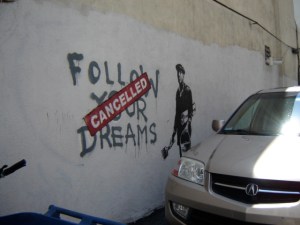
I am intrigued by street art, and have blogged a few times about the British street artist Banksy. For example, here.
So I wanted to share Nicholas Barber’s article “The Full Banksy Experience” at More Intelligent Life.
“Last week I was driving home along an unlovely stretch of main road in east London,” writes Barber, “when I saw what looked like a billboard on the side of a building. It had a friendly message printed in neat black letters: ‘Sorry! The lifestyle you ordered is currently out of stock.’
“It took a few seconds to process. It was definitely pithy, and definitely cheered me up at the end of a boring drive, but what was it? An advert? Did it have The Economist’s red logo at the bottom? Or was it … could it be … a Banksy?
“A few days later, an item in the local paper confirmed that it was indeed a Bansky, and a photo was on the artist’s website. I felt as if I’d lucked into a new artistic experience.
“The pleasure you get from a Banksy comes from the whole process: the chancing upon on an artwork in the unlikeliest of places, the speculation over how it got there, the uncertainty over whether it’s his or not, the subsequent authentication, and then the knowledge that it might have been rubbed out by the time you return.”
That is similar to my own reaction, except for the fact that I knew what I was looking for. And to this day, it has not been “authenticated.” Do you think it looks like a Banksy?
New research by Simone M. Ritter et al. in the Journal of Experimental Social Psychology seems to corroborate the truth of the old cartoon series “A Change Does a Man Good.”
You probably don’t remember the mild little cartoons in the series, but they tended to show situations like a man in a fedora scolding a police officer for parking next to a fire hydrant. Change can make one feel good.
It can also make one more creative.
In “Thinking Creatively: Just Add Milk” at Miller-McCune (now called Pacific Standard), Tom Jacobs describes an interesting experiment Ritter and her team conducted.
“Dutch university students were asked to prepare a breakfast sandwich popular in the Netherlands.
“Half of them did so in the conventional manner: They put a slice of bread on a plate, buttered the bread and then placed chocolate chips on top. The others — prompted by a script on a computer screen — first put chocolate chips on a plate, then buttered a slice of bread and finally ‘placed the bread butter-side-down on the dish with the chocolate chips.’
“After completing their culinary assignment, they turned their attention to the ‘Unusual Uses Task,’ a widely used measure of creativity. They were given two minutes to generate uses for a brick and another two minutes to come up with as many answers as they could to the question: ‘What makes sound?’
“ ‘Cognitive flexibility’ was scored not by counting how many answers they came up with, but rather by the number of categories those answers fell into. For the ‘What makes sound?’ test, a participant whose answers were all animals or machines received a score of one, while someone whose list included ‘dog,’ ‘car’ and ‘ocean’ received a three.
“ ‘A high cognitive flexibility score indicates an ability to switch between categories, overcome fixedness, and thus think more creativity,’ Ritter and her colleagues write.
“On both tests, those who made their breakfast treat backwards had higher scores.”
I like thinking about all the ways that the sign in a local shop window — “Craft Butchery” — could be read. Maybe the term is familiar to you, but it struck me funny. “We butcher arts and crafts”?
I guess it all depends on the meaning of “craft.” Small craft, as in small craft warning? “Hurricane predicted. Ignore this small craft advisory and invite craft butchery.”
If I saw the sign in Salem, I might conclude it was short for witchcraft butchery, but I still wouldn’t know if it was butchery by witchcraft or butchery of witchcraft.
Well, as you likely assumed straight off, the store sells cuts of meat. And the butcher is an artisan in his field.
Living on Earth, a national radio program produced in Somerville, Massachusetts, has interviewed an interesting guy who makes audio recordings of nature.
He may record, for example, what a woodland sounds like before a logging company comes in and what it sounds like after clear cutting. He may record the sounds of insects in trees. He says it is nearly impossible to get away from man-made sounds when recording nature.
Listening to his recordings early this morning resulted in my listening for the birds more on the walk I took later. (And I turned to see a very jubilant cardinal.)
“Few have heard the world as Bernie Krause has. Originally trained as a musician, he spent years recording the most famous musicians of the 1960s and 70s. Then he left the studio to explore the origins of music in nature. Krause has recorded wild sounds in places few have ever been or even dreamed of. Living on Earth’s Ike Sriskandarajah listens in.” Listen here or read transcript.
Those of us who go to work on the commuter rail or on the subway (the T) have a love-hate relationship with our public transportation system. Probably more love than hate since we forgive everything, always reminding ourselves how much more we would hate sitting in road traffic listening to the same news headlines repeated multiple times. We just make sure to carry a book and snacks in case of train breakdowns.
Take tonight. When I got down to the platform, the numbers of commuters seemed ominous. Even more ominous was the recorded message that kept telling us our train was “arriving” even though we know it never says “arriving” more than once for any train.
My boss said, “Don’t you have the option of taking the commuter rail from North Station?” Good point. I set off on foot, caught a number 4 bus, and landed at North Station in reasonable time, but for a later train.
The country badly needs good mass transit, and I think focusing on cars, gas, and roads is misguided. We riders get mad at the T and often complain about how it spends its money, but man, it sure is old and beat up! It’s held together with string — and the efforts of people who work all night on repairs to try to get the system functioning by 5:30 a.m. every day.
Now the T has made a 45-minute documentary on its night-time moles. If you don’t have time for the whole documentary, here’s a taste.
Another WordPress blogger, Piper Street Sound, “liked” one of my posts, so I went and looked at a couple of his. He’s a musician, and he produces a kind of music that is new to me. I read this post and in the comments section asked for more explanation.
The blogger answered on his blog, “It’s sort of reggae combined with a style of Peruvian pop music called Chicha that grew out of Cumbia’s spread across South America out of Colombia and with the youths of the 60′s and 70′s picking up electrified instruments, emulating US and UK rock music. So it is pretty layered as far as the musical influences go, part Jamaican, part Peruvian Psychedelia and then a heavy dose of electronic elements. … Here is a link to the best compilations of Chicha music available today. It also has a good explanation of what Chicha is”: Roots of Chicha.
Did you catch the National Public Radio story on backwards running? Who knew that there are actually competitions in backwards running? I thought it was something kids do, and only for a minute or two.
“Achim Aretz holds the Guinness World Record for running the half marathon, backward. But now, the 27-year-old German athlete says he’s tired of doing something almost no one else does and wants to head in a new direction. Reporter Caitlan Carroll caught up with him in Hanover, Germany.” Listen to the Interview.
What would Lewis Carroll do with this? I immediately thought of the Red Queen from Through the Looking-Glass.
” ‘Well, in our country,’ said Alice, still panting a little, ‘you’d generally get to somewhere else — if you run very fast for a long time, as we’ve been doing.’
” ‘A slow sort of country!’ said the Queen. ‘Now, here, you see, it takes all the running you can do, to keep in the same place. If you want to get somewhere else, you must run at least twice as fast as that!’ ”
Pretty much anything Lewis Carroll wrote has always made perfect sense to me.
I went to the concert of an oboe-playing friend Sunday. The 3 p.m. event coincided with the anniversary of the earthquake and tsunami that took place a year ago in Japan. My friend, of Japanese heritage, was moved by the music he was playing, and so was I. The modern pieces really sounded like an earthquake to me. I had visions of Poseidon, the Bull from the Sea, rising up in anger against humankind, and later of hope dawning.
The Charles River Wind Ensemble, where my friend plays, has a new conductor. I liked Matthew Marsit’s energetic style and his explanations of the pieces. Marsit, a clarinetist himself, is also a conductor at Dartmouth College, where he practices his belief in music outreach to lower-income communities.
“An advocate for the use of music as a vehicle for service, Matthew has led ensembles on service missions in Costa Rica and Philadelphia, Pennsylvania, collecting instruments for donation to schools, performing charity benefit concerts and offering workshops to benefit arts programs in struggling schools. His current work at Dartmouth allows for outreach projects in the rural schools of New Hampshire and Vermont, working to stimulate interest in school performing arts programs.” Read more.
I think musicians can be very giving people. Indian Hill Music in Littleton, Massachusetts, offers scholarships and more. Someone I know on the board tells me that Indian Hill has “a program to bring music instruction to schools in the region that have cut out music due to budgetary constraints. They also offer free concerts, a Threshold choir (music for dying patients), and a number of other outreach efforts.”
In Providence, Rhode Island, Community MusicWorks demonstrates how music builds community and teaches social responsibility. You can read about this and other innovations in Rhode Island’s creative economy here.