Feeds:
Posts
Comments

Photo: Victoria Onelien/Special to the Christian Science Monitor.
Dr. Marie-Marcelle Deschamps walks through the medical area of the Gheskio center, welcoming patients, in Port-au-Prince, Haiti, in July.

It’s hard to imagine that in a country ruled by armed gangs like Haiti, a doctor keeps doing her work “without fear.” Would we be without fear if our country were taken over by armed gangs?

Linnea Fehrm writes at the Christian Science Monitor, “Marie-Marcelle Deschamps was speaking at a conference in Washington last spring about her work running one of Haiti’s most innovative hospitals when the startling news started spilling in: Criminal gangs were releasing incarcerated people from a prison in Port-au-Prince, police stations and government buildings were under attack, and the international airport was shuttered. …

“ ‘Every day that I can’t go back is a catastrophe for me,’ she said with a sigh, speaking from her hotel room in Miami several weeks later, where she was anxiously awaiting the possibility of flying back to Haiti. ‘I can’t sleep at night. My staff are struggling, people are dying.’ …

“Dr. Deschamps is co-founder and deputy executive director of Gheskio, a hospital in Port-au-Prince known by its French acronym, where she has worked for the past 42 years. It’s not a typical clinic; it looks beyond physical health to tackle issues such as education, women’s leadership, job training, and community-building. …

“The doctor has guided the organization through earthquakes, epidemics, state coups, and political unrest. But when she finally returned to Port-au-Prince in April, she says she was faced with the most severe crisis she has ever seen. Hundreds of thousands of Haitians had fled their homes due to insecurity, many of whom began flooding her hospital in search of safety and treatment. Some people arrived close to starving, others with gunshot wounds, she says. …

“Gheskio is in downtown Port-au-Prince, adjacent to an enormous, gang-controlled area known as the City of God. The dusty access roads are teeming with heavily armed gangs, whose ranks have been reinforced by people who have escaped from prison. They regularly block the roads and kidnap people from passing cars. …

“Only a handful of hospitals have survived the past year’s violence in Port-au-Prince, according to Jean Bosco Hulute, head of UNICEF’s health program in Haiti. About a five-minute drive from Gheskio is the State University of Haiti Hospital, the largest health facility in the country. For more than four months this year, it was under gang control; doctors and patients were chased off the grounds and wards were looted of everything from medical supplies to ceiling fans. 

“Gheskio receives some funding and equipment from UNICEF, requiring Mr. Hulute to occasionally visit. These trips require ‘careful planning and authorization from the head office’ for safety purposes, he says.

“ ‘Dr. Deschamps, however,’ he says with a chuckle, ‘she just takes her car and drives there.’ 

“She holds weekly meetings with local community representatives, helping to earn respect for her organization’s work – even among gang leaders. When armed men on the street see her hospital ID, they let her pass, she says. …

“Today, the Gheskio grounds are like an oasis amid Haiti’s political and security-related chaos. Dr. Deschamps says she comes here to regain her strength, surrounded by green lawns, verdant gardens, and birds chirping from towering palm trees. …

“Shortly after founding Gheskio, Dr. Deschamps was selected by a group of Haitian and American doctors to study in the U.S. There, she trained under Dr. Anthony Fauci, who would later become a household name during the COVID-19 pandemic.

“ ‘He always had a positive attitude, so we were similar in that way. It has become a strategy in my life to team up with positive people.’ “

Just think of the comfort that her attitude must give to patients!

More at the Monitor, here. No paywall. Subscriptions are reasonable.

Photo: The Valley Ledger.
Grace Carr became a nurse cadet in 1944. She is still active as a volunteer at St. Luke’s Sacred Heart Campus in Allentown, Pa.

Nancy L and I, both living in retirement communities, have been fascinated to see how differently we ourselves — and the people around us — age. It’s like we’re making a study of our cohort.

Nancy tells me with a certain awe about an active woman over 100 that she’s met where there are people in their 70s who can barely function. What makes the difference? she wonders. We ponder together whether it’s all genetics, something about the life they’ve lived, a combination of those elements, or what.

From the Washington Post comes a story about an elderly WW II-era nurse called Grace Carr who adds to the wonderment.

Cathy Free writes, “Grace Carr was 17 when she left her family home in the coal town of Freeland, Pa., to pursue a dream she’d had since she was 5 years old.

“ ‘Ever since I can remember, I wanted to be a nurse and work in a hospital,’ said Carr, who as a child spent hours wrapping her dolls in bandages and taking their temperatures. …

“Carr, now 97, is still at it, working exactly where she started: St. Luke’s Sacred Heart Campus in Allentown, Pa., about 60 miles from where she grew up.

“Although she retired from her nursing job at age 62, Carr continued as a volunteer at the hospital, and she now shows up every Wednesday to escort patients to their tests, deliver flowers to rooms and take specimens to the lab.

“ ‘From the time she shows up in the morning until she leaves in the afternoon, Grace always has the same happy smile,’ said Beth Fogel, the hospital’s volunteer engagement specialist, who has known Carr for 20 years.

“ ‘She never shows any weariness and always has the same pep in her step,’ she said. ‘Everyone loves talking to her.’

“Carr has logged more than 6,000 hours as a volunteer, taking only a few months off at the height of the coronavirus pandemic. ‘I love people, and my health is good, so I’m happy to do what I can,’ she said. …

“Carr, formerly known as Grace Malloy, started training to become a nurse at Sacred Heart Hospital during World War II in 1944.

“ ‘When I went to nursing school at the hospital, we all lived on-site in a home for nurses,’ she said. ‘We had classes for most of the day, then we’d go onto the floors and learn about all the usual things nurses did, like making beds, taking temperatures and helping to keep the patients comfortable.’ In her first year as a trainee, she was paid $15 a month.

“The U.S. Army paid for her training on the condition that she serve in the U.S. Cadet Nurse Corps and work in a public hospital like Sacred Heart after graduation, she said. The nurse cadet program ensured that U.S. hospitals didn’t experience nursing shortages during the war. …

“Carr said the Army gave her two cadet uniforms — one for summer and one for winter — and she’d often wear them when she took the train home to visit her parents. …

“When Carr’s boyfriend, Edward Carr, came home from serving in the military, they were married in 1947 — the same year she graduated from nursing school.

“Carr was then hired to work the night shift at Sacred Heart, which she did for more than 20 years while raising four daughters and a son. She laughs when people ask her whether she slept during those years.

“ ‘I’d take little naps,’ Carr said. ‘Then when my husband came home, I’d let him take over until it was time for my hospital shift to start at 11 p.m. I look back on it now and I think, “How in the world did I do that?” … I always felt thankful to be doing something I loved.’

“Carr passed her work ethic along to two younger sisters who followed her into nursing. Her daughter Grace Loring also worked at the same hospital. …

“Loring, now retired after 35 years as a pediatric nurse, picks up Carr at her home in Allentown every Wednesday and drives her to and from the hospital. She said she often wonders how her mother managed it all while she was growing up.

“ ‘I also worked nights when I became a nurse, but I was single, and I could just go to bed,’ she said. ‘My mom was there for us after school, she handled the housework and the gardening, and she made matching Easter outfits for us every Easter.’ …

“ ‘When I was a student nurse, I was working in the maternity nursery and had to take this adorable baby boy to his mother,’ Carr said. ‘That little boy later married my oldest daughter, Janet, and he’s now 78. …

” ‘I’ve been given a lot by the hospital,’ Carr said. ‘So as long as I’m healthy and able, I’m going to keep coming back.’ ”

More at the Post, here, and at the Valley Ledger, here.

Here Comes Halloween!

Photo: Tualatin, Oregon.
The day of the West Coast Giant Pumpkin Regatta is a great day in Tualatin, Oregon.

Although Halloween is the “hallowed” evening that comes before All Saints Day, I don’t think it has ever been as serious as that sounds. Human spirits were said to come out of graves and dance around, maybe do a little mischief. And living humans picked up on that playful aspect of the day.

In my part of the world, a holiday focused on fun fits in with harvest season, and ghosts get merged with pumpkins.

Talk about fun! In Providence you can walk around the lake at Roger Williams Park and enjoy hundreds of amazingly carved pumpkins on every imaginable theme. In Louisville, Kentucky, Meredith’s daughter, Alene Day, works on a similar event and is a genius at the art of pumpkin carving. (Click here.)

A festival called Pumpkins and Pints takes place in Tualatin, Oregon. From the town’s website: “Since 2004 people from around the country have gathered to watch costumed characters paddle giant pumpkin boats in a series of races. This fun-filled weekend [features] a giant pumpkin weigh-off, the 5K Regatta Run/Walk, and Pumpkin Regatta festival and pumpkin races. The giant pumpkins are supplied by our friends from the Pacific Giant Vegetable Growers.”

“We grow ’em big!” PGVG says. “The Pacific Giant Vegetable Growers (PGVG) is an association of gardeners focused on the fun-filled, competitive hobby of growing obscenely large vegetables. While Atlantic Giant pumpkins and squash are often the show-stoppers, we grow and recognize all fruits and vegetables on the international competition list defined by the Great Pumpkin Commonwealth. …

“As a community organization, we hope to encourage individuals and families to enjoy gardening together. We strive to treat all of our members equally and fairly, and are always looking for ways to improve our organization for the benefit of our members. Above all, we want the hobby of gardening and growing giant vegetables to be fulfilling, rewarding, and fun.”

Travel Portland also emphasizes fun: “Just when you think you’ve seen everything, you realize you’ve been missing the West Coast Giant Pumpkin Regatta. Since 2004, this cherished local event returns to the Tualatin Commons every October with a series of races. The races are exactly what they sound like: costumed competitors piloting a gaggle of gigantic gourds through a watercourse on Tualatin Commons Lake. The regatta kicks off the day before the races with a pumpkin weigh-off at the Pumpkins and Pints event at Stickmen Brewing. The following day consists of a full day of pumpkin paddlers plying the shallow lake in giant pumpkin boats.”

What can I say? I was already speechless at “Great Pumpkin Commonwealth.”

Photo: Travel Portland.
Paddling a giant pumpkin takes perseverance.

Photo: Chris Granger/Times-Picayune.
New Orleans 12th grader Dejah Grimes was part of a pilot program, soon to be expanded, that gives students $50 per week with no strings attached.

Paying kids to do something they should be doing anyway — for their own sake — does not always have the intended result. But I can see that to keep some teens in school, it might help. And for those who’d stay in school anyway, what a nice bonus!

Marie Fazio writes at the Times-Picayune, “Every Wednesday morning for nearly a year, Dejah Grimes woke up to a $50 deposit in her account, money she was free to spend however she chose.

“Most weeks she gave the card to her mom, who put it towards the water or electric bill. Occasionally she used it to go to the movies or the mall with her friends, or to pay for school expenses, including the recent purchase of a black polo shirt with the G. W. Carver school logo embroidered on the breast, a privilege reserved for seniors.

“ ‘It helped my family a lot,’ Grimes said. ‘It really made life easier.’

“Now, hundreds of other New Orleans teens are set to receive similar assistance as part of a groundbreaking study on the impact of providing young people with a ‘universal basic income,’ or recurring cash payments with no strings attached. 

“After promising preliminary findings and a $1 million investment from the city of New Orleans, a guaranteed income program that began with 20 students at The Rooted School in 2020 will expand this fall to 1,600 high school seniors at schools across the city over the next three years. Deemed the ‘$50 Study,’ the program gives students $50 per week and follows their academic and financial progress. It’s one of the first of its kind to study the impact of universal basic income on youth. 

“Researchers said that high schoolers over the past two years — 386 students from The Rooted School in New Orleans, The Rooted School Indianapolis and G. W. Carver High School — who received payments missed fewer days of school, showed more literacy growth and enjoyed more financial stability than their peers who did not receive money. …

“At the height of the pandemic in 2020, [Jonathan] Johnson, then executive director of Rooted New Orleans, noticed an alarming spike in absenteeism among his students, many of whom had to take on extra shifts at work to help their families make ends meet. 

“Hoping to alleviate some of the financial stress on students, they launched a ‘micropilot’ with 20 Rooted seniors, ten of whom received weekly payments. From 2022 to 2024, they expanded to a randomized control trial with 386 students over two cohorts.

“According to preliminary data, which has not yet been peer reviewed, students who were given the funds attended an average of two more school days per semester and their reading test scores grew by nearly double that of the control group. Researchers also found students who received the money demonstrated better ‘financial capability,’ a term used to refer to financial literacy and real-world application, and scored higher on tests measuring their financial well-being.

“Stacia West, who co-founded the Center for Guaranteed Income Research at University of Pennsylvania and acts as lead researcher for the $50 study, said the program can provide young people with valuable lessons, including how to navigate — or avoid — risky financial instruments such as payday loans and credit cards.

“ ‘The fact that these kids are able to interact with these financial markets so early,’ said West, who is also an associate professor at the University of Tennessee, ‘means they’re going to be better equipped when they get into their 20s to make better financial decisions.’

“Students in phase one of the study, which took place from 2022 to 2023, only used about half of cash assistance. About 47% of the money remains in the students’ bank accounts, suggesting many are saving.

“Of the money they did spend, about 50% went towards food and groceries, 30% to goods and services, 12% to transportation, 3% to healthcare and the rest to other expenses.

“Results from the second phase of the study, which followed 28 students from Rooted Indianapolis, 47 students from Rooted New Orleans and 155 students from G. W. Carver — a Collegiate Academy-run high school — will be published in the spring.

“Grimes, who participated in the second phase, said having the money helped her family with unexpected expenses, like food and travel purchases while out-of-town for her great-grandmother’s funeral. This summer, she used it to pay for Ubers back and forth to work as a camp counselor-in-training at Live Oak Camp. …

“Malik Williams, a junior at G. W. Carver, said he spent money on food and school supplies, including a pair of New Balance sneakers and a pair of headphones.

“New Orleans used to have a guaranteed basic income program aimed at young people ages 18-24 that was part of a national initiative called Mayors for Guaranteed Income. An effort to expand the program in December was not funded by the city council.

“Jeff Schwartz, Director of Economic Development at the City of New Orleans, said in a statement that the agency is ‘thrilled to be an investor’ in the $50 study. …

“West said that the Rooted School’s study is the first to track the impact of guaranteed income on young people. … ‘I think this could be a new way to think about educating and socializing our children financially.’ “

Not to mention relieving some of the stress that interferes with learning, I’d say. Financial literacy shouldn’t be the only goal. Staying in school, learning more, having a better shot at a good future as a result … what about that? I hope to track down the newer study once it’s completed.

More at the Times-Picayune (Nola.com), here.

Photo: Dominique Soguel.
Kateryna Tolmachova (at left) and Olena Boiko stand in front of Metinvest Pokrovsk Coal, April 17, 2024. Both women have had to step up their work since Russia’s invasion has called away many of their male colleagues to military duty.

Yesterday I sent another donation to a Ukrainian I know from my four-month gig with Ukrainian journalists at the beginning of the Russian invasion. (Read about that here.) The war has kept going since then, affecting every aspect of life in Ukraine.

Consider how some women have had to step up to jobs men used to do. The women in today’s story work in coal mining. Whether coal mining is a bad thing in general is a topic for another day.

Dominique Soguel writes for the Christian Science Monitor, “Kateryna Tolmachova started working in the Donbas coal industry in 2017. But when Russia invaded Ukraine in February 2022 and men were called to military service, her career accelerated. For women like her, stepping into the critical roles the men left empty wasn’t just an opportunity, but a duty.

“ ‘Who, if not us?’ says Ms. Tolmachova, who recently became deputy head of the pumping division at Metinvest Pokrovsk Coal. ‘If our men are taken to the army and protect us from there, we need to protect the economy.’

“Nowhere is this shift more evident than in the coal mining industry of Donbas, where women have increasingly taken on critical roles to sustain both the war machine and their families. Ms. Tolmachova’s journey from machine operator to a leadership role highlights the expanding opportunities for women in the industry as more men get called to the front. …

“Metinvest Pokrovsk Coal, one of Ukraine’s newest coal mines, has been quick to harness the potential of female employees. … The war has brought significant challenges to the company. Approximately 1,000 employees have been mobilized to the Ukrainian military, and about 1,500 have moved to safer regions with their families. In all, 87 employees have been killed and 232 injured due to the ongoing conflict. Before the war, Metinvest employed around 8,000 people; now, this number has decreased to about 6,000.

“In response, the company’s female employees are taking on a greater share of the workload, and in more critical capacities. As Andry Akulih, general director of Metinvest notes, they make up almost a third of the current workforce (31%) compared with just under a quarter (24%) before the war. Those who stay often do so to care for older relatives who are either unable or unwilling to leave. Women are turning to the mine for employment opportunities as there is a dearth of other jobs, with most supermarkets and schools closed in the region.

“Traditionally, he explains, women at the coal mine were confined to roles such as operating the elevator or managing the facilities where miners receive their lamps and oxygen equipment. These jobs were considered suitable for women, as they did not involve the strenuous physical labor required underground.

“ ‘Women have come to substitute men in some underground jobs like pumping and electrical machines,’ he says. Before, ‘there were enough men to do these jobs. Women were not interested.’ …

“Metinvest’s training center, led by Larysa Batrukh, has adapted to this new reality. Previously, the center trained approximately 100 students per month, but now it trains around 50, including a small but growing number of women. …

“Inside a large classroom with boarded-up windows, most chairs are stacked on empty desks. One woman was killed after a Russian missile hit the grounds of the training center.

“But that did not deter Oksana Mariash, who returned to the mine after evacuating her daughter to Poland. She is training to become a pumping system operator, and focuses attentively on her lessons, aware that exams are approaching. ‘Of course, it is scary and hard when you hear explosions, but it is interesting to learn, and I really like my teachers.’

“One of those instructors, Yevhen Mezhenny, oversees the education for technical positions, including welders and machine operators. He is impressed by the seamless transition of women into traditionally male-dominated roles.

“ ‘I’m surprised, but it is going very smoothly, with no big hiccups,’ he says. ‘Ukrainian women are very smart and hardworking, and they put a lot of effort into studying. Many of them were previously teachers or accountants.’

“Most of the women working or training at the mine also have significant responsibilities on the home front, too.

“Tetiana Hrekova manages the demands of her job while caring for her 11-year-old son and her elderly parents. She begins her day at 4 a.m. to catch the bus, a crucial link in keeping operations running smoothly despite the war. She returns home at 5 p.m. and starts a fresh shift feeding the family and supporting her son’s online schooling.

“ ‘I can only hope that the war will be over soon and children will go to school,’ she says during her eight-hour shift deep in the coal mine. ‘We will not be afraid of leaving them above ground and be able to … enjoy our work.’ ”

Rosie the Riveter rises again!

More at the Monitor, here. No paywall.

Photo: Melanie Stetson Freeman/CSM.
A heifer stands inside a methane chamber at Cornell University, June 7, 2024, in Ithaca, New York. Researchers are studying how to reduce methane emissions from dairy cows.

When he was only 11, one of my grandsons gave up eating beef after learning in school about the effects of cows’ methane emissions on global warming.

I guess it’s fortunate that there are people researching ways to make cows “less gassy.” But some of the research sounds like it’s not much fun for the cow.

Stephanie Hanes of the Christian Science Monitor reported recently on work at Cornell.

“On the campus of Cornell University, within an intricately monitored and carefully sealed chamber, there is a cow. Scientists carefully record what this cow eats and what she drinks. They open the chamber only once a day, so as to limit disturbances to her environment. Every breath she takes – or more crucially, exhales – is also measured to its molecular level. There is hydrogen. There is carbon, recorded down to its isotopic composition. There is oxygen. And, most important to this state-of-the-art study, there is methane.

“Methane is a naturally occurring gas that comes from a variety of biological and industrial sources, from oil- and gas-well leaks to decomposing garbage to, well, cow burps. It is also one of the world’s most potent greenhouse gases – far more heat-trapping than carbon dioxide. …

“ ‘There is growing awareness amongst environmental advocates, policymakers, that reducing methane emissions is the fastest way to reduce warming,’ says Dan Blaustein-Rejto, director of food and agriculture at the nonprofit Breakthrough Institute. …

“Although exact percentages are difficult to determine, researchers estimate that cows are responsible for around 30% of U.S. methane emissions. This is largely because cattle, like goats or sheep, are ruminants: animals with four-chambered stomachs that ferment grass and other vegetation into consumable food. And a natural by-product of rumination is methane. …

“According to the U.S. Department of Agriculture, there are 28.2 million beef cattle in the U.S., along with 9.36 million dairy cows and 33.6 million calves. And those numbers pale in comparison to countries such as India, which has an estimated 61 million milk cows, or Brazil, with around 234 million beef cattle. 

“With growing pressures from policymakers and climate advocates, then, agribusiness and scientists are trying to figure out how to make individual dairy cows more productive, which could lead to smaller herds, while at the same time trying to find ways to make cow burps — the body function that produces the most methane — less gassy.

“The first step to doing that, says Cornell associate professor Joseph McFadden, is to get good measurements of bovine methane in the first place. …

“ ‘The challenge comes in capturing the methane,’ says Joe Rudek, lead senior scientist at the Environmental Defense Fund. ‘Cows are breathing out this methane. You’ve got them walking around in a pasture, how do you capture that methane that’s coming out of the cows’ mouth and nostrils?’

“So instead of individually measuring each cow, scientists are trying to build up a robust sample size of measurements that would let them statistically predict methane emissions, both broadly and specifically. One contraption they use now is called the GreenFeed – basically a high-tech box with cow treats. When the cow puts her head into it to eat, the box measures methane and other gases. These instruments are portable, so theoretically farmers can use them in different locations.

“But, Dr. McFadden says, those measurements are not always exact. That’s why his respiration chambers are important. Because the pods are highly accurate, closed systems, they can calibrate other machines. … The chambers can help him monitor other inputs and outputs that can give clues about animal health and well-being, and about how the animal uses energy – as well as about other greenhouse gases, such as nitrous oxide. …

“Across the country, at the University of California, Davis, professor Ermias Kebreab is also working with dairy cows, and has his eye on some solutions. In addition to feed additives, he is measuring what happens when cows eat local agricultural by-products, such as the grape residue from winemaking. GreenFeed measurements are finding some promising initial results, he says.   

“ ‘We found a 10% to 12% reduction in emissions,’ he says. ‘Animals were happy to eat it … and it avoids the emissions from putting it into a landfill.’ Not only that, he says, but grape pomace — the fruit’s leftover skin, seeds, or stems — seems to improve milk quality. 

“ ‘It’s a win-win kind of situation,’ he says.”

More at the Monitor, here.

Photo:Todd Davis.
Friends of Cleveland School District, a nonprofit composed of local parents and community members are working to save the town’s school district.

Northern states are supposedly against segregation, but as soon as Boston desegregated its public schools, it resegregated. Interestingly, a city in the deep South, is embracing diversity.

Leonardo Bevilacqua reports from Cleveland, Mississippi, for the Guardian, “Fernando Green sits on a pile of plywood in a new barn on a humid Mississippi Delta afternoon. The barn will be a center for students like his daughter to get a feel for local jobs in agriculture. There’s school swag for the incoming middle schoolers. A petting zoo with a baby alligator is off in one corner while boys throw a pigskin around in the back.

“A Mississippi Delta native … looks out with a glint in his eyes on the grounds of a middle school that used to house his revered high school: East Side. … A recent effort by a parent group looking to heal divides and counteract disinvestment has locals like Mr. Green excited. … Using donated lumber and dollars, the parents are fighting not only for their children’s future but for their town’s as well. …

“Says Todd Davis, a professor at the town’s own Delta State University in an interview with the Monitor. ‘I’m not fighting for some grand mission … I just want my kids to go to a nice school. … Every kid should have that option.’ …

“Dr. Davis joined with Kierre Rimmer, a Cleveland native and coordinator at the Family Treatment court, to fight disinvestment in Cleveland public schools. The duo, along with community partners, LaKenya Evans, Clare Adams Moore, and Rori Eddie Herbison, helped found the group, Friends of Cleveland School District (FOCSD).

“In a 2016 high-profile court-ordered integration, Cleveland School District’s two middle schools and high schools were ordered to merge. Some 63 years after Brown v. the Board of Education, Cleveland became the last district in the United States to desegregate in 2017. The historically white high school became the consolidated high school, and the historically Black high school became the site of the consolidated middle school. The district’s football team was rechristened the Wolves in purple and white. 

“The following autumn, over 100 white parents pulled their children out of public school – as locals of all races had predicted. That, locals interviewed say, is why residents both Black and white sought to block integration, to the consternation of mainstream media outlets and policy watchdogs. Many in town feared that court-ordered desegregation would inspire a massive white flight in the last town in the Delta to have a sizable white population still enrolled in the public schools.

“And, those interviewed say, the reality on the ground was different than in the headlines. By the time of consolidation in 2017, enrollment at Cleveland High and Margaret Green Junior High, the historically white schools, were roughly 50-50 when it came to race. In 2013, parents were granted the freedom to choose which high school to send their children to.

“With students arriving for their first day Aug. 5, administrators are still waiting on a final head count for the 2024-2025 academic year. Last year, 243 more students joined Cleveland public schools, the first time the district wasn’t losing students since consolidation. …

“Friends of Cleveland School District has secured $30,000 worth of paint, timber, and appliances from the likes of Fleming Lumber Company and other regional and local businesses. They’ve raised roughly $250,000 for the school from grants and fundraising efforts.

“This is a little less than the roughly $300,000 that leaves the district each year with the 300 or so students that depart for private school or other towns, after the neighborhood-zoned and magnet elementary schools cut off at sixth grade.

It helps that Cleveland has a middle class. Quality Steel, Baxter Healthcare, a luxury hotel, a local university, and a downtown with boutiques and coffee shops offer families comforts unknown in the rest of the Delta. …

“Dr. Davis is building planters for a school garden on a warm April afternoon, putting the raised funds to use. Students will get a chance to grow okra, sweet potatoes, and tomatoes – a reflection of the local agricultural economy.

“It’s still the big industry in this area,” remarks Dr. Davis. … He lends his green thumb during breaks in between teaching classes at the local university.

“Students have joined the garden club by the dozen, learning the power of civic mindedness with hands deep in world famous Delta dirt. The garden ‘allowed us to make new friends that we otherwise probably would not have made,’ says seventh grader Michael Vardaman. …

“Parent volunteer Stephen Chudy is tall and burly with a firm handshake and a warm smile beaming beneath a trucker hat. He’s here for one reason.

“ ‘I gave my daughter the choice, here or the independent school. She chose here. Fine by me. She’ll get to be around all different kinds of kids like there is out there in the world. It’s realistic,’ says Mr. Chudy, who is digging an irrigation path with ditches for the school’s many green stretches on a molasses thick morning. 

“ ‘There’s an understanding that the school is the only thing we all share as a town,’ he adds. ‘It’s a small place. We all go to the same McDonald’s and Walmart too.’ “

More at the Monitor, here. No paywall. Reasonable subscriptions. I really like the Monitor because it seeks out positive stories and international stories.

Photo: National Science Foundation/Wikimedia.
A 5-foot-wide flange, or ledge, on the side of a chimney in the Lost City Field is topped with dendritic carbonate growths that form when mineral-rich vent fluids seep through the flange and come into contact with the cold seawater.

I’ve always loved legends about the Lost Continent of Atlantis and really wanted to believe the theory propounded in Looking for Dilmun, by Geoffrey Bibby. But my roommate after college was an archaeology major and told me it was all fantasy.

Fortunately, there’s a kind of Lost City to spark the imagination in the Atlantic.

William J. Broad writes at the New York Times, “Researchers have long argued that regions deep in the Earth’s oceans may harbor sites from which all terrestrial life sprung. In the Atlantic, they gave the name ‘Lost City’ to a jagged landscape of eerie spires under which they proposed that the life-preceding chemistry may have churned. …

“A report in the journal Science on Thursday tells of a 30-person team drilling deep into a region of the Mid-Atlantic seabed and pulling up nearly a mile of extremely rare rocky material. Never before has a sample so massive and from such a great depth come to light. …

“ ‘We did it,’ said Frieder Klein, an expedition team member at the Woods Hole Oceanographic Institution on Cape Cod in Massachusetts. ‘We now have a treasure trove of rocks that will let us systematically study the processes that people believe are relevant to the emergence of life on the planet.’

“The drilled region sits alongside one of the volcanic rifts that crisscross the global seabed like the seams of a baseball. Known as midocean ridges, the abyssal sites feature hot springs whose shimmering waters shed minerals into the icy seawater, slowly building up strange mounds and spires that sometimes host riots of bizarre creatures. …

“ ‘A lot of people did lab work and paper studies and modeling on the origin of life,’ said Deborah Kelley, an oceanographer at the University of Washington. … The new research, she said, ‘is really important. … It lays a foundation for new understanding.’

“Early last year, the expedition … drilled deep into the rocky seabed adjacent to one of the largest known springs — a mid-Atlantic site some 1,400 miles east of Bermuda known as Lost City, which Dr. Kelley helped uncover in 2000. Its tallest spire rivals a 20-story building.

“The core retrieved nearby has a length of 1,268 meters, or some four-fifths of a mile, far deeper and more substantial than any comparable sample from beneath the undersea springs. The operation has brought into scientists’ labs the first long section of rocks originating in the mantle — the inner layers between Earth’s crust on which we live and the planetary core. It is the largest region of the planet, but its inaccessibility makes it poorly understood. Over eons, hot mantle rocks flow like extraordinarily thick fluids that slowly rearrange the cool planetary crust, lifting mountains, moving continents and causing earthquakes. …

“The mantle breakthrough was part of the International Ocean Discovery Program, a research consortium of more than 20 countries using a giant ship to drill into the ocean floor and retrieve rocky samples that bare Earth’s secrets. The ship is a modified oil exploration platform, 470 feet long and with a 200-foot derrick that lowers a hollow drill that bores into the seabed and retrieves cylindrical samples of rocks and other deep materials.

“ ‘We were astounded’ at how easily the rocky samples came to light,’ [C. Johan Lissenberg, the first author of the Science paper and a petrologist at Cardiff University in Wales] said. …

“The discovery raised waves of excitement in the community that studies life precursors because Michael J. Russell, a geochemist at NASA’s Jet Propulsion Laboratory in California, had predicted the existence of such cooler springs. He saw them as ideal for nurturing life.”

More at the Times, here. Cool photos.

Photo: Andy Hall/The Observer.
The Banksy cat mural in Cricklewood, north-west London, before the billboard was removed last summer.

I love the stealth artworks of Banksy and have taken a few photos of murals that could have been his, except that they were in Boston and New York.

People love guessing what the pieces mean, what his angle is.

At the Guardian last August, Vanesa Thorpe demonstrated that Banksy’s views are increasingly transparent.

“A big cat by Banksy appeared briefly, ­stretching in the morning sun, on a bare advertising hoarding on Edgware Road in Cricklewood, north-west London, on Saturday. A few hours later,” Thorpe writes, “it had gone, removed by contractors who feared it would be ripped down.

“The anonymous artist known as Banksy, who confirmed the image was his at lunchtime on Saturday, also promised a little more summer fun to come. …

“For a week now, the streets of the capital have been ­populated by a string of unusual animal sightings, courtesy of Banksy, ­including ­pelicans, a goat and a trio of monkeys.

“The artist’s vision is ­simple: the latest street art has been designed to cheer up the public ­during a period when the news headlines have been bleak. … Banksy’s hope, it is understood, is that the uplifting works cheer ­people with a moment of unexpected ­amusement, as well as to ­gently underline the human capacity for ­creative play, rather than for destruction and negativity.

“Some recent theorizing about the deeper significance of each new image has been way too involved, Banksy’s support organization, Pest Control Office, has indicated.

“When a goat teetering on a ­precipice first appeared on Monday near Kew Bridge, in south-west London, some thought it might be a symbol of humanity’s folly. Others speculated it might be a visual pun on the idea of the goat, now standing for ‘greatest of all time’ in popular parlance.

“On Tuesday, two silhouetted elephant heads popped up, their trunks reaching out to each other through the bricked-up windows of a house in Chelsea.

“Next came perhaps the most joyous so far when a trio of monkeys was revealed on Wednesday, swinging their way across a bridge over Brick Lane in east London.

“On Thursday, an outline of a howling lone wolf, painted on to a large satellite dish on a roof in Peckham, was removed by two masked men with a ladder, who made off with their prize. …

“On Friday, a pair of hungry pelicans appeared above a Walthamstow fish and chip shop on a corner of Pretoria Avenue, their long beaks snapping at fish. …

“While Banksy’s new menagerie has been springing up, the rescue boat the artist funds has been working to help endangered asylum seekers to reach safety. The M V Louise Michel, a high-speed lifeboat, patrols migrant routes in the Mediterranean.

“It has picked up at least 85 ­survivors in the past couple of days, taking them safely to Pozzallo, Sicily. … Five years ago, Banksy announced that he would finance the vessel, named after a French feminist anarchist, with the intention of rescuing refugees in difficulty as they fled north Africa.

“In June, at Glastonbury, an inflatable migrant boat created by Banksy was used to crowdsurf during performances by Bristol indie punk band Idles and rapper Little Simz. The Conservative home secretary at the time, James Cleverly, said the artist was ‘trivializing‘ small boat ­crossings and ‘vile.’

“Banksy responded that the detention of the Louise Michel by Italian authorities at the time was the really ‘vile and unacceptable’ development.

“His latest street art, however, is deliberately lighthearted, like Banksy’s lockdown series the Great British Spraycation of 2020. Banksy’s seaside series also memorably featured chips, with an image of a seagull hovering over oversized ‘chips.’ …

“Another image from the lockdown campaign made reference to the ­refugee crisis. It showed three children sitting in a rickety boat made of scrap metal. Above them, Banksy had inscribed: ‘We’re all in the same boat.’ “

More at the Guardian, here. No paywall. Delightful photos.

Photo: Harris & Ewing/Library of Congress Prints and Photographs.
Frances Perkins, Secretary of Labor under President Roosevelt.

I once read a fascinating biography of Frances Perkins, Secretary of Labor under President Franklin Delano Roosevelt. In the book, biographer Kirstin Downey set out to prove that Perkins was both the conscience of FDR and The Woman Behind the New Deal. (My take on the book is here.)

Recently, at the Guardian, Michael Sainato reported that President Biden had been asked by members of Congress and the National Park Conservation Association to create a monument to Perkins.

“Perkins, who served three terms under Franklin Delano Roosevelt from 1933 to 1945,” Sainato writes, “was the first woman to be appointed to a presidential cabinet and the longest-serving secretary of labor in US history.

“In 1911, Perkins was a witness to the Triangle Shirtwaist factory fire in New York City, which killed 146 people, mostly young women, and was one of the deadliest industrial disasters in US history. The tragedy greatly affected Perkins and helped inspire her labor activism in the subsequent decades.

“She said of her position: ‘I came to Washington to work for God, FDR and the millions of forgotten, plain common workingmen.’

“As secretary of labor, Perkins was one of the driving forces behind Roosevelt’s New Deal policies and pushed for many longstanding labor policies including a 40-hour work week, a federal minimum wage, unemployment compensation, worker’s compensation, the abolition of child labor, and social security. ‘The New Deal began on March 25, 1911. The day that the Triangle factory burned,’ Perkins said.”

At Goodreads, I observed that, according to biographer Kirstin Downey, Perkins “was the main person pushing the New Deal. Roosevelt, who was more cautious and political, trusted her and listened to her while many others in his circle came and went. She was unfailingly hardworking and skilled at understanding people and working with everyone, although in her first few months in Washington, she made some missteps that caused her trouble later.

“Her career didn’t start in Washington, though. She was focused on working people and their needs from college days, taking a teaching job in Chicago and spending all her spare time at Hull House, where she made lasting connections. When she lived in New York City, she was active in the rights of working women and child laborers. Greatly influenced by seeing the appalling Triangle Shirtwaist Factory fire after failing to get reforms, she worked harder than ever on workplace safety. She was the right hand of NY Governor Al Smith for some years and then the right hand of FDR when he succeeded Smith as governor.

“Perkins had a variety of roles in Washington over several decades but her biggest influence is seen in initiatives that got people working in the Depression and improved workers’ rights and workplace safety. …

“Downey wrote at the book’s end: ‘The secret of Frances’s success was that she had done what she did selflessly, without hope of personal gain or public recognition, for those who would come afterward. It was a perpetuation of the Hull House tradition of the old teaching the young how to advocate for the yet unborn. …

” ‘Factory and office occupancy codes, fire escapes and other fire-prevention mechanisms are her legacy. About 44 million people collect Social Security checks each month; millions receive unemployment and worker’s compensation or the minimum wage; others get to go home after an eight-hour day because of the Fair Labor Standards Act [all of which she shepherded]. Very few know the woman responsible for their benefits.’ “

By the way, although there are comparatively few monuments to women in the US, cities are trying to get up to speed. In New York alone, there are statues to Women’s Rights Pioneers, Joan of Arc, Harriet Tubman, Eleanor Roosevelt, women veterans, Gertrude Stein, and one coming soon of Shirley Chisholm, a Black woman who ran against Richard Nixon, and more. Click here for great photos.

More at the Guardian, here. No firewall, but if you click here, you can help support the Guardian journalism.

The Aphasia Choir

Photo: The Aphasia Choir of Vermont.
Aphasia Choir of Vermont founder and director Karen McFeeters Leary leading the group in a concert. Aphasia is caused by damage to the parts of the brain that control language.

We all know, or knew, someone who lost the ability to speak well because of a stroke or other brain injury. The condition is called aphasia. We also have heard that music can do miracles for people with disabilities — dementia for example. (Click here.)

Now read about the Aphasia Choir of Vermont and how it produces miracles for people with aphasia — and their families.

From the website: “The Aphasia Choir of Vermont was founded in 2014 by singer/songwriter and former speech-language pathologist Karen McFeeters Leary.

“The choir is composed of stroke and traumatic brain injury survivors who have expressive aphasia (difficulty talking or using language) as well as spouses, family members, University of Vermont (UVM) students studying speech-language pathology, and rehabilitation professionals from the UVM Medical Center who provide assistance.

“Because music is largely mediated by the undamaged hemispheres of the brains of people with aphasia, they can sing and are often fluent while singing even if they have severe difficulty speaking or are nonverbal. Bringing these individuals together in song enables them to experience freedom of expression in a context that fosters social connections and a sense of belonging.

“In honor of National Aphasia Awareness Month, the Aphasia Choir of Vermont performs a free public concert each spring, wherein educational information is provided in order to raise aphasia awareness in our communities. Concert audiences have grown since the choir’s inception, and attendees have used words and phrases such as ‘amazing’ and ‘awe-inspiring’ to describe what they’ve witnessed. In 2020, the American Stroke Association chose the Aphasia Choir of Vermont as the winner of their Stroke Hero Award for Outstanding Group. …

“If you or someone you know has aphasia and is interested in joining next year’s choir program, please contact Karen McFeeters Leary at kmcfeeters@aol.com or (802) 288-9777 for more information.”

But if you don’t live in Vermont, you should know there are aphasia choirs around the world. Click here.

It was my daughter-in-law who first heard about this music program in Vermont and knew it would be great for the blog. More here.

Photo: Clay Banks/Unsplash.
It’s important to know when to be active and when to just do nothing.

I’m worried about the election. I just made more donations to the get-out-the-vote groups I trust. It’s important to do more than worry. It’s important to do something.

But there are also times when it’s important to stop tying yourself up in knots and just do nothing. Maybe not for a solid year as described in today’s article, but when you need renewal.

Holly Williams writes at the BBC about the “slow-living” movement.

“How does the idea of doing nothing for a year sound? No work, no emails, no career progression, no striving or achieving or being productive. For many of us, such a thought might once have brought its own anxiety attack – surely, work is status, earning money is achievement, and being busy is a brag? But these days, a year of nothing is more likely to sound dreamy, even aspirational – there has been, as they say, a vibe shift.

“Millennials are embracing the concept of #SlowLiving – the hashtag has been used more than six million times on Instagram (despite posting on Insta being fairly antithetical to its principles of a mindful, sustainable lifestyle, with much reduced screen-time). Gen Z, meanwhile, have pioneered quiet quitting and ‘lazy girl jobs,’ where one does the minimum at work to preserve your energy for the more meaningful parts of your life. …

“This is something Emma Gannon knows all about: the prolific author, podcaster, and Substack entrepreneur published A Year of Nothing – her account of taking an entire 12 months off – earlier this year. It quickly sold out when published earlier this summer, and has proved so popular it will now be reprinted and available to buy in November. 

“Not that it was, initially, a lifestyle choice: Gannon suffered such extremely bad burnout, she had no choice but to stop working. Her account of her year of rest and recuperation is now published in two small, sweetly readable volumes by The Pound Project, charting her journey back to health via gentle activities such as journaling, watching children’s TV, birdwatching, and the inevitable cold-water swimming. …

“Having been fully on-board with the girl-boss culture of the 2010s, Gannon had already stepped away from that with her last book, The Success Myth: Letting Go of Having It All, which explored how relentlessly striving for success rarely brings true happiness. But it was experiencing complete burnout that forced her to really confront the importance of rest.

” ‘Looking back, there were lots of red flags – feeling very confused, pulsating headaches, not being able to focus on things in the room, quite scary stuff. But I over-rode it, [thinking]: “I’m busy, I’ve got to crack on,” ‘ she recalls. Suddenly, in 2022, her body went into a forced shut-down mode. ‘Couldn’t look at a phone, couldn’t look at a screen, couldn’t walk down a street without feeling fragile. …

” ‘Many people with chronic burnout have to get to that point before they’ll take time off [work], because we’re so conditioned in this society to push through at all costs.

” ‘But we were designed to have naps, and [walks in] the park. To go for a swim, and look at the sky. That stuff’s really important,’ Gannon insists. And she’s determined to carry the lessons from her burnout, and her recovery, into a slower, more spacious life. …

“Jenny Odell’s How to Do Nothing: Resisting the Attention Economy became a sensation in 2019, linking our frazzled brains to how profit-hungry technology and social media use up our attention and distract us. She advocated re-wiring our awareness to the natural world around us, and to our own interiority.

“Odell is also part of a wave of writers encouraging active resistance to the relentless ‘goal-oriented’ expectation that, ‘in a world where our value is determined by our productivity,’ every hour and minute of our time should be put to good use – if not at work, then in self-improvement. Resisting the pressure to always be optimizing can also be found in Oliver Burkeman’s surprisingly comforting 2021 book Four Thousand Weeks – which reminds us that life is brief, and we will never get everything on our to-do list done. Rather than seeking to be ever-more efficient, he argues that we should focus on what really matters … and live more fully in the present. 

“And it seems the idea of doing nothing is catching on: you may have noticed the recent proliferation of titles about niksen, the Dutch term for ‘doing nothing, intentionally.’ Olga Mecking’s book Niksen clearly chimed with readers when published in the pandemic, and has been followed by a wealth of others, many in the Little Book of Hygge mold. …

“Even the word ‘rest’ itself has become something of a buzz term. Published in 2022, Pause, Rest, Be by yoga teacher Octavia Raheem helps readers going through big changes or periods of uncertainty to slow down and turn inwards. Rather than using yoga to sweat your way to Instagrammable tight abs, she emphasizes what the practice can tell us about self-knowledge, peace and stillness.

The Art of Rest by Claudia Hammond also has a practical bent: its chapters lay out the 10 most relaxing activities identified in global research, as well as arguing for the importance of intentional winding down – whether that be taking a bath or reading a book or spending time in nature. ‘Rest is not a luxury,’ Hammond writes, but ‘a necessity.’ Meanwhile Katherine May’s book Wintering has the subtitle The Power of Rest and Retreat in Difficult Times, and forms a lyrical account of the author learning to accept the seasonality of life: that there are fallow periods when, rather than pushing on through, we need to step back and nurture ourselves.”

Lots more at the BBC, here. No firewall.

Photo: Claudia Morales.
The
Guardian reports from Bolivia: “The founders of Team Uru Uru found that totora reeds – which have long been used by their Indigenous community to build houses, boats and even floating islands – can absorb heavy metals.”

“One and two and 50 make a million.”

I still believe in that line from the Pete Seeger folk song about righting wrongs. Today I want to point out that, when it comes to protecting the environment, it’s often indigenous people who see what’s going wrong and decide to do something about it.

Sarah Johnson writes at the Guardian, “Looking out over Lake Uru Uru in the Bolivian highlands, it is hard to imagine that it once supported thousands of people, and was a sanctuary for wildlife, including 76 species of birds.

“Plastic waste now stretches as far as the eye can see, the water is tinged black or brown, and the stench is overwhelming.

“But in among the filth that chokes the water are submerged rafts that hold thousands of native reeds called totora – a bulrush that can grow to 6 metres [~20 feet] and was used to make Lake Titicaca’s famous floating islands. This aquatic plant, Schoenoplectus californicus, has been shown to be very effective at absorbing heavy metals and contaminants.

“Made of recycled plastic collected from the lake, the rafts were placed there by the Uru Uru Team, a group of about 50 Indigenous people.

“For years, lakeside communities have faced pollution from the mining industry, and from the waste of the nearby city of Oruro. The pollution also threatens flora and fauna in the lake, an internationally recognized wetland under the Ramsar convention.

“ ‘It’s very difficult to live and work in these conditions,’ says Dayana Blanco, 25, an Aymara woman who is co-founder of the Uru Uru Team and a Fulbright fellow studying peace-building at the University of Massachusetts in the US.

“ ‘The smell here is very strong and affects our health. When the sun rises and sets, it is intolerable. I had stomach ache from it once. Who knows what illnesses we could get in the future?’

“People living around the lake … used it for drinking water, fished in it, irrigated their crops with it and watered their cattle, says Blanco. This is no longer possible and many of the community have been forced to migrate.

“The lake used to be home to about 120,000 flamingos but only half that number remain. Years of damage to the lake’s fragile ecosystem has pushed wildlife into a small area of unspoiled habitat.

“Changing temperatures and rain patterns have seen Lake Uru Uru’s shoreline recede dramatically over recent years and, as Oruro city has grown, people have built houses in what were protected areas. Bolivia’s other highland lakes, all protected under Ramsar, face similar threats. …

‘Indigenous people know that if a lake dies, it’s as if the soul of a people dies,’ says Tatiana Blanco, 30, Dayana’s sister and in the Uru Uru Team.

“ ‘With colonialism and globalization, new generations have lost their way,’ she says. ‘They’ve forgotten where they’ve come from and that we are not superior to animals, plants, mountains, lakes and rivers. It is because of this lack of respect and care for nature and mother Earth that there’s an imbalance.’

“Fed up with the ever-increasing pollution, the sisters and other young women formed the Uru Uru Team in 2019.

“The first step was to clean the water. Their forebears used totora and so they decided to do the same. As well as being used to build floating platforms and houses, totora is important for treating sewage and mining wastewater as it traps minerals in its roots, leaves and stems.

“They transplanted about 600 young totora from a place where they grow in abundance and placed them on top of rafts made out of plastic bottles and a grid of sticks.

“ ‘We didn’t think the totora would grow, because the pollution is so strong. The water has a lot of heavy minerals,’ says Dayana. ‘But we’ve seen the plants remediating nature little by little and having an effect.’

“The team commissioned laboratory tests from Juan Misael Saracho University in Tarija, which found that areas in the lake with totora had reduced pollution by 30%. Flamingos and other birds have begun to return.

“The Uru Uru Team has planted about 3,000 totora plants so far. … The team’s aim is to plant 4,000 totora a year and completely clean up the lake to bring back the birds and allow the community to grow vegetables again.

“A 2023 Future Rising fellow, she is writing a graphic novel that tells the Uru Uru Team’s story from the perspective of a lake flamingo. The group has a Facebook page and international organizations, such as the United Nations children’s agency, Unicef, have provided technical support.

“Last year, the Uru Uru Team won the UN Development Programme’s 14th Equator prize, which celebrates initiatives by Indigenous peoples and other communities in adapting to and mitigating the climate crisis.”

Read more at the Guardian, here. No paywall but donations encouraged.

Photo: Ken Ruinard/USA Today.
Asheville, North Carolina, after Hurricane Helene.

Asheville, NC. “I’m safe, but my house is structurally damaged and I’ve just dealt with FEMA and they’re very good and my insurance is being a pain in the neck so … ugh. Anyway, I don’t have power or water and I’m living in a neighbor’s house right now. Thank you for thinking of me. I’m safe and a little stranded feeling. I’ll try and reach out when I’ve got more definite news.”

I got that voicemail on October 7. Hurricane Helene struck my childhood friend’s home September 24. She didn’t answer email. I didn’t have her mobile phone number. But when the US mail delivered my letter to her, we connected.

Patrik Jonsson goes in depth at the Monitor about hurricane-tossed North Carolinians pulling together to help one another.

“Eric Gillespie put his sandals on, walked outside his house, and stood in awe at the sight of Clear Creek – usually a gurgling rivulet – rushing like a dark torrent.

“Then he heard the screams for help. Down a steep bank lay a row of cookie-cutter houses, now up to their eaves in muddy water. Friends and neighbors – some infirm – remained in their homes as nearly 30 feet of water rushed down the French Broad River system, rising in a matter of minutes, trapping a dozen neighbors unable to scramble to higher ground.

“ ‘That’s when things got crazy,’ says the owner of the Wakey Monkey coffee shop in nearby Saluda. ‘There was no way to prepare for what happened.’

“In a rescue scene replicated over 6,000 times across Appalachia as remnants of Hurricane Helene crashed into the steep terrain, neighbors and first responders rushed to action, using everything from sofa cushions and paddleboards to mules and Chinook helicopters in order to ferry friends and strangers to safety. Over 230 people died in the storm, the bulk of them in Appalachia. The toll includes 11 members of one family in the Asheville suburbs.

“ ‘There was both beauty and tragedy in the response,’ says Nathan Smith, a pilot from Charlotte, North Carolina, who surveyed the damage as he flew his 1979 Cessna 180 Skywagon on multiple missions into hard-hit county airports. …

“There were slip-ups and mistakes. But to many on the front lines here, the very worst that nature could conjure was met by the very best America had to give. …

“What promises to be a long recovery is now top of mind for residents of Greater Appalachia, many of them exhausted and still in shock at the discombobulation not only of their lives, but also of the geography of their valleys. …

“In Saluda, North Carolina, a railroad stop that became an adventure destination, the tone of the first meeting of the local business association after the storm was subdued at best.

“The Green River, a world-renowned kayaking destination, could remain impassable for months, if not years, some association members said. With major roads blocked and tourist towns like Bat Cave and Chimney Rock leveled, would anyone show up for leaf-peeping season?

“ ‘What happened was scary,’ says Emily Lamar, co-owner of The Purple Onion restaurant in Saluda. ‘What happens next is scary, too.’

“Access issues for rescue crews tell that story. There is little way to get from South Carolina to Tennessee as parts of Interstate 40 are washed out. The famous Blue Ridge Parkway is undrivable, covered with trees and washouts. Large parts of Asheville’s quirky River Arts District are smashed. {See photo.] Much of what was the iconic village of Chimney Rock is now wreckage situated downstream in Lake Lure. …

“One analogue is the city of New Orleans, which lost more than a quarter of its population [after Hurricane Katrina] 2005 and 2011. But just as New Orleans used that experience to strengthen its levees, many here hope these Carolina communities can build back stronger. Hard-hit Asheville, for one, has long debated better flood controls for its vulnerable River Arts District.

“ ‘This recovery, it’s going to be weeks, months, years, decades, if it’s ever complete,’ says Aaron Clark-Ginsberg, professor of policy analysis at the Pardee Rand Graduate School in Santa Monica, California. ‘Some of this trauma is going to be incorporated into the structure of the community.’ “

More at the Monitor, here. No paywall. Excellent pictures.

Most photos: John and Suzanne’s Mom.

Time for photos from the last few weeks, starting with a typical New England sight — the stone wall. When my husband’s uncle visited us years ago, he couldn’t get over all the stone walls, having lived in a busy city or at the shore.

And you may remember all the stories of the early colonists not fighting “fair,” according to British soldiers used to marching in straight lines. Our side was unfairly fighting from behind stone walls.

The next photo shows the dry Sudbury River out back of our retirement community. The asters on our balcony did not last long, but the asters in the wild flourished weeks after ours were all brown.

I liked the starlike effect of a dried weed. My PictureThis app says it’s a wild carrot. Next I show bittersweet. You can understand why people picked it for floral displays and wreaths — it’s so pretty. But inadvertently, they spread the seeds and it became a plague. Next is a bee, drunk on sunflower nectar.

Musician Len Solomon plays his homemade pipe organ in front of the British shop at our town’s harvest market. Nowadays Americans love the British. We stopped shooting at them from behind stone walls.

There are two photos of the new boardwalk where we live. Everyone was excited for the opening. The path accommodates wheelchairs.

Kristina Joyce took the picture of the little house Ralph Shaner built for his grandchildren to decorate in the height of the pandemic.

The little painted rock was along a trail in the woods.

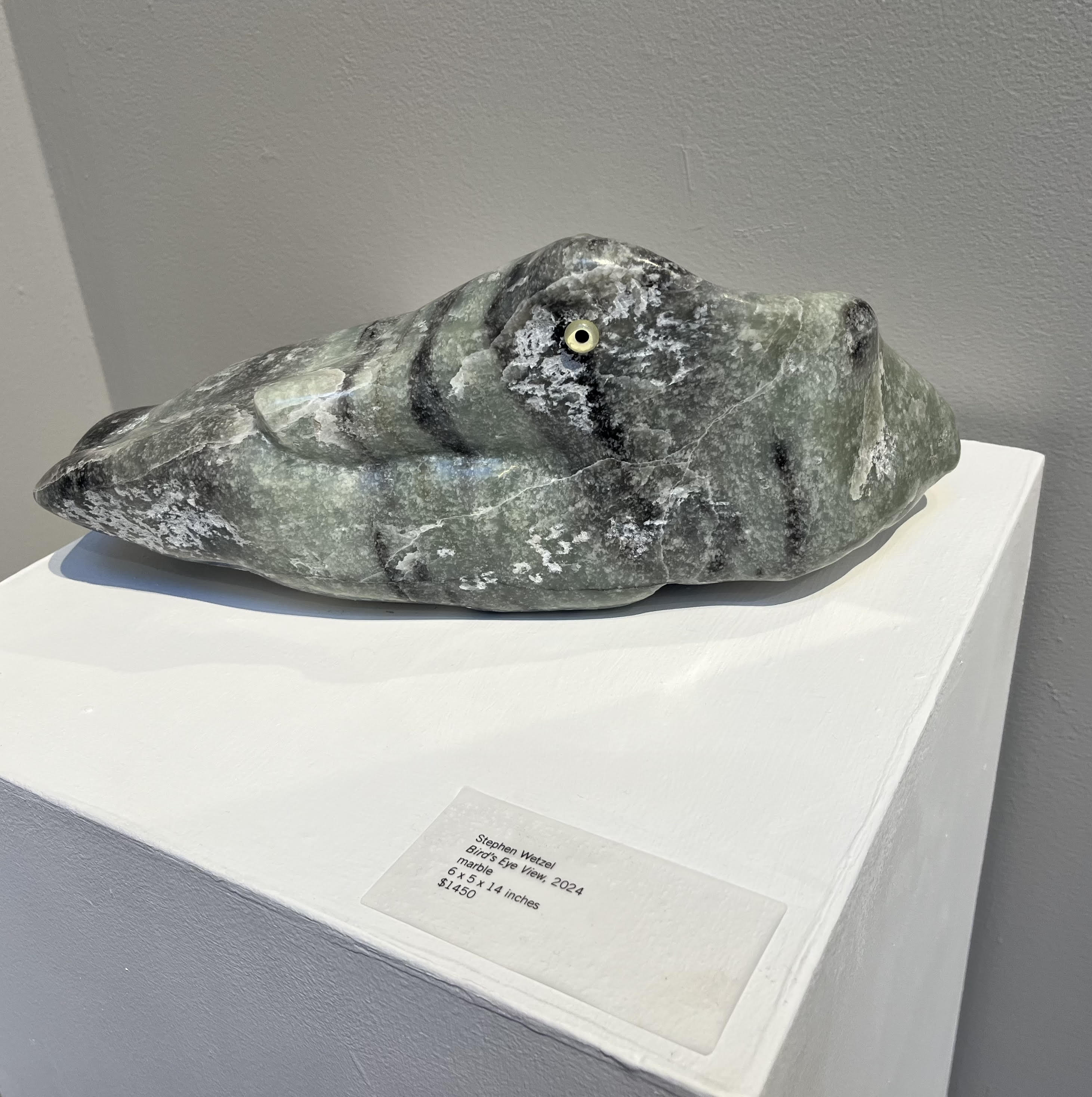
David Smyth created the whale ship for the juried show at Concord Art.

I wind up with a couple of my favorite photographic interests — reflections and shadows.