Feeds:
Posts
Comments

Photo: Stiftung Jüdisches Museum Berlin/Jewish Museum Berlin/ Convolute 816/Curt Bloch collection
Het Onderwater Cabaret, 1943. The satirical magazine, now on exhibit in Berlin, was produced by a German Jew hiding in a Dutch attic during the war.

Both the New York Times and the Guardian reported recently that a German Jew, hiding like Anne Frank in a Dutch attic during WWII, produced an angry, humorous magazine because he could. His magazine was in the news thanks to an exhibit in Berlin.

Nina Siegal writes at the Times that many people hid in attics during the war but that Curt “Bloch’s experience was different because, in addition to sustenance and care, his helpers brought him pens, glue, newspapers and other printed materials that he used to produce a startling publication: his own weekly, satirical poetry magazine.

“From August 1943 until he was liberated in April 1945, Bloch produced 95 issues of Het Onderwater Cabaret, or the Underwater Cabaret. … Writing in both German and Dutch, [he] mocked Nazi propaganda, responded to war news and offered personal perspectives on wartime deprivations.”

Charlie English at the Guardian has more from the perspective of Bloch’s daughter, Simone, now 64.

“As the daughter of antiques dealers, Simone Bloch grew up in a New York house filled with rare and mysterious materials. The dining room was packed with precious volumes, including a collection of small, hand-written magazines, illustrated with collages in a dadaist or surrealist style.

“ ‘All of my parents’ books were kind of intimidating,’ Simone, now 64, says. ‘But this was weirder. It wasn’t something I would ever want to pick up.’

“She found them a little creepy, with their frequent images of Adolf Hitler and other wartime leaders. It was only many years later that Simone came to understand that these magazines represented her father’s resistance to the Holocaust.

“Born in Dortmund in 1908, Curt Bloch was the first in his family to go to university, studying law in the German capital, which at that time was the centre of the buzzing avant-garde cabaret scene. Curt was Jewish and objected to Hitler from the first. In 1933, when Hitler introduced a law banning Jews from civil service positions unless they had fought in the first world war, Bloch wrote a biting response to the authorities, declaring that, no, he hadn’t served in the war since he was only five when it had broken out. When the Gestapo came knocking, Curt was ready. He slipped out of a top floor window with some cash he’d hidden, and fled across the rooftops, eventually reaching Holland.

“But he wasn’t safe for long. The Germans invaded the Netherlands in 1940, and … Bloch took refuge in the crawlspace above the attic of a small suburban house in Enschede, on the German border. It was here that he began to produce the first issue of his magazine. He wrote in fountain pen, made collages from cuttings and stitched the pages together by hand. He called his volume the Underwater Cabaret in reference to the Dutch term for people in hiding, ‘divers,’ and to the favored form of political theatre in Weimar Berlin. Friends in the Dutch resistance helped circulate the Underwater Cabaret to 30 or so other ‘divers.’ They would bring the issue back a week later, by which time Bloch had prepared a new one.

“Alongside political commentaries, Bloch published highly personal writing. His mother Paula and little sister Hélène had followed him to the Netherlands, and had also gone into hiding. In May 1943 they were detained. … He devoted several poems to Hélène, one of which contained the lines: ‘Stay strong against the hatred, betrayal, and scorn / And when the war someday comes to an end / I will go looking for you.’

“Writing this kind of material was extremely dangerous. … Why take the risk? Simone believes it was a way for her father ‘to fight his own despair.’ It was a demonstration that, even in such circumstances, resistance was possible. ‘It’s getting away with something when you can’t get away with anything,’ Simone suggests. …

“In all, Bloch produced 95 magazines. The last issue is dated 3 April 1945. By that day Enschede had just been liberated, and Bloch could leave his hiding place. He travelled back to Amsterdam, where he met and married an Auschwitz survivor, Ruth Kan. In 1948 they emigrated to the US. …

“It was only recently, after years of research conducted in part by her daughter, Lucy, that Simone came to understand the full significance of the zine as a rare literary monument capturing a terrible period in history.”

More at the Times, here. And at the Guardian, here. Is it any wonder that today’s Germany is a loyal supporter of Israel? Unlike America, I suggest, Germany has reckoned with the weight of history.

All 95 copies of the Underwater Cabaret are on loan to the Jewish Museum Berlin, where an exhibition will run to 26 May.

Photo: Signature Theatre.
A behind-the-scenes look at the rehearsal process for the musical Private Jones, featuring deaf and hard-of-hearing artists.

When we were watching the Hulu series Only Murders in the Building, we noticed efforts by the producers to be inclusive. For example, a key character is deaf. When he is on, he uses sign language and we read subtitles. A few other characters use signing for his benefit. He can also read lips.

A push for diversity and inclusion is not happening only in streaming services. At the Signature Theatre in Virginia, for example, deaf and hard-of-hearing characters powered a whole musical.

As Thomas Floyd has the story at the Washington Post.

“Signing, singing and soundscapes are intermingled on a late-January afternoon at Signature Theatre’s Arlington, Va., rehearsal studio, where the cast of Private Jones is marching through the world-premiere musical’s opening scene.

“Loosely inspired by Gomer Jones, a deaf sniper who fought in World War I, the show opens in rural Wales with an 8-year-old Jones getting a lesson from his gruff father in sharpshooting and hard truths. As the only scene before Jones loses his hearing, it uses radio-play-like foley effects to create the sounds that will echo in the character’s head through the rest of his life — and give deaf and hard-of-hearing audiences visual cues to associate with those sounds.

“When Johnny Link, the hard-of-hearing actor playing Jones, raises a prop rifle, another performer flaps an umbrella to conjure the sound of birds fluttering overhead. A ratchet replicates a rifle cocking. A snare drum stands in for a gunshot. All the while, two actors narrate — one in spoken English, one in American Sign Language — and writer-director Marshall Pailet reminds his cast to be aware of the open captions that will flank the stage at every show. …

“Accessibility is a guiding principle for [writer-director Marshall Pailet], the hearing playwright and composer who wrote the book, music and lyrics for Private Jones. … The musical features a cast of hearing, hard-of-hearing and deaf actors performing dialogue in three languages — English, ASL and British Sign Language — while also delivering Pailet’s Celtic-inspired score. To Pailet and Alexandria Wailes, the show’s director of artistic sign language, no scene should be staged without careful consideration of how narrative intent is both seen and heard.

“ ‘If the piano does something that is supposed to evoke an emotion and there’s not a visual equivalent of that, we haven’t done our job,’ Pailet says. ‘Theater is taking psychology and turning it into behavior. So everything is visual, everything is behavioral, and it’s also therefore a perfect medium for sign language, which is a visual language. It exists to be seen.’

“Pailet acknowledges that the origins of Private Jones are fairly mundane: He was interested in writing a World War I trench warfare story — specifically exploring how being asked to commit violence can reorient a person’s worldview — when he came across an article with a couple of sentences about the deaf Welsh sniper. …

“After traveling to Wales … and tracking down war records he believes belonged to Jones, Pailet took an early iteration of the show to Connecticut’s Goodspeed Festival of New Musicals in January 2020. He subsequently connected with Wailes, the ASL master on the Oscar-winning film CODA, and the duo began swapping ideas during the pandemic on how to better integrate deaf and hard-of-hearing perspectives.

“While the show features a narrator performing in ASL, Wailes pitched the idea of also incorporating British Sign Language during dialogue exchanges between characters who would have spoken in that wholly different dialect. …

“Finding the right actor to enlist as Jones — a deaf character who tricks his fellow soldiers into thinking he’s hearing and carries much of the show’s vocals — also proved critical. As a musical theater performer who has used hearing aids since childhood, Link came with connections to the hearing and deaf worlds that the character bridges. …

“ ‘I have never felt so seen in a character,’ Link says. ‘Truly, this is one of the most special projects I’ve ever worked on because it pulls from different parts of my life. I feel a lot of the things that Gomer feels. I just knew I had to do it.’

“Pailet says unfamiliar perspectives are at the core of Private Jones, which uses its innovative soundscapes to place the audience in Jones’s shoes while interrogating how people empathize with or dehumanize those they don’t understand. …

“Having spent the better part of five years developing the show, Pailet hopes this isn’t his last shot at envisioning Jones’s journey onstage.”

More at the Post, here.

House of Trees

Photo: Mitchell Joachim/Terreform ONE.

Most builders rely on steel and concrete in construction, but the production of those materials is bad for the environment. That’s why innovative thinking in architecture is so important. At Fast Company, Nate Berg describes one unusual experiment.

“In a forest along the Hudson River north of New York City, a strange new building is slowly rising. The strangeness of the building is that it’s meant to be occupied by humans, animals, and plants. The slowness of the building is that it’s made out of — made by, really — growing trees.

Fab Tree Hab is a 1,000 square foot tent-shaped pavilion that uses grafted white willow trees to form its walls and roof. Using a computer-designed scaffolding system to precisely guide their growth, these trees are bent to create a living canopy that will, through specifically placed tree grafts and planter boxes, fill out the form and structure of the almost-entirely bio-based building. The scaffold can eventually be removed and reused elsewhere. Within 10 years, it would be a kind of multi-armed and interconnected mega tree house. It’s a prototype that could show how buildings may eventually be grown rather than built.

“The project comes from Terreform One, a nonprofit art, architecture, and urban design research group led by architect Mitchell Joachim. The idea behind this project has had a tree-like maturation period, starting from seed around 2002. Habitat for Humanity had launched a design competition looking for new approaches to building suburban housing. At the time, Joachim was pursuing a PhD in architecture at the Massachusetts Institute of Technology, exploring the application of ecological processes to design.

“Along with fellow doctoral researchers Lara Greden and Javier Arbona, he began to explore new ways ecological processes might be applied to the design brief of getting massive amounts of housing built. …

“The idea of shaping trees into usable structures goes back thousands of years. ‘You can find examples of this within illuminated manuscripts, within the bible,’ Joachim says. The main problem, though, is that these structures take a long time to grow.

“Joachim and his collaborators began thinking of ways to accelerate the process. Initially they explored growing trees hydroponically, and transplanting them into a scaffold. This would have given them height very quickly, but the strength of the trees would have been less than naturally grown trees. With hopes of turning this tree-based system into a viable approach to building, Joachim and his collaborators decided they also needed that strength.

“By this point, Joachim was years into the research process, and had launched Terreform One. In looking at other methods for growing trees quickly, the team learned about biomass farms, which grow trees that are harvested and burned to create electricity. These farms grow tightly packed rows of trees that rise dozens of feet in height within just a few years. The tall, slender trees seemed perfect for use in the scaffold Joachim and his team envisioned. The design shifted and the project was reoriented around replanting white willows harvested from a commercial biomass farm.

“The Fab Tree Hab pavilion that’s now standing in the forest in New York is made up of these replanted trees. Planted together in clusters, the trees make up a few dozen vertical ribs of the pavilion. Designed to graft together over time into a thicker tree, each cluster forms what will be a pillar of the building.

“While they’re still young and pliable, the clusters have been bent into the mass timber scaffold, which is itself a unique piece of architecture, appearing somewhat like an upside-down boat hull. The ribs of the scaffold guide the trees upwards and along the path of what will eventually be a sloping pitched roof. In the wall space between the vertical trees, the scaffold is outfitted with planters and habitat for other plant and animal species, each made from biodegradable materials like hand-crocheted jute and bioplastic. After a year’s growth, it’s estimated that the tree elements will be able to physically support the weight of these planters and habitat structures.

“ ‘It is kind of a land coral, or a terrestrial reef. It attracts all kinds of things to live inside it and around it and underneath it and then thrive in that section of the forest,’”’ Joachim says.

‘On day one we had frogs move into the shelter.’

“About halfway up the arched pavilion, additional planters create space for the Fab Tree Hab’s key architectural element. This is where additional trees can be grafted onto the tree structure as it matures, enabling the building to rise even taller. …

“ ‘The point of the entire structure is a prototype to really get this right so that this could be replicated anywhere,’ Joachim says. He envisions the system being scaled up, made into a kit of parts people could use to grow, say, a garage or a backyard pergola, and eventually even a house. There could be tree-walled museums grown over a decade, or even opera houses with resonant walls of willow timber that are alive and still growing.”

More at Fast Company, here. No paywall.

Photo: Riley Robinson/Monitor Staff.
Kawehnokwiiosthe teaches the Mohawk language to students from both sides of the US-Canada border at the Akwesasne Freedom School, St. Regis Mohawk Reservation, northern New York.

Today many languages are in danger of dying out as the elders who speak them die off and young people don’t learn them.

Fortunately, in some places there are efforts to educate new speakers. Consider this Mohawk language school at a reservation in upstate New York.

Sara Miller Llana writes at the Christian Science Monitor, “Students and teachers, as well as some parents, sit on two wooden benches running the length of the hallway of their school, organized not by age or grade but by their clans.

“They take turns reading from the Ohén:ton Karihwatéhkwen, which translates from the Mohawk language to ‘Words before all else.’ These words, which recognize all life forces in creation, mark the day’s start at the Akwesasne Freedom School.

“But the 60-odd students here wouldn’t understand these lessons if it weren’t for this little schoolhouse at the United States-Canada border that for decades has been fighting to preserve Mohawk language and culture. ‘This makes us who we are, and if we don’t have this, who are we going to be?’ asks teacher Kawehnokwiiosthe, whose name in English means ‘She makes the island beautiful.’ …

“Kawehnokwiiosthe turns to her young pupils, who introduce themselves by their clans – Wolf, Bear, and Eel – and state that they are wisk, or age 5. Every class in K-8 that students take is full language immersion.

When a child asks a question in English, Kawehnokwiiosthe responds in Mohawk.

“Most parents pay tuition with a quilt sold at an annual auction in August. The school is run as a co-op, where parents do the cleaning (along with the students) and the maintenance work. Students come from American and Canadian sides of the border, but the school has never accepted funds from either government, says Alvera Sargent, who heads the nonprofit Friends of the Akwesasne Freedom School and is one of the last first-language speakers of Mohawk.

“That makes her precious, says Waylon Cook, former teacher and now project manager of the school’s nonprofit arm. ‘We treasure our first-language speakers,’ he says. … ‘If you lose [Mohawk], you can’t go to France like you could to learn French. There is nowhere else to do it but here.’ More at the Monitor, here.

Meanwhile, in the state of Washington, there’s an effort to bring Native language teaching into public school, too.

Lauren Gallup wrote at Northwest Public Broadcasting, “A number of Washington state public schools are partnering with tribes to bring Indigenous languages into classrooms in an effort to rectify the marred history of Native American boarding schools.

“Rachael Barger is a teacher on special assignment with Bethel School District, one of the districts partnering with the Nisqually Tribe to bring its Southern Lushootseed language into the classroom for a small subset of students. 

“5% of Bethel’s student population identifies as American Indian, Alaskan Native, two or more races or Hispanic and Native. Barger serves over 200 Title VI Indian Education Program students for the district. Title VI is a federal program that aims to meet the specific needs of Native American students. 

“The tribe and district have partnered, so far, to bring the language classes to two elementary schools for students who qualify for Title VI. Bethel School District had 461 qualifying students this last school year, which is around 2% of its student population.  Barger said those students were excited to learn the language because it felt unique to them. …

“The tribe’s partnership with the Bethel schools is part of the Nisqually Language Resource Center which started two years ago.

“ ‘It makes  it chokes me up,’ said Catalina Sanchez, research coordinator for the center. ‘It’s just something new that we’ve always needed in our community. So I’m proud of us for finally getting our own program in our schools and in our community.’

“The language work being undertaken by the tribe is part of broader efforts to expand and uplift culture and identity for the tribe. 

“ ‘You’re starting to see everything kind of awakening right now here in Nisqually,’ said Willie Frank III, chairman of the Nisqually Tribe. …

“Frank said he thinks it’s a perfect time to focus again on the tribe’s cultural traditions. ‘What I was taught was to tell our story, and, you know, keep building our people up,’ Frank said, ‘and that’s what we’re doing with all this great work in here. I think about the art, the culture and the language; that’s going to be something that sustains us.’ ” 

More at Northwest Public Broadcasting, here. No paywall for either article.

Photo: Chris Crowe/Smithsonian National Zoo & Conservation Biology Institute.
The endangered white-naped crane is difficult to breed in captivity. But then a zoo keeper in Virginia bonded with one.

This year marked the death of a white-naped crane called Walnut, a bird unusual not only for her rarity but for her predilections. Let’s go back a few years and learn why she was unusual.

At the Washington Post in 2018, Sadie Dingfelder wrote about the crane that fell for a human.

“Early one summer morning, as rain is misting the foothills of the Blue Ridge Mountains, a middle-aged man is courting a crane. Chris Crowe, 42, bends forward in a slight bow and then flaps his arms slowly, like wings. ‘Hey, girl, whatcha think,’ he coos.

“Walnut has heard that line before. The stately bird ignores Crowe, reshuffles her storm-cloud-gray wings, and snakes her head gracefully to the ground, looking for something tasty to eat.

“ ‘Come on, now,’ Crowe says. The zookeeper grabs a fistful of grass and tosses it into the air. This is Crowe’s sexiest move — a sly reference to building a nest together. Walnut looks up, curiosity glinting in her marigold eyes, but then she returns to probing the soft, wet ground with her bark-colored bill. She’s simply not feeling romantic. …

” ‘Try getting in the van,’ Crowe calls to me. I follow his suggestion, and, almost immediately, Walnut starts responding to Crowe’s overtures. She returns his bows and then turns away from him and holds her wings loosely away from her body. Kneeling behind the bird, Crowe rests a hand gently on her back. …

“This strange cross-species seduction has helped ensure that white-naped cranes continue to exist, at least in captivity, says Warren Lynch, a fellow zookeeper at the Smithsonian Conservation Biology Institute.

‘It’s amazing, what Chris has accomplished with Walnut,’ Lynch says. ‘This isn’t something just anyone can do.’

“When Walnut arrived at the Front Royal, Va., endangered species breeding center, back in 2004, she was the most genetically valuable white-naped crane in captivity. At 23, she had yet to produce a single chick. … Walnut hatched on July 2, 1981, in an old horse barn in Baraboo, Wis. … Volunteers named her, somewhat randomly, after their favorite dessert at a nearby diner, a walnut cream pie.

“The foundation was in full-tilt crane-making mode, trying to churn out as many of the rare animals as possible, recalls former ICF ornithologist Michael Putnam. When a pair of cranes produced eggs, staff would put the eggs in an incubator, which would prompt the pair to make more.

“Walnut’s parents [were] captured illegally in China and smuggled to Hong Kong. … They were intercepted by local authorities and eventually shipped to the [International Crane Foundation].

“Though it would have been better to return the birds to the wild, international tensions in 1978 made that impossible, Putnam recalls. Plus, no one knew exactly where in China they had been captured, or what the birds might have been exposed to during transit. ‘We didn’t want to release birds that might carry diseases and put them back into the wild flock,’ Putnam says.

“This kind of poaching is less common today, but the white-naped crane population is falling fast because of a more relentless foe: booming human populations, which are overtaking, polluting or draining the wetlands that the birds need to survive. ‘One pair of cranes, to breed, usually requires huge wetland areas,’ Archibald says. ‘It may be several acres, it may be several hundred acres.’

“In addition to demanding vast areas of untrammeled wilderness, these difficult birds seem almost drawn to marginal places. For instance, one of the white-naped cranes’ most important wintering grounds is the 2.5-mile-wide demilitarized zone that separates North and South Korea. There, in a strange, de facto nature preserve, white-naped cranes and their even-more endangered cousins, red-crowned cranes, root for tubers among the land mines they are too light to trigger. If tensions between the Koreas subside, however, the cranes will be in trouble. Farmers are already clamoring for access to the nutrient-rich land, and developers are planning for a reunification city and deepwater port.”

The long and fascinating article at the Post is here, but paywalled. So check out Walnut’s history at the Guardian obit, here.

It reads in part, “Walnut, a white-naped crane and internet celebrity, has died at the age of 42. She is survived by eight chicks, the loving staff at the Smithsonian’s National Zoo and Conservation Biology Institute, and by Chris Crowe – a human zookeeper whom Walnut regarded as her proxy mate for nearly 20 years. …

“Walnut was hand-raised by people and bonded with her human caretakers. That preference continued when she came to the institute – she showed no interest in breeding and even attacked male crane suitors. … As the offspring of two wild-caught cranes, Walnut’s genes were not represented in US zoos. So convincing Walnut to breed was regarded as a priority.

“Crowe, according to a zoo statement, won her over by ‘observing and mimicking’ the institute’s male white-naped cranes’ actions during breeding season. … Once Crowe had gained her trust, he was able to artificially inseminate her using sperm from a male crane.

“The unique arrangement was very successful and Walnut laid fertilized eggs that eventually hatched eight chicks. The fertilized eggs were given to other white-napped crane pairs who tended to them as their own. …

“Earlier this month, keepers noticed that Walnut wasn’t eating or drinking, even her favorite treats, frozen-thawed mice, peanuts and mealworms, couldn’t spark her appetite. The bird declined and, surrounded by an animal care team, died peacefully, an autopsy revealing the cause of death to be renal failure. …

“Crowe said, ‘Walnut’s extraordinary story has helped bring attention to her vulnerable species’ plight. I hope everyone who was touched by her story understands that her species’ survival depends on our ability and desire to protect wetland habitats.’ ”

Makes me think of the book Birdy — only the guy really thought he was a bird. Remember that?

Photo: Safeed Rahbaran/New York Times via the Las Vegas Sun.
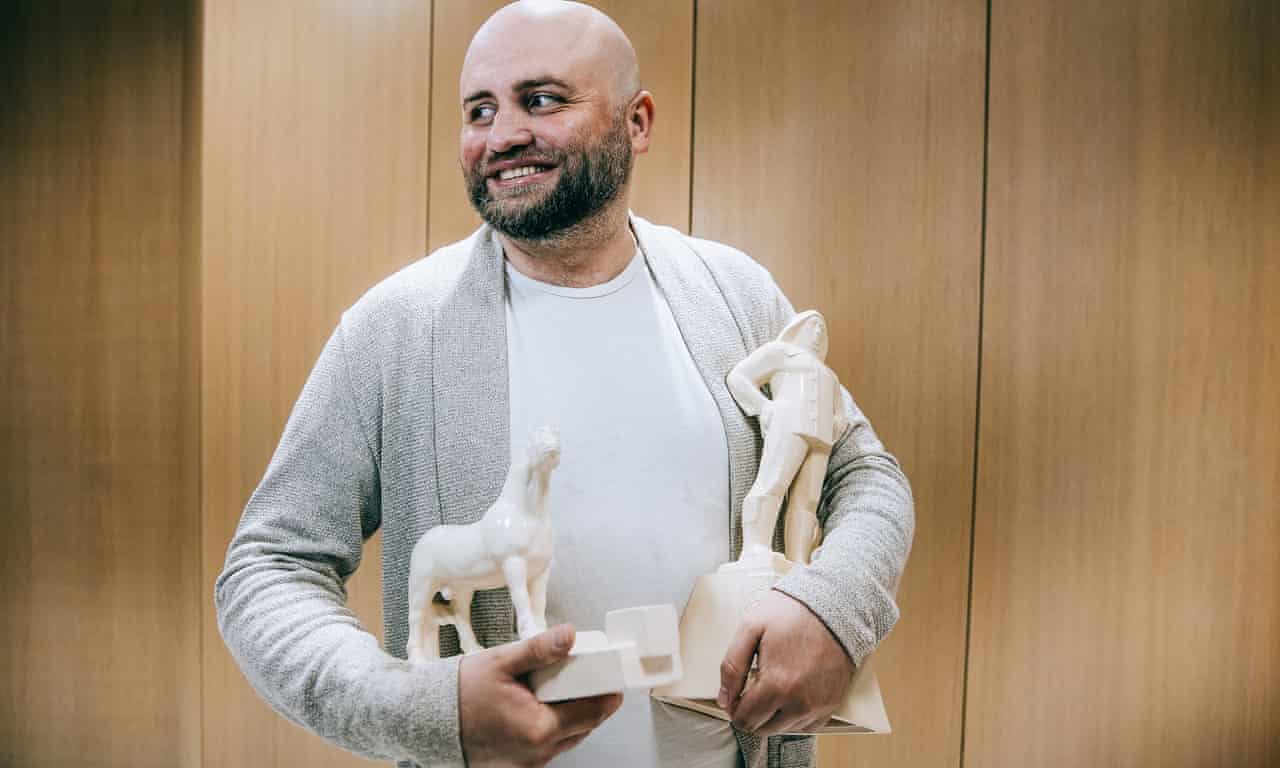
“George Lee at the Four Queens Hotel and Casino in Las Vegas, on Jan. 16, 2024. Lee was the original Tea in ‘George Balanchine’s The Nutcracker,’ ” says the New York Times. “A documentary filmmaker found him and a lost part of ballet history in Las Vegas.”

Several of my good friends from college are Chinese. I don’t know if I am stereotyping my friends, but having come from a throughly impractical family, I was impressed at once with what seemed to me a startling level of practicality. Practicality about what kinds of courses to take for what kind of well-paying jobs; even practicality about potential marriage partners.

So one of the things that struck me about the mother in today’s lovely story was the way she helped her son earn rice during the Japanese occupation of China and her advice to him when they headed to America.

Siobhan Burke reports at the New York Times, “Among the blaring lights and all-hours amusements of downtown Las Vegas, in a sea of slot machines at the Four Queens Hotel and Casino, George Lee sits quietly at a blackjack table, dealing cards eight hours a day, five days a week, a job he’s been doing for more than 40 years.

“Lee, 88, was likely in his usual spot when the filmmaker Jennifer Lin was sifting through old photos at the New York Public Library for the Performing Arts in 2022, wondering what had become of a dancer with a notable place in ballet history. Pictured in a publicity shot for the original production of ‘George Balanchine’s The Nutcracker,’ in the role known as Tea, was a young Asian dancer identified as George Li.

“For Lin, a veteran newspaper reporter turned documentarian, the picture raised intriguing questions. In 1954, when the photo was taken, it was rare to see dancers of color on the stage of New York City Ballet, the company Balanchine co-founded. Who was this young man, this breaker of racial barriers, this pioneer? Was he still alive? And if so, what was he up to?

“ ‘I became absolutely obsessed with trying to find out what happened to George Li,’ Lin said in a video interview.

“In just over a year, that obsession has blossomed into a short film, Ten Times Better, that chronicles the unexpected story of Lee’s life: from his childhood in 1940s Shanghai, where his performing career began; to a refugee camp in the Philippines, where he fled with his mother, a Polish ballet dancer, in 1949; to New York City and the School of American Ballet, where Balanchine cast him in ‘The Nutcracker’; to Flower Drum Song on Broadway, his first of many musical theater gigs; and ultimately, to Las Vegas, where he left dance for blackjack dealing in 1980. (He changed the spelling of his last name in 1959, when he became a United States citizen.) …

“ ‘So many years I haven’t done ballet,’ Lee said over coffee at the Four Queens on a recent Sunday, after his shift. ‘And then suddenly Jennifer comes and tries to bring everything up.’ …

“Lin was not the only one who had been searching for Lee. In 2017, while organizing an exhibition on ‘The Nutcracker,’ Arlene Yu, who worked for the New York Public Library at the time and is now Lincoln Center’s head archivist, was puzzled by the relatively few traces of him in the library’s vast dance collection. ‘Whereas if you look at some of his peers in ‘The Nutcracker’ in 1954, they went on to careers where there was a lot more documentation.’ …

“Lee, in his heyday, was a dancer to know. At just 12, he was already winning public praise. In a preview of a recital of the King-Yanover School in Shanghai, the North China Daily News called him an ‘extremely promising young Chinese boy, whose technique is of a very high standard.’ A reviewer wrote that he ‘already may be said to be the best Chinese interpreter of Western ballet.’ (Lee saved these newspaper clippings and shared them with Lin.) …

“Lee’s mother, Stanislawa Lee, who had danced with the Warsaw Opera, was his first ballet teacher; as a child, he would follow along with her daily barre exercises. Shanghai had a significant Russian population, and with that a robust ballet scene. To earn money, Stanislawa arranged for her son to perform in nightclubs — ‘like a polka dance, or Russian dance, or sailor dance,’ Lee said. The clubs would pay them in rice. …

“In 1951, an American friend of Lee’s father sponsored them to come to New York, where he introduced Lee to the School of American Ballet, City Ballet’s affiliated school. As Lee narrates these twists and turns in the film, one memory anchors his recollections. Before they immigrated, his mother issued a warning. ‘You are going to America, it’s all white people, and you better be 10 times better,’ he recalls her saying. ‘Remember that: 10 times better!’

“The footage of Lee in his 20s suggests he took that advice to heart. In television appearances — with the company of the ballet star André Eglevsky, and in a number from Flower Drum Song on the Ed Sullivan Show — his power and precision dazzle.

“ ‘He was good; he was really good,’ [Phil Chan, cofounder of Final Bow for Yellowface, an initiative focused on ending offensive depictions of Asians in ballet] said. ‘Clean fifth, high jump, polished turns, stick the landing — the training is all there. He’s already 10 times better than everybody else.’ …

“In a 1979 interview heard in the film, the former City Ballet soloist Richard Thomas, who took over the role of Tea, raves about Lee’s peerless acrobatic jumps: ‘He was wonderful! Balanchine choreographed a variation for him that none of us have ever been able to equal.’

“As Lee remembers it … the City Ballet makeup artist put him in full yellowface, and Balanchine insisted he take off the makeup. ‘He is Asian enough! Why do you make him more?’ he remembers Balanchine saying. Lee was costumed in the Fu Manchu mustache, queue ponytail and rice paddy hat often associated with the role, now widely critiqued as racist caricatures. But he said he didn’t take offense. ‘Dancing is dancing,’ he said. …

“He pieced together jobs for more than 20 years, often unsure of what would come next. He was dancing in a Vegas revue, ‘Alcazar de Paris,’ now in his 40s, when a blackjack dealer friend suggested he go to dealer school. ‘I can’t dance all my life,’ he remembers thinking.” More at the Times, here.

Photo: Paula Levihn-Coon/Texas Observer.
Volunteers look at a photo on David Cook’s camera to see the insect he captured.

Because I follow Alex Wild, curator of entomology at the University of Texas at Austin, on Mastodon, I learn more about bugs and Texas than I ever expected to know. Both Texas and bugs turn out to be pretty interesting.

Kit O’Connell has an article at the Texas Observer about an Austin nature preserve that is a good place for most bugs (maybe not yellowjackets).

“The prey is already dying when the hunters arrive. The sky is dark gray, the air thick with the threat of rain. But that hasn’t stopped over a dozen from gathering. They’re mostly, but not exclusively, older folks — frequently retirees with the ability to take a weekday morning off — and they’re armed with Digital SLR cameras and macro lenses.

“Valerie Bugh [I hope her name is not pronounced bug] crouches down over the squirming spots on the stone of the shady courtyard entrance to the Lady Bird Johnson Wildflower Center, prodding at the poisoned insects. Bugh, a gray-haired local naturalist, isn’t responsible for the state of these southern yellowjackets (Vespula squamosa), but she’ll take advantage of it for a photo opportunity. Someone on staff at the center discovered their nest and sprayed them just before the bug hunters arrived, and the entire hive is trickling out from their hidden home in a low rock wall. …

“ ‘I’m trying to find one that doesn’t look dead,’ she said. Soon, she’d even manage to document the hive’s queen as it haplessly tried to flee the toxins — a rare catch, though a grim beginning for a weekly ritual that largely focuses on the living. 

“Bugh is the author of 10 short fold-out pamphlets with color photos, with titles like Spiders of Texas: A Guide to Common and Notable Species and Unusual Insects of Texas: Caddisflies, Mantides, Lacewings, Walking Sticks, & More. That’s just one of her jobs: She’s also second clarinet in the Austin Opera. …

“Every Thursday morning from February through mid-December, Bugh and her team of volunteers in the Lady Bird Johnson Wildflower Center Fauna Project explore a winding path, gradually aiming to cover the entire grounds over the course of a year, in order to inspect more than 650 species of native plants in the gardens and the 50-plus species of oaks in the Texas Arboretum for their occupants. 

“With this diversity of native plants comes a diversity in insect population too. … [Since 2010] she’s identified almost 3,000 species of insect including over 50 bees, 345 flies, and over 500 different beetles. It’s not unusual to find a new species to add to the garden’s known tiny inhabitant list every week. 

“As Bugh gets moving, other bug hunters follow her in a pack. One by one and in pairs they break off. … The group also documents signs of larger animals, from mammals to amphibians, but their main focus is on these tiny crawling creatures, since bugs are the most plentiful fauna present both in this garden and worldwide. 

“The bug hunters move in a little cluster, calling out when they find something new for Bugh to examine. The salt marsh moth (Estigmene acrea) caterpillars are everywhere.

“ ‘If it’s a salt marsh, I don’t want to know about it,’ declares Bugh dismissively, though with good humor. Their hairy bodies remind me of an asp, the caterpillar with a nasty sting. But they’re actually harmless to the touch. Bugh is just frustrated because there are too many of them. Unlike other caterpillars, the salt marsh moths will eat almost any plant, building its hairy cocoons all over. ‘Every single plant is their host,’ Bugh said. …

“As she moves around, her tone becomes more of a graduate lecture in entomology, no doubt similar to the insect walks she sometimes leads around Austin. Her volunteers are here to hone their skills at macro photography, to learn from a preeminent local expert, and to expand their naturalist knowledge. Many are members of the Texas Master Naturalist program. …

“ ‘It’s an insect safari,’ said volunteer Katherine Baker, who told me she relished the challenge of macro photography after over a decade of experience in more general nature photography. She’s been helping count the fauna for about four years now, and always feels among kindred spirits here. But they all orbit around Valerie, returning to her for advice or an ID after wandering off.

“ ‘Her knowledge surpasses everyone … she’s just amazing,’ Baker said of Bugh. 

“The gray morning clouds are starting to burn off. As it warms up, the butterflies and others will begin to emerge from the foliage where they’re resting during the rainy, humid part of the day. 

“ ‘Aha, here’s where the bumblebees are,’ Bugh declares with delight as some are pointed out to her. ‘These are workers and look how docile they are, they’re barely moving.’ …

“On the day we visited, the team spotted seven different kinds of grasshoppers, two types of katydids and one cricket. Hunters often spot the American bumblebee, Bombus pensylvanicus, which is thriving in Central Texas even as its numbers dwindle elsewhere. But lately, its Sonoran cousin (Bombus sonorus) has been showing up more and more in the bug counts. 

“ ‘That doesn’t bode well for desertification,’ Bugh told me. ‘We’ve had a lot of Western species moving in, birds too, which means the habitat is great for them and a little drier than we’re used to for everyone else.’ …

“ ‘The ecosystems are moving east, including tornado alley. It’s not great for the people in the way, and not great for us on the edge of deserts. Think of Austin without any trees. I really like trees,’ Bugh says wistfully.”

More at the Texas Observer, here. The author can be found @oconnell on Mastodon.

Photo: Ben Hovland/MPR News.
Art Shanty #1 stands on the frozen surface of Lake Harriet in Minneapolis.

I once read that an eggshell is simultaneously one of the most fragile and also the most durable of Nature’s materials. Isn’t art like that, too? Both lasting and ephemeral?

Consider the on-again off-again role of ice in artistic output, from New Year’s Eve ice sculptures to colonies of working artists on frozen lakes. Alex V. Cipolle reported at Minnesota Public Radio about the latter.

“In the winter of 2004, something funny was afoot on Medicine Lake. There were ice fishing houses like always. But on the frozen lake, away from the fishing holes, was another shanty. This one was made with shiny red vinyl, a circle window and a wood sign hanging from the door that said, ‘The Poet is In.’

“The inhabitants weren’t fishing. Instead, they hosted birthday parties and built a heart-shaped ice skating rink for Valentine’s Day. They had a sleepover and screened the icy horror flick The Thing.

“This was the first-ever Art Shanty, created by local artists Peter Haakon Thompson and David Pitman.

“ ‘I had been talking with a couple of friends and was trying to convince them that we should build this shanty that we were going to put on Medicine Lake for the winter as our sort of fort-clubhouse-art studio,’ recalls Thompson.

“ ‘Just the creativity of what the possibilities were, were endless,’ Pitman adds. ‘As we’ve sort of seen 20 years later.’

“Twenty years later, one shanty has become a village, and a circle of artist friends became an arts nonprofit — Art Shanty Projects —  annually programming two weeks of free art events on ice. Now on Lake Harriet, Jan. 27 to Feb. 11, the frozen lake becomes a temporary arts community with about 20 shanties, each with a different theme, which host live performances, yoga sessions, and a polar bear (‘Lady Bear’) that walks the grounds. …

“To mark the 20th anniversary of the little red shack, the Art Shanty Projects team has recreated it, calling it Art Shanty #1.

“ ‘I had been going through old photos,’ says Erin Lavelle, the artistic director for Art Shanty Projects. ‘And the picture of the original shanty is just so iconic.’ … Lavelle wanted to bring in new artists to activate the classic shanty, so she tapped Richard Parnell and Tony Chapin, both based in Minneapolis and longtime shanty artists. During December and January, they rebuilt Art Shanty #1 in the Ivy Arts Building in South Minneapolis, using photos of the original as a guide. 

The original shanty was built with found materials and red-vinyl-covered plywood lifted from a Walker Art Center dumpster, says Thompson. 

“ ‘In the spirit of the way they had built theirs, we repurposed a lot of materials,’ Parnell says. Parnell volunteers in public schools so had access to gymnastic floor mats and plexiglass COVID shields that were being thrown out. The floor mats are now insulation and the shields are windows. …

“Thompson and Pitman, who are no longer officially involved with the event, say they are excited to see the shanty recreated, and the art shanty village flourishing two decades on.

“ ‘I don’t think either of us anticipated that it would be something that would continue hardly for any time at all,’ Thompson says. …

“ ‘What really excited me was seeing all these other people coming up with ideas for similar things within the limitations that were kind of set in this unregulated land,’ Pitman says.

“ ‘Relatively unregulated,’ Thompson adds, laughing. (The Hennepin County Sheriff’s Office Water Patrol board and the Department of Natural Resources require permits.) …

“The growing art village hopped from Medicine Lake to White Bear Lake and now Lake Harriet, and has had a few evacuations due to melting ice. In 2023, Art Shanty Projects moved it ashore for ‘Plan Beach.’ … 

“Today, the Art Shanty Projects is sometimes jokingly referred to as ‘Burning Man on Ice.’

“ ‘I’ve always been rankled by the whole Burning Man, Frozen Man comparison,’ Thompson says. The ever-expanding Nevada festival has become infamous for its impact on the environment.  With the art shanties, Thompson says, ‘We’ve followed this “Leave No Trace” ethos on the ice.’ ”

More at MPR, here. No paywall.

This year was one when the ice colony had to evacuate. The New York Times has that story here.

Photo: Suzanne and John’s Mom.
The original version of this classic was not published in Russia until long after the author’s death.

I’m rereading Michael Bulgakov’s The Master and Margarita because I liked it the first time and because a new movie based on the book is getting into trouble in Russia just like the book did.

Talk about book bans! The old Soviet Union was big on banning books, as a Ukrainian friend of John’s told me some years ago. He explained how people had to read unauthorized copies of The Master and Margarita under the table with a flashlight. Why?

On my current reading, I’m paying close attention to the why and how the fanciful elements — the Devil and his shape-shifting minions — must have looked to the government. I guess that satirizing the communist state’s slogans, its hostility to religion, and the way it drove free-thinking creatives into insane asylums was frowned upon.

Christopher Vourlias writes at the magazine Variety about a new film version that’s running up against Russia’s propaganda machine today.

“Just days after the Russian blockbuster The Master and Margarita surged to the top of the domestic box office, Kremlin cronies, pro-war propagandists and an army of online trolls have waged a campaign to discredit the film and its director, Michael Lockshin, a U.S. citizen who was raised in the Soviet Union and has been outspoken in his opposition to the war in Ukraine. …

“Produced by Amedia, Kinoprime and Mars Media Entertainment, The Master and Margarita cost an estimated $17 million, making it one of the most expensive Russian movies ever made. Notably, it also received financing from the state-backed Russian Cinema Fund, a fact that has also stoked the ire of many of the propagandists who are driving the current controversy.

The Master and Margarita, which was written by the Kyiv-born Soviet novelist Mikhail Bulgakov between 1928 and 1940 and published posthumously in Moscow magazine in the 1960s, is widely considered one of the great works of 20th century literature. It is a towering achievement of Soviet satire, heralded for its stinging social commentary and pointed critique of authoritarian rule during Stalin’s reign.

“Lockshin’s big-budget adaptation of this celebrated novel, a blistering critique of Soviet power and authoritarianism … quickly shot to the top of the box office, grossing more than 600 million rubles ($6.7 million) as of Feb. 1.

“Within days, pro-government bloggers, media and TV personalities began waging a campaign against Lockshin, the U.S.-born son of a Russian-American scientist who spent a large portion of his childhood in the Soviet Union and currently lives in Los Angeles. …

“Several screen adaptations of the novel have previously been made, including a popular TV mini-series released in 2005. However, Bulgakov’s iconic cult novel has never been fully realized on the big screen, only adding to the anticipation surrounding Lockshin’s blockbuster, according to influential film critic and radio host Anton Dolin, who says it’s hard to overstate the importance of Bulgakov’s novel on Russian society and culture. ‘A proper film based on it was a dream for everyone,’ he says. …

“German star August Diehl (A Hidden Life, Inglourious Basterds) was ultimately cast in the role of Woland, the Devil-like figure whose arrival in Moscow sets the plot into motion. Russian stars Yevgeny Tsyganov [as the Master] and Yuliya Snigir [Margarita] were cast in the other lead roles.

“The film was shot over the course of four months in 2021, at which point Lockshin returned to L.A. to edit the footage. Universal Pictures International was originally slated to release the movie domestically in 2023. Those plans were upended, however, with Russia’s February 2022 invasion of Ukraine, which prompted Universal and other Hollywood studios to pull out of the Russian market. …

“As the war in Ukraine unfolded, Lockshin freely shared his opposition on social media, though his politics went largely unnoticed at the time in Moscow, where he was still a little-known director. That quickly changed, however, when The Master and Margarita became a box-office smash and a cultural phenomenon.

“For those who have watched the space for public dissent in Putin’s Russia gradually vanish since the Ukraine invasion, the vitriol directed at the filmmaker has stuck to a familiar playbook. ‘The mechanism of persecuting inconvenient people is well established and works like a clock,’ says Anna Mongayt, a presenter and creative producer of the Russian opposition network TV Rain, which was forced from Russia after being shut down by the authorities in 2022.

“ ‘In two years, everyone who disagreed with the war and was ready to talk about it out loud was erased from culture,’ Mongayt says. ‘No amount of fame can save you here.’ “

More at Variety, here. No paywall.

Fortunately, I don’t need to read this once-banned book under the table in the US of 2024. At least not yet. Let’s don’t ban books, America. For one thing, we can always navigate around books we don’t like. For another, banned books never stay banned.

Photo: Boston Globe.
Teenage phenom and pastry chef Piper McAloon.

Some folks are still figuring out their calling when they are on Social Security. Others, like this chef in Bristol, Rhode Island, discover it when they are 11 years old.

Andrea E. McHugh has the inspiring story at the Boston Globe, “When she was a little girl, Piper McAloon had a natural curiosity when it came to baking, and was influenced by popular pastry-centric reality television shows. In her family kitchen, her parents Robin and Patrick encouraged her culinary creativity. What was once an 11-year-old’s lighthearted hobby morphed into the now 17-year-old’s career path.

“The high schooler, who lives in Bristol with her parents and sister, maintains a vegan dietShe applied for a job at Foglia when the plant-based restaurant opened in the summer of 2022, hoping she’d land a server position. But when chef/owner — and fellow vegan — Peter Carvelli, who was just named a semifinalist for 2024 Best Chef Northeast by the James Beard Foundation, saw her self-taught pastry skills for himself, he had other plans.

Andrea E. McHugh: How did you hear about Foglia?
Piper McAloon: Someone told me that there was a new vegan restaurant opening and so I reached out, never thinking I’d be their pastry chef — maybe I’d be a waitress. And I told [Peter Carvelli] about all my baking, and he was like, ‘I want you to be my pastry chef.’ I was so shocked. …

Have you always adhered to a plant-based diet?
“I’ve been a vegetarian since I was 11, and I’ve been vegan for about the past two and a half years. I think I was just kind of losing interest in meat, and like, the ethics of it, and then I cut out dairy. It was a very slow process, and eventually, I cut out eggs and other products. I didn’t have to go vegan, but I’m glad I did. I feel so much better.

Dairy is used in a lot of baking. How did you learn about vegan alternatives when it comes to pastry?
“It’s a big learning curve, learning how to switch everything. I’ve gotten the hang of it, and there’s so many people doing it now. At Foglia, we’re also nut-free, so I can’t use almond milk or any cashew [products]. … I learned so much from videos online and YouTube, I would just absorb so much information. I’ll see something and be like, ‘Hey, I could do this with this or that,’ and completely just take the inspiration and make it my own. Ground flaxseed and water, it gets really thick, and you can use it to replace eggs in different recipes. Aquafaba is more for say, macarons, and whipping, like you would an egg white. …

How has this experience at the restaurant expanded your business skills?
“Oh, it’s awesome. My boss, Peter, is such a great mentor. We’re always working together and he’s very, very supportive of me doing my own thing. I’ve also done a couple of pop-ups at the restaurant. I create a limited menu and he lets me use the restaurant during the afternoon because they’re only open for dinner, and I set up kind of like a mini-bakery, and people come in to buy food and I do all the accounting for it, and he helps me. We use Toast [a restaurant point-of-sale and management system], and if I have a special order for someone, he’ll let me use the kitchen.

What are you making right now for Foglia?
“Panna cotta is one of the things that’s a staple right now. It’s gluten-free and really good. It’s kind of like a custard. Generally it’s made out of gelatin, but I use something called agar, which is big in vegan baking for pastry cream, actually. We also have what we call a brownie snowball. …

What do your future plans look like?
“I’m going to Johnson & Wales in the fall, the Baking & Pastry Arts associates program, and then eventually I want to open a vegan bakery. It’s two years, and right after that I want to, I don’t know, travel and experience food everywhere else, and learn from them, and then eventually, probably a couple years after college, open my bakery. I’m very excited about it — it’s been my dream since I was 10.”

More at the Globe, here. What did you want to be when you were 10? Did you do it? I think I wanted to be an actress. Or maybe a ballerina.

Photo: John and Suzanne’s Mom.
Beautiful clouds and farm. How much is enough?

Although there are people in every country who strive for balance in their lives — people who are happy with having just enough — in Sweden, it’s a way of being that has its own name.

Erika Page reports at the Christian Science Monitor about the Swedish concept of lagom.

“The ladder she’s standing on rattles in the wind, but Havana Dadian’s paintbrush is steady. With freezing fingers, she lays color inch by inch onto the whitewashed wall. The street below is empty, as residents shelter from an approaching storm. 

“The muralist was hired to spruce up the working-class neighborhood of Södra Sofielund in Malmö, just blocks from where she grew up.  More than that, Ms. Dadian is painting for the future of her country. 

“ ‘I wanted to shine light on the beautiful soul of Sweden,’ she says, gesturing to the sketch on her phone. She is painting a scene from the 1940s, back when this building was home to a neighborhood laundry house. It was a time of community, frugality, and hard work – which she sees as the foundation of Sweden’s egalitarian prosperity.

“ ‘Something has happened, and it’s not so certain anymore – the safety, feeling that you have everything you need,’ says Ms. Dadian. 

At stake is a uniquely Swedish philosophy: lagom. It’s a difficult-to-translate word meaning not too much, not too little, but about right.

“The lagom amount is just enough. The lagom solution is reasonable, appropriate, and moderate. … To be lagom is to respect the rules of the group. 

“ ‘Lagom is one for all and all for one,’ says Ms. Dadian. ‘It was a way for everyone to come together, for everyone to get their share.’

“Yet Sweden appears to be reaching a turning point. The threads of lagom seem to be fraying, as social services come under increasing stress and politics reach unprecedented levels of polarization. Public discourse, dominated by talk of rising rates of violent crime and gang activity, is bringing to light fears about the erosion of social trust. Some wonder whether the economic pie is still big enough to go around. Others question the very foundation of a growth-based economy, pushing instead for a return to ‘just enough.’ …

“The country was a poor, agrarian society of low taxes and limited government until the mid-19th century. Without a feudal system, farmers in decentralized villages worked primarily for themselves, laying the foundation for a society with a relatively flat hierarchy that rewarded hard work. These farmers were of minor importance to the government as individuals but powerful as a collective, making cooperation key. …

“While socialists in other parts of the world sought complete control over the means of production in the early 20th century, the socialists who gained traction in Sweden took a more lagom tack. They believed in harnessing the power of the market through taxation and redistribution to achieve social goals. By the 1960s, Sweden had one of the most robust social support systems in the world and one of the most egalitarian income distributions.  

“ ‘A lagom economy is a pragmatic economy,’ says [Andreas Bergh, an economist at Lund University, near Malmö]. ‘At its best, Sweden has combined the benefits of a capitalist, well-functioning market economy with a relatively generous social welfare state.’

“Salaries may be lower than those for comparable job titles in the United States or United Kingdom. But for many people, that difference is compensated by free education from preschool through university, universal health care, generous pension and unemployment systems, housing allowances, and other social safety measures. …

“Social trust – including faith that people are not taking advantage of the system – is a key ingredient in the lagom mentality, ‘where people share similar interests and work together for the benefit of the group,’ says Dr. Bergh. … Recently, however, a new narrative has taken hold among some, suggesting that perhaps Sweden was once the land of lagom – but no longer. 

“A financial crisis in the early 1990s led to near political consensus that the welfare state had become too hefty. Over the past three decades, the government has slashed taxes and public spending. Sectors from education to health care and elder care have increasingly been privatized. 

“To some, this privatization is lagom, allowing for a healthy balance between the public and private spheres. … Others take the privatization as a sign that Sweden is losing its lagom-ness. 

“Tax cuts mean there is less funding today for social services. Wait times for health  services have grown notoriously long; during the pandemic, the weaknesses in Sweden’s elder care system became impossible to ignore. And since the 1980s, income inequality has increased more than in any of the other 37 countries in the Organization for Economic Cooperation and Development, though still low by international standards.

“Sweden has a reputation of being one of the most welcoming countries in the world for migrants and refugees. [But recently] neighborhoods have become more segregated, with unemployment rates higher among immigrant communities. …

“ ‘My Swedish friends have an innate safety feeling,’ says Ms. Dadian, the muralist, whose mother is Swedish and father is from Lebanon. ‘[For] my friends with mixed backgrounds … it’s starting to feel more like a movie sometimes: drugs, guns, no trust, and much involvement with the police. It can be like different worlds.’ …

“Jon-Mikko Länta, one in a long line of Sámi reindeer herders, has struggled to find that [lagom] balance in his own life as the cost of living has risen. 

“ ‘I was working a lot, all the time, working, working, working. All the money went to buying new stuff, buying new stuff, replacing old stuff,’ he says. 

“But then he began to simplify. He stopped buying the latest tools and took new pleasure in repairing old things. He bought a piece of land outside the town, where he is building a campsite for visitors – and for his reindeer. He’ll be able to continue herding while supplementing his income and spending more time with his wife and three young children.

“It’s a different kind of satisfaction, says Mr. Länta during a lunch break in his kitchen. Dishes are stacked waiting to be washed; half a bottle of milk has been left behind by their 2-year-old. Mr. Länta’s work pants are patched with tape.

“For him, [a controversial local] mine would bring ‘catastrophic’ changes to Jokkmokk, eroding respect for reindeer herding and the natural world. ‘It pinpoints exactly what’s sick with the Western society. … [It’s] built upon growth, and as much growth as possible. And that’s completely unsustainable.’  

“He wishes debates about the mine would take lagom into account, he says, helping residents ‘feel the contentness of enough.’ ” 

More at the Monitor, here. No paywall. Subscriptions encouraged.

I liked the pictures that went with this article. They had a peaceful feeling.

Photo: ABC News.
Flaco, the Eurasian eagle owl who escaped from his vandalized Central Park Zoo enclosure, seen on Feb. 18, 2023, in New York City.

Having recently read a children’s book about wild animals in a park like New York’s Central Park who were trying to free captive zoo animals, I am still pondering the message that freedom isn’t right for every once-caged creature. Now comes new detail on the death of Central Park Zoo’s escaped Eurasian eagle owl, Flaco, and some news on creating a statue in his memory.

Elaine Velie reports at Hyperallergic, “More than 3,000 people have signed a petition urging New York City to install a permanent statue in honor of Flaco, the beloved Eurasian eagle owl who died [in February]. The proposed monument’s design would involve a pedestal with a protruding branch where Flaco’s sculpture would perch for eternity. 

“Few members of the animal kingdom have captured the imagination of New Yorkers quite like the bird who was set free from his enclosure in the Central Park Zoo last year. Flaco, who was 12 at the time of his release, managed to live for more than a year in Manhattan, where he developed a devout following before colliding with a window on the Upper West Side last week. 

“Petition author Mike Hubbard, a 34-year-old musician who has lived in NYC for 12 years, told Hyperallergic that Flaco initially inspired him because of the bird’s ‘against-all-odds’ survival story. Though the owl had lived in captivity all his life, he was able to learn to hunt, most famously capturing rats. …

“Hubbard said. ‘He had people looking up instead of at their phones, and for once, everyone from all walks of life had someone to cheer for. It was beautiful.’ …

“Erecting commemorative statues in Central Park, however, is a lengthy process that requires rigorous rounds of public review. Few projects get approved. Still, New Yorkers have already taken the initiative to memorialize Flaco, creating ad hoc artistic tributes to the iconic bird.

“Native to a wide swath of land stretching from Siberia to the tip of Ethiopia and as far east as the Himalayan foothills, Eurasian eagle owls can live up to 60 years in captivity and 20 in the wild. Flaco died just short of 14. …

“ ‘Flaco’s swift adaptation to life in the wild inspired people all over the world,’ David Barrett, who runs the popular Manhattan Bird Alert X account, told Hyperallergic, adding that he ‘seemed to love being a free owl.’ ” More at Hyperallergic, here.

Ed Shanahan at the New York Times has details on the autopsy: “Flaco, the Eurasian eagle-owl whose escape from the Central Park Zoo and life on the loose captivated New York, had enough rat poison and pigeon virus in his system to kill him even if he had not died after apparently striking an Upper West Side building last month.

“The finding, from a necropsy conducted by Bronx Zoo pathologists after Flaco’s death on Feb. 23, validated widespread concerns about the hazards he faced living as a free bird in Manhattan for just over a year. …

“ ‘Flaco’s severe illness and death are ultimately attributed to a combination of factors — infectious disease, toxin exposures and traumatic injuries — that underscore the hazards faced by wild birds, especially in an urban setting,’ [said] the Wildlife Conservation Society, which operates the Central Park and Bronx Zoos.” More at the Times.

Photo: Rafael Viñoly Architects.
This airport in Italy will incorporate “multi-modal transport” links as well as … a vineyard.

No matter how innovative and complicated an architectural design is, it’s the quirkiest little thing that captures the attention of the public. As a member of the public, I am really hoping that the plans for a working vineyard on the roof of an airport in Florence will work out.

Lizzie Crook writes at Dezeen, “US studio Rafael Viñoly Architects has unveiled its plans for an international terminal at Florence Airport in Italy that will be crowned by a 7.7-hectare [19 acre] vineyard.

“The airport terminal will encompass 50,000 square meters [538,196 square feet] and is expected to be used by more than 5.9 million passengers annually. …

“The terminal’s main feature will be a vast sloping roof, which will be lined with skylights and 38 rows of usable vineyards.

“According to Rafael Viñoly Architects, this is a nod to Florence’s reputation as ‘the heart of Italy’s renowned wine country. … A leading vintner from the region will cultivate the vineyards, and the wine will be crafted and aged in specialized cellars beneath the terminal’s roof.’

“Inside, the terminal will feature a large piazza-like space at its centre, which will be flanked by the arrivals and departures areas on opposite sides. This central space will be linked to transport, parking and retail spaces open to both passengers and local people, and is hoped to streamline circulation for the terminal.

“Other key elements of the proposal include the reorientation of Florence Airport’s, formerly Aeroporto Amerigo Vespucci, existing runway by 90 degrees. This move will turn the runway away from the surrounding hills and lengthen it to better suit modern aircraft.

“The plans will also improve the airport’s links to the city and wider region through ‘multi-modal transport options including a new light rail system,’ the studio said. [The] construction of the airport terminal will be carried out in two phases, with the first slated for completion in 2026 and the second in 2035.”

The architects’ website adds this: “Linear structures of precast concrete contain the soil and irrigation to sustain the vineyard and are held aloft by a network of branching columns that preserve layout flexibility for the terminal’s internal components. …

“Between each of these sloping, elevated structures [are] insulated skylights that flood the interior with natural light. The structures’ trapezoidal section (narrower on the bottom than the top) increases the view angle of the sky from below. In all there are 38 rows of productive vineyards that will grow on the building’s roof while providing excellent thermal insulating characteristics that contribute to the building’s targeted LEED Platinum sustainability rating. …

“The wine will be crafted and aged on-site in specialized cellars below the area where the ground begins to slope up to become the terminal’s roof. This enormous surface, which hides the airport terminal when viewed from Brunelleschi’s Duomo and other prominent vantage points in the city, will not only serve as a new landmark for the city’s sustainable future, but also as a symbol of the traditions, history and innovative spirit that continue to drive the Italian economy into the 21st Century.” More here.

More at Dezeen, here.

Photo: Music & Youth.
The Music Clubhouse, one of several music-focused hangouts for teens in Massachusetts, opened unexpected doors for Kristiana — forming a band, participating in a music event with the Red Sox, being accepted to the Berklee College City Music Program.

Teens always need a place to hang out with other teens. The centers in today’s story offer a lot more than hanging out.

Catherine Hurley writes at GBH radio, “Eden Troderman knew where she wanted to spend her first afternoon as a student attending the Berklee College of Music: at BTC Records, the music production space at the Brookline Teen Center that she knew well. …

“The Brookline High School graduate, who releases songs under the name Aruna, has been playing music her whole life — which included writing some ‘really cringey songs in sixth grade,’ she said. But [Aruna] didn’t start releasing music until receiving some help from BTC Records.

“Founded in 2013, the Brookline Teen Center offers a community hub for teenagers who live or go to school in Brookline. It’s one of more than 800 active youth development nonprofits in Massachusetts, according to ProPublica’s Nonprofit Explorer.

“On that cold and icy afternoon in January, the center was active with teens playing basketball in the gym and huddling around small tables with snacks after school. Others were working on music in the BTC Records studio space. …

“Bri Skywall, teen technology coordinator at the Boston Public Library, said the library’s Teen Central aims to ‘provide what we call the “third space”: a space that isn’t their home and isn’t school or work, that they can come and just be themselves.’ A space where teens ‘don’t have to pay to exist,’ she said.

“Third spaces, which broadly include include free and publicly available spaces, social services organizations and low-cost commercial establishments, are known to strengthen communities. But research shows third spaces are declining, and disparities are more present along income, race and geographic lines.

“Connections in these spaces are informal, but the plans to expand them are in writing. Strengthening the BPL’s role as a third space is listed in the city’s Imagine Boston 2030 plan. And Boston’s Third Spaces Lab, in collaboration with New Urban Mechanics, aims to ‘make it easier for grassroots organizations and individuals to grow and nurture community-based third spaces from the bottom up,’ according to the program’s website.

“BTC Music Coordinator Pablo Muñoz said the center’s goal has always been to develop a space where teens can make music, whether they have big dreams in mind or are looking to express themselves day-to-day. …

“ ‘Whenever they’re having maybe not the best week, they’ll come in here and they’ll be like, “I want to do a song. I want to talk about this.” … They’ll get it out, and then they feel better, and they’ll work on their craft,’ Muñoz said. …

“With 60-70 hours of work, Troderman writing and Muñoz producing, she released her first song, ‘Crave‘ last May, which recently surpassed 1,000 streams.

“ ‘It’s a small milestone, but it means a lot to me. If people are even listening to my music, that’s crazy,’ Troderman said.

“Tom Goldberg, a junior at Brookline High School, started taking a music production class with Muñoz in early November. He’s still learning the basics, he said, but Muñoz has already helped him create a vocal-less track, teaching him how to establish a beat.

“ ‘I think I’m more confident in myself,’ Goldberg said. … [He] said if he were to show people at school the music he likes, there would be a different reaction than at BTC Records. ‘Here, [it’s] way more welcoming,’ he said. ‘Like the sense of community is way bigger here.’ …

“Teens at the center that day milled in and out of the control room, pushing open the heavy, soundproof door in search of Muñoz, their admired teacher and collaborator. Muñoz himself started at BTC in 2022, about a year after he graduated from Berklee. …

“The next day, on a colder and icier afternoon in Back Bay, four teens huddled around computers and small keyboards. They were there for Music Production with Hamstank, a weekly digital music creation session at the Boston Public Library. Somerville-based record producer Tony ‘Hamstank’ Hamoui has led the program for the last seven years. …

“Hamstank’s routine during the hourlong sessions differs from week to week. Sometimes he’s helping teens get started — like a participant that day who opened the music software for the first time and was already making a song — but he also supports kids with more advanced music skills.

“Hamstank glanced over to another teen, calling him a ‘master-level composer and vocalist.’ The student was working on a song he started the week prior, this time re-recording vocals in the space’s audio booth. …

“Hamstank said some kids come to the session with their headphones on, wanting to work solely on their own projects. ‘And that’s fine, but you always find them slowly taking the headphones off and listening and asking questions and talking to other teens,’ he said.”

More at GBH, here. No firewall. [Note: I may have used the wrong pronouns for Troderman. The GBH article was inconsistent.]

Photo: Classical-Music.com.
Playing piano four-hands.

Where I live now, we think a lot about brain health. We know that parts of our brains are not working as well as they used to. It takes longer to remember a word. Sometimes a memory is completely gone, and then we worry.

I like to think of a young man I know whose father helped him use other parts of his brain for daily functioning after he was born without a cerebral cortex. This young man now lives independently, has a job in the city to which he takes a train, and is the subject of study by amazed doctors. He’s my hero these days. Brains can learn new tricks.

BBC health reporter Aurelia Foster wrote recently about one way to teach your brain new tricks, and that’s through music.

She wrote, “Playing a musical instrument or singing could help keep the brain healthy in older age, UK researchers suggest. Practicing and reading music may help sustain good memory and the ability to solve complex tasks, their study says. In their report, published in the International Journal of Geriatric Psychiatry, they say music should be considered as part of a lifestyle approach to maintain the brain.

“More than 1,100 people aged over 40, with a mean age of 68, were studied. Scientists at the University of Exeter observed their brain function data as part of a wider study that has been finding out how brains age, and why people develop dementia.

“They looked at the effects of playing an instrument, singing, reading and listening to music, and musical ability.

“The researchers compared the cognitive data of those in the study who engaged in music in some way in their lives, with those who never had. Their results showed that people who played musical instruments benefitted the most, which may be because of the ‘multiple cognitive demands’ of the activity.

“Playing the piano or keyboard appeared to be particularly beneficial, while brass and woodwind instruments were good too. Simply listening to music did not appear to help cognitive health. The benefit seen with singing might be partly because of the known social aspects of being in a choir or group, the researchers say.

” ‘Because we have such sensitive brain tests for this study, we are able to look at individual aspects of the brain function, such as short-term memory, long-term memory, and problem-solving and how engaging music effects that,’ lead author Prof Anne Corbett told the BBC. …

” ‘Playing an instrument has a particularly big effect, and people who continue to play into an older age saw an additional benefit,’ she said. In the study, people who read music regularly had better numerical memory.

“Prof Corbett said: ‘Our brain is a muscle like anything else and it needs to be exercised, and learning to read music is a bit like learning a new language, it’s challenging.’

“Researchers did not test potential benefits of taking up a musical hobby for the first time later in life, but Prof Corbett said she believed, based on current evidence, it would be ‘very beneficial. …

” ‘The message is around how people can proactively reduce their risk of cognitive decline or dementia, and really thinking about engaging with music as a way of doing that.’ … However, she said: ‘It would be naïve to think taking up a musical instrument would mean you won’t develop dementia. It’s not as simple as that.’ “

More at the BBC, here.