Feeds:
Posts
Comments

Photo: Suzanne and John’s Mom.
The original version of this classic was not published in Russia until long after the author’s death.

I’m rereading Michael Bulgakov’s The Master and Margarita because I liked it the first time and because a new movie based on the book is getting into trouble in Russia just like the book did.

Talk about book bans! The old Soviet Union was big on banning books, as a Ukrainian friend of John’s told me some years ago. He explained how people had to read unauthorized copies of The Master and Margarita under the table with a flashlight. Why?

On my current reading, I’m paying close attention to the why and how the fanciful elements — the Devil and his shape-shifting minions — must have looked to the government. I guess that satirizing the communist state’s slogans, its hostility to religion, and the way it drove free-thinking creatives into insane asylums was frowned upon.

Christopher Vourlias writes at the magazine Variety about a new film version that’s running up against Russia’s propaganda machine today.

“Just days after the Russian blockbuster The Master and Margarita surged to the top of the domestic box office, Kremlin cronies, pro-war propagandists and an army of online trolls have waged a campaign to discredit the film and its director, Michael Lockshin, a U.S. citizen who was raised in the Soviet Union and has been outspoken in his opposition to the war in Ukraine. …

“Produced by Amedia, Kinoprime and Mars Media Entertainment, The Master and Margarita cost an estimated $17 million, making it one of the most expensive Russian movies ever made. Notably, it also received financing from the state-backed Russian Cinema Fund, a fact that has also stoked the ire of many of the propagandists who are driving the current controversy.

The Master and Margarita, which was written by the Kyiv-born Soviet novelist Mikhail Bulgakov between 1928 and 1940 and published posthumously in Moscow magazine in the 1960s, is widely considered one of the great works of 20th century literature. It is a towering achievement of Soviet satire, heralded for its stinging social commentary and pointed critique of authoritarian rule during Stalin’s reign.

“Lockshin’s big-budget adaptation of this celebrated novel, a blistering critique of Soviet power and authoritarianism … quickly shot to the top of the box office, grossing more than 600 million rubles ($6.7 million) as of Feb. 1.

“Within days, pro-government bloggers, media and TV personalities began waging a campaign against Lockshin, the U.S.-born son of a Russian-American scientist who spent a large portion of his childhood in the Soviet Union and currently lives in Los Angeles. …

“Several screen adaptations of the novel have previously been made, including a popular TV mini-series released in 2005. However, Bulgakov’s iconic cult novel has never been fully realized on the big screen, only adding to the anticipation surrounding Lockshin’s blockbuster, according to influential film critic and radio host Anton Dolin, who says it’s hard to overstate the importance of Bulgakov’s novel on Russian society and culture. ‘A proper film based on it was a dream for everyone,’ he says. …

“German star August Diehl (A Hidden Life, Inglourious Basterds) was ultimately cast in the role of Woland, the Devil-like figure whose arrival in Moscow sets the plot into motion. Russian stars Yevgeny Tsyganov [as the Master] and Yuliya Snigir [Margarita] were cast in the other lead roles.

“The film was shot over the course of four months in 2021, at which point Lockshin returned to L.A. to edit the footage. Universal Pictures International was originally slated to release the movie domestically in 2023. Those plans were upended, however, with Russia’s February 2022 invasion of Ukraine, which prompted Universal and other Hollywood studios to pull out of the Russian market. …

“As the war in Ukraine unfolded, Lockshin freely shared his opposition on social media, though his politics went largely unnoticed at the time in Moscow, where he was still a little-known director. That quickly changed, however, when The Master and Margarita became a box-office smash and a cultural phenomenon.

“For those who have watched the space for public dissent in Putin’s Russia gradually vanish since the Ukraine invasion, the vitriol directed at the filmmaker has stuck to a familiar playbook. ‘The mechanism of persecuting inconvenient people is well established and works like a clock,’ says Anna Mongayt, a presenter and creative producer of the Russian opposition network TV Rain, which was forced from Russia after being shut down by the authorities in 2022.

“ ‘In two years, everyone who disagreed with the war and was ready to talk about it out loud was erased from culture,’ Mongayt says. ‘No amount of fame can save you here.’ “

More at Variety, here. No paywall.

Fortunately, I don’t need to read this once-banned book under the table in the US of 2024. At least not yet. Let’s don’t ban books, America. For one thing, we can always navigate around books we don’t like. For another, banned books never stay banned.

Photo: Boston Globe.
Teenage phenom and pastry chef Piper McAloon.

Some folks are still figuring out their calling when they are on Social Security. Others, like this chef in Bristol, Rhode Island, discover it when they are 11 years old.

Andrea E. McHugh has the inspiring story at the Boston Globe, “When she was a little girl, Piper McAloon had a natural curiosity when it came to baking, and was influenced by popular pastry-centric reality television shows. In her family kitchen, her parents Robin and Patrick encouraged her culinary creativity. What was once an 11-year-old’s lighthearted hobby morphed into the now 17-year-old’s career path.

“The high schooler, who lives in Bristol with her parents and sister, maintains a vegan dietShe applied for a job at Foglia when the plant-based restaurant opened in the summer of 2022, hoping she’d land a server position. But when chef/owner — and fellow vegan — Peter Carvelli, who was just named a semifinalist for 2024 Best Chef Northeast by the James Beard Foundation, saw her self-taught pastry skills for himself, he had other plans.

Andrea E. McHugh: How did you hear about Foglia?
Piper McAloon: Someone told me that there was a new vegan restaurant opening and so I reached out, never thinking I’d be their pastry chef — maybe I’d be a waitress. And I told [Peter Carvelli] about all my baking, and he was like, ‘I want you to be my pastry chef.’ I was so shocked. …

Have you always adhered to a plant-based diet?
“I’ve been a vegetarian since I was 11, and I’ve been vegan for about the past two and a half years. I think I was just kind of losing interest in meat, and like, the ethics of it, and then I cut out dairy. It was a very slow process, and eventually, I cut out eggs and other products. I didn’t have to go vegan, but I’m glad I did. I feel so much better.

Dairy is used in a lot of baking. How did you learn about vegan alternatives when it comes to pastry?
“It’s a big learning curve, learning how to switch everything. I’ve gotten the hang of it, and there’s so many people doing it now. At Foglia, we’re also nut-free, so I can’t use almond milk or any cashew [products]. … I learned so much from videos online and YouTube, I would just absorb so much information. I’ll see something and be like, ‘Hey, I could do this with this or that,’ and completely just take the inspiration and make it my own. Ground flaxseed and water, it gets really thick, and you can use it to replace eggs in different recipes. Aquafaba is more for say, macarons, and whipping, like you would an egg white. …

How has this experience at the restaurant expanded your business skills?
“Oh, it’s awesome. My boss, Peter, is such a great mentor. We’re always working together and he’s very, very supportive of me doing my own thing. I’ve also done a couple of pop-ups at the restaurant. I create a limited menu and he lets me use the restaurant during the afternoon because they’re only open for dinner, and I set up kind of like a mini-bakery, and people come in to buy food and I do all the accounting for it, and he helps me. We use Toast [a restaurant point-of-sale and management system], and if I have a special order for someone, he’ll let me use the kitchen.

What are you making right now for Foglia?
“Panna cotta is one of the things that’s a staple right now. It’s gluten-free and really good. It’s kind of like a custard. Generally it’s made out of gelatin, but I use something called agar, which is big in vegan baking for pastry cream, actually. We also have what we call a brownie snowball. …

What do your future plans look like?
“I’m going to Johnson & Wales in the fall, the Baking & Pastry Arts associates program, and then eventually I want to open a vegan bakery. It’s two years, and right after that I want to, I don’t know, travel and experience food everywhere else, and learn from them, and then eventually, probably a couple years after college, open my bakery. I’m very excited about it — it’s been my dream since I was 10.”

More at the Globe, here. What did you want to be when you were 10? Did you do it? I think I wanted to be an actress. Or maybe a ballerina.

Photo: John and Suzanne’s Mom.
Beautiful clouds and farm. How much is enough?

Although there are people in every country who strive for balance in their lives — people who are happy with having just enough — in Sweden, it’s a way of being that has its own name.

Erika Page reports at the Christian Science Monitor about the Swedish concept of lagom.

“The ladder she’s standing on rattles in the wind, but Havana Dadian’s paintbrush is steady. With freezing fingers, she lays color inch by inch onto the whitewashed wall. The street below is empty, as residents shelter from an approaching storm. 

“The muralist was hired to spruce up the working-class neighborhood of Södra Sofielund in Malmö, just blocks from where she grew up.  More than that, Ms. Dadian is painting for the future of her country. 

“ ‘I wanted to shine light on the beautiful soul of Sweden,’ she says, gesturing to the sketch on her phone. She is painting a scene from the 1940s, back when this building was home to a neighborhood laundry house. It was a time of community, frugality, and hard work – which she sees as the foundation of Sweden’s egalitarian prosperity.

“ ‘Something has happened, and it’s not so certain anymore – the safety, feeling that you have everything you need,’ says Ms. Dadian. 

At stake is a uniquely Swedish philosophy: lagom. It’s a difficult-to-translate word meaning not too much, not too little, but about right.

“The lagom amount is just enough. The lagom solution is reasonable, appropriate, and moderate. … To be lagom is to respect the rules of the group. 

“ ‘Lagom is one for all and all for one,’ says Ms. Dadian. ‘It was a way for everyone to come together, for everyone to get their share.’

“Yet Sweden appears to be reaching a turning point. The threads of lagom seem to be fraying, as social services come under increasing stress and politics reach unprecedented levels of polarization. Public discourse, dominated by talk of rising rates of violent crime and gang activity, is bringing to light fears about the erosion of social trust. Some wonder whether the economic pie is still big enough to go around. Others question the very foundation of a growth-based economy, pushing instead for a return to ‘just enough.’ …

“The country was a poor, agrarian society of low taxes and limited government until the mid-19th century. Without a feudal system, farmers in decentralized villages worked primarily for themselves, laying the foundation for a society with a relatively flat hierarchy that rewarded hard work. These farmers were of minor importance to the government as individuals but powerful as a collective, making cooperation key. …

“While socialists in other parts of the world sought complete control over the means of production in the early 20th century, the socialists who gained traction in Sweden took a more lagom tack. They believed in harnessing the power of the market through taxation and redistribution to achieve social goals. By the 1960s, Sweden had one of the most robust social support systems in the world and one of the most egalitarian income distributions.  

“ ‘A lagom economy is a pragmatic economy,’ says [Andreas Bergh, an economist at Lund University, near Malmö]. ‘At its best, Sweden has combined the benefits of a capitalist, well-functioning market economy with a relatively generous social welfare state.’

“Salaries may be lower than those for comparable job titles in the United States or United Kingdom. But for many people, that difference is compensated by free education from preschool through university, universal health care, generous pension and unemployment systems, housing allowances, and other social safety measures. …

“Social trust – including faith that people are not taking advantage of the system – is a key ingredient in the lagom mentality, ‘where people share similar interests and work together for the benefit of the group,’ says Dr. Bergh. … Recently, however, a new narrative has taken hold among some, suggesting that perhaps Sweden was once the land of lagom – but no longer. 

“A financial crisis in the early 1990s led to near political consensus that the welfare state had become too hefty. Over the past three decades, the government has slashed taxes and public spending. Sectors from education to health care and elder care have increasingly been privatized. 

“To some, this privatization is lagom, allowing for a healthy balance between the public and private spheres. … Others take the privatization as a sign that Sweden is losing its lagom-ness. 

“Tax cuts mean there is less funding today for social services. Wait times for health  services have grown notoriously long; during the pandemic, the weaknesses in Sweden’s elder care system became impossible to ignore. And since the 1980s, income inequality has increased more than in any of the other 37 countries in the Organization for Economic Cooperation and Development, though still low by international standards.

“Sweden has a reputation of being one of the most welcoming countries in the world for migrants and refugees. [But recently] neighborhoods have become more segregated, with unemployment rates higher among immigrant communities. …

“ ‘My Swedish friends have an innate safety feeling,’ says Ms. Dadian, the muralist, whose mother is Swedish and father is from Lebanon. ‘[For] my friends with mixed backgrounds … it’s starting to feel more like a movie sometimes: drugs, guns, no trust, and much involvement with the police. It can be like different worlds.’ …

“Jon-Mikko Länta, one in a long line of Sámi reindeer herders, has struggled to find that [lagom] balance in his own life as the cost of living has risen. 

“ ‘I was working a lot, all the time, working, working, working. All the money went to buying new stuff, buying new stuff, replacing old stuff,’ he says. 

“But then he began to simplify. He stopped buying the latest tools and took new pleasure in repairing old things. He bought a piece of land outside the town, where he is building a campsite for visitors – and for his reindeer. He’ll be able to continue herding while supplementing his income and spending more time with his wife and three young children.

“It’s a different kind of satisfaction, says Mr. Länta during a lunch break in his kitchen. Dishes are stacked waiting to be washed; half a bottle of milk has been left behind by their 2-year-old. Mr. Länta’s work pants are patched with tape.

“For him, [a controversial local] mine would bring ‘catastrophic’ changes to Jokkmokk, eroding respect for reindeer herding and the natural world. ‘It pinpoints exactly what’s sick with the Western society. … [It’s] built upon growth, and as much growth as possible. And that’s completely unsustainable.’  

“He wishes debates about the mine would take lagom into account, he says, helping residents ‘feel the contentness of enough.’ ” 

More at the Monitor, here. No paywall. Subscriptions encouraged.

I liked the pictures that went with this article. They had a peaceful feeling.

Photo: ABC News.
Flaco, the Eurasian eagle owl who escaped from his vandalized Central Park Zoo enclosure, seen on Feb. 18, 2023, in New York City.

Having recently read a children’s book about wild animals in a park like New York’s Central Park who were trying to free captive zoo animals, I am still pondering the message that freedom isn’t right for every once-caged creature. Now comes new detail on the death of Central Park Zoo’s escaped Eurasian eagle owl, Flaco, and some news on creating a statue in his memory.

Elaine Velie reports at Hyperallergic, “More than 3,000 people have signed a petition urging New York City to install a permanent statue in honor of Flaco, the beloved Eurasian eagle owl who died [in February]. The proposed monument’s design would involve a pedestal with a protruding branch where Flaco’s sculpture would perch for eternity. 

“Few members of the animal kingdom have captured the imagination of New Yorkers quite like the bird who was set free from his enclosure in the Central Park Zoo last year. Flaco, who was 12 at the time of his release, managed to live for more than a year in Manhattan, where he developed a devout following before colliding with a window on the Upper West Side last week. 

“Petition author Mike Hubbard, a 34-year-old musician who has lived in NYC for 12 years, told Hyperallergic that Flaco initially inspired him because of the bird’s ‘against-all-odds’ survival story. Though the owl had lived in captivity all his life, he was able to learn to hunt, most famously capturing rats. …

“Hubbard said. ‘He had people looking up instead of at their phones, and for once, everyone from all walks of life had someone to cheer for. It was beautiful.’ …

“Erecting commemorative statues in Central Park, however, is a lengthy process that requires rigorous rounds of public review. Few projects get approved. Still, New Yorkers have already taken the initiative to memorialize Flaco, creating ad hoc artistic tributes to the iconic bird.

“Native to a wide swath of land stretching from Siberia to the tip of Ethiopia and as far east as the Himalayan foothills, Eurasian eagle owls can live up to 60 years in captivity and 20 in the wild. Flaco died just short of 14. …

“ ‘Flaco’s swift adaptation to life in the wild inspired people all over the world,’ David Barrett, who runs the popular Manhattan Bird Alert X account, told Hyperallergic, adding that he ‘seemed to love being a free owl.’ ” More at Hyperallergic, here.

Ed Shanahan at the New York Times has details on the autopsy: “Flaco, the Eurasian eagle-owl whose escape from the Central Park Zoo and life on the loose captivated New York, had enough rat poison and pigeon virus in his system to kill him even if he had not died after apparently striking an Upper West Side building last month.

“The finding, from a necropsy conducted by Bronx Zoo pathologists after Flaco’s death on Feb. 23, validated widespread concerns about the hazards he faced living as a free bird in Manhattan for just over a year. …

“ ‘Flaco’s severe illness and death are ultimately attributed to a combination of factors — infectious disease, toxin exposures and traumatic injuries — that underscore the hazards faced by wild birds, especially in an urban setting,’ [said] the Wildlife Conservation Society, which operates the Central Park and Bronx Zoos.” More at the Times.

Photo: Rafael Viñoly Architects.
This airport in Italy will incorporate “multi-modal transport” links as well as … a vineyard.

No matter how innovative and complicated an architectural design is, it’s the quirkiest little thing that captures the attention of the public. As a member of the public, I am really hoping that the plans for a working vineyard on the roof of an airport in Florence will work out.

Lizzie Crook writes at Dezeen, “US studio Rafael Viñoly Architects has unveiled its plans for an international terminal at Florence Airport in Italy that will be crowned by a 7.7-hectare [19 acre] vineyard.

“The airport terminal will encompass 50,000 square meters [538,196 square feet] and is expected to be used by more than 5.9 million passengers annually. …

“The terminal’s main feature will be a vast sloping roof, which will be lined with skylights and 38 rows of usable vineyards.

“According to Rafael Viñoly Architects, this is a nod to Florence’s reputation as ‘the heart of Italy’s renowned wine country. … A leading vintner from the region will cultivate the vineyards, and the wine will be crafted and aged in specialized cellars beneath the terminal’s roof.’

“Inside, the terminal will feature a large piazza-like space at its centre, which will be flanked by the arrivals and departures areas on opposite sides. This central space will be linked to transport, parking and retail spaces open to both passengers and local people, and is hoped to streamline circulation for the terminal.

“Other key elements of the proposal include the reorientation of Florence Airport’s, formerly Aeroporto Amerigo Vespucci, existing runway by 90 degrees. This move will turn the runway away from the surrounding hills and lengthen it to better suit modern aircraft.

“The plans will also improve the airport’s links to the city and wider region through ‘multi-modal transport options including a new light rail system,’ the studio said. [The] construction of the airport terminal will be carried out in two phases, with the first slated for completion in 2026 and the second in 2035.”

The architects’ website adds this: “Linear structures of precast concrete contain the soil and irrigation to sustain the vineyard and are held aloft by a network of branching columns that preserve layout flexibility for the terminal’s internal components. …

“Between each of these sloping, elevated structures [are] insulated skylights that flood the interior with natural light. The structures’ trapezoidal section (narrower on the bottom than the top) increases the view angle of the sky from below. In all there are 38 rows of productive vineyards that will grow on the building’s roof while providing excellent thermal insulating characteristics that contribute to the building’s targeted LEED Platinum sustainability rating. …

“The wine will be crafted and aged on-site in specialized cellars below the area where the ground begins to slope up to become the terminal’s roof. This enormous surface, which hides the airport terminal when viewed from Brunelleschi’s Duomo and other prominent vantage points in the city, will not only serve as a new landmark for the city’s sustainable future, but also as a symbol of the traditions, history and innovative spirit that continue to drive the Italian economy into the 21st Century.” More here.

More at Dezeen, here.

Photo: Music & Youth.
The Music Clubhouse, one of several music-focused hangouts for teens in Massachusetts, opened unexpected doors for Kristiana — forming a band, participating in a music event with the Red Sox, being accepted to the Berklee College City Music Program.

Teens always need a place to hang out with other teens. The centers in today’s story offer a lot more than hanging out.

Catherine Hurley writes at GBH radio, “Eden Troderman knew where she wanted to spend her first afternoon as a student attending the Berklee College of Music: at BTC Records, the music production space at the Brookline Teen Center that she knew well. …

“The Brookline High School graduate, who releases songs under the name Aruna, has been playing music her whole life — which included writing some ‘really cringey songs in sixth grade,’ she said. But [Aruna] didn’t start releasing music until receiving some help from BTC Records.

“Founded in 2013, the Brookline Teen Center offers a community hub for teenagers who live or go to school in Brookline. It’s one of more than 800 active youth development nonprofits in Massachusetts, according to ProPublica’s Nonprofit Explorer.

“On that cold and icy afternoon in January, the center was active with teens playing basketball in the gym and huddling around small tables with snacks after school. Others were working on music in the BTC Records studio space. …

“Bri Skywall, teen technology coordinator at the Boston Public Library, said the library’s Teen Central aims to ‘provide what we call the “third space”: a space that isn’t their home and isn’t school or work, that they can come and just be themselves.’ A space where teens ‘don’t have to pay to exist,’ she said.

“Third spaces, which broadly include include free and publicly available spaces, social services organizations and low-cost commercial establishments, are known to strengthen communities. But research shows third spaces are declining, and disparities are more present along income, race and geographic lines.

“Connections in these spaces are informal, but the plans to expand them are in writing. Strengthening the BPL’s role as a third space is listed in the city’s Imagine Boston 2030 plan. And Boston’s Third Spaces Lab, in collaboration with New Urban Mechanics, aims to ‘make it easier for grassroots organizations and individuals to grow and nurture community-based third spaces from the bottom up,’ according to the program’s website.

“BTC Music Coordinator Pablo Muñoz said the center’s goal has always been to develop a space where teens can make music, whether they have big dreams in mind or are looking to express themselves day-to-day. …

“ ‘Whenever they’re having maybe not the best week, they’ll come in here and they’ll be like, “I want to do a song. I want to talk about this.” … They’ll get it out, and then they feel better, and they’ll work on their craft,’ Muñoz said. …

“With 60-70 hours of work, Troderman writing and Muñoz producing, she released her first song, ‘Crave‘ last May, which recently surpassed 1,000 streams.

“ ‘It’s a small milestone, but it means a lot to me. If people are even listening to my music, that’s crazy,’ Troderman said.

“Tom Goldberg, a junior at Brookline High School, started taking a music production class with Muñoz in early November. He’s still learning the basics, he said, but Muñoz has already helped him create a vocal-less track, teaching him how to establish a beat.

“ ‘I think I’m more confident in myself,’ Goldberg said. … [He] said if he were to show people at school the music he likes, there would be a different reaction than at BTC Records. ‘Here, [it’s] way more welcoming,’ he said. ‘Like the sense of community is way bigger here.’ …

“Teens at the center that day milled in and out of the control room, pushing open the heavy, soundproof door in search of Muñoz, their admired teacher and collaborator. Muñoz himself started at BTC in 2022, about a year after he graduated from Berklee. …

“The next day, on a colder and icier afternoon in Back Bay, four teens huddled around computers and small keyboards. They were there for Music Production with Hamstank, a weekly digital music creation session at the Boston Public Library. Somerville-based record producer Tony ‘Hamstank’ Hamoui has led the program for the last seven years. …

“Hamstank’s routine during the hourlong sessions differs from week to week. Sometimes he’s helping teens get started — like a participant that day who opened the music software for the first time and was already making a song — but he also supports kids with more advanced music skills.

“Hamstank glanced over to another teen, calling him a ‘master-level composer and vocalist.’ The student was working on a song he started the week prior, this time re-recording vocals in the space’s audio booth. …

“Hamstank said some kids come to the session with their headphones on, wanting to work solely on their own projects. ‘And that’s fine, but you always find them slowly taking the headphones off and listening and asking questions and talking to other teens,’ he said.”

More at GBH, here. No firewall. [Note: I may have used the wrong pronouns for Troderman. The GBH article was inconsistent.]

Photo: Classical-Music.com.
Playing piano four-hands.

Where I live now, we think a lot about brain health. We know that parts of our brains are not working as well as they used to. It takes longer to remember a word. Sometimes a memory is completely gone, and then we worry.

I like to think of a young man I know whose father helped him use other parts of his brain for daily functioning after he was born without a cerebral cortex. This young man now lives independently, has a job in the city to which he takes a train, and is the subject of study by amazed doctors. He’s my hero these days. Brains can learn new tricks.

BBC health reporter Aurelia Foster wrote recently about one way to teach your brain new tricks, and that’s through music.

She wrote, “Playing a musical instrument or singing could help keep the brain healthy in older age, UK researchers suggest. Practicing and reading music may help sustain good memory and the ability to solve complex tasks, their study says. In their report, published in the International Journal of Geriatric Psychiatry, they say music should be considered as part of a lifestyle approach to maintain the brain.

“More than 1,100 people aged over 40, with a mean age of 68, were studied. Scientists at the University of Exeter observed their brain function data as part of a wider study that has been finding out how brains age, and why people develop dementia.

“They looked at the effects of playing an instrument, singing, reading and listening to music, and musical ability.

“The researchers compared the cognitive data of those in the study who engaged in music in some way in their lives, with those who never had. Their results showed that people who played musical instruments benefitted the most, which may be because of the ‘multiple cognitive demands’ of the activity.

“Playing the piano or keyboard appeared to be particularly beneficial, while brass and woodwind instruments were good too. Simply listening to music did not appear to help cognitive health. The benefit seen with singing might be partly because of the known social aspects of being in a choir or group, the researchers say.

” ‘Because we have such sensitive brain tests for this study, we are able to look at individual aspects of the brain function, such as short-term memory, long-term memory, and problem-solving and how engaging music effects that,’ lead author Prof Anne Corbett told the BBC. …

” ‘Playing an instrument has a particularly big effect, and people who continue to play into an older age saw an additional benefit,’ she said. In the study, people who read music regularly had better numerical memory.

“Prof Corbett said: ‘Our brain is a muscle like anything else and it needs to be exercised, and learning to read music is a bit like learning a new language, it’s challenging.’

“Researchers did not test potential benefits of taking up a musical hobby for the first time later in life, but Prof Corbett said she believed, based on current evidence, it would be ‘very beneficial. …

” ‘The message is around how people can proactively reduce their risk of cognitive decline or dementia, and really thinking about engaging with music as a way of doing that.’ … However, she said: ‘It would be naïve to think taking up a musical instrument would mean you won’t develop dementia. It’s not as simple as that.’ “

More at the BBC, here.

Easter with Family

Photo: Landon Speers/Guardian.
A Woodstock, New York, woodsman who prefers to be anonymous, cuts logs in his yard to deliver to neighbors.

Some people do good deeds and seek no credit. At the Guardian, David Wallis wrote early this year about one of those people.

“On a chilly morning in Woodstock, New York, frozen dew turns lawns a glistening white as puffs of smoke from chimneys float across the road.

“ ‘Winter is here,’ declares the woodsman, a broad-shouldered man in a black-and-gray checked wool shirt and navy denim Carhartt overalls as he sharpens his orange chainsaw. … The woodsman, who requested anonymity, is an accomplished director, writer and producer with several popular film and TV credits on his IMDb page. But he now devotes much of his time to supplying his struggling – and sometimes freezing – neighbors with free firewood. …

‘Many people are suffering,’ said the woodsman. ‘So many more than I imagined. Quietly, just secretly, really suffering.’

“The numbers back him up. Almost half of the children in the local public school district are economically disadvantaged, meaning that they or their families receive government anti-poverty aid such as supplemental nutrition assistance program (Snap) or disability funds. Affordable housing is in short supply: there are only a handful of long-term rentals on Zillow in the 12498 zip code with an average price of nearly $4,000 per month.

“A cord (128 cubic feet) of firewood, about enough fuel for a month or two, costs between $250 and $350 in Ulster county – up from about $200 before Covid. … In the world’s wealthiest nation, some people freeze to death inside their homes. … For many Americans, warmth is just another unattainable luxury.

“The woodsman has been an active activist for several years, helping refugees in Mexico stay in safe houses, distributing free masks during Covid and organizing voter registration drives with the Comedy Resistance, a non-profit organization.

“He moved to upstate New York from Los Angeles a few years ago to look after his mother, who had cancer and then Covid. He stocked a paying stand, which operated on the honor system, outside his mother’s house with bundles of wood; she donated the proceeds to local charities. But some of the bundles of wood vanished. The thefts distressed the woodsman, who recalled that a friend ‘suggested that I put a sign out on the stand that says if you if you need wood to heat your home, but you don’t have the resources, just ask me and I will deliver.’

“That conversation sparked the free firewood program. Two local librarians, Hollie Ferrara of the Woodstock Library and Elizabeth Potter of the Phoenicia Library, voluntarily spread the word about the grassroots initiative.

“ ‘Most people who work here can’t afford to live here,’ said Ferrara. ‘But there are still outlying folks who have been in their homes for a long time who basically have just about just enough money to live on and that’s about it.’ She acknowledged that librarians like her routinely act as unofficial social workers. …

“Residuals from the woodsman’s entertainment career defray some of his expenses. But Potter solicits donations for the charity from the community. Some benefactors leave gift cards for gasoline and stash them under a rock on her porch, or drop off oil for chainsaws.

“She first called on the woodsman during a power outage, a regular occurrence in upstate New York, two winters ago. An older couple had burned through their ‘last stick of wood.’ Within hours, the woodsman came to the rescue. ‘They said they and their spouse were huddled under the blankets upstairs, the fire long gone out, freezing cold, when they saw headlights in their drive and the soul-warming sound of wood being thrown on to the gravel. He got them through until the power was restored.’

“The woodsman considers his volunteerism a cheap form of therapy. ‘I’m sort of a quiet guy,’ he said. Giving away wood ‘does draw me out, pushes me out. When you interact with people, and I listen a lot, you do you learn their stories. And I’m moved by every one of them.’

“He often monitors his clients’ firewood reserves and notices that he is receiving requests for help earlier this winter than last, a sign, he believes, of increasing economic struggle. …

“When I visited him, he decided to check in with repeat customers who live about 20 minutes away from his wood lot. When driving on country roads, he eyed passing wood piles and offered reviews at 40 miles per hour. … He inspected a pile of logs strewn on the land to ensure they were not rotted. We then chatted in the house with Tom and Malley Heinlein, who had asked him to cut and split their wood. …

“Tom, the family’s main breadwinner, is gaunt and slowly recovering from Mycobacterium chelonae, a severe bacterial infection, that sapped his strength and swelled his body. ‘We’ve been happily living our independent little quirky life for all this time,’ Malley said wistfully. ‘And then all of a sudden, something trips you up.’ ” More at the Guardian, here. No paywall.

I have to say, I laughed out loud reading that, when the woodsman was a child, his mother boycotted grapes to help the United Farm Workers. I did that, too. Don’t know if there’s a direct connection, but both Suzanne and John do various kinds of good works now.

Olive Growers Adapt

Photo: Dominique Soguel.
Michael Antonopoulos, president of the Agricultural Cooperative of Kalamata, tells the Christian Science Monitor, “We want to adjust as soon as possible to the environment and be pioneers. Our place has to be fully ecological.”

In Greece, where farmers have grown olives for millennia, global warming has imposed a new normal. Nevertheless, writes Dominique Soguel at the Christian Science Monitor, “the result is not resignation. Rather, it’s fresh thinking and approaches.”

Soguel continues, “Olives and olive oil have become synonymous with Greece, and are credited, in part, with fueling the rise of Greek civilization. But despite a history spanning thousands of years, these culinary pillars of Greek identity are under threat. Small farmers expect this year’s harvest season, which got underway in November, to be one of the worst years on record, thanks to climate change and the irregular seasonal shifts it has wrought upon the flowering process and fruit development.

“ ‘We are collecting olives much earlier than ever before. Our producers do not recall any year like this,’ says Michael Antonopoulos, president of the Agricultural Cooperative of Kalamata. …

“He is not alone in expecting southern Europe to look like northern Africa in the span of 50 to 100 years. But Mr. Antonopoulos, a geologist and geotechnical environmentalist by training, is optimistic. He points to a series of steps that the community is taking to adapt to unseasonal temperature variations.

‘You can’t change the climate, but you can adjust.’

“[He] notes that traditional olive groves have an important role to play in combating climate change. They are carbon sinks and could easily be integrated into carbon-offsetting projects, increasingly popular but also controversial methods used to reduce the carbon footprint of a company or country. Kalamata is among six Greek cities participating in the European Union mission for 100 climate-neutral and smart cities by 2030.

“ ‘We want to adjust as soon as possible to the environment and be pioneers,’ he says. ‘Our place has to be fully ecological. We don’t care about higher productivity. We care about sustainability. We know people in the future will appreciate that more than anything.’

“One November day in Kalamata, as the mill that serves a community of roughly 300 olive oil producers operates at full throttle, the rain outside turns to hail. … It’s been that kind of year for Kalamata’s olive crop. In 2023, it endured winter conditions during the spring and, unlike much of Greece, experienced relatively low summer temperatures. That unusual weather, coupled with low rainfall, resulted in fewer and smaller olives. …

“ ‘If you don’t have certain weather conditions at a certain time,’ explains Mr. Antonopoulos, ‘you can’t have olive oil.’

“But the mill is also representative of how Greek olive farmers are adapting to the new environment. It is designed to run as sustainably as possible. Waste compost from the mill enriches the soil of the surrounding groves. It is the first mill in the region to rely on solar panel energy, and it recently secured a deal to sell electricity to the Greek government. Further, its farmers have adjusted their pruning tactics to optimize water use. And geothermal energy heats the olive oil extraction plants. …

“ ‘It’s all about feeding the soil,’ says George Kokkinos, head of the Nileas olive oil producers cooperative in the broader Messenia region, which encompasses Kalamata. ‘Soil health is top priority.’ …

“ ‘The philosophy was to look at how olive tree cultivation adapts to climate change,’ adds Mr. Kokkinos. ‘It was the first time that we heard of the expression “climate change.” … The consequences only start to be seen and felt here in 2016.’

“One of the most visible of these consequences, he says, are warmer, humid winters. This led to the spread of fungal diseases. Another change … summer now starts in July and lasts longer. All that confuses the olive tree, which decides in February whether to flower and delivers olives in April. …

“ ‘The normal, maximum temperature for this place this time of year would have been 16-18 C [60-66 F]. Typically, we would start the harvest wearing heavy clothes. Now we harvest in our T-shirts.’

“The mitigation measures are working, he says, even though recent summer heat waves dried up thesoil. He sees evidence of that in a 30% loss of productivity this year on his grove, compared with much higher losses among those who took no measures. The techniques they tested in the project now form part of the EU sustainable agricultural policy. But he worries that the Greek government is not prioritizing action and the spread of know-how to other farmers.

“ ‘The farmer stands in the middle and does not connect the dots,’ he says. ‘The average farmer in Greece is 60 years old. It’s a hard time. That’s true. But there are opportunities. The key is to adjust.’ ”

More at the Monitor, here. No paywall.

Photo: Wikimedia Commons.
“Chicago’s ‘Rat Hole’ has become an unofficial city landmark as hundreds have flocked to pay tribute to the unidentified rodent imprint,”
Hyperallergic reports.

Never underestimate the capacity of humans for fun and creativity. And be glad that social media amplifies good things, not just bad.

Rhea Nayyar writes at Hyperallergic, “In less than two whole weeks, the internet has turned a mildly interesting pavement impression on a residential sidewalk slab in Chicago into a viral local tourism site and a wellspring of artistic inspiration.

“The Chicago Rat Hole is exactly what it’s named — an imprint of a rat (or perhaps a squirrel) that fell with some force on a sidewalk panel that hadn’t fully dried yet. Some locals say it’s been there for over 20 years, but all it took was one post on X [site formerly known as Twitter] to turn the Rat Hole into something just short of a national landmark.

There is so much whimsy in going about your daily life here! That’s what I love about the Rat Hole the most

“Since artist and comedian Winslow Dumaine tweeted about his pilgrimage to the Rat Hole [January 2024] hundreds of people have flocked to the city’s Roscoe Village neighborhood to pay tribute to the unidentified rodent and its signature. What began as an innocent meme crept slowly into a small monument as people started leaving loose change and cigarettes and pouring one out over the hole, and then spiraled into something major. Offerings went from coins and smokes to flowers, cards, jewelry, hats, trinkets, toys, posters, and personalized artwork as the site drew more attention on TikTok and X.

“But it didn’t stop there. People built a community around the Rat Hole. Some groups have congregated and started drinking and partying together at the site, one couple got engaged in front of it, and another held a gay wedding there, complete with a balloon arch and everything. …

“Chicago-based artist and Etsy seller Margot la Rue was quick to cement the Rat Hole into the city’s iconography by replacing the stars of the official flag with silhouettes of the imprint and adding it to the label of the locally famous Jeppson’s Malört liquor bottle motif for iron-on patches. La Rue told Hyperallergic that she visited the Hole and chatted with a neighbor who was sitting on her porch at the time.

“ ‘She said over the weekend there was a line down the block to see the rat hole,’ La Rue recounted. … ‘It is very Chicago,’ the artist continued. ‘The city is simultaneously shiny and gritty — turning a rat shape in a sidewalk into a cultural landmark is very on brand.’ …

“Anthony Hall, one half of the Chicago-based design duo Harebrained, shared that people can get their very own Rat Hole t-shirt now. … Nick, a tattoo artist who goes by Inked Skunk on social media, recently moved to Chicago from New England and was really excited by the buzz around the Rat Hole. Enamored by the culture, Nick is offering Rat Hole-inspired tattoos. … ‘Since moving here, I’ve picked up such a different energy from the people and the area itself. There is so much whimsy in going about your daily life here! That’s what I love about the Rat Hole the most — it’s just a silly reminder that life doesn’t have to be so serious.’ …

“A less permanent option for Rat Hole fans who happen to be baddies is local nail technician Jena’s (@nailswithonen) artistic nail set tribute to the landmark. …

“Perhaps the most impressive ode to the Rat Hole is its commemorative plaque commissioned by Riot Fest, Chicago’s annual punk rock music festival. … The plaque has been converted into a t-shirt as well with all proceeds directed toward benefiting the city’s Douglass Park neighborhood and surrounding community via the Riot Fest Foundation. …

“But considering that the Rat Hole sits on a residential street, the loitering, littering, and loud noises have become a nuisance for the locals. One neighbor even took to Reddit to bullet-point out how the Rat Hole frenzy has impacted their life. … To anyone looking to make a pilgrimage to the Rat Hole as its future remains unclear, remember to be respectful of the neighborhood and keep the area clean.”

More at Hyperallergic, here.

Map: Jacob Turcotte/CSM.
There are still people in India who appreciate having friends from other religions.

There is not much to celebrate about Hindu-Muslim relations in India these days, where the current power structure seems to have turned its back on peaceful coexistence. But trust the Christian Science Monitor to come up with a rare upbeat story! It’s about an interfaith friendship between Sadiq Ali, a Muslim, and Mahant Gyan Das, a Hindu, that has survived many political storms.

Shweta Desai  writes, “The light blue walls of Sadiq Ali’s living room are adorned with photos of Hindu seer Mahant Gyan Das. The two have been friends since the 1980s, when Mr. Ali was a volleyball player and Mr. Gyan Das a wrestler. They bonded over their shared love of sports, and Mr. Gyan Das regularly visited Mr. Ali’s family tailoring shop to get his tunics stitched. 

“About 20 years ago, their friendship took on a new meaning. Days of violent riots had rocked the nation and left more than 700 Muslims dead. It tore open old wounds in Ayodhya, a north Indian city where the Muslim community was still reeling from the destruction of the historic Babri mosque by a Hindu mob in 1992.  

“Sensing the need for an olive branch, Mr. Gyan Das, then head priest of the city’s historic Hanuman Garhi temple, invited 1,000 Muslims to the temple premises during Ramadan to break their daily fast. Mr. Ali helped host the feast, which still fills its organizers with pride and nostalgia – especially as Ayodhya is once again in the spotlight for Hindu-Muslim tensions.

“[Recently] Prime Minister Narendra Modi unveiled an opulent Hindu temple on the site where the Babri mosque once stood. 

“Like the mob which leveled the mosque, Mr. Modi and his supporters in the ruling Bharatiya Janata Party (BJP) claim that Babri was built over the birthplace of Hindu deity Ram, and the construction of the new Ram temple has become a rallying point for India’s growing Hindu nationalist movement. …

“In such polarized times, Mr. Gyan Das and Mr. Ali’s friendship offers a reminder of what Ayodhya could have – and perhaps still can – become: a symbol of multiculturalism and tolerance.

‘Ordinary people here want to live in peace,’ says Valay Singh, author of Ayodhya: City of Faith, City of Discord.

“He argues that the city’s reputation as India’s ‘ground zero’ of communal conflict overshadows its history as a heartland where different religious traditions have long intersected. In fact, he notes, the land for the Hanuman Garhi temple was donated to the region’s Hindu community by Muslim ruler Shuja-ud-Daula in the 18th century.

“ ‘It was a common tradition for the religious establishments to receive patronage from the Muslim rulers,’ he says. …

“[The] religious strife has deep roots – several weaving back toward Ayodhya. The destruction of the Babri mosque, for instance, came after decades of campaigning by right-wing Hindu groups, such as the Vishva Hindu Parishad (VHP), and led to months of communal violence across India. In Ayodhya, Muslims and their properties were singled out. Mr. Ali’s shop was plundered multiple times. …

“Indeed, the mosque’s demolition and resulting chaos left deep fissures between the Hindu majority and Muslim minority throughout the country. 

“Those rifts grew during the 2002 Gujarat riots, which were sparked by a deadly fire on a train carrying Hindu pilgrims from Ayodhya to Godhra, Gujarat. …The following year, Mr. Gyan Das approached Mr. Ali with his idea to organize an interfaith iftar fast-breaking meal at Hanuman Garhi.

“At first, the tailor was baffled. He reminded Ayodhya’s most influential seer that after breaking fast, Muslims must offer the namaz prayers. Will the Hindu seers accept prayers to Allah on the temple’s premises? Mr. Gyan Das was confident they would.

“In November 2003, with fanfare and high security, saffron-robed priests from several local temples welcomed their Muslim guests, serving them fruits and yogurt. Around sunset, calls of ‘Allahu Akbar!’ mingled with the sounds of conch shells and temple bells, as rows of Muslims bowed down to read the namaz. Both sides prayed together for peace and brotherhood to prevail across the country.

“The Muslim community reciprocated. After the iftar, hundreds of seers marched to Mr. Ali’s home to break the Hindu Ekadashi fast with seviyan, a traditional sweet prepared by Muslims on festive occasions. …

“The iftar [inspired] Yugal Kishore Shastri, one of few outspoken Hindu priests who have left the far-right and put their faith in the spirit of Indian secularism. Mr. Shastri says he split from the VHP after discovering that there was ‘no evidence of an ancient Ram temple under the mosque structure.’ …

“Although it’s getting harder for activists to cut through the vitriol and bring communities together … ‘There will always be a place for people who work for Hindu-Muslim peace,’ he says.”

More at the Monitor, here.

Photo: Melanie Stetson Freeman/CSM.
Ebson Mbunguha (right) and Sebulon Hoeb track endangered black rhinos in the Torra Conservancy near Palmwag, Namibia.

On Facebook and Instagram this past week, I’ve been following the adventures of an intrepid high school classmate who is in Africa for up-close and personal encounters with lions and elephants. I’m impressed at what a good traveler she is at our age, when I would be stressing over the time change, Covid exposure, what foods I can digest — every little thing. But, oh, the wonders she is seeing in Tanzania!

Today’s article is about one African wonder, the threatened black rhino. The people of Namibia truly love their rhinos and are doing all they can to protect them.

Sara Miller Llana writes at the Christian Science Monitor, “The rhino trackers trek a mile into the open desert plains of northwest Namibia. They stop 300 feet from a desert-adapted black rhinoceros grazing on the rocky hillside.

“Rhinos have poor eyesight, so the windy day works in the trackers’ favor, making it harder for the animals to locate them by sound or smell. Sebulon Hoeb, the principal field officer of Save the Rhino Trust Namibia, wants to get closer, but his partner today, Ebson Mbunguha, has his binoculars trained at the distance. He tells the group to back away. He has identified this rhino: Matty 2. She is 4 years old, which means her mother probably has a new baby and could appear on the open plain at any moment. There are no trees to climb if the crew is suddenly surrounded by creatures that can weigh as much as 3,000 pounds. Plus, they’ve identified her. Their job is now done. 

“Every day and every night, trackers from Save the Rhino Trust, alongside rangers from the local community, patrol 25,000 square kilometers (just under 10,000 square miles) in Namibia’s northwest, the only place in the world where this desert-adapted subspecies of the black rhino is still truly wild. Even if these animals are spotted from a distance, the trackers know them so well that they can identify them from their behaviors, roaming patterns, and physical features like birthmarks. It’s all documented on small pieces of paper that pile up back at Save the Rhino Trust headquarters in the pinprick of a town, Palmwag.

“The trackers are not just building a living database of conservation or scientific study; patrolling is the best tool they have against rhino poaching. And the work is paying off. 

“Rhino conservationists discourage publishing the price of horns on the black market, in order to deter criminal activity, but rhino horns are in high demand, especially in China and Vietnam. After years of successfully clamping down, Namibia saw rhino poaching increase by 93% last year over the year before, according to the Ministry of Environment, Forestry and Tourism. But here the community hasn’t logged a rhino poaching in three years. That’s because, within the structures of Namibia’s community conservation model, safeguarding the animals is more lucrative than selling them on the illegal market. …

“The desert-adapted rhino, one of the oldest mammals on Earth, has roamed this arid, red-earth region that glows at sunrise and sundown for millennia. Its presence is depicted in the ancient cave art found in nearby Twyfelfontein, a UNESCO World Heritage Site. But in the 20th century, European hunting all but eradicated its numbers. Between 1960 and 1995, black rhino numbers dropped by 98% to fewer than 2,500. 

“Save the Rhino Trust was established in 1982, when only 50 black rhinos roamed this area. Forty years later, Namibia hosts almost 35% of the world’s remaining black rhino population, although the exact number is tightly guarded. ‘That’s a state secret,’ says Simson Uri-Khob, the CEO who has dedicated his career to saving the rhino. 

“When Namibia gained its independence in 1990, it became the first country in Africa to protect the environment in its constitution. It also created community conservancies – lands with defined borders and governances outside the national park structure, where the communities themselves benefit from the resources, including animals, on their homelands. Today the government counts 86 communal conservancies covering more than 20% of the country’s territory. Many of these conservancies thrive by running lodges that draw tourists to see wildlife, in turn fueling local economies.

“Steve Galloway, chairman of the Community Conservation Fund of Namibia, says community conservation represents the best of both worlds. It puts large tracts of land under environmental protection – but not at the expense of people. ‘You bring in tourists, and you grow vegetables for those tourists and curios for those tourists. You do hiking trails, and you create a whole ecosystem,’ he says. …

“The rhino rangers start the day under a starry southern sky in the Namibian desert. … It’s no easy job. A 24/7 operation demands that the rangers live in tents for three weeks at a time, doing most of their tracking on foot. They get a bonus for how many kilometers they walk and how many sightings they log. It can be dangerous. ‘I’ve had to run for my life many times,’ says Mr. Hoeb.”

More at the Monitor, here. Good pictures. No firewall, but are subscriptions encouraged.

Photo: F.Kemner/LfU Bayern.
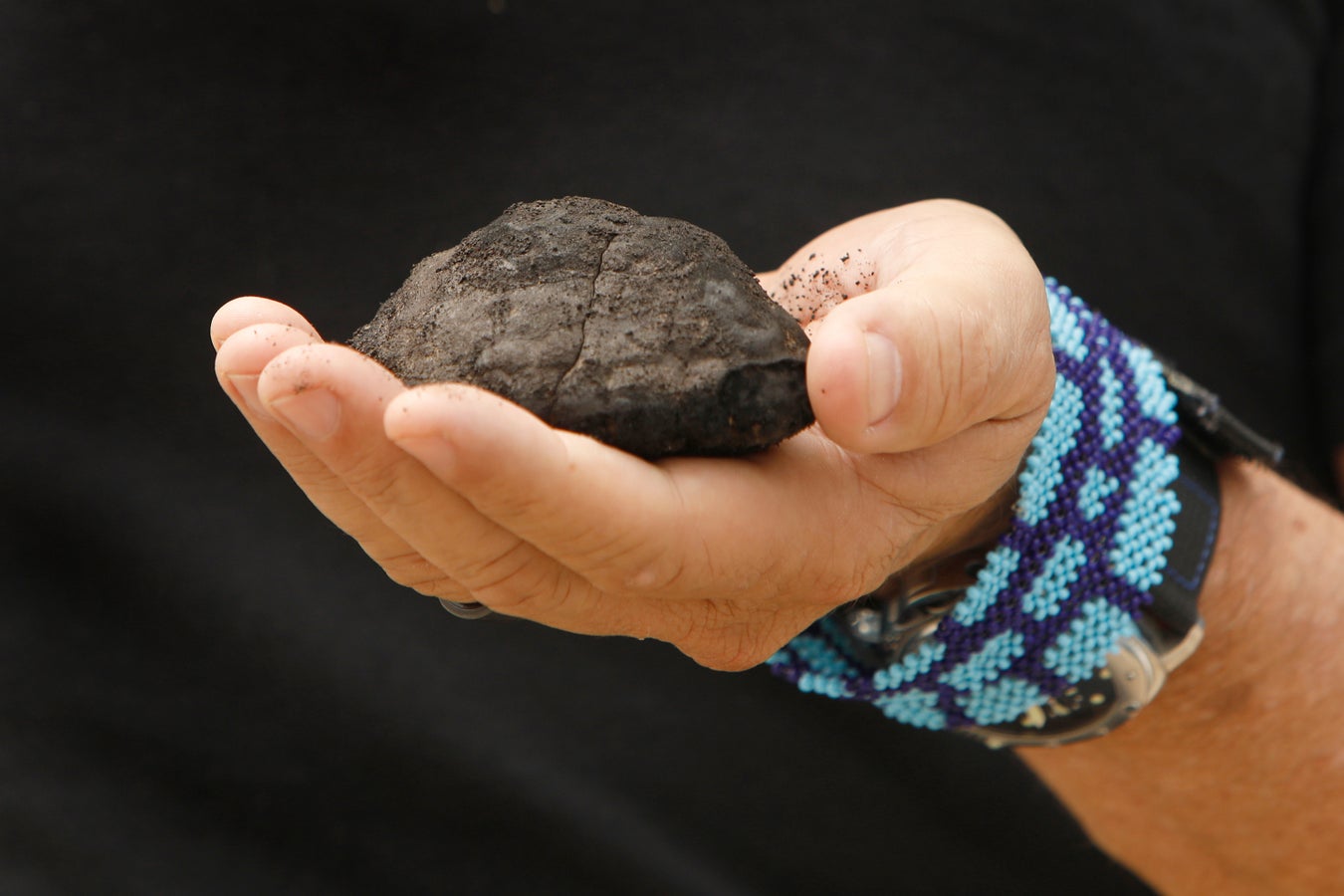
The rare mineral Humboldtine is known only from about 30 sites worldwide.
This specimen was found unexpectedly in a mineral collection in Germany.

I’ve often blogged about surprise discoveries of plants or animals thought to be extinct and about the unearthing of long-buried human artifacts. Today’s story by David Bressan at Forbes magazine is on the surprise discovery of a rare mineral that was hiding in plain sight. It makes me think there will be an endless supply of of things to discover in the future because we keep forgetting what we have.

“During a survey of an old mineral collection now hosted at the Bavarian Environment Agency or LfU Bayern in Germany,” Bressan writes, “experts discovered fragments of Humboldtine, one of the rarest minerals found on Earth.

Humboldtine is known from only 30 localities worldwide, including quarries and mines located in Germany, Brazil, the U.K., Canada, the U.S., Hungary, Czech Republic and Italy. It rarely forms tiny crystals and is most commonly found as a yellow, amorphous mass. Humboldtine forms when carbon compounds and iron-oxide react with water and is one of the few ‘organic minerals‘ containing carbon-oxygen-hydrogen groups in their crystalline structure.

“Humboldtine was first discovered by German mineralogist August Breithaupt in a weathered brown coal deposit near the municipality of Korozluky in Okres Most in the Czech Republic. [It was] scientifically described in 1821 by Peruvian geologist Mariano Eduardo de Rivero y Ustariz, who named the mineral after the German 19th-century naturalist and explorer Alexander von Humboldt. …

“In 2023, during the digitization of the archive of the LfU, a letter written by a coal mine owner and sent in 1949 to the agency was found. The letter mentions the presence of Humboldtine in coal seams of the Matthiaszeche near the town of Schwandorf, a town on the river Naab in the Upper Palatinate. The agency asked for some samples for further analysis to confirm the discovery. But no follow-up documentation seems to exist.

“But intrigued by the note, Roland Eichhorn, head of the geological department at the LfU, and colleagues decided to check the vast historic mineral collection — comprising over 130,000 rock and mineral samples — hosted in the agency’s basement. If any samples were ever sent in, they still could be here. In one drawer of the systematic mineral collection, where minerals are ordered according to their chemical composition, they found some fragments of a yellow mineral labeled ‘Oxalit,’ German for organic minerals, still inside an old cardboard box. The label also showed that the samples came from the locality mentioned in the letter.

“Modern chemical analysis confirmed the discovery made 75 years earlier; the six fragments, the largest almost the size of a nut, are indeed Humboldtine. Together with other samples, this doubles the amount of Humboldtine known so far. …

“The Matthiaszeche, a former open-pit mine for brown coal, was closed in 1966 and subsequently flooded. There is no chance of getting any more Humboldtine from this locality.”

More at Forbes, here.

I love that geologist Eichhorn was curious. Bless his heart. That’s how discoveries get made. And I also think curiosity is what keeps us all going.

Photo: Sophie Neiman.
Ms. Acogo spent several years on the street before receiving vocational training as a tailor from Hashtag Gulu in Uganda.

Recently, PRI’s The World broadcast a valuable but scary series on orphanages in Uganda, nearly all of which are bad. For children from impoverished or abusive homes, the alternative may be life on the streets.

In an issue last December, the Christian Science Monitor‘s Sophie Neiman wrote about how one city’s concerned citizens began helping street children reach for a better life.

“In the sticky evening,” she begins, “two boys in torn clothes dart between shop verandas and wrestle in the dust, trading jokes that quickly turn to insults. Onlookers grunt disapprovingly, angry at the noise. More groups of rowdy children will soon stream into the back alleyways of [the small city of Gulu] in northern Uganda, eking out a life in its underbelly.

“By day, the children pick through discarded plastic bottles trying to gather enough of them to sell. At night, they hang out in the shadows of dance clubs or sleep under pieces of cardboard between shop shelves that normally hold fruit.

“Steven Onek strolls over to the squabbling boys. Speaking in a calm and quiet voice, he breaks up their argument. A few minutes later, around another street corner, he comforts a teenager sporting a deep cut on his head, providing the boy with some money to see a doctor. 

“Such situations are commonplace for Mr. Onek, who is a program officer at Hashtag Gulu, a small organization supporting the city’s homeless children. For him, it is not so much a job as a calling.

‘Helping a child, one child out of the street, I feel like I have helped the whole nation,’ he says, smiling.

“The name Hashtag Gulu points to its history. Friends sharing on social media the problems they saw in their city decided to do more than that. At first, their efforts were all volunteer-based. The friends bought food for homeless children and comforted them when they could.

“ ‘If you were in our network, you were free to do anything, for any young person or child. You didn’t have to report to anyone,’ co-founder and director Michael Ojok said of Hashtag Gulu’s early days.

“Eventually the group grew into a fully registered community organization, as activists attempted to address the added problems caused by the coronavirus pandemic. Now, Hashtag Gulu reunites homeless children with their family members [if possible] and provides them with vocational skills. It is also a rare safe haven, running a free clinic as well as counseling and arts programs.

“Some of the children Hashtag Gulu works with are as young as seven, but its beneficiaries can be as old as 25. Most have nowhere else to go. Others have dropped out of school to make a living on the street, returning to their homes and families only rarely. 

“Gulu is a place accustomed to hardship. For some three decades, between the late 1980s and early 2000s, the city was the epicenter of an uprising against the government mounted by the Lord’s Resistance Army, notorious for forcibly recruiting some 20,000 child soldiers. A grim parade of boys and girls would flood into the city each night and sleep under its market stalls and in church yards, hoping to avoid capture by the rebels, before returning to their villages at dawn.

“Today, the children are often escaping family abuse or neglect, hoping to make it on their own. Mr. Dong, who asked to use a pseudonym, fled to the streets when he was six years old. His mother had died giving birth to him, and the women his father brought home with him were physically and emotionally abusive.

“Without parents to look out for him, he fell in with other children for safety. ‘I got a family outside of my family,’ he says. They helped each other find food; they also offered some protection in a community that viewed them as troublemakers, and from police officers quick to make arrests. …

“While collecting scrap metal a few years ago, a blade fell and cut Mr. Dong’s foot. He came to Hashtag Gulu for free medical treatment. After healing his injuries, workers provided him with piglets and agricultural training. Mr. Dong, now 16, lives with an aunt and continues to care for his pigs. …

“Hashtag Gulu also works with other local organizations to provide employment. At Taka Taka Plastics, which transforms waste into home goods, some 20 children who once lived on Gulu’s streets have been given jobs.

“Their Taka Taka earnings have enabled those young people to rent their own rooms, buy and cook their own food, and even start side businesses, says co-founder Paige Balcom, an American living in Gulu. 

“A municipal survey conducted two years ago estimated that there are some 2,000 children living rough in Gulu. So far, Hashtag Gulu has managed to reach about half of them with its programs. …

“Looking forward to the holiday is Ms. Acogo, also a pseudonym. Like Mr. Dong, she fled abuse at home, arriving on the streets in her early teens.

“ ‘We would go to night clubs, and there were men who would always support us. That is how we survived,’ she recalls quietly.

“Ms. Acogo became pregnant by one of those men. Hashtag Gulu helped her train as a tailor, and reconnected her with her grandmother. 

” ‘I didn’t know where to start from, how to raise this child,’ she recalls, holding her one-month-old baby. ‘Other women at home are now supporting me and guiding me into motherhood.’ “

More at the Monitor, here. No paywall. Subscriptions sought.