Feeds:
Posts
Comments

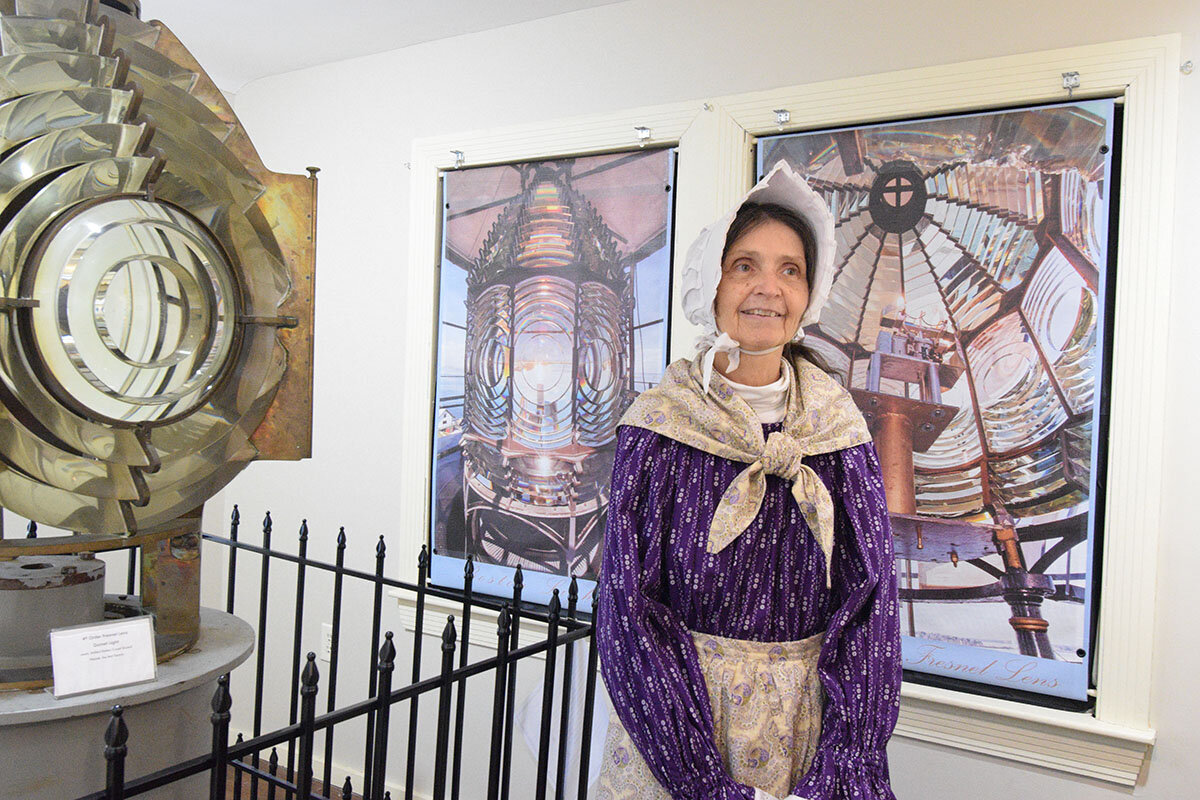
Photo: Sophie Hills/The Christian Science Monitor.
Sally Snowman stands next to a Fresnel lens in the Hull Lifesaving Museum in Hull, Massachusetts, Nov. 9, 2023. She retired at the end of the year after two decades as the keeper of nearby Boston Light.

Lighthouses are to the US what castles are to Europe, and there are many enthusiasts working to ensure that lighthouses don’t crumble but have an economically sustainable future for generations to come.

Sophie Hills reports at the Christian Science Monitor, “When Sally Snowman became the keeper of Boston Light in 2003, she expected the role to last only two years. … Ms. Snowman is the last of the lighthouse keepers in the United States. Her retirement marks the end of 307 years of keepers of Boston Light, originally established in 1716.

“When Ms. Snowman first set foot on Little Brewster Island at age 10, it was love at first sight. ‘I want to work as a keeper and get married here,’ she recalls saying. She did both. Now, after 20 years as keeper and even longer as a volunteer, she’s ready to retire. …

“For centuries lighthouses played the crucial role of guiding sailors safely through hazardous waters. Today, some are still active aids to navigation. They also hold a mystical, sentimental power to many, mariners or not, who balked at the news of the last lighthouse keeper retiring. The keeper herself has little patience for a nostalgia that would hamper the future of the icon she has tended for two decades. Ms. Snowman believes the transition will help lighthouses keep shining in the 21st century, rather than fade away. 

“The appeal of lighthouses reaches far and wide, says Jeremy D’Entremont, who has a weekly podcast, ‘Light Hearted,’ and is the historian for the United States Lighthouse Society. Just recently, his co-host was an 11-year-old girl from Kentucky. 

“While big ships today have ample navigational technology, their captains ‘feel welcomed’ by lights at harbor mouths, says local Dave Waller, who co-owns nearby Graves Light Station in Boston Harbor. And the need is still practical for smaller crafts. …

“The U.S. Coast Guard’s mandate isn’t to restore or preserve historical structures like lighthouses. The military branch will continue to operate the aids to navigation – like the light and foghorn – but the actual upkeep of the physical structures and tours of the island are better suited to a different entity. …

“Over her 46 years as a Coast Guard auxiliary volunteer and keeper, Ms. Snowman has become intricately acquainted with the history of the lighthouse and local nautical history. … A spiritual person, she’s touched by all the light has seen and withstood. And even those things it has not been able to withstand, such as when it was demolished by the British as they made their last escape from the harbor during the Revolutionary War. …

“Ms. Snowman is quietly firm that the transfer of the lighthouse is what’s best. ‘It’s important to ensure that our national icons are properly cared for,’ she says.

“Under a process laid out by the National Historic Lighthouse Preservation Act of 2000, there’s a mechanism for ownership of the historic sites to be transferred. Federally owned lighthouses are offered first to other federal agencies, then state and local governments, followed by nonprofits, and eventually private individuals.

“Graves Light Station was bought at auction a decade ago after sitting neglected. When Mr. Waller stepped out onto the top deck and saw the panoramic view of Boston and the ocean, he ‘fell in love.’ … The lifesaving role of lighthouses ‘is not ancient history,’ says Mr. Waller. Just recently, two men had a boating accident and made it to the rocks at the base of Graves Light before they were rescued.” 

More at the Monitor, here. No paywall. Subscriptions solicited.

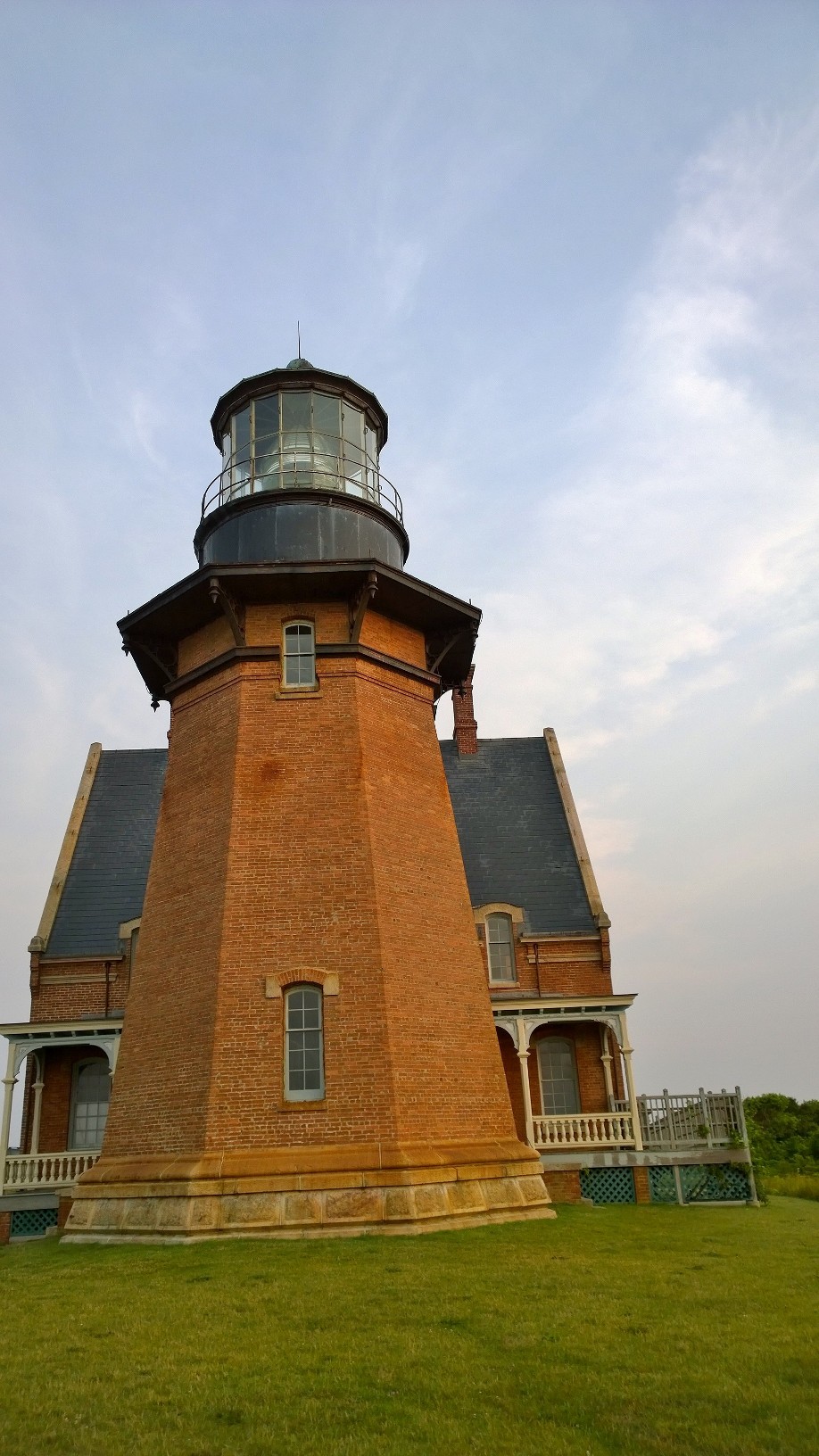
Photo: Suzanne and John’s Mom.
The Southeast Light, New Shoreham, RI, is still important in navigation but is not manned.
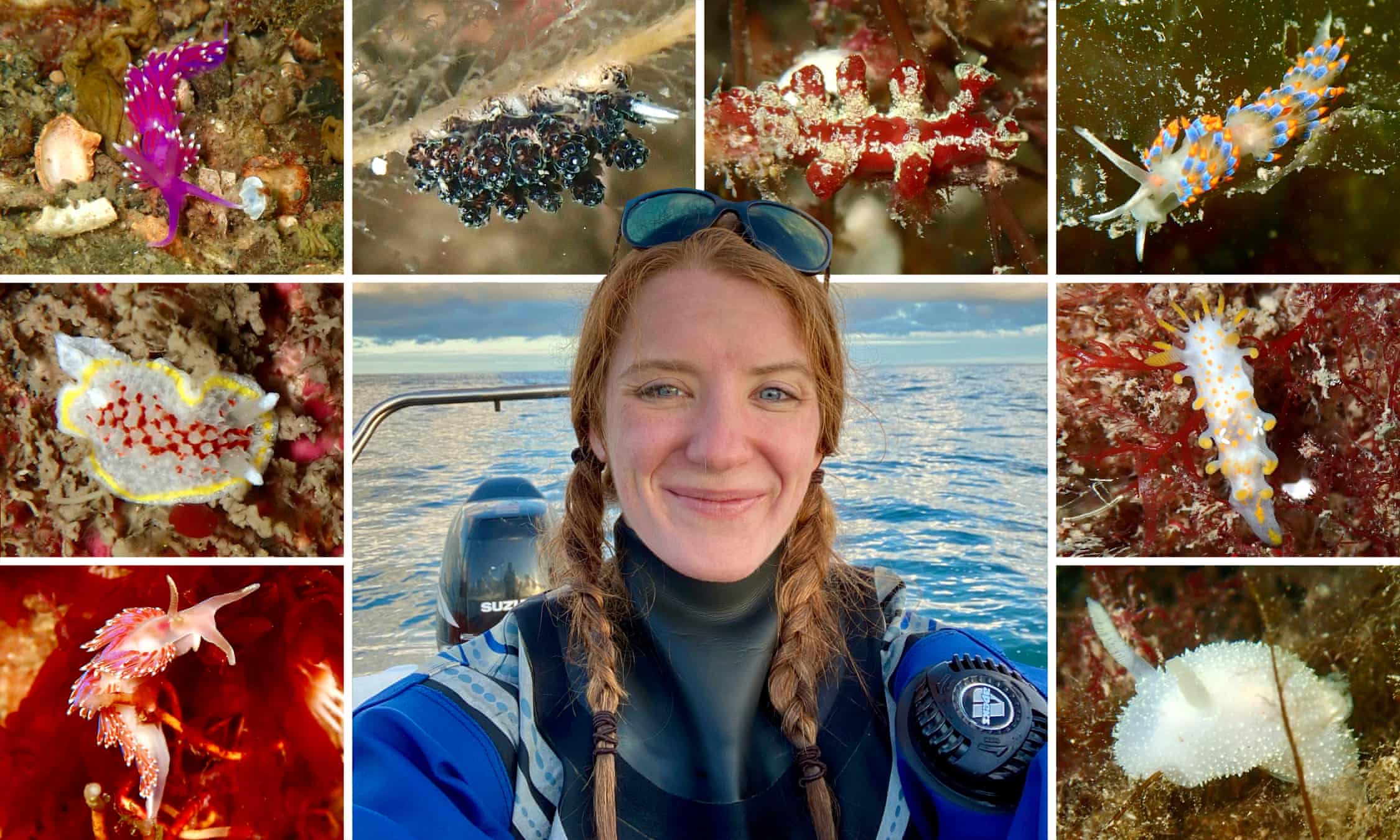
Photos: Libby Keatley.
Libby Keatley and some of the “inherently charismaticsea slugs she has encountered. 

After blogging singer Will McMillan told us more than we ever imagined about sea snails once used for a royal purple dye, I remembered that the Guardian had an equally fascinating story on sea slugs. It turns out some young people are huge fans of the critters and are helping scientists keep track of them.

Helen Scales writes, “Two years ago, Libby Keatley was diving off the coast of County Antrim in Northern Ireland when she spotted something unusual. It was a sea slug – or nudibranch – whose transparent body had orange lines running through it and twiggy projections arranged along its back. ‘It was quite distinctive and not like anything I’d seen before,’ she says.

“Keatley called over her diving buddy, Bernard Picton, a local marine biologist and pioneer in UK sea slug studies. He scooped it up in a plastic bag and, back at his lab, confirmed it was a newly discovered species. He named it in Keatley’s honour: Dendronotus keatleyae.

“ ‘Three years ago, I didn’t really know what a nudibranch was or I thought they only lived in tropical countries,’ says Keatley.

‘It just shows you can learn – you don’t have to be somebody who’s been in a lab for 20 years to know that something looks a bit funny or different.’

“For a niche but growing group of amateur naturalists, sea slugs have become an ideal subject: as stunning as butterflies but with the good grace to sit still while you peer in close and take a photograph. Distant relatives of the slimy, drab land-dwellers that live in gardens, sea slugs are an altogether more endearing bunch. Many are daubed in jewel-like colors that warn off predators. Others take on hues to blend in with their surroundings, often gaudy seaweeds and sponges. There are also plenty of sea slugs to discover in UK waters, with about 150 known species across the north Atlantic. …

“To show me why the hobby has attracted a worldwide community of scuba divers and amateur photographers – and how it makes important contributions to scientists’ understanding of how our oceans are changing – Keatley takes me diving in Strangford Lough. An hour’s drive south of Belfast, it is one of Europe’s largest sea inlets and a renowned wildlife spot, home to seabirds, seals and recently a pair of bottlenose dolphins.

“There’s even more going on beneath the waterline. At high tide, the Irish Sea brings in a soup of particles and nutrients which feeds a rich mix of underwater species – and a host of other creatures that feed on them. …

“We are joined on the dive by Keatley’s partner and fellow enthusiast, Phil Wilkinson, and Picton, who recently updated a guidebook to sea slugs of the north Atlantic with Christine Morrow. …

“We find more sea slugs than I’ve ever seen, even in tropical seas: neon pink ones and transparent ones covered with finger-like projections with shiny turquoise tips; another is white with yellow specks and a pair of bunny ears that are for smelling not hearing. We encounter a gathering of sea slugs that look like miniature fried eggs splashed in chili sauce, and Keatley points out a peach-colored specimen hitching a ride on a hermit crab. It feeds on minute hydroids – stinging relatives of jellyfish – that grow on the crab’s shell.

“For Keatley, sea slug spotting was part of an unexpected reawakening of a childhood interest in nature. In January 2019, she learned to scuba dive and was an instant convert to the underwater world. ‘I couldn’t get enough,’ she says. ‘The more I saw, the more I wanted to learn, and then the more I was seeing. So it just snowballed a wee bit.’ ”

Don’t you love the variety of things that people get interested in? At the Guardian, here, you can read about the importance of citizen scientists in the slug world. No firewall. Donations encouraged.

When You Need an ID

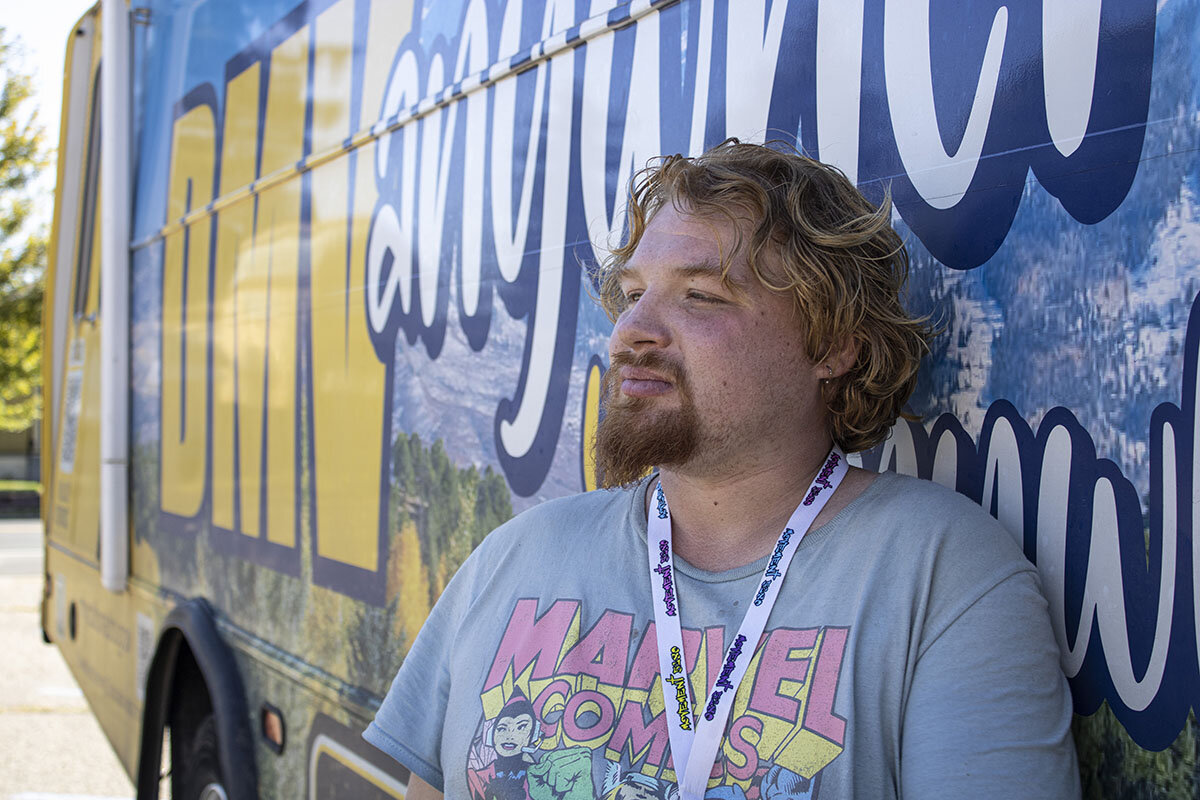
Photo: Sarah Matusek/The Christian Science Monitor.
At Colorado’s roving Department of Motor Vehicles — a bus — people experiencing homelessness and others can get an ID.

Some kind of ID is necessary in life — to apply for a job, get a bank account, rent an apartment, and sometimes to vote. That’s why Colorado has decided everyone should be able to get legal identification. The state’s Department of Motor Vehicles (DMV) is making it happen.

Sarah Matusek writes at the Christian Science Monitor, “Radio in hand, Steven Rustemeyer ushers the next person aboard the bus. … This bus has no rows of seats, no driver or destination. This is a project of the Colorado Division of Motor Vehicles – a DMV on wheels. It sits parked with an office inside – complete with computer, printer, fingerprint reader, and vision test chart. 

“ ‘It’s easier that way,’ says Mr. Rustemeyer, who got a new ID from the mobile clinic earlier this year. Homeless for eight years since he aged out of foster care, he says he appreciates not having to pay bus fare to head to the brick-and-mortar office. The bus shows up once a month at a nonprofit whose job readiness program he attends – and where he’s helping out today. The stop is one of several across the state. …

“As it issues IDs and licenses to hard-to-reach Coloradans, the DMV2GO program blunts bureaucracy by saving time and travel to traditional sites. Officially launched last year, the mobile program has issued around 11,000 documents as of September, stopping by incarceration sites, homeless shelters, universities, and rural community hubs. Given how IDs are key to securing housing, work, and other basics, the goal is to ensure equitable access to identity services for all, says Desiree Trostel, the program manager.

‘It’s important to “meet people where they’re at,” ‘ Ms. Trostel says, ‘regardless of circumstance or location.’

“Mobile staff members report more enjoyment on the job, too. Customers on the road are ‘a lot happier to come and see us,’ says Liz Kuhlman, an upbeat licensing technician on the bus.

“In mountainous Archuleta County, where there is no state DMV, Warren Brown says he and his wife saw the problem up close. At their former insurance business, part of the job meant helping older customers navigate license services online. 

“ ‘In my mind, this just didn’t have to be that way,’ says the county commissioner, who contacted the state for help. His constituents were first in line to benefit from the formal rollout of DMV2GO in 2022. …

“Customers can apply for or renew driver’s licenses or ID cards, including out-of-state transfers. The clinic doesn’t offer knowledge tests or print the physical card on-site (those will arrive later by mail), but it does offer temporary ones. …

“The Florida Licensing on Wheels program, or FLOW, has operated since 1988, says David Brown, a FLOW program manager. Beyond making regular stops, it’s also grown to respond to manmade and natural disasters. … ‘In order for you to start the process of rebuilding after a disaster, you need those solid credentials,’ he says.

“Rebuilding can also mean navigating society after incarceration. That’s why DMV2GO’s list of stops includes sites like the Jefferson County jail. …

“Convenience aside, mobile DMVs also aren’t without challenges. Spotty internet access in rural areas, for one, can complicate service. And in Colorado, demand is high for the program that currently involves four licensing technicians and three vehicles. The state says it’s gathering data on DMV2GO’s impact and hopes to expand. 

“That demand is clear at a recent stop at a public library in rural Westcliffe when a dozen people arrive ahead of the clinic’s opening at 10 a.m. Though a couple of locals note the wait, those in line still appreciate the service.

“ ‘This is awesome,’ says John Van Doren, a retiree here for a license renewal. ‘Very convenient.’ “

More at the Monitor, here.

Photo: Alamy.
A mosaic of the Byzantine empress Theodora from 547 AD. The purple color was once considered more precious than gold. (It seems a bit brown in photos.)

Today’s story about a valuable pigment that comes from mollusks made me think of “wampum,” the jewelry/currency made from quahog shells by indigenous people in North America. The difference is that to get this royal purple, it was the insides of snails that were used.

Zaria Gorvett reports at the BBC, “For millennia, Tyrian purple was the most valuable color on the planet. Then the recipe to make it was lost. By piecing together ancient clues, could one man bring it back?

“At first, they just looked like stains. It was 2002 at the site of Qatna – a ruined palace at the edge of the Syrian desert, on the shores of a long-vanished lake. Over three millennia after it was abandoned, a team of archaeologists had been granted permission to investigate – and they were on the hunt for the royal tomb.

“After navigating through large hallways and narrow corridors, down crumbling steps, they came across a deep shaft. On one side were two identical statues guarding a sealed door: they had found it. Inside was a hoard of ancient wonders – 2,000 objects, including jewelery and a large golden hand. But there were also some intriguing dark patches on the ground. They sent a sample for testing – eventually separating out a vivid purple layer from the dust and muck.

“The researchers had uncovered one of the most legendary commodities in the ancient world. This precious product forged empires, felled kings, and cemented the power of generations of global rulers. The Egyptian Queen Cleopatra was so obsessed with it, she even used it for the sails of her boat, while some Roman emperors decreed that anyone caught wearing it – other than them – would be sentenced to death.  

“That invention was Tyrian purple, otherwise known as shellfish purple.

But though this noble pigment was the most expensive product in antiquity – worth more than three times its weight in gold, according to a Roman edict issued in 301 AD – no one living today knows how to make it.

“By the 15th Century, the elaborate recipes to extract and process the dye had been lost. But why did this alluring color disappear? And can it be resurrected?

“In a small garden hut in north-eastern Tunisia, just a short distance from what was once the Phoenician city of Carthage, one man has spent most of the last 16 years smashing up sea snails – attempting to coax their entrails into something resembling Tyrian purple. …

“Ancient authors are particular about the precise hue that was worthy of the name: a deep reddish-purple, like that of coagulated blood, tinged with black. Pliny the Elder described it as having a ‘shining appearance when held up to the light.’ …

“It was so central to the success of the Phoenicians it was named after their city-state Tyre, and they became known as the ‘purple people.’ … In 40 AD, the king of Mauretania was killed in a surprise assassination in Rome, ordered by the emperor. Despite being a friend to the Romans, the unfortunate royal had caused grave offense when he strode into an amphitheatre to watch a gladiatorial match wearing a purple robe. The jealous, insatiable lust that the color ignited was sometimes compared to a kind of madness. …

“Tyrian purple could be produced from the secretions of three species of sea snail, each of which made a different color: Hexaplex trunculus (bluish purple), Bolinus brandaris (reddish purple), and Stramonita haemastoma (red). …

“Accounts of how colorless snail slime was transformed into the dye of legends are vague, contradictory and sometimes obviously mistaken – Aristotle said the mucous glands came from the throat of a ‘purple fish.’ To complicate matters further, the dyeing industry was highly secretive – each manufacturer had their own recipe, and these complex, multi-step formulas were closely guarded. …

“The most detailed record comes from Pliny, who explained the process in the 1st Century AD. It went something like this: after isolating the mucous glands, they were salted and left to ferment for three days. Next came the cooking, which was done in tin or possibly lead pots on a ‘moderate’ heat. This continued until the whole mixture had been boiled down to a fraction of its original volume. On the tenth day, the dye was tested by dipping in some fabric – if it emerged stained with the desired shade, it was ready. 

“Given that each snail only contained the tiniest amount of mucous, it could take some 10,000 to make just a single gram of dye. Mounds of billions of discarded sea snail shells have been reported in areas where it was once manufactured. In fact, the production of Tyrian purple has been described as the first chemical industry – and this not only applies to the scale of the operations, but their exacting nature.”

More at the BBC, here.

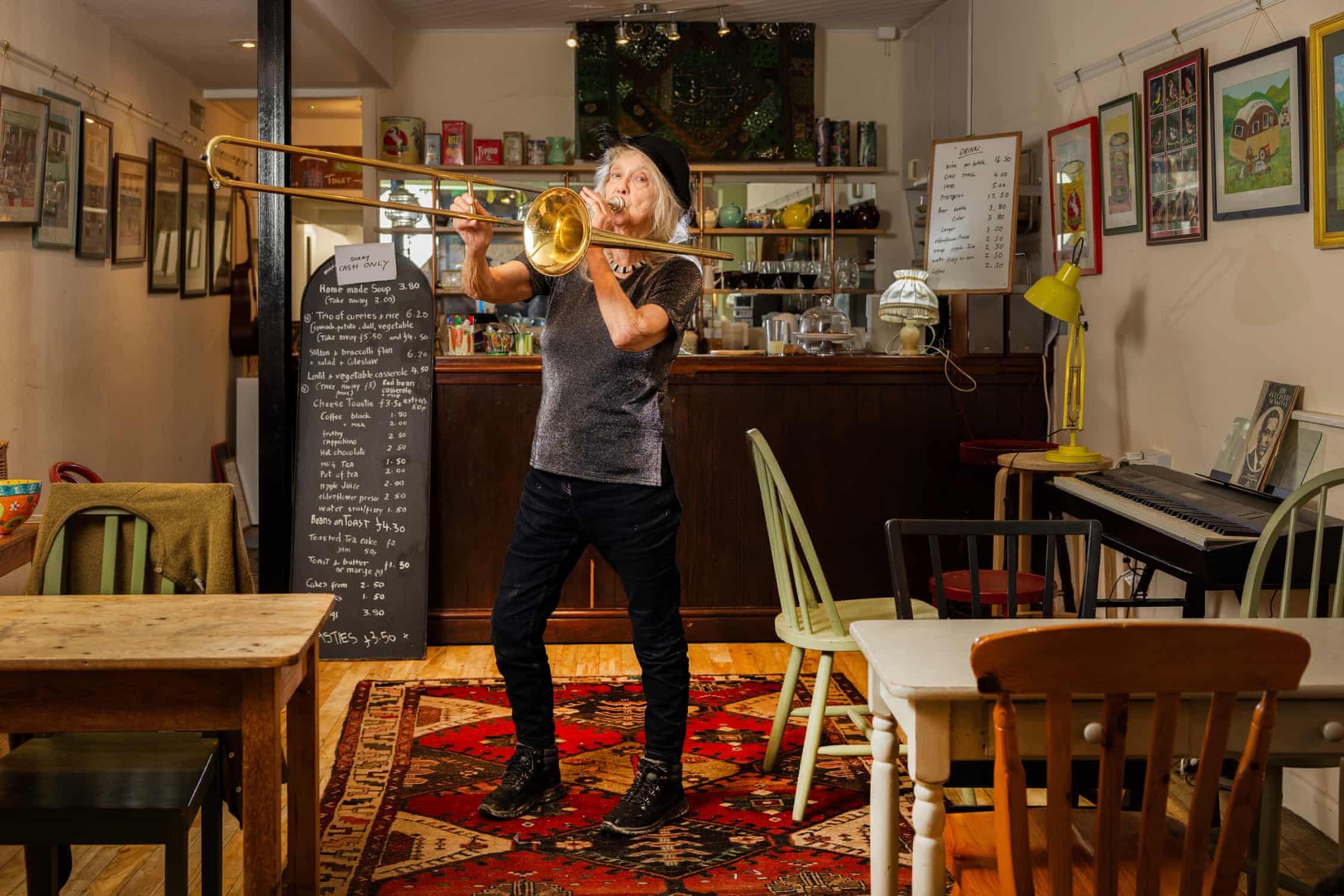
Photo: Fabio De Paola/The Guardian.
Eighty-four-year-old Noreen Davis took up trombone at 72 and never looked back.

Where I live now, it’s nice to see people taking up some pursuit that always interested them but seemed out of reach. For example, there’s a retired radiologist across the hall whose wife is an artist whose work he has always admired. Nowadays, he’s throwing himself heart and soul into some high-level art classes here and is doing an impressive job.

Today’s story is similar. It starts with a woman in the UK Midlands paying attention to a dream she had when she was sound asleep.

Ammar Kalia writes at the Guardian, “Twelve years ago, Noreen Davies had a dream. In it, the artist and cafe owner, then 72, saw herself wielding an unusual instrument. ‘There was a jazzy tune on in the background and I was playing along on a trombone, bending the notes and having a great time,’ she says. ‘When I woke up, I knew I had to learn it.’

“She headed to her cafe in Leominster, Herefordshire, and had a [routine] meeting with her accountant. ‘At the end, I asked him if he knew anyone with a trombone I could try out and he said he had five! Turns out he played in a local brass band with his wife, so he ended up bringing one round to me, along with an old music book on the instrument, and that’s how it all started.’

“Now 84, Davies has gigged throughout the West Midlands with groups exploring everything from the blues to vintage jazz and big band funk. No matter the tune, she has stayed true to her vision of bending the notes on the giant horn, twisting and wailing like a held string on an electric guitar. ‘I’ve only had two lessons and in the first one the teacher told me to just play what was written, but I do whatever I want to,’ she says. ‘I use it more like a percussion instrument, improvising over the tunes.’

“The trombone is notoriously difficult to learn, since players have to judge the distance between notes by pulling and pushing its tubing, rather than pressing fixed keys. Davies, though, found the instrument easy, thanks to her musical history. At 14, she took up the guitar and taught herself to play chords with her younger brother. ‘I forced him to play along with me. I taught myself the piano, too, by working out songs I liked listening to,’ she says. …

“Davies’ confidence to play live grew through hosting monthly music nights at the cafe, including a jam session with Ric Sanders of Fairport Convention, although she faced a setback when a series of operations on her lungs meant she was unable to play for several months.

“One evening in 2018, when she had regained her strength, she went along to a jam session in nearby Bromyard and met two young musicians who were looking for a trombone to round out their trio. Luckily, she had hers in the boot of her car in case such an opportunity arose. ‘We did a few numbers together and they ended up adopting me,’ she says. ‘We played for a couple of years, until Covid. It was great fun.’

“The open world of jam sessions and gigs has since led Davies to more instruments. She is back on the piano and has added the accordion, the washboard and the baritone ukulele. ‘I ended up in a vintage jazz band because they needed a washboard player and I was the only one who took it up in the local area. I also play Bob Dylan tunes on the ukulele and I’m trying to learn some Cole Porter on the accordion,’ she says. … ‘Everyone should try it out – just get yourself to a jam session somewhere and see what happens.’ “

More at the Guardian, here.

Photo: Philippe Lopez/AFP/Getty Images.
This valuable painting, called “The Mocking of Christ,” is by the 13th century Florentine artist Cimabue. It came close to being thrown away when a house in France was getting cleared out.

When the consignment guy comes to help with your lifetime downsizing, he naturally hopes to uncover some neglected item that turns out to be extremely valuable. That would have been OK with me, but the process went more in the opposite direction. Things I always thought were valuable, we couldn’t even give away for free.

Still, one always enjoys someone else’s discovery, like the one in today’s story. …

“Scott Reyburn reports at the New York Times, “A medieval painting that hung for years near the kitchen of an older Frenchwoman before being recognized as a work by the Italian artist Cimabue was auctioned [in October] in France for $26.8 million.

“The work was bought by the London-based dealer Fabrizio Moretti against competition from at least six other bidders.

” ‘I bought it on behalf of two collectors,’ Mr. Moretti said in an interview immediately after the auction. ‘It’s one of the most important old master discoveries in the last 15 years. Cimabue is the beginning of everything. He started modern art. When I held the picture in my hands, I almost cried.’ …

“The 10-inch-high poplar panel was discovered in June during a valuation of the contents of the house of an older Frenchwoman near Compiègne, north of Paris. Thought by the family to be an icon, the painting hung on a wall next to the kitchen.

“ ‘I had a rare emotion with this little painting, almost indescribable,’ said Philomène Wolf of [auction house] Actéon, who had made the discovery. ‘In our profession, we know that this emotion was the result of a great master.’ …

“Actéon consulted Eric Turquin, the Paris-based art expert on old masters, who collaborated on the sale of the painting. … Mr. Turquin said his research identified the Compiègne panel as ‘the only small-scale work of devotion to have been recently added to the catalog of authentic works by Cimabue.’ It was described as being in ‘excellent general condition.’

“ ‘This was an easy sale,’ Mr. Turquin said, comparing the auction of the Cimabue to the canceled public sale in June of the ‘Judith and Holofernes’ attributed to Caravaggio. ‘I was pleased at 10 million and tremendously happy at 15 million,’ he said of the Cimabue sale. ‘The price was more than I could have dreamed, and there was a contemporary art gallery bidding, which was new for us.’

“According to Mr. Turquin, ‘The Mocking of Christ’ was part of the same late-13th-century altarpiece that once included Cimabue’s similarly sized ‘Flagellation of Christ,’ now in the Frick Collection in New York, and the ‘Madonna and Child Enthroned Between Two Angels,’ now in the National Gallery in London.

“The Frick acquired its Cimabue in 1950. The ‘Madonna and Child’ was scheduled to be auctioned at Sotheby’s in 2000, but was sold to the National Gallery by private treaty for about 7.2 million pounds, about $10.8 million. …

“Traces of the original framing, the style and technique of the gold ornamentation and the pattern of wormholes on the back of the Cimabue panel ‘confirm that these panels made up the left side of the same diptych,’ Mr. Turquin said in a pre-auction statement.

“Cimabue pioneered a more fluent and naturalistic style of figure painting in Italy. … The Florence painter takes up the first biography in Giorgio Vasari’s hugely influential Lives of the Most Excellent Painters, Sculptors and Architects, published in 1550. Vasari describes how Cimabue emancipated himself from the ‘stiff manner’ of Byzantine artists and was ‘the first cause of the revival of painting’ before Giotto ‘overshadowed his renown.’ ”

More at the Times, here. If you enjoy this kind of story, see also the Guardian take on a neglected Botticelli, here.

Photo: Carrie Shepherd/Axios.
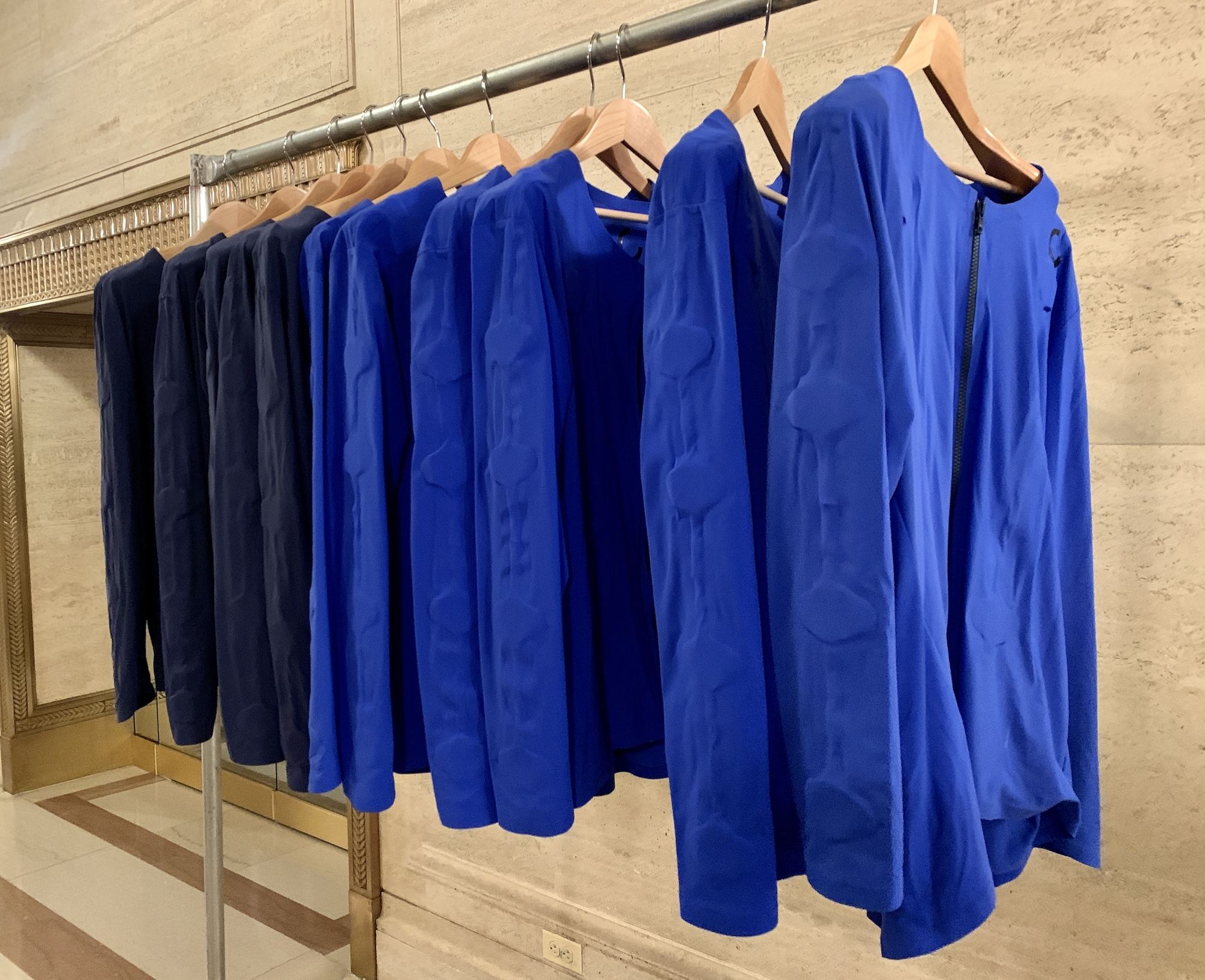
The Lyric Opera of Chicago’s SoundShirts use “patterns and pulses” to make opera more accessible for the deaf.

It used to be that, for people with a disability, there were certain experiences they knew they would probably never access. With technology, that is changing. Consider how “feeling” the music in new, more subtle ways is helping those with hearing loss.

Michael Andor Brodeur reports at the Washington Post about the SoundShirt.

“Opera is everything all at once: music and drama, poetry and dance, grandeur and intimacy, spectacle and sound. This all-encompassing aspect makes it one of the most accessible art forms yet one of the most challenging to make accessible.

“For audience members who are deaf or hard of hearing, or who are blind or have low vision, attending an opera can be a deeply frustrating experience.

“A pilot program at the Lyric Opera of Chicago is trying on a new approach for deaf and hard-of-hearing people to experience opera: the SoundShirt, a jacketlike garment equipped with 16 haptic actuators* that transmit sound from the orchestra and stage into pulses, vibrations and other forms of haptic feedback in the shirt itself. …

“In addition to accommodations for mobility disabilities such as ramps and wheelchair seating, like many opera houses, the Lyric offers performances with American Sign Language interpretation, projected subtitles, and assisted listening devices for deaf and hard-of-hearing patrons. For blind people and those with low vision, the Lyric provides Braille and large-print programs, audio-described performances, high-powered glasses and pre-performance ‘touch tours,’ allowing audience members to feel various props, costumes and surfaces before the curtain rises.

“The SoundShirt, though, is cut from a different cloth than most accessibility technology, providing a mediated experience of the music that registers as physical and personal.

‘It doesn’t re-create the experience of listening to music,’ [director of digital initiatives Brad Dunn] says. ‘It’s its own thing.’

” ‘It translates the music into a different sensory experience that can be felt by people. And what I’ve seen through all of the early testing that we did is that audiences who are deaf or hard of hearing have responded very viscerally to it.’ …

“For attendees at a Lyric production of West Side Story earlier this year, input from the SoundShirt didn’t just help provide additional detail to the performance — it also illuminated the musical spaces in between, the interludes and interstitial passages of music, the overtures overloaded with crucial cues. Dunn recalls one tester’s eyes welling up with tears after the performance. …

“Lyric’s SoundShirt project was launched in partnership with the city of Chicago’s Mayor’s Office for People With Disabilities (MOPD), but the garment itself was designed by CuteCircuit, a London-based wearable technology design firm. …

“At the Lyric, an array of microphones positioned over various sections of the orchestra feeds audio information to a central computer. Dunn and his crew adapt the software to respond to the specific instrumentation of a given piece. … Those audio signals are divided across seven channels, each mapped to one of 16 different ‘zones’ on the SoundShirt, where motifs and melodies register as patterns and pulses across the garment’s 16 actuators.

“Thus, for a production of The Flying Dutchman, the violins and cellos are assigned to trigger haptic feedback along the right and left shoulders and upper arms. Timpani and bass, meanwhile, are sent down to the lower torso and hips. Wagner’s mighty horns are split across the upper arms like goose bumps, while vocals register at the wrists like a pulse. …

“Rachel Arfa is a longtime disability advocate and civil rights attorney who serves as commissioner of MOPD. As a deaf person who wears bilateral cochlear implants, the issue of accessibility has been close to her heart for a long time. … But while expanding accessibility is her life’s work, Arfa also knows that good intentions can often pave the road to nowhere.

“ ‘When Lyric approached me with this shirt, I was highly skeptical,’ Arfa said via email. [But she] agreed to test the SoundShirt at a recent Lyric production of West Side Story. Arfa was surprised to find the shirt actually felt like a good fit for the problem it is trying to solve. …

“ ‘I began to understand that the haptics on the SoundShirt vibrated in conjunction with the orchestra sounds. One example is when string instruments were played, the haptics followed the pitch and rhythm. A second example is when a singer was singing a long melody, the haptics picked up on this and I could experience this through the vibration. I am not able to hear this sound, but I could feel it. It was such a surprise and a thrill.’

“Tina Childress, an audiologist who lives in Champaign, Ill., is a late-deafened adult who wears cochlear implants and works as an advocate for accessibility in the arts. … Childress appreciated the haptic feedback at the wrists to indicate dialogue, and the way the shirt clarified the various elements of the score. After intermission, she lent the shirt to another audience member to try out. ‘I didn’t realize how much I was using it until I didn’t have it.’ ”

More at the Post, here. Axios Chicago has still more, here.

* haptic actuators are gizmos that provide localized bodily sensations and tactile effects

A Thank You

Be sure to check out the writings of Laurie Graves. Maya and the Book of Everything is the first in her Great Library fantasy series. Lots of food for thought there.

The blogger and creator of the Great Library fantasy series, Laurie Graves, was kind enough to call out my posts on climate change, and I want to thank her here. She wrote at her blog Notes from the Hinterland, hinterlands.me, that her friend at “Suzanne’s Mom’s Blog shares inspiring articles from around the world about people who are making a difference. The focus isn’t always on climate change — although sometimes it is — but the pieces always illustrate the power of creativity and how people can band together to do good things. When they want to. The time has come when we should all want to.”

Can’t disagree with that! Thank you, Laurie.

Photo: LaDameBucolique.
A Mexican Salamander in captivity.

People who put development before the natural environment are known to wax indignant at protections for small critters like the snail darter fish or the northern spotted owl. But what happens to the smallest of these effects us, too. Today’s article explains about pollution and the Mexican salamander.

The Associated Press (AP) reported on November 25th “Ecologists from Mexico’s National Autonomous University on Friday relaunched a fundraising campaign to bolster conservation efforts for axolotls, a native, endangered fish-like type of salamander.

“The campaign, called Adoptaxolotl, asks people for as little as 600 pesos (about $35) to virtually adopt one of the tiny ‘water monsters.’ Virtual adoption comes with live updates on your axolotl’s health. For less money, donors can buy a virtual dinner for one of the creatures, which are relatively popular pets in the US.

“In Mexican axolotls’ main habitat, the population density has plummeted 99.5% in under two decades, according to scientists behind the fundraiser.

“Last year’s Adoptaxolotl campaign raised just more than 450,000 pesos ($26,300) towards an experimental captive-breeding program and efforts to restore habitat in the ancient Aztec canals of Xochimilco, a southern borough of Mexico City.

“Still, there are not enough resources for thorough research, said Alejandro Calzada, an ecologist surveying less well-known species of axolotls for the government’s environment department. …

Despite the creature’s recent rise to popularity, almost all 18 species of axolotl in Mexico remain critically endangered, threatened by encroaching water pollution, a deadly amphibian fungus and non-native rainbow trout.

“While scientists could once find 6,000 axolotls on average per square kilometer in Mexico, there are now only 36, according to the National Autonomous University’s latest census. A more recent international study found less than 1,000 Mexican axolotls left in the wild.

“Luis Zambrano González, one of the university’s scientists announcing the fundraiser, told the Associated Press he hopes to begin a new census (the first since 2014) in March.”Luis Zambrano González, one of the university’s scientists announcing the fundraiser, told the Associated Press he hopes to begin a new census (the first since 2014) in March.

“ ‘There is no more time for Xochimilco,’ said Zambrano. ‘The “invasion” of pollution is very strong: soccer fields, floating dens. It is very sad.’

“Without data on the number and distribution of different axolotl species in Mexico, it is hard to know how long the creatures have left, and where to prioritize what resources are available. …

“Axolotls have grown into a cultural icon in Mexico for their unique, slimy appearance and uncanny ability to regrow limbs. Scientists in labs around the world think this healing power could hold the secret to tissue repair and even cancer recovery.

“In the past, government conservation programs have largely focused on the most popular species: the Mexican axolotl, found in Xochimilco. But other species can be found across the country, from tiny streams in the valley of Mexico to the northern Sonora desert.

“Mexico City’s expanding urbanization has damaged the water quality of the canals, while in lakes around the capital rainbow trout, which escape from farms, can displace axolotls and eat their food.”

More at AP via the Guardian, here, and at Wikipedia, here.

Invasive species that eat the food of native species are a problem everywhere. In a turtle presentation last week I learned that the red-eared slider, one of the 100 most invasive species in the world, is such a problem turtle that environmentalists often recommend killing it in the freezer. Sometimes called the “pet shop turtle,” it is an invasive pest in many parts of the world, making it hard for other turtles to survive.

Photo: Imagine China via AP Images.
A solar-covered parking lot at the plant of Anhui Quanchai Engine Co., Ltd. in Chuzhou, China.

We have to keep a close watch on our innovations, even the ones we think are good. Take solar. Sometimes you read about aggressive solar companies decimating wooded lots to build an array. What? Trees are even better than solar at fighting global warming.

Let’s consider places where solar doesn’t harm anything. How about over a parking lot?

Richard Conniff writes at YaleEnvironment 360, “Fly into Orlando, Florida, and you may notice a 22-acre solar power array in the shape of Mickey Mouse’s head in a field just west of Disney World. Nearby, Disney also has a 270-acre solar farm of conventional design on former orchard and forest land. Park your car in any of Disney’s 32,000 parking spaces, on the other hand, and you won’t see a canopy overhead generating solar power (or providing shade) — not even if you snag one of the preferred spaces for which visitors pay up to $50 a day.

“This is how it typically goes with solar arrays: We build them on open space rather than in developed areas. That is, they overwhelmingly occupy croplands, arid lands, and grasslands, not rooftops or parking lots, according to a global inventory published last month in Nature. In the United States, for instance, roughly 51 percent of utility-scale solar facilities are in deserts; 33 percent are on croplands; and 10 percent are in grasslands and forests. Just 2.5 percent of U.S. solar power comes from urban areas.

“But that doesn’t necessarily make it smarter. Undeveloped land is a rapidly dwindling resource, and what’s left is under pressure to deliver a host of other services we require from the natural world — growing food, sheltering wildlife, storing and purifying water, preventing erosion, and sequestering carbon, among others. And that pressure is rapidly intensifying. By 2050, in one plausible scenario from the National Renewable Energy Laboratory (NREL), supplying solar power for all our electrical needs could require ground-based solar on 0.5 percent of the total land area of the United States … 10.3 million acres.

“Because it is more efficient to generate power close to customers, some states could end up with as much as five percent of their total land area — and 6.5 percent in tiny Rhode Island — under ground-based solar arrays, according to the NREL study. If we also ask solar power to run the nation’s entire automotive fleet, says Margolis, that adds another 5 million acres. It’s still less than half the 31 million acres of cropland eaten up in 2019 to grow corn for ethanol, a notoriously inefficient climate change remedy.

“The argument for doing it this way can seem compelling: It is cheaper to build on undeveloped land than on rooftops or in parking lots. And building alternative power sources fast and cheap is critical in the race to replace fossil fuels and avert catastrophic climate change. It’s also easier to manage a few big solar farms in an open landscape than a thousand small ones scattered across urban areas.

Despite the green image, putting solar facilities on undeveloped land is often not much better than putting subdivisions there.

“Developers tend to bulldoze sites, ‘removing all of the above-ground vegetation,’ says Rebecca Hernandez, an ecologist at the University of California at Davis. That’s bad for insects and the birds that feed on them. In the Southwest deserts where most U.S. solar farms now get built, the losses can also include ‘1,000-year-old creosote shrubs, and 100-year-old yuccas,’ or worse. The proposed 530-megawatt Aratina Solar Project around Boron, California, for instance, would destroy almost 4,300 western Joshua trees, a species imperiled, ironically, by development and climate change. … In California, endangered desert tortoises end up being translocated, with unknown results, says Hernandez. …

“The appeal of parking lots and rooftops, by contrast, is that they are abundant, close to customers, largely untapped for solar power generation, and on land that’s already been stripped of much of its biological value.

“A typical Walmart supercenter, for instance, has a five-acre parking lot, and it’s a wasteland, especially if you have to sweat your way across it under an asphalt-bubbling sun. Put a canopy over it, though, and it could support a three-megawatt solar array, according to a recent study co-authored by Joshua Pearce of Western University in Ontario.

“In addition to providing power to the store, the neighboring community, or the cars sheltered underneath, says Pearce, the canopy would shade customers — and keep them shopping longer, as their car batteries top up. If Walmart did that at all 3,571 of its U.S. super centers, the total capacity would be 11.1 gigawatts of solar power — roughly equivalent to a dozen large coal-fired power plants. Taking account of the part-time nature of solar power, Pearce figures that would be enough to permanently shut down four of those power plants.

“And yet solar canopies are barely beginning to show up in this country’s endless acreage of parking lots. The Washington, D.C., Metro transit system, for instance, has just contracted to build its first solar canopies at four of its rail station parking lots, with a projected capacity of 12.8 megawatts. 

“New York’s John F. Kennedy International Airport is now building its first, a 12.3 megawatt canopy costing $56 million. Evansville (Indiana) Regional Airport, however, already has two, covering 368 parking spaces, at a cost of $6.5 million. According to a spokesperson, the solar canopy earned a $310,000 profit in its first year of operation, based on premium pricing of those spaces and the sale of power at wholesale rates to the local utility.

“Rutgers University built one of the largest solar parking facilities in the country at its Piscataway, New Jersey campus, with a 32-acre footprint, an 8-megawatt output, and a business plan that the campus energy conservation manager called ‘pretty much cash-positive from the get-go.’ ”

Lots more info at YaleEnvironment360, here.

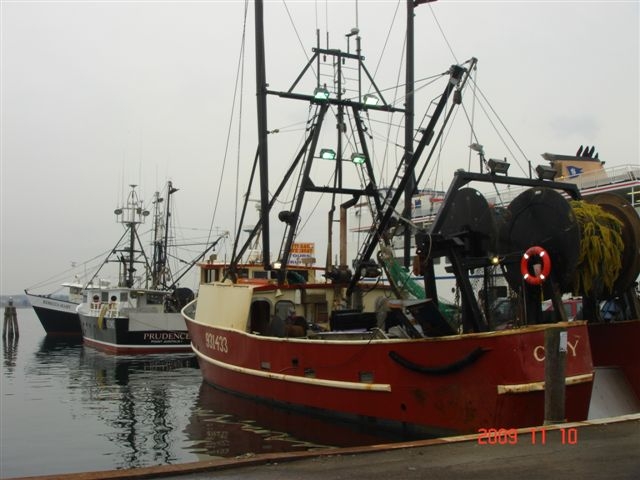
Photos: Suzanne and John’s Mom.
Commercial fishing is recognized as a high-stress job. Land & Sea Together offers a 24-hour help line and free counseling sessions with Coastline, a Rhode Island-based employee assistance program, for farming, fisheries, and forestry workers and their families.

Because I have never lived very far from the Atlantic, I have long known that the people who go out into deep water to catch the fish we buy are doing dangerous work. Fishermen may be injured handling boats in rough seas. Boats may be lost and the crew never seen again. The stress on families can be beyond belief.

That is why I was interested to read in this ecoRi News article that in Rhode Island, at least, help is available for workers in industries identified as especially stressful.

Bonnie Phillips writes, “Workers in Rhode Island’s farming, fisheries, and forestry [FFF] industries struggle with a number of stressors: the impacts of climate change; workforce issues; business and financial concerns; restrictive regulations, and more.

“Until recently, there were few ways workers in these industries — which have long working hours, often in isolation — could access support, whether financial, emotional, or physical. A new initiative, Land & Sea Together, is working to change that.

“ ‘Farmers and fishermen are among the professions most likely to commit suicide each year, and many more folks suffer silently as they tend their crops, equipment, and vessels,’ according to the organization’s website. Land & Sea aims to ‘reduce stress and build mental and financial resilience in the fisheries, forestry and farming communities’ by building a collaborative network of support services.

“The USDA-funded program, operated through the Rhode Island Department of Environmental Management and implemented by the Warwick-based Center for Collaboration and Mediation RI, was started in June 2022 with an initial $500,000 USDA grant. …

“To better understand the communities it wanted to help, Land & Sea put together a comprehensive needs assessment, released last December. For the 90-page report, L&ST studied existing data on the FFF industries in Rhode Island; surveyed individuals working in the industries about stressors; and convened a focus group of workers/owners in the industries. …

“Across the three industries, the main causes of stress were similar: financial management concerns; small-business operations; impacts of climate change; the inability to control the weather; labor shortages; succession planning; lack of access to resources; transportation barriers; housing challenges; longer working hours and increased workloads at peak times; and compliance with government regulations, according to the report. …

“Farmers, who often work where they live, said the lack of separation between work and home can blur the lines of family life, which often results in conflicts. And from spring to fall — the growing season — local farmers are under high amounts of stress, the report says, which can be exacerbated by the weather.

“Those in the fishing industry said heavy workloads, time pressure, lack of support due to isolated working conditions, and climate change were their main stressors. Employers in the fishing, aquaculture, and shellfishing industries reported difficulty hiring reliable workers, some of which they attributed to the lack of public transportation, especially in southern Rhode Island, and the difficulty of keeping employees during the winter. …

“A lack of mental health resources and a reluctance to seek help were identified as an issue across the FFF industries. Some employers, the report said, were unaware of available mental health resources they could offer their employees. Others said the nature of some of the jobs — lack of flexibility in the work schedule, uncompensated time off, and lack of insurance — prevented workers from seeking help. …

‘Most people in sea industries view themselves as a cross between Vikings and pirates, and they do not view themselves as people who need help,’ according to the report. …

“Employers interviewed for the report said they did not think their employees would seek help, and said they especially watch out for signs of concern in their younger employees. …

“Land & Sea offers a 24-hour help line and up to 12 free counseling sessions with Coastline EAP, a Rhode Island-based employee assistance program, for FFF workers and their families. Since the launch of the program in June 2022, [Laurel Witri, former director of the program] said, ’60 farming, fisheries, and forestry workers have called for assistance, receiving 286 hours of support with free outpatient services, financial counseling.’ …

The free, confidential help line with Coastline EAP is 1-800-445-1195, and support is available in English, Spanish, Portuguese, and Cape Verde Creole. The National Suicide and Crisis Hotline is 988, available by call or text.

More at ecoRI News, here. This nonprofit highlights environmental stories that often effect the whole country. It has no paywall, but please consider a donation.

Photo: AP via Ed Smith and family of Geoffrey Holt.
Almost no one knew this unassuming man was investing — until his small New Hampshire town got a large bequest.

In today’s story, a quiet man, known locally as a groundskeeper for a trailer park, rises to prominence in a way that would have totally embarrassed him.

Saleen Martin has the story at USA Today. “Community members knew the late Geoffrey Holt to be a reserved man who liked simple things.  What most people didn’t know is that he was sitting on a $3.8 million fortune. Holt died on June 6, leaving millions to his beloved town of Hinsdale, New Hampshire. ..

“Hinsdale Town Administrator Kathryn Lynch said Edwin ‘Smokey’ Smith is Holt’s estate executor. He told town administrators about Holt’s generous donation a few months ago. …

“ ‘The town and other community committees can apply annually for a grant of $150,000 to be used for health, education, culture or recreation,’ she told USA TODAY in an email. … The town is considering using the money for electronic ballot machines since Holt was ‘an avid voter.’ …

“The main thing, she said, is that they want to honor how frugal Holt was and find ways to help people in Hinsdale save money through the town budget.

“Smokey Smith [and Holt] met when Smith ran an insurance company. … ‘He was very reserved,’ Smith said. ‘He liked to be at the back of a group rather than in the front. He got along well with people, but he didn’t want to be the one leading the conversation. If he knew what was going on today with this story … he would be all sorts of embarrassed.’ …

“Holt worked for Agway Corporation in the 1970s. According to his obituary, he was a production manager with the company. When they closed in the 1980s, he received a cash settlement that he chose to invest.

“He also did odd jobs around town when Agway closed. Smith eventually hired him to do some work on his land. … Smith said Holt eventually moved into an apartment he owned and then, a mobile home that he shared with a woman named Thelma Parker. … She died in 2017.

“ ‘She was good for him and he was good for her,’ Smith said. … ‘She helped him be a little more social. They were a good fit. She was the inspiration he needed to keep moving and she had somebody around to help her.’ …

“He had a car when he worked at Agway but sold it. … What Holt seemed to really love was his lawn mower. He’d ride around Smith’s property with his bad leg elevated on the hood of the vehicle, his friend recalled. … ‘He had several places where he trimmed back the brush so that he could sit down there and read magazines, newspapers, just put his foot up and enjoy the brook and nature.’ …

“Holt spent many years in preparatory school when he was younger. … ‘That’s where he learned that if you stay in the background, you stay out of trouble,’ Smith said. … In 1963, he graduated with a bachelor’s degree from Marlboro College in Vermont and then served in the United States Navy, his obituary reads. 

“He later earned a master’s degree from American International College in Massachusetts in 1968 and then taught social studies and drivers’ education at Thayer High School in Winchester, New Hampshire.

“Smith recalls the day Holt told him about his fortune. It was about 13 years ago. He said his investments had done better than he expected.”

More at USA Today, here.

Art: Stella Teller.
“Seated Storyteller with Four Children.”

For too long, the dominant culture has missed out on some great storytelling. Gradually that is changing, and indigenous playwrights are part of the change.

Mark Kennedy wrote at the Associated Press (AP), “The financial crisis of 2008 hit Mary Kathryn Nagle differently. As a playwright and a citizen of the Cherokee Nation, she saw parallels to events that negatively impacted Indigenous people centuries ago.

“Her play Manahatta juxtaposes the recent mortgage meltdown when thousands lost their homes to predatory lenders with the shady 17th-century Dutch who swindled and violently pushed Native Americans off their ancestral lands. …

“Nagle’s 2018 play has landed in New York City at the prestigious Public Theater this winter and it’s just the latest in a flowering of Native storytelling. From Reservation Dogs, Dark Winds and Rutherford Falls on TV to Prey on the big screen and Larissa FastHorse becoming the first Indigenous female playwright on Broadway, barriers are being broken.

“ ‘I hope it’s not a moment. I hope it’s the beginning of an era,’ says FastHorse, a member of the Sicangu Lakota Nation and a 2020 MacArthur Fellow. …

“ ‘[Most] film studios had never produced any content actually written or produced by Natives. It may have been about some Native people, but it was not written by Native people. And we’ve just seen that flipped on its head,’ Nagle said. …

“Nagle recalls moving to New York in 2010 and asking artistic directors of theaters why they weren’t producing Native work. They would answer that they didn’t know any Native playwrights or that there weren’t enough Native audiences to power ticket sales.

“ ‘Good storytelling is good storytelling, whether the protagonist is white, Black, Asian, LGBTQ — it doesn’t matter,’ said Nagle, who is on the board of IllumiNative, a nonprofit working to deal with the erasure of Native people.

” ‘There’s a lot of projects out there that are changing the narrative and that are proving that our stories are powerful and that non-Natives are really moved by them because they’re good stories.’

“Madeline Sayet, a playwright and professor at Arizona State University who also runs the Yale Indigenous Performing Arts Program, sees the contemporary Native theater movement flowing from the Civil Rights Movement of the ‘60s and ’70s and an increase in awareness of Indigenous issues ever since Native people won the right to legally practice their culture, art and religion.

“She connects the Wounded Knee occupation of 1973 to the Standing Rock standoff over the Dakota Access Pipeline in 2016 to Ned Blackhawk’s The Rediscovery of America: Native Peoples and the Unmaking of U.S History winning the National Book Award this year.

“Sayet, a member of the Mohegan Tribe who became the first Native playwright produced at the Public when her Where We Belong made it in 2020, said keeping Indigenous stories being produced depends on changing funding structures and getting long-term commitments from theaters and programs like Young Native Playwrights Contest.

“FastHorse, who made history on Broadway in 2023 with her satirical comedy The Thanksgiving Play, which follows white liberals trying to devise a culturally sensitive Thanksgiving play, has since turned her attention to helping rewrite some classic stage musicals to be more culturally sensitive. …

“She has recently reworked the book for an upcoming touring musical revival of the 1954 classic Peter Pan, which was adapted by Jerome Robbins and has a score by Moose Charlap-Carolyn Leigh and additional songs by Jule Styne, Betty Comden and Adolph Green.

“FastHorse found the character of Peter Pan complex, the pirates funny, the music enchanting but the depictions of Indigenous people and women appalling. There were references to ‘redskins’ throughout, a nonsense song called ‘Ugh-A-Wug’ and Tiger Lily fends off randy braves ‘with a hatchet.’ …

“FastHorse widened the concept of Native in the musical to encompass members of several under-pressure Indigenous cultures from all over the globe — Africa, Japan and Eastern Europe, among them — who have retreated to Neverland to preserve their culture until they can find a way back.

“The playwright said one of her guiding principles in the reworking was to make sure a little Native girl in South Dakota could see herself and celebrate. ‘Then we’ve done our job and she can join the magic instead of having to armor herself against the magic.’ …

“ ‘I think one thing I’m just hoping that people take away from this play is like, “Wow, Native stories are really compelling. Native people are incredible. They’re incredibly resilient. They’re incredibly brilliant. Yes, there’s tragedy, but they have such incredible senses of humor,” ‘ [Nagle] said.

“ ‘I want them to love my characters the way I love them. I want them to feel the heartache. I want them to feel the laughter. I want them to feel the love,’ she said. ‘And I want them to leave the theater just wanting to know more about our tribal nations and our Native people.’ ” More at AP, here.

Got ideas for a show that needs the red pencil of FastHorse? I’d start with Annie Get Your Gun. Come to think of it, that show also needs the red pencil of poor, white mountain people. Their presentation is painful, too.

Photo: Aardman/Netflix.
A still from Chicken Run: Dawn of the Nugget. The Wallace and Gromit studio reassures fans over rumors of a clay “shortage.”

Here’s a kind of antidote to all the serious things one worries about these days. I myself am an Olympic worrier. For example, when Suzanne went to live in New York after college, I made a little notebook for her, starting with “Things to Worry About in New York City.” (I don’t think it infected her much.)

These days, I worry about the health of people I care about, the war in the Middle East, climate change, the increase in authoritarian governments, Covid, the meanness of our political divide, plastic in the ocean, homelessness, Bangladesh, Burma, Sudan, Ukraine, hungry children, income inequality. And when I don’t know what is going on or why something is happening in my own life, I revert to a childhood way of coping by making up scenarios that are usually off base. Like my scratchy eye means I’m going blind.

So I was delighted to see that there are silly things to worry about. Couldn’t they become a kind of self-inoculation? I guess they would still have to be regarding something you actually cared about. A nice example today is the worry that Wallace and Gromit claymation fans indulged in when they thought there might be a shortage of clay.

Andrew Pulver has the story at the Guardian, the “Wallace and Gromit studio, Aardman Animations, has reassured its fans, and the film industry at large, that production of its popular films will not be grinding to a halt any time soon, saying ‘there is absolutely no need to worry.’

“After reports that the manufacturers of Aardman’s favored modeling clay had gone out of business, meaning the animators had enough supplies for only one more film, Aardman issued a statement on social media saying: ‘We are touched about recent concern over the future of our beloved clay creations, but wanted to reassure fans that there is absolutely no need to worry.’ …

” ‘We have been tinkering away behind the scenes for quite some time with plans in place to ensure a smooth transition to new stocks to continue to make our iconic productions.’

“Aardman is shortly to release Chicken Run: Dawn of the Nugget, a sequel to its hit poultry comedy from 2000, while it is still in production on a new Wallace and Gromit feature, due for release in 2024.” More at the Guardian, here. No paywall.

That’s one worry that can be put to bed. … But wait! The Guardian goes on to say, “In 2005 Aardman lost much of its archive material in a warehouse fire in Bristol.” What? Oh, no!

Photo: Richard Conway/Bloomberg CityLab.
The 478-unit Reumannhof, public housing completed in 1926, was named for Vienna’s first Social Democratic mayor, Jakob Reumann.

Making sure all residents have decent housing is a challenge for cities around the globe. Richard Conway at Bloomberg CityLab says Vienna pretty much figured it out in the 1920s. He maintains it’s the reason Vienna is such a livable city today.

“The housing crunch that the growing city of Vienna faced a century ago,” he writes, “might seem strikingly familiar today: Private developers in the Austrian capital were good at building elegant luxury residences and substandard tenements for the poor, but they’d failed to create enough units to allow average residents to live in decent comfort at an affordable price.

“In response, Vienna’s Social Democratic government pursued a solution that modern cities still struggle to emulate: a massive construction program for public housing.

“The municipal apartment complexes they built, known as Gemeindebau, provided new homes at a volume and level of quality never seen before, and rarely seen since. The long-term results not only saw conditions for the average Viennese skyrocket, they also provided a hugely influential example for cities from Moscow to Manhattan.

These cities-within-a-city included medical facilities, schools, libraries, post offices and theater spaces.

“The Viennese Gemeindebau — plural Gemeindebauten — emerged in a city already in flux. Following Austria’s defeat in World War I, the country’s empire had dissolved and its monarchy was replaced by a democracy, in which the Social Democratic Workers Party (SDAPÖ) had the largest number of seats, both nationally and in Vienna. Once in power, the Social Democrats started addressing an issue central to their base: the overcrowding plaguing the new republic’s capital.

“In the 40 years leading up to 1918 … working-class families often lived in tenements known as Bassena, so named after the communal sinks found in their hallways. While they could look grand from the street, six or seven people might pack into a single apartment; often, each household shared a toilet and a sink and lacked electricity or heating beyond coal and wood stoves. They weren’t cheap, either: About 25% of a tenant’s wages went toward monthly rent, according to a 2022 MIT study.

“Starting in 1919 and continuing through to 1934, the Social Democrats launched a series of wide-reaching urban reforms focused on improving living conditions, education and social services. This period of SDAPÖ rule, widely known as Red Vienna, was informed by non-Bolshevik Austro-Marxism, which emphasized democracy, parliamentary politics and public investment. The Gemeindebauten, or municipal housing projects, were born.

“In the early days of the administration, there were two competing types of Gemeindebau. The first was associated with the settler movement: a group of low-income Viennese and refugees displaced from Austria’s fragmenting empire who occupied squatter settlements on the city’s periphery in an era of postwar political and social disruption. Viennese authorities eventually took over these informal communities, formalizing and planning them using elements of the Garden City philosophy.

“It was a second, much more common type of Gemeindebau, however, that came to define Vienna — the superblock-scaled Volkswohnungspaläste (‘people’s apartment palaces’). …

“Neither elaborately decorative like Vienna’s prewar tenements nor strikingly spare like the glass-and-steel apartments of the later International Style, the Gemeindebau often straddled an intriguing line between late 19th historicism and 20th century modernism. …

“Like older tenements, the buildings were typically aligned with streets, accessorized with some decorative features such as fancy brickwork or statuary and grouped around shared common yards. But while Bassena courtyards tended to be narrow, treeless and drab, the huge courtyards of the Gemeindebauten were spacious enough to serve as as combined garden, sports facility and public square, all accessible and sheltered from street noise. …

“In general, the shared areas within the superblocks were in fact as important as the individual homes, reflecting the Viennese administration’s social philosophy. These cities-within-a-city included medical facilities, schools, libraries, post offices and theater spaces. Curved staircases connected large floors — often as many as seven — and spacious landings. …

“The individual apartments, while varying in layout, shared key features. They included a living room, a bedroom, a kitchen, and some had small entrance hallways inside the front door. Almost all units featured running water, while many had large windows and balconies. Each apartment usually housed an individual family.

“Vienna employed nearly 200 architects to build more than 380 Gemeindebau complexes between the wars, a construction boom that created 60,000 new municipal apartments. In her book The Architecture of Red Vienna 1919-1934, Harvard professor Eve Blau describes how the municipal government was able to do this through expropriation, the use of tax policies to reduce land values and zoning laws. By 1931, it owned a third of the city’s area.

“Working-class citizens might now expect to live in airy apartments and access shared facilities. Indeed, the urban philosophy of Gemeindebauten is neatly captured by a term carved by artist Mario Petrucci into a statue outside a housing project: … ‘Light in the home. Sun in the heart.’ This was more than just a slogan; it represented an entire worldview.”

More at CityLab, here. No paywall. Interesting pictures.