Feeds:
Posts
Comments

The Monday Holiday

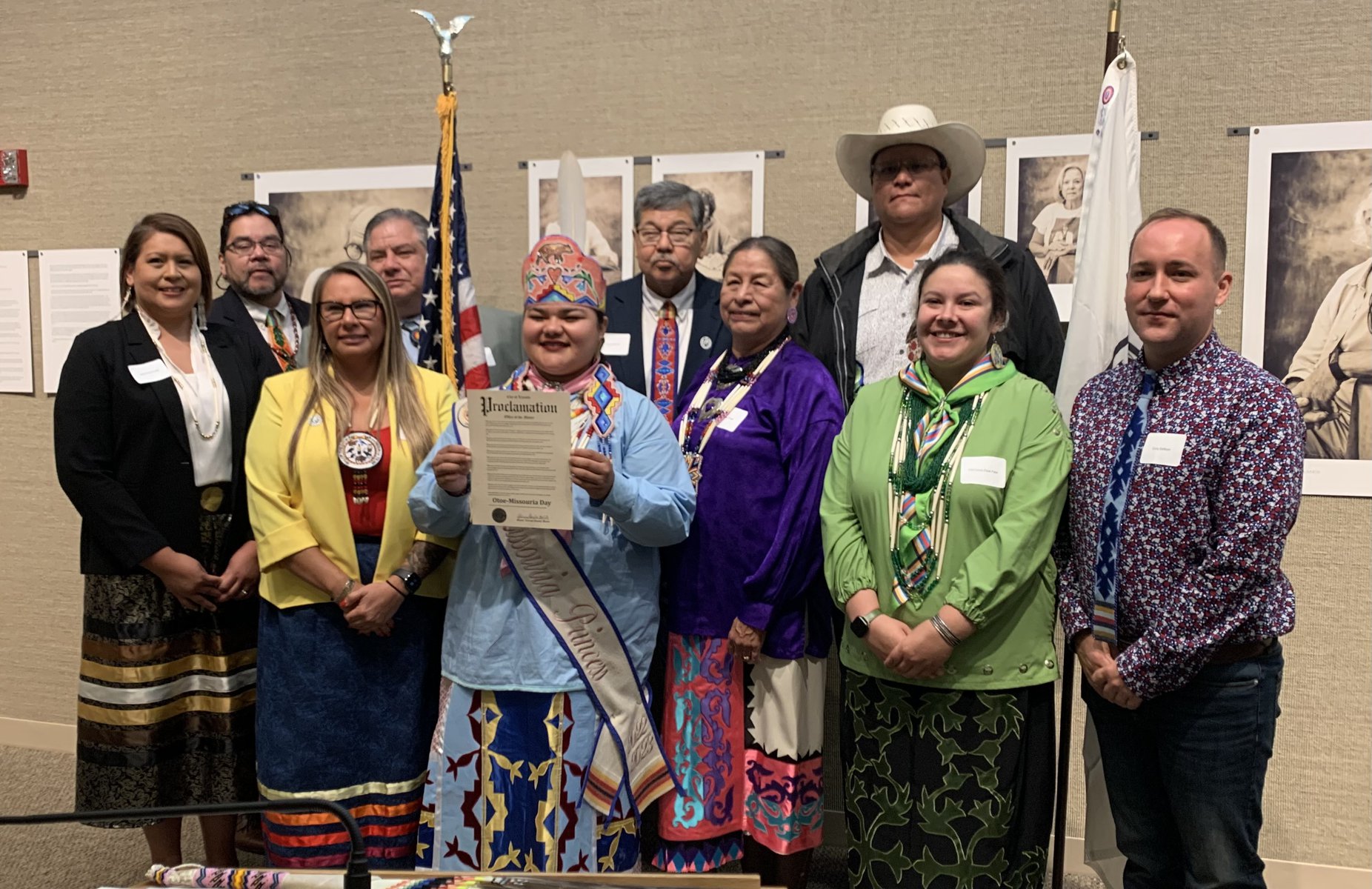
Photo: Nebraska Public Media.
Members of the Otoe-Missouria tribe pose with the proclamation that designates September 21 as “Otoe-Missouria Day” in Nebraska.

However we celebrate Monday, it’s a good idea to think it through. What is loyalty to Columbus about? What is loyalty to the original inhabitants about? What can we learn?

In a 2021 National Public Radio (NPR) story, Dylan Baca, a 19-year-old Arizonan who was instrumental in helping broker the proclamation recognizing Indigenous Peoples’ Day, said, “I still don’t think I’ve fully absorbed what that has meant. This is a profound thing the president has done, and it’s going to mean a lot to so many people.”

But he acknowledges that Italian Americans also deserve to be celebrated because Columbus Day was founded as a way to appreciate the mistreatment of Italian Americans. “Italian American culture is important, and I think there are other times and places to recognize that. But I think it’s also important to also recognize the history of Columbus Day itself. Should we recognize a man whose labors [decimated] the Native American population here? I don’t think that is something that we want to be honored.”

I know now that the traditions I learned in elementary school are mostly based on fairy tales. So I appreciate the opportunity to gain information based on facts. Here, for example, is an interesting article about a tribe indigenous to Nebraska.

Jackie Ourada at Nebraska Public Media reports, “The last time Otoe-Missouria families walked together on Nebraska prairie, they were headed south to hot, dry reservation land in Oklahoma. They wouldn’t be officially welcomed back to their ancestral home for nearly 200 years.

“This is where Christina Faw Faw’s relatives hunted elk and bison, where they kept their corn and wild plants, where they held celebrations and ceremonies, and eventually, where they had to leave. Though, Faw Faw says her ancestors’ presence remains.

“ ‘As soon as we got out of the car and started walking down this road, I could feel it,’ she said.

“Oregon marked its first statewide recognition of Indigenous Peoples’ Day, in place of Columbus Day, in 2021 after its legislature passed a bill brought by its Indigenous lawmakers. Rep. Tawna Sanchez, one of those lawmakers, said the movement to recognize the day is an ideal time to capitalize on the momentum of political recognition.

” ‘I don’t know that we’ll ever get to a place where people have their land back or have the recognition of who they are, to the degree that we that we need to or should. But the fact that people are paying attention at this very moment — that’s important, because we will have a greater opportunity to educate people and help them understand why we are where we are right now,’ she told NPR in 2021. …

“Her tribe’s land stretched across southeastern Nebraska, from Yutan to the Salt Creek in Lincoln. They were forced out in 1833 to make way for white settlements, some of which became the concrete city blocks of Lincoln and the University of Nebraska. Both are now officially recognizing the damage done to Native people.

“[Faw Faw] made the trip to Lincoln, as the city’s mayor signed a proclamation designating September 21 as Otoe-Missouria Day. It’s the latest step in a growing movement, in Nebraska and across the world, to recognize the harm white settlers inflicted on Indigenous people and to reconcile relations. …

“Nebraska State Historical Society excavations show the Otoe-Missouria tribe built several round earth lodges across this southeastern land they called nyi brathge, or ‘flat water,’ which later gave Nebraska its name. They had separate storage areas for their corn and wild plants, dedicated areas for their fishing and hunting utensils, and large gathering spaces for tribal ceremonies. …

‘Dozens of families from the 3,200-member tribe traveled from their reservation in northern Oklahoma for the ceremony. While the trip back to their former tribal land sparked feelings of gratitude and healing, Vernon Harragarra said there’s still pain that may never fully mend.

“ ‘Today is just one step forward in gaining what we lost,’ Harragarra said. His elders have long spoken of the culture white settlers erased when they pushed tribes to reservations.

“ ‘We used to share the pipe with the Omaha people and the Winnebagos – our neighbors,’ Harragarra said. ‘When we left, a lot of our ceremonial and ancient ways were gone.’

“The first arrival of white settlers and the diseases they carried nearly decimated the Missouria tribe. It’s what eventually brought the two groups together. At one point, the Missouria tribe dwindled to just one hundred relatives – forcing them to join the Otoes to survive.

“And when they were forced south to Oklahoma, Harragarra said his bloodline almost didn’t survive. His ancestors made the long trek as soldiers pushed other tribes along the Trail of Tears, the infamous and deadly 5,000-mile route that displaced Indigenous populations to reservations.

“Harragarra thought about that history when he and his family drove up from Oklahoma. Getting away from the reservation with his children felt like he was restoring lost traditions – such as his tribe’s sacred buffalo hunts, where families would take their growing children to gather food for the first time.

“ ‘When I took my daughter out of school, it reminded me of those stories,’ Harragarra said. ‘I wanted my kids to be here to witness this historic day. I kept telling them that on the way up here.’

“Harragerra said he expects his children to also keep traditions alive despite pressure to assimilate. ‘They’re not done yet. You know, in the future, I’m not gonna be here forever,’ Harragarra told his three children. ‘You guys got to carry on what we’re trying to get back.’ “

More at NPR, here, and at Nebraska Public Media, here. No firewalls.

Happy Cobblers

Photo: Marcie Parker for the Boston Globe.
Leslie Bateman and Emily Watts are the founders of Coblrshop, a modern shoe repair company in Boston.

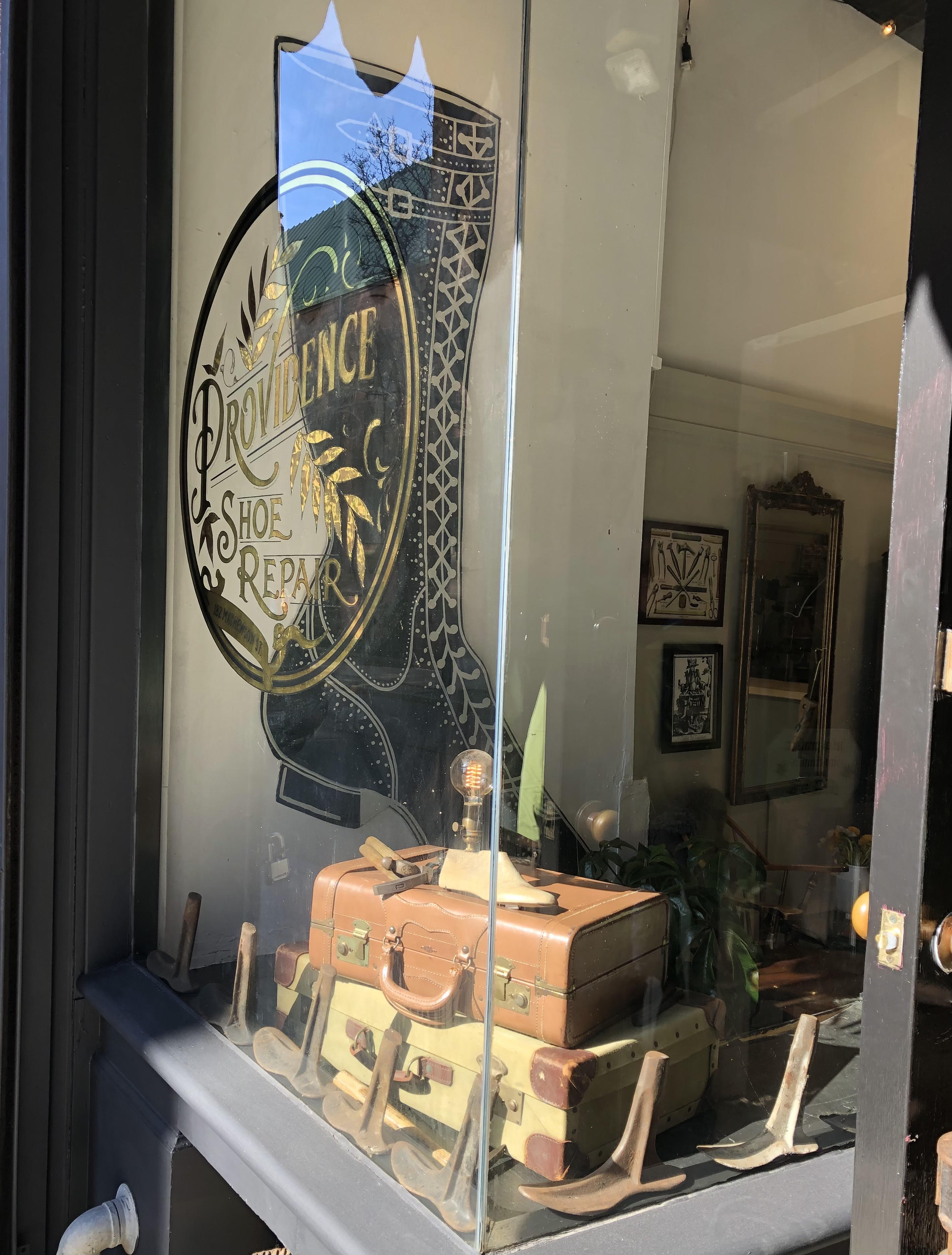
I don’t know if you would recall a photo blog post of mine that included a picture of a new-ish cobbler shop in Providence. I was surprised at the time to see that anyone new was eager to get into the shoe-repair business. Wasn’t it supposed to be a dying art?

It turns out that there are enough customers who want to keep their favorite shoes intact that cobbling services are actually increasing.

Marcie Parker reports at the Boston Globe, “Leslie Bateman always loved shoes. Since she was a little girl, she has walked with her eyes cast downward, checking out shoes as their owners stepped along sidewalks. She scoured shoe stores, department stores, and vintage clothes shops for the perfect shoes for school, work, exercise, formal occasions, and casual gatherings.

“And once she found the right shoes, she never wanted to toss them out. Thus began Bateman’s relationship with cobblers, the craftspeople who repair, customize, and sometimes make shoes. Whenever she moved to a new city — Montreal, New York, and now Boston — she searched for cobblers to keep her shoes in good condition, a task that became harder as the number of people practicing the trade dwindled.

“Now Bateman and her partner, Emily Watts, are launching a new service to make it easier for shoe lovers to get their shoes fixed. Their Boston-based startup, called Coblrshop, combines the latest in digital technology with a centuries-old craft, using its website and a mobile app coming next year to diagnose repairs for luxury shoes and handbags, estimate costs, and connect to cobblers.

“ ‘You bring technology in and it adds so much efficiency,’ Watts said. ‘[We’re] using technology to really improve a well-established and long-lasting industry.’

“Coblrshop is among the latest companies to use technology to connect customers with services, joining a host of websites and mobile apps that provide one-stop shopping for auto repair, dry cleaning, home maintenance, and food delivery.

“Bateman and Watts are betting if they make shoe repairs fast, convenient, and competitively priced, more people will fix rather than toss out worn shoes, not only helping to revive the art of shoe repair but also reducing the environmental impact of the footwear industry. …

“Coblrshop contracts with a downtown Boston shoe repair shop, David’s Instant Shoe Repair on Franklin Street, to make repairs. Ultimately, the company plans to find a larger, central location to host several cobblers and train new ones.

“Here’s how the service works: Customers go to the company’s website, where they can choose the type of shoe or handbag that needs repair. From there, they select from a drop down menu the condition of the shoes and the services needed.

“Customers can choose from broad repair categories, such as a clean and shine, wear and scuffing services, or a complete repair. They also have the option to add protective soles to reduce future wear and tear. … After ordering repairs and paying online, customers receive within three to five days a biodegradable and recyclable mailer bag to send their shoes to the company’s cobbler. The process, from estimate to delivery of just-like-new shoes, takes about two weeks.

“Eduard Harutyunyan, who works at David’s Instant Shoe Repair, is Coblrshop’s cobbler. After immigrating to Massachusetts from Armenia in 1997, he learned the craft from a cousin who owned a shoe repair shop in Natick.

“Bateman and Watts said they searched extensively to find a cobbler who they believed would do the highest quality work and be open to modernizing shoe repair. They chose Harutyunyan after speaking to more than 60 cobblers.

“Harutyunyan, 46, said … ‘The issue with the cobblers in general — they don’t get much respect,’ said Harutyunyan. ‘What I like is to be able to change that.’ …

“Few appreciate that as much as Bateman. She recalled becoming particularly attached to a pair of gold Chanel flats that her husband found at a vintage store in Manhattan in 2010 and gave to her for her birthday. She wore the flats every day for years, getting them resoled four times. …

“ ‘You’re not buying something and sending us something new or something via resale,’ Bateman said. ‘You are sending something in that has a story, and we need to take care of that and give you back that magical experience.’ ”

More at the Globe, here.

Photo: John and Suzanne’s Mom.
Providence cobbler shop.

Photo: Mata, et al, CC BY 4.0.
Entomology Today says, “City insects need native plants just like country insects do. A new study, conducted in a small greenspace in Melbourne, Australia, found that an increase in the diversity and complexity of plant communities leads to a large increase in insect biodiversity, a greater probability of attracting insects, and a higher number of ecological interactions between plants and insects.”

My friend Jean Devine, founder of Biodiversity Builders and Devine Native Plantings, works with young people to plant native species that nurture beneficial insects. Between her and University of Texas Prof. Alex Wild, @alexwild, I have been learning a lot about bugs and how essential to life they can be. I even work hard to understand some of Alex’s posts, of which the following is not unusual: “A genomic study of a small group of tiger beetles shows that convergent color evolution had misled past morphological taxonomists.” Ha!

Meanwhile, under the title “Every Little Bit Helps,” Entomology Today advises those responsible for plantings in cities thus: “By increasing the diversity of native plants in urban areas, researchers from the University of Melbourne have seen a seven-fold increase in the number of insect species in just three years, confirming the ecological benefits of urban greening projects. The findings were published [in August] in the British Ecological Society journal, Ecological Solutions and Evidence.

“The study, conducted in a small greenspace in Melbourne, Australia, found that an increase in the diversity and complexity of plant communities leads to a large increase in insect biodiversity, a greater probability of attracting insects, and a higher number of ecological interactions between plants and insects.

“Bringing nature into cities has been shown to deliver a host of benefits, from well-being to increased biodiversity and climate change mitigation. Being able to quantify the benefits of greening projects like rooftop gardens or urban wildflower meadows has become a sharp focus for people creating and funding them.

However, prior to this study, little evidence had been documented on how specific greening actions can mitigate the detrimental effects of urbanization through boosting the numbers of indigenous insect species that have become rare or ceased to exist in a particular area.

“ ‘Our findings provide crucial evidence that supports best practice in greenspace design and contributes to re-invigorate policies aimed at mitigating the negative impacts of urbanization on people and other species,’ says Luis Mata, Ph.D., researcher at the University of Melbourne’s School of Agriculture, Food and Ecosystem Sciences, lead research scientist at Cesar Australia, and lead author of the study.

“Prior to the beginning of the study in April 2016, the research team’s chosen greenspace was limited in vegetation: simply a grass lawn and two trees. Across April, the site was substantially transformed through weeding, the addition of new topsoil, soil decompaction and fertilization, organic mulching, and the addition of 12 indigenous plant species.

“Across the four-year length of the study, the researchers conducted 14 insect surveys using entomological nets to sample each plant species for ants, bees, wasps, beetles and more. Overall, 94 insect species were identified, 91 of which were indigenous to Victoria, Australia.

“ ‘Most importantly, the indigenous insect species we documented spanned a diverse array of functional groups: detritivores that recycle nutrients, herbivores that provide food for reptiles and birds, predators and parasitoids that keep pest species in check,’ Mata says.

“The 12 plant species planted at the beginning of the study were found to support an estimated 4.9 times more insect species after only one year than the original two plant species that previously existed in the greenspace where the research took place. …

“ ‘An increase in the diversity and complexity of the plant community led to, after only three years, a large increase in insect species richness, a greater probability of occurrence of insects within the greenspace, and a higher number and diversity of interactions between insects and plant species,’ Mata says. …

“ ‘I’d love to see many more urban greenspaces transformed into habitats for indigenous species,’ Mata says. ‘We hope that our study will serve as a catalyst for a new way to demonstrate how urban greening may effect positive ecological changes.’ ”

More at Entomology Today, here. No firewall.

An Octopus Mystery

Photo: MBARI.
Researchers nicknamed the Muusoctopus robustus species the pearl octopus because of the way they look while upside down protecting their eggs. In 2018, a team of scientists found thousands of M. robustus at the base of the Davidson Seamount, about 80 miles southwest of Monterey, California.

Some people may recall Ringo Starr singing “Octopus’s Garden” on “Abbey Road,” but who knew there was really such a thing as an octopus garden? Kasha Patel describes one at the Washington Post.

“About 80 miles from the coast of central California, thousands of octopuses gather on rocks two miles below the surface of the ocean. This location, dubbed ‘octopus garden,’ is the largest known aggregation of these mollusks in the world. … Scientists have been puzzled why so many octopuses plant themselves in these abysmal, colder waters — until now.

“After three years of monitoring the area, researchers found the site is a popular mating and nesting ground for pearl octopuses, where hot springs help embryos develop twice as fast as expected at this depth. The faster development increases a hatchling’s likelihood of survival through the brooding period, according to a study released [in August] in the journal Science Advances. …

“ ‘We’re supposed to be managing these areas and protecting them for future generations, and we didn’t even know that this habitat was down there [and] what kind of impact it was having,’ said Andrew DeVogelaere, research ecologist and study co-author. …

“The discovery of the octopus garden back in 2018 was lucky, said DeVogelaere, who runs the research program for NOAA’s Monterey Bay National Marine Sanctuary. For more than two decades, researchers have been studying an extinct underwater volcano called the Davidson Seamount. The seamount, located southwest of Monterey, Calif., is one of the largest seamounts in the world and known for its beautiful deep sea corals. It is also one of the most well-studied seamounts in the world, so when DeVogelaere wanted to explore it further, others were skeptical he would find anything new.

“ ‘We said, “Don’t waste your time going there,” ‘ said Jim Barry, senior scientist at the Monterey Bay Aquarium Research Institute and lead author of the new study. ‘ “We’ve been all over it.” ‘ …

“Nevertheless, Barry and his colleagues said there is an unexplored area on the foothills of the seamount that could be interesting to investigate. The researchers then sent a ship to study the area.

“DeVogelaere, who was following along on a video feed, said it was at first pretty dull, just a lot of mud. Then suddenly, they spotted a hoard of balls, like opalescent pearls, on the seafloor.

“They had found the ‘octopus garden,’ home to at least 6,000 nesting, Muusoctopus robustus. … The researchers estimate there could be 20,000 in this nursery.

“For three years, the team monitored the population through cameras and dives with remotely operated vehicles, measuring water temperature and oxygen. They found only adult males and female octopus, developing eggs, and hatchlings at the location, indicating the site was used exclusively for mating and nesting.

“They also noticed shimmering water, which was indicative of a thermal spring — something ‘totally new in this area,’ Barry said. He explained the shimmering water appears when warm water (such as from a thermal spring) and cool waters mix. Water temperature from these thermal springs can reach nearly 51 degrees Fahrenheit, while ambient water temperature is around 35 degrees. …

Typically at near-freezing temperatures in the deep ocean, researchers expected pearl octopus eggs at least five years to hatch. These hatched in just two years.

“ ‘As you get into colder waters, whether it’s polar waters or deeper waters, colder water slows down metabolism, slows down metabolic rates, slows down growth and embryonic development rates,’ Barry said. ‘We think that the warm water is providing some sort of reproductive benefit for them.’ …

“The team thinks the octopus garden is just one of many deep sea octopus environments out there. Just five miles away from the garden, researchers found another octopus nursery near thermal springs. In June, another group of researchers discovered a nursery near thermal springs in Costa Rica.

“[Beth Orcutt, vice president for research at the Bigelow Laboratory for Ocean Sciences in Maine] helped lead the Costa Rica expedition. [She] said both of these discoveries show that these small outcrops of rock on the seafloor, which are often passed over for study to focus on larger seamounts, can be incredibly rich and productive sites of life.

“ ‘I don’t think it’s a one-off curiosity,’ DeVogelaere said. ‘Most of the deep sea hasn’t been looked at.’ ”

More at the Post, here. For a version of the story with no firewall, see CNN, here.

Mini Urban Forests

Illustration: Elara Tanguy.
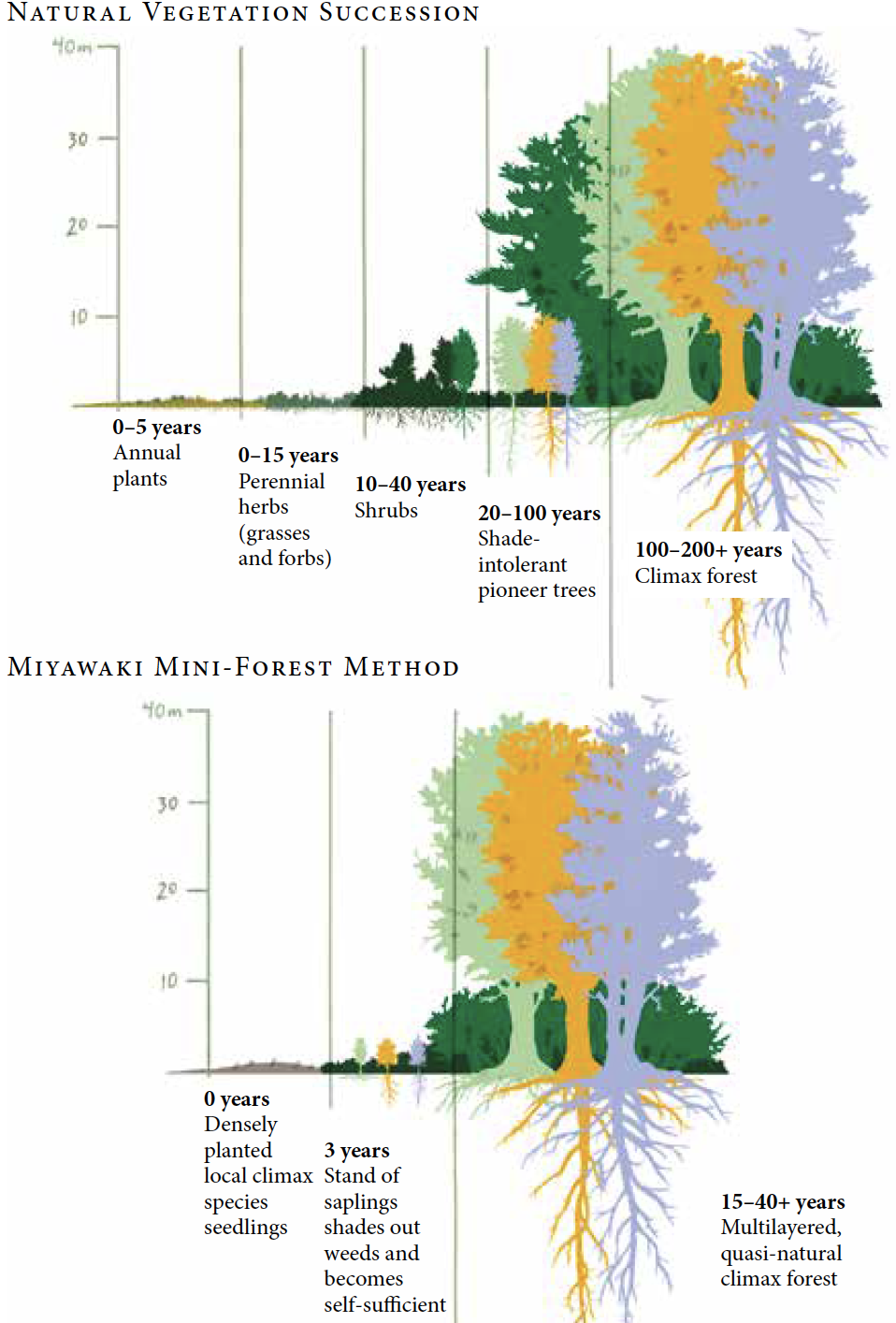
The Miyawaki Method (bottom) speeds up the process of natural ecological succession (top) through the planting of “climax species.”

Ideas on combating climate change through the planting of sustainable forests come today from an employee-owned publishing company called Chelsea Green. Here they focus on a book by Hannah Lewis about the Miyawaki Method.

“Author Hannah Lewis is the forest maker transforming empty lots, backyards, and degraded land into mini-forests and restoring biodiversity in our cities and towns to save the planet. …

“Most of us know the term old-growth forest, which refers to natural forests that are still mostly free of human disturbance (though not necessarily free of human presence). These forests have reached maturity and beyond — a process that often takes centuries. As a result, they host incredible biodiversity and sustain a complex array of ecosystem functions.

“The Miyawaki Method is unique in that it re-creates the conditions for a mature natural forest to arise within decades rather than centuries. 

At the heart of the method is the identification of a combination of native plant species best suited to the specific conditions at any given planting site.

“As we’ll see, determining this combination of special plants is not always so straightforward.

“More than just the species selection, the Miyawaki Method depends on a small collection of core techniques to ensure the success of each planting. These include improving the site’s soil quality and planting the trees densely to mimic a mature natural forest. It’s also necessary to lightly maintain the site over the first three years — which can include weeding and watering. Amazingly, though, if the simple guidelines are followed, after that point, a Miyawaki-style forest is self-sustaining.

“The trees grow quickly (as much as 3 ft per year), survive at very high rates (upward of 90 percent), and sequester carbon more readily than single-species plantations. The Miyawaki Method is also special for its emphasis on engaging entire communities in the process of dreaming up and planting a forest. Whether you are three years old or eighty-three, chances are you can place a knee-high seedling into a small hole in the ground. At the very least you can appreciate and cherish the return of quasi-wilderness to a space that was once vacant.

“The Miyawaki Method calls for planting native species, but not just any natives. In particular, the method involves a careful investigation of what’s known as potential natural vegetation (PNV). This unusual term refers to the hypothetical ecological potential of a piece of land. Or another way to say it is that potential natural vegetation is ‘the kind of natural vegetation that could become established if human impacts were completely removed from a site’ over an extended period of time. A site’s PNV depends on many factors, including current climate conditions, soil, and topography.

“How is potential natural vegetation different from the plants we see growing around us in towns and cities? For starters, in almost all developed landscapes, many of the plants are not native to the area, and as such may require maintenance to survive or reproduce.

“Given that most of Earth’s land surface is significantly altered by urbanization, agriculture, road construction, mining, and the like, it is far from obvious what the original vegetation of any given location would have been. (Original vegetation and potential natural vegetation are not necessarily exactly the same, but they are closely related.) Unraveling this mystery takes curiosity, patience, and persistence.

“However, thinking about land in terms of its potential natural vegetation is a powerful angle from which to approach ecosystem restoration, because it reveals which species and groups of species are best adapted to a particular environment and therefore more likely to thrive and to support a wider web of wildlife. …

“If left alone, previously forested land can grow back into mature forest via a process known as ecological succession, wherein the biological components of the ecosystem change over time as larger and longer-lived plant communities colonize the land. As mentioned, this process can take centuries to unfold. A foundational aspect of the Miyawaki Method is that it sidesteps the slow and capricious march of natural succession, instead focusing on those plants that mark the theoretical endpoint of succession.

“In nature, the successional process begins when lightweight seeds drift in and germinate on bare ground. Hardy, fast-growing plants — what scientists call pioneer species — such as clover, plantain, and dandelion take advantage of ample sunlight and space. They live short lives, produce a lot of seeds, and shelter the ground in the process. Next to show up are larger perennial herbs and grasses, followed by shrubs and pioneer trees, such as birch, poplar, or pine.

“ ‘Each new group of species arrives because the environmental conditions, especially the soil, have been improved; each new species becomes established because it is more shade tolerant than the previous species and can grow up under their existing foliage,’ Miyawaki wrote. He explains that just when a community of plants appears to be reaching its fullest potential, the seeds of the succeeding community are already germinating in its shade. The species making up each new successional stage tend to be bigger, more shade-tolerant, and longer living than those of the previous stage.

“ ‘The plant community and the physical environment continue to interact,’ Miyawaki explained, ‘until the final community most appropriate for the environment comes into being, one that cannot be replaced by other plant types. In regions with sufficient precipitation and soil, the final community is a forest.’

“Theoretically, this final community of plants, known as the climax community, is not easily superseded. Big trees that are considered climax species in their respective environments live for hundreds or thousands of years, forming canopies that shade the interior of the forest, keeping it cool and moist. Climax species shade out pioneer species and dominate the forest.

“ ‘In the absence of major environmental change, the climax is normally the strongest form of biological society and is stable in the sense that its dynamic changes are constrained within limits,’ Miyawaki wrote. Partly on account of the microclimate they create, such ecosystems tend to be more resistant to external conditions, such as heat or drought.”

More at Chelsea Green, here. No firewall.


Photo: Lanna Apisukh for NPR.
Concertgoers dancing at the Silent Disco dance party at Lincoln Center, New York City, on Saturday, July 1, 2023. “Haptic” suits designed for the deaf community were provided by Music: Not Impossible.

Of the many interesting kinds of jobs in the world, I bet you never heard of this one: “Chief Vibrational officer”! Jennifer Vanasco explains at National Public Radio (NPR).

“When Daniel Belquer was first asked to join a team to make a better live music experience for deaf and hard-of-hearing people, he was struck by how they had developed work-arounds to enjoy concerts.

” ‘What they were doing at the time was holding balloons to feel the vibrations through their fingers, or go barefoot and flip the speakers facing the floor,’ Belquer said.

“He thought the team could make something to help hard-of-hearing people enjoy live music even more with the technology now available. 

“Belquer, who is also a musician and theater artist, is now the ‘Chief Vibrational Officer’ of Music: Not Impossible, an off-shoot of Not Impossible Labs, which uses new technology to address social issues like poverty and disability access. …

“His team started by strapping vibrating cell phone motors to bodies, but that didn’t quite work. The vibrations were all the same. Eventually, they worked with engineers at the electronic components company Avnet to develop a light haptic [3D touch] suit with a total of 24 actuators, or vibrating plates. There’s 20 of them studded on a vest that fits tightly around the body like a hiking backpack, plus an actuator that straps onto each wrist and ankle.

“When you wear the suit, it’s surprising how much texture the sensations have. It can feel like raindrops on your shoulders, a tickle across the ribs, a thump against the lower back.

It doesn’t replicate the music — it’s not as simple as regular taps to the beat. It plays waves of sensation on your skin in a way that’s complementary to the music.

“The vibrations are mixed by a haptic DJ who controls the location, frequency and intensity of feeling across the suits, just as a music DJ mixes sounds in an artful way.

“The evening’s haptic DJ was Paddy Hanlon, co-founder of Music: Not Impossible. ‘What we’re doing is taking the feed from the DJ, and we can select and mix what we want and send it to different parts of the body,’ he said. ‘So, I’ll kind of hone in on, like, the bass element and I’ll send that out, and then the high hats and the snare.’

“The haptic suits were just one component of the event, which was celebrating Disability Pride Month as part of Lincoln Center’s annual Summer for the City festival. There were American Sign Language interpreters; the music was captioned on a screen on the stage; there was audio description for those who were blind, and there were chairs to sit in. There’s also a chill-out space with noise-reducing headphones, earplugs and fidgets for those who feel overstimulated. Because it’s a silent disco — meaning you can only hear the music through headphones — attendees could adjust the sound. …

“The suits are the star attraction. Lily Lipman, who has auditory processing disorder, glowed when asked about her experience.

” ‘It’s cool, because I’m never quite sure if I’m hearing what other people are hearing, so it’s amazing to get those subtleties in my body.’

“Said Kevin Gotkin, one of the evening’s DJs and the curator of disability artistry events at Lincoln Center, ‘This is a chance for us to be together and experience access that’s integrated into a party artistically and not as, like, a compliance thing. … Disability is the center of the party.’ “

More at NPR, here. No paywall.

Photo: chrisstockphoto/Alamy.
Traditional west African instrument, the balafon. 

Having fun today learning about unusual musical instruments, whose fans, though small in number, are nevertheless as devoted as those who love the sound of a French horn or steel drum.

Kevin LeGendre reports at the Guardian, “In the 2022 film Alice, the titular heroine – a slave living on a 19th-century-style plantation in Georgia – discovers that she is really living in the 1970s. The soundtrack reflects the latter period … with interludes that feature an instrument that was first heard in the days of plantations: the contrabass clarinet.

“The instrument is played by James Carter, a 54-year-old musician from Detroit who has been a significant figure in jazz since the early 90s. ‘I just loved the “muddy earth” sound it has,’ he says.

‘All that air flowing through it made you feel like you’re the lord of the underground. The contrabass clarinet has such expressive range; it reminds me of bullfrogs in the night, yet it is also a kind of wise old sage, it’s so commanding.’

“You can hear what he’s talking about on his 2003 album, ‘Gardenias for Lady Day,’ a tribute to the vocal great Billie Holiday. On Strange Fruit, Holiday’s anti-lynching anthem, Carter draws from the contrabass clarinet a series of primeval, haunting wails that entirely suit the subject matter. The low-end horn is like an engulfing darkness. …

“For those who play the sorts of instruments that are rarely seen in orchestras and jazz bands, there are practical hurdles to overcome, such as honing posture and technique to successfully negotiate the shape, size and structure of these uncommon inventions. Not to mention the cost and complexity of servicing and maintaining such devices. …

“First used in 19th-century classical orchestras and military bands, the contrabass clarinet is one of the more obscure members of the woodwind family. It has long held an appeal for jazz musicians intent on creating a wide tonal spectrum in their work. One of Carter’s major sources of inspiration, Anthony Braxton, an innovative Chicago-born composer-improviser, raised the profile of the instrument when he used it at prestigious international festivals in Montreux and Berlin back in the mid 70s.

“ ‘He was way ahead of his time,’ says Carter, whose arsenal of reed instruments also includes F-mezzo, soprano, tenor and baritone saxophones. ‘When he hits a low C, it takes you to another dimension. I wanted to experience the same thing when I played it myself.’

‘With its broad, upright frame, like a giant paperclip, the contrabass clarinet requires its players to have physical strength as well as technique. … Says Carter, “You have to make your lungs work a little bit harder with it, but that’s also the beauty. You feel everything you put into it.’

“As much as Carter, who has worked with jazz and rock stars such as Herbie Hancock and Ginger Baker, hails the wonders of the contrabass clarinet, he is keen to acknowledge the role that specialist woodwind makers such as Benedikt Eppelsheim have played in its evolution. The renowned German instrument maker, who died earlier this year, fitted it with trill keys – small levers that facilitate the shaking and warbling of notes – and additional octaves that ‘let the instrument sing more.’

“[Most] exciting are those custom-made devices that were never put into mass production. Such is the case of a one-off low-register beast played by Paul Rogers that straddles eras, genres and cultures. A hybrid of the baroque-period viola da gamba, double bass and Indian sitar, this unnamed instrument has seven rather than four playing strings, as well as 14 ‘sympathetic strings’ – non‑playing strings tucked under the playing strings to produce greater resonance.

“ ‘It’s a weird combination of many things,’ says Rogers. ‘I told a French luthier, Antoine Leducq, what I wanted and he took about a year and a half to make it. The shape of the instrument is like a small canoe. It’s like a medieval thing, really. But I listen to all sorts of music – medieval classical, Asian and African music – and with this instrument I can really find some of those sounds. …

“Yahael Camara Onono [loves] the balafon. It is one of many traditional west African instruments featured in Balimaya Project, the ensemble he leads that has built a sizeable audience in Britain in the past few years through its blend of Mandé rhythms, jazz, funk and spoken word. Similar in appearance to a xylophone, the balafon has keys made of strips of wood that resonate through small calabashes (gourds) tied underneath. The instrument must be handled with care.

“ ‘You have to be in the right atmospheric conditions because it’s quite fragile,’ says 31-year-old Onono, a percussionist and historian of west African instruments. ‘Heat and humidity affect every part of the instrument, so traveling from one continent to another is tricky.’ “

“When the Dust Settles by Balimaya Project is out now on New Soil/Jazz Re:Freshed.” If you are in London on the 17th of this month, check them out at the Barbican.

More at the Guardian, here. No paywall. Contributions encouraged.

Photo: Modacity.
“To understand how Groningen got to where it is today, one must look back nearly 50 years, to a young, idealistic politician who bravely decided to go against conventional wisdom,” says the Daily Hive.

I haven’t been to Ocean Beach on Fire Island in decades, so I don’t know if it is still entirely free of cars, but it definitely was in my childhood summers, and it’s hard to convey just how radically that changes the quality of life for the better. Car-free in the Netherlands sounds heavenly, too.

Chris and Melissa Bruntlett write at the Daily Hive, “When we initially selected the five Dutch cities we would explore over the course of our #CyclingAbroad adventure, many of our friends had no idea where Groningen was, let alone why we would want to visit there. But among our colleagues in the transportation and urbanism world, a pilgrimage to this once-fortressed college town, 200 km northeast of Utrecht – famously declared ‘The World’s Cycling City’ by Streetfilms’ short documentary  – was an absolute must.

“With a population of around 200,000, a quarter of whom are students at the two local universities, Groningen has accomplished a feat many emerging cycling cities could only dream of: a bicycle mode share that eclipses the established powerhouses of Amsterdam and Copenhagen. Recent figures indicate a staggering 61% of trips in the city are made by bicycle. That’s almost nine times larger than Vancouver’s celebrated mode share. …

“To understand how Groningen got to where it is today, one must look back nearly 50 years, to a young, idealistic politician who bravely decided to go against conventional wisdom.

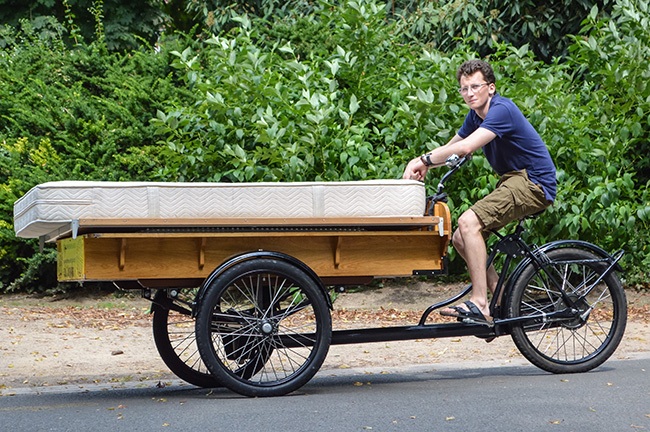
“In the mid-1970s, as cities across the country were scrambling to create the ideal conditions for mass motoring (including, most notably, Amsterdam), a left-leaning Groningen council recognized the inherent flaws in rebuilding their city around the private automobile. Max Van den Berg, then just 24 years old, and the councillor responsible for traffic and urban development, resolved to take his city in the opposite direction. Under Van den Berg’s advice, in 1977, council all but banished motor vehicles from the city centre, making it a far more pleasant place for people on foot and bicycle.

“For Lior Steinberg, an urban planner born and raised in Tel Aviv, the resulting lively cityscape is what drew him to relocate to Groningen, after a study tour while completing his master’s degree. ‘Groningen is a vibrant city, and there is a great cultural life. It’s a real hidden gem,’ he claims. …

“Steinberg credits Van den Berg’s Traffic Circulation Plan as central to Groningen’s successes: ‘The circulation plan divided the city centre to four parts, forbidding cars to cross between those quarters,’ he explains. ‘This made the city centre practically impenetrable with a car, and made cycling and walking the best way to get around.’

“While the plan didn’t completely remove motor vehicles from the equation (public buses and delivery vans still access certain parts of the city centre), we pedalled practically everywhere with our children over the course of a week, feeling completely at ease with our surroundings. Bicycles definitely rule the road in Groningen, with thousands of cyclists rolling along virtually every one of its cobblestone streets, from dawn until long after dusk. …

“Other Dutch cities began replicating their winning formula, and – having discovered that improving cycling conditions serves as an inexpensive and effective way to remain competitive – quickly started catching up.

“At the same time, many of the city’s cycle routes were experiencing problematic congestion, particularly on corridors leading to the university campus. The need to deal with an ever-increasing volume of people on bikes, along with the desire to retain their title of ‘The World’s Cycling City,’ are what provided the impetus for the Groningen Cycling City strategy.

“ ‘Cycling is in our DNA. We are proud of it and definitely aim to keep it that way,’ reads the preface of the 48-page plan. This is as clear of a mission statement as it gets. …

“Many the projects contained in this ‘bicycle first’ strategy are rather ambitious and innovative. Most notably, as a northern city, Groningen’s temperatures often hover around freezing during winter months, creating frosty conditions unsafe for road users, especially those on the narrow wheels of a bike. Within the next decade, officials hope to use geothermal energy (from the earth) and wastewater thermal energy (from the sewers) to heat the cycle tracks, keeping them clear of frost and snow, and allowing for safe, year-round, two-wheeled travel.

“Other measures include a series of ‘smart routes‘: direct, convenient cycle paths designed to get students and staff to school in 15 minutes, without having to make a single stop.

Groningen is also one of the first cities to attempt to ‘solve traffic situations with eye contact,’ first piloting, then expanding, a counterintuitive, but highly effective four-way green light for cyclists at 29 different intersections.

“With as many as 20,000 cyclists traveling certain corridors on a given day, planners are being forced to ‘think outside the lane,’ and experiment with the notion of handing entire streets – known as fietsstraten (Dutch for ‘bike streets’) – over to the bicycle as the dominant mode of transportation.

“The plan also includes a long-overdue expansion of their central train and bus station. Already overflowing from its above and below-ground parking lots – capable of holding 10,000 bikes – the strategy aims to expand that availability by another 5,000 bikes. The City also hopes to improve connectivity from the station to the existing cycling network by building a bicycle tunnel under the bus depot, reducing conflicts between these two popular modes. …

“In every Dutch city we toured, moving by bike was simple and intuitive, even for our seven-year-old son. But traveling on foot was much less desirable, and Groningen was no exception. Sidewalks are narrow, and teeming with bikes parked anywhere their owners could find a space. In fact, shops along the busier routes in Groningen now roll out red carpets to their front doors; not to make their patrons feel like royalty, but to discourage the parking of bicycles, and maintain access for their customers.

“Steinberg feels addressing people on foot is of utmost importance: ‘To be frank, the biggest concern at City Hall today shouldn’t be cycling, but walkability. Many of the city’s sidewalks are not accessible to elderly or physically-challenged people.’ ”

More at the Daily Hive, here. Because the Hive article is from 2016, I recommend that biking enthusiasts check out this update from 2022.

Photo: JShadab1/Twitter.
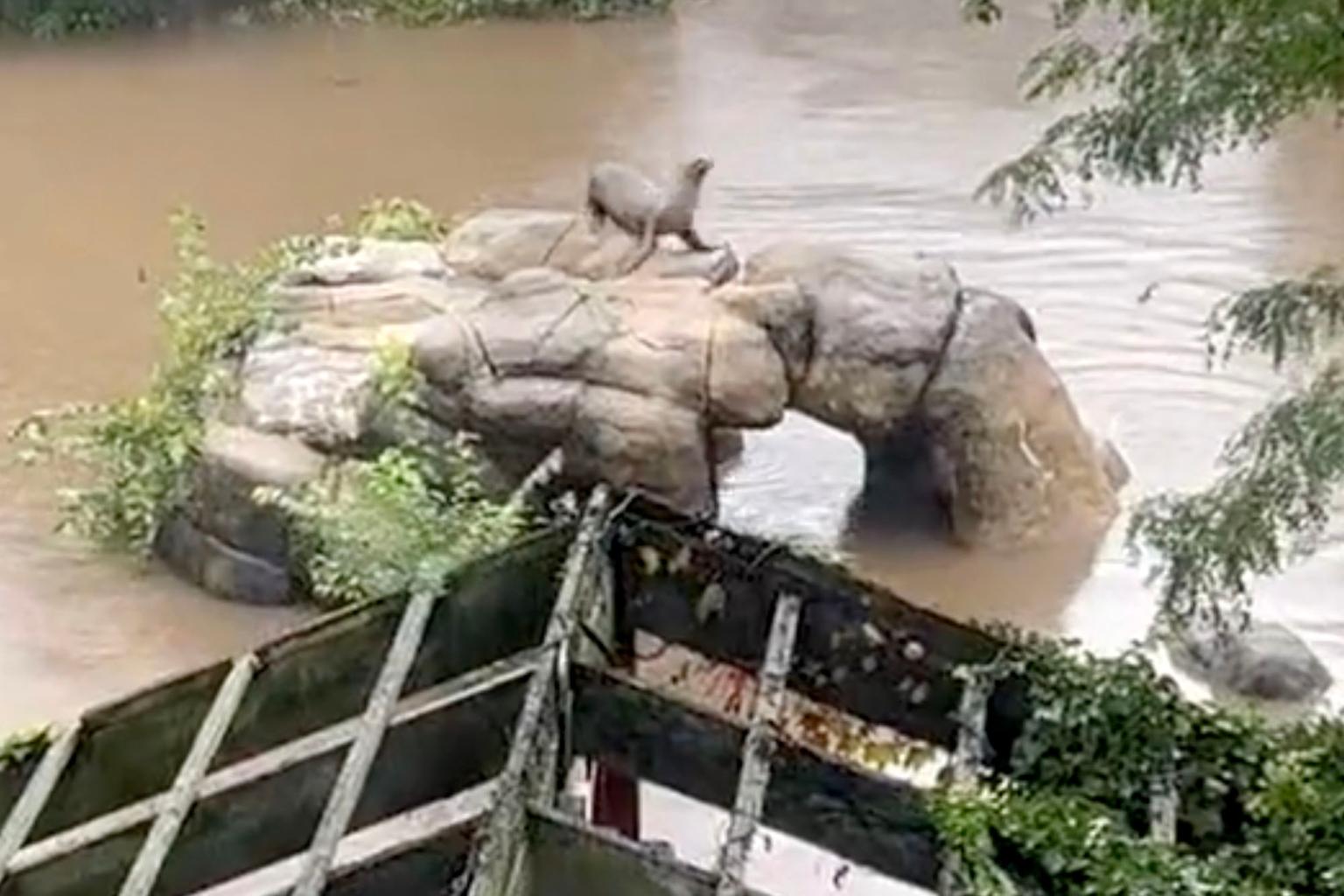
Says the NY Post, “A sea lion enjoyed a brief taste of freedom as she hitched a ride on floodwaters and swam out of her Central Park Zoo pool enclosure on Friday.”

Once upon a time, I was a kid who shared a crowded bedroom with two younger brothers. As the oldest, I was often relied on to help out — for example, by keeping the younger ones from wandering when they were supposed to go to sleep. And I did like telling them stories.

My series about a seal called Sammy who left the zoo at night for adventures but always came back in the morning must have meant something important to me because there were many episodes.

Sammy’s escape was different from Sally the Sea Lion’s in today’s story because Sammy had a secret place in the bottom of the tank where he went in and out, and he stayed away all night. Sally, on the other hand, merely took advantage of yesterday’s flooding to swim out the top of her enclosure for a brief look around and then go home.

I guess she was used to hanging out with the other sea lions there, her friends. I know what my hairdresser would think about this. She has almost convinced me that zoos are wrong. I think Tracie would let all the animals out if there were a way to do it safely.

Claire Fahy reports at the New York Times, “A female sea lion, known as Sally, escaped from her enclosure at the Central Park Zoo briefly on Friday, swimming out of the pool where she is kept when the heavy rains lashing New York City flooded the zoo grounds.

“Workers monitored Sally’s movements as she explored the area around the enclosure before rejoining the zoo’s other two sea lions in the pool, said Jim Breheny of the Wildlife Conservation Society’s Zoos and Aquarium, which oversees four zoos and the city’s aquarium.

“By 3 p.m., the water at the zoo had receded, and all animals were contained in their enclosures, Mr. Breheny said. No staff members were in danger during the storm, and the city’s four zoos were closed so that employees could focus on keeping animals safe.

“For Karen Dugan and her colleagues at the city’s parks department, the roving sea lion made for a rare sight from their third-floor offices in the agency’s headquarters at the Arsenal, a building inside the park that overlooks the zoo.” More at the Times, here.

What does an animal escaping the zoo mean to you?

Growing Her Own Paints

Photo: Lakshmi Rivera Amin/Hyperallergic.
Page spread from Feral Hues, a book by Ellie Irons on making your own paints.

Artistic types are going back to nature for pigments these days. My friend Ann grows special weeds and flowers to make dyes for her beautiful textiles. In today’s Hyperallergic interview by Lakshmi Rivera Amin, we learn about an artist making her own paints.

“Taking the concept of a ‘green thumb’ several steps further, artist Ellie Irons approaches plants as a literal source of color: She creates her watery paintings with pigments tinted by organic hues found in the natural world. These works … record, honor, and reorient our relationship to the vegetation around us, specifically in current-day New York State’s Hudson area.

“I picked Irons’s brain about the process of creating her own paints through harvesting on the occasion of her recent book, Feral Hues: A guide to painting with weeds (Publication Studio Hudson). This interview has been lightly edited for clarity.

Hyperallergic: What is the most joyful part of making your own pigments?
Ellie Irons: There are many joys, which is why I’ve been entranced by the process for so many years: an ever-deepening and shifting connection to urban ecosystems and the land that supports them that emerges through careful, considered harvesting practices; the smells, colors, and textures that reveal themselves when plant parts are processed by hand in the studio; the joy of sharing the process with other humans who also become entranced by the relatively simple act of lovingly harvesting often overlooked weedy plants and creating paint with them; the process of attuning to the cycles of vegetal life sprouting, growing, blossoming, fruiting, [dying] across the seasons and years — there is always something to delight in and harvest, in any habitat, even in deep winter. …

H: How has your practice evolved over the past several years?
“Irons: I would say recently, since maybe 2019, my work has become more locally rooted and grounded. In the decade before that, I found myself investigating plants across urban habitats in a global sense — comparing pokeweed and honeysuckle growing in a parking lot in Taipei with the same species sprouting from a concrete river in current-day Los Angeles, for example.

“I’m still fascinated by those global connections, and find them resonant and relevant, but in recent years my focus and my daily practice have shifted to be more bioregional — I take the Mahicanituck/Hudson River Watershed as a salient range in which to work, connecting with human and plant populations up and down the river from New York City to the Adirondacks. …

“This shifting focus is based on a range of factors, from my increasing discomfort with energy-intensive travel to my new(ish) status as a mother to my day job with a community science and art organization that focuses on hyper-local environmental justice issues, to of course, the ongoing impacts of the pandemic. There are other ways it has changed, of course — writing has become increasingly important to me, as has enduring land-based work (a result of living in a shrinking upstate city where access to soil and open earth is simpler than in New York City, where I started working with plants more than a decade ago).

H: What are your favorite plants to work and be in relation with, and why?
Irons: Perhaps unsurprisingly, I have many favorites, and feel fortunate regularly meet plants who are new to me — my loves change by the season, and across contexts. Right now, in early August, each morning I’m greeted by innumerable, intensely blue Asiatic dayflower … blossoms lining the border of my neighbors’ chainlink fence where it meets the sidewalk.

“The blossoms only last until noon or so, depending on the weather and the intensity of the sun. I take 20 to 30 blossoms most mornings, and store them in a small cup in the freezer, accumulating them until I’m ready to process them into a range of shades of blue.

“I love dayflowers for the way they become unmissable once they catch your eye, and draw you in. They have an unassuming stature, foliage that’s easy to overlook, but when they burst into flower for several hours each morning, the proliferation of electric blue petals — almost sparkling if you look closely — can feel like tiny jewels sprinkled along the sidewalk. …

“Having migrated to the American continent, they live well in cities, where they are sometimes appreciated as a ‘wildflower,’ and are gaining notoriety as a super weed in round-up ready soybean fields, where they’ve demonstrated resistance to the herbicide glyphosate. And in their native China they are being studied as a hyperaccumulator due to their ability to thrive on the polluted soils of old copper mines, absorbing large amounts of heavy metals. …

H: What do you hope anyone interested in approaching plants as material sources for art will first consider and reflect upon?
Irons: I hope people will keep in mind processes of gratitude and respect — of mutual exchange, rather than of taking to satisfy a material need. This can look many ways. Maybe even just asking yourself a few questions before harvesting: Who else might be in relation with this plant, human or more-than-human? What is the plant doing here and why? How long has this plant been here, will they be here tomorrow, or in 100 years?” 

More at Hyperallergic, here. No paywall, but subscriptions are encouraged.

Photo: Ermell/Wikimedia Commons.
Asiatic Dayflower, or Commelina communis.

Florida’s Ghost Reefs

Photo: Coral Restoration Foundation.
Severe bleaching and mortality in the Middle Florida Keys. Photo taken on July 24th.

One doesn’t always think of television news as going deep on a serious and complex problem, but I have to give credit to Florida’s WFLA for taking on dying ocean reefs. The sad tale makes me think we humans are like lobsters who don’t notice the water is boiling until it’s too late.

“Once colorful coral cities overflowing with marine life, transforming into ghost towns, or better stated, ‘Ghost reefs’ seemingly overnight.

“ ‘We are surprised by the pace. It is unprecedented what we have seen,’ said Scott Atwell the communications and outreach manager for the Florida Keys National Marine Sanctuary.

“Atwell told WFLA Chief Meteorologist and Climate Specialist Tuesday: ‘We’ve never seen anything like this. Some are not even bleaching, they are going straight to dead.’

“ ‘Straight to dead’ illustrates just how extreme the marine heatwave is and how quickly it’s evolving. When under stress, typically coral bleach first, expelling their symbiotic algae partners which give them their vibrant hues, and turn white. Then sometime later, if the heat persists, the coral can succumb and die.

“But right now in the Florida Keys, there are reports of rapid mortality. Coral is dropping like dominoes across much of the reef tract from Key Largo to Key West – the third largest tract in the world and the only shallow water reef system in the U.S. mainland.

“About 25% of marine life depends on coral reefs during some stage of their life. If coral reefs vanish it will have cascading consequences across ocean ecosystems and the life that it supports. …

Mission: Iconic Reefs, a large-scale NOAA-led coral restoration initiative reports that the most recent seafloor temperature at Sombrero Key (off Marathon) is 93.4F and at Looe Key (off Big Pine Key) is 89.6F. According to Mission: Iconic Reefs the ‘optimal’ temperature for reef-building corals maxes out at 84 degrees.

“Although tropical corals live in warm water, they are very sensitive to just a couple of degrees Fahrenheit spike in sea surface temperatures, especially if it lasts for too long. NOAA Coral Reef Watch says at four weeks, coral can begin to show signs of stress. If the heat last eight weeks, a bleaching event becomes likely. [In July, we passed] the eight-week mark. …

“Bill Precht is a coral reef scientist in South Florida. In his 45 years studying coral, he’s never been so concerned about the Keys’ iconic reefs, ‘If things progress as they have started … the likelihood of catastrophic levels of mortality are high.’

“As a result of this unprecedented event, NOAA Mission: Iconic Reefs and their partner organizations are racing against the clock to rescue coral from the reefs and bring specimens into the lab where they can buy some time until the ocean cools back down.

“So the natural question is, when the coral die, can they recover? Dr. Katey Lesneski, the Coordinator of NOAA Mission: Iconic Reefs was asked that question by PBS News Hour and here’s what she said, ‘Once they die there are other reef organisms that will settle on that skeleton, take up space, and the coral tissue cannot grow back, unfortunately.’

“So the teams are taking drastic measures to gene bank two fragments from each unique genetic individual of staghorn and elkhorn corals, listed as threatened under the Endangered Species Act. In other words, they are preserving the genetic material so that if much of the coral is lost, there is a way to restore it.”

More at WFLA, here. Startling graphs. No firewall.

Photo: Michigan State University Archives via the Smithsonian.
Michigan State University’s first observatory, circa 1888. 

Sometimes it’s just luck that starts someone on a rewarding career — or generates a lifetime of memories. Today’s story is about the trajectory of budding archaeologists.

Daniel Wu writes at the Washington Post, “Morgan Manuszak had to travel thousands of miles from her East Lansing, Mich., campus in 2022 to get some much-needed work experience. The Michigan State University senior, who studies archaeology as part of a minor in anthropology, said she was able to do archaeological fieldwork for the first time only in Isthmia, Greece, where the university hosts a field school.

“Not every budding archaeologist at Michigan State is so fortunate, students and researchers said. Opportunities for students to complete archaeological fieldwork are competitive and often require expensive overseas travel. Many students were also unable to access such trips during the pandemic, when travel was restricted.

“But soon, a new archaeological site will be waiting for the university’s undergraduates just a short walk from their dorms.

“Students working with Michigan State’s Campus Archaeology Program this summer unearthed part of the cobblestone foundation of a 142-year-old observatory in a clearing near a student residence hall, the university announced [in August]. The site of the building — Michigan State’s first observatory for astronomy, dating back to 1881 — will become a dig site next summer for the university’s undergraduates and local residents to practice archaeological techniques right on campus.

“The unlikely discovery happened this summer when construction workers attempted to install hammock poles near a student residence hall on the north end of campus, said Stacey Camp, director of the Campus Archaeology Program. They contacted the program after hitting a hard surface while trying to drive the poles into the ground.

“Researchers consulted school records and noticed that the unassuming site — a lawn shaded by leafy trees near picnic benches and a basketball court — was near the location of a century-old facility built during a key period of change for the university. Michigan State, originally an agricultural college, was slowly branching out into other fields when a professor built the observatory in 1881. …

“The observatory housed a telescope and some of the university’s early astronomy classes and was probably demolished in the 1920s, said Ben Akey, a PhD student and campus archaeologist at Michigan State.

“Akey and a team of students, including Manuszak, conducted an initial survey at the location in June, digging a grid of small holes to try to find remnants of the observatory. They dug for weeks without luck in the area where the construction crew had been working until, on the last scheduled day of searching, a shovel finally struck a small stretch of cobblestone and mortar.

“ ‘It’s a weird common occurrence in archaeology,’ Akey said. ‘Just as you’re about to move on from a site, you end up finding something that sticks you there for another few weeks.’

“Further excavation confirmed that the rock border was the foundation of the old observatory, to the excitement of Akey, Manuszak and the rest of the team. …

“ ‘It was really, really fulfilling,’ Manuszak said. …

“The Campus Archaeology Project has conducted additional research on the site since June, including a scan using ground-penetrating radar, but the bulk of the work is being saved for the university’s undergraduates.

“Some of those students have been starved for an opportunity like this, Akey and Manuszak said. The Campus Archaeology Project has conducted digs and partial excavations at other locations on campus, but the observatory will be one of the university’s oldest excavation sites. That makes a difference in a competitive field where job opportunities hinge on hands-on experience, Akey said. …

“ ‘You can sit in a classroom and learn the steps of how you’re going to lay out your grid and how you need to take note of your stratigraphy as you’re digging down for your excavation unit,’ Manuszak said. ‘But you don’t really get a feel for it until you’re doing it.’ “

More about getting hands-on experience at the Post, here. Also at the Smithsonian, where there is no paywall.

Those Ballroom Gowns

Photo: Bonfire Visuals/Greenville Journal.
Beautiful gowns are part of the competitive ballroom-dancing experience.

Do you ever watch ballroom competitions on television and wonder where the women get their amazing gowns? At the Washington Post, Cathy Alter provides an answer — for those who can afford it. The gowns are pretty expensive.

“It could be any house in suburban Annandale, Va.,” writes Alter, “among the split-level Colonials with manicured boxwood shrubs — except, around back, past the statue of the red fox and down some steppingstones, there’s a sign on the basement door to greet visitors: ‘You’re about to enter a sparkle splash zone. Twirling encouraged.’

“Inside, Julie Wilson runs a business here in the family home, known by those who need to know as Encore Ballroom Couture. It’s considered the ballroom dance industry’s leading consignment and consignment-rental dress company. Competitive dancers come here from far and wide, as do the frocks. The abiding aesthetic is more is more: feathers, sequins, fringe, crystals. …

” ‘Dancing With the Stars’ is scheduled to return to ABC’s prime-time schedule with its 32nd season this fall (after a sidestep to Disney Plus for a season); Bravo, in its endless hunt for reality-based drama and conflict among ambitious women and certain men, concluded its first season this summer of ‘Dancing Queens.’ …

“Fans of these shows, or just of the scene itself, may wonder where the gowns come from, or where they go after they’ve been worn. A good place to start is here in Wilson’s basement empire.

“Wilson danced competitively for 20 years, which included a decade as an instructor. She was a pageant queen, too. (Ms. Virginia; Ms. Ireland USA.) The years went by, and her closets bulged with the glimmering evidence of moments in the spotlight. There was no place for the family to keep winter coats. Wilson remembers when her mother, Brenda, had enough: ‘She said, “Julie, you need to do something about this.” ‘

“Wilson, 44, says it was hard to part with her girls. (Gowns, in this community, are all female.) ‘I didn’t trust eBay to take care of my dresses,’ she says. Plus, the resale space for competitive ballroom dancing dresses was ‘a black hole.’

“Brenda Wilson, a retired OB/GYN nurse, and Julie, a government contractor, decided to open Encore, transforming the basement of the home they shared with husband and dad Walter into a dance destination. Chandeliers simulate the lighting of competition dance floors, white ostrich feathers are arranged in vases and a small refurbishing station stands ready for dresses that need a bit of first aid. Instead of nails and screws, small drawers contain a color spectrum of crystals.

“At first, Julie sold her own dresses. Then she sold her friends’ dresses. Fourteen years later, Encore has an inventory of around 450 dresses, consigned by dancers who retired, overhauled their image or whose closets needed some breathing room. Consignors get 60 percent of the sale price, which can be quite considerable; dresses here start around $4,000. Dress rentals begin at $300.

“One of the first girls Wilson resold that wasn’t her own belonged to Rose-Ann Lynch, a lieutenant colonel in the U.S. Marine Corps. … When Mike prepared to retire in 2005, Rose-Ann handed him a honey-do list, which included dance lessons. ‘I told him, “I don’t want you to lead if you don’t know where you’re going,” she says.

“The duo competed for the first time that same year and are currently the 23-time USA Dance Senior Amateur national champions, a category for people ages 55-64. Tight as drums, Mike and Rose-Ann make a compelling case that the fountain of youth can be found on the dance floor. A logistician by training, Mike possesses rational, chess-like strategies that come in handy on the dance floor. With multiple couples whirling and twirling at the same time, avoiding a collision is vital when the judges determine their final scores.

“Today, the Lynches have come to Encore Ballroom Couture in search of an American Smooth dress for Rose-Ann. A primer, for those who need one: Competitive ballroom dancing includes both American and International categories. American style includes Smooth (waltz, tango, fox trot, Viennese waltz) and Rhythm (cha-cha, rumba, swing, bolero, mambo); International is separated into Standard (waltz, tango, Viennese waltz, slow fox trot, quickstep) and Latin (cha-cha, samba, rumba, paso doble, jive).

“American Smooth and International Standard styles call for dresses with floats (think fluttery silks that move behind the dancer like wisps of steam), and Rhythm and Latin necessitate something shorter and sexier.

“In American Smooth, partners separate and dance side by side, a la Fred and Ginger, so dresses must look good both coming and going. In International Standard, the couples dance closely, so dresses need look amazing only from the back.

“If Rose-Ann finds a dress today, it will appear in one of the most important dance competitions of the year: the Amateur National Championship, next March in Pittsburgh. ‘I always like to be prepared for Nationals,’ she explains.” 

Yesterday I peeked in at a ballroom refresher class for folks in my retirement community. The couples looked pretty sedate. And there certainly weren’t any swirling gowns.

Nice photos and more than you ever wanted to know on this topic at the Post, here.

Photo: Joel Goodman/The Guardian.
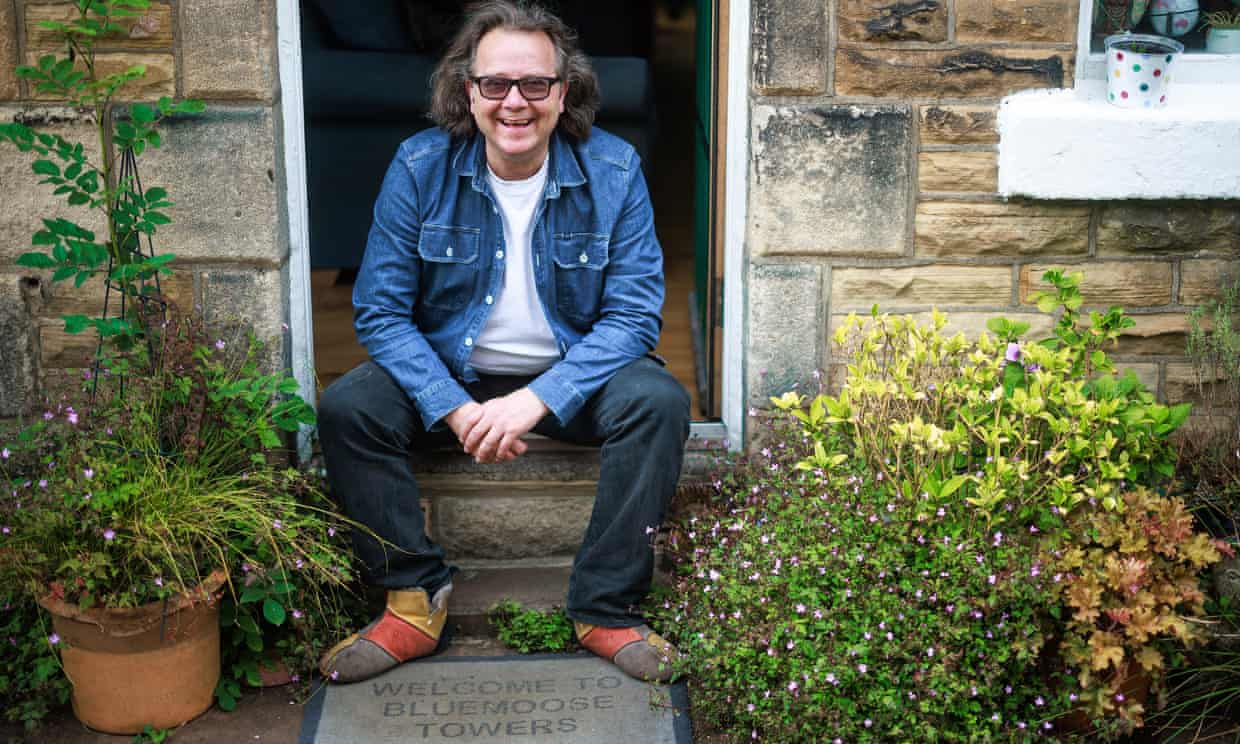
Kevin Duffy has built a publishing business in his home that focuses on ten books a year, many of them prize contenders.

Do you know the Aesop fable in which animal mothers brag about the number of their children? According to MIT Classics, “A controversy prevailed among the beasts of the field as to which of the animals deserved the most credit for producing the greatest number of whelps at a birth. They rushed clamorously into the presence of the Lioness and demanded of her the settlement of the dispute. ‘And you,’ they said, ‘how many sons have you at a birth?’ ”

And the Lioness said, “I have only one. But that one is a lion.”

That is my introduction to a story about a publisher who publishes only ten books a year.

Helen Pidd, North of England editor of the Guardian, writes, “The two-up, two-down terraced house on a cobbled Hebden Bridge street does not look like the headquarters of a multi award-winning publishing house.

“There is no gleaming edifice, no sign and certainly no reception desk. The green front door leads straight into Kevin Duffy’s living room, the nerve centre of Bluemoose books, his independent literary hit factory.

“It is at a cluttered table in the corner that Duffy has built a business with a success rate that billion-pound publishers regard with envy. Each year, Bluemoose puts out no more than 10 titles, but a remarkable number end up in contention for major literary prizes.

“Each author is handpicked by Duffy, 62, a self-confessed ‘control freak’ from Stockport, Greater Manchester, who spent years as a salesperson for big publishers before remortgaging his house to start Bluemoose in 2006. …

“It was Duffy who published Benjamin Myers’ The Gallows Pole, which has been made into a BBC series that was given five stars by the Guardian. …

“In March, Bluemoose won best northern publisher at the Small Press of the Year awards. In April, a Bluemoose title – I Am Not Your Eve, the debut novel by Devika Ponnambalam, which tells the story of Paul Gauguin’s child bride and muse, Teha’amana – was shortlisted for the £25,000 Walter Scott prize for historical fiction. …

“Bluemoose’s current bestselling author is Rónán Hession, a former musician who balances his writing career with being the assistant general secretary of the department of social protection in the Irish government.

“Hession’s 2019 debut Leonard and Hungry Paul, a funny and tender story about kindness, has sold more than 125,000 copies worldwide. A bestseller in Germany, it has also attracted fans in Hollywood – Duffy recalls receiving an email from someone claiming to be Julia Roberts’s agent. …

“ ‘Then her PR person got in touch saying she wanted to get in touch with Rónán because she loved the book. … How wonderful is that? She just wanted to say thank you,’ he said. …

“Another Bluemoose success story with a day job is Stuart Hennigan, a librarian from Leeds. Ghost Signs, an eyewitness account of the impact of the early days of the pandemic on those living in poverty, made the shortlist of the Parliamentary Book awards.

“Duffy shares an anarchic streak with Hennigan, finding it hilarious when he turned up to the Tory-packed ceremony in a T-shirt that said: ‘Still hate Thatcher.’ …

“Duffy remains Bluemoose’s only employee, drawing a ‘tiny’ salary, working with five freelance editors, including his lawyer wife, Hetha.

“He is happy that way. ‘I don’t want to be the next Penguin. I don’t want to be a huge business. I just want to publish eight to 10 books a year, make a bit of a profit and invest it all back into the business to find new writers,’ Duffy said.

“Running Bluemoose is a seven-day-a-week vocation. On an average day, Duffy receives 10-20 unsolicited pitches, usually the first three chapters of a new book, all of which, he insists, he reads. Perhaps four in a month will grab his attention enough for him to ask for the full manuscript.

“Duffy insists that there remains a ‘class ceiling‘ in the publishing of literary fiction. LGBTQ+ writers are being given deals, as well as people of color, he says, but working-class writers are not being heard. …

“ ‘The people making those publishing decisions, because of their educational background and their life background, are not reading books about people in the rest of the country. You know, 93% of the people in this country don’t go to private school. There’s a reading public out there that wants books about themselves and the areas they live in.’

“Myers, he notes, originally signed with Picador, which would not publish Pig Iron, his third novel about a Traveling community in the north-east. ‘Because, they said, “who would be interested in a working-class character from a small northern town?” That small northern town was Durham, theological capital of Europe for 2,500 years.

“ ‘Pig Iron went on to win the inaugural Gordon Burn prize. Ben’s next book, Beastings, won the £10,000 Portico prize. Then The Gallows Pole won the world’s leading prize for historical fiction. Then all the agents were interested,’ he said.”

As a reader who turns to Dickens whenever in doubt, I am surprised to find that I actually have read (and liked) one of these: Leonard and Hungry Paul. That’s because Wendy Greenberg, a prolific UK reader on Goodreads, wrote about it.

More at the Guardian, here.

Photo: The Guardian.
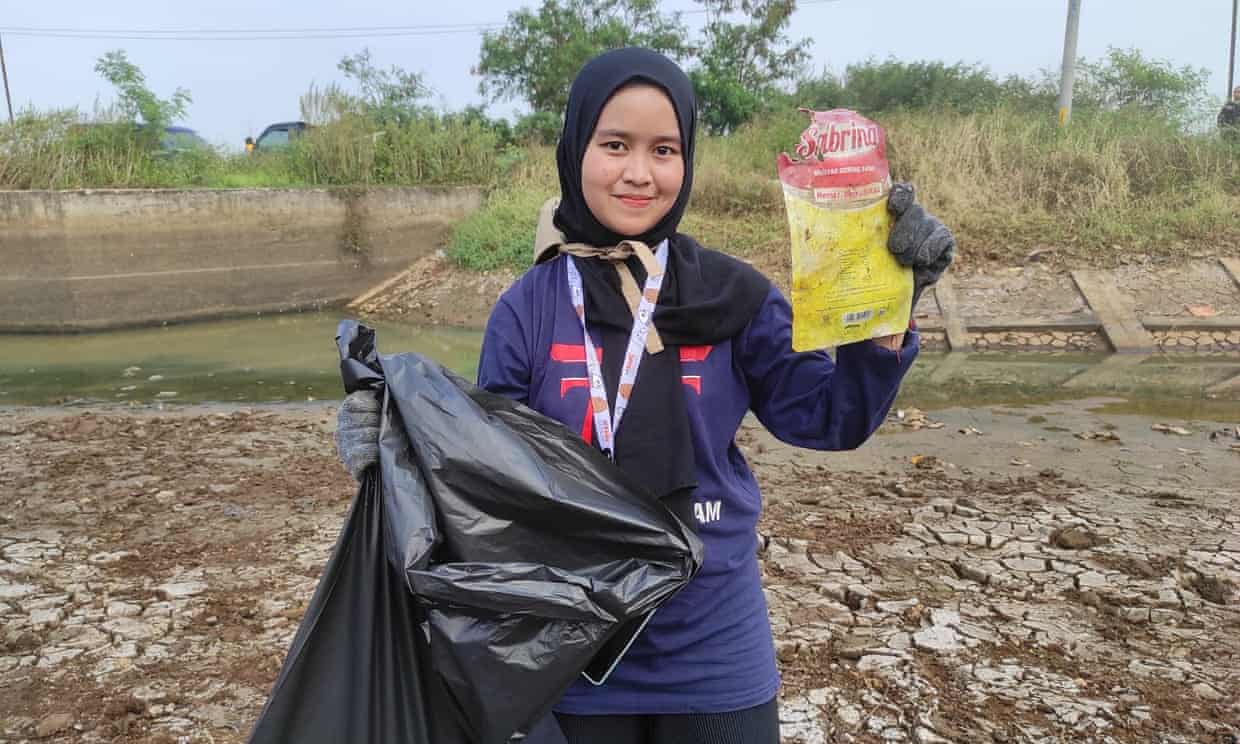
Resti Khairunnisa, 22, is a follower of Pandawara on TikTok. She joins other followers in collecting plastic waste from the Bandung dam in Indonesia. 

The young people will save us all. They certainly shouldn’t have to, but it restores our faith in humanity when we see them taking “arms against a sea of troubles” and not wasting time blaming those of us who deserve blame.

What is the secret of their strength? Perhaps not knowing what’s “impossible” enables people to do it anyway.

Guardian reporter Ardila Syakriah has this story from Indonesia.

“They started as flood victims, now they are touted as local heroes for cleaning up the rivers and beaches of Indonesia’s third largest city, Bandung in West Java, amassing over 9 million followers on TikTok and Instagram in the process and influencing others across the country to join the fight against pollution.

“The Pandawara group is five men in their early twenties and was formed in 2022 after flooding caused by rivers clogged with rubbish damaged their homes. … On TikTok, their profile – @pandawaragroup – contains over 100 short videos of their river and beach clean ups, earning them millions of views and totalling over 100 million likes.

“ ‘We have a team of river hunters who identifies rivers with urgent trash issues, where flooding can happen after rainfall,’ Pandawara member Gilang Rahma told the Guardian.

“The Greater Bandung area where they live produces 2,000 tons of waste each day, 10 to 20% of which doesn’t make it to landfill and often ends up in rivers. The vast mountain of waste produced in the region has exceeded landfill capacity by 800%, according to West Java official Prima Mayaningtyas. …

“Pandawara began modestly in 2022, cleaning up rivers around their neighborhood, protected by rubber hand gloves and boots. As they became full-time online celebrities-slash-activists, they were invited to meet government officials and receive partnership deals. As their popularity grew, so did their cleanups, which spread to other islands in Indonesia. 

TikTok went as far as to deem some videos as sensitive content because the sight of decaying rubbish might be considered disturbing by some viewers. …

“ ‘Sometimes when we call for volunteers, thousands would sign up but we could only select dozens due to limited space. At other times we don’t limit the number. These are for when we can’t clean up by ourselves,’ Gilang said, adding that the group hoped to use the social media platform to raise gen Z’s awareness of pollution.

“Pandawara’s latest call saw 600 people, including local government staff and officials, join the clean up of 17 tons of waste from the Bugel dam in Bandung regency, which is connected to West Java’s longest river, on 27 July.

“One of them was 22-year-old Resti Khairunnisa, who went straight to volunteering after finishing a night shift. Resti, who lives nearby the dam, said she had been inspired by Pandawara’s videos and would not hesitate to jump in even with limited protective gear.

“ ‘I haven’t slept at all. I’ve been concerned about waste pollution, but this is my first time taking action,’ she said after three hours of cleaning up, her sandals fully covered by mud.

“Another volunteer, 21-year-old university student Imam Ahmad Fadhil, himself a victim of floods, said he had been following Pandawara since before they became famous and lauded the group’s consistency. But he maintained that community-based initiatives were not enough.

“ ‘Some people know littering is wrong, but there is no waste facility in their village, nor do they have the tools to transport the waste, so they are left with no other options,’ he said.

“West Java official Prima Mayaningtyas acknowledged the need to improve waste management and people’s behaviors amid growing waste volumes, as the government looks to complete the construction of its estimated [$265 million] waste to energy plants by 2030.”

More at the Guardian, here.