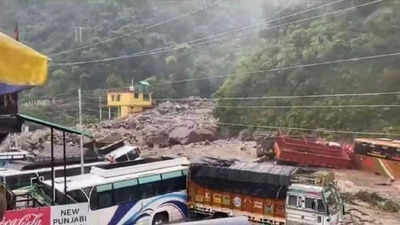
Photo: Times of India. Himachal rains: Chandigarh-Manali highway blocked at multiple places.
Blogger Friends,
Has anything like this happened to you? My June post about earthquake resistant construction in India elicited a cry for help today from a flooded part of the same country.
Here it is.
“saurabh joshi “Aryavrat or Bharat or India “I am from Himachal. Currently buildings have collapsed in Shimla, Manali and Mandi due to Heavy rains. I need to learn about old Earthquake Resistant Structures. Kindly help.”
I did a Google search and found out about the flooding August 14. But I am not someone who can advise about such things. All I do is share stories. I suggested trying to contact the expert in the article at his university.
I wish I could do more. All of a sudden, after posting an article that interested me, I am connected to a person in India who urgently wants my advice on earthquake resistant structures! It’s both wonderful and scary. What would you do? Have you encountered anything similar?
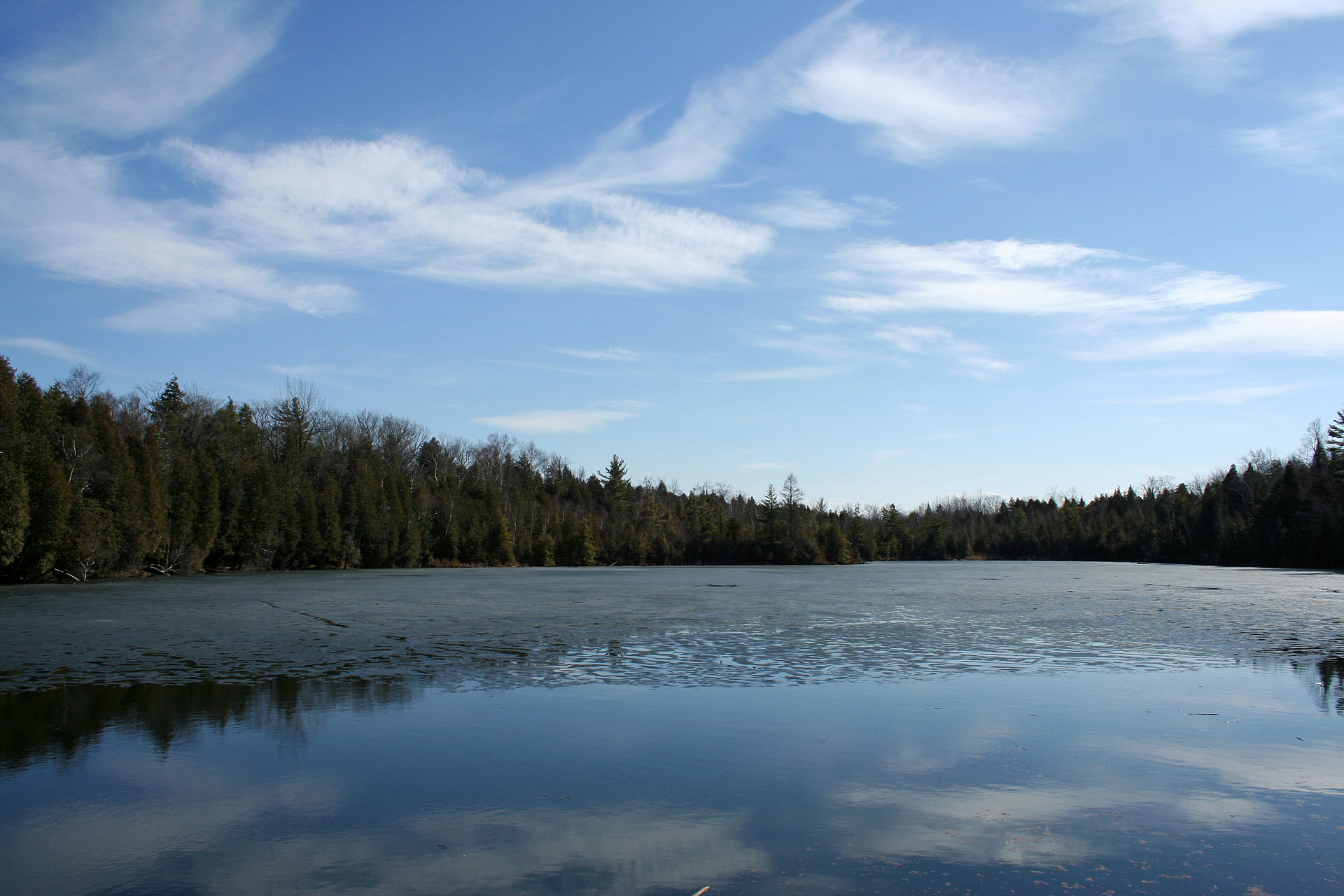
Photo: Whpqat Wikimedia Commons. Crawford Lake in Ontario, Canada, is giving up its secrets to geologists.
There is always something new to learn from the ancient record if we know how to read it. Case in point: the unusual characteristics of a deep lake in Canada are helping geologists understand a bit more about today’s rapid changes to the planet.
Sarah Kaplan, Simon Ducroquet, Bonnie Jo Mount, Frank Hulley-Jones, and Emily Wright each contributed to the story at the Washington Post.
“This summer, researchers will determine whether Crawford Lake should be named the official starting point for [the current] geologic chapter, with pollution-laden sediments from the 1950s marking the transition from the dependable environment of the past to the uncertain new reality humans have created.
“In just seven decades, the scientists say, humans have brought about greater changes than they did in more than seven millennia. Never in Earth’s history has the world changed this much, this fast. Never has a single species had the capacity to wreak so much damage — or the chance to prevent so much harm.
“ ‘It’s a line in the sand,’”’ said Francine McCarthy, a professor of Earth sciences at Brock University in Ontario, who has led research on Crawford Lake. …
“Every new phase of Earth’s history begins with a ‘golden spike‘ — a spot in the geologic record where proof of a global transformation is perfectly preserved.
“An exposed Tunisian cliff face bearing traces of an ancient asteroid impact marks the transition from the age of the dinosaurs to the Cenozoic era. Hydrogen molecules uncovered in Greenland’s ice denote the start of the Holocene — the 11,700-year stretch of stable temperatures that encompasses all of human civilization, up to and including the present day.
“These spikes are like exclamation points in the story of the planet, punctuating a tale of shifting continents, evolving species and temperatures that rose and fell as carbon levels fluctuated in the atmosphere. They mark the starts of epochs — small segments of geologic time. And they have helped scientists interpret the forces that shaped Earth’s past climates, which in turn allows them to forecast the effects of modern warming.
“In 2009, the International Commission on Stratigraphy — an obscure scientific body responsible for defining the phases of Earth’s past — created a new working group to investigate the evidence for the Anthropocene. The group’s mission: to identify a potential ‘golden spike’ site that might convince fellow scientists of the new epoch’s validity.
“Their search spanned from mountain summits to the depths of the ocean, from the Antarctic ice sheet to tropical coral reefs. And, in 2018, it led them to McCarthy’s office door.
“Before that moment, few beyond her field knew of McCarthy’s research studying lake sediments for signs of past climate change. Her outreach work was meaningful, but largely local: advocating for conservation of the Great Lakes, teaching geology to students at her midsize public university.
“Crawford Lake was similarly modest. … Yet McCarthy’s colleague Martin Head, a geologist at Brock who had been involved with the Anthropocene Working Group, was intrigued by the rare chemistry uncovered at Crawford.
“Crawford Lake developed thousands of years ago, as water filled a sinkhole in the limestone cliffs of Southern Ontario. Though tiny, the lake is exceptionally deep — so deep its waters are separated into two distinct layers.
“The upper waters are warmed by the sun and mixed by the wind. The layer below is cold and dark, with barely any life to disturb the sediments that accumulate at the bottom. All year long, a constant stream of dead microbes, animal droppings and other organic debris drifts through the Crawford’s waters to settle on the lake bed.
“But during summer, when the the temperature and acidity levels are just right, the water also produces minerals of a white color called calcite that falls to the lake bed forming a thin white cap. Each annual pair of dark and light sediments is also laced with material from outside the lake — pollen grains, pollution particles — that can serve as indicators of the changing environment.
“No other water body is known to possess this particular combination of attributes, making Crawford Lake a unique bellwether of global change. …
“As she considered her colleague’s proposal, McCarthy thought about the decades she’d spent studying prior planetary upheavals. Her work on lake sediments from the past several million years had shown her how dramatic swings in temperature destabilized ecosystems and drove species to extinction.
“Without drastic action to stave off modern climate change, she said, that history could repeat. …
“First, researchers had to tether a wooden raft in the deepest part of the lake, right over the spot they wanted to sample. To extract the lake’s layered sediments, the team used a tool called a ‘freeze corer.’ … The long aluminum wedge was filled with a mixture of alcohol and dry ice, making it much colder than the surrounding water, soil and air.
“They suspended the freeze corer from a tripod and lowered it through a hole in the raft. Down, down it went, through 75 feet of water, until finally it sank into the squishy mud on the lake bottom. Then they waited. It would take about 40 minutes for the lake sediments to freeze onto the corer’s chilly surface.
“Finally, it was time to pull the corer back up. Clinging to its face was a five-foot slice of mud, cut from the lake bottom like a piece from the center of a cake.
“Back on shore, McCarthy traced a gloved finger over the core’s delicate brown and white stripes — sharper than any other sample she’d seen. … Each sample, she knew, would give her a glimpse into a thousand years of the lake’s history, revealing its deepest responses to the changing world above. Each was like a new page from the diary of the Earth. …
“The archive inside Crawford Lake’s cores shows how human pressures on the lake built up over the centuries like steam inside a kettle, until finally the kettle boiled over.
“But humanity’s influence hasn’t always been so destructive.The first people to make their mark on the lake were Native villagers who built longhouses near the lakeshore. Researchers have counted more than two centuries’ worth of sediments from the lake’s ‘Indigenous period’ containing crop pollen and other evidence of human habitation alongside ancient goose droppings and traces of trees.
“Around the start of the 16th century, all signs of the settlement vanished for reasons still unknown. … Sediments from subsequent eras showed Europeans’ growing influence on the landscape. White pine pollen counts dwindled as people cut down trees. Traces of ragweed marked how different species flourished in the cleared land.
“The impacts piled up throughout the 19th and 20th centuries. Tiny black bits of fly ash — a byproduct of burning coal and oil — drifted into the lake from rapidly industrializing cities. Heavy metals like copper and lead increased in the mud.
“And then, around 1950, the world reached a tipping point.
“ ‘This is when humans essentially overwhelmed the Earth as a functioning system,’ said Head, McCarthy’s collaborator. Crawford Lake — and the rest of the planet — were fundamentally, irrevocably transformed.
“The sharpest sign of change was a surge in radioactive plutonium that started in Crawford Lake’s mud around 1950. … A lighter form of nitrogen — a molecular signature of burning fossil fuels — proliferated. The amount of fly ash increased eightfold in less than five years.”
More at the Post, here. If you have a subscription, you can see very cool graphics showing odds and ends floating downward through water.
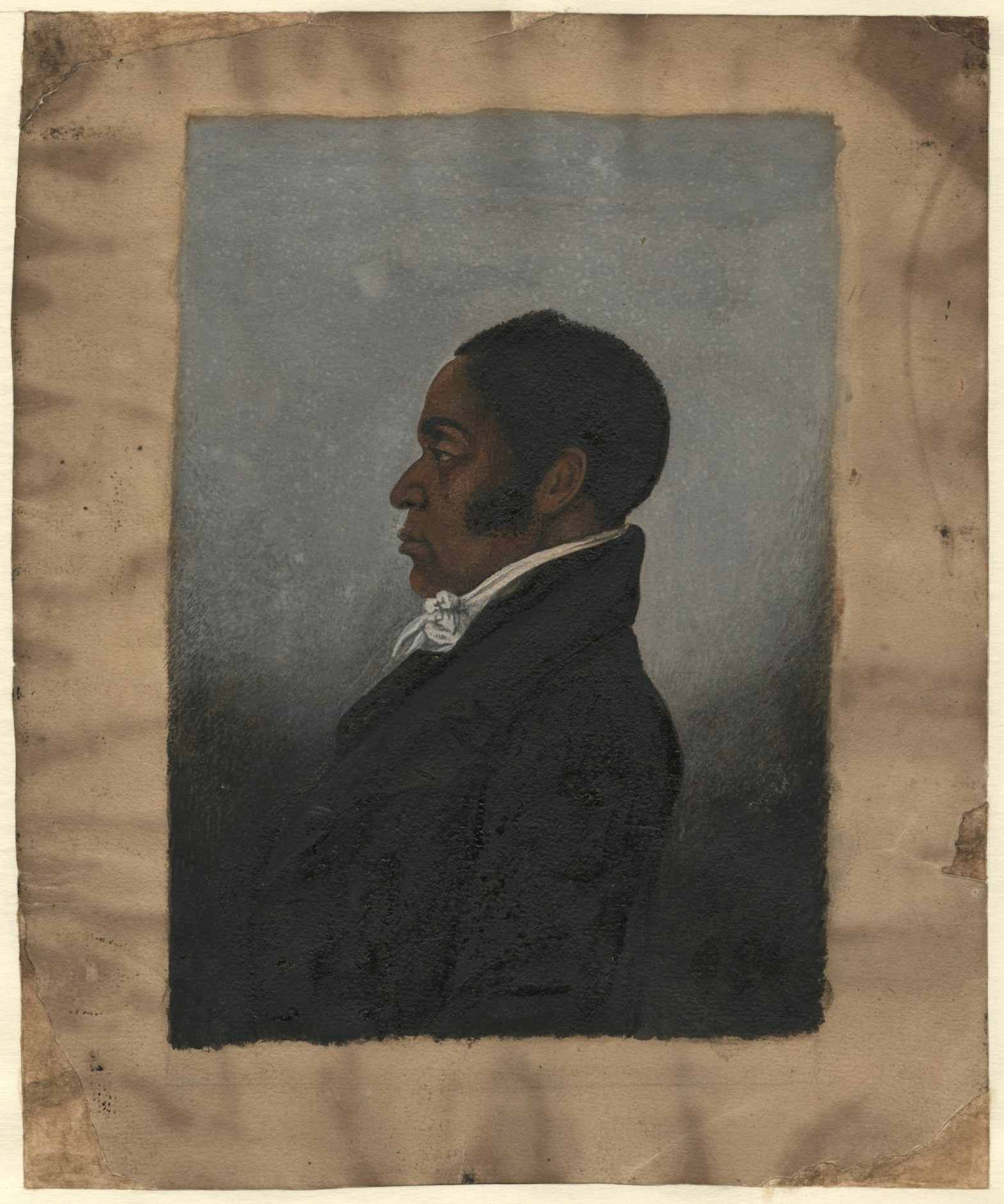
Photo: Artist unknown/Historical Society of Pennsylvania. Portrait of James Forten (c. 1834), oil on paper, from the Leon Gardiner collection of American Negro Historical Society records.
The US likes to designate a month for neglected groups to be honored, which is OK, I guess, but accomplished women are interesting even when it isn’t Women’s History Month, as are people who identify as Latino/a when it isn’t National Hispanic Heritage Month or African Americans when it isn’t Black History Month in February. I like to post the stories year round. So it’s August, and here’s a bit of Black history.
At Hyperallergic, Xenobia Bailey offers research on 19th century fiber craftsman James Forten.
Bailey begins, “That I, a quiet, radical, African-American fiber artist, raised in a nautical lakeshore Black community in the Pacific Northwest, would find the book A Gentleman of Color: The Life of James Fortenby Julie Winch, about a free-born, quiet, radical, elite African-American fiber craftsman, living in North America from 1766 to 1842 — the most prosperous and philanthropic sailmaker, born in Philadelphia during the turbulent period of the Revolutionary War — was truly a cosmic alignment. … I saw this book steps from the Schomburg Center for Research in Black Culture in Harlem, on the table of a street vendor and book dealer, Brother Mustafa. …
“James Forten’s miraculous life, and its role in shaping a prominent African-American history, is one of my greatest inspirations. Unknown to me, I opened my fiber arts studio in Philadelphia blocks away from where Forten’s sailmaking loft was located at Penn’s Landing on the Delaware River. It was my research into Forten’s life that bridged my wild, aquatic childhood, along Seattle’s Lake Washington, with my present fiber arts practice, which focuses on the evolution of African-American domestic textiles before and after emancipation.
“Looking back, it was fulfilling growing up in a lakeside ‘redlined’ Black community in Seattle’s Central District, with a pack of rambunctious children from the neighborhood. We played in the ponds and wooded area around our homes, venturing through Washington Park’s Arboretum to a now gentrified and forgotten area of natural bodies of shifting sand and clay mounds. They would emerge and disappear with the tides that created patches of land we claimed and named as our islands.
“We’d play pirate captains, patterning ourselves on the rowdy Seafair Pirates who opened the citywide Seafair summer festival of parades, hydroplane boat races, and carnivals every year. We built three-walled log cabins with open roofs and gathered floating logs for rafts from the fallen trunks, broken roots, branches, mud, and stones, and as our furniture we used the beautiful, organically sculpted driftwood that was scattered along the edge of the lake.
“Like James Forten’s community, ours was an unfamiliar story of the African-American experience. Our playground was the shoreline, with a backdrop of flying sea hawks, seagulls, rowboats, motorboats, and houseboats. And, like Forten, we were mesmerized by the majestic sails on the sailboats. …
“As with young James Forten in the mid-1700s, we too had the inquisitiveness and freedom of imagination of childhood — characteristics that continue to serve us as adults. We were aware of the community activism, cultural revolutions, and Black Power Movement happenings of the 1960s. In our imaginations, this was our private utopia. We’d make believe whatever we wanted. …
“James Forten and my siblings and I also share the experience of having a father who was an intuitive and knowledgeable maker. The senior Forten was a master sailmaker who repaired worn sails and prepared raw materials for sewing the strong textiles into tents for surveyors and sails for large-sail ships. …
“My father was a self-taught manipulator of electrical wiring. He purchased an abandoned van for about $100 and a broken floor buffer for $25 from a local junkyard and rewired them, which allowed him to start our family’s janitorial business. This upcycling practice was common in our underserved yet sustainable community in an otherwise booming industrial Seattle.
“Mrs. Forten, a ‘fierce’ homemaking mother, refused to give birth to children until she was able to buy her freedom at age 42; this was followed by her birthing two free, healthy children whom she groomed into outstanding adults. One of my fierce homemaking mother’s many gifts was enriching our home with vintage crocheted Afghans and quilts that she would purchase from the Goodwill Store and then elegantly drape and tuck the handmade textiles over our secondhand furniture.
“Forten was an abolitionist. His benevolent service to both free and enslaved Black people during the unsettling times of the Fugitive Slave Acts (passed by the US Congress in 1793 and 1850), the American Revolution, and the state of affairs before Emancipation is deeply admirable.
“Forten learned his discipline starting at the age of seven, from going to work with his father when an apprentice was absent, at the sailmaking loft near their home. This is the same loft young Forten would buy for his future successful sailmaking business, from Robert Bridges, the man who employed his father.
“At his prestigious sailmaking loft, Forten employed Black, White, and Indigenous men who were supported by his engineering a unique suite of sails and a device I am currently researching allowed his commissioned ships to outpace British war ships during battles and sea pirate ships searching for booty.”
Read about Forten’s connection to Paul Cuffe and the Back to Africa movement at Hyperallergic, here. No firewall.
Photo: BBC. A group of women from the Western Isles of Scotland perform a Waulking Song while softening wool so it can be woven and made into clothes and blankets.
Have you ever heard of “wool waulking”? It was new to me — a step after shearing the sheep and before turning wool into something usable. It shows up in various parts of the British Isles, and in addition to the delightful idea of working together to prep wool, it involves a special kind of song.
As in the old photo above, the wool “is banged off of a table, or ‘waulked,’ in time to songs that take the form of question and answer type songs. One woman would sing the question and the rest of the group would sing the response.”
A blogger at the website Shepherd’s Dream opines, “One of the most powerful aspects of working with wool is how deeply connected the tradition is with our Ancestors. Learning the traditional ways that our Ancestors worked with wool is a powerful way to connect with the fabric in our lives. Reading about the history of waulking songs is one of those opportunities. …
“Waulking is another word for fulling, a step in woolen clothmaking that refers to the practice of cleansing the cloth to eliminate oils, dirt, and other impurities. Fulling involves two processes, scouring and thickening, and is one of the steps in creating melton cloth.
“Originally, fulling was carried out by pounding the woolen cloth with the fuller’s feet, or hands, or a club. In the Scottish Gaelic tradition this process was accompanied by Waulking Songs, Scottish folk songs which were sung to set the pace.
“One person led the group by singing well-known verses or making up new lines. The rest would then come in on the chorus while the leader took a breath. A fulling session usually began with slow-paced songs. The tempo only increased as the cloth softened. As the fullers sang, they gradually shifted the cloth to the left so as to work it thoroughly.
“In this tradition moving the cloth counterclockwise is unlucky. It is also bad luck to repeat a song during a fulling session, which explains the large number of songs and verses.
“Our washable mattress protectors are made out of our pure melton wool textile and our mattresses are encased in this historical material as well,” the blogger adds.
Wikipedia also talks about “fulling” and adds some surprising details.
“Fulling, also known as tucking or walking (Scots: waukin, hence often spelled waulking in Scottish English), is a step in woollenclothmaking which involves the cleansing of woven cloth (particularly wool) to eliminate (lanoline) oils, dirt, and other impurities, and to make it shrink by friction and pressure.
“The work delivers a smooth, tightly finished fabric that is isolating and water repellent. Well known examples are duffel cloth, first produced in Flanders in the 14th century, and loden, produced in Austria from the 16th century on.
“Waulking could be done with the hands and feet. In Medieval Europe, it was done in water-powered fulling mills. After the industrial revolution, coal and electric power were used.
“Felting refers more generally to the interlocking of loose wool fibers; they need not be spun and woven first.
“Fulling involves two processes: scouring (cleaning) and milling (thickening). Removing the oils encourages felting, and the cloth is pounded to clean it and to encourage the fibers to felt, so in practice the processes overlap.
“Urine was so important to the fulling business that it was taxed in Ancient Rome. Stale urine, known as wash or lant, was a source of ammonium salts and assisted in cleansing and whitening the cloth and having its fibers intertwined.
“By the medieval period, fuller’s earth had been introduced for use in the process. This is a soft clay-like material occurring naturally as an impure hydrousaluminium silicate. Worked through the cloth, it absorbs oils and dirt. …
“The second function of fulling was to thicken cloth by matting the fibres together to give it strength and increase waterproofing (felting). … After this stage, water was used to rinse out the foul-smelling liquor used during cleansing. Felting of wool occurs upon hammering or other mechanical agitation because the microscopic scales on the surface of wool fibres hook together, somewhat like hook and loop fixings. …
“Scotland, then a rather remote and un-industrialized region, retained manual methods into the 1700s. In Scottish Gaelic tradition, this process was accompanied by waulking songs, which women sang to set the pace.”
More here, at Shepherd’s Dream, and here, at waulk.org. No firewalls.
Photo: Miami Herald/Getty. The English language in Miami is changing.
Here’s something for readers interested in the evolution of languages. Miami has such a vibrant Spanish-speaking community that it’s developing its own version of English.
Phillip M Carter of Florida International University describes the new dialect at the Conversation, ” ‘We got down from the car and went inside.’
“ ‘I made the line to pay for groceries.’
“ ‘He made a party to celebrate his son’s birthday.’
“These phrases might sound off to the ears of most English-speaking Americans. In Miami, however, they’ve become part of the local parlance.
“According to my recently published research, these expressions – along with a host of others – form part of a new dialect taking shape in South Florida. This language variety came about through sustained contact between Spanish and English speakers, particularly when speakers translated directly from Spanish.
“Whether you’re an English speaker living in Miami or elsewhere, chances are you don’t know where the words you know and use come from…. Borrowed words are far more pervasive than you might think.
“They’re all over English vocabulary: ‘pajamas‘ from Hindi; ‘gazelle‘ from Arabic, via French; and ‘tsunami‘ from Japanese.
“Borrowed words usually come from the minds and mouths of bilingual speakers who end up moving between different cultures and places. …
“One bilingual confluence famously changed the trajectory of the English language. In 1066, the Norman French, led by William the Conqueror, invaded England in an event now known as ‘the Norman Conquest.’
‘Soon thereafter, a French-speaking ruling class replaced the English-speaking aristocracy, and for roughly 200 years, the elites of England – including the kings – did their business in French.
“English never really caught on with the aristocracy, but since servants and the middle classes needed to communicate with aristocrats – and with people of different classes intermarrying – French words trickled down the class hierarchy and into the language.
“During this period, more than 10,000 loanwords from French entered the English language, mostly in domains where the aristocracy held sway: the arts, military, medicine, law and religion. Words that today seem basic, even fundamental, to English vocabulary were, just 800 years ago, borrowed from French: prince, government, administer, liberty, court, prayer, judge, justice, literature, music, poetry, to name just a few.
“Fast forward to today, where a similar form of language contact involving Spanish and English has been going on in Miami since the end of the Cuban Revolution in 1959.
“In the years following the revolution, hundreds of thousands of Cubans left the island nation for South Florida, setting the stage for what would become one of the most important linguistic convergences in all of the Americas.
“Today, the vast majority of the population is bilingual. In 2010, more than 65% of the population of Miami-Dade County identified as Hispanic or Latina/o, and in the large municipalities of Doral and Hialeah, the figure is 80% and 95%, respectively.
“Of course, identifying as Latina/o is not synonymous with speaking Spanish, and language loss has occurred among second- and third-generation Cuban Americans. But the point is that there is a lot of Spanish – and a lot of English – being spoken in Miami.
“Among this mix are bilinguals. Some are more proficient in Spanish, and others are more skilled English speakers. Together, they navigate the sociolinguistic landscape of South Florida in complex ways, knowing when and with whom to use which language – and when it’s OK to mix them.
“When the first large group of Cubans came to Miami in the wake of the revolution, they did precisely this, in two ways.
“First, people alternated between Spanish and English, sometimes within the same sentence or clause. This set the stage for the enduring presence of Spanish vocabulary in South Florida, as well as the emergence of what some people refer to as ‘Spanglish.’
‘Second, as people learned English, they tended to translate directly from Spanish. These translations are a type of borrowing that linguists call ‘calques.’ Calques are all over the English language.
“Take ‘dandelion.’ This flower grows in central Europe, and when the Germans realized they didn’t have a word for it, they looked to botany books written in Latin, where it was called dens lionis, or ‘lion’s tooth.’ The Germans borrowed that concept and named the flower ‘Löwenzahn‘ – a literal translation of ‘lion’s tooth.’ The French didn’t have a word for the flower, so they too borrowed the concept of ‘lion’s tooth,’ calquing it as ‘dent de lion.’ The English [brought] ‘dent de lion’ into English, calling it ‘dandelion.’
“This is exactly the sort of thing that’s been happening in Miami.”
Since people whose first language is Spanish live all over the US, I think any of us could come up with similar blends if we thought about it. Maybe there are some specific to English as spoken in England.
At the Conversation, here, you can read about the three kinds of calques the researchers identified in Miami. No firewall.
Photo: Getty Images via New York Post. Helping recent migrants put a strain on overworked cops in Chicago.
There are no easy stories about migration. Although most people would rather make a good life at home if they could, many launch themselves into the unknown with a vague idea that someplace else will be safer. As a popular destination, however, the US has not been on top of things for a very long time.
In one example, described by Eric Cox and Ted Hesson at Reuters in May, our confused system left “Chicago’s new mayor [grappling] with how to house hundreds of migrants arriving on buses from the U.S.-Mexico border, with some sleeping in police stations and shelters strained after border crossings. …
“Officials in the third-largest U.S. city have said they cannot afford to rent hotel rooms for all arriving migrants and have pressed for more federal funding. Some migrants seeking a safe place to sleep have turned to police stations.
” ‘We’re waiting to see where they’re going to place us,’ said Tomas Orozco, a 55-year-old migrant who arrived at a Chicago shelter on Wednesday with his family after an arduous seven-week journey from his home country, Venezuela.
“The trip took them through the Darien Gap, an inhospitable jungle separating Colombia and Panama, and his family members were still sick from drinking contaminated water, Orozco said. …
“Earlier this month, Texas Governor Greg Abbott [resumed] a campaign of busing migrants to Democratic strongholds further north, including Chicago and New York City. The busing aims to alleviate pressure on border cities and call attention to what Abbott says were overly lenient policies by Biden’s [administration].
“On Thursday, Texas began busing migrants to Denver, where [Mayor] Michael Hancock is already struggling to house new arrivals.
“New York City Mayor Eric Adams … has called on the Biden administration to provide more funding to cities. Adams suspended some of New York’s right-to-shelter rules last week, citing the strain of housing asylum seekers, and is considering using school gyms as shelters.
“Chicago Mayor Brandon Johnson … reaffirmed the city’s commitment to welcoming asylum seekers in his inauguration speech, saying ‘there’s enough room for everyone.’ …
“Dean Wynne, who owns a Chicago building serving as a temporary shelter for nearly 200 migrants, said families were ‘subdued and quiet’ on the first day they arrived.
” ‘By the second day, I could see little kids were playing around, playing catch, kicking the ball and stuff,’ Wynne said. ‘They were just happy.’
A more recent article, from July, may be read at the Chicago Sun-Times, here. Said one migrant through a translator, “You can rest, but this isn’t life. … I’m happy to work because that’s my goal. Because I want to fight and learn each day a little more than what I knew.”
The immigrants I’ve worked with as a volunteer in ESL classes are often suspicious of police in their home countries. I imagine the Chicago experience is unsettling, but then, maybe not as unsettling as that dangerous trip.
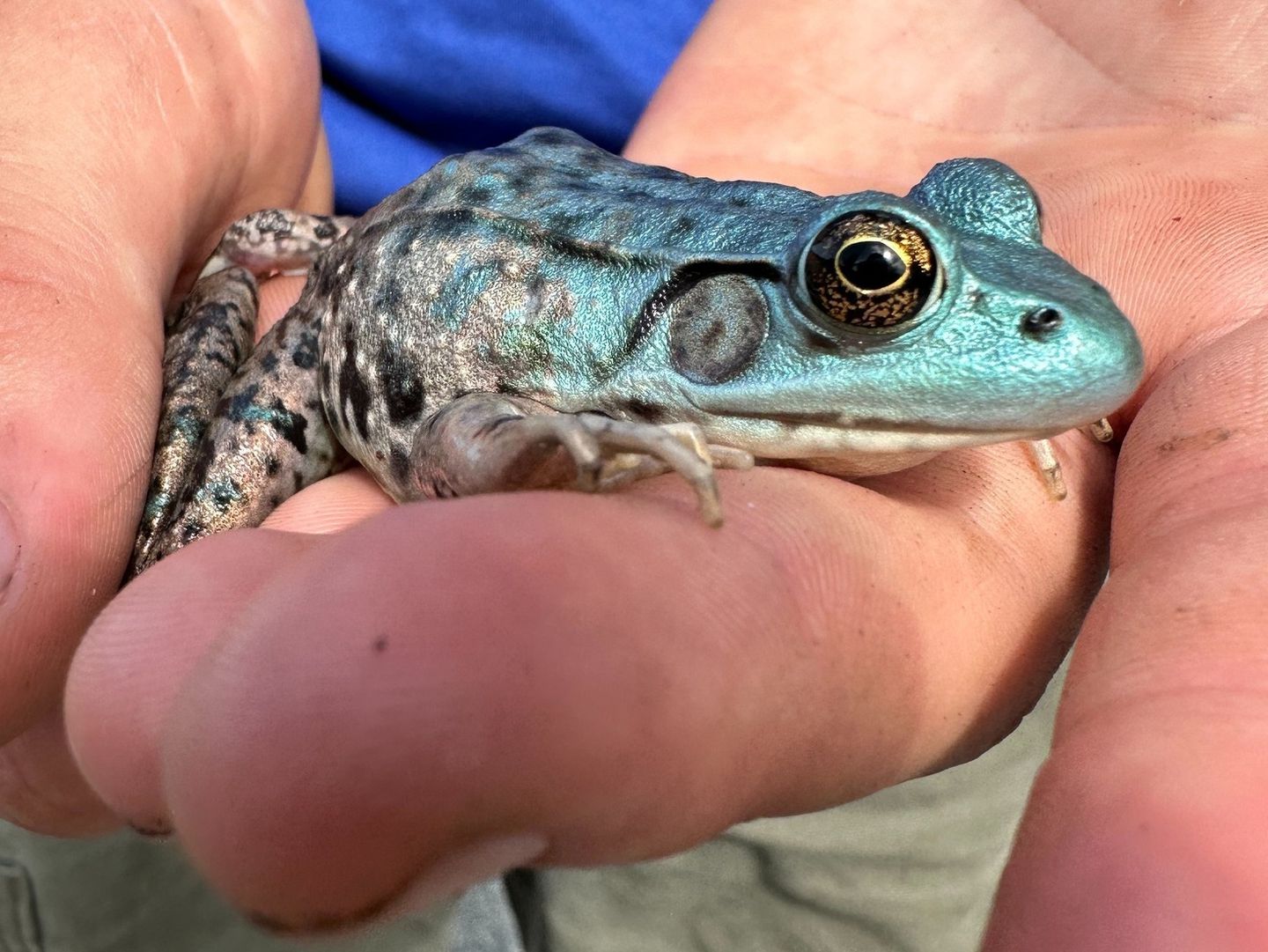
Photo: Ragosta family via RI Department of Environmental Management. A family in Rhode Island found a rare blue frog and reported it to the DEM.
What turns kids on to Nature? Often it’s a parent’s enthusiasm about fly fishing, say, or their excitement about a rare bird or wildflower. Sometimes it’s just what kids find on explorations of their world. There are natural curiosities everywhere, even in cities, if you walk around with noticing eyes.
Carlos R. Muñoz reports at the Boston Globe about the rare blue frog Rhode Island boys spotted recently.
“A Rhode Island family made the remarkable discovery of a rare blue frog [in July] and reported it to the state Department of Environmental Management. The bullfrog displayed signs of a rare pigmentation known as axanthism, which is a lack of color-bearing cells that turns green frogs blue.
“The department said in a Facebook post on its Division of Fish and Wildlife Outdoor Education page that the condition is most frequently seen in green frogs, leopard frogs, and bullfrogs — species in the Ranidae family of amphibians. …
“A 1966 study by Cornell researchers found that only 69 out of two million frogs (0.003 percent) are blue.
“Michael Berns and Lowell Uhler, authors of the study, said that blue-green frogs are ‘incredibly rare’ but exhibit different regional occurrence rates. In New England, these blue frogs are most common in Massachusetts and Connecticut. …
“ ‘Green frogs are widely distributed throughout Rhode Island, spending most of their lives in freshwater wetlands such as marshes, ponds, streams, and vernal pools,’ according to a DEM brochure authored by wildlife technician Liam Corcoran.
“Kimberly Ragosta, the mother of five whose kids made the once-in-a-million discovery, said her son Jack spotted the glistening blue bullfrog squatting by the road while the kids were running a roadside stand.
“Jack told his mother he was taking a stroll along the road near a swampy woodland area when he noticed the croaking bullfrog’s shimmering skin ‘sticking out like a sore thumb.’ He ushered it into a bucket to show his mother. ‘It didn’t move at all; it was his easiest catch ever,’ Ragosta said.
“Jack went on to research the amphibian and correctly discovered its rarity. They notified the department, but later released the frog into the woods.
“Another blue frog was caught July 2 in northern Rhode Island by 11-year-old Finn Leonard, according to his mother Kate Arsenault Leonard. She saw the department’s Facebook post and commented with a picture of the giant blue frog with a dark leopard print and a broad grin.
“Finn told the Globe that he was trying to catch frogs for a friend when he saw the blue frog and tried to catch it. He said he also saw it last year but could not get it.
“ ‘He hopped out each time,’ Finn Leonard said of his previous attempts to lure the amphibian. He was triumphant this year when he netted the frog, which he said he knew was rare because he saw it on the YouTube Channel ‘Brave Wilderness.’ …
“Kate Arsenault Leonard said one of the reasons her family loves living in rural Rhode Island is the ability to explore nature in their own backyard. They go out looking for salamanders, fishing, watching fireflies, and of course frog hunting. …
“The family is floating ‘Alien’ as a name. Finn set the frog free. …
“DEM said the exact locations of the rare frogs are being kept secret to limit the number of ‘well-intentioned nature observers who inadvertently may cause negative impacts on habitat.’ “
This story reminds me that maple leaves also “turn color” when a certain pigment is missing. And I’m noting the role of the parents here: the kids in both stories knew their adults would be excited. Now they will be doubly inspired to look closely at Nature and try to make more discoveries. Perhaps they’ll be scientists one day. Even if not, they will always be friends of our planet.
Photo: Suzanne and John’s Mom. Wild black cherries are edible. They are more pit than pulp, but they taste good.
It’s been a while since I’ve written a post on foraging, but if you search on the word at this site, you will find a few — like the post about the homeless teen who learned life skills from foraging, here.
Lauren Colella has some new thoughts on the ancient art at Sierra magazine: “Summertime for me brings back childhood memories of backyard harvesting. Inspired by books likeMy Side of the Mountain, I used to search for edible plants: sassafras for tea, wild cherries for pies, and walnuts for snacking. I learned the hard way that walnut juice stains your hands.
“I didn’t know it, but I was participating in the millennia-old act of foraging. The practice is about more than free food and the thrill of the search — it’s an opportunity to engage with local ecosystems and learn more about the species in your area. …
“While today only a few hunter-gatherer groups live off what they hunt and gather, foraging has been a common human practice for hundreds of thousands of years. Members of the working classes depended on it to supplement their diets up until the 1800s. Thanks to these traditions — along with intel from contemporary botanists and mycologists — modern foragers can access extensive catalogs of edibles, often in the form of handy apps like Forager’s Buddy and iNaturalist. Chances are that no matter where you live, you’ll find naturally growing and uncultivated plants, fungi, and insects to eat.
“When scouting spots, be wary of areas near roads or industrial sites that could be contaminated with pollutants, and avoid harvesting plants near farms or lawns likely treated with pesticides and herbicides.
“Start by seeking out commonly found harvestables — like wild onions, berries, and apples — then carefully cut them from the stem or branch and avoid damaging nearby plants or fungi. Be aware that not all wild plants may be consumed raw. Do your research before popping anything into your mouth.
“While many Americans live within walking distance of edible wild plants such as hawthorn berries, yarrow, dandelions, and chickweed, ‘most people have no clue how useful these plants are in terms of food, fiber, and medicine,’ says Lynn Landes, founder of Wild Foodies of Philly. Among the free online resources listed on her organization’s site, Landes names Plants for a Future as a particularly reliable directory, thanks to its extensive descriptions of plants fit for consumption. She also recommends Eat the Planet because it includes details on bugs and mushrooms to eat and avoid.
“Fallingfruit.org maps forageable plants and indicates whether they’re on private or public land. Many universities encourage staff and students to nosh on campus flora. … At the Bay Area’s California School of Traditional Hispanic Herbalism, Charles Garcia passes on wisdom learned from his mother, a curandera (folk remedy healer). Garcia points out that many forageable plants have dual uses, such as stinging nettle, which can be eaten or made into anti-inflammatory salves and extracts, and Pacific blackberry, a tasty plant whose leaves treat diarrhea. …
“Among the Millennial and Gen Z foragers who’ve taken to social media, perhaps the most famous is Alexis Nikole, or @blackforager, an Ohio-based outdoors educator whose Instagram and TikTok feeds abound with recipes and sustainable harvesting guidelines. Nikole touts an “honorable harvest” mindset—collecting only what you need, expressing gratitude by giving back to the earth (like composting), and harvesting only from legally permissible areas. …
“Foraging laws and regulations — generally designed to reduce damage to topsoil and avoid disruption to wildlife and gaps in vegetation where invasive species can flourish — vary by state and dictate what you’re allowed to take. … Volunteering during city parks’ weed-removal days can be a great way to legally source larger quantities of dandelion, mustard, and Japanese knotweed, which are routinely removed before they overpower neighboring plants.”
Check Colella’s Do’s and Don’ts list at Sierra, here, where you can also see her excellent illustrations. No firewall.
Photo: The Nation. Choreographer Mark Morris at the Ojai Music Festival.
Many people know Mark Morris as a great choreographer, but much of his success has depended on his devotion to teaching his dancers.
Alastair Macaulay wrote recently about this side of Morris at the New York Times. “New York City has often been called the world’s dance capital. One good reason is that a number of the world’s foremost choreographers not only lived and worked in New York, but also taught class here. Martha Graham, George Balanchine, Merce Cunningham and many others helped to lure dancers to the city.
“Fewer and fewer of today’s top dance-makers carry on that tradition. The foremost exception is Mark Morris. … While there have been seasons when his choreographic inspiration has dipped, his performers have almost invariably looked wonderful. This is a tribute to how he and his teaching colleagues prepare them each day.
“The dancers don’t present themselves as virtuosos. And they’re all such distinct individuals — each exuding what seems natural — that it’s easy to make the mistake of thinking they don’t share training. But it’s precisely their schooling with Morris, whose company, the Mark Morris Dance Group, was established in 1980, that makes them look so natural.
“ ‘I first taught when I was 13 — Spanish sevillanas — and first taught ballet in my later teens,’ Morris, 66, said in an interview at the Union Square Cafe. ‘As an adult, I used to teach modern or jazz or ballet. I would take class all over the city, which is how I met so many fabulous people: We were all dancing together. And when I gave workshops, I’d ask the most talented people to come back and be in my next piece.’ …
“ ‘It’s just the last year or two I’ve cut back,’ he said. He now shares teaching assignments with company alumni. Surprisingly, for a modern-dance master, he teaches a ballet class, with a live pianist. The dancers start by standing at the barre, bringing more and more parts of the body into play with each exercise. Then, after about 40 minutes, they work without support in the center of the room. Finally they move expansively across the room, in phrases involving turns and jumps.
“It’s ballet — though with a difference or two. Like other modern-dance choreographers (he particularly credits Hannah Kahn), Morris will sometimes ask his dancers to articulate and bend the spine in ways largely foreign to ballet — they alternate convex and concave shapes of the spine at the barre — and to phrase in irregular counts. And there’s no work on pointe: the dancers are barefoot or in socks or soft shoes. …
“The Morris class is ‘a very pure form of ballet that strives to be stripped of its affectations,’ Billy Smith, a dancer who joined the company in 2010, wrote in an email. ‘We do use our torsos in a more “modern” way than maybe a ballet company would in class. But at the core our classes are very much oriented toward the purity of ballet technique.’ …
“Morris, an invariably entertaining talker, speaks exuberantly to his dancers, between exercises — about what’s on television, about an unmissable Broadway show (and about the long lines for the ladies room in Broadway theaters), about New York traffic gridlock, about Olive Oyl. But this spiel isn’t just a one-way Morris event: He wants his dancers to be people with lives and interests, not just dance executants, and he enjoys their repartee. …
“Sam Black, who became a full-time Morris dancer in 2005 and is now the company director sharing the teaching assignments, will give his stage farewell during the Joyce season. In an interview at the Mark Morris Dance Center in Brooklyn in July, he recalled how he used to stretch his arms too straight upward in certain positions. Morris would say, ‘You only have three joints in your arm. You have to make a curve with only three joints. That takes imagination.’
“Many dancers have remained with the company more than 10 years, their longevity in part attributable to Morris’s growing concern with anatomical efficiency. …
“It was not until 1988, when the Morris dancers moved for three years to Brussels to become the resident company at the Théâtre Royale de la Monnaie, that he began to teach them a daily ballet class. That was when Megan Williams, now a ballet teacher, joined. She remembers that, in class, he enjoyed giving them one exercise for footwork and one for the upper body.
“ ‘He would show us the feet pattern, and then the port de bras pattern — separately!’ she said. ‘We had to put them together like a puzzle. It was almost impossible, like that exercise of rubbing your stomach and patting your head at the same time.’ “
Photo: Joshua Ware. Ian Fisher art, “Atmosphere No. 139 (Nate & Marissa)” (2022), oil on canvas.
My friend Nancy L. is a fan of beautiful cloud formations. She is also a member of the Cloud Appreciation Society, where she signed up for cloud-a-day photos and bought a bumper sticker that reads, “I brake for clouds.”
If you think about it, gazing at clouds can really enrich a life. Try stopping where you are sometime and just looking up.
An article by Sommer Browning at Hyperallergic talks about what clouds have meant to a couple of artists.
She writes that the paintings in the“Carey Fisher” exhibit at the Redline Contemporary Art Center in Denver last December were “as expansive and composed as one might expect from landscape paintings, though there isn’t much land in them. The exhibition of new works by Albuquerque-based Beau Carey and Denver-based Ian Fisher, alumni of RedLine’s artist residency program, takes place mainly in the sky, among mountain tops, the moon, and the clouds. The horizon line is often thousands of feet below view or occluded by giant ancient rocks.
“Carey chooses realistic depictions of mountain peaks and ranges as one of his main subjects, but his work in this exhibition is kaleidoscopic. In ‘Solaris’ (2022), a celestial sphere seems to rise multiple times behind multiple mountain ranges. It might be a moon the color of the sun, or the sun looking as cold and harsh as the moon. The mountain range vibrates with rich purples and Martian-like colors.
“Some of the paintings, like ‘Folie a Deux’ (2022), look like reflections of themselves — the mountain ranges repeat down the canvas, almost upside down at times. In ‘Magdalenfjorden’ (2022), a stark heavenly circle casts a cold glow across a mountain valley. The mountain paintings remind me of the delirium of standing on a cliff. The moon/sun paintings evoke quarantine feelings of desolation; I remembered wondering, after a couple of weeks, if I had forgotten how to interact with other people.
“Fisher paints exquisite hyperrealist oil paintings of cloud formations. He manages to paint these ephemeral, giant puffs of water vapor with such attention and detail that the paintings seem somehow more real than real clouds. … What is approaching transcendent really, is the perspective. I’d have to be flying to see clouds at these angles, to see them this close. But here there was nothing — not a 747’s plexiglass window, not a camera lens — between me and the cloud. It’s as though what I was seeing is how clouds see each other in the sky. …
“The effect of seeing both painters’ work together is disorienting, unmooring. The longer I looked at Carey’s orange moons and icy mountain-scapes and Fisher’s impossible, vertiginous vistas, the more I wobbled. To be removed from the world by looking at paintings of our world is a wonderful experience. That would have been enough to carry (no pun intended) the show, but the exhibition wall text encourages viewers to draw connections to climate change, which feels a bit unearned. … For a while there, Carey and Fisher had me floating.”
I am reminded of a beautiful N.C. Wyeth painting you may have seen of an old man and a young boy digging a trench in the snow. The boy is looking down, focused on the digging. The old man is standing still, gazing up at the light on the snow, the sky, the clouds. So moving.
More at Hyperallergic, here. No firewall. Subscriptions solicited.
Photo: Naomi Antonino/CNET. “As the world warms, non-native species threaten Earth’s last great wilderness,” says Jackson Ryan.
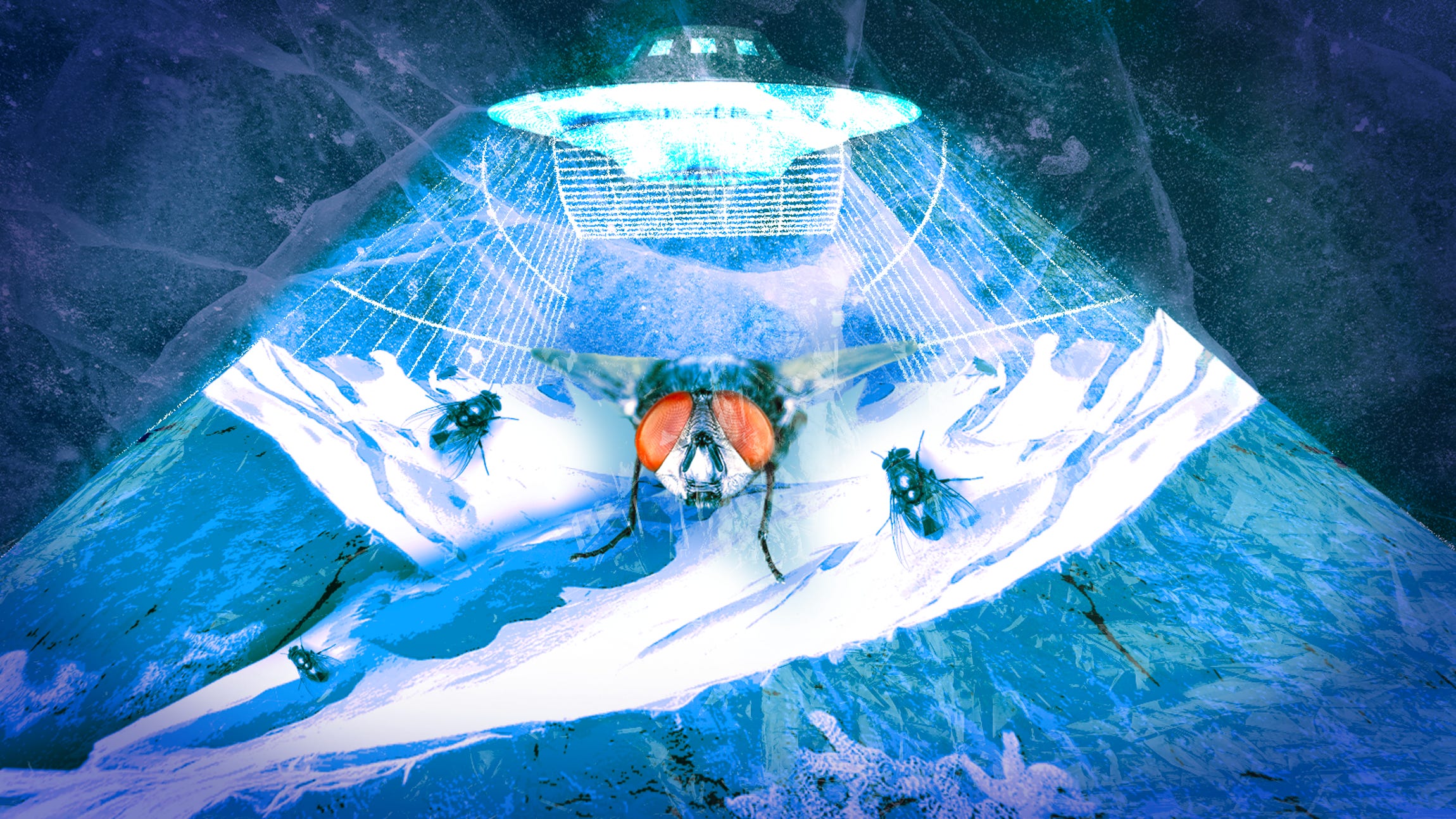
In the interest of identifying a problem in order to do something about it, today I share bad news about Antarctica: the invasion of alien species.
Jackson Ryan reports at CNET Science, “At the bottom of the stairwell leading to deck five, an alien lies upturned on green nonslip flooring. If you get close enough, you can see one of its six legs twitching and one of its translucent wings crushed to pieces. Unlike the throng of Antarctic expeditioners aboard the RSV Nuyina, Australia’s newest icebreaking ship, it hasn’t cleared customs.
“Days after the Nuyina departed its harbor in Hobart, Tasmania, the alien buzzed its way across the Derwent River, slipped through an open door and zipped into the bowels of the ship until this restless, twitching death.
“Scientists call the creature Musca domestica. You likely know it as the housefly.
“Even if it hadn’t been felled by an errant hand or boot, it likely wouldn’t have survived the journey to Antarctica. At temperatures below 14 degrees Fahrenheit, flies move lackadaisically and seem to barely get airborne. I know this because I’ve been watching them as part of the crew onboard the Nuyina as it crosses the Southern Ocean. Surviving flies buzz at the ship’s windows, trying to escape the upper decks.
“If their prison break were to succeed, they’d find themselves facing seemingly endless waters, with nowhere to go. The Southern Ocean provides a formidable barrier to entering Antarctica, a great wall of water and powerful currents that has separated the continent from the rest of the world for about 30 million years. Couple that with freezing temperatures, and the Antarctic provides little hope for a wayward housefly trapped on a ship.
“But Antarctica’s temperature is changing, and dramatically. In March, a French-Italian base in East Antarctica recorded temperatures 70 degrees higher than average for that time of year. That may just be an unprecedented anomaly, but it’s expected the continent’s average temperatures could rise a few degrees by 2050. In particular regions, like the western peninsula, the continent is warming at a rate 10 times faster than the rest of the world. In February 2020, the temperature at Argentina’s Esperanza Base research station reached 18.3 degrees Fahrenheit – an all-time high – providing the kind of conditions a wayward housefly might survive in.
“Historically, it’s been difficult for lost flies to reach the most southern landmass on Earth. As Antarctic explorers aimed to discover and map the continent in the 1800s, humans began providing fleeting opportunities for alien trespass. A handful of nations with a permanent presence across the continent annually resupply research stations that provide permanent outposts for studying the ice and the Antarctic ecosystem. …
” ‘Back-of-the-napkin math, less than a million people in the entire history of human existence have visited Antarctica,’ says Dana Bergstrom, an ecologist at the Australian Antarctic Division.
“But that too is changing. Before the pandemic slowed cruises to a halt, Antarctic tourism was on the rise. In the 2019-20 season, almost 75,000 people visited the continent, according to IAATO, the chief tourist body in the Antarctic. That’s a 35% increase over the previous season.
“Wherever humans go, so too our pests. Signatories to the Antarctic Treaty and the Madrid Protocol, which include protections for the Antarctic environment, must endeavor to limit their effects on the pristine wilderness, and tourist bodies like IAATO and national Antarctic programs go to great lengths to prevent biological invasions. …
“If an alien were to slip in, it could be disastrous for the delicate Antarctic ecosystems hidden from the world for millennia.
” ‘It’s a super special place to understand how the planet works,’ says Bergstrom. ‘And so it’s really worthwhile putting all our efforts to try to keep nature operating without interfering.’
“On the eastern edge of Antarctica … [a] base, called Davis, is Australia’s southernmost presence on the continent. In 2014, its hydroponics facility was the site of an infamous alien invasion.
“In May of that year, expeditioners entered the facility, composed of two gray shipping containers, to pick fresh greens for the chef’s evening meal. … During the vegetable collection, they inspected the facility’s water and noticed a black mat had developed over the surface. ‘When they looked closer, they realized it wasn’t a mat,’ says Andy Sharman, environmental manager at the Australian Antarctic Division, ‘it was thousands of tiny invertebrates.’
“Davis had been invaded by The Thing, a thousand times over. An alien species of arthropod known as Xenylla had snuck into the facility and began multiplying in the warm, wet conditions. The flealike critters, known as collembolans, hadn’t been seen in this region of the Antarctic before but had become established in warmer areas. A crack team of scientists deduced that should they get out, they might threaten the local ecosystem.
Almost immediately, the station went into eradication mode. ‘We had a biohazard response like you might get with a virus or disease,’ notes Sharman.
“The effort was blazingly fast. The response team sprayed alcohol throughout the facility, then bagged and burned everything, including recently harvested vegetables that had already made it to the Davis kitchen. The building was subjected to rigorous freeze-thaw cycling; the heat would trick any leftover eggs into hatching and then the temperatures would drop to minus 11 degrees Celsius, killing the hatchlings.
“The response team also took extreme social distancing measures. ‘We actually lifted the whole building out and parked it on the sea ice and left it there,’ says Sharman. A few months after the discovery and various eradication measures, the containers were shipped back to Australia.
“An investigation into the source of the incursion eventually discovered that the aliens likely got in through plant feed. Subsequent monitoring hasn’t found the collembolan in the area since, but other stations have experienced invasions, too, and protecting the continent from such risks is a constant battle.
“Exterminating The Things at Davis is one of the Australian Antarctic Division’s success stories, but the threat of incursion is constant. Invertebrates are the most widely dispersed non-native species and are known to hide in shoes and bags, while plant seeds can become stuck in Velcro and marine creatures can lurk in ballast tanks on vessels.”
The long, interesting CNET article is, here. No firewall.
We had one of the first televisions because my father was writing a story for Fortune on Dumont. It was a little black & white screen in a huge wooden box.
There really wasn’t much on in the beginning. We watched endless silent movies like Charlie Chaplin, and some with sound like The Tons of Fun, featuring big, heavyset guys, or Laurel & Hardy. The Lone Ranger was considered a huge advancement and even in black & white Disney was pure magic. Artist AndreÌ Dugo came over to watch what we were watching because he was writing Tom’s Magic TV.
But that was later.
Today I am remembering those hours of watching silent movies because the radio show the World tells me that silent movies are still being shown.
Theo Merz writes at the World, “On a recent Saturday evening, an audience ranging from teenagers to the retired, gathered at the film institute in Brussels, Belgium, to watch Isn’t Life Wonderful, a 1924 movie by the American director D.W. Griffith.
“It’s one of Griffith’s lesser-known works telling the story of a couple of Polish refugees who fall in love despite the hardships they face in Germany following World War I.
“The Cinematek — the only remaining cinema in the world with a regular schedule of silent films (along with live piano accompaniment) — is thriving.
“ ‘It is a museum, like, you could say; Paris has the Louvre Museum.’ …
“Piette said that around 80% of silent movies have been lost forever — at the time they were being made, the industry just wasn’t very interested in preserving its output. But Piette’s predecessors tasked themselves with collecting every single silent film that remained. Now, the cinematheque has about 10,000 such movies.
“ ‘[The Cinematek] really wanted to share it with the audience and with younger people who are used to younger films — to recent films — and to show them where cinema was coming from. It is our mission.’ …
“The silent film program has been going since the 1980s, and Piette said it’s as popular as ever. But he complained about a lack of funding from the Belgian government, especially given the program’s unique status and the broad audience it attracts.
“Lucas Vienne is 17 years old. He comes to the Cinematek most days and was in the audience for Isn’t Life Wonderful.
“ ‘I started to come here to see very popular movies, the Shining and stuff like that,’ he said. ‘But then, I started to check out films I’d never heard of.’
“Now, Vienne said that he doesn’t see much difference between silent films and more recent movies — for him, it’s all cinema. ‘I’m also interested in the history of cinema — so, coming back to silent film, it’s interesting to see how film evolved.’
“For the price of a ticket, audiences not only get to see a movie — they also get a live concert.
“Hughes Marachel is one of a roster of pianists who accompany every single film. He’s 59 and has been working at the Cinematek part-time for more than three decades.
“Marachel is a professional performer and composer. But when he’s playing there, his main aim is to blend into the background.
“ ‘You are not to be the star,’ he said. ‘The star is the movie. The best compliment you can make to a silent movie pianist is: “Wow, I forgot you were there.” ‘
“Often, pianists are seeing the film for the first time, and everything they play is entirely improvised. ‘You just let the picture on the screen, the movie, impress you, and the impression comes in your body and in your fingers. And you play.’
‘Marachel said that interest in the screenings dipped when film on demand became widely available at home. Now, the movies are picking up again as audiences seek out something different. …
“ ‘For young people, it’s very interesting.’
“Many of the films he accompanies are a hundred years old — if not more. But the Cinematek hopes it’ll still be attracting an audience a hundred years into the future.
The website Screen Composers says, “Hughes Marachel composed more than 80 film original soundtracks, with inspiration reflecting his interest and passion for a large spectrum of music. His long experience as a silent movie pianist allows him to quickly adapt to and grasp a film’s rhythm and emotional intensity.
“He can also rely on his extended experience with multiple instruments and time as a studio musician.
“With a vivid interest in acoustic music, he enjoys the hypnotic power of atmospheric music, the lyricism and poetry that music can convey. Since the beginning of his career, Hughes has always viewed the job as a dialogue between the musician and the director (as well as the movie editor and sound engineer and designer) working together to serve the film. Music only has meaning if it brings an additional dimension to the visual one.”
Photo: Dan Plaster/CBC News/Creative City Centre. An aerial view of “The Path to Reconciliation” (2023) in downtown Regina, Saskatchewan.
There’s a new effort in Canada to make the art of indigenous people more visible to all. At Hyperallergic,Rhea Nayyar reports on one public project, “The Path to Reconciliation,” a pavement mural painted in the style of traditional beadwork.
“Hundreds gathered in downtown Regina, the capital city of the Canadian province of Saskatchewan,” writes Fayyar, “for the unveiling of a new public artwork on National Indigenous Peoples’ Day last Wednesday, June 21. Cree-Métis artist Geanna Dunbar and Inuvialuit-Gwich’in artist Brandy Jones designed ‘The Path to Reconciliation’ (2023), a 300-foot-long and eight-foot-wide footpath mural on pavement rendered in the style of traditional First Nations beadwork. The piece featured over 2,600 painted circular ‘beads,’ also referencing the significance of the circle as a broader Indigenous symbol rooted in healing, community gatherings, and mutual support without hierarchies.
“The mural occupies a stretch of a downtown pedestrian-only city block at the F.W. Hills Mall on Scarth Street. Dunbar and Jones incorporated motifs such as flowers for their ubiquitous representation in every culture; bison bones to honor how First Nations peoples use every part of an animal for sustenance and survival and in acknowledgment of their near extinction due to colonial overhunting; and the colors of the aurora borealis that represent late ancestors looking down and offering guidance to those still on Earth. The path begins in front of late artist Joe Fafard’s buffalo sculpture, ‘oskana ka-asasteki’ (1998), and is marked by a painting of a white buffalo, which signifies the sacred loop of life for several Indigenous cultures. …
“ ‘Reconciliation begins with starting these conversations and improving education around these subjects,’ Jones said, reflecting on her community work on top of this project. ‘There’s so much interest in wanting to learn more and help out.’ …
“Dunbar and Jones sought guidance and knowledge from Muscowpetung First Nation Elder and residential school survivor Brenda Dubois as well as Indigenous cultural art advisor Audrey Dreaver for this endeavor.
“ ‘Dubois told us a very powerful story about how river water and ocean water pass through obstacles to meet each other, and that really resonated with us so we made blue background beads to represent the journey of water along the path,’ Dunbar noted. Jones mentioned that Dubois had a grounding presence that helped the artists tone down their perfectionistic tendencies for this project and that Dreaver was a great resource for historical knowledge about the ubiquity of beadwork as a post-colonial impact on First Nations cultures across North America.
“The artists joined forces on this project through the Creative City Centre (CCC), an artist-run community space in Regina that provides employment opportunities and professional development assistance to independent creative workers, and the Regina Downtown Business Improvement District.
“ ‘It was interesting to see a bunch of people coming together from different places, financial classes, cities, and so on really endure the harsh weather of an extreme heat wave for this,’ Dunbar said of the public turnout. ‘We were all uncomfortable, and that also represents the path of reconciliation — to feel what it’s like to be uncomfortable in situations and work together as a team.’ She stated that reconciliation for non-Indigenous people to foster and maintain respectful relationships with First Nations people means knowing where your money is going, and ‘putting in the work and creating jobs.’
“ ‘You can wear an orange shirt for Every Child Matters Day (September 30), or you can come out on Indigenous Peoples’ Day (June 21), but where did you get your orange shirt?’ Dunbar asked. ‘Did you buy your shirt at Walmart, or did you purchase it from an Indigenous artist?’ “
We do not seem to have enough colors for all the serious issues dyed T-shirts represent nowadays. Today I am learning about orange for indigenous children, but I know orange is also used in MS ribbons and, separately, for ending gun violence.
More at Hyperallergic, here. Nice pictures. Subscriptions welcome.
I admit I have not yet found a plant-based hamburger or vegan chicken that I really like, but since inventors keep working on better-tasting meat substitutes, I have hope. Today’s story is about a company investing in new protein sources — for example, duckweed.
Michael J. Coren is Climate Advice Columnist at the Washington Post.
He writes, “I came to this aquatic farm an hour outside of San Diego because I wanted to see what could be the future of humanity’s protein supply. At the moment, it looks more like a meth lab out of the drama Breaking Bad, jokes Tony Martens Fekini, the chief executive of Plantible Foods.
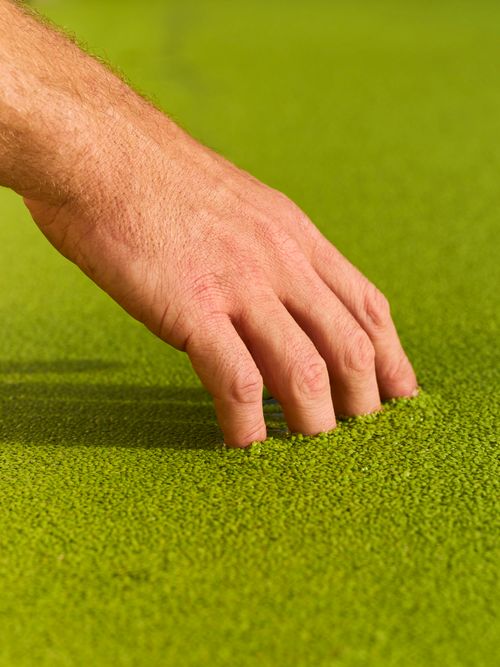
“Decrepit recreational vehicles squat on the property. In one corner, people tend to vials, grow lights and centrifuges in a trailer lab. More than a dozen big ponds filled with duckweed, a tiny green plant, bask in the Southern California sunshine.
“But the only thing cooking here is protein.
“Within each tiny floating aquatic plant is a molecule colloquially called rubisco. Without it, most life on Earth would cease to exist.
“Plants use rubisco protein — technically known as Ribulose-1,5-bisphosphate carboxylase/oxygenase — as the catalyst for photosynthesis, combining CO2 from the air with the building blocks for sugars and carbohydrates composing the base of our food chain.
“Rubisco is arguably the most abundant protein on the planet. Every green leaf has it. But this tireless molecule is locked inside plants’ cells, spoiling almost as soon as it comes into contact with the outside world. At the moment, eating salads is the only way to consume much of it.
“But Plantible’s farm may change that. If it succeeds, duckweed may become humanity’s first new major crop in more than a century. …
“Rubisco doesn’t just provide the protein we crave. It’s one of the world’s most versatile proteins, shape-shifting into forms resembling egg whites, meat, milk, gluten or even steak — all extracted from leaves. …
“The world grows more than enough food to feed everyone on Earth. Much of it goes to livestock. About half of the corn and soybeans grown in the United States are fed to cows, pigs and chickens to support meat-rich diets.
“This is not changing anytime soon. Even as protein alternatives proliferate, global meat consumption reached a record high in 2021, roughly doubling since 1990. The typical American consumed about 260 pounds of meat and 670 pounds of dairy last year, according to government statistics.
“That comes at a steep cost to ecosystems and the climate. Meat, at least how most of it is raised today, is the driver behind 57 percent of all food production emissions. …
“The challenge, then, is not to persuade people to eat more vegetables. It’s how to make plant proteins taste better than their animal counterparts.
“For a moment, it seemed like ‘alternative meat’ might succeed. Highfliers like Impossible Foods and Beyond Meat, after seeing sales soar in 2020, have faltered. Retail sales of alt-meat dropped more than 10 percent in 2022 amid health questions and high prices. Plant-based milk, while stealing market share from traditional dairy, still accounts for just 9 percent of the volume sold in the United States. …
“Plant proteins aren’t a perfect substitute. They can impart grainy textures, ‘vegetal’ off-flavors or fall short of the savory appeal of eggs, dairy and meat.
“So food producers are searching for the holy grail of plant proteins, one that combines the best of plant and animal proteins: affordable, abundant and easy to grow, with the physical properties that make a hamburger or milkshake so alluring. Rubisco might just be it. …
“Rubisco’s composition is a nearly ‘ideal’ protein for humans, according to the U.N. Food and Agriculture Organization, boasting an amino acids profile rivaling egg whites or casein in milk. Unlike the most common plant protein in soy, wheat and peas, it offers a non-allergenic, easily digestible and complete set of all nine essential amino acids our body can’t produce on its own.
“In contrast to alt-meats, rubisco is a versatile shape-shifter on the human palate. … As a binder in plant-based meats, it retains the delicious bite of a juicy burger. In a fluffy omelet or whipped meringue, it replicates the function of eggs. …
“The problem, however, has been getting it out of the leaf. As soon as a leaf is cut, its compounds bind to rubisco, rendering it unusable as a food ingredient. At the industrial scale, harvesting rubisco has proved to be a formidable challenge.
“ ‘You just have to process the plant material reasonably quickly so you don’t end up with a brown sludge,’ says [Grant Pearce, a protein chemistry researcher at the University of Canterbury in New Zealand]. Sugar beet leaves, cauliflower, kale, broccoli stems, radishes and even invasive plant species have all been harvested as protein sources. None proved economical. And some are skeptical it will ever be. …
“Duckweed, or lemna, doesn’t get much respect in most of the world. While eaten in parts of Southeast Asia, the pond vegetation is regarded as a nuisance elsewhere. That reputation belies the plant’s remarkable biology.
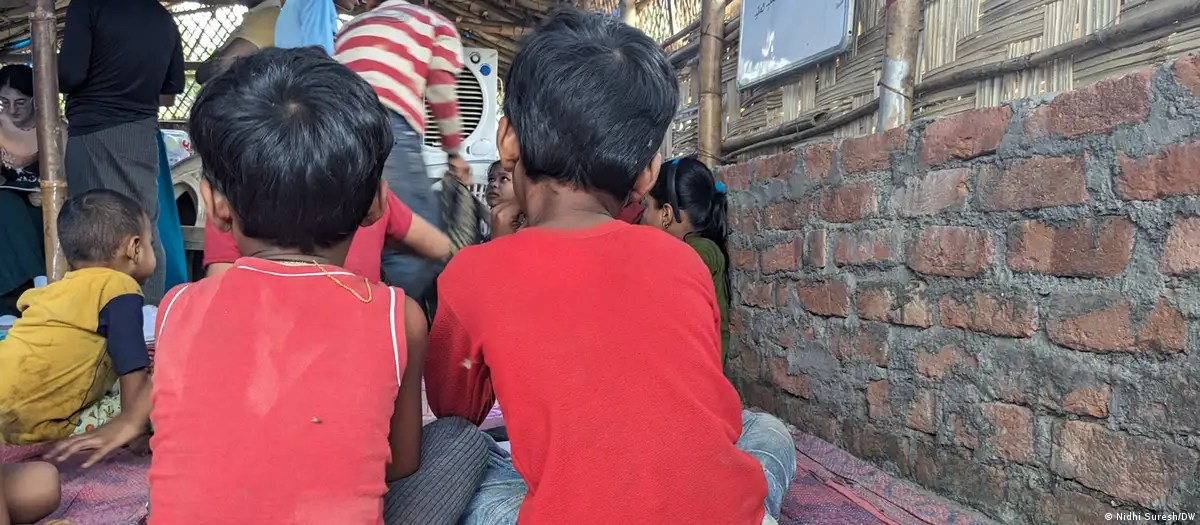
Photo: Nidhi Suresh/DW. In May, a small classroom made of woven bamboo walls and a cardboard roof was set up in a refugee camp where around 30 children between the ages of 5 and 15 could be taught how to read and write the Rohingya language.
Did you ever feel a need to invent a written form of a language? The Karen language of Burma had no written system until the 1830s, and Somali got Latin characters in 1973. Meanwhile, the Rohingya are barely getting started.
Nidhi Suresh writes for DW, “Ayesha Siddique, an 11-year-old Rohingya girl, rushed into her classroom. She picked up a broom, swept the floor and laid out a plastic mat in front of the small white board.
“Siddique’s family fled Myanmar soon after she was born to escape the widespread discrimination and persecution of the Rohingya, a Muslim minority group in the Southeast Asian nation. They spent a few years in Bangladesh‘s Cox’s Bazar refugee camp before moving to India in 2019.
“The young girl currently lives in a refugee camp in Faridabad, on the outskirts of the Indian capital, Delhi.
” ‘My grandparents often describe Burma as a beautiful land with mountains,’ Siddique said, referring to the country now known as Myanmar. ‘They told me about the trees behind our house, too. One day, I want to write a song about this in my own language.’
“For the past month, Maulvi Mohammad Ismail, himself a Rohingya asylum seeker, began teaching children like Siddique how to read and write in their mother tongue.
“In 2013, Ismail’s family also fled to Bangladesh’s Cox’s Bazar, which is currently home to at least 1 million Rohingya Muslims from Myanmar. After five years, he and his family made their way to India.
“They settled in the Faridabad camp, along with 50 other Rohingya families. The camp is located inside a garbage dump and most of the men work as ragpickers.
“The people in the camp speak to each other in Rohingya. They’re also fluent in Bengali and Hindi. However, most of them do not know how to read or write the script known as the Hanifi Rohingya. …
Rohingya living in Saudi Arabia and Bangladesh started a WhatsApp group called the Rohingya Zubaan Online Academy.
“Ismail joined the group, downloaded the script, and spent a month learning the alphabet. Last month, he set up a small classroom made of woven bamboo walls and a cardboard roof where he started teaching around 30 children between the ages of five and 15 how to read and write the language. …
“Sabber Kyaw Min, founder and director of the Rohingya Human Rights Initiative in India, explained why it was so important that children learn the language.
” ‘We as a community do not have much documentation. Our children must learn to write our language and then our stories, which will become our history. … Through these stories we can hopefully demand justice some day.’
“The Rohingya language remained an oral tradition until the 1980s when Mohammad Hanif, an Islamic scholar, developed a script based on Arabic letters and a set of decimal numbers. [However,] due to a military crackdown, violence and an internet shutdown, most of the population could not access it.
” ‘What happens in any genocide is the systematic erasure of a cultural identity which had to be preserved,’ said Shehzar Doja, founder and editor of the Luxembourg Review. … The erasure of Rohingya culture began in 1964, when Myanmar’s then military dictator, Aye Ne Win, excluded the Rohingya language from Burmese Broadcasting Service.
“In 1982, the military government enacted the Citizenship Law, which excluded the Rohingya people from the list of recognized ethnic groups in the country. …
“In 2017, Myanmar unleashed a violent military crackdown in what many describe as a genocide against the Rohingya Muslims in the country. This led to a mass exodus, with more than a million Rohingya fleeing to Bangladesh and other countries.
“Mayyu Ali, currently residing in Canada, is a Rohingya poet and author of Exodus: Between Genocide and Me. Ali himself learned the language in 2013 while working at a research center in Myanmar which had access to the internet. …
“Ali was among the thousands of Rohingyas who fled to Bangladesh. While living in Cox’s Bazar, he began the ‘Art Garden Rohingya,’ a website which now brings together hundreds of Rohingya writers, poets and artists.
“The platform, launched in 2019, also documents and preserves ancient Rohingya folktales, proverbs and riddles. They’re published in Rohingya, Burmese and English.
“Ali also explained that another factor contributing to the slow erasure of the language is that after fleeing, most of the Rohingya focus on quick assimilation into their host countries. …
“Reefa Akhtar, 10, and Abdul Shukur, 12, are two children studying Rohingya language in Ismail’s class. When asked if they ever want to go home, both siblings immediately said, ‘yes.’
“However, Akhtar was quick to add, ‘but I also don’t want to go back to a place which makes my father sad even if he thinks about it for a minute.’ “









 Suzanne's Mom's Blog
