Feeds:
Posts
Comments

Posts Tagged ‘art’

Photo: Fahad Shah.
In Srinagar, India, Syed Maqbool Rizvi paints intricate floral patterns on a decorative box made of papier-mâché. The ancient craft is dying out.

In reading about traditional crafts in danger of dying out as its elderly practitioners die, I keep thinking about recent posts on young artists taking crafts in new directions. (Consider the Navajo weaver, here, and the bojagi artist, here.) I wonder if such an evolution can emerge in a politically turbulent place like Kashmir. Ancient decorations now cover more than boxes, but who will take it to the next level? The current popularity belies the unsustainable bottom line for the workers themselves.

Reporting from India for the Christian Science Monitor, Fahad Shah writes, “Papier-mâché dates back hundreds of years in Kashmir. Local folklore credits the 14th century Sufi saint Mir Sayyid Ali Hamadani with bringing the craft to this Himalayan region from Iran, and it flourished under a series of sultans, quickly becoming a symbol of Kashmir’s cultural identity.

“But for a long time, the art form was limited to decorative boxes and other items molded from paper pulp. … These days, the iconic designs popularized by traditional papier-mâché items can be found on bags, leather jackets, and home decor. Artisans apply their intricate designs on unconventional materials like steel, glass, and porcelain, using industrial paints for durability.

“This creative evolution has expanded papier-mâché’s market appeal, with a new generation of clientele emerging – a group that includes interior designers, a local urban bourgeoisie, and international buyers. …

“It’s a relief – of sorts – to the Kashmiri artisans who have watched similar local crafts die out in recent years. To be sure, papier-mâché artisans continue to struggle with low wages and a lack of new talent entering the craft. Yet Hakim Sameer Hamdani, an architectural historian and design director for the Kashmir section of the Indian National Trust for Art and Cultural Heritage, says the industry itself is performing better now compared with 20 or 30 years ago. …

“He says, ‘The internet’s role, especially social media and WhatsApp, in design inspiration and market expansion has further driven demand, allowing artisans to reach global buyers directly and removing middlemen.’

“In Srinagar city, Jammu and Kashmir’s summer capital, papier-mâché art adorns the walls and ceilings of everything from Sufi shrines and mosques to homes and hotels. It can also be spotted in the windows of boutiques, where tourists and locals alike browse ornate bags or leather jackets. Mohammad Ismail, a retired educationist in Srinagar who collects papier-mâché art, says artists are always innovating.

“In papier-mâché, ‘the main focus is the design,’ he says, as he leaves a shop with a newly purchased bag. ‘It is the color and the pattern, whether it is on a glass or paper, that is authentic.’

“Around the world, demand for classic papier-mâché designs – applied to modern products – is growing, says Rahul Dhar, founder of e-commerce platform Treasures of Kashmir. He’s been selling Kashmiri handicrafts since 2020, and in the last few years, interest in papier-mâché jewelry has surged on his platform. …

“For artists, customer enthusiasm doesn’t always translate into prosperity. From his home in a historic neighborhood of Srinagar, Syed Maqbool Rizvi paints intricate floral patterns on a decorative box. His day started at 9 a.m. and will end at midnight. Despite having a loyal customer base that he communicates with via WhatsApp, he only earns the equivalent of about $5 for an entire day’s labor.

“The award-winning, seventh-generation papier-mâché artisan will be the last in his family to master the craft. His children – a son and a daughter – have chosen different paths.  

“ ‘There were many families known for this craft, but their children have moved on,’ Mr. Rizvi says. ‘Everyone looks for private jobs these days – who can afford to sit from morning till night for this kind of work?’  

“Government loans during the pandemic helped, he says, but it’s become almost impossible to make ends meet through papier-mâché alone. 

“Historian Bashir Ahmad Maliyar, whose doctoral thesis examined the evolution of Kashmir’s Mughal-era arts, crafts, and trade, says it will take more aggressive interventions to reverse the decline in active artisans.

“Without policies that ensure fair wages, incentivize arts education, and promote the region’s crafts, ‘papier-mâché will vanish within 10 to 20 years,’ he says. ‘People may still practice it in isolated ways, but once the art dies, reviving it will be difficult.’ ”

More at the Monitor, here.

Read Full Post »

Photo: Peter Ellzey.
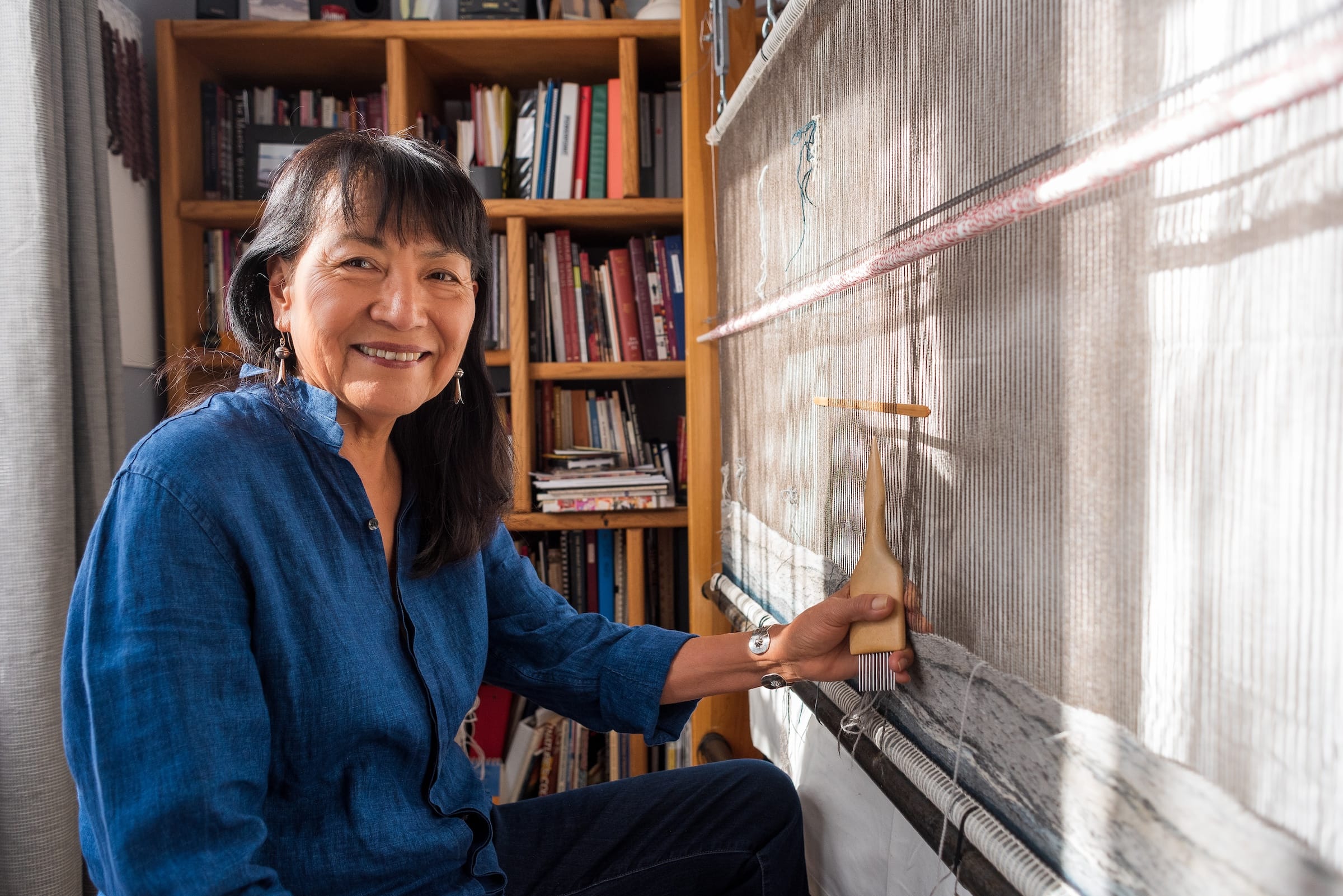
DY Begay in her weaving studio in Santa Fe, New Mexico, in 2022.

Traditions often gain strength and durability when the spirit behind them is reinterpreted through a new generation’s sensibilities. A case in point: the way the weaving and dyeing of Diné artist DY Begay has enriched a traditional Navajo craft.

Sháńdíín Brown and Zach Feuer at Hyperallergic recently interviewed the artist.

They write, “For over four decades, artist DY Begay expanded the expressive range of Diné (Navajo) weaving, transforming the form into a language that is entirely her own. She is a Diné Asdzą́ą́ (Navajo woman), born to the Tótsohnii (Big Water) clan and born for the Táchii’nii (Red Running into Water/Earth) clan. Her maternal grandfather is of the Tsénjíkiní (Cliff Dweller) clan and her paternal grandfather is of the Áshįįhí (Salt People) clan. 

“Begay is a fifth-generation weaver who was raised in Tsélání (Cottonwood) on the Navajo Nation, where her family’s sheep flock still resides. Rooted in Diné Bikéyah (Navajo homelands) — from the cliffs of Tsélání to the horizon of the Lukachukai Mountains — her work reflects the blended hues of sunsets, mesas, and mountain ranges, while her use of wool from her family’s flock and natural dyes binds her practice to the land she seeks to honor and protect.

“After graduating from Arizona State University in 1979, Begay moved to New Jersey and immersed herself in the fiber art world of New York City. She studied historic Diné textiles at the Museum of the American Indian, whose collections later became part of the Smithsonian’s National Museum of the American Indian (NMAI). Most of these pieces were created by Diné weavers whose names were not recorded, likely women. She also took inspiration from the work of artists such as Anni Albers, Sheila Hicks, and Lenore Tawney — all of whom trained in modern Western traditions yet studied Indigenous weaving practices. …

“When she returned to Tsélání in 1989, her grandmother, Desbáh Yazzie Nez (1908–2003), saw her weavings and urged her to develop her own compositional sensibility. Begay quickly gained recognition at the Heard Museum Guild Indian Fair and Market as well as the Santa Fe Indian Market, yet she felt restless in her practice. By 1994, that questioning crystallized into a breakthrough: She began developing color hatching, a method of creating subtle gradations and nuanced color interactions that transformed the solid, banded designs of conventional Diné weaving. …

“In August, Begay spoke with us over Zoom from her home in Santa Fe. The interview has been edited and condensed for clarity.

Sháńdíín Brown and Zach Feuer
“In Sublime Light: Tapestry Art of DY Begay, the first book dedicated to you and your recent retrospective at the NMAI, you write about watching your mother and grandmother weave in the hogan. …

DY Begay
 “I don’t remember the very first time I picked up weaving tools and set a loom on my own. I was very young. I do remember standing behind my mother’s loom, watching her pull colored yarns over and around the warps. Her fingers moved swiftly in and out, pressing the wefts into place. Within minutes, geometric shapes stacked and formed into the outline of a Ganado-style weaving. At that age — maybe four or five — I could not quite comprehend how those shapes came together. I was always perplexed and in awe. Everything happened so fast in front of me as her hands composed lines and rows of colored yarn. 

“I grew up surrounded by weavers: my maternal grandmother, my mother, and my aunts. Someone was always at the loom, often positioned in a very central place inside the hogan. And we lived in the hogan when I was growing up, and everybody else did too.

“I watched my mother create stepped patterns with hand-dyed yarns, moving with precision and grace. Teaching came through showing. It was a physical action. The word that I always remember, and is still used today, is kót’é — ‘like this.’ My mother said ‘kót’é, kót’é.’ …

SB & ZF
“Do you remember the moment when you first began weaving yourself — whether your family set up a loom for you or you started working on theirs?

DB
“I was very curious. I tried to hold my mother’s tools, but they were too big for my hands. … Eventually, she allowed me to sit with her once in a while and said ‘kót’é, kót’é.’ I began to get used to the natural action of tapping with the combs. I was about eight years old when I had my own loom. I don’t remember its size. My mother prepared the warp and I used leftover yarn from her bin. I do remember finishing my first weaving, maybe two colors. It was pretty decent for a first attempt. It was a good learning situation because my mother was there. She would sometimes unweave certain parts and we would go on. …

“Most finished weavings, maybe two by three or three by three feet, and some saddle blankets, were taken by my father and my grandfather to the local trading posts to exchange for food, fabric, or whatever was needed. My mother never went to the trading post herself — we didn’t have a vehicle then, so transportation was by wagon or horses. They would roll up the weavings, pack them, and take them to the trading post. …

“In weaving ‘Pollen Path,’ I wanted to share a cultural belief. Among the Diné, we sprinkle corn pollen to honor a new day, to seek blessings, and to bring balance into our lives. Corn itself is a sacred plant. The pollen is collected in late summer, when the tassels of the corn begin to pollinate. We gather it in the early morning, just before the sun rises. For me, ‘Pollen Path’ reflects peace, beauty, and gratitude for life.

“The project began in the summer of 2007, a very good year for growing plants that I use in dyeing my wool. My sister, Berdina Y. Charley, planted local corn seeds she received from our Táchii’nii (Red Running into Water/Earth) relatives. I believe these were heirloom seeds from our Táchii’nii family. …

SB & ZF
“How do you translate the experience of walking in beauty, through the landscapes of Diné Bikéyah (Navajo Country) and more specifically your home of Tsélani (Cottonwood), into the two-dimensional form of weaving?

DB
“Not only do I have my Tsélani landscape embedded in my mind, but I frequently photograph the surrounding textures at various times of the day to capture different lighting as it reflects on the terrain. …

SB & ZF
“Can you tell us about your color palette and the process of dyeing the wool? Is it essential for you to use and make dyes that are from the earth?

DB
“I have been practicing and experimenting with natural dyes for quite a while, and I love using local plants to create my color palette. It is both essential and traditional in my culture to use what the earth provides to create dyes for our yarn.

“My palette comes from many sources. I work with common plants such as cota (Navajo tea), chamisa, rabbitbrush, and sage. I also use non-native materials like insects, fungi, foods, and flowers. Each has its own season, and I collect plants according to the time of year.

“The process itself is an experiment every time. I’ve studied many dyeing methods and learned to be attentive to formulas that help obtain and preserve the colors. For me, making dyes from the earth is not only practical but also deeply connected to tradition and creativity.”

More at Hyperallergic, here. No paywall. Subscriptions encouraged.

Read Full Post »

Photo: Charlie Rubin/Kasmin, New York.
An example of sculpture by Alma Allen, ‘Not Yet Titled‘ (2024). He is the artist chosen by a conservative art group to represent the US in the 61st Venice Biennale.

With all the sinister goings-on in the world, you might think that something strange in the art world would be the least of our worries. But this creepy story really got under my skin, and I’m wondering what the artists among you have to say about it.

Ben Davis reports at Artnet that the administration “has picked its artist for the 61st Venice Biennale. After months of speculation and much confusion, the artist to represent the U.S. will be Mexico-based sculptor Alma Allen, in a pavilion organized by curator Jeffrey Uslip. The sponsor is the American Arts Conservancy (AAC).

“But what is this organization, now vaulted front and center of the international art conversation, which no one I know has ever heard of? I was perplexed. So I took a spin around the internet to get a sense of what its chops were. Here are some observations.

“If no one has heard of the Tampa-based AAC, this is because it was founded only in July of this year. The press release is so poorly edited that it repeats the same quote by executive director Jenni Parido twice.

“The fact that this gaffe stands, four months later, as AAC takes on the most high-profile job in the arts, might put into question their professionalism in organizing a major international art exhibition. …

“Parido is an enigma on the art scene. According to her LinkedIn, her primary work experience is as the founder of Feed Pet Purveyor, a Tampa vendor specializing in natural foods for pets, which she ran from 2014 to 2023. …

“Frank Bardonaro was named president of the AAC board of directors in late August; he’s the CEO of the Houston-based Brock Group, a conglomerate that provides scaffolding, insulation, and the like for industrial and commercial customers. John Mocker, who serves as board secretary, is head of a pipe distributor, LB Industries.

“Mocker distinguishes himself as arty in this company because his biography identifies him as a collector of ‘American and international art.’ I’m interested! All I was able to find out, though, was that he also had a bit part in the unknown 2024 Abigail Breslin feature Chapter 51 directed by photographer Tyler Shields. …

“Ryan Coyne joined the AAC board as treasurer in September. He is best-known for running Starboard, a digital marketing, media, and government relations business. Among other things, it owns BizPac Review, which promises ‘breaking news and analysis unfiltered by the liberal bias that has eroded the media’s credibility.’ Starboard is probably best known for purchasing Parler, the right-wing Twitter clone, in 2023. Coyne also runs We the People Wine, ‘America’s Favorite Patriotic Wine.’

“Finally, AAC vice president Janet Steinger is a socialite married to superstar Palm Beach personal-injury lawyer Michael Steinger. …

“ ‘The Conservancy brings together a national network of curators, scholars, educators, artists, and patrons who believe in the transformative power of the arts,’ AAC boasted when it launched. Let’s take a look at what that means. The advisory board includes: curator Jeffrey Uslip, who is helming the Alma Allen pavilion in Venice, socialite Mackenzie Brumberg, socialite Nicola Verses … Nicole McGraw, a Palm Beach art dealer and former CEO of Jupiter NFT Group [now] ambassador to Croatia … artist Brendan Murphy, who made a diamond-encrusted spaceman sculpture for a Four Seasons in Riyadh … photographer, artist, and Web3 entrepreneur Brandon Ralph. …

“One name on the advisory board list, Madison Wright, remains an unknown, as the AAC site does not identify or provide links for its advisory board, just names. ‘Mathew Taylor’ and ‘Michelle Taylor’ are also listed. ‘Mathew’ seems to be a misspelling of ‘Matthew.’ It probably refers to a filmmaker who goes by both M.A. Taylor and Matthew Taylor, depending on whether he is directing films about conservative politics or art. He has directed both Marcel Duchamp: The Art of the Possible (2019), about the famed father of conceptual art, and Government Gangsters (2024) [about] Kash Patel‘s book about a deep state conspiracy. …

“The other big initiative AAC is pushing is the ‘Passport to Patriotism: America 250’ exhibition, which it says will happen next year. ‘Children ages 5–15 are invited to submit original works that express what patriotism means to them,’ for possible inclusion. …

“The ‘children’s art’ used to illustrate the contest has the hallmarks of very bland A.I., including [one] where Lady Liberty has six fingers, and the stripes on the flag inexplicably flip colors. …

“A bare-bones official website for the U.S. pavilion now exists. On Instagram and Facebook, AAC posted a short statement about the vision of the show.”

Maybe I read too many murder mysteries, but the thin online presence of these entities sure do suggest the shell companies I’m currently reading about in a novel by Richard Osman.

More at Artnet, here.

Read Full Post »

Photo: John and Suzanne’s Mom.
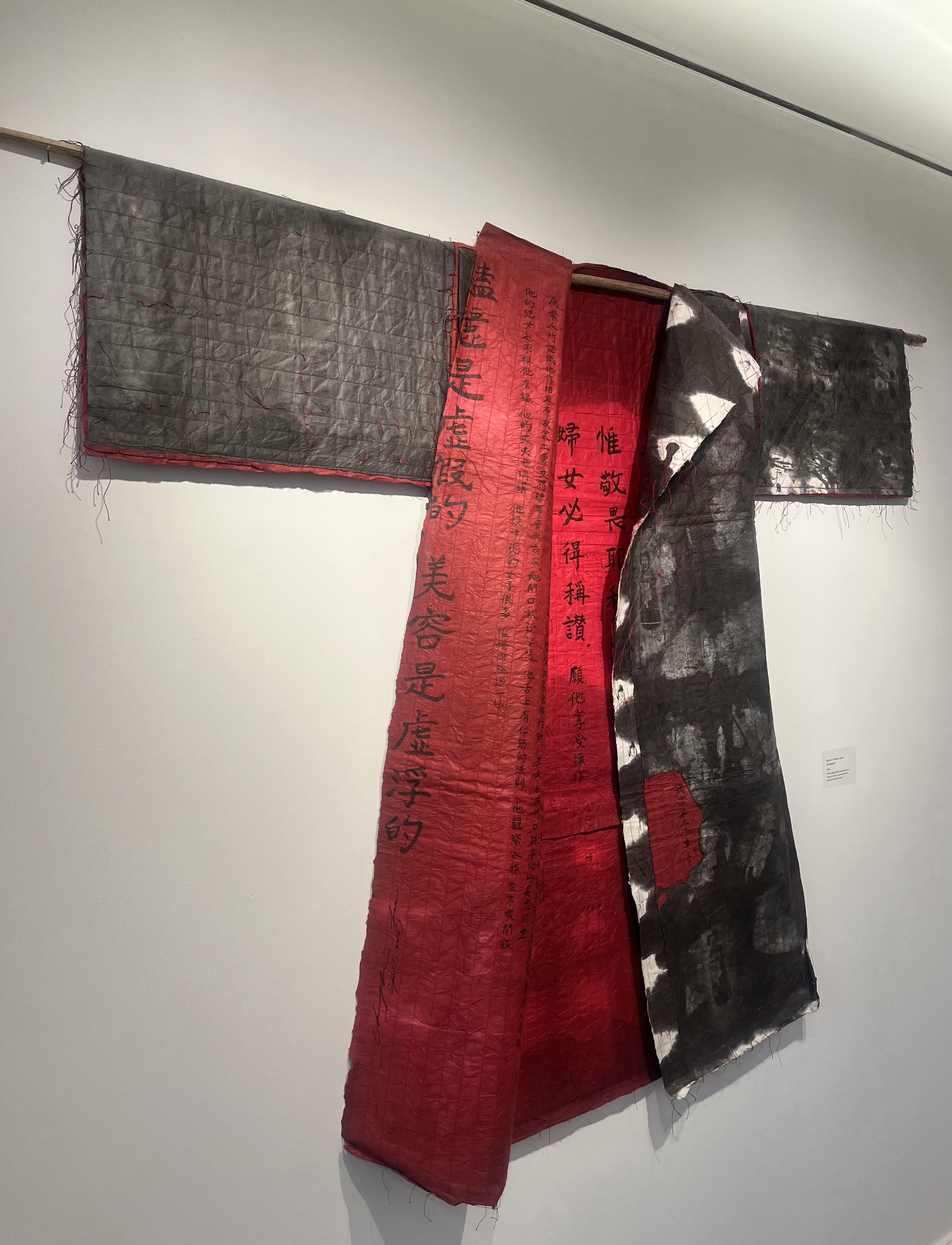
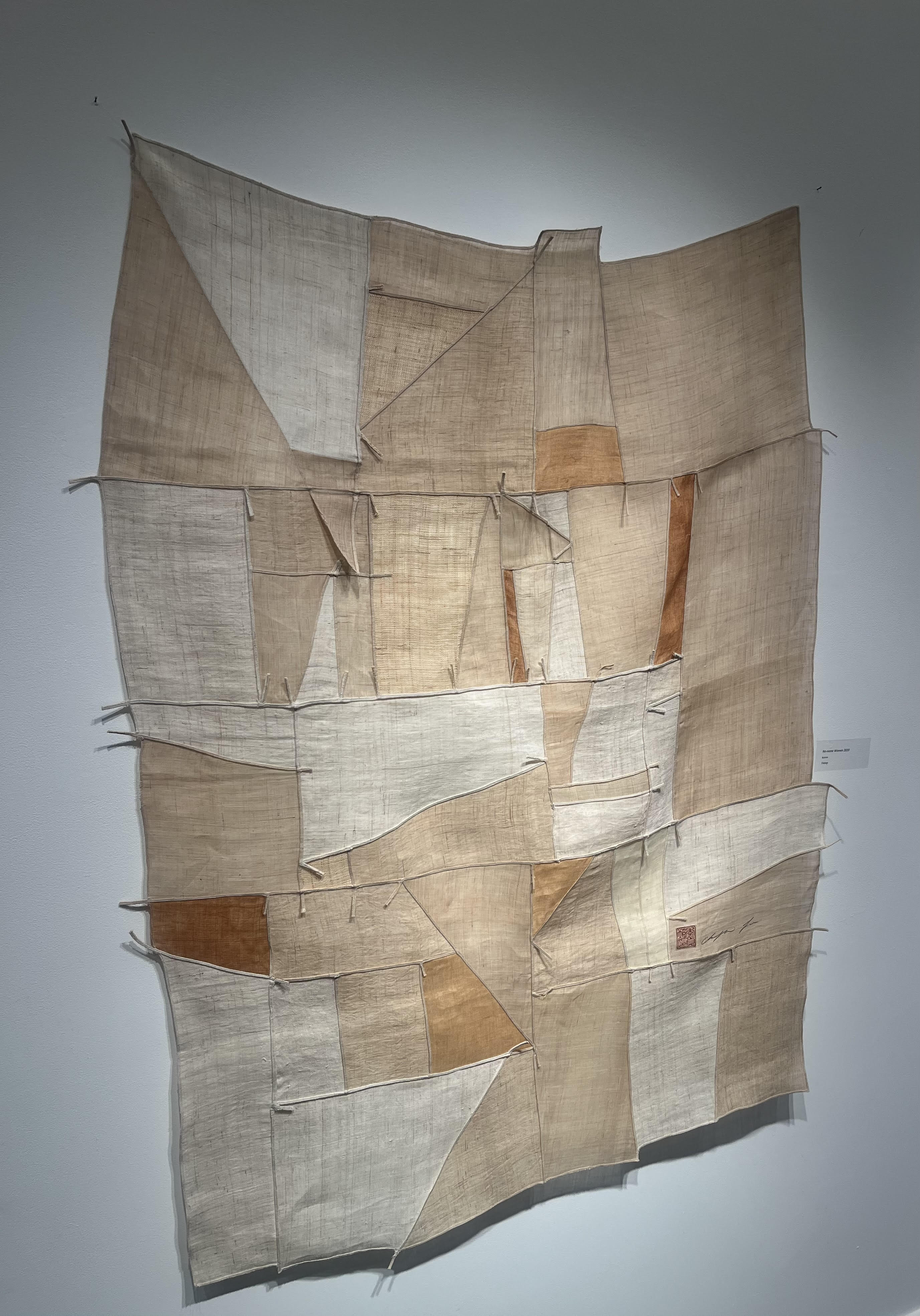
Chunghie Lee‘s bojagi style “No-Name Women Paper DuRuMaGill”: photo images silk-screen-printed on Korean mulberry paper dyed with ground oriental ink stick. At Lexington Arts in Massachusetts.

My friend Ann, the textile artist, put me on to a new/ancient type of quilting and fabric art. It’s from Korea and it’s called bojagi.

According to the websit for Beyond Above Publications, “Bojagi (Bo-Jah-ki), or wrapping cloth, is the ancient Korean folk tradition of making pieced textiles for both everyday and ceremonial use. Originally made by anonymous housewives to fulfill a practical need along with an artistic impulse, Bojagi and its techniques have recently gained attention outside of Korea due to the increasing interest in the value of handmade items, as well the use of recycled materials and the politics of sustainability in textiles and contemporary art.”

I would never know about this type of thing, but Ann is on every email list imaginable for textile art in Greater Boston and beyond. So one day I headed over to Lexington Arts and Crafts to see contemporary bojagi by artist Chunghie Lee.

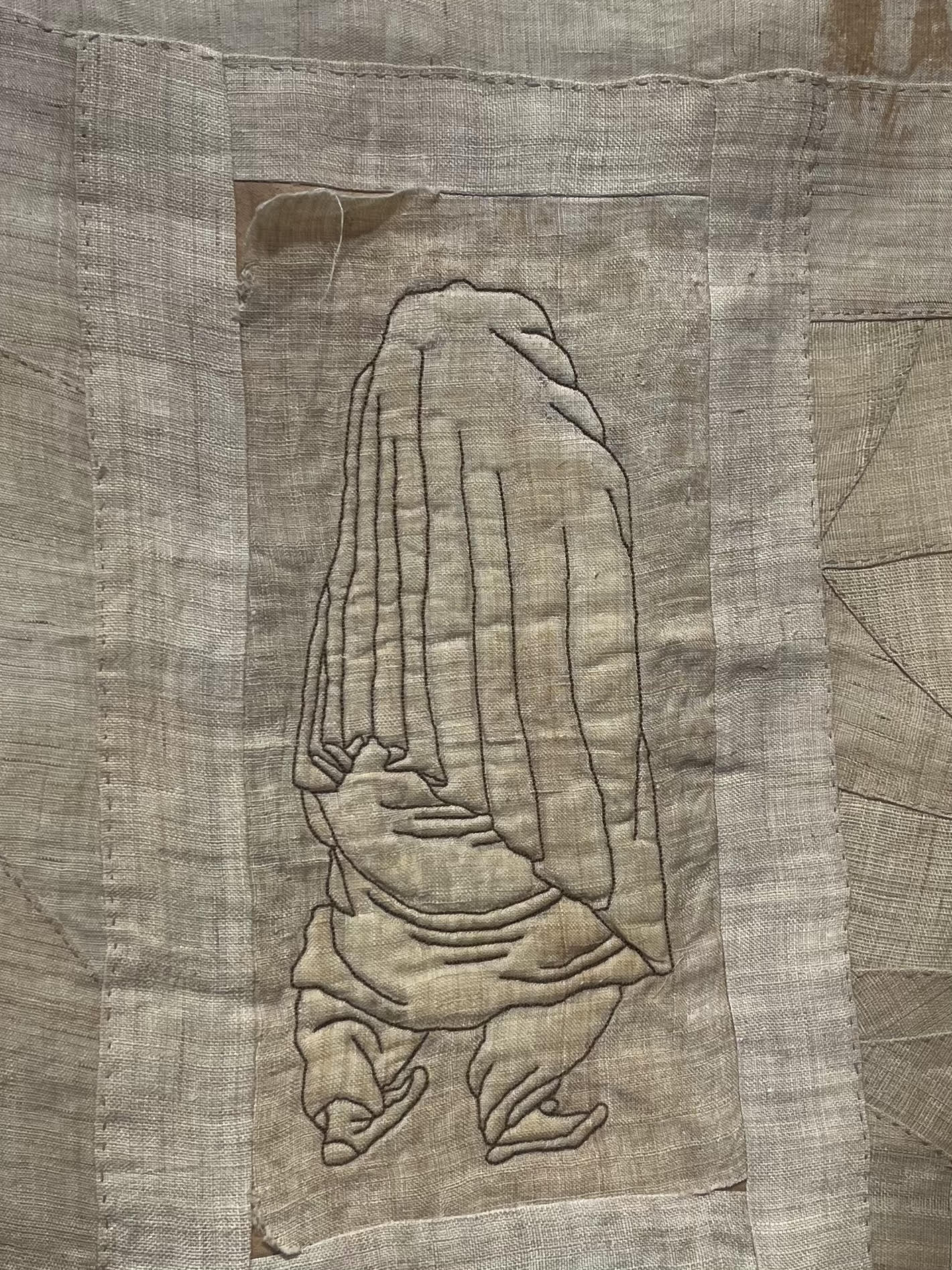
Apart from appreciating Lee’s skillful needlework, I was struck by her use of sustainable materials: previously used fabrics, mulberry paper, and ground-up ink sticks for red and black dyes. Especially moving was her focus on “no-name women,” the anonymous people behind this technique to make scraps of cloth go far. Women unknown and unappreciated.

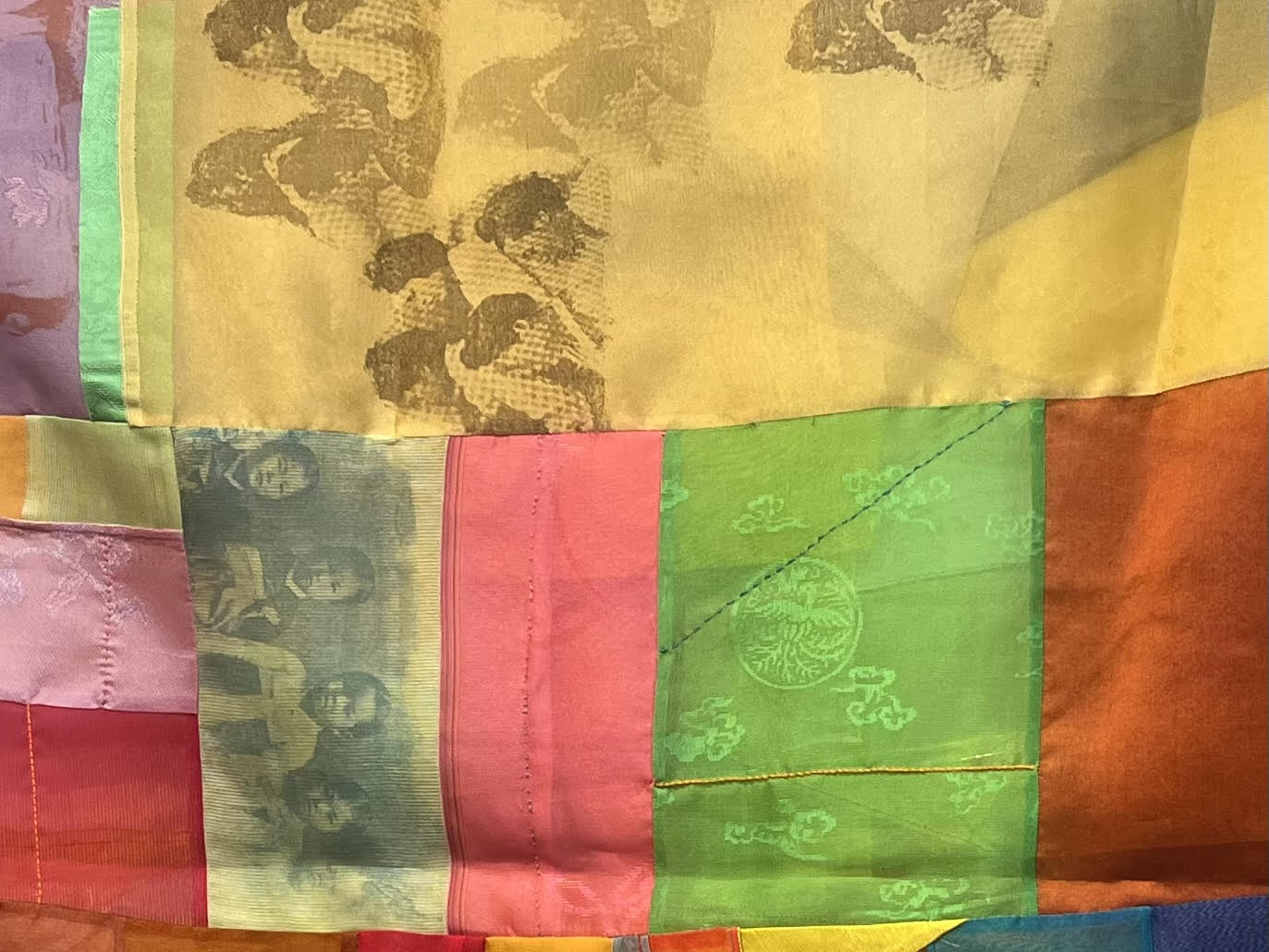
You have to look closely to see them. Lee brings them into her work with silk screens of old-time photos, barely visible. Which is why for this piece I am showing you only a close-up.

Close-up of silk bojagi “no-name women” piecework by Chunghie Lee.

Here is more detail from the publishing company Lee founded with Jiyoung Chung, a visual artist inspired by the Joomchi papermaking tradition.

“From traditional women’s work to contemporary sustainable textiles, bojagi works include delicately pieced and hand-stitched traditional bojagi, reinterpreted bojagi, wearable pieces, installations, and wall hangings.

This uniquely Korean art form made by anonymous ancestors has evolved from functional works into a contemporary art form that is embraced worldwide.

“Since the late 14th century, every household, from the royal palace to the thatched-roof hut in a mountain village, has found these wrapping cloths indispensable. The tradition of making and using bojagi was established during the Josun Dynasty (1392 – 1910), when women were restricted from leaving their households. To spend the long, tedious hours of the day, girls were taught to sew at age ten, and needlework became a big part of their lives as they moved into  adulthood. This folk art tradition was the only escape from the sequestered lifestyle of Korean women, and provided them with an artistic outlet for creative expression.”

Chunghie Lee adds, “I see this patchwork as a metaphor for human life. We may feel ourselves to be as random pieces of fabric, alone and without meaning, but God’s hand places us together in a beautiful composition, which has great harmony and meaning. As artists of all nationalities, generations and heritages, we discover we are all alike, and have been saving and making beautiful things with discarded fabric and other materials. In the eyes of artists, fabric scraps can be transformed and repurposed to fulfill the design and vision of the creator.”

More on bojagi at the website for publishing company Beyond Above, here. Follow Lee on Facebook, here.

Below, Chunghie Lee’s contemporary version of Korean piecework, followed by her careful stitching for “No-name Woman with Head Covering.”

Read Full Post »

Photo: Robles Casas & Campos.
The painting by Italian artist Giuseppe Ghislandi in a living room in Mar del Plata. The 18th-century painting ‘Portrait of a Lady’ (Contessa Colleoni) was stolen by an SS officer and rediscovered this year in Argentina.

Guilty secrets don’t stay hidden forever. It may take a long time, as in today’s story about Nazi loot, but more often than not, truth eventually surfaces.

Facundo Iglesia  and Jon Henley write at the Guardian, “There was nothing very remarkable about the middle-aged couple who lived in the low, stone-clad villa on calle Padre Cardiel, a quiet residential street in the leafy Parque Luro district of Argentina’s best-known seaside town, Mar del Plata.

“Patricia Kadgien, 59, was born in Buenos Aires, five hours to the north. Her social media described her as a yoga teacher and practitioner of biodecoding, an obscure alternative therapy that claims to cure illness by resolving past traumas.

“Her husband, Juan Carlos Cortegoso, 61, built and raced go-karts. Like many in this neighborhood, the couple were comfortably off, and discreet. …

“Then, last month, they put their house up for sale. A photographer from a local estate agent, Robles Casas y Campos, came round to shoot the spacious, elegantly furnished interiors. The pictures went up. And their quiet existence came crashing down.

“The fifth photograph on the agency’s listing showed a general view of the villa’s living room. Hanging on the wall, above a buttoned sofa in plush green velvet and next to a polished antique commode, was a highly distinctive oil painting of a woman.

“More than [6,000 miles] away, the Dutch news outlet AD had, for several years, been quietly investigating the fate of old master paintings looted by the Nazis and still listed by the Dutch culture ministry as ‘unreturned‘ after the second world war.

“Journalists had made several attempts to speak to Patricia Kadgien, the owner of the property, and to her elder sister, Alicia, the daughters of a high-ranking Nazi official Friedrich Kadgien, who was known to have settled in Argentina after the war.

“Their calls and messages had consistently gone unanswered, or been rebuffed. But then a Dutch reporter based in Buenos Aires, Peter Schouten, went knocking on the door of the villa – and spotted a ‘for sale’ sign.

“What followed, after Schouten and his colleagues in Rotterdam clicked on the link to the property and instantly recognized the work, made headlines around the world as the story unfolded of the unlikely recovery of an 18th-century portrait missing for 80 years. …

“After the media reports of the work’s likely location, and before a police search, the couple had tried to obstruct the investigation, the prosecutor argued, by taking down the online property listing and for sale sign and replacing the portrait with a tapestry.

“Despite knowing they were under investigation, it was alleged that the defendants had also attempted a civil action claiming the painting was rightfully theirs, turning it over only after they were placed under house arrest and facing further police raids.

“Through their lawyer, Kadgien and Cortegoso have denied concealment, saying they had always been willing to hand over the painting, and obstruction, arguing that their civil action was aimed at establishing ownership and not at hiding the artwork. …

” ‘Portrait of a Lady’ belonged to Jacques Goudstikker, a Jewish-Dutch art dealer who fled Amsterdam in mid-May 1940 to escape the Nazis, but died after falling through an open hatch into the hold of the SS Bodegraven, the ship carrying him to the UK.

“Goudstikker carried with him a notebook detailing his collection of more than 1,100 artworks, including pieces by Rubens, Giotto, Titian, Rembrandt and Van Gogh, all of which were snapped up for a fraction of their value by Nazi officials.

“Some were later recovered and displayed as part of the Dutch national collection in the Rijksmuseum, before 202 works were restored to the dealer’s sole heir, his daughter-in-law, Marei von Saher, in 2006. ‘Portrait of a Lady’ was not among them. …

“Born in 1907, Kadgien joined the Nazi party in 1932 and the SS in 1935. By 1938, he was a special representative working for Göring on the four-year economic plan drawn up by Adolf Hitler to rearm Germany and prepare it for self-sufficiency by 1940. …

“Kadgien ‘confiscated a large amount of property from Jewish merchants, including jewelry and diamonds in Amsterdam, and oversaw the sale of expropriated shares and securities through banks and front companies in Switzerland’ [federal prosecutor Carlos Martínez] said.

“He fled to Zurich early in 1945, then to nearby Baden, where in 1948 he set up a successful finance and trading firm, Imhauka. With pressure growing after questioning by Swiss and US investigators, Kadgien left for South America in 1949. …

“Kadgien resurfaced in Rio de Janeiro in 1951, settling in the Santa Teresa district and establishing a Brazilian branch of Imhauka. … Imhauka secured valuable contracts with Juan Perón’s government, including acting as an intermediary for major German engineering firms such as Siemens. …

“The fate of ‘Portrait of a Lady,’ which will be registered with Argentina’s supreme court, is now uncertain. Prosecutors have requested it be held, but not displayed, at the Holocaust Museum in Buenos Aires while its ultimate ownership is determined. This week von Saher, Goudstikker’s heir, lodged a legal claim to the work with the FBI in New York.”

More at the Guardian, here. No firewall.

Read Full Post »

Photo: Museum of Fine Arts, Boston.
Descendants of potter David Drake, seen at the Museum of Fine Arts with one of the artist’s works

If we are in a hurry for the many evils we see to be defeated, we’re likely be disappointed. But in time, even a foundering ship can right itself. The growth of initiatives to return artifacts stolen in the past is an example.

Jori Finkel writes at CNN that in a “likely precedent-setting agreement, the Museum of Fine Arts (MFA) Boston has agreed to return two works from 1857 by the Black potter David Drake, who made his ambitious jars while enslaved, to his present-day descendants.

“By the terms of the contract, one of those vessels will remain on loan to the museum for at least two years, according to the lawyer George Fatheree, who is representing Drake’s descendants. The other vessel — a masterpiece known as the ‘Poem Jar’ — has been purchased back by the museum from the heirs for an undisclosed sum. Now the work comes with ‘a certificate of ethical ownership.’

“ ‘In achieving this resolution, the MFA recognizes that Drake was deprived of his creations involuntarily and without compensation,’ a museum spokesperson said in a statement. ‘This marks the first time that the museum has resolved an ownership claim for works of art that were wrongfully taken under the conditions of slavery in the 19th-century US.’ …

‘Ethan Lasser, chair of the art of Americas at the MFA, said the museum has learned from its work restituting Nazi-looted art. ‘We’ve become very expert in Holocaust restitution. We’re dealing with (repatriation) issues in our African collections and Native American collections,’ he said over the phone. …

“He considers Drake’s work an example of ‘stolen property,’ too, ‘since the artist is always the first owner of his work and he never got to make the call about where it went or what he was paid for it.’

“Born enslaved around 1800 in Edgefield, South Carolina, a region known for its rich clay, Drake (who was also known as Dave the Potter) was one of relatively few African American potters to sign his work. He also dared — despite punitive anti-literacy laws for enslaved people in the state — to etch short sayings or poems on the jars, making them powerful acts of resistance. Some inscriptions boast of the jar’s intended contents or enormous capacity; others remark more poignantly on his own life or working conditions.

“The ‘Poem Jar,’ which the MFA originally bought in 1997 from a dealer in South Carolina, features a couplet that hints at Drake’s financial exploitation. The inscription reads: ‘I made this Jar = for cash/Though its called Lucre trash.’ Currently in a gallery for self-taught and outsider art at the museum, it will assume a more prominent spot at the entrance of the Art of Americas wing once renovated in June 2026. …

“Another jar made the same year, 1857, has a particularly wrenching inscription in light of Drake’s forced separation from a woman believed to be his wife and her two sons. That vessel, at the Greenville County Museum of Art in South Carolina, reads: ‘I wonder where is all my relation.’

“One of Drake’s great-great-great-great grandsons, the children’s book author and producer Yaba Baker, said he feels the restitution process offers one answer to that question. ‘It’s been exciting, overwhelming and feels full circle,’ he said in a video call. He praised the MFA for ‘showing integrity and leadership’ in ‘allowing us to connect to Dave’s legacy,’ noting that ‘to go from being slaves to having a family of engineers and doctors and people in executive positions is a testament to Dave’s legacy in a different way.’

‘These descendants began talking about getting involved in Drake’s legacy in 2022, upon the opening of ‘Hear Me Now: The Black Potters of Old Edgefield, South Carolina,’ an exhibition jointly organized by the MFA and the Metropolitan Museum of Art in New York. The family soon hired Fatheree, fresh from his win in the Bruce’s Beach land reparation case. Earlier this year they established the David Drake Legacy Trust, governed by five of the oldest heirs.

“So far there are about 15 family members involved, according to Fatheree, but they have created a website so that other descendants of Drake can be identified and join the efforts — what Fatheree calls ‘a big tent approach.’ …

“There are thought to be around 250 pots by Drake still in existence, and over the past five years the market for his work has exploded, driven mainly by American museums competing for pieces in the hopes of telling a more complex story about the history of slavery in the US. Several have paid six figures for his work, and in 2021 the Crystal Bridges Museum of American Art in Arkansas paid a record-setting $1.56 million for a 25-gallon stoneware jar at auction.

“Other museums that own Drake’s work include the Met, the Philadelphia Art Museum, the De Young Museum in San Francisco, the Art Institute of Chicago, Harvard Art Museums, the St Louis Art Museum and the Smithsonian American Art Museum in Washington, DC, as well as smaller venues in the American South.

“Fatheree confirmed he has begun to reach out to some of these other art institutions on behalf of the family. ‘Our approach has been one of collaboration and invitation. I am not a litigator; we did not go to the museum and file a lawsuit (or) threaten to sue them. But our hope and frankly our expectation is that other institutions’ — and private collectors of Drake’s work, he added — ‘will follow the Boston museum’s lead here.’ ”

More at CNN, here.

Read Full Post »

Photo: FoxyDonuts.
Seattle is making a game of loving rats.

Gotta love the kooky things people come up with. Today’s story is about people in the state of Washington who’ve decided there is a patron saint of rats. They call him St. Rat.

Nathalie Graham writes at the Stranger, “Heat waves shimmer along Pine Street. A rancid, somehow warm fishy smell wafts from Momiji’s dumpster, which is baking in the hot sun on 12th Avenue. The crumb rubber in Bobby Morris Playfield’s astroturf emits its own corona of heat, absorbing the sun’s rays. …

“Nearby, genderqueer youths balance on the concrete lip of the Cal Anderson Gatehouse scrubbing Hot Rat Summer, a pseudo-famous, pseudo-religious guerrilla mosaic of a rat with a halo. …

“Hot Rat Summer features St. Rat, a kind of patron saint for those at the bottom of the societal heap. … They leave offerings of doodles, flowers, and snacks at St. Rat’s feet. They protect the art and the saint within it.

“Last month, City Hall decided to protect Hot Rat Summer from bureaucracy, but that has not kept it safe from taggers, who’ve consistently spraypainted it. Ten days ago, it was a wash of black. …

“The taggers may not see the value of St. Rat, but the art and theology professors at Seattle University who spoke to the Stranger certainly did. They gave a few hot takes on this venerable rat.  

“Ken Allen, an associate professor of Art History at Seattle University, strolled over to Hot Rat Summer to analyze it in person. For the scholar of West Coast art in the mid-20th century, the rat’s saintly halo evoked the Beatnik era and artist Joan Brown, part of a loose, bohemian artist collective in the mid-50s called the Rat Bastard Protective Association

“These bastards ‘often used urban detritus in their assemblage and collage work,’ Allan wrote in an email. Brown, herself, often featured animals, including rats, ‘in a similarly dignified if not quite saintly way as in the Rat Summer piece.’ Take her various portraits of weird cats or The Bride, a painting of a beautiful cat in a wedding dress with a leashed pet rat (the groom?). Or the less sanctified Fur Rat, a rat sculpture made with chicken-wire and a raccoon fur coat.  

“ ‘They would have admired the underground spirit of the anonymous artist of Rat Summer, no doubt,’ he continued. 

“As would Beatnik writers like Jack Kerouac, who ‘idealized the poor and oppressed.’ …

“Dr. Kristin Doll, adjunct professor in Seattle University’s Department of Theology and Religious Studies, meditated quite a bit on the ‘Saint Rat’ figure central to Hot Rat Summer. 

“Doll wrote in an email that she couldn’t attribute any intentional religious metaphors to the artist(s) because she did not know them, but says the work is full of symbols with a clear religious history that make for a ‘clever twist on tradition.’ She loved it. 

“ ‘The creators of Hot Rat Summer are certainly creative, humorous, and they have injected a serious topic (protection of trans people and their rights) with tongue-in-cheek versions of traditional religious themes,’ she wrote. …

“Mosaics are common in religious art, Doll wrote, especially in the Eastern Orthodox tradition and in the Byzantine empire, which popularized the style. …

“St. Rat is not a saint. Cannonization is a lengthy, posthumous process analyzing a saint’s life for piety and holiness, plus a series of documented miracles. We don’t know if St. Rat is based on a real rat, if that real rat is dead or living. … This makes analyzing holiness hard. 

“And, Doll points out, the Vatican formalized the process in the 12th century to prevent situations exactly like Saint Rat, or, as she explained, ‘the rise of a popular cult based on a figure that may not meet the Church’s standards of holiness.’ Worshippers of Saint Guinefort, a greyhound who became a folk saint in 13th century France, know what she’s talking about.  

“Anyone who has been to Cal Anderson has seen the dog worshippers. Rats are not so well loved. We’re quicker to associate rats with garbage, plague, and excellent French cooking than we are to associate them with holiness. ‘A rat is a subversive image that challenges traditional notions of sanctity,’ Doll wrote.”

More at the Stranger, here, and on Instagram. Fun pictures at both sites.

Read Full Post »

Photo: Shimabuku.
Unlike animals that spend their days eating, sleeping or mating, octopuses “have time to wander — time for hobbies,” says Shimabuku, who makes art for sea creatures to enjoy. 

There’s an artist in Japan who makes art for marine animals just to see how they react. The responses of octopuses seem to be the most gratifying to him. The whole time I was reading this story, I was wondering why I had never heard the naturalist Sy Montgomery, author of The Soul of an Octopus, talk about this on Boston Public Radio in one of her her weekly visits. I must have missed that day.

“When the Japanese artist Shimabuku was 31 years old,” writes Francesca Perry at CNN, “he took an octopus on a tour of Tokyo. After catching it from the sea with the help of a local fisherman in Akashi, a coastal city over 3 hours away from the Japanese capital by train, he transported the live creature in a temperature-controlled tank of seawater to show it the sights of Tokyo before returning it safely to its home the same day.

“ ‘I thought it would be nice,’ the artist, now 56, said about the experience, over a video call from his home in Naha, Japan. …

‘I wanted to take an octopus on a trip, but not to be eaten.’

“Documenting it on video, Shimabuku took the octopus to see the Tokyo Tower, before visiting the Tsukiji fish market, where the animal ‘reacted very strongly’ to seeing other octopuses on sale, the artist said. …

“The interspecies day trip, resulting in the 2000 video work ‘Then, I Decided to Give a Tour of Tokyo to the Octopus from Akashi,’ kickstarted a series of projects Shimabuku has undertaken over the decades that engage with octopuses in playful, inquisitive ways. A portion of this work is currently on show in the UK, in two exhibitions that explore humanity’s relationship with nature and animal life: ‘More than Human‘ at the Design Museum in London (through October 5) and ‘Sea Inside‘ at the Sainsbury Centre in Norwich (through October 26).

“Fascinated by what the sea creatures might think, feel, or like, Shimabuku has documented their reactions to various experiences, from the city tour of Tokyo to being given specially crafted artworks. ‘They have a curiosity,’ he said. …

“When he lived in the Japanese city of Kobe, Shimabuku would go on fishing trips with local fisherman, taking the opportunity to learn about octopuses. ‘Traditionally we catch octopuses in empty ceramic pots — that’s my hometown custom,’ he said. Fishermen would throw hundreds of pots into the sea, wait two days, then retrieve them — finding octopuses inside. ‘Octopuses like narrow spaces so they just come into it,’ explained Shimabuku.

“When he saw the animals within the pots, he discovered they were ‘carrying things’: shells, stones, even bits of broken beer bottles. He began to save the small objects the octopuses had gathered. …

“Shimabuku started to think, ‘maybe I can make sculptures for them.’ … In his 2010 work ‘Sculpture for Octopuses: Exploring for Their Favorite Colors,’ Shimabuku crafted a selection of small glass balls and vessels, in various colors. At first, he went out in a fishing boat and threw the sculptures in the sea, ‘like a present to the octopuses.’ But then he wanted to see how the animals were reacting to the objects.

“Collaborating with the now-closed Suma Aqualife Park in Kobe, he repeated the effort in a large water tank, where he could film the reaction of octopuses.

“ ‘They played with them, and sometimes they carried them,’ said Shimabuku. … ‘They keep touching, touching.’ The resulting film, and photographs, show the octopuses wrapping their tentacles around some of the glass objects, grabbing and rolling them across the sand, and even holding them in their suckers as they move across the side of the tank.

“In 2024, Shimabuku had a landmark solo show at Centro Botín in Santander, Spain. Specially for the exhibition, he collected an assortment of glass and ceramic pots to offer to local octopuses. Some of the vessels were made by the artist and others were from ‘second-hand shops and eBay.’ …

“Although octopuses are colorblind, Shimabuku wanted to see through these projects whether they were attracted to objects of certain colors. ‘What I heard from fishermen is that octopuses like red,’ he said. ‘Long ago in Kobe, I found an octopus in a red pot, so I believe they like red.’ Perhaps more so than the hue, Shimabuku is convinced that octopuses are drawn to very ‘smooth, shiny’ glass objects. He doesn’t have evidence to back this up, [he’s just] a man entranced by eight-legged mollusks is dedicating his time to engaging with them through art.”

More at CNN, here.

Read Full Post »

Photo: Navy Yard Garden & Art, Inc.
Gillie and Marc’s “The Wild Table of Love,” part of their “Wildlife Wonders” collection.

There’s a new outdoor art exhibit in Boston that seems like it might be worth a special trip. It entails impressive bronze sculptures of animals from rhinos to octopuses. In its way, it conveys messages about conservation and human coexistence.

Solon Kelleher reports at WBUR, “There’s a new 36-foot-long octopus on display in Boston as of this week. It’s made of bronze and weighs nearly 8 tons.

“You’ll find the massive octopus on Dry Dock 2 at the Charlestown Naval Shipyard, as if it climbed out of the water by the USS Constitution Museum to meet a few land animal friends. A different wild animal sits on each of its hefty tentacles. … The piece is called ‘The Arms of Friendship.’

“It’s one of three fantastical wildlife sculptures installed in Charlestown, on view for the next two years. The name of the collection is ‘Wildlife Wonders’ by activists and artists Gillie and Marc, a duo known for public art displays of animals around the globe. This particular installation is organized by the Boston nonprofit Navy Yard Garden & Art, Inc.

“  ‘The term that we gave is a “Bridge of Joy” to connect Charlestown — which is divided by the Tobin Bridge,’ said Robin DiGiammarino, president of Navy Yard Garden & Art. …

“There’s another statue a short walk down 5th Street underneath the Tobin Bridge. That one is called ‘The Wild Table of Love,’ and it features about a dozen wild animals sitting at a table together as if to share a meal. Two empty chairs function as an invitation for passersby to pose with the sculptures. The third is located closer to the water in the Charlestown Naval Shipyard Park. It portrays a figure with the head of a rabbit and the body of a human attempting to get a hippo to try something new. That work is aptly named ‘The Hippo Was Hungry to Try New Things with Rabbitwoman.’

“DiGiammarino said the group collaborated with the Charlestown Coalition and several of its partner organizations — including Turn it Around, Charlestown Trauma Team, Institute of Health Professions, Harvard-Kent Elementary School and the National Parks Service — to review proposals of four different art installations. “’The one that had the most votes was Gillie and Marc,’ said DiGiammarino. …

“Although the scenes are out of this world, DiGiammarino imagines the ways visitors can see themselves in these statues. ‘ There are different animals sitting at the table with all different food in front of them, and those animals in the wild would not get along,’ she said. ‘But here they are having a meal together.’ …

“Navy Yard Garden & Art plans to announce events and curated offerings around these statues, including an augmented reality workshop with local tech company Hoverlay and a photo contest with a grand prize of a Gillie and Marc mini octopus statue.” More at WBUR, here.

Other amazing photos are here. And the artists’ website, here, has additional pictures and background information.

It reads in part, “British and Australian artists, Gillie and Marc … are redefining what public art should be, spreading messages of love, equality, and conservation around the world. …

“The artists are best known for their beloved characters, Rabbitwoman and Dogman, who tell the autobiographical tale of two opposites coming together to become best friends and soul mates. As unlikely animal kingdom companions, the Rabbit and the Dog stand for diversity and acceptance through love. Gillie and Marc believe art is a powerful platform for change. Their art is multi-disciplinary, paying homage to the importance of togetherness, as well as the magnificence of the natural world, and the necessity of preserving it. …

“Gillie grew up in Zambia and realized her love for art by sketching all the wonderful wildlife that surrounded her, falling in love with the captivating creatures with each drawing she created. Tragically, she saw an elephant brutally shot one day. This had a profound impact on her as a young child and from then on she vowed to dedicate her life and work to protecting Earth’s innocent animals. While in his twenties, Marc fell in love with conservation on a trip to Tanzania to see the chimpanzees. …

“Finding an extra special place within the hearts of the artists are rhinos. This love affair began during a project memorializing a black rhino and her calf who mysteriously died in a Zoo in Australia. The artists were heartbroken by this tragedy and wanted to create an artwork that would not only remember the rhinos but also raise awareness about conservation. This sparked a fire that led to the duo learning all they could about rhinos, trying to find a way to give a voice to the voiceless, and help people to understand the urgency for the conservation of these beautiful animals. …

“Their unique approach to contemporary conservation has generated unprecedented awareness and funds to protect some of the world’s most endangered animals. Most recently they unveiled ‘A Wild Life for Wildlife’ in NYC, featuring the world’s longest interactive wildlife tandem bicycle; ‘Love the Last March’ at Gardens by the Bay in Singapore, showcasing a 200-meter wildlife-saving sculpture; and ‘A Wild Life for Wildlife’ in London, featuring nine magnificent interactive sculptures displayed along the Thames in the heart of the city.”

Read Full Post »

Photo: Pat Greenhouse/Globe Staff.
Dutch artist Hendrick Avercamp’s winter scene, stolen in 1978, arrived in May at the Worcester Art Museum in Massachusetts. 

As an inveterate reader of mystery novels, I do love a yarn about art thieves, especially if there’s a clever sleuth who figures out what happened. It’s best if the perps end up in jail, but you can’t have it all. These things take time.

At the Boston Globe, Malcolm Gay has a good story about Clifford Schorer, a former president of the Worcester Art Museum’s board as well as “an international art dealer and sleuth who spends his days (and many nights) hunting ‘sleepers’ — lost masterpieces whose true identities have been obscured through the ages.

“Schorer had flown from Brussels [on a day last May] with the painting he now carried in his hands, a winter scene by the acclaimed Dutch Golden Age artist Hendrick Avercamp.

“The artwork was stolen nearly half a century earlier in a sensational 1978 heist from the baronial estate of Helen and Robert Stoddard, a Worcester industrialist. The Avercamp picture, along with numerous other paintings and other valuables taken from the home that night, had not been seen since. Local officials were stumped. So was the FBI. …

“[Schorer] and a conservator carefully unwrapped the package, revealing the aged but unscathed picture of Dutch figures skating in winter.

“ ‘It was nirvana,’ Warner Fletcher, a nephew of the Stoddards, said of the moment. …

“The Avercamp originally disappeared the night of June 22, 1978, when thieves broke into the 36-acre Stoddard estate, hacking open sofa cushions to cart away valuable works by Camille Pissarro, J.M.W. Turner, and Pierre-Auguste Renoir, among others. …

“That night, with Helen undergoing cancer treatment at a Boston hospital, Robert turned in just before midnight. [He] was sound asleep when thieves broke in through the sun porch.

“The burglars ransacked the home, rifling through drawers and closets. They drank the couple’s liquor and ate food from the fridge, according to later news reports. They made their way through each room, snatching paintings from the walls and pocketing collectibles including miniature carvings, silver tea sets, watches, and valuable music boxes.

“When Stoddard awoke the next morning, he realized the house had been robbed when he found his glasses on the floor. …

” ‘We never had a suspect,’ Ralph E. Doyle, a retired detective sergeant with the Worcester Police Department, told the Telegram & Gazette in 2000.

That‘s not to say there haven‘t been breakthroughs.

“The most valuable work in the Stoddard’s collection, Pissarro’s 1902 oil on canvas, ‘Bassins Duquesne et Berrigny à Dieppe, temps gris,’ surfaced at a Cleveland auction house in 1998. …

“The discovery of the Pissarro prompted authorities to look closely at a Springfield-area art dealer named Robert Cornell and his ex-wife, Jennifer Abella-Cornell, who had brought the painting to Ohio. But the estranged couple gave wildly conflicting accounts. [An FBI] spokesperson later told the Telegram & Gazette that reconciling their stories was ‘like beating a dead horse.’ …

“The trail of the Avercamp and other missing works then went cold. Frustrated by the lack of progress and still hoping they might be retrieved, Fletcher, the Stoddards’ nephew, finally turned to Schorer in 2021. He put information about the missing artworks in a manila envelope and sent it to the sleuth.

“Fletcher was by then familiar with Schorer. … He’s renowned in the trade, and he’d recently discovered a previously unknown drawing by Northern Renaissance master Albrecht Dürer that was purchased at a Concord estate sale for $30.

“Schorer was only vaguely aware of the Stoddard theft at the time, but as he looked through the envelope’s contents, he began to concentrate on the works he found most interesting: the Avercamp, the Turner, and an oil painting by 19th-century Dutch painter Johan Jongkind. …

“His search came up empty. But from his years of experience tracking down stolen art, Schorer knew that disreputable dealers will sometimes misrepresent works to evade detection.

“ ‘Finally, I said, “All right, if I had that painting, who would I fence it as?” ‘ Schorer recalled thinking.

“He knew that Avercamp, a mute painter who specialized in outdoor winter scenes, had a nephew, Barent Avercamp, who mimicked the style of his more gifted relative. Schorer turned again to his computer, this time searching for winter scenes by the famed painter’s nephew.

Bingo: Fifteen minutes later, he came across a throw pillow that was selling for $18.40 with a portion of the missing Avercamp scene — including a distinctive arch — printed on its case. …

“Schorer had made a breakthrough. The only known images of the Avercamp were grainy black and white photos from the ’70s. But this image was in color. It could mean only one thing: The photo was taken after the theft.

“ ‘I clicked on that, and it took me to a page trying to sell me a pillow,’ Schorer recalled. There, just above the asking price, he also found the logo of the image licensing company that held the source file.

“Schorer navigated to the site and paid $39 to download the photo. As he parsed its metadata, he discovered the copyright on the image: L.S.F.A.L., an acronym for Lawrence Steigrad Fine Arts Ltd., a dealer he’d known for years.

“Steigrad told Schorer he’d taken a photo of the painting for Newhouse Galleries, which had offered the artwork at a fine arts fair in the Netherlands in the mid-90s.

“Working another angle, Schorer discovered the name of the person who’d originally sold the work to Newhouse: Sheldon Fish. Fish told Schorer he’d purchased the painting at the Brimfield Antique Flea Market, a short drive from Worcester.”

Brimfield, Holy Cow! It’s a really famous flea market in our area, where Suzanne found most of the antique lockets she sold. I followed her around as she shopped one rainy weekend before Covid.

I love reading this stuff. The rest of the story is at the Globe, here.

Read Full Post »

Photos: Suzanne and John’s Mom.
Blue lacecap hydrangea on a sunny day.

The photo collection below starts with my visit to the annual Umbrella Art show in the woods, which this year was located on Brister’s Hill for the town’s 250th Anniversary.

Brister Freeman was a man who started life in slavery. Thoreau spoke of him. The art show honors the travails and aspirations of enslaved Americans in New England, which was not an exception to slavery. You can read about the show, “Weaving an Address,” here.

The artist of the indigo slave cabin, Ifé Franklin, wrote a personal message to Brister Freeman and his wife on one wall. The color indigo references slavery’s “other cash crop.” Click here for info on that.

Incongruously, a Lorax hangs out in nearby Walden Woods. I had to take a picture of him as he represents what Dr. Seuss had to say about protecting nature.

Transitioning from Massachusetts to vacation in Rhode Island, I include a fishing boat seen in Point Judith on a foggy day. Point Judith is where I catch the boat to New Shoreham, but it’s also a working port.

New Shoreham’s iconic Southeast Light is the first of my recent New Shoream photos.

Read Full Post »

Photo: Christie’s Images Ltd. 2025.
Eva Hesse, “Landscape Forms” (1959).

If you found a painting you loved in some cheap second-hand shop, what would you do with it? Even if it turned out to be valuable? I think if I bought it because I loved it, I’d want it on my walls. Everything in the world is not valued only in terms of gold.

In April, Laurie Gwen Shapiro reported at Hyperallergic about a brother-sister team who are in it for the gold.

“One afternoon last fall, 55-year-old Kara Spellman was working from her Upper East Side apartment when her phone pinged. Her big brother Glenn, 58, a longtime licensed appraiser and self-described ‘picker,’ who lives in the same building, had texted a photo and a short message: ‘Take a look at this.’

“The image was of a small abstract painting — 30 by 24 inches — titled ‘Landscape Forms’ and newly listed on ShopGoodwill.com, the online auction wing of the national thrift store chain. The brushwork was gestural, the color palette felt just right, and in the lower-right corner, a signature: E.H.

“Glenn had a hunch. Kara, director of Estates and Acquisitions at Hollis Taggart Gallery in Chelsea, had a stronger one.

“ ‘We both have a good eye,’ she told Hyperallergic, laughing. ‘The brushwork looked too specific to be a copy.’

“But instinct wasn’t enough. The siblings, who’ve teamed up before on treasure hunts, needed the catalogue raisonné — the official compendium of an artist’s authenticated work.

“Kara emailed the Watson Library at the Metropolitan Museum of Art and begged them to pull the volume by the end of the day. Miraculously, someone she knew replied right away: They’d do it. She jumped in a cab.

“ ‘There it was,’ she said. ‘Landscape Forms’ (1959). Signed. Documented. And officially marked: ‘Whereabouts Unknown.’

“The only visual in the book was an off-color image made from an unmarked slide in the artist’s papers at Oberlin College’s Allen Memorial Art Museum. In fact, as noted in the catalogue raisonné, it’s ‘one of 15 paintings known only by unmarked slides’ included in that archive. But it matched exactly. And it was lost for decades until it popped up at a Goodwill warehouse in Frederick, Maryland.

“The Jewish artist Eva Hesse, born in Hamburg in 1936, escaped the Nazis as a child via the Kindertransport to London with her sister. Their desperate parents followed soon after, and the family eventually resettled in New York. Hesse would go on to become one of the most influential figures of the postwar American avant-garde. Best known for her radical, impermanent sculptural work in materials such as latex, fiberglass, and cheesecloth, she died in 1970, at just 34. Fragile and emotionally charged, her most important pieces helped define Post-Minimalism and, though rarely offered at auction, have sold for millions. Most are held in the collections of major museums.

“But before all that, Hesse painted. ‘Landscape Forms,’ made while she was an MFA student at Yale under Josef Albers — who affectionately called her ‘my little colorist’— is part of that rare early body of work. …

“And then one day, it was gone. Was it lost? Stolen? A gift quietly passed along, then forgotten?

“ ‘I’m not an artist,’ Glenn said in a phone call late at night after a grueling 10-hour day looking at estates. ‘I’m a treasure hunter. A detective.’ …

“ ‘Once or twice a year, something outstanding shows up there,’ he said of ShopGoodwill. ‘You just have to know what you’re looking at.’ …

“For bigger finds, Glenn often partners with Hollis Taggart, his former boss and longtime friend. They agreed it was worth pursuing together. After winning the lot for $40,000 — not exactly a steal, but Hesse’s auction record is above $4 million — Glenn drove to Frederick, Maryland, himself. …

“Back in New York, Glenn brought the painting to Hollis Taggart Gallery. There, it underwent conservation: surface cleaning, minor restoration, and re-stretching.

“It was shown at two major art fairs, including the Armory Show last September. There was interest — almost a sale — but no one bit. …

“Now, after regrouping, ‘Landscape Forms’ is headed to Christie’s Post-War and Contemporary Art Day Sale in May, with an estimate of $60,000–$80,000. [Update: It sold for $107,100.]

“The Spellman siblings, Gen Xers who’ve been in New York for decades, grew up in Ballston Spa, near Saratoga Springs, and got their start as bottle diggers.

“ ‘There was an old slaughterhouse near the creek bed,’ Glenn recalled. ‘We’d find colored, hand-blown bottles and sell them downtown, because there was also a one-cent candy store in town. If we sold an old bottle for a quarter, we’d get 25 pieces of candy. A home run would be a dollar bottle, which equaled 100 pieces of candy!’ …

“Both are longtime fans of American Pickers (2010–), the History Channel’s reality TV series whose hosts travel across the country in search of valuable artifacts. ‘I still watch it religiously,’ Glenn added. ‘You pick up more than you’d think.’

“When asked how it felt to hold the Hesse in his hands for the first time, Glenn got quiet.

“ ‘It was very exciting,’ he said. ‘You get the thrill when you win it, but when you finally handle it, when you know it’s real, that’s the magic.’ ”

More at Hyperallergic, here. No paywall, but your donation helps keep great art coverage going.

Read Full Post »

Astonishing Fingernails

Photo: Prestel Publishing.
Kumi Chantrill (@nailsbykumi on Instagram) is a resident of Queensland, Australia, She began her nail business in 2019.

People can create art that lifts up any aspect of life, and if they do, I want to write about it here.

Today it’s about miniature art on fingernails — intriguing in ways that most other art isn’t. It’s easily destructible but must be used in constantly in life. With nails like these, how do you not have a meltdown when you break one immediately after leaving the salon?

At Hyperallergic, Rhea Nayyar explains her own interest in the fingernail phenomenon: “As a small-scale painter, I’ve been interested in meticulous manicures since 2005, when my mom presented me with the holy text — Klutz’s Nail Art tutorial book with six peel-off nail polishes. Twenty years later, I’m pivoting into DIY gel nails and poring over beauty and culture writer Tembe Denton-Hurst’s Fresh Sets: Contemporary Nail Art from Around the World (2025), which contextualizes advanced manicures as a form of visual art and cultural expression. …

“Casting a wide net, Denton-Hurst included select interviews and work samples from 35 international artists from Mexico, India, Japan, Korea, and across the United States and Europe. In a brief introduction, she traces the exponential growth of salon culture and nail art in the last two centuries, highlighting how Vietnamese immigrants began to shape the industry in the United States in the 1970s and the historical significance of custom nail art as a form of personal style for Black women.

“In an interview, Denton-Hurst told me that the driving force behind the project was not only to get readers to appreciate their nail artists more, but also to call attention to both the fine arts and fashion applications of the form by highlighting artists who are doing boundary-breaking work in the field.

“  ‘The thing that was most interesting to me was the range of experience across each included artist,’ she said in a phone call. …

Denton-Hurst noted that many art and design workers ended up pivoting to nail art in 2020 during quarantine.

“I did, too. With the pandemic raging around us, nail art became an outlet for both anxiety and boredom, allowing artists to regain a sense of control and reignite their creativity during a time of uncertainty and limited resources. …

“This new era of avant-garde nails has continued to evolve in the last few years, as material science advances in tandem with human imagination. Denton-Hurst cites the 2017 inception of the Aprés Gel-X nail extension system as a catalyst for experimental nail art, and new products for two- and three-dimensional designs regularly shake up the industry. From 3D elements on natural nail foundations to what I could only describe as wearable sculptures sprouting from fingertips, nail art has far exceeded the boundaries of a curved millimeters-long canvas.

“Photographed in Fresh Sets, sculpted novelty nails by Juan Alvear and Nathan Taylor stand out as structurally and conceptually marvelous. Moscow-based artist Margarita Tsibizova embraces the grotesque with her signature ‘dirtycore’ claw extensions, while Tahvya ‘Tav’ Krok‘s fine-line precision makes references to art historical forms, from Manga to mandalas and Victor Vasarely’s Op art to Claude Monet’s Impressionism.

Fresh Sets ultimately emphasizes manicures as a medium for cultural and personal expression for artists and clients alike. Shirking racialized and gendered critiques of nail art as impractical, frivolous, and unprofessional, Denton-Hurst emphasizes that this wearable art form isn’t just an extension of our fingertips, but an extension of ourselves, our heritage, our interests, and our stories.”

See some fantastic photos at Hyperallergic, here. (No paywall, but please consider donating to keep their art coverage alive.)

I myself have always felt funny wearing nail polish. Like those baby turtles that ignorant five and ten stores used to paint with a kid’s name in the 1950s. I can feel the smothering quality of paint. And then, after chemo in 2002, my nails have been a mess anyway and definitely not worth decorating. But what about you? Have you ever tried nail art?

Read Full Post »

Photo: Wes McRae/Georgia Tech School of Music.
Dinosaur Choir is a musical instrument that reconstructs the vocal tract of a Corythosaurus — a type of duck-billed dinosaur with a large, distinctive crest on its head.

Where will the imagination of science-oriented artists take us next? Here’s the story of two imagineers who investigated how dinosaurs might have sounded back in the day.

Verity Burns writes at Wired, “What did dinosaurs really sound like? If you’ve ever found yourself asking that question, a musical project using 3D models of dino skulls could be getting closer to answering it. …

Dinosaur Choir is a musical instrument developed by artists Courtney Brown and Cezary Gajewski, which reconstructs the vocal tract of a Corythosaurus—a type of duck-billed dinosaur with a large, distinctive crest on its head.

“To make a sound, the user stands in front of a camera while blowing into a microphone. Depending on how hard they blow and the shape of their mouth as they do, the vocalizations that resonate through the dinosaur’s skull will change. In effect, the user’s breath becomes the dinosaur’s breath. The result is not the roar that we hear in the movies, but something that sounds more like a deep wail.

“The instrument has just been recognized at Georgia Tech’s 2025 Guthman Musical Instrument Competition, an event that brings together inventors from around the world to discuss ideas on the future of music. …

“ ‘In 2011, we were on a family road trip and we stopped off at a dinosaur museum in New Mexico,’ Brown tells Wired. ‘There I saw an exhibit of a Parasaurolophus, which had crests like a Corythosaurus. There had been many theories as to why this family of dinosaurs had these crests, but researchers have settled on the idea that it could have been for sound resonation. As a musician, I felt empathy with them.’ …

“Brown was inspired and immediately started work on her first project, Rawr! A Study in Sonic Skulls, which is the work that Dinosaur Choir continues. Both projects focus on the Corythosaurus, but at different stages of their lifespan to investigate how changes to the crest in adult maturity affects their sound. However, the biggest difference between the two projects is the way the sound is made — the reimagining of the dinosaur’s vocal box.

“ ‘With Rawr!, we used a mechanical larynx, so people would have to actually blow into a mouthpiece to create the sound. But once we started exhibiting it, we realized it wouldn’t be possible for people to interact with it in a way that was hygienic — and the pandemic solidified that. That’s when I started thinking about something more computational. And as I have a computer science degree, it also made more sense.’

“The work on Dinosaur Choir officially began in 2021, with Brown traveling to Canada, where the Corythosaurus is supposed to have lived, to update her research. She and Gajewski worked with paleontologist Thomas Dudgeon, from the University of Toronto and the Royal Ontario Museum, to analyze the most recent CT scans and 3D fabrications. From those, they built a life-size replica of an adult Corythosaurus’ head, right down to its intricate nasal passages.

“ ‘I’m extremely proud of my nasal passages,’ jokes Brown. ‘I learned CT segmentation for about a year to get them as accurate as possible, taking into consideration the effects that being buried for millions of years would also have had on them.’

“With the skull model complete, work then began on imagining the dinosaur vocalizations themselves. Recreating the vocal box in computational form gave Brown much more control to test out new, and perhaps even conflicting research, without having to rebuild everything from scratch.

“ ‘The models are based on a set of mathematical equations that relate to the mechanics of the voice — things like changes in air pressure and a number of other affected variables through time,’ she says. …

“So far, Brown has developed two models for Dinosaur Choir — one based on the syrinx of a raven, and a more recent one based on that of a dove, but she is also working on one of an alligator too. As these models are computational, they can be switched between in real time during a performance, and participants can also experiment with different trachea lengths and vocal membrane widths to hear the effects on the sound. …

“ ‘We [can’t] completely rule out that non-avian dinosaurs maybe didn’t vocalize at all. Soft tissue [like vocal chords] rarely preserves, and the vocalizations are also a type of behavior that leaves no fossils at all. In my heart, I truly believe they vocalized, but feelings are not facts. So much is lost to time.’ ”

More at Wired, here.

Read Full Post »

Photos: Suzanne and John’s Mom. (Erik took the photo of my grandson.)
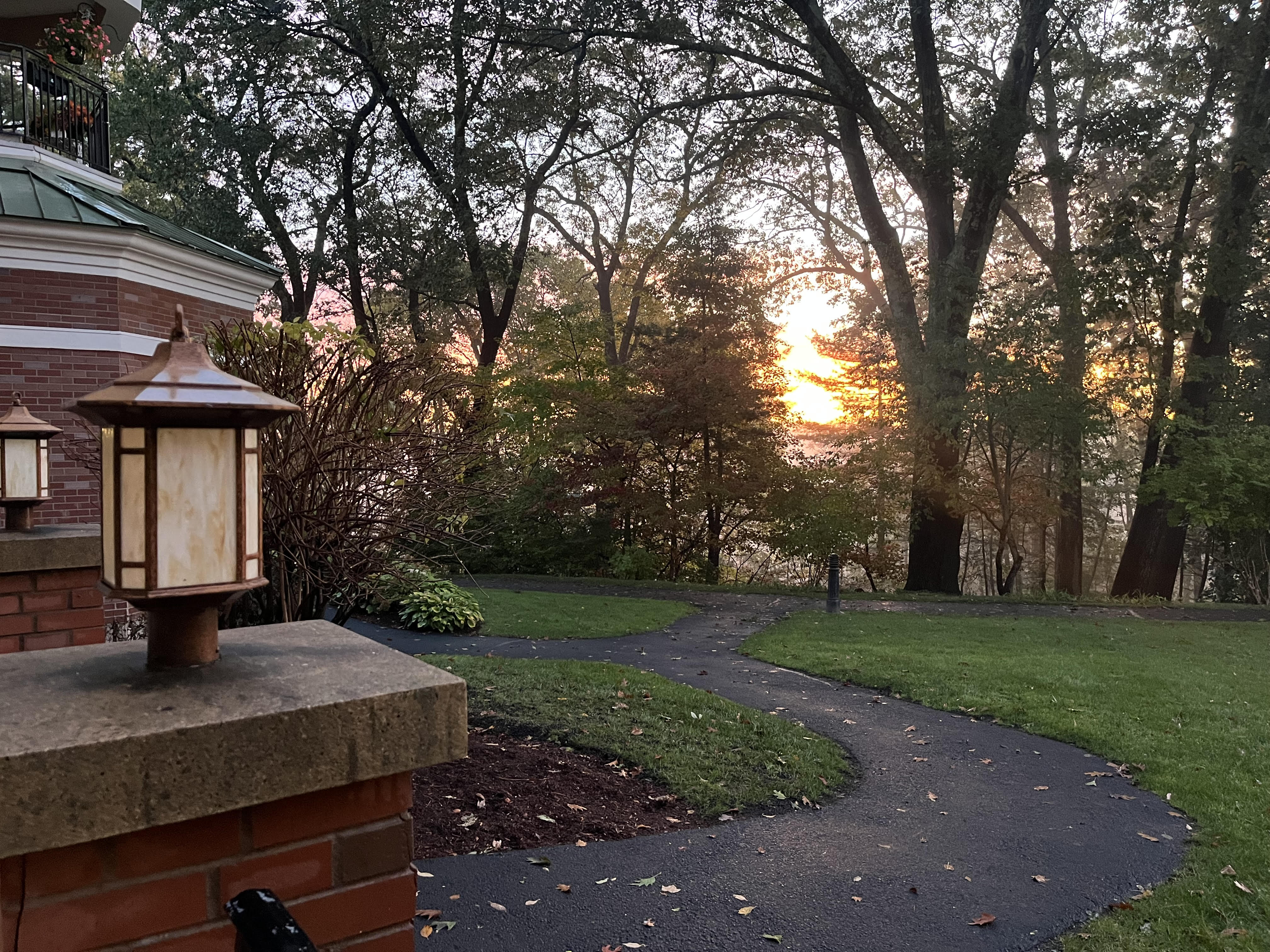
Where I like to walk these days.

We had some gorgeous days in April, and May is shaping up nicely, too.

I start my latest photo round-up with the boardwalk my retirement community built according to stringent environmental regulations. I love the feeling of walking in the woods, and right now, wildflowers that were already there are coming up, while residents are planting others with the guidance of a woman specializing in the removal of invasive species.

The first photo below is a white trillium. Next in the leaf litter, you see a stand of May apples and a group of Spring beauty wildflowers. The apple tree has buds about to bloom.

Blogger Will McMillan bloomed at my retirement community the other day with one of his deep dives into the heroes of the American Songbook. This time it was Hoagy Carmichael. It’s amazing the forgotten songs Will digs up for his shows — while also presenting classics like “Skylark” and “Stardust.” There was a funny one about a jazz band in the afterlife, where all Carmichael’s departed friends were playing.

In one week, we went to see a grandson in the musical Matilda, which was polished and lots of fun, and the Spitfire Grille, which did not impress.

I also attended the Edvard Munch exhibit at the Harvard Museums, which I liked very much. It had paintings as well as a lot of prints in different stages of development to demonstrate Munch’s experiments with technique. The exhibit is there until the end of July, so try to catch it if you are ever near Cambridge, Massachusetts.

Meanwhile, at Umbrella Arts, there’s a textile show called “Weaving an Address.” The beautiful fiber art here is by Kimberly Love Radcliffe. The first one I photographed she calls “Have Faith in Art.” Then “Ms. Nina God Damn” references singer Nina Simone’s response to the murder of Black Sunday school girls in 1963. And the last Radcliffe I’m showing is a portrait of civil rights icon Fannie Lou Hamer. I just love these works.

Read Full Post »

Older Posts »