Feeds:
Posts
Comments

Posts Tagged ‘art’

Art: Simon Roberts
Simon Roberts was the “election artist” for the 2010 general election in the United Kingdom. He chose 24 images — one for each day of the campaign — to reflect the geographical breadth of the trail
. Cornelia Parker is the election artist for 2017.

Not long ago, my husband pointed out a story about official “election artists” in England. That was a new idea for me.

An article in the Economist offers background.

“Many were bemused by the announcement on May 1st that Cornelia Parker was to be the official artist of the 2017 general election. Not as a comment on Ms Parker’s credentials — she is widely considered to be one of Britain’s most exciting contemporary artists — but to discover that such a post exists.”

Parker is the first woman chosen since the post was established in 2001 and the first conceptual artist.

“Jonathan Yeo, the inaugural artist, created a triptych oil painting of the main party leaders where the size of their portrait correlated to their portion of the vote. In 2005, David Godbold produced Hogarthian satirical illustrations on scraps of election ephemera such as manifestos, letters and flyers. In 2010 Simon Roberts photographed the quiet lanes and doorstep conversations of day-to-day campaigning …

“Ms Parker is using an Instagram account (@electionartist2017) to offer an eclectic commentary: so far she has posted pictures of road signs, homeless people and newspaper headlines. One image, captioned ‘The election contenders,’ shows a group of waving garden gnomes.

“Two further stipulations come with the role. First is that the artist must remain politically impartial. … The second is that they must produce a final work — one that can be put on display, or contain elements that can be displayed — which will eventually join the parliamentary art collection.”

I searched the web but couldn’t find Parker’s piece for the permanent collection. Maybe a reader will find it for me. It’s hard to envision what an artist known for “detonated sheds, cut-up shotguns and squashed instruments” would come up with, even if she is currently focused on instagram.

The Economist story is here, the Guardian‘s here and the New Yorker‘s here.

Read Full Post »


Image: The Art Newspaper
Alexander Ponomarev’s underwater art project, “Alchemy of Antarctic Albedo (or Washing Pale Moons)” was said to be for the edification of whales.

Quirky art projects in quirky places call for quirky reporters. Adrian Dannatt writes entertainingly at the Art Newspaper about memorable moments experienced on a trip to cover underwater art — in the Antarctic.

“Typical barren beach; Joaquin Fargas putting reflective silver sheets over the rocks to try and help stop global warming whilst the young architect Gustav Düsing was busy with his white cotton tent, sprayed with water to freeze rock-solid like salt or Greek marble drapes. …

“Rather effective photo exhibition using special plastic display boxes on tripods mounted in the water and along the beach, the horizon line in a photograph next to actual horizon on the sea. …

“At 4 pm it had been a week since we first came up the gangplank and boarded this boat, now our dear old friend. All gather on the back deck for Alexander-the-Great, Pon-Pon lui-même to launch his own underwater art project, ‘Alchemy of Antarctic Albedo (or Washing Pale Moons).’

“These submerged lit globes will be lowered into the sea in order ‘to clean the moon ash.’ He happily admits that he is making this work just for the whales, typically generous, ‘they are a better audience than so many others.’ …

“Much masculine labour, heaving and pushing, to get the moon-balls out to sea, a sweaty, rather laborious form of three-dimensional poetry.

We went out in our Zods but of course could not see anything of the project because it was all underwater, made for the fishes rather than mere humans.

“However the two Argentine underwater divers, fantastic moustachioed veterans straight out of Hemingway, who had been very dismissive and suspicious of the whole thing, were actually impressed, touched, transformed by seeing the reality. Which makes it a successful art work by any definition, and the whales apparently surely adored it also.” More here.

It feels both silly and sacred. Like liturgical clowns.

Read Full Post »

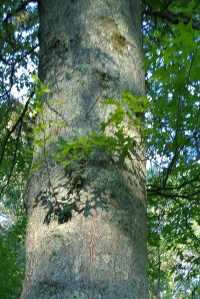
I’m back to taking walks near my home and looking for interesting shadows. The current collection of photos includes leaf shadows on a tree trunk. Only a couple dog walkers were out when I shot this, but I noted an unusual number of cars outside a house flying “2017” balloons. Probably a late-night graduation bash. All was quiet as the grave at 6:30 a.m.

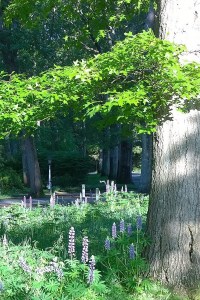
Nearby, blue lupines caught my attention. I admired many lovely ones in Sweden and was happy to see that, while I was gone, a whole batch was blooming along my usual walking route.

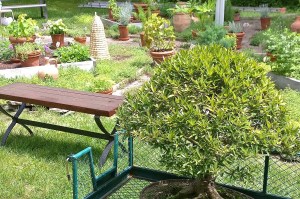
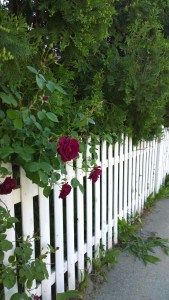
I’m also sharing a grapevine over a bench, a bonsai tree near the church herb garden, and a deep red rose on a white picket fence.

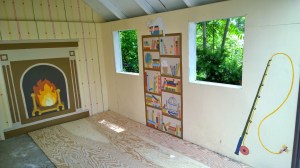
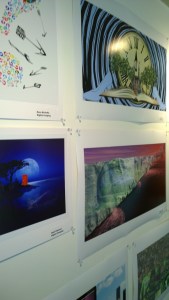
More unusual: the big playhouse at the nursery school and some elaborate digital art by high school students.

061117-leaf-shadows

061117-lupines-ConcordMA


051817-bench-under-grape-arbor

060917-bonsai-and-herb-garden


061117-deep-red-rose-white-picket-fence

060917-playhouse


052117-CCHS-digital-art

Read Full Post »

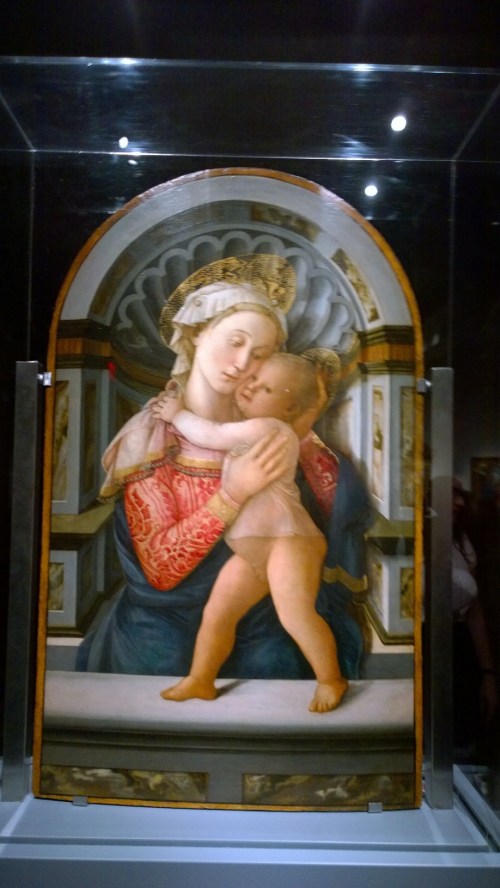
061017-Felippo-Lippi-Madonna-and-Child

I made it to “Botticelli and the Search for the Divine” at the Museum of Fine Arts. By the time I paid for the ticket, the parking garage, lunch, and gas, it was an expensive outing, but I was glad I went. The show closes July 9.

Curiously, I think I loved the tenderness of the mother-and-child by Felippo Lippi (above) the most. That isn’t to say there wasn’t a splendid Botticelli Venus, holding her long tresses in a way that made her look like Eve and the snake. And I was delighted to see the famous Minerva and centaur that I admired so much in Florence when I was 16.

I don’t think I ever knew the centaur story. I ask you, does it look more like the Goddess of War just defeated a warlike centaur or like a tragic couple accepting that they have no future together? The latter version is what I made up, and it still works for me.

But getting back to Botticelli’s teacher: I remembered the name from “Fra Felippo Lippi,” a long, biographical poem by Robert Browning that we were assigned in high school.

So when I got home, I went on Google to have a look. The poem includes a description of the artist’s early years as a street urchin, before being handed over to the friars to be trained as a monk. I wanted to share this section of the poem about how Lippi became a close observer of his world.

“But, mind you, when a boy starves in the streets
“Eight years together, as my fortune was,
“Watching folk’s faces to know who will fling
“The bit of half-stripped grape-bunch he desires,
“And who will curse or kick him for his pains, —
“Which gentleman processional and fine,
“Holding a candle to the Sacrament,
“Will wink and let him lift a plate and catch
“The droppings of the wax to sell again,
“Or holla for the Eight and have him whipped, —
“How say I? — nay, which dog bites, which lets drop
“His bone from the heap of offal in the street, —
“Why, soul and sense of him grow sharp alike,
“He learns the look of things, and none the less
“For admonition from the hunger-pinch.
“I had a store of such remarks, be sure,
“Which, after I found leisure, turned to use.
“I drew men’s faces on my copy-books,
“Scrawled them within the antiphonary’s marge,
“Joined legs and arms to the long music-notes,
“Found eyes and nose and chin for A’s and B’s,
“And made a string of pictures of the world
“Betwixt the ins and outs of verb and noun …”

More on Lippi at Wikipedia, here, and on Botticelli, here.

061017-Minerva-and-centaur-Botticelli.jpg

Read Full Post »

060917-art-and-words-show

Mary Ann alerted me to a local art show co-curated by her artist friend Holly Harrison. I will be visiting this exhibit more than once — it’s a beautiful assemblage of artworks that incorporate words, and there’s a lot to read.

Included in the show “Inhabiting Words” are two needlework pieces by Liz Shepherd that I think will interest blogger KerryCan, given her recent post about a woman who stitched information for her citizenship test into a sampler. (Read it here.)

KerryCan wrote that the citizenship project “was created by artist Aram Han Sifuentes. Sifuentes, from South Korea, prepared for her own US citizenship test by embroidering a sampler of 100 questions and answers typical of the test questions, questions like, ‘What did Susan B. Anthony do?’ ‘Who wrote the Declaration of Independence?’ ‘What is the capital of your state?’ ” I think I should suggest this to a certain Cambodian ESL student who sews.

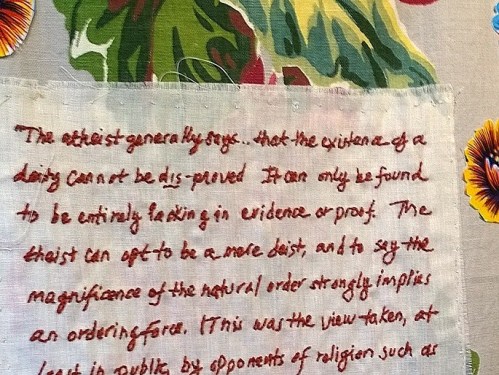
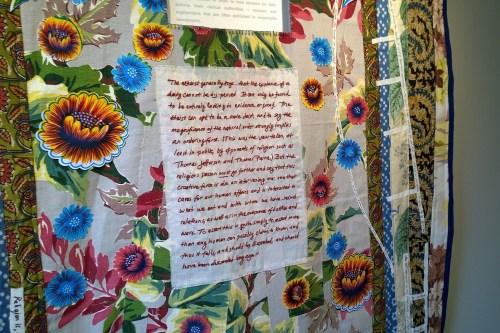
In Liz Shepherd’s creation for the Concord Center for the Visual Arts show, the topic is religion and its sometimes unintended consequences. Here she stitches ruminations by the late Christopher Hitchens.

060917-Liz-Shepherd-philosophy

060917-Liz-Shepherd-sews-Hitchens-words


Read Full Post »

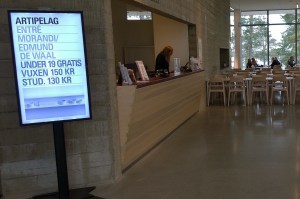
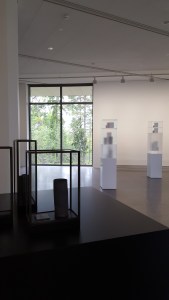
Tuesday we went to Artipelag, a pretty spectacular new museum in the archipelago on the east coast of Sweden. It was built by the founder of Baby Bjorn, with great attention to detail. We liked the wide windows that brought the outdoors in and the way that massive archipelago rocks were kept in place and worked into the design of the rooms.  Below you can see the rock wall in the bathroom, for example, and the rock in the lunchroom with its live candles marching along one edge.

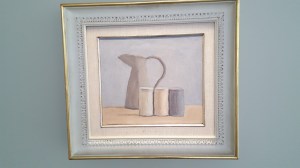
I took some of these pictures, and Stuga 40 took the rest. The current exhibit features the still life paintings of Giorgio Morandi (Italian, 1890-1964) and ceramic pieces made in admiring response by British potter and author Edmund de Waal. (Some people know the latter for the book The Hare with Amber Eyes, a memoir highlighting his family’s netsuke art.) I had not known about Morandi and found his simple, domestic shapes and shadows beautiful.

I should mention that the food at Artipelag was delicious. We had a smörgåsbord buffet, and Stuga 40 made sure we knew how to eat the dishes in the correct Swedish order. I have posted a picture of her friend Anna (in orange) discussing the art with me.

On less wet days, you can have a beautiful walk up and down the Artipelag grounds or tie up your boat at the museum’s dock and climb up for a picnic.

053017-Artipeleg-museum-Sweden

053017-rockc-wall-Artipelag-bathroom


053017-candles-and-native-rock-in-museum

053017-Morandi-at-Artipelag-Sweden


053017-Artipelag-Edmund-de-waal-show

053017-Anna-at-Artipelag-on-her-bday


Read Full Post »

Image: Norah Borges
The artist’s older brother, Jorge Luis Borges, wrote that Norah was the fearless one in the family and “I the slow, timid, submissive one. She climbed to the top of the roof, traipsed through the trees, and I followed along with more fear than enthusiasm.”

How many women in the arts have been overshadowed by the men in their families? Countless. Just the other day I was surprised to hear some work by Fanny Mendelssohn — composer of more than 480 pieces of music — that was pretty impressive.

Maria Popova at Brain Pickings wrote recently of another female artist who was new to me: “Few people know that literary titan Jorge Luis Borges had a sister, and even fewer that Leonor Fanny Borges Acevedo (1901–1998), better-known under the pseudonym Norah Borges, was an acclaimed artist in her own right, who emerged in the 1920s as one of the female pioneers of modern art. …

“During her lifetime, Borges illustrated close to eighty books, including some of her brother’s, in addition to editorial illustrations for a number of avant-garde magazines belonging to ultraísmo — the first major avant-garde movement in Spain, comprising an eclectic group of writers and artists influenced by Italian futurism.

“Her soulful paintings and drawings, the earliest of which is collected in the out-of-print Spanish-language volume Norah Borges: Obra Gráfica, … spans more than seven decades and is nothing short of breathtaking.” See examples of that oeuvre here, at Brain Pickings.

For details on the life of Norah Borges, go to Wikipedia, here.

Photo: Wikipedia
Norah Borges, Argentinian artist, 1901-1998

Read Full Post »

How did we get halfway through May already? It’s time to mention I’ll be taking my first break in six years between May 26 and June 6. We’ll be in Sweden. I’ll try to blog, but you never know.

It sure will feel strange not to post. I have put something up on this site every day since May 2011!

But before I leave, I have other things to share, including today’s photos. The first two are from the giant mural in Dewey Square, Boston — the latest in the Greenway’s ongoing series. The featured artist this time is Mehdi Ghadyanloo from Iran, where he is known for upbeat murals.

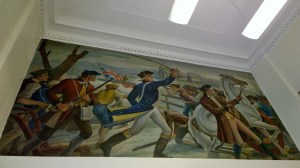
The next photo shows a WPA mural in the Arlington, Mass., post office. John pointed me to it after he saw my recent post “Hunting Down WPA Art.”

Then comes another of my shadow photos. Can’t resist shadows. That one is followed by tree-stump mushrooms and dogwood. Can’t resist mushrooms either.

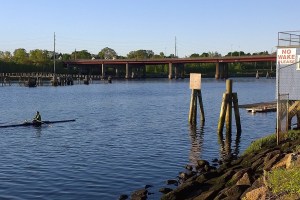
The four Providence photos that follow attest to the fact that the city finally experienced a sunny Tuesday morning (the first since February). Blackstone Park is the location of the Indian shelter and the fallen birch tree with the mysterious yellow plastic strips (art?). Nearby was a wondrous carpet of pink petals and an early rower on the Seekonk River.

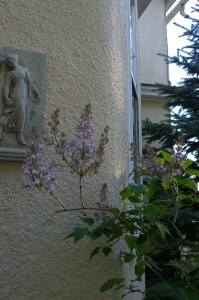
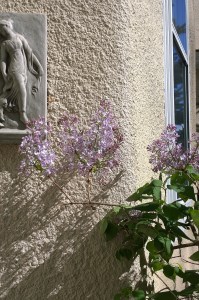
Finally, I wanted to show you my lilac progression. With muse.

042817-Greenway-mural-Boston

042817-Iranian-artist-Mehdi-Ghadyanloo


042917-WPA-mural-in-ArlingtonMA-PO

051117-can't-resist-sun-and-shadow


043017-mushrooms-on-stump

051217-feathery-dogwood-and-garage


051217-feathery-dogwood-and-garage

051617-fallen-birch-art


051617-carpet-of-petals-Providence

051617-sculling-on-the-Seekonk


042617-lilac-and-lady-1

050317-lilac-and-lady-2


050617-lilac-and-lady-


Read Full Post »

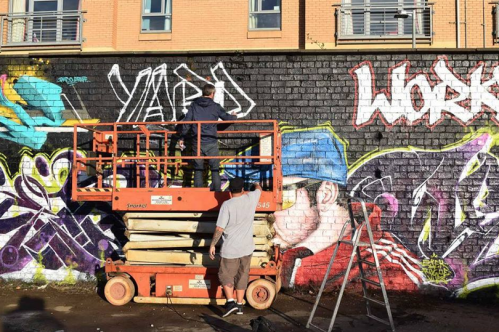
screen-shot-2017-04-28-at-153802

Photo: SWG3/Facebook
Y
ardworks takes place May 6 and 7
, 2017, in Glasgow, Scotland.

Melita knows I like artistic graffiti. In fact, we are both such fans of Lata_65 (graffiti for old folks) that we intend to try our hand at spray painting if the organization ever comes to the Boston area.

Today Melita shared a link on Facebook about graffiti in Glasgow.

Gregor Kyle wrote at GlasgowLive, “Scotland’s first dedicated graffiti festival will take street art into the heart of the community in Glasgow and open up new opportunities for young people across the city.

“Next weekend (May 6 and 7) in Finnieston, SWG3 will host over 30 of the world’s finest graffiti artists and 50 of Scotland’s street artists at the Yardworks Festival. …

“One of its main aims is to strengthen SWG3’s bond with the local community and the city of Glasgow as a whole.

“School and youth groups have been invited, with the days featuring specialist graffiti workshops and a ‘Creation Station’ for children which will allow everyone the chance to try their hand at painting. …

“ ‘It’s Scotland’s first graffiti festival and the scale of it now, the way it has grown, it’s massive now,’ explained Gaz, who is himself a graffiti artist and part of the management team at SWG3. …

“Most Glaswegians will know SWG3 as a club and concert space but by day it is a thriving hub for artists, filled with studio spaces and workshops. Slowly but steadily it has progressed over the years with the scale and ambitions of its projects growing bigger and bigger.

” ‘The yard is now basically a massive canvas for the artists,’ continued Gaz. ‘We have rendered the walls, wrapped containers in sheet metal – at no small expense – and every surface will be perfect for the artists to paint on. …

” ‘We are trying to build a sense of community in the area, which can be hard sometimes when you have a transient population with some of the students maybe only staying in the flats here for a term and then moving on.

“ ‘Finnieston has this reputation as this hipster area; what people forget is that there is this core population here and in the likes of Partick and Anderston who have lived here a long time. …

“ ‘The Commonwealth Games in Glasgow were fantastic for the city. They drew people together and, through a number of projects, connected me with a lot of other artists and graffiti writers that I didn’t know in the city.

“ ‘We will be looking to run workshops in the summer for young people and will try to play our part in improving the area and bringing the community together.’ ”

More at GlasgowLive, here.

Read Full Post »

As everyone knows, there was serious unemployment when Franklin D. Roosevelt was president, so, in collaboration with Congress, he had the government hire people to create work that continues to benefit us —  roads and parks, for example, and fine art.

Unfortunately, some murals and sculptures from the 1930s and 1940s have been lost, so the search is on to reclaim it.

Matthew Blitz at Atlas Obscura has the story. “The United States government wants its art back. Special Agent Eric Radwick, who works in the Office of Investigations for the General Service Administration’s Office of the Inspector General, is working to do just that — to locate and recover government-owned long-lost artwork of the New Deal-era federal arts programs. It could be hidden in plain sight.

“It could be in grandma’s attic. It could be in the possession of art collectors. No matter if it was found in the trash or cost a few grand, the art is federal property. … Most people, upon realizing they are in possession of federal property, are cooperative. …

“On May 9th, 1933, President Franklin Delano Roosevelt received a rather curious letter from an old classmate and professional artist George Biddle. Since his March inauguration, President Roosevelt had implemented the most aggressive 100 days agenda in the country’s history in hopes of solving the Great Depression.

“While absurdly busy — he had just delivered his second Fireside Chat and was about to sign both the Farm Relief and Unemployment Relief bills — this note gave him pause. In it, Biddle wrote that he had long admired the Mexican government for paying artists ‘plumbers’ wages’ to paint murals on government buildings expressing Mexican ideals. Perhaps the President should consider something similar in the United States? …

“The letter got the President’s attention. A month later, Biddle met with members of FDR’s administration in Washington about his proposal. By the end of 1933, the first national art relief program — the Public Works of Art Project — was established.

“Over the next decade, the American art scene flourished thanks to the financial encouragement of the government. According to Smithsonian Magazine, in the first four months of 1934 alone, nearly 4,000 artists were hired to produce over 15,000 paintings, murals, sculptures and other works of art for federal buildings across the country. In 1935, the Works Progress Administration’s Federal Art Project was established, the largest of these programs both in scope and number of artists employed. …

“At a time of crisis in America, these programs not only provided an enormous collection of artwork for public consumption, but gave the creators a sense that they were needed. ‘It made them feel like they counted,’ says Virginia M. Mecklenburg, Chief Curator at the Smithsonian American Art Museum.”

Oh, my, what an enlightened federal government! Sometimes one hopes for history to repeat itself.

Read about the challenges of tracking down missing federal artwork at Atlas Obscura, here.

Once upon a time, when the federal government was concerned about unemployment, it paid people to work, artists included. That’s why many murals appeared in post offices and other government buildings in the 1930s and 1940s. This post office mural by Charles Anton Kaeselau depicts the shot heard ’round the world at Concord’s North Bridge.

042617-Kaeselau-North-Bridge-mural

042617-Kaeselau-North-Bridge-mural

Read Full Post »

Art: Caleb Cole
“The Teacher,” exhibited at a Montserrat College of Art show, is a portrait of unnoticed dedication.

Cate McQuaid’s recent Boston Globe review of an art exhibit really spoke to me. I liked the idea of portraits that have meaning beneath the surface, and I especially liked the portrait of a teacher devoting extra time to his job. Anyway, that’s what I saw here. McQuaid saw woe.

McQuaid wrote, “With portraits, the subject tries on one face, the artist may capture another, and the viewer may see something else. Your projection, my projection. It’s all dreadfully nebulous, but if it weren’t, it would be pat and dull.

“ ‘Observance: As I See You, You See Me,’ an exhibition of photographic portraits at Montserrat College of Art’s Montserrat Gallery, examines what these shifting valences tell us about identity and societal assumptions. Many of the artists and subjects, people of color or queer, have experienced the walls strangers throw up based on appearance alone. …

“Woe is a keynote in Caleb Cole’s series ‘Other People Clothes,’ elaborately staged scenes in which the artist creates fictional personae. Cole is small and balding, with a peak of red hair, like Tintin. In ‘February Is Dental Month,’ the artist, surrounded by file folders, looks down at us from behind a large desk. We can find a story here, but the expression tells more: alienation, tenderness, perhaps disdain.” More here.

As much as I like abstract art, representational art that stirs the depths can be fascinating.

My Struggle, by Karl Ove Knausgaard, does something like that. The seemingly endless minutiae of the author’s life and thoughts flow along the surface, but something compelling emerges that is hard to describe. The writing is cinematic. The author sees everything, and observing him observe everything creates a powerful connection.

Interestingly, in the part of My Struggle that I’m reading now, Book 5, Knausgaard gets a tip from a successful novelist about having the “hinterland,” or backstory, of all your characters in mind when you write fiction. As with the Cole portrait of the teacher, the observer will sense things that are not spelled out.

Read Full Post »

Photo: Rachel Sussman
Rachel Sussman’s “Study for Sidewalk Kintsukuroi #02 (MASS MoCA),” photograph with enamel paint and metallic dust.

What a lovely art idea! Mending cracks with gold resonates with me on so many different levels. You start with sidewalks and then …

Allison Meier writes at Hyperallergic, “Artist Rachel Sussman had traveled for years photographing the most ancient organisms on Earth when a photograph on social media of a shattered bowl reassembled with gold introduced her to the tradition of kintsukuroi, also called kintsugi. In this Japanese practice, broken pottery is repaired with gold dust and glue. …

“This sense of time and its visibly healed scars, and the beauty of imperfections, helped inspire her current Sidewalk Kintsukuroi series, of which the newest edition is in ‘Alchemy: Transformations in Gold,’ currently at the Des Moines Art Center in Iowa. As part of the exhibition, which considers the cultural and historical connotations of gold, Sussman repaired a fissure in the museum’s marble floor, an embedded installation now in their permanent collection.

“ ‘We’re not talking the millions of years it took for the Grand Canyon to form, but by noticing the crack in the marble floor of the Des Moines Art Center that formed over the course of several decades, it serves as a reminder that natural processes are happening all around us, but at a pace that is far too slow for us to observe with the naked eye,’ Sussman explained.

“The Alchemy exhibition includes images of her Sidewalk Kintsukuroi gold dust alterations on photographs of cracks on the streets of Soho and Williamsburg in New York City. Each patching, whether a physical surface or photograph, can take weeks of physically straining work. …

“ ‘Over time, even the repairs will be destroyed,’ Sussman stated. … “Such is the transient nature of everything in the universe. All the more reason to value the time we have.”

” ‘Alchemy: Transformations in Gold’ continues at the Des Moines Art Center (4700 Grand Avenue, Des Moines, Iowa) through May 5.”

Love this concept! Let’s mend everything in ways that go beyond the need.

More at Hyperallergic, here.

Hat tip: Gwarlingo on twitter.

Read Full Post »

Photo: Southwest Minnesota Housing Partnership
Hmong dance festival in southwest Minnesota. A Community Development Investments grant from ArtsPlace aims to give newcomers a voice.

Never underestimate the power of art and cultural events to improve lives.

As Amy Evans reports in the magazine Shelterforce (published by the National Housing Institute), the community development field has come to recognize that the arts are key to integrating diverse populations.

Evans discusses the issue with the McKnight Foundation’s Vickie Benson.

“More and more, it seems that arts and culture are being perceived as essential to the core fabric of what builds and nourishes communities — and that gives Benson enormous hope. ArtPlace America, a decade-old collaboration of foundations, federal agencies, and financial institutions, has been one of the driving forces for that shift, Benson says, by insisting that the arts must be in conversation with other sectors, whether community development, housing, or health.

“In Minnesota, the Southwest Minnesota Housing Partnership (SWMHP) has joined that conversation. With the support of a community development investment [CDI] grant from ArtPlace America, which will provide $3 million in funding over three years, SWMHP is exploring ways of building arts and culture into its operations.

“It’s a bold step for the organization, and one that Benson wholeheartedly applauds.

” ‘Music, dance, or visual art are forms of expression within many cultures. And just the weaving together of these many, many varied cultural traditions is a natural path for people to communicate with each other,’ says Benson. ‘That is what I hope to see, that communities will understand the importance of arts and culture not as an add-on but as a core piece of community development.’ …

“A couple of decades ago, [the future of the southwest Minnesota town of Worthington] future looked bleak. The farm crisis had taken its toll; the town’s population dropped from 10,243 in 1980 to 9,980 in 1990 as people left the area in search of better opportunities.

“The expansion of the meat processing industry in Worthington turned this trend around. JBS Swift and Co., a subsidiary of ConAgra Foods Inc., established what would become its principal plant in Worthington. The impact was far-reaching in the area, propping up small businesses like Smith Trucking Inc. and local hog producers.

“In 1989, increases in productivity led to an additional shift at the plant, attracting workers from literally around the world. … The so-called foreign-born population of Worthington jumped in parallel from 3.7 percent of the total population in 1990 to more than 15 percent in 2000.

“Mike Woll remembers when that shift took place. ‘Worthington’s history of immigration dates back to when I was in high school, when we had some early Lao immigrants,’ Woll recalls. ‘The community became incredibly diverse.’

“Walk into Woll’s high school today and some 50 dialects can be heard, from Central American to Southeast Asian to East African. Downtown on 10th Street, Woll says, ‘you’ll see people from all over the world. Myanmar, Ethiopia, Laos, all sorts of Latin American influence. It’s a remarkable place.’ …

“Woll hopes that one outcome of Worthington’s participation in the CDI Initiative will be preservation of one of the community’s strongest assets.

“ ‘Diversity brings challenges, but it’s put Worthington ahead of the curve. It gives us a broader scope of the world,’ Woll says. He is proud to know that his college-aged son, who grew up in Worthington, can take living in a multicultural environment for granted, even more so than his peers from places like Minneapolis and Chicago. But making space for multiculturalism to truly thrive means giving voice to communities that often haven’t had a seat at the table. Woll hopes that the CDI Initiative will help expand leadership roles to segments of the population who have so much to say, but haven’t had the platform to say it.

“ ‘If not for a program like [ArtPlace], those cultures do get lost,’ Woll says. ‘Having a bit of institutional strength and a financial boost from ArtPlace can help take what are challenges and turn them into positives.’ ”

More at Shelterforce, here.

Read Full Post »

Photo: Getty
People take part in an installation entitled Sea of Hull, by artist Spencer Tunick.

The notion that the arts and related fields like graphic design can boost local economies has been an article of faith for decades, causing disappointment when it frequently fails to lift whole cities above poverty.

Nevertheless, done right and with other stars in alignment, it can be a piece of the economic puzzle in a changing world.

Here is a recent angle from Kingston upon Hull in the UK.

David Barnett reports at the Independent, “On New Year’s Day, a firework display heralded the beginning of Hull’s tenure as the Britain’s City of Culture. Multimedia stories from the city’s maritime and industrial heritage were projected on local buildings in front of a crowd of thousands.

“Over in the Hull City Museum they like a bit of culture and they know Hull’s had it for a long time; exhibits go back to the Paleolithic era. There’s also a recreation of a Roman bath house, featuring mosaics discovered in the 1940s in the Roman settlement of Petuaria, modern-day Brough in East Yorkshire.

“But never mind the Romans … what, the people of Hull might be asking, in true Monty Python’s Life of Brian style, has culture ever done for us? …

“It regularly tops the deprivation rankings for the UK’s 326 local authorities – according to the Kingston upon Hull Data Observatory’s latest figures, Hull ranks as the third most deprived local authority generally, and tops the lists of deprivation for education, skills and training. ..

“Perhaps a typical, post-industrial Northern city. Its traditional industries of whaling and sea-fishing have declined, as elsewhere; Hull still remains a large port, though, and there has been a successful drive to attract chemical and health companies to the area. …

“ ‘There might well be degrees of scepticism about what culture can mean to a place like Hull,’ says Robert Palmer, the director of the team that won and managed Glasgow’s successful bid to be named European City of Culture (as it was then known) in 1990. ‘But being designated a capital of culture can bring long-term effects in terms of the legacy it can offer.’ …

” ‘We employ a very broad definition of culture,’ says Palmer. ‘It’s not just what people might think of as “fine culture.” It’s not just opera. …’

“Which is why Hull’s City of Culture website lists events for the coming year that range from acrobatics to walking tours, by way of cabaret, jazz, literature, parkour and, yes, opera. Which is all very nice, but is it just a distraction from the problems facing Hull?

“ ‘There are tangible economic benefits,’ says Palmer. ‘We’ve seen it before in all cities that get a culture status, it’s well documented. Visitor numbers, job creation, the social impact through participation from social groups who are not normally involved in culture. The benefits are incontestable.’ ”

Lots more here.

Perhaps one year of intense focus on the arts and culture can energize enough residents to keep the momentum going. It certainly seems to have done so for Liverpool, another struggling postindustrial city that was a UK City of Culture in 2008.

One wonders if a designation as, say, a City of Math and Science might have the same kind of long-term ripples.

Read Full Post »

Photo: Andrew Edlin Gallery
Part-time gravedigger John Byam’s carvings of hands, as seen in a New York gallery.

Artists often have to support themselves with non-art jobs. Gone are the wealthy arts patrons of past centuries, and maybe that’s not all bad, considering the Medicis. In any case, it’s interesting to see what kinds of jobs contemporary artists hold down. You may recall this post about Brando’s gardener’s art, for example.

Now at Hypoallergic, Allison Meier describes the recent gallery showing of a self-taught artist who dug graves in his spare time.

“Dusted with sawdust, John Byam’s sculptures appear as if they’ve just been carved, the shavings attached with glue binder giving a rawness to the miniature spacecrafts, airplanes, houses, helicopters, cameras, and coffins. Andrew Edlin Gallery in Manhattan [displayed] an assembly of these pocket-sized pieces by the late Byam in Unearthed. …

“Born in 1929 in Oneonta, New York, Byam mostly lived a local life, working at his family’s trailer court, with a two-year stint in the military taking him to Japan during the Korean War.

“Later, he had odd jobs with the Delaware and Hudson Railway and as a gravedigger at the local cemetery. The wood carvings, arranged by theme at Andrew Edlin with no label text, have traces of this autobiographical narrative, with a platoon of tanks and heavy artillery, or an open coffin, colored black, on a rolling gurney.

“Yet others, like spaceships and rockets, one with ‘”Moon or Bust’ scrawled in red, herald dreams of exploration. Recognizable pop culture forms, including the U.S.S. Enterprise from Star Trek, suggest these ambitions were limited to vicarious experiences through television, magazines, and movies.

“While that gives the toy-like objects a melancholy edge, they have a lot of joy in their detailed shapes. Byam seemed to delight in making even a simple chair on such a small-scale, with annotations in pencil indicating details like ‘door front’ on a tiny house. An array of human hands chiseled into various poses, one holding a coin, another with the words ‘2 close hands’ folded in prayer, shows a similar enchantment with the shape of things. …

“Byam was a deft craftsman in the tradition of American vernacular woodcarving, and his roughly hewn art is haunted by 20th-century culture, both its wars and fantasies.”

Hyperallergic has some great pictures of Byam’s art here.

Read Full Post »

« Newer Posts - Older Posts »