Feeds:
Posts
Comments

Posts Tagged ‘art’

Dutch artist Peter Gentenaar makes stunning paper sculptures that Nathaniel Ross at Inhabitat (“design will save the world”) describes as “soaring through the air like flying jellyfish. …

“Peter Gentenaar’s art was born out of the limitations of what he could (or couldn’t) create with store-bought paper. So with the help of the Royal Dutch Paper Factory, he built his own paper factory and devised a custom beater that processes and mills long-fiber paper pulp into the material you see in his artwork. He saw the potential that wet paper had when reinforced with very fine bamboo ribs, and he learned to form the material into anything his imagination would allow.”

Check out the machine Gentenaar uses to create his paper. You can buy one. He describes it thus:

“A machine suitable for beating long fibers, flax, hemp or sisal, as well as for beating soft and short fibers like cotton linters. The machine is built in stainless steel and has a bronze bedplate. The bronze bedplate has the same curve as the knife roll, this gives effective grinding/beating over a surface of: ± 20 x 10 cm. The distance between the roll and the bedplate can be finely adjusted. Also the weight under which the fibers are beaten can be varied from 0 to 60 kilo’s. This means you can use the beater on very delicate fibers and on very strong and rough fibers as well. I never have to cook my fibers. There is a factory guarantee on the beater of one year. At present I’m getting a CE mark, which ensures certain safety standards. There are over 70 beaters of this type sold over the last 12 years and they are all still working.”

Art: Peter Gentenaar

Read Full Post »

Today I walked over to the Moakley Courthouse on Boston Harbor to see an art exhibit that the Actors’ Shakespeare Project put together with youth in detention. It consisted of large photographs in which a young person, sometimes in costume, acted out a word from Shakespeare. I did not feel that the presentation in the low-ceiling hallway did the works justice — and having to go through metal detectors to look at them is a bit of a downer — but the concept is positive.

Deborah Becker of WBUR reported that the photographs were part of a larger effort to turn young offenders around with the help of art: “Using the arts as a way to heal and transform is the theme of an exhibit at Boston’s federal courthouse. The artists are children who have been involved with the Massachusetts Department of Youth Services (DYS), the agency that handles youngsters charged with crimes.

“At a recent reception of the artists and DYS officials, 17-year-old Ricky Brown was among the young people proudly describing his work. He helped paint a mural that covers the entire wall of a DYS district office in Springfield. He says it sends a message about kids in the juvenile justice system.

“It brightens up the whole building,” Brown said. “It makes sure to say that we’re not only there to get locked up. It’s there to let people know that we do work together, we do do something positive.”

Read more.

Read Full Post »

You may have read about the monumental projects of the artist Christo. Perhaps you even went to see “The Gates” when his orange banners dotted Central Park.

Well, Christo is at it again, proposing to “drape 5.9 miles of fabric across a 42-mile stretch of the river” in Colorado for two weeks. And he’s once again exposing himself to the hostility of people who feel passionately protective of a particular space. It’s the cost of doing business.

In this February 10 Denver Post article: “Christo sits stone-faced as they call him a liar, a cheater, a con man, a killer, as they politely suggest he is a fool, as they angrily denounce him as an enemy of nature. He is the world’s most famous artist and this is what he must endure for these odd projects he dreams up. Here, in southern Colorado, where he hopes to drape 5.9 miles of silvery fabric over the Arkansas River, it is the same as it was in Manhattan where he battled 25 years to hang orange material from 7,503 gates in Central Park, and in Berlin, where he had to persuade 612 German parliamentarians, one by one, to let him wrap his cloth around the Reichstag.” Read more.

Whatever else you might say about him, the man has patience. An even more recent article in the Denver Post, February 22, indicates that he has moved the target date from August 2014 to August 2015. (The first of many target dates was summer 2001.)

“At the two final public hearings for the Over the River project earlier this month, the Fremont County Board of Commissioners fielded almost 10 hours of heated support and opposition as well as 575 letters. On Tuesday, the three-member board decided it would not make a decision regarding the artist’s request for a temporary-use permit at its next scheduled meeting Feb. 28.

” ‘We simply feel we are not ready for a formal vote,’ said Commissioner Debbie Bell, noting that the board is scripting a list of conditions for the project. The board could make a final decision at its March 13 or March 27 meeting, she said. …

“Christo’s decision to delay reflects his desire to share yet-to-be-developed emergency-management plans that detail traffic, safety and other issues during the installation process. It also restores the 28-month construction period, which was pinched when federal approval stretched nearly three years.” Read more.

Read Full Post »

The last time we checked in at the Greenway, Occupy Boston had just departed, and new sod was being laid down where there had been tents.

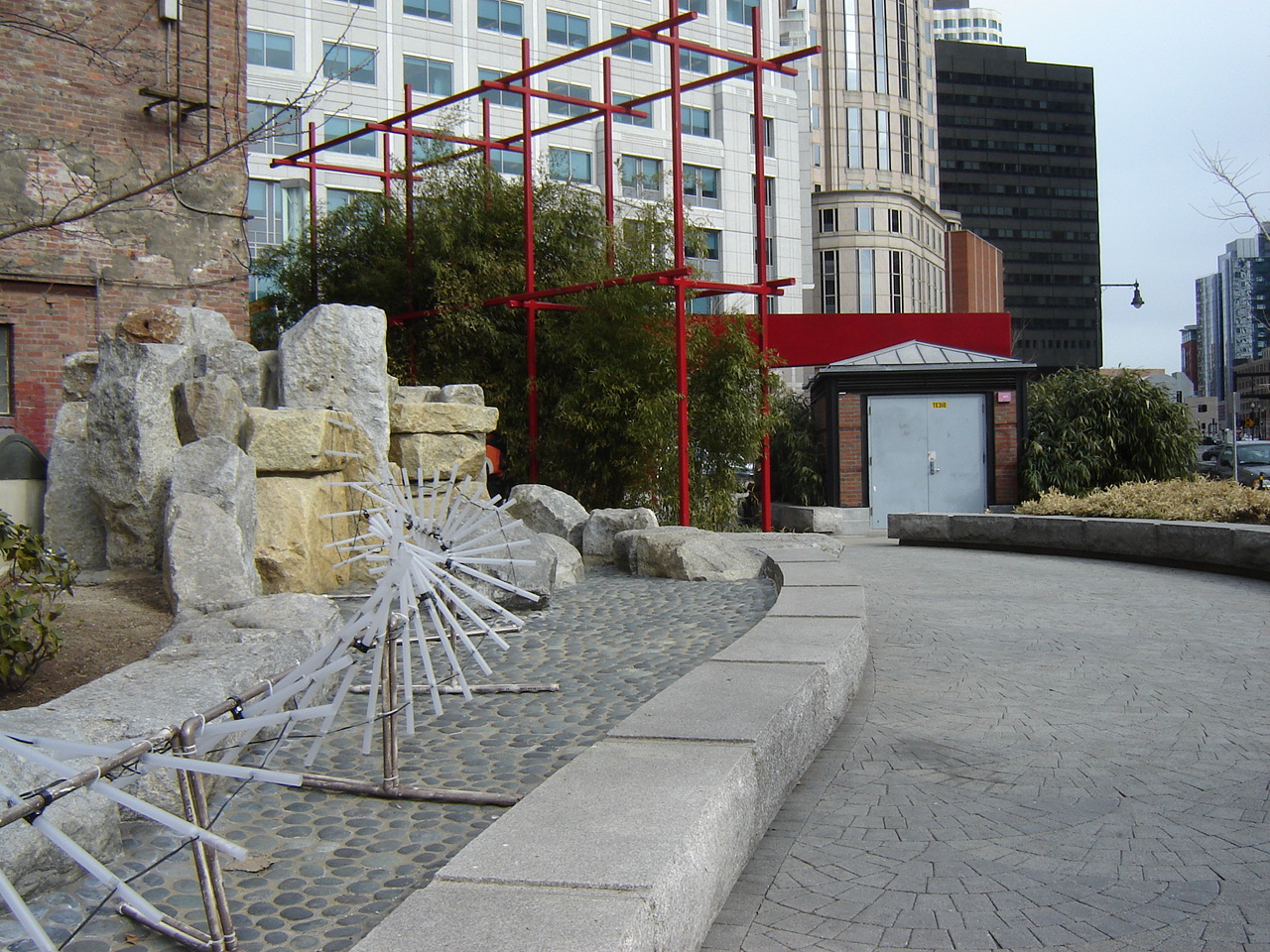
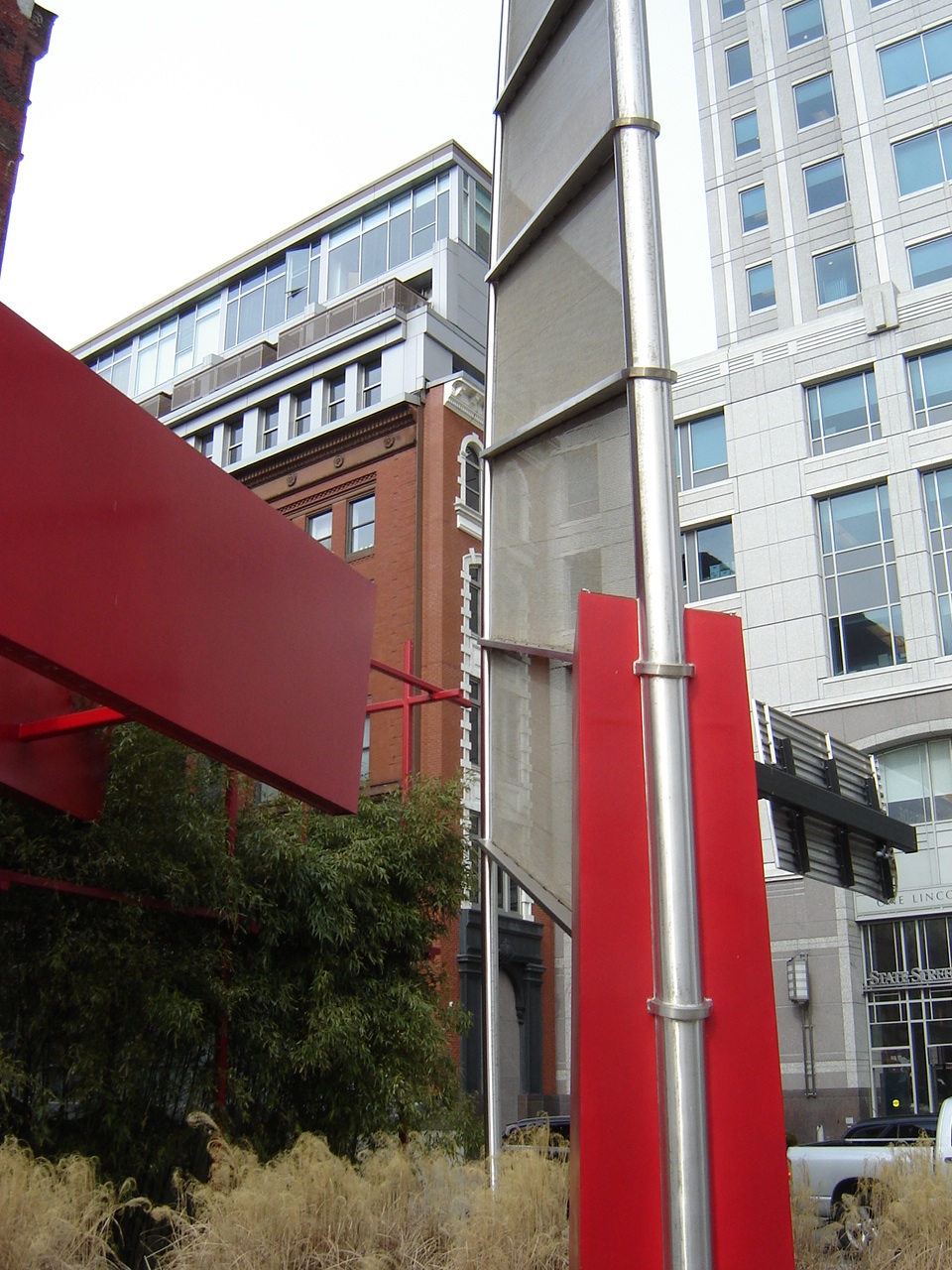
Today I walked in both directions along the Greenway and took pictures of the new art. In front of the Boston Harbor Hotel is a temporary exhibit called Ice Chimes. It is designed to enhance the music of icicles. In the other direction, near the gateway to Chinatown is a sculpture with what looks like the sail of a junk and another sculpture of white sticks.

Pictures may serve better than words.

Read Full Post »

Today I went to the last performance of Red, a drama about Abstract Expressionist painter Mark Rothko at the SpeakEasy Stage. It starred the inimitable Thomas Derrah with a young actor who was new to me, Karl Baker Olson.

It’s always interesting to read reviews of shows that touch different creative realms. For example, an opera critic who reviews Porgy and Bess might have a different take from a theater critic.

In the case of Red, theater critics were full of praise, but an art critic I read found the story thin.

Not being either kind of critic, at least not at the moment, I thought it moving, well acted, and well directed. The set by Cristina Todesco and featuring Rothko’s studio was amazing, dim, with the chapel-like quality Rothko found necessary for communing with a painting and seeing it vibrate.

Read Full Post »

I met Mary Driscoll in playwriting class last summer.

Mary has had a lifetime focus on social justice for marginalized people. She has traveled to foreign countries to work with refugees. For people with HIV, she has taught pilates and the healing art of telling one’s stories. She has performed with mission-oriented theater troupes. And she is the founder of  OWLL, On with Living and Learning, which helps ex-offenders build new lives after prison.

At Mary’s invitation, my husband and I found our way last night to what is a virtual artist colony in the long-abandoned but reemerging warehouse district of South Boston. In Mary’s loft apartment, one of the artists she has drawn into her orbit presented a wonderful cabaret show to raise money for OWLL’s production of Generational Legacy about mothers and children after prison.

Michael Ricca interpreted songs by Michel Legrand with great humor and feeling (including the theme song of our wedding, “What Are You Doing for the Rest of Your Life?”). Ricca is performing the songs and others by Legrand at Scullers in March.

My husband and I enjoyed talking to Mary’s guests  — artists, actors, musicians, social activists, old  friends. We’re especially keen to keep an eye on the doings of the Fort Point Theatre Channel in the Midway Studios building, where Mary  lives and works. The collaborative productions in the Black Box Theatre sound intriguing and offbeat. We like offbeat.

Read Full Post »

I am psyched. I blogged a while back about UBS banker Geoff Hargadon, who is also a conceptual artist with a crazy sense of humor.

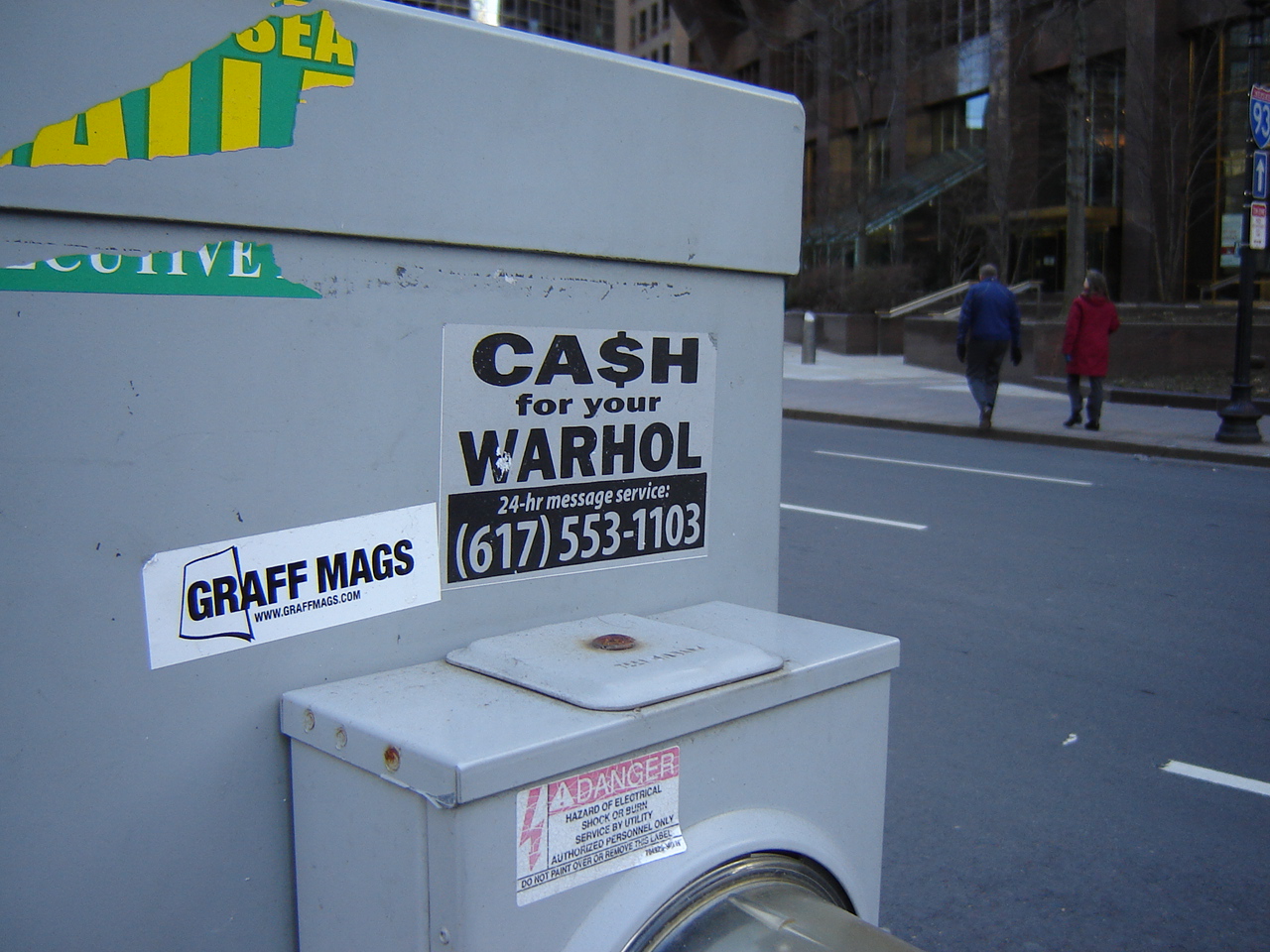
After Brandeis University’s then president made noises about selling the art collection of the Rose Museum, Hargadon put a sign outside on the grass: “Cash For Your Warhol.” It looked like the signs on telephones poles or in abandoned lots that lure the unwary into deals too good to be true.

Hargadon has put his signs up hither and yon, like the street artist Banksy in a way, or Shepard Fairey.

Yesterday I noticed one in the Boston financial district as I waited for the light to change. It’s at the corner of Congress and Franklin streets. I came back today and took a picture. Anyone want to call the number?


Read Full Post »

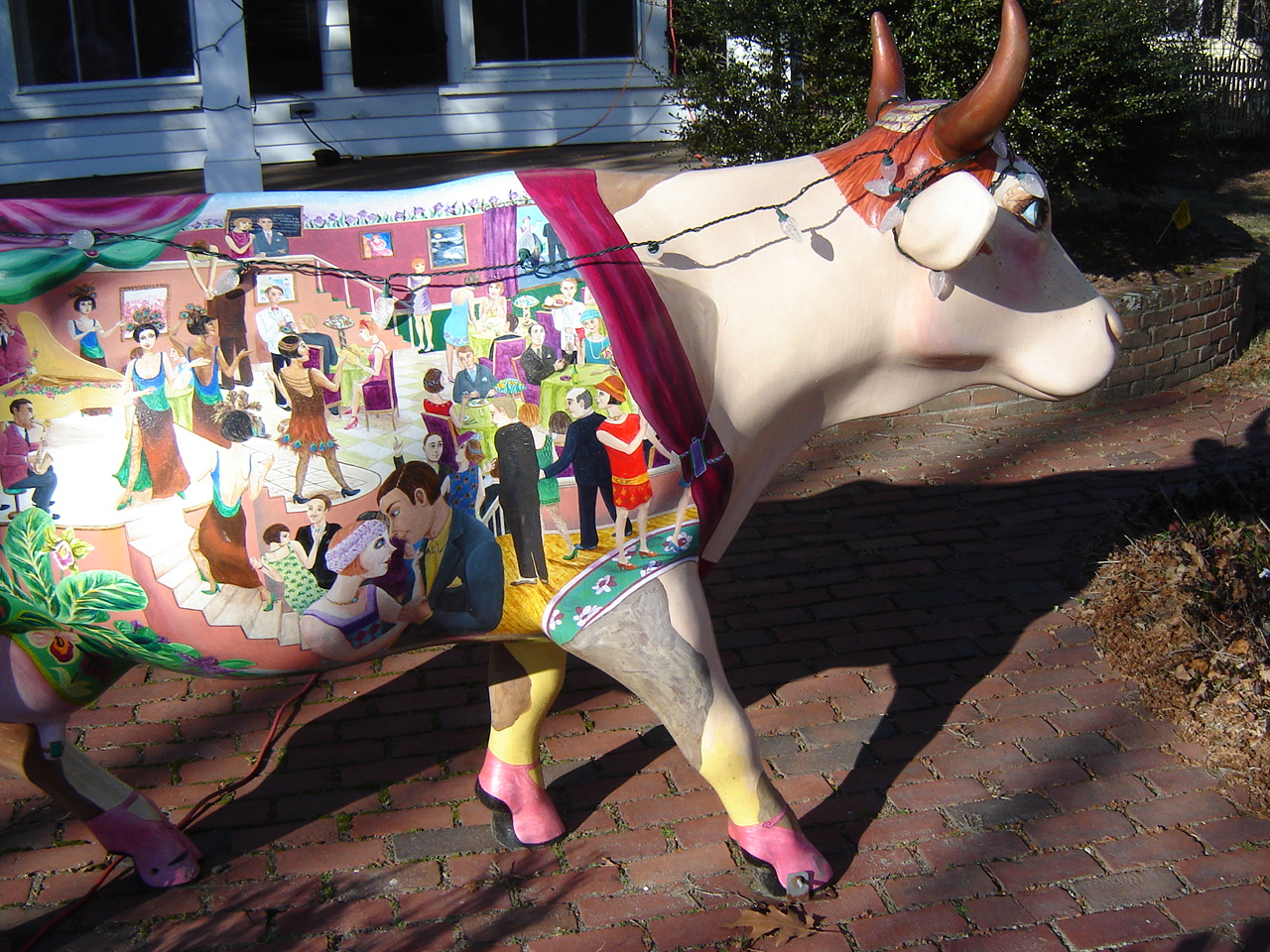
My Neighbor’s Cow

My neighbor’s cow is still sporting Christmas lights in mid-January. I like the subjects that interest her deeply (in her gut, really), and I love her high-heeled shoes and pink socks. I also appreciate that she is very calm and unlikely to kick over a a lamp and start the Chicago Fire.

My neighbor’s cow is detached and steady and, other than donning Christmas lights, never changes.

Read Full Post »

I like reading about street art and what motivates the creative outbursts. I have blogged on this before (Slinkachu, Banksy).

The Art Newspaper recently did quite a long feature on street art inspired by (and inspiring) the Arab Spring.

Anny Shaw and Gareth Harris interview “Hans Ulrich Obrist of London’s Serpentine Gallery, who is chairing a discussion on art patronage in the Middle East as part of a summit at the British Museum and the Royal College of Art (12-13 January).”

” ‘What is interesting to see in Egypt, and in all these countries, is that artists are not only going out into the city, they also become agents of change in society. … If you think about it in terms of the Russian Revolution and Mayakovsky saying “the streets are our brushes, the squares our palettes,” it’s about art going beyond the museum and blurring the boundaries between art and life.’

“Obrist also notes that there is a long-standing tradition, particularly in Egypt, of contemporary artists using the street to mount performances or install works. Indeed, several contemporary Egyptian artists, including Susan Hefuna and Hassan Khan, have used the city as a site for their work, both before and in response to the uprising. …

“As Anthony Downey, the director of contemporary art at Sotheby’s Institute of Art in London, editor of ibraaz.org and a speaker at the summit says, the region has ‘antecedents in graffiti-based pro­tests,’ citing those against the Shah of Iran before his flight from Tehran in 1979 and the graffiti and posters used in Beirut during the civil war in Lebanon.”

What a hoot that this art has been taken up by auction houses like Sotheby’s! But on the whole it’s good for the artists. I know what a great moment it was when the favela artists from Brazil were able to sell their work in the movie Waste Land.

Read more here.


Read Full Post »

You knew that the poet Wallace Stevens was a lawyer for the Hartford Insurance Company in Connecticut, right?

It’s fascinating, the double lives many creative people live. In this post, for example, I mentioned Kyan Bishop, a colleague with a pretty businesslike job, who turns out to be an accomplished conceptual artist.

Today I have two gentlemen from the financial-services industry, which whatever else one might say about it, pays enough for a guy to indulge an artistic bent.

Consider first Geoff Hargadon, now showing at the Kayafas Gallery in Boston.

Art critic Cate McQuaid writes in the Boston Globe, “Bring up conceptual art, and some people’s eyes glaze over. So before we dive into the conceptual underpinnings of the work of … Geoff Hargadon now up at Gallery Kayafas, let’s say this: It’s funny, wry, and self-mocking — accessible on many levels.

“Hargadon’s ‘Dealers Protected!’ features signs that he has put up, first around Boston and then during the Frieze Art Fair in London in October, and during Art Basel Miami Beach earlier this month. Perhaps you have seen them. They read ‘Cash for Your Warhol.’ This show features the signs themselves, and photos of them in situ.

“The artist, who is an unlikely hybrid of street artist and senior vice president at the financial services company UBS, was inspired by the ‘cash for your house’ signs he saw on telephone poles during the worst of the economic collapse. He hilariously posted his first ‘Cash for Your Warhol’ sign outside the Rose Art Museum at Brandeis in 2009, after the museum announced controversial — and later canceled — plans to close and sell off its collection.” Read more here.

Second is the late Warren Hellman, Wall Street financier and devoted banjo player. “After nearly 20 years at Lehman in New York, he started several money management businesses, including Hellman & Friedman in San Francisco, one of the country’s most successful private equity funds. More recently Mr. Hellman focused on philanthropy, bestowing millions of dollars on cultural, educational and medical charities in the Bay Area. The three-day concert he founded, Hardly Strictly Bluegrass, held each year in Golden Gate Park, has been financed entirely by him.” Read about Hellman in the NY Times obit.

Read Full Post »

I love looking out the upper level of a parking garage at rooftops and chimneys. It makes me think of Dickens novels. And I’ve always been interested in art that shows a view from a window or someone looking out a window.

The Metropolitan Museum of Art must like windows, too, given that it mounted a whole show called Rooms with a View: The Open Window in the 19th Century. I’m told that the exhibit’s focus was on how a window can frame a subject, but I’m more interested in what the person at the window is feeling.

There is a lovely painting at Boston’s Museum of Fine Arts showing a young woman working at a sewing machine and gazing out a window through which a soft, dreamy light is falling. What is she thinking? “The Open Window,” painted by Elizabeth Okie Paxton in 1922, gives me the feeling that the woman is thinking about what other people are doing out in the world or what she might want to do someday.

I got a new insight into gazing-out-windows art from a review of the movie Hugo in the NY Times.

Manohla Dargis writes, “Mr. Scorsese caps this busy introductory section with Hugo looking wistfully at the world from a window high in the station. The image mirrors a stunning shot in his film Kundun, in which the young, isolated Dalai Lama looks out across the city, and it also evokes Mr. Scorsese’s well-known recollections about being an asthmatic child who watched life from windows — windows that of course put a frame around the world. This is a story shared by all children, who begin as observers and turn (if all goes well) into participants. But ‘Hugo’ is specifically about those observers of life who, perhaps out of loneliness and with desire, explore reality through its moving images, which is why it’s also about the creation of a cinematic imagination — Hugo’s, … Mr. Scorsese’s, ours.”

I had not thought about that before — that we all start out as observers.

Read Full Post »

We went downtown to have lunch at the Whitney Museum with friends and to take in the Real/Surreal exhibit.

Favorite artists like Charles Sheeler, Mardsen Hartley, and Grant Wood were featured. I liked the eerie emptiness of Edward Hopper’s “Seventh Avenue” and the anxious denizens of George Tooker’s subway world.

Sounds unnerving, but in surfacing the alienation, I think the artists make one feel the possibility of getting a grip on it.

Afterward, we walked up Madison, stopping at a gallery in the Carlyle Hotel that was showing Magritte works, some for sale.

I have always liked Magritte, with his bowler-hatted men blocked by giant green apples and his nighttime streets overarched by daytime skies. And I especially like him because once in a workshop, I directed a Tom Stoppard one-act play inspired by him, After Magritte. It was the best fun!

Read Full Post »

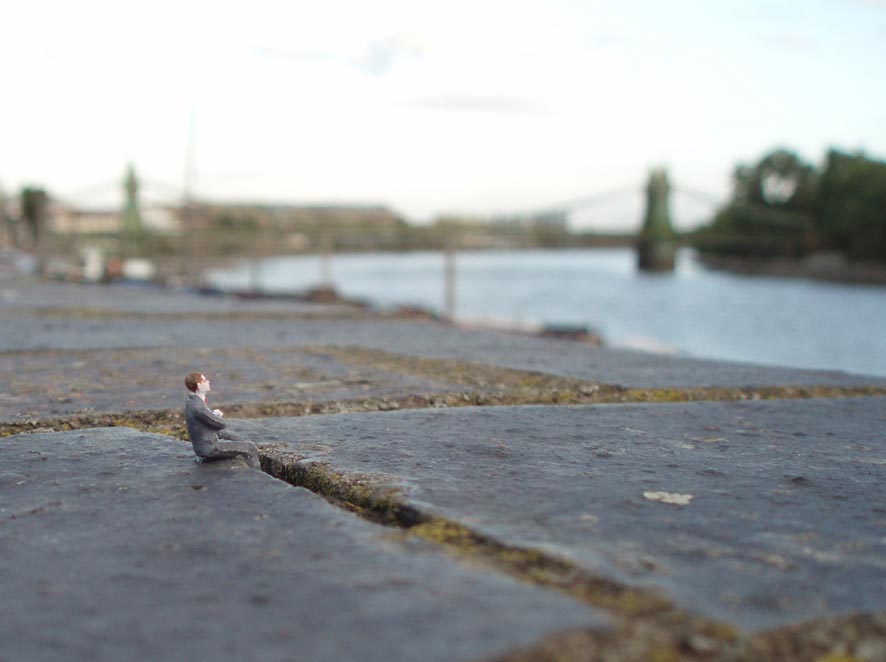
Michelle Aldredge once again introduces me to an artist I knew nothing about. Check out her wonderful post about the artist Slinkachu at her blog, Gwarlingo.

Like Banksy, Slinkachu is part of the London street art scene, Aldredge writes, but  “is everything Banksy is not — subtle, empathic, poignant, contemplative.”

I won’t try to replicate her post but will just mention that I especially like “The House of God” and “Dreams of Packing it All In.”

The photos are copyrighted by Slinkachu. If he doesn’t consider this “fair use,” I can take them down.

Update: He is in NYC until tomorrow, Oct. 7, 2012. Read up, here.

Read Full Post »

My workplace closes down on Veterans Day, so today my husband and I finally got a chance to visit the new Art of the Americas wing at the Museum of Fine Arts.

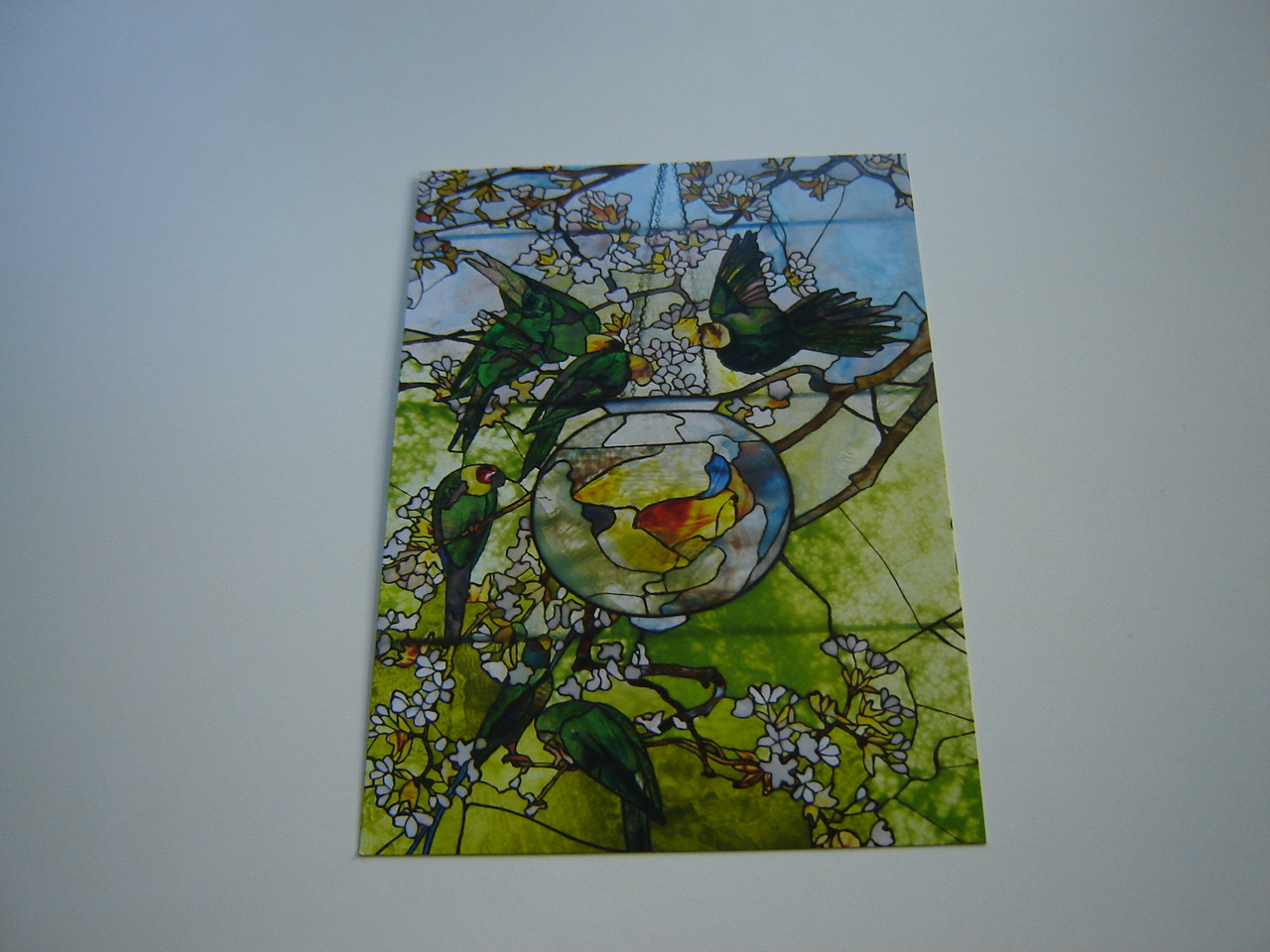
I didn’t realize that people bring cameras to museums now and take pictures of whatever they like. Is that allowed? For this post, I wanted to use a particular painting I saw today, but after trying the MFA site and searching the Internet, all I could find was a bootlegged photo for sale at Flickr. Fortunately, I did buy an MFA postcard that I was able to photograph at home.

This is a Louis Comfort Tiffany-designed stained glass window of parakeets and a goldfish bowl.

My favorite floor was the third, though. There we saw some great 20th Century art: Calder mobiles, a Jackson Pollock, works by Charles Sheeler, Georgia O’Keeffe, Arthur Dove, Marsden Hartley, the photographer Weegie, and more. Although the MFA also has a new gallery of contemporary art in a different part of the building, I liked the selections on the third floor of the Americas wing best.

At lunch we ate in the new dining area, a large, beautiful space that combines both classical and modern styles comfortably and features a tall, green, glass sculpture by Dale Chihuly.

The food was very good.

Read Full Post »

Miller-McCune.com tweeted today that the National Endowment for the Arts has new data on where artists are finding work.

Four of the six New England states are among the states with the most arts jobs: Vermont, Rhode Island, Massachusetts, and Connecticut.

“The report on artists in the workforce supplements and expands upon a 2008 paper, which found about two million Americans list a job in the arts as their primary source of employment. That comes out to 1.4 percent of American workers.

“New York heads the newly released state-by-state list, with artists making up 2.3 percent of its labor force. California, home to the film and television industry, places second with 2.0 percent.

“Not far behind are Oregon and Vermont, each of which has a workforce in which 1.7 percent of workers are artists. That means they exceed the national average by a substantial 20 percent.

“ ‘Writers and authors are especially prominent [in Oregon and Vermont],’ the NEA report notes.

“Also exceeding the national average: Colorado and Connecticut (where artists make up 1.6 of the labor force), and Hawaii, Rhode Island, Massachusetts, Maryland, Washington, Nevada, and Minnesota (at 1.5 percent).”

Although there likely to be different perceptions of what kind of work constitutes arts employment, I find the report interesting. And since I know anecdotally that there are arts jobs in Maine and New Hampshire (the two New England states not among the top few), I can’t help hoping that some organization will do an in-depth study of the region. Unfortunately, ornery New Englanders don’t often think regionally.

And more generally, what are the reasons some states have more arts jobs? Public policies? Landscape? Accident?

Read more here.

Read Full Post »

« Newer Posts - Older Posts »