Feeds:
Posts
Comments

Posts Tagged ‘art’

My Neighbor’s Cow

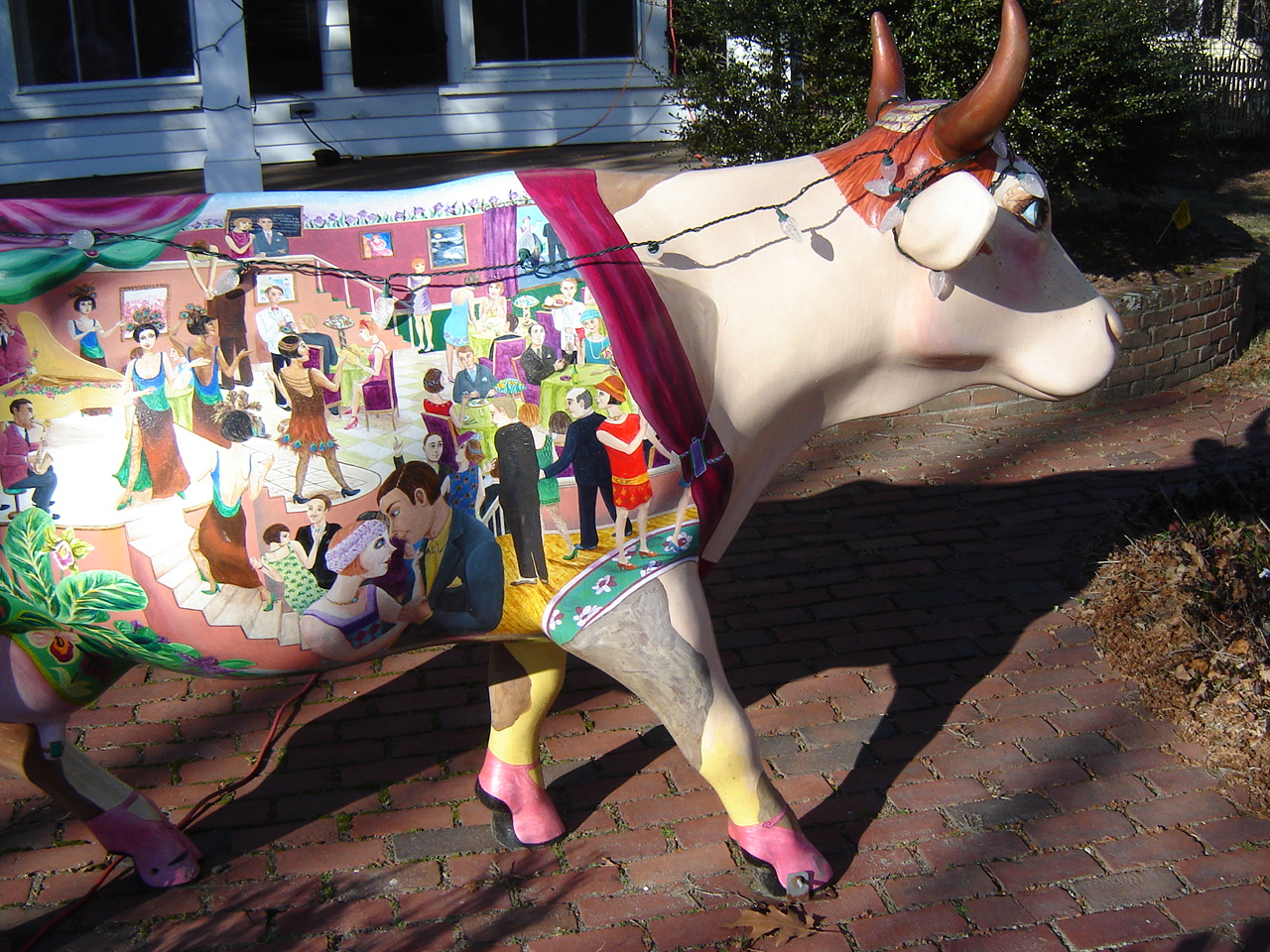
My neighbor’s cow is still sporting Christmas lights in mid-January. I like the subjects that interest her deeply (in her gut, really), and I love her high-heeled shoes and pink socks. I also appreciate that she is very calm and unlikely to kick over a a lamp and start the Chicago Fire.

My neighbor’s cow is detached and steady and, other than donning Christmas lights, never changes.

Read Full Post »

I like reading about street art and what motivates the creative outbursts. I have blogged on this before (Slinkachu, Banksy).

The Art Newspaper recently did quite a long feature on street art inspired by (and inspiring) the Arab Spring.

Anny Shaw and Gareth Harris interview “Hans Ulrich Obrist of London’s Serpentine Gallery, who is chairing a discussion on art patronage in the Middle East as part of a summit at the British Museum and the Royal College of Art (12-13 January).”

” ‘What is interesting to see in Egypt, and in all these countries, is that artists are not only going out into the city, they also become agents of change in society. … If you think about it in terms of the Russian Revolution and Mayakovsky saying “the streets are our brushes, the squares our palettes,” it’s about art going beyond the museum and blurring the boundaries between art and life.’

“Obrist also notes that there is a long-standing tradition, particularly in Egypt, of contemporary artists using the street to mount performances or install works. Indeed, several contemporary Egyptian artists, including Susan Hefuna and Hassan Khan, have used the city as a site for their work, both before and in response to the uprising. …

“As Anthony Downey, the director of contemporary art at Sotheby’s Institute of Art in London, editor of ibraaz.org and a speaker at the summit says, the region has ‘antecedents in graffiti-based pro­tests,’ citing those against the Shah of Iran before his flight from Tehran in 1979 and the graffiti and posters used in Beirut during the civil war in Lebanon.”

What a hoot that this art has been taken up by auction houses like Sotheby’s! But on the whole it’s good for the artists. I know what a great moment it was when the favela artists from Brazil were able to sell their work in the movie Waste Land.

Read more here.


Read Full Post »

You knew that the poet Wallace Stevens was a lawyer for the Hartford Insurance Company in Connecticut, right?

It’s fascinating, the double lives many creative people live. In this post, for example, I mentioned Kyan Bishop, a colleague with a pretty businesslike job, who turns out to be an accomplished conceptual artist.

Today I have two gentlemen from the financial-services industry, which whatever else one might say about it, pays enough for a guy to indulge an artistic bent.

Consider first Geoff Hargadon, now showing at the Kayafas Gallery in Boston.

Art critic Cate McQuaid writes in the Boston Globe, “Bring up conceptual art, and some people’s eyes glaze over. So before we dive into the conceptual underpinnings of the work of … Geoff Hargadon now up at Gallery Kayafas, let’s say this: It’s funny, wry, and self-mocking — accessible on many levels.

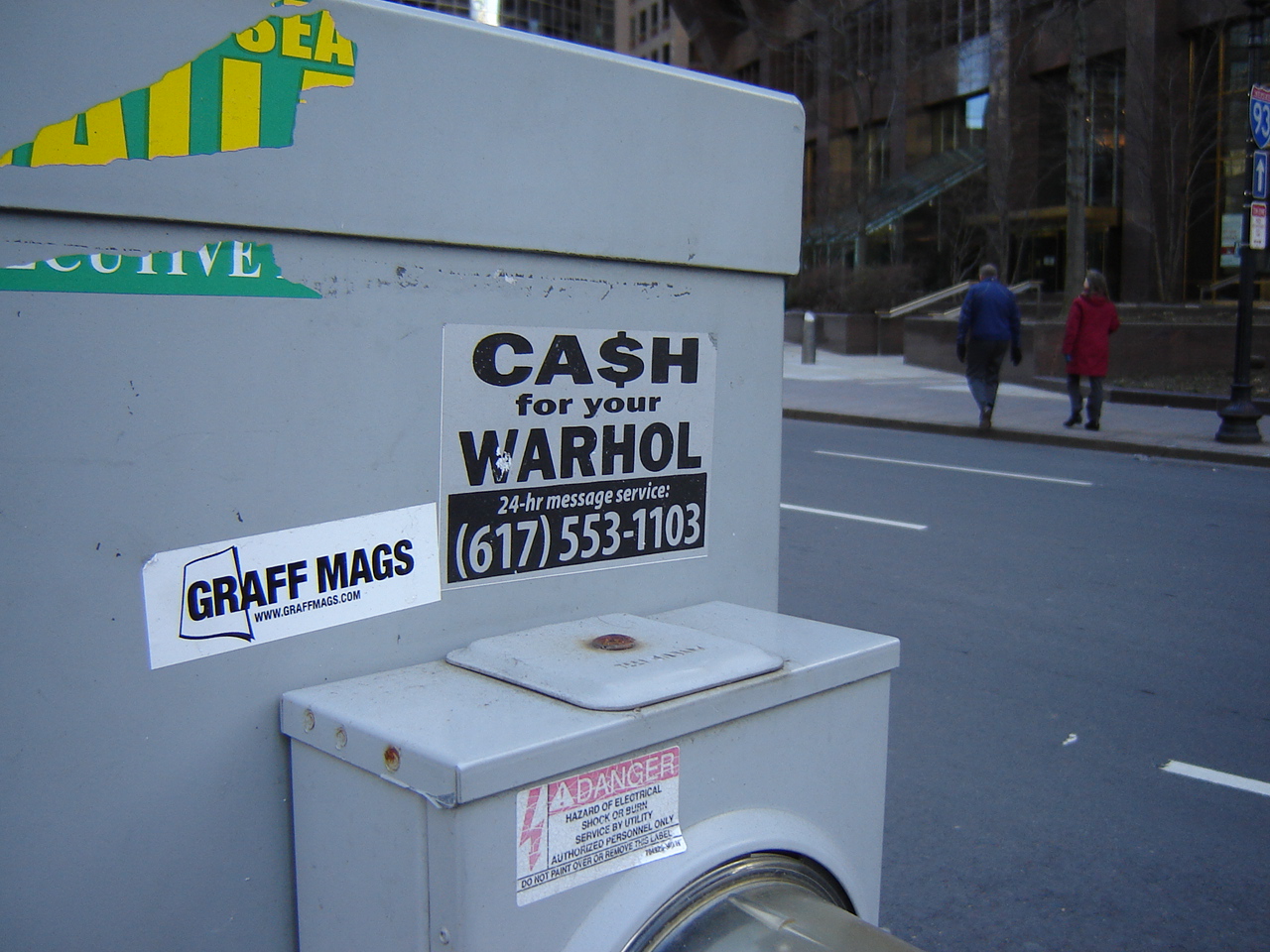
“Hargadon’s ‘Dealers Protected!’ features signs that he has put up, first around Boston and then during the Frieze Art Fair in London in October, and during Art Basel Miami Beach earlier this month. Perhaps you have seen them. They read ‘Cash for Your Warhol.’ This show features the signs themselves, and photos of them in situ.

“The artist, who is an unlikely hybrid of street artist and senior vice president at the financial services company UBS, was inspired by the ‘cash for your house’ signs he saw on telephone poles during the worst of the economic collapse. He hilariously posted his first ‘Cash for Your Warhol’ sign outside the Rose Art Museum at Brandeis in 2009, after the museum announced controversial — and later canceled — plans to close and sell off its collection.” Read more here.

Second is the late Warren Hellman, Wall Street financier and devoted banjo player. “After nearly 20 years at Lehman in New York, he started several money management businesses, including Hellman & Friedman in San Francisco, one of the country’s most successful private equity funds. More recently Mr. Hellman focused on philanthropy, bestowing millions of dollars on cultural, educational and medical charities in the Bay Area. The three-day concert he founded, Hardly Strictly Bluegrass, held each year in Golden Gate Park, has been financed entirely by him.” Read about Hellman in the NY Times obit.
Read Full Post »
I love looking out the upper level of a parking garage at rooftops and chimneys. It makes me think of Dickens novels. And I’ve always been interested in art that shows a view from a window or someone looking out a window.

The Metropolitan Museum of Art must like windows, too, given that it mounted a whole show called Rooms with a View: The Open Window in the 19th Century. I’m told that the exhibit’s focus was on how a window can frame a subject, but I’m more interested in what the person at the window is feeling.

There is a lovely painting at Boston’s Museum of Fine Arts showing a young woman working at a sewing machine and gazing out a window through which a soft, dreamy light is falling. What is she thinking? “The Open Window,” painted by Elizabeth Okie Paxton in 1922, gives me the feeling that the woman is thinking about what other people are doing out in the world or what she might want to do someday.

I got a new insight into gazing-out-windows art from a review of the movie Hugo in the NY Times.

Manohla Dargis writes, “Mr. Scorsese caps this busy introductory section with Hugo looking wistfully at the world from a window high in the station. The image mirrors a stunning shot in his film Kundun, in which the young, isolated Dalai Lama looks out across the city, and it also evokes Mr. Scorsese’s well-known recollections about being an asthmatic child who watched life from windows — windows that of course put a frame around the world. This is a story shared by all children, who begin as observers and turn (if all goes well) into participants. But ‘Hugo’ is specifically about those observers of life who, perhaps out of loneliness and with desire, explore reality through its moving images, which is why it’s also about the creation of a cinematic imagination — Hugo’s, … Mr. Scorsese’s, ours.”

I had not thought about that before — that we all start out as observers.

Read Full Post »

We went downtown to have lunch at the Whitney Museum with friends and to take in the Real/Surreal exhibit.

Favorite artists like Charles Sheeler, Mardsen Hartley, and Grant Wood were featured. I liked the eerie emptiness of Edward Hopper’s “Seventh Avenue” and the anxious denizens of George Tooker’s subway world.

Sounds unnerving, but in surfacing the alienation, I think the artists make one feel the possibility of getting a grip on it.

Afterward, we walked up Madison, stopping at a gallery in the Carlyle Hotel that was showing Magritte works, some for sale.

I have always liked Magritte, with his bowler-hatted men blocked by giant green apples and his nighttime streets overarched by daytime skies. And I especially like him because once in a workshop, I directed a Tom Stoppard one-act play inspired by him, After Magritte. It was the best fun!

Read Full Post »

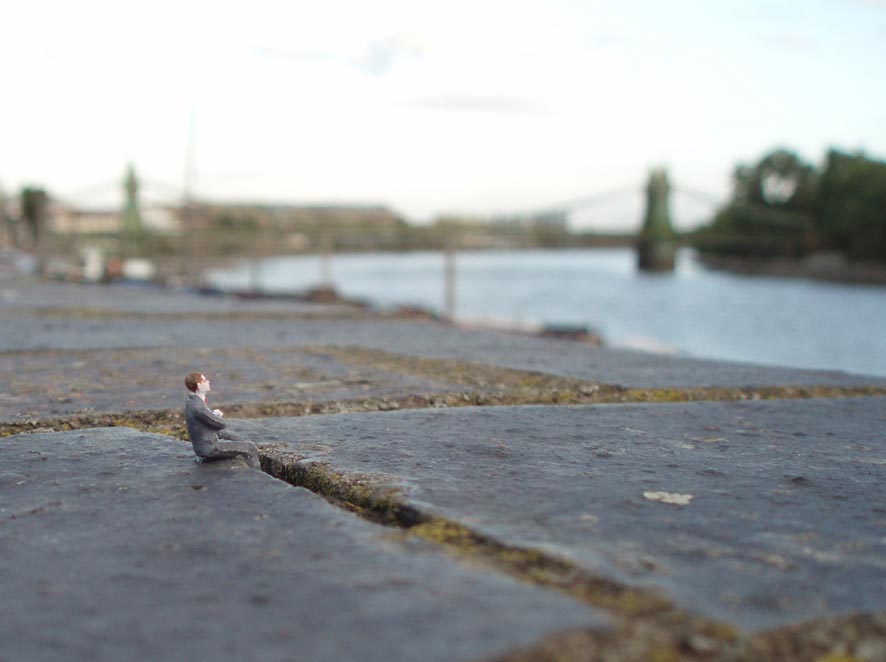
Michelle Aldredge once again introduces me to an artist I knew nothing about. Check out her wonderful post about the artist Slinkachu at her blog, Gwarlingo.

Like Banksy, Slinkachu is part of the London street art scene, Aldredge writes, but  “is everything Banksy is not — subtle, empathic, poignant, contemplative.”

I won’t try to replicate her post but will just mention that I especially like “The House of God” and “Dreams of Packing it All In.”

The photos are copyrighted by Slinkachu. If he doesn’t consider this “fair use,” I can take them down.

Update: He is in NYC until tomorrow, Oct. 7, 2012. Read up, here.

Read Full Post »

My workplace closes down on Veterans Day, so today my husband and I finally got a chance to visit the new Art of the Americas wing at the Museum of Fine Arts.

I didn’t realize that people bring cameras to museums now and take pictures of whatever they like. Is that allowed? For this post, I wanted to use a particular painting I saw today, but after trying the MFA site and searching the Internet, all I could find was a bootlegged photo for sale at Flickr. Fortunately, I did buy an MFA postcard that I was able to photograph at home.

This is a Louis Comfort Tiffany-designed stained glass window of parakeets and a goldfish bowl.

My favorite floor was the third, though. There we saw some great 20th Century art: Calder mobiles, a Jackson Pollock, works by Charles Sheeler, Georgia O’Keeffe, Arthur Dove, Marsden Hartley, the photographer Weegie, and more. Although the MFA also has a new gallery of contemporary art in a different part of the building, I liked the selections on the third floor of the Americas wing best.

At lunch we ate in the new dining area, a large, beautiful space that combines both classical and modern styles comfortably and features a tall, green, glass sculpture by Dale Chihuly.

The food was very good.

Read Full Post »

Miller-McCune.com tweeted today that the National Endowment for the Arts has new data on where artists are finding work.

Four of the six New England states are among the states with the most arts jobs: Vermont, Rhode Island, Massachusetts, and Connecticut.

“The report on artists in the workforce supplements and expands upon a 2008 paper, which found about two million Americans list a job in the arts as their primary source of employment. That comes out to 1.4 percent of American workers.

“New York heads the newly released state-by-state list, with artists making up 2.3 percent of its labor force. California, home to the film and television industry, places second with 2.0 percent.

“Not far behind are Oregon and Vermont, each of which has a workforce in which 1.7 percent of workers are artists. That means they exceed the national average by a substantial 20 percent.

“ ‘Writers and authors are especially prominent [in Oregon and Vermont],’ the NEA report notes.

“Also exceeding the national average: Colorado and Connecticut (where artists make up 1.6 of the labor force), and Hawaii, Rhode Island, Massachusetts, Maryland, Washington, Nevada, and Minnesota (at 1.5 percent).”

Although there likely to be different perceptions of what kind of work constitutes arts employment, I find the report interesting. And since I know anecdotally that there are arts jobs in Maine and New Hampshire (the two New England states not among the top few), I can’t help hoping that some organization will do an in-depth study of the region. Unfortunately, ornery New Englanders don’t often think regionally.

And more generally, what are the reasons some states have more arts jobs? Public policies? Landscape? Accident?

Read more here.

Read Full Post »

I blogged a while back about a prison arts program that seemed to help some offenders discover a more positive, less antisocial side of themselves. Today I have a similar story, this one from England.

“Allowing prisoners to take part in art [projects] can help cut reoffending rates in half, according to a report commissioned by the Arts Alliance. The group of charities has voiced concern that in tough economic times such projects may be cut.” Nick Higham of the BBC reports in a video clip here.

I admire people who have the faith in human nature to try to reach society’s lost souls with arts or yoga or meditation or any other enrichment.

My second cousin, Alex, went to college in Cambridge, Mass., and did an internship teaching meditation techniques to some serious cases at the Suffolk County jail. She loved it and was inspired to go to graduate school and work with others in trouble.

Her mother tells me her latest internship is with a social services agency an hour and 20 minutes away. “She is managing several extremely challenging cases and spends a lot of time making home visits in dismal housing projects. Her days include fighting for housing for her clients, calling the police when bruised and beaten women answer the door, mediating confrontations between single moms who are managing 3-9 children and school officials who won’t let a child ride the bus due to behavioral issues. Her clients have been victims of domestic and other forms of violence and most have substance abuse issues. Her job is to find resources to rehabilitate troubled families. She is learning fast how to be the ultimate problem solver, confidante and counselor.  Most of all, she is extremely happy and energized by the challenge.”

I am in awe that this tough work makes Alex happy and energized. We are lucky to have people like that on the front lines.


Read Full Post »

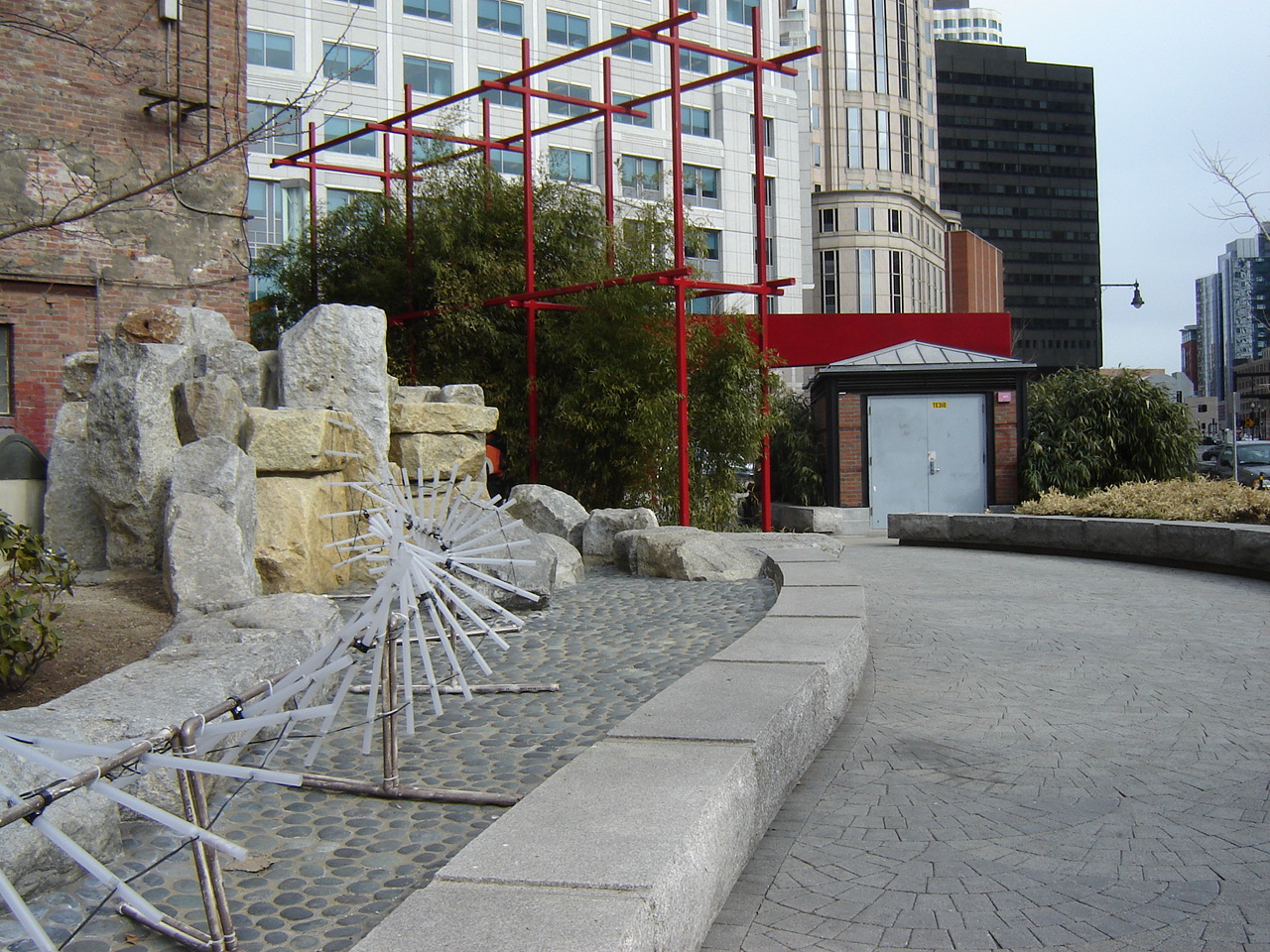
More curiosities seen on the Rose Kennedy Greenway in Boston: Waves. The first wave pictured below has a sign saying, “From the Greenway.” The second says, “From the Peabody Essex Museum, Salem, MA.”

This website helps to explain that an urban collaboration led by artists Susan Hoffman Fishman and Elena Kalman is behind this project, “The Wave: An Interactive Public Art Installation Fostering Global H20 Awareness.” I love it, but it didn’t raise my water awareness immediately because I had trouble figuring out what it was. Thank goodness for Google.

A couple weeks ago, I wrote to the Greenway people (and to the city of Boston) about bikers who were using the Greenway paths despite signs saying not to use “bicycles, skateboards, personal transportation, i.e. Segway.” I like that people bike instead of use cars, but not on footpaths. The signs cause walkers to lower their guard. I’ve seen near misses.

The city wrote me: “Thank you so much for your email. It is illegal to ride on the Greenway. We at the City of Boston are aware of this issue. We will be installing a bike lane on the road for the cyclists this season. Research shows that that bike lanes dramatically reduce sidewalk riding.”

The Greenway people wrote: ” For the safety and enjoyment of all Greenway visitors, biking is not permitted anywhere in the parks. When our horticultural and maintenance staffs witness a cyclist, they will ask them to dismount; City of Boston Police Department handles enforcement.  … The City of Boston installed five new Hubway stations along the Greenway.  This fall, the City will be installing painted bike lanes onto the street which will help alleviate the problem in the parks.”

(At the moment the Boston police are more preoccupied with Occupy Boston. They arrested 141 Occupiers early Tuesday because they had spread into the Greenway from Dewey Square. Funny how a few days can change one’s perspective. Today the concerns of the Occupiers and the concerns of the police both seem more serious than bikes on footpaths.)


Read Full Post »

I have not been blogging that long for Luna & Stella, but already interesting things have happened. For example, one customer who found the blog decided Suzanne’s Mom was OK and probably Suzanne’s business was, too. She became a Luna & Stella customer.

Another interesting thing occurred after I blogged about an artist I once knew, Lucille Corcos. I had written her up with the goal of creating an entry for her on Wikipedia. (The entry is still to come. I need a good block of time to make the changes Wikipedia asked for.)

Soon I began to notice in my WordPress site statistics that someone was doing Internet searches on “Lucille Corcos.” I wondered if it might be one of her sons. Sure enough, I eventually received an e-mail from artist Joel Corcos Levy, saying, “Who are you and when were you in our house?” So I e-mailed him, and we had a nice back-and-forth. He generously sent me a piece of his mother’s art, an illustration for a children’s book.

Joel himself appears in an art book called The Artist as Native: Reinventing Regionalism, by Alan Gussow. The book features Joel’s painting of the Davies farmhouse and pine trees. Nice, huh? The other selections are great, too.

Not sure if Joel is OK with having this on the web. I’ll take it down if asked.

Read Full Post »

I tend to think that our creativity comes from our memories, because no one who has ever been or ever will be has exactly the same collection of memories bouncing off one another in exactly the same way.

A recent NY Times science story on a successful artist who got viral encephalitis — and suffered damage to the part of the brain where memories form — doesn’t exactly contradict that view, but it sure raises a lot of questions.

“She is still able to make art, though it is simpler and more childlike than her professional work. Her case is rare, experts say, because few accomplished artists continue to create after sustaining severe brain damage.

“Now scientists at Johns Hopkins University hope Ms. Johnson can help them answer longstanding questions: What parts of the brain are needed for creativity? With little access to one’s life experience, how does an artist create?

“And as Michael McCloskey, a professor of cognitive science at Hopkins, put it, Ms. Johnson’s case ‘raises interesting questions about identity: Here you’ve lost an awful lot of what makes you who you are — what’s left for art?’ ” Read about her.

Although the artist doesn’t seem sad, I think it’s sad to lose memories. I want to keep mine — the bad with the good.

Enjoy this amazing Moray McLaren video about memory, called with irony “We Got Time.”

“Time is a memory
“And memories can make you sad
“With time still in front of me
“Oh we can get it back”

Read Full Post »

I like to think I know something about the nonwork interests of my colleagues, interests that may be — in spite of their workday professionalism — at least as much a part of who they are as their jobs. There’s the woman employed as a customer service rep who gets her kicks out of Tough Mudder competitions (extreme sports in mud). Or the editor who bakes bread every day. Or the economist who composes choral music and creates arrangements for flute choir.

Everyone has at least one other life.

But I guess if you’re not physically in the same office, if don’t have lunch together or chat in the ladies room or on the subway, you never find out about people’s other lives.

That’s why I was utterly floored this week when a hard-driving, business-oriented colleague in the Washington office sent around an e-mail saying she would be away from her desk for a month at an artist retreat in Korea. Huh?

Says I, “Oh! Are you an artist?”

Says she: “Yes” and sends me her website.

Oh, my gosh. This is who she really is: a sculptor and installation artist with a record of shows and a gorgeous portfolio. How does she even find time to be hard-driving and business-oriented in the day job?

It makes me wonder what else I’m missing, whose real life is right in front of me and I’m not noticing.

Read Full Post »

Just a quick post to say that there are some lovely blogs on WordPress, where Suzanne’s Mom’s blog is housed. I recently noticed two in particular I wanted to share.

The first features the Modern Museum of Glass Art in Copenhagen.

The second has photos of cool cut-paper art. Enjoy.


Read Full Post »

Do you remember seeing a René Magritte painting called “Ceci n’est pas une pipe”? It took me a while to get what he meant. It was a picture of a pipe, after all. Why would he call it “This is not a pipe.”

(Oh, right. It’s not a real pipe. You can’t fill it with tobacco. You can’t smoke it.)

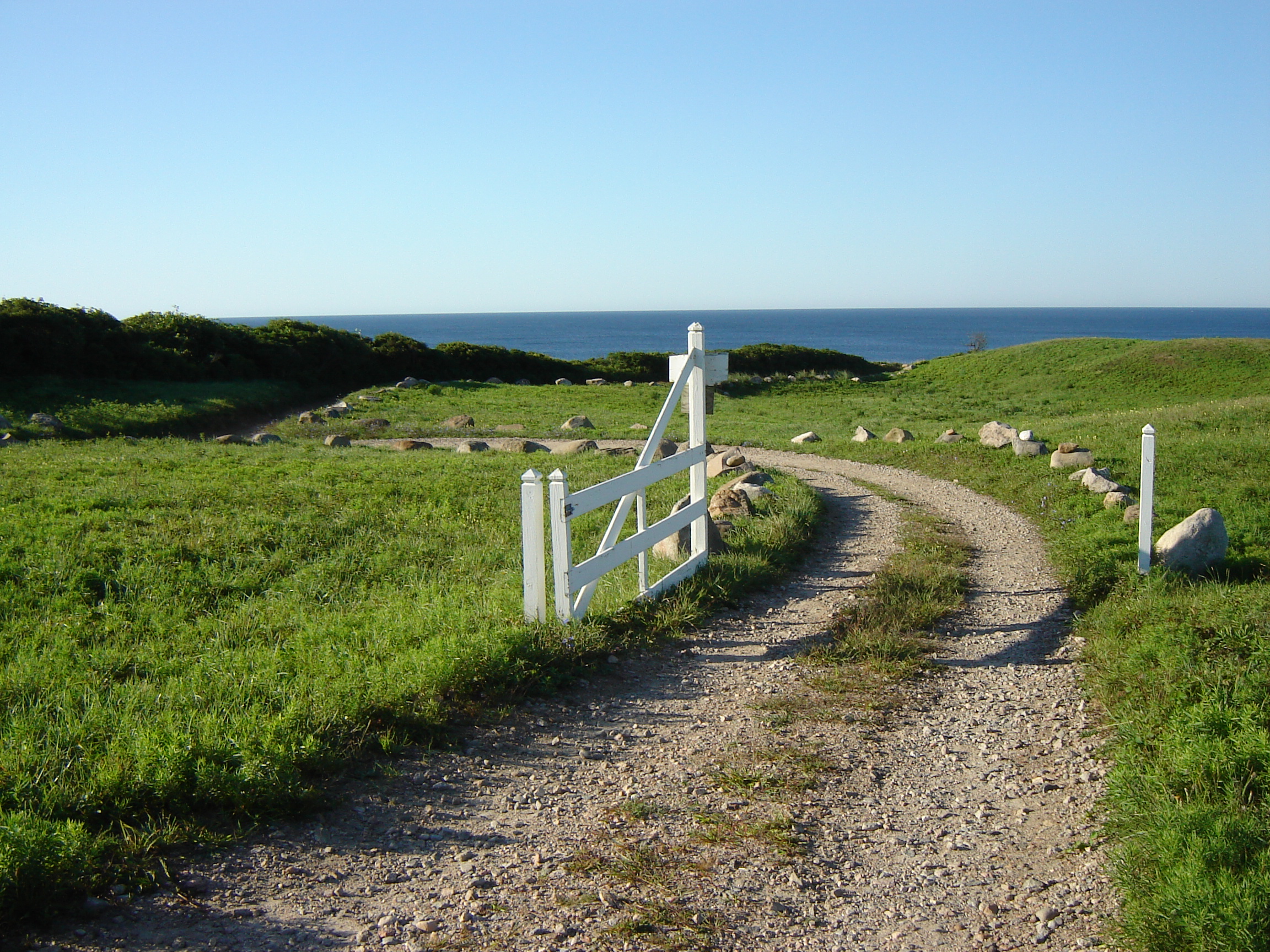
In the same spirit, I am posting pictures of not-summer.

On a warm July day, I took my photos of blue skies, beach paths, and small boats, and the next thing I knew we were having a Labor Day clambake. Within two days, summer was over, and a curtain of cold, windy rain descended. Along with the September mindset, my husband says.

Ceci ne’est pas l’été. Au revoir.

Read Full Post »

« Newer Posts - Older Posts »