Feeds:
Posts
Comments

Posts Tagged ‘australia’

Photo: Newshub
Sans Forgetica is a typeface meant to aid memory. It was invented by researchers at RMIT in Melbourne, Australia.

There’s a new memory-boosting font that you can download for free and use for short texts. The inventors say you wouldn’t want to use it for long texts like a novel because it would give you a headache. But I say, what good is a typeface if you can’t read novels with it?

Lisa Martin writes at the Guardian, “Australian researchers say they have developed a new tool that could help students cramming for exams – a font that helps the reader remember information.

“Melbourne-based RMIT University’s behavioural business lab and design school teamed up to create ‘Sans Forgetica,’ which they say uses psychological and design theories to aid memory retention.

“About 400 university students have been involved in a study that found a small increase in the amount participants remembered – 57% of text written in Sans Forgetica compared with 50% in a plain Arial.

“Typography lecturer Stephen Banham said the font had an unusual seven-degree back slant to the left and gaps in each letter.

“ ‘The mind will naturally seek to complete those shapes and so by doing that it slows the reading and triggers memory,’ Banham told the Guardian.

“Senior marketing lecturer Janneke Blijlevens said the concept of ‘desirable difficulty’ underpinned the font’s design. …

“The font was designed with year 12 students cramming for exams in mind but could also be used to help people studying foreign languages and elderly people grappling with memory loss.” More at the Guardian, here.

I can see that having to work harder to read something may cause memory to fire on more burners, but when I was a kid, a friend who purported to analyze handwriting told me that broken letters like this indicated a criminal mind!

Read Full Post »

Photo: Australia Nuclear Science and Technology Organisation
Australian wetlands researchers behind the Feather Map invite citizen scientists to send feathers and include an explanation of where the feathers were found.

I recently saw a great quote on twitter from a Rhode Islander about what he learned years ago when he visited post-apartheid South Africa: “I learned that the power that you have to change big things is entirely about how strong of a community you can form.”

That quote came to mind as I was reading about how researchers in Australia are enlisting the enthusiasm of citizen scientists to address the challenges of wetlands protection. That may not sound as important as ending apartheid, but wetlands are expected to play a big role in the fight against global warming.

Livia Albeck-Ripka had a report at the New York Times.

“One day in April 2016, Kate Brandis opened a weathered envelope, mailed to her from suburban Sydney. Instead of a letter inside, she found the feathers of an Australian white ibis. A day or so later, another envelope arrived, stuffed with more feathers. In the days following, more began to come.

“Soon, Dr. Brandis, who is a research fellow at the University of New South Wales’s Center for Ecosystem Science, was receiving three to four envelopes a day containing the feathers of birds from across Australia, including those of pelicans, wood ducks, cormorants, herons and spoonbills. …

“Two years before, she had put out a call to the public to send her fallen feathers of wetland birds so she could analyze where they came from, in an effort to map how the birds are moving between the country’s disappearing wetlands. …

“Wetlands — which include swamps, marshes, lakes, mud flats and bogs — are biodiverse ecosystems that can improve the quality of water and mitigate damage from flooding and pollution. But since the beginning of the 20th century, some estimates say, more than half the world’s wetlands have been lost, largely because of human activities. …

“Now, the impacts of climate change — which can include less rainfall in some areas, changing river flows and flood patterns, and potential saltwater intrusion into inland bodies of water — are further threatening some of Australia’s wetlands, and the birds that rely on them for breeding. …

“ ‘When our floodplains flood, which is only every couple of years, these birds come together in the hundreds of thousands to breed,’ Dr. Brandis said. But when the water recedes, the birds disband. …

“Where do the birds come from, and where do they go afterward? ‘Because we don’t track our birds, we have no idea,’ she said.

“Traditional tracking methods, like banding birds, have not fared well in Australia. … Many birds, like the ibis, have a high mortality rate. Another factor is simply Australia’s size: Inland birds often go to places where people do not.

“For that reason, Corrie Kemp, a 73-year-old retiree from Queanbeyan, New South Wales, made a special effort to collect feathers for Dr. Brandis’s project from among the most remote corners of Australia, in western Queensland. ‘We made a point of going places where no other people where going,’ Mrs. Kemp said, adding that she and her husband, Peter, had devoted an entire three-month trip to collecting feathers, during which she kept a diary of her discoveries and often corresponded with Dr. Brandis. …

“Bird feathers, like human hair and nails, are made of a protein called keratin. As the feathers grow, the keratin keeps a record of the bird’s diet, much like the rings of a tree. By analyzing a section of a feather, Dr. Brandis and her team can get a snapshot of the bird’s diet while the feather was developing.

“Feathers from chicks — which have spent their entire lives at one wetland — are particularly useful to researchers, providing what Dr. Brandis and her team call a ‘fingerprint’ of each place. By comparing the diet record of adult feathers against this information, researchers hope to map which wetlands the birds have been using, and how healthy those wetlands are. …

“Dr. Brandis said the possibilities were endless when studying animals’ tissue for clues about their environments, their habits and their origins. ‘It’s like the tip of the iceberg.’ ”

Read more about the Feather Map of Australia here and here.

Read Full Post »

Photo: AP
Before the Australian men’s soccer team’s first World Cup appearance in 1974 (pictured above), the team competed in war-torn Saigon.

Young, ambitious Australians, playing for their country for free in 1967, didn’t know any better when they accepted an invitation to a soccer tournament — in Saigon. I heard this story on WBUR radio’s Only a Game. It is beyond amazing.

James Parkinson reported, ” ‘It was one of these stories that you heard at a bar with colleagues and ex-players, and you thought, “Is this really true? Could this really be a thing? Surely this didn’t actually happen,” ‘ sports journalist Davidde Corran says. ‘Except that it really did actually happen. It really was the way that they told it.’

“It was November 1967, at the height of the Vietnam War, when an international football tournament was held in Saigon. Eight nations would compete: New Zealand, Thailand, Malaysia, Singapore, South Korea, Hong Kong, then South Vietnam and Australia. …

” ‘We were the pawns in the game to win over the South Vietnamese people, so it was a PR exercise,’ says Ray Baartz, a former Australian national team player, from 1967 to 1974. …

“There was little time for the players to think about the potential dangers of sending civilians into a war zone.

” ‘I think it was about a matter of weeks. We’re on the plane off to Vietnam. We didn’t have too many discussions about it,’ says Stan Ackerley, who represented Australia from 1965 to 1969. ‘These days, you would think twice about going.’ …

” ‘Well, the first, biggest shock we got was the amount of armed people we saw — soldiers, sentry points all over the place,”‘ Stan says.

“Bombers here, and fighter planes here, there and everywhere,” Ray says. “You thought, ‘Hello, we are in the middle of a war zone,’ you know? And we got through the airport, and then into the bus to take us to the hotel and had a police escort all the way.” …

” ‘They went to this briefing at the embassy, and one of the things they were told was, “Be careful of people riding on bikes because it might be someone who’s a threat, and they could mistake you for an American or a soldier and attack you and shoot you,” ‘ Davidde says. ‘[These] players, in this completely new surrounding, walk out of the Australian Embassy, and what do they see? Just a city filled with people riding around on bikes.’ …

“The players discovered the proprietor of their hotel had stolen their food vouchers, leaving them with nothing but substitute ham. And Stan received an electric shock, thanks to exposed wires in his room. Even the training pitch was questionable.

” ‘The training field was a real quagmire at the best of times, so you couldn’t train there all the time because of the conditions and that,’ Ray says. ‘It was really a cow paddock. You know, quite often we’d train on the roof of the hotel, just to keep the body moving a little bit. We weren’t allowed to train on the main stadium.’

” ‘There would have been this surreal sight during this short period of the Vietnam War, where footballs were just falling off the top of this building, this hotel, every day during training,’ Davidde says. …

“The tournament began with a group stage. Australia was drawn into Group A alongside New Zealand, Singapore and hosts South Vietnam.

” ‘The army was going around the stadium with mine detectors and so forth, and then you think, “Oh, hello,” ‘ Ray says. …

” ‘You gotta bear in mind that these players — a lot of these players were playing for the national team unpaid,’ Davidde says. ‘You’re taking annual leave to go and play for the national team — you’re sacrificing to play for the national team.’ …

“The Australian team’s PR mission had, in some ways, managed to work. The Vietnamese people had just seen their own team eliminated in the other semifinal. They also loathed the South Korean soldiers. So they began cheering for the Australians. …

” ‘To be part of the first tournament that we ever won was fantastic,’ Ray says. ‘You know, we were all so thrilled and so proud to be a part of it.’

“The magnitude of Australia’s performance in the Friendship Tournament cannot be overstated. Not only did they perform on the pitch, but they did it in remarkable circumstances, and all for the honor of representing their country.

” ‘To play for your country, you have to sacrifice a lot,’ Stan says. ‘So we sacrificed a lot, you know?’ ”

Wow. More at Only a Game, here.

Read Full Post »

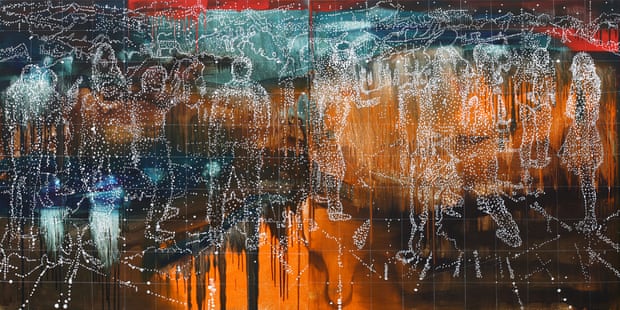
Photo: Jon Cattapan/Dominik Mersch Gallery
The Decade Positions, by Jon Cattapan (2017).

I’ve been reading arguments lately about “cultural appropriation” — both from those who think artists should stick to their own culture and from those who think that artists who imagine how people from a different culture feel are building understanding.

I thought about the controversy as I read this article on Australia’s indigenous dot art by Brigid Delaney at the Guardian.

“For a long time,” she writes, “the dot painting has been synonymous with Aboriginal art. Emerging out of the remote Northern Territory community of Papunya in the early 1970s, the first dot paintings were produced when art teacher Geoffrey Bardon encouraged his Indigenous students to paint their stories in murals on the school wall.

“But long before that, circles and dots were used in ceremonies in the form of body paint or marks on the ground. The Papunya people drew on this knowledge in their art, painting stories, ceremonies and rituals, first on walls and then on canvas and board.

“dot, dot, dot […], a new exhibition at Sydney College of the Arts, tackles some of the issues around the use of Papunya dots in paintings, but also looks at why so many artists – Indigenous and non-Indigenous – are attracted to using dots in their work.

“Curator Janelle Evans, a lecturer at Sydney University, a Wingara Mura fellow and Dharug artist, told Guardian Australia that the exhibition had its genesis in 2006, when she conducted an interview with Australian artist and political activist, Richard Bell. ‘He was talking about Aboriginal art as something constructed by the art market.’ …

“The ubiquity of the dot painting was so powerful that Indigenous artists working in different mediums had trouble attracting the interest of the international art market. At the same time, the market became flooded with cheap fakes and rip offs, alongside mass-produced tack such as tea towels made overseas and sold to tourists. …

“In situations like this, Indigenous people rarely see the profits of their artefacts being used, perpetuating a cycle of poverty and appropriation.

“Queensland MP Bob Katter has taken up the cause, putting a private member’s bill before parliament that seeks to amend consumer law to ensure that profits from Indigenous art and artefacts go back to Indigenous communities. …

“What about artists using the dot who are non-Indigenous? It could be seen as cultural appropriation, although Evans says it’s not that clear cut.

“ ‘Non-Indigenous artists who work with dots can work without appropriation. Within the dot, there’s a whole world that can be created. Artists have always referred to other artists in their work but appropriation becomes an issue when you are copying someone’s style. You need to bring your own inquiry to into what you are doing.’ …

“dot, dot, dot […] … focuses on showing work from artists who interpret the dot beyond the style of central and western desert artists and ‘in ways that are non-derivative,’ says Evans.”

More here.

Read Full Post »

Photo: Simon Peter Fox 
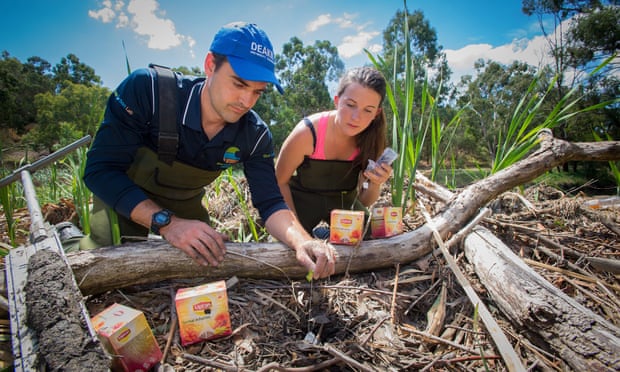
Deakin University researchers bury the first of 50,000 teabags to be placed in wetlands around the globe as part of a project to monitor which wetlands do best at soaking up the carbon that causes global warming.

It’s reassuring to know that people will keep doing whatever they can for the environment no matter what. The increased carbon dioxide that contributes to global warming will not go away by itself. One approach to breaking it down could come from preserving wetlands.

Melissa Davey writes at the Guardian about Australian scientists who are using Lipton green tea bags and red tea “rooibos” bags to study how wetlands capture carbon and make it harmless.

“Australian scientists have launched a project to bury tens of thousands of teabags in wetlands around the world. …

“Lipton green tea and red tea ‘rooibos’ varieties will be used in the project, which already involves more than 500 scientists in every continent except Antarctica.

“Leader of the project, Peter Macreadie from Deakin University’s Blue Carbon Lab, said wetlands were important for carbon capture and storage, a process known as carbon sequestration, holding up to 50 times as much carbon by area as rainforests.

” ‘But some wetlands are much better at carbon storage than others, and some are in fact carbon emitters, so they’re not all fantastic,’ Macreadie said.

“ ‘We need to find out the best wetland environments for carbon sequestration so we know where we should invest our energy.’

“That’s where scientists have come up against barriers in the past. There are hundreds of thousands of wetlands around the world. A standardised technique for monitoring the carbon is needed for accurate comparison, and monitoring devices can cost thousands of dollars to install.

“But Macreadie had been reading scientific research about teabags being buried and used to measure the rate at which carbon was being released from soil into the atmosphere.

“Fast decay of the tea inside the bag meant more carbon was being released into the atmosphere, while slower decay meant the soil was holding the carbon.

“ ‘I thought, “Jeez this is a bloody good idea. Why aren’t we using it in wetlands?” ‘ Macreadie said.

“ ‘People think of innovation as involving fancy new technology, but sometimes the best ideas are the most simple ones.’ ” More here.

I wonder if this property of tea relates to another thing I’ve noticed. Loose tea seems to absorb the aroma of whatever is around it. I’ve often thought that if you wanted to remove, say, a burned smell from upholstery or clothing, tea (not brewed) could do the trick.

Read Full Post »

Photo: Frasers Property
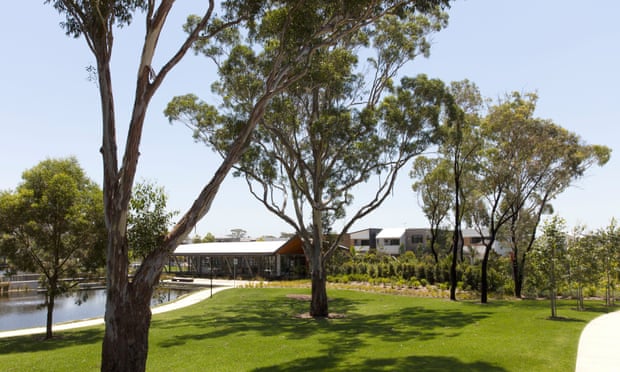
Fairwater, developed by Frasers Property, is the largest geothermal community in the southern hemisphere.

These days there’s a lot of talk about “sustainable” daily-living practices and “sustainable” business practices. But let’s be honest: some practices are more sustainable than others.

One monitoring organization that sets a high bar is the Green Building Council of Australia (GBCA).

Clarissa Sebag-Montefiore wrote recently at the Guardian about projects the council has approved: “In 2016, a new master-planned estate in [Blacktown, near Sydney] became the first residential community in New South Wales to be awarded a top, six-star Green Star community rating by the Green Building Council of Australia.

“Not only that, Fairwater, developed by Frasers Property, is the largest geothermal community in the southern hemisphere. Houses are cooled or heated by a refrigerant that pumps air underground then back to the surface, using less power than air-conditioning or heating and saving residents of a three-bedroom house $500 to $600 a year.

“ ‘There’s this avenue of mature trees with this massive lake and lovely terrace houses – yoga by the lake, cycling paths, all these people walking,’ says the GBCA chief executive, Romilly Madew. …

“Green-star buildings produce, on average, 62% fewer greenhouse gas emissions and use 51% less potable water and 66% less electricity than average buildings in Australia, according to GBCA’s 2013 report The Value of the Green Star.

“Since launching in 2003, hundreds of buildings around the country have been certified for the rating system and 120,000 people are now moving into Green Star communities. …

“The key is looking at the project holistically, says Madew. ‘It’s about going back to that old adage of community: people, walkability, liveability, places for the kids to play. [We want to] change the way people think about how they live.’

“Developers, ultimately, ‘are there to sell house and land packages – so they’re not going to be successful unless they’re building something people want to buy. Take “sustainability” out and ask what [buyers] want. They want something close to amenities – schools, public transport, shops and parks. And a home that is cheap to run.’ ” Read about other sustainable projects in Australia here.

Hat tip to ArtsJournal.com, a great source of stories.

Read Full Post »

Photo: Jessica Hinchliffe/ABC Brisbane
The women of Queensland’s Spice Exchange create different spice blends to sell. 

This happy refugee story is from Australia, another country where refugees make valuable contributions, in this case sharing their beautiful foods and recipes with the broader population.

Jessica Hinchliffe writes at ABC Brisbane, “A social enterprise in Queensland is helping refugee and migrant women gain employment and foster community spirit through cooking.

“The Spice Exchange sees these enterprising women come together to create spice blends, condiments and gingerbread. They use recipes and spices well known in their home countries.

“Backed by Access Community Services, the social enterprise in Logan, south of Brisbane, also helps the women practise their English-speaking skills.

“Many of those involved are single women with dependent children, with limited education and literacy skills.

“Organiser Tianna Dencher said the Spice Exchange was helping these women, who sometimes felt isolated, find their voice. …

” ‘We saw that these women were comfortable with food and we decided to create something that would engage women around food.

” ‘Many of the women had such great cultural diversity, had beautiful cuisines that had spices … that’s how we started.’

“The program also teaches the women about workplace culture, marketing and how to price products. …

“Adhel Mawien Ukong began with the Spice Exchange in September and said the program provided her with opportunities for her and her children.

” ‘I’ve learnt so much,’ she said. ‘I start at 9:00 am and finish at 2.30 pm, and it’s given me a job four days a week and it’s helped us.

I love it so much so I come here every day of the week sometimes, and I’ve invited other women to join me.’ “

More here.

Hat Tip to @VictoriaLynden on twitter.

Read Full Post »


Photo: ABC News: Kristine Taylor
The arrival of six primary school-aged children allowed Mingoola’s (New South Wales, Australia) school to reopen.

Cousin Claire put another good link on Facebook–this one about the small Australian community of Mingoola, which was losing population and decided to welcome refugees just as its only primary school was about to close.

Greg Hassall writes at ABC Australia, “In the tiny township of Mingoola, on the border of New South Wales and Queensland, local woman Julia Harpham was grappling with a common problem in rural communities.

“The population was in decline, enrolments at the local primary school were down and farmers could not find labourers to help with manual work. Her town was dying before her eyes.

” ‘Many of us have children who work in the city and aren’t going to come back to the farm because things have been so tough on the land,’ Ms Harpham said.

” ‘You don’t like to see a community die. And there’s not much joy in a place with no children.’

“Three years ago the local progress association decided to take a leaf from the region’s migrant past and looked for refugees willing to move to the area.

“But when they began contacting refugee agencies they were told there would not be adequate support for refugees in the bush. …

“Meanwhile in Sydney, refugee advocate Emmanuel Musoni was grappling with problems in his community from central Africa. They had been displaced from Rwanda and neighbouring countries during years of bitter civil war.

“The majority had rural backgrounds before having to flee their homes for refugee camps. …

“They were resettled in cities where employment prospects were few, the environment was intimidating and many became depressed and isolated. …

“Mr Musoni led a small delegation from his community to Mingoola early this year to meet locals and see whether resettlement was viable.

“On his return he put out a call for families willing to make the move; within a week he had a waiting list of 50.

“He chose two families [with] 16 children between them. Six of the children were of primary school age, which would allow Mingoola Primary School to remain open.

“Meanwhile, the community began renovating several abandoned houses in the area to accommodate the families, who moved to Mingoola in April. …

“For those involved in this social experiment, the hope is that its success can be replicated elsewhere to help other struggling rural communities.

“Mr Musoni now has 205 families on his database wanting to move out of the cities and politicians have been watching the Mingoola project with interest.”

Read more here. And for a past post on African refugees in rural Maine, click here.

Read Full Post »

There’s always something fun over at PRI’s environmental radio show Living on Earth. Here’s a story that ran in March about the unique bird species isolated in Northeastern Australian rainforests.

Bob Sundstrom wrote up the audio report of BirdNote‘s Mary McCann: “The Eastern Whipbird hangs out in the dense understory. It’s dark, crested … nearly a foot long and emerald-green with white spots. … The large, pigeon-like Wompoo Fruit-Dove … feathered in a stunning combination of green, purple, and yellow, [is] clearly named for its voice.

“Pig-like grunting on the forest floor tells us we’re in the company of the largest bird on the continent – the Southern Cassowary. On average, the female weighs 130 pounds and stands around 5 feet tall, looking like a giant, lush, black hairpiece on thick legs. A helmet called a casque makes it look as much like a dinosaur as any living bird.” Five feet tall? I think I know a one-year-old who would like to try riding it.

The bird sounds on the radio show were provided by The Macaulay Library of Natural Sounds at the Cornell Lab of Ornithology. Hear them all here, where you can also enjoy the equally far-out pictures.

Photo: Jan Anne
Southern Cassowary

Read Full Post »

Following up on my 2012 post about fairy circles.

Rachel Nuwer writes at the NY Times, “When Stephan Getzin, an ecologist at the Helmholtz Center for Environmental Research in Leipzig, Germany, opened the email, his heart began to flutter. Attached was an aerial image of fairy circles, just as he had seen in countless photos before. But those images were always taken along long strips of arid grassland stretching from southern Angola to northern South Africa. These fairy circles — which looked nearly identical — came from Australia, not Africa. …

“The emailed photo came from Bronwyn Bell, who does environmental restoration work in Perth. She had read about Dr. Getzin’s research in Namibia and made a connection to the odd formations in her home state, Western Australia. …

“Scientists have been interested in fairy circles since the 1970s, but have not been able to agree on what causes the patterns to form. Researchers generally fall into two groups — team termite and team water competition — but there are other hypotheses as well, including one involving noxious gases.

“Dr. Getzin, like others on team water competition, explains the circles through pattern-formation theory, a model for understanding the way nature organizes itself. The theory was first developed not by biologists, but by the mathematician Alan Turing. In the 1990s, ecologists and physicists realized it could be tweaked to explain some vegetation patterns as well. In harsh habitats where plants compete for nutrients and water, the new theory predicts that, as weaker plants die and stronger ones grow larger, vegetation will self-organize into patterns …

“In the case of African fairy circles, the bare patches act as troughs, storing moisture from rare rainfalls for several months, lasting into the dry season. Tall grasses on the edge of the circles tap into the water with their roots and also suck it up with the help of water diffusion through the sandy soil.

“Although similar in appearance, Australian fairy circles turn out to behave differently, Dr. Getzin and his colleagues have found. … Aussie circles feature a very hard surface of dry, nearly impenetrable clay, which can reach up to a scalding 167 degrees during the day. Despite the differences, though, they believe the fairy circles’ function remains the same. When the researchers poured water into the circles in a simple irrigation experiment, it flowed to the edges, reaching the bushy grass …

“The new research ‘moves us closer toward a unifying theory of fairy circle formation,’ said Nichole Barger, an ecosystem ecologist at the University of Colorado, Boulder.

“It could be that more fairy circles are yet to be discovered in arid environments around the world, she said.

“According to Walter Tschinkel, an entomologist at Florida State University, the findings strengthen the claim that the circles are a result of self-organization by plants. He cautioned, though, that to be more certain, scientists would need to control environmental factors — water and termites, for example — to see which produce the predicted outcome.”

More here.

Photo: Norbert Jürgens
Tracks of Oryx antelopes crossing fairy circles in Namibia.

Read Full Post »

Don’t you love it when something that is extinct turns out not to be extinct at all? Like coelacanths, which, according to Wikipedia, “were thought to have become extinct in the Late Cretaceous, around 66 million years ago, but were rediscovered in 1938 off the coast of South Africa.”

While I’m waiting for someone to prove unequivocally the existence of the Ivory Billed Woodpecker, I will regale myself with Lazarus-like sea snakes in Australia.

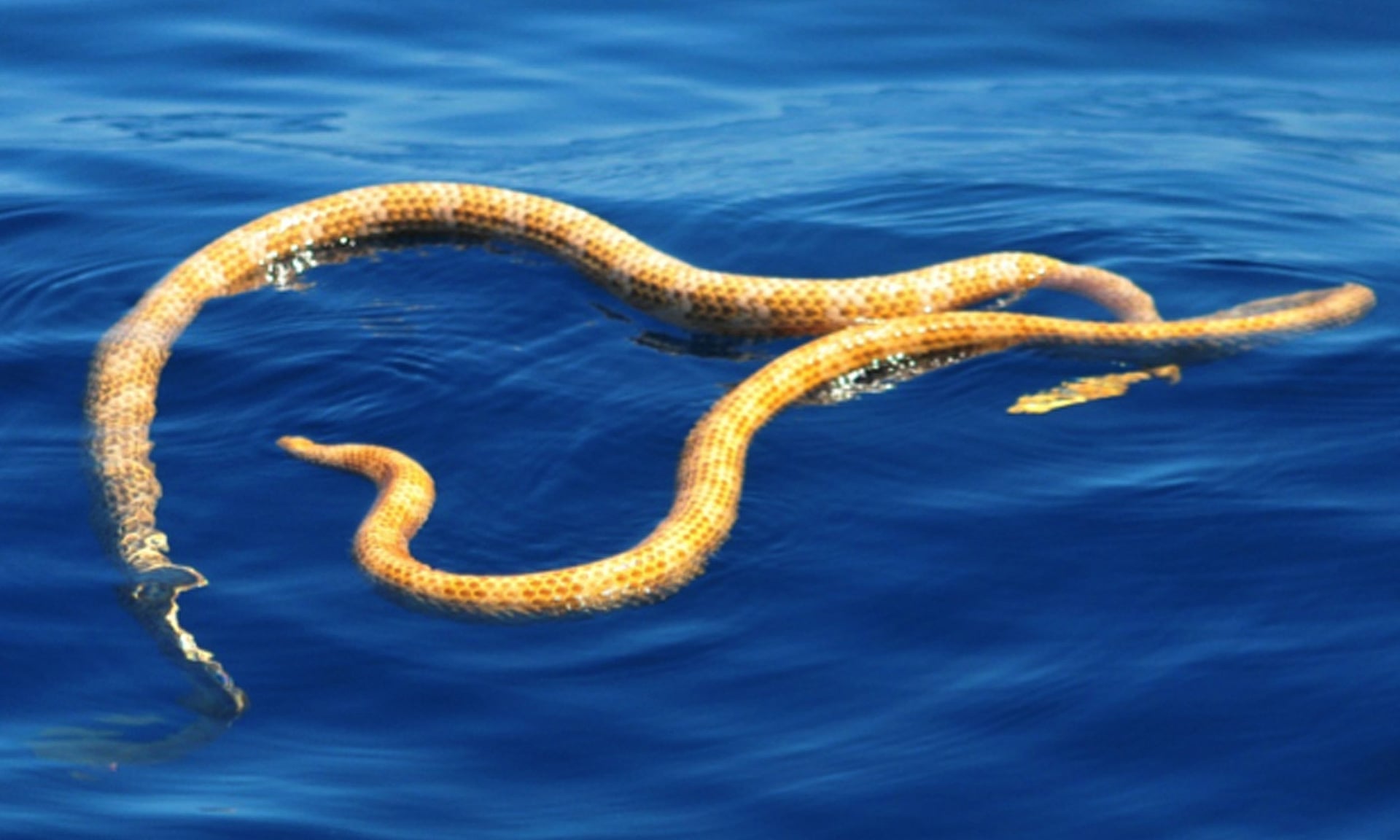
I saw this Australian Associated Press story at the Guardian: “A species of sea snake thought to be extinct has been rediscovered off the Western Australian coast. A wildlife officer spotted two courting short-nosed sea snakes while patrolling in Ningaloo marine park on the state’s mid-north coast. …

“The Western Australian environment minister, Albert Jacob, said the discovery was especially important because they had never been seen at Ningaloo reef. …

“A Department of Parks and Wildlife officer photographed the snakes on Ningaloo Reef and James Cook university scientists identified them.”

Maybe marine creatures such as sea snakes and coelacanths are more likely to be preserved than woodpeckers — hidden away in the ocean’s unexplored depths. Still, as a movie I reviewed, Revolution, made clear, the seas are threatened, too.

More on courting sea snakes at the Guardian.

Photo: Grant Giffen/AFP/Getty Images
The discovery of the short-nosed sea snake, previously thought to have been extinct, is significant because the species had never been seen in the Ningaloo marine park in Western Australia before.

Read Full Post »

How lovable is this? Sheepdogs that protect a tiny species of penguin from predators.

Austin Ramzey writes at the NY Times about an effort to counteract “Australia’s long history of imported species’ decimating native wildlife. … The toll on Middle Island, off Victoria State in southern Australia, kept rising. By 2005, the small island’s penguin population, which had once numbered 800, was below 10.

“Today, their numbers are back in the triple digits, and much of the credit has gone to a local chicken farmer known as Swampy Marsh and his strong-willed sheepdogs.

“ ‘The powers that be wouldn’t listen to me until it got down to six penguins,’ said Mr. Marsh, whose long-unused birth name is Allan. ‘They were desperate.’

“The farmer’s simple solution — deploy a particularly territorial breed of sheepdog to scare the foxes away — became local legend and, in September, the subject of an Australian film, ‘Oddball,’ which fictionalized the story and made a lovable hero of one of the dogs. The strategy is now being tried elsewhere in Victoria, in hopes of protecting other indigenous species from non-native predators. …

“Maremma dogs are self-reliant; they can be left to defend a patch of land for long periods of time with a supply of food and water that they know not to wolf down right away. During the summer, when foxes pose the greatest danger to Middle Island’s penguins because of tidal patterns that form sandbars, the dogs can stay on the island for several days in a row, watching over the birds from a raised walkway.

“Training them for the job involves introducing them to the penguin’s distinct odor. ‘Penguins don’t smell particularly nice,’ said Peter Abbott, manager of tourism services for the Warrnambool City Council. ‘They look cute and cuddly, but they smell like dead fish.’ Gradually, the dogs are taught to treat the penguins like any other kind of livestock, to be defended and not harmed.’ ”

The article explains that “when red foxes were imported for sport hunting in the 19th century, they found the tiny, flightless birds to be easy prey.” More here.

Photo: David Maurice Smith/NYT
A little penguin, the name of the smallest penguin species. Middle Island’s penguin population, protected by sheepdogs, has rebounded to 150. 

Read Full Post »

Dezeen magazine has an article on an apartment building in Australia that seems to change color depending on your viewing angle.

“The triangular window bays that project from the facade of this Sydney housing block by MHN Design Union appear either red or yellow, depending on the viewing angle.”

The apartment block was designed “for local developer Crown Group on a plot in Waterloo, a former industrial area that is gradually being redeveloped into a residential neighbourhood.

“The architects based the design of the facade on the sculptures of Yaacov Agam, an Israeli artist who is known for his brightly coloured kinetic and optical illusion works – which also influenced a series of rugs by London studio Raw Edges. …

“The building’s form tapers to a point at the rear, creating triangular floors that range from 10-high at the front to seven at the back. …

“The building is shortlisted for two awards at this year’s World Architecture Festival, which will be held in Singapore at the beginning of November.” More here.

Photo: John Gollings

Read Full Post »

As usual, John has a pretty good idea of the kind of story that really floats my boat. Mysterious green balls washing up on the beaches of Australia, Anyone?

The Science Alert website reports that on the weekend of September 20, “thousands of peculiar green balls appeared on Dee Why Beach near Sydney in Australia. About 6 centimetres in diameter, these squishy little spheres are living organisms – seaweed balls known as ‘marimo’.

” ‘They’re actually a really unusual growth form of seaweed, because seaweeds mostly grow on the rocks but occasionally they get knocked off and rolled around in the ocean forming these beautiful little balls,’ Alistair Poore from the University of New South Wales explained to 7News.’It’s quite an unusual phenomenon, it’s only been seen a handful of times around the world.’

“First discovered in the 1820s by Austrian botanist Anton Eleutherius Sauter, and named by Japanese botanist Tatsuhiko Kawakami in 1898 (‘marimo’ roughly means ‘bouncy play ball’ in Japanese), colonies of these little balls have only been seen off the coast of Iceland, Scotland, Japan, Estonia and now Australia.”

See videos at Science Alert, here.

More on the green balls at Wikipedia and at Smithsonian.

Read Full Post »

Funny how things work out.

If Suzanne hadn’t spoken to a woman speaking Swedish to her little girl after toddler music class, I probably would never have known about the Australian mining community Tom Price and the Chinese opera written about it by the Swedish woman’s American husband. But there you are.

Ben Collins, Vanessa Mills, and Hilary Smale put together a story about the opera for ABC Australia.

“It’s a contender for the most unlikely arts even of all time,” they write, “the story of a small North West Australian iron ore mining town told in Chinese operatic style.

“It’s the attention grabbing work of an American artist called Daniel Peltz, who says he aims to provoke ruptures in the socio/cultural fabric through which new ways of being may emerge. In this case that means Chinese opera in a remote Australian mining town.

” ‘I look at Chinese opera as something that’s embedded in the landscape of China, just as iron ore is embedded in the Western Australian landscape. And I think of the gesture of the piece as a way of extracting this resource from China, digging it up and bringing it to Tom Price to tell a story of the town,’ Mr Peltz says. …

“The opera follows the story of Thomas Moore Price, who is said to have died at his desk just before the deal was completed that led to the mine which the town serves.

” ‘I did find an out-of-print book on Tom Price that was produced by Kaiser Steel which confirmed that component of the narrative. But my aim is not to write historically accurate narrative, it’s actually quite the opposite… I’m really looking at extracting elements of the story of this place and sending them to China to be transformed into this opera,’ Mr Peltz says.

“In the opera, Thomas Moore Price’s only daughter, Shirley, has an encounter with the ghost of her father at the summit of Mt Nameless. A 30 minute film of the opera being performed in China will be presented at the Tom Price Community Centre.

” ‘I’ve done a lot of work to make sure that it’s well subtitled so that people can access the narrative,’ says Mr Peltz.”

Wish I had known all this when Dan and his wife (the artist Sissi Westerberg) brought their daughter to my grandson’s two-year-old birthday party a few weeks ago.

The missed opportunities of life!

Read more here and listen to a clip of the traditional-style Chinese opera.

Read Full Post »

« Newer Posts - Older Posts »