Feeds:
Posts
Comments

Posts Tagged ‘charity’

Photo: Boston Globe.
A headline in the Boston Globe from 1924.

I didn’t get to post this story about a charitable Gothenburg-born Boston immigrant last year, but I think you’ll agree that it’s a bit of Christmas history that will always be fresh.

Jenny Ashcroft wrote about it at Fishwrap, the official blog of Newspapers.com.

“On Christmas Day in 1921, a Swedish immigrant quietly wheeled his hot dog stand to a street corner in Boston’s North End and distributed 500 free hot dogs to hungry children. Axel Bjorklund was no stranger to poverty. He barely made ends meet himself, but he wanted to give back. His cart was soon swamped with hundreds of shivering children wearing tattered clothing that did little to stave off the cold. Their hungry faces beamed when Axel handed them a steaming hot dog. Eventually, the food was gone, but Axel’s determination to repeat the event wasn’t. The Hot Dog Santa tradition was born. Over the next eight years, Axel gave away some 10,000 hot dogs before he died in 1930.

“Born in Gothenburg, Sweden, on August 6, 1869, Axel Bjorklund emigrated to America in 1889, eventually settling in Boston’s North End neighborhood. The area had become a melting pot of immigrants, most of whom were impoverished as they struggled to establish lives in a new country. The Spanish Flu Pandemic hit the North End particularly hard, leaving families even more destitute and many children orphaned.

“The first Christmas hot dog giveaway in 1921 was so successful that Axel decided to expand in 1922 and doubled the number of hot dogs to 1,000. His hot dog giveaway grew with each year until he distributed 3,000 annually. The children loved Axel and nicknamed him ‘Hot Dog Santa.’ …

“Axel’s annual Christmas Day hot dog giveaway eventually moved to New Year’s Day, but it was an event the children anticipated all year. As Axel’s generosity expanded, so did his health challenges. He was plagued with rheumatism, which led to frequent hospitalizations. His finances struggled, too, and he could no longer pay his rent. Not wanting to end the hot dog giveaway, he appealed to the public to help him continue the tradition.

“In December 1928, just before the annual hot dog giveaway, Axel’s landlady kicked him out because he hadn’t paid rent. The Salvation Army stepped in to help, but Axel was broke. The next two years saw Axel skipping between the poor house, the Cambridge Home for the Aged, or obtaining temporary lodging from generous benefactors. Despite his circumstances, in 1929, he participated in his final hot dog giveaway.

“On November 10, 1930, Axel Bjorklund passed away, penniless and alone at a Massachusetts hospital. He had no relatives and was set to be buried in a potter’s field when newspapers published word of his death. Citizens stepped forward, offering to contribute to a fund to give Axel a proper burial. The Swedish Charitable Society coordinated, and Axel was laid to rest in the Cambridge Cemetery.

“If you would like to learn more about the Hot Dog Santa or discover other heartwarming Christmas stories, search Newspapers.com.”

It hurts to think that today there are still plenty of shivering, hungry American children who could use this 1920s Good King Wenceslas.

Read Full Post »

Photo: Jeremie Souteyrat for the New York Times.
Steve Mills shows his copy of The Naughtiest Girl Again, by Enid Blyton, with marginalia by a child.

In a fun story from the New York Times, Jonathan Wolfe writes about a children’s-book collector in England who was surprised to discover who did the childish drawings inside an acquisition. It reminded me of some favorite childhood books — and how I loved to draw pictures of girls with pointy noses on any piece of paper I could find.

“In retirement,” writes Wolfe, “Steve Mills began collecting secondhand books that he had read as a child. It was an effort to reawaken lost memories. …

“He was at home in Hockley, east of London, flipping through titles from a recent book haul from a charity shop. Inside the pages of an early hardcover edition of The Naughtiest Girl Again, by the English author Enid Blyton, he found a girl’s handwritten notes from more than 50 years earlier. It took a few moments for Mr. Mills to grasp who the writer was: his wife, Karen.

“At first, Mr. Mills, a 67-year-old former civil servant, simply recognized an address in the town where his wife had grown up, written in a child’s handwriting. He brought the book to Ms. Mills, and said, ‘Oh look, they used to live in the village you came from,’ Mr. Mills recalled.

“The address had been her childhood home, though it was spelled wrong. Ms. Mills couldn’t believe it. …

“ ‘I thought at first that it was him being a silly bugger,’ she said. ‘I actually said to him, “Are you trying to misspell our first address?” But I looked at it again, and I thought, “Oh my word, this is written by my brother and me when we were 9 and 10,” ‘ she said. … There were timetables she had carefully recorded, pages she had folded to save her place and a sketch of little Karen, freckles dotting her face. …

“[Ms. Mills] grew up in Staffordshire, about 170 miles northwest of Hockley. Her parents, Brenda and David Larden, both 87, told their daughter that they must have donated the book to a church or school drive around 1975, when they moved. …

“ ‘For 50 years,’ Ms. Mills said, the book had ‘gone around the country, doing I don’t know what — entertaining children — and then it came back to us.’ …

“But his discoveries weren’t over. A few days after finding his wife’s name in The Naughtiest Girl Again, Mr. Mills suddenly realized that there were other titles in the haul that he hadn’t looked at. Could some of those, too, have been from his wife’s childhood home?

“ ‘I picked up another couple of books and, lo and behold, there was my wife’s name,’ he said.

“He found doodles by Ms. Mills and her brother Mark on two other Enid Blyton books, The Adventures of Pip and The Famous Five: Five on a Treasure Island. The latter was one of Mr. Mills’s favorite books as a boy.

“The find was particularly meaningful for him, he said, because Ms. Blyton’s stories reminded him of boyhood adventures with his mother in Cornwall, on the English coast. …

“In the back of one of the three books, he said, his wife had written, ‘I have got 12 of Enid BLYTONS Books.’

“ ‘So that leaves me with another nine to try and find now,’ he said.”

More at the Times, here. What did you draw in your books — or hide inside? Four-leaf clovers?

Read Full Post »

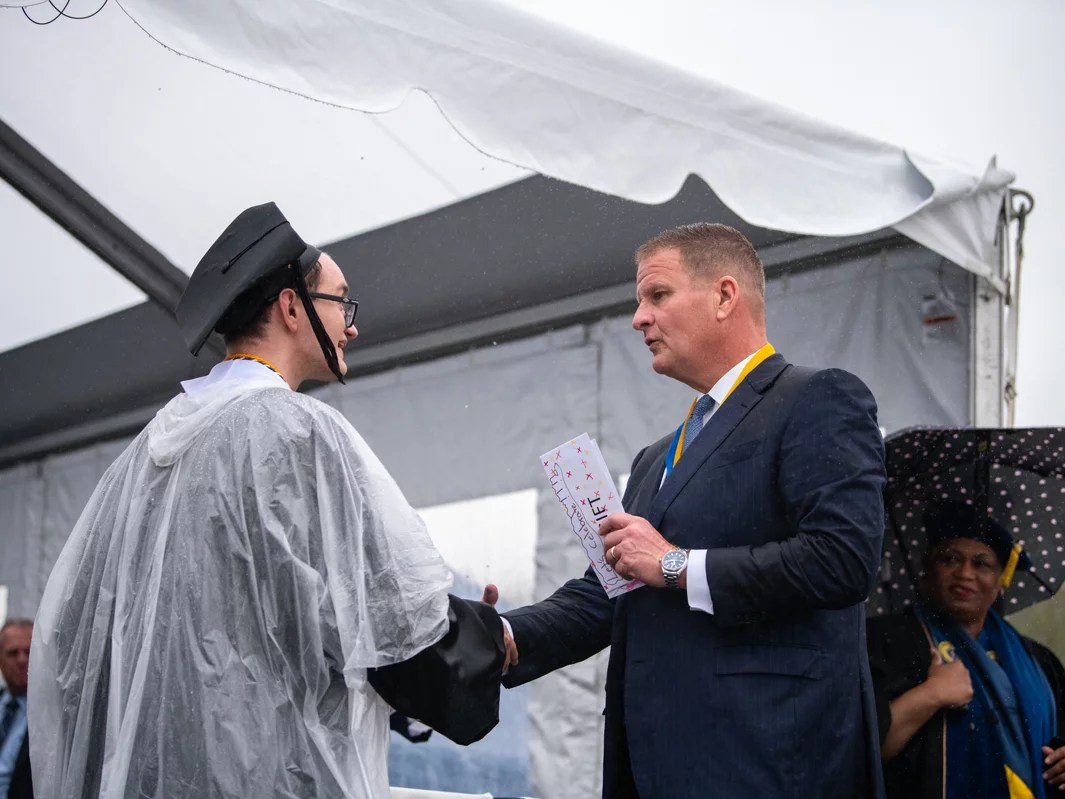
Photo: Karl Christoff Dominey/University of Massachusetts Dartmouth via NPR.
Robert Hale gives an envelope with cash to a graduating UMass Dartmouth student at commencement. Each of the 1,200 graduates received $1,000 onstage, half to keep and half to donate.

Here’s a story from the most recent graduation season: a speaker who gave graduates the inspiration and also the means to start being productive members of society right away.

Jenna Russell reported at the New York Times in May, “Until the final minutes of their commencement ceremony last Thursday, the 1,200 graduates of the University of Massachusetts Dartmouth thought they knew what they would remember most about it: the supremely bad weather during the outdoor ceremony, where they sat drenched and shivering in a torrential rainstorm.

“Then, as they prepared to collect their diplomas, their commencement speaker, Rob Hale, a billionaire philanthropist from Boston, returned to the dripping podium. He brought along two cash-stuffed duffel bags, he announced, and would hand every graduate $1,000 as they crossed the stage — $500 to keep for themselves, and $500 to give to any good cause. …

“Hale, the co-founder and chief executive of Granite Telecommunications … told the graduates at UMass Dartmouth he has never forgotten the experience of losing everything, when the first company he built went bankrupt in the dot-com crash more than 20 years ago.

” ‘Honestly, have you guys ever met someone who lost a billion dollars before?’ Mr. Hale, a part owner of the Boston Celtics, asked in his speech, which he cut short because of the rain.

“Since that disaster, he said in an interview this week, he and his wife have found deep joy and satisfaction in giving their money away. In granting college students a chance to experience the same feeling, he said he hoped to light a spark that they will carry with them — even if he had no guarantee that they will honor his request. …

“ ‘If they get to feel that joy themselves, then maybe it becomes something they want to do again, and make part of their own lives,’ Mr. Hale, 57, said.

‘In America and the world, these are times of turmoil, and the more we help each other, the better off we’ll be.’

“In the week since a businessman they had never met handed them two damp envelopes onstage — one labeled ‘GIFT and the other ‘GIVE’ — the new graduates have packed up dorm rooms, fine-tuned résumés and snapped last campus selfies. They have also pondered where to send what for most will be the largest charitable gift they have ever had the chance to give.

“Tony da Costa, a graphic design major who graduated with high honors, considered giving his $500 to a charitable organization but decided instead to hand it over to an acquaintance of his mother, someone he has never met, who is suffering from an illness and struggling to pay bills. …

“Kamryn Kobel, an English major, gave her $500 to the Y.W.C.A. in Worcester, Mass., where she learned to swim as a child, to support its programs for young women and survivors of violence. Her donation felt like something to be proud of, she said — once it sank in that the envelopes she tucked under her rain poncho contained exactly what Mr. Hale had promised. …

“UMass Dartmouth enrolls about 5,500 undergraduates, more than half of them first-generation college students. Eighty percent come from Massachusetts; 80 percent receive financial aid. It is the fourth Massachusetts college campus in the last four years where Mr. Hale has thrilled graduates with his signature split gift. Each time, he has selected a public school with high concentrations of first-generation and lower-income students who have ‘worked their tails off to get there,’ he said. …

“In an interview … he briefly grew emotional describing how one of the UMass Dartmouth graduates had given her $500 to a local group that provides holiday gifts for children in need — a program that had helped her family when she was a child.

“ ‘Seeing things like that is very cool,’ he said.”

More at the Times, here. There’s a story on this at NPR, too, where there’s no paywall.

Read Full Post »

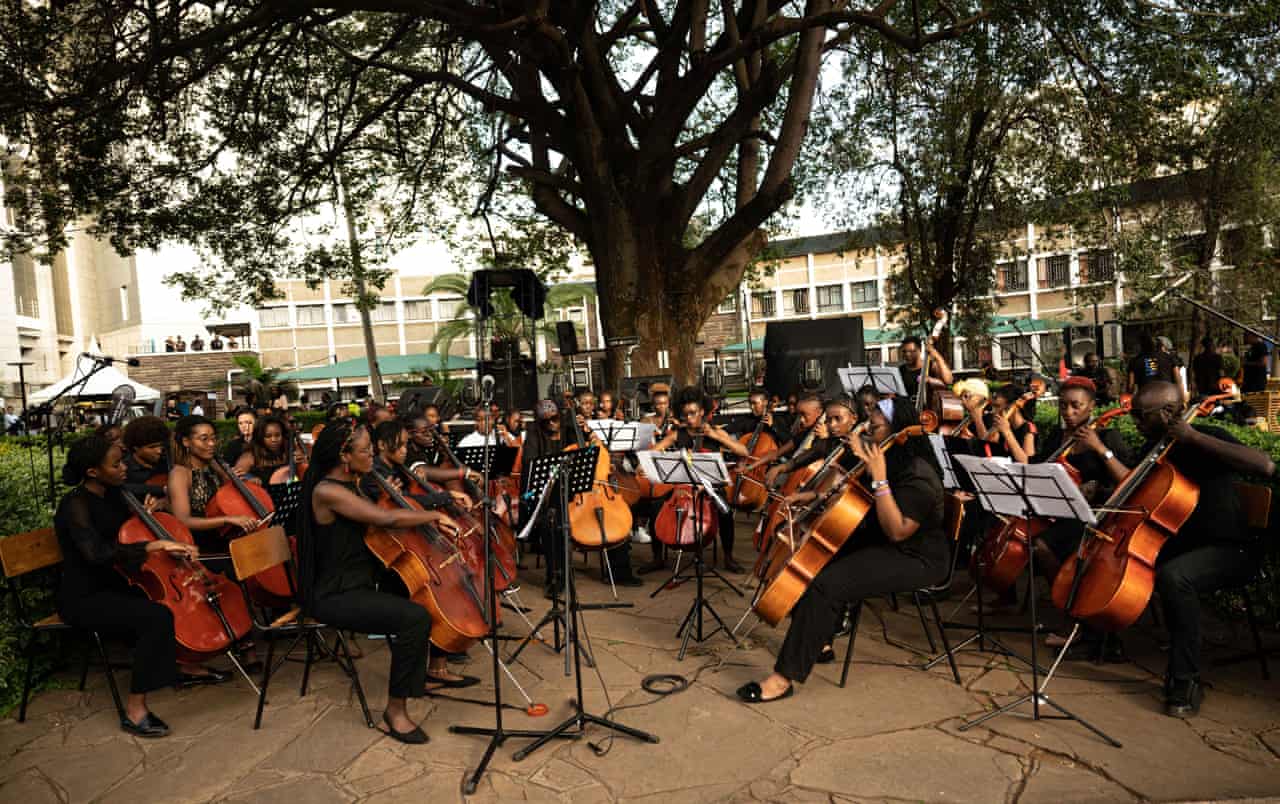
Photo: Edwin Ndeke/The Guardian.
Kenyan classical musicians gave an outdoor performance in Nairobi recently. Cellist Yo-Yo Ma also performed that day. 

Do you know the cellist Yo-Yo Ma? He seems to be performing in a different country every day, and often he’s performing for charity. I follow him on Instagram, and I’m always amazed.

Caroline Kimeu wrote at the Guardian in June about Yo-Yo Ma’s recent visit to Kenya.

“Nairobi’s bustling Kenyatta market is an unlikely place to hear classical music. Yet playing today in front of stalls where butchers roast meat and hairdressers compete over heads to braid is a very surprising busker: the distinguished cellist Yo-Yo Ma. Playing ‘Over the Rainbow’ alongside Kenyan percussionist Kasiva Mutua, he matches his cello to her beats in a truly eclectic mix.

“Ma’s broad artistic sensibilities make weaving together the diverse musical traditions of drum and cello seem like a natural fit. ‘It was symbolic to introduce [classical] music to the crowd through something they know and understand,’ says Mutua. ‘Africans understand rhythm to their core.’ …

“Nairobi is Ma’s last stop of his Bach Project – a five-year, six-continent global tour. With its rising cultural and artistic scene, organizers say the city was near the top of the cellist’s list.

“The project marked Ma’s ambition to connect cultures and people across the world, performing Johann Sebastian Bach’s cello suites in 36 countries. …

“Bach’s cello suites were not well known by the time of the composer’s death in 1750. They began to resurface nearly a century later, and were brought to prominence in the 1930s when Pablo Casals, one of the world’s most highly regarded cellists, performed and recorded the neglected suites.

“Ma has recorded interpretations of the suites three times, with more than a decade between each.

“They are wrapped up with his life’s memories, he has said, citing his first encounter with Bach’s music when he was four: his father, Dr Hiao-Tsiun Ma, taught him the first suite in small, incremental steps. …

“ ‘For almost six decades, they have given me sustenance, comfort and joy during times of stress, celebration and loss,’ Ma wrote at the start of the Bach Project in 2018. ‘What power does this music possess that even today, after 300 years, it continues to help us navigate through troubled times?’

“Beyond busking, Ma takes to a more conventional stage with a concert at the Kenya national theatre. His audience now is a classical crowd – the [$145] auditorium tickets sold out in 24 hours – with prominent members including the arts minister, Ababu Namwamba, and the US ambassador, Meg Whitman. …

“Ma plays as though he is the only person in the room. Only the loud applause breaks through to him, earning his bow and embrace of the audience, arms flung wide. The solemn, lonely fifth cello suite – his penultimate performance – makes the auditorium fall silent.

“From a viewing room on the upper balcony, Brian Kivuti, a 34-year-old Kenyan jeweler, listens with closed eyes. ‘For me, it was a practice in presence,’ says Kivuti. ‘There are no lyrics telling you how to feel. It’s just the music and you, feeling your way through, so you pay more attention to how the notes make you feel. …

“ ‘When I started to listen with my body, I could feel notes of hope, the quiet of a Sunday morning, the dizziness of preparing for a party. The rise and fall of the notes allow you to tap into more than just everyday feelings.’

“At the theatre’s Wasanii restaurant, workers perched on rooftop balcony seats to watch a screening of the performance. For Margaret Wanjiru, a 22-year-old waitress, Ma’s music is a far cry from what she knows, such as her tribe’s Mugiithi. ‘It may not be the music I grew up with, but it slows you down, however much you’re busy, and allows you to get lost in your thoughts.’

“The Nairobi Orchestra, one of the oldest in Africa, performs ahead of Ma’s set, and its musicians are thrilled to have him in the auditorium. Violinist Bernadette Muthoni says: ‘For me, it was very huge to think that Ma was going to play just a few metres from where we were. He’s what a lot of us aspire to.’ …

“Ma is increasingly interested in using his work for social impact. He played outside the Russian Embassy in Washington DC last year to protest against its war in Ukraine, and dedicated his Songs of Comfort to providing solace for people during the difficult days of the pandemic.”

More at the Guardian, here.

Read Full Post »

Photo: What Cheer Flower Farm.

Today’s story shows, among other things, that if you pick a really good name, you’re halfway to your goal. Who wouldn’t be drawn to a charity with a name like What Cheer Flower Farm?

And wait till you hear what it does! Frank Carini’s ecoRI News story was originally reported in 2018.

“The place was a complete mess, but a trio of determined women was going to buy it anyway, as soon as the seller removed about 50 tattered mattresses from the dilapidated building.

“The 2.7-acre property was covered with wind-blown trash. More than a year later, the three women are still picking up broken glass. … They ripped up poison ivy by gloved hand, and brought in a tractor to help tear down the overgrowth. The empty factory with a brick facade, largely vacant since the 1990s, has no running water or electricity, is covered in graffiti, has been the victim of arson, and has been gutted of all scrap metal.

“ ‘The property was neglected for years,’ said Shelby Doggett, who, at 25, is the youngest of the three buyers.

“The women, Doggett, her mother, Marian Purviance, and Anne Holland, bought the derelict property for $525,000, so they could give away flowers.

What Cheer Flower Farm was incorporated [in October 2017] and it acquired the former site of the Colonial Knife Co., forgotten industrial land in the heart of the city’s Olneyville neighborhood, not far from Route 6, this spring.

“After the sale became final, the first two essential items the women had delivered were a port-a-potty and a truckload of compost.

“This new urban farm, at 46 Atwood St., only began its growing season two months ago. The seeds were planted late in the season because there was plenty of other work to do first. For one, the property was covered in pavement.

“Some 4,000 square feet of parking lot was torn up and transformed into an organic raised-bed ‘field’ of flowers, both perennial and annual. Purviance, the farm’s horticultural director, has years of garden cultivation and management experience.

“ ‘I worked in the fine-gardening business for a long time, and I worked for very high-end clients. A lot of them really didn’t even appreciate what it was to have a garden and how much a flower really means,’ said Purviance, 57, a 30-year resident of Providence.

‘I get so much more satisfaction out of working on this project than I did working for people who take that for granted.’

“The nonprofit flower farm with two full-time farmers — Purviance and Doggett, who as the program director also handles the administrative side of things; Holland is the communications manger — and with support from volunteers, grows organic flowers on a brownfield site.

“They give their product away to ‘people who deserve flowers but don’t have access,’ Purviance said.

“To supply those people who deserve flowers, What Cheer Flower Farm has partnered with Amos House, the Ronald McDonald House of Providence, and Meals on Wheels of Rhode Island. The women deliver bouquets and buckets of cut flowers to these institutions and other partners.

“About 90 percent of the flowers currently being grown at the farm were started from seed by Purviance in her kitchen and in a friend’s basement. The rest of the plants were donated by Green Animals Topiary Garden in Portsmouth. …

“Besides brightening people’s lives with free flowers — 1,000 have so far been donated — the nonprofit’s mission also includes reversing urban blight, creating a job training center for Rhode Island residents to help them enter the state’s $2.5 billion ‘green’ economy, and making Providence famous for urban flower farming.

“Chicken manure from Scratch Farm and horse manure from a gentleman farmer in Rehoboth, Mass., have been used to build soil. … The farm rents a meter from Providence Water, which allows it to use a fire hydrant for watering. The water is stored in donated tanks of various sizes.

“Where the dilapidated building now stands, the co-founders envision a barn, classroom space, an office, and space for lease. …

“What Cheer Flower Farm has applied for a brownfield remediation grant with the Rhode Island Department of Environmental Management. An ongoing inventory assessment didn’t find elevated levels of polychlorinated biphenyls (PCBs). The owners have worked with the National Resources Conservation Service and David Foss of Wilcox & Barton Inc., a Vermont-based environmental consulting firm.

“The property is in better toxic shape than the new owners predicted, but there’s still much work to be done. Much of that work will revolve around fundraising. As a 501(c)(3), the organization will rely on grants, donations, volunteers, and kindness. They also plan to host fee-based workshops for hobby gardeners and amateurs.”

From the farm’s website: “Our staff are busy working on growing, rescuing and giving away flowers. You can visit as a volunteer, or as an artist who wants to work outside en plain air or as a group seeking a tour. …

“What Cheer Flower Farm is a nonprofit dedicated to bringing solace, joy and healing to the people of Rhode Island via flowers as well as supporting our local floral economy via job training.

“We grow, rescue and give away 100,000 flowers per year and are on track to expand to giving away 300,000 flowers per year in the next five years. We never sell flowers – all are given away freely via our network of local nonprofits and organizations serving Rhode Islanders including hospitals, senior services, recovery centers, shelters, hospices and food pantries. …

  ” 2022 Achievements

  • “92,000 flowers grown, rescued and given away
  • “$50,000 grant won from United Way/Social Enterprise Greenhouse
  • “Relaunched Flower Festival named ‘The Best Thing to Do in RI’ by The Boston Globe.”

More at ecoRI News, here. No firewall.

Read Full Post »

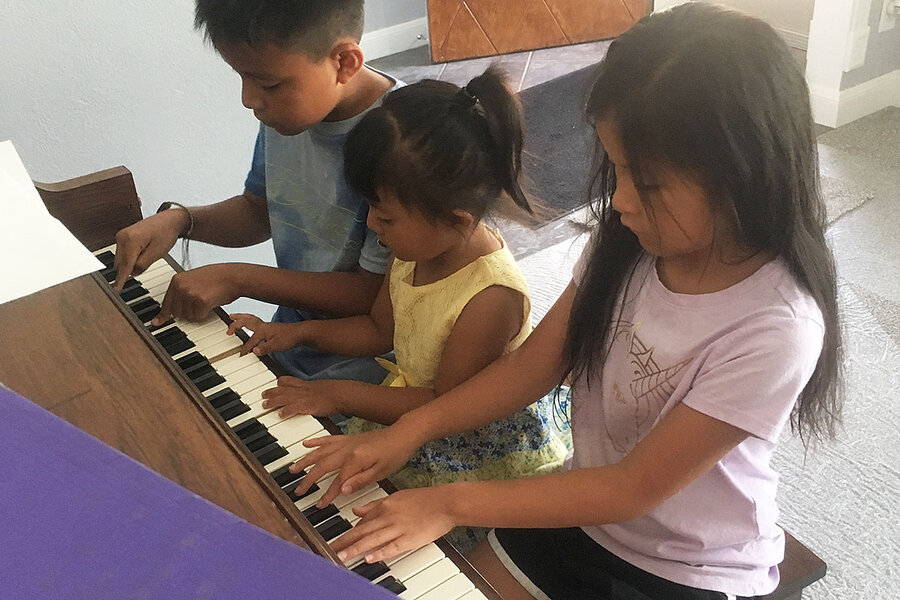
Photo: Tara Adhikari/The Christian Science Monitor.
Three Pluma siblings rushed to play the upright that Pianos for People had just brought from a donor in St. Louis.

Not all children take to the piano, but for those that do, cost should never be a barrier. At least, that’s the belief of a relatively new charity in St. Louis, as we learn from Tara Adhikari at the Christian Science Monitor.

“Nose pressed to the window, 2-year-old Mary Pluma is excited, her smile so big it’s visible even from the street. Her four older siblings lean in behind her. Eyes wide, they track the movers outside. …

“Today is the day the Pluma family receives their first piano. 

“The moment the upright is nestled in the corner, three of them beeline for the bench meant for one and tap on the black and white keys. Sometimes the notes sync in harmony, more often they do not, but the room is alive with music and joy. 

“The piano was delivered by Pianos for People, a St. Louis nonprofit that reduces financial barriers to music education by providing donated pianos and free lessons to low-income families. The organization is transforming what was historically a luxury item and symbol of financial success into a tool for growth – accessible beyond the American middle-class family.

‘Our philosophy is that a piano is more than just a piano,’ says Matt Brinkmann, the executive director. ‘We use the piano as a gateway to self-esteem and connection and community.’ 

“Tom Townsend, a St. Louis advertising executive, and his wife, Jeanne Townsend, an attorney, founded Pianos for People in 2012 in memory of their son, Alex. A pianist and artist, Alex died in a car accident while attending college. …

“Their focus on saving pianos – connecting unwanted instruments with recipients who can’t afford their own – expanded to music education more broadly. They opened a piano school, in 2014, at their Cherokee Street headquarters and have since delivered more than 300 donated pianos, opened a second school, and grown lesson enrollment to 129 this past spring.

“Of the families served, 92% have annual income below $25,000. While many recognize the benefits of music education – confidence, discipline, focus – paying the grocery bill takes priority. A good upright used piano can cost upward of $1,000; a new one close to $10,000; and lessons here average $50 an hour. By cutting the costs that make learning an instrument untenable, Pianos for People creates space for self-expression that, for many, wouldn’t exist otherwise. …

“There are far more pianos available for donation than the organization can accept, says Danny Ravensberg, piano donations coordinator. This allows Pianos for People to reject pianos in poor condition and protects recipients from repair costs. 

“Every piano has a history, and donors care where their piano, often a treasured part of family memories, ends up. 

“Jackie Wennemann’s five children enjoyed playing piano when they were growing up in the 1960s – so much so the family bought two, and she’d conduct from the basement door giving cues between the instruments. ‘Sometimes we would have duets and one would get on this piano,’ she says gesturing to one in the entryway, ‘and one on the one downstairs. I would say, “Ready, set, go,” and they’d both play the same song.’

“With her children grown, Ms. Wennemann wanted the pianos to be used again. She donated the one in the best condition to Pianos for People. The organization matched it with the Pluma family, three of whom had been taking free lessons for four years. …

“ ‘When they come [home] from school, they are stressed,’ says their mother Patricia Pluma, adding that the kids speak Spanish at home, which means in school they are having to learn in their second language. But sitting at the piano bench translating the music on the page into sounds on the keys is different. It’s freeing, she says. ‘They start playing the piano and they start smiling.’

“Indeed, the peaceful power of pianos is emblazoned on Pianos for People staff T-shirts: ‘A free piano inspires peace in a child. A peaceful child becomes a peaceful adult. Peaceful adults make a peaceful world.’ “

More at the Monitor, here.

Read Full Post »

Hip-Hop Auction

I don’t know much about hip-hop, or rap, but I thought it was fascinating that it’s been a part of our culture long enough for a Sotheby’s auction of “historic” memorabilia this month.

As Laird Borrelli-Persson wrote at Vogue, “Until now hip-hop, a global lingua franca, has been in use seemingly everywhere but in auction rooms. That’s set to change next week when, on September 15, Sotheby’s presents its first sale dedicated to the subject.

“The broad spectrum of items on offer — everything from teenage love letters written by Tupac Shakur to graffiti writer Buddy Esquire’s sketchbook — demonstrate that hip-hop has always been a multimedia genre. …

“Though hip-hop is an existing collectible category, it didn’t have an auction ‘home.’ Traditionally, explains [Sotheby’s Cassandra] Hatton, this world has been very focused on specific collecting categories, like cars, jewelry, books, and contemporary art. Hip-hop, she says, ‘is the sum of all of its parts, and if you take a part of it out, it’s not itself anymore.’ …

“ ‘What I think is really important here,’ says [Monica Lynch, former president of Tommy Boy Records], ‘is that the overwhelming majority of the people who are consigning to this auction are the artists and creators themselves, and that they are going to be recognized. … If this expands or brings them a new audience, … that’s a great thing.’ …

“Hip-hop’s influence on fashion is enduring. Lynch recalls being seated at a dinner across from [fashion designer] Karl Lagerfeld in the early 1990s and ‘the only thing he wanted to talk about was TLC.’

“The sale includes items designed and worn by MC Sha-Rock and, spectacularly, Salt-N-Pepa’s ‘Push It’ jackets, [also] a number of jackets that were made only for crews or for staff, as in the case of a Carharrt topper with a Shawn Stussy–designed logo made for Tommy Boy employees. …

“Lynch calls attention to the ‘DIY customization’ of many of the pieces, and also to luxury’s ‘strange history with hip-hop.’ (Note Dapper Dan’s Louis Vuitton jacket, circa 1988.)

“ ‘The hip-hop community always adapted,’ she continues. ‘They adopted and adapted. I think Carhartt was pretty shocked when it realized that a huge amount of its customer base was up in Harlem and in the Bronx. Slick Rick was always wearing Clarks Wallabees shoes. I don’t think they were marketing to a Slick Rick, but you know, the hip-hop community took brands that were known with different audiences and flipped them, turned them inside out, and they made them their own.’ …

“The sale will be an introductory experience for some, a nostalgic one for others. Hatton hopes it will be cheering for all. ‘I think something important about hip-hop is that it’s uplifting,’ she says. ‘There are some markets where money is made by making you feel like you’re not good enough, you’re not beautiful enough, or smart enough, or rich enough, or whatever, so the motivation for purchasing certain things is because it will make you look better or smarter or more sophisticated. And hip-hop is very different. It’s very much celebrating who you are and creating something great out of nowhere. That is what to me art is.’ ” More at Vogue.

Forbes reported on how the auction actually turned out, here. According to Jacqueline Schneider, “Five consignors (for lots 12, 36, 80, 81 and 118), with sales totaling $170,226, indicated their intention to donate money to various charities. Sotheby’s itself committed an undisclosed portion of its proceeds to benefit hip-hop programs at the Queens Public Library and Building Beats, a non-profit teaching young people in underserved communities tech literacy and entrepreneurial skills through DJ and music programs.”

At my September 1 post, Hannah commented, “In my anti-racism group one of our members, who studies racism as an academic discipline, has suggested listening –- really listening –- to rap.” I have been trying that.

Read Full Post »

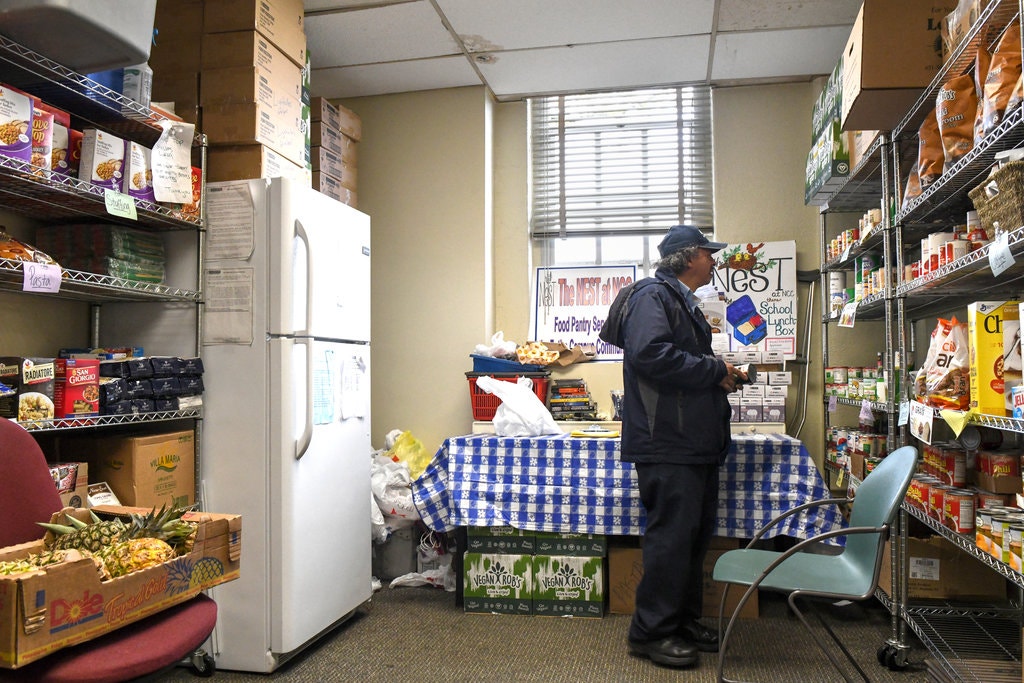
20sorkin1-jumbo

Photo: Desiree Rios for the New York Times
A community college employee shops at the campus food pantry. When folks get paid a living wage, they don’t need food pantries.

As much as I admire smart philanthropy, I recognize that helping individuals get by or even helping communities make lasting change can only go so far. Most of us know that when people can be self-sufficient, they feel happier — and the societal benefits last longer.

Opinion columnist Andrew Ross Sorkin writes about this at the New York Times.

“Real charity doesn’t come with a tax deduction. That’s what I told a gathering of generous Wall Street and business luminaries this month about the increasing paradox of even some of the most well-intentioned philanthropy.

“All too often, charitable gifts are used not only to help those who can’t help themselves but to make up for the failure of companies to pay people a living wage and treat their workers with dignity. …

“Countless C.E.O.s donate to worthy causes that, for example, help fund food banks and homeless shelters across the country. They should be applauded for their charity.

“But the real opportunity for generosity is more likely inside the workplace.

“Do you know who goes to the food banks that so many support? It is not just the homeless and unemployed. It is, many times, the people we all work with: The janitors and support staff who help offices run smoothly and keep them clean. The Uber drivers and people who work at the checkout counter and deliver groceries. The nannies and caregivers.

“According to Feeding America, 43 percent of people who visit a food bank have at least one family member who is working full time but still doesn’t earn enough to cover bills. A researcher for the Urban Institute estimated that a quarter of adults in homeless shelters work.

If business leaders genuinely care about eradicating poverty, paying people a living wage matters. …

“So here’s a challenge for chief executives and employees alike: When you go back to work after the holidays, ask your human resources department what the lowest pay is for any employee at the company. And, just as important, what is the lowest pay for any outside contractor that your company uses? What kind of benefits do they get? Do the outside firms your company contracts with provide benefits?

“Once you have answers to those questions, the real charity is to do something about it — whether you’re a decision maker or you can use your voice to influence the decision makers.

‘When I walk to work, I’m looking into the eyes of the homeless people. I can’t forget about them,’ Marc Benioff, the founder of Salesforce, told me. ‘I mean, that’s the whole point — that’s why we’re here.’ …

“ ‘This is why I like being in business, because I can create change — that business must be the greatest platform for change. And if it isn’t, then what is?’ he said. …

“This past year, Brian Moynihan, the chief executive at Bank of America, raised the firm’s minimum wage to $20 an hour. Walmart’s chief executive, Doug McMillon, who lifted his company’s starting wage, has called on Congress to raise the federal minimum. Mark Bertolini, a former chief executive of Aetna, raised the minimum wage at his company to $16 an hour — in 2015. All three companies have benefited — and their stock went up. …

“At the gathering of business leaders that I spoke to — organized by the UJA Federation of New York, which supports the poor and elderly in New York and in Israel — I shared what I had learned about the idea of charity. I grew up thinking that the Hebrew word tzedakah means charity, which is its modern definition. But I later learned its original meaning was much more profound: It meant ‘justice’ and ‘fairness.’

“So when it comes to giving, the goal shouldn’t be to simply donate more money, as laudable as that is. The aim should be to create a society where we don’t need places like food banks in the first place. To put it in Wall Street terms, we should be trying to put the food banks out of business.”

More here.

Read Full Post »

dsc1405_2

Photo: Alight (formerly American Refugee Committee)
The nonprofit called Alight, which believes in “doing the doable” amid daunting challenges, knows how to make a huge difference with just a small gift. For this tea lady in Sudan, the gift was a few chairs for customers.

I love this nonprofit and want you to know about it. It used to be called American Refugee Committee. Today it is Alight, an organization that focuses on doing the doable for those in need, including refugees here or in camps around the world. I get Alight’s e-newsletter, and it’s always full of inspiring stories about places many people think of as hopelessly damaged. Here are some words of cheer from Sudan.

Alight’s “Changemakers 365 is all about doing the doable. It’s about opening our eyes to the opportunities to make an impact in a person’s life with relatively few resources – and making change each and every day of the year. …

“Tea ladies are a neighborhood institution in Khartoum. They provide the place – a piece of shade and a place to sit – for the community to meet, connect and share a cup of tea. They don’t earn much at all, but they really are the glue that holds together communities.

“Fatima’s tea stand is right outside [Alight’s] front door. And that’s given us a great opportunity to get to know everyone who lives and works in the neighborhood.

“We wanted to thank Fatima for her service to the community, so we asked if there was anything she needed.

“ ‘Chairs,’ she said, immediately! Fatima’s stools weren’t very comfy and she wanted everyone to feel at ease as they discussed neighborhood happenings and the news of the day.

“It was an easy wish to grant. 30 minutes later we delivered a couple dozen chairs to an astonished Fatima.

“ ‘I’m the most happiest ever!’ ” Click here.

“Mayo is a large section of the city that is home to people who’ve relocated to Khartoum, mostly from western Sudan. And inside Mayo, there’s a neighborhood called Mandela that refugees from South Sudan now call home. Some came fleeing conflict near home, others were seeking the opportunity of the capital and the chance at a different future.

“For most the promise hasn’t lived up to reality. But there is a group of changemakers in Mayo determined to change that. Samira and Kemal lead the Green Hope Association for Peace and Development. They don’t have any regular funding. So, when they decide to do something new, they mostly just bootstrap it by gathering resources and talent from their own community.

“Green Hope offers adult education, skills training for women in carpentry, welding, food service, handicrafts, electrical repair and more. They even offer a food-for-work program for the vulnerable elderly in the neighborhood, providing food staples in exchange for seniors collecting trash in the community. But Green Hope’s primary mission is running a K-8 school for 200+ students.

South Sudanese and Sudanese students attend together in harmony. Teachers are college educated. There are no funds for teacher salaries, so they volunteer. And when the school day ends in the afternoon, they have to find some small jobs to make ends meet.

“Green Hope is abundant with hope, joy, possibility and a can-do spirit. But scarce in almost everything else. When we asked the students how we could help, their response was unanimous. Books! …

“So they gave us a list and we headed to the store to buy all the books that students from 5th to 8th grade would need to prepare for their high school entrance exams – Arabic, English, Mathematics, Geography, History, Science. The budget allowed for a notebook and pen for every single student in the school. And we received a donation of storybooks for the younger children – so everyone in Green Hope received at least one book. For many, their first ever book.

“ ‘We’re so happy, we want to dance,’ Samira told us. And they did.” More.

“Green Hope Founders Samira, Kemal and a group of women had built the center themselves some 15 years ago. At night!

‘We built at night, because construction work wasn’t really acceptable for women. AND we all had to work to make a living during the day,’ Samira told us.

“The school is compact, but there’s space for separate classrooms for all of the grade levels. What there wasn’t was a chair for every student. Some kindergarteners sat on the floor. Other kids shared chairs. We knew we could do something about that.

“We called up a local furniture maker and he got to work building wooden and metal chairs – small ones for the younger kids and big chairs that would work for older students and for the adults who come to Green Hope for adult education and skills training.

“The kids had also asked us for some exercise materials, so we grabbed some soccer balls and jump ropes. And we had enough left over to buy a small stock of crayons and JUMBO coloring books for the two, three and four-year olds who accompany their older siblings to school – and sit so nicely, by the way – because their mothers are at work.

‘You may think that what you have done here is small, but it will make a big difference for our children,’ said Kemal. ‘Thank you for coming back to us down this bad road.’

More.

If you’re feeling down, you can sign up for the doing the doable newsletter or follow Alight on Facebook or Twitter @We_Are_Alight . Alight has earned the top rating at Charity Navigator.

Read Full Post »

Photo: Christy Sommers
People who raise goats in India, Bangladesh, and elsewhere, think it’s obvious you’d put sweaters on your goats in cold weather. It takes an outsider to be surprised — and make a calendar.

Got your 2019 calendar yet? We have way too many at our house because my husband donates to so many nature organizations. I wish that nonprofits would forget about free gifts and just spend donations where the money is most needed.

Today I have a story about a charity calendar that is not a giveaway. You have to buy it. But I hereby make an exception to my grumpiness about charity calendars.

Danielle Preiss writes at National Public Radio (NPR), “When we came across pictures of ‘Sweateredgoats‘ on Instagram, we wanted to know more. …

“The caprine fashionistas are featured on a calendar, the sales of which have benefited local organizations in Varanasi, India, where most of the images were taken.

“Christy Sommers, who takes the photos, first noticed the cuteness that is clothed goats in 2010, while living in a village in northwestern Bangladesh as a Fulbright scholar studying rural primary education. …

” ‘It blends my love of cute things with India and this desire that I have for people to understand the rest of the world better,’ Sommers says.

“Originally from Des Moines, Iowa, Sommers has spent much of the last five years working in northern India as an instructor and administrator for a high school and college travel abroad program called Where There Be Dragons. She started to notice goats, particularly in lower-income urban areas, decked out in winter gear. Varanasi doesn’t actually get too cold — typically not dropping below a January average of 60 degrees.

Sommers says when she asks families why the goats are clothed, they usually tell her it’s because they’re cold — and look surprised that she’s asking something so obvious.

“And it turns out to be a good idea. Jagdip Singh Sohal, assistant professor of microbiology and microbial genomics at Amity University in Jaipur and organizer of the Asian Regional Conference on Goats, confirmed that goats can get cold. …

“Extra insulation, whether from a sweater, a discarded track suit or a burlap sack, allows the goat to divert more energy to productive purposes, like getting meatier and birthing more kids. …

“[Sommers] gives about half the profits to Asha Deep, a school for underprivileged kids in Varanasi. (The rest of the money she views as compensation for her labor.) The $4,500 donation from 2018 calendar sales provided the funds the school needed to operate for one month. Asha Deep is a vetted charity on Global Giving, a U.S.-based nonprofit that crowd funds donations for local NGOs around the world. …

“Meanwhile, the goat owners aren’t that impressed. To them, dressing a goat in a sweater is no big deal. ‘They generally think I’m crazy,’ she says.”

More at NPR, here.

Read Full Post »

Famed physicist Stephen Hawking has ALS and has to talk using an electronic voice substitute. Recently, as part of a skit for the antipoverty charity Comic Relief’s Red Nose Day fundraiser, he pretended to audition a bunch of well-known actors to be his newest voice.

Erin Jensen reports at USA Today, “A new, highly sought after role might not win actors any Oscars or BAFTAs, but that’s not stopping Hollywood’s elite from auditioning.

“In the clip, Hawking, who has ALS and communicates with synthesized speech, reviewed tapes from the self-described ‘intelligent … kind of’ Anna Kendrick and Rebel Wilson, who got a hard no from the physicist. Hawking also wasn’t persuaded by The Theory of Everything stars Felicity Jones and Eddie Redmayne or the ‘soothing, calming voice’ of Gordon Ramsay.

“Hawking wasn’t Taken with Liam Neeson’s voice either, despite the actor’s opinion that it possessed ‘a tinge of … physics.’ ” More.

For the true story behind Hawking’s voice, read this Wired article. Joao Medeiros details the many iterations of the technology underlying Hawking’s ability to communicate, but he notes Hawking likes his original “voice” and has stuck with it.

“His voice had been created in the early ’80s by MIT engineer Dennis Klatt, a pioneer of text-to-speech algorithms. He invented the DECtalk, one of the first devices to translate text into speech. He initially made three voices, from recordings of his wife, daughter and himself. The female’s voice was called ‘Beautiful Betty’ the child’s ‘Kit the Kid’, and the male voice, based on his own, “’Perfect Paul.’ Perfect Paul is Hawking’s voice.”

Photo: http://www.hawking.org.uk/

Read Full Post »

I love stories about young people who have an impulse to help people in need. And I like that they often have creative ideas about how to do so that an older person might never have considered.

At the Boston Globe, Astead W. Herndon recently covered a high school student, now at Tufts University, who got her creative idea in a rather unusual way — while watching reality television.

Herndon reports, “Before Hannah Steinberg had a day named in her honor and was recognized by a US senator, the Tufts junior was just another high school student watching reality television.

“On that day about four years ago, Steinberg’s show of choice was ‘Extreme Couponing,’ the cable program that follows discount-obsessed shopaholics who go to supreme lengths to buy ultra-cheap items regardless of whether they need them.

“But as she watched the show’s stars proudly hoard their deeply discounted prizes, Steinberg said she had a thought: What if she could coupon with a conscience?

“These days, the 20-year-old Steinberg has a registered charity that has donated more than $100,000 worth of household items, canned goods, and electronics to homeless shelters and hospitals by using the couponing tricks she observed on the show. …

“Steinberg uses the example of a chocolate bar priced at $1.19. If she finds a buy one, get one free coupon, and pairs it with a buy two, get one free coupon and a $4 off any $10 purchase discount, Steinberg said she can purchase 30 chocolate bars for only $6.

“To fund her purchases, Steinberg solicits donations to Our Coupons Care, her federally recognized nonprofit charity. By mixing that money with her coupon magic, Steinberg said she can make “every dollar count for four to five dollars.” More here.

Although this seems like a lot of work, to me that’s not the point. Here’s a young woman who is transforming a consumerism that has run amok — until it is almost an illness — into something positive. And she is demonstrating that people with kind hearts and compassion continue to be born.

Photo: John Tlumacki/Globe
Tufts student Hannah Steinberg surrounded by the coupons she collects to buy goods to donate to charity.

Read Full Post »

When I think of Russia and the words “big brother” together, I don’t ordinarily picture the charitable organization that partners adults with kids who need role models. Roman Sklotskiy has altered my mental model.

Last month, Diana Kultchitskaya interviewed Sklotskiy for the Christian Science Monitor.

“Roman Sklotskiy, a former businessman and a graduate of the Moscow State Institute of International Relations, didn’t dream of having a career in charity. In the early 2000s he was a pioneer in the telecommunications industry, testing applications for mobile networks.

“But then he was invited by a friend to be the administrator of a theater for deaf actors – a charity project launched by a group of professional actors and directors. He was so inspired by the experience that he decided to pursue charitable work.

“In 2007 he learned of a nonprofit group trying to bring a United States-based mentoring program to Russia. Big Brothers Big Sisters International is a volunteer program that helps orphans and children from troubled families find mentors who provide them with a role model and help them build a healthy relationship with an adult.

“In Russia this kind of volunteering was a new idea. Mr. Sklotskiy decided to join the Big Brothers Big Sisters of Russia team and became its director, spending six years developing it. …

“The selection process for people who would like to participate in Russia’s Big Brothers Big Sisters program is strict. … Those who are selected receive training. Psychologists work with them and explain the unique demands of communicating with an orphan. …

“Alexandr Gezalov, an expert on child adoption and orphanages, says that the project is very successful.

“ ‘I’ve never seen a more effective format for communicating with an orphaned child,’ Mr. Gezalov says. The success of Big Brothers Big Sisters should be shared with other organizations, he says.

“Today Sklotskiy serves as director of charitable programs at the RVVZ Foundation. But he’s stayed involved in Big Brothers Big Sisters as chairman of the board. And he thinks it still has great potential to grow and help even more children. Currently Big Brothers Big Sisters is operating in Moscow and St. Petersburg.”

More here.

Photo: Svetlana Balashova for the Christian Science Monitor
Roman Sklotskiy longed to do charitable work, and he found his calling in developing Big Brothers Big Sisters of Russia.

Read Full Post »

Heifer Project is a charity founded by Dan West, “a farmer from the American Midwest and member of the Church of the Brethren who went to the front lines of the Spanish Civil War as an aid worker. His mission was to provide relief, but he soon discovered the meager single cup of milk rationed to the weary refugees once a day was not enough. And then he had a thought: What if they had not a cup, but a cow?”

Recipients of Heifer Project’s cows, chickens, pigs, and other assistance commit to giving the offspring of the donated animals to others in need. That way the giving grows and spreads.

Recently, Heifer Project has been helping poor farmers in Guatemala make enough from their cardamon crops to live on.

Editor Jason Woods, has the story in the nonprofit’s magazine, World Ark.

“Miguel Xo Pop farms his own plot of land. Everyone in the Sierra de las Minas depends on two crops, cardamom and coffee, to survive. Xo and his family are no different. Traditionally, the cloud forest’s climate helps the two plants thrive, but in the past few years a pair of plagues cut cardamom prices in half and reduced coffee income to nothing.

“Recently, Xo joined a Heifer International Guatemala project that will help him keep the pests away from his cardamom while adding more crops to his farm, but the project is still in its initial stages, gaining momentum. So for now, Xo spends a quarter of a year away from his wife and five kids to earn money.”

More on the lives of the farm families, here.

The reporter also describes how an altruistic businessman moved to a “double bottom line,” one that includes charity.

“A couple of years ago, McKinley Thomason was searching for a way to use his Nashville-based spice business to make a positive impact. After hearing about Heifer International’s burgeoning work with cardamom, he knew he had found his organization.

“Shortly after contacting Heifer, Thomason’s company, The Doug Jeffords Co., started donating 10 cents to Heifer Guatemala for every seasoning blend sold from their J.M. Thomason line. But Thomason’s passion for Heifer’s work in Guatemala moved him to do even more.

“Thomason has been acting as a project adviser to Guatemalan farmers, sharing his market knowledge and technical expertise in the world of cardamom. He is also making connections and introducing Heifer Guatemala to other like-minded spice companies that could support this or other projects.”

More at Heifer Project, here.

Photo: Dave Anderson

Read Full Post »

A husband and wife who run a restaurant in Norfolk, Mass., have opened their hearts to worthy causes, offering to assist through sales of a Brazilian dough boy.

Bella English writes at the Boston Globe, ” ‘We know the stresses of running a restaurant,” says Jennifer [Lima], 37. ‘But we promised each other we would also use it to do some good.’ …

“They donate bread weekly to the Wrentham Food Pantry. Their first Easter brunch, they donated much of the sales to the local fire department. They’re constantly giving gift cards to this or that raffle.

“When a friend was diagnosed with breast cancer, struggling to work while raising her son and undergoing treatment, they donated a percentage of their earnings to Project Princess, which a friend organized on the woman’s behalf.

“And when the family of a young Marine just back from Afghanistan wanted to book a welcome home party, the Limas told them no problem. In late December, a peak holiday time, they closed the restaurant and donated the entire party. They hung signs and strung red, white, and blue lights around the bar.

“ ‘Who else closes on a busy Saturday night?’ asks Lauren Eliopoulos, the Marine’s sister. ‘They would not take anything in return. It touched my entire family.’ …

“Rolling in the Dough, [is] the couple’s latest endeavor. Their ‘Doughboy,’ take my word for it, is the best piece of fried dough you’ll ever eat. … The box notes that 100 percent of the proceeds from Doughboy sales will go to a person, family, or cause in need. ‘Do you know a deserving cause? E-mail lima@novatosgrill.com.’ ”

Read more here.

Photo: Bella English

Read Full Post »

Older Posts »