Feeds:
Posts
Comments

Posts Tagged ‘conservation’

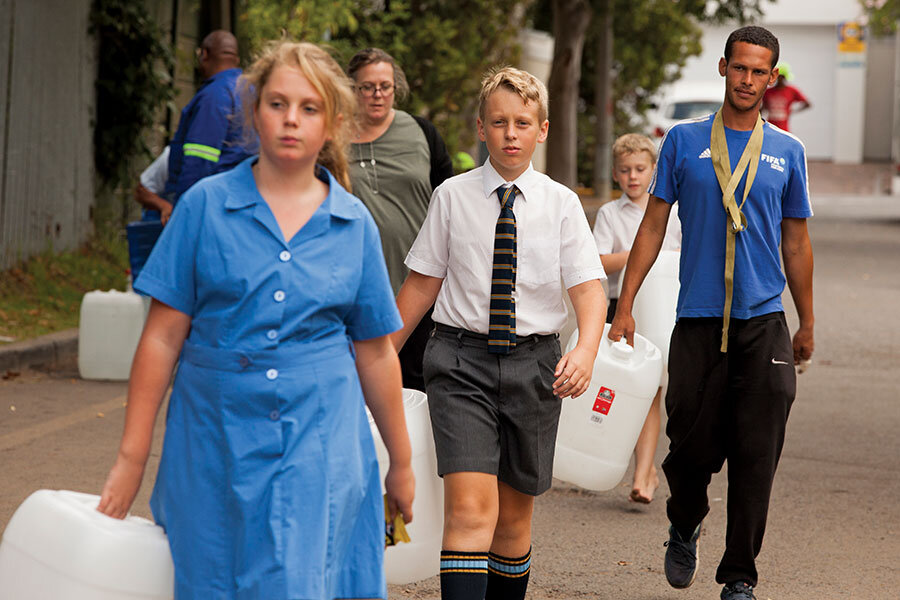
Photo: Melanie Stetson Freeman/Christian Science Monitor

People come with plastic bottles and jugs to collect free water in Cape Town, South Africa, where a dire shortage spurred residents to cut water usage in half.

You may have read about the dire water scarcity in Cape Town, South Africa, a situation resulting from lack of public funds to do the work that would have protected the supply.

But this story shows how much people can accomplish when faced with a life or death challenge.

Ryan Lenora Brown reports at the Christian Science Monitor, “A year ago, [Musa] Baba and [Helen] Moffett had almost nothing in common, and in many ways, they still live in two different universes. Moffett lives in a manicured gated community flanked by mountains. Baba’s house is two tin rooms she built herself that grip the side of a hill cluttered with other small shacks.

“But these days, the two women, along with millions of others here, share a common preoccupation: how to save water. For Baba and many others, that’s been a lifelong project of necessity. But for another population of Cape Town residents, including Moffett, it’s part of a massive lifestyle pivot that has helped bring the city on the southwestern tip of South Africa back from the brink of the unthinkable.

“As recently as March, Cape Town’s government was instructing residents to prepare for an imminent ‘Day Zero,’ when taps across most of the city would be shut off indefinitely. …

“Newspaper headlines across the world blared [Cape Town] was about to become the first developed city in the world to completely run out of water.

“But behind the scenes, a tectonic shift was under way. As the city bartered for water with local farmers and hustled to build desalination plants, its residents simply started using less water. A lot less.

“And it has worked – at least for now. … Using a combination of sticks and carrots to coax residents on board, the city has cut its water use by half. Its biggest customers now use 80 percent less. Today, every Capetonian is allowed just 13 gallons of municipal water per day – a little less than the amount it takes to flush a toilet four times. Use more, and the city reduces your pressure to a trickle, and your water bill can turn into a mortgage payment. …

“Here in Cape Town, suburban residents have become connoisseurs of taking 90-second showers and then flushing their toilets with the water they collected while doing it.

“On popular water-saving Facebook groups, city residents debate the best way to wash their dog ‘off the grid’ (bottled water, one woman suggests. Scrub him down with used bath water, offers another.) They swap the names of local companies that will sink a personal well in your backyard. Local police, meanwhile, receive a steady stream of tips from concerned residents who’ve seen their neighbors committing the ultimate middle-class drought crime: watering their lawns. …

“Says Kirsty Carden, an engineer at the University of Cape Town’s Urban Water Management Research Unit, ‘Yes, it’s been a crisis, but it’s also good to learn these lessons now. Cape Town isn’t the only city in the world that’s going to need them for the future.’ …

“Water restrictions have had another, less obvious effect: They have given the rich a small but rare experience of how the poor have always gotten by.

“ ‘It’s humbling, learning to think about water the way most South Africans have been doing for a long time,’ Moffett says, arranging two gallon jugs of water from another local spring in the trunk of her car. ‘Every household chore takes three times as much thought, and three times as long.’ …

” ‘We have always lived like this – nothing has changed because of the drought,’ says Baba, sloshing a T-shirt in a sudsy bucket outside her house. ‘If now rich people can understand better what that’s like, I think that’s a good thing.’ ”

More at the Christian Science Monitor, here.

Read Full Post »

Photo: Kathryn Scott Osler/Denver Post via Getty Images
Black-footed ferrets are the most endangered mammal in North America. Scientists in Montana are trying to save the ferrets by saving their main food source, prairie dogs.

Never doubt the power of a research report written in elementary school. Maybe I would have become interested in conservation anyway (my mother headed up a local conservation group for years), but a report I wrote in 6th grade about the devastation to birds caused by fancy hats pre-WWI made me pay particular attention to birds. John, an environmentalist today, really got into the cause of endangered black-footed ferrets when he wrote a report on them in elementary school.

Although once-threatened birds like the snowy egret and the great egret have been saved, the black-footed ferret, alas, is still endangered. At National Public Radio, Nate Hegyi reports on how scientists are addressing the problem today.

“In central Montana, drones are dropping peanut butter pellets on prairie dog colonies. It’s part of an effort by biologists to save North America’s most endangered mammal — the black-footed ferret (or as the U.S. Fish and Wildlife Service calls it, the BFF).

“Prairie dogs make up the vast majority of a BFF’s diet. Save the food and you save the ferret, biologists wager. …

“Kristy Bly, a senior biologist with the World Wildlife Fund, [said] there are only about 300 black-footed ferrets left in the wild, and they depend almost entirely on prairie dogs to survive. And protecting the prairie dog population is beneficial to species beyond the ferrets.

” ‘Prairie dogs are Chicken McNuggets of the prairie, where so many species eat them,’ Bly said.

“But in recent years, prairie dog towns across the American West have been exposed to a deadly disease called sylvatic plague. While it’s treatable in humans, sylvatic plague can wipe out entire prairie dog towns in less than a month. And that means no more food for endangered black-footed ferrets.

“So Bly, [Fish and Wildlife biologist Randy Matchett] and a team of scientists and engineers have spent this year vaccinating prairie dogs in central Montana against the plague using drones.

“Drone pilots fly the machines across the prairie, dropping blueberry-sized pellets about every 30 feet. They are flavored to taste like peanut butter, and prairie dogs love peanut butter. The kicker is that they’re laced with a live vaccine that protects them from the plague. …

“By the end of [one] day, they hope to expose more than 4,000 prairie dogs to the vaccine. Past field trials have shown that prairie dogs living in vaccinated areas survive waves of the plague.

” ‘Without [the ferret], do we really have a complete ecosystem?’ Bly asked. ‘You start taking those pieces apart, it’s like a domino effect. When we have ferrets on the landscape the piece of the puzzle that is the American prairie all fits.’ ” More here.

I like the idea of using drones this way. Makes me wonder if the technique could be adapted to handle the overabundance of deer in areas suffering from tick-borne disease. Couldn’t a deer contraceptive in salt pellets be scattered by drones? Just asking.

Read Full Post »

I wish Pete Seeger were around for this story. The folksinger spent many years sailing his sloop the “Clearwater” up and down the Hudson River to draw attention to pollution. Today the river is in good enough shape to attract a whale chasing its dinner.

Recently, New York Times reporter Katie Rogers interviewed Dr. Rachel Dubroff, whose apartment overlooks the Hudson. She writes that the first time Dubroff spotted a whale swimming outside her living room window, “she didn’t quite believe the sighting was real,” but news reports in November confirmed that “the Hudson River has a resident humpback.”

Continues Rogers, “The Hudson, as scenic as it is, does not scream ‘whale habitat.’ But experts say cleanup and conservation efforts have led to cleaner waters and an abundance of fish. …

“A whale appearing in the Hudson is very rare, [Paul Sieswerda, the president of Gotham Whale, an organization that tracks marine life around the city] said, which is why he thinks this one is a solo traveler. But the whale still faces significant danger because it is swimming in traffic-laden waters. …

“ ‘When you have whales chasing the bunker [menhaden], and fishermen chasing the stripers that chase the bunker, accidental interactions between whales and vessels can occur,’ Jeff Ray, a deputy special agent with NOAA’s law enforcement division,” added.

I hope everyone using the river will watch out for whales and try to coexist. It would be great if the whale came back after the usual typical retreat to warmer breeding grounds in winter.

More at the New York Times, here.

Art: Amy Hamilton
A humpback whale like the one spotted in New York’s Hudson River in November 2016.

Read Full Post »

Upscale housing developers used to advertise tennis courts, pools, or golf courses as desirable amenities. Today they are increasingly likely to tout farmland.

Amy Hoak writes at MarketWatch about a family in suburban Chicago, where neighbors’ lawn chemicals have killed off pollinators. She reports that the Faheys are moving to a community that offers more opportunity for growing vegetables.

“Set in Hampshire, Ill., about 50 miles from downtown Chicago, Serosun Farms is a new home-conservation development, restoring wetlands, woodlands and prairie, and preserving farmland throughout. Already, the frog population has grown exponentially from the conservation work done onsite, and monarch butterflies are also on the rebound, said Jane Stickland, who is working on the project with her brother, developer John DeWald. Their efforts also are boosting the bee population. …

“Serosun plans to incorporate about 160 acres of working farmland, making farm-to-table a way of life for residents through regular farmer’s markets. The community also offers eight miles of trails, an equestrian center and fishing ponds: 75% of the development will be reserved for farming and open space. …

“The concept isn’t new, but ‘agrihoods’ are gaining in popularity, said Ed McMahon, senior resident fellow for the Urban Land Institute, an organization that focuses on land-use issues. He tracks about 200 agrihoods, where residential development coexists with farmland. …

“ ‘We started to realize you could cluster houses on a small portion of a farm and keep the farm working,’ he said. People were often drawn to the open spaces. More recently, however, there has been a huge interest in locally grown food. ‘All of a sudden, agrihoods have become a hot commodity in residential development,’ McMahon said.” More here.

This concept is not only for upscale developments. In urban neighborhoods without access to a local grocery or healthful food, affordable housing combined with community gardens and sales outlets are moving along without much fanfare. In Providence, for example, West Elmwood Housing Development Corporation‘s new Sankofa Apartments partner with the Sankofa Initiative, an outlet for homegrown food and handmade crafts from many countries. The initiative is satisfying to residents on a personal-development level and as a way to meet neighbors and build community.

Photo: J. Ashley Photography
Serenbe farmers’ market.

Read Full Post »

Photo: Lancaster Farming

Wish I could remember where I first saw that this Ephrata-based magazine had a story on a farm that I have been driving past for 30-plus years without knowing much about it.

Sarah L. Hamby writes at Lancaster Farming, “Since 1999, the Farrell family has lived and worked at Sunset Farm, transforming nearly 150 acres into a well-known destination for freshly baked pies, heirloom tomatoes, and quality, all-natural meats not just for sale to the public, but also served at dozens of beach-front restaurants.

“Located on a four-lane highway in the south end of Narragansett, a small beach town in Rhode Island with a population that doubles during the summer months, Sunset Farm is one of a kind.

“In 1986, the Narragansett Land Trust was established to preserve open land in the largely developed Rhode Island town. …

“In 1991, historic Sunset Farm, established in 1864, along with Kinney Bungalow, a turn-of-the-century landmark and picturesque spot for weddings, was acquired by the town. … Since 2013, both the farm and bungalow have been on the National Register of Historic Places.

“The farm has been so successful that in 2014 the family signed a 25-year lease with the town of Narragansett. In return for taking care of the farm, the Farrells live rent free, though they do pay utilities. Maintenance and restoration work is part of the job, too, and must be up to historical standards.

“If you ask farmer and landscaper Jeff Farrell why he and his family applied to be caretakers of Sunset Farm, the last working farm in Narragansett, he will answer you with the candor and humor of most who work the land for a living.

“ ‘I lost my mind.’

“Ethan Farrell, who is now 25, has put a marketing degree from Johnson and Wales University to work at Sunset Farm. His phone constantly rings with calls from local restaurants and delivery trucks. … Last July, he started a food truck designed for local festivals and events, bringing his own flare to the farm-to-table movement. …

“The family donates to the local food pantry, supports area events for veterans and charities, and recently introduced gift certificates to increase activity from the local community.”

Read about the challenges of being the only farm in a tourist town at Lancaster Farming, here. And do check out Sunset Farm on Facebook at http://www.facebook.com/SunsetFarm505 — or  at http://www.sunsetfarm1864.com.

Photo: Seth Jacobson
Kinney Bungalow is available for events.

Read Full Post »

Although I didn’t get to see it in person, I was excited to learn from Timmons Roberts by way of Erik that the indigenous Hawaiian canoe Hōkūleʻa was making a stop in Rhode Island.

Lars Trodson writes at the Block Island Times, “The island welcomed the crew of the Polynesian catamaran Hōkūle‘a [June 21] at a ceremony held at the Block Island Maritime Center in New Harbor. The crew was greeted with songs sung by the students from the Block Island School, as well as greetings and tribal gifts from Loren Spears, an educator and former Council Member of the Narragansett Tribe of Rhode Island. Capt. Kalepa Baybayan of the Hōkūle‘a also offered brief remarks.

“The Hōkūle‘a is traveling around the world to teach about ocean conservation. ‘We live on a blue planet,’said capt. Baybayan. ‘Without the blue there would be no green.’ …

“Block Island is the Hōkūle‘a’s  only stop in Rhode Island.”

From the Hōkūleʻa website: “Our Polynesian voyaging canoes, Hōkūleʻa and Hikianalia, are traveling over 60,000 nautical miles around the earth, bringing people around the world together to set a course for a sustainable future.

“We are sailing like our ancestors have for a thousand years—using wayfinding. On board, there is no compass, sextant, or cellphone, watch, or GPS for direction. In wayfinding, the sun, moon, and stars are a map that surrounds the navigators. When clouds and storms make it impossible to see that map, wave patterns, currents, and animal behavior give a navigator directional clues to find tiny islands in the vast ocean. …

“Everyone can be the navigator our earth needs. Every person on earth can help navigate us to a healthy future where our Island Earth is safe and thriving again. …

“We are asking kids, families, governments, communities, and businesses to share how they mālama honua—take care of our Island Earth.  Please visit our Mālama Honua map, and help us grow the movement by adding stories of hope that can inspire and educate us all. …

“Hōkūleʻa, our Star of Gladness, began as a dream of reviving the legacy of exploration, courage, and ingenuity that brought the first Polynesians to the archipelago of Hawaiʻi. The canoes that brought the first Hawaiians to their island home had disappeared from earth. Cultural extinction felt dangerously close to many Hawaiians when artist Herb Kane dreamed of rebuilding a double-hulled sailing canoe similar to the ones that his ancestors sailed.

“Though more than 600 years had passed since the last of these canoes had been seen, this dream brought together people of diverse backgrounds and professions. Since she was first built and launched in the 1970s, Hōkūle’a continues to bring people together from all walks of life. She is more than a voyaging canoe—she represents the common desire shared by the people of Hawaii, the Pacific, and the World to protect our most cherished values and places from disappearing.”

Lots more at www-dot-hokulea-dot-com.

Photo: Block Island Times

Read Full Post »

My friend Kristina is an artist with a long-time interest in shells. At a Harvard-based shell club that she frequents, she meets many interesting artists and scientists — including George Buckley, a Caribbean coral reef researcher who made the video below.

Buckley says, “Little did I know in 1976 that my first visit to Bonaire to study land snails … and dive with Captain Don Stewart would lead to a career interconnected with Bonaire and to some 100 more return trips!

“Bonaire became the focus of case study after case study of marine management and biodiversity in my Harvard University environmental management program. [Dozens] of research and study groups, students, magazine writers and photographers that I brought to the island all fell in love with the landscapes and the emerald sea of Bonaire.

“The early years of the Bonaire Marine Park [BMP] and STINAPA [Dutch acronym for national park] … were a great adventure and while my efforts with the Carco Project and Marecultura were not as successful as hoped, both helped to lay the groundwork for future efforts around the world as to best practices in that field.

“The BMP’s pioneering leadership in education, moorings, gloves policies, banning light sticks and spearfishing, creating the ‘Nature Fee’ and so much more led to Bonaire’s well-deserved world-wide recognition. The efforts to save Klein Bonaire were a testament to international collaboration and stand to this day as the Hallmark of what a committed group of concerned people can accomplish. It is indeed true that Bonaire is to conservation of nature as Greenwich is to time – with credit to Captain Don.”

If you are on Facebook, check out the rest of Buckley’s post.

Photo: Sand Dollar in Bonaire


Read Full Post »

Is the New England cottontail no longer in trouble? I guess, as David Abel suggests at the Boston Globe, it depends on who you talk to.

“The threatened New England cottontail — the region’s only native rabbit, made immortal in The Adventures of Peter Cottontail [by Thorton Burgess] — appears to be making a comeback.

“Federal wildlife officials [are] removing the cottontail from the list of candidates to be named an endangered species. It’s the first time any species in New England has been removed from the list as a result of conservation efforts. …

“Wildlife officials said the bark-colored rabbits, which have lost nearly 90 percent of their dwelling areas to development, are benefiting from an increasing effort to protect their habitat. …

“The rabbit, which has perky ears and a tail that looks like a puff of cotton, has been the victim of development that has wiped out most of the region’s young forests. … Unlike its abundant cousin, the Eastern cottontail, the New England species relies on the low-lying shrubs of young forests for food and protection from predators, such as raptors, owls, and foxes. …

“Some environmental advocates worry that the federal government may be acting prematurely in removing [New England cottontails] from the list of candidates for endangered status …

“It has never been easy to galvanize concern for the cottontails, given how much they look like the nonnative Eastern cottontails. Those rabbits, brought to the region by trappers in the 19th century, have flourished because they have better peripheral vision than the native bunnies …

“ ‘People think they’re everywhere,’ Scott Ruhren, director of conservation for the Audubon Society of Rhode Island, said of the local cottontails. ‘But like every species, they are important and deserve a place on the New England landscape.’ ” More here.

Update January 10, 2019: More good news at EcoRI, here. If zoos can do more this sort of wildlife restoration, they will go a long way toward justifying their existence to opponents.

Photo: Mark Lorenz for The Boston Globe
A New England cottontail bred in a refuge in Newington, N.H., was penned Thursday in advance of its release.

Read Full Post »

Maria Popova linked to this story on twitter. It’s about how climate change is affecting a way of life for Fiji Islanders.

Meehan Crist writes at the blog Nautil.us, “The day that conservation biologist Joshua Drew, his two students, and I arrive in the Fijian village of Nagigi, the wind is blowing so hard that the coconut palms are bent sideways. ‘Trade winds,’ we are told. And, ‘El Nino. The villagers here also know that climate change is affecting the weather, but their more immediate problem, shared across the Pacific—and, indeed, the world—is an ocean ecosystem sorely depleted by overfishing.

“Nagigi is a village of about 240 people living in tin-roofed wooden homes strung along a sandy coastline. A single paved road runs the length of the village, parallel to the ocean, and along this road are homes clustered by family, painted in cheerful pastels, and connected by well-worn paths through the crab grass. ‘Before,’ said Avisake Nasi, a woman in her late 50s who has been fishing this reef her whole life, ‘you just go out and you find plenty fish. Now, you have to look.’ …

“If pressures mount from too many sides at once—rising ocean temperatures, acidification, pollution, overfishing—the combined pressure will be too much even for Fiji’s remarkably resilient reefs to bear. …

“Conservationists and humanitarian groups have recently united in the call for sustainable resource management, and in this trend, Nagigi is ahead of much of the Western world. Villagers have been discussing how they might use a traditional ban on fishing known as a tabu (tam-bu) to help manage their marine resources in new ways. …

“Drew presents his findings about how fish here are interconnected with other reefs, and how to best protect the species most important to the village in terms of food and income. He talks about how, for the last three years, he has been collecting baseline data about the species present on the reef so that if the village sets up a tabu, its effects can be measured.

“His audience is most interested in what Drew has to say about where to set up a tabu—include the mangroves at the left side of the village shore, because they act as fish nurseries—and for how long—three years would give crucial species enough time to mature and spawn. There has been some talk of a one-year tabu, which would be less of a hardship for villagers who will have to walk a mile or more to reach ocean where they are allowed to fish. But Drew’s data suggest this wouldn’t be long enough to make the sort of difference the village wants to see. ‘I can only offer information,’ Drew says at the end of his presentation, ‘the decision is yours.’ ”

The reporting for Crist’s  story was made possible by a grant from the Mindlin Foundation.

Try to see the related climate-change movie Revolution, which I wrote about here.

Photo: Meehan Crist
The view from Nagigi’s school to the sea, where many locals make their living

Read Full Post »

One of the websites I check for cool stories is the one for Living on Earth, an excellent environmental news magazine from Public Radio International. In a recent episode, host Steve Curwood interviewed the author of a new book on the rare Asian “unicorn.”

“CURWOOD: Deep in the forests of southeast Asia lives a creature nicknamed the Asian Unicorn, and it’s nearly as rare as the mythical creature, as well. … And it is right at the edge of extinction. Writer William deBuys accompanied conservationists on an expedition to study the saola, and his book The Last Unicorn lays out the story and the challenges of saving a species so rare. …

“DEBUYS: The saola was discovered to Western science only in 1992. Local villagers in the habitat of the saola [such as Laos] have known it was there forever, but this new discovery was made when scientists saw a rack of horns on the wall of a hunter’s shack. And these horns are the most distinctive features of the saola. They’re long, almost straight, and beautifully tapered to a very sharp point, so that when the saola stands profile, the two horns in perspective merge into one, and it appears to have only one horn, it appears to be a unicorn. Perhaps only dozens to a few hundred still exist, and there are none in captivity. …

“CURWOOD: Tell us what it’s like there in the forest. What would you hear in the forest?

“DEBUYS: Oh, the music of the forest was constantly inspiring and entertaining. The birdcalls never ceased. We heard laughing thrushes, and we heard drongos and Indian cuckoos and all kinds of birds with really distinctive calls. There was a kind of chorus behind us all the time.

“But the most marvelous thing occurred at first light, almost every morning. We heard the calls of gibbons. Gibbons are small apes, beautiful, slender animals that swing through the trees, so gracefully, and their calls are ethereal. And they call, male to female and female to male, in mated couples, and you can think of it as almost a kind of love song that you hear echoing through the forest. …

“Our expedition basically had three purposes: one was to look for saola habitat and for saola in that habitat. A second was to evaluate the poaching pressure on the landscape. And a third was to conduct a kind of conservation diplomacy in the villages of the forest. …

“CURWOOD: How many saola did you see?

“DEBUYS: Well, we saw none. No Westerner has yet seen a saola in the wild, and the joke is that saola are so like unicorns, and everybody knows that in the Middle Ages, the only people who had an outside chance of seeing a unicorn had to be absolutely pure of heart. And Robichaud and I joke that if that applies also to saola, then we were disqualified from the get-go.” More here.

Note the thoughtful discussion at Living on Earth about the rights and sensitivities of native peoples where the conservation efforts are focused.

Photo: William Robichaud / Wildlife Conservation Society
The first adult saola to be observed outside of its habitat.

Read Full Post »

I was charmed by Sy Montgomery’s recent article in the Boston Globe on the intelligence of octopi (she says “octopuses”).

The author of The Soul of an Octopus: A Surprising Exploration into the Wonder of Consciousness, Montgomery describes getting to know a clever and apparently affectionate octopus called Octavia.

“Everyone wanted to pet Octavia,” she writes. “And no wonder. She was beautiful, graceful, and affectionate. The fact that she was boneless, slimy, and living in painfully cold, 47-degree water deterred none of us.

“What thrilled us — me, New England Aquarium volunteer Wilson Menashi, and four visitors from the environmental radio show Living on Earth was the surprising fact that Octavia, who clearly wanted to be petted, was a giant Pacific octopus.

“When her keeper, Bill Murphy, opened the top of her exhibit, Octavia recognized Menashi and me immediately; we’d been working with her for several weeks. Turning red with excitement, she flowed over toward us from the far side of her tank. When we put our hands in the water, her arms rose to meet ours, embracing us with dozens of her strong, sensitive, white suckers. Occasionally Wilson handed her a fish from the plastic bucket perched on the edge of her tank. …

“Then, as Menashi reached for another capelin to feed her, we realized the bucket of fish was gone. While no fewer than six people were watching, and three of us had our arms in her tank, Octavia had stolen the bucket right out from under us.

“ ‘Octopuses are phenomenally smart,’ Menashi says. And he should know: He has worked with them for 20 years, and is expert in keeping these intelligent invertebrates occupied. Otherwise, they become bored. Aquariums design elaborate escape-proof lids for their octopus tanks, and still they are often thwarted. Octopuses not infrequently slip out of their exhibits and turn up in other tanks to eat the inhabitants.

“Many aquariums give their octopuses Legos to dismantle, jars with lids to unscrew, and Mr. Potato Head to play with. Menashi, a retired inventor, designed a series of nesting Plexiglas cubes, each with a different lock, which Boston’s octopuses quickly learned to open to get at a tasty crab inside. And just this spring, New Zealand Sea Life aquarists teamed up with Sony engineers to teach a female octopus named Rambo to press the red shutter button on a waterproof camera to take photos of visitors, which the aquarium sells for $2 each to benefit its conservation programs. Rambo learned in three attempts.”

What a different perspective on the scary beast in the film 20,000 Leagues Under the Sea, which I saw as a child.

I’d love to copy the whole intriguing article, but I’m afraid that would not be “fair use.” So read it all here.

Photo: Tia Strombeck
Sy Montgomery pets Octavia, an octopus at the New England Aquarium in Boston.

Read Full Post »

In a move that will benefit the environment, farmers are placing increased emphasis on the quality of their soil and cutting back on ploughing. It took a kind of soil evangelist to create the revolution.

Erica Goode has the story at the NY Times.

“Gabe Brown is in such demand as a speaker that for every invitation he accepts, he turns down 10 more. …

“Mr. Brown, a balding North Dakota farmer who favors baseball caps and red-striped polo shirts, is not talking about disruptive technology start-ups, political causes, or the latest self-help fad.

“He is talking about farming, specifically soil-conservation farming, a movement that promotes leaving fields untilled, ‘green manures’ and other soil-enhancing methods with an almost evangelistic fervor.

“Such farming methods, which mimic the biology of virgin land, can revive degenerated earth, minimize erosion, encourage plant growth and increase farmers’ profits, their proponents say. And by using them, Mr. Brown told more than 250 farmers and ranchers who gathered at the hotel for the first Southern Soil Health Conference, he has produced crops that thrive on his 5,000-acre farm outside of Bismarck, N.D., even during droughts or flooding.

“He no longer needs to use nitrogen fertilizer or fungicide, he said, and he produces yields that are above the county average with less labor and lower costs. ‘Nature can heal if we give her the chance,’ Mr. Brown said.” More here.

Sounds like wisdom that even a backyard farmer could embrace.

Photo: Brandon Thibodeaux for The New York Times
“My goal is to improve my soil so I can grow a better crop so I can make more money,” [says Texas farmer Terry] McAlister, who farms 6,000 acres of drought-stricken cropland. 


Read Full Post »

Fred Pearce of Yale Environment 360 (a publication of the Yale School of Forestry & Environmental Studies) had a post on some positive change in Kenya recently. It came to me by way of the Christian Science Monitor Change Agent e-mail.

“In Kenya, local farmers are replacing state officials and forest wardens …

“Kenya’s five main ‘water towers’ — the Aberdare Mountains, the Mau forest complex, Mount Kenya, Mount Elgon, and the Cherangani Hills — cover just 2 percent of the country. But their elevation means that they intercept clouds blowing off the Indian Ocean, capturing most of the country’s rains. These places are the sources of all but one of Kenya’s major rivers. …

“Emilio Mugo, the acting director of the Kenya Forest Service (KFS) … says an important factor in [the process of reclamation] was the popularizing of the phrase ‘water towers.’ It unlocked a recognition about the nation’s precarious ecosystems and water supplies, and their link to forests.

“ ‘The new terminology galvanized public attention,’ he says. Calls to revive the towers became a national priority, culminating in the creation in 2012 of the Kenya Water Towers Agency to coordinate government activity.

“We are now looking at the towers as national assets,” says Francis Nkako, the CEO of the new agency. In the past five years, 81 square miles of the Mau forest system have been repossessed from illegal settlers for ecological rehabilitation …

“Control of the forests is being systematically given to democratically elected community forest associations (CFAs) that manage the forests under agreements with the KFS. …

“Under the agreements, CFAs are tasked with ensuring sustainable use of the forests, preventing illegal activity in them, managing and raising fees for grazing of livestock and firewood cutting in the forests, and starting new economic activities based on forest resources. No members of the community are allowed to live in the protected forests, but they can use them.” More here.

Photo: Fred Pearce
Sarah Karungari shows beehives set up by the community forest association (CFA) in Kimunye village in Kenya. Management of mountain forests is being systematically given over to democratically elected CFAs.

Read Full Post »

The Barnes Collection is a quirky museum that is now located in Philadelphia. The eccentric art collector required all his art to be displayed a particular way. Which is perhaps why two Cézannes hidden behind other works weren’t uncovered before now.

Writes Randy Kennedy in the NY Times, “In 1921, the wily art collector Albert C. Barnes wrote to Paris to his friend and fellow collector Leo Stein, who was in dire need of money and had deputized Barnes to sell some of his holdings in the United States. They included five watercolor landscapes by Paul Cézanne, but Barnes reported that he had failed to find ‘anybody who seems to think they are sufficiently important to want to own them.’

“It was pure mercantile flimflam. Barnes turned around and bought the watercolors for himself, at $100 each, installing them permanently in his personal museum near [Philadelphia]. Now it turns out that Barnes got a better deal than even he had thought: A conservation treatment of the watercolors has revealed two previously unknown Cézanne works — a graphite drawing and a watercolor with graphite — on the verso (the reverse side) of two of the watercolors.

“Hidden beneath brown paper backing, the newly discovered pieces are unfinished, but they have sent tremors through the world of Cézanne scholarship, where additions to his body of work are exceedingly rare and where even the resurfacing of long-unseen pieces can be huge news. …

” ‘These are a perfect example of how much we still don’t know about this collection,’ said Martha Lucy, a consulting curator at the Barnes and an expert on its Renoir and Cézanne holdings. ‘To add new work to Cézanne’s oeuvre is incredible.’ “

More here.

Art: “New” Cézanne at the Barnes Collection in Philadelphia

Read Full Post »

Good news for Letterbox Farm Collective in New York State! The environmental nonprofit Scenic Hudson’s interest in protecting a Hudson River tributary has enabled the young farmers to purchase land.

Scenic Hudson’s Jay Burgess writes, “Scenic Hudson has acquired a conservation easement protecting 62 acres of productive farm fields and watershed lands in Greenport, just south of the City of Hudson. The easement’s purchase enabled a group of young farmers who had been leasing the property to purchase it, securing the future of their farm operations.

“Known as the Letterbox Farm Collective, the farm partners supply specialty vegetables, herbs, pork, poultry, rabbits and eggs to a variety of regional and New York City markets — local bakeries and food trucks, many restaurants (including New York City’s renowned Momofuku restaurants) and two farmers’ markets. In the spring the farmers will launch a diversified Community Supported Agriculture (CSA) operation. …

“ ‘Achieving the goal of Scenic Hudson’s Foodshed Conservation Plan — meeting the growing demand for fresh, local food in the Hudson Valley and New York City — depends on successful partnerships like this, which provides a stable base of operations for the dedicated young farmers in the Letterbox Farm Collective. We also thank these farmers for enabling a future public access point to our protected lands along South Bay Creek, which present exciting opportunities for Hudson residents and visitors to enjoy the outdoors,’ said Steve Rosenberg, executive director of The Scenic Hudson Land Trust. …

“ ‘We were lucky to have Scenic Hudson with us while we gathered our financing and at the closing table when the moment came and we were able to buy our land,” said Letterbox’s Faith Gilbert.” More here.

Thanks to Sandy and Pat for letting me know and congrats to their niece for being successfully launched in farming.

Photo: Nathaniel Nardi-Cyrus

Read Full Post »

« Newer Posts - Older Posts »