Feeds:
Posts
Comments

Posts Tagged ‘dance’

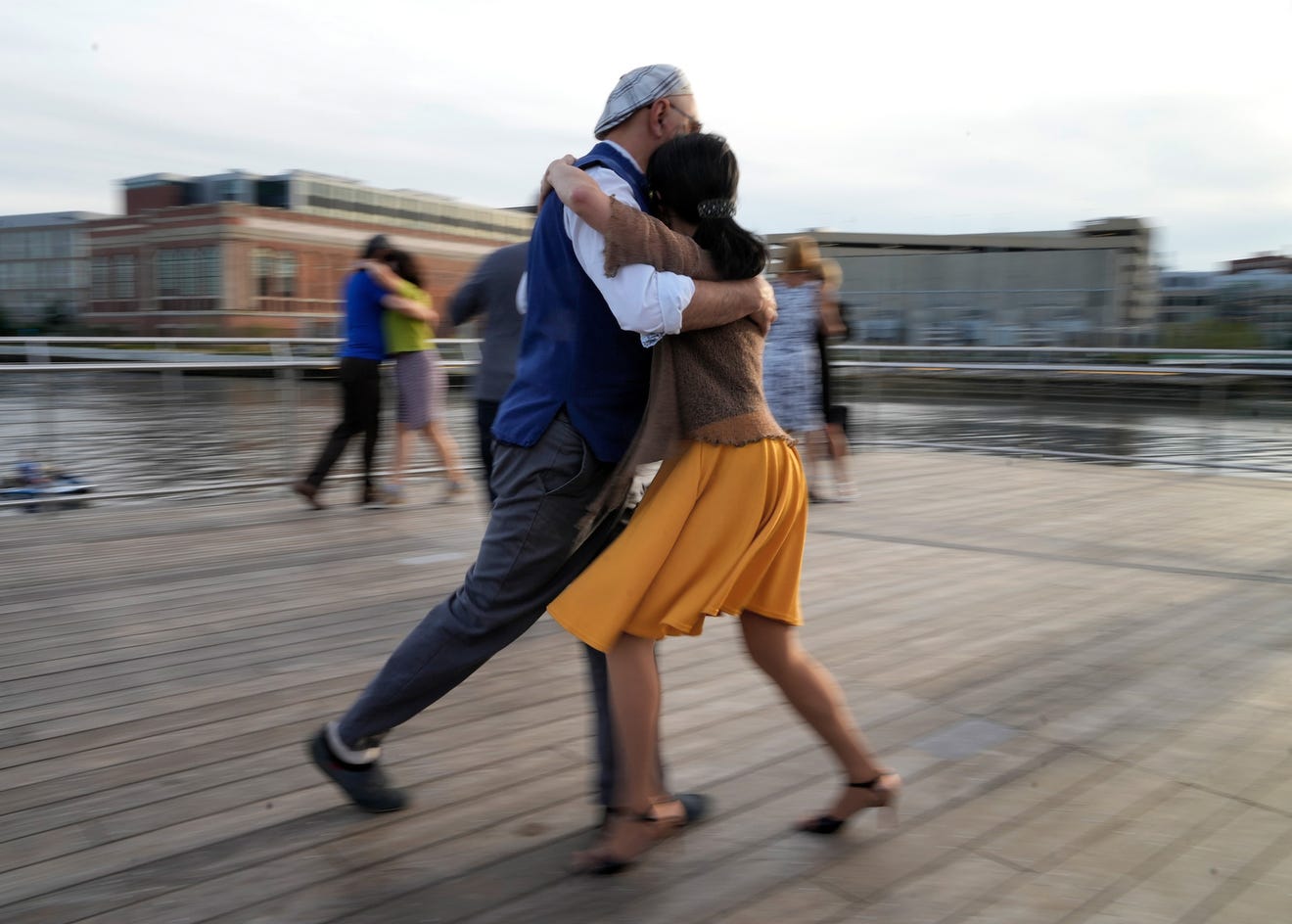
Photo: Bonfire Visuals/Greenville Journal.
Beautiful gowns are part of the competitive ballroom-dancing experience.

Do you ever watch ballroom competitions on television and wonder where the women get their amazing gowns? At the Washington Post, Cathy Alter provides an answer — for those who can afford it. The gowns are pretty expensive.

“It could be any house in suburban Annandale, Va.,” writes Alter, “among the split-level Colonials with manicured boxwood shrubs — except, around back, past the statue of the red fox and down some steppingstones, there’s a sign on the basement door to greet visitors: ‘You’re about to enter a sparkle splash zone. Twirling encouraged.’

“Inside, Julie Wilson runs a business here in the family home, known by those who need to know as Encore Ballroom Couture. It’s considered the ballroom dance industry’s leading consignment and consignment-rental dress company. Competitive dancers come here from far and wide, as do the frocks. The abiding aesthetic is more is more: feathers, sequins, fringe, crystals. …

” ‘Dancing With the Stars’ is scheduled to return to ABC’s prime-time schedule with its 32nd season this fall (after a sidestep to Disney Plus for a season); Bravo, in its endless hunt for reality-based drama and conflict among ambitious women and certain men, concluded its first season this summer of ‘Dancing Queens.’ …

“Fans of these shows, or just of the scene itself, may wonder where the gowns come from, or where they go after they’ve been worn. A good place to start is here in Wilson’s basement empire.

“Wilson danced competitively for 20 years, which included a decade as an instructor. She was a pageant queen, too. (Ms. Virginia; Ms. Ireland USA.) The years went by, and her closets bulged with the glimmering evidence of moments in the spotlight. There was no place for the family to keep winter coats. Wilson remembers when her mother, Brenda, had enough: ‘She said, “Julie, you need to do something about this.” ‘

“Wilson, 44, says it was hard to part with her girls. (Gowns, in this community, are all female.) ‘I didn’t trust eBay to take care of my dresses,’ she says. Plus, the resale space for competitive ballroom dancing dresses was ‘a black hole.’

“Brenda Wilson, a retired OB/GYN nurse, and Julie, a government contractor, decided to open Encore, transforming the basement of the home they shared with husband and dad Walter into a dance destination. Chandeliers simulate the lighting of competition dance floors, white ostrich feathers are arranged in vases and a small refurbishing station stands ready for dresses that need a bit of first aid. Instead of nails and screws, small drawers contain a color spectrum of crystals.

“At first, Julie sold her own dresses. Then she sold her friends’ dresses. Fourteen years later, Encore has an inventory of around 450 dresses, consigned by dancers who retired, overhauled their image or whose closets needed some breathing room. Consignors get 60 percent of the sale price, which can be quite considerable; dresses here start around $4,000. Dress rentals begin at $300.

“One of the first girls Wilson resold that wasn’t her own belonged to Rose-Ann Lynch, a lieutenant colonel in the U.S. Marine Corps. … When Mike prepared to retire in 2005, Rose-Ann handed him a honey-do list, which included dance lessons. ‘I told him, “I don’t want you to lead if you don’t know where you’re going,” she says.

“The duo competed for the first time that same year and are currently the 23-time USA Dance Senior Amateur national champions, a category for people ages 55-64. Tight as drums, Mike and Rose-Ann make a compelling case that the fountain of youth can be found on the dance floor. A logistician by training, Mike possesses rational, chess-like strategies that come in handy on the dance floor. With multiple couples whirling and twirling at the same time, avoiding a collision is vital when the judges determine their final scores.

“Today, the Lynches have come to Encore Ballroom Couture in search of an American Smooth dress for Rose-Ann. A primer, for those who need one: Competitive ballroom dancing includes both American and International categories. American style includes Smooth (waltz, tango, fox trot, Viennese waltz) and Rhythm (cha-cha, rumba, swing, bolero, mambo); International is separated into Standard (waltz, tango, Viennese waltz, slow fox trot, quickstep) and Latin (cha-cha, samba, rumba, paso doble, jive).

“American Smooth and International Standard styles call for dresses with floats (think fluttery silks that move behind the dancer like wisps of steam), and Rhythm and Latin necessitate something shorter and sexier.

“In American Smooth, partners separate and dance side by side, a la Fred and Ginger, so dresses must look good both coming and going. In International Standard, the couples dance closely, so dresses need look amazing only from the back.

“If Rose-Ann finds a dress today, it will appear in one of the most important dance competitions of the year: the Amateur National Championship, next March in Pittsburgh. ‘I always like to be prepared for Nationals,’ she explains.” 

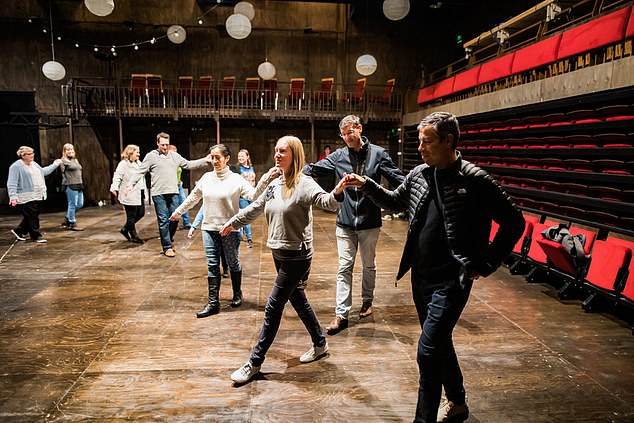
Yesterday I peeked in at a ballroom refresher class for folks in my retirement community. The couples looked pretty sedate. And there certainly weren’t any swirling gowns.

Nice photos and more than you ever wanted to know on this topic at the Post, here.

Read Full Post »

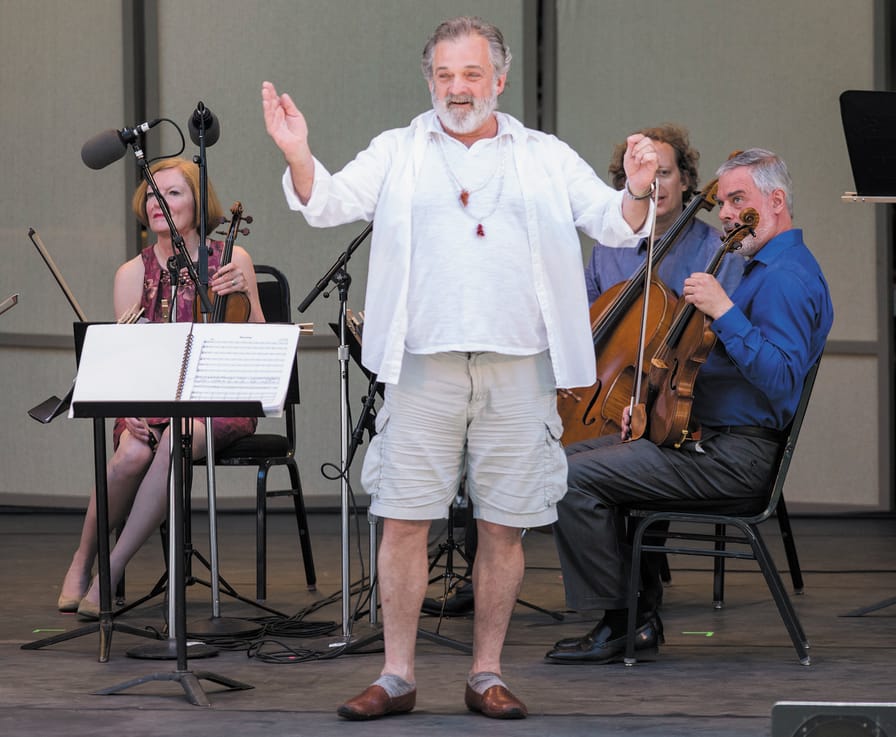
Photo: The Nation.
Choreographer Mark Morris at the Ojai Music Festival.

Many people know Mark Morris as a great choreographer, but much of his success has depended on his devotion to teaching his dancers.

Alastair Macaulay wrote recently about this side of Morris at the New York Times. “New York City has often been called the world’s dance capital. One good reason is that a number of the world’s foremost choreographers not only lived and worked in New York, but also taught class here. Martha Graham, George Balanchine, Merce Cunningham and many others helped to lure dancers to the city.

“Fewer and fewer of today’s top dance-makers carry on that tradition. The foremost exception is Mark Morris. … While there have been seasons when his choreographic inspiration has dipped, his performers have almost invariably looked wonderful. This is a tribute to how he and his teaching colleagues prepare them each day.

“The dancers don’t present themselves as virtuosos. And they’re all such distinct individuals — each exuding what seems natural — that it’s easy to make the mistake of thinking they don’t share training. But it’s precisely their schooling with Morris, whose company, the Mark Morris Dance Group, was established in 1980, that makes them look so natural.

“ ‘I first taught when I was 13 — Spanish sevillanas — and first taught ballet in my later teens,’ Morris, 66, said in an interview at the Union Square Cafe. ‘As an adult, I used to teach modern or jazz or ballet. I would take class all over the city, which is how I met so many fabulous people: We were all dancing together. And when I gave workshops, I’d ask the most talented people to come back and be in my next piece.’ …

“ ‘It’s just the last year or two I’ve cut back,’ he said. He now shares teaching assignments with company alumni. Surprisingly, for a modern-dance master, he teaches a ballet class, with a live pianist. The dancers start by standing at the barre, bringing more and more parts of the body into play with each exercise. Then, after about 40 minutes, they work without support in the center of the room. Finally they move expansively across the room, in phrases involving turns and jumps.

“It’s ballet — though with a difference or two. Like other modern-dance choreographers (he particularly credits Hannah Kahn), Morris will sometimes ask his dancers to articulate and bend the spine in ways largely foreign to ballet — they alternate convex and concave shapes of the spine at the barre — and to phrase in irregular counts. And there’s no work on pointe: the dancers are barefoot or in socks or soft shoes. …

“The Morris class is ‘a very pure form of ballet that strives to be stripped of its affectations,’ Billy Smith, a dancer who joined the company in 2010, wrote in an email. ‘We do use our torsos in a more “modern” way than maybe a ballet company would in class. But at the core our classes are very much oriented toward the purity of ballet technique.’ …

“Morris, an invariably entertaining talker, speaks exuberantly to his dancers, between exercises — about what’s on television, about an unmissable Broadway show (and about the long lines for the ladies room in Broadway theaters), about New York traffic gridlock, about Olive Oyl. But this spiel isn’t just a one-way Morris event: He wants his dancers to be people with lives and interests, not just dance executants, and he enjoys their repartee. …

“Sam Black, who became a full-time Morris dancer in 2005 and is now the company director sharing the teaching assignments, will give his stage farewell during the Joyce season. In an interview at the Mark Morris Dance Center in Brooklyn in July, he recalled how he used to stretch his arms too straight upward in certain positions. Morris would say, ‘You only have three joints in your arm. You have to make a curve with only three joints. That takes imagination.’

“Many dancers have remained with the company more than 10 years, their longevity in part attributable to Morris’s growing concern with anatomical efficiency. …

“It was not until 1988, when the Morris dancers moved for three years to Brussels to become the resident company at the Théâtre Royale de la Monnaie, that he began to teach them a daily ballet class. That was when Megan Williams, now a ballet teacher, joined. She remembers that, in class, he enjoyed giving them one exercise for footwork and one for the upper body.

“ ‘He would show us the feet pattern, and then the port de bras pattern — separately!’ she said. ‘We had to put them together like a puzzle. It was almost impossible, like that exercise of rubbing your stomach and patting your head at the same time.’ “

More at the Times, here.

Read Full Post »

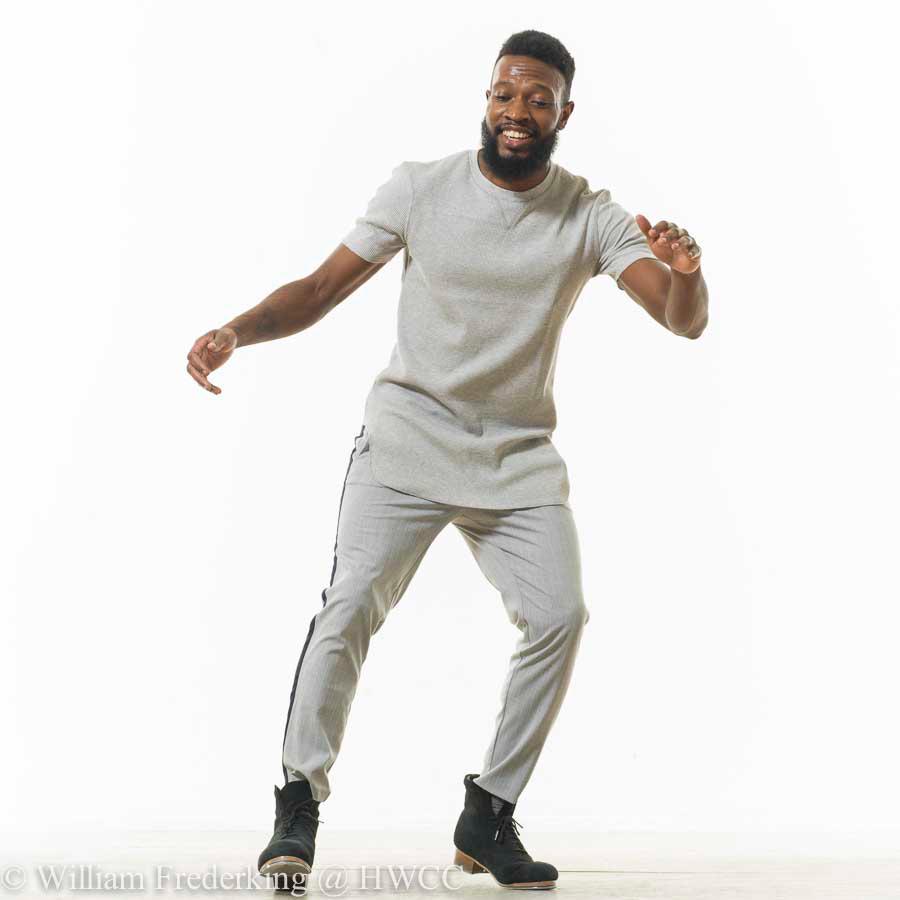
Photo: William Frederking.
Ja’Bowen Dixon is a performance and visual artist on the Broadway Dance Center faculty. He is one of the founding members of the tap dance company M.A.D.D. Rhythms

The New York subway gets a bad rap these days, but did you know about all the art down there? So much great stuff to experience.

Gia Kourlas writes at the New York Times, “You can tell when Ja’Bowen is feeling a song. The grounded power of his feet — whether tapping delicate, whispery notes or hitting rhythmic patterns with ferocity and speed — enlivens an unassuming place: a subway platform.

“But beyond his sleek and supple feet, there is simply his presence. With rigor, elegance and humor, he takes the craft of tap seriously while disarming the crowds that pass through his impromptu theater.

‘You know, more than tap dancing, I’m working to bring some good energy to the city, to the moment where I am.’

“Stumbling on Ja’Bowen is like uncovering a New York City art secret. The lucidity of his body and the music that it produces are steadying forces in an unpredictable space. For months now, this Chicago transplant has been bringing quality tap to the uptown F platform at Delancey Street/Essex Street.

“What he creates with taps and a wooden board — his portable stage — is a reciprocal experience. His dances are containers for waves of energy that pass between him and a crowd. He is a dance artist who makes people smile. Of all ages. In the subway.

“ ‘I get real hyped, and then the audience gets real hyped, and then I lay back a little bit and the audience gets a little quiet,’ he said. ‘It’s like a tennis match going back and forth.’

“His improvs often start slowly. ‘If I’m being honest,’ he said, ‘sometimes people aren’t paying attention or could care less that I’m down there.’

“When a dancer, or really any performer, needs too much love, I tend to look the other way. Ja’Bowen is different. He can seem lost in his own world, dancing for himself until he feels the people around him drawing closer, looking — taking a break from social media to watch a live performance. That’s when he sends his energy out to the crowd.

“Ja’Bowen knows audiences love it when he dances fast, but his preference is to sit back in the pocket, to swing. His internal focus — the way he listens and reacts in this unprotected space of strangers — is a vulnerable display of deep body-mind awareness. And while his musical sensitivity starts at his feet, it doesn’t end there. He dances with his entire self. He likes to play with the levels and emotions in music.

“Ja’Bowen hails from a tap family in Chicago, where his older brother and a friend started the collective company M.A.D.D. Rhythms in part to give Ja’Bowen, then a teenager, something to do. Ja’Bowen joined the percussive-forward group with no formal training. Once he became proficient enough, he started performing in the streets.

“ ‘That’s what really developed my talent more than anything else,’ Ja’Bowen said. ‘You build the skill in rehearsals, but performing is a different thing.’

“If a train is a minute or so away and he’s done with his number, he’ll pick up his mic and invite kids on the platform — they watch him in awe — to learn a step. ‘I’m inviting the kids up, and I’m wishing everybody a good day and that’s intentional,’ he said. ‘You know, more than tap dancing, I’m working to bring some good energy to the city, to the moment where I am.’

“That idea is proven again and again. ‘Hey, tap dancer!’ a woman cried out from the opposite side of the platform one day. She wanted to know where to find him on Instagram.

“Where does his inspiration come from? Ja’Bowen, also an actor and musician, draws a lot from Jimmy Slyde for the way he used tap as a way to connect with an audience, as well as Sammy Davis Jr. and Gregory Hines. ‘It’s not just their footwork but their presentation,’ he said, ‘the way they talk to an audience when they’re onstage, the way they stand still.’

“Tap, he added, is like music. ‘The notes that you’re not playing also have just as much importance as the notes you do play.’ ”

More at the Times, here. Awesome videos.

Read Full Post »

Photo: Erika Page.
The Christian Science Monitor says, “An Afro-Uruguayan rhythm may be traced back to slavery, but it’s transcending present-day divisions and differences to spark joy across Uruguay.” This group performed in Barrio Sur, Montevideo, in March.

There is a kind of street music in Uruguay that is wildly joyful and welcoming to all kinds of people. It’s called candombe.

Erika Page reports at the Christian Science Monitor, “One by one, the drums unite from every direction. Slung over shoulders, cradled by old-timers, and clasped on either side by children, they meet on a corner in the Montevideo neighborhood of Barrio Sur.

“The pulse begins sporadically, an unorchestrated call to gather. Those perched on curbs and leaning against cars perk up and wander over. By the time the Uruguayan flag takes to the air, waving from one side of the street to the other in the hands of a proud bearer, the drums are thumping in perfect unison. Dancers give life to the beat as they lead the parade down the block.

“This is candombe, a distinctly Uruguayan rhythm brought into being by the descendants of enslaved Africans who arrived at the port of Montevideo in the 18th century. Today that lineage is celebrated loudly and triumphantly, with this event marking the end of the Carnaval season. Wherever candombe goes, it makes visible a culture long left out of mainstream Uruguayan society.

“In the past few years, interest in candombe has boomed both within Uruguay and abroad. While some worry popularity could water down the tradition’s richness, those in the community say this beat belongs to everyone, and all are invited to make it their own.

“ ‘For us, it doesn’t matter your ethnicity, your skin tone, your age, your gender, if you have three university degrees, or if you never finished high school,’ says Wellington Silva, who has led this troop, one of the city’s most revered, alongside his brother since their father passed away. ‘The drums bring joy, they open channels of communication, they turn us into brothers and sisters.’

“As the sun dips out of sight, the division between procession and observers fades. Dancers, shy at the start, now twist their hips and kick out their feet as children weave in and out of the crowd making its way down the iconic Isla de Flores street. …

“ ‘Anyone who happens to pass by is bound to hear and to want to know more,’ says Álvaro Salas, the director of culture at the nonprofit Mundo Afro, which focuses on the visibility and rights of the Afro-Uruguayan population. ‘That’s the most natural part of being human. We have to love joy.’

“There are three main styles of candombe in Montevideo. … Cuareim 1080, was born on this very block, named after the historic address of the building where the parade convenes. [It] used to be a tenement where the city’s poor lived, including Mr. Silva’s father. 

“The practice of candombe had faded in the late 19th and early 20th centuries but found a new home in these communal living spaces. In the late 1970s, this and other conventillos, as the tenements were known, were cleared by the military dictatorship in an effort to make the center of Montevideo more attractive.

“ ‘They pick you up and throw you out, and what happens? You expand,’ says Dr. Salas. ‘Today, there is candombe in every neighborhood in Uruguay.’ …

“Afro-Uruguayans make up around 10% of the Uruguayan population and are three times as likely to live in poverty as white Uruguayans. But members of the candombe community say their music is a celebration rather than a protest.

“Fernanda Rossana was a kid when her family’s home in the Ansina conventillo was razed. She spent the rest of her childhood on the outskirts of town. These days she is a proud participant of the Ansina candombe troop and is here dancing in support of her husband, a member of Cuareim 1080.

“ ‘That’s candombe – not losing our essence or our roots,’ she says, dressed in bright orange. ‘It’s demonstrating that we are free.’ …

“For Mr. Silva, the leader of Cuareim 1080, candombe is a way of life open to anyone, whether they are of Afro-Uruguayan descendence or not. Everyone is welcome, he says, ‘as long as you understand that your freedom ends where another’s freedom begins, you always extend a hand, and you always greet your neighbor. When you have something someone needs, you offer it, and when you need something, come, because someone will provide it.’ ” 

More at the Monitor, here. No firewall. Subscriptions are encouraged.

Read Full Post »

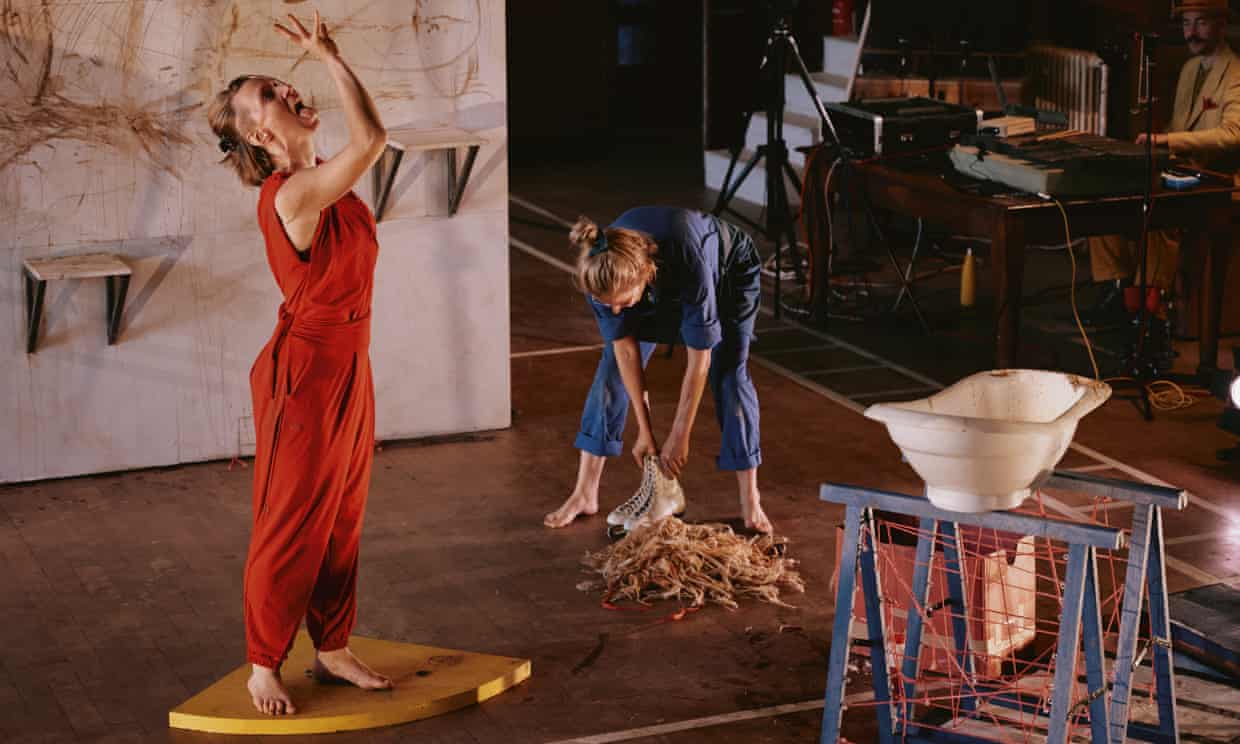
Photo: Luke Waddington.
At Cambois Miners Welfare Institute, Esther Huss’s avant garde dance group involved local residents in performing Stairwall. Another choreographer in the north of England tapped local low-income children for a production and realized that it would be practical to make costumes that the kids could keep.

When the arts engage local people, they learn fast that fantasy tied to the practical concerns of daily life works best.

Lyndsey Winship reports at the Guardian on dance groups in the UK that are serious about involving the community.

“On the beach, the sand is black-flecked with coal. The pit closed in 1968, houses condemned and residents pushed to move out. But people stayed. ‘There’s not much in the way of anything really,’ says one local resident, Becca Sproat, except for a strong sense of community.

“This isolated patch of Northumberland seems an unlikely place for the German choreographer Esther Huss to have set up shop, after 20 years in London. But her husband, the playwright Alex Oates, who grew up down the coast in Whitley Bay, brought her here. ‘I fell in love with the oddness of this place, this meeting of the industrial and nature and being slightly outside mainstream society. It’s creatively interesting,’ she says. …

“In the middle of a row of brightly painted houses stands the Cambois Miners Welfare Institute, built in 1929. It had been unused for more than a decade until Huss asked to have a look inside. … Huss and Oates took on the lease, shared with the local boxing club. So there is a boxing ring on the hall’s stage and leather punchbags along one wall. As well as Huss making her own work here, she runs a dance group, and Oates runs a writing group, shivering through the winter with no heating and scraping together funding to keep everything free. Some artists pay lip service to reaching new audiences, Huss and Oates are actually living it. Next is a two-year project Cambois Creates, to make a memorable event for the whole community.

“Huss’s choreography is inspired by dadaism, German expressionism and the Japanese dance-theatre form butoh, and in the Cambois dance group, she encourages novice dancers to create their own movement.

‘My family howl at me,’ laughs 61-year-old Alison Johnson, ‘ “Oh mam, show us your latest interpretive dance!” But it’s nice to do something different,’ she says.

“ ‘It’s become such a safe environment where we all get out of our comfort zone, because we trust each other, because of Esther. It’s special.’

“Sproat, 33, had been stuck at home for 16 months during the pandemic when she got a leaflet through the door. ‘Something about a dance group, and I just laughed and binned it, because there’s no way I was going to do that. Or so I thought!’ she says. Desperate to get out of the house, she agreed to volunteer at the Institute, ‘And somehow Esther’s enthusiasm rubbed off on me. I’m not a dancer,’ says Sproat, who has some mobility issues, ‘but I’ve learned how to express myself through movement. I’m a lot more confident than I was.’ …

“You’re a long way from the London bubble and for artists working here that can be part of the appeal. ‘Moving up here, it changed everything,’ says Huss. ‘I always felt like, does London need another dance piece?’ Liv Lorent, who moved to Newcastle 30 years ago, tells me the same: ‘London didn’t need another choreographer.’ Lorent only planned to stay a few months, but fell in love with the people, the light, the beauty, the audiences. [They’re] no-nonsense, there’s no woolliness, she says, but there’s always a sense of humor. …

“Lorent describes herself as ‘all heart and idealism’ and being in the north-east has allowed that. Like Huss, she’s long been committed to community involvement. Her company, balletLORENT, recently moved into a 1930s former school building in Newcastle’s deprived West End. Lorent frequently works with local adults and children in performances. She tells me about one project where there was a costume budget, but knowing some of those children were in need of every day clothes, she made the costumes something they could take home and wear after the show. It’s about creating fantasy, while living in the real world.

“Huss likes to take her fantasies into the real world. Her last piece, Stairwall, toured in unconventional venues including a timber merchants in North Shields. She heard that some of the male staff were expecting the dancers to arrive in heels and sexy outfits – ‘It’s quite blokey up here sometimes’ – so they must have been surprised by Huss’s multidisciplinary dance-theatre. But some of the men were game to be part of the performance, one telling Huss: ‘When I die, this is going to be one of the proudest days of my life.’ She loves seeing how people respond to her work. ‘I’m not pretending everyone liked it, but generally people were really open to it,’ says Huss.

“ ‘I was surprised how immersed I became in it,’ says Johnson. ‘I found myself becoming quite emotionally charged. The fact that she’s showcased these within Cambois, I remember feeling very privileged that something you would see on a stage in a major town or city was on in Cambois Institute!’

“ ‘I didn’t think I would actually like it,’ says Sproat, ‘But it was just so inspiring. Esther and Alex lived in London and there’s millions of opportunities down there. So for them to come here is amazing.’ ”

More at the Guardian, here.

Read Full Post »

Photo: Dale Robinette/ Lionsgate Publicity.
Emma Stone and Ryan Gosling are not primarily dancers, but thanks to coaching, they did a good job dancing in the film La La Land.

Fred Astaire and Ginger Rogers were film stars who were best known for dancing. But what if your stars need to dance but know no more steps than the average partygoer? For stunts, you get stunt experts, but do you also get experienced dancers to stand in? Can’t imagine how that would work.

Haley Hilton has the answer at Dance Magazine, “From Patrick Swayze lifting Jennifer Grey above his head in Dirty Dancing, to John Travolta and Uma Thurman doing ‘The Twist’ in Pulp Fiction, to Emma Stone and Ryan Gosling tapping their way through ‘A Lovely Night’ in La La Land, dancing Hollywood A-listers have made simple steps iconic on the silver screen. Behind the movie magic and clever choreography is a hard-working choreographer, navigating the challenges unique to actors with varying levels of skills in dance. Leading industry choreographers Chloé Arnold, Marguerite Derricks and Mandy Moore [say] creating choreography for celebrities takes a different set of skills — and amount of time — than working with elite professional dancers.

“ ‘With dancers, you know they can do anything you come up with,’ says choreographer and tap dancer Chloé Arnold, who created the moves for Ryan Reynolds, Will Ferrell and Octavia Spencer for the 2022 holiday film Spirited. ‘Whereas with celebrities, you have to first build trust, then take the time to discover how their body naturally moves.’ Uncovering strengths is the first step: For example, certain actors­ might have an innate musicality. Once a choreographer is aware of that, they can highlight that strength while avoiding steps that magnify their weaknesses.

“Marguerite Derricks, who choreographed for the Amazon Prime series ‘The Marvelous Mrs. Maisel’ from 2016 to 2022, believes that adaptability is essential when choreographing for A-listers. ‘Once I have the script, I go into a studio with an assistant and put together movement ideas,’ she says. ‘Then I take those ideas to the actors, but I’m very ready to change up the moves. Right when I walk in, I tell them I have hundreds of ideas in my pocket, so if we try something that looks great and feels good we continue. If not, I will remove it and start playing with new ideas.’

“Derricks, whose movement has been featured in more than 50 films and 40 television shows, cultivates an open dialogue with performers and a low-stress environment in the studio. ‘It’s not about pushing a style or an idea on actors, but going in as their confidant and cheerleader, and making them feel comfortable,’ she says. ‘When they see my patience, they are more patient with themselves.’

“When La La Land choreographer Mandy Moore works with celebrities, she makes sure that she will have ample time to teach them to dance. ‘On set, things can change and shift, and if the actor understands the basics of movement and weight changes, as well as the choreography, they will be able to make changes without melting down.’ She, too, enters the rehearsal space with an open mind. ‘I am someone who preps everything to a T, knowing it could all change the first second I get into rehearsal,’ she says. …

“Having an A-lister on a project will bring attention to the work, but for these three choreographers, the benefits extend far beyond that. ‘What actors bring to the choreography is so rich — they totally embody the character,’ Derricks says. ‘I get so excited because I know that in some ways, they will take my movement deeper than even dancers can.’ That’s why Derricks encourages dancers to take acting classes. ‘You can kick and spin and pas de bourrée, but the magic is how you put it all together in a story. Acting brings greater depth to your dancing.’

“The Spirited celebrities shared their genuine enthusiasm for tap with their massive fan base—as well as their appreciation for the dancers on set. … ‘Everyone was so kind, and there were no big egos,’ [Arnold] says. ‘If one of the actors grasped something and the other didn’t, they would respond with comedy. If the steps didn’t work out and needed to be changed, they were trusting. They could have challenged me or pushed back, but there were no excuses.’ …

“ ‘So much of choreography is reading the room,’ Derricks says. ‘When working with actors for the first time, I want them to know that I am here for them. I’m not here to win an award. I will do whatever I can to help make them comfortable and confident for the scene.’

“Building that confidence is no easy task. Moore says she’s found many actors have been told they’re not good dancers, leading to insecurities. ‘It’s time-consuming, but you need to help them believe in themselves,’ she says. ‘It’s almost like therapy — you don’t want to feed into their complex. You want them to leave you loving dance.’ One of the ways Moore fosters confidence in the rehearsal studio is by not having mirrors on the walls. ‘I don’t want them to get critical of how they look,’ she says. She also holds off on filming portions of rehearsal until the dancers are ready.

“Navigating difficult personalities is another potential challenge. When casting dancers, choreographers can choose who to work with, but when they are part of a larger work with celebrities, they don’t have that luxury. Arnold does all she can to change the energy in the room. ‘If you are seeing negative things, introduce alternatives,’ she says. ‘Dress for the betterment of the space. Sometimes I will come in wearing a message T-shirt that says something uplifting. Be kind, lead by example and make sure the rest of the cast feel supported by you.’ ”

More at Dance, here. No firewall. Nice pictures from movies.

Read Full Post »

Photo: Holger Rudolph.
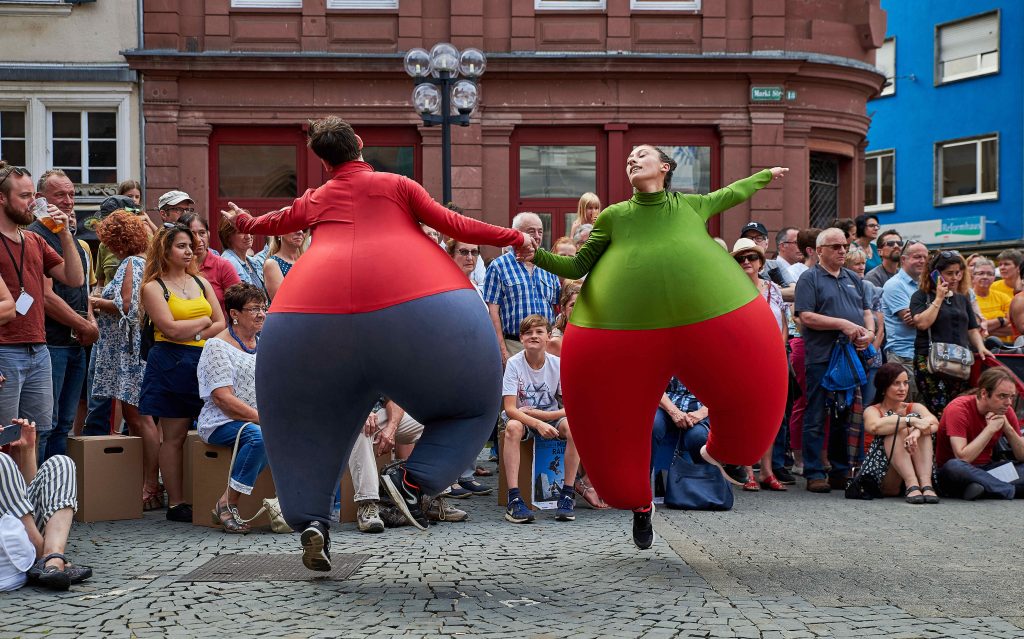
A performance of “La Grande Phrase” by French company Campagnie Didier Théron. The idea is to share the fun of dance and draw in new audiences.

I love reading about serious artists reaching out through humor. But what is going on in the picture above? One kid is watching the playful performance and wearing a big smile. Everyone else is looking in another direction with solemnity. Bad choice of illustration?

Celina Lei reports at Australia’s ArtsHub that the “French dance company Campagnie Didier Théron will soon land in Adelaide to upend expectations of dancers’ bodies with a dash of humor.

” ‘Dance!’ Usually when kids hear this cue,” she writes, “they immediately start wiggling their bottoms and shuffling their feet – circling, hopping and swinging their arms.

“But often as we grow, we grow more hesitant, our movements become more restricted and choreographed in fear of embarrassing ourselves. So what if to dance is to be silly?

“Wearing colorful inflated suits and roaming across streets, parks and city centers, La Grande Phrase (The Big Phrase) is a dance-work series by Montpellier-based Campagnie Didier Théron that explores ways to upend stereotypes of what a dancer should look like or do.

“The self-taught dancer and choreographer Didier Théron tells ArtsHub that the work was born from a journey of experimentation and collaboration with international artists and dance companies, allowing dancers the freedom of movement while wearing suits inflated with air. …

“Théron points to the German artist and choreographer Oskar Schlemmer (1888-1943), as well as Venus figurines of the European Paleolithic period, as inspirations for these dramatic bodily forms. The movement of dance and the flow of air within the suits further activate these forms.

“After touring in cities around Europe and taking out the 2013 Grand Prize of Setouchi Triennale in Japan, the company will bring three dancers to WOMADelaide (SA) this March where ‘any space shared with the audience becomes a performance space.’

“In the same way that contemporary visual artists are continually challenging the notion of a hushed, white-cube gallery, dance with a splash of humor can provide multiple access points for different audiences.

“From the time of Charlie Chaplin, who pulled off every sequence with full comic relief, to more recent contemporary experimentations such as the UK’s New Art Club combining dance with stand-up comedy, there are plenty of examples where humor can support choreographic expression.

“Théron says: ‘This project always surprises me in the reactions of the people and how they receive it. The first time we performed it outside was in a suburb of Montpellier. It was not easy to have a cultural artistic project in this area, but we crossed this line with these characters and everybody was laughing or smiling.’

“Taking this performance [onto] the streets also offers the dancers greater freedom, and the audiences more opportunities to interact, adds Théron. …

“Roving performances were also something that had a great impact on Théron as a child, from the very first time he encountered a ritualistic dance parade in his grandparents’ village in the centre of France.

“He says: ‘That was the first dance I saw and members of my family were also dancing (only men at the time), but it was very powerful and filled with a deep joy. This performance allowed me to reconnect with this memory.’ …

“What the company hopes to bring to the audience is an invitation to think about dance and dancers’ bodies ‘beyond the norm,’ and perhaps at some point share the joy of movement.

‘There is something in being this character that [gives] us permission to do many things. I think it’s a real positive body and filled with possibilities that we can experiment with all the time,’ concludes Théron.”

More at ArtsHub, here. No firewall. Funny pictures.

Read Full Post »

Soccer and Samba

Photo:MB Media/Getty Images.
Brazil’s players celebrate by dancing the samba after their win over South Korea. 

Is it my imagination or is there new excitement in the US over the World Cup this year? We have never been prominent among soccer teams, and that’s changing. Also, we have many immigrants and naturalized Americans from big “futball” nations. So there’s that.

In any case, it’s been fun. Suzanne and Erik and the kids each picked a team at the start, and three of them have had to swallow their disappointment and choose a second favorite. Suzanne is still standing.

Every soccer country has its own way of reacting to wins and losses. Not many are subdued. Today’s story is about the form that Brazilian soccer celebrations take.

Ed Aarons opens his story at the Guardian with a player’s memories of games in the 1930s.

” ‘I was afraid of playing football [soccer] because I had often seen a black player get struck on the pitch for committing a foul,’ said Domingos da Guia, a defender who played for Brazil in the 1938 World Cup. ‘But I was a very good dancer and that helped me on the pitch. I invented the short dribble by imitating the miudinho, a form of samba.’

Roy Keane did not like it but when Brazil’s players – and the coach, Tite – celebrated scoring against South Korea in their last-16 victory on Monday by performing Richarlison’s trademark pigeon dance, they were following a historic tradition that represents the very soul of the Seleção. Samba, which has its roots in Angola and the Democratic Republic of Congo via the African slave trade, and football were adopted by Brazil’s working classes just as Da Guia was making his international debut in 1931.

“According to Brazilian sociologist Gilberto Freyre, the distinctive style of play Brazil has become known for comes from the indelible link between the two:

‘In football, as in politics, a feature of the Brazilian racial blend is a taste for bending the rules, an element of surprise or frills that calls to mind dance steps and the Capoeira.’ …

“When a 17-year-old Pelé and the winger Garrincha inspired them to their first World Cup victory in 1958, the song A Taça do Mundo é Nossa – The World Cup is Ours – left no doubt about the vital importance of music to the team’s success. …

“According to legend, the celebrated samba singer Elza Soares fainted in the stands at the end of Brazil’s 3-1 win over Czechoslovakia in the final but recovered in time to perform a song in honor of her future husband Garrincha in the changing room.

“Pelé was among those to pay tribute to Soares in January after her death at the age of 91, describing her as a ‘legend of our music, historic, genuine, unique and unparalleled.’ …

“The tradition of celebrating goals with dance routines is generally a more recent phenomenon that has not been restricted to Brazilians. Roger Milla’s corner flag wiggle at Italia 90 and again at USA 1994 were inspired ‘by his own imagination’ according to the Cameroon striker, while Papa Bouba Diop celebrated his goal against France, the holders, in 2002 by removing his shirt and performing a mbalax dance with his Senegal teammates. But after Bebeto and Romario’s cradle-rocking routine in 1994 that was a tribute to the former’s newborn Mattheus Oliveira – now 28 and playing in the Portuguese second division – it is Brazil that has always had the strongest tradition to uphold.

“ ‘Dance is the symbol. We symbolize the joy of scoring a goal. We don’t do it to disrespect, we don’t do it in front of the opponent,’ said West Ham’s Lucas Paquetá after the South Korea match. ‘We get together, you can look. Everyone is there and we celebrate. It’s our moment, we scored the goal, Brazil is celebrating.’

“For Vinícius Júnior, who scored the first goal against South Korea, the criticism will have had particular resonance. In September, the Real Madrid forward was accused of not respecting his opponents and told to ‘stop playing the monkey’ by Pedro Bravo – a leading agent and president of the Association of Spanish Agents – on live television after celebrating his goals by dancing. …

“ ‘They say happiness upsets. The happiness of a black Brazilian successful in Europe upsets much more,’ Vinícius wrote. ‘Weeks ago they began to criminalize my dances. Dances that are not mine. They belong to Ronaldinho, Neymar, Paquetá, [Antoine] Griezmann, João Félix and Matheus Cunha. … They belong to Brazilian funk and samba artists, reggaeton singers, and black Americans. Those are dances to celebrate the cultural diversity of the world. Accept it, respect it. I’m not going to stop.’ ”

More at the Guardian, here.

Meanwhile, in Switzerland, riots break out after the World Cup loss to Portugal.

Read Full Post »

Body Percussion

Photo: K. Linnea Backe.
Leonardo Sandoval of Music From The Sole uses body percussion in dance.

Music is everywhere. You just have to listen for it. Children know. Most of them make music out of pots and pans before they can walk. I have pictures of my children and grandchildren sitting on the kitchen floor surrounded by everything they pulled out of the lower cupboards and getting ready to drum a joyful noise. You may have pictures like that, too.

Brenda Dixon-Gottschild at Dance Magazine writes about a kind of percussion that’s even more accessible than your pots and pans.

“Crash. Bump. Thump. Thwack. Whack. Knock. These are a few of the many synonyms of the word ‘percussion.’ All of them are appropriate when we look at the ways world cultures use the body as an instrument. …

“Clapping, stomping and striking body parts from head to feet in rhythmic or repetitive ways is a timeless means of human interchange, whether for pleasure, protest, entertainment, ritual, healing or survival. Hand- and body-clapping children’s games accompanied by sung or spoken rhymes are common around the world. … Enslaved Africans used body percussion as furtive communication — fearful of its messaging potential, plantation owners prohibited the use of drums, and to sabotage this taboo, the Black body became the drum.

“The juba dance, brought to the Americas in Middle Passage — the grueling sea journey of Africans captured from their homelands to live enslaved on foreign territories — was performed during plantation gatherings. In this dance of prowess, one person entered a circle of movers to exhibit their extraordinary variations on jig, hop and jump steps and was joined by a second dancer as the outer circle alternated rotating and remaining stationary. Pattin’ juba, the juba dance accompanied by clapping hands, chest and thighs, and the juba song — composed of short, rhymed verses that seemed like nonsense but carried double meanings — were ingenious later adjustments made to accompany the dance and send messages when drums were banned. Pattin’ juba further morphed into the hambone, a variation that centers on body percussion and is performed standing in place or seated, while retaining the original rhythm of the dance. …

“For Rennie Harris, legendary hip-hop concert dance choreographer and artistic director of Rennie Harris Puremovement and RHAW (Rennie Harris Awe-Inspiring Works), hambone was second-nature: ‘I don’t remember exactly when I learned or who taught me. In fact, I don’t even remember seeing it or being introduced to it — I just remember doing­ it,’ he says. ‘I was 7 or 8 years old; this was on Master Street in North Philadelphia. We used to sit on the stoops and challenge each other, doing the hambone, seeing who could do it the fastest, cleanest. It was a summer pastime. We sang the song, as well. Being older, I’d run into people who still do it, so it’s kind of interesting and cool. We’d add parts of it to dance steps. I didn’t learn the history of it, pattin’ juba, until later in life.’ …

“The basic hambone beat got a second life in the world of popular music. The 1950s R&B legend Bo Diddley made the five-accent hambone rhythm famous as the Bo Diddley Beat, a recurrent riff that has been appropriated by many white rock musicians.

“Tap dance, another style of body percussion, has impacted almost every culture. Using toes, heels and the full foot in rhythmic fashion goes beyond any one era or continent and includes traditions as diverse as African American buck dancing, Irish step dancing, English clogging and South Indian bharatanatyam.

“Beyond those traditional examples, the complex, polyrhythmic fusion of tap, combined with hambone-inspired body percussion, has proliferated with present-day artists across continents. The South African gumboot dance was transformed into a performance mode from its goldmine workforce origins, where it was created by Black miners as a sly replacement for conversation, since the white mine owners exacted harsh punishments for verbal communication among the workers.

“Other spinoffs include ensembles like Colombia’s Tekeyé; The Percussion Show, from Egypt; and the U.S.-based Music From The Sole, which draws on Afro-Brazilian influences. These artists transform a combination of tap and hambone to a glorious, millennial sensibility through the lens of hip hop and jazz.

“The art of flamenco includes a special kind of tapping — zapateado — as well as body-percussion elements that resonate with hambone.

” ‘Flamenco was being born in the mid-19th century. Certainly, by the 1902 arrival of the cakewalk in Spain, Black dance cultural motifs were transmitted, and flamenco artists expressly emulated Black American dance,’ says Dr. K. Meira Goldberg, author of Sonidos Negros: On the Blackness of Flamenco. “New forms that were created in explicit response to competition from Black artists in Spain emphasized percussive footwork, and over the past 30 or so years flamenco footwork techniques are increasingly influenced by tap and hip hop. It is fair to say that other modes of body percussion (hambone, or making percussion by snapping fingers, clapping hands or hitting hands on various parts of the body mixed with footwork) are also increasingly emphasized. Flamenco is always ready to absorb new performative ideas, and these ideas are reinterpreted and reinvented: In Spanish, the saying is “Llevarlo a tu terreno,” or “Make it your own.” ‘ …

“Indonesia has its share of corporeal clapping traditions as well. The Saman (‘dance of a thousand hands’) of the Gayo ethnic group of Aceh, Sumatra, is known across the island and performed by large groups to celebrate special occasions. Dancers sit on the ground with their legs crossed or folded beneath them, torsos upright. Though there are also mixed-gender performances today, ensembles had traditionally been separated by gender: Women do gentle tapping or patting on chest and thighs accompanied by hand-clapping, singing and rhythmically moving the torso and head, while the men move vigorously and their taps become slaps. …

“Exploring body percussion reinforces the understanding that everything we humans create has roots in something that went before. Even the most sublime innovations have a precedent. … The concealed riches of ‘the before time’ have become available on a global basis, thanks to social media, YouTube, streaming platforms and international touring by artists of every origin.

“Interestingly, hip-hop movements and music act as a unifying factor crossing cultural, class, racial and economic divides, transgressing differences, blurring boundaries and allowing a current generation of artists to travel beyond the assumed limitations of their genres, to try new things and experience other realms.”

More at Dance Magazine, here. No firewall.

Read Full Post »

Photo: Everybody Dance.
Summer dance participant in Los Angeles.

There are certain kinds of opportunities that are taken for granted in higher-income families. Being able to participate in sports that require equipment, tutors, summer camp, music and dance and art classes, college. Mary McNamara writes at the Los Angeles Times about a dance class that gets lower-income children and families thinking that opportunity might be possible for them, too.

“We could all use some good news these days, and that’s what Natasha Kaneda offered when she said [‘You can’t be scared when you’re dancing’] to her Jazz I class of 8- and 9-year-olds. …

“She was reminding them to stay focused even if something went wrong during a routine — to resume their dance without fear. She said it quickly, almost as an afterthought, but it should be on a T-shirt, like the Everybody Dance LA! T-shirts these kids were wearing.

“Practicing for their upcoming spring recital, these boys and girls could be part of any dance program. Well, maybe not any — their execution of steps exhibit grace, precision and energy, and their teachers, though unfailingly patient, are not about to let an imperfectly pointed toe or lethargic arm movement pass uncorrected.

“Whatever the skill level, the courses at Burlington studios, part of the building that also holds Camino Nuevo Charter Academy, are so instantly familiar they could be anywhere.

“Except that … for kids living below a certain income bracket, dance class is too often an impossibility. Clothing and lessons cost money; access to those mirrored rooms, even the ones at the local Y, is often out of reach.

“The dancers and the parents at the Burlington studios … wouldn’t ordinarily be taking pride in last summer’s performance with the Youth Orchestra of Los Angeles and the Los Angeles Dance Project, or preparing to send all of their graduating seniors off to college.

“Yet here they all are, part of the Everybody Dance LA!, an almost-too-good-to-be-true program founded more than 20 years ago by a grieving mother who believed that things should not remain unequal — and that you can’t be scared when you’re dancing.

“In 1999, 13-year old Gabriella Axelrad was hit by a car while biking in the Grand Tetons National Park. After Gabriella died, her mother, Liza Bercovici, found herself unable to simply return to her life as a family law specialist. Instead, she decided to commemorate her daughter, who loved to dance, by creating a program for low-income children. She would employ top dance teachers at professional wages and emphasize excellence and life skills along with creativity and collaboration.

“Bercovici’s biggest fear when she opened the doors to those first classes a year later, in the ballroom of the renovated Sheraton Town House hotel near Lafayette Park, was that no one would come.

“ ‘I looked out the window and saw this huge crowd,’ she says now. ‘I thought it was people wanting to rent apartments in the [low-cost] building. But it was people who had come for the dance classes.’

“What started as 35 children in 12 extra-curricular classes grew to more than 5,000 served by in-school, after-school and summer camp classes; in 2014, Everybody Dance won a 2014 National Arts and Humanities Youth Program Award.

“Many students enter the program when they are 4 or 5 and stay until they graduate high school; a few, like Zuleny Ordonez and Kimberly Gomez, returned to work for EDLA!

“ ‘When you’re a low-income family, there’s a stigma about asking for help,’ says Gomez, now a teaching artist with the program, who joined the staff as a dance site coordinator after graduating from UC Irvine. ‘The teachers here gave us someone to talk to, someone to listen to us. I would be here from right after school until 9. Change in the car, do homework here, it was my second home.’

“Ordonez works here as teacher’s assistant while taking classes at Santa Monica College. ‘I was very hyper as a child and my mom found this,’ she says. ‘I grew up with the other students here.’ …

“Bercovici realized she could do even more good if she ‘had the kids for eight hours instead of two.’ So she founded the Gabriella Charter Schools; in 2015, she stepped down as Everybody Dance’s director, turning it over to Tina Banchero, a former dancer and artistic director of Dance Mission Theater’s Youth Program in San Francisco. Banchero has run it ever since. …

“EDLA! lost about 1,100 students during the peak of the pandemic. For those who stayed, dance class, like everything else, went virtual. ‘We pivoted to online in less than two weeks,’ Banchero says. ‘I was so proud of everyone.’

“Children across the country were trapped at home for more than a year, struggling with online learning and isolation. But Banchero’s students, Banchero’s families, have had a harder time than most. For low-income, urban families, COVID-19 has been particularly devastating. Many parents lost their jobs and many of those who didn’t continued to work in person. Cramped housing, which often included multiple generations, left little space for kids to study, much less dance.

“ ‘We had kids dancing between two bunk beds,’ Banchero said. ‘But it was so important for them to turn their cameras on, see our teachers and other students, and dance. We had a number of kids who were struggling with depression. So many of our families lost a loved one. …

“ ‘I realized how much l love my job during that time,’ Kaneda says. ‘Because when I ended my Zoom class, I would feel happy for the first time that day.’ “

More at the LA Times, here.

Read Full Post »

Video still: Millicent Johnnie Films.
Filmed by a drone, Jawole Willa Jo Zollar dances in Lafayette Heritage Trail Park in Where Water Is Not Thirsty.

The shut-in days of the pandemic made changes in everyone’s life and work. Many kinds of artists accepted the challenge to their own work and responded with bursts of creativity that made use of weird circumstances. Today’s article addresses what some choreographers did.

Zachary Whittenburg reports at Dance Magazine, “On a bright but chilly day in April 2022, choreographer Biba Bell and composer-director Joo Won Park premiered A DREAM IS A HOUSE for remembering the future. Created specifically for the McGregor Memorial Conference Center in Detroit, the hourlong performance by 21 dancers, nine musicians and Park embraced architect Minoru Yamasaki’s prismatic jewel box of marble and glass, built in 1958.

“Taking advantage of the faceted atrium’s unusual acoustics, Park’s original score for electric guitar, percussion and eight laptop computers emanated from small amplifiers distributed throughout the skylit room, whose tall panels of teakwood resonated with every whisper and rhythm. At one point, the entire ensemble of dancers rushed from one end of the space to the other, as if the McGregor Center was a cruise ship rocking and rolling in turbulent seas. Cloud cover during the 3 o’clock performance brought somber qualities to the action, but, when repeated at 5 o’clock and lit vividly by the setting sun, it was an ascension.

“Every dance is site-specific in some sense, but, in a warming world changed by war, political upheaval and a pandemic, some choreographers forgo traditional venues entirely. Whether their work is about climate change, social dynamics, systemic oppression or community vibrance, they’re all drawn to the friction between moving and staying in one place.

“ ‘Sites outside of a dance studio are fields of infinite potential that can be very generative as places we have relationships with,’ says transmedia artist d. Sabela grimes, a professor at the USC Glorya Kaufman School of Dance, who grew up on California’s central coast and attended UCLA. While he lived and worked in Soweto, South Africa, and Philadelphia, grimes maintained a connection with the Leimert Park Village neighborhood of Los Angeles, where the community weaves performance — both planned and spontaneous — into daily life along Degnan Boulevard. …

” [During the pandemic] ‘I can’t explain to you how important it was, how valuable it was, how special it was, to be in public space with people making music, to see them dancing, to be in communion and fellowship,’ grimes says. …

“ ‘The streets continue to be a driving force and wellspring of knowledge production and transmission,’ he says. One night reminded grimes how performance can be not only site-specific but a way to bring the essence of one place to another: TOB, a band that plays go-go, a variant of funk music specific to the nation’s capital, played Leimert Park Village from a stage on top of a bus booked by Jolly and Long Live GoGo DC. Dancing ensued. ‘I had no idea so many people from Washington were living in L.A. … It literally was like the spot turned into a street in DC.’ …

“At a May 2022 work-in-progress showing in Chicago of reorientations, by SLIPPAGE resident artists Kate Alexandrite, who is white, and Thomas F. DeFrantz, Ayan Felix and MX Oops, who are Black, Alexandrite wore virtual-reality goggles while the other three interacted and made eye contact. The four artists might technically have shared space, but, experientially, Alexandrite was often somewhere else. A large screen periodically displayed a live feed of video from inside the goggles, revealing to the audience where Alexandrite ‘was.’ …

“As a choreographer of mixed European and Moose Cree First Nation ancestry, Starr Muranko’s work as co–artistic director of Raven Spirit Dance in the Canadian city of Vancouver is informed, she explains, by Indigenous values.

“ ‘A lot of our research is land-based and takes place outside,’ says Muranko. ‘Even though the work might eventually end up on a stage, it’s often rooted in a particular place or in going home.’

“For a piece titled Before7After, about seven generations of Cree women, Muranko traveled to an island in the Moose River in northern Ontario, 500 miles from Toronto. ‘The idea that I wouldn’t go back to the land for that project made no sense. How your body moves is influenced by certain surfaces, by the land around you, by the temperature, by the climate, by the time of year.’

“After developing material on location, Muranko and her collaborators sometimes return to the studio, where ‘we then have that landscape and that map within our bodies, as well as within the space. It’s not a “blank studio” or a “blank theater.” It’s where that river is, where that mountain is.’

“In creating The Sky Was Different for Hubbard Street Dance Chicago’s Season 43: A Virtual Homecoming, the company’s 2020–21 virtual season, company alumni Jonathan Fredrickson and Tobin Del Cuore collaborated with Hubbard Street’s dancers on a 50-minute film, shot in and around the 1938 home and studio of architect Paul Schweikher in the Chicago suburb of Schaumburg.

“ ‘For me, site-specificity is about utilizing a space by being aware of it and letting it dictate what happens,’ says Fredrickson, a choreographer now based in Germany and a guest artist with Tanztheater Wuppertal Pina Bausch. ‘The house itself was a character, this body in which the dancers were its organs, its bloodstream, its brain, its heart. The narrator of the piece was the house itself.’ In long, meticulously choreographed takes, Del Cuore’s eye-level camera glides through the house’s rooms. …

“Fredrickson choreographed a solo for Alvin Ailey American Dance Theater’s Jamar Roberts in director Bram VanderMark’s I Carry Them, produced by Jacob Jonas The Company. Released in May 2022, the five-minute film uses an editing technique called cross-cutting to move Roberts from place to place, while his fluid dancing continues uninterrupted. …

“Site-informed performance can be a way to raise awareness of threats to a community’s existence, says Millicent Johnnie, founder and CEO of Millicent Johnnie Films and chief visionary producer at 319 productions.

“In 2013, Johnnie and her collaborators, including New Orleans–based companies ArtSpot Productions and Mondo Bizarro, won a Creative Capital Award to develop Cry You One, which addressed the impact of climate change on wetlands in southeast Louisiana. …

“Johnnie says that Cry You One asked the question ‘What happens to art and culture that’s tied to land when that land disappears?’ After premiering in St. Bernard Parish, the project toured for two years, bringing with it the artists’ embodied knowledge of its source.

“Sometimes, site-specific research plants seeds for works that bloom elsewhere. During the four years Johnnie lived in Rio de Janeiro, Brazil, she would often visit the Tijuca rainforest­ to write, improvise movement and develop studies for future projects. When Toshi Reagon, then the festival curator for the Women’s Jazz Festival at the Schomburg Center for Research in Black Culture, paired Johnnie with Ethiopian American musician Meklit Hadero, ‘that wasn’t intended to be a site-responsive work,’ Johnnie says, ‘but there were certain sounds and textures I kept hearing in Meklit’s music that paralleled sounds and textures from the Tijuca rainforest. That helped me create and build the world that I needed to improvise with Meklit.’

“Johnnie recently collaborated with Urban Bush Women founding artistic director Jawole Willa Jo Zollar on Where Water Is Not Thirsty, responsive to Tallahassee, Florida’s Lafayette Heritage Trail Park and Lichgate on High Road, and captured on video by a camera built into a remote-controlled drone. …

“Dance companies large and small pivoted to site-specific, digital filmmaking as part of their pandemic responses. … Time will tell whether major dance institutions continue such location-based experimentation.” More at Dance, here. No firewall.

If you love dance, consider signing up, here, for short, free videos from the summer dance festival Jacob’s Pillow, in the Massachusetts Berkshires.

Read Full Post »

Photo: DiverseAbility.
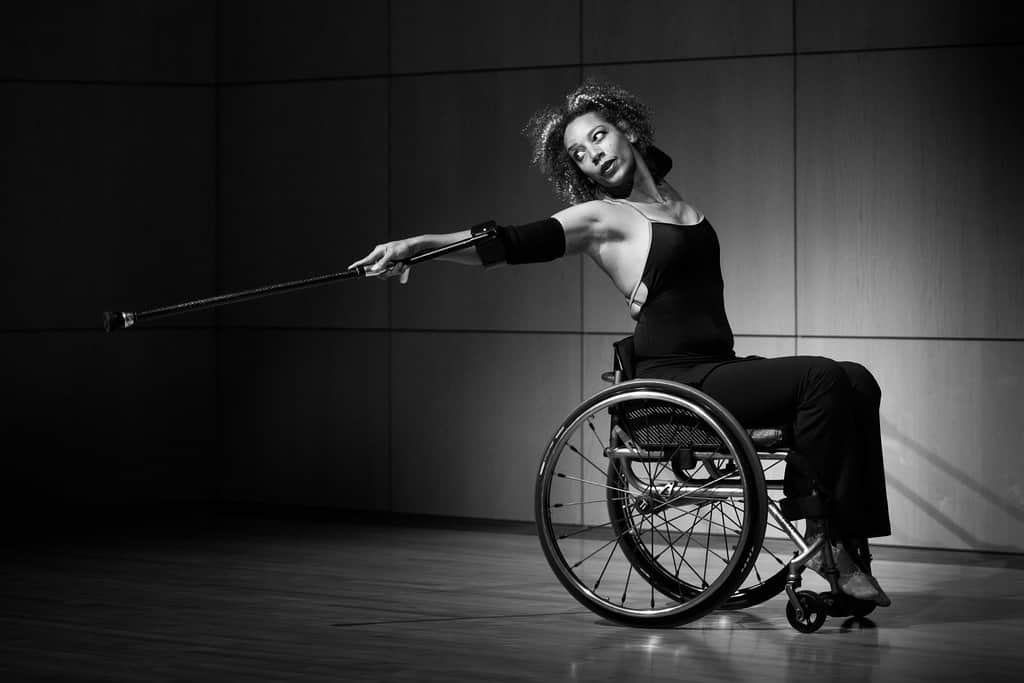
After leaving academia, Alice Sheppard “began exploring the techniques of dancing in a wheelchair and learning how disability can generate its own movement.” 

An unusual and dramatic entertainment took place in Chicago in May. It was the brainchild of Alice Sheppard, a fearless risk taker in a surprising sequence of careers. Today she is a choreographer, but as recently as 2004, she had never considered that dance could be compatible with her disability. According to DiverseAbility magazine, “she was a professor in medieval studies at Penn State.” Then a dancer with one leg dared her to try a dance class.

Lauren Warnecke says of Sheppard at the Chicago Tribune, “Alice Sheppard does not shy away from a challenge. In devising her latest dance, ‘Wired,’ she and her Bay Area disability arts company Kinetic Light had to first write the rule books for wheelchair aerial dance.

“Kinetic Light’s mission is to create art that centers disability. Sheppard and the rest of the company are disabled artists who make work for disabled performers. Key to that vision are questions and advocacy around access — who ‘gets’ to dance and who ‘gets’ to watch or experience art? Since the company’s founding in 2016, Sheppard’s work consistently explores the intersections of disability, race and gender. ‘Wired,’ premiering May 5-8 at the Museum of Contemporary Art in Chicago, is no exception, though it’s the first of Kinetic Light’s growing catalog to incorporate aerial dance.

“Actually, the first step for Sheppard was to read everything she could find about barbed wire. Sheppard, a dancer, choreographer and scholar with a doctorate in medieval studies from Cornell University, devoured the literature on this sharp-edged, steel wire’s fraught history.

“The initial spark for ‘Wired’ came from a visit to the Whitney Museum, where Sheppard viewed Melvin Edwards’ 1969 barbed wire sculpture, ‘Pyramid Up and Down Pyramid.’ …

“It led her down a barbed wire rabbit hole. Sheppard’s source material lends multiple metaphors to what has become her latest multimedia dance piece. Indeed, few pieces of steel are saddled with so much context. Barbed wire is primarily a strict form of forced separation, used in trench warfare and applied in the United States as a means of keeping incarcerated people in, for example, or livestock in and intruders out as ranchers in the American West increasingly claimed land as their personal property.

“Throughout the piece, the dancers wrestle with this unwieldy, unforgiving object, their bodies enclosed by a tangle of wires and barbs. As she continued to explore, Sheppard knew ‘Wired’ had to be an aerial dance. …

“Having never studied aerial dance before, Sheppard and Kinetic Light company members Laurel Lawson and Jerron Herman started from scratch. With support from some 30 artists and engineers with backgrounds in rigging, automation and flight, Sheppard, Lawson and Herman took to the air. …

“ ‘We are not the first disabled artists to fly, by any means,’ she said. ‘There is, of course, in circus arts, a deep and rooted history of disability and flight. That’s not random or new. And there’s a history of disabled dancers also doing aerial work in the UK, New Zealand and the U.S. Part of that history and legacy is to recognize that flight isn’t random. It is perfectly within the tradition and the culture for disabled dancers. What is new here is the construction of the show. It’s not a circus.’

“The process for ‘Wired’ started at Chicago Flyhouse in late 2019. Before the dance and other artistic elements could even begin to take shape, Kinetic Light was faced with huge technical considerations.

“ ‘Before we could even get to “here’s a pretty dance, here’s the choreography,” ‘ she said, ‘we had to get to, “how does this thing fly?” ‘ …

“Lawson, who is also an engineer, assisted in developing the chairs and harnesses needed for her and Sheppard safely ascend into the air. Company member and dancer Herman completes the cast of three and has yet another setup. Herman, who has cerebral palsy, dances sections of ‘Wired’ with a girdle-type harness used to suspend him above the stage. …

“Sheppard reiterated that she and Lawson are not the first disabled artists to fly ,,, but they are the first disabled dancers in the U.S. to explore a thorough compendium of techniques, which includes low flying on hard lines and bungees, as well as flight patterns suspended from joystick-operated, motorized cables. The pandemic enabled Kinetic Light to make connections with then-unemployed entertainment workers with expertise in automation who would not otherwise have been available.

“In a way, ‘Wired’ serves as a primer on wheelchair flight.

“ ‘Understand, this is not actually documented,’ Sheppard said. ‘There are no books. There are no teachers … All of these questions that are easily available to non-disabled aerial artists because there’s a history and tradition here — we just had to figure that out bit-by-bit.’ ”

More at the Chicago Tribune, here.

Read Full Post »

Photo: Jonathan Atk/Cunard.
“Boundless as the Sea” is a new piece created for Cunard cruises by Owen Horsley from Shakespearean love scenes, including Romeo and Juliet, Macbeth, Othello, The Winter’s Tale, Troilus and Cressida, and A Midsummer Night’s Dream.

Several of my friends are back to taking cruises now that Covid appears manageable. Today’s post is about some new entertainment offerings on cruises. I enjoyed reading about them about as they bring to mind the “Royal Viking Singers and Dancers!” that our family got such a kick out of on our one cruise, 1990.

Siobhan Burke reported in January at the New York Times about a very modern dance group taking to the high seas. And Emma Powell had a Daily Mail story about Cunard Lines tapping the Bard.

Burke wrote, “On a late-summer night, three choreographers greeted friends at the New York opening of their latest show, exchanging hugs and chatting through masks over the blare of pop music. Neon projections in the theater, a nightclub-like space called the Red Room, exclaimed ‘Welcome to the Show!!’ Cocktail servers wove efficiently through the crowd with trays of drinks, as nimble as the dancers who would soon take the stage.

“It could have been one of the many clubs or theater spaces where the choreographers — Ani Taj, Sam Pinkleton and Sunny Min-Sook Hitt — had performed and presented their work over the past decade, as members of the Dance Cartel, a group founded by Taj in 2012 and known for its exuberant, open-to-all, party-meets-performance live events.

“But a few features set this space apart: the screen outside the entrance beckoning ‘Sail Into Something Spectacular’; the fluorescent signs reading ‘PORT’ and STARBOARD to mark stage left and stage right; the enormous pink inflatable whale onstage.

“How had the artists landed here, on a 2,770-passenger luxury cruise ship, which on this particular night was docked in Manhattan, en route to Miami? Among the three of them, they have choreographed for Broadway, television, opera, music videos, museums and other arenas. But as Taj said when they recently got together for a video interview, a foray into cruise ship entertainment was ‘not something any of us expected to be on the timeline of our careers.’

“ ‘We definitely had a moment of: A cruise ship — did they get the right people?’ Pinkleton said, recalling his confusion when he and Taj, who are represented by ICM Partners, were invited by their agents to pitch a show to Virgin Voyages, a new adults-only cruise line founded by the British billionaire Richard Branson. ‘I think we had a very narrow idea of what making a show for a ship would mean.’ …

“Dance shows on cruise ships typically take place on proscenium stages, for seated, stationary audiences. … In the group’s first and signature work, ‘OntheFloor, which Taj and Pinkleton directed, dancers maneuver around and among a standing audience, their irrepressible energy an invitation to join in. …

“Still, she and Pinkleton answered the call for a pitch.

“We said, ‘Yeah, we’ll accept that challenge and come up with something that surely won’t fly,” ‘ Taj said.

“ ‘We were like, “This seems like a fun exercise,” ‘ Pinkleton added, ‘and dared ourselves to present a pretty authentic version of what we would like to make.’

“That exercise, which began in 2017, has now become a full-fledged, hourlong production aboard the Scarlet Lady, the first Virgin ship to set sail for paying customers.”

Funny article. See it at the Times, here.

Meanwhile, the Daily Mail reports, “The Royal Shakespeare Company has teamed up with British cruise line Cunard to take the Bard’s work out to sea as part of a three-year partnership.

“Voyagers on the Queen Mary 2 will be able to enjoy several pieces during transatlantic crossings from Southampton or explorations around Norway’s fjords.

“One such performance is ‘Boundless as the Sea,’ a brand new piece created by Owen Horsley from Shakespeare’s iconic love scenes including Romeo and Juliet, Macbeth, Othello, The Winter’s Tale, Troilus and Cressida and A Midsummer Night’s Dream. …

“Workshops will be on offer as well as events ‘where the actors will perform their personal favorite sonnets and speeches, and answer questions from the audience.’

“The Queen Mary 2 will also host touring exhibition, ‘Digital Diorama: An Augmented Journey Through Shakespeare’s Stratford,’ with some of the RSC’s most popular productions including Hamlet, Henry V, The Merry Wives of Windsor and As You Like It screened in the on board cinema. … The first voyages will run from May 29 until August 12 and then again from September 15 to November 13.”

More at the Daily Mail, here.

Read Full Post »

Photo: Ivan Petrov.
Kyiv-born and -trained ballet star Ivan Petrov is working with ballerina Alina Cojocaru to help dancers whose lives are in upheaval since Russia invaded Ukraine.

It’s been interesting to see how many different kinds of groups are pulling together to help Ukraine since Russia invaded. College alumni groups, small towns, chefs, former military, athletes … the list goes on.

When I was reading today’s article on the dance world’s efforts, I was surprised by an observation about how ballet-world organizing after the death of George Floyd affected the speed with which dance folk are taking action today.

Sarah L. Kaufman reports at the Washington Post, “Amid the constant air raid sirens and shelling near her home in Kyiv, 17-year-old Polina Chepyk tried to fill her days with dancing.

“Her ballet school had shut down, so she stretched and spun in the apartment she shared with her parents and 8-year-old sister, Anfisa. Chepyk used the back of the sofa as her ballet barre.

“But lying in bed in the dark, she could not tune out the war. ‘At night you can’t control your feelings,’ Chepyk said in a recent phone interview. …

“Since early childhood, she had devoted herself to perfecting her pirouettes and learning excerpts of the great ballet roles. When war came, she feared that the world of music and grace she longed to inhabit was gone. …

“Yet the international ballet community has swung into action, led by the New York-based organization Youth America Grand Prix. Russian dancers Larissa and Gennadi Saveliev, who began their careers at Moscow’s Bolshoi Ballet before emigrating to the United States, founded YAGP in 1999 to help students gain access to the world’s most selective ballet schools, through scholarship auditions. But since the war in Ukraine began, YAGP has been tapping its network of dancers and educators to help nearly 100 Ukrainian dance students (and often their entire families) flee danger and continue their art, by placing them in training academies throughout Europe. …

“Suddenly, Chepyk found herself packing a suitcase with leotards, tights, bottles of her mother’s perfume and ‘every gift my parents ever gave me, for remembering them.’ …

“After a five-day journey, she arrived March 21 into the embrace of a Dutch family with two girls. Chepyk said she has become ‘their third daughter.’

“And she has resumed her beloved dance training at the Dutch National Ballet Academy, where she is in the highest level. …

“The war in Ukraine has hit the tight-knit ballet world hard, and dancers have responded with an unprecedented storm of activism. Ukrainian ballet students and professional dancers are being taken in by far-flung academies and companies, swelling their rosters. Dancers are converging across borders for star-studded fundraisers. …

“Ballet is a profoundly international art, as well as a communal one. It depends on continuous, daily interaction with fellow performers, who are typically drawn from all over and who work together on a uniquely intimate physical and emotional level. …

“The ballet world’s rapid mobilization in support of Ukraine was prompted by something much more recent, according to Lynn Garafola, a dance historian and author of La Nijinska: Choreographer of the Modern. She points to the Black Lives Matter movement as helping set the ground for solidarity.

“ ‘Black Lives Matter primed the ballet community for self-interrogation,’ she said. ‘It responded in a very strong way with a lot of thinking and discussion, across the board, trying to establish new norms for diversity and inclusivity and equity. So people were already thinking in ways that were more ethical. And that’s what has come to the fore here.’

“Echoes of BLM lie in the questions that dance artists have been asking themselves since the Russian invasion of Ukraine, Garafola said, such as: ‘What can I do about it?’ …

“Romanian-born ballerina Alina Cojocaru, formerly of the Royal Ballet, and Ivan Putrov, a Royal Ballet principal from Kyiv, trained together in the Ukrainian capital as children. Before joining the Royal Ballet, Cojocaru danced professionally in Kyiv for a year, where one of her first partners was Artyom Datsishin, ‘a tall, very quiet person and very talented dancer,’ she said in a recent video call with Putrov from London. Datsishin later became an internationally known star of the National Opera of Ukraine. Two days after the Russian invasion began, he was hit by shelling, and he died three weeks later of his injuries.

“Datsishin’s death, which made headlines around the world as an especially poignant symbol of the war’s brutality, helped spur Cojocaru and Putrov to organize the Dance for Ukraine charity gala. … The gala came together in two weeks, and was an easy sell to their colleagues. ‘We already knew so many people from all over the world. We are just one phone call away from someone in Cuba, France, Germany and America,’ Putrov said.”

Read more at the Post, here.

Read Full Post »

Photo: The Guardian.
Born and raised in Tokyo, Rina Hanzawa is one of thousands of women around the world who have taken up Ori Tahiti, the traditional Polynesian dance.

The joy of dance is international. It’s fun for me to see, for example, that Shagufa, raised in a conservative Afghan community and now a student at Brandeis, is adding belly dancing to a repertoire that has long included golf.

Meanwhile, around the world, many people are discovering the fun of a Polynsian dance form once banned by colonizers. Tiare Tuuhia has a story about that at the Guardian.

“Wearing intricate costumes made of plants and adorned with tropical flowers, the women look spectacular. While their torsos remain completely still, somehow, impossibly, their hips are moving in circles so fast it’s almost a blur.

“These women are performing traditional Tahitian dance, or Ori Tahiti, in Tahiti’s annual cultural festival, the Heiva. And they’re not alone. Thousands of women across the globe, from Mexico to Japan, are doing it too. …

“Ori Tahiti is a broad term that encompasses the many traditional dances native to the island of Tahiti, performed by both men and women. The most well-known is the ote’a, a very fast, hip-shaking dance performed by women. Another is the aparima, which features slower, more graceful body movements. …

“ ‘In my eyes it is the most beautiful, powerful, sensuous and expressive,’ says Tumata Robinson, a renowned Tahitian choreographer, costume designer and founder of acclaimed dance group Tahiti Ora.

“ ‘I think Ori Tahiti is very complete, you know. It’s fierce, but also elegant and powerful, graceful, feminine when we dance,’ [says] says Moena Maiotui, one of Tahiti’s most beloved professional dancers, who has traveled around the world performing, teaching Ori workshops, and sharing Tahitian culture. YouTube videos of her dancing, both solo and with the dance group Tahiti Ora, have racked up millions of views. …

“Self-expression and connecting to nature are what Ori Tahiti is about for Rina Hanzawa. Born and raised in Tokyo, Hanzawa discovered Ori Tahiti in her early twenties.

“ ‘I went to dance school and I found Ori Tahiti there,’ says Hanzawa. ‘At the time I had no clue about Tahitian culture. But I fell in love with Ori Tahiti when I tried it.’ …

“What started as a casual hobby soon became an enduring passion, which led to her competing at a national level. Hanzawa now lives in Australia, where she has set up her own Tahitian dance school, Tai Pererau, in Sydney’s northern beaches. …

The arrival of Europeans in French Polynesia, along with their religion and laws, saw Ori Tahiti banned or repressed for close to 100 years.

“At the end of the 18th century, dance was banned by European missionaries, who labelled it immoral. Then, in 1819, the Pomare Code, a set of laws laid down by the Tahitian monarchy, forbade traditional dancing outright. In 1842 the French protectorate allowed dancing – but with so many conditions that the practice was still repressed.

“It was only in the 1960s that the church began to lose influence and traditional dancing really began to be revived. During this time the first modern dance group appeared on the scene, led by Madeleine Mou’a.

“Damaris Caire, author of a book titled Ori Tahiti: Between Tradition, Culture and Modernity, says: ‘Little by little, by doing dance shows at hotels for tourists, Ori Tahiti became popular – even if the local population initially struggled to accept it.’ …

“Despite a rocky past, Ori Tahiti has today become a way for Tahitians to connect with their ancestors, their land and their language. It is a celebration of a cultural identity and pride that was almost lost to colonization. Now, it has become one of Tahiti’s best exports.

“Hinatea Colombani, a Tahitian cultural expert and director of the Arioi culture and arts centre, says it is particularly satisfying to see Ori Tahiti become popular in the very countries that tried to stamp the practice out two centuries ago.

“ ‘For me it’s a revenge, because they celebrate our culture,’ she says. …

“This year, the Heiva Ori Tahiti Nui international 2021 – Ori Tahiti’s biggest competition – had to be held online due to the pandemic. However, it still managed to attract competitors from 12 countries and territories, including two new participants: New Caledonia and Switzerland. …

“ ‘It was really a superb experience,’ says [Ginie Naea, a dance teacher at the Te Ori Tahiti school in Geneva]. ‘We danced in front of Lake Geneva and the mountains; it was just magic. The best part of the competition was actually the preparation and team cohesion that it necessitated – a connection that’s created when performing. There is a real bond between Ori Tahiti dancers, a real family that is created around the same passion.”

More at the Guardian, here.

Read Full Post »

« Newer Posts - Older Posts »