Feeds:
Posts
Comments

Posts Tagged ‘environment’

The humble horseshoe crab is a reminder of prehistoric times. Public Radio International’s Living on Earth recently devoted a segment to this curious character.

From the transcript of the show …

Steve Curwood: “For healthy oceans, it’s not enough to protect just the top of the food chain – the cod or halibut or swordfish we eat. The bottom of the food chain is vital too. That could be the plankton or the tiny forage fish eaten by many species – or it could be the extraordinary prehistoric-looking horseshoe crab.

“These helmet-shaped arthropods have been around for millions of years, and up and down the east coast of the US, volunteers come out to count them as the females come ashore to spawn. On Cape Cod, as Karen Zusi reports, scientists and volunteers are tagging and labeling the crabs to help conserve them.”

Karen Zusi: “There are a lot of reasons why someone might appreciate the lowly horseshoe crab. Eel and conch fishermen use them as bait, and medical companies draw blood from the animals. Horseshoe crab blood will clot in the presence of bacteria, so these companies can use the crab’s blood to make sure vaccines and medical implants are free of germs. Their blood is worth sixty thousand dollars a gallon.

“But horseshoe crab populations are dropping. To preserve them, scientists and volunteers on Cape Cod are wading into the water to count and tag the animals.

“Special labels help them keep track [says] Mark Faherty, the science coordinator at Audubon’s Wellfleet Bay Sanctuary. …

“The Massachusetts Audubon Society just recruited graduate student Michael Long to lead their newest horseshoe crab study. With researchers from the University of Massachusetts, he will be tagging the crabs this summer with a telemetry [label], glued onto the crab’s shell.”

Faherty: “My acoustic study is going to be putting on acoustic receivers out in the bay, and acoustic markers on the crabs. The receivers have about a 600-meter detection radius so anytime a crab that’s marked with an acoustic receiver comes within 600 meters of that receiver, it will mark where it is. So based on where each crab pings, you can kind of track its movements around the bay.”

Zusi: “None of this would be possible without the Audubon Society’s volunteers. They come from all walks of life.

“At an Audubon horseshoe crab conference, Long organizes new volunteers to help him count horseshoe crabs on the beach, and Faherty trains them in the basic survey procedures. …

“Once they got down to business, the volunteers were trained to divide the beach into small sections, count the horseshoe crabs, and record all of their information. The volunteers go out to survey when female crabs are coming to lay their eggs in the sand. Males follow to fertilize the eggs after they’re laid.”

Faherty: “The male crabs you quickly learn to recognize because they’re by themselves. They will mate with a model, if you make a model of a horseshoe crab — the males will congregate around it. They’ll spawn. They’ll spawn with your boot. These are just hormonally-charged animals that are ready to mate with anything. Females are not lonely for long in the horseshoe crab world.”

More here on the effort to study and protect horseshoe crabs.

Photo: Peter Massas, Flickr CC BY-SA 2.0
A horseshoe crab floats by the shore on Union Beach in New Jersey. The species is listed as Near Threatened by the International Union for the Conservation of Nature.

Read Full Post »
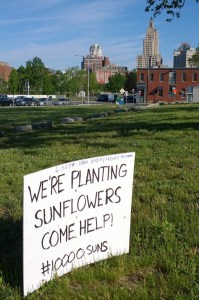
I added Ello to my social media a while ago but am only now beginning to explore it. A kind of Facebook without ads, it seems to be preferred by people in the arts. Lately, Ello has been publishing interviews with particularly interesting users.

Here are excerpts from Ello Chief Marketing Officer Mark Gelband’s interview with Ben Staley.

“Ben Staley is an Emmy award-winning filmmaker, storyteller, photographer, and professional adventure-haver. His striking portraits and nature photography are a constant source of inspiration to the Ello team. …

“Mark: I started paying really close attention to your work when you were documenting the film you’re making about ships and welders. Could you tell us more about that project?

“Ben: The project is called ‘Starbound’ and it’s about a boat of the same name. The boat is a catch processor that fishes on the Bering Sea. It’s a top performer but the factory was outdated and inefficient and they were losing money. The construction project would lengthen the boat, making it as environmentally friendly as possible and saving the jobs of the 100+ crew members. The owners are doing it for the best reasons. They could have taken the easy way out and and saved a lot of money up front and had no risk, but they undertook this incredible challenge because they care about the environment and their employees and their families. …

“For me as a storyteller it’s a once-in-a-lifetime opportunity to capture this process and tell their story. The family that owns the boat are incredibly committed and hardworking people and they will willingly spend more money and take on this risk to do things the right way. …

“Picking a 240 foot-long boat up out of the water, cutting it in half and sticking 60 foot section in the middle, welding it back together and putting it back in the water. All in the space of a couple months. The hard work, skill and craftsmanship are incredible. …  I’ll be making the first trip to sea with the boat later this summer and hope to have the doc done by end of year. …

(more…)

Read Full Post »

Photo: National Oceanic and Atmospheric Administration
A sponge the size of a minivan was found in summer 2015 in the Papahānaumokuākea Marine National Monument off Hawaii.

One of Earth’s oldest living animals is a sea sponge. As big as a minivan, it has been growing for generations unnoticed and undisturbed in waters off Hawaii.

Elahe Izadi writes in the Washington Post that a remotely operated vehicle (ROV) “captured footage of the spectacularly large sponge during a National Oceanic and Atmospheric Administration deep-sea expedition, and the species was identified for the first time in a study published [in May] in the journal Marine Biodiversity. …

“There’s more to this sponge than its girth: It could also be among the oldest living animals on earth. … Sponges can live for hundreds or even thousands of years. ‘While not much is known about the lifespan of sponges, some massive species found in shallow waters are estimated to live for more than 2,300 years,’ the study authors write. …

“ ‘Finding such an enormous and presumably old sponge emphasizes how much can be learned from studying deep and pristine environments such as those found in the remote Papahānaumokuākea Marine National Monument,’ Daniel Wagner, Papahānaumokuākea research specialist, said in a statement. …

“Christopher Kelly, NOAA research scientist and co-lead for the expedition, said the sponge ‘just appeared’ on the ROV’s high-definition camera, Australia’s Pacific Beat radio reported.

” ‘We were looking for deep water corals and sponges, and we had just gotten some close ups of some corals, then turned away to continue the survey and the sponge appeared out of nowhere.’ ”

I can just picture that cinematic moment of discovery.

More at the Washington Post, here.

Read Full Post »
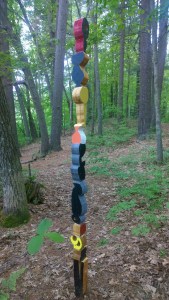
 

On my walk this morning I saw an official-looking sign on a fence in a residential neighborhood. The sign read “Certified Wildlife Habitat.”

I had to look it up when I got home. The website of the National Wildlife Federation says, “Wildlife needs our help. … You can invite wildlife back to your own yard and neighborhood by planting a simple garden that provides habitat. …

“Providing a sustainable habitat for wildlife begins with your plants. That’s why we call it  a wildlife habitat ‘garden.’ When you plant the native plant species that wildlife depend on, you create habitat and begin to restore your local environment. Adding water sources, nesting boxes and other habitat features enhances the habitat value of your garden to wildlife. By choosing natural gardening practices, you make your yard a safe place for wildlife. …

“Here is what your wildlife garden should include:

“Food: Native plants provide nectar, seeds, nuts, fruits, berries, foliage, pollen and insects eaten by an exciting variety of wildlife. Feeders can supplement natural food sources.

“Water: All animals need water to survive and some need it for bathing or breeding as well.

“Cover: Wildlife needs places to find shelter from bad weather and places to hide from predators or stalk prey.

“Places to Raise Young: Wildlife needs resources to reproduce and keep their species going. Some species have totally different habitat needs in their juvenile phase than they do as adults.

“Sustainable Practices: How you manage your garden can have an effect on the health of the soil, air, water and habitat for native wildlife as well as the human community.

“Already have all these elements in your wildlife garden? Certify today!” And there’s a box to click on if you think you are ready.

Now I’m wondering if the chipmunk on our back steps today thinks our yard could qualify. It’s a small yard, so not much cover. And we’d need to provide water. Hmm.

More at the National Wildlife Federation, here.

Read Full Post »
A Dutch diplomat started following me on twitter. He’s a Yale World Fellow, so how bad could it be? (Better than, say, Contagious Disease Fellow.)

@Alex_Verbeek is focused on environmental issues, and today he tweeted about the Stockholm Environment Institute, “ is ranked second best think tank worldwide.”

Because of my Swedish relatives, I naturally felt curious about SEI and looked it up. The website doesn’t say which think tank is first — or at least not prominently — but it does say that the US office is in Somerville, Mass., of all things. You learn something every day. I did know that the great environmental radio show Living on Earth is in Somerville, but the city is still a bit under the shadow of its industrial past.

From SEI’s website: “SEI’s vision is a sustainable future for all. Our mission is ‘to support decision-making and induce change towards sustainable development around the world by providing integrative knowledge that bridges science and policy in the field of environment and development’.

“To deliver on our mission, we work across issues like climate change, energy systems, water resources, air quality, land-use, sanitation, food security, and trade, and we approach these issues from a range of perspectives from the natural and social sciences.

“We combine scientific research with policy analysis, connecting our work to decision-makers and civil society in global governance, national public policy, regional cooperation, local planning, and the private sector. We generate and share knowledge that catalyses action, and always take a highly collaborative approach: stakeholder involvement is at the heart of our efforts to build capacity, strengthen institutions, and equip partners for the long term.

“Making scientific knowledge accessible is a priority. We publish our own series of open-access reports and briefs, alongside articles in leading academic journals, and work creatively through a range of media to ensure that our research is available to those that need it. We convene seminars and conferences that bring together decision-makers, academics, and practitioners to debate key issues and share knowledge, and engage in and inform policy processes, development action, and business practice worldwide.”

Whew! Wonky! Wish I could introduce SEI to Somerville neighbor Steve Curwood of Living on Earth. He’s pretty good at using everyday language for listeners.

I hope to learn more about the Stockholm Environment Institute, in any case, and am delighted its US office is so close to home.

Photo: Stockholm Environment Institute
One environmental concern SEI is studying is disaster risk in the Asia-Pacific region.

Read Full Post »
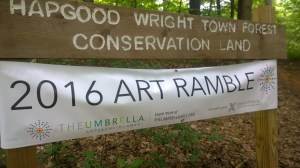
At first I saw no art. I didn’t enter the woods where the sign was, and I thought, “Maybe I have the wrong time.”

But the Hapgood Wright Town Forest is a work of art in itself, and I was up for a walk. The hilly pine-needle paths, the pond, the sounds of bullfrogs, wind in the trees, unfamiliar bird calls — all lovely. Then bit by bit, I began noticing pieces of art, part of the 2016 Art Ramble, which can be seen in the woods until September 5. How good of artists to do this!

The Umbrella Community Arts Center explains on its website, “This collaborative project with the Concord Department of Natural Resources celebrates all the arts. Sculpture, poetry, dance, and dramatic readings encourage the intersection of art, nature, and community in a historic natural setting.

“The arts offer a doorway for exploring our relationship with nature and place. An exhibit map will guide you through the exhibit at your own pace. And our calendar of special events and activities offers numerous opportunities to engage with the artists and with nature along the trails.

“We invite you to visit often, reflect, and play.  Share your experiences via writing and drawing in the journals provided along the trail.  Or make your own art using natural materials in the forest.”

[Nancy, this sounds like an event you organized last year.]

Curator Ursula Ziegler says, “It’s been a rumble-tumble-fantastic-interesting road, and it has already exposed us to so many interesting-important dialogues, thoughts, and ideas. Beyond the visible part of art works in a public space, there is an equally important but less visible part, which are the conversations, networks, and structures that are created within our local community and beyond.”

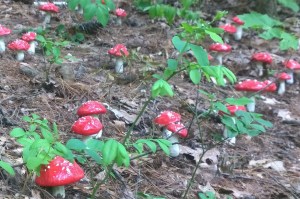
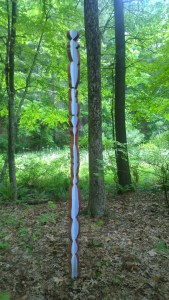
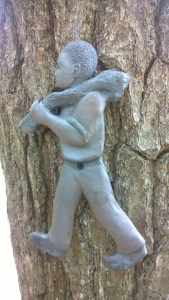
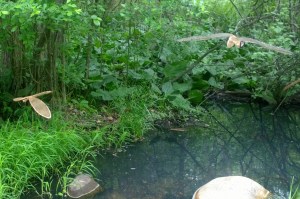
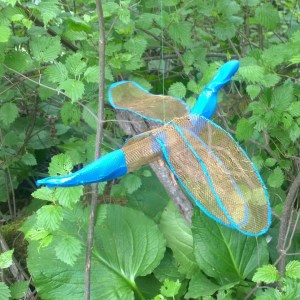
I took some pictures of ceramic toadstools, a QR code I don’t know how to use that would have identified an artist, sapling-like totems (or totem-like saplings), a small sculpture of a boy attached to a tree, fluttery dragonflies and the sign I missed on entering.

060316-toadstools-town-forest-art

060316-QR-code-town-forest-art


060316-art-blends-in-at-town-forest

060316-totem-at-town-forest-art


060316-boy-on-tree-art

060316-dragonflies-town-forest-art


6tag-060316-dragonfly

060316-town-forest-art

Read Full Post »
Radio show Living on Earth did a segment in February on new technology to store and release solar heat. Here is host Steve Curwood on his outing to MIT to learn about the breakthrough.

“A team of researchers at MIT has come up with a chemical that would let windshield glass directly store solar energy and then release it on demand as heat to melt the ice. … The same chemical could be woven into clothing fibers to capture the sun’s energy and then give you some added warmth when you ask for it, even days later.

“I paid a visit to the lab where the MIT team has been working on this breakthrough and met up with researchers David Zhitomirsky and Eugene Cho, who work in the lab of professor Jeffrey Grossman.”

To Curwood’s question about the difference between the familiar electrical, battery-enabled solar technology and the MIT lab’s chemical version, Zhitomirsky replies,”We use these molecules that can absorb UV light and instead of generating charges, what they do is that they change shape, and by changing shape, they can store chemical energy …

“CURWOOD: OK, so sunlight hits this molecule, it changes shape and can storage its energy. And how do you get the energy out?

“ZHITOMIRSKY: So you can figure the material in several ways. One way is to add a small amount of heat, and the material will release more heat than you add in. The other methods are triggering it with light or you can apply an electrical field to the material. …

“The way we envision using it is to integrate into fibers that you then make clothing out of.” More here.

Release solar heat from my coat in a blizzard? Where do I sign up?

Photo: Helen Palmer
Living on Earth host Steve Curwood, right, in the MIT lab with Eugene Cho and David Zhitomirsky.

Read Full Post »
Pigeons are often associated with pollution underfoot, but in London, pigeons are being harnessed in the fight against another kind of pollution.

Melissa Breyer reports at TreeHugger that the ubiquitous birds are being “outfitted with light-as-a-feather backpacks that collect air pollution data and tweet back live info in an effort to track air quality.

“Putting pigeons to work was the brainstorm of Pierre Duquesnoy, creative director at the global marketing and technology agency DigitasLBi. He entered the curious concept into the #PoweredByTweets competition which was launched last year in conjunction with the London Design Festival.

“Currently there are 120 stations monitoring air pollution in London but they are in fixed locations. ‘That means there are blind spots,’ Duquesnoy tells the Evening Standard. ‘The stations are really accurate but only for the immediate vicinity, so scientists don’t have a clear idea of what is happening elsewhere.’ …

“Pigeon Patrol was one of six winning entries that was built and exhibited – and now, the patrol is actually patrolling. [They will] measure levels of nitrogen dioxide and ozone, the main gases behind harmful urban air pollution …

“For the project Duquesnoy worked with Plume Labs, a tech firm that helps citizens track their exposure to air pollution.” More here.

Video: Newsy

Read Full Post »

You haven’t heard the last word on tiny houses from this blog yet. Just check out Treehugger reporter Kimberley Mok’s amazing story about using a 3D printer to create a tiny house and SUV that can create, store, and share energy. Unreal but true.

“Designers from architecture firm SOM, University of Tennessee and researchers from the US Department of Energy’s Oak Ridge National Laboratory are cleverly tackling the energy issue by using a concept they call ‘integrated energy.’

“Their innovative design features a 3D printed house, that comes with a 3D printed SUV, which each generate, store and share energy — boosting energy efficiency both ways, while benefiting from the reduced construction waste and quick turnaround that comes with additive manufacturing techniques. …

“The design of both home and car uses carbon-fiber-reinforced ABS plastic (admittedly not the greenest of materials). The home was printed in separate modules that are assembled together and reinforced with steel rods, and insulated with a modified, highly efficient atmosphere insulation panels, resulting in a surprisingly strong and insulated structure.

“Certainly the most intriguing thing about the design is the reciprocal energy relationship that the car has with the house. … The 3D printed SUV is a hybrid that uses both electricity and natural gas to power itself. It’s parked on an inductive charging pad that allows it to send or receive energy from the solar-powered house — thus significantly solving the electricity issue on cloudy days. If there’s no electricity at all from either solar panels or car, the house can still tap into the energy grid. …

“Thanks to the additive manufacturing process, the prototype took only one year to realize from start to finish.” Read more here.

Photo: ORNL (Oak Ridge National Laboratory)

Read Full Post »

In environmental news, Lloyd Alter at Treehugger reports that an Irish county now requires new homes to meet the very high standard of energy efficiency called passive.

“In Ireland’s Dún Laoghaire-Rathdown County, a near suburb of Dublin, it’s now the law. …

“The building codes there are pretty tight already. And it’s not completely a done deal; the national Minister of the Environment, of all people, may challenge it out of concern that it might raise the cost of housing. However the local Passive House Association says that it’s not necessarily true, and showed case studies demonstrating that in fact they could build passive houses ‘at or below conventional build costs.’

“Writing in Passive House Plus, Pat Barry of the Irish Green Building Council noted that really, it’s all about just trades having the skills and doing the job right. …

“As many as 20,000 houses could be built in the county, houses that cost almost nothing to heat, produce almost no CO2, and are comfy as can be day or night, sun or no sun.”

More here.

Photo: Kelvin Gillmor
Irish passive house built on a budget
. Hmmm. Does it burn wood?

Read Full Post »

If the five unexpected salmon are a sign of a comeback in the Connecticut River, this could be really exciting.

Nate Schweber writes at Al Jazeera America, “By the fall of 2015, the salmon of the Connecticut River were supposed to be doomed. The silvery fish … went extinct because of dams and industrial pollution in the 1700s that turned the river deadly. In the late 1800s a nascent salmon stocking program failed. Then in 2012, despite nearly a half-century of work and an investment of $25 million, the federal government and three New England states pulled the plug on another attempt to resurrect the prized fish.

“But five Atlantic salmon didn’t get the memo. In November, fisheries biologists found something in the waters of the Farmington River — which pours into the Connecticut River — that historians say had not appeared since the Revolutionary War: three salmon nests full of eggs.

“ ‘It’s a great story,’ said John Burrows, of the Atlantic Salmon Federation, a conservation group, ‘whether it’s the beginning of something great or the beginning of the end.’ …

“The streamlined wild Atlantic salmon, genetically different from their fattened domesticated counterparts, which are mass-produced for human consumption, are so rare that anglers spend small fortunes chasing them across Canada, Iceland and Russia. …

“The stocked salmon continued to die off through the early 1970s. Gradually, scientists began to learn the importance of different strains of salmon and their close relatives, trout. In 1976 the program was able to acquire Atlantic salmon eggs from the Penobscot River in Maine, the closest surviving population both physically and genetically. This strain was still different from the lost native strain of the Connecticut River, but less so than their Canadian cousins, previously stocked there. In 1978, 90 fish from the Maine strain managed to make the two-year, 6,000-mile migration out to the food-rich Labrador Sea off of Greenland and then return to the Connecticut River. …

“As only 54 salmon returned to the Connecticut River in 2012, the U.S. Fish and Wildlife Service pulled out of the restoration program. New Hampshire, Vermont and Massachusetts followed. Connecticut opted to continue stocking a small number of salmon …

“Then in the fall of 2015, biologists found five adult Atlantic salmon swimming past the Rainbow Dam on the lower Farmington River. On a hunch, they searched likely upstream spawning habitat and there found the three nests full of eggs.

In the spring of 2016 they will hatch the first wild salmon into that river in two centuries.”

More here.

Photo: Design Pics Inc / Alamy Stock Photo
In North America, Atlantic salmon migrate up rivers and streams to reach spawning grounds in New England and Canada.

Read Full Post »

The radio show Living on Earth recently reported how negotiations among environmental activists, the timber industry, indigenous people, and the British Columbia government protected 85 percent of a huge Canadian forest.

“Eighty-five percent of the Great Bear Rainforest in British Columbia is now protected … Steve Curwood discusses [the compromise] with reporter Andrew MacLeod of the magazine The Tyee, who explains what’s been protected and what’s open for logging.

MACLEOD: “It’s an area of 6.5 million hectares between the top end of Vancouver Island and the Alaska Panhandle. So it’s an area, about the size of Ireland, and it’s quite remote. There are only about 1,400 people who live there. So much of it has never been logged. This is usually described as the largest intact temperate rainforest in the world, a very lush, mossy, moist year-round ecosystem. … We’re talking trees that five or six people put their arms around. Some of these cedars can be in 20 feet in diameter …

CURWOOD: “Tell me what is the [forest’s] Spirit bear?

MCLEOD: “They are a subspecies of black bear. They are a genetic variant that comes out white, so it’s a white black bear. There are also Grizzly bears there, there are whales, wolves, and just a relatively pristine ecosystem up there.

CURWOOD: “And who calls them Spirit bears? …

MACLEOD: “My understanding is that it goes back through the First Nations, there have always been these genetic variant bears there and they’re seen as special.”

When Curwood asks why the timber industry agreed to the negotiation, MacLeod explains that the campaign to protect the forest helped to avoid extended confrontation.

“Lots of First Nations people will tell you they’ve been on the land for thousands and thousands and thousands of years and it’s been sustainable, it’s been healthy, that it’s really only last 150 years of colonialism where you’ve seen clear-cuts and destruction and species driven to extinction. On the other hand, there are lots of people from First Nations who are working in the logging industry today as well. Over time, First Nations have sort of reestablished their rights. There have been some precedent-setting cases just in the last few years that have recognized aboriginal title does exist.” More here.

Of possible interest: Read how Wabanaki diplomacy smoothed a similar negotiation process in Maine, here.

Photo:  Elsen Poulsen/Animals Asia, Flickr CC BY-NC 2.0
A white Spirit bear fishing

Read Full Post »

My friend Kristina is an artist with a long-time interest in shells. At a Harvard-based shell club that she frequents, she meets many interesting artists and scientists — including George Buckley, a Caribbean coral reef researcher who made the video below.

Buckley says, “Little did I know in 1976 that my first visit to Bonaire to study land snails … and dive with Captain Don Stewart would lead to a career interconnected with Bonaire and to some 100 more return trips!

“Bonaire became the focus of case study after case study of marine management and biodiversity in my Harvard University environmental management program. [Dozens] of research and study groups, students, magazine writers and photographers that I brought to the island all fell in love with the landscapes and the emerald sea of Bonaire.

“The early years of the Bonaire Marine Park [BMP] and STINAPA [Dutch acronym for national park] … were a great adventure and while my efforts with the Carco Project and Marecultura were not as successful as hoped, both helped to lay the groundwork for future efforts around the world as to best practices in that field.

“The BMP’s pioneering leadership in education, moorings, gloves policies, banning light sticks and spearfishing, creating the ‘Nature Fee’ and so much more led to Bonaire’s well-deserved world-wide recognition. The efforts to save Klein Bonaire were a testament to international collaboration and stand to this day as the Hallmark of what a committed group of concerned people can accomplish. It is indeed true that Bonaire is to conservation of nature as Greenwich is to time – with credit to Captain Don.”

If you are on Facebook, check out the rest of Buckley’s post.

Photo: Sand Dollar in Bonaire


Read Full Post »

As an official member of his town’s tree committee, John has been working hard to promote the many benefits of an urban tree canopy both for quality of life and for the business environment.

Now here comes a really unusual idea for fans of urban greenery. You just need a large body of water.

At the website “Pop Up City,” describes Rotterdam’s floating forest, thought up by (who else?) an artist.

“Rotterdam will get its first ‘bobbing forest’ in 2016: a collection of twenty trees that are floating in the Rijnhaven, a downtown harbor basin.

“Inspired by Jorge Bakker’s artwork ‘In Search of Habitus‘, an aquarium filled with bobbers that grow small trees, Dutch designers and entrepreneurs from Mothership decided to carry out this idea in ‘real life’. After experimenting with a sample tree last year, an entire floating forest of twenty trees is scheduled to be ‘planted’ on March 16, 2016.” Check out some intriguing photos here.

My only question as a person who grew up in a hurricane corridor: What happens if there’s a storm?

Photo: Popupcity.net

Read Full Post »

I’ve been learning a lot lately from reading ecoRI’s Tim Faulkner. Recently he wrote about entrepreneurial approaches to taking carbon out of the atmosphere. He notes that one of the more ironic opportunities, according to Thorne Sparkman of investor Slater Technology Fund, is through the oil and gas industry, which uses CO2 in extraction and now can at least bury it instead of releasing it.

“Finding ways of supplying some [CO2] from existing carbon sources is a one of the main markets in the emerging, and broadly defined, field of carbon capture and storage (CCS),” writes Faulkner.

“ ‘CO2 is everywhere, but it has not really been harnessed,’ said Emily Cole, co-founder of Liquid Light, a New Jersey-based startup that wants to reduce greenhouse gasses by transforming carbon dioxide into industrial chemicals. …

Enhanced Energy Group of West Kingstown is also looking at cutting emissions from the oil and gas industry, while increasing production. Its founder, Paul Dunn, spent 25 years designing engines for the Navy, some of which were emissions free.  He’s now building power sources that sequester CO2 before it vents into the air. …

Bioprocess Algae is converting unwanted CO2 into algae for fish and animal feed, and as nutritional supplements. The company recently relocated its headquarters from Portsmouth, R.I., to Shenandoah, Iowa, to be closer its CO2 supply source, a corn-fueled ethanol plant.”

Chief technology officer Toby Ahrens says that sequestering carbon dioxide in algae may not have large-scale prospects, but so far, it is one of the few profitable opportunities in this arena. More at ecoRI, here.

Photo: iStock
Trees are one way to sequester carbon.

Read Full Post »

« Newer Posts - Older Posts »