Feeds:
Posts
Comments

Posts Tagged ‘environment’

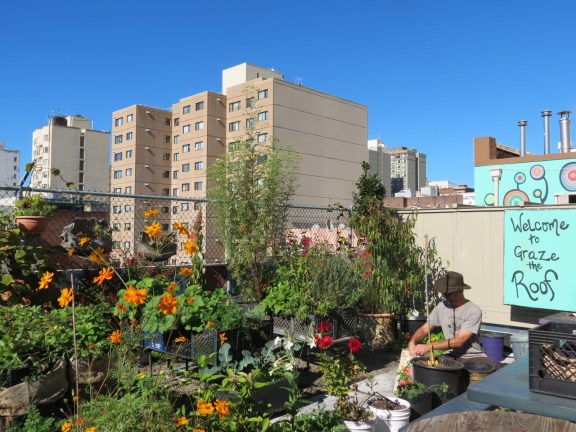
Brian sent me information about Higher Ground Farm, which is putting down roots on the roof of the Design Center in South Boston.

“A roof farm is a type of green roof. A green roof is a system of layers that is laid over an existing roof. A green roof is beneficial to a building owner and the community because it protects the existing roof, doubling to tripling its life, thereby saving money and keeping materials out of the landfill.

“Green roofs also reduce a building’s energy costs by insulating in the winter and cooling the rooftop in the summer. Finally, green roofs temper the effects of two common urban environmental problems – combined sewer overflow and the urban heat island effect.

“A series of roof farms throughout the city will capitalize on the environmental benefits of green roofs while also increasing access to fresh, healthy food. Higher Ground Farm will operate several roof farms throughout the greater Boston area, utilizing previously unused space while providing additional rental revenue to a building owner.

“Roof agriculture has the potential to be a job-producing boost to the economy, and a completely environmentally sustainable business sector that can set Boston apart from other cities. Higher Ground Farm will utilize the resources of our top-notch universities to study roof agriculture, which will position Boston as a leader in the field. Finally, Higher Ground Farm will be a space where our community can reconnect to productive green space and learn about sustainable city planning.” More.

I also found a video interview about it that you will like, here.

Read Full Post »

Happy President’s Day! Why are you working?

​According to Mother Jones, economist David Rosnick has “found that dialing back the amount of time the average person works by 0.5 percent per year would mean a significant reduction in greenhouse gas emissions. If you work 40 hours a week, that would mean shaving about 12 minutes off the average work week per year. Working one minute less per month seems pretty doable. Basically, we’re using a whole lot more of everything when we’re working – electricity, gasoline, heating, air conditioning, etc. Leisure requires less greenhouse-gas-producing activity.”

I forget were I found this story first, but you can read more at Mother Jones, here.

Photograph: http://yasmincolemanportraits.wordpress.com/
“Lazy Bones, sleeping in the shade. How you ‘spect to get your corn meal made?”
(Hoagy Carmichael)

Read Full Post »

I hope colleagues who saw almost the same post on the blog I contribute to at work don’t mind a repeat. I’m winging it a bit as I hold a two-day-old little girl in my left arm and type on her mom’s Mac with my right.

This post can be taken as reassurance that there are pockets of people here and there working to make the world greener for my grandkids and yours. It originates with Jim Robbins, Yale Environment 360, part of the Guardian Environment Network.

He begins in Seattle.

” ‘The biggest threat to Puget Sound is non-point sources [of pollution],’ says Nancy Ahern, Seattle Public Utilities deputy director.

“Blowhole samples taken from killer whales have revealed fungi, viruses and bacteria living in their respiratory tracts, some of them antibiotic-resistant and once found only on land. Health officials often have to shut down oyster beds because of fecal contamination. Salmon in streams are killed by torrents of dirty storm water.

“To lessen this deluge of diffuse pollution — a problem faced by many regions worldwide — Seattle is looking not at new and expensive sewage treatment infrastructure. Instead it is embracing an innovative solution to storm water runoff called green infrastructure … A growing number of places, from New York City to Sweden, are investing in everything from rooftop gardens to pollution-filtering assemblages of trees to reduce tainted runoff.

“Gray infrastructure is the system of pipes and ditches that channel storm water. Green infrastructure is the harnessing of the natural processes of trees and other vegetation — so-called ecosystem services — to carry out the functions of the built systems. Green infrastructure often intercepts the water before it can run into streets and become polluted and stores the water for gradual release through percolation or evapotranspiration. Trees also clean dirty water through natural filtering functions. …

A 2012 study by American Rivers, ECONorthwest, and other groups examined 479 projects around the country. About a quarter of the projects were more expensive, they concluded, and 31 percent cost the same; more than 44 percent brought the costs down, in some cases substantially. New York City, for example, expects to save $1.5 billion over the next 20 years by using green infrastructure.” I call that having your cake and eating it, too.

More.

Photograph: Mike Di Paola/Getty Images
Plants grow on a rooftop farm in Greenpoint, New York.

Read Full Post »

Do you remember the scene in War and Peace (I know, I read it a long time ago, too) in which Prince Andrei, lying wounded on the field of Austerlitz, looks up at the sky and experiences a kind of awakening?

Well, there’s an organization that hopes we will all connect with the sky with that sort of attention and feel renewed.

“It began with a cryptic e-mail from an unfamiliar source,” writes Jan Brogan at the Boston Globe.

“ ‘Look at the sky as often as you can — for about 21 days. I’ll contact you again in 3 wks.’ It included a link to a website with clouds.

“Signing off with ‘More Light,’ this guy could have been a total whack job. But something about the writing said this had nothing to do with UFO sightings. I clicked in.

“The website was ForSpaciousSkies.com. The man who sent the e-mail, Jack Borden, a former Boston television reporter, had had an epiphany as he looked up from a meadow one day in the mid-1970s and saw the sky as if for the first time. He has been on a mission to educate people about sky awareness ever since.

“ ‘When we are unconscious in regard to our surroundings, we are irresponsible to them,’ says Borden, speaking of that mission now.

“It began with a series of televised man-on-the-street interviews. Borden stopped pedestrians, covered their eyes, and asked what the sky looked like. Most had no clue. They were rushing through their lives without ever looking up.” More.

I want to take up the challenge, pay more attention to the sky. I’m good about this when I go out early in the dark for my walk and take a deep breath of the moon and stars, but I should be more attentive more often during the day. I think my hiking and skiing and sailing friends must get sky vitamins  all the time. They probably don’t even think about it.

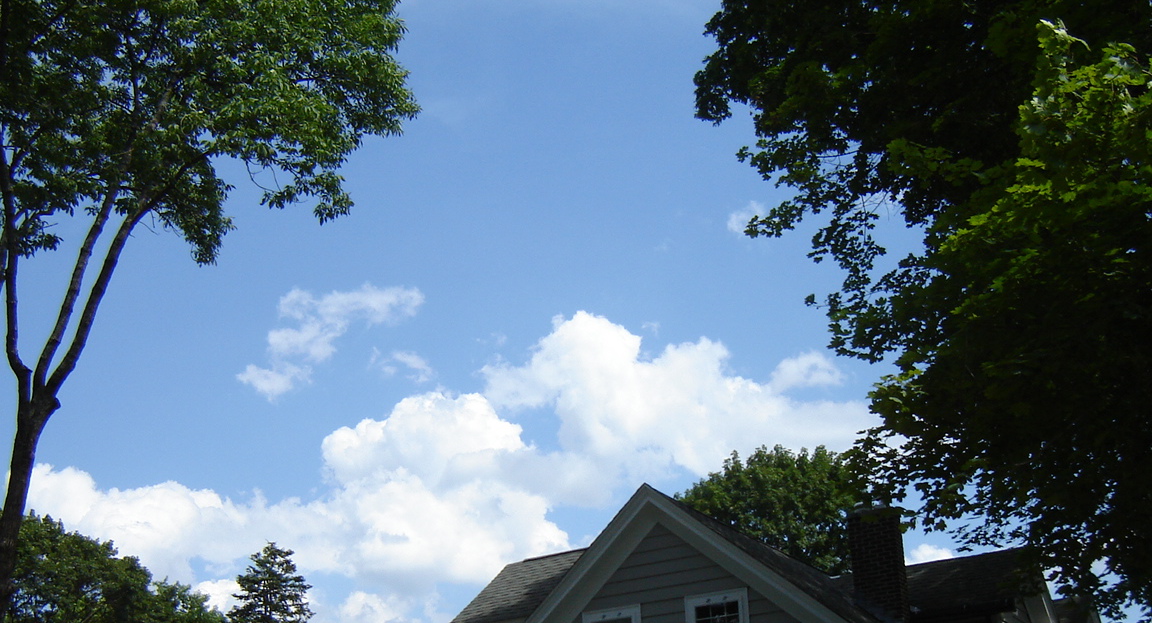
I include a couple pictures from times I did pay attention during the day.

042912_Japanese_Maple_3

063012_clouds (2)

Read Full Post »

It should be obvious that being out in nature is good for us, but today it often seems like a foreign concept.

“Take Two Hours of Pine Forest and Call Me in the Morning” is a lovely article, coming to you from Outside magazine. (I got the link from Andrew Sullivan’s blog.)

“These days, screen-addicted Americans are more stressed out and distracted than ever. And nope, there’s no app for that. But there is a radically simple remedy: get outside. [Outside magazine’s] Florence Williams travels to the deep woods of Japan, where researchers are backing up the surprising theory that nature can lower your blood pressure, fight off depression, beat back stress —  and even prevent cancer. …

“If the Japanese embrace of forest therapy can be attributed to one man, it’s [Yoshifumi] Miyazaki, a physiological anthropologist and vice director of Chiba University’s Center for Environment, Health, and Field Sciences, located just outside Tokyo.

“Miyazaki believes that because humans evolved in nature, it’s where we feel most comfortable, even if we don’t always know it. …

“Miyazaki has taken more than 600 research subjects into the woods since 2004. He and his colleague Juyoung Lee, also of Chiba University, have found that leisurely forest walks, compared with urban walks, yield a 12.4 percent decrease in the stress hormone cortisol, a seven percent decrease in sympathetic nerve activity, a 1.4 percent decrease in blood pressure, and a 5.8 percent decrease in heart rate. On subjective tests, study participants also report better moods and lower anxiety. …

“The science is so convincing that other countries are following Japan’s lead in studying and promoting nature as a cure. Lee just got hired away by the South Korean government, which is pouring more than $140 million into a new National Forest Therapy Center, expected to be completed in 2014. Finland, an empire of boreal spruce and pine, is also funding numerous studies. ‘Japan showed us that there could be cooperation between forestry and medical fields,’ says Liisa Tyrvainen of the Finnish Forest Research Institute” More.

Apart from just feeling better when I step outside for my walk and breathe the outdoors air, I note that a couple of my hero writers (Dickens and Asakiyume) are known for ruminating on long walks. Nature nourishes creative thought. P.S. Asakiyume also takes great pictures on her walks and posts them on her blog.

May 27, 2013, update from John: Mononoke creator Hayao Miyazaki on how he thinks about his art, here.

Photograph: Casey Yee
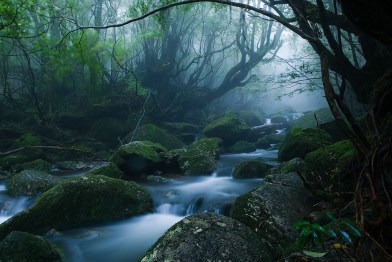
Mononoke forest, Yakushima Island, a
long the Kusugawa Trail. This is the forest that inspired Ghibli studio’s “Princess Mononoke.”
[University of Chiba‘s Yoshifumi Miyazaki] believes that because humans evolved in nature, it’s where we feel most comfortable, even if we don’t always know it. “Throughout our evolution, we’ve spent 99.9 percent of our time in natural environments,” he says. “Our physiological functions are still adapted to it. During everyday life, a feeling of comfort can be achieved if our rhythms are synchronized with those of the environment.”

To prove it, Miyazaki has taken more than 600 research subjects into the woods since 2004. He and his colleague Juyoung Lee, also of Chiba University, have found that leisurely forest walks, compared with urban walks, yield a 12.4 percent decrease in the stress hormone cortisol, a seven percent decrease in sympathetic nerve activity, a 1.4 percent decrease in blood pressure, and a 5.8 percent decrease in heart rate. On subjective tests, study participants also report better moods and lower anxiety.

Read Full Post »

An editorial in the NY Times earlier this month praised the efforts of a Long Island organization committed to rescuing a lovely, endangered body of water.

The editorial said that in Shinnecock Bay, “pollution from fertilizer and septic runoff feeds frequent algae blooms that block oxygen and sunlight. …  Once-lush beds of eelgrass, shelter for the little fish that feed bigger ones, have largely disappeared from the western part of the bay.”

But there is hope. “What Shinnecock Bay has going for it are scientists working to restore its waters and tidal flats to health. The Shinnecock Bay Restoration Program, run by Stony Brook University’s School of Marine and Atmospheric Sciences and its Institute for Ocean Conservation Science, means to fix the problem, not just study it.

“The institute’s executive director, Dr. Ellen Pikitch, said a big part of the job was as simple as replanting eelgrass and seeding the bay with clams and oysters, which filter the water clean and make the bay better able to fend for itself. …  Local officials were doing their part by agreeing to close sections of the bay to shellfishing.”

More on what is being done now and ideas for even bigger efforts here. The program could serve as a model for sustainability elsewhere in the world. And we can all do our bit by using less fertilizer and thinking first before putting pollutants down our drains.

Read Full Post »

Hurricane Sandy was terrible for many communities in its path, and the devastation has given urgency to climate concerns and innovative solutions.

Henry Fountain writes about one such solution in the NY Times, “With a few dull thuds, the one-ton bag of high-strength fabric tumbled from the wall of the mock subway tunnel and onto the floor. Then it began to grow. As air flowed into it through a hose, the bundle inflated until it was crammed tight inside the 16-foot-diameter tunnel, looking like the filling in a giant concrete-and-steel cannoli.

“The three-minute procedure, conducted on a chilly morning this month in an airport hangar not far from West Virginia University, was the latest test of a device that may someday help guard real tunnels during disasters — whether a terrorist strike or a storm like Hurricane Sandy, whose wind-driven surge of water overwhelmed New York City’s subway system, shutting it down for days.

“ ‘The goal is to provide flooding protection for transportation tunnels,’ said John Fortune, who is managing the project for the federal Department of Homeland Security’s Science and Technology Directorate.

“The idea is a simple one: rather than retrofitting tunnels with metal floodgates or other expensive structures, the project aims to use a relatively cheap inflatable plug to hold back floodwaters.

“In theory, it would be like blowing up a balloon inside a tube. But in practice, developing a plug that is strong, durable, quick to install and foolproof to deploy is a difficult engineering task, one made even more challenging because of the pliable, relatively lightweight materials required.”

More.

Photograph: NY Times

Read Full Post »

I just got a great lead from Erik. It seems that Sweden has run out of garbage for running its waste-to-energy program. Fortunately, Norway has garbage it can spare. (I wonder if Erik’s buddy Svein knows that.)

Check out Matt Hickman at Mother Nature Network:

“Sweden, birthplace of the Smörgåsbord, Eric Northman, and the world’s preferred solar-powered purveyor of flat-pack home furnishings, is in a bit of a pickle: the squeaky clean Scandinavian nation of more than 9.5 million has run out of garbage. The landfills have been tapped dry; the rubbish reserves depleted. And although this may seem like a positive — even enviable — predicament for a country to be facing, Sweden has been forced to import trash from neighboring countries, namely Norway. Yep, Sweden is so trash-strapped that officials are shipping it in — 80,000 tons of refuse annually, to be exact — from elsewhere.

“You see, Swedes are big on recycling. So big in fact that only 4 percent of all waste generated in the country is landfilled.

“Good for them! However, the population’s remarkably pertinacious recycling habits are also a bit of a problem given that the country relies on waste to heat and to provide electricity to hundreds of thousands of homes through a longstanding waste-to-energy incineration program. So with citizens simply not generating enough burnable waste to power the incinerators, the country has been forced to look elsewhere for fuel. Says Catarina Ostlund, a senior advisor for the Swedish Environmental Protection Agency: ‘We have more capacity than the production of waste in Sweden and that is usable for incineration.

“Public Radio International has the whole story (hat tip to Ariel Schwartz at Co.Exist), a story that may seem implausible in a country like garbage-bloated America where overflowing landfills are anything but scarce.” Read more.

Photograph: Smath/Flickr

Read Full Post »

More and more nonprofits are creating investment opportunities for well-wishers who want to support the charity’s mission while also receiving a modest return on their money.

New Hampshire Community Loan Fund is one I know about. “Investments in the New Hampshire Community Loan Fund are stable, pay interest to the investor and create opportunity many times over in New Hampshire’s communities,” says their website. “The money that people and institutions invest in us, combined with our own capital, creates the pool of funds from which we lend to create opportunity for decent housing, child care and jobs for families with low or moderate incomes.

“Our borrowers are people and nonprofit organizations that won’t qualify for a bank loan, but that are responsible and motivated to achieve their goals, including repayment. We connect them with the specialized training and support they need to be successful.”

The website also notes that the Community Loan Fund “received the highest honor in our field: the NEXT Award for Opportunity Finance. We were selected from among the country’s top community development financial institutions for providing fair, fixed-rate mortgage loans to help people in New Hampshire’s resident-owned communities build value in their home.” (Resident-owned communities are parks for manufactured housing at which the residents own not just the home but also share ownership of the land. They are a specialty of the Loan Fund.)

At The Chronicle of Philanthropy, Holly Hall writes about how the Nature Conservancy is using the concept of an investment vehicle for supporters.

Hall writes, “Project manager Jeff DeQuatro walks on a protective reef built by the Nature Conservancy off Coffee Island, Alabama. The environmental group has started Conservation Note, an investment program that returns the principal and interest of up to 2 percent to the charity’s supporters.

“Since April 2012, the Nature Conservancy has secured more than $16 million with the Conservation Note, a new investment program that will return an interest rate of up to 2 percent to the charity’s supporters. Under the arrangement, supporters who provide at least $25,000 to the Nature Conservancy to invest for a term of one, three, or five years will earn 0 to 2 percent in interest and get all their money back. The Conservation Note has been given a double-A rating by Moody’s.

“The Nature Conservancy will use the money from supporters to help it shoulder the costs involved in transferring a protected piece of land.

“For instance, the Nature Conservancy recently purchased a Colorado ranch on sensitive land and obtained a conservation easement that prohibits the land from being developed, thereby lowering its value. The lower price made it possible for five families with adjacent ranches each to buy a portion of the property back from the Nature Conservancy. The buyers all agreed not to develop the land.

“Money from the Conservation Notes helped the charity make up the costs involved in selling the land and getting the easement.

“ ‘What is so exciting is that it opens up a whole new avenue of supporting conservation with resources aside from philanthropy,’ says Charlotte Kaiser, who manages the program.” More on how it works.

Photograph: Brian Snyder/Reuters/File
Project manager Jeff DeQuatro walks on a protective reef built by the Nature Conservancy off Coffee Island, Alabama. The environmental group has started Conservation Note, an investment program that returns the principal and interest of up to 2 percent to the charity’s supporters.

Read Full Post »

Nourishing the Planet, a Worldwatch Institute project, “assesses the state of agricultural innovations with an emphasis on sustainability, diversity, and ecosystem health, as well as productivity.”

At the Nourishing the Planet blog, Jenna Baning writes about five groups of farmers in Africa who are sharing their problems and finding that the group has more solutions than the individuals.

1. Africa Rice Center “has been developing learning tools that focus on reaching as many farmers as possible … One powerful method has been farmer-to-farmer videos, which feature local experts sharing their knowledge about seed drying and preservation, rice quality, and soil management.”

2. Self-employed Women’s Association (SEWA), “a member-based Indian trade union that brings together approximately 1.3 million poor, self-employed women workers. … These women meet monthly in groups across the country to discuss challenges they are facing and identify possible solutions. SEWA’s Village Resource Centers connect the farmers with agricultural supplies, including improved seeds and organic fertilizers, as well as trainings.”

3. Songtaab-Yalgré, a rural women’s association that began “by teaching each other how to read and write in their local language. After gaining this basic, but critical skill, the organization then found ways to boost members’ incomes by producing shea butter products.”

4. Ecova – Mali was founded by two former Peace Corps Volunteers in 2007 because they saw that local people were better at training other local people than foreigners were. It “runs a training center and testing ground 35 kilometers (22 miles) outside of Bamako, Mali’s capital, as well as provides small grants to local farmers.”

5. The First Annual Conference of Indigenous Terra Madre, “a network launched by Slow Food International in 2004, focuses on protecting and promoting improved education, biodiversity, and connections between food producers and consumers. In June 2011, 200 representatives from 50 indigenous communities around the world met in Jokkmokk, Sweden, for the first-ever Indigenous Terra Madre Conference.

“The meeting, hosted by the native Arctic people known as the Sámi, and organized in partnership with Slow Food Sápmi and Slow Food International, discussed food sovereignty issues, the importance of preserving traditional knowledge for future generations, and ways to involve indigenous people and local communities in policy decision making and implementation.

“Small-scale farmers and indigenous people around the world shared their experiences and the solutions they had developed in response to the challenges they faced in common. As TahNibaa Naataanii, a participant in the meeting from the US-based Navajo Sheep Presidium, described, ‘We hear stories of the same thing that is happening in our own countries and own lands, and it gives us hope.’ ”

More here.

Photograph: Noor Khamis/Reuters/File
A farmer sets rice seedlings into paddy fields in Kirinyaga district, about 62 miles southeast of Kenya’s capital, Nairobi. The Africa Rice Center helps farmers share solutions to problems with each other.

Read Full Post »

Cathryn J. Prince has a story in the Christian Science Monitor about a research ecologist who thinks we can have our cake and eat it too: that is, have a strong economy and a sustainable future.

Prince writes, “As head of the conservation biology department at Antioch University New England in Keene, NH, [Tom] Wessels isn’t against chopping down trees or clearing land to farm. He just wants to see more people embrace sustainable forest and land management practices.

“Wessels, trained as a research ecologist, says economics plays as much a role in protecting the environment as does saving energy. Think how the adoption of fair trade principles for growing and selling coffee have changed the economics of that industry. Forests can benefit in the same way.

“ ‘Adam Smith, the father of modern economic theory, wrote about this in Wealth of Nations,’ Wessels says. ‘People will act out of self-interest, but they can support each other doing it. …

“Market forces can help to conserve forests and farmlands, says Wessels, who also serves as chair of the Vermont-based Center for Whole Communities. …

“ ‘We are incredibly frivolous about our energy use,’ Wessels says. ‘Any organism or population that is energy wasteful gets selected out of the system.” Charles Darwin explained this when he wrote about survival of the fittest, he says. Survival of the fittest also means survival of the most adaptable, and the most energy efficient, he says. …

“Partnering with more than 400 organizations in 47 states, Whole Communities aims to help create communities where people rely on each other for their food and other needs.

“For example, Wessels would like to see Detroit become a different kind of urban jungle. The city has lost about 50 percent of its population since the late 1980s. Empty lots abound. But now community gardens have begun to fill these open tracts with food crops. The Detroit Food Policy Council and the city government want to make Detroit food secure by 2020 – meaning that everyone will have access to sufficient, safe, and nutritious food.

“ ‘A lot of our focus is around food security,’ Wessels says. ‘Detroit will become a model for other urban areas.’ ” More here.

Photograph: Cathryn J. Prince

Read Full Post »

Shawn and Laura Sears were touched by inner-city kids with too many strikes against them and invited a few for an outdoor camping experience. The outing was so satisfying all around that they just kept doing it.

Marilyn Jones has the story at the Christian Science Monitor.

“Leaving college with liberal arts degrees – his in psychology, hers in geology – Shawn and Laura applied to Teach for America and were eventually placed to teach in one of the poorest regions in the country.

“Today, celebrating 14 years together (getting married along the way in 2004), they’ve seen the seeds sown during their experiences in Mississippi grow to fruition in the founding of Vida Verde Nature Education, a nonprofit outdoor education camp they’ve now run for 11 years.

“Located on northern California’s spectacular coast between San Francisco and Santa Cruz, this free camp for children from low-income families has served more than 7,000 kids from the inner cities of Oakland, East Palo Alto, San Francisco, and San Jose.

” ‘We help them let go of much of the negativity they often carry,’ Shawn says. ‘It’s nonstop fun, and they get to just be kids for a few days. Three days later, they’re transformed.’ ”

Read more.

Tony Avelar/Special to the Christian Science Monitor
Laura and Shawn Sears founded Vida Verde to give groups of students three days of exposure to and hands-on experience in the outdoors.

Read Full Post »

I like win-win stories like this one from National Public Radio. It’s about a new crop with a lot of monetary potential — and distinct advantages for the environment.

“It doesn’t require any land or fertilizer. Farming it improves the environment, and it can be used in a number of ways. So what is this miracle cash crop of the future? It’s seaweed.

“Charlie Yarish, professor of ecology and evolutionary biology at the University of Connecticut, loves seaweed. In nature, he says, when seaweed turns a rich chocolate color, that means the plant is picking up nitrogen, a process called nutrient bioextraction. …

“Many plants and animals cannot survive when there is too much nitrogen in the water, but seaweed is able to ‘capture’ the nitrogen, as well as contaminants in the water.

“A United Nations report says that nearly 16 million tons of seaweed were farmed in 2008 — most of it in Asia. Yarish helped a company called Ocean Approved start the United States’ first open-water kelp farm in the Gulf of Maine in 2006 … Now, he’s helping to create a seaweed farm off the coast of Connecticut.

“Bren Smith owns and runs the Thimble Island Oyster Company, off the coast of Branford, Conn. After his business was hit hard by Tropical Storm Irene last year, ruining about 80 percent of the shellfish crop, Smith started looking around for something more resilient to farm. That’s when he found Yarish, who agreed to help set him up in the seaweed farming business. …

” ‘There’s no barns, there’s no tractors. This is what’s so special about ocean farming. It’s that it’s got a small footprint and it’s under the water. I mean, we’re so lucky; I feel like I stumbled on this just great secret that we then can model and spread out to other places,’ ” Smith says. …

” ‘The plan is to actually split it into a couple different experimental markets — one for food, one for fertilizer, one for fish food. I’m [also] working with a skin care company in Connecticut, and then one for biofuel,’ Smith says. He’s even hoping he can someday fuel his own boat with biofuel from the seaweed.”

Craig LeMoult has the whole story here at NPR, where you also can listen to the audio.

Photograph by Ron Gautreau
Oyster fisherman Bren Smith on his boat.

Read Full Post »

In a recent article in the NY Times, Kathryn Shattuck described a festival that took place on “600 acres of pasture and test plots at the Land Institute on the outskirts of Salina, Kansas. …

“Each autumn for 34 years, during its annual Prairie Festival, this nonprofit research organization has become a Mecca of sorts for those whose passions run to sustainability, farming and feeding the world.

“For two days, Friday evening through Sunday afternoon, lectures and walking tours, interspersed with art installations and musical performances, focused on climate change, agricultural practices and what the institute’s president, Wes Jackson, called ‘getting over the hump’ in the use of carbon-based energy sources. …

“Jackson, a plant geneticist who co-founded the institute in 1976, calls the festival ‘an intellectual hootenanny,’ where ideas collide with music, art, food like bison chili, and bread and beer made from Kernza, the institute’s trademarked perennial wheatgrass.

“But the democratic casualness of the environment — listeners sprawled on hay bales, children frolicking on the hillside — belied the seriousness of purpose as college hipsters and wizened hippies shared space with revered scientists and conservationists like David Orr, an environmental studies professor at Oberlin; Fred Kirschenmann, a distinguished fellow at the Leopold Center for Sustainable Agriculture at Iowa State University who is also the president of the Stone Barns Center for Food and Agriculture in Pocantico Hills, N.Y.; and Douglas Tompkins, who has preserved more than two million acres of wilderness in Chile and Argentina.”

Read all about it here.

Photograph: Steve Hebert for the New York Times
Sleeping under the stars at the Prairie Festival 

600 acres of pasture and test plots at the Land Institute on the outskirts of Salina, Kansas

Read Full Post »

Conrad Wilson recently posted an intriguing story at National Public Radio. It’s about a a practical approach to sustainability: converting sewage to energy.

“It turns out,” writes Wilson, “a sewer — the place where a city’s hot showers, dishwashing water and organic matter end up — is a pretty warm place. That heat can generate energy — meaning a city’s sewer system can hold tremendous potential for heating and cooling.

“It’s just that unexpected energy source that Brainerd [Minn.] hopes to exploit.

“Scott Sjolund, technology supervisor for Brainerd Public Utilities, is standing on the corner of 6th Avenue and College Drive in Brainerd, as sewage rushes unseen through underground pipes.

” ‘Everybody heats water up … and all that gets drained down the sewer, and that’s potential energy that could be extracted. That’s part of the equation,’ Sjolund says.

” ‘Actually extracting it in an economical fashion,’ Sjolund says, is the equation’s critical second part.

“The idea for this project comes from Brainerd-based company Hidden Fuels. In 2009, the business partnered with the city and the school district and received a $45,000 grant from the federal stimulus package.

“Hidden Fuels’ Peter Nelson says the first phase of the project involved installing sensors in the city’s sewers. For more than a year, the company and the city measured the temperature and amount of sewage running through the system to create a thermal energy map.

” ‘It shows that there’s a significant amount of energy — literally enough to heat hundreds of homes — within the streets of the city of Brainerd,’ Nelson says.

“Earl Wolleat, director for buildings and grounds with the Brainerd School District, says there’s enough energy running in just one of the sewer pipes to heat the entire high school. That could save tens of thousands of dollars every winter.”

Read more.

Public Utilities’ Scott Sjolund at a sewer site. Photograph: Conrad Wilson

Read Full Post »

« Newer Posts - Older Posts »