Feeds:
Posts
Comments

Posts Tagged ‘environment’

Photo: Wikipedia.

There are so many things on this beautiful planet that we’ve never given much thought — things that turn out to be important for our future. Insects, for example, fungi, seagrass.

Allyson Chiu , with Michaella Sallu contributing from Sierra Leone, has written about seagrass research for the Washington Post.

“From the deck of a small blue-and-white boat, Bashiru Bangura leaned forward and peered into the ocean, his gaze trained on a large dark patch just beneath the jade-green waves.

“ ‘It’s here! It’s here! It’s here!’ crowed a local fisherman, who led Bangura to this spot roughly 60 miles off the coast of Freetown. ‘It looks black!’

“Bangura, who works for Sierra Leone’s Environment Protection Agency, tempered his excitement. After two unsuccessful attempts to find seagrass in this group of islands, he questioned whether the shadowy blotches were meadows of the critical underwater greenery he and other researchers have spent the past several years trying to locate along the coast of West Africa.

“It was only once he was standing in the waist-high water, marveling at the tuft of scraggly hair-like strands he’d uprooted to collect as a sample, that he allowed himself to smile.

“The wet, reedy plants Bangura held in his hands were unmistakably seagrass, and the green blades stretched past the plastic 12-inch ruler he’d been using to measure specimens. His grin grew even wider.

“The dense grass swaying in the current appeared to be healthy, and the water teemed with schools of small, silvery fish, making it the best site researchers have documented in these islands since the existence of seagrass was first confirmed in Sierra Leone in 2019. …

“Seagrasses — which range from stubby sprout-like vegetation to elongated plants with flat, ribbon-like leaves — are one of the world’s most productive underwater ecosystems. The meadows are vital habitats for a variety of aquatic wildlife.

Sometimes described as ‘the lungs of the sea,’ the grasses produce large amounts of oxygen essential for fish in shallow coastal waters.

“But, long overlooked, these critical ecosystems are vanishing. In fact, researchers don’t know exactly how many exist or have been lost. One recent study estimated that since 1880, about 19 percent of the world’s surveyed seagrass meadows have disappeared — an area larger than Rhode Island — partly as a result of development and fishing.

“ ‘When you lose foundation species like seagrasses … then you lose fisheries really quickly,’ said Jessie Jarvis, a marine ecologist who, until recently, headed the World Seagrass Association. …

“But locating grasses in the world’s vast oceans is a formidable task. While some researchers are using drones and satellite imaging, in countries such as Sierra Leone, where resources are scarce, the search is painstaking and tedious.

“Without these efforts, though, seagrasses would probably be disappearing even faster.

“ ‘What we don’t know, we can’t protect,’ said Marco Vinaccia, a climate change expert with GRID-Arendal, an environmental nonprofit that helped put together West Africa’s first seagrass atlas. …

“Similar to terrestrial plants, seagrasses have roots, leaves, flowers and seeds. Seagrasses have been discovered in the waters off more than 150 countries on six continents. The meadows are estimated to cover more than 300,000 square kilometers, an area the size of Germany. Along with mangroves, kelp forests and coral reefs, these grasses play a vital role in maintaining healthy oceans, Jarvis said. But unlike those other ecosystems, she notes, the meadows can exist in a wider range of ocean environments and tend to be more resilient than most species of seaweed.

“Critters, such as sea horses, crabs and shrimp, along with juvenile fish — some of which are critical species for fishing — often lurk within the thick meadows, seeking refuge beneath the underwater canopy. Other creatures, including sponges, clams and sea anemones, can be found nestled between the blades of grass or in the murky sediment at the base of the plants. And much as mosses coat trees, many species of algae grow directly on the leaves.

“Seagrass beds can in turn attract larger animals, including turtles and manatees, that stop by to munch on the leaves and stems. …

“From the leaves down to the roots, these unassuming plants work as ‘ecosystem engineers.’ Through photosynthesis, they help fill the surrounding water with oxygen. The leaves also absorb nutrients, including those in runoff from land, while their roots stabilize sediment, which helps to reduce erosion and protect coastlines during storms.

“Seagrasses also have the potential to play a significant role in combating climate change. Just as trees pull carbon from the air, seagrasses do the same underwater. Then, as the carbon-filled parts of the plants die, they can wind up buried in the sediment on the seafloor. Over time, this can help create sizable carbon deposits that could remain for millennia.

“But the grasses aren’t showy like coral reefs or immediately recognizable like mangroves, and they’ve become one of the least protected coastal ecosystems.”

Read more about what is being done here, at the Post.

Read Full Post »

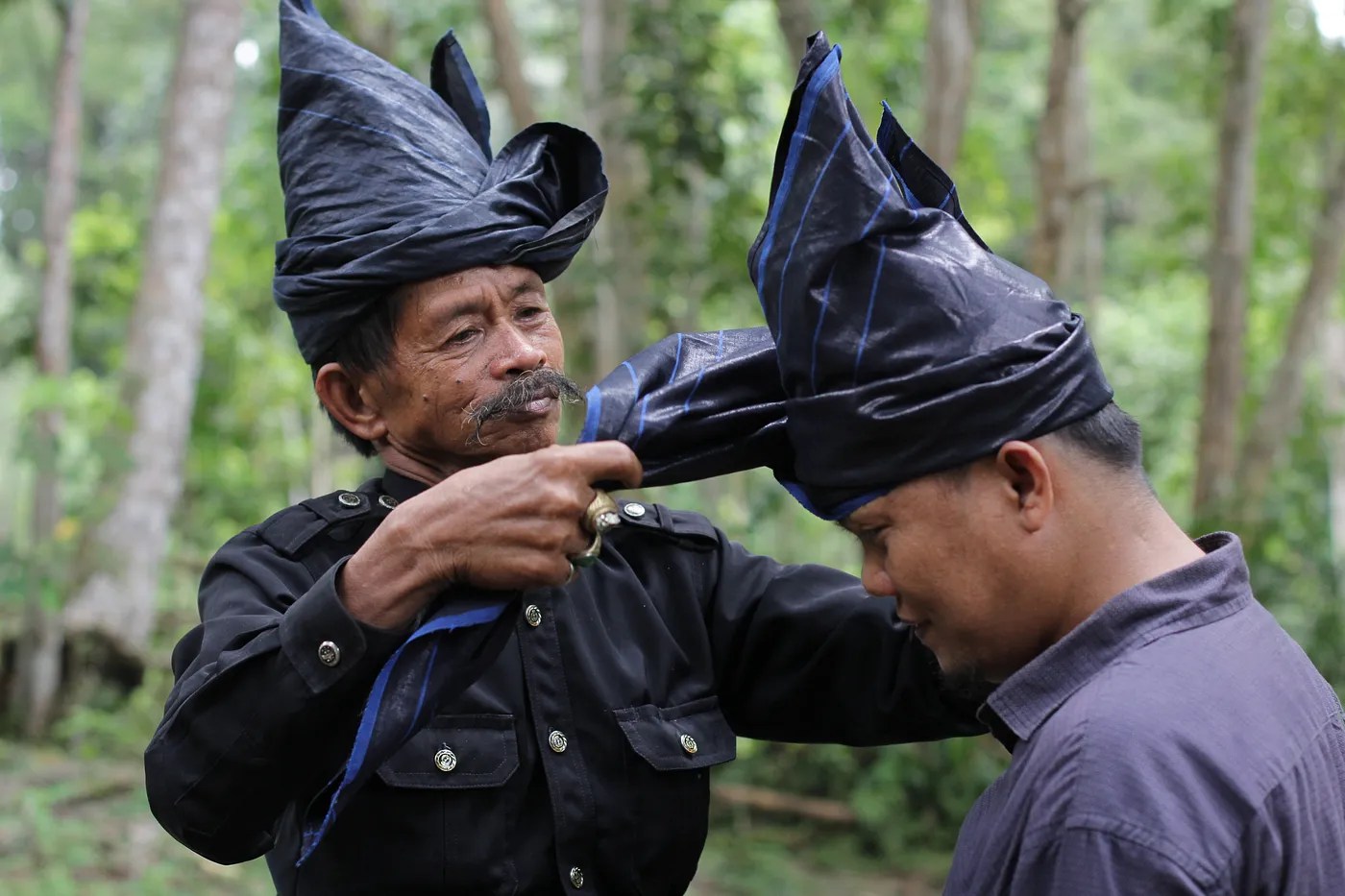
Photo: Annas Radin Syarif / AMAN at Medium.
A Kajang elder in Indonesia demonstrates the wearing of a passapu headwrap and the passing of knowledge to the next generation.

While most of the world was going full-steam on nature-destroying “progress,” many indigenous groups were quietly protecting whatever was left.

Peter Yeung at the Washington Post writes about the Kajang people in Indonesia.

“By midmorning, beams of tropical sun cut through the rainforest canopy, illuminating a bamboo hut in a rare clearing of trees. Inside, a wrinkled old man, sitting cross-legged with his eyes shut, whispers blessings to the Earth.

“After the spiritual leader, the Ammatoa, goes silent, groups of men wearing dark indigo sarongs jump to their feet and head into the forest carrying an offering of rattan baskets full of rice, bananas and lighted candles.

‘The Earth is angry with us,’ said Budi, a barefoot boy crouching on the hut’s edge. ‘That is why the weather is getting worse. There are more rains and floods. It is getting hotter. It is because we have sinned.’

“This ritual is known as the Andingingi, held once a year by the Kajang, a tribe from the Indonesian island of Sulawesi. Like many parts of the world, their land has been hit by more extreme weather because of climate change. But as satellite imagery shows, the Kajang’s dense primary forest is free from roads and development, soaking up violent rains that devastate other parts of the island.

“As global deforestation continues at alarming rates, the empowerment of Indigenous peoples such as the Kajang is emerging as a key way to protect the world’s rainforests. A spate of recent research suggests that when armed with land rights, these communities, whose members manage half the world’s land and 80 percent of its biodiversity, are remarkably effective custodians. …

“The Kajang [community] lives according to the Pasang Ri Kajang, an ancestral law passed down orally through legends and tales. It tells of how the first human fell from the sky into their forest, making it the most sacred place on Earth.

“In practice, that means the forest is at the center of life. The Kajang rely on subsistence agriculture, with no industry or commerce to speak of. Cutting trees, hunting animals and even pulling up grass is prohibited on most of the land. Modern technology, such as cars and mobile phones, is not allowed within the traditional territory.

“ ‘The tree is just like a human body,’ said Mail, a 28-year-old Kajang. … ‘If the forest is destroyed, there will be nothing for the bees, nothing for the flowers and nothing for life.’

“So far, Indigenous tribes have received little legal, financial or institutional backing, advocates say. A 2021 report by the nonprofit Rainforest Foundation Norway found that over the past decade, Indigenous peoples received less than 1 percent of donor funding for fighting deforestation.

“Yet policy is now beginning to shift in recognition of the role they can play in protecting the land. …

“At the U.N. Climate Change Conference in 2021, also known as COP26, world leaders pledged $1.7 billion of funding for these communities, calling them ‘guardians of forests.’ …

“In December 2016, the Indonesian government officially recognized more than 50 square miles of rainforest as belonging to nine of the country’s tribes — including the Kajang — following a landmark ruling by the nation’s highest court. … In a case brought by the Alliance of Indigenous Peoples of the Archipelago (AMAN), an Indonesian nonprofit, the Constitutional Court ruled in 2013 that the state should transfer ownership of what are called customary forests to the Indigenous peoples who had historically governed them according to custom. …

“The rate of primary forest loss in Indonesia has declined every year since 2016, according to the most recent data available, and is now at its lowest level since at least 2002.

“The recognition of customary forests, along with government efforts to protect peatlands and mangroves and to tighten regulations on logging, oil palm and mining permits, has helped drive that reduction. …

“The Kajang are a showcase of Indonesia’s experiment. For years, local forest rangers have helped protect a wealth of native wildlife, including deer, monkeys, wild boars and tropical birds, as well as four rivers, whose watersheds supply several villages outside Kajang land. ..

“The philosophy of Kamase Mase, living simply and taking no more than needed to subsist, underpins their lifestyle here. …

“ ‘We must keep the tradition,’ said Jaja Tika, a weaver. … ‘As long as we live, the forest will exist.’ ”

More at the Post, here.

Read Full Post »

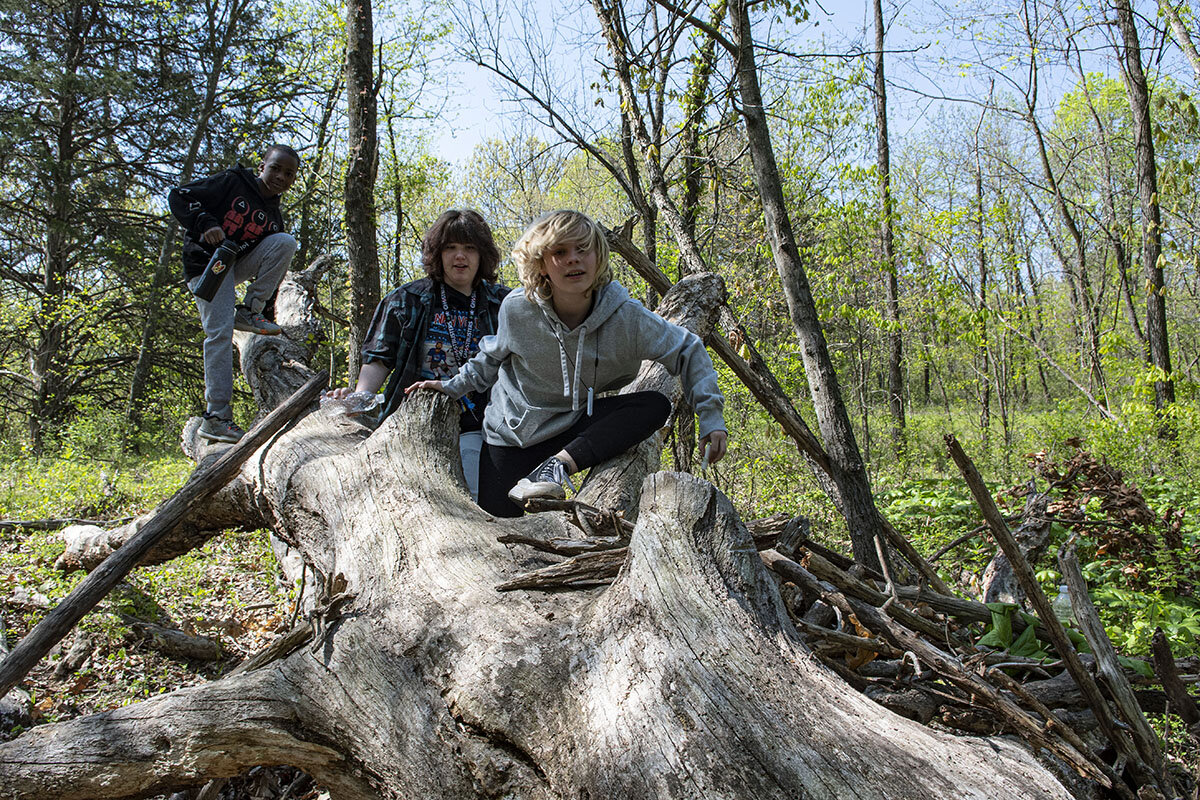
Photo: Alfredo Sosa/CSM Staff.
Students from Thorpe Gordon Elementary in Jefferson City, Missouri, at the Runge Conservation Nature Center in April.

It’s not a new idea, but it’s gaining traction: Getting kids outside into nature benefits their learning.

Jackie Valley writes at the Christian Science Monitor, “Down a hiking path and through the woods, giggles and chatter echo from a clearing where elementary students have just finished constructing makeshift shelters.

The challenge blended environment with engineering, hence this visit to the Runge Nature Center from third, fourth, and fifth graders. They’re part of a STEM (science, technology, engineering, and math) club at nearby Thorpe Gordon Elementary in Jefferson City, Missouri. …

“A boy announces he saw a turkey, while another student proclaims ‘teamwork’ her favorite part. The scene portrays what conservation leaders and educators in Missouri are hoping to instill in the state’s youngest residents: an appreciation for the outdoors, a new experience, and some learning along the way.

“ ‘I think it’s so important,” says Melanie Thompson, a librarian from the elementary school who’s leading the STEM group on this day. ‘Kids don’t spend enough time playing outside.’

“In Missouri, efforts to connect children with nature date back to 1939. That’s when the Nature Knights program launched, giving children recognition for conservation practices. Three years earlier, the state’s residents approved an amendment that created an apolitical conservation agency.

“Today, terms such as nature education, outdoor learning, and environmental education refer to instruction that, in many ways, takes students out of traditional classroom settings. Subtle nuances exist, though, depending on the location and programming. The Environmental Protection Agency defines environmental education as a type of learning that allows people to ‘explore environmental issues, engage in problem solving, and take action to improve the environment’ – while also not advocating a particular viewpoint.

“The Missouri Department of Conservation, meanwhile, sees nature education as a way to ‘inspire and educate individuals about nature so they appreciate and ultimately protect our resources and wild places,’ says Brian Flowers, a regional supervisor for the agency’s education branch. …

“ ‘You introduce them to it,’ says Mr. Flowers, referring to conservation, natural resources, and wildlife. ‘You show them why it’s important, and, eventually, that leads to that they care about it. They protect it.’

“A study called The Nature of Americans, conducted in 2015 and 2016, found that more than 80% of children surveyed said time in nature made them feel creative, happy, healthy, and smarter. …

“ ‘Once they’re there, there’s so much that happens – curiosity and creativity and just enjoyment of being outside,’ [Megan Willig, a program coordinator for the National Environmental Education Foundation] says. It can also introduce students to career pathways in the natural resource, conservation, and STEM fields.

“In a grassy field not far from an elderberry patch, a sustainably designed building with large windows and a gently sloping roofline is under construction. It’s the future Boone County Nature School, which occupies land in the Three Creeks Conservation Area and will welcome a rotating cast of 12,000 to 13,000 students each year, says Mr. Flowers.

“The project represents a partnership among the Missouri Department of Conservation, Columbia Public Schools, community organizations, and other school districts in Boone County.

“Columbia Public Schools has hired a teacher to lead instructional efforts at the Boone County Nature School, which fits into the district’s overall mission to pour more resources into place-based learning, says Michelle Baumstark, the chief communications officer. About half of the district’s students qualify for free or reduced-price lunch.

“ ‘These may not be experiences that they would have any other way and when you can create an access to an enriching opportunity, that can change the trajectory of a kid,’ she says.

“The land surrounding the nature school will feature a food forest, pollinator plots, a prairie restoration area, trails, a pavilion, and a council house with three tiers of stadium seating. The karst topography of the conservation area – caves, springs, and hills – is typically only found in southern Missouri near the Ozarks, making it an ideal exploration area for local children, Mr. Flowers says. …

“The Missouri Department of Conservation also operates programs that teach students archery and how to fish, among other things. And, in St. Louis, pavement will be removed and replaced with a green schoolyard at Froebel Literacy Academy. Picture a park-like setting with trees and wildflowers, where students can play and learn through STEM activities.

“The schoolyard project represents a step toward outdoor equity for children who grow up in urban areas that have more concrete and asphalt than lush, green recreation space, says Aaron Jeffries, deputy director of the Missouri Department of Conservation. …

“There’s no national standard for outdoor learning or environmental education, says Ms. Willig of NEEF, which was congressionally chartered in 1990 to complement the work of the EPA. So efforts differ by state and local jurisdiction, though she has seen more interest in making it a formal part of the curriculum.

“If barriers such as time or transportation exist, Ms. Willig recommends that school systems seek community partnerships. For instance, a local nonprofit that supports watershed health, she says, may be keen on helping with programming.

“ ‘The school doesn’t need to reinvent the wheel or start from scratch,’ she says.”

More at the Monitor, here. No firewall, nice pictures.

You can read another of my posts on kids benefiting from nature at school, here.

Read Full Post »

Photo: Goldman Environmental Prize.
Chilekwa Mumba took on a UK mining giant that was polluting Zambia — and won.

Today’s story shows how one person can make a difference, even when the goal is considered impossible. It’s also a cautionary tale, because you can win the battle and not the war. The irony is that powerful entities can excuse polluting a region in order to meet “green economy” needs.

Jocelyn C. Zuckerman reported at Yale Environment 360, “The southern African nation of Zambia is home to a wealth of minerals — in particular, lots of the copper and cobalt that the world will require to power a green economy. Among its largest operations is the Konkola Copper Mines (KCM), located in the country’s Copperbelt Province.

“In 2004, U.K.-based Vedanta Resources acquired the controlling stake in KCM, whose operations span 11 square miles along the Kafue River. Soon after, residents noticed that the Kafue was emitting foul odors. Fish began dying. Crops began to wither.

Livestock fell ill. And villagers came down with mysterious headaches, nose bleeds, rashes, and burns.

“Chilekwa Mumba, who had grown up in the region but since moved to the Zambian capital, Lusaka, learned of the problem and vowed to do something about it. In an interview with Yale Environment 360, he talks about how he spent the next several years facilitating meetings between the communities and British lawyers, gathering water samples, and convincing former mine workers to provide evidence for a lawsuit that made its way through the British court system. Finally, in 2019, its Supreme Court found that KCM’s parent company could be held accountable in the U.K. for environmental damage from the mine’s operations.

“Not only had Mumba, 38, who was awarded a Goldman Environmental Prize [in April], helped win significant financial compensation for the 2,000 villagers involved, but his case set a legal precedent that British companies can be held accountable for the environmental fallout of their operations overseas. …

Yale Environment 360: KCM was already a presence when you were growing up in the town of Chingola. … You did your primary schooling in Chingola, so you got a good education in part thanks to the mine, which funded the schools? …

Mumba: They had excellent schools. We moved to Lusaka when I was 15, but I still went to school under the mine system. I went to a boarding school that was supported by the mines, including KCM.

e360: In 2004, Vedanta Resources, which is headquartered in the U.K., acquired a controlling stake in KCM. What happened after that?

Mumba: When they took over, there was too much collusion with government. They were not being held to account on many different issues. Based on what I was reading in the media, I started talking to residents in Chingola. We’ve got family and friends there, and my parents still maintain a home there. I used to go back occasionally, but it became almost a permanent home when I started to find out about the reports [of pollution]. I began realizing that what I’d been hearing was correct. And I started to do my own investigation. …

“I went to the same spot I used to go to as a child to fish. … There were basically no fish, and the smell of chemicals was quite evident. The soil makeup was different from what I remembered when I was young.

e360: Did you confront the company? …

Mumba: I had a couple of meetings with a local lawyer representing the villagers, and he was telling me that nothing would happen, that I shouldn’t waste my time. But he did give me quite a bit of information, and I put it in my file.

e360: You wrote letters to something like 100 law firms?

Mumba: A combination of law firms and environmental NGOs, all over the world. I was just randomly sending them out from my Yahoo address. I got a lot of automatic replies. And then there was an automatic reply from [British law firm] Leigh Day, followed up with an actual email from a person, Katie Gonzalez. I can never forget that name. I happened to find it in my email and was surprised. They told me they would be there in two weeks.

e360: How did the community respond to this British lawyer coming in? Did they trust him?

Mumba: Not immediately. But the way he is — Oliver Holland, I have to absolutely mention him — he was a white guy in a remote village, but he has this aura about him where he is very friendly, so they warmed up to him.

e360: What sort of evidence did you bring to court?

Mumba: We gathered water samples and soil samples and found that copper, iron, cobalt, and dissolved sulfates were present far beyond legal limits. We also took in — though we did not put that to the court — blood tests for various clients, to test for the presence of heavy metals. We already had overwhelming evidence from the water and the soil.

e360: Did you have help from anybody inside the company?

Mumba: A former mine manager, who knew the whole process and how there was gross negligence on the part of pollution control, gave us a lot of documents. He, of course, did not want to be named, so we videoed his testimony using certain means where his identity could be withheld. …

“Because of my connection to the case, I would get random calls and they would say, ‘Can we meet you? We want to help you. But protect our identity.’ So I would meet as many as possible. I would talk to everyone. It was part of the investigation, to get all that evidence together. …

“At the time, funnily enough, I was working for a local law firm, as a business development consultant. But I abandoned that work and decided to do this. I honestly didn’t even think that I was doing an investigation per se. It all came together when I was just simply inquiring into all these issues. …

e360: We know that copper and cobalt will be critical to the new green economy. Lots of people, including in the United States, want Zambia’s minerals. How does that help or hinder your position?

Mumba: I see it as a very dangerous position, especially the thirst for cobalt. I feel like the communities around the mines have never gotten a fair share of the deal. America says the end game of mining is they want clean energy. Cobalt is one of the components for that. So right now we need to be more watchful about how these mining operations are taking place and what benefit goes to the community.”

More at Yale Environment 360, here. No firewall.

Read Full Post »

Photo: RTÉ.ie (Raidió Teilifís Éireann), Ireland’s National Public Service Media.
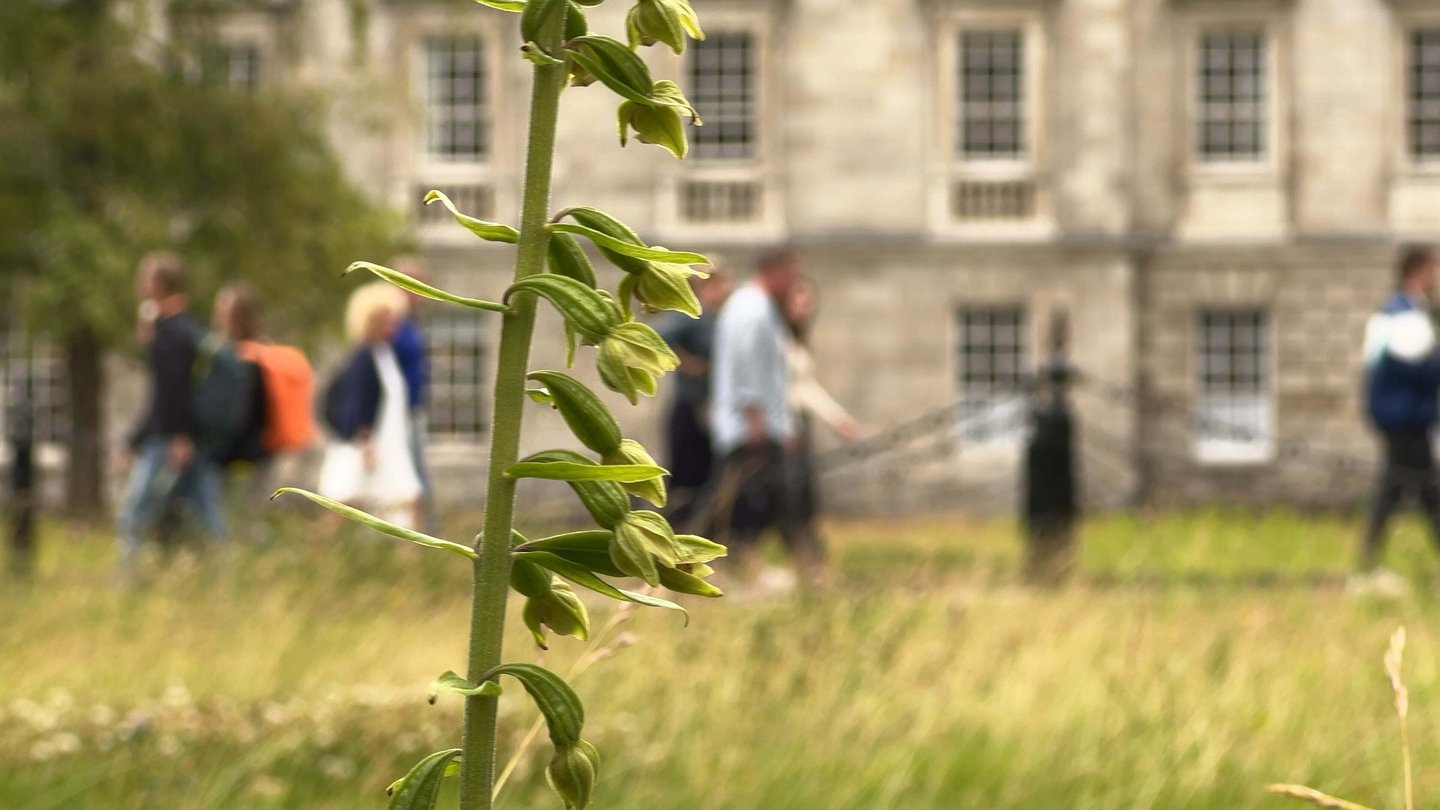
One of the broad-leaved helleborines near the front arch of Trinity College in Dublin. Good things are growing in the city after No Mow May.

John made a good point about No Mow May the other day. The initiative to give a chance to plants that pollinators love has been growing, but why destroy the improved ecosystem by mowing in June?

Philip Bromwell writes at RTÉ (Ireland’s National Public Service Media) about an approach in Dublin.

“Two species of orchids have been discovered growing on the campus of Trinity College in Dublin city centre, much to the surprise and delight of botanists.

“The wild plants — a broad-leaved helleborine and a pyramidal orchid — have popped up in a lawn next to Trinity’s iconic Front Arch.

“Inspecting the 60cm [~2 foot] broad-leaved helleborine, Professor Jennifer McElwain, from TCD’s School of Natural Sciences, said … ‘It’s really unusual to find this orchid anywhere. It’s rare. It’s extra unusual to find it in the middle of Trinity, right in Front Square, in the middle of the city.’

“There are around 30 different species of wild orchids in Ireland. Some thrive in fields, others prefer bogs, woods or mountains.

“Professor McElwain believes the appearance of the orchids in Trinity are the result of the university’s participation in ‘No Mow May’ – the annual campaign that encourages gardeners to not mow their lawn during the month of May so that plants and pollinators benefit.

” ‘We wanted to implement a positive measure for biodiversity. So, we just simply stopped mowing this lawn in May. And that was difficult to do, because a lot of people really like finely cut lawns. But we stopped mowing, and this wonderful orchid began to emerge. And there’s not just one — there are three orchids, including another species. So, we actually have an orchid-rich meadow.

‘That’s a botanist’s dream and our only intervention has been to stop mowing the lawns.’

“Orchids have the smallest seeds of all flowering plants, with a typical seed the size of a speck of dust.

” ‘A seed could have blown in by wind. It could have come in on the feet of people, or been brought in by a bird,’ Professor McElwain explained. ‘Alternatively, this seed could have been in this lawn for decades. Underground, just waiting for the right conditions to allow nature to thrive. And the right conditions in this case happened to be not mowing the lawns.’

“Flower-rich, grassland habitats are rapidly disappearing from the island of Ireland and one third of our wild bees are threatened with extinction.

“Trinity installed wildflower meadows on College Green in 2020 after thousands of students, staff and members of the public voted to replace the manicured lawns at the front entrance to the university with the more nature-friendly alternative. …

” ‘I think this a really hopeful demonstration that biodiversity and nature can thrive if we just give it time and space. We are in the midst of biodiversity and climate crises. It can seem overwhelmingly complex to solve it, but it’s our responsibility to show what’s possible.

” ‘In this lawn alone, more than 35 plant species have come up. And if you think each one of those plant species supports one or two species of pollinators, that’s 90-odd species. If this lawn was a mown, clipped lawn, you would have a species diversity of one.

” ‘This demonstrates how simple measures can lead to really spectacular results. Never in our wildest dreams did we expect this,’ she said.”

More at Ireland’s National Public Service Media, here. No firewall. For more insight on the importance of meadows, see my friend Jean’s Devine Native Plantings, here.

How do you feel about giving up lawns? We have not had one for years, initially because neighborhood dogs kept destroying ours, but nowadays because we like the look of vinca. I do think that while a family’s kids are young, a lawn for outdoor games is pretty necessary, but not with weed- and bug-killers.

Read Full Post »

Photo: Bluetti Power.
Using solar power for a fish farm is better for the environment than the usual diesel.

Who wouldn’t be encouraged to see all the clever ways innovators are working to reduce the harm that human activity can cause to the planet?

If it’s happening anywhere near Rhode Island, the nonprofit ecoRI News will find it and tell you about it. For example, Rowan Sharp covered the advent of a solar-powered, self-cleaning fish farm in Rochester, Massachusetts, back in 2012.

“Dale Leavitt told me to meet him at the 7-Eleven in this small town of about 5,000. I wouldn’t be able to find the fish farm on my own, he said. ‘It’s way out in the woods — it would be impossible.’

“He pulls up in a pickup — a cheerful, mustached man with slightly wild silvering hair. He wears a weather-beaten baseball cap and T-shirt, both advertising the marine biology program at Roger Williams University, where he teaches part time. He has blurry tattoos on his forearms, including one of a cartoonish, polka-dotted octopus. …

“I follow him down Route 28, until he veers into forest. Soon we’re rolling slowly down an unpaved track, just rutted wheel marks with grass tufting up between them. … Leavitt parks on a little scrap of solid ground amid the bogs, where a murky pond and a bank of solar panels are the only clues to the one-of-a-kind innovation hidden here. But this unassuming exterior packs a punch. Leavitt, cranberry farmer Brad Morse, Roger Williams University engineering professor Charles Thomas and a handful of undergraduate students from Roger Williams University have turned hard-won Environmental Protection Agency (EPA) grant money into a solar-powered, self-cleaning fish farm that may prove two to three times more efficient than conventional fish farms, at scant environmental cost. …

“Leavitt — his students call him Dale — is in his element here. He produces a plastic container of what looks like dog food pellets — Purina Fish Chow, actually — and happily leads me over to an unnervingly rickety plank onto a metal walkway over the pond. Weathered boards delineate the 15 6-by-8-foot mesh-sided fish pens.

The 15 6-by-8-foot fish pens are stocked with juvenile largemouth bass. … Soon the surface roils with activity: 6-inch juvenile largemouth bass, voracious eaters, which, by fall, will grow into 14-inch, one-and-a-quarter-pounders. Each pen is a module that can be lifted out with a backhoe. The mature fish will be sold at Boston’s live seafood markets or over-wintered for pond stocking this coming spring.

“Each pen can comfortably hold 100 bass, though some aren’t yet filled. Soon three of Leavitt’s assistants drive up with more fish in plastic tanks. Leavitt bought the bass as 2-inch hatchlings from a Delaware hatchery last winter; he and his students raised them to their current size in a Roger Williams University laboratory. …

“[Cranberry] farmer Morse is out today, but this enterprise owes its beginnings to a struggling late-1990s cranberry market that left Morse searching for other options. Morse is a fifth-generation grower who has farmed the 65-acre bog surrounding us since 1971.

“By 1999, cranberry prices were so depressed that many farmers feared selling their land for development was the only viable option. But Morse had another idea.

“ ‘I was looking for ways to diversify,’ he says in a telephone interview. He connected with the Massachusetts Department of Agriculture, where Leavitt then worked as an aquaculture extension agent. Leavitt found funding to help Morse launch a fish farm, and the two became good friends as they worked together on an elegant partitioned aquaculture system, kept clean by phytoplankton.

“It was a two-pond design: one pond for the fish, with water circulating by paddle wheel through a wider, shallower pond — a converted cranberry bog — where naturally occurring algae absorbed fish waste from the water. An aerator gave the needed oxygen boost.

“The farm was ‘a learning curve,’ Morse says, but it supplemented his income until the cranberry market recovered. The project’s Achilles’ heel, however, was its fuel consumption. The bog is too isolated for an electricity connection; a diesel generator powered the paddle wheel and aeration.

“In 1999, diesel had cost 76 cents a gallon. By 2006, it was well over $3. The fish were no longer profitable; Morse converted the filtration pond back to cranberries. Leavitt turned his attention to other things.

“But Leavitt’s passion has never strayed too far. He joined the Roger Williams University biology department and continued doing aquaculture outreach, advising new oyster farmers and even designing a solar-powered shellfish growing system. His lab also grows oysters for restoration of Narragansett Bay.

“In 2008, Leavitt called Morse to say, ‘Brad, I’m ready to start fish farming again.’

“This time, Leavitt had a different plan. He applied for an EPA grant to work with undergraduates in developing technology for sustainable living. Morse was more than willing to get involved. …

“Morse, Leavitt, and Thomas worked with a team of senior engineering students to “completely revamp the concept” of the fish farm. They modeled the new system on the flow dynamics of an automobile turbo-charger — a lucky stroke of inspiration from a student. They designed a single-pond system, with waist-deep fish pens on one side and a shallow, 18-inch algae filtration area on the other; algae need plenty of sunlight to photosynthesize fish waste, so depth matters. A single pump would aerate and circulate the water, and the whole pond would only be a quarter acre.

“Eighteen 200-watt, 24-volt solar panels power the fish farm’s water pump.Goodbye diesel. They were going solar.”

More at ecoRI News, here. No firewall.

Read Full Post »

Photo: Alibaba.
You can take a jug to buy detergent in bulk at Debra’s and keep refilling the smaller bottle you keep by your sink.

For a few years now, I have been refilling the plastic bottle that my dishwashing liquid once came in. For a while I bought a concentrate online. Now I take a clean jug into Debra’s Next Door, pump the detergent into the jug, and refill my smaller container for months.

Today’s story is about big brands trying to get into the act.

Susan Shain reports at the New York Times, “Every week, Angela Espinoza Pierson looked at her recycling bin — filled with detergent jugs, shampoo bottles and clamshell containers that once held strawberries — with mixed feelings. Sure, it was a lot of plastic. But it was going to be recycled.

“Or so she thought. Then her husband sent her some articles revealing that less than 6 percent of the country’s plastic gets recycled, and that even recycled plastic can only be reused once or twice. Ms. Espinoza Pierson, who lives in Buda, Texas, was shocked. …

“Determined to cut back on her plastic consumption, Ms. Espinoza Pierson got a starter kit from a company selling refillable household cleaners. In it were tablets containing concentrated hand soap as well as multi-surface, glass and bathroom cleaners — and four empty containers. She filled each one with tap water, then dropped in a tablet and watched it dissolve. If she is happy with the cleaners, she will order more tablets but reuse the containers. No new plastic required.

“Given plastic’s detrimental effects on the environment, nearly three-quarters of Americans say they are trying to reduce their reliance on single-use plastic, according to Pew Research Center. Since plastic is everywhere and avoiding it altogether is extraordinarily difficult, some, like Ms. Espinoza Pierson, have revived a once-customary practice: refilling containers rather than disposing of them. If just 10 to 20 percent of plastic packaging were reused, a report from the World Economic Forum estimates, the amount of plastic waste entering the ocean could be cut in half. …

“Over the past few years, Windex, owned by SC Johnson, introduced concentrates that dissolve in water; Dove began selling a deodorant stick that slots into a reusable case; and The Body Shop added refill stations to half its American stores.

“These are tiny experiments in a country that generates nearly 500 pounds of plastic waste per person, per year. But Matt Prindiville, the chief executive of Upstream, a reuse advocacy organization and consultancy, says his organization has seen the number of reuse-refill start-ups grow from a dozen in 2019 to more than 150 today.

‘If you asked me about this three years ago, I wouldn’t have guessed at how quickly the interest in the sector has blown up,’ Mr. Prindiville said. ‘Not just from the do-gooders, but from the biggest brands in the world.’

“American beverage companies switched to single-use plastic containers during the 1970s, largely because it saved money, said Bart Elmore, an associate professor of environmental history at Ohio State University. No longer would companies have to collect or clean refillable bottles.

“Since throwing things away, rather than cleaning and reusing them, was convenient, too, it seemed like progress. … Manufacturers and consumers alike fell in love with the lightweight and unbreakable material. More than a third of all plastic ever produced has been used for packaging, most of it created and disposed of in the same year.

“Today, the pressure to reduce corporate carbon footprints is forcing a second look at all that plastic packaging. ‘Reuse, for some types of products and packaging,’ Mr. Prindiville said, ‘can put a huge dent in reducing those climate impacts.’

“Household cleaners seem particularly primed for a refill revolution. Whereas shampoo and conditioner* involve complicated chemical formulas, many cleaners can be easily concentrated and reconstituted with water. In fact, that’s what makes up the bulk of traditional cleaning products, leading Mr. Prindiville to describe the current system this way: ‘We’re just shipping around water. And that’s dumb.’

“In contrast, the concentrated surface cleaners sold by Grove Collaborative each contain 1 ounce of liquid, far less than a standard 16-ounce bottle of ready-to-use cleaner, and thus require less fuel to transport.

Grove’s spray bottles are meant to be reused, and its concentrates are packaged in glass or aluminum — materials that, unlike plastic, can be recycled over and over.

“Grove’s products are now on shelves in more than 5,000 stores, including Target, CVS and Walmart, and the company has seen its net revenue from refillables grow by more than 600 percent since 2018. But with $322 million in total revenue, it is a tiny player in the $30 billion home care market.

“The Clorox Company, on the other hand, has a huge reach. Last year, the $7.1 billion company, which sells products in 100 countries, stepped into the refillable market with cleaning spray concentrates that can be emptied into a reusable plastic spray bottle. (Packaging accounts for more than half of all trigger spray manufacturers’ greenhouse gas emissions, transportation for another third.) …

“Not everyone is as enthusiastic. Jan Dell, a chemical engineer and founder of the anti-plastic pollution organization The Last Beach Cleanup, noted that many cleaning products are housed in PET or HDPE, two types of plastic with relatively high recycling rates. So she is less concerned about them — and far more concerned about the packaging of other products.

“ ‘Where these companies should be focusing is on this vast portfolio of everything else that isn’t recyclable, that is single use and that often becomes plastic pollution,’ she said, pointing to SC Johnson’s Ziploc bags and Clorox’s Hidden Valley ranch dipping cups. ‘This is just a classic example of big corporations doing a stunt over here on something that’s not the main issue to distract from all the single-use plastic they’re pushing out.’

More at the Times, here, including the response from Clorox.

*Note that shampoo and conditioner in a soap-bar form work just fine.

Read Full Post »

Photo: Yoav Aziz/Unsplash.
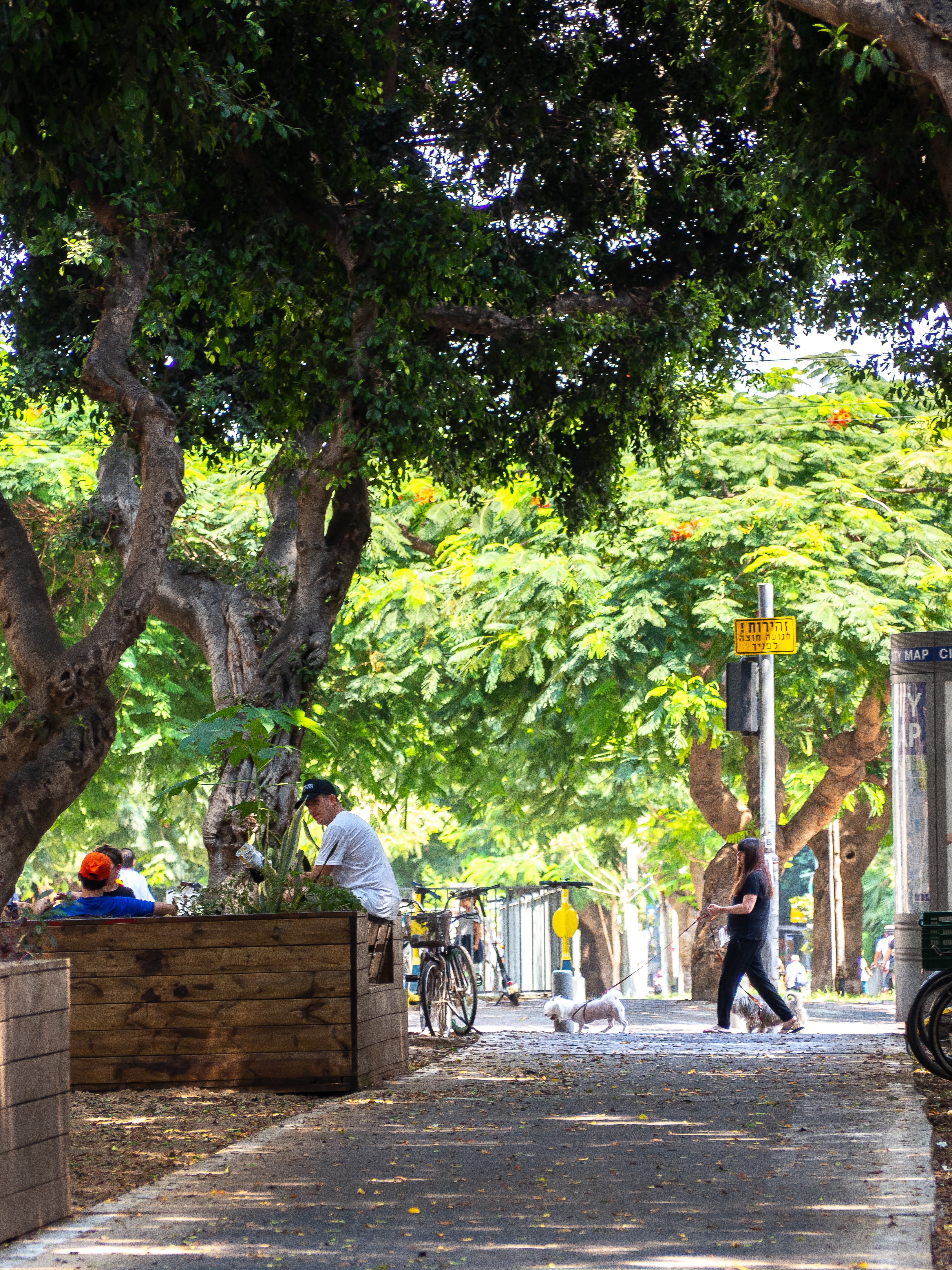
Urban trees on Rothschild Boulevard, Tel Aviv, Israel.

If you search this blog on “urban trees,” you will see many posts showing how trees in cities are beneficial both for the environment and human health. I never tire of new research on this topic. Today’s research comes from medical journal the Lancet via Forbes magazine.

Robert Hart reports, “Planting more trees in cities could cut the number of people dying from high temperatures in summer, according to a study published in the Lancet medical journal … a strategy that could help mitigate the effects of climate change as it continues to drive temperatures upwards.

“Cities experience much warmer temperatures than the rural areas surrounding them—a phenomenon known as the urban heat island effect—a result of vegetation and green spaces being replaced with structures like roads and buildings that absorb heat.

“The effect is particularly problematic in summer, when temperatures can soar to dangerous levels and more people die of heat-related causes, but can be tackled by planting more trees, researchers suggest.

“An analysis of mortality data from some 57 million people living in 93 European cities in the summer of 2015—the most recent year for which data is available — revealed that 6,700 deaths could be attributed to the hotter urban environment.

“The researchers estimated nearly 40% of these deaths could have been prevented if urban tree cover were increased up to 30% (the average was 15%).

“The researchers said their study … is the first to estimate the burden associated with urban heat islands and the first to estimate how increasing tree coverage, which helps reduce temperature, could combat this.

“Study co-author Mark Nieuwenhuijsen, director of urban planning, environment and health at the Barcelona Institute for Global Health, said the findings should encourage city planners and policymakers to include green spaces in their developments, particularly as we already know green spaces have other health benefits like ‘reducing cardiovascular disease, dementia and poor mental health’ and improve cognitive function.

“The research identifies a way for city planners to combat the impact of rising temperatures, wrote Kristie Ebi, a professor for health and the environment at the University of Washington, in a linked comment. Such action is especially important as climate change continues to drive temperatures upwards and it must be combined with other initiatives like modifying infrastructure to reduce heat, added Ebi, who was not involved in the research. …

“Heat has a profound impact on our health. Extreme heat is responsible for hundreds of thousands of deaths around the world every year, according to the World Health Organization, and is associated with an increased risk of conditions including heart diseasediabetes and obesity. Heat also exacerbates mental health conditions, hampers cognitive functioning and makes us more aggressive.

“Climate change, which experts say is indisputably linked to human use of fossil fuels, is set to drive temperatures higher and a slew of countries around the world have broken heat records over the last few years. This is expected to continue and extreme weather events, including flooding and major storms are set to increase in both severity and frequency as a result. Beyond the direct impact, this can help other diseases spread through water and expand the range of animals that carry them.” More at Forbes.

This 2017 post mentions John’s work with the Arlington Tree Committee to get sidewalk trees to homeowners. Another post, from 2018, says lack of trees increases depression. This 2019 post is on trees in Paris. I also wrote a 2020 entry about preserving the tree canopy in Baltimore, here.

And those are just a few angles I’ve covered. The other day on Mastodon, someone wrote that trees make her incredibly happy. I guess I am not the only one.

Read Full Post »

Photo: Kung Fu Nuns.

The roles of women around the world keep evolving. Today we learn that the traditionally quiet Buddhist nuns of Nepal are branching out — through their practice of kung fu and through good works in the community.

Sameer Yasir reports at the New York Times, “As the first rays of sun pierced through the clouds covering snowcapped Himalayan peaks, Jigme Rabsal Lhamo, a Buddhist nun, drew a sword from behind her back and thrust it toward her opponent, toppling her to the ground. …

“Ms. Lhamo and the other members of her religious order are known as the Kung Fu nuns, part of an 800-year-old Buddhist sect called Drukpa, the Tibetan word for dragon. Across the Himalayan region, and the wider world, its followers now mix meditation with martial arts.

“Every day, the nuns swap their maroon robes for an umber brown uniform to practice Kung Fu, the ancient Chinese martial art. It’s part of their spiritual mission to achieve gender equality and physical fitness; their Buddhist beliefs also call on them to lead an environmentally friendly life.

“Mornings inside the [Druk Amitabha] nunnery are filled with the thuds of heavy footsteps and the clanking of swords as the nuns train under Ms. Lhamo’s tutelage. …

“ ‘Kung Fu helps us to break gender barriers and develop inner confidence,’ said Ms. Lhamo, 34, who arrived at the nunnery a dozen years ago from Ladakh, in northern India. ‘It also helps to take care of others during crises.’

“For as long as scholars of Buddhism remember, women in the Himalayas who sought to practice as spiritual equals with male monks were stigmatized, both by religious leaders and broader social customs. Barred from engaging in the intense philosophic debates encouraged among monks, women were confined to chores like cooking and cleaning inside monasteries and temples. They were forbidden from activities involving physical exertion or from leading prayers or even from singing.

“In recent decades, those restrictions have become the heart of a raging battle waged by thousands of nuns across many sects of Himalayan Buddhism.

“Leading the charge for change are the Kung Fu nuns, whose Drukpa sect began a reformist movement 30 years ago under the leadership of Jigme Pema Wangchen, who is also known as the 12th Gyalwang Drukpa. He was willing to disrupt centuries of tradition and wanted nuns who would carry the sect’s religious message outside monastery walls.

‘We are changing rules of the game,’ said Konchok Lhamo, 29, a Kung Fu nun. ‘It is not enough to meditate on a cushion inside a monastery.’

“Every year for the past 20, except for a hiatus during the pandemic, the nuns have cycled about 1,250 miles from Kathmandu to Ladakh, high in the Himalayas, to promote green transportation. Along the way, they stop to educate people in rural parts of both Nepal and India about gender equality and the importance of girls.

“The sect’s nuns were first introduced to martial arts in 2008 by followers from Vietnam, who had come to the nunnery to learn scriptures and how to play the instruments used during prayers. Since then, about 800 nuns have been trained in martial arts basics, with around 90 going through intense lessons to become trainers.

“The 12th Gyalwang Drukpa has also been training the nuns to become chant masters, a position once reserved only for men. He has also given them the highest level of teaching, called Mahamudra, a Sanskrit word for ‘great seal,’ an advanced system of meditation. …

“But the changes for the sect have not come without intense backlash, and conservative Buddhists have threatened to burn Drukpa temples. During their trips down the steep slopes from the nunnery to the local market, the nuns have been verbally abused by monks from other sects. But that doesn’t deter them, they say. When they travel, heads shaved, on trips in their open vans, they can look like soldiers ready to be deployed on the front line and capable of confronting any bias.

“The sect’s vast campus is home to 350 nuns, who live with ducks, turkeys, swans, goats, 20 dogs, a horse and a cow, all rescued either from the knife of butchers or from the streets. The women work as painters, artists, plumbers, gardeners, electricians and masons, and also manage a library and medical clinic for laypeople.

“ ‘When people come to the monastery and see us working, they start thinking being a nun is not being “useless,” ‘ said Zekit Lhamo, 28, referring to an insult sometimes hurled at the nuns. ‘We are not only taking care of our religion but the society, too.’ ”

More at the Times, here. The pictures are wonderful, but you do need a subscription.

Read Full Post »

Sam Knowlton is an interesting guy who specializes in improvements to coffee growing — improvements that help both farmers and the environment.

According to his SoilSymbiotics website, he “offers a practical, principle based suite of consulting and education services to farmers and growers seeking to increase crop quality, yield and soil health.”

On Twitter, @samdknowlton recently posted a photo of a shady coffee farm with the words, “The typical coffee farm applies about 200 kg/ha of synthetic nitrogen (N) each year, an excessive amount. I worked with this farm to phase out synthetic N and cut a total of 195,000 kgs of annual applications. The trees are healthier, higher yielding, and the coffee tastes better.”

I went to Knowlton’s blog to learn more. In a typically intriguing post, he wrote, “To make it rain, plant more coffee trees.

“Coffee-growing regions are quickly becoming hotter and drier while at the same time losing substantial tree cover. Trees and forests create and maintain their ideal conditions by producing rainfall, and coffee excels as a crop of economic significance that thrives as part of a forest-like system. 

“Coffee farms cover 11 million hectares of ecologically sensitive land worldwide. Many of these farms are the last bastion of standing trees in landscapes that would otherwise be deforested and dehydrated. As part of an integrated agroforestry system, coffee trees are the key to preserving and expanding tree cover and maintaining and repairing regional water cycles.  

“Contrary to commodity crops like corn and soy, which are ecologically unfit for the fields where they’re planted, coffee is the ideal crop for most of the ecosystems where it grows. As an understory species, coffee trees prefer a shade story above them. They grow most vibrantly within a web of companion plants among their drooping branches adorned with waxy emerald leaves and bright red cherries. Coffee trees offer the unique possibility of planting a productive crop in a forest-like system of complimentary trees of multifunctional use like hardwoods, nitrogen fixers, fruits, and nuts. 

“Grown within an integrated agroforestry system, coffee farmers can produce abundant high-quality yields while simultaneously regenerating soil, water cycles, and overall ecosystem function. 

“The problem is most coffee farms are far from this ideal. The few successfully implementing integrated systems are relatively unknown compared to the standard coffee industry narratives dominated by pessimism and non-solutions. …

“In several coffee-growing countries, coffee trees represent a large share of the remaining tree cover. Between 1970 and 1990, approximately 50% of the shade trees associated with coffee farms in Latin America were lost. Globally, coffee farms have lost 20% of their shade trees since the mid-1990s, and countries like Costa Rica and Colombia lost between 50% and 60% of shade tree cover. This is a consequence of intensified production, where coffee trees grow in full sun and bare soil. The loss of shade is accompanied by the increased use of synthetic fertilizers and pesticides, further disturbing the ecology of these areas.  

“The textbook description of the water cycle presents the ocean as the primary source of condensed atmospheric moisture and ultimately falls as rain. Missing is the role of trees as veritable water fountains, pulling water up from the soil with their extensive root systems and releasing that moisture into the atmosphere through the microscopic pores of their leaves. This arboreal version of sweating is the process known as transpiration. A single tree can transpire hundreds of liters of water per day, and a forest, with its extensive, layered leaf surface area, can transpire an amount of moisture equal to or exceeding that of a large body of water. 

“Another step is required to turn the transpired water into rainfall, and trees are once again the benefactors making it all happen. 

“Trees transpire water into the atmosphere to produce precipitation and ice particles that take shape in the clouds. Not long ago, the prevailing belief was that small mineral particles served as the nuclei to catalyze ice particle formation. However, we now know that microbes, originating from the forests below, catalyze ice particle formation and trigger precipitation at higher temperatures than inert material like minerals. In other words, clouds don’t have to be as cold for ice nucleation, and rainfall can occur in a broader range of conditions.  

“Approximately 40% of precipitation over land originates from the evaporation and transpiration of water from plants. 

Simply put, trees create rainfall. In one of the more impressive feats of low-tech terraforming, Willie Smits reforested a 2,000-hectare area of clearcut Borneo forest using agroforestry and six years later documented a 12% increase in cloud cover with a 25% increase in rainfall

“Forests don’t simply grow in moist areas; they create and maintain the conditions in which they grow by producing rainfall and shortening the length of the dry season.  When trees are removed from the landscape, the rainy season becomes sporadic, and less water is available for evaporation and transpiration, effectively turning off the source of rainfall. 

“A key theme of the theory described above is the forest structure, not just individual trees. The action of trees seeding the rain through transpiration and microbial ice nucleation is the product of a more complex forest structure and greater leaf surface area — not monocrop tree plantations. 

“While coffee has been planted as a monocrop with increasing furor in the past few decades, it is one of the only crops of economic significance that grows as part of a system that mimics the natural forest structure and dynamics of its tropical environs. The benefits of growing coffee in an agroforestry system are vast.”

More at Sam Knowlton’s blog, here. Hat tip: John.

Read Full Post »

Photo: Nick BanKo/CNN.
No, it’s not a shark. A bystander captured video of dolphins in the Bronx River in January, the first time they had been seen in the once polluted river since 2017.

Whenever I start feeling that saving the environment is hopeless, I remind myself that the Erie River no longer catches fire.

Now I can also think about what has changed at a formerly filthy river in New York’s Bronx borough.

Cathy Free reports at the Washington Post, “Nick Banko paused during a bike ride in New York City’s Starlight Park on a Monday afternoon [in January] when he saw something unusual in the Bronx River.

“Two dorsal fins were circling in the water, not far from where he was standing. They briefly disappeared beneath the river’s surface, then popped up again.

“Banko said he couldn’t believe what he was seeing: dolphins.

“ ‘I told myself, “Hold on, let me go to the dock and get closer,” ‘ said Banko, 22. ‘When I did, it was like they almost sensed my presence. Both of them passed through the surface of the water, showing their fins once more.’

“Banko quickly took a video of the dolphins, then posted it on Instagram with an all caps caption [asking for information.] A few days later, the New York City Department of Parks and Recreation shared his encounter on Twitter, where it has been viewed more than 2 million times.

“ ‘It’s true — dolphins were spotted in the Bronx River this week!’ NYC Parks posted. ‘This is great news — it shows that the decades-long effort to restore the river as a healthy habitat is working.’ …

“A parks spokesperson wrote later in a statement. ‘Make sure that they’re comfortable during their visit by giving them space and not disturbing them.’

“Two days later, there was another sighting of two dolphins in Brooklyn, although no one is certain if they were the same pair. People immediately started sharing videos of them on social media. …

“ ‘There was no wildlife in the Atlantic Ocean off [Long Island] and N.J. when I was a kid,’ posted another Twitter user. ‘Now there are seals, dolphins and yes, sharks, not to mention osprey and other birds. Environmentalism has had enormous successes.’

“One person surmised that New York dolphins probably sound different from other dolphins. ‘FUN FACT: The dolphins communicate with each other using a series of clicks and whistles in a distinctly Bronx accent,’ he wrote. …

“Dolphins occasionally make an appearance to feed on Atlantic bunker fish in New York City’s waterways, according to wildlife experts. They have been more often seen in the New York Harbor, where the Hudson River meets the salt water from the Atlantic off the lower tip of Manhattan. Sightings as far north as the Bronx are less common.

“ ‘It’s not every day you see them, but we did have some sighted in 2017,’ said Adriana Caminero, an urban park ranger with NYC Parks, recalling when students in a youth development program snapped photos of a lone dolphin in the Bronx River. …

“In 2012, a bottlenose dolphin was spotted in the Hudson River near West 120th Street, and in 2013, a couple of dolphins were spotted swimming in the East River. New Yorkers have also seen a humpback whale in the Hudson, and a fisherman caught a shark there in 2015.

“Two days after Banko took a video of the dolphins in the Bronx, several people witnessed two dolphins swimming in Whale Creek, a tributary of Newtown Creek, near the Grand Street Bridge in Brooklyn, prompting the Newtown Creek Alliance to post a photo and short video of the marine mammals on Instagram.

“ ‘It’s a good sign to see dolphins in our waters — it’s a sign that the river is much more healthy now than in the past,’ Caminero said, noting that it took years of activism to clean up the Bronx River after decades of pollution and dumping.

“Most people think of the 23-mile waterway as a freshwater river, she said, but further south it’s more brackish as it becomes part of the Long Island Sound. The river is restocked with fish every year by NYC Parks, Caminero noted. …

“After the dolphins were spotted in Whale Creek, people worried they might be poisoned by toxins, oil and sewage in the water. The adjacent Newtown Creek is a Superfund site that won’t be cleaned up until 2032. …

“Both of the recent dolphin sightings are reminders of the importance of keeping waterways clean to increase wildlife activity, said Willis Elkins, executive director of the Newtown Creek Alliance.

“ ‘Despite the improvements in water quality around New York City in recent decades, we still have a long road ahead to clean up historic toxins and eliminate the billions of gallons of sewage overflow that pose real risk to humans and marine wildlife alike,’ he said.

“While big improvements have been made in the Bronx River, there is still work to be done, added Caminero.

“ ‘Here in New York City, it’s really important that we properly dispose of our litter, because even something small can be washed into our waterways,’ she said. ‘Fishing gear left behind can also be dangerous — fish and other animals can become entangled in fishing lines.’

“She encourages those who want to view wildlife in or out of the water in New York City to keep their distance from the creatures.”

Never doubt that the accumulated efforts of many individuals can make change. “One and two and 50 make a million,” you know.

More at the Post, here.

Read Full Post »

Photo: Suzanne and John’s Mom.
Frances Moore Lappé, author of Diet for a Small Planet, founded the Small Planet Institute, which focuses on social solutions to environmental, hunger, and political challenges.

The environmental radio show Living on Earth is staying on top of concerns about our global food system and the role it plays in “environmental crises like global warming and water pollution even as it fails to adequately feed billions of people.” Diet for a Small Planet author Frances Moore Lappé recently joined host Steve Curwood to discuss how “embracing the plant world in our diets connects to climate, health, and democracy.”

“STEVE CURWOOD: Our present food system is polluting and wasteful. For starters, about a third is thrown away, tossed from kitchens and plates in rich places and spoiled where people can’t afford to refrigerate. And many industrial growing systems pollute and waste as well, using too much water, land and chemicals in ways that also add to climate disaster. Yet around the world more than 2 billion people are food insecure.

“Fifty years ago Frances Moore Lappé wrote the bestselling Diet for a Small Planet in a bid to address the hunger crisis, and along the way she seeded a plant-centered food revolution in the kitchens of America. She joins me now from Belmont, Massachusetts. … Frankie, just to be clear, what is a plant-centered diet?

“FRANCES MOORE: Well, it’s embracing the plant world. When I moved from meat, you know I grew up in Texas cow town, right. So people said oh you’re giving up so much and I said, no, no, no, it’s the plant world that has all the taste differences, the color, the shapes, the textures, you know, it’s where all the yummy stuff is. And so for me being plant centered is I don’t follow recipes a lot but going into the kitchen and looking, you know, seeing what’s there and finding out spices and herbs I love and for example, I turned a basic beans and rice dish into an Italian dish by just changing the herbs that are used in it. It’s called Roman Rice and Beans in Diet for a Small Planet. …

“CURWOOD: So what’s changed in the last 50 years since you wrote Diet for a Small Planet? …

“MOORE: We’re sort of moving in two directions at once because we’ve got it now we know what to do and all over the world, people are aligning with nature to grow our food [but] the dominant extractive approach that is so dangerous and so unnecessary is still going strong. …

“Our food system globally contributes about 37% of greenhouse gas emissions and about 40% of that is from the livestock sector. So that’s a huge contribution. And now I’m calling it a plant- and planet-centered diet because if we really addressed this crisis and grew a healthy plant-centered diet, that would cut the agricultural greenhouse gas emissions by about two-thirds. A professor at the University of Minnesota calculated that it would be the equivalent to removing basically all the vehicles off the planet.

“CURWOOD: Now, people listening to us need to be reassured that you’re not saying you can never eat meat, you’re just telling us to make it a rare occasion. …

“MOORE: I really want to be big tent and to welcome people if they are eager to align with their body because there’s a lot of evidence that this plant-centered stuff is really good for us. … Any step we can take, I celebrate.

“CURWOOD: Now, the meat production industry has gone to great lengths to concentrate operations. …

“MOORE: What woke me up at age 26 [was] that I saw meat production as a protein factory in reverse. Consider this, we use about 80% of our agricultural land to produce livestock, but they give to us only 18% of our calories. So right there, that is pretty darn inefficient and for beef, one estimate says that of the grains fed to livestock we get about 3% to 5% of the calories and protein that we eat from all of that grain that gets fed to livestock in this country. So it’s really hard to imagine anything less efficient. …

“CURWOOD: Tell me a little bit more about the the health risk of red meat.

“MOORE: Well, I was actually shocked to learn recently that the WHO, the World Health Organization, has deemed red meat a probable carcinogen. And when I looked into it a bit that has to do with heme iron in red meat. … And then on processed meat, the WHO has deemed processed meat a carcinogen. …

“CURWOOD: Why [is] the food we eat is also linked to the health of our democracy in your view? …

“MOORE: Our democracy [is] the taproot crisis and we also have a living-planet crisis and we also have an economic crisis [of] concentration of wealth, but the taproot is democracy, because that is the way that we make decisions together to solve problems. [If] we’re going to solve these huge problems of our environment and the impact of farming on climate change, which is quite significant, we have to have democracy. And what we have now I think of as a very corrupted form because private interests those who are benefiting very much from fossil fuels and from the meat-production industry and [they] have tremendous power in Washington. There are now 20 corporate lobbyists in Washington for every single person that you and I elect to represent us in Washington. That is problematic, that is what I call a corrupted system, and that’s why I think it’s so important, Steve, we’ve got to solve these problems, and we’ve got to have democracy to solve them.”

More on that at Living on Earth, here. No firewall.

Read Full Post »

Photo: Emmett FitzGerald.
Dean Wilson
, protector of Louisiana swampland.

Now that we know how important wetlands are for the environment and for protecting us from the worst effects of hurricanes, it doesn’t seem like a fringe occupation to be a protector of swamps. Among those who take Louisiana’s wetlands seriously is the scrappy nonprofit Louisiana Bucket Brigade. Another defender is Dean Wilson. Emmett FitzGerald at Living on Earth [LOE] interviewed him recently.

“LOE: Once, cypress swamps covered hundreds of thousands of acres across the American South. Logging, oil and gas extraction and swamp drainage transformed the landscape. But over recent years, Dean Wilson has worked to protect the remaining cypress swamps of Louisiana’s Atchafalaya Basin from illegal loggers and oil prospectors. Recently, the European biomass industry has set up shop in the state, and conservationists are concerned for the future. Living on Earth’s Emmett FitzGerald reports. …

“EMMETT FITZGERALD: Dean Wilson doesn’t sound like a Cajun, but he’s been living in the swamps of Southern Louisiana for 30 years now.

“DEAN WILSON: I remember the first time I saw the swamp I fell in love with it. You know you see the beautiful green trees, with the Spanish moss, over water, and those egrets flying around like angels. Uh, I just really fell in love with that.

“FITZGERALD: Dean grew up outside of Madrid, in Spain, but he came to Louisiana in his early twenties on his way to South America. He wanted to get used to the humidity and the mosquitoes before doing scientific research in the Amazon. But he never left the Bayou State.

“WILSON: When I realized I could actually make a living off the land, I decided to stay. I was a commercial fisherman for 16 years, full-time. So I made my living hunting and fishing the swamps in the Atchafalaya Basin for 16 years.

“FITZGERALD: Dean says people call all kinds of marshy wetlands swamps, but true swamps are actually pretty rare, and the Atchafalaya Basin is the largest in the United States.

“WILSON: And the difference between a swamp and a marsh is that a swamp is a flooded forest. So you actually go in the springtime when the waters high you go with a boat through the forest and you can see the birds and the animals the otters minks alligators all the things that live in the swamp. It’s a magnificent place. One of the most beautiful places on earth. The Cypress trees grows to different shapes; they can live to up to 4000 years old. So the Cypresses are incredibly beautiful.

The difference between a swamp and a marsh is that a swamp is a flooded forest.

“FITZGERALD: A few years ago, Dean gave up commercial fishing and turned his attention to protecting the ancient Cypress forest he calls home. Now, Dean patrols the swamp in his little motorboat as the head of the conservation organization Atchafalaya Basinkeeper. Today Dean and I are joined in his boat by his German Shepherd Shanka, and a fellow conservationist.

“PAUL ORR: I’m Paul Orr and I’m Lower Mississippi Riverkeeper. …

“FITZGERALD: Dean pulls the boat through the undergrowth into a clearing in the forest, and suddenly hundreds of giant cypress trees are all around us. Their trunks flare out at the bottom like grass skirts. Dean says this cypress forest is teeming with life.

“WILSON: The swamps of the Atchafalaya are considered by scientists the most productive in the entire world. You can go to the Amazon and you may have more biodiversity, but if you get an acre of the Atchafalaya Basin and you’re supposed to get more pounds of fish and crawfish than any other wetlands in the world.

“FITZGERALD: Full-grown cypress trees have nooks and cavities that birds love to nest in.

“WILSON: Nearly half of the waterfowl population in North America come at one time or another through the Atchafalaya basin. So it is a critically important ecosystem not only for North America but the whole western hemisphere.

“FITZGERALD: As we float between the trunks, Dean says swamps like this one once covered much of the American South.

“WILSON: Most people have seen the Amazon river flooding millions of acres of rainforest. The Mississippi used to do the same thing, used to flood 24 million acres of forest. For somebody to picture how big is 24 million acres, there was a time when you could get in a boat, right now this time of year and through this water, could go through this forest, and never leave the forest all the way to Missouri.

“FITZGERALD: But that five-hundred-mile waterway didn’t last. A lucrative timber industry developed in Louisiana around 1700. And then in the 19th century new steamship technology allowed companies to log southern cypress forests quickly and efficiently.

“WILSON: By the year 1900 it was the largest industry in coastal Louisiana, was the cypress logging industry. Uh, and people thought it would last forever. By 1920, it was all over. They logged every single forest in this state. Didn’t leave a single acre standing.

“FITZGERALD: In 1927, the Mississippi River spilled its banks, killing hundreds of people and displacing hundreds of thousands in the most destructive flood in US history. The Army Corps of Engineers responded to the crisis by building levees all up and down the Mississippi to control the flow of the river. The levees were designed to protect cities like New Orleans, but they straight-jacketed the river and prevented the natural flooding of Louisiana’s cypress swamps.

“WILSON: It drained all those forests. Farmers came in, they cut those trees down and today it’s mainly farmland. When people drive through Arkansas, Northern Louisiana, Mississippi through what is called the Delta area, it’s all farmland but it used to be like the Atchafalaya Basin.

“FITZGERALD: Today although the Atchafalaya Basin is smaller than it once was, it’s still one of last great cypress swamps left in the United States. Like all swamps it’s protected under the federal Wetlands Protection Act, and Dean Wilson and Paul Orr want to do everything in their power to preserve it. In 2008, they noticed an uptick in illegal logging in the Atchafalaya. They followed the supply chain all the way to the garden mulch aisle.

“ORR: We realized pretty quickly from following the logs and then finding bags of cypress mulch and following those to Wal-Mart, Lowes and Home Depot that there was this tremendous push to try and build a cypress mulch industry.

“FITZGERALD: But Dean says the companies that supplied the mulch weren’t clear about where it came from.

“WILSON: Home Depot, Lowes and Wal-Mart were selling the mulch as environmentally harvested. The bags would say ‘Made with environmentally-harvested cypress, from Florida’ – you have a Florida address, so they were actually deceiving the public into buying their mulch.

“ORR: And deceiving the retailers — I think that some of the retailers were not very happy that that was not what they said it was.

“FITZGERALD: So when Paul and Dean brought this issue to the attention of the retailers in 2008, the stores agreed to stop selling Louisiana Cypress mulch. But Dean’s still worried about illegal logging. He says the problem is enforcement.

“WILSON: We have laws to protect wetlands, the problem is those laws are not being enforced, and the government isn’t even putting in the resources to enforce them, they don’t even have a boat, so they can’t be enforced.

“FITZGERALD: And Paul Orr believes that problem starts with the cozy relationship between big business and the state government.

“ORR: I guess it was like the late 90s, early 2000s, the Louisiana Department of Economic Development put an ad in a lot of national publications and it was like a guy in a suit doing a back bend and it said, ‘Louisiana bends over backwards for business.’ And that’s really been the culture in Louisiana — the wealthy business people just give away all of our natural resources and our tax monies and everything for business.”

Oh, Homeowners, here’s a simple thing you can do: don’t buy mulch.

More at Living on Earth, here. There is no firewall, but donations are encouraged.

Read Full Post »

Photo: Corinne Staley, Flickr, CC BY-NC 2.0.
The Congo basin is home to numerous endemic plant and tree species, but today there are serious threats to the health of the ecosystem.

Peat bogs are the last thing I picture when thinking about the Congo. Shows how ignorant I am. Apparently, I am not alone. As the radio show Living on Earth reports, “Western scientists only learned about the Congo Basin peatlands in 2017. But indigenous communities have avoided disturbing the peatland while sustainably hunting and fishing in the area for generations. Raoul Monsembula grew up in the area and now works with Greenpeace Africa. He spoke with host Bobby Bascomb for a local perspective on the region.

BOBBY BASCOMB: “This area is new to the western world but, of course, local people have known about it for generations. Can you tell me a bit about your relationship with the peatlands and how the communities surrounding it used the area?

“RAOUL MONSEMBULA: The elders said to us it was a productive area for the fish and animals, and we could only do seasonal fishing and hunting, and collect some firewood because it’s a fragile area, where the fish and animals reproduce. We only use it during the dry season. We don’t go there during the wet season when the animals are reproducing.

We were advised by our elders to never start a fire in these areas, because these areas were essential for food. It’s also an area where we practiced traditional ceremonies.

“And you don’t see a lot of hospitals here but you don’t see people dying a lot because they’re using medicinal trees from the peatland and eating forest fruit.

“BASCOMB: So as a scientist from the DRC who grew up there, you spent your life in this region, how surprised were you to learn about the enormous amount of carbon locked up in the soil there?

“MONSEMBULA: When the scientists came here and we learned about the peatland, that night it was one of the biggest celebrations I’ve ever had in my life, we danced and we drank with the villagers because even if we didn’t know about the peatlands for a long time we knew that they were special. Even as we now begin to scientifically understand what this area means, the elders knew for a long time that this area would benefit humanity. This discovery made us very happy even if we were unsure if carbon would have any financial significance or not! It’s as though we are helping the world fight against climate change. …

“The problem is in Indonesia they are growing a lot of rice and palm oil crops in the peatlands, so the youth think why not grow them here too because it’s easy money. Most of the young people, the ones who are less than 25 years old, some of whom are unemployed or not well educated, want to do things like that.

“BASCOMB: Well you know the Congo Basin, the rain forest there, is second only to the Amazon of course in terms of being the largest rainforest in the world but unlike Brazil the Congo basin hasn’t really seen a whole lot of development but what are you seeing on the horizon in terms of possible development and threats to the integrity of the peatlands?

“MONSEMBULA: Logging is nearing the peatlands and agribusiness is growing. And the growing population can be problematic because it will encourage the development of more rice crops or palm oil crops in the peatland.

“That can be a problem because with a larger population if people can’t make a living, send their kids to school or go to the hospital they will damage the peatland by logging ecologically valuable trees to sell the wood and once they do that the peatland can dry. …

“BASCOMB: How can the Western world, do you think, support people living in the Congo Basin to preserve this thing that’s so important for all of us but at the same time support the people that need development?

“MONSEMBULA: The problem is that we need donors. We need western countries who are creating a lot of pollution to give some money for peatland protection. But another thing is corruption. You know how bad governance is in Central Africa. Like right now in the DRC we are hearing about millions of dollars going to the Central Africa Forest Initiative, they are giving a lot of money but when you’re in the field you don’t see anything. There is now a very big forest community project which is funded by international NGOs like Greenpeace, not the DRC government. We don’t want people to donate through the government ministry. With the corruption and bad governance that money will not go to the field.”

Reading this story on the day after the US elections, I am struck but something. I may be overgeneralizing, but it seems to me that the elders in the Congo have the wisdom, but in the US, it’s the youth. Whoever shows wisdom, I hope we can give them all the support they need.

More at Living on Earth, here.

Read Full Post »

Photos: Suzanne and John’s Mom.
The movement to promote native species as protectors of the environment is gaining steam. Native species love your discarded leaves.

I haven’t had any luck yet persuading my own family and friends about the advantages of unraked yards, but after all, it took a few years for my friend Jean, the native-plant evangelist, to get through to me.

In recent years, a range of stories on the topic have appeared as the national media has caught on. I will list a few articles at the end. But perhaps the best explanation of the thinking behind unraked yards — and the best how-to — can be found at the Wild Seed Project.

Anna Fialkoff talks about rethinking garden clean-up. “While planting native plants is an essential step toward creating habitat, how we manage our plantings will determine whether we can sustain and support the life-cycles and successful reproduction of many other organisms including birds, butterflies, moths, bees, salamanders, and frogs.

“Autumn is when many of us think to put our gardens to bed by removing leaves and cutting back perennials. Yet to truly support living creatures year round, it’s much better to leave fallen leaves, branches, stems, and seed heads where they are rather than raking, blowing, shredding, or cutting them away. Leaves and other organic matter insulate plant roots through the cold winter months and then decompose to build up living soil critical to healthy vegetation.

This organic matter also stores large amounts of carbon, which is crucial to supporting a climate-resilient planet. …

“Many species of butterflies and moths, including our beloved luna moth, pupate and overwinter in leaves before emerging as stunning winged adults the following spring. Raking away the leaves is very disruptive to that life in the leaf litter. Leaf blowers are even more damaging, and also create noise pollution and use large amounts of fossil fuels – please discontinue this practice.

“Undisturbed leaf litter is also essential to the Baltimore checkerspot butterfly, which requires two seasons to complete its life cycle. After a first season of foraging on its host plant (white turtlehead) the caterpillars crawl down and overwinter in the leaf litter. This once common butterfly is in decline due to loss of habitat and poor gardening practices. [See pictures here.]

“Other small creatures like the eastern newt, as well as many species of salamanders and frogs, spend the frigid winter months hibernating under the protection of leaves, rocks, and logs.

“For many, leaf management can feel like a never-ending burden in the fall. Even if we want to leave the leaves, we can’t let them accumulate everywhere or they will smother the grass, clog sewer heads, and leave a slippery layer to get mushed into the ground by cars, snowblowers and pedestrians.

The problem is not that deciduous trees shed ‘too many’ leaves, but that we have developed our landscapes and removed natural areas. Too much space is now taken up by driveways, streets, sidewalks, and lawn.

“Leaves are an exceptionally valuable resource! They contain nutrients and organic matter that we should keep on site, instead of raking or blowing them from off our lawns and driveways and into the woods, or stuffing them into leaf collection bags to be taken off site. We can find more places for the leaves to go by shrinking our lawns, creating more planting space, and consolidating the excess leaves that fall outside our planting beds.

“Using leaves as mulch for a planting bed is a free alternative to buying bark mulch or other expensive and harmful inputs such as fertilizers and dyed mulches. The space under a tree is an especially critical place to keep leaves since many butterfly and moth caterpillars drop down from trees into the leaf litter to pupate and overwinter. …

“Still too many leaves? Rake the leaves that fall outside the planting beds into a pile. Yes, in this case raking is okay (and leaf piles are necessary for jumping in!). Our goal is to not remove them from within our planting beds, which benefit from the organic matter and insulation for the cold winter months, limiting disturbance to the leaf litter and any overwintering creatures.

“Move your leaf pile somewhere it can compost in place over the next growing season. You will be surprised by how quickly it shrinks down. Or, make a leaf fence! Coil up chicken wire into columns and arrange them side by side. Fill them with leaves. You’ll find that you can’t use the leaves up fast enough since they break down so quickly. Before you know it you’ll be stealing the curbside leaf collection bags from your neighbors to keep your leaf fence full. Suddenly one person’s yard waste is another’s treasure. …

“Inevitably, leaves will blow around and pile up in various corners of the yard. Rather than repeatedly removing leaves from the same spots, pause and pay attention to where they tend to accumulate or blow away, and plant accordingly.

“Plant strong stemmed plants like ferns, baneberries and bugbanes, coneflowers, or milkweeds in the areas where leaves accumulate. Leaves often form a deeper layer in low, concave spaces of the landscape, like at the bottom of a slope or a valley.

“There are a few ground covers like sedges, creeping and rock phlox, pussytoes, bearberry, and groundsels, that can get smothered by leaves. Plant them in spots where the wind strips leaves away. Leaves don’t tend to stay put on elevated, convex landforms, so don’t fight it and work with what you have.

“Wait until spring, just as you begin to notice sprouting and emergence, to remove leaves that get stuck in the crevices between rocks, against fences, and within shrubs.

042118-trout-lily-brick-wal
The native trout lily has no problem pushing through 2″ to 6″ of leaf litter.

“A common worry of gardeners is that plants cannot push through whole leaves or thick layers of leaves. Many woodland natives, even ephemerals like trout lily and squirrel corn, that are adapted to soils rich in organic matter created by decomposing leaves, have no trouble emerging through a good 2-6” of leaves.”

Fialkoff even gets into leaving the sticks and making outdoor art if you are so inclined, but I will stop now and let you read the rest at the Wild Seed Project, here. More at the Nature Conservancy, here, Audubon, here, and USA Today, here. No firewalls.

Read Full Post »

« Newer Posts - Older Posts »