Feeds:
Posts
Comments

Posts Tagged ‘film’

I checked Gwarlingo not long ago to catch up on Michelle Aldredge’s thorough, sensitive meditations on art and literature.

What caught my attention was her review of a movie about restoring an old house in Japan.

“It is rare to find a film that is pitch-perfect in its cinematography, story, pacing, and length,” Aldredge writes, “but Davina Pardo’s short film Minka is such a gem. (I owe writer Craig Mod a thank you for turning me onto this quiet masterpiece.)

“Based on journalist John Roderick’s book Minka: My Farmhouse in Japan, the film is a moving meditation on place, memory, friendship, family, and the meaning of home. Most remarkable, this haunting story plays out in a mere 15 minutes.

Minka is the Japanese name for the dwellings of 18th-century farmers, merchants, and artisans (i.e., the three non samurai-castes), but as Wikipedia explains, this caste-connotation no longer exists in the modern Japanese language, and any traditional Japanese style residence of an appropriate age could be referred to as minka. The word minka literally means ‘a house of the people.’

“The story of how AP foreign correspondent John Roderick and his adopted Japanese son Yoshihiro Takishita met, and then rescued a massive, timber minka by moving it from the Japanese Alps to the Tokyo suburb of Kamakura is full of small surprises and revelations (the biggest one comes at the end of the film).

Minka is a film that celebrates stillness. Pardo’s camera lovingly lingers on sun, shadows, and dust. But the peaceful home is not just a restored space full of beautiful, personal objects, it is also an expression of the deep connection between Roderick and Takishita and of familial love.”

Read about that at Gwarlingo, where the filmmaker will let you watch the entire 15-minute movie.

Photo: Davina Pardo & Birdlings LLC
A still from the film
Minka

Read Full Post »

Today would have been Shakespeare’s 451st birthday, and I am seeing testimonials all over Facebook and twitter. So it seems like a good day to write about the Sonnet Project in New York City.

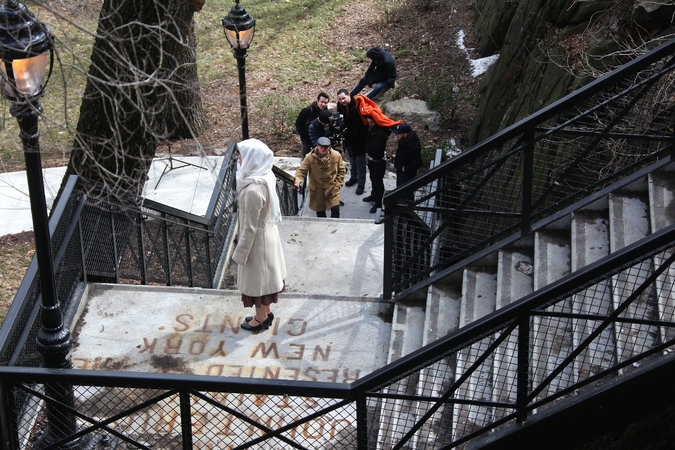
Stuart Miller wrote at the New York Times about “an ambitious project to create a short film for each of Shakespeare’s 154 sonnets, with each movie shot at a different New York City location.

“ ‘It brings Shakespeare to people who might not be in touch with it, and we can use social media like Twitter and Instagram to spread the word,’ [actor Billy] Magnussen said. The endeavor, called the Sonnet Project, grew from the work of the New York Shakespeare Exchange, a local theater group.

“The group, which started the project in 2013, just completed its 100th film: Sonnet 27, starring Carrie Preston, an Emmy award-winning actress, and filmed on the Verrazano-Narrows Bridge [and premiering] April 8 on the Sonnet Project website and app. …

“Some directors found inspiration at the location where the films were shot. At Leidy’s Shore Inn, a 110-year-old bar on Staten Island, Daniel Finley, who was making Sonnet 19, filmed Laurie Birmingham, an actress who works mostly in regional theater, as a world-weary regular musing over her drink.

“ ‘We walked in at 10 a.m. and the regulars were there watching OTB and scratching their lotto tickets,’ he said. ‘We learned some of their stories and Laurie based her character on those impressions.’ ” More at the New York Times, here.

Photo: Chang W. Lee/The New York Times
A crew filming Sonnet 108 at the John T. Brush stairway. 

Read Full Post »

It always seems so limiting to put anything in a category. Some WordPress bloggers are good at categorizing their posts, and I’m sure that helps many readers, but my posts are never about one thing only.

Netflix makes movie recommendations based on categories that pigeonhole movies we’ve rated highly. But the approach seems clunky. Just because we have liked a lot of foreign films (Wadjda, Son of Rambow, Princess Mononoke), that doesn’t mean we like all foreign films. Maybe we like the ones we’ve seen for some other reason than being foreign. Maybe they are less glitzy, more honest, or more entertaining.

He are some funny categories Netflix recommended for my husband and me: “emotional, independent films based on books,” “critically acclaimed foreign movies,” “mind bending movies,” “anime,” “musicals,” “social & cultural documentaries,” “critically acclaimed emotional movies,” and “horror movies.” Horror!? Where did they get that?

At the late, lamented Kate’s Mystery Books in Cambridge, you could get pretty sound advice on books from Kate herself. She would ask you to name some mysteries you liked, and you might say you had read all of Tony Hillerman and Arthur Upfield. Then she would say, “Different cultures.”

Well, ye-es. But what kept me coming back to those authors were detectives who were likable and endings that were positive in some way. no matter how small. Kate did give me some authors I loved, like Eliot Pattison (mysteries about Tibet and, more recently, several about 18th century American Indians), but other books about different cultures might be too noir for me or too fluffhead, like mysteries with animal detectives.

I suppose categories help a bit. I just think they are clunky. Where would I file this post, now? Movies? Books? Retail? Misconceptions? Colin Cotterill, Dr. Siri, Laos?

Colin Cotterill writes a series that is both funny and deadly serious about a 70+ coroner in Laos, Dr. Siri, a likable antihero with an offbeat bunch of equally likable cronies.

Read Full Post »

Photo: Greenfusefilms.com

Vanessa Gould, the sister of one of Suzanne’s elementary school buddies, is a documentarian. A while back, she made a Peabody-winning film about makers of advanced origami called Between The Folds. More recently, she was given unheard-of access to the New York Times obituary desk.

Her parents just sent an e-mail about the resulting movie and what Vanessa has been up to in general.

“Vanessa recently worked on Showtime’s Years of Living Dangerously, a nine-part series tackling the challenges of climate change. … Vanessa was a producer on several of the stories and did additional cinematography on others. You can see most of her work in episodes three (“Super Storm Sandy”) and nine (“Chilean Andes”). Episode three, “The Rising Tide” with Chris Hayes, airs tonight, Sunday, April 27, at 10 pm on Showtime. … Here are links: http://www.yearsoflivingdangerously.com and https://www.facebook.com/YearsOfLiving. …

“Soon after making Between The Folds, one of the artists in the film passed away. Vanessa alerted the Times of his death, aware that it was unlikely they would run an obituary. And yet – somewhat amazingly – they did, and she assisted them in the unusual process of putting together an editorial obituary. Only three or four such obituaries are written by the NYT staff each day. The whole story of how these obituaries are selected and written, as well as the social history they tell, became her fascination. Hence OBIT will be her next film. Check out these links: http://www.obitdoc.com, http://www.greenfusefilms.com, and www.vanessagould.com.”

I wonder if OBIT will show to what extent the obituaries of famous people are written before they shuffle off this mortal coil. Come to think of it, do any newspapers let people submit their own obit in advance? I recently read a hilarious one that a small paper accepted from the deceased at the insistence of his grandson. It revealed a guy with a terrific sense of humor — not a bad tribute.

Read Full Post »

An old, falling-apart film of a heath hen has been unearthed.

Why is that thrilling? The heath hen is extinct.

Writes Carolyn Y. Johnson in the Boston Globe, “The bird stamps its feet on the ground, taking mincing dance steps through the corn stubble. Neck feathers flare like a headdress, and the male puffs out his neck, making a hollow, hooting call that has been lost to history.

“These courtship antics are captured on a silent, black-and-white film that is believed to be the only footage of something not seen for nearly a century: the extinct heath hen.

“The film, circa 1918, is the birding equivalent of an Elvis sighting, said Wayne Petersen of Mass Audubon — mind-blowing and transfixing to people who care. It will premier Saturday [March 8] at a birding conference in Waltham.

“Massachusetts officials commissioned the film nearly a century ago as part of an effort to preserve and study the game bird, once abundant from Southern New Hampshire to Northern Virginia. Then, like the heath hen, the film was largely forgotten.

“Martha’s Vineyard is where the last known heath hens lived, protected in a state preserve. But the last one vanished by 1932. …

“Jim Cardoza, a retired wildlife biologist who worked for the Division of Fisheries and Wildlife, said that for him, the film holds lessons about how conservation efforts have evolved.

“ ‘The thing that is striking to me is the habitat of the animal — it looks like they’re out in corn fields and open areas and things like that,’ Cardoza said. ‘That isn’t what the birds really inhabited — they were a scrub-land species.’ Conservationists at the time, he said, ‘didn’t know what the habitat requirements of the species even was.’  ”

Read the rest of the article and watch the film here.

I love the idea of a long-rumored, valuable film finally being found. It’s a great story. It’s also an argument for better filing systems.

State of Massachusetts woodcut, 1912. The fancier heath hens are males.

Read Full Post »

Do you ever check the website This Is Colossal? They have the best stuff.

Here is a cute bit about giant, playful robots in Argentina.

In a “clip from Fernando Livschitz of Black Sheep Films,” says the website, “we watch as tin windup toys overtake the streets of Buenos Aires, living amongst its inhabitants as if it was an everyday occurrence. Livschitz is known for his short films that blend live action footage with aspects of absurdity, most notably his New York and Buenos Aires theme parks. Music by the very fine Canned Heat circa 1972.” More.

We hear so much these days about robots in advanced manufacturing and medicine, but I like the idea of robots as toys. You could really warm up to some of these guys, as Frank Langella did with his robot in the futuristic movie Robot & Frank.

Photo: Fernando Livschitz at This Is Colossal

Read Full Post »

2014-DeCordova-in-winter

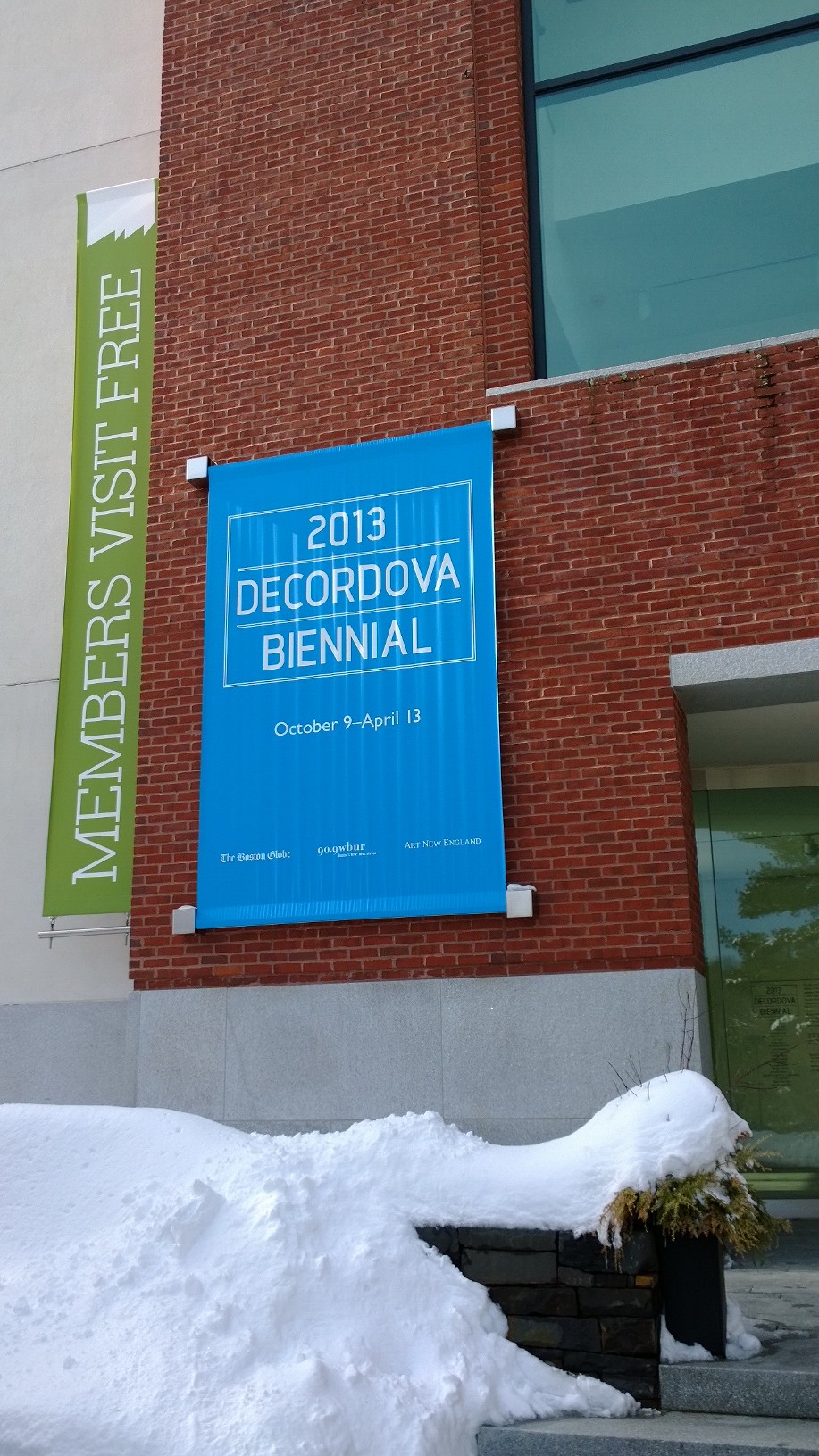
On Sunday, my husband and I decided to see what’s new at the DeCordova Museum in Lincoln.

A favorite in the biennial show of New England artists was Laura Braciale of Manchester, NH. It took me a minute, but when I realized she had displayed everyday objects along with what they looked like once she had turned them into art, I thought, Yes, art really is in everything if you look.

The blurb about her says, “close observation reveals subtle differences between the three-dimensional structures and their two-dimensional renderings. …  Her works engage a question concerning representation—which image is more ‘real’? As both her items and her illustrations occupy the same physical reality, however, Braciale’s work suggests that neither is more real than the other.” (Sigh. I’m not really fond of the way museums write.)

In a different DeCordova exhibit we saw three tintype photo portraits by the late David Prifti, Suzanne’s high school photography teacher. (A solo show in Winchester, Mass., goes through March 2, here.)

The biggest surprise was a documentary about Laos, a country we are interested in largely because of the the mystery books of Colin Cotterill. (Read one of my posts about him, here.)

The film, Route 3, shows a small mountain town that, having been leased to China for 75 years, was utterly destroyed to make way for casinos, hotels, entertainments, and jobs for Chinese people alone. Hard to imagine selling a part of your country like that, but Laos is desperately poor.

The documentary was by Patty Chang and David Kelley, who live and work in Boston and Brooklyn.

The DeCordova says on its website, “Blending the genres of documentary and road trip films with surrealist cinematic passages, Patty Chang and David Kelley present a compelling trip through the physical and psychological landscape of a community in transition. … Enlisting the help of tour guides and local entrepreneurs in this tightly controlled area, the artists immersed themselves in this community to create a unique portrait of a changing society.” More information on the artists here and here.

Read Full Post »

We watched a lovely thing on PBS recently, an opera about the Christmas armistice in World War I. You have probably heard of it. The combatants decided to take Christmas off. A movie was made about it, taking a few liberties with the story. Then the Minnesota Opera Company commissioned  composer Kevin Puts to write an opera based on the movie.

From the composer’s website: “Silent Night is an opera in two acts by composer Kevin Puts and librettist Mark Campbell, based on the 2005 film Joyeux Noël, directed by Christian Carion and produced by Nord-Ouest Production. Commissioned by Minnesota Opera with co-producer Opera Company of Philadelphia, it opened on November 12, 2011 at the Ordway Theater, St. Paul Minnesota … The opera is sung in English, German, French, Italian and Latin.

The interplay of the five languages was charming, especially when the German officer translated English into French and French into English so the three main officers could understand one another.

Read Allan Kozinn’s comments about this Pulitzer Prize winner at the NY Times ArtsBeat blog, here.

I will say that, delightful as it is to see the soldiers put down their arms and show each other pictures of loved ones back home, it makes the misery and futility of war doubly painful as the men are ordered back to battle and the camera pans over the lifeless bodies and the very young faces.

Peace is something to think about at Christmas. Ordinary people just want to live in peace.

Read Full Post »

Got to share this movie: Le Havre (in French with subtitles).

Lately, nearly all the movies we see are on Netflix. Our taste seems to run to animation, documentaries, and foreign films. Not exclusively, but in general.

Last night we watched an odd, wistful comedy about an old guy in Le Havre,
France, who makes up his mind to help a boy whose family is arrested after being discovered in a packing crate near the harbor, on route from Africa to London.

Every shot in the film was like a painting, every gesture true. The characters were good-hearted, down-and-out types in the roughneck port, where many undocumented immigrants come looking for work. There they find squatter camps, deportation, kindness, hostility, drugs, poverty, crime, and sometimes a living.

The dialogue in the bar scenes reminded me of Mike Leigh films, the ones where he has his actors ad-lib their lines. It was just so funny and believable. And the “trendy” charity fundraiser the old guy arranges with the graying rock band has to be seen to be believed.

The “2011 comedy-drama film written and directed by Aki Kaurismäki, starring André Wilms, Kati Outinen, Jean-Pierre Darroussin and Blondin Miguel. It tells the story of a shoeshiner who tries to save an immigrant child in the French port city Le Havre. The film was produced by Kaurismäki’s Finnish company Sputnik …

“The film premiered in competition at the 2011 Cannes Film Festival, where it received the FIPRESCI Prize. Kaurismäki envisions it as the first installment in a trilogy about life in port cities. His ambition is to make follow-ups set in Spain and Germany, shot in the local languages.”

More at Wikipedia, here.

Read Full Post »

Have you ever taken out-of-town guests to see the glass flowers at Harvard? They are among the area’s must-see attractions.

The Czech father-son team Leopold and Rudolf Blaschka created the flowers in the 19th century, when they also made glass replicas of sea creatures.

Now scientists are comparing the duo’s marine life to what exists today. Have the creatures evolved? Are some extinct?

“I’ve been a marine biologist my entire professional life,” write C. Drew Harvell in the Science section of the NY Times, “spending more than 25 years researching the health of corals and sustainability of reefs. I’m captivated by the magic of sessile [attached by the base]  invertebrates like corals, sponges and sea squirts — creatures vital to the ecosystem yet too often overlooked in favor of more visible animals like sharks and whales.

“The filmmaker David O. Brown and I want to change that. To make a documentary, Fragile Legacy, we are on a quest to lure these elusive and delicate invertebrates in front of the camera lens.

“Our inspiration springs from an unlikely source: a collection of 570 superbly wrought, anatomically perfect glass sculptures of marine creatures from the 19th century.

“These delicate folds and strands of glass make up the Blaschka collection of glass invertebrates at Cornell, of which I am the curator — enchanting and impossibly rare jellyfishes of the open ocean; more common but equally beautiful octopus, squid, anemones and nudibranchs from British tide pools and Mediterranean shores.

“They are the work of an extraordinary father-and-son team, Leopold and Rudolf Blaschka.”

The rest of the story is worth your time. Check it out.

Photo: Kent Loeffler
A glass sculpture of Facelina drummondii, a sea slug in Cornell’s Blaschka collection.

Read Full Post »

On Saturday we watched the documentary Urbanized, about urban planning.

Although there were many discouraging notes (Mumbai slums, Beijing smog, destructive construction in Stuttgart), there were enough positive ones to give hope.

I liked the grassroots gardening efforts in Detroit, pedestrian/bike paths in Bogota (while cars were relegated to mud), miraculous transformations of aging infrastructure (the High Line in Manhattan), lighted paths in Cape Town, and bicycle commuting in Copenhagen.

The point was made that walkability (one of my favorite topics, as readers know) and similar quality-of-life improvements in cities can be hugely beneficial to the planet just because cities are so big and changes there affect so many people.

Doug Foy, who helped get Boston Harbor cleaned up and now consults with New York City’s Mayor Bloomberg, has spoken at my workplace a few times. He likes to talk about how New York avoided buying a whole new water supply simply by partnering with plumbers unions to get standard toilets gradually replaced with low-flush toilets.

Read Full Post »

I recently saw a National Geographic special about money and the central bank. The documentary took viewers into the vault at the NY Fed, where gold bars are stored. Although the security is really tight, anyone may sign up for a tour there. The film also went to places where cameras are usually not allowed, like the National Bureau of Engraving and Printing, which prints dollar bills.

It also went to offices deep underground in the gold and diamond district of New York City. I thought Suzanne would be interested to see the broker who buys gold. Being in the jewelry business with Luna & Stella, she naturally is aware that gold has been expensive since the economic downturn. The film showed the multilingual broker buying small bags of gold objects, which were then shown being melted down and made into a gold bar.

National Geographic has also blogged about the movie: “What Jake Ward of Popular Science magazine discovers in this one hour special is that without the engines that power the world’s financial systems, that world would grind to a halt.

America’s Money Vault follows 55 million dollars worth of gold as it makes its way down into the most valuable gold vault in the world. Hidden deep under the streets of New York City, hundreds of billion dollars in gold bars  …

“Jake goes behind the storefronts to see how everybody from the street level to the brokers make their money buying, selling and even finding gold. He meets Onikwa Thomas who calls himself the urban miner and claims to earn up to four hundred dollars a week off of gold specks found in the cracks of sidewalks.”  More from the documentary.

P.S. Speaking of Luna & Stella, Suzanne’s birthstone jewelry company, gold vermeil angel wings can make a lovely gift for the right person.

Photograph: National Geographic

Read Full Post »

A guy at the office reads a different blog I write, a blog for work, and knows the types of stories I like. Recently he e-mailed me about a new documentary in which the solutions to our economic problems are tackled by “just folks.” Add this to the growing list of proofs that “one and one and 50 make a million.”

“In Fixing the Future, host David Brancaccio, of public radio’s Marketplace and NOW on PBS, visits people and organizations across America that are attempting a revolution: the reinvention of the American economy. By featuring communities using sustainable and innovative approaches to create jobs and build prosperity, Fixing the Future inspires hope and renewal in a people overwhelmed by economic collapse.

“The film highlights effective, local practices such as: local business alliances, community banking, time banking/hour exchange, worker cooperatives and local currencies.” That’s what the film’s website says anyway. Read more. And if you see the movie, please let me know.

 Photographs: http://fixingthefuture.org

Read Full Post »

Pamela and I went to see the movie Hugo. The theater didn’t have 3-D, and one critic said 3-D is essential for full enjoyment of the film, but we found it delightful anyway.

Before I saw the movie, a NY Times review worked its way into my post on the charm of looking out windows. Indeed, as little Hugo peers out of windows and clock faces in the Paris train station where he works, it’s as if he were watching a theatrical entertainment staged for him alone.

A major “character” in Hugo is an old automaton that the boy had worked to repair with his father before a fire left him an orphan. He desperately wants to finish the work. He fancies that if the automaton were to write something, it would deliver a message from his father.

Automatons were apparently quite popular in the early 20th century. They were ingenious robots that could perform feats like writing and drawing.

There is one that can be seen today at the Franklin Institute in Philadelphia. Thought to have been constructed around 1800, it knows how to make four drawings and write three poems — two in French and one in English. “Henri Maillardet, a Swiss mechanician of the 18th century who worked in London producing clocks and other mechanisms” is the tinkerer behind it. Read more.

Read Full Post »

Gene Sharp (founder of the Albert Einstein Institution and the go-to guy on nonviolent revolution) is proof that one and one and 50 make a million. Sharp is one man, but his writings have had a powerful influence on many of the players in the 2011 Arab Spring and democracy movements elsewhere.

Today I went with Jane’s family to see a movie about Sharp at the Boston Film Festival. (Jane’s cousin, Ruaridh Arrow, directed it.) It’s a remarkable film. There were interviews with organizers of nonviolent change in Serbia, Ukraine, Egypt, Syria, and beyond. The documentary was interspersed with news footage and video from recent uprisings around the world. A key message is that change takes strategic planning (you can’t wing it) and is a kind of armed resistance, only people are armed with ideas for undermining the pillars that support an oppressive regime. In addition to conducting research on the subject of nonviolence, Sharp has offered a list of 198 techniques that effect change.

After a standing ovation, a frail Gene Sharp, 83, his assistant, Jamila Raqib, and nonviolent-change trainer Col. Robert Helvey, retired, came up on the stage with the director and took audience questions. Raqib was asked about the funding for the Albert Einstein Institution, which operates out of a small space in East Boston. She said that likely funders back off because the ideas do relate to overthrowing a government. The institution is struggling.

I wish you could have been there to hear a young woman stand up and say that she is Egyptian and took  part in the January uprising. She said the overthrow of the government was easy but the rebuilding is hard. She wanted to know if any studies had been done comparing the transitions to democracy of other uprisings. When Sharp said that studies had yet to be done, I couldn’t help thinking what a good use of new funding such research might be. The film itself was funded by large and small donations from around the world through Kickstarter, which I blogged about here. Perhaps it can kickstart nonviolent change elsewhere.

Update: Gene Sharp died at his home in East Boston on January 28, 2018. He was 90.

Read Full Post »

« Newer Posts - Older Posts »