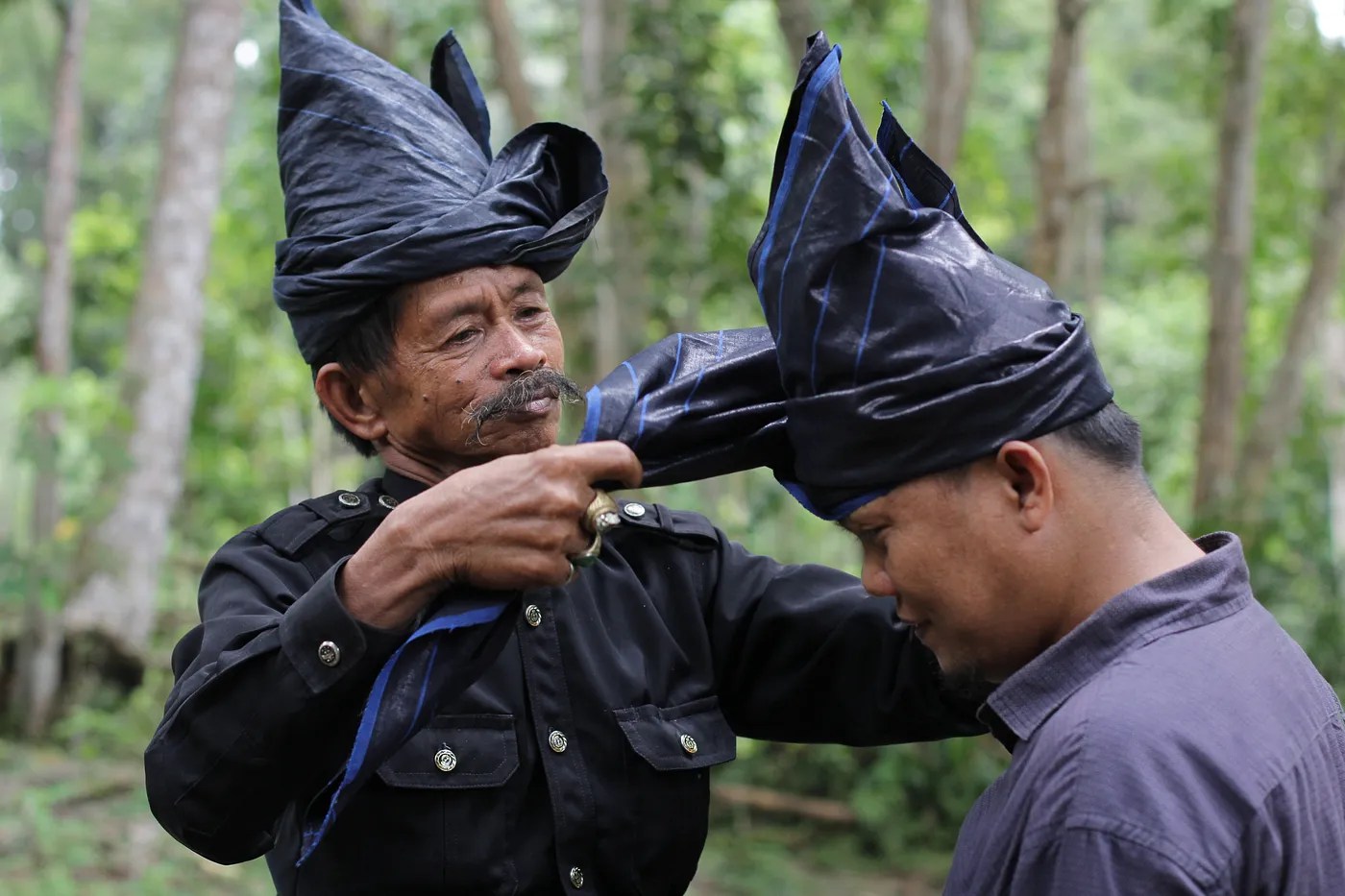
Photo: Annas Radin Syarif / AMAN at Medium.
A Kajang elder in Indonesia demonstrates the wearing of a passapu headwrap and the passing of knowledge to the next generation.
While most of the world was going full-steam on nature-destroying “progress,” many indigenous groups were quietly protecting whatever was left.
Peter Yeung at the Washington Post writes about the Kajang people in Indonesia.
“By midmorning, beams of tropical sun cut through the rainforest canopy, illuminating a bamboo hut in a rare clearing of trees. Inside, a wrinkled old man, sitting cross-legged with his eyes shut, whispers blessings to the Earth.
“After the spiritual leader, the Ammatoa, goes silent, groups of men wearing dark indigo sarongs jump to their feet and head into the forest carrying an offering of rattan baskets full of rice, bananas and lighted candles.
“ ‘The Earth is angry with us,’ said Budi, a barefoot boy crouching on the hut’s edge. ‘That is why the weather is getting worse. There are more rains and floods. It is getting hotter. It is because we have sinned.’
“This ritual is known as the Andingingi, held once a year by the Kajang, a tribe from the Indonesian island of Sulawesi. Like many parts of the world, their land has been hit by more extreme weather because of climate change. But as satellite imagery shows, the Kajang’s dense primary forest is free from roads and development, soaking up violent rains that devastate other parts of the island.
“As global deforestation continues at alarming rates, the empowerment of Indigenous peoples such as the Kajang is emerging as a key way to protect the world’s rainforests. A spate of recent research suggests that when armed with land rights, these communities, whose members manage half the world’s land and 80 percent of its biodiversity, are remarkably effective custodians. …
“The Kajang [community] lives according to the Pasang Ri Kajang, an ancestral law passed down orally through legends and tales. It tells of how the first human fell from the sky into their forest, making it the most sacred place on Earth.
“In practice, that means the forest is at the center of life. The Kajang rely on subsistence agriculture, with no industry or commerce to speak of. Cutting trees, hunting animals and even pulling up grass is prohibited on most of the land. Modern technology, such as cars and mobile phones, is not allowed within the traditional territory.
“ ‘The tree is just like a human body,’ said Mail, a 28-year-old Kajang. … ‘If the forest is destroyed, there will be nothing for the bees, nothing for the flowers and nothing for life.’
“So far, Indigenous tribes have received little legal, financial or institutional backing, advocates say. A 2021 report by the nonprofit Rainforest Foundation Norway found that over the past decade, Indigenous peoples received less than 1 percent of donor funding for fighting deforestation.
“Yet policy is now beginning to shift in recognition of the role they can play in protecting the land. …
“At the U.N. Climate Change Conference in 2021, also known as COP26, world leaders pledged $1.7 billion of funding for these communities, calling them ‘guardians of forests.’ …
“In December 2016, the Indonesian government officially recognized more than 50 square miles of rainforest as belonging to nine of the country’s tribes — including the Kajang — following a landmark ruling by the nation’s highest court. … In a case brought by the Alliance of Indigenous Peoples of the Archipelago (AMAN), an Indonesian nonprofit, the Constitutional Court ruled in 2013 that the state should transfer ownership of what are called customary forests to the Indigenous peoples who had historically governed them according to custom. …
“The rate of primary forest loss in Indonesia has declined every year since 2016, according to the most recent data available, and is now at its lowest level since at least 2002.
“The recognition of customary forests, along with government efforts to protect peatlands and mangroves and to tighten regulations on logging, oil palm and mining permits, has helped drive that reduction. …
“The Kajang are a showcase of Indonesia’s experiment. For years, local forest rangers have helped protect a wealth of native wildlife, including deer, monkeys, wild boars and tropical birds, as well as four rivers, whose watersheds supply several villages outside Kajang land. ..
“The philosophy of Kamase Mase, living simply and taking no more than needed to subsist, underpins their lifestyle here. …
“ ‘We must keep the tradition,’ said Jaja Tika, a weaver. … ‘As long as we live, the forest will exist.’ ”
More at the Post, here.



 Suzanne's Mom's Blog