Feeds:
Posts
Comments

Posts Tagged ‘immigrant’

The United States still has a primarily throwaway culture and has not caught on yet to the Dutch “repair café” concept or Swedish notions about a mall for recycling.

Which is why it probably took a New American to notice that there was a need.

As Isaiah Thompson reports at WGBH radio, “It isn’t entirely clear from looking through the big windows facing Dorchester Avenue, in the Field’s Corner neighborhood, what the business is.

“The only advertising is an inauspicious plastic sandwich board reading ‘Repair Service: From $30 and Under 30 Minutes, Walk-in Welcome.’

“Inside is a large, room, with electronic equipment stacked in bins along the wall and lying in piles around the floor, and a few guys hunched over cheap plastic tables. But what they’re doing is as much a fine craft as it is hi-tech.

“They’re fixing cell phones.

“These guys don’t work for Apple or Samsung, or any manufacturers. That’s the whole point.

“ ‘I’m not officially sanctioned by the manufacturer,’ explains Quang Le, who, with his friend and business partner Minh Phan, started this scrappy repair shop in 2015.

The shop, says Le, ‘exists because there’s a need, and they don’t satisfy it.’ …

“The need he’s talking about is ubiquitous: cracked smartphone screens.

“Samsung screens can cost hundreds of dollars to replace. iPhone screens can cost an Apple customer around $150. …

“ ‘When they come to my store it’s like 80 bucks … Wouldn’t you rather go to the store down the block? we do it in like five minutes!’

“Born in Vietnam, Le came to the United States as a foreign student when he was sixteen. ..

“Where most of us see broken glass, Quang saw opportunity. …

“Le realized that by teaching himself this one, super-difficult skill: separating the broken glass from working screens — he could get an edge – and make money.

“He and his partner Phan hired some friends. They bought heavy-duty glue-warming tables from China. They built a dust-proof chamber out of metal. And they taught themselves by watching Youtube videos – and by trial and error. …

“ ‘Like, we broke so many screens – like we broke probably hundreds of them, trying to do it,’ Le chuckles.” Read more here and see what ambition Le wants to tackle next.

Hat tip: The International Institute of New England, on twitter.

Photo: Isaiah Thompson/WGBH News
Quang Le has built a business doing phone repairs the tech giants would rather not bother with.
 

Read Full Post »


Photo: Museum of Fine Arts, Boston
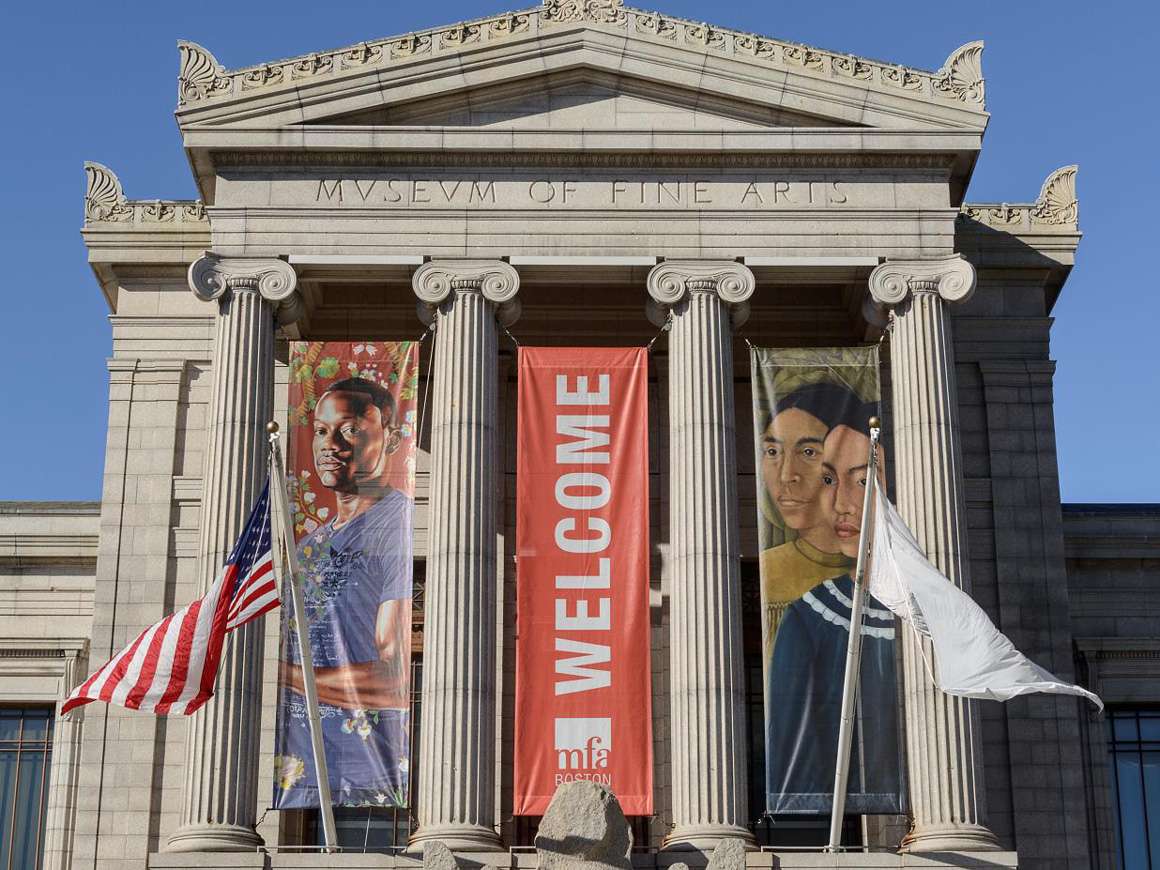
The museum now offers free family admission to new citizens.

The magnificent collections of Boston’s Museum of Fine Arts have gotten out of reach for many people as admission on most days has escalated. So it was with great interest that I read at the MFA website about a generous program for one deserving group of people: New Americans.

“Starting July 1, the Museum of Fine Arts, Boston (MFA), [began welcoming] newly naturalized U.S. citizens living in Massachusetts with complimentary one-year family memberships through a new program called MFA Citizens — the first of its kind in the country. …

“Engaging new citizens is part of the MFA’s ongoing efforts to build a more inclusive community of visitors, volunteers, staff and supporters, fostering the next generation of museum-goers and professionals that reflects the region’s changing demographics. …

“New citizens can sign up for the program by showing a copy or photo of their naturalization certificates at any MFA ticket desk within one year of their ceremony.

“In addition to free admission to the MFA for one year for two adults and unlimited children (ages 17 and under), discounts on programs, shopping, parking and dining, and invitations to member events, the MFA Citizens membership includes a special in-person welcome packet in a custom-designed tote bag. Included in the packet [is] information about upcoming exhibitions and programs — available in Spanish, Chinese, Haitian Creole and Portuguese, the most common non-English languages spoken at home in Boston. On-site signage in these languages will also be placed at the MFA’s Huntington, Fenway, and Schools and Groups entrances to encourage enrollment. …

“The Museum will work with Project Citizenship, the Mayor’s Office for Immigrant Advancement and Boston Public Library to raise awareness of the MFA Citizens program among the approximately 25,000 immigrants who are expected to go through the naturalization process across the Commonwealth within the next year. …

“In addition to hosting ESL classes and conversation groups, Boston Public Library’s Central Library in Copley Square and 24 neighborhood branches house Immigrant Information Corners, which provide information about resources and services available to help advance the well-being of the city’s immigrant residents.”

They don’t put this initiative in terms of the current controversies swirling around immigration, but to me it feels like an institution taking a positive stand in a troubling climate. I hope it will catch on.

Read Full Post »

wiggs_immigrants_04

Photo: Jonathan Wiggs/Globe Staff
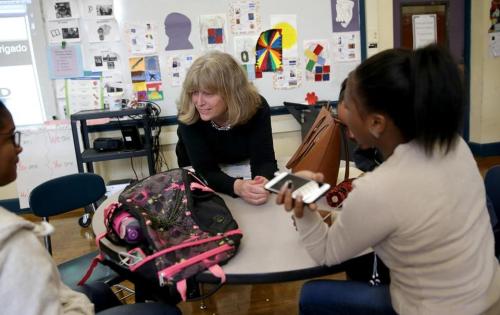
Attorney Elizabeth Read led a session at “Know Your Rights Day” at Boston International Newcomers Academy, a high school.

The lawyer in the photo above is someone I met in April, when we were both volunteering in a Jewish Vocational Service class for Haitians learning English. I was surprised to see her picture the very next day in the Boston Globe, doing a related kind of volunteer work. She certainly has found multiple ways to serve.

Evan Allen wrote, “Attorney Elizabeth Read stood before the classroom full of teenage immigrants at Boston International Newcomers Academy [and] explained their rights if they are ever detained by an immigration official.

“ ‘You have the right to make a phone call,’ she told them Friday afternoon, as their teacher translated into Spanish.

If you are detained, they can take your cell. You must memorize phone numbers. It’s hard! But you must.’ …

“The talks were organized by the Political Asylum/Immigration Representation Project and conducted by volunteer lawyers. …

“The PAIR Project has trained more than 300 lawyers across the state, and delivered 250 presentations to 10,000 people in community centers, health centers, churches, and schools. …

“ ‘I feel sad,’ said 15-year-old Alvaro … ‘I’m with my dad here, and at any minute, immigration could come and there’s nothing we can do.’

“All the students were given red cards to hand to immigration authorities that outline their rights, including the right to remain silent and to refuse to allow authorities to enter their homes. Alvaro said feeling prepared was a relief. …

“[Headmaster Tony] King said he has tried to reassure students by explaining their rights, reminding them that politicians in Massachusetts support immigrants, and talking to Muslim girls who wear head scarves about what to do if someone becomes aggressive. He gave them numbers to call — including his own — if they need help. …

“Sowda Roble, a 16-year-old Somali refugee wearing a sparkling silver headscarf and a Red Sox shirt, said through a translator that America is a country where ‘every opportunity — education, everything — is available.’

“She arrived here from a refugee camp in February 2016 with her mother and two brothers; four other siblings and her father stayed behind. …

“ ‘I know what it feels like to be in a refugee camp, and wait for hope. It hurts. [All of a sudden,] you are told the hope dies.’ Sowda started to cry. She had walked for days through the desert to the refugee camp, people dying around her, she said.

“The Know Your Rights presentation from the attorney, she said, was helpful. And she still loves America. The people ‘have good hearts.’ ”

More at the Globe, here.

Read Full Post »

Photo: Luke Runyon/Harvest Public Media
In a small Colorado farm town, immigrants accept America’s least popular jobs. Now the town is helping them gain citizenship.

When you hear that immigrants are important to a farm town, you probably think of farm labor. But farm towns, like other small towns in America, struggle to find workers for many grueling jobs citizens don’t want.

Now the town of Brush, Colorado, is offering help to its new residents to become citizens themselves.

This Harvest Public Media report by Luke Runyon, broadcast on National Public Radio, explains.

“At the public library in the rural Morgan County town of Brush, Colo., Marissa Velazquez welcomes her students to class. It’s a sunny Saturday morning, and the day marks the halfway point in Velazquez’s class, a 10-week crash course on American history, civics and English.

“Nearly all of the students work in either meatpacking or dairying. Everyone in it has the same goal: become an American citizen. In two hours, Velazquez runs through voting rights, the legislative process and some grammar tips. …

“Morgan County has anchored its local economy to agriculture. A meatpacking plant, cheese factory, sugar beet processing plant and large dairy farms provide plentiful yet grueling jobs that require little proficiency in English, just hard manual labor. That has made the rural county a magnet for migrating immigrants and refugees. It now holds sizable Somali, Mexican, Ethiopian, El Salvadoran, Guatemalan and Honduran populations. …

“In some smaller towns … fear has spurred some to take steps to go from green card holders to fully fledged citizens.

“The number of people who applied for U.S. citizenship rose across the country in 2016. And while there are no definitive data for the first part of 2017, there are small indications that the same trend could be continuing this year.

“To become naturalized, applicants are tested with a series of questions about the U.S. They are given a dictation exam and an interview, most often in English.

” ‘That’s why we get to practice listening skills, writing skills, reading, so that they’re ready for when they go in for their interview to become a citizen,’ Velazquez says.

” ‘I never thought I would teach the class, because I took this class as a student,’ says Velazquez, who became a naturalized citizen in 2016.

“Citizenship classes are pretty standard in some parts of the country, often offered by nonprofit groups and immigration law firms. What makes this one unique is its size. In 2015, 10 people finished it. In 2016, just five. This year, Velazquez has a class of 21 students. In a rural area like Morgan County, that is huge.” More.

One thing you can say about immigrants who take those tough jobs: they work hard. I believe that the country is strengthened by people like that deciding to become part of it.

Read Full Post »

Photo: Anna Mindess
One of Ba-Bite’s colorful salads: red cabbage with mung bean sprouts, dried figs, arugula and feta and the creamiest hummus. The restaurant is like a welcoming family for immigrant workers.

Lisa, who lives in Oakland, California, put this nice story about an Oakland restaurant on Facebook. If I ever go to Oakland, I’m going to visit Ba-Bite in person.

Anna Mindess writes at KQED Food, “They’ve won accolades for their silken hummus and rainbow of organic salads, but for the owners of Oakland’s Ba-Bite, the most precious thing the almost two-year old restaurant can display right now may be the Sanctuary Restaurant poster on their front door. …

“Ba-Bite is Hebrew for ‘at home.’ Even though most of Mica Talmor and Robert Gott’s employees don’t speak Hebrew, (besides English, they speak Spanish, Maya, and Arabic) they completely understand the concept. The majority of them — like most food service workers in the Bay Area — are immigrants. After walking across deserts at night, being shortchanged or abused in other restaurants where they could not complain, working at Ba-Bite feels like they have found a family.

“Russell Chable manages the kitchen at Ba-Bite and is responsible for set up, prepping, and cooking. He grew up in a tiny town in Mexico’s Yucatan. … He started as a dishwasher and worked his way up to his lead position in Ba-Bite.

“After eight years away from home, Russell missed his mom. Sure, he would talk to her on the phone every week, but he wanted to see her face. So this determined young man decided to build his parents a cell tower so that he could FaceTime with his mom. Six months ago, he made contact with a man back in Mexico who outlined what would be needed: laptops, cables and a cell tower. Russell had his uncle check out the man and then sent money. Now he uses FaceTime to talk to his mom every week, and his parents have a small business renting out computer and internet time. …

“Fatima Abudamos is from Jordan and works as cashier. She also holds the distinction as Ba-Bite’s best falafel shaper. As she stuffs the green balls with sheep’s milk feta, she says, ‘This is an amazing place, just like a family. I’ve worked here almost two years. Mica is not like a boss, she’s more like a friend. She doesn’t scream if you make a mistake; she explains things. I feel safe here; it’s my second family.’ …

““We pay all of our workers well,” says Gott. “Partly because we know how expensive it is to live here. My experience is that more often than not, immigrants are working multiple jobs or longer hours, and forgo taking time off at all costs, as they want to or need to make money. …

“[Food runner Kasandra Molina says,] ‘This space here doesn’t feel like a workplace, it feels like home. We all get along. They care about our opinions and feelings. They don’t treat us just as employees; it’s more like a family.’ ”

More at KQED, here.

Are you in Oakland? Check out Ba-Bite at 3905 Piedmont Ave. Phone: (510) 250-9526

Read Full Post »

I’m beginning to think that this period of history will come to be known as one of enormous creativity. It’s not just isolated incidents. I was working on the upbeat story below and skipping back and forth to Facebook, where each sign from the marches and each costume seemed to outdo the last — and where I saw women on the US-Mexico border weaving their hair together Friday — when it hit me. One and one and 50 have already made a million. And there is no sign of stopping.

The story I wanted to share is on a creative effort to help refugees, this time in the Netherlands.

Liz Alderman described it at the NY Times.

“Mahmoud al-Omar leaned over a sewing machine in the basement of a former prison being used to house refugees and began stitching jeans for a popular clothing line. With more than 15 years experience as a tailor in Syria, he zipped through one pair and moved on to another, methodically filling a small order.

“The job, set up by a Dutch organization that matches refugees with work opportunities, is only temporary. Yet after Mr. Omar fled his war-torn hometown, Aleppo, two years ago, just having a place to go each day felt like a salvation.

“ ‘Working is completely necessary to speed up integration,’ said Mr. Omar, 28, who still struggles to speak Dutch, hindering his chances of a full-time job. ‘I want to become independent as soon as possible, so I can start giving back to the country that took me in.’

“When more than one million men, women and children streamed into Europe last year to seek a haven from conflict and poverty in the Middle East and Africa, governments viewed the labor market as the quickest path to absorb newcomers. The sooner people started working, the thinking went, the faster they could get off government aid and start contributing to the economy.

“Yet permanent jobs have proven elusive. The lack of language is a big barrier, as is a skills mismatch. Some refugees do not have the right experience, while others cannot get their professional qualifications or degrees recognized.

“Private initiatives have sprung up across Europe to help. The Refugee Company, the Dutch group that steered Mr. Omar toward work, is one of scores guiding refugees into professional networks and opportunities to improve employability.” More here.

From the company’s About page: “Our mission is to empower refugees. We believe work is the best tool to integration; through work, refugees can blend in with their society and build up a new meaningful life in The Netherlands. We speed up integration by providing opportunities for newcomers upon arrival to utilize their talents again. …

“We decided Refugee Company will focus on craftsmanship. We provide work opportunities in the creation and hospitality sector, as that is where our roots lie. We see a growing demand for craftsmen and horeca [Hotel/Restaurant/Café] staff in the Netherlands.” More.

The Providence Granola Project does something similar in Rhode Island, though on a smaller scale. Language is definitely a barrier, so if you have always liked explaining English to people, consider volunteering near your home.

Photo: The Refugee Company


Read Full Post »

A year ago, I retired from a magazine job I’d held for ten years to see if I could offer more-direct service to people. From January until October I worked at a quasi-public agency that allowed me to connect a bit with lower-income clients. But I wanted to focus more.

What I really wanted to do was to help refugees and other immigrants learn English. So after getting my feet wet in the refugee world as a volunteer blogger for one nonprofit, I retired completely and started to volunteer at three other agencies. So far, it’s tremendously satisfying.

It took a while to set this up, however. It turns out that although most nonprofits need help, few have the infrastructure to move volunteers smoothly into useful roles.

Organizations I reached out to in Massachusetts didn’t respond, and getting a response in Rhode Island required contacting the leadership. Understandably, they then had to take the time to assess whether I had shown any previous interest in helping immigrants with English. (I had life experiences and volunteering that related, but for work that was exactly the same as what I wanted to do, I could claim only a few hours on a United Way Community Care Day.)

The largest organization, an official resettlement agency, wanted to see if I could be empathetic to frustrated adult learners who might have been accomplished in their home countries and were now starting from scratch with a whole new alphabet. And they needed to evaluate whether as an unpaid person I would show up consistently.

Their schedules weren’t necessarily my ideal schedule, but I finally cobbled something together that keeps me busy two and a half days a week.

I definitely had to talk some people into it. At one place where I now volunteer two mornings a week, the teacher hadn’t answered the email I sent after the volunteer coordinator gave it to me. I tried again. She then responded that she had enough volunteers but I could come observe. So I showed up. And stayed. Believe me, she has really needed me with her large class of immigrants, many of whom arrived only months ago from the Congo or Syria.

One aspect of the work that has been particularly interesting has been comparing three different organizations and three different approaches to teaching English. The differences relate in part to students’ different levels of English. In addition to those who have just arrived, there are people who may have been in Providence many years but could function just fine using Spanish. There are others who had no schooling as children and may turn written pages upside down.

I am learning, meeting new people, and having new experiences, which I love. I love seeing someone’s face light up when they suddenly “get it.” I love feeling like this work is important.

Many people I know are asking themselves lately, “What can I do?” There are needs out there in many different fields of interest. I think all the seekers will eventually find the right thing. It may take a while to put it together.

Photo: Genesis Center
Immigrants having fun with learning at Genesis Center in Providence.

Read Full Post »

In an article by the “Cooperative Development News” at Mother Earth News (by way of twitter), I read about a group of Somali Bantu refugees in Maine who started a cooperative farm.

This interests me particularly because when I was at the magazine, I acquired a couple articles about Somali refugees adjusting to life in Lewiston, Maine, through farming.

Here’s the story: “A group of Somali Bantu refugees have started a cooperative farm in Maine … Thousands of miles from Somalia, on 30 acres in Maine’s second-largest city, they’ve begun to feel like they’ve come home.

“New Roots Cooperative Farm, though just recently started by four new Americans, is already a success story. Combine the complexities of farming with the uncertainty of navigating a system that is unfamiliar — and, at times, unfriendly — to newcomers and you’ll understand just a fraction of how far New Roots has already come. They’re inspired to help one another and the community, too.

“ ‘Our aim is not only to grow food and run a business ourselves but to help our community and teach them about how to run a business,’ says New Roots farmer Batula Ismail. …

“The group used to farm before being forced from their homes during Somalia’s tumultuous civil war period. … After arriving in Maine, they got back to farming at Cultivating Community’s New American Sustainable Agriculture Project at Packard-Littlefield Farm in Lisbon, Maine. The program empowers New Americans to launch independent farm businesses, to adopt new leadership roles in the community, and to attain increased economic independence for themselves and their families.

“Now, with a decade of experience at Packard-Littlefield backing them up, the group is ready to put their education to the test. When Gendron Farm, a dairy farm in Lewiston was divided into several parcels in 2015, New Roots worked with Cooperative Development Institute, Maine Farmland Trust, Land for Good, Cultivating Community, and many others to preserve 30 acres as a working farm.” More here.

I’ve been interested in Somali immigrants since living for three years in Minneapolis, where there is a large population. I was friendly with one man who worked in our apartment building, ran for mayor, and got a job as a community liaison for a US Senator. Very nice guy. I loved his stories about being a child in Somalia, soaking up geography from international radio news, and pausing for a camel to get off the field when he was playing soccer.

Photo: Jenny Nelson/Maine Farmland Trust
Bantu refugees start a cooperative farm in Maine.

Read Full Post »

This year, I’ve been volunteering with refugee organizations — four altogether — and am always grateful for positive stories about this population. Here’s a story from Sweden.

Bridie Witton writes at the UK’s Independent, “Immigration has helped fuel Sweden’s biggest economic boom in five years, new figures have revealed.

“The Swedish government, whose policies saw the country take in more refugees per capita than any other in Europe last year, helped lower unemployment rates by increased spending on welfare for asylum seekers from war torn countries like Syria, Afghanistan and Iraq.

“The move helped the Nordic region’s largest economy expand 4.5 percent on an annual basis in the fourth quarter of 2015, the most in almost five years and more than twice the growth of Germany, according to Bloomberg. Increased consumer spending and borrowing and high house prices also contributed to the boom which, although projected to fade, has consolidated Sweden as one of Europe’s success stories.

“National Institute of Economic and Social Research fellow Jonathan Portes said economies benefitted from more workers, but emphasised the difference between immigrants and refugees.

” ‘What the Swedish experience tells us is that even in the short term, even when you have a very large influx of refugees, there is a perception this is an impossible burden on the state,’ he told The Independent. ‘But in the short term it increases growth.’

“He said the Swedish government needed to have a long-term strategy to successfully integrate refugees and continue the growth.”

Careful planning is needed, for sure, but history shows that an influx of workers with needed skills helps countries grow.

More at the Independent, here.

Photo: Getty
Sweden took in more refugees per capita than any other country in Europe in 2015.

Read Full Post »

Photo: The Genesis Center

I’ve been having the best time lately. I’m volunteering in English classes at three refugee agencies, assisting the classroom teachers. The nonprofits are all near one another in Providence.

Dorcas International is an official refugee resettlement agency. It offers a range of services not just for refugees but for other immigrants and for native-born people living in poverty. At Dorcas, I help a teacher work with students who have just arrived in the United States. Most of them know no English at all, and some never went to school in their own countries and are just learning to write.

We have students from Myanmar, the Dominican Republic and Cape Verde, among others, but they are not all refugees. In fact, the majority of families being resettled by the State Department in Providence right now are from Syria and the Congo.

I read in the paper today that 80 percent of the refugees that have entered the United States this year are children, but I work with adults.

The Genesis Center is not a government resettlement agency, but it works with refugees and other immigrants on English and on job skills. It has a great culinary program and places many people in jobs. It also has a day-care center. The students I work with at the Genesis Center are generally a bit farther along in English.

The Refugee Dream Center was more recently established than the other two. It was founded by Omar Bah, a refugee who had been a journalist in Gambia and who had to flee when his articles on human rights garnered him death threats. Bah’s nonprofit is small so far, but its focus on helping people after the four months or so that they receive government assistance is needed. At the Dream Center last week, I worked with a woman newly arrived from Haiti and another from Burundi who has lived in Providence about a decade.

Pretty much all the students act grateful for the help, and it’s a treat to see a face light up when the penny drops. In January, closer to home, I plan to take a training to co-lead small conversation groups.

Did I mention I’m having a lot of fun?

Read Full Post »

Dorcas International of Rhode Island is a refugee-resettlement and immigrant-support organization that also offers education programs and services to native-born residents.

On the nonprofit’s website, you can find uplifting stories of DIIRI beneficiaries. Here is one.

Sidy Maiga, a master percussionist from Mali, wanted to take his skills to the next level. The first step was to get over his insecurity about education.

“His mastery of the djembe, a drum of West African origin that is rope-tuned [and] shaped like a large goblet, has taken him on tours all over the world and as a teacher in schools all over the East Coast … But without a high school diploma, he felt like he had hit a wall. …

“Sidy heard from friends about things you could do at Dorcas International Institute of Rhode Island. …

“He admits he was hesitant about going to school again. … He enrolled in an ESL [English as a Second language] class to get up to speed” before taking the high school equivalency test known as the GED “and felt himself getting discouraged — so he stopped going to class.

“However, after getting encouraging calls from DIIRI staff, Sidy decided he would give it another shot. … ‘I think they saved my life, and I’m glad I came back.’ …

“With the help and encouragement of DIIRI staaff, Sidy decided the next step would be college.”

Sidy starts at Berklee College of Music this year and says, “Once I learn the academic way of music, then I can teach African music to the world.”

More here.

Photo: Dorcas International Institute
Malian djembe drummer Sidy Maiga says Dorcas staff “saved my life.”

Read Full Post »

A New York Times article that was widely shared yesterday detailed how eager many Canadians are to welcome refugees. Enthusiastic, sometimes a bit bossy, they are volunteering in droves to make a difference in the lives of anxious families who have been through the mill.

It reminded me of other welcome stories I’ve been collecting. Small towns, in particular, seem to feel they could benefit from welcoming refugees.

On Nagu, a remote island on the southwest tip of Finland, migrants have found open arms.

Giles Duley writes in the Guardian, “From the start, the people of Nagu made their guests feel welcome. A Facebook group was set up, activities suggested, volunteers came forward. ‘It was exciting,’ says Mona Hemmer, a bastion of Nagu life and one of the organisers of activities for the refugees. …

“Of course, for the refugees, being busy does not erase their past or the uncertainty of their future. … Many still find it hard to sleep, aware that until their asylum applications have been processed, they have not reached the end of their journey.

“However, the warm welcome of the Nagu people has made a difference. And despite their initial reservations, the islanders now feel that it is the refugees who have brought them something.”  More.

In this Al Jazeera story by Thomas Bruckner, refugees are reviving faded Italian villages.

“The village of Riace had seen its population drop from 2,500 to 400 since the 1990s, when people moved to northern Italy for better economic opportunities.

“Domenico Lucano, Mayor of Riace, saw the flow of refugees in Italy as an opportunity. ‘We have been welcoming refugees with open arms for the past 15 years. [They have] saved our village,’ Lucano explained.

“The resourceful mayor first acted on this opportunity in 1998, when a boat with 218 Kurdish refugees on their way to Greece got stranded on a beach in Riace. This is when Lucano first proposed that the refugees should stay in the village and take over the homes and apartments that had been left vacant by the migrating former residents of the town.

“The mayor helped to facilitate the integration by establishing a ‘refugees welcome’ project, which is now spreading through neighbouring towns.”

Here’s a PBS story by Jason M. Breslow about a small town in Germany that wants more population. “With Goslar’s population shrinking by around 2,000 people per year as young people flee to bigger cities and older residents die, [Mayor Oliver] Junk sees refugees as key to the town’s future.

“ ‘Europeans must welcome and integrate refugees, accepting that they are not a burden but a great opportunity,’ Junk wrote in an op-ed published last month in the policy journal Europe’s World.”

The mayor has also said, “Anyone who tells me Germany is full up, or that we can’t afford them, I say think of our past, and of the future. Of course we can afford them – we’re a rich country, and we have a duty to help those in need.’ ” More from PBS.

And here’s a story closer to home. Brian MacQuarrie writes at the Boston Globe about Rutland, Vermont, and its interest in refugees.

“Mayor Christopher Louras has unveiled a plan, developed in near-secrecy, to resettle 100 Syrian refugees who fled the onslaught of the Islamic State and are exiled in sprawling Jordanian camps. …

“Most residents appear ready to welcome the refugees, mindful of the harrowing images of Syrians desperately seeking refuge outside their ravaged country….

“ ‘The benefits, economically and culturally, that we will recognize is exactly what the community needs at this time,’ said Louras, the grandson of a Greek immigrant who fled the Ottoman Turks a century ago. ‘As much as I want to say it’s for compassionate reasons, I realize that there is not a vibrant, growing, successful community in the country right now that is not embracing new Americans.’ ” More at the Globe.

Photo: Giles Duley/UNCHR
Volunteers from Nagu, a small island in Finland, laugh with refugees during a New Year’s Eve concert put on by local musicians.

Read Full Post »

One place that refugees are making a life for themselves is in Kansas City, Kansas, where some are bridging their current and former lives through farming.

Oluwakemi Aladesuyi reports at National Public Radio, “In the midst of boxy yellow and brown public housing, beyond the highway and past empty grain elevators, sits Juniper Farm. It’s spread over nine acres on the Kansas side of Kansas City.

“As their children play on the grassy knoll behind us, four women sit at a plastic picnic table speaking in Karen, a language spoken in parts of Myanmar [Burma].

“They’re students at a program called New Roots for Refugees. The program aims to teach the basics and business of farming [in America] to refugees over the course of four years. At the end, many of the graduates are ready to start farms of their own.

“It’s a joint effort between Catholic Charities and Cultivate Kansas City, a nonprofit that encourages locally grown food and urban agriculture. …

“Many of the men and women at New Roots come from Myanmar or Bhutan. Some were farmers in their homelands. But farming on the outskirts of Kansas City is different: the land, the crops and even the weather. …

“Many who’ve come here are happy to have escaped violence. But adapting to life in a new country, with a different language and customs, is still difficult. Many refugees struggle economically. …

“August Gaw [is] 25 years old and often translates for her mother, Beh paw Gaw, who graduated from New Roots a few years ago. …

“August used to come here to help her mother. But now Beh paw has her own 3-acre farm which she runs with her sister. Last year the operation made more than $10,000. The potential to make money is important; many refugee families live below the poverty level.” More here.

Read the story if you have time. One striking aspect: farm manager and adviser Sam Davis, an African American, experienced real intolerance when moving to Kansas from Arkansas, but to one of the Karen women, who had seen extreme isolation of different ethnic groups in Myanmar, America seems prejudice-free.

You might also be interested in this article on Karen people who were relocated to Waterbury, Connecticut. Written by John Giammatteo, it appeared in Communities & Banking magazine in 2012.

Photo: Oluwakemi Aladesuyi/NPR
Beh paw Gaw is a New Roots graduate and a Karen refugee from Myanmar. Now she has her own three acre farm which she runs with her sister.

Read Full Post »

Readers know I’m a fan of the Providence Granola Project, a social enterprise that, by training refugees to make a product, acclimates them to US employment norms and aids their transition to self-sufficiency.

Recently, the organization produced an annual report that explained how it developed a different sort of model for small business, a model they hope others will use or adapt.

Founder Keith Cooper says, “The Providence Granola Project started as an experiment to explore what might help refugees enter the job market. Building a small business seemed like a logical place to start. But what a revelation it has been to discover how nearly every aspect of a small business—from capital to product—can serve a higher purpose.”

The organization’s Big Idea tweaks all the traditional elements of a business.

New hires: workers who are the least prepared, workers the training could really help.

Customers: frequently people who not only like granola but share the mission.

Investors: people whose desired return on investment is the ability to benefit immigrants on their path to becoming contributing members of their new nation.

Work: “repurposed as hands-on education. Making granola is transformed into an experiential classroom.”

Products: delicious foods that are simultaneously tools for raising awareness.

Check out the remarkable variety of granola flavors, granola bars and snacking nuts at the website. You can also sign up for a Granola of the Month package here if you’re up for giving this worthy cause a bit more predictability about resources.

Infographic: Providence Granola Project

Our Big Idea

Read Full Post »

Photo: Mary MacDonald/Providence Business News
A rehabilitation project recently turned the old Mechanical Fabric Company mill in Providence’s West End into a live-work space for culinary entrepreneurs.
Providence can be a good place for starting a food business, partly because Johnson & Wales turns out so many good cooks, partly because the cost of a restaurant liquor license is much less than in many other cities.

And in recent years, the arrival of food incubators like Hope & Main in nearby Warren have provided a way for food entrepreneurs to get up and running without going deep into debt.

Recently, Providence Journal reporter John Hill wrote about a new food incubator, combined with living space, going into the old Mechanical Fabric Co. mill in Providence’s West End.

“In its 125 years,” writes Hill, “the old brick factory at 55 Cromwell St. has made bicycle tires, electronic components and jewelry. Now it’s getting ready to make dinner.

“The interior of the 1891 building, once filled by the clatter and thrum of steam-powered, belt-driven machines, is being gutted and rebuilt as the new home of two commercial kitchens, restaurant space and 40 efficiency apartments for young food-industry entrepreneurs.

“Federico Manaigo, whose Cromwell Ventures LLC owns the building, said the conversion is aimed at capitalizing on Providence’s reputation as a restaurant mecca. When finished, he said, the factory will be home to recent college graduates considering the restaurant business, either as chefs or owners. …

“Manaigo wants to see if he can duplicate the success of Hot Bread Kitchen, an incubator program in East Harlem in New York City. That program, without apartments, rents space to people with small ethnic food businesses who want to grow into full-fledged commercial operations. It also provides training programs and rents space to start-ups that grow from those efforts.

“The idea is to give promising food-business grads a way to stay in Providence, he said, where they can hone their skills and, when they’re ready to open a restaurant, bakery or catering company, do it in Rhode Island and hire Rhode Islanders. …

“Manaigo said he wants to see if the project can tap into sources of culinary inspiration beyond the colleges. The East Harlem incubator found success by recruiting immigrants, especially women, from the neighborhood, persuading them to share their recipes from home and start small bakeries selling their food. The West End has Middle Eastern, Asian and Central and South American restaurants in its storefronts, a sign of a diverse ethnic population Manaigo said he hopes the kitchen can work with.”

Mayor Jorge Elorza has said he likes that the project offers “a way for the city to use the colleges in the area as sources of potential new business owners and play off the restaurant business in a way that could make it even bigger in the future.

” ‘The whole food scene is a strategic strength for the city,’ he said. ‘This fits squarely within that.’ ” More here.

Read Full Post »

« Newer Posts - Older Posts »