Feeds:
Posts
Comments

Posts Tagged ‘library’

An African writer’s gratitude to a generous book lover in his childhood city has inspired an online bookstore geared toward African authors.

Daniel A. Gross writes at the New Yorker, “Magunga Williams grew up in Kisumu, a Kenyan city that’s home to more than three hundred thousand people but to only two major bookstores. There, Williams told me recently, ‘people depend on books that they find in supermarkets.’ Most of these books come from the United States and Europe. ‘These supermarkets do not have a rich African collection,’ Williams said.

“But there was one place where he could always find a wider range of books. It was the personal collection of a local man, whose house became a neighborhood meeting place and an unofficial sort of public library. …

“Williams moved to Nairobi and began an undergraduate program in law, but he never forgot the way that a house full of books, in a city with too few, became an escape. …

“So Williams, while he was in school, started a literary blog, Magunga.com, and … he made it his mission to create a space like that library—not in a house but on the Internet. The result is a fledgling online pan-African bookshop: the Magunga Bookstore.

“In becoming a bookseller, Williams was, in part, following in the footsteps of his girlfriend, Abigail Arunga. A few years ago, Arunga, a Nairobi-based freelance writer in her late twenties, stopped by a few local bookstores and asked if they would stock ‘Akello,’ her self-published collection of poems.

“At one shop, she was told that Kenyans don’t read poetry. At another, an employee claimed that her ninety-three-page book was too short. ‘They told me that my book had to be at least a hundred pages,’ she said. So she decided to sell the book herself — at poetry readings, literary festivals, even family gatherings. …

“An epiphany came last winter, when Williams was reading an article in the Guardian and noticed that the newspaper operates its own online bookstore. He told Arunga that they were going to open a bookstore, too. …

“Williams earns his living by writing sponsored posts on his blog, which attracts around five thousand readers each day. He asked his Webmaster, David Mabiria, to add a new tab to the Web site, which would offer books for sale. … He and Arunga requested book donations from writer friends, who provided copies of their own work. They launched the feature with ten titles in stock, under a simple slogan: ‘Spreading the Word.’

“Word spread slowly. The Magunga Bookstore made its first sale in December, 2015, when Williams was out of town — he had to ask a friend to deliver the book. ‘He was telling me he was in traffic,’ Williams recalled. ‘And I was, like, “I don’t care. Just go get a boda-boda ride.“ ‘ (Boda-boda is East African slang for a motorcycle taxi.) He remembers telling the friend, “I’ll pay you even if it costs me double the price. Just to make sure the client is happy.” ‘ ”

More at the New Yorker. And while you’re clicking, take a look at the Magunga Bookstore site, here.

Photo: Facebook/Babishai Niwe Poetry
Abigail Arunga and Magunga Williams at the 2016 Babishai Poetry Festival, in Ntinda, Uganda.

Read Full Post »

Photo: Canadian Press/Andrew Vaughan
Halifax firm Fowler Bauld & Mitchell won a Governor General’s Medal in Architecture for its work on the Halifax Central Library.

Sandy and Pat drove up to Nova Scotia from Rhode Island this year, a trip that had been on their bucket list for some time. I loved hearing their blow-by-blow account when they returned and, among other things, their enthusiasm for the Halifax Central Library, where returned books reshelve themselves with little-to-no human assistance.

I Googled around to see what I could find about the library.

CBCNews reported, “The team behind one of Halifax’s architectural diamonds has won a crown jewel of an award. Fowler Bauld & Mitchell, the Halifax-based firm that designed the Halifax Central Library, was one of 12 recipients announced Thursday of the Governor General’s Medals in Architecture. …

“Halifax’s library was lauded by jury members as an ‘inviting, light and playful public space.’

” ‘This outstanding new civic building is a community gathering place that responds to the diversity of its users, accommodating many more activities than the traditional library,’ the jury wrote.

” ‘The jury commends the process of early user engagement that led to the design, and the public’s embrace of the building is a testament to its value.’

“The library has been a resounding success since the day it opened, with visitor numbers far exceeding expectations. A big reason for its success was in the design process, which relied heavily on community consultation and inclusion, said [George Cotaras, the architect of record for the project]. …

“The proof that people’s opinions mattered and were considered showed on the day the library opened, said Cotaras.

” ‘They knew what it was going to be like but they had never been able to see inside and when they came in they went, “Wow,” and people were going around saying “Wow, that was my idea. I suggested that.” ‘ ” More.

Can’t help thinking that community involvement would be a good idea for every area of public life.

Photo: Anjuli Patil/CBC
A view from the second floor of the new library.

Read Full Post »

I’ve read about book lovers delivering books to children and adults by camel, donkey, portable Uni bookshelf and van. Now at the BBC, Theodora Sutcliffe reports on a sailboat that can get books to watery places in Indonesia.

“The toothless steersman positioned the rudder. A second sailor, balancing barefoot on an outrigger, coaxed an elderly engine into life. A third poled the boat away from the trash-strewn beach. In West Sulawesi, Indonesia, a ground-breaking mobile library was on its way.

“The Perahu Pustaka (Book Boat) is sorely needed. In a recent study of 61 nations for which data was available, Indonesia ranked second worst for literacy – only Botswana scored lower. More than 10% of the West Sulawesi’s adult population cannot read, while in many villages, the only book available is a solitary copy of the Quran.

“So in 2015, local news journalist Muhammad Ridwan Alimuddin decided to combine his twin passions for books and boats by setting up a mobile library on a baqgo, a small traditional sailboat. His aim? To bring fun, colourful children’s books to remote fishermen’s villages and tiny islands in the region where literacy is low and reading for pleasure virtually non-existent. He preaches the joy of reading. …

“Despite never finishing university, he has written 10 books on maritime culture and helped sail a small traditional pakur craft from Sulawesi to Okinawa in Japan. His love of the sea can be seen in his maritime museum, a collection of model and antique boats, which shares space with his library. And he uses the boat journeys, which can mean up to 20 days at sea, to research and make YouTube documentaries on the fishing and seafaring life of his native Mandar people. …

“As we closed in on the oyster-farming village of Mampie on the West Sulawesi coast, a gaggle of children emerged from the palms to watch the library boat pull in. Others stopped the hard, repetitive work of shucking oysters as Alimuddin, a volunteer from his home village and his crew of three unrolled plastic mats and covered them in books.

“Excited children dived into the brightly coloured tomes; their mothers, some with babies, were more circumspect.

“ ‘We have low expectations,’ Alimuddin said. ‘We want them to use the books – that’s all.’

“With more than 17,000 islands scattered across the Indian and Pacific oceans – some virtually in the Philippines, others close to Australia or butting up against Singapore – education in Indonesia is a constant struggle. …

“ ‘When you see a child smile and open a book, all your problems disappear,’ Alimuddin said with a smile of his own.” More here.

Photo: Theodora Sutcliffe
In 2015, Alimuddin decided to combine his twin passions for books and boats by setting up a mobile library.

Read Full Post »

102216-leaves-tinged-with-pink


102416-shadow-bondir-restaurant


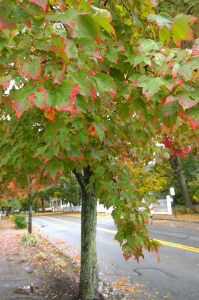
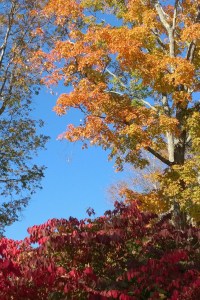
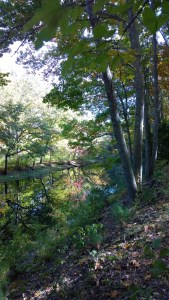
In spite of the drought, Massachusetts trees displayed some of their best colors this year. I’m sharing one photo taken along the Concord River, another that barely does justice to this month’s reds and golds, and a third that intrigued me because the green leaves were pink only on their tips.

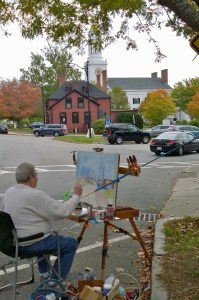
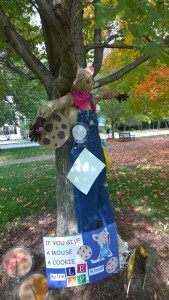
Other photographic offerings include a name shadow at Bondir restaurant, where we had lunch today, a pirate skeleton with his skeletal parrot in a Lowell bookshop/café, lovely plants in the café, an artist working en plein air, shadows of ivy trying to break into the house, and four book-themed scarecrows at the public library.

The first scarecrow was inspired by the book Strega Nona, the second by If You Give a Mouse a Cookie. The third scarecrow promotes the library’s seed catalog, and the fourth celebrates the counting books.

Don’t you wonder how the library came to do all that work? There must be 20 scarecrows altogether. I’m trying to picture the meeting where the boss says, “We’re doing scarecrows for Halloween. Who volunteers to do what?” Or maybe it was more spontaneous. It sure looks like people had fun with it.

101916-red-and-yellow-leaves

101516-autumn-river-reflections


102016-pirate-and-parrot-skeletons

102016-hypertext-bookshop-cafe-lowell


101616-en-plein-air-painter

101416-ivy-wants-in


101416-strega-nona-concord-library

101616-if-you-give-a-mouse-a-cookie


101616-concord-seed-library

102016-celebrating-counting-books


Read Full Post »

You probably know that a library is a haven. But in case you didn’t, here is a story about what libraries mean to New Yorkers these days.

Winnie Hu writes at the NY Times, “Matthew Carter’s summer hideaway … does not require a car ride or a small fortune to keep up.

“Mr. Carter, 32, an adjunct professor of music at the City College of New York, simply holes up at the Inwood Library in northern Manhattan with his research books. It is quiet, air-conditioned and open every day.

“ ‘I’m a total leech of public libraries,’ he said. ‘It’s my summer hangout. It’s where I spend the majority of my time, and where I’m most productive.’ …

“Far from becoming irrelevant in the digital age, libraries in New York City and around the nation are thriving: adding weekend and evening hours; hiring more librarians and staff; and expanding their catalog of classes and services to include things like job counseling, coding classes and knitting groups. …

“Sari Feldman, president of the American Library Association, said library workers had shown people how to file online for welfare benefits and taught classes in science, technology, engineering and math to children who could not afford to go to summer camps. …

“A recent contest to recognize neighborhood libraries underscored their vitality: 18,766 online and paper nominations were submitted in one month, up from about 4,300 when the yearly competition was started in 2013. Nearly every library was nominated at least once. Some received hundreds of nods.

“One young man wrote that he was homeless when he started going to the Arverne branch of the Queens Library, where the staff not only helped him study to become a security guard but also hired him to work as a mentor to teenagers. Today, that man, Richard Johnson, has two jobs and his own apartment.

” ‘Ever since becoming a member of the Queens Library, I have been bettering my life,’ he wrote in his statement. …

“The recent gains by libraries have delighted Christian Zabriskie, a librarian and executive director of Urban Librarians Unite, an advocacy and education group that organizes an annual ‘read-in,’ in which people take turns reading nonstop for 24 hours, to support the libraries.

“ ‘In New York City, there is somebody using library materials every second, every day of the year,’ Mr. Zabriskie said. ‘It’s showing that libraries are the fabric of society.’ “

More here.

Photo: Alex Wroblewski for The New York Times
The Inwood Library in northern Manhattan is quiet, air-conditioned and open every day.

Read Full Post »

You never know what you will pick up from twitter. I started following Ferguson Library tweets after the death of Michael Brown. The library has wonderful tidbits about books, among other topics.

A tweeted tidbit on the antiquity of fairy tales is from Science magazine.

David Shultz writes, “A new study, which treats these fables like an evolving species, finds that some may have originated as long as 6000 years ago.

“The basis for the new study, published in Royal Society Open Science, is a massive online repository of more than 2000 distinct tales from different Indo-European cultures known as the Aarne–Thompson–Uther Index, which was compiled in 2004. Although not all researchers agree on the specifics, all modern Indo-European cultures (encompassing all of Europe and much of Asia) descended from the Proto-Indo-European people who lived during the Neolithic Period (10,200 B.C.E.–2000 B.C.E.) in Eastern Europe. Much of the world’s modern language is thought to have evolved from them.

“To conduct the study, Jamshid Tehrani, an anthropologist at Durham University in the United Kingdom, and colleagues scanned the repository. They limited their analysis to tales that contained magic and supernatural elements because this category contained nearly all the famous tales people are familiar with. This narrowed the sample size to 275 stories, including classics such as Hansel and Gretel and Beauty and the Beast. …

“Tehrani says that the successful fairy tales may persist because they’re ‘minimally counterintuitive narratives.’ That means they all contain some cognitively dissonant elements—like fantastic creatures or magic—but are mostly easy to comprehend.

“Beauty and the Beast, for example contains a man who has been magically transformed into a hideous creature, but it also tells a simple story about family, romance, and not judging people based on appearance. The fantasy makes these tales stand out, but the ordinary elements make them easy to understand and remember. This combination of strange, but not too strange, Tehrani says, may be the key to their persistence across millennia.”

More.

(from a Ferguson Library tweet)

An illustration of Beauty and the Beast from 1913.

Read Full Post »

Are you familiar with the “Lens” blog at the NY Times? It focuses on “photography, video and visual journalism.” Here David Gonzalez writes about the photos of Putu Sayoga.

[Hat tip: Asakiyume on twitter.]

“If you live in a far-off place, a library may be something you’d only read about in books. That is, if you had books to begin with.

“That became the mission of Ridwan Sururi, an Indonesian man with a plan — and a horse. Several days a week, he loads books onto makeshift shelves he drapes over his steed, taking them to eager schoolchildren in the remote village of Serang, in central Java. ..

“Mr. Sayoga, a co-founder of the collective Arka Project, had seen something about the equine library on a friend’s Facebook page. It reminded him of his own childhood, where his school had only out-of-date books. Intrigued, he reached out to Mr. Sururi, who offered to put Mr. Sayoga up in his home while he spent time photographing Mr. Sururi on his rounds. …

“Mr. Sururi made a living caring for horses, as well as giving scenic tours on horseback. One of his clients, Nirwan Arsuka, came up with the book idea as a way of doing something to benefit the community, specifically a mobile library. He gave Mr. Sururi 138 books for starters. Most were in Indonesian, and the books included a lot with drawings.

“Children at the schools he visits can borrow the books for three days, and demand has been so great that he now has thousands of books.” More here. Check out the slide show.

Photo: Putu Sayoga

Read Full Post »

Last Sunday, Pam and I walked over to the library to hear an acclaimed poet read at the poetry series. Ross Gay, who lives in Indiana, had just published his poetry collection Catalogue of Unabashed Gratitude and was doing readings around New England.

Glenn Mitchell, who organizes the library’s poetry series, was able to publish an advance interview with Gay in the local paper.

She wrote, “Gay says his inspiration for writing poems is a determination to practice joy as a discipline. He is a finalist for the 2015 Kingsley Tufts Poetry Award and the National Book Critics Circle Award and was a finalist for the 2015 National Book Award in Poetry and the NAACP Image Award in Poetry.

“Gay also works in the field of literary sports writing. He is a founding editor of the online sports magazine Some Call it Ballin’, a publication of reflective essays written by well-known poets, essayists and fiction writers along with podcasts of contributors.

“He serves on the board of the Bloomington Community Orchard, a nonprofit, food justice project.

“An associate professor of poetry at Indiana University, Gay is residing in Cambridge while a 2015-16 Fellow at the Radcliffe Institute for Advanced Study.”

Here is what Gay told Mitchell about the poet that inspired him to write poetry: “[Amiri] Baraka’s poems were such a clear articulation of the kind of alienation I was experiencing when I went off to college — a kind of racial alienation and class alienation — that I had no idea how to begin to talk about other than wanting to break things. I knew I was full of rage (which I later knew was a version of sorrow, too), but I didn’t know how to put it into words, which Baraka’s work made it possible for me to understand was possible.”

To her question about gardening coming into his life and the difference it made, he says, “I think close looking, paying attention, going slow, a kind of training in receptivity — I think those are things I learn from the garden … I approach poems like that, usually. I like to listen to them as much as I try to impose my own will on them. … A garden or a poem is potentially a device for pulling people together, they are both food, I’m saying, which we might feed to each other.”

In his Sunday reading, Gay included a poem about strangers sharing figs from a tree unexpectedly flourishing near his Philadelphia home — a poem that expresses some of his thoughts about our history of racism and the possibility of goodness.

He says, “The poem ‘To the Fig Tree at 9th and Christian’ gets at it—gets at what it means for us to come together despite the brutal history we’ve inherited, or even enacted. I think that fig tree is a kind of mercy.”

More here.

Read Full Post »

In case you’ve ever wondered why anyone would become a scholar and spend life mired in musty, dark library stacks, let me introduce you to an assistant professor of English at Montclair State University in New Jersey.

“In an unassuming notebook held in an archive at the University of Cambridge,” writes Jennifer Schuessler an American scholar has found what he says is an important new clue to the earthly processes behind that masterpiece [the King James Bible]: the earliest known draft, and the only one definitively written in the hand of one of the roughly four dozen translators who worked on it.

“The notebook, which dates from 1604 to 1608, was discovered by Jeffrey Alan Miller, an assistant professor of English at Montclair State University in New Jersey, … last fall, when he was in the archives at Sidney Sussex College in Cambridge, researching an essay about Samuel Ward, one of the King James translators and, later, the college’s master. He was hoping to find an unknown letter, which he did.

“ ‘I thought that would be my great discovery,’ he recalled.

“But he also came across an unassuming notebook about the size of a modern paperback, wrapped in a stained piece of waste vellum and filled with some 70 pages of Ward’s nearly indecipherable handwriting.

“The notebook had been cataloged in the 1980s as a ‘verse-by-verse biblical commentary’ with ‘Greek word studies, and some Hebrew notes.’ But as Professor Miller tried to puzzle out which passages of the Bible it concerned, he realized what it was: a draft of parts of the King James Version of the Apocrypha, a disputed section of the Bible that is left out of many editions, particularly in the United States.

” ‘There was a kind of thunderstruck, leap-out-of-bathtub moment,’ Professor Miller said. ‘But then comes the more laborious process of making sure you are 100 percent correct.’ ” More here.

Photo: Maria Anna Rogers/Master and Fellows of Sidney Sussex College, Cambridge
Pages from Samuel Ward’s translation for part of the King James Bible, the earliest known draft for the King James translation, which appeared in 1611.

Read Full Post »

As a child, were you ever into secret communication methods? A couple tin cans on a line between houses? Invisible ink? Goose language?

I was. Which is why this Cranston Library fundraiser appealed to me. You could embed a message in the library branches’ sidewalks. But it would only be visible when wet.

Gregory Smith
 wrote about WaterWalk for the Providence Journal:Library officials are inviting the public to pay $25 for an opportunity to display an image and a pithy message in a now-you-see-it/now-you-don’t manner on walkways. …

“At work is a technique in which library staff members and volunteers will apply a stencil and a superhydrophobic (water-repellent) solution to display the image and message. On a sunny day, the image and message are invisible, but on a rainy day, they become visible.

“The images are expected to last six months to one year and have been demonstrated to last even in the Northeast, where a snow shovel is likely to scrape the surface, according to Katy Dorchies, community engagement manager for the libraries. ..

“The donor is allowed to select one of three images and to compose a personal message of up to 10 characters — a name or a phrase. …

“The three images reflect someone’s love of reading, interest in technology and support for libraries, respectively. …

“The images are scheduled to be in place at the beginning of October.” More here.

Photo: Frieda Squires/The Providence Journal files
Walkways at the Cranston’s central library, seen here, and two branch locations will feature in WaterWalk, a fundraiser.

Read Full Post »

I have another unusual library story — this time from China. It’s about a small village that built a magnificent library, drawing admiring visitors and boosting the local economy.

Jane Perlez writes at the New York Times, “The tiny village of Jiaojiehe suffers from being close to the nation’s capital. The young flee easily to the big city, leaving the elderly behind, lonely and poor.

“In today’s China, villages like this often try to engineer a sense of well-being by opening a new medical clinic, say, or by upgrading the water supply.

“But Li Xiaodong, an award-winning architect who fuses traditional Chinese ideas of design with Western themes, had a different idea for Jiaojiehe. He was captivated by the potential he saw in the village’s most abundant natural resource, the branches of its thousands of trees, which the locals harvest for fuel.

“So he built a library — with a twist. At its base, it is a steel and glass box in the vein of a Philip Johnson open-plan creation from the 1950s, but its exterior walls and roof are clad with fruit-tree twigs.

“The spindly sticks are arranged in vertical rows, and their uneven shapes allow natural light to filter into the library’s reading room, while keeping the building cool in the summer and cozy in the winter. They also act as a kind of camouflage, making the library’s rectangular edges barely noticeable in the landscape as visitors approach the village on a narrow, twisting road. …

“The library has a presence on social media, and many of the visitors on the weekend are university students or young professionals. They wander around the village, snap photos of themselves and order the local delicacy, stewed chicken with chestnuts, at one of the restaurants.

“And some of them actually read. Sun Liyang, 27, an automotive journalist, said a friend in Beijing had donated some books after hearing about the library online, and he decided to come for a look. ‘I am sitting here reading “The Adventures of Tintin,” ‘ he said. ‘It’s taking me back to my childhood.’

“Wang Fuying, 57, who used to grow crops in the area, is now the librarian, even though she can barely read. ‘All the library visitors are from the city,’ she said. ‘We have up to 200 visitors a day over the weekend. They come for fun, take a look, take some pictures and take a walk.’

“There are a few flaws. To preserve the wood floor, patrons must remove their shoes at the front door, but in the summer when there are many visitors, the reading room becomes smelly from all the socks, Ms. Wang said. …

“Mr. Li’s projects in other parts of China where he has built small structures in rural areas — including a school built high over a creek — have won many prizes. But few honors seem to have pleased him more than last year’s Moriyama R.A.I.C. International Prize, named for the Canadian-Japanese architect Raymond Moriyama. …

“On a recent weekend, Mr. Moriyama, 85, was one of the visitors to the library. He liked what he saw. ‘I was so happy this particular project won,’ he said. ‘It was all about picking one that represents service to the people. The sense of humanity of the library is so great.’

“The older architect patted Mr. Li on the back. ‘You did good,’ he said. ‘I was not on the jury, and quite often, I disagree with the jury. But in this case, I believe it was 150 percent right.’ ”

More here.

Photo: Sim Chi Yin for The New York Times
Li Xiaodong, a prize-winning architect, was inspired by the branches of local fruit trees, which he used to cover the Liyuan library’s roof and exterior walls.

Read Full Post »

Julie Turkewitz writes at the NY Times about a mountain library planned by two not-exactly-wealthy book lovers with big ideas.

“The project is striking in its ambition: a sprawling research institution situated on a ranch at 10,000 feet above sea level, outfitted with 32,000 volumes, many of them about the Rocky Mountain region, plus artists’ studios, dormitories and a dining hall — a place for academics, birders, hikers and others to study and savor the West.

“It is the sort of endeavor undertaken by a deep-pocketed politician or chief executive, perhaps a Bloomberg or a Buffett. But the project, called the Rocky Mountain Land Library, has instead two booksellers as its founders.

“For more than 20 years, Jeff Lee, 60, and Ann Martin, 53, have worked at a Denver bookshop, the Tattered Cover, squirreling away their paychecks in the pursuit of a single dream: a rural, live-in library where visitors will be able to connect with two increasingly endangered elements — the printed word and untamed nature. …

“They have poured an estimated $250,000 into their collection of 32,000 books, centering the collection on Western land, history, industry, writers and peoples. There are tales by Norman Maclean; wildlife sketches by William D. Berry; and books on beekeeping, dragonflies, cowboys and the Navajo. …

“Mr. Lee and Ms. Martin have a grant from the South Park National Heritage Area and this summer will finally begin renovations, repairing two leaky roofs. Construction will be limited, however, as they have gathered less than $120,000 in outside funds. An estimated $5 million is needed to build out their dream.” More here.

Photo: Michael Ciaglo for The New York Times

Read Full Post »

Ajay Singh writes about the good work of a library in Haiti that manages to do everything libraries do … except hand out books.

“When Rebecca McDonald was helping rebuild Haiti in the aftermath of its 2010 earthquake, the former construction manager witnessed … noticed that children had little or no access to books. …

” ‘I asked myself how children were supposed to get any education without books, especially given that they’d catch up with their teachers really fast,” McDonald said. An avid reader herself, the 36-year-old often shopped for books online, which led to her epiphany about the medium.

“ ‘It hit me that Haiti’s kids could use digital books,’ she said. …

“In spring 2012, McDonald met Tanyella Evans, then the Scottish executive director of Artists for Peace and Justice in charge of building a school in Haiti. Evans, 27, immediately liked McDonald’s idea, and together they set out to achieve a lofty goal: Launch a cloud-based digital library that would make books accessible to 250 million schoolchildren in developing countries around the world.

“With $110,000 raised on Kickstarter in July 2013, the duo officially established their nonprofit, Library for All. By the end of that year—thanks to Open Educational Resources, free digital titles provided by major US publishers, and partnerships with local governments and NGOs to purchase electronic devices—Evans and McDonald started their pilot program at Respire Haiti, a K–12 school on the outskirts of Port-au-Prince. …

“Today, Library for All uses an Android app for low-cost tablets, PCs, and feature phones to make available a selection of 1,200 cloud-based e-books in Haitian Creole, French, English, and Spanish; many of the students had never even seen books in their native language of Haitian Creole before.” More here.

The story comes from TakePart, by way of the Christian Science Monitor feature “People Making a Difference.”

Swoan Parker/Reuters/File
Students at Julie Siskind School in Port-au-Prince, Haiti, identify alphabet letters on a wall.

Read Full Post »

Mary Ann is a creative person and a great source of blog ideas. She also remembers topics I’ve enjoyed in the past. For example, the stealth book artist in Scotland. She sent me word of the artist’s new accessibility.

The BBC reports, “An anonymous artist has been leaving delicate paper sculptures made from old books at locations in Edinburgh and around Scotland for more than three years.  The identity of the woman has remained secret despite the international attention that the book sculptures have received.

“BBC Scotland’s arts correspondent Pauline McLean conducted an interview with her — via email to maintain her anonymity.

“Question: Why did you start making the sculptures?

“Answer: The first book sculpture, a little tree for The Scottish Poetry Library, was made primarily as a response to library closures and cutbacks. But it was also as a bit of fun for the library staff who, throughout Scotland, the UK and much further afield, provide a service in straitened times — above and beyond. It was a poor attempt to illustrate the notion that a book is more than just a book — and a library is a special kind of building.

“It’s no secret that I would like everyone to have access to books, art, artifacts and the buildings that house them. Not just those with the money for a ticket. I think it’s true that the immediate way we can and do now access information has altered things. But it remains important to have expert help, to see things for real, to have buildings set aside that inspire and make expectations of us and that anyone can enter. …

“I like to think the sculptures have served their purpose in some small way, but I do worry that they overly draw attention to themselves as objects. My intention was never that they be viewed as artworks or even that they would last. They are, after all, made from clapped-out old books. The end for me though was in leaving them. Once a gift is given it is in the hands of another.” More here.

There are several good pictures of book sculptures at the BBC site. Suzanne’s Mom couldn’t resist the one below. It makes me nostalgic for the inspired ceramic tea cups of Anne Kraus.

Photo: Anonymous book sculptor
“Nothing beats a nice cup of tea (or coffee) and a really good book.”

Read Full Post »

First there was the photo, which was tweeted with a link to tumblr. But tumblr offered no story and no credit. I did some searching and found the story at The Trumpet. It reminds me of this post on Sam and Leslie’s Uni, a pop-up library that has traveled from New York to Kazakhstan and many places in between.

At The Trumpet, Jeremiah Jacques reports on a Mongolian Andrew Carnegie (without the fortune). “What do you do if you are a young book lover? You go to the library. But what if you live in the rural regions of the Gobi desert? Your situation would be bleak — were it not for Dashdondog Jamba. He has devoted his life to writing, translating, publishing and transporting books to children all over Mongolia with his Children’s Mobile Library.

“ ‘I can’t remember how many trips I have made—I have lost count,’ Mr. Jamba said. ‘Sometimes we travel by camel, sometimes on horseback, and with horse carts or ox carts; we now also have our van.’

“Over the last 20 years, his library has traveled 50,000 miles through every province of Mongolia — mostly before the van was part of the operation. Jamba’s assistants are his wife and his son. They often spend several days in one place to give as many children as possible a chance to read their books.

“ ‘[It] is a little different from other libraries,’ Jamba says. ‘The walls of this reading room are made of mountains covered with forest, the roof is blue sky, the floor is a flower-covered steppe, and the reading light bulb is the sun.’

“Jamba created his library in the early 1990s, shortly after Mongolia abandoned communism and adopted free-market economics. Life in Mongolia changed dramatically, mostly for the good. But organizations focused on children’s literature fared badly. They were viewed as profitless, so no private investors wanted to take them over. Most children’s libraries were converted into banks.

“Jamba tried to keep the libraries alive. … Ever since, he’s been writing children’s books, translating foreign youth literature into Mongolian, and bringing books to children who would otherwise never read them. Several of his original books have earned the Best Book of Mongolia award. Some of his stories have been put to song. Some have been made into movies. In 2006, his mobile library won the prestigious ibby-Asahi Reading Promotion Award.” More here.

Photo: Dashdondog Jamba
Dashdondog Jamba has traveled more than 50,000 miles through every province of Mongolia with his Children’s Mobile Library.

Read Full Post »

« Newer Posts - Older Posts »