Feeds:
Posts
Comments

Posts Tagged ‘low-income’

Shawn and Laura Sears were touched by inner-city kids with too many strikes against them and invited a few for an outdoor camping experience. The outing was so satisfying all around that they just kept doing it.

Marilyn Jones has the story at the Christian Science Monitor.

“Leaving college with liberal arts degrees – his in psychology, hers in geology – Shawn and Laura applied to Teach for America and were eventually placed to teach in one of the poorest regions in the country.

“Today, celebrating 14 years together (getting married along the way in 2004), they’ve seen the seeds sown during their experiences in Mississippi grow to fruition in the founding of Vida Verde Nature Education, a nonprofit outdoor education camp they’ve now run for 11 years.

“Located on northern California’s spectacular coast between San Francisco and Santa Cruz, this free camp for children from low-income families has served more than 7,000 kids from the inner cities of Oakland, East Palo Alto, San Francisco, and San Jose.

” ‘We help them let go of much of the negativity they often carry,’ Shawn says. ‘It’s nonstop fun, and they get to just be kids for a few days. Three days later, they’re transformed.’ ”

Read more.

Tony Avelar/Special to the Christian Science Monitor
Laura and Shawn Sears founded Vida Verde to give groups of students three days of exposure to and hands-on experience in the outdoors.


Read Full Post »

A while back I watched the movie The Little Red Truck, a documentary by producer Pam Voth and director Rob Whitehair highlighting the work of the Missoula Children’s Theatre. It was a moving experience.

The Missoula (Montana) Children’s Theatre travels by truck from city to city all over America to put on productions with children in low-income urban and rural areas. The transformation of some of these children in the week it takes to produce a full-scale, one-hour musical is something to see, with many insecure children discovering talents that no one, including the children themselves, knew they had.

For kids who have never seen a play and have no place to rehearse — nor any props or costumes or sets other than what the theater company can pack into the truck —  putting on a production seems unimaginable.

As the movie unfolds, you see how doing the unimaginable builds self-confidence, and generates both laughter and ideas about possible futures. It’s not about growing up to be actors. It’s about seeing that there are options, and starting to think differently.

And in case anyone is more interested in the academic skills boosted through theater, this Education Week article makes that case. Not a bad case to be made, but it’s the magic of Queen Mab that speaks to me.

Read Full Post »

A reason that poor children are sometimes unprepared for school is that the words they are starting to read in books may not convey meaning to them. What does it mean to park a car if you have never ridden in a car?

The NY Times has a lovely article about one NYC school’s unusual field trips, designed to fill some gaps in knowledge that textbook writers take for granted.

Michael Winerip writes, “Experiences that are routine in middle-class homes are not for P.S. 142 children. When Dao Krings, a second-grade teacher, asked her students recently how many had never been inside a car, several, including Tyler Rodriguez, raised their hands. ‘I’ve been inside a bus,’ Tyler said. ‘Does that count?’

“When a new shipment of books arrives, Rhonda Levy, the principal, frets. Reading with comprehension assumes a shared prior knowledge, and cars are not the only gap at P.S. 142. Many of the children have never been to a zoo or to New Jersey. Some think the emergency room of New York Downtown Hospital is the doctor’s office. …

“Working with Renée Dinnerstein, an early childhood specialist, [Ms. Levy] has made real life experiences the center of academic lessons, in hopes of improving reading and math skills by broadening children’s frames of reference.

“The goal is to make learning more fun for younger children. … While many schools have removed stations for play from kindergarten, Ms. Levy has added them in first and second grades. [And] several times a month they take what are known as field trips to the sidewalk. In early February the second graders went around the block to study Muni-Meters and parking signs. They learned new vocabulary words, like ‘parking,’ ‘violations’ and ‘bureau.’ JenLee Zhong calculated that if Ms. Krings put 50 cents in the Muni-Meter and could park for 10 minutes, for 40 minutes she would have to put in $2. They discovered that a sign that says ‘No Standing Any Time’ is not intended for kids like them on the sidewalk.” Read more.

One thinks of all the small daily interactions one has with one’s own children and the learning occurring without forethought. There are interactions and learning in poor families, too, but if the words and concepts are not what they kids will encounter in school, I think these excursions can be very helpful.

Photograph: Librado Romero, NY Times

Read Full Post »

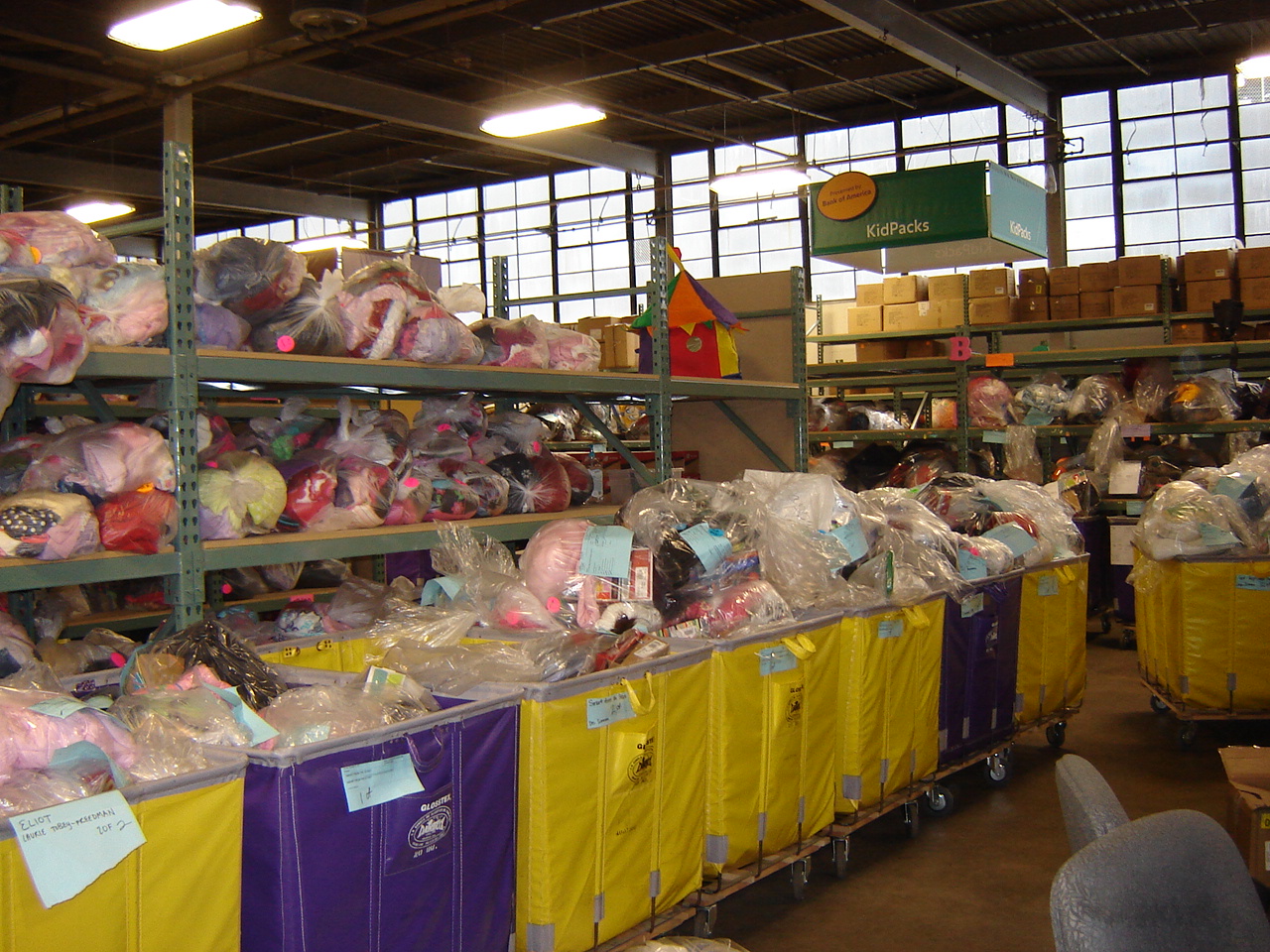
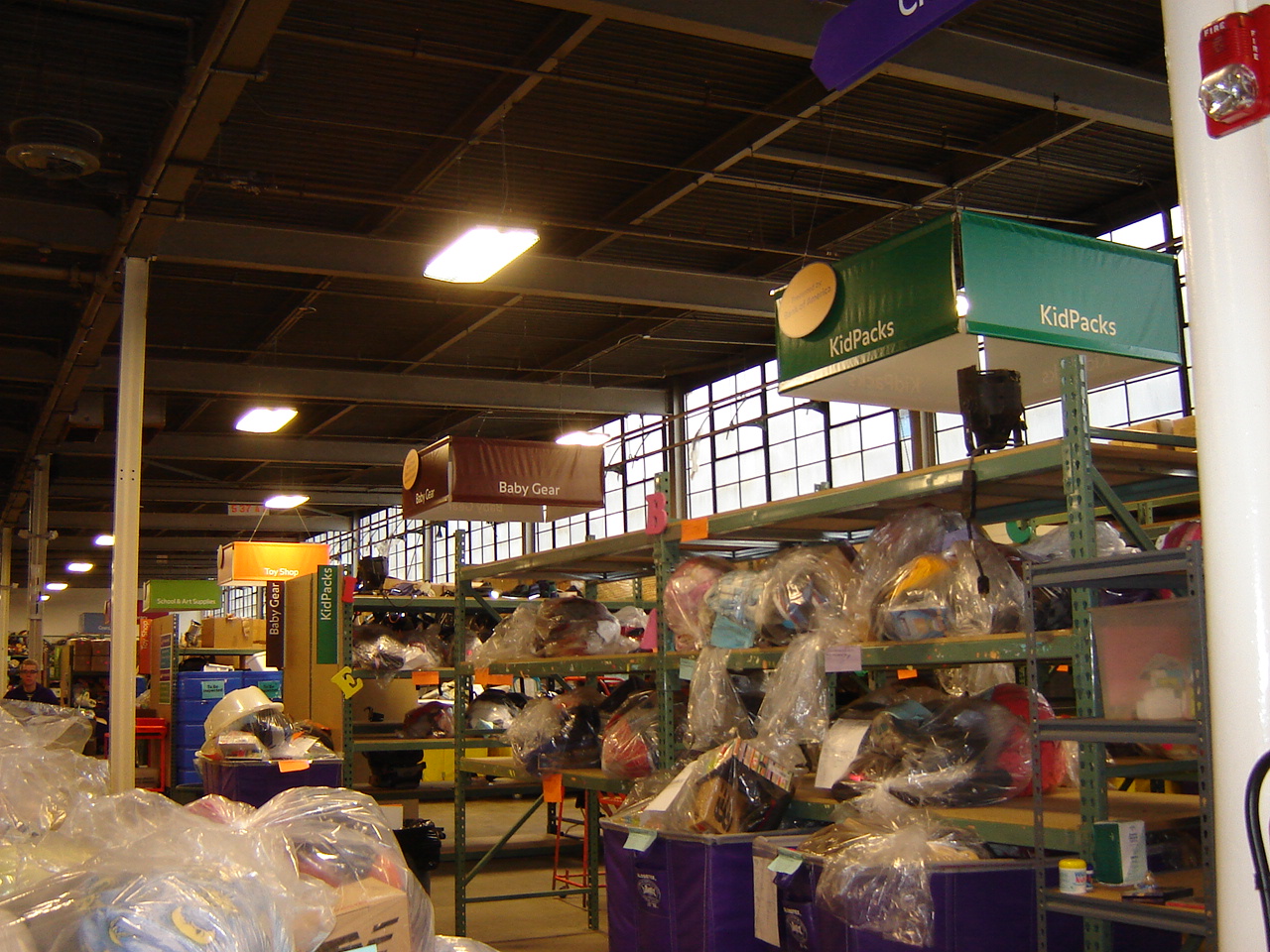
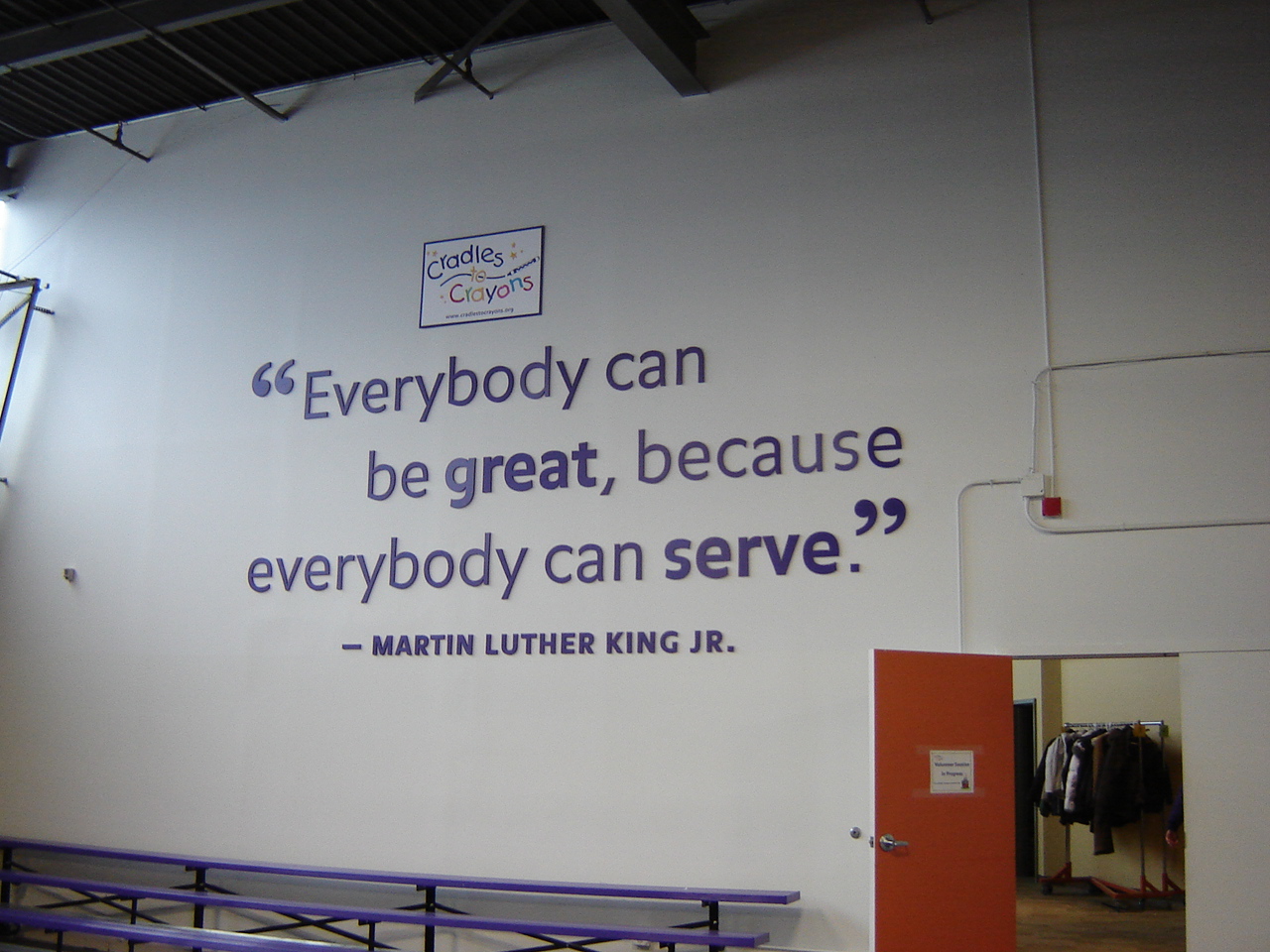
Today at work we had a holiday team-building outing to the nonprofit Cradles to Crayons. A lot of organizations bring employees to the group’s Giving Factory for their community service projects. Our team volunteered at the same time as Blue Cross Blue Shield and Bank of America.

First we watched a video about the history of the organization, which takes donations of clothes and equipment for children, sorts them, and fills orders for individual children at the request of social service agencies. The donations come from ordinary people and from partner corporations.

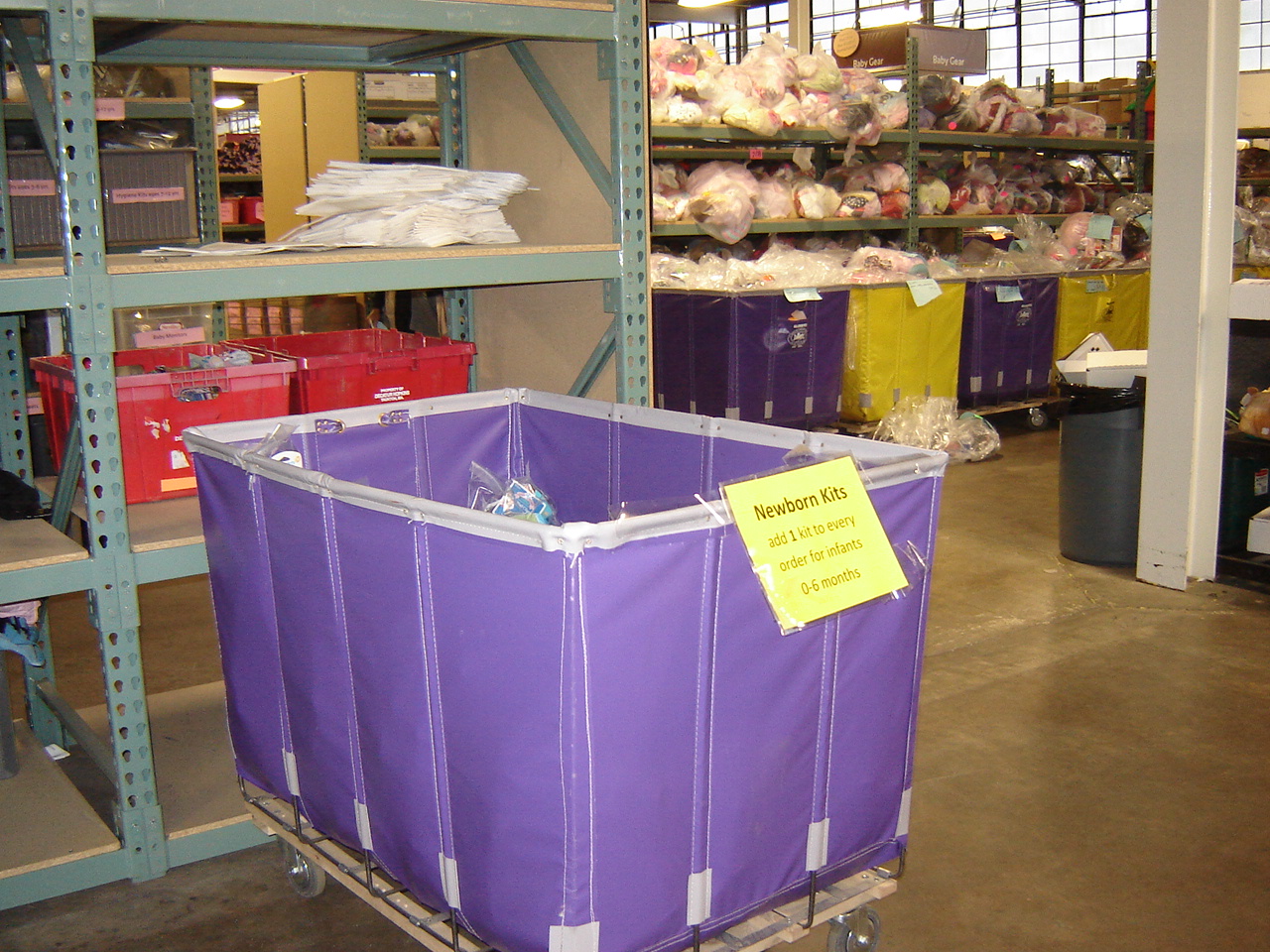
A group of us sorted donated coats. I was with the group that “shopped” among the warehouse shelves for bundles of sorted and age-labeled items, looking for the needs listed on individual order sheets. For example, we might have a sheet for a boy, age 4, that said “clothing pack, book bundle, craft packet, boots size 6, coat size 6.” It was very well organized. If we found that Cradles to Crayons was  out of something, the staff would fill the order anyway and invite the requesting agency to reapply for missing items. They like to provide whatever they can as fast as they can.

Cradles to Crayons says, “Our vision is that one day every child will have the essentials they need to feel safe, warm, ready to learn and valued. Through the Giving Factory, we provide those essentials, as donated clothes, shoes, books and school supplies to homeless and low-income children. We also offer meaningful volunteer opportunities to hundreds of corporations and thousands of individuals and families each year.”


Read Full Post »

The Boston Medical Center, whose patients are mostly poor, has been a pathbreaker in treating the whole person. Its volunteers and staff help patients find services for life issues that may be exacerbating health problems. BMC works with lawyers to get landlords to make building-code-required changes that affect asthma and other conditions.

Now it is doing an experiment with yoga.

On Monday, the Boston Globe wrote, a “yoga class, held in a Boston Medical Center lobby for staff and patients, features postures vetted for people with back pain. It was a prototype for an ongoing study exploring the use of yoga in the city’s poorer neighborhoods.

“A survey of 5,050 people who practice yoga, conducted for Yoga Journal in 2008, found that 44 percent — almost half — reported annual incomes of $75,000 or more, and 24 percent said their income was higher than $100,000. Chronic low-back pain annually affects between 5 and 10 percent of all income levels of the population …

“Because many yoga postures stretch and strengthen the muscles affecting the back, at least 10 published studies have been done on yoga and chronic low-back pain, says [BMC’s Dr. Robert B.] Saper. But though the majority have shown yoga to be promising as a low-cost treatment, all have been done on predominantly white, educated, affluent populations, he says.

“ ‘In our patient population, it’s unusual to have back pain alone as a single problem,’ Saper says, noting that many patients also suffer from hypertension, diabetes, obesity, depression, and anxiety. And while he emphasizes that he doesn’t consider yoga a ‘panacea for everything,’ he says that ‘because of the mind-body component of yoga, we’re aware that [it] may be helpful for a variety of patients with co-morbidities. And that it may help with depression, anxiety, and resilience.’ …

“The yoga group received one 75-minute class each week that included postures, deep breathing, and meditation. They were also given an instructional CD and equipment to practice 30 minutes a day at home. After 12 weeks, the yoga group reported one-third less pain and an 80 percent decrease in pain medications. The control group reported a decrease in pain of 5 percent and no change in medication use.”

Read more here.

Read Full Post »

I went to a conference today on how industry and higher-education entities can collaborate better to prepare students for the jobs that companies want to fill. There was a big crowd, and among the speakers were U.S. Senator Sheldon Whitehouse of Rhode Island and Connecticut Governor Dannel Malloy.

I was especially pleased to hear panel member Gerald Chertavian and catch up with what his nonprofit has accomplished in the past few years.

Starting in college, Chertavian volunteered as a Big Brother, and the experience had a profound effect on him. After he went to Harvard Business School, launched a company, and sold it, he decided to invest in helping motivated youths aged 18-24 who lacked the money, networks, or opportunity to get a good education or decent job.

So he founded Year Up. He built on his list of corporate contacts to make internships a key part of a training program that ended in jobs.

Interested young people had to have a high school diploma or GED and demonstrate through the application process (which involves getting references) that they are serious. They earn a stipend during a year of training in either financial-industry or tech skills. They learn workplace behavior and business communication. At the same time they get college credits at an affiliated school, which most students decide to put toward a degree after their year in the program. Companies have found the Year Up youths invaluable, and some are changing their HR requirements to allow in more people without a bachelor’s already in hand.

At the conference, Chertavian acknowledged that in spite of having helped 5,000 students over a decade through Year Up programs around the country, the organization was not big enough to achieve its ambition of a major impact on the opportunity divide. To scale up, he said, Year Up is partnering first with a college in Baltimore that will use the approach. It hopes to keep expanding the new model after Baltimore.

There are a lot of great You Tube videos that might interest you — some about the Year Up program, some about Chertavian, some about the students. Here is one.

Read Full Post »

A new exhibit organized by the Cooper-Hewitt National Design Museum in New York demonstrates the power of design to make life better for disadvantaged people.

“This is a design show about remaking the world … And that’s thrilling,” writes Michael Kimmelman, “whether it’s happening in Cupertino, Calif., or Uganda, where H.I.V. infects hundreds of people a day, and the latest news cellphone-wise has been the design and distribution of a text-messaging system that spreads health care information.

“In Kibera, an area of Nairobi, Kenya, and one of the densest slums in Africa, the challenge was different. Traditional wood and charcoal fires cause rampant respiratory disease there. Refuse fills the streets. So a Nairobian architect designed a community cooker, fueled by refuse residents collect in return for time using the ovens.

“From cellphones and cookers to cities: in Thailand, a public program called Baan Mankong Community Upgrading has, for the last eight years, been improving conditions in hundreds of that country’s 5,500 slums, bringing residents together with government and nongovernment agencies to design safer, cleaner places to live.”

Read more in the NY Times.

You will also enjoy reading about slum (favela) painting in Brazil and what a new coat of paint can do for building residents’ skills while lifting their spirits.

Read Full Post »

Years ago, when we were living near Rochester, New York, it was pointed out to me that poverty in rural areas was often worse than in cities because people were more isolated and there were fewer services. That winter I contacted an outreach coordinator who had put out a call for warm clothing. I offered to drop off some clothes we no longer needed.

The coordinator, an African American, believed deeply that dropping off clothes was not the same as understanding what the need was. She herself had grown up in a family of migrant farm workers and was acquainted with grief. When she was small, I later learned, her family had even been assigned to a chicken coop for their housing.

The coordinator knew a family who needed my clothes, and she thought I should go with her to make the delivery. Somewhat reluctantly, I agreed.

I will never forget the wary, beaten-down look in the eyes of a young woman living with family members in a tumble-down old house. After handing over the donation, the coordinator and I hung around for a brief, awkward chat. I could see that my contribution could not scratch the surface of the family’s need and was mostly for my conscience (which is not a reason to give up on donations, of course).

The main thing that has changed in the America in 30-plus years is that greater percentages of Americans are poor.

That is why some photojournalists, outraged at the lack of serious coverage in the mainstream media and recognizing that a picture is worth a thousand words, have founded an organization to fight poverty called American Poverty. See their recent photos here.

Perhaps you know the work of Walker Evans and James Agee in the Great Depression. The photographers’ new antipoverty site may, like Walker and Agee’s “Let Us Now Praise Famous Men,” provoke the question, “Is this America?”

Read Full Post »

Check out this story in the Boston Globe. It seems especially timely given the increasing numbers of people growing their own food and the concerns about many others who are struggling.

“Every summer, 40 million backyard farmers produce more food than they can use, while people in their communities go hungry. If only they could link up. Enter Gary Oppenheimer, 59, of West Milford, N.J. He was directing a community garden a couple of years ago when inspiration struck. In May 2009, AmpleHarvest.org hit the Internet, connecting food pantries and gardeners. In just 150 days, Rosie’s Place in Boston became the 1,000th pantry on the site, and the growth has continued. As of Labor Day, 4,188 pantries were listed, in all states. Oppenheimer says the nonprofit organization is actively seeking grant funding to sustain what has sprung up.” Read more here.

If you have extra produce from your garden, you can go to AmpleHarvest to find a food pantry near you.

Photographs: Sandra M. Kelly

Read Full Post »

Dr. Paul Farmer, the subject of a great Tracy Kidder book called Mountains Beyond Mountains, has spent many years delivering medical care — and working to alleviate poverty — in remote areas of Haiti. His nonprofit organization, Partners in Health, takes the word “partners” seriously. The teams do not tell the locals what is good for them but makes a point of learning from them and helping them get what they need.

In recent years, Farmer has been in demand in other countries, too. One focus area has been Rwanda. I liked a recent Boston Globe article on the approach to building a Partners in Health hospital there.

“The designers quickly realized that the challenge was not simply to draw up plans, as they had first thought, but rather to understand the spread of airborne disease and design a building that would combat — and in some cases sidestep — the unhealthy conditions common to so many hospitals.

“Learning from health care workers that hospital hallways were known sites of contagion, poorly ventilated, and clogged with patients and visitors, MASS Design decided that the best solution would be to get rid of the hallways. Taking advantage of Rwanda’s temperate climate, they placed the circulation outdoors, designing open verandas running the lengths of the buildings. …

“When it came to building, MASS Design looked at the Partners in Health model of involving local poor communities in health care, and realized that they could apply the same ideas to the construction process. The hospital was built entirely using local labor, providing food and health care for the workers. Unskilled workers received training that would help them get more work; and skilled laborers, notably the Rwandan masons who built the hospital’s exterior from carefully fitted together local volcanic stone, refined their craft and found themselves in demand all over the country. The construction process also beefed up local infrastructure — new roads and a hydroelectric dam — creating more jobs and literally paving the way for future projects.”

To paraphrase what Farmer often says, the biggest challenge to health is poverty. Read more.

Update on the designers from the June 19, 2012, Boston Globe.

Read Full Post »

How can you not love groups that use the arts to facilitate community development goals?

In a recent NY Times article I see that a collaboration to revive a 1937 musical revue is designed to benefit the community. The show is a classic, and it’s called Pins & Needles.

“Running at the Irondale Center in Fort Greene, Brooklyn, from Wednesday through July 9, the show, comprising sketches and songs, is a joint endeavor of the Obie-winning Foundry Theater and Families United for Racial and Economic Equality (Furee), which since 2001 has worked to increase access to housing, jobs and services for low-income families.”  Read the Times article here.

I went to Wikipedia to refresh my memory about Pins & Needles, which I have heard only on an old vinyl recording, and found this.

“The International Ladies Garment Workers Union used the Princess Theatre in New York City as a meeting hall. The union sponsored an inexpensive revue with LGWU workers as the cast and two pianos. Because of their factory jobs, participants could rehearse only at night and on weekends, and initial performances were presented only on Friday and Saturday nights. The original cast was made up of cutters, basters, and sewing machine operators.”

I have to say, I love Wikipedia — you never know what new paths it will lead you down. I had forgotten (if I ever knew) that one of the Pins & Needles creators was Arnold Horwitt, a playwright neighbor who helped me out years ago. He showed me how to write a musical on Fire Island. It was for the annual teenage show. His daughter is a tech writer in the Greater Boston area now, someone who also writes fiction.

Read Full Post »

« Newer Posts