Feeds:
Posts
Comments

Posts Tagged ‘military’

Photo: Charles Lawrence.
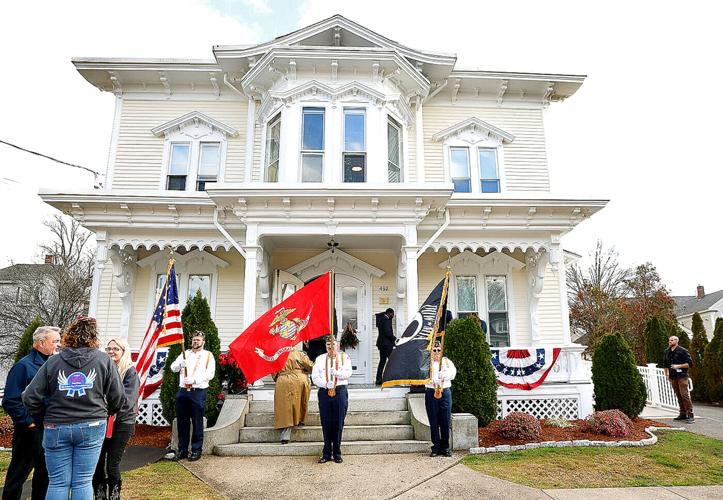
A renovated 1865 Woonsocket, RI, home now provides living space for homeless female veterans.

When one thinks of homeless veterans, one tends to think of men. I remember visiting a new space for veterans when I worked at Rhode Island Housing. Saccoccio & Associates were the architects for the historic renovation of the Heaton and Cowing Mill in Providence, which created 20 units of veterans housing. It was beautifully done, but it did not house women.

So I was interested to read about housing specifically for female veterans in nearby Woonsocket, Rhode Island.

Bella Pelletiere has the story at the Valley Breeze.

“Homeless female veterans in Woonsocket will now have a home to spend the holidays in, say representatives from Operation Stand Down Rhode Island.

“[In November] the historic house at 495 South Main St. was reopened as transitional housing for female veterans in honor of the late Marine Corporal Andrea Ryder.

“Operation Stand Down Rhode Island is Rhode Island’s primary nonprofit resource for homeless and at-risk veterans. OSDRI facilitates a combination of permanent supportive, transitional and recovery housing to low-income and disabled veterans and has 88 locations for housing throughout the state.

“Executive Director Erik Wallin told The Breeze that since 2010, OSDRI has been operating a six-unit facility in Johnston for female veterans. That facility was recently filled to capacity and they have been trying to find alternative ways to house female veterans, who are currently allowed to stay between 6 and 24 months. …

“In May, Wallin told news sources that lead paint had been discovered during renovations, but OSDRI was working with the city and painters to restore the building. Though it was a long process, he said they knew they wanted to restore this ‘magnificent piece of architecture’ for the veterans who were coming to live there.

He added that they wouldn’t house veterans in any building they wouldn’t put their own family members in. …

“OSDRI dedicated the home to Ryder, a Rhode Island native who enlisted in the Marine Corps after graduating high school and was diagnosed with stage three melanoma when she left the service. After numerous surgeries she appeared to be in remission. In 2014, Ryder learned both that she was pregnant and that the cancer had returned at stage four.

“Ryder give birth to her baby girl in 2014, and in 2020, she ultimately succumbed to her illness after spending some time in hospice.

“Wallin said that throughout the years, they had gotten to know Ryder and her family, hosting fundraisers and supporting her until she died. …

“Many officials attended the reopening of the [house], including Tony DeQuattro, president and chairperson of the board of OSDRI, Sen. Sheldon Whitehouse, and Ryder’s family members.

“Ryder’s mother, Donna Paradiso, as well as her daughter, Olivia, and husband, Dennis Bourassa, also came to celebrate the life of their loved one and her name that will live on at 495 South Main St.”

These stories of veteran homelessness are so sad. You just know every time a war starts up that some who serve will come back traumatized. Some will end up homeless. We never do enough for them, but organizations like Operation Stand Down keeping chipping away at the needs.

More at the Valley Breeze, here. No firewall.
Read Full Post »

Photo: The Unwritten Record.
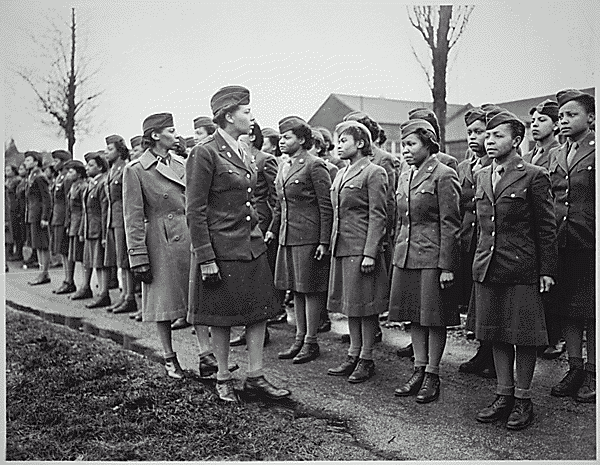
African American Women in the military during WW II.

November 11 is Veterans Day in the US. Veterans come in all shapes and sizes and they all deserve recognition. The African American veterans above served in the military in World War II.

A veteran from more recent times was honored in this reminiscence at the Washington Post. Lauren Koshere, a volunteer with Veterans Affairs’ My Life, My Story program and a food service worker at William S. Middleton Memorial Veterans Hospital in Madison, Wisconsin, shared some poignant memories.

“Final Salutes don’t come with much notice, maybe five minutes. But even those of us in chronically understaffed departments can attend. I join a river of co-workers flowing toward Ward 1B: nurses in turquoise scrubs, doctors in white coats, executives in business suits, police in uniform and me in a hairnet and black polyester polo — ‘VA Food Service’ embroidered over the heart — but without my usual stainless-steel tray cart.

“Most of us working in Veterans Affairs hospitals are not veterans. But the nurse standing across from me, in a hall lined with people, must be a veteran: She knows exactly how to stand with respect for a memorial service. I try to copy her posture, feet shoulders-width apart, hands joined behind my back.

“No one speaks. Then the quiet is broken by a single resonant tone. Five seconds of silence. Then another tone. A nurse carrying a brass singing bowl and wooden mallet appears from the hospice unit. She strikes the bowl again. Behind her, another nurse escorts a morgue cart draped in an American flag.

“I think of a hospice patient I’ve been bringing meals to for weeks. He was born in the late 1940s. Every day, his thin form lies at the same angle under a faded Green Bay Packers blanket.

“Until a hot day in July, we had never spoken — I suspected he couldn’t — but he always nodded and made eye contact when I set down his dinner tray. On this day, I pointed to a cup of chocolate ice cream he had ordered. ‘It’s a good day for ice cream.’

“He surprised me by replying, ‘Every day is a good day for ice cream.’

“The gurney comes into full view, and I now see a black baseball cap with a yellow, red and green Vietnam veterans badge resting on the flag.

“When the procession stops, people remove their hats. Veterans salute, and hold it, while the rest of us raise our hands to our hearts. The first notes of a ‘Taps’ recording fill the hallway, and we are locked in stillness. …

“My vision blurs as the song continues, and I wonder how many other funerals are being remembered in this hallway. I hear soft, deep sighs and a few sniffles. …

“As the flag-draped gurney passes on its way to the morgue, I realize it isn’t every day that I’m this close to the sharply defined red, white and blue. Working with veterans reminds me of what millions have invested for the idea of that flag. But it also reminds me of what that flag has asked, has taken. …

“Joseph Campbell said, ‘Affirmation is difficult. We always affirm with conditions.’ But ‘affirming it the way it is — that’s the hard thing, and that is what rituals are about.’

“To affirm unconditionally. To affirm the way it is. Ritual asks us to suspend our noise and our opinions and our egos. For a few moments of sacred silence, we affirm, creating the space where ritual works its power: weaving the personal to the anonymous, the individual to the universal, the known to the unknown.

“During a Final Salute, the deceased veteran’s identity is not disclosed. … The Final Salute on this day has gathered strangers in honor of a stranger. I don’t know whose loved one walks behind the gurney. I don’t know who lies under the Vietnam veterans hat, the American flag. But I did know a veteran who liked the Packers and chocolate ice cream.

“I never saw him again.”

More at the Post, here.

Read Full Post »

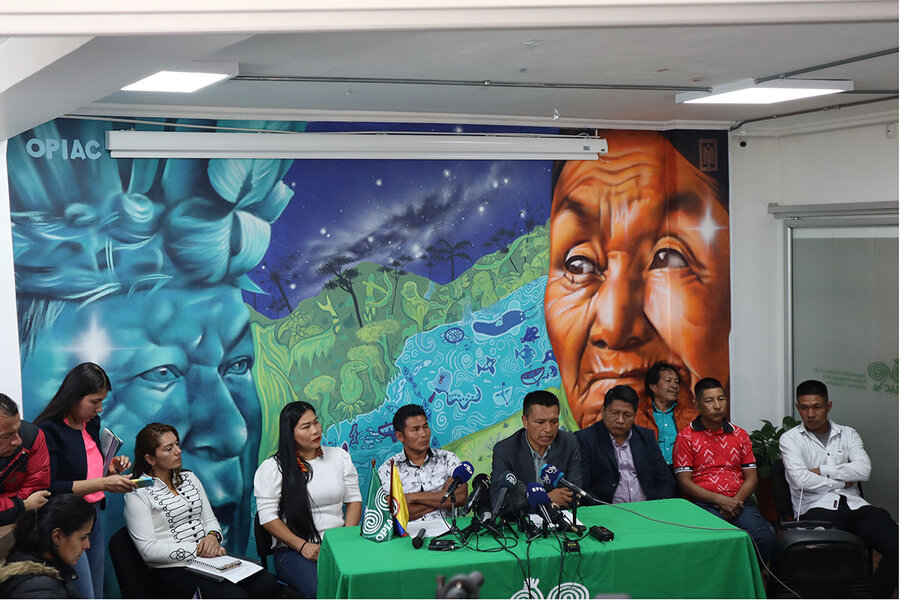
Photo: Mie Hoejris Dahl.
An indigenous leader and indigenous
guards and family members of four lost children meet at the office of the National Organization of Indigenous People of the Colombian Amazon, in Bogotá, Colombia, June 15, 2023.

You may have heard about the kids who were in a plane crash in the jungle and survived largely because of their indigenous skills. Today I share a story about how an unusual collaboration among searchers led to their being found.

Mie Hoejris Dahl reports at the Christian Science Monitor, “Few things have united the Colombian population like the recent successful rescue of four young Indigenous children following a deadly plane crash – and their ability to survive alone in the jungle for 40 days.

“The story of Lesly Jacobombaire Mucutuy, Soleiny Jacobombaire Mucutuy, Tien Ranoque Mucutuy, and Cristin Ranoque Mucutuy, who ranged in age from 11 months to 13 years at the time of the crash, grabbed hearts and headlines [recently] for their incredible resilience. The plane wreck killed all three adults on board, but against great odds, the children survived alone in the jungle by tapping into ancestral education about the animals, edible plants, and survival tactics in the wild jungle.

“Their survival is an inspiration, but the saga also put a spotlight on challenges faced by Colombia’s Indigenous populations, who fight to preserve their culture amid historical marginalization. …

“A promising thread has emerged in the days since the children’s discovery, which is the unparalleled, collaborative search efforts by the Colombian military and Indigenous guards that led to their rescue in the first place.

“It has many here looking to what the future of respect and partnership might look like between the government and Indigenous communities.

“ ‘This was a lesson … to look for commonalities’ between the government and Indigenous groups, says Rufina Román, a leader in the National Organization of Indigenous People of the Colombian Amazon, a nongovernmental organization. ‘We are going to need to rely on joint action for many other issues … like climate change’ and environmental protection. …

“On May 15, two weeks after an engine failure caused a flight carrying three adults and the four children to crash in the dense Amazon jungle, rescuers found the front part of the plane stuck between trees in the southern Colombian state of Caquetá. The pilot, an Indigenous leader, and the children’s mother were found dead.

“Although the search team saw signs of life – a baby bottle, half-eaten fruit, and dirty diapers – the children were nowhere to be found.

“The Colombian government deployed search-and-rescue planes and helicopters, as well as land and river teams to the crash site. They scoured for the kids in an area of about 1,650 miles and used sound systems to play a recording of the children’s grandmother speaking in their native language, Huitoto, telling them that people were looking for them and that they should stay in one place.

“The children kept moving, some close to them speculate out of fear of who exactly was looking for them. Armed dissident guerrilla groups are a threat for many Indigenous communities in the jungle.

“But even so, the search was challenging from the start.

“ ‘It’s a very remote zone that requires special capacity,’ says Pedro Sánchez, the general who led the government search operation. Some 16 hours of rain a day, humidity, dense vegetation, and dangerous animals make the terrain hard to penetrate even for the country’s best-trained soldiers. It’s hopeless trying to see anything from the air due to tree coverage, and it’s hard from the ground, too. …

“Eventually, General Sánchez authorized Indigenous volunteers from across the country to participate in the operation: a decision that almost certainly saved the children’s lives.

“ ‘Without them, we still wouldn’t have found the kids,’ he says of the approximately 80 Indigenous volunteers.

“Working with the guard helped multiply eyes and ears on the ground, but also contributed important, deep-seated knowledge about the jungle. Spiritual knowledge, too, General Sánchez says.

“He describes the collaboration as ‘very fluid,’ which stands in contrast to the historical mistrust between Indigenous people and the government’s armed forces. Indigenous communities are often stigmatized as uneducated, violent, and out of touch with modern society. And the absence of the state in many of these remote communities, lack of public services like roads and running water or electricity, and few security measures in a region overrun by armed groups mean that many mistrust and feel abandoned by the state. …

“There’s hope that the unprecedented collaboration that took place between the armed forces and the Indigenous guard in Operation Hope, as the rescue mission was dubbed, can blaze a new path for relations between the government and Indigenous groups here.

“When the soldiers and Indigenous guards were deep in the jungle, on several occasions their technology, like GPS satellites and compasses, stopped working. ‘What do you say?’ General Sánchez asked the Indigenous guards.

“That simple question was ‘something spectacular,’ says Janer Quina, regional coordinator of the Indigenous guard in Cauca … who participated in the search. It contrasts with his experience with non-Indigenous Colombians in the past. Historical knowledge around nature, for example, is often met with skepticism from outsiders, he says. …

“In the long, emotional search, the soldiers and Indigenous guards shared food, personal questions, and survival techniques. Indigenous guards shared ancestral knowledge, like medicinal plants, while soldiers taught them to use their high-tech equipment. … What was perhaps even more surprising was the kids’ ability to survive in such precarious conditions.

“ ‘We taught them how to survive in the Amazon jungle,’ says Eliecer Muñoz, one of the Indigenous rescuers, of the education that children in many remote Indigenous communities are brought up with about plants, animals, and how to construct a shelter. …

“Thus, ‘Lesly [the 13-year-old] knew what to do,’ says Ms. Román, including which plants or insects were edible and how to care for a baby without any of the tools many Westerners rely on, like formula or a crib.’ “

More at the Monitor, here. No firewall.

Read Full Post »

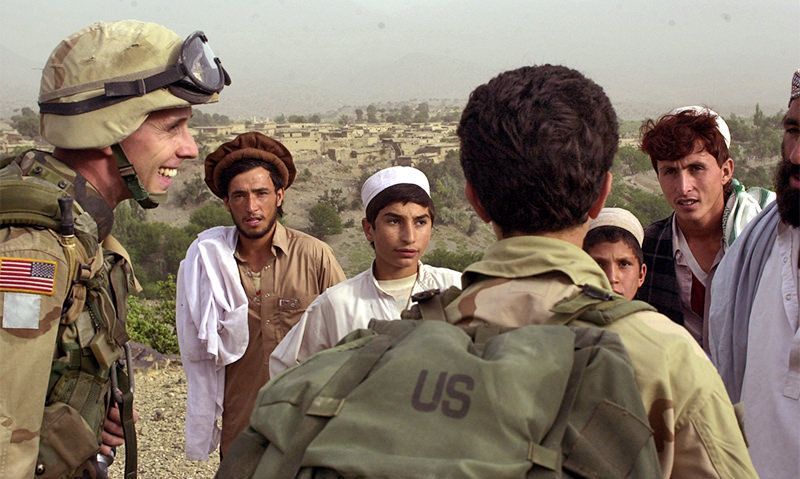
Photo: U.S. Army.
An Afghan interpreter assists U.S. military personnel trying to locate Taliban weapons.

On Memorial Day, as we honor the men and women of our military, I am thinking in particular of those whose lives have been lost fighting in Afghanistan. Today, many who are leaving that troubled country have a justifiable concern about what will happen to their interpreters and friends when the Taliban reassert control.

I am not one to say we should stay there, but I have learned from Shagufa just how bad things are likely to get, and I wanted to know what our soldiers thought.

Ken Olson writes at Legion.org, “Gerald Keen’s Afghan interpreter is running out of time. One relative was assassinated by the Taliban a month ago. Another was killed by an IED last Sunday. Both also worked as translators for U.S and coalition forces in Afghanistan.

“ ‘It’s like he has a bounty on his head,’ Keen says of the Afghan national he worked closely with during his 2016 deployment. ‘The Taliban has no remorse.’ …

“There are more than 17,000 interpreters and their families mired in the same bureaucratic quagmire of the U.S. Special Immigration Visa application process. Their peril is exponentially greater now that the United States has announced it will withdraw all of its troops from Afghanistan. …  

“It’s a haunting reminder of the situation faced by the Montagnards who risked their lives and their families’ lives to support U.S. operations in the Vietnam War. The American Legion has asked the president and Congress through a 2018 National Security Commission resolution to recognize the crucial contribution Afghan and Iraqi interpreters have made and ensure they are able to come to the United States. ‘Our wartime allies saved countless American lives and directly contributed to every level of tactical, operational and strategic success during the mission is Iraq and Afghanistan,’ according to Resolution No. 16, passed by Legion’s National Executive Committee in October 2018.

“The International Refugee Assistance Project also called for the mass evacuation of Afghans at risk to Guam or another location while they slog through the lengthy visa process, much like what was done for Iraqi Kurds as part of Operation Pacific Haven in 1996. …

“The Special Immigrant Visa program most Afghan nationals are using was established in 2009 when Congress created the Afghan Allies Protection Act, says Julie Kornfeld, an attorney with the International Refugee Assistance Project who represents several Afghan interpreters. The statute calls for visa applications to be processed in nine months. The reality is far worse. Kornfeld has clients who have been waiting as long as 10 years.

“ ‘The U.S. mission in Afghanistan recruited Afghan nationals with a promise of safety, but we’ve made it bureaucratically impossible for them to access safety,’ she says. ‘It sends a message to them that we aren’t fulfilling our promise to protect them.’ …

“ ‘It’s very frustrating,’ Keen adds. ‘We couldn’t have made it through this without these interpreters.’ ”   

So today, as we honor military personnel who have died serving in wars at the behest of a series of presidents, let’s spare a thought for those who are in danger because they helped us, and let’s support any elected representatives who may be trying to rescue those people.

More here.

Read Full Post »

Wednesday is Veterans Day, and I thought I would share something I just learned about how some veterans have continued in public service after being discharged from the military.

Last week, veterans volunteered at the polls because coronavirus concerns were keeping elderly poll workers and others at risk at home.

As Sarah Sicard wrote at Military Times, “Veterans often look for opportunities to continue to serve even after retiring or moving on from the military. In 2020, a number of veterans have taken to volunteering to work the polls at their local election sites.”

Sicard cites Maggie Seymour, who served in the Marine Corps from 2008 to 2017. Seymour wrote on Twitter that she was expecting a baby and “serving as an election judge here in Beaufort. Exposing little fetus to the sounds of democracy!”

Sicard continues, “Veterans across the country have volunteered on Nov. 3 to serve in various capacities, many through the organization Veterans for American Ideals [VIFI]. …

“ ‘We’re trying to get vets engaged as poll workers to assist in pulling off a free and fair election, protect the elderly — who constitute the majority of poll workers — during COVID, and get a new generation involved in their communities,’ said Christopher Purdy, program manager of Veterans for American Ideals, according to Reuters.” More at Military Times, here.

I decided to take a look at the VIFI website, where I found this mission statement. “Veterans for American Ideals is a nonpartisan group of veterans who share the belief that America is strongest when its policies and actions match its ideals.

“We dedicated our lives to our country as citizen-soldiers, and we believe that honor, courage, commitment, duty, and country are not just words, but values worth defending. After taking off the uniform, we seek to continue serving our country by advocating for policies that are consistent with the ideals that motivated us to serve in the first place.

“Our current campaigns are focused on saving the Special Immigrant Visa program for interpreters and translators who served with the U.S. military, protecting refugees, and countering Islamophobia.”

Now, I call that living your values.

Read more at Vets For American Ideals, here — and have a happy, thoughtful Veterans Day.

Read Full Post »

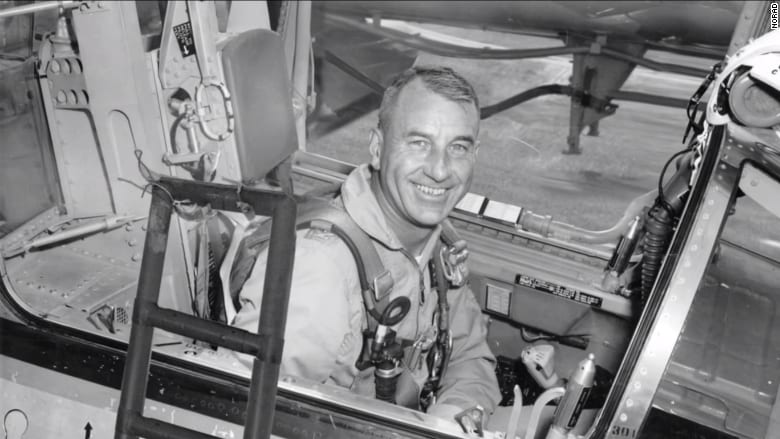
oypmomn4w5fqvh4avx2kwy3rgqPhoto: Shoup Family
Col. Harry Shoup was a NORAD commander who received a surprising phone call in 1955 about Santa — and started a new tradition.

This story about a fast-thinking colonel in the North American Aerospace Defense Command (NORAD) who calmed a crying child and started a new Christmas tradition is sure to warm the cockles of your heart. John sent it to me early this year, and I’ve been waiting until the right moment to share it.

Steve Hendrix at the Washington Post had the report.

“Col. Harry Shoup was a real by-the-book guy. At home, his two daughters were limited to phone calls of no more than three minutes (monitored by an egg timer) and were automatically grounded if they missed curfew by even a minute. At work, during his 28-year Air Force career, the decorated fighter pilot was known as a no-nonsense commander and stickler for rules.

“Which makes what happened that day in 1955 even more of a Christmas miracle.

“It was a December day in Colorado Springs when the phone rang on Col. Shoup’s desk. Not the black phone, the red phone.

“ ‘When that phone rang, it was a big deal,’ said Shoup’s daughter, Terri Van Keuren, 69, a retiree in Castle Rock, Colo. ‘It was the middle of the Cold War and that phone meant bad news.’

“Shoup was a commander of the Continental Air Defense Command, CONAD, the early iteration of the North American Aerospace Defense Command (NORAD). Then, as now, the joint U.S.-Canadian operation was the tense nerve center of America’s defensive shield against a sneak air attack. … It was not a place of fun and games. And when that red phone rang — it was wired directly to a four-star general at the Pentagon — things got real. All eyes would have been on Shoup when he answered.

“ ‘Col. Shoup,’ he barked. But there was silence.

“Until finally, a small voice said, ‘Is this Santa Claus?’ Shoup, by all accounts, was briefly confused and then fully annoyed. ‘Is this a joke? … Just what do you think you’re doing?’ he began.

“But then the techno-military might of the United States was brought up short by the sound of sniffles. Whoever was on the phone was crying, and Shoup suddenly realized it really was a child who was trying to reach Santa Claus.

“The colonel paused, considered and then responded:

‘ Ho, ho, ho!’ he said as his crew looked on astonished. ‘Of course this is Santa Claus. Have you been a good boy?’

“He talked to the local youngster for several minutes, hearing his wishes for toys and treats and assuring him he would be there on Christmas Eve. Then the boy asked Santa to bring something nice for his mommy.

” ‘I will, I will,’ Santa-Shoup said. ‘In fact, could I speak to your mommy now?’

“The boy put his mother on the phone, and Shoup went back to business, crisply explaining to the woman just what facility their call had reached. …

“The woman asked Shoup to look at that day’s local newspaper. Specifically, at a Sears ad emblazoned with a big picture of Santa that invited kids to ‘Call me on my private phone, and I will talk to you personally any time day or night.’

“The number provided, ME 2-6681, went right to one of the most secure phones in the country.

” ‘They were off by one digit,’ said Van Keuren. ‘It was a typo.’

“When Shoup hung up, the phone rang again. He ordered his staff to answer each Santa call while he got on the (black) phone with AT&T to set up a new link to Washington. Let Sears have the old number, he told them.

“That might have been the end of it. But a few nights later, Shoup, as was his tradition, took his family to have Christmas Eve dinner with his on-duty troops. When they walked into the control center, he spotted a little image of a sleigh pulled by eight unregistered reindeer, coming over the top of the world. …

” ‘What’s that?’ the commanding officer asked.

“ ‘Just having a little fun Colonel,’ they answered, waiting for the blowup.

“Shoup pondered the offense as the team waited. Then he ordered someone to get the community relations officer. And soon Shoup was on the phone to a local radio station. CONAD had picked up unidentified incoming, possible North Pole origin, distinctly sleigh-shaped.

“The radio station ate it up, the networks got involved and an enduring tradition was born. This Christmas Eve marks the 63rd straight year that NORAD is publicly tracking Santa’s sleigh on its global rounds.” More here.

As a former copyeditor, I’d like to point out that typos matter. But as a grandma, I’ll add that sometimes a mistake can lead to something good.

Photo: ShareAmerica
shutterstock_117822769


Read Full Post »

Photo: Hartford Courant
Former US Marine Roman Baca
develops ballets that help veterans heal and help audiences gain empathy. For his Fulbright Fellowship, he’s creating a new version of Igor Stravinsky’s
Rite of Spring tied to WW I.

Not long ago, Suzanne’s friend Liz found a piece of antique weaponry and asked instagram friends how it might be used in an art project or something else positive.

I said to “beat it into plowshares.”

In their own way of beating weapons into plowshares, war veterans may continue to serve the country after their time in the military. They may run for Congress like Seth Moulton of Massachusetts or establish a nonprofit like Soldier On, which treats veterans suffering from addictions.

And then there’s the Marine who became a choreographer to tell stories that enlighten and heal.

Candice Thompson writes at Dance Magazine, “When Roman Baca returned home from active duty in Iraq in 2007, he found himself having a tough time transitioning to civilian life.

” ‘I remember a couple of instances where I was mean and angry and depressed,’ says Baca. [His wife] suggested Baca return to his roots in dance. ‘She asked me, “If you could do anything in the world, what would you do?” ‘…

“Baca had to broker his transition back into dance. Earlier, he had trained at The Nutmeg Ballet Conservatory in Connecticut and spent a few years as a freelance dancer before feeling compelled, like his grandfather had, to serve his country. ‘I walked into the recruiter’s office and said, “I want to help people who can’t help themselves.” ‘ Baca reveled in the rigor of the Marine Corps, which seemed like a perfect analog to classical ballet. …

“Baca served as a machine gunner and fire team leader [in Fallujah]. And while his job was one of looking for insurgents and intelligence, Baca also ended up doing humanitarian work, bringing water and school supplies to those in need. The transition from violence to aid helped him meet his original desire to defend the vulnerable.

“In 2008 … he reached out to his mentor Sharon Dante from The Nutmeg Ballet Conservatory. He had dabbled in choreography before joining the Marines and had begun to write while overseas. Dante suggested [that he] focus his writing and choreography on his experiences in Iraq. The exploration led Baca to form Exit12 Dance Company, a small troupe with a goal of inspiring conversations about the lasting effects of violence and conflict. …

“When a theater in the UK reached out to him in 2016 about creating a new Rite of Spring — one that would explore the connections between the creation of this famous ballet and the outbreak of World War I, in commemoration of the war’s centennial, as well as touch on today’s veterans and current events — he knew immediately it was a project for [him].

” ‘One percent of our population serves in the military, and an even smaller number serves in war,’ explains Baca of one of the central questions motivating this new commission. ‘How do we take all of this remote and little understood experience and inspire the audience to positive action?’ ”

More at Dance Magazine, here.

Read Full Post »

Photo: Military Friends Foundation
Joining the Tough Ruck marathon means carrying a heavy load for 26.2 miles to raise money for the fallen and injured and their families. Acknowledged by the Boston Marathon.

I was out for my ordinary walk on Saturday when I soon realized I was accidentally in the way of a new kind of marathoner: soldiers carrying heavy rucksacks on their backs. They were pushing hard as they were at mile 25 of a 26.2-mile marathon.

The signs saying “Tough Ruck” didn’t tell me much, so when I got home, I looked on Google to see what this was all about.

From the website: “We are a group of military and civilians whose sole purpose is to Ruck in honor and in memory of our Fallen Service Members, Police, Firefighters and EMTs, while raising funds to support military families in times of need.

“We will walk a 26.2 mile course with our Rucks.  Military Friends Foundation is proud to announce the continuation of our partnership with the Boston Athletic Association, the National Park Service and the Old Manse for 2017.

“On April 15, 2013, the Tough Ruck members were at the finish line of the Boston Marathon and joined the first responders to help those that were injured by the horrific blasts. They truly exemplify the best of what our Nation is. …

“Each year Ruckers are awarded the first of the official Boston Marathon Medals and receive recognition from the Boston Athletic Association.

“Tough Ruck participants are made up of any member of the Armed Forces currently serving, Veterans, First Responders, or Civilians. This extends across borders and is an open invite to our allied brothers and sisters around the world.
Regardless of a Rucker’s branch of service, rank, or position, each Rucker is a person who has volunteered to band together and do something to honor our Fallen Soldiers. …

“Ruckers push themselves and are an exemplar of drive, determination, and motivation. We ask each Rucker to push him or herself to their max potential and NEVER GIVE UP. Ruckers leave all egos, negative attitudes, and apathy at the start line. You are a member of a team. …

“When you register you will be asked to select one of three a divisions.  Ruck sacks will be weighed in prior to the start time and immediately after crossing the finish line.  You will NOT be permitted to ruck if your ruck sack does not weigh in at a minimum of 15 pounds.

“Military Division – Open to all active military and veterans and retirees.  Each Rucker will wear a: blouse, trousers, safety belt, regulation issued boots, and a ruck/assault pack/regulation pack issued by branch of service.  The minimum weight in the military division is 35 pounds.

“Heavy Weight Division – Ruckers in the heavy weight division will carry a minimum of 35 pounds at weigh in and at the finish line.

“Light Weight Division – Ruckers in the light weight division will carry a minimum of 15 pounds at weigh in and at the finish line.”

I didn’t realize something was up until I heard people clapping and cheering them on outside the Colonial Inn. I love the symbolism of sharing a heavy burden.

Read more here.

Read Full Post »

Sept-11-in-the-Greenway


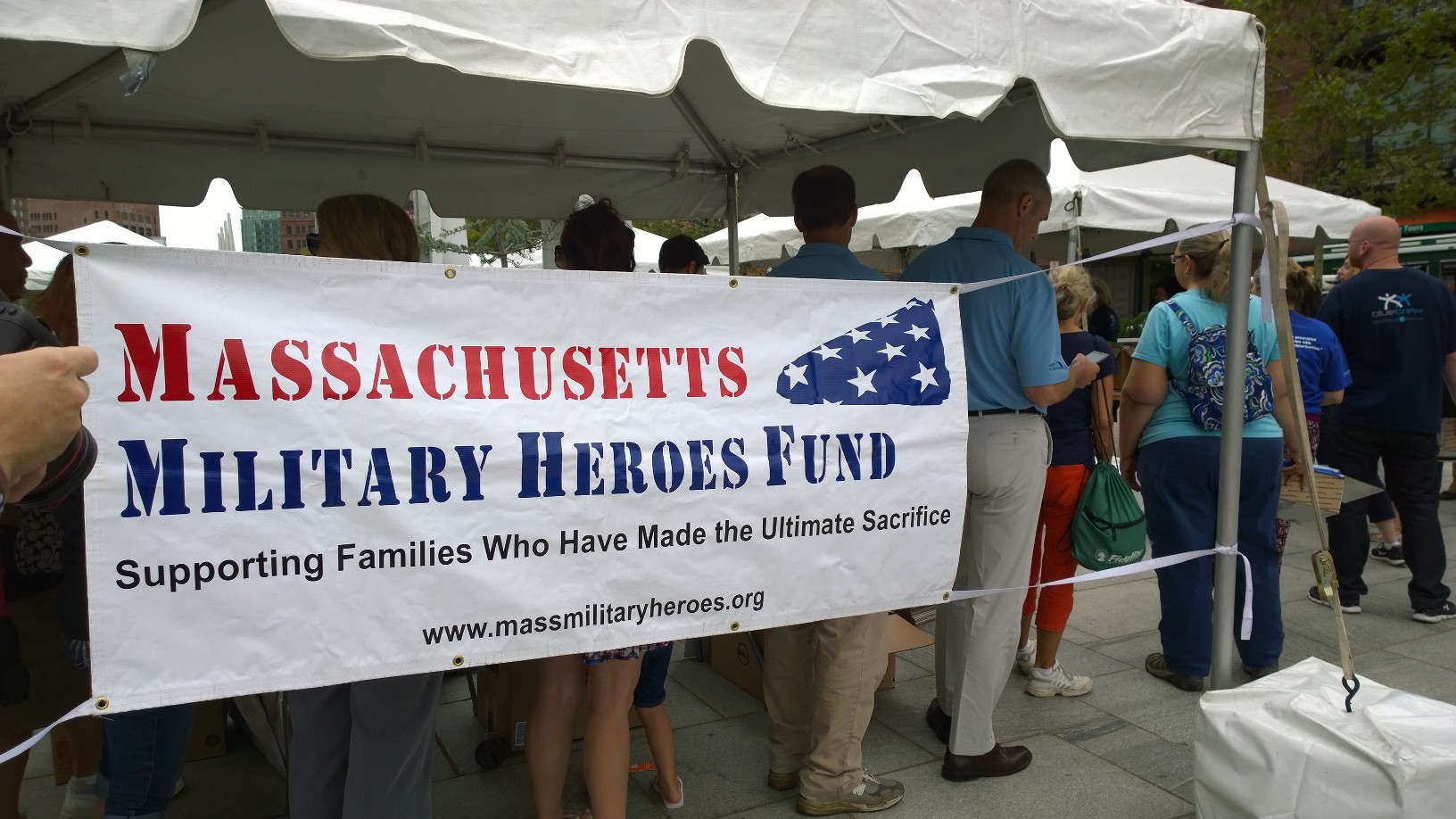
There was an event in the Greenway today to commemorate Sept. 11. A lot of companies volunteered to help the Massachusetts Military Heroes Fund prepare care packages for service men and women.

The fund’s website explains that the care-package service project was to support active duty service members and veterans. Activities included “building 500 military care packages for our service men and women overseas, writing letters of support to our troops, building care packages for our local veterans in need, and a pledge drive for the families supported by the Massachusetts Military Heroes Fund.” More here.

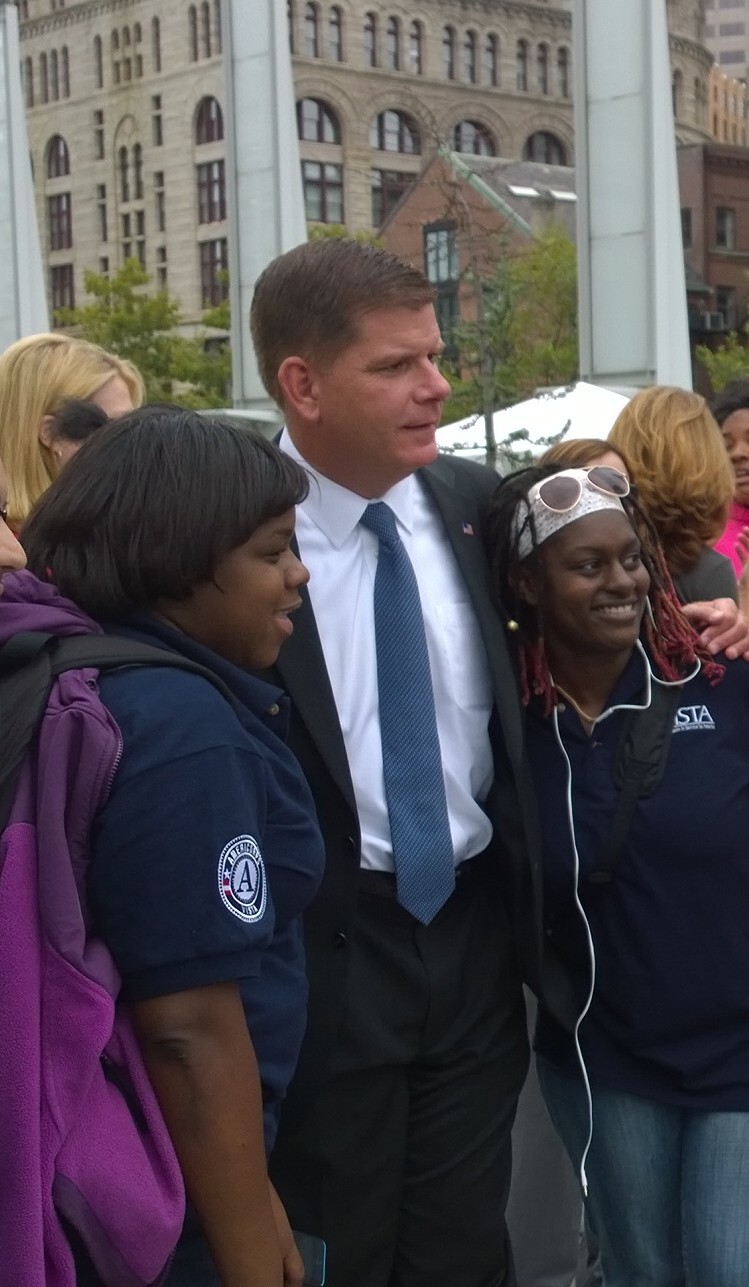
I saw the mayor having his picture taken, so I took his picture, too.

Boston Mayor Marty Walsh at 9/11 service project in the Rose Fitzgerald Kennedy Greenway.
091114-Maypr-Marty-Walsh

Read Full Post »

I’ve blogged before about programs that use theater for healing purposes and programs that use the arts specifically to help veterans.

Now Dana Ferguson writes at The Los Angeles Times about Shakespeare getting into the act and easing vets into the job world.

“Fifteen years ago former Pfc. and military police officer Jerry Whiteside had two masks tattooed on his left bicep, one smiling, one frowning. …

“Little did he know that more than a decade later, he would be symbolically reunited with the images imprinted on his skin.

“His journey began at the end of a 30-year struggle with drugs and alcohol, he said. Whiteside, a Chicago native turned Angeleno who had served in the Marine Corps from 1972 to ’76, sought help from the Veterans Administration in Los Angeles. He completed a detoxification program in 2011 and for this summer was referred to the Shakespeare Center of Los Angeles to do various jobs on the set of A Midsummer Night’s Dream.

“Whiteside, 61, and some 30 other veterans of the Afghanistan, Iraq, Vietnam and the Gulf wars assisted in building the set and working odd jobs with the production, which continues through July 28.

“Shakespeare Center artistic director Ben Donenberg said employing veterans stemmed from another of the company’s outreach programs, Will Power to Youth, which hires young Angelenos to study and perform Shakespeare plays. After seeing alumni of the program serving in the armed services and later seeking jobs at home, Donenberg said, the company decided to extend its employment program opportunity to veterans, starting last year. …

“One of the things we want to do as a company is to ease the transition to civilian life, and part of that is on the civilians; there’s only so much the veterans can do,” [Chris Anthony, associate artistic director at the Shakespeare Center] said. “The rest of us have to see them in a different light. It’s something we need to work on as civilians.” More.

Photo: Ricardo DeAratanha / Los Angeles Times
Military veteran Jerry Whiteside passes out programs before each Shakespeare Center performance.

Read Full Post »

Photograph: Julio Cortez/AP
Musician Julio Fernandez during a Voices of Valor music session at Montclair State University.

Today I am returning to the topic of veterans programs that help people overcome post-traumatic stress and reintegrate into civilian life. (Interesting how often these programs involve gardening or the arts — which we always knew were good for us!)

Samantha Henry at the Boston Globe has the story.

“During stressful times as a combat medic in Afghanistan, Mason Sullivan found solace in Vivaldi. New Jersey native Nairobi Cruz was comforted by country music, a genre she had never heard before joining the Army. For Jose Mercedes, it was an eclectic iPod mix that helped him cope with losing an arm during a tour of duty in Iraq.

“These three young veterans all say music played a crucial role in alleviating the stresses of active duty. Now, all three are enrolled in a program that hopes to use music to ease their reintegration into civilian life.

‘‘ ‘It’s a therapy session without the “sit down, lay down, and write notes,” ‘ Mercedes, 26, of Union City, said of the music program. ‘It’s different — it’s an alternative that’s way better.’

“The pilot program, called Voices of Valor, has veterans work as a group to synthesize their experiences into musical lyrics. Guided by musicians and a psychology mentor, they write and record a song, and then hold a CD release party. The program is currently underway at Montclair State University, where students participate through the school’s veteran affairs program.

“Developed by husband and wife team Brian Dallow and Rena Fruchter, it is open to veterans of any age and background. No musical experience is required.” More.

P.S. A word on the power of reddit. John posted my blog entry from yesterday in the Christmas category at reddit and it increased traffic to this site by a factor of 10 so far.

Read Full Post »

Although the Christian Science Monitor daily is strictly online, there is a hard-copy Christian Science Monitor Weekly that is worth buying. The cover story of the latest issue is about a group of Iraq and Afghanistan veterans. Each was floundering a bit in civilian life, looking for the same sense of purpose that they had felt in the military.

The story of how they came together in the blighted Oliver neighborhood of Baltimore is inspiring. The setting for the TV show The Wire, the area had been run by drug dealers for decades. Despite the best efforts of the local police, the residents could never get the help they needed to feel safe, to get vacant lots cleaned up, or to weatherize homes.

Today the veterans, applying the leadership and community-rebuilding skills they learned in places like Anbar Province, are making a difference — and feeling motivated once more.

See a great array of pictures at the Monitor website.

Photograph : Christian Science Monitor

Three veterans – (l. to r.) Patrick Young, Earl Johnson, and Dave Landymore – survey buildings and chat with neighbors on a warm Friday night. The men are volunteers with the 6th Branch, a nonprofit organization of volunteer veterans who use their community rebuilding skills to address urban blight in a project called Operation Oliver.

Read Full Post »

It’s amazing how much the arts can help people.

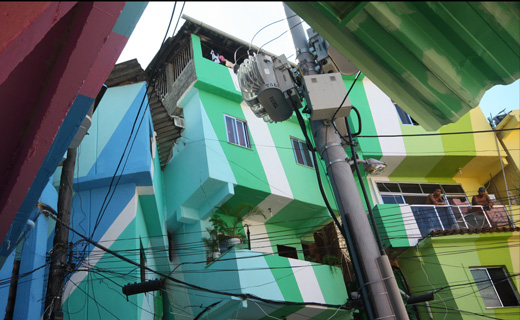
I have blogged about programs that use the arts to turn convicts toward something positive, to build up the self-worth of the homeless, to turn Brazilian slums into more hopeful places. The list goes on.

Recently ArtsJournal.com alerted me to a BBC story on an arts initiative that helps veterans reacclimate to civilian life.

“Many veterans are turning to charities for help. One is using the unlikely weapon of art to help fight the psychological wounds of war, while another organisation is actively encouraging artwork in the army. Outside of the [national health service] the charity Combat Stress is the biggest provider of support to armed forces veterans with conditions such as post-traumatic stress disorder (PTSD), depression and anxiety.

“Art therapy is one of the treatments it uses. Drawing, sculpting and painting are helping patients manage their symptoms with great success.

” ‘Traumatic memories take a different path from our normal memories and tend to be frozen in the body in the central nervous system,’ explains Janice Lobban, who has been a trauma therapist at Combat Stress for the past 10 years. …

“Group sessions typically begin with the therapist giving a one or two word brief to inspire creativity before veterans are given a selection of materials for painting, modelling or writing. After 45 minutes of quick work, the group then get together to talk about and describe what they’ve just created.

” ‘I try to keep a blank mind and just let images and feelings rise out from my unconscious to my hand and things start appearing,’ says Richard Kidgell … who served in the Royal Air Force from 1978 to 1985. ‘What surprises me is that while I’m drawing I don’t know what it is — they’re just images, but by the end of the session I’ve made a complete story. It’s quite enlightening as sometimes I’m not entirely sure what I’ve drawn until I speak to others about it.’ ”

Read more of Genevieve Hassan’s story on arts therapy for veterans here.

Read Full Post »