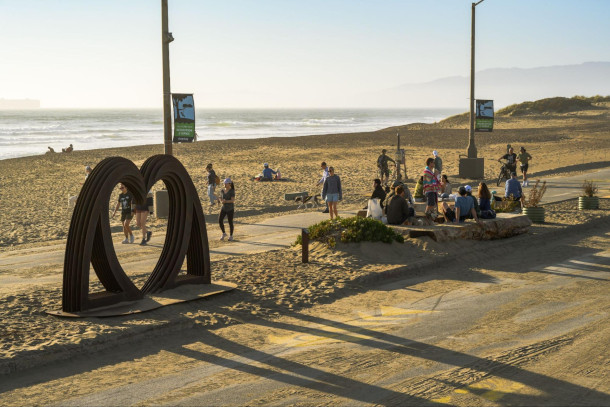
Photo: Jack Persons, Friends of Sunset Dunes. Once a four-lane highway threatened by flooding, Sunset Dunes Park now welcomes visitors who fancy recreation along the Pacific coast.
Many of us have had a chance to enjoy the elevated park in New York City known as the High Line. Once it was a highway. Now I’m learning about a similar conversion in California.
There’s an interesting story about it at the environmental radio show Living on Earth,
Jenni Doering “The four-lane Great Highway used to run along the Pacific Ocean on the west side of San Francisco. But in April 2025, this pavement became a little slice of paradise. Now visitors to Sunset Dunes Park can bike, walk, skate, and play next to the water. Zach Lipton is a volunteer with the nonprofit Friends of Sunset Dunes and he joins us now to talk about this highway’s transformation. … For someone who’s maybe never been to San Francisco or to Sunset Dunes Park … what is it like?
Zach Lipton “Sunset Dunes is a 50 acre park at the edge of San Francisco along the Pacific coast. It used to be a four lane highway and has been converted into a recreational space for people to walk and bike and sit by the ocean, have a bite to eat and just enjoy our Pacific coast. So we brought in eleven local artists to paint murals. … The city has installed benches made out of logs that have fallen in recent storms from the park … a bike park and a skate area. … And of course, just the Pacific Ocean View is the star of the show. …
“[There’s a sculpture] called Spinning Rock. It’s a 20,000 pound rock that is on a spinner. And just the look of delight when kids and adults, when everyone realizes you can just push this rock and start spinning it around. It’s a lot of fun. We have a giant octopus the kids love to climb on, some giraffes down by the zoo. [The park] is a perfectly flat space, which is great for people, especially riding bikes. I know folks who have come out, learned to ride a bike there during the pandemic as an adult, using Sunset Dunes. …
Doering “Going from a four lane roadway to a coastal park, how exactly did we get here?
Lipton “So let’s go back all the way to just give you the long version of the history. The entire western side of San Francisco originally was just sand dunes, and in the 1800s some folks started creating a coastal path back when a road really was a recreational facility. This was a place to go ride your horse along the ocean. In time, that road was paved, but it always, for over a century, has been part of the city’s Recreation and Parks Department, even though gradually, it kept shifting from a recreational use to really just transportation. … Then during the pandemic, there was a huge need in San Francisco for socially distanced outdoor recreation, and the city converted a couple of streets to recreational facilities, including what was the Great Highway. …
“Ultimately, we ran a campaign, a ballot measure last November for the city to vote on its future. 55% of the city voted that they wanted it to be a full time park. And then we worked quickly with the city, with the California Coastal Commission, to make that vision a reality and start its transformation. …
“The park sells itself more than we can ever explain its benefits to people. And this is something where if a few years ago, you said, ‘y”Yeah, let’s turn the Great Highway into a park,’ people would look at you like you were crazy. But having tried it during the pandemic, and having just had the chance for people to experience it, all of a sudden, it makes a lot more sense. And I think there’s a spirit of experimentation there that cities can embrace, whether it’s this or other environmental efforts, that it’s okay to just try things and see how they go.”
Can you think of other pandemic experiments that have lasted? I’m going to be thinking about that.
Photo: Viraj Nayar for NPR. Ten-year-old Keashaanth, with a notebook and chessboard in front of him, follows along as his coach Selvabharathy leads a class at the Madras School of Chess in Chennai.
Our whole family takes an interest in chess, partly because Suzanne and Erik’s son is so good at it. He has represented his state and age group in two national competitions so far. That’s why I notice chess stories like today’s, which comes from NPR (National Public Radio).
Omkar Khandekar writes, “On a balmy morning [in fall 2024] in the coastal Indian city of Chennai, dozens of fans perched on their seats as they watched an elite-level tournament unfold.… On stage, some of the world’s best players were gathered for the annual Chennai Grand Masters. After a thrilling tiebreaker, 25-year-old Indian prodigy Aravindh Chithambaram prevailed. The audience broke into applause. …
“This level of attention is wild, says the world’s 11th-ranked chess player, Levon Aronian, who was the runner-up. Even he, an Armenian-American, is stopped on the streets here. ‘I can understand that happening in a country like Armenia with a population of three million. … ‘But for that to happen in India, I think that speaks to the popularity of the game.’
“Chess has seen a worldwide resurgence since the pandemic-induced lockdown. … With more leisure time, people began playing on streaming platforms like chess.com and on YouTube. India has been among the biggest beneficiaries of the boom.
“The country has 85 grandmasters — an elite group of chess players — and some of the youngest top-rankers in the world. Last year, both of its men’s and women’s teams swept the Chess Olympiad — the Olympics of chess — held in Budapest, Hungary. At the World Chess Championship in Singapore, held in December, Indian national Gukesh Dommaraju became the youngest-ever world champion at age 18.
“This is a remarkable shift. After decades of Russian and European chess dominance, the spotlight is on India, the likely birthplace of the ancient game. Many historians believe that modern chess originated from chaturanga, an ancient Indian board game that spread to the world via traders, pilgrims and conquerors. Within India, it’s the southern state of Tamil Nadu, and its coastal capital Chennai, that has emerged as the epicenter of chess. …
“At the Madras Chess Academy, children trickle in after school. They sit in a windowless room, surrounded by portraits of chess legends, including world champion Gukesh Dommaraju, once a student here.
“Many of these dozen or so kids spend their weekends sparring at chess tournaments across Chennai. If they perform well, trainers like Selvabharathy — he only has one name — invites them to stand before the class, and orders the other kids to clap, as he did on a recent day. …
“Chess coach Vishnu Prasanna started this academy two years ago. He says the day before NPR visited, one parent walked in with their 3 ½-year-old child to train. Another parent, Suresh Dasarathan, proudly shared his 6-year-old son’s daily routine: Wake up at 7, an hour of chess practice, school, then an hour of chess coaching at the club, then homework and bedtime at 9 p.m. …
“Parents often play a crucial role in the success of young prodigies. Gukesh’s father Rajinikanth often put his day-job as a surgeon on hold to double up as a de facto manager of his son. … But one 6-year-old girl, Rivina, says some parents at chess tournaments also get overbearing. ‘They will say, “I will give you dinner only if you win this game,” ‘ she says. …
“In 1995, India got its first world champion in Chennai-born Viswanathan Anand. Today, his successors in India are oftencalled ‘Vishy’s kids.’ Now 55, Anand is still among the world’s top 10 players. … Anand thinks the culture surrounding chess has changed because now, it’s something you can make a living from. That’s key in a country where good-paying jobs are scarce.
“The Indian government often gives high-ranking players a job in the public sector — a dream opportunity for many because of the job security and perks: monthly pay, housing allowance, pension, insurance and paid leave they can use to practice. High-ranking players can win prize money in a newly launched global Chess League. Many also work as chess coaches. …
“Some chess watchers say there’s a major obstacle to India becoming the world’s unchallenged chess power: the English language. Most chess books, software and classes are in English. The government’s 2011 population census found that a little more than 10% of Indians fluently speak the language. Most English-speakers in India are from the country’s country’s middle and upper classes.
“One man wants to move beyond that. Two years ago, Venkatesh Enumalai founded theTamil Chess Channel on YouTube. It teaches the basics of chess in Tamil, a language spoken by some 80 million Indians, concentrated in the southern state of Tamil Nadu. The channel has more than 80,000 followers and millions of views, including among Tamil-speakers in Sri Lanka and the United States. One of his students there, he says, became a state champion in Illinois recently.
“Buoyed by such success stories, Enumalai quit his day job with the sales team of a pharma company and started a chess club in Chennai, offering coaching at a little over $10 a month so even poorer children can afford it. He says he intends to travel and conduct chess boot-camps for students in the rural parts.
“As the world’s most populous country, India has the numbers on its side. Enumalai says it just needs a nudge to become a chess powerhouse. ‘If we can nurture so many people at the bottom level, maybe we will be able to become a number one nation.’ “
Photo: Craig F. Walker/Globe staff. Using nasal swabs, scientists are collecting viral samples from the willing on Boston streets.
It’s both surprising and reassuring how groups that in normal times can expect some federal assistance (for instance, food pantries, artists, scientists) often manage to keep going in a time of government hostility. It makes me think of what ants do after you knock over their anthill. Recently, I heard a US scientist say that he always has a plan B and C for funding sources. Even funders from foreign countries.
Today’s story of persistence is about MIT scientists who think it might be a good idea to anticipate and prevent the next pandemic.
Hiawatha Bray writes at the Boston Globe, “On a bright, brisk December day, two people stood in front of Boston’s Old South Church, asking passersby to shove cotton swabs up their noses, for science — and for two bucks.
“And despite the aching cold, quite a few said ‘yes.’ Dozens by early afternoon, hundreds on a typical day. and with each swabbed-out nostril, Simon Grimm gets a little closer to his goal — a reliable method for early detection of the next major pandemic.
“ ‘We want to understand what pathogens are circulating in the population,’ said Grimm. ‘To do that, you need samples from many different people, and one straightforward way to collect them at scale is recruiting volunteers on the street.’
“Grimm, a physician born and educated in Switzerland, is a technical program manager at SecureBio, which was spun out from the Massachusetts Institute of Technology in the wake of the COVID pandemic. Now an independent nonprofit, SecureBio has launched the Nucleic Acid Observatory, a team of scientists working on new ways to monitor the spread of diseases.
“They’re best known for searching through sewage. In cooperation with the University of Missouri, the observatory regularly tests for viruses in the sewer water of 20 US cities ranging from Boston, New York, and Chicago, to Milan, Mo. and Ottumwa, Iowa. They’ve also tried sampling toilet waste from international airplane flights landing at Logan Airport to see if anything unpleasant is coming in from abroad.
“But COVID, like many other pathogens, is an airborne virus, so testing sewer water only gets the scientists so far. That’s why the observatory last year launched Zephyr, a program that uses nasal swabs to monitor the viruses people are carrying. Even if a person isn’t infected, the viruses tend to stick around inside their nostrils. Test enough people, Grimm believes, and you’ll get a good idea of the ebb and flow of viruses in the local population. All Grimm had to do was find a few thousand people willing to poke around in their own noses for a few seconds.
“Turns out, this isn’t so hard, if you give people a financial incentive.
“Grimm figured that every nasal passage has its price, but how much? When the program started a year ago, he experimented. A dollar was too little, while five dollars would quickly drain his funds. They hit the sweet spot about six months ago, when they hit upon the idea of a two-dollar payment, in the form of a brand-new $2 bill. Since then, SecureBio has paid out about $20,000 in swab money and collected 10,000 swabs.
“Genevieve Speedy and Liam Nokes oversee the nose swabbing and dole out the cash. Speedy is a student at Boston University, majoring in genetics. She took the swab job hoping it’ll impress future employers. … Nokes signed on after speaking with members of a swab team working the T station in Harvard Square.
“ ‘I’m really interested in microbial ecology,’ said Nokes, who recently graduated from Dartmouth College with a degree in mathematics, and who’s planning to pursue either a medical degree or a PhD. …
The swab donors had a variety of motives.
“Brittany Bernie was doing her bit to protect public health. ‘I did this to stop the germs and the whole spread of everything and make sure we’re all safe,’ she said. The money played no part in her decision.
“The same went for another woman, Alex Million. “‘I think it’s important to detect the next pandemic,’ she said. ‘To protect people and get the vaccine.’
“But for Eric Saarinen, the price was right. ‘I was walking by and they asked … you need a $2 bill?’ Saarinen said.
“It’s not much money, but it’s hard to resist a brand-new $2 bill. It’s a denomination you don’t often see in the real world, making the gift something of a collector’s item.
“The experiment poses no threat to privacy, the researchers say. All donations are anonymous. Volunteers swab out their own nostrils, then dunk the swab into a communal test tube partly filled with liquid. … Grimm’s team isn’t interested in individuals. They’re trying to track viruses spreading through the population at large.
“The samples are taken to a laboratory where human DNA is filtered out and discarded. Technicians home in on RNA, the genetic material found in many infectious viruses, including influenza, polio, West Nile fever, and of course COVID. They use gene-sequencing machines to identify these RNA samples, then match them with known viruses.
“Over time, this method can measure how many people have come in contact with these viruses. In addition, the tests can spot viruses that aren’t identical to known pathogens, but are genetically close enough to merit a closer look. If these new viruses begin to show up frequently in the swab tests, it’s a clear signal that they’re spreading through the population.
“For now, the swabs are being collected only in the Boston area. But if the method proves its worth, it could become part of a nationwide early warning system for the pandemics of the future.”
And, perhaps it will be states that fund it. More at the Globe, here.
Photo: Mark Vonesch / Modern Biology. “Fungi whisperer” Tarun Nayar started experimenting with connecting a synthesizer to plants and fungi during the early days of the COVID-19 pandemic.
Today we have another example of the creative work that got a lift during the pandemic. Not that we ever want a pandemic, but it doesn’t hurt to remember that good things can flourish in the shelter of nothing-much-going-on.
Radhika Iyengar writes at Atlas Obscura about some pandemic-era experiments. “On a pleasant December morning, Tarun Nayar was at a mangrove reserve in Mumbai, where he plugged his synthesizer into a thick leaf. The sound that emerged was hypnotic and otherworldly, blending a sense of the future with nostalgic echoes of 1980s synthwave. It felt like something right out of Stranger Things.
“Nayar is not your traditional musician—he’s a fungi whisperer. By connecting cables from his custom-built modular synthesizers to mushrooms, fruits, and leaves, he transforms their natural bioelectric signals into captivating sounds. …
“Over the last five years, Nayar has jammed with myriad types of fungi, including trumpet-shaped chanterelles and the glorious, red-roofed fly agaric mushrooms. He has also collaborated with a giant ficus tree, clumps of bamboo, sword ferns, a pineapple, and even the odd-looking citrus fruit called Buddha’s Hand. ‘It’s an intoxicating feeling to be able to make all these crazy sounds and program really interesting melodies, many of which will probably be impossible to play on a traditional instrument,’ he muses.
“Music has always been central to Nayar’s life. Born to a Punjabi father and a Canadian mother, he was immersed in Indian classical music from an early age, particularly through his training in tabla, a type of hand drum. But for the past four years, the former biologist, who is based in Montreal, has been experimenting with what one may describe as plant music.
“Nayar’s journey into this experimental soundscape began during the COVID-19 pandemic, when he was living on a tiny island north of Vancouver, surrounded by nature. That’s when he began ‘messing around’ with flora. He recalls plugging a software synthesizer into a salmonberry bush. ‘All of a sudden, the synthesizer started playing a piano patch,’ he says. ‘I could actually “listen” to the salmonberry bush.’ …
“In 2021, Nayar started posting videos of his ‘little experiments’ on the internet under the stage name Modern Biology. While initially his videos on TikTok received only three to four views, slowly they gained momentum and worldwide attention, leading to tens of thousands of people appreciating his work. ‘To be honest, I was quite surprised that people were interested in this relatively niche practice. It really gave me a feeling of community during the pandemic when my bubble was quite small,’ admits Nayar. Today, he has over 379,000 followers on Instagram alone.
“To be clear, fruits, fungi, and trees don’t make music. They don’t even produce sounds that lie within the audible range of human hearing. But as Nayar explains, ‘almost every behavior in plants and fungi is mediated by electrical impulses, just like in humans. Every thought, every movement, every little cellular division is associated with an electrical activity. These signals or processes are all reflected in the conductivity of the organism’s body. All I’m doing is tapping into these fluctuating electrical fields and translating the electrical signals into musical notes.’…
“His interest in sound synthesis began several years before the pandemic, sparking a deep fascination that eventually led him to build his own analog synthesizers at home. He pursued courses focused on DIY synthesizers made out of breadboards—versatile plastic boards with perforated holes, designed for assembling electronic circuits by plugging in jumper cables. …
“One of the first exercises in the online course involved the humble orange. ‘We had to use it in a circuit as a resistor,’ Nayar recalls. ‘Everything has electrical resistance, but some materials are so resistant that current can’t even pass through them. Fruits and vegetables, however, are effective conductors, allowing electrical current to flow through them.’
“When Nayar squeezed the orange, he realized that its conductivity changed, and the sound changed with it. ‘The pitch of the oscillator went up or down depending on whether you were squeezing it or not,’ he says, adding with a hint of amusement, you can actually play the synthesizer just by squeezing the orange!’
“From holding festivals in parks to conducting intimate gatherings at restaurants, Nayar has been gaining attention for his experimental music. His goal is to encourage people to reconnect with nature. ‘For the most part, as human beings we kind of forget that the world is alive,’ he says.”
Lots more at Atlas Obscura, here, where you can also listen to some musical results.
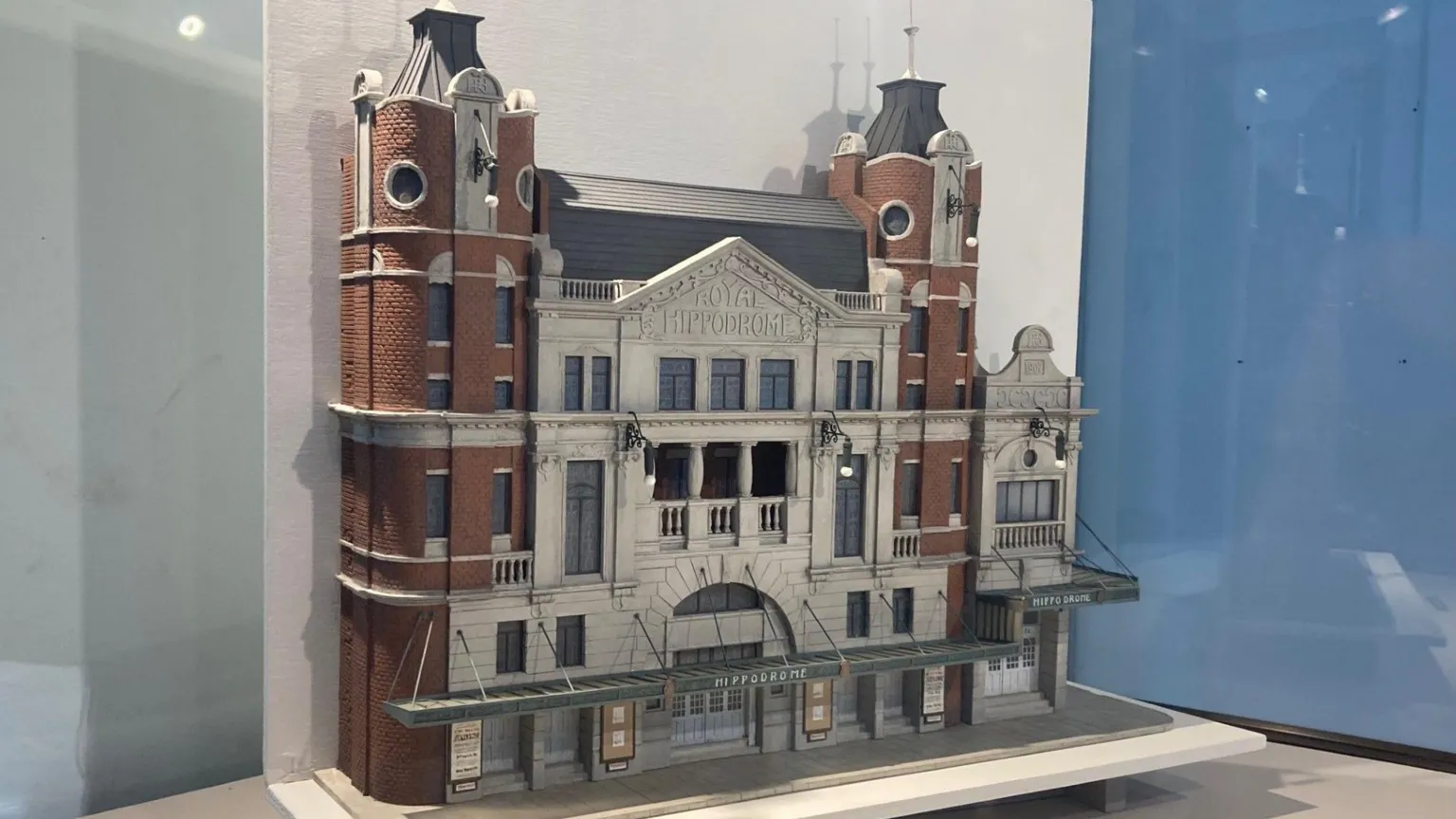
Photo: BBC. During lockdown, set designer Stuart Marshall started making models of Belfast’s lost theatrical world. Above is his model of the Hippodrome.
No one wants to go back to the pandemic’s lockdown, but enough time has passed for people to feel a little nostalgia for the creative projects some folks undertook during that dark time. I remember a guy in Boston who encouraged artists to send him miniatures of their work, which he would then display on his popular website. Refresh your memory of that here.
Jake Wood at the BBC reported in March on an exhibit in Northern Ireland that had its beginnings when a set designer was stuck at home.
“Miniature models of Belfast’s lost theatres created by set designer Stuart Marshall are bringing the city’s vibrant theatre history back into the the limelight. They are part of an exhibition at Ulster University for the Children’s Festival.
“Mr Marshall told BBC News NI that … ‘Children appreciate the miniature dolls house type model making, adults appreciate the skill that goes into making them, and older people who may remember when some of these places still stood. …
” ‘I started working on a model of the Grand Opera House as part of the heritage exhibition and through doing that got interested in looking at all the other theatres that aren’t about anymore. …
” ‘The Hippodrome was the most complicated and detailed one I’ve made; it took me around six weeks to make.’
“He said he mostly works from old photographs, but it can be hard to get enough accurate detail because ‘with a black and white photograph that you can’t move around, it’s basically static.’
“When photographs of the old theatres are not available or poor quality, Mr Marshall refers to old newspaper articles which sometimes have written descriptions of what materials the theatre was built from and how it appeared.
“Opening in the early 1870s, the Alhambra was Belfast’s first music hall and was a ‘real spit on the floor type joint,’ according to Mr Marshall. ‘In the early days, the Alhambra was more of a variety house, and I’ve heard that it wasn’t the most enticing establishment, quite a rowdy place.’ …
“A typical bill from the early days of the Alhambra shows performances which ‘would nowadays be contentious’ included events such as a minstrel show and a Japanese troupe. …
“To adapt to the evolution of mass entertainment, the Alhambra converted to a full-time cinema house in 1936. Between the late 1800s and its closure in 1959, the Alhambra suffered four separate fires.
“The Theatre Royal was Belfast’s original high-end theatre, opening in the late 1700s with a capacity of just over 1,000. The building was demolished and rebuilt a number of times.
” ‘As these places go, they kept getting burnt down or demolished and rebuilt again – there’s always a renewal aspect to them.’
“The Theatre Royal was to be Belfast’s ‘higher class establishment,’ which in the end became ‘a mixed-use building of shops and place called the “boom boom room,” which was like a dance hall upstairs. …
” ‘Now, there’s a little Starbucks in the corner where the building stood,’ he added.
“Not to be mistaken for the pub and music hall on Botanic Avenue, the Empire Theatre was situated on Victoria Square and opened to the public in 1894. …
“While it did adapt to the growing popularity of cinema, the Empire ‘stayed true to theatre for all of its life,’ Mr Marshall said.
“The Hippodrome was ‘more fiddly.’ … There aren’t too many quality photographs of the Hippodrome, so he ‘had to use his judgment’ when designing the model in terms of color scheme and scale.
“Coming quite late, the ‘Hippodrome was was built in 1907 originally with a cinema in mind’ as to take full advantage of the advent of modern cinema and growing popularity of picture shows.
” ‘And then there was the Ritz,’ which opened in 1938. The Ritz was, according to Mr Marshall, ‘a giant cinema more or less, but it called itself the Ritz Theatre.’ However, it did produce shows as part of the night’s entertainment.
” ‘They would have a brass band, dancers or a ballet, and then a film at the end. It also did huge concerts, people like the Stones, The Beatles and Billy Connolly all performed at the Ritz during their time,’ he added. …
“The Ritz was damaged by bombs hidden in the seats and the theatre’s interior and roof was destroyed in 1977.” More at the BBC Northern Ireland, here.
Did you do a particularly creative project during lockdown? Of, course, many of us kept on blogging away, but we would have done that anyway.
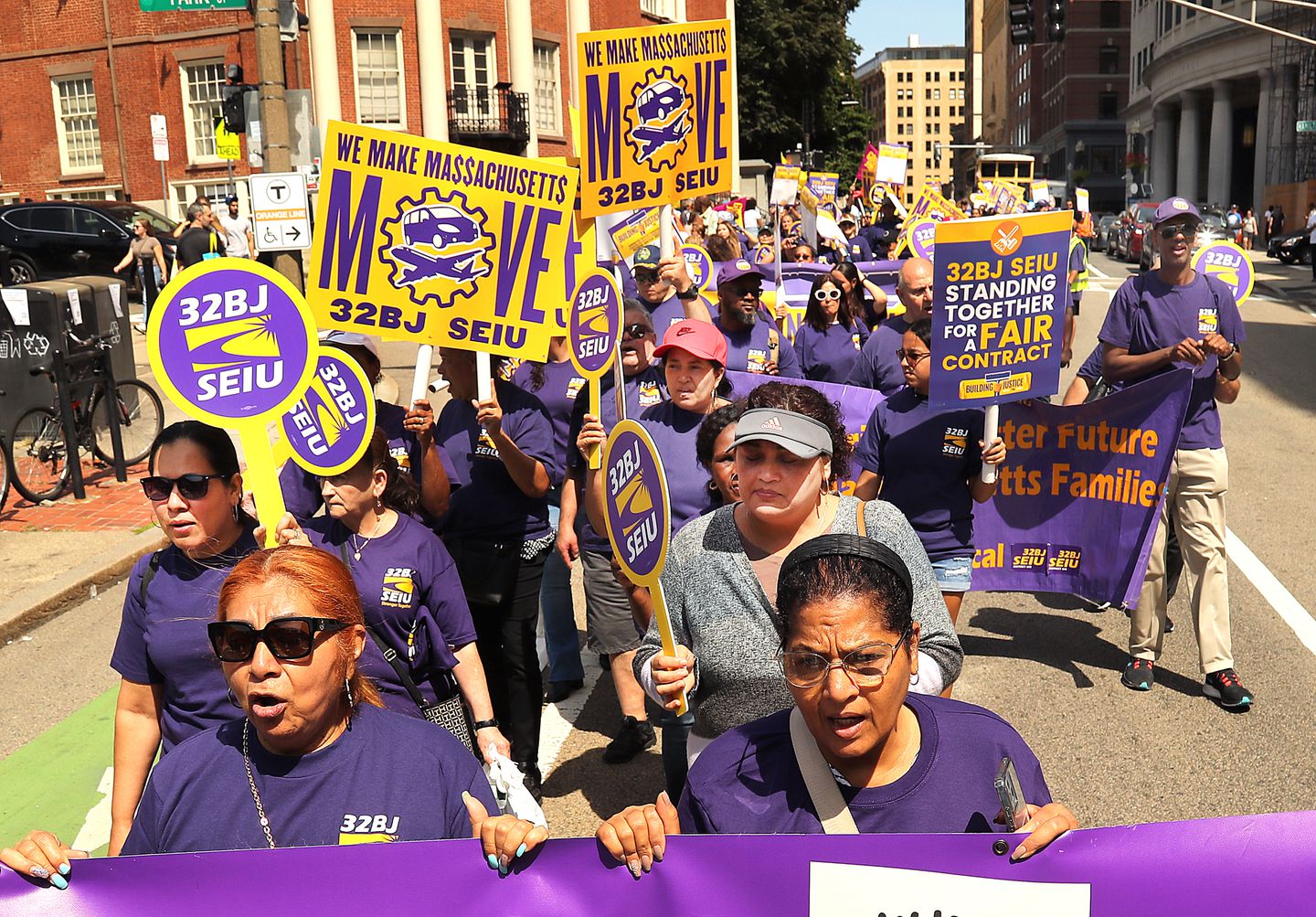
Photo: John Tlumacki/Globe Staff. The Boston Globe reported recently on service workers marching “down Tremont Street to Boston Common, where they held a labor rally for new contracts and freedom to unionize.”
As a member of the general public, I don’t like being inconvenienced by a labor strike any more than the next person. But I know my history. I know what life was like when workers couldn’t strike and how some gave their lives to change the status quo. So I think of that on Labor Day.
At the Boston Globe, John Hilliard wrote recently about service workers, who are among the last to band together for better working conditions. We need to stay as grateful to them as we were during the pandemic.
“Hundreds of essential workers — including janitors, airport staff, and ride-hailing drivers — marched through Boston’s streets Saturday demanding better post-pandemic workplace conditions after laboring to keep the economy afloat during the health crisis.
“The Labor Day weekend demonstration, organized by Local 32BJ of the Service Employees International Union, drew together service workers from across Greater Boston who are members, as well as some who are organizing to join the union, according to Roxana Rivera, a labor organizer and assistant to 32BJ president Manny Pastreich.
“ ‘This is a moment for workers, because they put so much of themselves out there during the pandemic. They didn’t have a choice to work remotely. Service workers risked their own personal health, and those of their families,’ Rivera said. ‘The fact that they still struggle to make ends meet is unacceptable.’ …
“Luis Medina, of Malden, who works full time as a janitor, said he joined the demonstration because he is fighting to secure full-time hours for colleagues struggling to make ends meet with part-time employment. …
“Saturday’s demonstration came amid a dramatic resurgence in labor organizing and activity across the country — from Starbucks workers seeking to unionize to Hollywood writers and actors now on strike — demanding better pay, benefits, and working conditions from employers.
“Among the successes are Teamsters and UPS workers who have secured new contracts through union efforts.
Support for labor unions in the US has soared, with roughly two-thirds of Americans now saying they approve of them, according to a Gallup poll released Wednesday.
“And demonstrators in Boston Saturday, like Marty, a 43-year-old from Plymouth who works as an Uber driver and gave only his first name, drew a direct line between union successes nationwide and efforts to support workers locally.
“ ‘We are really important, because we are the people who move the economy,’ said Marty, who wore a Screen Actors Guild shirt to support striking actors. ‘If no one is making any money, no one’s spending anything, [and] that’s when the economy starts to suffer.’
“Rivera said that even though many people now can work from home, commercial buildings must still be cleaned and maintained, while airport employees and ride-hailing drivers remain vital to keeping the economy going. ‘We need to make sure that we are not leaving these workers behind,’ Rivera said. …
“Waitstaff and food service workers at restaurants along the route gathered at doors to watch the protesters. One worker left her restaurant, asked a union representative for a flyer being handed out and took it back inside.
“The city was packed with people enjoying a beautiful end-of-summer Saturday, and throngs watched from sidewalks, many taking photos with their phones. Several raised their arms in support, and one man on a scooter beeped his horn as he rode along Tremont Street.
“Elizabeth Hill-Karbowski, who was visiting Boston with family from Wisconsin, watched as demonstrators marched along Tremont Street and read from a flyer.
“ ‘It’s a timely type of demonstration for the Labor Day weekend, very peaceful, well organized and [it is] people just wanting to have their voices heard,’ Hill-Karbowski said. …
“State Senator Lydia Edwards, whose district includes East Boston, Revere, and Winthrop, spoke to workers in Spanish then English. …
“ ‘We celebrate all the victories that we have had, but also we need to remember the lives that we’ve lost in the fight for justice, and the lives that you have saved as workers’ during the pandemic, Edwards said.
“Ed Flynn, Boston City Council president, told the crowd: ‘When workers aren’t receiving a decent wage here in the most liberal, progressive city in the country, there’s something wrong with that.’ ”
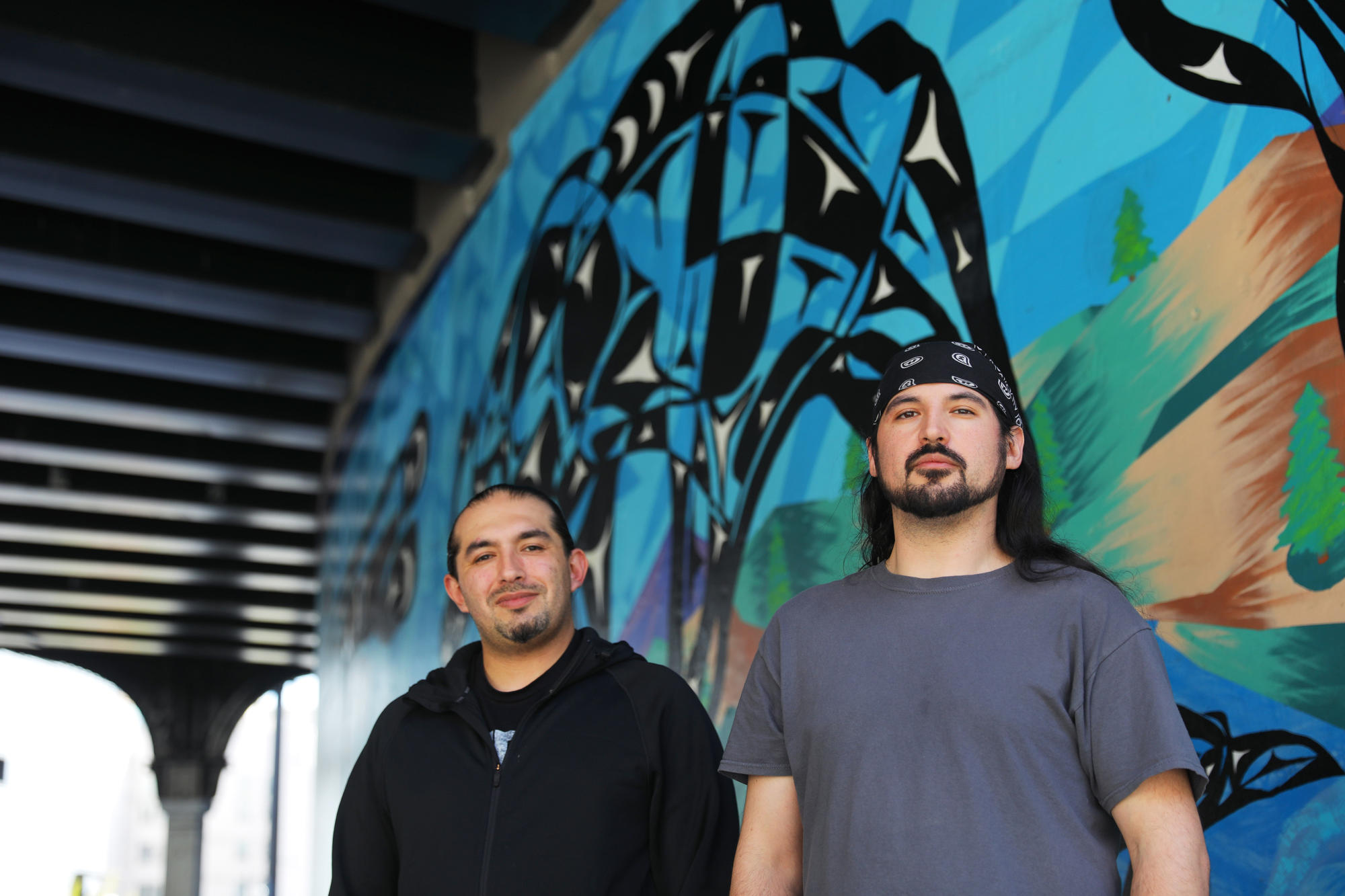
Photo: Genna Martin/Crosscut. Writes Crosscut, “In their roles as King County support services specialists, Kirk Rodriguez, right, and Joe Barnhart walk the area around the King County Courthouse and City Hall Park, as they build relationships with those who live or hang out in that area, … using their own lived experiences with homelessness to form connections.”
After a recent post on better approaches to homelessness, Hannah sent me a link to a New York Times opinion piece by Maia Szalavitz.
“The needs of homeowners and businesses and those of people who are unsheltered often conflict, ” she writes. “Community leaders, faced with increasing crime and disorder, frequently see police sweeps as the only answer, while advocates for homeless people argue that this response is merely a stopgap that does more damage than good.
“But what if there was a way to stop shifting people from encampments to jails to shelters to hospitals and back again? In Seattle a unique collaboration among businesses, neighborhood groups, the police, advocates and nonprofits is fighting cynics and misperceptions driven by politics to cut homelessness.
“The coronavirus pandemic presented Seattle with a crisis and an opportunity. In early 2020, authorities closed congregate shelters, emptied jails and stopped new arrests for minor crimes. Lisa Daugaard, a lawyer, saw a rare chance to develop a new approach to addressing homelessness that didn’t involve law enforcement.
“She’d already had success in getting officials to cooperate across siloed systems: In 2019, she won a MacArthur ‘genius’ award for helping to create a program originally called Law Enforcement Assisted Diversion, which has now been replicated in over 80 jurisdictions across the United States.
“Instead of re-incarcerating homeless people who typically already have long histories of minor arrests, police departments that participate in LEAD refer them to case management services. The program has an overall philosophy of harm reduction, which, in addition to securing shelter, focuses on improving health, rather than mandating abstinence from drugs and other risky behaviors. LEAD originated as a collaboration of public defenders, the police and prosecutors, who put aside differences to work on solutions.
“Peer-reviewed research published in 2017 by the University of Washington found a 39 percent reduction in felony charges for participants (a group of over 300 people suspected of low-level drug and sex work activity in downtown Seattle) in LEAD compared with controls and an 89 percent increase in the likelihood of being permanently housed for participants after they started case management.
“At the height of the pandemic, when the police were ordered not to make minor arrests or referrals to LEAD, Ms. Daugaard decided to try something new. With federal pandemic funds becoming available and desperate hotel owners newly open to being paid to house nontraditional guests, she said she saw ‘our chance to show that there is another way.’
“Ms. Daugaard and her colleagues created a program now known as JustCare. JustCare staff members, rather than police officers, would respond to urgent calls about encampments. After building trust with local homeless people, the workers would move them into housing without strict abstinence requirements and then help clean up the site. The police would be contacted only as a last resort.
“An early success involved an encampment on a major thoroughfare, Third Avenue, where around two dozen tents were erected directly outside the popular local restaurant Wild Ginger, which had closed under pandemic restrictions. A co-owner, Rick Yoder, wanted to reopen the restaurant in the summer of 2021, but he told me, ‘I couldn’t get the windows repaired because the guy said, “I’m not going near those tents.” ‘ …
“Outreach workers from JustCare managed to house those living in the encampment and clean up the site without police reinforcement. …
”The work begins with no-strings offerings of items like food, water and clean needles. These regular visits help demonstrate trustworthiness and defuse fear about coercion. Creativity is also a must: Conflicts arise over everything from open drug use to burning items for heat. Workers neutralize tense situations with humor and compassion and by recognizing that often bizarre behavior is driven by fundamental needs like hunger, thirst and exhaustion.
“Alison McLean owns a condo in the Pioneer Square neighborhood and contacted JustCare for help dealing with tents that started being pitched against her building during the pandemic. …
“JustCare began its outreach. ‘Maybe two weeks later, they were like, “We found housing for everybody,” ‘ Ms. McLean said. …
“Between the fall of 2020 and this past spring, JustCare closed 14 encampments and placed over 400 people in hotels and other lodging.”
More at the Times, here. Thanks, Hannah. Good tip.
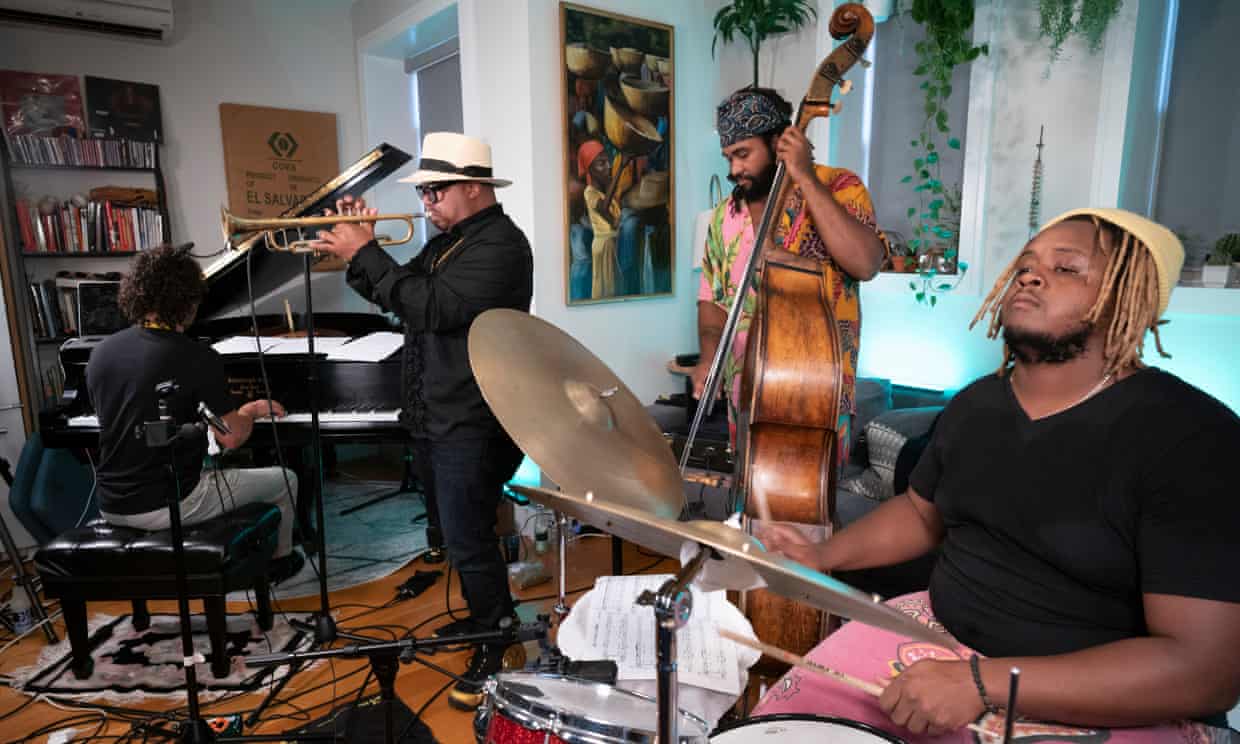
Photo: Mark Lennihan. Emmet Cohen (left), Nicholas Payton, Russell Hall, and Kyle Pool livestreaming one of the weekly jazz concerts Cohen launched from his small apartment whenthe pandemic struck.
I was listening to Christian McBride hosting “Jazz Night in America” (streaming weekly at WICN, here), and he made me want to learn more about the young musician Emmet Cohen.
Allen Morrison wrote at about Cohen’s pandemic venture at the Guardian: “It’s the most exclusive jazz concert in New York. Only about eight guests can attend the weekly shows, by invitation only, squeezing into the 32-year-old jazz pianist Emmet Cohen’s fifth-floor walk-up in Harlem. Meanwhile, thousands more around the world tune into livestreams of the event on Facebook and YouTube.
“Live From Emmet’s Place started as a near-desperate response to the disappearance of gigs for musicians when the Covid-19 pandemic began. Ninety-four shows later, the weekly concert featuring Cohen, his trio with bassist Russell Hall and drummer Kyle Poole, and a roster of guest musicians who represent some of the jazz world’s leading lights, has evolved into the most highly watched regular online jazz show in the world.
“Talking on a recent Monday afternoon four hours before showtime, Cohen, a one-time child prodigy who has become one of his generation’s most highly regarded jazz pianists, was chilling in a T-shirt and shorts. At this hour, his one-bedroom apartment seems relatively spacious by New York standards. But that’s only until the technicians – a piano tuner, a sound engineer, a videographer – start arriving and setting up equipment. …
After two and a half years, [it’s] been transformed from a ragtag live shoot using only an iPhone into a hi-tech, multi-camera production with pristine sound.
“The superior production values would count for little if they were not in the service of a charismatic, often dazzling, trio of performers. Partly it’s Cohen’s energy, exceptional musicianship, and likable personality. Partly it’s the appeal of his inclusive brand of jazz, incorporating the entire tradition of the genre from the 1920s to the present day. And partly it’s the joy and esprit de corps with which the trio perform, evident in Cohen’s frequent ear-to-ear grin and the trio’s telepathy.
“At first, the current music scene in Harlem was the central focus of the show. ‘There’s such a high concentration of great musicians living here, right down the block,’ he said, citing regular guests like saxophonists Patrick Bartley and Tivon Pennicott and trumpeter Bruce Harris, all rising jazz stars on the New York scene.
“ ‘There’s a rich history of great jazz musicians living in this area: Billie Holiday lived on the corner, Mary Lou Williams up the street, Thelonious Monk would hang out here … all the stride piano greats would play Harlem rent parties. Duke Ellington and his whole band lived here, Sonny Rollins … So, it just felt very natural to host a Harlem rent party, but an updated, digital, virtual version, where we could invite people in to try to make the rent and get the musicians paid at a time when people were really struggling.’
“These days, Live From Emmet’s Place has an audience that averages about 1,000 fans each Monday night on Facebook and YouTube, but videos of most of the shows, as well as dozens of individual songs, have logged tens of thousands more views on YouTube. One video, featuring the sparkling French-born jazz singer Cyrille Aimee, has racked up 4.6m views.
“ ‘I wanted to figure out how to create an online community where we could play and make money. When you play at [the New York City jazz club] Smalls there are 80 people, if you sell out; at Birdland, 250. When we did the first concert from the apartment on March 22, 2020, after one week the livestream had 40,000 views. For a jazz group to reach that many people requires months, if not years, of touring.’ …
“In its pre-pandemic infancy, the webcast’s unlikely success could scarcely have been imagined. In February 2020, Cohen and the trio were flying high. … ‘Suddenly we had no gigs and no idea when we would play again.
“[The show] quickly became an international ‘communal gathering,’ Cohen said. ‘And community, in a time of hardship, turned out to be the most important thing.’ …
“ ‘When I’m on the road,’ Poole said, ‘people say to me, “I’m part of the Emmet’s Place community.” ‘ …
“ ‘The pandemic caused incredible destruction and dismay, but there was a silver lining,’ Cohen reflected. … ‘The fact that we’re a family, Kyle, Russell and me, showed the brotherhood and what it means to be a band in a time of crisis.’ ”
Live From Emmet’s Place can be viewed most Monday nights at approximately 7:30 PM ET on Facebook and YouTube. More at the Guardian, here. And at NPR, here, you can click on links to several of the musical numbers.
Photo: Everybody Dance. Summer dance participant in Los Angeles.
There are certain kinds of opportunities that are taken for granted in higher-income families. Being able to participate in sports that require equipment, tutors, summer camp, music and dance and art classes, college. Mary McNamara writes at the Los Angeles Times about a dance class that gets lower-income children and families thinking that opportunity might be possible for them, too.
“We could all use some good news these days, and that’s what Natasha Kaneda offered when she said [‘You can’t be scared when you’re dancing’] to her Jazz I class of 8- and 9-year-olds. …
“She was reminding them to stay focused even if something went wrong during a routine — to resume their dance without fear. She said it quickly, almost as an afterthought, but it should be on a T-shirt, like the Everybody Dance LA! T-shirts these kids were wearing.
“Practicing for their upcoming spring recital, these boys and girls could be part of any dance program. Well, maybe not any — their execution of steps exhibit grace, precision and energy, and their teachers, though unfailingly patient, are not about to let an imperfectly pointed toe or lethargic arm movement pass uncorrected.
“Whatever the skill level, the courses at Burlington studios, part of the building that also holds Camino Nuevo Charter Academy, are so instantly familiar they could be anywhere.
“Except that … for kids living below a certain income bracket, dance class is too often an impossibility. Clothing and lessons cost money; access to those mirrored rooms, even the ones at the local Y, is often out of reach.
“The dancers and the parents at the Burlington studios … wouldn’t ordinarily be taking pride in last summer’s performance with the Youth Orchestra of Los Angeles and the Los Angeles Dance Project, or preparing to send all of their graduating seniors off to college.
“Yet here they all are, part of the Everybody Dance LA!, an almost-too-good-to-be-true program founded more than 20 years ago by a grieving mother who believed that things should not remain unequal — and that you can’t be scared when you’re dancing.
“In 1999, 13-year old Gabriella Axelrad was hit by a car while biking in the Grand Tetons National Park. After Gabriella died, her mother, Liza Bercovici, found herself unable to simply return to her life as a family law specialist. Instead, she decided to commemorate her daughter, who loved to dance, by creating a program for low-income children. She would employ top dance teachers at professional wages and emphasize excellence and life skills along with creativity and collaboration.
“Bercovici’s biggest fear when she opened the doors to those first classes a year later, in the ballroom of the renovated Sheraton Town House hotel near Lafayette Park, was that no one would come.
“ ‘I looked out the window and saw this huge crowd,’ she says now. ‘I thought it was people wanting to rent apartments in the [low-cost] building. But it was people who had come for the dance classes.’
“What started as 35 children in 12 extra-curricular classes grew to more than 5,000 served by in-school, after-school and summer camp classes; in 2014, Everybody Dance won a 2014 National Arts and Humanities Youth Program Award.
“Many students enter the program when they are 4 or 5 and stay until they graduate high school; a few, like Zuleny Ordonez and Kimberly Gomez, returned to work for EDLA!
“ ‘When you’re a low-income family, there’s a stigma about asking for help,’ says Gomez, now a teaching artist with the program, who joined the staff as a dance site coordinator after graduating from UC Irvine. ‘The teachers here gave us someone to talk to, someone to listen to us. I would be here from right after school until 9. Change in the car, do homework here, it was my second home.’
“Ordonez works here as teacher’s assistant while taking classes at Santa Monica College. ‘I was very hyper as a child and my mom found this,’ she says. ‘I grew up with the other students here.’ …
“Bercovici realized she could do even more good if she ‘had the kids for eight hours instead of two.’ So she founded the Gabriella Charter Schools; in 2015, she stepped down as Everybody Dance’s director, turning it over to Tina Banchero, a former dancer and artistic director of Dance Mission Theater’s Youth Program in San Francisco. Banchero has run it ever since. …
“EDLA! lost about 1,100 students during the peak of the pandemic. For those who stayed, dance class, like everything else, went virtual. ‘We pivoted to online in less than two weeks,’ Banchero says. ‘I was so proud of everyone.’
“Children across the country were trapped at home for more than a year, struggling with online learning and isolation. But Banchero’s students, Banchero’s families, have had a harder time than most. For low-income, urban families, COVID-19 has been particularly devastating. Many parents lost their jobs and many of those who didn’t continued to work in person. Cramped housing, which often included multiple generations, left little space for kids to study, much less dance.
“ ‘We had kids dancing between two bunk beds,’ Banchero said. ‘But it was so important for them to turn their cameras on, see our teachers and other students, and dance. We had a number of kids who were struggling with depression. So many of our families lost a loved one. …
“ ‘I realized how much l love my job during that time,’ Kaneda says. ‘Because when I ended my Zoom class, I would feel happy for the first time that day.’ “
Video still: Millicent Johnnie Films. Filmed by a drone, Jawole Willa Jo Zollar dances in Lafayette Heritage Trail Park in Where Water Is Not Thirsty.
The shut-in days of the pandemic made changes in everyone’s life and work. Many kinds of artists accepted the challenge to their own work and responded with bursts of creativity that made use of weird circumstances. Today’s article addresses what some choreographers did.
Zachary Whittenburg reports at Dance Magazine, “On a bright but chilly day in April 2022, choreographer Biba Bell and composer-director Joo Won Park premiered A DREAM IS A HOUSE for remembering the future. Created specifically for the McGregor Memorial Conference Center in Detroit, the hourlong performance by 21 dancers, nine musicians and Park embraced architect Minoru Yamasaki’s prismatic jewel box of marble and glass, built in 1958.
“Taking advantage of the faceted atrium’s unusual acoustics, Park’s original score for electric guitar, percussion and eight laptop computers emanated from small amplifiers distributed throughout the skylit room, whose tall panels of teakwood resonated with every whisper and rhythm. At one point, the entire ensemble of dancers rushed from one end of the space to the other, as if the McGregor Center was a cruise ship rocking and rolling in turbulent seas. Cloud cover during the 3 o’clock performance brought somber qualities to the action, but, when repeated at 5 o’clock and lit vividly by the setting sun, it was an ascension.
“Every dance is site-specific in some sense, but, in a warming world changed by war, political upheaval and a pandemic, some choreographers forgo traditional venues entirely. Whether their work is about climate change, social dynamics, systemic oppression or community vibrance, they’re all drawn to the friction between moving and staying in one place.
“ ‘Sites outside of a dance studio are fields of infinite potential that can be very generative as places we have relationships with,’ says transmedia artist d. Sabela grimes, a professor at the USC Glorya Kaufman School of Dance, who grew up on California’s central coast and attended UCLA. While he lived and worked in Soweto, South Africa, and Philadelphia, grimes maintained a connection with the Leimert Park Village neighborhood of Los Angeles, where the community weaves performance — both planned and spontaneous — into daily life along Degnan Boulevard. …
” [During the pandemic] ‘I can’t explain to you how important it was, how valuable it was, how special it was, to be in public space with people making music, to see them dancing, to be in communion and fellowship,’ grimes says. …
“ ‘The streets continue to be a driving force and wellspring of knowledge production and transmission,’ he says. One night reminded grimes how performance can be not only site-specific but a way to bring the essence of one place to another: TOB, a band that plays go-go, a variant of funk music specific to the nation’s capital, played Leimert Park Village from a stage on top of a bus booked by Jolly and Long Live GoGo DC. Dancing ensued. ‘I had no idea so many people from Washington were living in L.A. … It literally was like the spot turned into a street in DC.’ …
“At a May 2022 work-in-progress showing in Chicago of reorientations, by SLIPPAGE resident artists Kate Alexandrite, who is white, and Thomas F. DeFrantz, Ayan Felix and MX Oops, who are Black, Alexandrite wore virtual-reality goggles while the other three interacted and made eye contact. The four artists might technically have shared space, but, experientially, Alexandrite was often somewhere else. A large screen periodically displayed a live feed of video from inside the goggles, revealing to the audience where Alexandrite ‘was.’ …
“As a choreographer of mixed European and Moose Cree First Nation ancestry, Starr Muranko’s work as co–artistic director of Raven Spirit Dance in the Canadian city of Vancouver is informed, she explains, by Indigenous values.
“ ‘A lot of our research is land-based and takes place outside,’ says Muranko. ‘Even though the work might eventually end up on a stage, it’s often rooted in a particular place or in going home.’
“For a piece titled Before7After, about seven generations of Cree women, Muranko traveled to an island in the Moose River in northern Ontario, 500 miles from Toronto. ‘The idea that I wouldn’t go back to the land for that project made no sense. How your body moves is influenced by certain surfaces, by the land around you, by the temperature, by the climate, by the time of year.’
“After developing material on location, Muranko and her collaborators sometimes return to the studio, where ‘we then have that landscape and that map within our bodies, as well as within the space. It’s not a “blank studio” or a “blank theater.” It’s where that river is, where that mountain is.’
“In creating The Sky Was Different for Hubbard Street Dance Chicago’s Season 43: A Virtual Homecoming, the company’s 2020–21 virtual season, company alumni Jonathan Fredrickson and Tobin Del Cuore collaborated with Hubbard Street’s dancers on a 50-minute film, shot in and around the 1938 home and studio of architect Paul Schweikher in the Chicago suburb of Schaumburg.
“ ‘For me, site-specificity is about utilizing a space by being aware of it and letting it dictate what happens,’ says Fredrickson, a choreographer now based in Germany and a guest artist with Tanztheater Wuppertal Pina Bausch. ‘The house itself was a character, this body in which the dancers were its organs, its bloodstream, its brain, its heart. The narrator of the piece was the house itself.’ In long, meticulously choreographed takes, Del Cuore’s eye-level camera glides through the house’s rooms. …
“Fredrickson choreographed a solo for Alvin Ailey American Dance Theater’s Jamar Roberts in director Bram VanderMark’s I Carry Them, produced by Jacob Jonas The Company. Released in May 2022, the five-minute film uses an editing technique called cross-cutting to move Roberts from place to place, while his fluid dancing continues uninterrupted. …
“Site-informed performance can be a way to raise awareness of threats to a community’s existence, says Millicent Johnnie, founder and CEO of Millicent Johnnie Films and chief visionary producer at 319 productions.
“In 2013, Johnnie and her collaborators, including New Orleans–based companies ArtSpot Productions and Mondo Bizarro, won a Creative Capital Award to develop Cry You One, which addressed the impact of climate change on wetlands in southeast Louisiana. …
“Johnnie says that Cry You One asked the question ‘What happens to art and culture that’s tied to land when that land disappears?’ After premiering in St. Bernard Parish, the project toured for two years, bringing with it the artists’ embodied knowledge of its source.
“Sometimes, site-specific research plants seeds for works that bloom elsewhere. During the four years Johnnie lived in Rio de Janeiro, Brazil, she would often visit the Tijuca rainforest to write, improvise movement and develop studies for future projects. When Toshi Reagon, then the festival curator for the Women’s Jazz Festival at the Schomburg Center for Research in Black Culture, paired Johnnie with Ethiopian American musician Meklit Hadero, ‘that wasn’t intended to be a site-responsive work,’ Johnnie says, ‘but there were certain sounds and textures I kept hearing in Meklit’s music that paralleled sounds and textures from the Tijuca rainforest. That helped me create and build the world that I needed to improvise with Meklit.’
“Johnnie recently collaborated with Urban Bush Women founding artistic director Jawole Willa Jo Zollar on Where Water Is Not Thirsty, responsive to Tallahassee, Florida’s Lafayette Heritage Trail Park and Lichgate on High Road, and captured on video by a camera built into a remote-controlled drone. …
“Dance companies large and small pivoted to site-specific, digital filmmaking as part of their pandemic responses. … Time will tell whether major dance institutions continue such location-based experimentation.” More at Dance, here. No firewall.
If you love dance, consider signing up, here, for short, free videos from the summer dance festival Jacob’s Pillow, in the Massachusetts Berkshires.
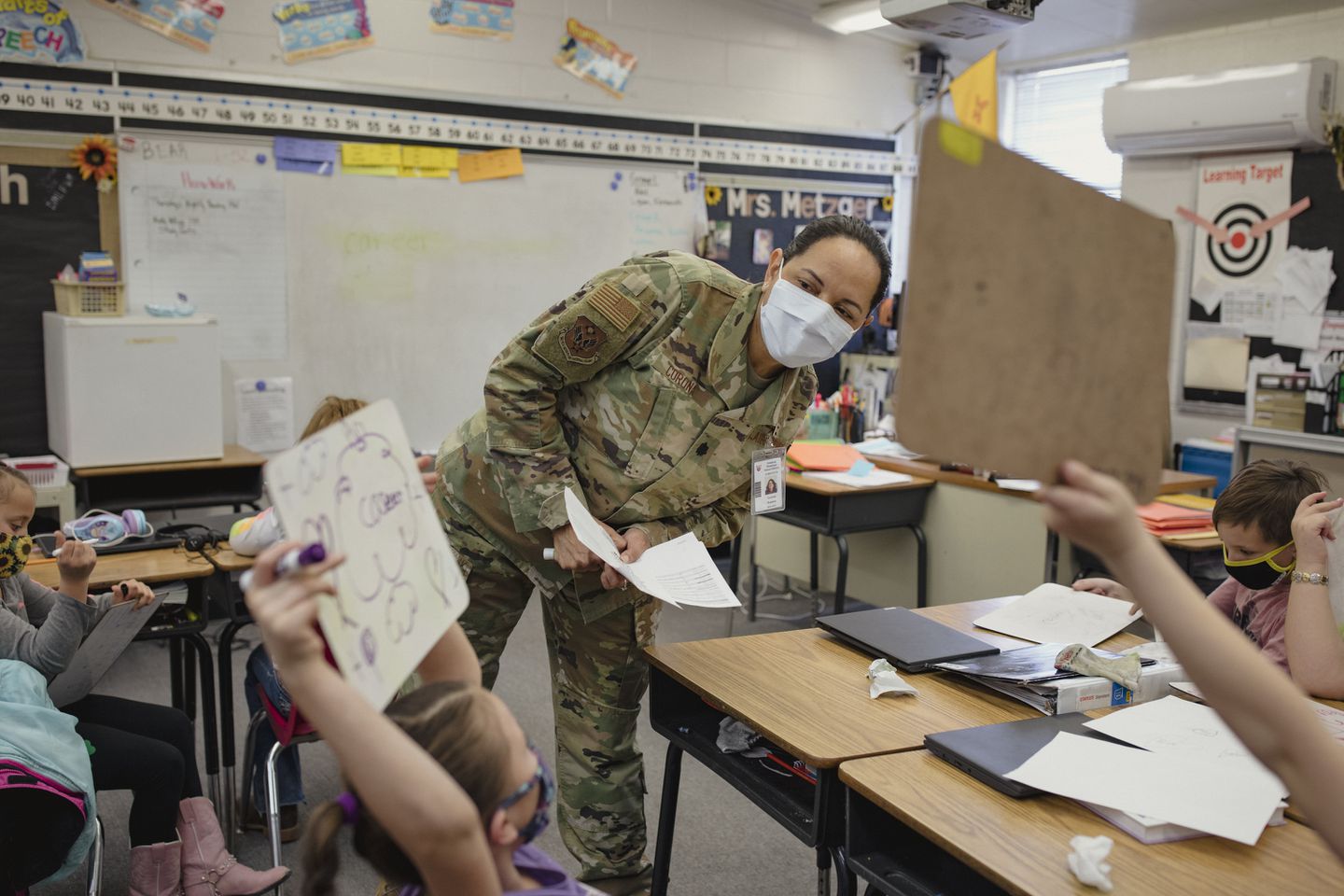
Photo: Adria Malcolm/ NYT. Lieutenant Colonel Susana Corona of the New Mexico National Guard worked as a substitute teacher in a third grade class in Estancia, New Mexico.
When things are bleak, it’s helpful to remember the advice that Fred Rogers’s mother gave him when he was small: “Look for the helpers. There are always helpers.”
On National Public Radio the other day Ari Shapiro interviewed a woman who had just escaped from Ukraine and came back to the border the next day to help people with translation. And yesterday I learned that Asakiyume — from her home in Massachusetts — was helping translators make their English sound more natural. Perhaps I can also help with that.
Many, many people have also stepped up during the pandemic to meet needs wherever they are. Consider this story about a National Guard lieutenant colonel filling in for an elementary school teacher in New Mexico.
Erica L. Green wrote at the New York Times, “The chorus of small voices ringing from a third grade classroom on a recent morning signaled how far Estancia Elementary School had come in resuming a sense of normalcy after the latest coronavirus surge.
“Students in this small, remote community were enthusiastically engaged in a vocabulary lesson, enunciating words with a ‘bossy r,’ as well as homophones and homonyms, and spelling them on white boards.
“But there was also a sign of how far the district, about an hour outside Albuquerque, New Mexico, still had to go. The teacher moving about the classroom and calling on students to use the words in a sentence was clad in camouflage. ‘My substitute is wearing gear,’ one student responded.
” ‘Yes,’ Lt. Col. Susana Corona replied, beaming. ‘The superintendent allows me to wear my uniform. I’m wearing a pair of boots.’
“[Dozens] of soldiers and airmen and women in the New Mexico National Guard have been deployed to classrooms throughout the state to help with crippling pandemic-related staff shortages. Gov. Michelle Lujan Grisham has also enlisted civilian state employees — herself included — to volunteer as substitute teachers. …
“The presence of New Mexico’s state militia — whose members are trained to help with floods, freezes and fires, as well as combat missions overseas — has largely been embraced by schools as a complicated but critical step toward recovery. Teachers have expressed gratitude for ‘extra bodies,’ as one put it.
Students were mostly unfazed but aware that, as Scarlett Tourville, a third grader in Corona’s class put it, ‘This is not normal.’
“Superintendents were given the choice of whether to have the guardsmen and women wear regular clothes or duty uniforms; most joined Cindy Sims, superintendent of the Estancia Municipal School District, in choosing the uniforms. ‘I wanted the kids to know she was here, to know why she was here,’ Sims said. ‘I wanted them to see strength and community.’ …
“ ‘Trying to have school at a time when everybody’s heart was broken was very difficult,’ Sims said. ‘Our mission is to keep hope alive, and the National Guard is helping us do that.’
“Corona, an intelligence officer in the New Mexico Guard … never envisioned that one of her missions would require being armed with a lesson plan, Wet-Naps and dry-erase markers. But nor did she envision watching her own fourth grader try to learn from a teacher through a screen last year.
“ ‘You always have to be ready when there’s a need,’ she said, ‘when there’s a call to service.’ …
“Coronavirus-related illnesses, quarantines and job-related stress have hit many districts hard. But the country’s education leaders say the pandemic is just accelerating trends that were at least a decade in the making. …
“ ‘Crisis is the word we have to use now,’ said Becky Pringle, the association’s president, describing the enlistment of the guard as a ‘stopgap.’ …
“At Belen High School, in a farming community less than an hour south of Albuquerque, the staffing crunch has been felt acutely. … Principal Eliseo Aguirre said he believed the death of a teacher from COVID-19 had a chilling effect on teacher and substitute applications.
“The arrival of Airman 1st Class Jennifer Marquez last month was a ‘blessing,’ Aguirre said. On a recent Wednesday, she was covering a Spanish class — her third subject in two weeks. …
“Veronica Pería, a freshman at Belen, was happy to see [her]. She said her grades suffered last semester when her teachers were absent and random staff members were popping in and out of her classes, leading to inconsistent instruction. ‘It’s better than watching a video or something,’ she said of having Marquez filling in. ‘It’s good to have someone I can go to and ask for help.’ …
“When the call came from the governor, the New Mexico National Guard’s commander-in-chief, Brig. Gen. Jamison Herrera, knew he would have no trouble recruiting volunteers for Operation Supporting Teachers and Families, or STAF.
“Many guardsmen and women had already seen how the pandemic affects students up close, having delivered meals to those at risk of going hungry when schools closed. …
“Although some members have advanced degrees or certifications that could translate to the classroom — a welder is teaching shop class in one district, for example — Herrera, a former teacher, impressed upon his team they were there to accomplish one goal.
“ ‘We are there to support the learning objectives of the teacher, because we certainly know we can’t fill their shoes,’ he said.”
Photo: Federico Vespignani/Bloomberg. The Standard of Saint Mark, the flag of the Venetian region, flies above gondolas. Venice is eager to attract young professionals who want to live in, not just visit, the city.
I’m not sure how a floating city puts out the welcome mat, but this one is inviting young professionals to come and be part of its daily life. Just don’t try to recreate the culture of any other city there. As one resident says, “You do have to live by Venice’s rules.”
Catherine Bennett writes at Bloomberg’s City Lab, “From Karuna Clayton’s window, she can see a gondola bobbing in a Venetian canal and a simple white stone church on one side of a small campo, or city square. Normally there would also be a steady trickle of tourists walking below, but on a January afternoon amid the pandemic’s omicron wave, the square’s empty.
“For the last nine months, this has been Clayton’s home and workspace. Formerly a commercial food photographer based in London, she now shares an apartment in Venice with her partner and two-year-old daughter, running a coaching business and teaching yoga alongside her photography.
“ ‘I’ve always called myself location-independent,’ she says. … Young, skilled and nomadic, the 35-year-old Clayton represents exactly the demographic that the new Venice-based project Venywhere is trying to attract.
“Launched in December 2021 by the Università Ca’ Foscari and the Fondazione di Venezia, a nonprofit group that protects Venice’s cultural heritage, Venywhere aim is to convince people who can do their jobs from anywhere to do so in Venice. …
“Inspired by the Tulsa Remote work program in the U.S. and a slew of similar efforts from around the world, leaders in the Italian city are eager to bring in young professionals who want to live and work there, not just vacation. …
“ ‘The pandemic has created a large population of highly skilled people who want to move,’ says Venywhere founder Massimo Warglien, a professor of management at the Università Ca’ Foscari. He believes that the pandemic’s disruptive impact on the world of work, from the ‘Great Resignation’ to a new breed of flexible and remote workers, could present a solution to Venice’s chronic brain drain. ‘This is a way of repopulating Venice,’ he says. …
“Unlike remote-worker programs in less-charismatic sites, Venywhere isn’t offering cash incentives to prospective residents. Instead, digital nomads who want to move to Venice will pay a one-time fee to get access to a concierge service that eases them into Venetian life: viewing apartments on their behalf, advising them on how to get a SIM card or access the health system, and even showing them where to shop. The platform promises to help newcomers navigate the city’s many eccentricities, connecting them with workspaces, language lessons and recreational amenities off the beaten tourist paths. …
“The latest population data shows that there are twice as many people in their 50s living in the historical center as there are people in their 20s. Sara Ajazi, a 26-year-old project manager at Venywhere, says that she was the only one of 300 students in her management class to stay and work in the city after graduating from the Università Ca’ Foscari.
For freshly minted graduates who don’t want to be gondoliers, tourist guides or waiters, building careers in Venice can be a challenge. …
“Could an injection of remote workers reverse this demographic trend? The Venywhere project is banking on a domino effect: If large firms send remote teams to the city, that will attract investment and, eventually, more startups who would hire the city’s graduates.
“But some people say it’s hard to see Venice transforming into an entrepreneurial hub or hot destination for remote workers anytime soon. ‘It’s not the easiest city to live in,’ says Riccardo Longobardi, a former Venice resident and the founder of the Digital Nomads in Italy Facebook group. ‘It’s very beautiful, but it’s a bit isolated. Digital nomads tend to look for places with a big nomad community.’
“Clayton agrees. ‘Venice isn’t set up for remote workers, unless you have a nice space to work in. There are almost no coworking spaces and it’s not a thing here to sit at a café for a few hours, getting coffee or lunch and working on your laptop. Lots of places don’t even have Wi-Fi.’
“Solving connectivity problems is one of the first things Venywhere plans to address, in part by creating a network of open-air Wi-Fi hotspots around the city. …
“To accommodate new workers, Venywhere proposes repurposing historic buildings, scattering workers across several sites. The economics campus of the Università Ca’ Foscari, where the team behind Venywhere works, is a perfect example of this: Sleek, white-painted coworking stations, student cafeterias and tutor rooms occupy mid-19th century brick buildings that used to be the municipal San Giobbe slaughterhouse.
“Alternatively, remote workers could hop on a vaporetto and head to Giudecca island, where the bare stone galleries and vaulted ceilings of former tanneries, mills and shipyard buildings in the Giudecca Art District are more often used to host art exhibitions during the Venice Biennale. Venywhere plans to use spaces like these, along with unused rooms in museums, artists’ studios that lie empty without an artist-in-residence, vacant hotel rooms and even restaurant tables between mealtimes as alternatives to the traditional rent-a-desk coworking set-up.
“ ‘This isn’t an expensive project because we are using what is already there. So many structures in the city are only half-used,’ says Warglien.
“The same can be said for the city’s rental housing during the pandemic. Living in Venice can be expensive: In the last few decades, efforts to build social housing have stalled as the region’s conservative politicians have chosen instead to turn residential lots over to the more lucrative tourist market, driving up prices in the city center. Venice has become increasingly unaffordable for Venetians, many of whom have migrated to terraferma, the mainland. The apartments that they left behind have been bought up by private companies for rent to tourists through platforms like Airbnb and Booking.com. Ocio, a local organization that investigates the city’s housing issues, has found that there are now as many beds for tourists in the city as there are for residents.” More at CityLab, here.
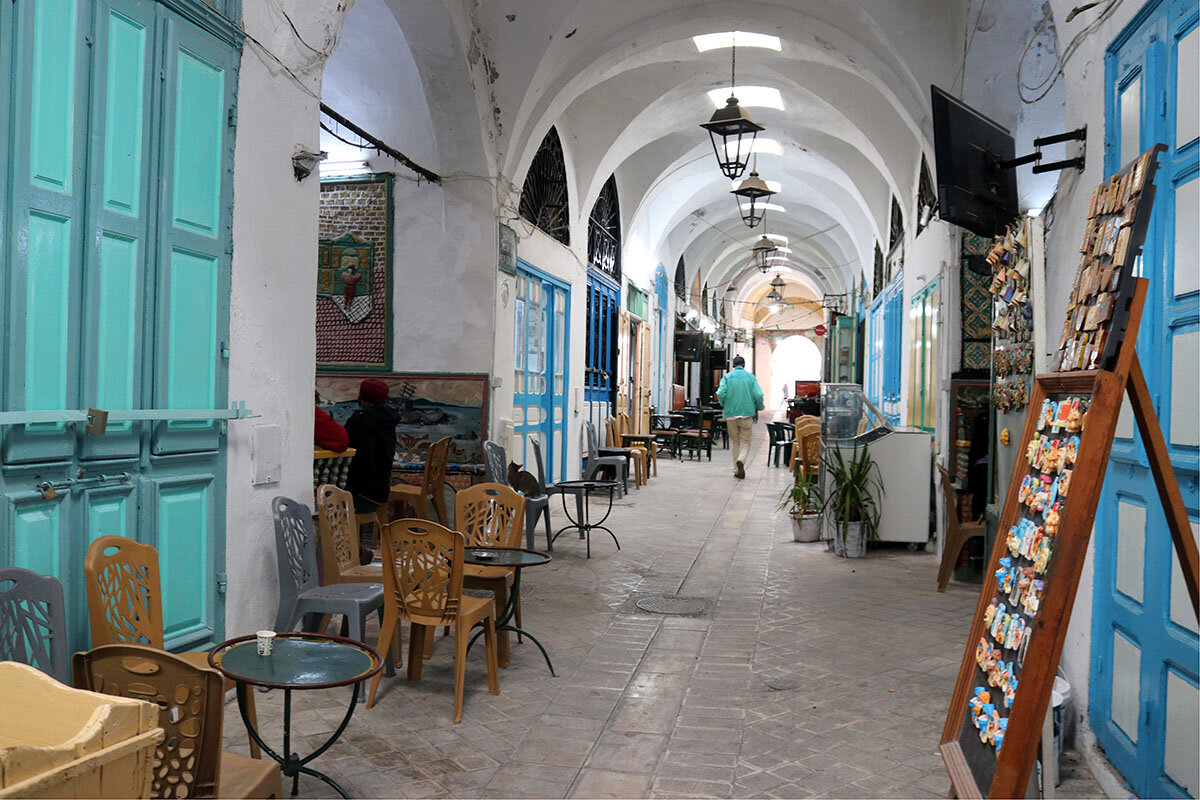
Photo: Taylor Luck. The near-empty Souk Chaouachine, or traditional chachiya hat market, one of many historic souks facing closure from a pandemic-induced recession in the Medina in Tunisia.
The list of pandemic effects just keeps growing. Today’s story addresses what happened after Covid kept tourists from the colorful small shops in Tunis. Just like workers in the US that have decided they need to join unions, Tunisian businesses are realizing there’s strength in numbers.
Taylor Luck reports at the Christian Science Monitor, “It takes one glance to tell all is not well in the Medina. The walled, historic old city of the Tunisian capital – once marked by bustling markets and streams of people hustling between the shops, homes, and government offices along its narrow streets and hidden passageways – is nearly empty. …
‘We are waiting for nothing,’ a chachiya hatmaker says as he shuffles boxed hats from one wall of his shop to the other. ‘We just show up for a few hours out of habit. No one is coming.’
“The Medina’s shuttered shops serve as a stern warning that the pandemic and a recession are threatening to undo the old city’s rich tapestry of families and artisans who have made it their home for centuries. But not, it appears, without a fight.
“Banding together for the first time, Medina business owners and families are trying to reintroduce the UNESCO World Heritage Site to Tunisians and the world, sharing its secrets and inviting people to take part in its history – and save its identity in the process.
“M’dinti, or ‘My Medina,’ the brainchild of Leila Ben Gacem, a social entrepreneur and advocate for Tunisia’s artisans, is an initiative that has united two dozen boutique hoteliers, artisans, and restaurant owners into an economic lobby to advocate for the old city and search for new ways of resilience.
“ ‘By ourselves, we cannot survive the pandemic’s effects,’ says Ms. Ben Gacem, who is also a Medina hotelier. ‘But together we can make changes to improve the Medina.’ …
“For seven centuries, hatmakers, cobblers, silver and goldsmiths, and tailors have occupied craft-specific streets – separate ecosystems within the maze-like Medina. But with no business, unable to afford monthly rent … many of these artisans are now packing it up. … In their place are popping up cafes, cigarette stands, betting outlets, and fast-food joints – their chrome and blue plastic storefronts incongruous with the World Heritage Site’s cobblestone streets and wrought-iron windows. …
“Silversmith Mohammed Sidomou, whose family’s shop has stood on the narrow street of the birket al-fidhah (pool of silver) market for a century, [describes] the pandemic as the ‘greatest challenge’ the Medina has seen in his four decades in business.
“ ‘We have been hit by a revolution, terrorism, instability, but there was always some economic activity to keep us going. With the pandemic, everyone is affected. … It breaks my heart to see the Medina turned into shuttered storefronts. It’s as if the Medina is losing its soul.’
“Compounding troubles are the pandemic-induced jump in international shipping costs, inflation, and the devaluation of the Tunisian dinar, making it logistically difficult or financially prohibitive for artisans to get the raw materials they crafted, pounded, and molded into Tunisian heritage crafts for centuries. …
“The economic downturn is also fraying a unique community of 20,000 people who live in the Medina, including working- and middle-class families and transplants from rural villages.
“Before, residents say, families, shop owners, and artisans supported one another during lean months and years. … Neighbors would loan a few dinars, share groceries, and cook for each other’s weddings. Shop owners and artisans whose businesses were flush would divert customers to other craftsmen they knew were facing a rough patch. …
“Says Mohamed Ali Dweiri, a 26-year-old Medina resident and hotel worker, ‘People have become more selfish; no one is helping each other. This is the biggest change to the Medina I have seen in my lifetime, and it’s sad.’
“Enter M’dinti.
“With no foreign tourism, the joint initiative’s first priority was finding ways to attract Tunisians to the Medina. …
“Since October 2021, M’dinti has hosted weekend activities for families, inviting Tunisians into the district’s historic homes and businesses for culinary classes and workshops with artisans – such as carpenters or cobblers – offering a glimpse into the centuries of knowledge of the maalam, or craft master. …
“ ‘Each activity is bringing 100 guests to the Medina. They are learning there are days’ worth of sights to see, they are appreciating the traditional crafts we fight to keep alive,’ says Mr. Ghorghor, the perfumer. ‘Word-of-mouth is our best hope.’ ”
A girl photographs a bridge over the foggy Seekonk River.
What’s been hard about the most recent iteration of the pandemic is the feeling of going backwards. For a while, there was a sense of forward movement even though we were still taking some precautions. But with Omicron so transmissible, many of us chose isolation again.
It hit me right before Christmas when a friend stopped by. We both had had three vaccine shots and were used to being together without masks, but because I knew that some of her coworkers were not wearing masks, I decided we had better go back to masking when together. Sure enough, not long after that she caught Covid from a coworker. (Doing OK, thanks to the shots.)
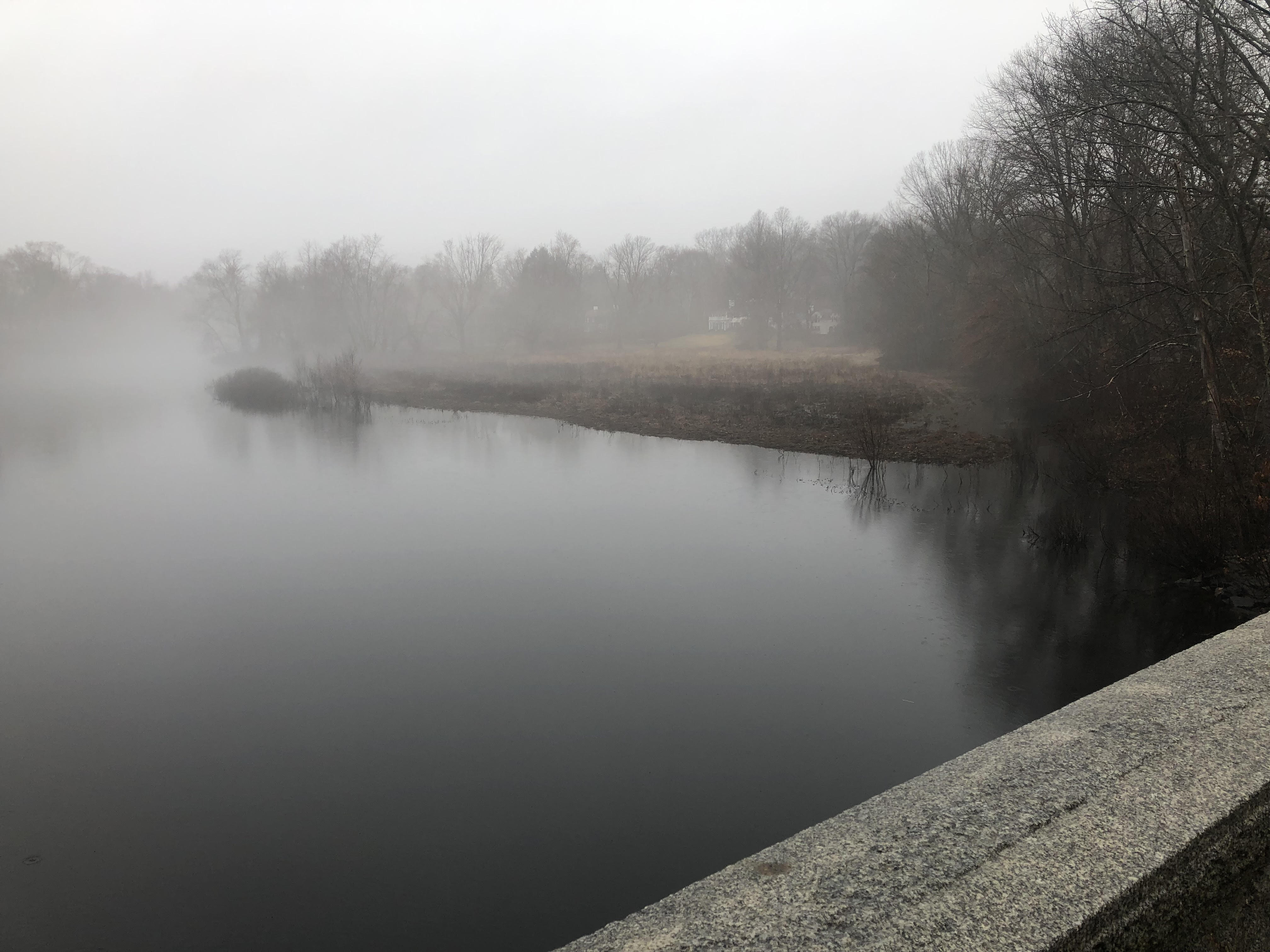
Most of my photos reflect the grayness of this period. The view below of the Sudbury River was taken on New Year’s Day: outlook foggy.
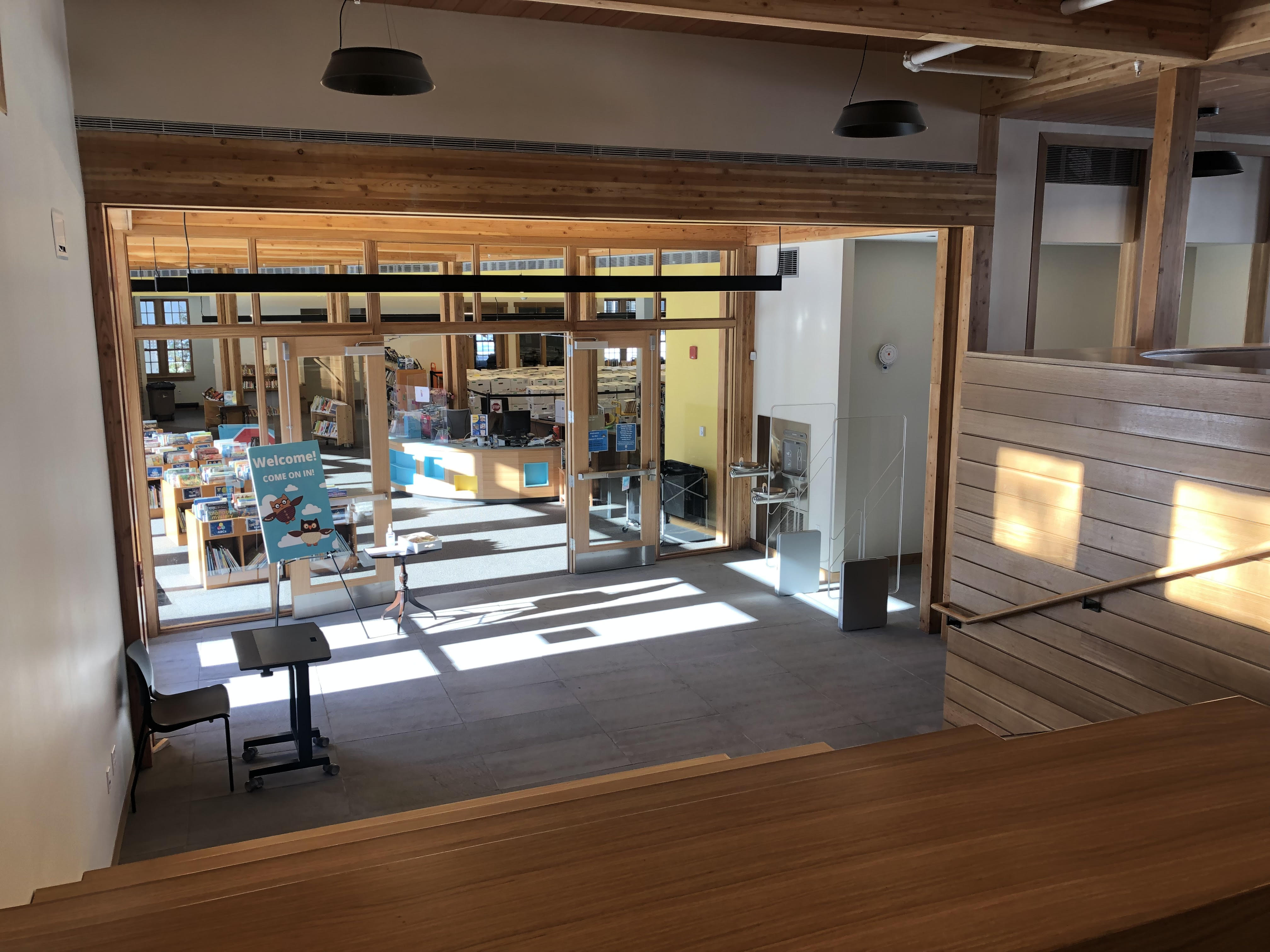
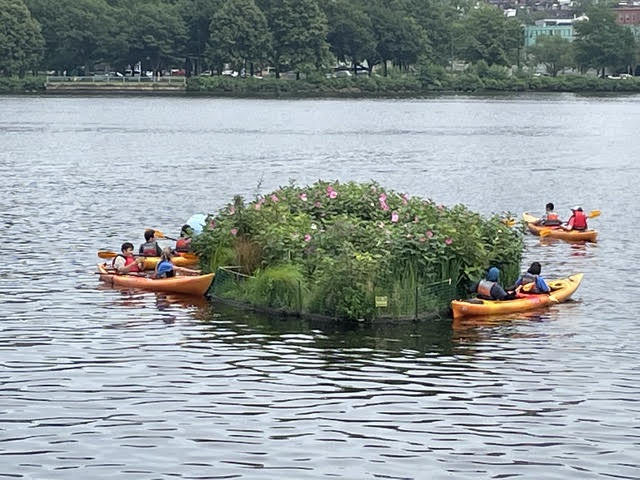
I took a lot of snow photos, as you can see, but I’m also including a sunny one of the library’s brand-new children’s wing, several pictures from friends (Kim Gaffet’s snowy owl, a tiny island that Jean Devine’s students planted last summer), and scenes in Providence yesterday (the girl photographing a fogged-in bridge, an icy sandbox, a pond starting to melt). Sandra M. Kelly made the 2022 photo of snow in New Shoreham, where heavy snow is a rare event.
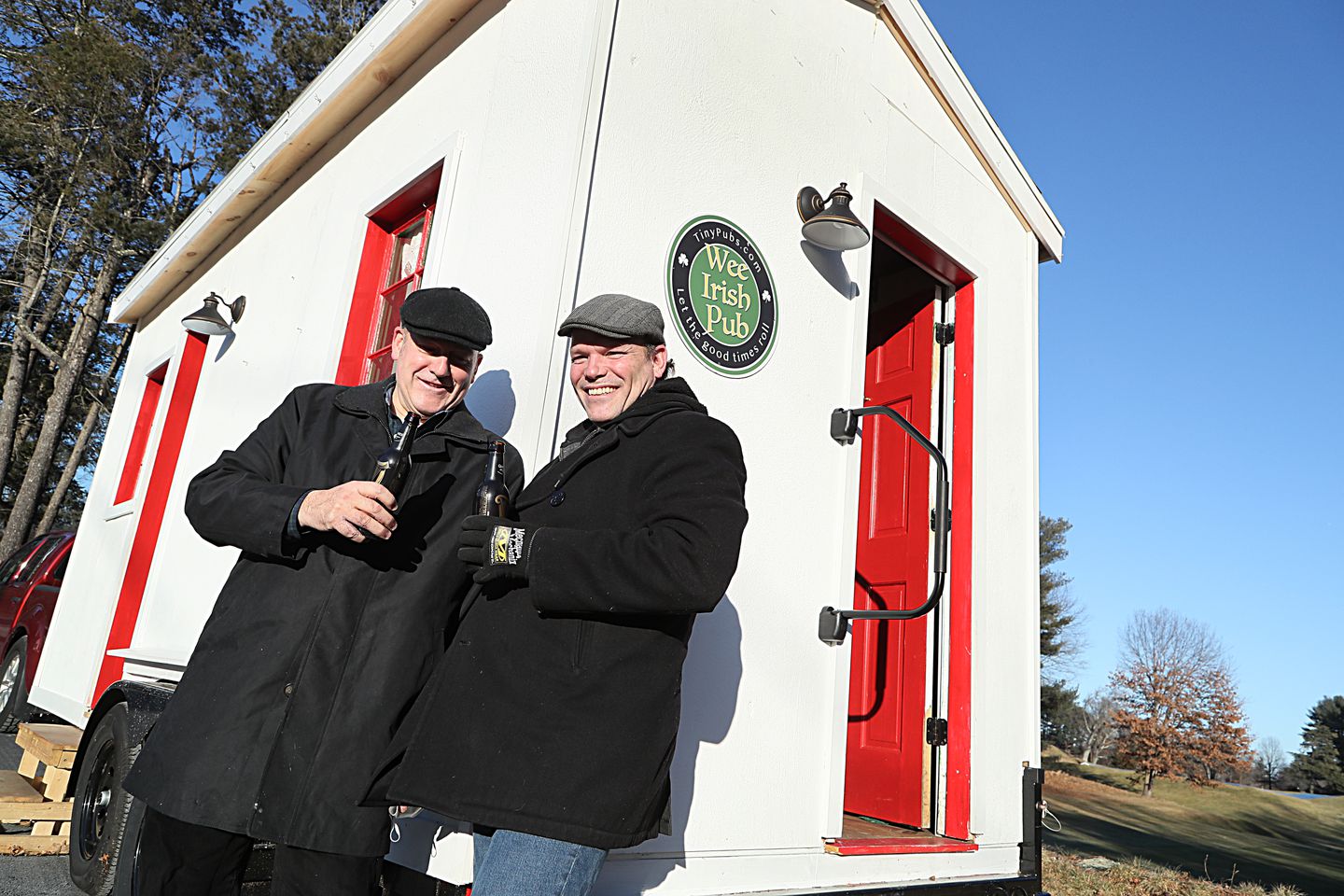
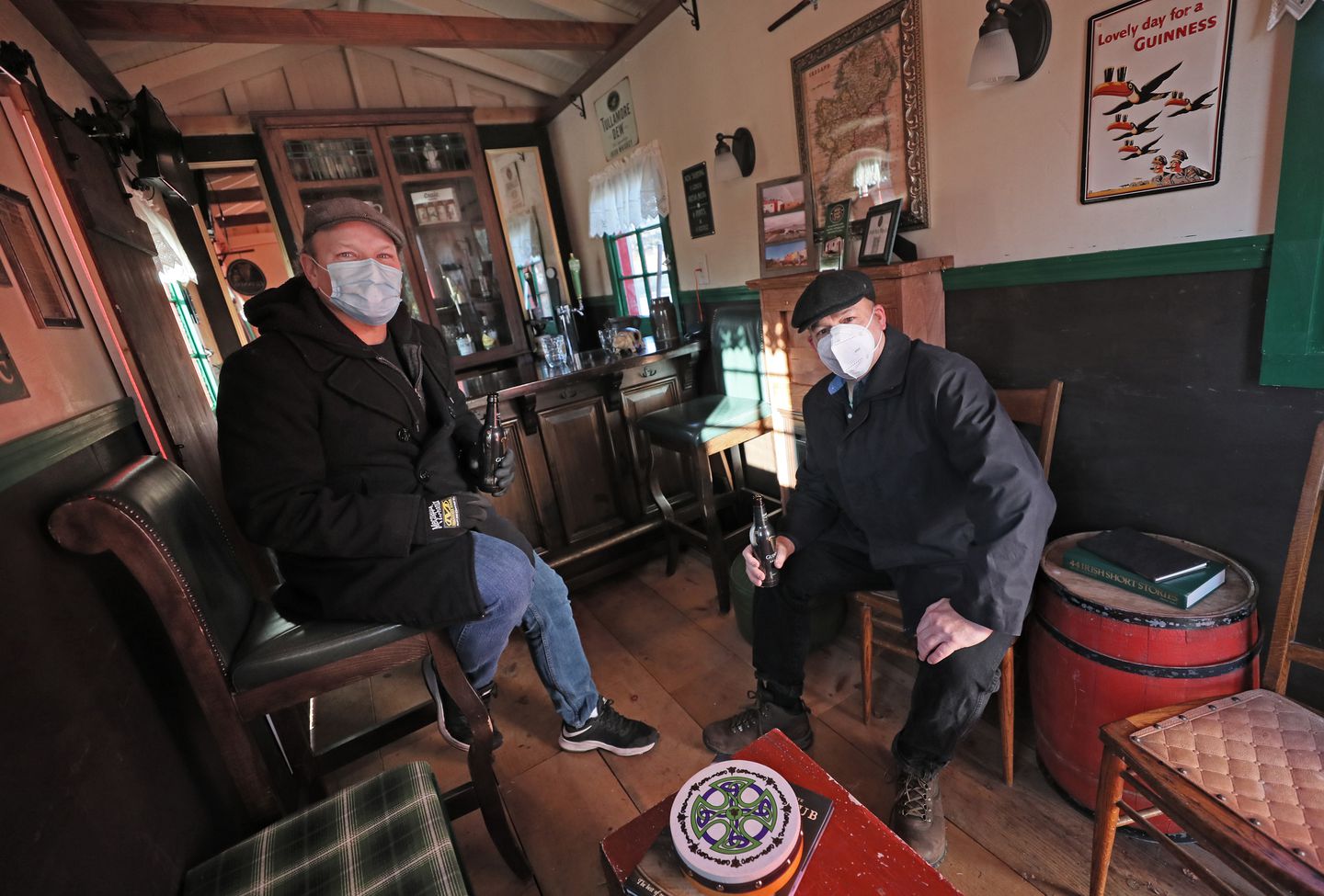
Photo: Suzanne Kreiter/Globe. Brothers Craig and Matt Taylor built a miniature Irish-style pub on wheels, dubbed the Wee Irish Pub. Want to rent it?
Journalist Steve Annear at the Boston Globe gets all the fun assignments. This report is about a perfect little Irish pub available for rent.
“At first, brothers Craig and Matt Taylor thought building a miniature Irish-style pub on wheels, a traveling taproom they could rent for private events and parties, would just be a hobby — a pandemic project that would take their minds off the world’s problems and let people enjoy the familiar comforts of crowding into a bar (albeit a very small one) at a time when it had become almost impossible to do so.
“But within days of launching the ‘Wee Irish Pub’ in September, it became clear that the fireside chat-turned-business venture was going to be much more than a side gig. …
“ ‘The floodgates have opened,’ said Craig, 58. ‘We are getting requests [to rent it], at least two an hour, for the last week.’
“The idea to construct a tiny Irish pub, complete with a small bar, stools, bench seating, and many of the other features found in traditional venues of its kind, had been in the back of Craig’s mind for years, since he read about an inflatable Irish bar that people could rent for a day in their own backyard. …
“ ‘I had been talking about it sort of as a pipe dream that would never happen,’ said Craig, who works in marketing.
“But as the Reading residents found themselves spending a lot of time around a fire pit in Matt’s backyard early in the pandemic — one of the few activities that was still safe and allowed — the possibility surged to the forefront, like the head on a perfectly poured pint of Guinness.
“ ‘We’d talk about it night after night,’ said Matt, 49. ‘Finally it was like, “Alright, let’s just do this.”
‘It’s kind of the perfect pandemic project because people were having backyard get-togethers and staying outside.’
“Last February, after batting around the notion and discussing logistics, they decided to try their luck. They bought a large trailer for the tiny pub to be built on, so it could be towed from place-to-place upon request.
“When it was finally delivered in April, they got to work on construction, a joint effort bolstered by Matt — ‘an IT guy by trade’ with a penchant for carpentry.
“ ‘I’m definitely more about the overall impression and the ambiance,’ said Craig, who took a genealogical tour of Ireland in 2018 with his family, visiting the homeland of his wife’s ancestors. ‘Matt is precise to the micro inch on making sure that every rafter is exact.’ …
“They sourced materials from online marketplaces like Craigslist, and repurposed and recycled old furniture and other items to try and give it an authentic look and feel. Their siblings and other close family members pitched in considerably.
“Within months, the cozy pub had it all: A Sláinte sign graced one wall, under a weathered horseshoe. A framed map of Ireland hung above an electric fireplace. The small bar was installed, with a refrigerator and taps for kegs. A plaque dedicating the project to Craig’s late father-in-law — who was of Irish descent — went up behind the benches, forever holding a seat for him.
“The Wee Irish Pub, which can fit up to 12 people inside, finally rolled to its first event — a company gathering in Melrose — in September. It hasn’t slowed down since. …
“The company, officially dubbed ‘Tiny Pubs,’ is based in Reading. But the brothers will deliver the bar to people’s doorsteps up to 30 miles away (or more, depending on the situation). Rentals cost between $800 and $1,200 per day, with Craig and Matt arriving to help with the set-up in the afternoon and then whisking it away the following day. …
Photo: Suzanne Kreiter/Globe.
“Most people are renting it to celebrate a milestone birthdays and retirement parties, the brothers said. But they recently received one call from a customer who has a terminally ill relative who had always wanted to visit Ireland, but no longer can.
“Instead, ‘they’re bringing the pub over to her in the driveway, to have a little taste of Ireland,’ Craig said. ‘It’s very sweet.’ More at the Globe, here.
I want to expand on the idea of bringing a bit of Ireland to a patient who can no longer travel. I remember when Animals as Intermediaries (now the Nature Connection) was founded in Massachusetts in 1983. It all started with asking an elderly, disabled woman what would cheer her up and receiving the answer, “Bring me the ocean.” The nonprofit’s founder was able to bring her a collection of items that really made her feel like she was near the ocean. Read about that early, perhaps better, version of virtual reality here.
















 Suzanne's Mom's Blog